Nuclear Radiation Releases Continue in New Mexico
Something Happened in February, Something is STILL Going On

By William Boardman | Reader Supported News | July 2, 2014
Environmental radiation releases spiked again in mid-June around the surface site of the only U.S. underground nuclear weapons waste storage facility near Carlsbad, New Mexico. The facility, the Waste Isolation Pilot Project (WIPP), has been shut down since February 14, when its isolation technology failed, releasing unsafe levels of Plutonium, Americium, and other radio-nuclides into the environment around the site.
Radiation levels in the underground storage area, 2,150 feet below the surface vary from near-normal to potentially lethal. At the time of the February accident, more than 20 WIPP workers suffered low level radioactive contamination, even though none of them were underground. WIPP assumes, but cannot confirm, that underground conditions have not changed since May 31, when the last entry team went into the mine, as reported by WIPP field manager Jose Franco on June 5:
As I noted in my previous letter, we have identified the damaged drum believed to be a contributing source of the radiological release. On May 31, an entry team was able to safely and successfully collect six samples from a variety of locations in Panel 7 of Room 7, including from the breached drum and a nearby standard waste box. These sample results are consistent with the contamination previously identified.
In mid-March, WIPP suffered a surface radiation release almost twice the levels released in February. WIPP was designed to isolate highly radioactive nuclear weapons waste from the environment for 10,000 years. It went 15 years before its first leak of radioactivity into the above ground environment.
The latest elevated radiation levels were detected by monitors placed by the New Mexico Environment Department (NMED). The monitors measure radiation only after it has passed through the WIPP filtration system that is designed to minimize radiation from escaping from the storage area half a mile underground. Radiation levels in the storage area where the original leak occurred are possibly as lethal as Fukushima, hampering efforts to determine the source, cause, and scale of the February leak.
What happened underground remains a mystery and a danger
More than five months after the February accident, officials still have no certain understanding of what went wrong. It is generally thought that one 55 gallon drum of waste (perhaps more than one) overheated and burst, spilling radioactive waste in a part of the storage area known as Panel 7, Room 7. This room, designated a “High Contamination Area,” measures 33 by 80 feet and presently has 24 rows of waste containers. The room holds 258 containers, tightly stacked and packed wall-to-wall, with no aisles to allow easy access. There is some clearance between the top of the stacks and the room’s ceiling.
The high contamination in Room 7 is a threat to human inspectors, limiting inspection of the room to date to mechanical means, primarily cameras on extension arms. As a result of these limitations, WIPP teams have inspected only ten of the 24 rows of waste containers in Room 7. Rows #1-14 have been out of reach of the available equipment.
WIPP has begun building a full scale replica of Room 7 above ground, to provide a realistic staging area in which to test methods of remote observation that might reach the 14 uninspected rows. According to WIPP:
Options include a device that uses carbon fiber rods to extend the camera, a gantry camera suspended on wires, or a boom system mounted on a trolley that would move across the waste face from wall to wall and out 90 feet to view all rows of waste.
WIPP has spent much of June improving the air filtration system to the mine, adding filters that reduce escaping radiation and improving underground air flow for the sake of entry teams. WIPP suspended underground entries on May 31, apparently to improve safety conditions. Reporting on June 18, field manager Jose Franco wrote:
Since the radiological event, we have safely entered the underground facility nearly a dozen times. Each time, we learn more and we use those discoveries to refine our tasks moving forward. Our entry teams have identified a breached container and we are using all of the resources at our disposal to find the cause.
No one is more eager than we are to determine what happened and return to normal operations.
Nuclear waste in Los Alamos puts National Lab at risk
“Normal operations” in the past included accepting thousands of waste-filled containers from the Los Alamos National Laboratory (LANL), which is under a June 30 legal deadline to clean up its above ground and shallow underground waste that has accumulated since the 1940s when Los Alamos scientists were building the first atomic bombs.
The contractor packaging LANL waste into containers made a change a while back, substituting organic kitty litter for the standard inorganic product. More than 500 containers with organic kitty litter have been prepared, 368 of them already stored underground at WIPP. One frequently cited theory (promoted by a WIPP booster) is that one or more of these containers underwent a chemical, heat-generating process because of the organic kitty litter and that reaction caused the container to burst.
The rest of these containers with organic matter are temporarily buried at a West Texas site or remain on the LANL property. They are under constant watch and reportedly none have failed to date.
Los Alamos has been under pressure to clean up its radioactive waste for years, if not decades. But it took the approach of wildfires to the LANL waste site for the laboratory to enter into a binding agreement with the state Environment Department to remove all the waste it has accumulated. As the June 30 deadline approached, LANL again asked the state for an extension of the deadline, saying there wasn’t enough money in its federal budget to comply with the court order.
In the past, the state had granted an extension more than 100 times. This time New Mexico said no. That will subject LANL to further sanctions, including fines.
Lawsuit over state-approved high-level waste containers
Almost two years ago, after the state approved new containers for use at WIPP without holding a public hearing on the application, the Southwest Research and Information Center (SRIC) sued to block the containers from coming into use. In the Center’s view, these new, shielded containers were less robust than containers already in use for highly radioactive waste. That issue should have been considered at a public hearing, SRIC argued at the time:
The Appellants and approximately 200 individuals requested that the request to modify the state’s WIPP permit be subject to a public hearing because of the dangers posed by RH [Remote Handled] waste, the technical complexity of handling RH waste at WIPP, and the substantial public interest in the request. NMED ignored those comments and approved the Department of Energy (DOE) request despite the fact that the state agency had in December 2011 and January 2012 rejected virtually the same request.
Remote Handled (RH) waste is so designated because radiation levels are too high to allow close personal contact, so the waste must be handled by remote-controlled machinery. About 10 per cent of WIPP waste is Remote Handled.
In December 2012, NMED had publicly announced a public hearing on the new container issue. The department rescinded the hearing notice four days later, without explaining the change.
The New Mexico Appeals Court heard closing arguments in the case in July 2013, but had not rendered a decision at the time of the February 2014 accident at WIPP.
On June 26, the court held a further hearing to consider whether the radiation release at WIPP was relevant to the use of the new, high-level waste containers. As reported by the New Mexican, this case has a number of anomalies:
The Environment Department said in an email that the shielded containers can be transported in fewer shipments, and the process is quicker and significantly reduces the dosage rates of radiation from the drums.
Moreover, although the department doesn’t know who manufactures the shielded containers, their safety has been vetted by the Nuclear Regulatory Commission and the Environmental Protection Agency….
Regulators and the nuclear watchdog group hope the judges will make a decision sooner rather than later. Even though WIPP is closed for now, a whole lot of highly radioactive waste has to be packaged into containers for temporary storage until shipments resume.
Investigations rampant, answers scarce
On June 16, four months after the radiation release from WIPP, the Department of Energy (DOE), announced its “decision to conduct an investigation into the facts and circumstances associated with potential programmatic deficiencies in the nuclear safety, radiation protection, emergency management, quality assurance, and worker safety and health programs revealed by the February 2014 fire and radiation release at the Waste Isolation Pilot Project.”
Currently there are at least nine investigations into WIPP’s failure, including DOE, which operates the facility largely through private contractors. A few days later, a DOE attorney told the New Mexico Court of Appeals that “Nobody is contemplating a closure of WIPP,” but that WIPP is unlikely to reopen until 2016 at the earliest.
In March, Don Hancok of SRIC published a piece listing questions that were then unanswered:
* What caused the leak?
* How much leaked into the underground salt mine?
* How much leaked into the environment?
* Where are those radioactive and toxic wastes now?
* To what amount of radiation were the workers exposed?
* What are the health effects for those workers?
* What decontamination is necessary in the underground mine?
* What decontamination is necessary on the WIPP site and surrounding area?
* If WIPP reopens, what changes in the operation, monitoring, and safety culture will be implemented?
On June 25, Hancock published another piece in the same online magazine, La Jicarita, pointing out that the questions of March all remained unanswered in June.
The piece carried this headline:
Why do we still not know what’s wrong with WIPP?
NATO arming Ukraine with Soviet weapons
RT | July 4, 2014
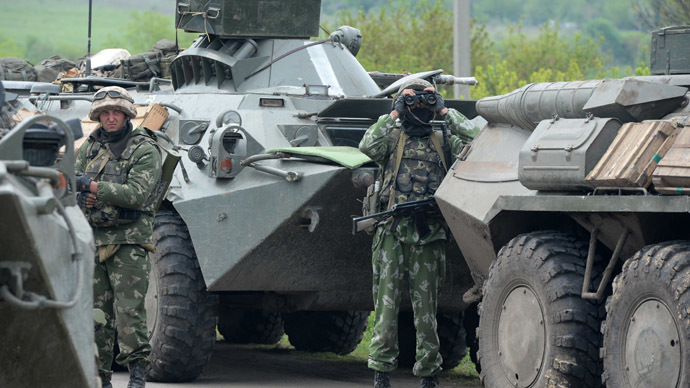
NATO’s newest Eastern European members are handing over their Soviet arms stockpiles to the Ukrainian army, Russia’s Deputy PM Dmitry Rogozin says, adding that the alliance is in danger of pouring gasoline on the flames of that country’s civil war.
Rogozin, who supervises the Russian military industry, has tweeted that NATO is asking its newest members to get rid of operable Soviet military equipment and send it to Ukraine, to aid the miserable state of the country’s military hardware.
“In turn, the US is ready to compensate for the “losses” of the newly co-opted NATO member states. The American military-industrial complex must be happy,” Rogozin wrote in his Twitter account.
“By the way, this is NATO’s commonplace to put out civil wars’ fire with aviation kerosene,” Rogozin added.
Over the months of Ukraine’s hot political crisis, NATO member states, primarily the US, announced they are planning non-lethal aid to Ukrainian troops, supplying uniforms and tents, and even promising to deploy a number of military instructors to train the Ukrainian army to fight the adherents of federalization of the country in Eastern Ukraine.
Political commentator Mikhail Rostovsky told RIA Novosti news agency that the “US and EU are thinking not about Ukraine but about the neutralization of Russia.”
Rostovsky compared the current policies of the European and American leaders with that of British PM Margaret Thatcher and French President François Mitterrand towards the reunification of East and West Germany in 1990.
Speaking loudly about “the European choice for Ukraine,” the EU and US politicians are essentially seeking ways to drive a wedge between Moscow and Kiev to neutralize what they regard as Russia’s possible “imperial ambitions,” Rostovsky said. “We’re dealing with politics dictated by fear: God forbid the Kremlin’s imperial instincts got awakened! This is a matter of principle to deny the Kremlin such an opportunity and break Ukraine away from Russia.”
Rostovsky said he fully agreed with German Foreign Minister Frank-Walter Steinmeier, who told Der Spiegel in late April that Europe has slid “into the worst crisis since the end of the Cold War.”
“Those who can remember the fall of the Berlin Wall know what we’ve accomplished over the past 25 years. The gains we’ve made almost everywhere in Europe in terms of peace, freedom and prosperity are now at risk,” Steinmeier said, adding that that it was important to take “every measure to prevent things [in Ukraine] from getting worse.”
Xi to discuss denuclearization in S. Korea
The BRICS Post | July 2, 2014
South Korea’s senior presidential secretary said on Wednesday that visiting Chinese President Xi Jinping and South Korean President Park Geun-hye will exchange notes on detailed measures towards denuclearization of the Korean Peninsula during their upcoming summit talks.
Ju Chul-ki, senior foreign affairs and security advisor to Park, told a press briefing on Wednesday that the two leaders will discuss the Trust-Building Process on the Korean Peninsula, a key policy measure of the Park government.
China and South Korea will release a joint cooperation document paper and ink deals in trade, finance, environment and consular affairs during the Chinese President’s state visit.
Xi will make a two-day state visit to Seoul to hold a summit with Park Thursday and meet with National Assembly Speaker Chung Ui-hwa and Prime Minister Chung Hong-won Friday.
“The two sides will also exchange views on maintaining peace and stability on the Korean Peninsula,” Chinese Vice Foreign Minister Liu Zhenmin told a press briefing in Beijing on Tuesday.
The upcoming China-South Korea summit talks will aim to empower efforts to solve the Peninsula nuclear issue and deter possible provocations from North Korea, Park’s advisor said.
Xi and Park are also expected to discuss the recent move by the Japanese government to end its post-war pacifist outlook.
The Japanese cabinet, headed by Prime Minister Shinzo Abe, decided Tuesday to reinterpret its 67-year-old pacifist constitution to allow itself to exercise collective self-defense right.
The revision paved the way for Japanese forces to fight abroad in defense of “countries with close ties.”
Japan also provoked South Korea on June 20 by unveiling the results of its review on the Kono Statement, which acknowledged and apologized for its wartime sex slavery.
The results said Seoul intervened in the wording of the 1993 apology, indicating it was the consequence of closed-door political dealings.
South Korean President Park Geun-hye criticized Japan for attempting to undermine the credibility of its 1993 apology over wartime sexual enslavement of women during World War II, describing the move as an “act that betrayed trust between the nations”, says a Yonhap report.
Xi and Park are also expected to push for speeding up negotiations for the bilateral free trade pact and setting up a market to directly exchange currencies of the two countries.
Putin to West: Stop turning world into ‘global barracks,’ dictating rules to others
RT | July 1, 2014
Russia’s president has blamed the turmoil in Ukraine on the country’s newly-elected leader Petro Poroshenko. Vladimir Putin also criticized the West for its intention to turn the planet into a “global barracks.”
Russia’s president has laid the blame for the ongoing turmoil between Kiev and south-eastern regions squarely at the feet of Petro Poroshenko, after the Ukrainian leader terminated the ceasefire.
He has stressed that Russia and European partners could not convince Poroshenko to not take the path of violence, which can’t lead to peace.
“Unfortunately, President Poroshenko has made the decision to resume military actions, and we – meaning myself and my colleagues in Europe – could not convince him that the way to reliable, firm and long-term peace can’t lie through war,” Putin said. “So far, Petro Poroshenko had no direct relation to orders to take military action. Now he has taken on this responsibility in full. Not only military, but also political, more importantly.”
On Monday, the leaders of Russia, France, Germany and Ukraine held a phone call in which Putin stressed the need to prolong the ceasefire and the creation of “a reliable mechanism for monitoring compliance with it and the OSCE [Organization for Security and Cooperation in Europe] should play an active role.”
Russia offered that checkpoints on the Russian side should be monitored by representatives of the Ukrainian Border service as well as OSCE observers for “the joint control of the border.”
As the violent conflict continues in the east of Ukraine and the number of refugees fleeing to Russia grows, Putin vowed to provide help to everyone who needs it.
“Everything that’s going on in Ukraine is of course the internal business of Ukrainian government, but we are painfully sorry that people die, civilians,” Putin said. He added that the killing of journalists was “absolutely unacceptable.”
“In my opinion, there is a deliberate attempt to eliminate representatives of the press going on. It concerns both Russian and foreign journalists,” the president said.
Speaking in front of ambassadors on Tuesday, Putin expressed hope that Western partners will stop imposing their principles on other countries.
“I hope pragmatism will still prevail. The West will get rid of ambitions, pursuits to establish a ‘world barracks’ – to arrange all according to ranks, to impose uniform rules of behavior and life of society,” Putin said.
“I hope the West will start building relations based on equal rights, mutual respect and mutual consideration of interests.”
Putin recalled the situation with France and the delivery of the Mistral-class ships that was agreed between Moscow and Paris, but was jeopardized in March.
“We know about the pressure that our American partners put on the French so that they would not deliver the Mistral [ships] to Russia,” Putin said. “And we know that [they] hinted that if the French don’t deliver Mistral, sanctions on banks will be gradually removed, or at least minimized. What is this, if not blackmail?”
Russia is ready to have dialogue with the US only on the basis of equality, Putin added.
“We are not going to stop our relations with the US. The bilateral relations are not in the best shape, that is true. But this – and I want to emphasize – is not Russia’s fault,” he told diplomats.
Speaking about international relations, Putin stressed that Russia always tried to be “predictable, to do business on an equal basis”, however, in return, its interests were quite often ignored.
War is Our Business and Business Looks Good
By Edward S. Herman | Z Magazine | June 28, 2014
It is enlightening to see how pugnacious the U.S. establishment, led by the Peace Laureate, has been in dealing with the Ukraine crisis. The crisis arguably began when the Yanukovich government rejected an EU bailout program in favor of one offered by Russia. The mainstream media (MSM) have virtually suppressed the fact that the EU proposal was not only less generous than the one offered by Russia, but that whereas the Russian plan did not preclude further Ukrainian deals with the EU the EU plan would have required a cut-off of further Russian arrangements. And whereas the Russian deal had no military clauses, that of the EU required that Ukraine affiliate with NATO. Insofar as the MSM dealt with this set of offers they not only suppressed the exclusionary and militarized character of the EU offer, they tended to view the Russian deal as an improper use of economic leverage, “bludgeoning,” but the EU proposal was “constructive and reasonable” (Ed., NYT, Nov. 20, 2014). Double standards seem to be fully internalized within the U.S. establishment.
The protests that ensued in Ukraine were surely based in part on real grievances against a corrupt government, but they were also pushed along by rightwing groups and by U.S. and allied encouragement and support that increasingly had an anti-Russian and pro-accelerated-regime-change flavor. They also increased in level of violence. The sniper killings of police and protesters in Maidan on February 21, 2014 brought the crisis to a new head. This violence overlapped with and eventually terminated a negotiated settlement of the struggle brokered by EU members that would have ended the violence, created an interim government and required elections by December. The accelerated violence ended this transitional plan, which was replaced by a coup takeover, along with the forced flight of Victor Yanukovich.
There is credible evidence that the sniper shootings of both protesters and police were carried out by a segment of the protesters in a false-flag operation that worked exceedingly well, “government” violence serving as one ground for the ouster of Yanukovich. Most telling was the intercepted phone message between Estonia’s Minister of Foreign Affairs Urmas Paet and EU Foreign Policy chief Catherine Upton in which Paet regretfully reported compelling evidence that the shots killing both police and protesters came from a segment of the protesters. This account was almost entirely suppressed in the MSM; for example, the New York Times never mentioned it once through the following two months. It is also enlightening that the protesters at Maidan were never called “militants” in the MSM, although a major and effective segment was armed and violent—that term was reserved for protesters in Eastern Ukraine, who were commonly designated “pro-Russian” as well as militants.
There is also every reason to believe that the coup and establishment of a right wing and anti-Russian government were encouraged and actively supported by U.S. officials. Victoria Nuland’s intercepted “fuck the EU” words express her hostility to a group that, while generally compliant and subservient, departed from neocon plans for a proper government in Kiev headed by somebody like “Yats.” So she would surely have been pleased when the EU-supported February compromise plan was ended by the violence and coup. The U.S. support of the coup government has been enthusiastic and unqualified, and whereas Kerry and company delayed recognition of the elected government of Maduro in Venezuela, and have strongly urged him to dialogue and negotiate with the Venezuelan protesters—in fact, threatening him if he doesn’t — Kerry and company have not done the same in Ukraine where the Kiev government forces have slowly escalated their attacks on the Eastern Ukraine, but not on “protesters,” only on “militants!”
The Kiev government’s military is now using jets and helicopters to bomb targets in the East and heavy artillery and mortars in its ground operations. Its targets have included hospitals and schools, and as of June 8 civilian casualties have been in the hundreds. A dramatic massacre of 40 or more pro-Russian protesters in Odessa on May 2 by a well-organized cadre of neo-Nazi supporters, possibly agents of the Kiev government, was an early high point in this pacification campaign. No investigation of this slaughter has been mounted by the Kiev government or “international community” and it has not interfered in the slightest with Western support of Kiev. In parallel the MSM have treated it in very low key. (The New York Times buried this incident in a back page continuation of a story on “Deadly Clashes Erupt in Ukraine,” May 5, which succeeds in covering up the affiliation of the killers.) Kerry has been silent, though we may imagine his certain frenzy if Maduro’s agents had carried out a similar action in Venezuela. Recall the “Racak massacre,” where the deaths of 40 alleged victims of the Serb military created an international frenzy; but in that case the United States needed a casus belli, whereas in the Odessa case there is a pacification war already in process by a U.S. client, so MSM silence is in order.
It is an interesting feature of media coverage of the Ukraine crisis that there is a regular focus on alleged or possible Russian aid, control of and participation in the actions of the protesters/militants/insurgents in Eastern Ukraine. This was evident in the Times’s gullible acceptance of a claim that photos of insurgents included a Russian pictured in Russia, later acknowledged to be problematic (Andrew Higgins, Michael Gordon and Andrew Kramer, “Photos Link Masked Men in East Ukraine to Russia,” NYT, April 20, 2014); and in another lead article which was almost entirely speculation (Sabrina Tavernise, “In Ukraine Kremlin Leaves No Fingerprints,” NYT, June 1, 2014.). But this interest in foreign intrusion in Ukraine affairs, with the implication of wrong-doing, does not extend to evidence of U.S. and other NATO power aid and control. Visits by Biden, Cain, Nuland and intelligence and Pentagon figures are sometimes mentioned, but the scope and character of aid and advice, of U.S. “fingerprints,” is not discussed and seems to be of little interest. It is, in fact, normalized, so that as with the aid plans in which Russian proposals are “bludgeons” but U.S.-EU plans are “constructive and reasonable” the double standard is in good working order here as well.
Isn’t there a danger that Russia will enter this war on behalf of the pro-Russian majority of the eastern part of Ukraine now under assault? Possibly, but not likely, as Putin is well aware that the Obama-neocon-military-industrial complex crowd would welcome this and would use it, at minimum, as a means of further dividing Russia from the EU powers, further militarizing U.S. clients and allies, and firming up the MIC’s command of the U.S. national budget. Certainly there are important forces in this country that would love to see a war with Russia, and it is notable how common are political comments, criticisms and regrets at Obama’s weak response to Russian “aggression” (e.g., David Sanger, “Obama Policy Is put to Test: Global Crises Challenge a Strategy of Caution,” NYT, March 17, 2014). But so far Putin refuses to bite.
In response to this pressure from the powerful war-loving and war-making U.S. constituencies, Obama has been furiously denouncing Russia and has hastened to exclude it from the G-8, impose sanctions and penalties on the villain state, increase U.S. troops and press military aid on the near-Russia states allegedly terrified at the Russian threat, carry out training exercises and maneuvers with these allies and clients, assure them of the sacredness of our commitment to their security, and press these states and major allies to increase their military budgets. One thing he hasn’t done is to restrain his Kiev client in dealing with the insurgents in eastern Ukraine. Another is engaging Putin in an attempt at a settlement. Putin has stressed the importance of a constitutional formation of a Ukraine federation in which a still intact Ukraine would allow significant autonomy to the Eastern provinces. There was a Geneva meeting and joint statement on April 17 in which all sides pledged a de-escalation effort, disarming irregulars, and constitutional reform. But it was weak, without enforcement mechanisms, and had no effect. The most important requirement for de-escalation would be the termination of what is clearly a Kiev pacification program for Eastern Ukraine. That is not happening, because Obama doesn’t want it to happen. In fact, he takes the position that it is up to Russia to curb the separatists in East Ukraine, and he has gotten his G-7 puppies to agree to give Russia a deadline to do this, or face more severe penalties.
This situation calls to mind Gareth Porter’s analysis of the “perils of dominance,” where he argued that the Vietnam war occurred and became a very large one because U.S. officials thought that with their overwhelming military superiority North Vietnam and its allies in the south would surrender and accept U.S. terms—most importantly a U.S. controlled South Vietnam—as military escalation took place and a growing toll was imposed on the Vietnamese (see his Perils of Dominance: Imbalance of Power and the Road to War in Vietnam). It didn’t work. In the Ukraine context the United States once again has a militarily dominant position. On its own and through its NATO arm it has encircled Russia with satellites established in violation of the 1990 promise of James Baker and Hans-Dietrch Genscher to Mikhail Gorbachev to not move eastward “one inch,” and it has placed anti-missile weapons right on Russia’s borders. And now it has engineered a coup in Ukraine that empowered a government openly hostile to Russia and threatening both the well-being of Russian-speaking Ukrainians and the control of the major Russian naval base in Crimea. Putin’s action in reincorporating Crimea into Russia was an inevitable defensive reaction to a serious threat to Russian national security. But it may have surprised the Obama team, just as the Vietnamese refusal to accept surrender terms may have surprised the Johnson administration. Continuing to push the Vietnamese by escalation didn’t work, although it did kill and injure millions and ended the Vietnamese alternative way. Continuing and escalating actions against Russia in 2014 may involve a higher risk for the real aggressor and for the world, but there are real spinoff benefits to Lockheed and other members of the MIC.
Netanyahu endorses Kurdish independence citing chaos in Iraq
RT | June 29, 2014
Citing the “collapse” of Iraq amid the ISIS insurgency and sectarian violence, Israeli Prime Minister Benjamin Netanyahu has endorsed the de-facto independence of Iraqi Kurds. Netanyahu has also called to support the “Kurdish aspiration for independence.”
The hawkish Israeli leader said on Sunday that Kurds are “fighting people that has proved its political commitment, political moderation, and deserves political independence,” Reuters reported.
Speaking to Tel Aviv University’s INSS think-tank, Netanyahu described the situation in Iraq and the Middle East in general as a “collapse,” due to strife between Sunni and Shiite Muslims.
Amid the recent insurgency of the Islamic State in Iraq and the Levant (ISIS/ISIL) militants, Kurds have seized the opportunity to bring a long-sought independent state of Kurdistan closer to reality. Kurdish Peshmerga armed forces have been guarding their provincial borders from ISIS, but also seized the contested Iraqi city of Kirkuk, proclaiming it part of their territory.
Now, in an apparent clash against the international community’s support of a united Iraq, the Israeli leader has called to back the de-facto independence of Kurds.
“We should… support the Kurdish aspiration for independence,” Netanyahu was quoted as saying.
Who Violated Ukraine’s Sovereignty?
By Ray McGovern | Consortium News | June 28, 2014
Did Russia’s annexation of Crimea on March violate the 1994 Budapest agreement among Ukraine, Russia, Great Britain and the U.S.? Specifically, in Paragraph One, Ukraine agreed to remove all nuclear weapons from its territory in return for a commitment by Russia, Britain and the U.S. “to respect the independence and sovereignty and existing borders of Ukraine?”
I’m no lawyer, but I can read the words. And, taken literally, the answer seems to be Yes – despite a host of extenuating circumstances that can be adduced to explain why Crimea rejoined Russia, including the alarm among Crimean leaders over the unconstitutional ouster of Ukraine’s elected president and the Russian government’s fear about the possible berthing of NATO’s nuclear-missile warships at the naval base at Sebastopol.
But there’s also the item in Paragraph Three in which Russia, the UK, and the U.S. also commit “to refrain from economic coercion designed to subordinate to their own interest the exercise by the Ukraine of the rights inherent in its sovereignty.”
Might the EU’s take-it-or-leave-it proposal last fall offering Ukraine “associate” status in return for draconian economic austerity imposed on the Ukrainian people come under the rubric of the “economic coercion” prohibited at Budapest? An arguable Yes, it seems to me.
Some will try to dismiss President Viktor Yanukovych’s ill-fated rejection of these International Monetary Fund demands to make the hard lives of average Ukrainians even harder as “history,” now that the EU and Ukraine’s replacement President Petro Poroshenko signed on June 27 that “associate” status agreement – the same agreement that Yanukovich rejected in favor of what appeared to be a better deal from Russia.
Was Yanukovich also under pressure from Moscow to maintain Ukraine’s historic, cultural and economic ties to Russia? Of course. Putin reportedly weighed in heavily with Yanukovich last October and early November when U.S. and EU diplomats were pressuring the Ukrainian president as well.
But did Yanukovich expect to be overthrown if he opted for Moscow’s offer? If he did not, he sorely underestimated what $5 billion in U.S. “democracy promotion” can buy. After Yanukovych’s decision, American neoconservatives – the likes of National Endowment for Democracy President Carl Gershman and Assistant Secretary of State for European Affairs Victoria Nuland – pulled out all the stops to enable Ukraine to fulfill what Nuland called its “European aspirations.”
The central problem confronting Ukraine, however, was not whether it leaned toward Europe or toward Russia. It was that after the collapse of the Soviet Union in 1991, some ruthless businessmen used their insider connections to snap up (or “privatize”) the natural and industrial resources of the country. These handful of “oligarchs” then corrupted the political process, buying off politicians from both pro-EU and pro-Moscow perspectives.
Last fall, Yanukovych, who was elected from a political base in the more industrial Russian-ethnic east, was looking for how to bail Ukraine out of the financial and economic crisis that it was facing amid widespread unemployment and the hangover from the Great Recession.
In a layman’s way of understanding what happened in Ukraine, Yanukovych issued what in the consulting world is called a Request for Proposal (RFP), i.e., a feeler to see who could offer the most promising plan for helping Ukraine escape insolvency. After initially tilting toward the EU proposal (before he learned of its draconian IMF small print), he later shifted to the less onerous offer from Russia.
In the world of contractors and RFPs, there are orderly procedures for firms whose bids are turned down to contest the selection of the eventual winner. But I know of no case where one of the losing firms turned around and violently removed the leadership of the RFP-issuing institution, installed new leadership and got the contract.
Abortive Feb. 21 Agreement
And, in assessing which side – the U.S./EU or Russia – is in the wrong on Ukraine, there was also the agreement, facilitated on Feb. 21 by the foreign ministers of Poland, Germany and France, in which then-President Yanukovich acceded to demands from the opposition by accepting limits on his powers and agreeing to early elections to vote him out of office.
Yanukovych also fatefully agreed to pull back the police, opening the way for right-wing militias, including neo-Nazis, to seize government buildings and force Yanukovych and his government officials to flee for their lives. With these paramilitary forces patrolling government offices, what was left of the Parliament voted to replace Yanukovych and install a new regime, giving four ministries to the far right and the neo-Nazis in recognition of their crucial role.
As the U.S. and the EU hailed the “legitimacy” of this new regime — with Nuland’s hand-picked leader Arseniy Yatsenyuk appointed as the new prime minister – the Western “mainstream media” quickly forgot the Feb. 21 agreement (surprise, surprise!). But Russian President Vladimir Putin had a personal representative there, Russian Human Rights Commissioner Vladimir Lukin.
Yet, because the MSM was already parading Putin (and Yanukovych) around the op-ed pages and talks shows as the black-hatted villains of the Ukraine saga, few Americans got to hear Putin’s perception of what happened, as he explained at a Moscow press conference ten days after Yanukovich was overthrown:
“First of all, my assessment of what happened in Kiev and in Ukraine in general. … This was an unconstitutional takeover, an armed seizure of power. Does anyone question this? Nobody does. … The question is why this was done? …
“President Yanukovich, through the mediation of the foreign ministers of three European countries – Poland, Germany and France – and in the presence of my representative signed an agreement with the opposition on Feb. 21. I would like to stress that under that agreement (I am not saying this was good or bad, just stating the fact) Mr. Yanukovich actually handed over power. He agreed to all the opposition’s demands: he agreed to early parliamentary elections, to early presidential elections, and to return to the 2004 Constitution, as demanded by the opposition.
“He gave a positive response to our request, the request of western countries and, first of all, of the opposition not to use force. … he issued orders to withdraw all police forces from the capital, and they complied. He went to Kharkov to attend an event, and as soon as he left, instead of releasing the occupied administrative buildings, they [the opposition] immediately occupied the President’s residence and the Government building – all that instead of acting on the agreement.
“I ask myself, what was the purpose of all this? … He had in fact given up his power already; and as I believe, as I told him, he had no chance of being re-elected. … What was the purpose of all those illegal, unconstitutional actions, why did they have to create this chaos in the country? Armed and masked militants are still roaming the streets of Kiev. …
“If you want, I can tell you even more. He [Yanukovich] called me on the phone and I told him not to do it. I said, ‘You will have anarchy, you will have chaos in the capital. Think about the people.’ But he did it anyway. And as soon as he did it, his office was seized, and that of the government, and the chaos I had warned him about and which continues to this day, erupted.”
If Putin’s account of how the Feb. 21 agreement was violated the very next day is accurate, and by almost all indications it is, then we have the anatomy of an undisguised putsch – an unconstitutional overthrow of a duly elected president of a sovereign state. The apparent aim, to install a government friendlier to the EU, is relevant but not essential here. The fact of the coup is essential.
Guaranteeing Ukraine’s Sovereignty
Friday’s lead editorial in the neocon flagship Washington Post, “Potemkin drawdown: The West must hold Russia to a real withdrawal from Ukraine,” charged that “the rebellion in the east is manufactured by Russia to undermine Ukraine’s sovereignty. The United States and Britain guaranteed support for that sovereignty in 1994 when Ukraine gave up its nuclear weapons.”
That claim brought my thoughts back to a conference of distinguished scholars at the U.S.–Russia Forum in the Hart Senate office building on June 16. With Professors Stephen Cohen and Robert Legvold presenting, it was the most sensible discussion of the Ukraine imbroglio that I have witnessed to date.
The point was made that Russia had violated the Budapest agreement in annexing Ukraine. But were the Russians the only culprits? What about the rest of the story? Russia, the UK and the U.S. all pledged “to respect the independence and sovereignty and existing borders of Ukraine?” Okay. Gotcha on Putin considering the “existing borders.”
But what about the political destabilization supported by the U.S. government, including the $5 billion that Assistant Secretary of State Nuland publicly announced had been invested in Ukraine’s “European aspirations” – or the scores of projects financed by the U.S.-funded National Endowment for Democracy, training activists, supporting “journalists” and organizing business and political groups.
During the crisis, U.S. officials even showed up in Kiev’s Maidan square to urge on the protesters seeking to overthrow Yanukovych. Sen. John McCain gave a speech on a platform of the right-wing Svoboda party under a banner hailing the late Nazi collaborator Stepan Bandera. Nuland went so far as to pass out cookies to the demonstrators and discuss with the U.S. ambassador to Ukraine who should be take over after Yanukovych was ousted.
How does this overt and covert interference square with the Budapest pledge “to respect the independence and sovereignty … of Ukraine?” And how do the strong-arm tactics of the EU square with the commitment “to refrain from economic coercion designed to subordinate to their own interest the exercise by the Ukraine of the rights inherent in its sovereignty?”
Luckily, at the U.S.-Russia Forum, I was able to go first during the Q and A. [To see my question and the answer, click on https://www.youtube.com/watch?v=p8iH50BR0EQ and go to the 2:01:00 point near the end.]
I said: “I have a brief question having to do with the Budapest agreement and also in the perspective of Vladimir Putin being more in a reactive mode than anything else. He’s been accused, of course, of violating that agreement because of the Crimea [annexation].
“I’m wondering, if you look at the putsch, if you look at the coup d’etat of Feb. 22nd, supported to the tune of $5 billion by outside forces over the course of several years, of course, could that not also be regarded as a violation of the Budapest memorandum?”
Columbia University Professor Legvold’s answer was, I think, instructive – instinctive, perhaps. His first thought was to associate my point with an argument the Russians have made. For many listeners, that might put me in the category of some kind of apologist for Putin. I know Legvold well enough to doubt this was his intent. But still: Is Putin’s account of the Feb. 21-22 events to be dismissed out of hand simply because it is from Putin?
The main takeaway for me from the forum was the Cohen-Legvold common assertion that we have already entered a New Cold War. Cohen was very direct in exposing the extraordinary abuse regularly accorded to scholars and specialists who try to discern and explain honestly Moscow’s point of view.
Legvold suggested it would be “naïve” not to recognize that the new Cold War is already upon us, that it will be “immensely expensive and immensely dangerous,” and that all of us need to do whatever we can to make it “short and shallow.”
That endeavor of averting the costs and the risks of Cold War II might well start with a truthful narrative of what happened, not the one-sided account that the American people have been seeing and hearing in the U.S. media.
Obama requests $500 million to aid Syrian rebels
RT | June 26, 2014
The White House on Thursday asked Congress for half-a-billion dollars in aid to go towards opposition fighters in Syria at war with the regime of recently re-elected President Bashar Al-Assad.
In a report sent to lawmakers at the Capitol on Thursday, the White House requested $500 million in aid to “help defend the Syrian people, stabilize areas under opposition control and facilitate the provision of essential services, counter terrorist threats and promote conditions for a negotiated settlement.”
The Associated Press reported that the multimillion dollar request makes up just a fraction of a larger, $65.8 billion overseas operations request sent to Congress that, if approved, would fund a number of Pentagon and State Department programs, as well as $1 billion in assistance to nations adjacent to Syria.
This latest request by the administration for aid comes merely weeks after the president outlined his foreign policy objectives during a speech last month at the West Point Military Academy graduation ceremony.
“As president, I made a decision that we should not put American troops into the middle of this increasingly sectarian civil war, and I believe that is the right decision. But that does not mean we shouldn’t help the Syrian people stand up against a dictator who bombs and starves his own people,” Obama said. “And in helping those who fight for the right of all Syrians to choose their own future, we are also pushing back against the growing number of extremists who find safe haven in the chaos.”
“So with the additional resources I’m announcing today, we will step up our efforts to support Syria’s neighbors — Jordan and Lebanon, Turkey and Iraq — as they contend with refugees and confront terrorists working across Syria’s borders.”
At the time, Obama added that he would “work with Congress to ramp up support for those in the Syrian opposition who offer the best alternative to terrorists and brutal dictators.” Now only weeks later, he appears to have taken the first steps to securing such funding.
Since nearly the start of the Syrian civil war more than three years ago, hawkish Republicans in Congress have urged the White House to take action against Assad, with Sen. John McCain (R-Arizona) going as far as to travel abroad to meet with rebel fighters overseas. Others have condemned any response from Washington altogether, though, including Sen. Rand Paul (R-Kentucky), who this week attributed the arming of fighters in Iraq as the impetus for a “jihadist wonderland” there created on Uncle Sam’s watch and dime.
According to the AP’s Julie Pace, White House officials said the Obama administration would work with members of Congress and regional player to come to terms with what sort of training and assistance in particular would be provided to opposition fighters by the US.
“One potential option,” Pace wrote, “would be to base US personnel in Jordan and conduct the training exercise there.”
Also last month, the Pentagon deployed more than 6,000 Marines to Jordan to conduct drills alongside military officials there.
Featured Video

10K More U.S. Troops Deploy as Trump Weighs New Iran Strikes
or go to
Aletho News Archives – Video-Images
From the Archives
Genetic baloney in thick slices
MAYBE COULD BE INC.
By Jon Rappoport | No More Fake News | July 8, 2021
Gene research companies tend to come and go. They start out banging and popping like fireworks in the sky, and then they fade out—selling themselves to larger outfits who’ve hired better liars…
Once upon a time, it sounded easy. Start with a disease, find the gene responsible for the disease, and correct the problem.
Then, researchers wondered, was disease the result of one gene or a group of genes acting together?
Either way, the proof would be in devising cures for diseases using gene therapy. “Not yet, but soon…”
And regardless, the major need was: money. Lots and lots of money.
This need required good PR people. “We have to pump up the idea that we’re on the edge of tremendous breakthroughs. We’re always on that edge…”
This hype also needed to obscure the fact that there wasn’t (and isn’t) ANY gene cure for ANY disease. … continue
Blog Roll
 Aletho News
- US military withdrawal from Iraq and the collapse of US-Israeli hegemonic project in West Asia
- What does Europe want – a war with Russia?
- She Followed the Actual Data on COVID Vaccines and Masks — Her Career Took a Huge Hit
- Florida AG Sues Pfizer, Bourla Over Deceptive Marketing of COVID Vaccines
- Von der Leyen gifts her spin doctor a job for life
- 10K More U.S. Troops Deploy as Trump Weighs New Iran Strikes /Suliaman Ahmed
- Iranian crew declared Dena training vessel ‘unarmed’ to US warship before deadly torpedo strike: Report
- Iran’s NPT debate moves beyond parliament
- Houthis condemn Saudi claims of attack on Medina
- Fatuous False Flags
- If Americans Knew
- Israel is squeezing the life out of Palestinians – Daily Update
- The Israeli Right Portrays Islam as Murderous. It Serves a Political Purpose
- Jordan Has Had Enough: King Abdullah’s Scathing Warning to Israel
- Israeli Colonizers (i.e. Settlers) Kill Palestinian Man Near Salfit
- New Google Maps images reveal massive scale of devastation in Gaza
- Jewish supremacy, anti-Palestinian bigotry on display in Israel – Daily Update
- Israeli Soldiers Abduct At Least 22 Across Occupied West Bank
- Eight Palestinians Killed in Israeli Attacks on Gaza
- Israeli former leaders and security chiefs threaten legal action over ‘Jewish terrorism’
- Israel map in LA Times ad includes all land from the river to the sea
- No Tricks Zone
- Green Energy Debacle: German Expert Professor Fritz Vahrenholt Warns Of Severe Economic And Social Consequences
- Two More Paleo Reconstructions Affirm Meters-Higher Sea Levels Across Ireland, Brazil 7000-6000 Years Ago
- New Study: Earth And Venus Surface Warmth Largely Explained By Convection And Lapse Rate, Not CO2 Or Radiation
- 2025 Nature Paper Claiming Worsening Global Drought Gets RETRACTED …Heavily Flawed
- New Study: ‘Global Drought Shows No Detectable Recent Acceleration Under Climate Warming’
- Economic Masterminds: German Socialists Suggest Taxing Productivity Gains Stemming From Using AI
- The South China Sea Has Not Been Cooperating With The Climate Change Narrative
- Energy Crisis: Germany Enters Heating Season With Historically Low Gas Reserve Fill Levels
- New Study: The Antarctic Ice Sheet Gained Mass From 2020-2024 Due To Staggering Snow And Ice Accumulation
- Study: Ocean Heating Rates From Thousands Of Years Ago ‘Dwarf’ Modern Ocean Heating Rates

