U.S. Still Cleaning up Chemical Weapons from World War II… in 40 States
By Noel Brinkerhoff and Danny Biederman | AllGov | March 26, 2014
Bring us your nerve gases, your blister agents, your horrible weapons of warfare, your wretched refuse of World War II… This about sums up the decision of leaders in Washington after World War II when it came time for the American military to dispose of its arsenal of chemical weapons and those belonging to both the countries it fought against and alongside.
After the war’s conclusion, the U.S. government buried thousands of munitions loaded with chemical agents all across the country. These weapons of mass destruction were part of the U.S. arsenal as well as those belonging to ally Britain and enemies Germany and Japan.
The bombs and containers were simply dumped in the ground and buried, without concern for long-term environmental and health consequences.
Alabama is home to the largest of 249 such sites that are located in 40 states. Redstone Arsenal, a longtime U.S. Army base, sits atop miles of hidden trenches containing blister agents, choking agents, blood agents and more.
The 38,000-acre base is surrounded by homes, schools, churches and shopping centers—a city of 200,000 people. It was reported that few residents are aware of the toxic danger lurking nearby.
A disposal team has been working at Redstone since the 1970s trying to locate all of the chemical weaponry that is buried beneath 17 six-mile-long trenches. Once those trenches have all been located, the next step—scheduled to begin in 2019—is to remove the bombs and containers with great care, due to the uncertainty of the weapons’ condition after being held deep underground for decades. No more than six munitions can be safely removed each day.
“Even if we tried to do this as fast as anybody could ever get it done, we’re talking decades and decades,” James Watson, a disposal team member, told the Los Angeles Times. “This stuff is very dangerous to dig up. It’ll hurt you. It will blister you up. If you get that nerve agent on you, it will kill you.”
Redstone’s cleanup is expected to take until at least 2042. The quantity of weapons: 388,000. Between 20,000 and 25,000 of these are intact and, once disturbed, may be volatile.
Alabama has a second site, at former Camp Sibert (pdf) near Huntsville, with at least 13 stockpiles of mustard and phosgene gas.
Another of these sites is located in Spring Valley, Virginia, not far from the White House. Its arsenal features even older chemical munitions—possibly including mustard and arsenic—manufactured during World War I.
Several years ago, a vast supply of munitions from World War II was discovered beneath the grounds of Odyssey Middle School in Orlando, Florida. One of the weapons ignited into flames, but didn’t explode, injuring an Army Corps of Engineers contractor attempting to remove it. More than 200 potentially volatile explosives were found, most under the school and some near homes in the surrounding neighborhood. Home values, which were originally in the $600,000 range, plunged by at least 30%, while banks told homeowners their residences were worthless to lend against.
The U.S. military also dumped a huge volume of chemical weapons off both the Atlantic and Pacific coasts. There are no plans to clean up those sites, although Congress has authorized studies to look into it.
In 1958, about a hundred miles offshore of California, the SS William Ralston—loaded with more than 300,000 mustard gas bombs and 1,500 one-ton containers of Lewisite, a blistering agent—was scuttled by the U.S military. To this day it sits beneath nearly 14,000 feet of water just outside of San Francisco.
Ralston believes the U.S. task of removing 1,300 tons of secured chemical weapons from Syria for destruction at sea will be something of a breeze compared to the job here at home. “In Syria, you know where the weapons are and what they are, and they can move them with a forklift,” Watson told the Times. “Here, we don’t know. We have to go out there and dig them out of the ground … The sheer mass of this stuff is overwhelming.”
To Learn More:
Deadly Chemical Weapons, Buried and Lost, Lurk Under U.S. Soil (by David Zucchino, Los Angeles Times)
Redstone Arsenal: Yesterday and Today (by Michael Baker, U.S. Army Missile Command)
A Generation of Indiscriminate Dumping (Daily Press) (pdf)

WHY? Stories of bombed Yugoslavia
Exactly 15 years ago, on March 24, NATO began its 78-day bombing of Yugoslavia. The alliance bypassed the UN under a “humanitarian” pretext, launching aggression that claimed hundreds of civilian lives and caused a much larger catastrophe than it averted.
Years on, Serbia still bears deep scars of the NATO bombings which, as the alliance put it, were aimed at “preventing instability spreading” in Kosovo.
Codenamed ‘Operation Allied Force,’ it was the largest attack ever undertaken by the alliance. It was also the first time that NATO used military force without the approval of the UN Security Council and against a sovereign nation that did not pose a real threat to any member of the alliance.
NATO demonstrated in 1999 that it can do whatever it wants under the guise of “humanitarian intervention,” “war on terror,” or “preventive war” — something that everyone has witnessed in subsequent years in different parts of the globe.
Nineteen NATO member states participated to some degree in the military campaign against the Federal Republic of Yugoslavia (Serbia and Montenegro), which lasted for 11 weeks until June 10, 1999.
In the course of the campaign, NATO launched 2,300 missiles at 990 targets and dropped 14,000 bombs, including depleted uranium bombs and cluster munitions (unexploded cluster bombs continued to pose a threat to people long after the campaign was over.) Over 2,000 civilians were killed, including 88 children, and thousands more were injured. Over 200,000 ethnic Serbs were forced to leave their homeland in Kosovo.
In what the alliance described as “collateral damage,” its airstrikes destroyed more than 300 schools, libraries, and over 20 hospitals. At least 40,000 homes were either completely eliminated or damaged and about 90 historic and architectural monuments were ruined. That is not to mention the long-term harm caused to the region’s ecology and, therefore, people’s health.
News correspondents Anissa Naouai and Jelena Milincic, the authors of RT’s documentary ‘Zashto?’ — which means “Why?” in English –traveled through former Yugoslavia to Belgrade, Kosovo, and Montenegro and spoke to people who endured the atrocities and horrors of the war and lost their friends and relatives. … http://rt.com/news/yugoslavia-kosovo-…
Egyptian army delegation visits Israel
MEMO | March 20, 2014
 A delegation from the Egyptian army and Ministry of Foreign Affairs visited Israel last week against the backdrop of consolidating relations between the two countries following the July 3 military coup.
The Egyptian delegation was hosted by the Israeli army’s Planning Department and the MFA, according to Haaretz.
A senior Israeli official told Haaretz that the Egyptian delegation spent a week in Israel, met Israeli officials, and toured a number of areas.
In the same context, Israeli journalist Barak Ravid said in his latest Haaretz article that Israel urged senior officials in the US Administration and Congress not to cancel the sale of 10 advanced Apache combat helicopters to Egypt, quoting an Israeli official as saying that supplying Egypt with the helicopters “is crucial to Egypt’s fight Against jihadist organizations in the Sinai, and will improve regional security.”
Ravid stressed that security cooperation between Egypt and Israel has been enhanced since June, and that Israel has made huge efforts to support the interim Egyptian government.
Violence and Terror: The Ukrainian and Colombian Road to Empire Building
By James Petras | The People’s Voice | March 19, 2014
Introduction
The two paths to 21st century empire-building-via-proxies are illustrated through the violent seizure of power in the Ukraine by a US-backed junta and the electoral gains of the US-backed Colombian war lord, Alvaro Uribe. We will describe the ‘mechanics’ of US intervention in the domestic politics of these two countries and their profound external effects – that is how they enhance imperial power on a continent-wide basis.
Political Intervention and Proxy Regimes: Ukraine
The conversion of the Ukraine into a US-EU vassal state has been a prolonged process which involved large scale, long term financing, indoctrination and recruitment of cadres, organization and training of politicos and street fighters and, above all, a capacity to combine direct action with electoral politics.
Seizing power is a high stakes game for empire: (1) Ukraine, in the hands of clients, provides a NATO with a military springboard into the heart of the Russian Federation; (2) Ukraine’s industrial and agricultural resources provide a source of enormous wealth for Western investors and (3) Ukraine is a strategic region for penetrating the Caucuses and beyond.
Washington invested over $5 billion dollars in client-building, mostly in ‘Western Ukraine’, especially in and around Kiev, focusing on ‘civil society groups’ and malleable political parties and leaders. By 2004, the initial US political ‘investment’ in regime change culminated in the so-called ‘Orange Revolution’ which installed a short-lived pro-US-EU regime. This, however, quickly degenerated amidst major corruption scandals, mismanagement and oligarchical pillage of the national treasury and public resources leading to the conviction of the former-Vice President and the demise of the regime. New elections produced a new regime, which attempted to secure ties with both the EU and Russia via economic agreements, while retaining many of the odious features (gross endemic corruption) of the previous regime. The US and EU, having lost thru democratic elections, relaunched their ‘direct action organizations’ with a new radical agenda. Neo-fascists seized power and established a dictatorial junta through violent demonstrations, vandalism, armed assaults and mob action. The composition of the new post-coup junta reflected two sides of the US-backed political organizations: (1) neo-liberal politicos for managing economic policy and forging closer ties with NATO, (2) and neo-fascists/violent nationalists to impose order by force and fist, and crush pro-Russian Crimean ‘autonomists’ and ethnic Russians and other minorities, especially in the industrialized south and east.
Whatever else may ensue, the coup and the resultant junta is fully subordinated to and dependent on the will of Washington: claims of Ukrainian ‘independence’ notwithstanding. The junta proceeded to purge the elected and appointed government officials affiliated with the political parties of the previous democratic regime and to persecute its supporters. Their purpose is to ensure that subsequent managed elections will provide a pretense of legitimacy, and elections will be limited to two sets of imperial clients: the neo-liberals, (self-styled “moderates”) and the neo-fascists dubbed as “nationalists”.
Ukraine’s road to imperialist power via a collaborator regime illustrates the various instruments of empire building: (1) the use of imperial state funds, channeled through NGOs, to political front groups and the build-up of a ‘mass base’ in civil society; (2) the financing of mass direct action leading to a coup (‘regime change’); (3) the imposition of neo-liberal policies by the client regime; (4) imperial financing of the re-organization and regroupment of mass direct action groups after the demise of the first client regime; (5) the transition from protest to violent direct action as the major backdrop to the extremist sectors (neo-fascists) organizing the seizure of power and purge of the opposition; (6) organizing an ‘international media campaign’ to prop up the new junta while demonizing domestic and international opposition (Russia) and (7) political power centralized in the hands of the junta, convoking “managed elections” limited to the victory of one or the other pro-imperial pro-junta candidates.
In summary, empire-builders operate on several/levels: violent and electoral; social and political; and with selected incumbents and rivals committed to one strategic aim: the seizure of state power and the conversion of the ruling elite into willing vassals of empire.
Columbia’s Deathsquad Democracy: Centerpiece of the Imperial Advance in Latin America
In the face of a continent-wide decline of US influence in Latin America, Colombia stands out as a constant bulwark of US imperial interests: (1) Colombia signed a free trade agreement with the US; (2) provided seven military bases and invited thousands of US counter-insurgency operatives; and (3) collaborated in building large-scale paramilitary death squads prepared for cross border raids against Washington’s arch enemy Venezuela.
Colombia’s ruling oligarchy and military have been able to resist the wave of massive democratic, national and popular social upheavals and electoral victories that gave rise to the post-neo-liberal states in Brazil, Argentina, Venezuela, Ecuador, Bolivia, Paraguay and Uruguay.
While Latin America has moved toward ‘regional organizations’ excluding the US, Colombia strengthened its ties to the US through bilateral agreements. While Latin America reduced its dependence on US markets, Colombia expanded its commercial ties. While Latin America reduced their military ties to the Pentagon, Colombia tightened them. While Latin America moved toward greater social inclusion by increasing taxes on foreign multinational corporations, Colombia lowered corporate taxes. While Latin America expanded land settlements for its landless rural populations, Colombia displaced over 4 million peasants as part of the US-designed ‘scorched earth’ counter-insurgency policy.
Colombia’s “exceptional” unwavering submission to US imperial interests is rooted in several large-scale, long-term programs developed in Washington. In 2000, President ‘Bill’ Clinton committed the US to a $6 billion dollar counter-insurgency program (Plan Colombia) which greatly increased the brutal repressive capacity of the Colombian elite to confront the popular grass roots movements of peasants and workers. Along with arms and training, US Special Forces and ideologues entered Colombia to develop military and paramilitary terror operations – aimed primarily at penetrating and decimating political opposition and civil society social movements and assassinating activists and leaders. The US-backed Alvaro Uribe, notorious narco-trafficker and the very personification of a ruthless imperial vassal, became president over a ‘Death-Squad Democracy’.
President Uribe further militarized Colombian society, savaged civil society movements and crushed any possibility of a popular democratic revival, such as were occurring throughout the rest of Latin America. Thousands of activists, trade unionists, human rights workers and peasants were murdered, tortured and jailed.
The ‘Colombian System’ combined the systematic use of para-militarism (death squads) to smash local and regional trade union and peasant opposition and the technification and massification of the military (over 300,000 soldiers) in fighting the popular insurgency and ‘emptying the countryside’ of rebel sympathizers. Large-scale multi-billion dollar drug trafficking and money laundering formed the ‘financial glue’ to cement a tight relationship among oligarchs, politicos, bankers and US counter-insurgency advisers – creating a terrifying high-tech police state bordering Venezuela, Ecuador and Brazil – countries with substantial popular mass movements.
The same state terror machinery, which decimated the pro-democracy social movements, has protected, promoted and participated in ‘stage-managed elections’, the hallmark of Colombia as a “death squad democracy”.
Elections are held under a vast overlapping network of military bases, where death squads and drug traffickers occupied towns and villages intimidating, terrorizing and ‘corrupting’ the electorate. The only ‘safe’ protest in this repressive atmosphere has been voter abstention. Electoral outcomes are pre-ordained: oligarchs never lose in death squad democracies, they are the empire’s most trusted vassals.
The cumulative effects of the decade and a half-long bloody purge of Colombian civil society by Presidents Uribe and his successor, Santos, have been to eliminate any consequential electoral opposition. Washington has achieved its ideal: a stable vassal state; a large-scale and obedient military; an oligarchy tied to US corporate elites; and a tightly-controlled ‘electoral’ system that never permits the election of a genuine opponent.
The March 2014 Colombian elections brilliantly illustrate the success of US strategic intervention in collaboration with the oligarchy: The vast majority of the electorate, over two-thirds, abstained, demonstrating the absence of any real legitimacy among the eligible voters. Among those who ‘voted’, ten percent submitted ‘spoiled’ or blank ballots. Voter abstention and ballot-spoilage was especially high in the rural regions and working class areas which had been subject to state terror.
Given the intense state repression, the mass of voters decided that no authentic pro-democracy party would have any chance and so refused to legitimize the process. The 30% who actually voted were largely urban middle and upper class Colombians and residents in some rural areas completely controlled by narco-terrorists and the military where ‘voting’ may have been ‘compulsory’. Of a total of 32 million eligible voters in Colombia, 18 million abstained and another 2.3 million submitted spoiled ballots. The two dominant oligarchical coalitions led by President Santos and ex-President Uribe received only 2.2 million and 2.05 million votes respectively, a fraction of the number who abstained (14 million). In this widely scorned electoral farce, the center-left and left parties made a miserable showing. Colombia’s electoral system puts a propaganda veneer on a dangerous, highly-militarized vassal state primed to play a strategic role in US plans to “reconquer” Latin America.
Two decades of systematic terror, financed by a six-billion dollar militarization program, has guaranteed that Washington will not encounter any substantial opposition in the legislature or presidential palace in Bogota. This is the ‘acrid, gunpowder-tinged smell of success’ for US policymakers: violence is the midwife of the vassal state. Colombia has been turned into the springboard for developing a US-centered trade bloc and a military alliance to undermine Venezuela’s Bolivarian regional alliances, such as ALBA and Petro Caribe as well as Venezuela’s national security. Bogota will try to influence neighboring right and center-left regimes pushing them to embrace of the US Empire against Venezuela.
Conclusion
Large-scale, long-term subversion and organization in Ukraine and Colombia, as well as the funding of paramilitary and civil society organizations (NGO) has enabled Washington to: (1) construct strategic allies, (2) build ties to oligarchs, malleable politicians and paramilitary thugs and (3) apply political terrorism for their seizure of state power. The imperial planners have thus created “model states” – devoid of consequential opponents and ‘open’ to sham elections among rival vassal politicians.
Coups and juntas, orchestrated by longstanding political proxies, and highly militarized states run by ‘Death Squad Executives’ are all legitimized by electoral systems designed to expand and strengthen imperial power.
By rendering democratic processes and peaceful popular reforms impossible and by overthrowing independent, democratically elected governments, Washington is making wars and violent upheavals inevitable.
-###-
James Petras is a Bartle Professor (Emeritus) of Sociology at Binghamton University, New York. He is the author of 64 books published in 29 languages, and over 560 articles in professional journals, including the American Sociological Review, British Journal of Sociology, Social Research, Journal of Contemporary Asia, and Journal of Peasant Studies.
Crimea: The Referendum, the Mote and the Beam
By Jan Oberg | Transnational Foundation for Peace & Future Research | March 17, 2014
Of course, it is illegal and, of course, it will be rigged, that referendum in Crimea today. And, of course, it is a ploy and comes only in the wake of Russia’s (read Putin’s) unprovoked aggression, used as a pretext to build a new Greater Russia.
That is, if you browse the mainstream Western media the last week and on this Sunday morning.
Referendum means referring an issue back to the people. It is – or should be – an important instrument in democracies. And it’s a much better instrument than war and other violence to settle complex conflicts.
Generally, citizens-decided conflict-resolution is likely to last longer and help healing wounds of the past than any type of solution imposed by outside actors.
In Switzerland citizens go and vote on all kinds of issues on many a Sunday throughout the year. Sweden has used it to decide about nuclear energy, Denmark about EU membership and – in 1920 – to solve the conflicts in Schleswig-Holstein and define the future border between Germany and Denmark. Referendums, binding as well as non-binding, are an accepted instrument in many countries.
Why did the West not use referendums?
The West likes to pride itself of its type of democracy whenever and wherever it can. But it doesn’t use the referendum instrument that often.
About 25 years ago it decided that it was good conflict-resolution to divide Yugoslavia into six republics; foolishly it used the old administrative borders and elevated them to international borders (the purpose behind that: you could then define the Yugoslav People’s Army’s presence in Croatia and Slovenia as ”international aggression by Serbia”) instead of asking people to which republic they preferred to belong.
In a few days it is 15 years ago NATO bombed Kosovo and Serbia to ”liberate” Kosovo and make it an independent – predictably failed – state. Fifteen years later, one wonders what better situation a negotiated solution ending with a referendum could have produced. No referendum there either.
Or take the Dayton Accords from 1995 for Bosnia-Hercegovina. No one in the democratic West bothered to ask the 4.3 million people living there (around 33% Serbs, 45% Muslims/Bosniaks and 17% Croats) whether they would like to live under those Accords.
Further, Dayton was signed in the US, the Bosnian constitution written by US lawyers and the agreement signed by three presidents none of whom were representing anybody in Bosnia at the time of signing. Not exactly a democratic peace. And it should be clear today that it is not going to work in the future either.
Or take the issue of nuclear weapons. No nuclear weapon state has ever asked its citizens whether they want their country to possess nuclear weapons which, logically, also make them potential targets of somebody else’s nukes. All opinion surveys in the nuclear powers tell us that there is no majority anywhere for the nuclear weapon status.
And how few of the new Eastern members of NATO and the EU have had a referendum on membership?
So, even in democracies the belief that ”we know what is best for you” often stands in the way of more intelligent, democratic conflict-resolution; i.e. better and more sustainable solutions to complex conflicts.
This is dangerous: How did it come to this?
Crimea is an extremely sensitive conflict spot and has been for centuries. In my view, there is more than a 50% risk that the situation we see today in Ukraine may lead to something like Yugoslavia in the 1990s.
Conflicts and violence – even the threat of it – as well as sanctions have their own dynamics and there is always a risk that they spin out of control – if people don’t stop and think but continue tit-for-tat escalation.
Why has it come to this? There are many reasons but let me mention these:
► The US and the EU have meddled in Ukraine’s internal affairs in a way that they would never accept Russian neo-cons, finance institutions and NGOs would in their own countries and are, thus, significantly co-responsible for the mess.
► The US and the EU lack politicians and they lack advisers who understand the larger scheme of things. They invest in spin doctors and PR companies instead of in knowledge-based expertise. It should have been obvious to a historically minded Western security and foreign policy elite that Ukraine is not a place to fish in extremely troubled waters and not expect a harsh reaction.
► Putin sees a golden opportunity to play tough in the light of the history of the end of the Cold War, the dissolution of the Soviet Union and the Warsaw Pact saying in effect: This far and no longer! To be or act surprised at that speaks volumes of ignorance, propaganda, or both.
The triumphalist US/NATO/EU expansion policies since 1989 would boomerang at some point – and that point is Ukraine, Ukraine meaning ”border” (like Krijina in Croatia).
Wiser politicians of the past: Common security
Whether we like it or not, the US and the EU have handed Russia and Putin a point or two on a silver plate.
Wiser politicians like Willy Brandt, Olof Palme, Urho Kekkonen, or Nelson Mandela knew that we need peace first and then a policy to secure it (not the other way around) and that that again means moderation, prudence and search for common interests rather than provocatively promoting yourself.
The reduction in intellectualism and moderation of foreign and security policy elites worries me at least as much as Russia’s response to US/NATO/EU the-winner-takes-it-all policies.
Hopefully the referendum may defuse tension
And, so, let’s rather hope that the referendum in Crimea could be a means to diffuse the tension. The rest of Ukraine has its own deeply worrying conflict — and violence-prone factors looming.
But they don’t have to blow up like Pakrac, Western Slavonia in Yugoslavia where the first shot was fired in what became a terrible war. And remember that war was preceded by a similar fishing in troubled waters as we have seen in Ukraine.
Are political decision-makers and media able to learn from contemporary history this time or will Yugoslavia be repeated?
Perhaps a Christian West should remind itself – and take serious – of the Gospel of Matthew 1-5:
And why beholdest thou the mote that is in thy brother’s eye, but considerest not the beam that is in thine own eye?
The mutual blaming in Moscow, Brussels and Washington of ”the other” should be seen as little but psychological projections of their own dark sides (beams) of which they must be subconsciously aware.
We will get nowhere but to hell with tit-for-tat, judgmentalism and self-righteousness. Both Russia and the West should, instead, take steps in the direction of democratic peace-making: refer issues back to people themselves but – and that is important beyond words – stop influencing or buying them on the way to the ballot box.
Jan Oberg is a peace researcher, art photographer, and Director of Transnational Foundation for Peace and Future Research (TFF).
Related article
Against Ukraine War? Obama May Seize Your Assets
By Daniel McAdams | Ron Paul Institute | March 14, 2014
Do you, like 56 percent of the US population, believe that the US should “not get too involved” in the Ukraine situation? Do you think that the US administration putting us on a war footing with Russia is a bad idea? Are you concerned that the new, US-backed leaders of Ukraine — not being elected — might lack democratic legitimacy? Are you tempted to speak out against US policy in Ukraine; are you tempted to criticize the new Ukrainian regime?
Be careful what you say. Be careful what you write. President Obama has just given himself the authority to seize your assets.
According to the president’s recent Executive Order, “Blocking Property of Certain Persons Contributing to the Situation in Ukraine”, the provisions for seizure of property extend to “any United States person.” That means “any United States citizen, permanent resident alien, entity organized under the laws of the United States or any jurisdiction within the United States (including foreign branches), or any person in the United States.”
Declaring a “national emergency” over the planned referendum in Crimea to determine whether or not to join Russia, the US president asserts that asset seizure is possible for any US person “determined by the Secretary of the Treasury, in consultation with the Secretary of State”:
(i) to be responsible for or complicit in, or to have engaged in, directly or indirectly, any of the following:
(A) actions or policies that undermine democratic processes or institutions in Ukraine;
(B) actions or policies that threaten the peace, security, stability, sovereignty, or territorial integrity of Ukraine; or
(C) misappropriation of state assets of Ukraine or of an economically significant entity in Ukraine;
The Executive Order is, as usual, so broadly written that it leaves nearly everything open to interpretation.
For example, what are “direct or indirect…actions or policies that threaten the peace, security, stability, sovereignty, or territorial integrity of Ukraine”? Could that be someone writing an article that takes issue with the US policy that the Crimea referendum is illegal and illegitimate? Could it be standing up in a public meeting and expressing the view that Ukraine would be better off with nationwide referenda to determine whether other regions should become autonomous or joined to neighboring countries? What if a Polish-American appears on a radio or television program suggesting that parts of Poland incorporated into Ukraine after WWII should be returned to Polish authority?
Probably the president will not seize the assets of Americans in the scenarios above. But he says he can.
As the US government moves ever-closer to war with Russia, it is reasonable to expect these attempts to squash dissent and to remove “threats” to the administration’s position. The historical pattern is clear.
Recall Eugene V. Debs sentenced to ten years in prison for his opposition to US involvement in WWI. Recall Japanese-Americans interned in camps during WWII because their loyalty to the United States was deemed suspect.
The stage is being set to silence dissent. It sounds alarmist to read this, agreed.
Probably the president will not use his Executive Order to seize the assets of Americans who disagree with his Ukraine policy. But he says he can.
America’s $1 Trillion National Security Budget
Blank Check for the Pentagon
By Winslow T. Wheeler | CounterPunch | March 14, 2014
The Pentagon’s current leadership and most on the House and Senate Armed Services Committees in Congress describe President Obama’s 2015 defense budget request as painfully austere, if not dangerously inadequate. The defense trade press is full of statements from generals, admirals and the other politicians from both political parties that there is not nearly enough money available to buy adequate amounts of new hardware, maintain current pay and benefits or provide even low amounts of training and equipment maintenance. As a result, they are looking for ways to relieve the Pentagon from its penury.
Scarcity of money is not their problem. Pentagon costs, taken together with other known national security expenses for 2015, will exceed $1 Trillion. How can that be? The trade press is full of statements about the Pentagon’s $495.6 billion budget and how low that is.
There is much more than $495.6 billion in the budget for the Pentagon, and there are piles of national security spending outside the Pentagon-all of it as elemental for national security as any new aircraft and ships and the morale and well-being of our troops.
The table below details what a careful observer will find in President Obama’s 2015 budget presentation materials. The amounts for the Pentagon are well above the advertised $495.6 billion, and there are several non-Pentagon accounts that are clearly relevant.
(The relevant data for 2014 is also presented for comparison, and the notations in the “Comments” column help explain the data. The table is also available on line here.)
Total US National Security Spending, 2014-2015
(All figures are $billions; Then-Year$)
(Sources: Table 28-1 from Analytical Perspectives and Homeland Security Appendix in 2015 OMB Budget Materials)
| National Security Program | 2014 as Enacted | 2015 as Requested | Comments |
| DOD Base Budget (Discretionary) | 496.0 | 495.6 | The “base” budget purportedly contains all routine, peacetime expenses; however, DOD and Congress have loaded tens of billions of such “base” spending into the Overseas Contingency Operations fund for declared wartime expenses. See below. |
| DOD Base Budget (Mandatory) | 5.7 | 6.2 | DOD often does not count this “mandatory” spending in its budget presentations to the public; however, being for military retirement and other DOD-only spending, it is as much a part of the DOD budget as military pay and acquisition. |
| DOD Base Budget (Total) | 501.7 | 501.8 | “Total” spending is discretionary and mandatory combined. |
| Overseas Contingency Operations (OCO) | 85.2 | 79.4 | The $85.2 billion in 2014 contains at least $30 billion in “base” budget spending; read here and here. The $79.4 billion for 2015 is a “place holder” pending a decision on the actual amount to be requested, which may take months. The ultimate 2015 OCO request may be smaller, but that is not certain–given past behavior. |
| DOD Subtotal (Total) | 586.9 | 581.2 | |
| DOE/Nuclear (Total) | 18.6 | 19.4 | For nuclear weapons activities. |
| “Defense-related activities” (Total) | 8.2 | 36.0 | This spending is usually just for international FBI activities, Selective Service, the National Defense Stockpile and other miscellaneous defense-related activities. For 2015 OMB added a $27.7 billion “Opportunity, Growth and Security Initiative” that includes readiness and “wish list” DOD spending-the latter described here.. |
| National Defense (Total) | 613.6 | 636.6 | This is the OMB budget function “National Defense” (also known as “050″) which is sometimes confused as Pentagon-only spending. |
| Military Retirement Costs Not Scored to DOD | 35.8 | 37.8 | This category shows funds paid by the Treasury for military retirement programs, minus interest and contributions from the DOD military personnel budget. The data for the amounts shown here are in functions 600, 900 and 950. As DOD-unique spending they should be displayed as part of the DOD budget, but they are not by either DOD or OMB. |
| DOD Retiree Health Care Fund Costs | 1.1 | 0.1 | Shown are nets costs to the Treasury for this DOD health care program. See functions 550 and 950. As DOD-unique spending, they should be displayed as part of the DOD budget, but they are not by either DOD or OMB. |
| Veterans Affairs (Total) | 151.3 | 161.2 | These costs are projected to increase to $238.1 billion in 2024 as the human costs of the wars in Iraq and Afghanistan continue to grow. |
| International Affairs (Total) | 38.5 | 39.0 | The amount for the International Affairs budget function (150) do not include its share of the yet to be determined request for OCO funding in this budget function for 2015. |
| Homeland Security (Total) | 51.0 | 52.1 | Includes Homeland Security spending in DHS for federal agencies not shown on this table (thereby excluding DOD, DOE, State and VA). |
| Share of Interest on the Debt | 76.3 | 82.7 | Total On-Budget Federal Budget Authority is $2.9 trillion in 2014 and $3.2 trillion in 2015. Total gross interest paid on Treasury debt is $254.3 billion in 2014 and $285.3 billion in 2015. The calculable shares of defense-related spending relative to the federal totals are 30% in 2014 and 29% in 2015. |
| Grand Total | 967.9 | 1,009.5 |
Note the various ways the Pentagon augments its own budget well above the $495.6 billion that is frequently cited by the people seeking more money.
* There is the additional “placeholder” amount for the wars in Afghanistan and elsewhere ($79.4 billion), which may or may not turn out to be smaller once the formal request for this spending is compiled and Congress is finished fiddling with it: adding huge amounts of non-war (or “base”) spending to this account by both DOD and Congress is routine.
* There is also the $6.2 billion in “mandatory” (or entitlement) spending the Pentagon’s complete budget must include for military retirement and other DOD-only programs.
* There is the Pentagon’s $26 billion dollar portion of the “Opportunity, Growth and Security Initiative” (a slush fund if ever there were one) that OMB and Secretary of Defense Hagel have dreamed up–to the applause of the Joint Chiefs of Staff.
* While some in the press have caught most of the above additions, they virtually never spot the additional money the Treasury pays out for additional military retirement ($37.8 billion in 2015) and DOD healthcare (just $100 million in 2015 but more in other years).
In all, the Pentagon’s budget for all of its own expenses in 2015 is not $495.6 billion, it is $645.1 billion, or $149.5 billion (30 percent) more. If one were to add the nuclear weapons’ costs borne by the Department of Energy, the amount would be $664.5 billion, or 34 percent more. (Don’t add the four score billions of dollars for intelligence and snooping; the budgets for CIA, NSA and all the rest are embedded in the DOD budget.)
Consider also the substantial costs that are properly outside of the Pentagon’s budget but that are central to US national security:
$52.1 billion in non-DOD spending in the Department of Homeland Security,
$161.2 billion for the human consequences of past and ongoing wars in the Department of Veterans Affairs, and
$39 billion for the activities of the Department of State and related agencies-for international security and the exercise of US power abroad.
With the addition of an equitable share of the interest on the national debt that is attributable to this spending, it all adds up to $1.0095 trillion. It is that amount, not $495.6 billion, that US taxpayers are being asked to pay out in 2015 for “defense,” defined generically. However, you will not find that number in the talking points of the Joint Chiefs of Staff, Secretary Hagel, or most Republicans and Democrats on the House and Senate Armed Services Committees. They are arguing that times are tough and if still more money can be found, it should go to these accounts.
There is another perspective to measure defense spending in 2015. We can compare just the amounts formally requested for the Pentagon (the “base” budget plus the “placeholder” amount for Overseas Contingency Operations) to what has been spent historically. By converting annual Pentagon spending to “constant” (inflation adjusted) dollars adjusted to their 2015 value, and by using the economy-wide GDP measure of inflation for doing so (not the Pentagon’s own hopelessly self-serving measure of inflation), we can compare the 2015 Pentagon budget to its post-World War Two history. See the figure below.
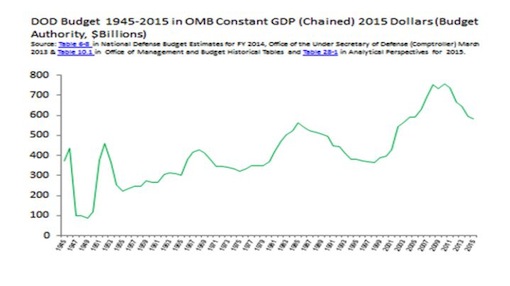
(Those interested to do so can find a historically identical graph in CSBA’s 2013 study “Chaos and Uncertainty: The 2014 Defense Budget and Beyond” by Todd Harrison; see Figure 18 on page 25.)
This graph tells us that the 2015 level of Pentagon spending would return us to the same overall level as 2005 when Donald Rumsfeld was secretary of defense and the DOD budget was generally considered flush with money and supporting substantial fighting in both the Iraq and Afghanistan wars. Note also that this is a level of spending that matches the peak of the Ronald Reagan years that was thought by its advocates to be a US build up so massive it was intimidating the Soviet Union into collapse. The 2015 level is also an amount that significantly exceeds the peaks of the Korea and Vietnam wars-both of them higher intensity conflicts with hundreds of thousands more US troops deployed than are currently in Afghanistan.
To repeat, the problem is not scarcity of money. The problem is how it is being spent. We are getting very little defense–training, maintenance, hardware, and troops–for a gigantic amount of money. By virtue of how they characterize $1 trillion dollars as penury, our national security leaders in the Pentagon and Congress are clearly incapable of dealing with the problem.
Our equipment is outrageously expensive and yet too much of it is a step backwards in effectiveness. Since the mid-1990s Congress has bulldozed money into across-the-board pay raises, double pensions for many military retirees, significantly increased benefits for the survivors of World War Two veterans and much else that has much more to do with placating constituencies than addressing 21st century security problems. In addition, the Pentagon’s civilian and military leadership has bloated itself to historically unprecedented levels of overhead. Worse yet, none of them have even bothered to fundamentally understand the dimension of the problems because, under their tutelage, the Pentagon remains unaudited and un-auditable, which will remain the case even after it meets its decades overdue, and embarrassingly modest, financial management goals-which, by the way, it will do no time soon.
One more time: the problem is not scarcity of money.
Winslow T. Wheeler is the Director of the Straus Military Reform Project at the Project on Government Oversight. He spent 31 years working for the Government Accountability Office and both Republican and Democratic Senators on national security issues.
West to accelerate proxy war on Syria: Report
Press TV – March 12, 2014
The West is planning a new push against Syrian President Bashar al-Assad through funding proxy war on the conflict-stricken country, a report suggests.
The British daily The Guardian reported that a fresh clandestine effort is under way for opening up a “southern front” against the Syrian president.
A secret command center for international operations in Amman is monitoring preparations for the offensive. This center is staffed by military officials from the US, Britain, Israel and 11 Arab states opposed to Assad.
The paper said its information is based on leaks from the United States, Israel, Jordan and some Persian Gulf Arab states.
It said the planned offensive, dubbed Geneva Horan, is aimed at pushing back Syrian troops in the Daraa, Quneitra and As-Suwayda governorates in the southwest of the country in a bid to clear the way for militants to reach the capital Damascus.
The operation derives its name from the plains near Jordan’s border with Israel.
“The command centre, based in an intelligence headquarters building in Amman, channels vehicles, sniper rifles, mortars, heavy machine guns, small arms and ammunition to Free Syrian Army (FSA) units,” the Abu Dhabi-based National newspaper quoted militants as saying.
Syria has been gripped by deadly crisis since 2011. Over 130,000 people have reportedly been killed and millions displaced due to the unrest.
Saudi Arabia has been the main supplier of weapons and funds to foreign-backed militants inside Syria.
The United States is also constructing runways for reconnaissance aircraft near the border between Jordan and Syria to help with the operation against Syria.
The Guardian said the US hosted secret talks last month between President Barack Obama’s National Security Advisor Susan Rice and Saudi Interior Minister Prince Mohammed bin Nayef.
The talks, reportedly attended by spy chiefs from Jordan, Qatar, Turkey and other regional countries, focused on making a “stronger effort” to assist the militants in Syria.
Related articles
Human Radiation Experiments in the Pacific
By Glenn Alcalay | CounterPunch | March 11, 2014
” . . . protect the inhabitants against the loss of their lands and resources; protect the health of the inhabitants . . .” (1)
According to Marshallese folklore a half-bad and half-good god named Etao was associated with slyness and trickery. When bad things happened people knew that Etao was behind it. “He’s dangerous, that Etao,” some people said. “He does bad things to people and then laughs at them.”(2) Many in the Marshall Islands now view their United States patron as a latter day Etao.
Castle-Bravo
 Sixty years ago this month the American Etao unleashed its unprecedented fury at Bikini Atoll in the Marshall Islands. It was nine years after the searing and indelible images of Hiroshima and Nagasaki that the world first learned about the dangers of radioactive fallout from hydrogen bombs that use atomic Hiroshima-sized bombs as triggers.
Castle-Bravo, the first in a series of megaton-range hydrogen bomb tests at Bikini Atoll on March first of 1954, was nicknamed “the shrimp” by its designer – Edward Teller – because it was the first deliverable thermonuclear weapon in the megaton range in the U.S. nuclear holster. We had beaten the Soviets in this key area of nuclear weapons miniaturization when the Cold War was hot and the United States did not need to seek approval from anybody, especially the Marshallese entrusted to them through the U.N.
At fifteen megatons – 1,000 times the Hiroshima A-bomb – the Bravo behemoth was a fission-fusion-fission [3-F] thermonuclear bomb that spread deadly radioactive fallout over an enormous swath of the central Pacific Ocean, including the inhabited atolls of Rongelap, Rongerik and Utrik in the Marshalls archipelago. The downwind people of Rongelap [120 miles downwind of Bikini] and Utrik [300 miles east of Bikini] were evacuated as they suffered from the acute effects of radiation exposure.
As an international fallout controversy reached a crescendo, a hastily called press conference was held in Washington in mid-March 1954 with Eisenhower and AEC chair Admiral Lewis [“nuclear energy too cheap to meter”] Strauss, his Administration’s top lieutenant in nuclear matters.
Adm. Lewis Strauss: “I’ve just returned from the Pacific Proving Grounds of the AEC where I witnessed the second part of a test series of thermonuclear weapons . . . For shot one [Bravo] the wind failed to follow the predictions, but shifted south of that line and the little islands of Rongelap, Rongerik and Utrik were in the edge of the path of the fallout . . . The 236 Marshallese natives appeared to me to be well and happy . . . The results, which the scientists at Los Alamos and Livermore had hoped to obtain from these two tests [Bravo and Union] were fully realized. An enormous potential has been added to our military posture.” Strauss added the caveat that “the medical staff on Kwajalein have advised us that they anticipate no illness, barring of course, diseases which may be hereafter contracted.” (3)
Even former Sec. of State Henry Kissinger took note of the significance of Bravo and the new perils associated with widespread radioactive fallout contamination from megaton sized H-bombs, as might happen if the Soviets dropped The Big One on our nation’s capital and the fallout headed up the Eastern Seaboard. Writing about nuclear weapons and foreign policy in 1957, Kissinger wrote: “The damage caused by radiation is twofold: direct damage leading to illness, death or reduced life expectancy, and genetic effects.”(4)
Almira Matayoshi was one of the Rongelap “natives” referred to by Adm. Strauss. When I interviewed her in 1981 in Majuro she recounted her experience with Bravo:
The flash of light was very strong, then came the big sound of the explosion; it was quite a while before the fallout came. The powder was yellowish and when you walked it was
all over your body. Then people began to get very weak and began to vomit. Most of us were weak and my son was out of breath.
I have pains and much fear of the bomb. At that time I wanted to die, and we were really suffering; our bodies ached and our feet were covered with burns and our hair fell out. Now I see babies growing up abnormally and some are mentally disturbed, but none of these things happened before the bomb. It is sad to see the babies now.(5)
A persistent puzzle surrounds the question of intentionality. In a 1982 New York Times interview, Gene Curbow (the former weather technician during Bravo) confessed that the winds did not “shift” according to the official U.S. explanation for the massive contamination during Bravo. “The wind had been blowing straight at us for days before the test,” said Curbow. “It was blowing straight at us during the test, and straight at us after the test. The wind never shifted.” When asked why it had taken so long to come forth with this important information, Curbow replied “It was a mixture of patriotism and ignorance, I guess.”(6)
The late Dr. Robert Conard, head of the Brookhaven/AEC medical surveillance team for the islanders, wrote in his 1958 annual report on the exposed Marshallese: “The habitation of these people on Rongelap Island affords the opportunity for a most valuable ecological radiation study on human beings . . . The various radionuclides present on the island can be traced from the soil through the food chain and into the human being.”(7)
In reference to the exposed Marshallese after Bravo, AEC official Merrill Eisenbud bluntly stated during a NYC AEC meeting in 1956, “Now, data of this type has never been available. While it is true that these people do not live the way westerners do, civilized people, it is nonetheless also true that they are more like us than the mice.”(8)
At present, the atoll communities of Bikini, Enewetak, and Rongelap remain sociologically disrupted and uncertain about their future as their contaminated islands and lagoons have yet to be fully repatriated and restored for permanent human habitation.
Kwajalein
Following 67 A- and H-bombs at Bikini and Enewetak between 1946-58, the U.S. was not about to let go of its island capture, terminate the AEC-Brookhaven long-term human radiation studies at Rongelap and Utirk, nor forfeit the valuable “catcher’s mitt” at Kwajalein for monthly incoming ICBMs from Vandenberg air base in California and Kauai. In 1961 – following a polio outbreak on Ebeye, Kwajalein – Pres. Kennedy ordered a comprehensive review of the Trust Territory of the Pacific Islands by his Harvard economist friend Anthony M. Solomon, head of the New York Reserve Bank.
Correspondingly, JFK’s National Security Action Memorandum 145 of April 18, 1962 called for the movement of Micronesia into a permanent relationship with the U.S.(9)
Through legerdemain and the inherent asymmetry of the relationship, the U.S. took every conceivable advantage of its island wards, thus setting the stage for the ongoing human and ecological radiation studies and other Pentagon activities in perpetuity.
To this end the Solomon Report recommended a massive spending program just prior to a future status plebiscite being planned for Micronesia. “It is the Solomon Mission’s conclusion that those programs and the spending involved will not set off a self-sustaining development process of any significance in the area. It is important, therefore, that advantage be taken of the psychological impact of the capital investment program before some measure of disappointment is felt.”(10)
As the Pentagon and AEC used the isolated isles of the Marshalls to perfect its Cold War nuclear deterrent – replete with human subjects for longitudinal radiation studies – let us not forget the Pentagon’s ongoing project of missile defense, aka “Star Wars” at Kwajalein Atoll encompassing the world’s largest lagoon bull’s eye.
Characterized as “hitting a bullet with a bullet,” ballistic missile defense has always had a reputation for fantasy and wish fulfillment, sold to Pres. Reagan with an exciting and glitzy video designed to parallel the then-sensation called “Star Wars.” Kwajalein and the fiction of Ballistic Missile Defense has tragically dumped good money after bad, notwithstanding the huge profits by Boeing, Raytheon, Northrup Grumman, MIT’s Lincoln Lab, Aerojet, Booz Allen et al. Between 1962 and 1996 the U.S. spent $100 billion. And between 1996 and 2012 the total comes to $274 billion and still counting.(11)
And what do we have to show for our nearly $300 billion missile defense boondoggle? Last July 4th was also the planned launch date for a test of the BMD program. The Ground Based Missile Defense system at Kwajalein Atoll failed again, despite the fact that the test was manipulated: “The intercept team knew ahead of time when to expect the incoming missile and all its relevant flight parameters. Such luxury is obviously not available in real-life combat. But even if the $214 million ‘test’ had worked it would not prove much.”(12)
The collateral damage known as Ebeye Island at Kwajalein is infamously tagged throughout the region as the “slum of the Pacific.” The appalling conditions on Ebeye for its 15,000 cramped residents and pool of cheap labor for the adjacent missile base are in stark contrast to the southern California-like setting on ten times as large Kwajalein Island for the 3,000 Americans manning the missile base.
Likening it to South African apartheid, I recall my first encounter with Kwajalein and Ebeye as a young Peace Corps volunteer in 1976:
Having spent the afternoon on Kwajalein yesterday left me feeling ashamed to be an American citizen. The overt segregation of the American civilian and military employees on Kwajalein Island, and the cheap labor pool of Marshallese living on nearby Ebeye Island, makes me realize that racism is not confined to the American south.(13)
And just to insure the longevity of the asymmetry, the American Etao embedded a little-noticed caveat into the 1963 Limited [Atmospheric] Test Ban Treaty that allows the U.S. to unilaterally resume nuclear testing in the Marshall Islands, despite assurances to the contrary during the 1986 Compact status negotiations. Safeguard “C,” as the provision is known, also calls for the readiness of Johnston Atoll and Kauai in the Hawaiian archipelago, and Enewetak Atoll in the Marshalls under the auspices of the DOE’s Pacific Area Support Office in Honolulu.(14)
Several formerly inhabited atolls remain off limits due to lingering radioactivity decades after the last H-bomb shattered the peace on Bikini and Enewetak. Imagine if the U.S. finally saw fit to do the right thing and pay their past-due $2 billion nuclear legacy bill, a small morsel of the annual Star Wars budget.(15)
The recently discovered Mexican refugee fisherman on Ebon Atoll in the Marshall Islands drew world attention to these obscure coral formations atop extinct and submerged volcanoes where a continuous culture has survived and nearly thrived for the past two thousand years. And even though Jose Salvador Alvarenga said he had no idea where he was, Uncle Sam has always known where these tiny islands are, strategically located stepping stones in the bowels of the northwestern Pacific leading to Asia’s doorstep, now in the era of the pending Trans Pacific Partnership.
Undoubtedly the legendary Etao is somewhere lurking in these once-pacific isles savoring the work of its American protégé . . .
Glenn Alcalay is an adjunct professor of anthropology at Wm Paterson Univ. and Montclair State Univ. in New Jersey. Alcalay was a Peace Corps volunteer on Utrik Atoll in the Marshalls, and has conducted anthropological research re: reproductive abnormalities among the downwind islanders. Alcalay may be reached at: alcalayg@wpunj.edu
[Addendum: PBS is sitting on an important 90-minute film about the radiation experiments in the Marshall Islands titled “Nuclear Savage: The Islands of Secret Project 4.1” by Adam Horowitz. Please contact PBS and urge them to air “Nuclear Savage,” a documentary film they funded and are keeping from the public’s view. Also, please see these additional articles about the Marshall Islands: http://www.counterpunch.org/2012/06/01/nuclear-savages and PBS’ attempt to suppress this film: http://www.opednews.com/articles/2/Nuclear-Savage-by-William-Boardman-Broadcasting_Navy_Nuclear-Arms-Race_Nuclear-Attack-140110-941.html]
Endnotes
(1) United Nations. Trust Territory of the Pacific Islands. Trusteeship Agreement. URL: http://www.fsmlaw.org/miscdocs/trustshipagree.htm. New York. 1947. Article VI.
(2) Grey, Eve. Legends of Micronesia. Book Two. The sly Etao and the sea demon. 1951. Honolulu: Office of the High Commissioner. TTPI, Dept. of Educations. Micronesian Reader Series. Pages 35-36.
(3) Adm. Lewis Strauss, chair-AEC. Press conference about Bravo with Pres. Eisenhower, March 12, 1954, Washington, D.C. The archival footage may be viewed in this clip @ 1:00-4:30 in Part 3 of O’Rourke’s Half Life.
(4) Henry Kissinger, Nuclear Weapons and Foreign Policy. Council on Foreign Relations. Harper Bros.: New York. 1957. Page.75.
(5) Interview with Almira Matayoshi conducted by Glenn Alcalay in Feburary 1981 in Majuro, Marshall Islands. This interview is online: http://archive.is/M5aH
(6) Judith Miller. “Four veterans suing U.S. over exposure in ’54 atom test.” New York Times. Sept. 20, 1982.
(7) Robert Conard, M.D., et al. March 1957 medical survey of Rongelap and Utrik people three years after exposure to radioactive fallout. Brookhaven National Laboratory, Upton, N.Y. June 1958. Page. 22.
(8) Merrill Eisenbud. Minutes of A.E.C. meeting. U.S.A.E.C. Health and Safety Laboratory. Advisory Committee on Biology & Medicine. January 13-14, 1956. Page 232.
(9) Report by the U.S. Government Survey Mission to the TTPI by Anthony M. Solomon, October 9, 1963. Page 41. The Solomon Report is online: https://archive.org/stream/TheSolomonReportAmericasRuthlessBlueprintForTheAssimilationOf/micronesia3_djvu.txt
(10) Report by the U.S. Government Survey Mission to the TTPI by Anthony M. Solomon, October 9, 1963. Pages 41-42. The Solomon Report is online: https://archive.org/stream/TheSolomonReportAmericasRuthlessBlueprintForTheAssimilationOf/micronesia3_djvu.txt
(11) Stephen Schwartz. “The real price of ballistic missile defenses.” The Nonproliferation Review. April 13, 2012.
(12) Yousaf Butt. “Let’s end bogus missile defense testing.” Reuters. July 16, 2013.
(13) Glenn Alcalay. Journal entry of January 21, 1976. Aboard the MV Militobi. Peace Corps Journal, Marshall Islands 1975-77.
(14) David Evans. “Safeguard ‘C’: U.S. spending millions on plan to re-start Pacific nuclear tests.” Chicago Tribune. August 26, 1990.
(15) Giff Johnson. “At 60, legacy of Bravo still reverberates in Marshall Islands.” Editorial. Marshall Islands Journal. February 28, 2014.
Related article
US warship in Black Sea as Ukraine’s Crimea readies for referendum
RT | March 8, 2014
US Navy destroyer, the USS Truxtun, has crossed Turkey’s Bosphorus and entered the Black Sea. With the Crimea Peninsula getting ready to hold a referendum on independence from Ukraine in a week, the US is ramping up its military presence in the region.
USS Truxton is heading to “previously planned” training exercises with the Bulgarian and Romanian navies, AFP reported earlier. At the same time, Fox News declared that NATO’s bolstering presence in the Black Sea is a “defensive” measure to counter “Russian military aggression” in Ukraine.
The situation in Ukraine is close to financial and humanitarian catastrophe, urging mass protests in eastern regional centers against self-proclaimed government in Kiev. The autonomous Crimea region is preparing to hold a March-16 referendum on whether it wants to remain part of Ukraine or join Russia, after ousted President Viktor Yanukovich fled the country and the opposition imposed a central government.
Subsequently, Russia’s upper chamber of the parliament approved the possibility of Moscow deploying troops to Ukraine and particularly to Crimea – but only to protect ethnic Russians in Crimea.
On Friday night, Vladimir Putin’s Press Secretary, Dmitry Peskov, warned of possible ethnic cleansing of the Russians in Crimea if the people who seized power in Kiev also grasp autonomy.
Peskov stressed that Russians in Crimea and eastern Ukraine are “scared and are asking for help from Russia”.
“We fully understand the fears that now prevail in the East [of Ukraine,” Peskov acknowledged.
However, the US State Department doesn’t see any possible danger to millions of ethnic Russians.
Russians make up well over 17 percent of Ukraine’s 45 million population, whereas in Crimea Russians are over 58 percent of the autonomy’s nearly two million population.
“There are no confirmed reports of threats to ethnic Russians,” Eric Rubin said, testifying before the House Foreign Affairs Committee. Mr Rubin is a Deputy Assistant Secretary of State in the Bureau of European and Eurasian Affairs.
USS Truxton, with a crew of about 300, is an Arleigh Burke class destroyer equipped with the Aegis combat system, which integrates the ship’s radar, sensors and missile weapons to engage anti-ship missile threats. The warship is part of the USS George W. Bush Carrier Strike Group currently stationed in Greece. The carrier is not expected to move into the Black Sea in respect of the Montreux Convention of 1936, which closed Turkish Bosphorus and Dardanelles for ships with deadweight over 45,000 tons. With its 97,000 tons, the USS George W. Bush is the world’s largest warship.
USS Truxton has taken up the baton of American military presence in the region from frigate USS Taylor, which ran aground in the Turkish port of Samsun in the Black Sea last month, with a broken propeller hub and blades. On Friday, a tugboat began to tow the damaged warship to Greece’s island of Crete, where it will be repaired at the US Navy base in Souda Bay.
USS Truxton will reportedly stay in the Black Sea till mid-March. The Montreux Convention allows a warship of any non-Black Sea country to stay in the region for 21 days only.
During the military conflict between Russia and Georgia in August 2008, an American ship was also present in the Black Sea with reconnaissance and an officially proclaimed humanitarian mission. In September 2008, the US costal guard ship, Dallas, docked at Sevastopol harbor with a secret mission and had to leave in haste because of mass local protest.
Given the present conditions, an American battleship is highly unlikely to get anywhere near the Crimea shores, let alone Sevastopol, without a risk of repeating a hasty exit from the past.
On February 12, 1988, a Ticonderoga-class cruiser, the USS Yorktown, and a Spruance-class destroyer, the USS Caron, had to flee from Soviet territorial waters off the Crimean Peninsula. After the two American warships ignored the Soviet Navy’s demands to leave country’s territorial waters immediately, the Soviet frigate, Bezzavetny, simply rammed both American ships, forcing them to comply with international maritime rules.
Nukes Now
Obama Worse Than Reagan
By Steve Breyman | CounterPunch | March 6, 2014
Heads-up, veterans of the nuclear freeze movement in the US, the anti-Euromissile campaigns in Western Europe, and the various anti-nuclear weapons efforts in New Zealand, Australia and Japan. Incoming.
We spent much of the eighties resisting Ronald Reagan’s new Cold War, and his new nuclear weapons of all shapes and sizes. We pushed back against his giant ‘defense’ budgets and countered his harrowing rhetoric. We knew Star Wars was a scam, and the MX missile a danger. We grimaced at his appointments to key policymaking positions, and scoffed at his insincere arms control efforts.
In the end, we prevailed (after a sort). We get much of the credit for preventing planetary incineration that seemed frighteningly close at the time (Gorbachev deserves some too). Professional activists, Plowshares heroes, and a handful of stalwart others stayed in the anti-nuclear weapons movement trenches. Although nukes were not abolished with the end of the Cold War, most of the rest of us nonetheless moved on to fight other evils, and to work on one or more better world construction projects.
It’s time to return. President Obama released his FY 2015 budget on Tuesday, March 4. Ready for this? It asks for considerably more money (in constant dollars) for nuclear weapons maintenance, design and production than Reagan spent in 1985, the historical peak of spending on nukes: $8.608 billion dollars, not counting administrative costs (see graph below). The Los Alamos Study Group crunched the numbers for us.

Next year’s request tops this year’s by 7%. Should the President’s new Opportunity, Growth and Security Initiative be approved, yet $504 million more would be available for warhead spending. The OGSI is $56 billion over and above the spending agreed to in the December 2013 two-year budget (unlikely to pass given that it’s an election year, would be paid for by increased taxes on the retirement funds of the rich, and reduced spending in politically dicey areas like crop insurance).
Increased lucre for the nuclear weapons complex maintains Obama’s inconsistency on the Bomb. He wrote his senior thesis at Columbia on the arms race and the nuclear freeze campaign. Two months after his first inauguration, he uttered these words in Prague: “So today, I state clearly and with conviction America’s commitment to seek the peace and security of a world without nuclear weapons.”
The Pentagon’s 2010 Nuclear Posture Review promised to avoid “new military missions or . . . new military capabilities” for nuclear weapons (don’t laugh, you’d be surprised how imaginative those guys can be). 2011 was even better: Obama signed the New START Treaty. It limits the number of operationally deployed nuclear warheads to 1550, a 30% decrease from the previous START Treaty, signed in 2002. New START also lowered limits on the number of launch platforms — ICBMs, ballistic missile launching subs, and nuke-equipped bombers.
At the same time, his State Department refuses—under first Hilary Clinton and now John Kerry—to present the Comprehensive Test Ban Treaty to the Senate for ratification out of timidity over expected resistance (never mind that the US has essentially figured out ways to circumvent the Treaty’s spirit if not letter; the CTB was once the ‘holy grail’ for arms control and disarmament advoates).
That same State Department refrains—under both Hilary Clinton and John Kerry—from getting tough with Pakistan over its years-long obstruction of United Nations-sponsored negotiations over a global ban on the stuff needed to make bombs. (Pakistan is the country building them faster than any other; how about: ‘we’ll ground the killer drones in exchange for a fissile material cut-off?’). And Obama now wants to outspend Reagan on nuclear weapons maintenance, design and production.
Winding down nuclear weapons spending, and eventually abolishing the things (for which no negotiations are underway) has been the right thing to do since the first bomb exploded in the New Mexico desert in 1945. State Department support for the coup in Ukraine and the resultant saber rattling (echoes of August 1914?) make it as urgent as ever.
Steve Breyman was 2011-12 William C. Foster Visiting Scholar Fellow in the Euro-Atlantic Security Affairs Office of the Bureau of Arms Control, Verification and Compliance at the US Department of State where he worked fruitlessly on reforming nuclear weapons policy.
US Policy of Isolating Russia and Expanding NATO Is a Dismal Failure
By Rodrigue Tremblay | The People’s Voice | March 5, 2014
[NATO’s goal is] to keep the Russians out, the Americans in, and the Germans down.
— Hastings Ismay, first NATO Secretary-General
Of all the enemies to public liberty, war is perhaps the most to be dreaded because it comprises and develops the germ of every other.
— James Madison (1751-1836), fourth American President
The hazards associated with American foreign policy since the collapse of the Soviet Union in 1991 should appear obvious to all, because it is precisely this policy that has caused the crisis in Ukraine with all its negative consequences for the coming months and years.
President Barack Obama was candid in admitting it on March 3, 2014: “we are indicating to the Russians [that] if in fact they continue on the current trajectory they’re on, then we are examining a whole series of steps — economic, diplomatic— that will isolate Russia.”
Well, it is precisely this desire to expand NATO and to isolate Russia by incorporating all the countries bordering Russia into NATO; i.e., a strategy of geopolitical and military encirclement of Russia, which has provoked that country when it felt threatened in its national security.
This is easy to understand.
For example, what would the United States do if a hypothetical Russian Empire were to incorporate Mexico or Canada into a military alliance? To ask the question is to answer it. Why is it so difficult to understand that the best way to start a war is to threaten a country’s vital interests?
The truth is that NATO should have been disbanded after the collapse of the Soviet empire in 1991, and especially after the Warsaw Pact was itself dismantled. Europe should have then moved to build an expanded Europe of nations, large, democratic and peaceful, within a framework of economic and political cooperation and peace. But no! The United States wanted to take advantage of the situation and demanded that everything fell into the military-financial U.S. empire.
That is the source of many problems.
In my book The New American Empire, originally published in 2003, just before the onset of the Iraq war, I pointed out the dangers of the American global imperial ambition and explained the reasons. The Middle East was the first to suffer under this global policy of interventionism. And now, Europe as a whole, most unfortunately, may have to pay the price for this unbridled American hubris, under both George W. Bush and Barack Obama, although that policy goes back to George H. Bush and Bill Clinton.
This is why President Obama and his neocon advisers do not think beyond their nose, as was the case for the not-too-bright George W. Bush, when they adopted such a global imperialist ideology.
In 2008, it just happened that I wrote an article in which I advanced the idea that Europe had a vital interest in disbanding that relic of another age: NATO. Indeed, we must blame European leaders not to have understood that the fundamental interest of Europe was not to blend into the American Empire but rather to build an independent and united Europe. Because that reality has not been well understood, Europe is now running the risk of falling prey to a new Cold War with divisive and ruinous conflicts, while the United States will try to pull the chestnuts out of the fire, with the U.K. as its convenient ally from within Europe.
It may be not too late for European leaders to rectify the situation. This would, however, require wisdom and the courage to tell the American neo-cons who have designed American foreign policy for a quarter of a century that they are not masters of the world and that the European Union has no intention to pursue an aggressive policy of military encirclement of Russia. Point to the line.
Rather, on the contrary, Russia should be invited to join an expanded Europe of nations, large, democratic and peaceful within a framework of economic cooperation and peace.
What is needed of them is vision, insight, and a spirit of independence, which currently seems to be lacking badly in many current European governments.
Carelessness and the current European abdication in letting Washington decide European foreign policy may serve the interests of the American empire, but this could lead Europe to disaster.
The author can be reach at: rodrigue.tremblay1@gmail.com
Featured Video
10K More U.S. Troops Deploy as Trump Weighs New Iran Strikes
or go to
Aletho News Archives – Video-Images
From the Archives
Genetic baloney in thick slices
MAYBE COULD BE INC.
By Jon Rappoport | No More Fake News | July 8, 2021
Gene research companies tend to come and go. They start out banging and popping like fireworks in the sky, and then they fade out—selling themselves to larger outfits who’ve hired better liars…
Once upon a time, it sounded easy. Start with a disease, find the gene responsible for the disease, and correct the problem.
Then, researchers wondered, was disease the result of one gene or a group of genes acting together?
Either way, the proof would be in devising cures for diseases using gene therapy. “Not yet, but soon…”
And regardless, the major need was: money. Lots and lots of money.
This need required good PR people. “We have to pump up the idea that we’re on the edge of tremendous breakthroughs. We’re always on that edge…”
This hype also needed to obscure the fact that there wasn’t (and isn’t) ANY gene cure for ANY disease. … continue
Blog Roll
 Aletho News
- UK Government Body Kept Files on People Criticizing Prevent Program
- US military withdrawal from Iraq and the collapse of US-Israeli hegemonic project in West Asia
- What does Europe want – a war with Russia?
- She Followed the Actual Data on COVID Vaccines and Masks — Her Career Took a Huge Hit
- Florida AG Sues Pfizer, Bourla Over Deceptive Marketing of COVID Vaccines
- Von der Leyen gifts her spin doctor a job for life
- 10K More U.S. Troops Deploy as Trump Weighs New Iran Strikes /Suliaman Ahmed
- Iranian crew declared Dena training vessel ‘unarmed’ to US warship before deadly torpedo strike: Report
- Iran’s NPT debate moves beyond parliament
- Houthis condemn Saudi claims of attack on Medina
- If Americans Knew
- Israel is squeezing the life out of Palestinians – Daily Update
- The Israeli Right Portrays Islam as Murderous. It Serves a Political Purpose
- Jordan Has Had Enough: King Abdullah’s Scathing Warning to Israel
- Israeli Colonizers (i.e. Settlers) Kill Palestinian Man Near Salfit
- New Google Maps images reveal massive scale of devastation in Gaza
- Jewish supremacy, anti-Palestinian bigotry on display in Israel – Daily Update
- Israeli Soldiers Abduct At Least 22 Across Occupied West Bank
- Eight Palestinians Killed in Israeli Attacks on Gaza
- Israeli former leaders and security chiefs threaten legal action over ‘Jewish terrorism’
- Israel map in LA Times ad includes all land from the river to the sea
- No Tricks Zone
- Green Energy Debacle: German Expert Professor Fritz Vahrenholt Warns Of Severe Economic And Social Consequences
- Two More Paleo Reconstructions Affirm Meters-Higher Sea Levels Across Ireland, Brazil 7000-6000 Years Ago
- New Study: Earth And Venus Surface Warmth Largely Explained By Convection And Lapse Rate, Not CO2 Or Radiation
- 2025 Nature Paper Claiming Worsening Global Drought Gets RETRACTED …Heavily Flawed
- New Study: ‘Global Drought Shows No Detectable Recent Acceleration Under Climate Warming’
- Economic Masterminds: German Socialists Suggest Taxing Productivity Gains Stemming From Using AI
- The South China Sea Has Not Been Cooperating With The Climate Change Narrative
- Energy Crisis: Germany Enters Heating Season With Historically Low Gas Reserve Fill Levels
- New Study: The Antarctic Ice Sheet Gained Mass From 2020-2024 Due To Staggering Snow And Ice Accumulation
- Study: Ocean Heating Rates From Thousands Of Years Ago ‘Dwarf’ Modern Ocean Heating Rates

