Kiev army blocks civilians from leaving Slavyansk – self-defense
RT | May 7, 2014
Ukrainian troops which have encircled Slavyansk are firing their machine guns at any transport that is trying to move out of the city, preventing civilians from leaving, members of the self-defense forces are saying.
“The city is encircled and civilians are not allowed to leave,” a representative of the self-defense forces told Itar-Tass. “Just recently, a family with a young child tried to leave the city by car. As a result, [the troops] opened fired, killing at least 2 people.”
According to the source, the government forces blockade points around the city have seen an influx of “people in black uniforms.”
“We suspect them to be from the Right Sector, but so far we have no concrete evidence,” the source said adding that he has information that “Kiev’s junta” artillery units are being deployed to Slavyansk, in particular, Grad multiple rocket launcher systems.
Commander of the ‘Donetsk Republic’ self-defense forces, Igor Strelkov, confirmed the information saying that Grad batteries have been deployed to the outskirts of the city in addition to an “almost complete tank battalion” of some 30 tanks and a motorized infantry unit of around 20 armored infantry fighting vehicles, as well as a battery of “Akatia”, an artillery unit.
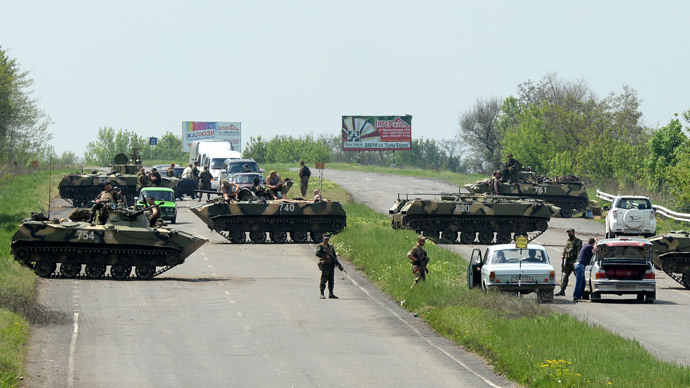
A checkpoint of the Ukrainian Army on the road linking Kramatorsk and Slavyansk.(RIA Novosti / Mikhail Voskresenskiy)
Strelkov says that all the barrels are pointed at Slavyansk, warning that once the assault starts, citizens of Slavyansk “will live badly, but not for long.” He says that volunteers, mostly men in their forties, are continuing to join the ranks of the self-defense pro-federalization forces, to “defend their native city.”
On May 5 several checkpoints came under attack around the city of Slavyansk. Casualties were reported on both sides. Donetsk Health Department reports that at least 8 people died and 16 others injured when the troops started the assault on the city, trying to fight their way in into the center of the city.
With support of armored vehicles, artillery, and the air force the Ukrainian troops encircled Slavyansk but did not retake the city from the pro-federalization forces. Strelkov said that at least 10 of his men died in the last attempt.
“We suffered losses – about 10 people, including civilians, 20-25 people were injured. I do not know the losses of our adversaries; clearly they are smaller than ours, they have armor. Most of our losses came from plainclothes [troops], disguised as civilians,” he said.
The Ukrainian Interior Ministry said four of its troops were killed and some 30 others injured in Slavyansk during Monday’s attack. There were also casualties among the civilian population of the city, the ministry added.
US ‘anti-Russian’ missile shield may threaten nuke reduction, officials warn
RT | May 6, 2014
Moscow believes that the US has intensified its effort to create a Europe-based anti-missile shield and is increasingly certain that it is targeting Russia. If the situation deteriorates, US-Russia nuclear reduction agreements may be at risk.
Russian concerns over the ABM shield, which the US is building in Eastern Europe, claiming that it is meant to stop ballistic missiles from North Korea and Iran, were voiced Tuesday by both the military and diplomats.
“Unfortunately, I have to state that our partners from NATO have effectively rejected any expert dialogue on the anti-ballistic missile defense issue and substitute it with political slogans,” said Sergey Koshelyev, the head of the Defense Ministry’s department for international military cooperation.
“This situation and the latest statements from the alliance leadership only make us more certain that the ABM system is an anti-Russian capability, which will only grow stronger in time,” he said.
The assertion was echoed by statements from the Foreign Ministry. Russian Deputy FM Sergey Ryabkov said that in Moscow “we feel the symptoms of the work on various segments of the AMD system being intensified… And those symptoms are more frequent that they used to be.”
“This proves our initial concerns that the system in its final form is designed to block not only limited threats, as it was claimed. To a much degree it will be formed, designed and built to try and devalue the Russian strategic nuclear deterrence,” he told RIA Novosti in an interview.
Ryabkov warned that such developments may affect the New START treaty between the US and Russia on nuclear weapons disarmament.
“Fundamental for this treaty is the link between strategic offensive and defensive weapons. So the development of the AMD may in the end affect negatively the prospects of preserving of the treaty,” he said, adding that so far the treaty is strictly observed by both sides and that Moscow has all reasons to believe that its reduction goals will be fulfilled by the 2018 deadline.
The warning comes days after the US rejected the latest Russian proposition on defusing the conflict of the anti-missile system. Russia insists that US should take legally binding obligations not to use the European AMD system to undermine Russia’s nuclear capabilities.
The rejection was expected, especially considering that the US downgraded most lines of cooperation with Russia, except for those beneficial to America, as part of its response to the Ukrainian crisis.
Meanwhile the European AMD system made a new step in mid-April after the US Navy decided to deploy the second generation of the Standard Missile-3 Block IB missile, interceptor projectiles that are part of the antimissile shield.
“The SM-3 Block IB’s completion of initial operational testing last year set the stage for a rapid deployment to theater,” said Taylor W. Lawrence, president of Raytheon Missile Systems, the producer of the interceptor missile. “The SM-3’s highly successful test performance gives combatant commanders around the world the confidence they need to counter the growing ballistic missile threat.”
The Obama administration scrapped the Bush-era plans for European AMD and replaced it in 2009 with the so-called Phased Adaptive Approach. While initially viewed as a positive sign of possible compromise, in practice the move resulted in US is continuing to develop the system and stonewalling Russia’s objections.
Iran renews call for global nuclear disarmament
Press TV – May 6, 2014
Iran has once again called for global nuclear disarmament, as preparations are underway for a review conference of the Non-Proliferation Treaty (NPT).
The NPT, which went into force in 1970 and was extended indefinitely in 1995, was designed to prevent the spread of nuclear arms with the end goal of complete nuclear disarmament.
One of the main concerns of the member states of the treaty has been the issue of fissile material, which led to the Fissile Material Cutoff Treaty. However, decades later, no substantial negotiations have taken place.
Iran’s Deputy Permanent Representative to the UN Gholam-Hossein Dehqani criticized the nuclear-armed powers for failing to disarm decades after the NPT went into effect.
“The Fissile Material Cutoff Treaty in the conference in Geneva, the negotiations on this topic were to be started from 50 years ago. Unfortunately, there has been diversity of views on the scope and goal of this treaty,” Dehqani told Press TV.
“The goal of this treaty must be nuclear disarmament, because it has to be considered as a step toward realizing the ultimate goal of the NPT,” he said.
Under the terms of the NPT, five countries, including the United States, Russia the United Kingdom, France, and China are nuclear armed-states. The NPT has many signatories, who often faced the most gridlock when it came to fissile material.
Although all five powers have agreed to the eradication of nuclear weapons, a specific timeline has yet to be proposed.
Israel, widely believed to possess between 200 to 400 nuclear warheads in its arsenals, refuses to either allow inspections of its nuclear facilities or join the NPT.
The Preparatory meeting for the 2015 Review Conference of the Parties to the Treaty on the Non-Proliferation of Nuclear Weapons is currently underway in New York and will last until Friday May 9.
NATO’s record 6,000-strong drills kick off in Estonia amid Ukraine tensions
RT | May 5, 2014
NATO’s three-week ‘Spring Storm’ drills, involving a record-breaking number of 6,000 troops, have begun in Estonia. For the first time, a cyber security team from France is participating in the military exercises.
“This year’s Spring Storm brings together a record number of allied troops – infantry from the Duke of Lancaster’s Regiment, soldiers from Latvia, soldiers from the 173rd Airborne Brigade Combat Team of the US army, as well as soldiers from Lithuania,” the Estonian Defense Ministry said in a statement.
In addition, Poland has sent three of its Sukhoi Su-22 attack aircraft and a division of missile defense system unit SA-8, which will be tasked with protecting an air base near Tallinn and the surrounding airspace.
Just like last year, the exercise also involves anti-aircraft personnel from Belgium.
The main goal of the military exercises is to assess the skills of the infantry battalions, rehearse cooperation between different units, and improve management methods of staff divisions, the ministry stressed.
The Spring Storm drills have been held annually in different parts of Estonia since 2003.
This year, military maneuvers will be held in 5 out of 15 Estonian counties, including southern and southeastern regions close to the border with Russia. The exercises are scheduled to finish on May 23.
Britain, France, and the US have been deploying troops to the Baltic region since April 29, a week ahead of the drills in Estonia. A day earlier, around 150 personnel of the US airborne division arrived in a military transport aircraft to Amari airbase. Upon completion of the maneuvers, the US Marines will remain in Estonia at least until the end of 2014.
Amid rising tensions in Ukraine, the UK and France deployed eight fighter jets to Lithuania and Poland to strengthen NATO air defense over the Baltic regions.
On May 2, a group of NATO ships arrived in the Lithuanian port of Klaipeda to “ensure regional security.”
Russia considers the increase of NATO forces so close to its border a provocation, and believes it is counter-productive in the struggle to de-escalate tensions in Ukraine.
On Monday, Russian Minister of Defense Sergey Shoigu called on his American counterpart, Chuck Hagel, to cool down the rhetoric over Ukraine and work together to defuse the situation.
With Washington’s Syria Gambit in Tatters, Iran’s ‘Smart Power’ Strategy Working
By Flynt Leverett and Hillary Mann Leverett | Going to Tehran | May 4, 2014
One of the more persistent tropes in Western discourse about the Syrian conflict is that, by “siding with” the Assad government, the Islamic Republic of Iran has marginalized itself in regional affairs and squandered much of the soft power it had accumulated as the champion of regional resistance to Western and Israeli abuse. From the outset of the Syrian conflict, we have been critical of this view (and of the Western approach to Syria more generally). For three years, we have argued that Iran is an indispensable player in any serious effort to negotiate a political settlement in Syria—and that such a settlement will necessarily be reached between the Syrian government, headed by President Bashar al-Assad, and those elements of the opposition who understand that they cannot defeat Assad either on the battlefield or at the ballot box. In other words, a political settlement may reform Syria’s current political order—but it won’t overturn that order.
Now, events of the ground are providing ever more abundant evidence that our analysis is correct.
Late last week, the Syrian government and opposition fighters in the city of Homs reached agreement on a ceasefire. Beyond a ceasefire, the agreement is drawn to let opposition fighters leave Homs for other rebel-held areas, effectively surrendering Syria’s third-largest city back to the government. Yesterday, the New York Times and other media outlets reported that, while the evacuation of opposition fighters had not yet occurred, the ceasefire in Homs is holding. If the agreement is fully implemented, the departure of opposition fighters from Homs would constitute another significant military advance by the government in its campaign against rebel forces—helping set the stage for Syrian presidential elections on June 3, with President Assad standing for a third term.
One of the more striking things about this story is that, according to the Wall Street Journal, the talks between the Syrian government and opposition fighters that produced this agreement were “brokered by the United Nations and the Iranian Embassy in Damascus.” Western discourse about Syria wants to limit any discussion of a “peace process” in Syria to the Geneva process—but the United States and its Western partners have rendered the Geneva process utterly dysfunctional by their continued insistence on Assad’s departure as an essential precondition for a political settlement. By contrast, the Islamic Republic of Iran, by having a clear political strategy of supporting elections and by being willing to deal with all relevant players—even “a hard-line Sunni Muslim rebel group,” as the Wall Street Journal describes its interlocutors in Homs—is actually able to accomplish things on the ground in Syria.
So, which parties are in fact marginalizing themselves in regional affairs by unreservedly aligning themselves with one side—and refusing to have anything to do with the other side—in the Syrian conflict? At this point, it seems that the Islamic Republic of Iran is pursuing a much smarter and more effective strategy in Syria than the United States and its partners.
Sweden’s elite more loyal to NATO, the US and EU than to its people
By Jan Oberg | Transnational Foundation for Peace & Future Research | May 2, 2014
Over the last 25-30 years Sweden’s military, security and foreign policy elite has changed Sweden’s policy 180 degrees.
These fundamental changes were initiated by the Social Democratic government under Goran Persson and foreign minister Anna Lindh and have been carried through virtually without public debate.
The rapproachment with interventionism, militarism and US/NATO in all fields has been planned, incremental, furtive and dishonest; in short, unworthy of a democracy.
This elite is more loyal with Brussels and Washington than with the Swedes.
If your image of Sweden is that it is a progressive, innovative and peace-promoting country with a global mind-set and advocate of international law, it is – sad to say – outdated.
How Sweden has changed
Sweden is no longer neutral and it is only formally non-aligned; there is no closer ally than US/NATO. It has stopped developing policies of its own and basically positions itself in the EU and NATO framework. It no longer produces important new thinking – the last was Olof Palme’s Commission on Common Security (1982).
It has no disarmament ambassador and does not consider the UN important; it does not have a single Swede among the UN Blue Helmets. None of its top-level politicians make themselves available as mediators in international conflicts.
Nuclear abolition is far down the agenda, problematic as a NATO-aspiring country. But one thing has not changed: Sweden remains the world’s largest arms exporter per capita.
Sweden no longer contributes to the protection of smaller states through a a commitment to international law. Its elites wholeheartedly supported the bombing of Serbia/Kosovo. It thought – also under social democratic leadership – that the mass-killing sanctions on Iraq and the occupation were appropriate.
Since Sweden cannot legally export arms to a country in war but upholds a close military technological co-operation with the U.S., its parliament decided to make the US an exception.
Sweden supported the destruction of Libya – participating with its planes there, however only conducting reconnaissance, not bombing, missions.
Sweden did not support the planned war on Syria but also did not voice any audible criticism of the West’s support of only the militant opposition, including Al-Qaeda affiliates.
Carl Bildt
Sweden’s foreign minister Carl Bildt operates mainly as an eminently well-informed international affairs traveler and blogger who doesn’t seem to want to waste too much of his precious time on being a minister. And when he does, he isn’t known for consulting many people around him.
That could be a reason that his comments on various events repeatedly attract laughable media attention. If you compare, as he has, Ukraine’s former President Yanokovich with Norway’s Quisling and thereby make Putin equivalent to Hitler and Russia to Nazi-Germany you no longer operate as a statesman but, rather, as an emotional hothead or a marketing consultant. (Add to that that Bildt recently refused in the Swedish Broadcasting’s ”Saturday Interview” to distance himself from neo-Nazi elements in Kiev).
Bildt’s simplifying, twisted interpretation of Georgia 2008 is revealing of his biased emotionality where earlier – for instance during his position as High Rep in Bosnia – he deserved respect for operating in an intellectually sober manner.
If you don’t have your own thinking and policies, Russophobic platitudes is all you need. And it qualifies for CNN’s Christiane Amanpour.
Sweden is heading for NATO membership
Here follow a few recent events/news which emphasize further the deplorable path Sweden – its elites rather than its people – have decided to follow.
1. Sweden’s security political elite these years ”considers broader alliances with NATO and the EU” as Defence News recently informed us.
How enigmatic! After having been neutral and non-aligned during tough confrontation and tension in the Cold War years, Sweden now needs to join NATO when there is no single analysis anywhere that makes it likely that Sweden, in the foreseeable future, will be faced with a threat.
While the intelligent security and defence discourse is now about human security, the environment and high-tech challenges, Sweden’s elites talk about defence as weapons only.
This is dangerous ”group think” steered by bureaucratic vested interests and paid for by tax payers who are de facto threatened more by these interests than by Putin. A reality check would lead to a reality chock.
Cruise missiles for “deterrence”
2. Swedish planes shall now, in the light of a conveniently hysteric interpretation of the crisis in Ukraine, equip its planes with cruise missiles. (Defense News)
Incredibly, decisions like this are taken with the intellectually sloppy mantra that it adds to the country’s ‘deterrence’ capacity.
The security priesthood of the country consists of some researchers of military affairs at huge, well-financed state institutes in close contact with politicians and the military to whom military-loyal journalists have close bonds. Everybody, follow the party line! Saty in the box! Don’t challenge the domain assumptions!
Sweden now jumps on a sinking ship
The country that once did something for a better world, has joined the militarist world. In a time when both NATO and the US is getting weaker, Sweden’s elite foolishly plans to put all Sweden’s eggs there.
It has no policy vis-a-vis, say, the BRICS countries or any vision of the world in 20 years to navigate towards. It has no ideals, values or commitments, only a ”follow-the-US/NATO and EU” flock mentality.
The US Ambassador is invited to blackmail
3. The US ambassador to Sweden, Mark Brzezinski, recently told Sweden to join NATO, otherwise it won’t get any help in the event of an attack – in short, Mafiosi blackmailing disguised as deep concern and generous offer to bring (conditional, however) help. This was revealed by the conservative Swedish daily, Svenska Dagbladet, Google translation here.
How many – and which – ambassador’s are given the opportunity to speak directly to all parties of the Swedish parliament?
The message is pure blackmail – and based on fearology – because everybody knows that should Russia attack anyone, Sweden would not be the first target and it would be in the interest of NATO to control Swedish territory before any spreading of Russian forces from somewhere else to the Nordic area.
In short, NATO’s interests in Sweden are much larger than Sweden’s in NATO. Whatever one may think of these fantasies, they are just that: No one has thought up a credible scenario for how Sweden would be invaded by Russia and remain defenceless.
If one of largest militaries per capita can’t defend its people there is something wrong with it
But this is the military-fundamentalist propaganda the Swedes are the target of these years: We must join NATO because we have such a weak defence that we can’t defend ourselves!
The liberal party’s defence spokesman, Allan Widman, recently stated this in a manner indicative of the low intellectual level of defence discussions here: ”I can only state the fact that Russia is about 140 million people and Sweden is 9 million. We won’t be able to manage serious challenges from outside on our own…”
Now if the Swedish military can’t provide any protection of the 9 million Swedes with a budget of 8 billion dollars (among the 10% highest per capita in the world) at its disposal, it’s time to ask how inefficient and cost-maximising it can be without its leadership being fired.
4. Just this week it was decided that AWACS planes can pass through Swedish airspace in connection with its Ukraine crisis missions.
5. Sweden (and Finland) is discussing how to receive military aid, including troops, from NATO (see Dagens Nyheter April 27, 2014). This goes beyond what NATO members Denmark, Norway and Iceland have ever accepted. And Sweden is not a NATO member! (You may see a petition against this here)
It’s time to begin to think
Take the money, prestige, privileges and funds from the Military-Industrial-Media-Academic Complexes – MIMAC – of the world – and in Sweden too – and force them to think:
• Think for the common good and not for their vested interests.
• Think for the world and not for their parochial psycho-political nationalism.
• Think of the people’s human security and make violence-prevention the top goal.
• Think first of non-violent policies and use militry as the last resort in accordance with the UN Charter.
• Think as you should in a democracy, with the people, for the people and by the people.
As long as all you have on your shelves is fighter planes, the world’s problems will be seen as bombing missions.
And that’s when peace, co-operation and mutual understanding is dropped and cold – even warm – wars become ”realistic”. This must not be Sweden’s future.
Contact:
Dr. Jan Oberg, TFF director
0046 738 525200
The B61 Family of Nuclear Bombs
By Hans M. Kristensen* | April 27, 2014
… The Obama administration is about to give birth to the newest member of the B61 family: the B61-12. And this is a real golden baby estimated at about $10 billion. …
Although based on the same basic warhead design first developed in the 1960s, the capabilities of the remaining version vary considerably with explosive yields ranging from 0.1 kilotons to a whopping 400 kilotons – more than 30 times as powerful as the bomb that destroyed Hiroshima in 1945.
Now the Obama administration has proposed that four of the remaining versions (B61-4, B61-7, B61-10, and B61-11) can be retired if the last version – the B61-4 – is converted into a guided standoff nuclear bomb. An even larger bomb, the B83-1, can also be retired, they say (even though its retirement was planned anyway).
The sales pitch is as arcane as the family name: building a new bomb is good for disarmament.
But most of the B61 bombs and the B83 could probably be retired anyway for the simple reason that deterrence no longer requires six different ways of dropping a nuclear bomb from an aircraft. A much simpler and cheaper life-extended version of the B61-7 could probably do the job.
Implications
The new B61-12 will be capable of holding at risk the same targets as current gravity bombs in the US stockpile (apparently even those currently covered by the B61-11 nuclear earth-penetrator that the Air Force no longer needs), but it will be able to do so more effectively and with less yield (thus less collateral damage and radioactive fallout) than the existing bombs.
Congress rejected Air Force requests for new, low-yield, precision-guided nuclear weapons in the 1990s because of concern that such weapons would be seen as more usable than larger strategic warheads. With the B61-12, which will have several low-yield options, the military appears to obtain a guided low-yield nuclear strike capability after all.
In Europe, the effect of the B61-12 will be even more profound because its increased accuracy essentially will add high-yield targeting capability to NATO’s non-strategic arsenal. When mated with the stealthy F-35A fighter-bomber planned for Europe in the mid-2020s, the B61-12 will represent a considerable enhancement of NATO’s nuclear posture in Europe.
How they’re going to spin that development at the nuclear Non-Proliferation Treaty Review Conference in New York next year will be interesting so see. But the B61-12 program is part of a global technological nuclear arms race with nuclear weapon modernization programs underway in all the nuclear-armed states that is in stark contrast to the wishes of the overwhelming number of countries on this planet to see the “cessation of the nuclear arms race at early date and to nuclear disarmament,” as enshrined in the nuclear Non-Proliferation Treaty (more about that in the May issue of Arms Control Today).
*This excerpted content has been made available at the USS Bennington blog where a link to the entire article can be found.
Trans-Atlantic global leadership at stake in Ukraine – Kerry
“NATO, the planet’s strongest alliance… can absolutely take advantage of the opportunities that are presented by crisis”
RT | April 30, 2014
NATO must return to its original goal of fending off Russia, seizing the chance presented by the Ukrainian crisis to sever Europe from Moscow and move it closer to America, the US secretary of state said. Or else the bloc’s global leadership may be lost.
John Kerry delivered the confrontational call in a speech to the Atlantic Council think tank in Washington, DC. He said the stand-off in Ukraine had resulted from a “uniquely personally-driven set of choices” and is “a wake-up call” for NATO. He added that now the military bloc must turn the page on two decades of focusing on expeditionary operations and take a stand against “Putin’s Russia.”
“After two decades of focusing primarily on our expeditionary missions, the crisis in Ukraine now call us back to the work that this alliance was originally created to perform,” Kerry told the audience.
NATO’s original purpose was to oppose the Communist Soviet Union, giving the West the military backbone to the ideologically-driven stand-off with the East. Kerry described it as “to defend alliance territory and advance trans-Atlantic security.”
“Today, Putin’s Russia is playing by a different set of rules,” the secretary stated. “Through its occupation of Crimea and its subsequent destabilization of eastern Ukraine, Russia seeks to change the security landscape of Eastern and Central Europe.”
“Together we have to push back against those who try to change sovereign border by force. Together we have to support those who simply want to live as we do,” he added.
Kerry didn’t mention NATO’s own operations against Yugoslavia, which helped change sovereign borders in Europe. But he said NATO must not allow that the situation continue to develop as it is, because Russia is challenging the position NATO members have held since the end of the Cold War.
“Our entire model of global leadership is at stake. If we stand together, if we draw strength from the example of the past and refuse to be complacent in the present, then I am confident that NATO, the planet’s strongest alliance, can meet the challenges, can absolutely take advantage of the opportunities that are presented by crisis,” he stressed.
Kerry suggested three points on how trans-Atlantic partners can preserve their leadership and contain Russia. He said all NATO members must comply with the alliance’s benchmark of 2 percent GDP defense spending, which is not observed by many European members of the alliance, including European economic powerhouse Germany.
“Clearly, not all allies are going to meet the NATO benchmark of 2 percent of GDP overnight or even next year,” Kerry said. “But it’s time for allies, who are below that level to make credible commitments to increase their spending on defense over the next five years.”
NATO members must also help Europe reduce its dependence on Russian energy and develop economic ties with America by speeding down the pipeline the Trans-Atlantic Trade and Investment Partnership Agreement, Kerry said.
The agreement would certainly give more access to European markets to some US corporations, as it would require freeing up European regulations on things like fracking, GMOs, copyright and finance.
Kerry’s policy remarks are in line with those made recently by some other members of the US political establishment. For example Senator John McCain, one of the most vocal critics of Russia, went on the same lines of presenting Russia’s stance on Ukraine a personal choice by President Vladimir Putin and calling for more defense spending in Europe in his speech at Vilnius University, Lithuania, on Wednesday last week.
“Considering what President Putin is doing right now in Ukraine, it is more important than ever for every NATO ally to spend at least 2 percent of its GDP on defense,” McCain said. “I’m pleased that Lithuania has pledged and is planning to do this, and the sooner you follow through on that commitment the better.”
The US and Russia have been trading accusations of meddling with Ukrainian crisis lately. Washington says Moscow is sowing dissent in eastern Ukraine, fanning up anti-government protests there. Russia says the US sponsored the February coup in Kiev, which brought into power the current Ukrainian central authorities and has been playing a dominant role in defining the policies of the new government.
Canada deploys six fighter jets to Romania
Canada has sent six fighter jets to Romania as part of its contribution to NATO’s military presence in Eastern and Central Europe.
The six CF-18 fighter jets were deployed from Canadian Forces Base Bagotville in Quebec on Tuesday.
Canada’s Defense Minister Rob Nicholson, who was present for the aircrafts takeoff, told the pilots and their support staff that they were being sent in response to the crisis in Ukraine.
“Soon you will join our allies as part of Canada’s contribution to NATO’s efforts to reassure our allies in Central and Eastern Europe,” Nicholson said. “The work will be key in supporting international efforts to find a solution that respects the democratic aspirations of the Ukrainian people.”
Meanwhile, Denmark has also sent four warplanes to the region.
On April 28, Russian Defense Minister Sergei Shoigu expressed concern about what he described as an unparalleled increase in US and NATO military activity along Russia’s borders.
The planes, along with support staff, will be stationed in Romania, and will take part in NATO air patrols of the Baltic region and training activities. The air patrols operate on a rotational schedule, and the six Canadian CF-18s will be rotating in.
According to reports, some 150 US troops have been deployed in western Estonia and another 450 are presently stationed in Latvia, Lithuania and Poland.
Tensions between Moscow and the Western-backed interim government in Kiev heightened after Crimea declared independence from Ukraine and rejoined Russia following a referendum on March 16, in which almost 97 percent of the participants voted for rejoining the Russian Federation.
Obama Ends Asian Tour With Little to Show for it
Prensa Latina | April 29, 2014
 Manila – U.S. President Barack Obama ended a tour today that included four Asian countries, accomplishing only the signing of a military agreement with the Philippines.
Of all the issues in Obama’s agenda, that was the only agreement to be brought to fruition, while Japan delayed its joining to a free trade agreement and Malaysia did not sign on either.
Obama’s South Korean stopover included a confirmation of Washington’s military reinforcement to Seoul, but the president met with no success in his attempt to improve relations with Tokyo, a regional ally.
The defense and security agreement with the Philippines will facilitate a greater U.S. naval presence in the archipelago, but thousands of people took the streets to protest the visit and the agreement.
Although the White House backs the Philippines in a territorial dispute with China, Obama clarified that the bilateral agreement does not aim at Beijing, with whom the United States maintains a constructive relationship.
Obama’s Asian tour cost taxpayers almost one billion USD, taking into account that a single day abroad for Obama costs more than $100 million USD.
Britain has invaded all but 22 countries in the world
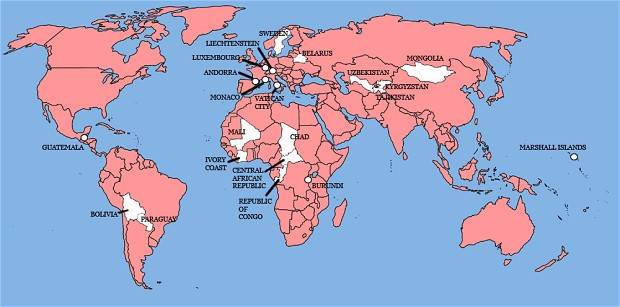
By Jasper Copping | World Observer | November 9, 2012
Every schoolboy used to know that at the height of the empire, almost a quarter of the atlas was coloured pink, showing the extent of British rule.
But that oft recited fact dramatically understates the remarkable global reach achieved by this country.
A new study has found that at various times the British have invaded almost 90 per cent of the countries around the globe.
The analysis of the histories of the almost 200 countries in the world found only 22 which have never experienced an invasion by the British.
Among this select group of nations are far-off destinations such as Guatemala, Tajikistan and the Marshall Islands, as well some slightly closer to home, such as Luxembourg.
The analysis is contained in a new book, All the Countries We’ve Ever Invaded: And the Few We Never Got Round To.
Stuart Laycock, the author, has worked his way around the globe, through each country alphabetically, researching its history to establish whether, at any point, they have experienced an incursion by Britain.
Only a comparatively small proportion of the total in Mr Laycock’s list of invaded states actually formed an official part of the empire.
The remainder have been included because the British were found to have achieved some sort of military presence in the territory – however transitory – either through force, the threat of force, negotiation or payment.
Incursions by British pirates, privateers or armed explorers have also been included, provided they were operating with the approval of their government.
So, many countries which once formed part of the Spanish empire and seem to have little historical connection with the UK, such as Costa Rica, Ecuador and El Salvador, make the list because of the repeated raids they suffered from state-sanctioned British sailors.
Among some of the perhaps surprising entries on the list are:
* Cuba, where in 1741, a force under Admiral Edward Vernon stormed ashore at Guantánamo Bay. He renamed it Cumberland Bay, before being forced to withdraw in the face of hostile locals and an outbreak of disease among his men. Twenty one years later, Havana and a large part of the island fell to the British after a bloody siege, only to be handed back to the Spanish in 1763, along with another unlikely British possession, the Philippines, in exchange for Florida and Minorca.
*Iceland, invaded in 1940 by the British after the neutral nation refused to enter the war on the Allies side. The invasion force, of 745 marines, met with strong protest from the Iceland government, but no resistance.
* Vietnam, which has experienced repeated incursions by the British since the seventeenth century. The most recent – from 1945 to 1946 – saw the British fight a campaign for control of the country against communists, in a war that has been overshadowed by later conflicts involving first the French and then Americans.
It is thought to be the first time such a list has been compiled.
Mr Laycock, who has previously published books on Roman history, began the unusual quest after being asked by his 11-year-old son, Frederick, how many countries the British had invaded.
After almost two years of research he said he was shocked by the answer. “I was absolutely staggered when I reached the total. I like to think I have a relatively good general knowledge. But there are places where it hadn’t occurred to me that these things had ever happened. It shocked me.
“Other countries could write similar books – but they would be much shorter. I don’t think anyone could match this, although the Americans had a later start and have been working hard on it in the twentieth century.”
The only other nation which has achieved anything approaching the British total, Mr Laycock said, is France – which also holds the unfortunate record for having endured the most British invasions. “I realise people may argue with some of my reasons, but it is intended to prompt debate,” he added.
He believes the actual figure may well be higher and is inviting the public to get in touch to provide evidence of other invasions.
In the case of Mongolia, for instance – one of the 22 nations “not invaded”, according to the book – he believes it possible that there could have been a British invasion, but could find no direct proof.
The country was caught up in the turmoil following the Russian Revolution, in which the British and other powers intervened. Mr Laycock found evidence of a British military mission in Russia approximately 50 miles from the Mongolian border, but could not establish whether it got any closer.
The research lists countries based on their current national boundaries and names. Many of the invasions took place when these did not apply.
The research covered the 192 other UN member states as well as the Vatican City and Kosovo, which are not member states, but are recognised by the UK government as independent states.
The earliest invasion launched from these islands was an incursion into Gaul – now France – at the end of the second century. Clodius Albinus led an army, thought to include many Britons, across the Channel in an attempt to seize the imperial throne. The force was defeated in 197 at Lyon.
Mr Laycock added: “On one level, for the British, it is quite amazing and quite humbling, that this is all part of our history, but clearly there are parts of our history that we are less proud of. The book is not intended as any kind of moral judgment on our history or our empire. It is meant as a light-hearted bit of fun.”
The countries never invaded by the British:
Andorra
Belarus
Bolivia
Burundi
Central African Republic
Chad
Congo, Republic of
Guatemala
Ivory Coast
Kyrgyzstan
Liechtenstein
Luxembourg
Mali
Marshall Islands
Monaco
Mongolia
Paraguay
Sao Tome and Principe
Sweden
Tajikistan
Uzbekistan
Vatican City
Featured Video

Ivermectin and iodine
or go to
Aletho News Archives – Video-Images
From the Archives
UN declares war on ‘dangerous’ conspiracy theories
‘World is not secretly run by elites’
Free West Media | August 5, 2022
UNESCO says it is seriously concerned about the increase in “disinformation” and “conspiracy theories”. And they plan to put an end to it through a network of informants.
“Conspiracy theories can be dangerous,” the UN agency warned. “Often they ignore scientific evidence and polarize society with dire consequences. This has to stop.”
Unesco’s director-general warned that “conspiracy theories” could cause damage to people as well as to their health. “They reinforce misconceptions about the pandemic, reinforcing stereotypes that can fuel violence and violent, extremist ideologies,” said Audrey Azoulay.
The UN agency has launched a campaign to help people identify, debunk and report “conspiracy theories” to prevent them from spreading further.
This campaign is being carried out in collaboration with the European Commission, Twitter and the World Jewish Congress. The UN has created a toolkit to “debunk” such theories and smear anyone who dares to claim that governments are not fair and transparent.
The UN also warned that George Soros, the Rothschilds and Israel should not be linked to “alleged conspiracies”.
World events “are not secretly manipulated behind the scenes by powerful players with malicious intent,” the UN agency maintained.
And if anyone therefore comes across someone who believes that the world elite is plotting to consolidate power or direct events, then that person needs to take action. According to the UN agency, when meeting a “conspiracy theorist”, under no circumstances should one enter into a discussion. … continue
Blog Roll
 Aletho News
- Ivermectin and iodine
- Congratulations climate skeptics — you are a ‘Hybrid weapon of war’ and a growing public health threat
- ‘The Arab Vote’: How Israeli Racism Has Ruined Their Elections
- Israel forces Palestinians in Gaza to choose between assassination alone or death with their families: Report
- US Approves Sale of 500 Patriot Missiles to Ukraine, Deliveries May Take Years
- German Imperialism: An Urgent Explainer
- Backed by AAP, West Virginia Proposal Would Allow Dental Hygienists to Give HPV Vaccine to 9-Year-Olds
- Poland Is the Symptom and Europe Is the Patient
- UAE security forces tortured, killed journalist for opposing Israel normalization: Report
- They Compared the Spice to the Drug. The Spice Won — Again. (Part 2)
- If Americans Knew
- DAILY UPDATE: Latest essential news on Palestine, Israel, & region
- 1,300 will gather in Palo Alto on Nov. 1 for Z3 Conference on Zionism
- DAILY UPDATE: Latest essential news on Palestine, Israel, & region
- The Long Arm of AIPAC
- Genocidal intent behind Hebron assault, rights group says
- This week, Israel killed 8-year-old who survived bombing that wiped out her family
- DAILY UPDATE: Latest essential news on Palestine, Israel, & region
- Israeli soldier poses at damaged Lebanon church, sparking anger
- New Report. Manufacturing the Great Replacement: Is Israel behind one of the largest racist influence campaigns ever documented?
- ‘Arab voice doesn’t count’: Jewish Israeli blocs reject Palestinian support
- No Tricks Zone
- Germany’s Green Energy Transition Becoming Increasingly Expensive…Another 6 Trillion Euros!
- Sudden Stratospheric Warming, Powerful El Niño Combination May Lead To Extreme Europe Cold, Energy Crisis!
- Two New Studies Find Thwaites Glacier Melt Cannot Be Driven By Human Activity Or A Warming Ocean
- E-Cars Reduce CO2 Emissions By Only 41% Compared To Internal Combustion Engine Vehicles
- Predictions Made By Renowned Climate Professor Over Past Decades Have Been Proven To Be Poor
- New Study Suggests Large Regions Of The Pacific Ocean Have Been Cooling For The Last 80 Years
- Germany’s Green Energy Debacle: High Energy Costs Force Kahla Porzellan to Close After 182 Years!
- New Study: 50 Years Of The Most Aggressive ‘Net Zero’ Policies Can Only Affect The Global Climate By 0.03°C
- US September “Heat” Was No Record…Many Records Set Decades Ago
- Latest European Green Energy Debacle; Portugal’s Largest Flagship Solar Park Insolvent!

