Israeli soldiers breach Lebanese border to retrieve crashed spy plane
Al-Akhbar | February 18, 2014
Israeli troops crossed the barrier separating Lebanon from Occupied Palestine on Tuesday, searching for parts of a crashed surveillance plane, the Lebanese National News Agency reported.
The Israelis then fired a shot in the air when a joint patrol by the Lebanese army and UNIFIL passed close by, near the southern Lebanese village of Mays al-Jabal.
The 11 Israeli soldiers were allegedly searching for pieces of an Israeli reconnaissance plane which had crashed inside Lebanon, eyewitnesses told the NNA.
In January, a group of 70 Israeli soldiers also crossed into southern Lebanon to retrieve surveillance equipment, all under the eyes of UNIFIL troops, who are tasked with monitoring breaches at the border.
Israeli drones and warplanes fly over Lebanon on a near-daily basis, violating Lebanese sovereignty despite complaints to the United Nations.

Do We Care About People If They Live in Bahrain?
By David Swanson – February 17, 2014
I had a heck of a time making sense of the U.S. Navy’s new motto “A Global Force for Good” until I realized that it meant “We are a global force, and wherever we go we’re never leaving.”
For three years now people in the little island nation of Bahrain have been nonviolently protesting and demanding democratic reforms.
For three years now the king of Bahrain and his royal thugs have been shooting, kidnapping, torturing, imprisoning, and terrorizing nonviolent opponents. An opponent includes anyone speaking up for human rights or even “insulting” the king or his flag, which carries a sentence of 7 years in prison and a hefty fine.
For three years now, Saudi Arabia has been aiding the King of Bahrain in his crackdown on the people of Bahrain. A U.S. police chief named John Timoney, with a reputation for brutality earned in Miami and Philadelphia, was hired to help the Bahraini government intimidate and brutalize its population.
For three years now, the U.S. government has been tolerating the abuses committed by Bahrain and Saudi Arabia, continuing to sell weapons to Bahrain and Saudi Arabia, and continuing to dock the U.S. Navy’s Fifth Fleet in Bahrain. In fact, the U.S. military has recently announced big and pricey plans to expand its bases in Bahrain and add more ships.
For three years now, the U.S. government has continued to dump some $150 billion (with a ‘B’) each year into the U.S. Navy, a large portion of which goes for the maintenance of the Fifth Fleet in Bahrain. Withdrawing and disbanding that fleet would save that gargantuan expense. Retraining and re-employing in peaceful activities all personnel would cost a fraction of $150 billion. Providing aid to nonviolent pro-democracy activists in Bahrain would cost a tiny fraction of a fraction. Establishing a policy in the case of this one country of supporting human rights over brutal dictatorship would be, as they say, priceless. It would create a very useful model for a transformation of U.S. policy in numerous other nations as well.
Accurate and timely information about the horrors underway for the past three years in Bahrain are available online, via Western human rights groups, and via small back-page stories in U.S. newspapers. There’s little dispute over the general facts. Yet, there’s little outrage. There appears to have been no polling done of the U.S. public on the topic of Bahrain whatsoever, so it’s impossible to know what people think. But my impression is that most people have never heard of the place.
The U.S. government is not shouting about the need to bomb Bahrain to protect its people. Senators are not insisting on sanctions, sanctions, and more sanctions. There seems to be no crisis, no need for “intervention,” only the need to end an intervention we aren’t told about.
Which raises a tough question for people who give a damn. We’re able to reject a war on Iran or Syria when the question is raised on our televisions. But we can’t seem to stop drone strikes nobody tells us about. How do we create a question nobody is asking, about a topic nobody has heard of, and then answer it humanely and wisely? And how do we overcome the inevitable pretense that the Fifth Fleet serves some useful purpose, and that this purpose justifies a little teargas, a bit of torture, and some murders here and there?
The Fifth Fleet claims to be responsible for these nations: Afghanistan, Bahrain, Egypt, Iran, Iraq, Jordan, Kazakhstan, Kyrgyzstan, Lebanon, Oman, Pakistan, Qatar, Saudi Arabia, Syria, Tajikistan, Turkmenistan, United Arab Emirates, Uzbekistan, and Yemen. None of these nations have ships in U.S. waters claiming to be responsible for it. None of these nations’ peoples have indicated majority support for having the Fifth Fleet be responsible for them. Afghanistan has suffered under U.S. occupation for over a decade, with chaos and tyranny to follow. Egypt’s thugs are rising anew with steady U.S. support, money, and weaponry. Iran has threatened and attacked no other nation for centuries, has never had a nuclear weapons program, spends less than 1% what the U.S. does on its military, and moves away from democracy with every U.S. threat. Why not leave Iran alone? Iraq, Jordan, Qatar, Saudi Arabia, Yemen, and others of these nations, including Bahrain, suffer under the rule of U.S.-backed governments. One might reasonably add Israel and the lands it occupies to the list, even if the Navy cannot bring itself to mention them. Yemen and Pakistan suffer under the constant buzzing and missile launching of U.S. drones, which are creating far more enemies than they kill. In fact, not a single nation falling under the past 19 years of benevolent “responsibility” of the Fifth Fleet has clearly benefited in any way.
At a third annual conference recently held in Lebanon, Bahraini activists laid out a plan of action. It includes building international connections with people who care and are willing to help. It includes supporting the International Day to End Impunity on November 23rd. It includes pushing Bahrain to join the ICC, although that may be of little value until the U.S. can be persuaded to do the same and until the United Nations can be democratized. The plan includes calls for an end to weapons sales and the initiation of sanctions against the Bahraini government (not its people).
Those would certainly be good steps. The first question in my mind remains: do the people in the nation that screams most loudly about “freedom” and does the most to support its repression wherever deemed useful, care?
CIA seeks new bases for deadly drones
Press TV – February 17, 2014
The US Central Intelligence Agency is seeking new drone bases in unnamed countries in Central Asia, fearing the full withdrawal of US troops from Afghanistan would affect the targeted killings in neighboring Pakistan.
The spy agency asserts that if the US fails to sign a bilateral security deal with Afghanistan and secure an enduring military presence there, it would not be able to fly drones from its Afghan bases because drone operations are covert and need US military protection.
The security deal, which Washington says “ought to be signed” and is not renegotiable, could allow thousands of US troops to stay in Afghanistan beyond 2014.
However, despite pressures from the White House and Congress, Afghan President Hamid Karzai has so far refused to sign the deal and the US intelligence community is hoping that the next Afghan president will agree to sign it.
Worried that its drone killings can become a casualty of strained relations between Kabul and Washington, the CIA is reportedly making contingency plans to use bases in other countries.
“There are contingency plans for alternatives in the north,” an unnamed US official briefed on the matter told the Los Angeles Times without specifying the countries.
According to Brian Glyn Williams, a University of Massachusetts professor, the CIA and the Pentagon used to fly drones from an airbase in Uzbekistan until the US was evicted in 2005.
Michael Nagata, commander of US special operations in the Middle East and Central Asia, also traveled last month to Tajikistan, which is Afghanistan’s northern neighbor, to discuss “issues of bilateral security cooperation” and “continued military cooperation.”
Meanwhile, US officials say a new jet-powered drone, called Avenger, which will be able to “get to ‘hot’ targets in Pakistan much faster,” could soon be flying from bases outside Afghanistan.
The CIA is in charge of drone strikes in Pakistan since the country is not officially a war zone and the CIA’s program is covert.
US President Barack Obama has already stated that the responsibility for Washington’s deadly drone attacks could gradually shift from the CIA to the Pentagon. However, the idea of putting the US military in charge of drone attacks is not favored by US lawmakers.
Georgia to join NATO Response Force in 2015
Xinhua News Agency | February 12, 2014
TBILISI: Georgian Defense Minister Irakli Alasania said Wednesday that the country has decided to join the NATO Response Force (NRF) in 2015 with financial support from the United States.
The decision was announced at a joint press conference with Knud Bartels, chairman of the NATO Military Committee, on the second day of the committee’s first ever visit to the South Caucasus country, during which talks with Georgian leaders were also held to discuss security, cooperation and Georgia’s involvement in NATO’s mission in Afghanistan.
“It has already been decided that Georgia will become part of the NATO Response Force in 2015 and a sponsor state has already been selected. The United States will ensure readiness along with the NATO military to provide rapid response in case of crisis,” said Alasania.
Bartels told the assembled press that Georgia has made “solid progress in its defense reforms that will allow cooperation between Georgia and NATO.”
The NRF, initiated in November 2002, has a joint force of around 13,000 high-readiness troops made up of land, air, maritime and special operations components that the Alliance can deploy quickly wherever needed, according to NATO information.
McCain urges Syria military intervention
Press TV – February 16, 2014

Hawkish US Senator John McCain has called on the Obama administration to employ its already-devised plan of military intervention against the Syrian government.
“The only way to achieve success at Geneva is to change the balance of power on the ground,” McCain said in a statement on Saturday, referring to the failure of the so-called Syria peace talks in Geneva.
“There are options far short of an Iraq-style invasion that can, and should, be employed to change the calculation of the Syrian regime, stem the violence, and ultimately achieve a negotiated political solution,” he added.
The second round of negotiations ended on Saturday without any concrete results about the unrest in Syria.
“The second round of Syria peace talks ended today with no progress toward a negotiated political settlement to the conflict and UN Special Envoy Lakhdar Brahimi recognizing that failure is looming,” McCain said.
“After three weeks of talks, we are moving further and further away from a peaceful political solution,” he argued.
The Arizona Republican senator also criticized President Barack Obama for allowing Russia to put pressure on him.
“Russia has recently prevented the passage of a much-needed UN resolution on bringing aid to desperate Syrian civilians,” he said. “Such actions indicate that the Russian government is simply not a partner for peace in Syria and cannot be relied on to help secure a successful outcome.”
During a press conference on Friday, White House press secretary Jay Carney said there is no military solution for the crisis in Syria.
“The crisis in Syria is a crisis. The circumstances on the ground are horrific that is why we have to bring the parties together to try to compel them towards a negotiated political settlement because there isn’t a military solution here,” Carney said.
Le Parisien uncovers French lie on 1960 nuke test
Press TV – February 16, 2014
A report says France covered up the extent of the nuclear fallout from its first atomic bomb test in North Africa.
The report published by the French daily Le Parisien was based on a recently declassified military map regarding the fallout from the detonation of the Gerbouise Bleue bomb in the Algerian desert in 1960.
The map revealed that radioactive particles reached the Italian island of Sicily and the southern Spanish coast on the 13th day after the blast.
Lawyer Fatima Benbraham, who represents dozens of cases in Algeria, said the map shows that Algeria and practically the whole Saharan region was contaminated following the atomic test.
The documents were declassified last year following a ten-year legal battle, in which the French government fought long and hard to prevent the documents from becoming public, according to Bruno Barrillot, a member of the pressure group Observatoire des Armaments.
The pressure group along with others battled through court to have the documents released in a bid to bring compensation to people whose health has been allegedly affected by the radioactive fallout.
Human rights activists say civilians were not warned of the danger of the 17 blasts that took place in North Africa in 1960-66.
France admitted in 2009 that a small-populated area has been affected by the fallout.
Barrillot said he hopes the newly declassified maps would force the administration of French President Francois Hollande to admit that more people could have been affected by the fallout.
“They did not do these tests under the Eiffel Tower,” said Barrillot. “No, they went far away from France and then lied about the true impact.”
France conducted a total of 210 tests in Algeria and then in French Polynesia in the Pacific Ocean from 1960 to 1996.
Syria peace talks break off, no new date set: Brahimi
Al-Akhbar | February 15, 2014
A second round of peace talks between Syria’s warring sides broke off Saturday without making any progress and without a date being set for a third round, UN mediator Lakhdar Brahimi said.
“I think it is better that every side goes back and reflects on their responsibility, (and on whether) they want this process to continue or not,” Lakhdar Brahimi told reporters in Geneva.
Speaking on the final day of a second round of talks that have been mired from the start by blame-trading over the violence ravaging Syria, he apologized to the Syrian people for not making progress.
“I’m very, very sorry,” he said.
Brahimi said that the two sides now at least had reached agreement on an agenda for future talks – if they happen – something they had failed to do throughout the past week.
“At least we have agreed on an agenda. But we also have to agree on how we tackle that agenda,” Brahimi said, adding: “I very much hope there we will be a third round.”
Syria’s warring sides met in a last-ditch effort to save deadlocked peace talks amid fears that they could collapse altogether.
The second round of talks already appeared to fizzle out on Friday, but UN mediator Lakhdar Brahimi at the last moment invited the two sides to come back for a final joint meeting Saturday morning.
After days of discussions, the rivals stood further apart than ever, seeming to agree on only one thing: that the negotiations were going nowhere.
“We deeply regret that this round did not make any progress,” Syrian Deputy Foreign Minister Faisal Mikdad said after meeting Brahimi on Friday.
Opposition spokesman Louay Safi agreed: “The negotiations have reached an impasse.”
As the parties in Geneva failed to agree even on an agenda for their talks, the death toll mounted in Syria, where more than 100,000 people have been killed in three years.
A monitoring group this week that more than 5,000 people had been killed since a first round of talks began on January 22.
The United Nations warned Friday that more than 2,700 refugees had poured across the Lebanese border as the Syrian army carries out an offensive in the Qalamun mountains and heads towards the opposition-held town of Yabrud.
Thousands had already fled the town, but as many as 50,000 people were believed to still be inside.
In Geneva, the second round of talks, which began Monday, appeared set to wrap up Saturday with no sign of progress and it was unclear if Brahimi could convince the foes to come back for a third round of negotiations.
Washington, which backs the opposition and initiated the so-called Geneva II talks with regime ally Russia, voiced deep frustration Friday at the stalemate.
“Talks for show make no sense,” a senior US official said Friday.
US President Barack Obama vowed to push the regime harder.
“There will be some intermediate steps that we can take to apply more pressure to the Assad regime,” he said after talks with Jordanian King Abdullah II in California, but did not specify what such steps might be.
In an effort to inject life into the talks, both the United States and Russia sent top envoys to Geneva this week to meet Brahimi and the two sides.
But after a meeting with high-ranking US and Russian diplomats Thursday, the veteran peacemaker admitted that “failure is still staring us in the face”.
Washington blamed the impasse squarely on the Syrian regime, and chastised Moscow for not doing enough to push its ally to engage “seriously” in the process.
Regime representatives have so far refused to discuss anything beyond the “terrorism” it blames on its opponents and their foreign backers, and stubbornly insist President Bashar al-Assad’s position is non-negotiable.
They have declined to discuss the opposition coalition’s 24-point proposal for a political transition, or to consider Brahimi’s suggestion that the parties discuss the two issues in parallel.
Observers said the talks were hanging in the balance.
“We are in a dead end,” said a Western diplomat, warning prospects looked “grim” and that it would be tough for Brahimi to organize a third round.
Spokesman Safi said the opposition was appealing to the international community to “make a difference to push this process forward” but that a “pause” looked likely in the meantime.
Algerian veteran peacemaker Brahimi, who helped broker past deals in Lebanon, Afghanistan and Iraq, has pledged not to “leave one stone unturned if there is a possibility to move forward”.
But the Western diplomat cautioned: “I would not assume he will stay indefinitely,” saying Brahimi might have “concerns about his own credibility” if he allows the process to continue like a broken record.
The ongoing evacuation of civilians from besieged rebel-held areas of Homs – seen as the only tangible result so far of the Geneva II talks – has been hailed as a relative success.
But UN humanitarian chief Valerie Amos expressed frustration at the “extremely limited and painstakingly slow” process of getting 1,400 people out, given that 250,000 are under siege across Syria.
Syria’s deputy foreign minister Mikdad had sharp words for Amos, accusing her of an “unacceptable” failure to recognize there was “terrorism” in Syria and that it hindered aid operations.
(AFP, Al-Akhbar)
Related article

Saudis Agree to Provide Gunmen in Syria with Mobile Antiaircraft Missiles
Press TV – February 15, 2014
Saudi Arabia has reportedly agreed to provide foreign-backed militant groups in Syria with more sophisticated weaponry.
Citing Western and Arab diplomats as well as foreign-backed Syrian opposition sources, the Wall Street Journal said on Saturday that the weapons include anti-aircraft shoulder-fired missiles.
“Saudi Arabia has offered to give the opposition for the first time Chinese man-portable air defense systems, or Manpads, and antitank guided missiles from Russia,” the journal said.
A Western diplomat with knowledge of the weapons deliveries told the journal that “new stuff is arriving imminently.”
Saudi Arabia has been the main supplier of weapons and funds to foreign-backed militants inside Syria.
The United States is also said to have stepped up its financial support for the militants.
Militant commanders say Washington has handed them millions of dollars in new aid.
Meanwhile, the Syrian army has reportedly arrested more than 80 foreign officers and soldiers, mostly from Saudi spy services.
The detainees include seven high-ranking Saudi military officers, 14 Qatari officers and 9 Turkish intelligence personnel.
The detainees are said to have entered Syria to carry out terrorist attacks.
French daily Le Figaro recently said that the weapons used by the militants in Syria are initially purchased by Saudi Arabia from black markets in Ukraine and Bulgaria.
The weapons, which include Israeli missiles, are then transferred to a number of cells on the outskirts of the Syrian capital, Damascus, Le Figaro added in its report.
Related article

NAM urges global nuclear disarmament
Press TV – February 14, 2014
The Non-Aligned Movement (NAM) has renewed its call for the elimination of nuclear weapons across the world.
In a statement on Thursday, NAM labeled nuclear arms as a major threat and expressed deep concern over the destructive repercussions of the use of such weapons on present and future generations as well as the environment.
The statement said that using or threatening to use nuclear weapons was in contravention of international law, urging all countries to fulfill their denuclearization commitments.
It said that global nuclear disarmament is the first step toward creating a world free of nuclear weapons, stressing that the elimination of all such weapons is the only way to guarantee that they will not be used as a threat against countries.
Calling on world countries to respect international law and meet their legal commitments, NAM also urged an immediate conference attended by the leaders of world countries to discuss global disarmament.
It also urged the full implementation of a UN General Assembly resolution on nuclear disarmament, which was passed last year.
In December 2013, the UN General Assembly unanimously adopted a nuclear disarmament resolution that includes proposals forwarded by Iranian President Hassan Rouhani as the head of NAM.
The resolution, adopted on December 5, 2013, calls on nuclear-power states to make more efforts to scale down and ultimately eliminate all types of nuclear arms.
According to the resolution, non-nuclear states should be given guarantees that they will not be threatened or attacked by nuclear weapons.
It also calls on the General Assembly to urge all signatories to the Non-Proliferation Treaty (NPT) to follow up on the implementation of their obligations as agreed in the 1995, 2000 and 2010 Review Conferences.
Related article
US deploys destroyer to Europe amid Russia concerns
Press TV – February 11, 2014
The first of four US missile destroyers has arrived in Europe, an apparent move by Washington to challenge Russia that voiced concerns over the deployment.
The USS Donald Cook arrived in the Spanish port of Rota on Tuesday.
“For the first time, a ship of the United States Navy equipped with the Aegis ballistic missile-defense system is permanently based in Europe,” NATO Secretary General Anders Fogh Rasmussen said.
“The arrival of the USS Donald Cook marks a step forward for NATO, for European security, and for transatlantic cooperation,” he added.
Three more American destroyers will also be joined the USS Donald Cook at the base in Rota over the coming two years. Other US destroyers are the USS Ross, the USS Porter, and the USS Carney.
The deployment of the four destroyers is part of Washington’s military policy in Europe that includes land-based Aegis interceptor batteries in Romania and Poland, radar in Turkey and a command center at the US Air Force base in Ramstein, Germany.
The Obama administration’s plans for increasing military presence in Europe have caused a major rift with Russia.
Moscow says the system is major threat to its own security and has threatened to beef up its own nuclear arsenal in response.
Russian President Vladimir Putin has already ordered the deployment of short-range missiles to the country’s western Kaliningrad enclave, which is situated between Poland and Lithuania.
In a speech to the country’s Federal Assembly in December, the Russian president said that his country will not allow any nation to dominate it in military terms.
“We realize clearly that the AMD system is only called defensive, while in fact it is a significant part of the strategic offensive potential,” Putin said.
Related article

Big Media Again Pumps for Mideast Wars
By Robert Parry | Consortium News | February 4, 2014
Journalistically, there’s a problem with this passage from Monday’s New York Times: “Defense Minister Moshe Yaalon of Israel … castigated Iran as being dedicated to a nuclear weapon and acting to deceive, and he repeated Israel’s warning that it would not allow Iran to get a nuclear weapon.” Can you tell what the flaw is?
If the New York Times were acting in a professional and objective manner, the next line would have read something like: “Of course, Israel itself developed a nuclear bomb in secret decades ago and now has possibly the most sophisticated undeclared nuclear arsenal on earth.” But the Times chose not to remind its readers of Israel’s stunning hypocrisy as a rogue nuclear-armed state condemning Iran for supposedly harboring a desire for a nuke, a weapon that Iran doesn’t have and says it doesn’t want.
That sort of double standard is common in the mainstream U.S. news media when reporting on Israel and its Muslim adversaries. But to let an Israeli official get away with castigating Iran for contemplating something that Israel has already done – without mentioning the hypocrisy – is a clear violation of journalistic standards. Indeed, it is evidence of bias.
Meanwhile, the neocon editors of the Washington Post are continuing their new campaign to pressure President Barack Obama into issuing more military ultimatums to Syria, another Israeli “enemy.” The logic seems to be that if Obama keeps issuing ultimatums eventually Syria won’t comply or won’t be able to comply, thus creating a casus belli, much as when President George W. Bush demanded that Iraq surrender WMD that it didn’t have.
In a double-barreled blast on Tuesday, the Post published a lead editorial and then a separate op-ed by its editorial-page editor Fred Hiatt making essentially the same argument – that Obama’s diplomacy over Syria has failed and that it’s time for more military threats or even a military intervention in Syria’s civil war. That “theme” was quickly picked up by other U.S. news outlets, including “liberal” MSNBC.
Yet, the real problem with Obama’s Syria strategy is that it is still based on his blustering pronouncements during Campaign 2012 when he was trying to sound tough in order to fend off the more hawkish, neocon rhetoric of Republican Mitt Romney.
During that period, Obama was drawing “red lines” regarding Syria and declaring that Syrian President Bashar al-Assad “must go.” Obama insisted that the purpose of any peace talks must be to dissolve Assad’s government and replace it with one organized by Assad’s opponents, in other words, Assad’s negotiated surrender.
But that was never realistic, however unsavory Assad and his regime might be. He still represents major segments of Syrian society, including blocs of Alawites (an offshoot of Shiite Islam) and Christians. Plus, the strongest part of the rebel movement, seeking Assad’s ouster, is the contingent of radical jihadists representing extreme Sunni groups, including some affiliated with al-Qaeda and some even more extreme who are vowing to exterminate the Alawites and other “heretics.”
Baiting Obama
In the midst of this complex and dangerous mix, the Post’s neocon editors are baiting Obama to stop being so weak, so “inert,” as Hiatt wrote.
On Sunday, the Post’s editors demanded that Obama issue a new military ultimatum regarding delays in Assad’s delivery of chemical weapons to a UN agency for destruction. On Tuesday, the argument was that Obama must intervene militarily to prevent Syria from becoming a base for al-Qaeda militants to plot attacks against the American “homeland.”
“Once again, terrorists linked to al-Qaeda may be using territory they control to plot attacks against the United States, even as [Secretary of State John] Kerry pursues his long-shot diplomacy and Mr. Obama offers excuses for inaction,” the Post’s editorial read.
“With or without U.N. action, it is time for the Obama administration to reconsider how it can check the regime’s crimes and the growing threat of al-Qaeda. As Mr. Kerry reportedly conceded, for now it has no answers.”
Hiatt reiterated the same points in his companion op-ed: “It is no secret that the Obama administration’s Syria policy, to the extent that one exists, is failing. Now the man with the unenviable task of implementing that policy, Secretary of State John F. Kerry, has acknowledged as much, according to two U.S. senators who spoke with him Sunday, John McCain (R-Ariz.) and Lindsey O. Graham (R-S.C.).
“Kerry said that the Geneva negotiating process hasn’t delivered, they said, and that new approaches are needed. … Now, though, a new factor has emerged. Last week, in Senate testimony that got less attention than it deserved, Obama’s director of national intelligence, James Clapper, said Syria ‘is becoming a center of radical extremism and a potential threat to the homeland.’”
Hiatt continued: “Havens in Syria, in other words, could play the same role that Afghan refuges offered al-Qaeda before 9/11. As the West cold-shouldered moderate and secular forces, extremist ranks have swelled in Syria to as many as 26,000, including 7,000 foreigners, Clapper said.”
Not surprisingly, given the always-hawkish views of McCain and Graham, their proposed “new approaches” to this new threat involved military interventions in Syria. Graham wanted to unleash armed drones over the country, while McCain called for establishing “a safe zone in which to train the Free Syrian Army and care for refugees, protected by Patriot missiles based in Turkey,” Hiatt wrote.
Which Side?
Of course, a big part of the Syrian problem is that al-Qaeda-connected extremists are fighting as part of the rebel coalition against Assad’s army. Indeed, the jihadists are considered, by far, the most effective part of the rebel force. To a significant degree, the Sunni jihadists – funded and armed by Saudi Arabia and other Persian Gulf states – are the rebel army.
In other words, the semantic trick that the Post is pulling off is to conflate the existence of al-Qaeda affiliates in Syria with the Syrian government when they are actually on opposite sides, bitterly fighting one another. The Post’s argument is a bit like blaming Fidel Castro for harboring al-Qaeda operatives in Cuba without mentioning that they are locked up at the U.S. military base at Guantanamo and thus outside Castro’s control.
Currently, the Syrian government is engaged in a brutal campaign to root out these “terrorists” – as well as other armed rebels – and is killing lots of civilians in the process. While there may be no easy solution to this catastrophe, the idea of another U.S. military intervention could easily lead to even more death and destruction.
As Hiatt noted, “Obama has doubted that the United States could intervene in such a messy conflict without making things worse. He reportedly worries that even a limited commitment would inexorably suck the nation into something deeper. There certainly is no public clamor to intervene.”
But lack of public support for another Mideast war is no concern to Hiatt and other Post editors who have never really apologized for helping to mislead the American people into the Iraq invasion which resulted in the deaths of nearly 4,500 U.S. soldiers and hundreds of thousands of Iraqis. Indeed, the Iraqi bloodbath — initiated by President Bush and promoted by the neocons — has already been forgotten, as the Post cited the Syrian civil war as the worst humanitarian disaster since the Rwanda genocide in the 1990s, jumping over the Iraqi carnage of the past decade.
Now, Hiatt and the other neocons are promoting “themes” designed to maneuver Obama into another Mideast conflict, pushing the hot button of al-Qaeda “refuges” as if Assad is protecting the extremists, not trying to kill them.
Yet, if preventing al-Qaeda from establishing a safe haven in Syria is now the top U.S. concern – and not just the latest neocon excuse for another U.S. invasion of a Muslim country – then a more logical approach might be to seek a power-sharing arrangement between Assad’s government and the more moderate opposition, creating a united front against the jihadists.
Such an agreement could be followed by a coordinated strategy to rid Syria of these extremists. Obama also might put the squeeze on the Saudis and other oil-rich sheiks to stop funding the Sunni jihad inside Syria.
But the U.S. insistence that Assad negotiate his own surrender – especially when his forces have gained the upper hand militarily – will simply ensure more fighting and killing, while the neocons ramp up their pressure on Obama for one more “regime change.”
~
Investigative reporter Robert Parry broke many of the Iran-Contra stories for The Associated Press and Newsweek in the 1980s. You can buy his new book, America’s Stolen Narrative, either in print here or as an e-book (from Amazon and barnesandnoble.com).
Related articles


Ecuador leaves inter-American defense treaty
Press TV – February 5, 2014
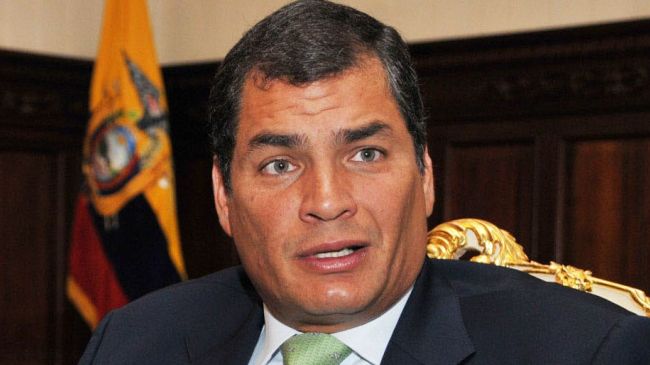 Ecuador has announced its withdrawal from the Inter-American Treaty of Reciprocal Assistance, a hemispheric agreement of mutual defense signed in 1947.
On Wednesday, Ecuador Foreign Ministry said President Rafael Correa pulled the country out of the US-led security arrangement on the grounds it is outdated, AFP reported.
The Foreign Ministry said Correa signed a decree on Tuesday, ratifying a decision earlier this month by the National Assembly to withdraw from the treaty.
“Ecuador renounces in all its articles the Inter-American Treaty of Reciprocal Assistance,” the ministry said.
The treaty, commonly known as the Rio Treaty, stipulates that an armed attack against any of the member states is to be considered an attack against all of them.
Ecuador ratified the treaty in 1950.
The move is the latest in a shift away from US-led security arrangements in the region by Ecuador and other leftist Latin American allies.
At the end of an annual meeting of the Organization of American States (OAS) in Bolivia in 2012, the foreign ministers of Bolivia, Venezuela and Nicaragua announced their decision to pull out of the treaty, saying the regional defense treaty is a US initiative and membership is not beneficial to them.
Featured Video

Diplomacy is Now a Crime in Britain / Ian Proud
or go to
Aletho News Archives – Video-Images
From the Archives
Genetic baloney in thick slices
MAYBE COULD BE INC.
By Jon Rappoport | No More Fake News | July 8, 2021
Gene research companies tend to come and go. They start out banging and popping like fireworks in the sky, and then they fade out—selling themselves to larger outfits who’ve hired better liars…
Once upon a time, it sounded easy. Start with a disease, find the gene responsible for the disease, and correct the problem.
Then, researchers wondered, was disease the result of one gene or a group of genes acting together?
Either way, the proof would be in devising cures for diseases using gene therapy. “Not yet, but soon…”
And regardless, the major need was: money. Lots and lots of money.
This need required good PR people. “We have to pump up the idea that we’re on the edge of tremendous breakthroughs. We’re always on that edge…”
This hype also needed to obscure the fact that there wasn’t (and isn’t) ANY gene cure for ANY disease. … continue
Blog Roll
 Aletho News
- Diplomacy is Now a Crime in Britain / Ian Proud
- UK Government Body Kept Files on People Criticizing Prevent Program
- US military withdrawal from Iraq and the collapse of US-Israeli hegemonic project in West Asia
- What does Europe want – a war with Russia?
- She Followed the Actual Data on COVID Vaccines and Masks — Her Career Took a Huge Hit
- Florida AG Sues Pfizer, Bourla Over Deceptive Marketing of COVID Vaccines
- Von der Leyen gifts her spin doctor a job for life
- 10K More U.S. Troops Deploy as Trump Weighs New Iran Strikes /Suliaman Ahmed
- Iranian crew declared Dena training vessel ‘unarmed’ to US warship before deadly torpedo strike: Report
- Iran’s NPT debate moves beyond parliament
- If Americans Knew
- Israel is squeezing the life out of Palestinians – Daily Update
- The Israeli Right Portrays Islam as Murderous. It Serves a Political Purpose
- Jordan Has Had Enough: King Abdullah’s Scathing Warning to Israel
- Israeli Colonizers (i.e. Settlers) Kill Palestinian Man Near Salfit
- New Google Maps images reveal massive scale of devastation in Gaza
- Jewish supremacy, anti-Palestinian bigotry on display in Israel – Daily Update
- Israeli Soldiers Abduct At Least 22 Across Occupied West Bank
- Eight Palestinians Killed in Israeli Attacks on Gaza
- Israeli former leaders and security chiefs threaten legal action over ‘Jewish terrorism’
- Israel map in LA Times ad includes all land from the river to the sea
- No Tricks Zone
- Green Energy Debacle: German Expert Professor Fritz Vahrenholt Warns Of Severe Economic And Social Consequences
- Two More Paleo Reconstructions Affirm Meters-Higher Sea Levels Across Ireland, Brazil 7000-6000 Years Ago
- New Study: Earth And Venus Surface Warmth Largely Explained By Convection And Lapse Rate, Not CO2 Or Radiation
- 2025 Nature Paper Claiming Worsening Global Drought Gets RETRACTED …Heavily Flawed
- New Study: ‘Global Drought Shows No Detectable Recent Acceleration Under Climate Warming’
- Economic Masterminds: German Socialists Suggest Taxing Productivity Gains Stemming From Using AI
- The South China Sea Has Not Been Cooperating With The Climate Change Narrative
- Energy Crisis: Germany Enters Heating Season With Historically Low Gas Reserve Fill Levels
- New Study: The Antarctic Ice Sheet Gained Mass From 2020-2024 Due To Staggering Snow And Ice Accumulation
- Study: Ocean Heating Rates From Thousands Of Years Ago ‘Dwarf’ Modern Ocean Heating Rates

