Okinawa: Two Elections
By C. Douglas Lummis | CounterPunch | February 5, 2014
Naha, Okinawa – The 2010 Governor’s election in Okinawa was a game changer. Up to then the pattern of elections here had been, a progressive candidate clearly opposed to the US military bases on the island, vs. a conservative candidate who was not positively in favor of them, but took the attitude, if we can’t get rid of them we might as well make a little money off them.
In 2010 the issue on the table was not all the bases, but what to do with the US Marine Air Station at Futenma, in the middle of densely populated Ginowan City. In 1996 the US and Japanese Governments had announced that they would close it down, but only on the condition that the 1st Marine Air Wing, which it houses, be moved to a new base to be built offshore from the fishing village of Henoko, in the less populated northern part of Okinawa. This construction has been fiercely opposed by Okinawans. Pacifists argue that the base should be abolished altogether; ecologists and fisher-people point out that construction would be devastating to the coral-rich Oura Bay, habitat to the endangered sea-mammal the dugong; Okinawans generally feel that the Government’s insistence that the base stay on their island amounts to discriminatory treatment. Okinawa comprises 0.6% of Japanese territory, but just under 75% of all US bases in Japan are located here. More and more people are using the word “colonialism” to describe this. Thus after the 1996 announcement the Okinawans, by means of rallies, demonstrations, lawsuits, petitions, sit-ins, and direct action civil disobedience, have so far prevented construction from beginning.
In 2010 the incumbent conservative Governor Nakaima Hirokazu [family name first, following East Asian practice], who had been elected on the What the Hell can you do about it? ticket, was advised that the electorate had changed, and that he could not be reelected unless he changed his position. This he did, saying that now he favored moving the Futenma base to mainland Japan. This enabled him to pick up the support of people who were not ready to oppose all the US bases, but who resented the unequal treatment.
The result was an election in which both the progressive and the conservative candidates opposed moving the Futenma base to a different location within Okinawa. There was a third candidate, from the crackpot Happiness Realization Party, who supported the US-Japan plan to move the base to Henoko. The progressive and conservative candidates between them got 97% of the votes; the only party that supported the US-Japan plan got a little over 2%. It’s not often that you see that kind of agreement in a free election. In that election the US-Japan plan was supported only by the crazies. Governor Nakaima, campaigning on the slogan Move the Base to the Mainland, was re-elected.
For three years after that, Governor Nakaima put on a pretty convincing performance. Again and again Prime Ministers, Foreign Ministers, Defense Ministers came to his office trying to persuade him to accept the Henoko base plan, and again and again he sent them packing, sometimes after only a few minutes. (One of them, I think it was a Foreign Minister – these fellows have been changing like a game of musical chairs in recent years so it’s hard to remember – was caught on TV looking at his watch to see how much time he had got, as the Governor walked out of the room.) During that period not only the governor, but many Okinawan Liberal Democratic Party politicians, defying their Party headquarters in Tokyo, came out against the base plan. People began to talk about an All Okinawa Anti-Base Movement. Increasingly anti-base activists, instead of appealing for sympathy, were calling the plan “impossible”.
Last year the Tokyo Government, after completing a survey of Oura Bay, wrote up an environmental impact report and handed it to the Governor for his approval, without which they cannot legally begin reclamation work in the Bay. He set up a committee, and they fiddled with it for the better part of a year. Many people believed, I among them, that Nakaima would reject it in the end: why would anyone want to put their name on a document that claims that dumping several millions of tons (or whatever the amount is) of dirt and junk into a coral bay will have no detrimental effect on the environment? But at the end of December last year, he approved it, which opened the way for construction to begin. Most people were stunned, though there was also a minor chorus of I Told You So. In exchange the Governor claimed to have gotten some major gifts and concessions from Tokyo, a mess of pottage that turned out to be mostly promises that won’t be kept and aid money that Okinawa Prefecture was entitled to anyway. It continues to amaze me that a person presented with the opportunity to become a hero whose name would be passed on in Okinawan culture for generations, would instead choose to be remembered as a liar and a turncoat. There is a strong movement calling for his resignation or, failing that, his recall.
It seemed that Okinawa was in danger of falling into despondency and resignation. But there was one more test coming up. Just a couple of weeks after Nakaima’s collapse, on January 19, there was the election for Mayor of Nago City, of which Henoko is an administrative part. The incumbent Mayor, Inamine Susumu, had been elected on the public promise that he would oppose new base construction in the city. Two candidates declared against him, both supporting base construction. For the Abe Shinzo Government, this was a must-win election. First they sent down a gang of top Party and Government officials to persuade one of the pro-base candidates to stand down – a very unusual case of interference in local politics (of course, they were successful). Then when campaigning began they sent down Party and Government superstars to join in the electioneering. A lot of dubious money is said to have been passed around. Nago is the home of several of the construction companies which would likely get the reclaiming contracts, and which also have political clout in the city. Presumably a lot of pressure was put by those and other companies on their employees. In the last days of the campaign the Liberal Democraic Party’s Secretary General Ishiba suddenly announced that if the pro-base candidate won Nago would be rewarded with 50 billion yen (about $500 million) in extra aid. It was the town of Nago, population 62000, vs. the state of Japan, and to the last moment no one knew which side would win.
Inamine won, by a healthy margin. Okinawa’s temptation to despondency ended after just a few weeks. This has got to be remembered as one of the great election victories in the history of democracy. Nago would not be bought; the voters took the aid offer as an insult. Immediately after the election, Inamine announced that he would use his powers as Mayor, not to appeal to Tokyo to reconsider their plan, but positively to prevent it from going forward. Concretely, he said he would prohibit any construction-related use of roads, harbors or rivers that are under the City’s administration, and that he would not participate in any negotiations that presuppose base construction. Inamine, incidentally, is not a professional politician or an ex-movement activist. Before he ran for Mayor he was an official in the City’s Board of Education. To this day he goes out every morning to work as a traffic safety volunteer at a corner where kids cross the street on the way to school. There is a good lesson in politics here: You don’t need charisma; all you need is to say “no”. It’s also a lesson in popular sovereignty. The Tokyo Government says, We will decide. The people of Nago reply, No, we have decided. Like they say, it takes a village.
The Abe Shinzo Government has painted itself into a corner. They continue to tell the US Government, and the world, that they will build the new base at Henoko anyway. They say they will “persuade” Inamine, but it looks like that can’t be done. Will they rewrite the law, to take away the Mayor’s powers? Will they send in the Riot Police, or maybe the Self-Defence Forces? Will they revive the method used by the US military to get land for bases right after the Battle of Okinawa, the method known here as “bulldozers and rifles”? Of course all these are possible, but they will be made less possible the more the Nago situation comes to the attention of people around the world. That’s why it’s a good thing that some overseas supporters of the Okinawa anti-base movement, beginning with Oliver Stone and Peter Kuznick who visited Okinawa last year, after the election drafted a letter of solidarity that has been signed by over 100 writers, scholars, movie makers and others. This has evolved into a general petition campaign on the internet. I have no illusion that submitting this petition to President Obama and Prime Minister Abe will have any effect on their consciences. What it will do is send a message to the people of Nago that they are not isolated. And by making clear to both heads of state that the whole world is watching it will make it difficult for them to use dirty tricks or violence to get their way in Nago.
The petition can be accessed at http://chn.ge/1ecQPUJ
Douglas Lummis is a political scientist living in Okinawa and the author of Radical Democracy. Lummis can be reached at ideaspeddler@gmail.com
Related articles


Karzai sees ‘no good’ with US presence in Afghanistan
Press TV – February 3, 2014
Afghan President Hamid Karzai says he has seen “no good” with the presence of American forces in his country, prompting further speculations of a breakdown of trust between Kabul and Washington.
“This whole 12 years was one of constant pleading with America to treat the lives of our civilians as lives of people,” Karzai said in an interview with The Sunday Times.
Karzai also said that he has not spoken to US President Barack Obama since June last year, which may show the increasing gulf between Afghanistan and the US.
“We met in South Africa but didn’t speak. Letters have been exchanged,” he said, referring to the funeral ceremony for South African anti-Apartheid leader Nelson Mandela.
The differences between the two sides have grown increasingly since Karzai refused to sign a security pact with Washington that would allow thousands of foreign troops to stay in Afghanistan after 2014.
“The money they should have paid to the police they paid to private security firms and creating militias who caused lawlessness, corruption and highway robbery,” Karzai said.
The Afghan president also went on to say that the US-led forces “then began systematically waging psychological warfare on our people, encouraging our money to go out of our country.”
“What they did was create pockets of wealth and a vast countryside of deprivation and anger,” he said.
“In general, the US-led NATO mission in terms of bringing security has not been successful, particularly in Helmand,” Karzai said.
He also dismissed concerns about the cutting of Western financial aid to Afghanistan over his refusal to sign the security deal.
“Money is not everything,” he said, adding, “If you ask me as an individual, I would rather live in poverty than uncertainty.”
On Wednesday, US Defense Secretary Chuck Hagel expressed deep frustration with Karzai over the prolongation of the review process for the signing of the Bilateral Security Agreement (BSA) with the US.
The Pentagon chief, however, stated that Karzai is the elected president of a sovereign country, and Washington’s ability to influence his decisions is limited.
Karzai says he will not sign the BSA until certain conditions are met, including a guarantee from Washington that there will be no more raids on Afghan houses. He says the demands come from the country’s highest decision-making body, the Loya Jirga.
In his speech at the Loya Jirga on November 24, 2013, Karzai said, “If US military forces conduct military operations on Afghan homes even one more time, then there will be no BSA and we won’t sign it.”
The US and its allies invaded Afghanistan on October 7, 2001 as part of Washington’s so-called war on terror. The offensive removed the Taliban from power, but after more than 12 years, the foreign troops have still not been able to establish security in the country.
Russia threatens to quit START as US deploys Aegis destroyer to Spain
RT | February 2, 2014
The US has deployed a ballistic missile defense destroyer to Spain to boost NATO’s anti-missile shield in Europe. The move, allegedly aimed at curbing the Iranian threat, has sparked talks about Russia possibly scrapping the START nuclear treaty.
The deployment of the Navy destroyer USS Donald Cook, equipped with the Aegis shipboard integrated combat weapons system, was announced by US Defense Secretary Chuck Hagel at the Munich Security Conference on Saturday.
“An important posture enhancement is European missile defense in response to ballistic missile threats from Iran,” Hagel said, adding that the US is committed “to deploying missile defense architecture there,” as a part of Phase 3 of the European Phased Adaptive Approach (EPAA).
Hagel also said that over the next two years, three additional Aegis-enabled missile defense-capable destroyers will join the effort to protect NATO countries on the European continent.
“Despite fiscal constraints, the budget that we will release next month fully protects our investment in European missile defense,” Hagel said, reiterating views he also expressed on a visit to Poland earlier last week.
“There are some capabilities that the United States military will continue to invest heavily in,” Hagel told the Munich conference. “We will continue to be the world leader in those kinds of capabilities.”
In his Munich speech, Hagel also mentioned that China and Russia “are rapidly modernizing their militaries and global defense industries, challenging our technological edge and defense partnerships around the world.”
The USS Donald Cook will become the first of four ballistic missile defense (BMD)-capable ships based in Europe. It will be joined by the destroyer Ross in a few months, while Carney and Porter will reach European waters in 2015.
The US Navy estimates that 1,239 military personnel will move to Spain’s port of Rota as part of the EPAA plan, according to the Congressional Research Service. The move will cost $92 million, with another $100 million being spent annually on maintaining the ships in Spain.
The Obama administration claims this deployment will serve to protect US allies in Europe from Iranian and possibly North Korean missile threats.
The movement of the four destroyers to Spain and a creation of a ground-based radar is Phase 1 of the EPAA. Phase 2 is the installation of the Aegis Ashore armed with Standard SM-3 IB interceptor missiles in Romania. Phase 3 of EPAA is the creation of Polish Aegis Ashore installation, armed with SM-3 IIA missiles. Phase 4, involving deployment of SM-3 IIB missiles, was canceled by the US in March 2013.
The destroyers in Spain are known as “forward deployed naval forces” (FDNF), as they enable the US Navy to provide more forward-based presence with fewer ships, and also cut down on the transit time when tackling a wide range of threats.
“Permanently forward-deploying four ships in Rota will enable us to be in the right place, not just at the right time, but all the time,” Navy Secretary Ray Mabus said, Defense News reported.
Russia may consider withdrawing from START treaty
In the meantime, if the US continues boosting its anti-missile capabilities through developing its missile defense system in Europe, Russia may eventually be forced to withdraw from the Strategic Arms Reduction Treaty (START), the Russian Foreign Ministry’s top disarmament official, Mikhail Ulyanov, has warned.
“We are concerned that the US is continuing to build up missile defense capability without considering the interests and concerns of Russia,” Ulyanov told Interfax. “Such a policy can undermine strategic stability and lead to a situation where Russia will be forced to exercise [its] right of withdrawal from the [START] treaty.”
Ulyanov said that the legal basis for Moscow to scrap the START treaty is legislated for within the text of the agreement, which Russia says it has so far fully implemented. In certain exceptional cases, involving a known threat to national security, both Russia and the US have the option to quit the treaty.
“The statement on missile defense made by the Russian side on April 8, 2010, at the signing of the START Treaty, explicitly states that such exceptional circumstances include the build-up of missile defense systems by the United States, which threatens the potential of Russian Federation’s strategic nuclear forces,” Ulyanov said. “A similar [regulation] is contained in the Federal Law on the Ratification of the New START treaty.”
Ulyanov said that “at the current stage” Russian experts estimate that the US missile defense system “has not yet reached a level that would represent a threat to the efficiency of Russian strategic deterrence forces.”
Moscow hopes to eventually come to terms with Washington on the issue of European missile shield, Ulyanov said. “Such a chance, of course, remains, but everything depends on the political will of the US.”
The New START Treaty was signed between US and Russia in April 2010 and entered into force after ratification in February 2011. It is planned to last until at least 2021.
Britain, France vow to strengthen cooperation in defense, nuclear energy
Xinhua | January 31, 2014
LONDON — British Prime Minister David Cameron and French President Francois Hollande agreed Friday to beef up the two countries’ cooperation in defense, nuclear energy and climate policy.
Britain and France inked the cooperation deals at the UK-France Summit 2014 held in British royal air force station RAF Brize Norton in Oxfordshire of southeast England.
The two countries issued a communique setting out plans for joint investment in the procurement of defense equipment, joint training of armed forces and continued development of the Combined Joint Expeditionary Force, an Anglo-French joint military training and operation program.
“Britain and France are natural partners for defense cooperation,” British Defense Secretary Philip Hammond said, adding that the agreements reached at the summit would enhance the “interoperability” of British and French forces.
According to the agreements, the two countries are set to launch a two-year-long joint feasibility study program with an investment of 120 million pounds (about 197.4 million U.S. dollars) for a future Anglo-French combat air system.
Britain and France also agreed to invest in Britain’s major nuclear weapons base, the Atomic Weapons Establishment, to carry out safe testing of British and French stockpiles and achieve greater sharing of technical and scientific data for joint research.
The two nations pledged to join hands in tackling security issues, such as terrorism and drug and arms trafficking, in north and west Africa, as well as building on international peacekeeping missions in Libya, Mali and the Central African Republic.
In addition, the two sides declared their commitment to developing safe nuclear energy, collaborating on new nuclear power stations, combating climate change and pushing for European Commission’s domestic emissions reduction agenda.
“We reiterated our resolve to work together towards achieving an ambitious and legally-binding agreement at the next COP (UN Conference of the Parties on Climate Change) in Paris in 2015,” said Edward Davey, British Secretary of State for Energy and Climate Change.
See also: Britain, France sign nuclear energy agreement
Related articles


Israel prepares world opinion for high civilian casualties in any future war with Hezbollah
MEMO | January 30, 2014
Israel accused Hezbollah on Wednesday of setting up military bases inside residential buildings and threatened that it would target these bases in any future conflict, even if civilians are killed.
According to Israeli officials, Iran and Syria have supplied more sophisticated missiles to Hezbollah, which defended Lebanon against the technologically superior Israeli military in July 2006.
Israeli newspaper the Jerusalem Post reported that: “The unusually explicit threat by air force chief Major General Amir Eshel appeared to be part of an effort by Israeli officials to prepare world opinion for high civilian casualties in any new confrontation with Hezbollah in Lebanon.”
The newspaper noted that last year Israeli Defence Minister Moshe Ya’alon showed UN Secretary-General Ban Ki-moon an Israeli map of alleged military sites for Hezbollah in villages in southern Lebanon, further suggesting that Israel is threatening a high civilian death toll in any future war.
According to Agence France Presse, during the July 2006 war 1,287 Lebanese died, nearly all civilians, and 4,054 were wounded when Israeli forces intentionally inflicted severe damages to civilian infrastructure, especially in southern Lebanon and in the capital city of Beirut.
Lebanese president, Michel Suleiman, has called the Israeli threats to strike residential and civilian areas in his country “a flagrant violation of human rights principles.”
He added that the Israeli position is “an attempt to spread a sense of instability among the Lebanese citizens, the thing which the enemy wants, as Israel is happy about the turbulence that is taking place in the Arab region.”
US Congress secretly approves sending small arms to ‘moderate’ Syrian rebels
RT | January 28, 2014
Congressional lawmakers have quietly authorized sending small arms, an assorted variety of rockets, and financial backing to so-called “moderate” rebels fighting in Syria’s civil war, according to a new report.
American and European security officials told Reuters that the US will provide anti-tank rockets, but nothing as deadly as shoulder-launched surface-to-air missiles (known as MANPADs), which can be used to bring down military or civilian aircraft.
Legislators voted in closed-door meetings to fund the opposition forces through September 30, the end of the US government’s fiscal year. The decision is an about-face from congressional debates last year, in which the same committees were reluctant to supply arms over concerns that American weapons would wind up in the hands of radical Islamists fighting in the region, the Al-Qaeda-backed Al-Nusra being the most well known.
Now, though, those concerns appear to have lessened. Exactly when Congress approved the funding is not known, yet the sources speculated that it was signed in a classified section of a defense appropriations bill that was approved in December.
“The Syrian war is a stalemate,” said Bruce Riedel, a former CIA analyst and current foreign policy advisor to US President Obama with the Brookings Institution. “The rebels lack the organization and weapons to defeat Assad; the regime lacks to loyal manpower to suppress the rebellion. Both sides’ external allies…are ready to supply enough money and arms to fuel the stalemate for the foreseeable future.”
Despite the uncertainty remaining around the conflict, Western officials have asserted in recent weeks that “moderate” rebels have strengthened their positions in the south of Syria and have begun excluding Al-Qaeda sympathizers. Extremists are known to be in control of rebel forces in the north and east, however.
US and British officials temporarily suspended “non-lethal aid” (a category that includes communications equipment and transportation vehicles) in December, although officials now say they hope to resume providing assistance to the Supreme Military Council (SMC), which oversees rebel forces favored by the West.
“We hope to be able to resume assistance to the SMC shortly, pending security and logistics considerations,” one source told Reuters. “But we have no announcement at this time.”
News of the funding comes as the Syrian government and the external opposition in Geneva have reached an agreement that would see humanitarian aid enter the besieged city of Homs, and would allow women and children to leave its war-ravaged areas.
What makes the deal dubious, however, is that it’s not yet clear how it will be implemented on the ground. Currently, the Syrian government is promising – voiced on Sunday by Deputy Foreign Minister Faisal Mekdad – that women and children can leave Homs safely. Another question is how rebels inside the city besieged by the army will react.
“If the armed terrorists in Homs allow women and children to leave the old city of Homs, we will allow them every access. Not only that, we will provide them with shelter, medicines and all that is needed,” he said, as cited by Reuters. “We are ready to allow any humanitarian aid to enter into the city through the arrangements made with the UN.”
US State Department spokesman Edgar Vasquez said that an evacuation is not a legitimate option because of how dire the need for aid is.
“We firmly believe that the Syrian regime must approve the convoys to deliver badly needed humanitarian assistance into the Old City of Homs now,” Vasquez said. “The situation is desperate and the people are starving.”
The results of a meeting in Geneva, Switzerland – where government officials sat across the negotiating table from representatives of the opposition on Monday – is so far unclear. Each side pledged its willingness to continue discussions, though progress so far has been nearly nonexistent.
United Nations envoy Lakhdar Brahimi told reporters after the meeting Monday that even though the talks “haven’t produced much,” another session was scheduled for Tuesday.
“Once again, I tell you we never expected any miracle, there are no miracles here,” he said in a news conference. “My expectation from this conference is that the unjust war will stop. But I know this is not going to happen today or tomorrow or next week.”
France to expand military presence in Africa
Press TV – January 25, 2014
French Defense Minister Jean-Yves Le Drian says the country is to expand its military presence in Africa’s Sahel region.
“This redeployment will cover about 3000 troops which we are about to reorganize and re-deploy all over the area,” Le Drian said in an address to the Center for Strategic and International Studies in Washington, D.C. on Friday.
The Sahel spans 5,400 kilometers from the Atlantic Ocean in the west to the Red Sea in the east.
“I wanted to say all this to you because we think that the intervention in Mali is not enough. We have to go beyond,” he added.
France began a major military intervention in its former colony in January, citing concerns about the growing influence of militants in northern Mali and a rebellion by Tuareg separatists that threatened the French-backed Malian government.
“We have to protect ourselves against different risks, new risks and especially, tomorrow, against the risk of a Libyan chaos,” said the French minister.
Ecuador to urge US military withdrawal
Press TV – January 23, 2014
Ecuador’s President Rafael Correa has announced plans to call for the withdrawal of some US military officers from the South American country.
 Speaking at the Carondelet presidential Palace in the Ecuadorian capital Quito on Wednesday, Correa said his government will ask Washington to withdraw “nearly 50 military personnel” assigned to the US embassy in the Latin American country.
He described the number of American military personnel in Ecuador as “inconceivable,” saying, “Unfortunately, these people have been so infiltrated in all the sectors that what is scandalous appeared normal.”
Correa also noted that Quito was “already taking measures” to address the outsized presence of the US forces.
The remarks came after revelations concerning the presence of four US military personnel in an Ecuadoran military helicopter that came under fire in October last year near the border with Colombia.
“They (the US troops) flew in the helicopters of the air force, of the army. It was normal for foreign soldiers to be flying with our soldiers in frontier areas,” he said.
Meanwhile, the US embassy said it has not received any request from the Ecuadorian government yet.
In 2009, Quito refused to renew an agreement with Washington on counter-narcotics operations after accusing it of financing opposition groups.
Related articles


America on MLK’s Birthday: The Trifecta of Evils
A Black Agenda Radio commentary by executive editor Glen Ford | January 22, 2014
When Dr. Martin Luther King died at the age of 39, he was quite clear about who and what was at the root of human suffering. He believed that “racism, militarism and extreme materialism” were the “giant triplets“ of “interrelated” evil that had to be overcome if society was to be transformed. Dr. King said the United States was host to all three resident evils, and that America reigned as “the greatest purveyor of violence in the world, today.” Forty-six years later, the United States clearly leads the world in all three of Dr. King’s categories of evil. And, we can prove it by the numbers.
It is true that racism is hard to measure, but the effects of racism can be quantified. If a racist government is defined as one that consistently uses its powers in ways that harm a particular racial group, then the U.S. is indisputably the most racist major state in the world. The U.S. prison population is by far the largest on the planet, in sheer numbers and in the proportion of Americans locked up. No other country comes close – which makes the United States the superpower of mass incarceration. America’s police and prison custodial forces dwarf the militaries of most countries – which tells us that militarism is now so deeply embedded in U.S. domestic structures that you can’t tell where the military ends and the police begin. Nearly half of U.S. prisoners are African American, although Blacks are only one-eighth of the total U.S. population. Since Americans make up fully one-quarter of the world’s prison inmates, that means one out of every eight prisoners on the planet is an African American. This could only occur in a thoroughly racist state, whose institutions work overtime to produce the biggest and most racially unbalanced incarceration numbers on Earth. Clearly, America has racism – triple evil number one – covered.
Number two is militarism. The U.S. military budget is almost as large as the military spending of all the world’s other nations, combined. Together, the U.S. and its NATO allies account for more than 70 percent of global weapons spending. At last count, the U.S. spent six times more on war than China, and 11 times more than Russia. In fact, if you count up the U.S. and all of its allies, they are probably responsible for about 90 percent of total moneys spent on war. Therefore, today, 46 years after Dr. King’s death, the United States is not just the greatest purveyor of violence in the world – it is right at the center of just about the totality of militarized violence in the world, today. Which is why a recent international poll shows that the people of the world think the U.S. is the most significant threat to peace.
Finally, the third of the triple evils: extreme materialism. By that, Dr. King meant great disparities in wealth and income. According to the Suisse Global Wealth Databook, wealth is so unevenly distributed in the United States, it no longer resembles a First World country. Of all the rich nations, the U.S. is dead last in terms of material equality.
So, by Dr. Martin Luther King’s measurements, America is in bad shape – more bedeviled by the triple evils than back in his day. In fact, things are much, much worse because…it’s the silence that kills you.
~
BAR executive editor Glen Ford can be contacted at Glen.Ford@BlackAgendaReport.com.
Related article

Unilateral missile defence plans great challenge to non-nuclear world – Russian envoy
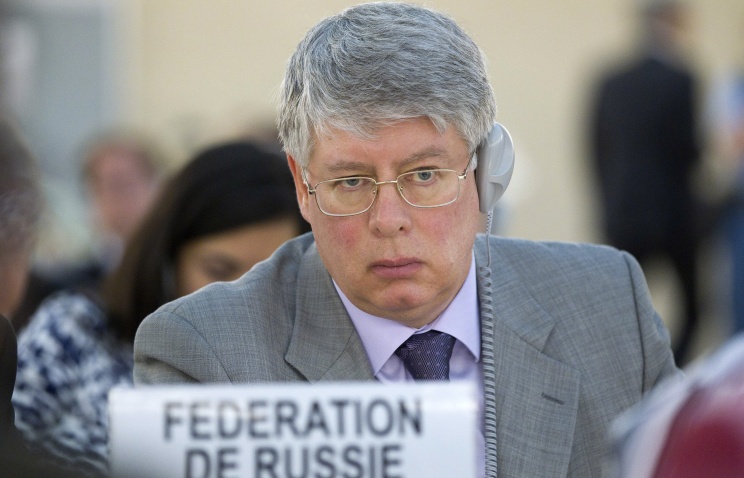
Permanent Representative of Russia to the United Nations and other International Organizations in Geneva Alexei Borodavkin
EPA/Salvatore Di Nolfi
ITAR-TASS | January 21, 2014
GENEVA – Unilateral plans for creating a global missile defense are the strongest challenge to the idea of ridding the world of nuclear weapons, Russia’s permanent representative at the UN office and other international organizations in Geneva, Alexei Borodavkin, told the conference on disarmament on Tuesday.
“Russia’s and the United States’ experience of implementing a number of agreements on the reduction of nuclear arsenals indicates that a short way towards a common goal simply does not exist,” he said. “Also, the situation in the modern world to my deep regret by no means promotes the conclusion of more agreements in the nuclear disarmament sphere.”
According to the diplomat, “some negative factors that undermine strategic stability” have been gaining strength.
“Unilateral plans for creating a global missile defense system are the strongest challenge on the road to a nuclear-weapons-free world,” Borodavkin said. They are fraught with an anti-destabilizing potential. They contradict the fundamental principle of impermissibility of strengthening one’s own security to the detriment of others.
“Abuse of this principle, in view of the inseparable link between the defense and strategic offensive weapons, may have extremely negative consequences in various spheres, including the disarmament agenda,” the Russian envoy said.
Borodavkin said that alongside the missile defense one should remember plans for the implementation of the concept of an instant global strike, imbalances in conventional armaments, and insufficient progress towards the enforcement of the NPT treaty.
“We are certain that all countries having nuclear potentials should join the efforts in the field of nuclear disarmament,” he said.
Related article

The endless arms race
By Lawrence Wittner | International Physicians for the Prevention of Nuclear War | January 21, 2014
It’s heartening to see that an agreement has been reached to ensure that Iran honors its commitment, made when it signed the 1970 nuclear Non-Proliferation Treaty (NPT), to forgo developing nuclear weapons.
But what about the other key part of the NPT, Article VI, which commits nuclear-armed nations to “cessation of the nuclear arms race at an early date and to nuclear disarmament,” as well as to “a treaty on general and complete disarmament”? Here we find that, 44 years after the NPT went into force, the United States and other nuclear powers continue to pursue their nuclear weapons buildups, with no end in sight.
On January 8, 2014, U.S. Defense Secretary Chuck Hagel announced what Reuters termed “ambitious plans to upgrade [U.S.] nuclear weapons systems by modernizing weapons and building new submarines, missiles and bombers to deliver them.” The Pentagon intends to build a dozen new ballistic missile submarines, a new fleet of long-range nuclear bombers, and new intercontinental ballistic missiles. The Congressional Budget Office estimated in late December that implementing the plans would cost $355 billion over the next decade, while an analysis by the independent Center for Nonproliferation Studies reported that this upgrade of U.S. nuclear forces would cost $1 trillion over the next 30 years. If the higher estimate proves correct, the submarines alone would cost over $29 billion each.
Of course, the United States already has a massive nuclear weapons capability — approximately 7,700 nuclear weapons, with more than enough explosive power to destroy the world. Together with Russia, it possesses about 95 percent of the more than 17,000 nuclear weapons that comprise the global nuclear arsenal.
Nor is the United States the only nation with grand nuclear ambitions. Although China currently has only about 250 nuclear weapons, including 75 intercontinental ballistic missiles (ICBMs), it recently flight-tested a hypersonic nuclear missile delivery vehicle capable of penetrating any existing defense system. The weapon, dubbed the Wu-14 by U.S. officials, was detected flying at ten times the speed of sound during a test flight over China during early January 2014. According to Chinese scientists, their government had put an “enormous investment” into the project, with more than a hundred teams from leading research institutes and universities working on it. Professor Wang Yuhui, a researcher on hypersonic flight control at Nanjing University, stated that “many more tests will be carried out” to solve the remaining technical problems. “It’s just the beginning.” Ni Lexiong, a Shanghai-based naval expert, commented approvingly that “missiles will play a dominant role in warfare, and China has a very clear idea of what is important.”
Other nations are engaged in this arms race, as well. Russia, the other dominant nuclear power, seems determined to keep pace with the United States through modernization of its nuclear forces. The development of new, updated Russian ICBMs is proceeding rapidly, while new nuclear submarines are already being produced. Also, the Russian government has started work on a new strategic bomber, known as the PAK DA, which reportedly will become operational in 2025. Both Russia and India are known to be working on their own versions of a hypersonic nuclear missile carrier. But, thus far, these two nuclear nations lag behind the United States and China in its development. Israel is also proceeding with modernization of its nuclear weapons, and apparently played the key role in scuttling the proposed U.N. conference on a nuclear weapons-free zone in the Middle East in 2012.
This nuclear weapons buildup certainly contradicts the official rhetoric. On April 5, 2009, in his first major foreign policy address, President Barack Obama proclaimed “America’s commitment to seek the peace and security of a world without nuclear weapons.” That fall, the UN Security Council — including Russia, China, Britain, France, and the United States, all of them nuclear powers — unanimously passed Resolution 1887, which reiterated the point that the NPT required the “disarmament of countries currently possessing nuclear weapons.” But rhetoric, it seems, is one thing and action quite another.
Thus, although the Iranian government’s willingness to forgo the development of nuclear weapons is cause for encouragement, the failure of the nuclear nations to fulfill their own NPT obligations is appalling. Given these nations’ enhanced preparations for nuclear war — a war that would be nothing short of catastrophic — their evasion of responsibility should be condemned by everyone seeking a safer, saner world.
Lawrence S. Wittner (http://lawrenceswittner.com) is Professor of History emeritus at SUNY/Albany. His latest book is a satirical novel about university corporatization, What’s Going On at UAardvark?
Related articles


UK to spend $6.5 bln on military drones
Voice of Russia | January 19, 2014
Britain announced its plans to spend more than $6.5 billion to purchase 657 military drones, the Sunday People reports. It includes 10 Reaper MQ-9s, which are armed with Hellfire missiles plus laser-guided 500lb bombs and can hover 20,000ft above targets for more than 20 hours.
According to the publication, Reapers could be operated 3,500 miles away from Afghanistan’s warzones by a two-man crew. Yet, most of the drones will be unarmed and constructed for spy or fly recce missions.
A Freedom of Information request found the biggest number of UK drones are the 324 Black Hornet Nano micro-helicopters, only four inches long and an inch wide (100x25mm). They fly over insurgent strongholds to film and take pictures. Then there are 222 Desert Hawks, plastic spy-drones with a 4ft 3in wingspan (1.3m).
For tougher operations, 54 Watchkeepers can stay aloft for 17 hours. Nine more are due in service soon to replace ageing Hermes 450s. By contrast 30 Tarantula Hawks weigh just 20lbs apiece and are used as recce aides by bomb-disposal teams in Afghanistan.
Lastly there are eight ScanEagles, a specialist drone being used in the campaign against Somali pirates.
Drones are likely to make up a third of all RAF working aircraft by 2030 but human rights groups fear they could be used to spy on the innocent public.
Although using unmanned aircraft in military operations is criticized by many people all over the world, the UK keeps on saying that drones are an effective weapon and should be used more in the foreseeable future.
Despite critics’ claims that drones often kill civilians, the UK says that only one civilian was killed as a result of 459 missile strikes from its unmanned Reaper aircraft in Afghanistan.
Related article

Featured Video

Diplomacy is Now a Crime in Britain / Ian Proud
or go to
Aletho News Archives – Video-Images
From the Archives
Genetic baloney in thick slices
MAYBE COULD BE INC.
By Jon Rappoport | No More Fake News | July 8, 2021
Gene research companies tend to come and go. They start out banging and popping like fireworks in the sky, and then they fade out—selling themselves to larger outfits who’ve hired better liars…
Once upon a time, it sounded easy. Start with a disease, find the gene responsible for the disease, and correct the problem.
Then, researchers wondered, was disease the result of one gene or a group of genes acting together?
Either way, the proof would be in devising cures for diseases using gene therapy. “Not yet, but soon…”
And regardless, the major need was: money. Lots and lots of money.
This need required good PR people. “We have to pump up the idea that we’re on the edge of tremendous breakthroughs. We’re always on that edge…”
This hype also needed to obscure the fact that there wasn’t (and isn’t) ANY gene cure for ANY disease. … continue
Blog Roll
 Aletho News
- Diplomacy is Now a Crime in Britain / Ian Proud
- UK Government Body Kept Files on People Criticizing Prevent Program
- US military withdrawal from Iraq and the collapse of US-Israeli hegemonic project in West Asia
- What does Europe want – a war with Russia?
- She Followed the Actual Data on COVID Vaccines and Masks — Her Career Took a Huge Hit
- Florida AG Sues Pfizer, Bourla Over Deceptive Marketing of COVID Vaccines
- Von der Leyen gifts her spin doctor a job for life
- 10K More U.S. Troops Deploy as Trump Weighs New Iran Strikes /Suliaman Ahmed
- Iranian crew declared Dena training vessel ‘unarmed’ to US warship before deadly torpedo strike: Report
- Iran’s NPT debate moves beyond parliament
- If Americans Knew
- Israel is squeezing the life out of Palestinians – Daily Update
- The Israeli Right Portrays Islam as Murderous. It Serves a Political Purpose
- Jordan Has Had Enough: King Abdullah’s Scathing Warning to Israel
- Israeli Colonizers (i.e. Settlers) Kill Palestinian Man Near Salfit
- New Google Maps images reveal massive scale of devastation in Gaza
- Jewish supremacy, anti-Palestinian bigotry on display in Israel – Daily Update
- Israeli Soldiers Abduct At Least 22 Across Occupied West Bank
- Eight Palestinians Killed in Israeli Attacks on Gaza
- Israeli former leaders and security chiefs threaten legal action over ‘Jewish terrorism’
- Israel map in LA Times ad includes all land from the river to the sea
- No Tricks Zone
- Green Energy Debacle: German Expert Professor Fritz Vahrenholt Warns Of Severe Economic And Social Consequences
- Two More Paleo Reconstructions Affirm Meters-Higher Sea Levels Across Ireland, Brazil 7000-6000 Years Ago
- New Study: Earth And Venus Surface Warmth Largely Explained By Convection And Lapse Rate, Not CO2 Or Radiation
- 2025 Nature Paper Claiming Worsening Global Drought Gets RETRACTED …Heavily Flawed
- New Study: ‘Global Drought Shows No Detectable Recent Acceleration Under Climate Warming’
- Economic Masterminds: German Socialists Suggest Taxing Productivity Gains Stemming From Using AI
- The South China Sea Has Not Been Cooperating With The Climate Change Narrative
- Energy Crisis: Germany Enters Heating Season With Historically Low Gas Reserve Fill Levels
- New Study: The Antarctic Ice Sheet Gained Mass From 2020-2024 Due To Staggering Snow And Ice Accumulation
- Study: Ocean Heating Rates From Thousands Of Years Ago ‘Dwarf’ Modern Ocean Heating Rates

