The Missing Quote from the King Memorial
By Don DeBar | Black Agenda Report | January 17, 2012
“The greatest purveyor of violence in the world today: my own Government… I cannot be silent.” – Rev. Dr. Martin Luther King, Jr.
While the insiders in Washington parse the meaning of the paraphrased words of Dr. Martin Luther King, Jr. regarding his own epitaph, his true legacy – the one that many believe led to his murder – has been whitewashed from the King Memorial entirely.
Speaking at the Riverside Church in New York City, exactly one year – to the day – before he was shot and killed in Memphis, Dr. King announced that he was expanding his focus on America’s national shame of segregation to include its international crime of war on the people of Vietnam:
“(I)n the ghettoes of the North over the last three years — especially the last three summers, (a)s I have walked among the desperate, rejected, and angry young men, I have told them that Molotov cocktails and rifles would not solve their problems. I have tried to offer them my deepest compassion while maintaining my conviction that social change comes most meaningfully through nonviolent action. But they ask — and rightly so — ‘what about Vietnam?’ They ask if our own nation wasn’t using massive doses of violence to solve its problems, to bring about the changes it wanted. Their questions hit home, and I knew that I could never again raise my voice against the violence of the oppressed in the ghettos without having first spoken clearly to the greatest purveyor of violence in the world today — my own government. For the sake of those boys, for the sake of this government, for the sake of the hundreds of thousands trembling under our violence, I cannot be silent.”
The King Memorial lists a total of 15 direct quotes and a paraphrase (currently in controversy) from Dr. King’s words; yet, curiously, this particular quote – which ties together the struggle for social and economic justice at home with the actions of the government abroad in an elegant and profound way – did not make the list.
Here are the quotes that appear on the Inscription Wall of the Memorial:
“We shall overcome because the arc of the moral universe is long, but it bends towards justice.” (16 August 1967, Atlanta, GA)
“Darkness cannot drive out darkness, only light can do that. Hate cannot drive out hate, only love can do that.” (1963, Strength to Love)
“I believe that unarmed truth and unconditional love will have the final word in reality. This is why right, temporarily defeated, is stronger than evil triumphant.” (10 December 1964, Oslo, Norway)
“Make a career of humanity. Commit yourself to the noble struggle for equal rights. You will make a greater person of yourself, a greater nation of your country, and a finer world to live in.” (18 April 1959, Washington, DC)
“I oppose the war in Vietnam because I love America. I speak out against it not in anger but with anxiety and sorrow in my heart, and above all with a passionate desire to see our beloved country stand as a moral example of the world.” (25 February 1967, Los Angeles, CA)
“If we are to have peace on earth, our loyalties must become ecumenical rather than sectional. Our loyalties must transcend our race, our tribe, our class, and our nation; and this means we must develop a world perspective.” (24 December 1967, Atlanta, GA)
“Injustice anywhere is a threat to justice everywhere. We are caught in an inescapable network of mutuality, tied in a single garment of destiny. Whatever affects one directly, affects all indirectly.” (16 April 1963, Birmingham, AL)
“I have the audacity to believe that peoples everywhere can have three meals a day for their bodies, education and culture for their minds, and dignity, equality and freedom for their spirits.” (10 December 1964, Oslo, Norway)
“It is not enough to say ‘We must not wage war.’ It is necessary to love peace and sacrifice for it. We must concentrate not merely on the negative expulsion of war, but on the positive affirmation of peace.” (24 December 1967, Atlanta, GA)
“The ultimate measure of a man is not where he stands in moments of comfort and convenience, but where he stands at times of challenge and controversy.” (25 February 1967, Los Angeles, CA)
“Every nation must now develop an overriding loyalty to mankind as a whole in order to preserve the best in their individual societies.” (4 April 1967, Riverside Church, New York, NY)
“We are determined here in Montgomery to work and fight until justice runs ‘down like water, and righteousness like a mighty stream.'” (5 December 1955, Montgomery, AL)
“We must come to see that the end we seek is a society at peace with itself, a society that can live with its conscience.” (16 April 1963, Birmingham, AL)
“True peace is not merely the absence of tension: it is the presence of justice.” (16 April 1963, Birmingham, AL)
Within the list, there is one quote which deals directly with the Vietnam war, two that deal directly with war, and others that deal, in one way or another, with issues of war and peace in general. One is lifted from the Riverside speech.
Inscribed on the Stone of Hope are two statements – one, a direct quote, the other, the paraphrase of his words that is at the center of the present controversy:
The first, from the “I Have a Dream” speech, is “Out of the Mountain of Despair, a Stone of Hope” – the quotation that serves as the basis for the monument’s design. The words on the other side of the stone read, “I Was a Drum Major for Justice, Peace, and Righteousness,” which is a paraphrased version of a longer quote by King: “If you want to say that I was a drum major, say that I was a drum major for justice. Say that I was a drum major for peace. I was a drum major for righteousness. And all of the other shallow things will not matter.” The memorial’s use of the paraphrased version of the quote has been criticized (Wikipedia).
Nowhere on the monument is there any mention of Dr. King’s clearly-stated indictment of American foreign policy as being intrinsically evil (above); nor is there any mention that America’s wars are the cause of economic hardship at home:
“There is at the outset a very obvious and almost facile connection between the war in Vietnam and the struggle I, and others, have been waging in America. A few years ago there was a shining moment in that struggle. It seemed as if there was a real promise of hope for the poor — both black and white — through the poverty program. There were experiments, hopes, new beginnings. Then came the buildup in Vietnam, and I watched this program broken and eviscerated, as if it were some idle political plaything of a society gone mad on war, and I knew that America would never invest the necessary funds or energies in rehabilitation of its poor so long as adventures like Vietnam continued to draw men and skills and money like some demonic destructive suction tube. So, I was increasingly compelled to see the war as an enemy of the poor and to attack it as such.”
At the dedication of the King Monument last October, President Barack Obama invoked the words of Dr. King – some of them – without even mentioning war:
“When met with hardship, when confronting disappointment, Dr. King refused to accept what he called the ‘is-ness’ of today. He kept pushing towards the ‘ought-ness’ of tomorrow.
“And so, as we think about all the work that we must do –- rebuilding an economy that can compete on a global stage, and fixing our schools so that every child — not just some, but every child — gets a world-class education, and making sure that our health care system is affordable and accessible to all, and that our economic system is one in which everybody gets a fair shake and everybody does their fair share, let us not be trapped by what is. We can’t be discouraged by what is. We’ve got to keep pushing for what ought to be, the America we ought to leave to our children, mindful that the hardships we face are nothing compared to those Dr. King and his fellow marchers faced 50 years ago, and that if we maintain our faith, in ourselves and in the possibilities of this nation, there is no challenge we cannot surmount.”
Obama even went so far as to impute to Dr. King words that, if the record is any indication, are mere sterile parodies of the words of this Nobel Peace Prize winning minister:
“If he were alive today, I believe he would remind us that the unemployed worker can rightly challenge the excesses of Wall Street without demonizing all who work there; that the businessman can enter tough negotiations with his company’s union without vilifying the right to collectively bargain. He would want us to know we can argue fiercely about the proper size and role of government without questioning each other’s love for this country — with the knowledge that in this democracy, government is no distant object but is rather an expression of our common commitments to one another. He would call on us to assume the best in each other rather than the worst, and challenge one another in ways that ultimately heal rather than wound.”
Not a word about “the greatest purveyor of violence in the world today” – this is particularly odd when one considers that the US is now currently involved in more war and destruction, in more places and involving more people, weaponry and expense, than at the time Dr. King uttered those words in 1967.
As to the shared status with the President as a fellow Nobel Peace Prize winner, in contrast to the Commander-in-Chief’s actions over the past three years, Dr. King said:
“I cannot forget that the Nobel Peace Prize was also a commission, a commission to work harder than I had ever worked before for ‘the brotherhood of man.’ This is a calling that takes me beyond national allegiances, but even if it were not present I would yet have to live with the meaning of my commitment to the ministry of Jesus Christ. To me the relationship of this ministry to the making of peace is so obvious that I sometimes marvel at those who ask me why I’m speaking against the war. Could it be that they do not know that the good news was meant for all men — for Communist and capitalist, for their children and ours, for black and for white, for revolutionary and conservative? Have they forgotten that my ministry is in obedience to the One who loved his enemies so fully that he died for them? What then can I say to the Vietcong or to Castro or to Mao as a faithful minister of this One? Can I threaten them with death or must I not share with them my life?”
Quite a different interpretation of the charge that comes with joining the company of other Nobel Peace Prize winners than that demonstrated by the man who sat silent during the siege of Gaza (“Only one President at a time”), expanded the wars in Iraq and Afghanistan into Pakistan, Libya, Bahrain, Syria and, soon, Iran. Could we imagine Dr. King conducting – or sanctioning – a six-month bombing campaign for “humanitarian reasons”? Or might he instead feel compelled to speak out:
“And as I ponder the madness of Vietnam and search within myself for ways to understand and respond in compassion, my mind goes constantly to the people of that peninsula. I speak now not of the soldiers of each side, not of the ideologies of the Liberation Front, not of the junta in Saigon, but simply of the people who have been living under the curse of war for almost three continuous decades now. I think of them, too, because it is clear to me that there will be no meaningful solution there until some attempt is made to know them and hear their broken cries.
“They must see Americans as strange liberators.”
“Strange liberators,” indeed…
Don DeBar is a journalist and political activist residing in Ossining, NY. He currently serves as senior producer for WBAIX.org, an internet news and public events outlet featuring progressive producers who were purged from Pacifica Radio.

Israeli nukes aimed at terrorizing world: Ralph Schoenman
Press TV interview with Ralph Schoenman | January 19, 2014
Press TV has conducted an interview with Ralph Schoenman, author of Hidden History of Zionism, from Berkeley, California, to discuss Israel’s use of nuclear bombs to terrorize and dominate populations with the help of the United States.
What follows is a rough transcript of the interview.
Press TV: First of all, with this report in, will there be any political or legal implications for those who assisted Israel in acquiring these nuclear weapons?
Schoenman: The question is really going to the relationship of imperialism to the Zionist [entity] from its inception, in specific terms now the issue of the use of nuclear weapons.
There is a book,The Unspoken Alliance: Israel’s Secret Relationship with Apartheid South Africa, by Sasha Polakow-Suransky, which details the joint development of nuclear weapons by including neutron bombs by Israel and South Africa, and their testing.
The well-known figure Mordechai Vanunu – who was kidnapped by the Israelis when he disclosed the evidence of the Israeli preparations for nuclear capacity and testing of weapons, indeed, with the full panoply of evidence pertaining to this – was kidnapped, taken to Israel and held in incommunicado for 18 years.
There is a very sorted and menacing history of the use of these weapons to menace peoples across the world. I want to give a specific example in illumination of this, namely ‘View of the Cameroon Disaster…’, which Dan Fisher wrote about in the Los Angeles Times on August 27, 1986.
Death occurred in which people were found frozen in place as if they have been killed by gas. This was an event in 1986 in Cameroon – it was immediately described as an event in which the Israelis were involved. The Israeli infantry troops were soon to be on the scene. In fact, Shimon Perez, who was the former Foreign Minister and Prime Minister of Israel, was quickly on the scene with a team.
Indeed, the evidence about this was documented by Dan Fisher in the Los Angeles Times, as I’ve mentioned, but also there was a detailed account by the Cameroonian journalists which specified the role of the Israelis and the evidence of a neutron weapon: ‘The Lake Nyos Disaster 20 Years After: Revisiting Israeli Connection’, by Dibussi Tande.
My wife and I had a role in this expose because after the time we flew to the big island of Hawaii where leading volcanologist in the island of Hawaii was involved in the report on what occurred in Cameroon, he confirmed that the claims that this was the result of gases emerging from a lake with presumptive latent volcano that emitted gases in Lake Nyos, those gases then reached the atmosphere in causing thousands of people to die in their tracks frozen, while no damage to property occurred, was quickly exposed as a myth.
In fact, what we’re dealing with here is a neutron weapon. One of the people who’s most associated with the neutron bomb, Sam Cohen, who was working with the RAND Corporation in the United States, has detailed the neutron weapon.
There is no question whatsoever, given what Vanunu has exposed, given what evidence there is in Cameroon, that neutron weapons have been used and tested by the Israelis with the approval and collusion of the United States and the imperial powers notably France.
This is not a new development. The story is important. It is the culmination of a series of documentations, revelations over a period of 20, 30 and 40 years. These are crimes against humanity.
These are ongoing threats to the peoples of the world. They define the relationship of Israel and the Zionist [entity] to imperialism and the utilization of the nuclear capacity and of neutron bombs and weapons of this nature to terrorize the populations they seek to dominate, whose sovereignty they wish to destroy.
Related article
Rejecting the Rule of Law
The US Now Backs a “Code of Conduct” for Space, Instead of a Legally Binding Treaty to Ban Space Weapons
By ALICE SLATER | CounterPunch | January 17, 2014
The most important lesson one can acquire about US foreign policy is the understanding that our leaders do not mean well. They do not have any noble goals of democracy and freedom and all that jazz. They aim to dominate the world by any means necessary. And as long as an American believes that the intentions are noble and honorable, it’s very difficult to penetrate that wall. That wall surrounds the thinking and blocks any attempt to make them realize the harm being done by US foreign policy.
– William Blum, former member of the US State Department, author of Killing Hope: US Military and CIA Interventions since World War II[i]
More than 5,000 satellites have been launched into orbit since the space age began[ii]. Today, eleven countries have space launch capability, with over sixty countries operating about 1,100 active satellites orbiting the earth providing a constant stream of data and information relied upon for critical civilian communications as well as for military operations by some.[iii] As we grow ever more dependent on the ability of these satellites to perform their essential functions without interruption, there are growing concerns that this useful technology is giving rise to a new battleground in space for the purpose of sabotaging or destroying the vital services our space-based communications now provide.
The US and Russia have been testing anti-satellite technology (ASAT) since the space age began, and have even contemplated using nuclear tipped ballistic missiles to destroy space assets. In 1967, the US and Russia realized it would be in their interest to support the 1967 Outer Space Treaty, which banned the placement of nuclear weapons or other weapons of mass destruction in space, although they failed to ban the use of conventional weapons in space. And in 1972 they agreed to sign the Anti-Ballistic Missile Treaty (ABM) to slow down the space race and the ability to harm each other’s assets in space. Unfortunately, George Bush walked out of the ABM treaty in 2002, and the race to weaponize space was on once again in full force. China is getting into the act too, having launched, in 2007, a device which destroyed one of its aging weather satellites orbiting in space. The US followed suit in 2008, destroying a non-functioning satellite, while both nations denied any military mission for their acts, claiming they were merely trying to destroy outdated satellites that no longer functioned.
With the proliferation of military spacecraft such as imaging and communications satellites and ballistic missile and anti- missiles systems which often pass through outer space, there have been numerous efforts in the UN Committee on Disarmament (CD) to outlaw the weaponization of space through a legally binding treaty. But the United States is having none of it. In the CD, which requires consensus to take action, the US has been the only nation to block every vote to begin negotiations on such a treaty, with Israel generally abstaining in support. Russia and China actually prepared a draft treaty to ban weapons in space in 2008, but the US blocked the proposal, voting against it each year thereafter when it was reintroduced for consideration, saying the proposal was “a diplomatic ploy by the two nations to gain a military advantage”.[iv]
While continuing to block a legally binding treaty to ban weapons in space, the US has recently begun to work with a group of nations in a new initiative that began in the European Union in 2008, proposing a “Code of Conduct for Outer Space Activities“ which would lay out a non-binding set of rules of the road for a safer and more responsible environment in space. Some of its key objectives are to mitigate damage to satellites that could be caused by space debris orbiting the earth, to avoid the potential of destructive collisions, and to manage the crowding of satellites and the saturation of the radio-frequency spectrum, as well as to address direct threats of hostility to assets in space. [v] At first, the US rejected any support for the Code, but has now agreed to participate in drafting a new version based on the third iteration from the European Union. Obama’s Under Secretary of State for Arms Control and International Security, Rose Gottemoeller, acknowledged in 2012 the necessity for a Code to deal with orbital debris and “other irresponsible actions in space”, while at the same time, noting that,
It is important to clarify several points with respect to the code. It is still under development, we would not subscribe to any code unless it protects and enhances our national security, and the code would not be legally binding. [vi]
In addition, the US is insisting on a provision in this third version of the Code of Conduct that, while making a voluntary promise to “refrain from any action which brings about, directly or indirectly, damage, or destruction, of space objects”, qualifies that directive with the language “unless such action is justified”. One justification given for destructive action is “the Charter of the United Nations including the inherent right of individual or collective self-defense”, thus lending legitimacy and codifying the possibility for warfare in space as part of the Code’s established norm. And while the Charter of the United Nations prohibits aggressive action by any nation without Security Council approval unless a nation acts in self-defense, we know there have been numerous occasions where nations have by-passed the Security Council to take aggressive action, often protesting they were acting in self-defense. Instead of banning ASAT development and warfare, this Code justifies such warfare as long as it’s done, individually and collectively, under the guise of “self-defense”. Thus despite lacking the force of law that would be established with a legally binding treaty, this new US version of the Code creates, as the norm it is proposing, a possibility for space warfare.
Our world deserves better!
Alice Slater is NY Director of the Nuclear Age Peace Foundation and serves on the Council of the Global Network Against Weapons and Nuclear Power in Space
US to Expand Military, Intelligence Presence in Bahrain

Al-Manar | January 17, 2014
The US military plans to establish an intelligence center in Bahrain in a bid to compensate for its dwindling presence in Afghanistan.
A senior US military official told a Senate hearing that the planned espionage center in the Arab state, home to the US Navy’s 5th Fleet, will be an “integral part” of the Pentagon’s post-2014 strategy in Afghanistan, the Washington Post reported on Thursday.
The official, Erin Logan, who oversees the Pentagon’s “counter-narcotics efforts,” claimed during a US Senate hearing on narcotics on Wednesday that the plan is part of Washington’s efforts to “continue fighting” Afghanistan’s “booming drug industry.”
“The center,” she added, “will help fill the gap where space for personnel on the ground in Afghanistan is no longer available.”
The US move to expand its military and intelligence presence in Bahrain comes, however, despite the grave human rights record of the ruling Al Khalifa regime for its brutal crackdown on a popular uprising that has left scores shot and tortured to death and many more injured and prosecuted for taking part and even sympathizing with the continuing anti-regime protests in the country.
The United States has long been suspected by regional countries, particularly Iran and Russia, of promoting the growth of the narcotics trade in Afghanistan ever since American and NATO military forces invaded the country in 2001 under the pretext of fighting terror and bringing stability to Afghanistan.
There have been numerous press accounts over the past years pointing to the involvement of US troops and CIA operatives in Afghanistan’s expanding drug trade that largely finances the al-Qaeda-linked Taliban militants in the country.
The US military aims to establish an intelligence center in the Persian Gulf kingdom of Bahrain in a bid to compensate for its dwindling presence in the war-torn Afghanistan.
Israel, Pentagon ‘big winners’ in US spending bill
Press TV – January 15, 2014
The Pentagon, defense industry and Israel came out as big winners in a bipartisan $1.1 trillion omnibus spending bill that would pay for government operations through October, a report says.
The massive measure, unveiled Monday night, fleshes out the details of the budget deal that US Congress passed last month.
The spending bill provides about $497 billion for the Pentagon in 2014 — about the same as in 2013. In addition, it allocates $85.2 billion for the war in Afghanistan as part of the Pentagon’s overseas contingency operations (OCO), $5 billion more than requested.
“The big winner is the Defense Department. They should be breaking out champagne in the Pentagon,” said Gordon Adams, a defense budget expert and former US official, as quoted by the Hill.
Before last month’s budget deal that relieved $22.4 billion in sequestration cuts, the Pentagon budget for 2014 would have been around $475 billion.
Fiscal watchdog and antiwar groups criticized the $5 billion increase from the Pentagon’s request in overseas contingency funding as a “slush fund to pad the department’s budget and avoid spending reductions,” the Hill said.
“There is no excuse for a $5 billion increase to OCO especially in a time of belt tightening throughout the federal government,” David Williams, president of Taxpayers Protection Alliance, said in a statement Tuesday.
The defense industry was also a winner in the omnibus spending bill, Adams said.
The bill largely fulfills the Pentagon’s procurement request for ships, aircraft, tanks, helicopters and other war-fighting equipment, including 29 new F-35 Joint Strike Fighters, eight new warships as requested by the Navy, and a variety of other aircraft like the V-22 Osprey, new and improved F-18 fighters and new Army helicopters.
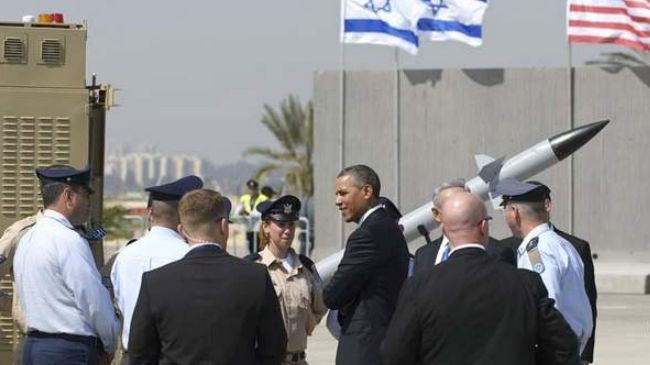
Israel is also a “winner” in the spending measure, as it fully funds the Arrow, David’s Sling, and the Iron Dome rocket systems, the Hill said.
The spending bill authorizes $173 million in added funding for Israel’s missile systems, including nearly $34 million to improve the Arrow weapon system and $117.2 million for development of the David’s Sling short-range ballistic missile system and $22 million for an upper-tier interceptor.
The US provides $3.1 billion in annual military aid to Israel, making the Zionist regime the largest recipient of US aid in the world.
US President Barack Obama has pledged to extend annual military aid to Tel Aviv through 2027.
The pending 10-year military aid package would commit the United States to give up to $40 billion in military grant assistance to Israel. It would automatically kick in after the current 10-year, $30 billion agreement expires in 2017.
US tested biological weapons in Japan’s Okinawa in the 60s – report
RT | January 12, 2014
The American army conducted experiments with biological weapons aimed at destroying rice crops on the Japanese island of Okinawa in the 60s, Kyodo news agency reports. The alleged target of the tests was the China and Southeast Asia region.
Citing classified US documents, Japanese news agency Kyodo said the US military carried out experiments on their sovereign territory between 1961 and 1962. At this time Japan’s southern island of Okinawa was still under post-WWII, US jurisdiction. The US did similar tests in Taiwan and the American mainland, notes Kyodo.
The American army experimented with rice blast fungus – a plant pathogen – which infects rice crops with disastrous effects. The pathogen latches onto the rice plant as a spore and produces lesions and spots all over the rice plant and then reproduces.
A single lesion can generate a thousand spores in one night alone, while an entire cycle – lasting about a week – can have a devastating effect on rice crops.
Kyodo reports that tests were conducted over a dozen times, and mentions test sites, Nago and Shuri, in Okinawa. The US army reported some success in their experiments and the gathering of “useful data”.
“Field tests for stem rust of wheat and rice blast disease were begun at several sites in the (US) Midwest and south and in Okinawa with partial success in the accumulation of useful data,” wrote Kyodo, citing its documents.
The US government discarded all its biological weapons in 1969 and discontinued testing, after a leak of chemical weapons made 20 American soldiers stationed on the island sick. Moreover, residents had to be evacuated from the surrounding area and were reported to still be suffering the effects of the toxins two years after the leak.
In response to public outrage, the US government was forced to launch Operation Red Hat – a mission to remove all the biological weapons stored on Okinawa.
Six years later in 1975, Washington signed the international convention against production and possession of biological weapons.
Okinawa came back under Japanese jurisdiction in 1972, but the US still keeps a military presence of around 50,000 troops on the island.
Their presence is a constant source of tension with local populations due to crimes committed by servicemen, disruptions caused by military flights and land use by the US military.
U.S. Human Radiation Experiments Covered up by Public Broadcasting

By William Boardman | Reader Supported News | January 8, 2014
The bomb will not start a chain reaction in the water, converting it all to gas and letting all the ships on all the oceans drop down to the bottom. It will not blow out the bottom of the sea and let all the water run down the hole. It will not destroy gravity. I am not an atomic playboy.
– Vice Admiral William P. Blandy, Bikini bomb test commander, July 25, 1946
When the military scientists of an advanced technological nation deliberately explode their largest nuclear bomb (and 66 others) over Pacific islands and use the opportunities to study the effects of radiation on nearby native people, which group is best described as “savage”? And what should you call the people who prevent a documentary about these American post-war crimes from reaching a wide audience in the United States?
Nuclear Savage is a recent documentary film that explores American nuclear weapons testing in the Marshall Islands, 1946-1958, and particularly the secret Project 4.1: an American experiment in exposing Pacific Islanders to overdoses of radiation – deliberate human radiation poisoning – just to get better data on this method of maiming and killing people. The public broadcasting establishment has spent more that two years keeping this story off the air.
The preview reel of Nuclear Savage includes a clip with a stentorian newsreel announcer reporting on the American treatment of Marshall Islanders in April 1957, and explaining to his predominantly American audience:
The Marshallese caught by fallout got 175 roentgens of radiation. These are fishing people, savages by our standards, so a cross-section was brought to Chicago for testing. The first was John, the mayor of Rongelap Atoll…. John, as we said, is a savage, but a happy, amenable savage.
So how serious is 175 roentgens (assuming the measurement is accurate)? In 1950, the International Commission on Radiological Protection (ICRP) recommended that human radiation contact should not exceed 0.3 roentgen per week for whole-body exposure [“roentgen” as a measure of radiation dose has since been replaced by “rem” (for “roentgen equivalent man”)]. It’s not clear how long the Marshallese were exposed to radiation levels of 175 roentgens – or on how many occasions – but that amount was more than 580 times what was then considered a safe weekly exposure.
Public broadcasting paid for this film – and is now suppressing it
In 2005, director Adam Horowitz started work on Nuclear Savage, his second documentary about the American military use and abuse of the Marshall Islands. Horowitz has a contract with Pacific Islanders in Communications (PIC), which describes itself as “a national non-profit media arts organization” whose mission “is to support, advance and develop programming that enhances public recognition of and appreciation for Pacific Islander history, culture, and society. In keeping with the mission, PIC provides funding for new programs primarily for public television. We work with independent producers to create and distribute programs about Pacific Islanders that bring new audiences to public television, advance issues and represent diverse voices and points of view not usually seen on public or commercial television.”
Among its efforts to carry out this mission, PIC supported the production of Nuclear Savage with $100,000 passed through to Horowitz from the Corporation for Public Broadcasting (CPB). Horowitz delivered a completed, 87-minute version of Nuclear Savage in October 2011 – the same month it was nominated for Best Environmental Film at the Amsterdam International Documentary Film Festival. That was also the same month various public broadcasting officials started putting up roadblocks to keep the movie off the air, a delaying tactic that continues into 2014. FAIR (Fairness & Accuracy in Reporting) reported the story in detail as “Nuclear Stalemate” in Extra!
One of the first requests, from Leanne Ferrer at PIC, was for a shorter version at 60 minutes. Rather than have Horowitz cut his film by 27 minutes, PIC hired its own editor and controlled the editing process. Part of Ferrer’s concern reportedly was a sort of politically correct reverse racism, her objection that there was too much of Horowitz in the film and he’s not a Pacific Islander. The shorter version has less of Horowitz. And the PIC web site pitches Nuclear Savage: The Islands of Secret Project 4.1 as a “portrait of Pacific Islanders struggling for dignity and survival after decades of intentional radiation poisoning by the U.S. government.”
PIC summarizes the film this way:
Some use the term ‘savage’ to refer to people from primitive cultures, but nuclear experimentation pushed savagery to new levels. In the 1950s, the U.S. conducted 67 atomic and hydrogen bomb tests in the Marshall Islands, vaporizing islands and exposing entire populations to fallout. The islanders on Rongelap received near fatal doses of radiation from one test, and were then moved onto a highly contaminated island to serve as human guinea pigs for 30 years. Filmmaker Adam Jonas Horowitz spent 25 years collecting material – including original footage, archival clips, and unpublished secret documents – to create this unforgettable and ironic portrait of American cynicism, arrogance, and racism. Winner of festival awards in Paris, Chicago and Mexico City.
PBS canceled scheduled broadcasts without public explanation
In 2013, PBS World Channel scheduled Nuclear Savage for four showings on May 28 and 29 – and PBS executive Tom Davison emailed Horowitz in advance, saying “Congratulations on this airing.” When the airing failed to take place, without explanation from PBS, Horowitz was unable to get a straight answer from Davison, Ferrer, or anyone else in the public broadcasting food chain, although PIC executive Amber McClure wrote with Orwellian deceit: “Your program has not been declined by PBS.”
Outright rejection by PBS is required by Horowitz’s contract in order for him to regain independent control of his film. In December 2013, in his original letter to the editor of the Santa Fe Reporter, Horowitz summed up his experience to date this way:
PBS ‘World Channel’ executives accepted, scheduled and advertised the show nationally, only to reverse their decision and cancel the show at the last minute. The show was originally accepted and then later rejected by two different branches of PBS, on three different occasions. PBS executives promised to deliver to me, a list of the precise points in the film that they felt represented ‘bias,’ or questions of ‘fact,’ and I promised to work with them to fix any problems. But PBS has still never delivered any specifics whatsoever of their complaints about the film, a film by the way that they have already completely reworked with their own editors.
The project has also had support from private foundations, including the Kindle Project, where:
We support whistleblowers and rabble-rousers. We give grants to peacemakers and seed savers. We make awards to artists and activists. We support people and projects working towards solutions and alternatives to systems in transition. We seek out the strange, the bizarre, the unpolished, the less likely to receive funding. We fund individuals and initiatives that may seem risky or radical to mainstream funding sources….
Public information is not always well known by the public
The unsigned Notes on Nuclear Savage: The Islands of Secret Project 4.1 on the Kindle Project web site from April 2012 talks about the ways the film was succeeding, despite unofficial quasi-government censorship and beyond “the glamorous festival circuit”:
Heartbreaking is the most poignant word that could be used to describe this film, and in my conversations with Adam this word has been uttered more than once. I’ve often wondered how he has the stamina for this subject matter; the stamina to expose himself to the worst kinds of atrocities that humans inflict on one another. The people of the Marshall Islands have faced similar catastrophic fates as the victims who underwent Nazi medical tests during WWII. Adam was there to tell the world about it. These days, his perseverance comes from the success of the film – not just from the attention it’s getting from the international circuit, but from what’s happening in the Islands themselves.
What was happening in the islands was that Nuclear Savage was being shown again and again on local and national television channels. It was shown at the Pacific Island conference of Presidents. People were copying and bootlegging the film across the region, with bootleg copies sometimes turning up on television. And Marshallese activists were using the film to resist U.S. government efforts to re-re-settle some populations back to their home islands that were still dangerously radioactive.
“As of now, no one has moved back,” Horowitz told an audience after showing Nuclear Savage at the International Uranium Film Festival in Window Rock, Arizona, last December. Despite the American effort to re-re-settle the forced Marshallese refugees on their former home islands, Horowitz said the effort had amounted to “just a bunch of empty houses.”
Horowitz has been angry about American treatment of the Marshall Islands for a long time. In late 2013 he told a reporter the U.S. “destroyed an entire country that we were not at war with, that we were at peace with. Not only did they blow up all these islands, but they purposely contaminated all these people as human experiments. It’s a very unknown story here.”
The story was classified top secret until the 1990s, when the Clinton administration declassified documents related to nuclear testing that included previously unknown information on the Project 4.1 program to use Pacific Islanders as human guinea pigs for assessing the impact of ionizing radiation. Even the official historian of U.C. nuclear testing, Barton Hacker, who tries to minimize the criminality of Project 4.1, ended up writing in 1994 that an “unfortunate choice of terminology may help explain later charges that the AEC [Atomic Energy Commission] had deliberately exposed the Marshallese to observe the effects. Like the American radium dial painters of the 1920s and the Japanese of Hiroshima and Nagasaki in 1945, the Marshallese of 1954 inadvertently were to provide otherwise unobtainable data on the human consequences of high radiation exposures.”
The U.S. was an occupying power, and effectively still is
Europeans “discovered” these Pacific Islands in the 1520s (they were named the Marshall Islands after the British explorer John Marshall). In 1874 they became part of the Spanish East Indies. In 1884 Germany bought them as part of German New Guinea. During World War I, the Japanese occupied the islands and later ruled them under a League of Nations mandate. During World War II, the United States took the islands from the Japanese and has effectively occupied them ever since.
In 1946, the U.S. evacuated the entire population of Bikini Atoll (167 people) and logged the first of 23 atomic weapons explosions that have made what’s left of the atoll (part of it was vaporized) a largely uninhabitable radioactive tourist destination [one report says 4-6 “caretakers” live there]. Most of the 167 original residents have died, but their descendants number more than 4,000. A 1975 federal lawsuit (seeking roughly $750 million in compensation promised but not paid by the U.S.) was denied review by the U.S. Supreme Court in April 2010, but the effort to make the U.S. provide just compensation continues.
Later in 2010, UNESCO named Bikini a “world heritage site” as a symbol of the “dawn of the nuclear age.” The U.S. Environmental Protection Agency has said that Bikini is close to the “safe” radiation level of 15 millirems – but according to the U.S. Department of Energy, the “safe” level is really 100 millirems, and the contradiction remains unreconciled.
In 1947, the United Nations included the Marshall Islands in a Trust Territory controlled by the U.S., whose obligations included the duty to “protect the inhabitants against the loss of their lands and resources.” Later in the year the U.S. evacuated the entire population of Enewetak Atoll, where it would explode another 44 atomic weapons, the last series in 1958.
On March 1, 1954, the U.S. exploded its first deliverable hydrogen bomb that, at 15 megatons, was more than 1,000 times as powerful as the Hiroshima bomb of 1945. The official story, which the U.S. government still defends, is that it was an “accident” that the bomb dumped so much radiation on downwind populations, and that Project 4.1 was initiated after the blast in order to help the victims as well as study them.
The record includes one reference to Project 4.1 prior to March 1 [the government says someone put it there after the fact]. More troubling is the undisputed evidence that the U.S. was aware that the weather had changed, that the wind was blowing toward populated areas, but they went ahead with the test anyway. After the radiation came down like “snow” on Rongelap and other islands, the Navy evacuated American personnel quickly, but left the “happy, amenable savages” to absorb more radiation for another two days.
As early as 1956, the Atomic Energy Commission had characterized the Marshall Islands as “by far the most contaminated place in the world.”
For the victor, justice is only optional, not enforceable
In 1979, the U.S. allowed the Marshall Islands to become “self-governing,” while the U.S. reserved the sole control of military use and defense of the territory. In 1986 the U.S. granted the Republic of the Marshall Islands “sovereignty” under the Orwellian-named Compact of Free Association, which left the U.S. in military control and free to use Kwajalein Atoll as a missile testing range. Four years later the U.N. ended the “nation’s” Trusteeship status. The CIA estimates that the Marshall Islands’ GDP is $182 million, of which the U.S. provides $70 million in aid payments, according to the State Department. Both the CIA and State Department omit unpaid compensation from their public summaries of the Marshall Islands.
Nuclear Savage includes U.S. Ambassador Greta Morris making a wooden public statement of “deep regrets” for the “hardships” the Marshallese have suffered “as a result of the testing program, as well as the accidental downwind injuries caused by one test, Bravo” – which is the official version of the 1954 H-bomb Castle Bravo. Later Greta Morris is asked at a public event to discuss U.S. “government policy” – the ambassador refuses to talk on camera.
In March 2012, at an event commemorating the anniversary of the H-bomb test, Marshall Islands foreign minister Phillip Muller called on the U.S. to pay more than $2 billion in awards already made by the Nuclear Claims Tribunal, which was created and underwritten by the U.S. The U.S. moral and financial obligation continues to grow, as the Marshall Islands are reportedly seeing a continually rising cancer rate more than half a century later. An the same event, according to Overseas Territories Review:
U.S. Ambassador to the Marshall Islands Martha Campbell told the event in Majuro Thursday evening that ‘the United States has provided nearly $600 million in compensation and assistance to the Republic of the Marshall Islands to help the affected communities overcome the effects of nuclear testing,’ and noted that the U.S. and Marshall Islands governments had agreed to ‘a full and final settlement of all nuclear-related claims’ in 1983 [an apparent reference to the Compact of Free Association and its side agreements].
In 1998, staff from the U.S. Centers for Disease Control and Prevention (CDC) made a comparison study to compare the amount of radioactive Iodine-131 at four different radiation-polluted sites, measured in curies (1,000 curies of Cesium-137, as found in a radiation therapy machine, could produce serious health effects in a direct exposure of just a few minutes). The CDC team reported its finding that the atmospheric release of curies of Iodine-137 at the Hanford nuclear processing plant was 739,000 curies; at Chernobyl the release was 40 million curies; at the Nevada bomb test site, 150 million curies; and in the Marshall Islands, 6.3 billion curies (more that 30 times as much radiation as the other three sites combined).
The Republic of the Marshall Islands is ranked #5 in the world among countries with the highest health costs as a percentage of GDP – behind Liberia, Sierra Leone, Tuvalu, and the United States.
The history of the treatment of the radiation victims of the Marshall Islands is essentially a paradigm for the treatment of radiation victims everywhere. The perpetrators of radiation-exposure lose patience with the seemingly endless effects of their acts and so they tend to abandon all responsibility for them. So far at least, the Marshall Islands history appears to be foreshadowing Fukushima’s future.
Given the unpalatibility this story might have for an American television audience, it’s little wonder that public broadcasting executives are content to spend public money to keep the public under-informed.
Is Obama Trying to Resolve or Prolong the Conflict in Syria?
By Flynt Leverett and Hillary Mann Leverett | Going to Tehran | January 10, 2014
Suppose a great power declares that it supports a peace process aimed at finding a political solution to a terrible, ongoing conflict. Then suppose that this great power makes such declarations after it has already proclaimed its strong interest in the defeat of one of the main parties to said conflict. And then suppose that this great power insists on preconditions for a peace process—preconditions effectively boiling down to a demand for pre-emptive surrender by the party whose defeat the great power has already identified as its major goal—which render such a process impossible. Is it not reasonable to conclude that the great power in question is (how to put this gently) lying about its purported support for peace?
That, in a nutshell, is the Obama administration’s posture toward the ongoing conflict in Syria.
Earlier this week, United Nations Secretary General Ban Ki-moon began sending out invitations for the Geneva II conference on Syria scheduled for January 22. And, as Ban’s spokesperson acknowledged, the Islamic Republic of Iran was not among the “first round” of nations asked to take part.
According to the spokesperson, invitations to the talks are subject to the approval—or veto—of the two “initiating states,” Russia and the United States. The Islamic Republic has said repeatedly that it is prepared to attend and to contribute constructively to the search for a political settlement. Of course, Russia supports Iran’s participation in Geneva II—as does China, Germany, Turkey, every other state seriously interested in resolving the conflict in Syria, and the United Nations itself. (Ban’s spokesperson publicly stated this week, “The secretary-general is in favor of inviting Iran.”)
It is the United States—whose leader, President Obama has demanded for more than two years that Syrian President Bashar al-Assad relinquish his position—that is blocking Iranian participation in Geneva II. And it is attempting to justify this position by continuing to insist on Assad’s pre-emptive surrender as part of the Geneva II agenda. Moreover, Washington is couching its demand for Assad’s pre-emptive surrender in a shamelessly dishonest reading of the 2012 Geneva I communique, which is supposed to set the terms of reference for Geneva II.
On this last point, Secretary of State John Kerry earlier this week (before Ban started sending out invitations) reiterated the Obama administration’s opposition to Iran’s participation in Geneva II as a “ministerial partner.” In the administration’s view, Iran can’t come to the meeting because it has not signed on to the Geneva I document—in particular, the passage positing that a “transitional governing body” for Syria “shall be formed on the basis of mutual consent” among “the present government and the opposition and other groups.”
Since Iran (at Washington’s insistence) was not invited to Geneva I, it is not clear exactly how or why Tehran should sign up to a communique it had no part in producing. But the most shamelessly dishonest aspect of the Obama administration’s posturing on the matter is its insistence that Iran accept the administration’s warped reading of the passage from Geneva I just cited, which Team Obama (including Kerry) interprets as a requirement that Assad leave office and play no future political role—whether as part of a transitional government or as Syria’s first president elected after a settlement is negotiated.
We suspect that Assad would, in all likelihood, win another national mandate—even in the “free and fair multi-party elections” envisioned in Geneva I. But Washington doesn’t want Syrians to have the chance to make that choice. And so Washington continues to block Iranian participation in Geneva II—save perhaps, as Kerry pompously suggested earlier this week, “from the sidelines” (a proposition that Iran has roundly rejected).
What is so appallingly arrogant about the Obama administration’s position is that it was explicitly rejected at Geneva I. Then-UN envoy Kofi Annan’s draft communique originally contained U.S.-backed language barring figures from the conflict resolution process whose participation would block creation of a national unity government—language that the United States, Britain, and France crafted to exclude Assad. Russia and China insisted that this language be removed from the final communique. But the Obama administration has disingenuously continued asserting that the language in Geneva I bans Assad from any future political role—even though it is as clear as day that Geneva I, as actually adopted, does not do any such thing.
Kerry and Russian Foreign Minister Sergei Lavrov are supposed to discuss the question of Iranian participation in Geneva II on January 13. Let’s see if the Obama administration can actually decide that it wants to resolve the conflict in Syria, rather than prolonging it further.
70 NEOCONS PETITION CONGRESS TO EFFECTIVELY ALLOW ISRAEL TO SAY WHEN THE U.S. SHOULD ATTACK IRAN
By Damian Lataan | January 10, 2014
Seventy senior Israeli-centric neoconservatives have written an open letter to Congress imploring them to do more to ensure Iran complies with the conditions of any agreement finally reached with the P5+1 over Iran’s nuclear program.
While the neocons are ostensibly asking Congress to ensure compliance, it is clear that their real aim is to convince members of Congress to support the bill currently passing through the Senate which calls for tighter sanctions against Iran in the event of any waywardness on Iran’s part.
The neocons are eager to see the bill currently passing through the Senate with enough support to make it veto-proof, not so much because they are concerned about Iran’s so-called nuclear weapons program – there’s still not a skerrick of hard evidence that Iran has a nuclear weapons program – but, rather, because embedded within the bill is this clause:
…if the Government of Israel is compelled to take military action in legitimate self-defense against Iran’s nuclear weapon program, the United States Government should stand with Israel and provide, in accordance with the law of the United States and the constitutional responsibility of Congress to authorize the use of military force, diplomatic, military, and economic support to the Government of Israel in its defense of its territory, people, and existence…
Essentially, the clause is an automatic trigger for the US to attack Iran at any time the Israelis choose to launch a first strike – regardless of whether President Obama is in favour or not.
Partial list:
Elliott Abrams
James Kirchick
Dr. Fouad AjamiIrina Krasovskaya
Dr. Michael Auslin
Dr. William Kristol
Congresswoman Shelley Berkley
Dr. Robert J. Lieber
Josh Block
Senator Joseph I. Lieberman
Dan Blumenthal
Tod Lindberg
Max Boot
Mary Beth Long
Ellen Bork
Dr. Thomas G. Mahnken
Ambassador L. Paul Bremer
Dr. Michael Makovsky
Dr. Eliot A. Cohen
Ann Marlowe
Senator Norm Coleman
Clifford D. May
Ambassador William Courtney
Robert C. McFarlane
Seth Cropsey
David A. Merkel
Jack David
Thomas C. Moore
James S. Denton
Dr. Joshua Muravchik
Dr. Paula J. Dobriansky
Governor Tim Pawlenty
Dr. Michael Doran
Dr. Martin Peretz
Mark Dubowitz
Danielle Pletka
Dr. Colin Dueck
John Podhoretz
Dr. Nicholas N. Eberstadt
Arch Puddington
Ambassador Eric S. Edelman
Stephen G. Rademaker
Douglas J. Feith
Dr. Michael Rubin
Dr. Jeffrey Gedmin
Randy Scheunemann
Reuel Marc Gerecht
Dr. Gary J. Schmitt
Abe Greenwald
Dan Senor
Related articles
Iraq: The ‘Liberation’ Neocons Would Rather Forget
By Ron Paul | January 5, 2014
Remember Fallujah? Shortly after the 2003 invasion of Iraq, the US military fired on unarmed protestors, killing as many as 20 and wounding dozens. In retaliation, local Iraqis attacked a convoy of US military contractors, killing four. The US then launched a full attack on Fallujah to regain control, which left perhaps 700 Iraqis dead and the city virtually destroyed.
According to press reports last weekend, Fallujah is now under the control of al-Qaeda affiliates. The Anbar province, where Fallujah is located, is under siege by al-Qaeda. During the 2007 “surge,” more than 1,000 US troops were killed “pacifying” the Anbar province. Although al-Qaeda was not in Iraq before the US invasion, it is now conducting its own surge in Anbar.
For Iraq, the US “liberation” is proving far worse than the authoritarianism of Saddam Hussein, and it keeps getting worse. Last year was Iraq’s deadliest in five years. In 2013, fighting and bomb blasts claimed the lives of 7,818 civilians and 1,050 members of the security forces. In December alone nearly a thousand people were killed.
I remember sitting through many hearings in the House International Relations Committee praising the “surge,” which we were told secured a US victory in Iraq. They also praised the so-called “Awakening,” which was really an agreement by insurgents to stop fighting in exchange for US dollars. I always wondered what would happen when those dollars stopped coming.
Where are the surge and awakening cheerleaders now?
One of them, Richard Perle, was interviewed last year on NPR and asked whether the Iraq invasion that he pushed was worth it. He replied:
I’ve got to say I think that is not a reasonable question. What we did at the time was done in the belief that it was necessary to protect this nation. You can’t a decade later go back and say, well, we shouldn’t have done that.
Many of us were saying all along that we shouldn’t have done that – before we did it. Unfortunately the Bush Administration took the advice of the neocons pushing for war and promising it would be a “cakewalk.” We continue to see the results of that terrible mistake, and it is only getting worse.
Last month the US shipped nearly a hundred air-to-ground missiles to the Iraqi air force to help combat the surging al-Qaeda. Ironically, the same al-Qaeda groups the US is helping the Iraqis combat are benefiting from the US covert and overt war to overthrow Assad next door in Syria. Why can’t the US government learn from its mistakes?
The neocons may be on the run from their earlier positions on Iraq, but that does not mean they have given up. They were the ones pushing for an attack on Syria this summer. Thankfully they were not successful. They are now making every effort to derail President Obama’s efforts to negotiate with the Iranians. Just last week William Kristol urged Israel to attack Iran with the hope we would then get involved. Neoconservative Senators from both parties recently introduced the Nuclear Weapon Free Iran Act of 2013, which would also bring us back on war-footing with Iran.
Next time the neocons tell us we must attack, just think “Iraq.”
Pentagon Data on Student Testing Program Rife with Errors and Contradictions
Student Privacy Compromised by Massive Program
By Pat Elder | War is a Crime | January 4, 2014
In late December, 2013 the Department of Defense released a database on the military’s controversial Student Testing Program in 11,700 high schools across the country. An examination of the complex and contradictory dataset raises serious issues regarding student privacy and the integrity of the Student Testing Program in America’s schools.
The data was released after a protracted Freedom of Information Act (FOIA) request.
See the State ASVAB Databases and the National Database.
The DoD’s Freedom of Information office reports that 678,000 students participated in the Armed Services Vocational Aptitude Battery Career Exploration Program (ASVAB-CEP) during the 2012-2013 school year, down nearly 10% from the previous school year. The three-hour test is the linchpin of the Pentagon’s school-based recruiting program and provides the Military Entrance Processing Command (USMEPCOM) an invaluable tool in prescreening candidates for military service.
The ASVAB is the military’s entrance exam that is given to fresh recruits to determine their aptitude for various military occupations. Since 1968 the test has also been used as a recruiting tool in high schools. It’s used by USMEPCOM to gain sensitive, personal information on high school students, the vast majority of whom are under the age of 18. Students typically take the test at school without parental consent and often without parental knowledge.
The Pentagon admits military testing in the nation’s schools is a crucial component of maintaining an “all-volunteer” force. In recent years military recruiting has evolved into an exceptionally sophisticated psychological campaign aimed at enticing high school children to enlist. From a myriad of social websites and a host of other sources, recruiters may know, before first contact, that a young man reads wrestling magazines, weighs 155, can bench press 230, drives a ten year-old truck, listens to “classic rock,” and enjoys fly fishing. They know where his girlfriend stands on his looming decision to enlist. But the ASVAB opens the door to a student’s cognitive abilities, something recruiting services can’t purchase or find on line. A child’s virtual social being, his intellectual capabilities, and mechanical aptitude are combined to create a precise, virtual portrait, all before a recruiter’s first contact.
In 1974 The Educational Rights and Privacy Act (FERPA) stood in the way of the DoD’s carte blanche access to student education records. The law, which is still in effect today, requires a signed parental release statement before “education records” are released to third parties. The Pentagon’s position, explained in the ASVAB Counselor Guide (See page 14) is that the ASVAB is proctored by DoD personnel and that ASVAB results become education records only after the test is scored by the DoD and returned to the school. This way, the brass argues, ASVAB results are not education records. Instead, they’re “military records”. ASVAB results are the only information about students leaving American schools without providing for parental consent.
USMEPCOM Regulation 601-4 (Section 3) identifies several options schools have regarding the administration and release of ASVAB information. These options range from Option 1, which permits test results and other student information to be released to military recruiters without prior consent, to Option 8, the only one that prevents test results from being used for recruiting purposes. The problem is that many, if not most school administrators are unaware the release options exist and USMEPCOM officials are not going out of their way to tell them. Coalition partners in several states report telling hundreds of school officials who did not know about release options.
Inaction on the part of a school will cause USMEPCOM to automatically select Option 1.
53% of all students taking the ASVAB across the country did so under Release Option 1. Students and parents may not determine which release option is used; therefore they cannot opt out of releasing the information individually. Just 15% of students taking the ASVAB had Option 8 selected by school officials.
DoD officials wash their hands of the privacy issue. “Whether or not a school official seeks students’ or parents’ or guardians’ permission is entirely up to that school, and we don’t have anything to say about that at all,” said Curtis Gilroy, the Pentagon’s prior Director of Accession Policy during an NPR Interview in 2010.
Meanwhile, the DOD markets the ASVAB in high schools without revealing its tie-in to the military or its primary function as a recruitment tool. School counselors and administrators encourage students to take the test that many claim assists students in matching their abilities with certain career paths. It is terribly deceptive.
A Snapshot of the data
=========================================
INDICATOR 2011-2012 2012-2013
Total Tested 752,758 678,248
Total Schools 11,754 11,741
# Students Option 8 122,636 105,222
% Option 8 16.29 15.51
# Schools Option 8 2177 2408
# Schools Mandatory 1219 938
==========================================
Mandatory Testing
Pursuant to the FOIA request, the data released by the DoD contains a column that identifies whether the test was mandatory for students. The data shows that 931 schools required nearly 50,000 students to take the test.
Interestingly, military regulations forbid recruiters from suggesting the ASVAB be made mandatory. According to USMEPCOM Regulation 601-4, “School and student participation in the Student Testing Program is voluntary. DOD personnel are prohibited from suggesting to school officials or any other influential individual or group that the test be made mandatory. Schools will be encouraged to recommend most students participate in the ASVAB CEP. If the school requires all students of a particular group or grade to test, the Military Entrance Processing Command will support it.”
School officials in several states are under the impression that ASVAB testing is mandated by federal law. For instance, counselors in Nebraska have reported they’ve been told by recruiters that testing is required.
Kevin Haake of the Nebraska Coalition to Protect Student Privacy explains it this way, “We’d rather not have the military actively recruiting in our schools but I don’t see an egregious violation of civil rights when a couple of kids voluntarily sign up to take this military test. It’s another matter when entire classes of children are told they’ve got to take this thing and all their information is shipped to the Pentagon without mom and dad knowing about it.”
The line between mandatory and voluntary testing is blurred with U.S. Army Recruiting Command Regulation 601-107 page 25 Item 8 which ranks each high school based on how receptive it is to military recruiters. Schools are awarded extra points when they make the ASVAB mandatory.
Regardless of the perceptions of school officials concerning the voluntary or mandatory nature of the testing regime many principals and counselors are sold on the utility of the ASVAB as a useful career exploration program that assists students in determining career paths. Critics claim 16 year-olds are generally clueless regarding the “careers” they may eventually choose. They say the test fails miserably in this regard – and they’re not alone.
The U.S. Marine Corps Military Personnel Procurement Manual contains the following, “The ASVAB is used by the Armed Forces for recruiting purposes and by school counselors for vocational guidance counseling. The ASVAB’s ability for determining civilian job skills has not yet been proven.” See Sec. 4104 3b (pg 237 of this document)
It’s mind boggling.
Once the test is administered and scored, the recruiting command sends recruiters to the schools after the tests are scored to discuss “career paths” with students.
The military has done a tremendous job marketing the program in high schools across the country. American high schools are blanketed with posters and announcements that read like this: “Explore your interests. Expand your horizons. Realize your strengths. Realize your dreams. Start opening doors to your future. Participate in the ASVAB Career Exploration Program on (DATE). It’s free! See your counselor to register today.” See ASVAB Snippets. The Pentagon’s marketing to students in the high schools never explains what “ASVAB” stands for and never mentions the primary purpose of the testing regime, which is to procure leads for recruiters. Its website, http://www.asvabprogram.com/ looks nothing like a DoD site and buries any mention of the military.
Do huge numbers voluntarily take the test?
The database purports to reflect the number of schools and students that participate in mandatory testing but there are several problems with its accuracy.
The ASVAB provides the first, massive, national litmus test for enlistment. Consider five schools in the Miami area. North Miami Beach HS tested 855. It has a minority population of 96%.. Coral Gables HS tested 695 with a minority population of 90%. Coral Park HS had 429 take the test. It has a minority population of 96% Miami Central High School tested 645 and Miami Northwestern HS sat down 642. Both have minority populations of 99%. None of these five schools are listed in the DoD database as having “mandatory” testing and there’s no evidence online that students were required to take the test.
Voluntary?
A web search of seven Michigan high schools listed in the newly released data as “Not Mandatory” clearly shows that students are required to take the ASVAB. Pickford, Watersmeet, Goodrich, Manistique Lake Linden, Rapid River, and Ironwood High Schools all force students to take the test.
Munford High School in Munford Tennessee tested 855 but is listed in the database as not mandatory. Perhaps patriotism is rampant in Munford, but how, exactly, do they manage to get 855 teenagers to voluntarily sit for three hours to take a military exam?
Scranton High School in Arkansas is listed as being mandatory for all grades but only 11 students took the test, according to the data. Scranton has a total enrollment of 181. It begs the question: Just how many students are required to take the test in Arkansas? Last year the state led the nation with more than 10,000 students being forced to take the ASVAB. After a robust email campaign to school officials, that number has dropped to 7,333 although 140 schools still require students to take the test. (That’s an average of 52 per school.) One school counselor explained that the test has always been required and no one had ever complained. Certainly there have been no complaints from the Military Entrance Processing Command in Little Rock, until now, perhaps.
Two important questions remain concerning mandatory testing, despite the data. How can we tell from the statistics furnished by the DoD exactly how many are taking the test and how do we know if a school requires students to take the ASVAB? If the Pentagon admits there are nearly a thousand schools that require military testing, how many are there, really? There’s never been outside accountability. This is tragically ironic because we’re dealing with the most sensitive information the state can possess regarding our children.
According to the data, 6,536 schools or 56% of the total nationally, tested ten or fewer children, comprising just 6% of the total number of students tested. Most of these children, it may reasonably be assumed if the data is accurate, were offered the opportunity to participate, rather than being required to do so.
The average American high school has an enrollment of 595 students and the average junior class has about 120 students. If our hypothetical high school has 120 juniors what number of juniors tested might provide us a clue that the test was required? Alternately, how small must the number of test takers be to reasonably demonstrate the voluntary nature of the exam?
There have been numerous press reports concerning student and parent dissatisfaction with mandatory military testing. Often, juniors and seniors use these ASVAB testing days to simply skip school, reducing the numbers of those being tested. 3,600 schools tested more than 50 students. Is it reasonable to assume that these students were required to do so? Is it a stretch to suggest that the number of children in America that are forced to take the ASVAB is substantially higher than what the Pentagon publicly admits?
The U.N. weighs in on mandatory testing
In early 2013 The UN’s Committee on the Rights of the Child called on the Obama Administration to “Ensure that schools, parents and pupils are made aware of the voluntary nature of the ASVAB before consenting to the participation into it.” See the Concluding observations on the Second Report of the United States of America, Adopted by the Committee on the Rights of the Child at its sixty-second session (14 January–5 2013) regarding the Optional Protocol on the Involvement of Children in Armed Conflict
http://www2.ohchr.org/English/bodies/crc/docs/co/CRC_C_OPAC_USA_CO_2.doc
The Committee had previously found that “Parents and children are often unaware of the voluntary nature of the Armed Services Vocational Aptitude Battery (ASVAB) test organized in schools or its links to the military and that in some instances students were reportedly informed that the test was mandatory.” Members of the Committee in Geneva found it incredulous that a thousand American schools force underage children to take this military test without parental consent.
The United States ratified the Optional Protocol to the Convention on the Rights of the Child on the Involvement of Children in Armed Conflict (OPAC) in 2002. Article 3.3 of OPAC states that recruitment practices involving minors should be voluntary. Forced military testing in American public schools for recruitment purposes without parental consent violates the treaty. In late 2012 the Obama Administration denied the mandatory nature of the testing regime. The US replied to the Committee,“Participation in the ASVAB CEP is entirely voluntary. DOD does not require schools to participate, nor does it require schools to test all students within a participating school.”
The ASVAB is “free”
There is a compelling financial reason why so many take the ASVAB. It is often the only “free” assessment on “test day”. A third of all high school students are not college bound. If these students are offered a choice between taking the PSAT which is a college entrance exam and involves paying a fee — or taking the ASVAB which is free, they’ll typically pick the ASVAB. The military will list these children as voluntarily taking the ASVAB, although they’re actually forced to do so.
At Crown Point HS in Indiana, “11th grade students that wish to take the PSAT, and potentially qualify for national merit scholarships, will be required to pay $14.00. Juniors may register to take the PSAT in room c-203 from September 7-14th. 11th grade students that do not wish to take the PSAT will be administered the ASVAB exam. The ASVAB exam is free of charge.”
Crown Point tested 469 students last year and they’re listed as not mandatory. All had their results shipped to recruiting services without parental consent.
It’s the same deal at Woodridge High School in Ohio, “Juniors may take the PSAT or the ASVAB. The cost of the PSAT is $14, Students register for the PSAT in Guidance and the deadline is September 16, 2013. There is no cost for the ASVAB.” The DoD lists Woodridge as “not mandatory”.
Administrative and Legislative Inroads by the DoD
New Jersey allows the ASVAB to be used as a substitute for mandatory graduation tests. The guidelines call for receiving a 31 on the AFQT, the Armed Services Qualifying Test. The ASVAB is used to calculate the AFQT. A 31 is the minimum score for enlistment in the Army. A 31 on the AFQT is roughly comparable to 5th or 6th grade proficiency in reading and math.
Kentucky calls for a 55 on the AFQT for a student to earn a diploma. A 55 on the AFQT is the same as a composite SAT score of 840, according to the widely distributed ASVAB Concordance Table provided by the recruiting command. An 840 on the SAT won’t open college doors. It represents the bottom 5th of national SAT scores. A 55, however, opens the door to a host of military occupations. Kentucky, it should be noted, allows the military access to all student academic records upon request by any agency of the federal or state government for the purpose of determining a student’s eligibility for military service. It’s the worst law in the nation.
Mississippi’s Department of Education is close to allowing students who score a 36 or better on the ASVAB in addition to a passing score on a state vocation test or approved industry certification to receive a high school diploma. The Magnolia State’s board of education is seeking public input and is widely expected to approve the changes in January of 2014. The proposed policy does not address privacy concerns.
In Minnesota a new policy allows students to take the ASVAB to meet graduation assessment requirements in reading, mathematics and writing.
Missouri schools now encourage the universal use of the ASVAB and track all ASVAB scores as an integral part of the state’s school improvement program.
Missouri and Kentucky alone tested 21,000 more students than they did last year. The rapid decline in the popularity of the testing regime nationally is somewhat arrested by these developments. Meanwhile, the vast majority of these new test takers had their personal information sent to military recruiting services without parental consent, undermining the efforts of privacy advocates.
The Military Entrance Processing Command is also aided by a dozen state governors who have issued proclamations calling on all students to take the ASVAB. In 2008 Alaska’s Governor Palin became one of the first to proclaim ASVAB Career Exploration Month although no arrangements were made in Alaska or any other state to protect student privacy.
We’re witnessing the institutionalization of a direct informational pipeline to the Military Entrance Processing Command.
Psychology 101
School officials often ask, “What’s the problem with sharing student information with the recruiting command?”
Some aren’t too smart and they can get killed would be the answer.
Military recruiting is an exceptionally sophisticated psychological program aimed at enticing high school children. The American Public Health Association (APHA) has called for the cessation of military recruiting in the nation’s high schools, citing the vulnerable stage of brain development of youth and their “limitations in judging risk at this stage in life. They are unable to fully evaluate the consequences of making a choice to enter the military.” The APHA specifically calls for the end to military testing in the high schools.
=========
Patterns of Obfuscation
In 2010 Maryland became the first state to pass a law requiring the universal selection of Option 8 for all high school students taking the ASVAB. When the bill was working its way through the legislature, the USMEPCOM Battalion Commander at Fort George G. Meade warned school officials and legislators of a “disinformation campaign” regarding the school testing program. The Colonel wrote that the efforts to encourage schools to select Option 8 are “bent on disrupting any effort to build, support, or sustain the military.”
It is apparent the Pentagon has orchestrated a “disinformation” campaign of its own.
Guidance counselors in high schools in a dozen states across the country have said they were told by MEPS personnel that privacy concerns are misplaced because students sign a “Privacy Act Statement” that is part of the ASVAB answer sheet. It is a very familiar refrain. The counselors are led to believe that the Privacy Act Statement gives students notice of the release of test results to military recruiters and provides student consent for the release of information. The statement, however, says nothing about recruiter contact. The statement is not a proper waiver of rights because it does not disclose that ASVAB test results may be used for recruitment purposes, and it does not do away with the obligation to obtain consent from a parent or guardian when a student is under age 18. This is precisely where the program runs afoul of state laws.
See the 2013 report Best Practices for ASVAB-CEP Administrationfrom Rutgers Law School. The report makes a compelling case that high school counselors have both legal and professional responsibilities to ensure that ASVAB student test information is not automatically released to military recruiters.
Another misperception spread by the recruiting command is the notion that the “Opt Out” law covers ASVAB testing. Every fall parents of American high school children are provided the opportunity to “opt out” of information being forwarded to recruiting services pertaining to their children. If parents haven’t “opted out”, the reasoning goes, their kids are fair game for the ASVAB. The “opt out” law is found in Section 9528 of the Elementary and Secondary Education Act (ESEA) and is limited to the release of a student’s name, address, and phone number. The ASVAB, on the other hand, provides an in-depth cognitive picture of a student, along with detailed demographic information and social security number. ESEA doesn’t regulate ASVAB testing.
Still, another obfuscation practiced by USMEPCOM is the use of ASVAB Test Request Forms that are distributed to high school administrators that purposely leave off Option 8. See this form distributed by the recruiting command to school administrators in Prince George’s County, Maryland. School officials were so incensed they supported an effort that resulted in passing a law that mandates the selection of Option 8 across the state.
Another reprehensible practice involves recruiters who lurk on internet chat rooms like Yahoo Answers. It’s a way for Staff Sergeants to procure leads to meet their monthly quotas and sometimes it’s laughable. Consider this post in mid-December, 2013, “I’m a junior in high school (17) and I took the ASVAB. When I was taking the test it didn’t seem hard. Yes it was timed, and I have test anxiety. I think that’s why I did so poorly. I made a score of 16. I cried afterwards because one, I felt stupid, and two, I want to join the military and I know getting a 16 won’t qualify me for any jobs. I am planning on joining the Marine Corp. I know you’re probably going to tell me to study. But can you give me some good advice on what to do to keep my head up and keep trying?”
A score of 16 would mean our Yahoo friend is functionally illiterate. A 16 roughly equates to a 2nd grade level and is half of the score necessary to enlist in the Army. Several of the comments alluded to the contradiction between the claimed score of 16 and the rather well written question. Yahoo Answers enforces Community Guidelines. Under the heading “Exploiting the Community” Yahoo requires participants “to be responsible and don’t misrepresent yourself or claim false credentials… Yahoo Answers is a place to gain knowledge, not customers.”
Yahoo is quick to remove these miscreants and has done so a dozen times.
The question has been deleted.
The greatest fallacy perpetrated by the Pentagon is their insistence that ASVAB testing is not subject to the Family Educational Rights and Privacy Act. It is ludicrous to suggest that ASVAB results are not education records because the military, instead of the school, proctors the test. Although the recruiting command may send one civilian employee to officially administer the exam, it is school employees who market the test over several weeks, assemble and keep track of students, and provide much of the work controlling a large group of teenagers for a few hours.
It’s unconscionable that ASVAB results are the only information leaving American schools regarding children without providing for parental consent, but the tide is turning.
Diane Wood with the Texas Coalition to Protect Student Privacy reflects common sense Lone Star State attitudes, “I support the military but I got fired up when I discovered this egregious violation of civil liberties that’s been going on entirely unnoticed. I don’t care if it’s the Department of Defense or who ever. The thing that’s surprised me is that this privacy campaign has resonated with Tea Party activists down here. We all see ASVAB testing as an unwarranted and illegal federal incursion into our lives.” It’s a peculiar campaign that attracts allies on opposite ends of the political spectrum.
Wood’s tireless organizing and her testimony to the nationally maligned Texas State School Board probably contributed to Texas testing 6,600 fewer students in 2012-2013 than the year before. In Texas Option 8 rates increased from 14.7% to 15.5% while the number of students forced to take the test shrunk from 15,805 to 4,825 and the number of schools requiring students to take the ASVAB decreased from 181 to 70.
In many states, smart, targeted community activism has been shown to translate into quantifiable results.
Barbara Harris with the New York Coalition to Protect Student Privacy has been at it for years and has helped to eliminate mandatory testing in the Empire State. “We’ve witnessed several trends here in New York. The number of test takers continues to drop, the percentage of schools that have selected Release Option 8 continues to rise, and mandatory testing has disappeared. I’m hopeful we’ll soon get the Board of Regents to mandate Option 8 across the state.”
It’s the same in Connecticut and Massachusetts. Seth Kershner with the Connecticut Coalition to Protect Students Privacy reports, “Testing numbers in Connecticut and Massachusetts have plummeted in recent years to about 4,000 in each state. There’s no mandatory testing. Nearly half of the students being tested do so under Option 8. We’re hoping to duplicate successes in Hawaii and Maryland and have policies or laws enacted that mandate Option 8.”
Oregon’s school officials have responded to our campaign. Don Chapin with the Oregon Coalition to Protect Student Privacy reports that 57.2 % of students taking the test have Option 8 selected. See the statistics on the National Coalition’s website www.studentprivacy.org
Will Hopkins with the Coalition in New Hampshire has lobbied to introduce a bill in the New Hampshire. HB 1321 mirrors Maryland’s law.
Outreach to moderate school board members in the north citing privacy concerns are often taken into consideration, resulting in policy changes. In the South and the Midwest, however, many responses have been hostile, especially after school officials consult with their local military entrance processing command.
If the Pentagon called the shots across the country every high school student would be subjected to taking the ASVAB for enlistment purposes. The program is fraudulent but it is sponsored by the military, a sacrosanct institution that remains above constitutional restraint and the rule of law in the view of many American school officials and state legislators. We must convince them otherwise.
Pat Elder is the Director of the National Coalition to Protect Student Privacy. www.studentprivacy.org Email: pelder@studentprivacy.org
Related articles

French public support for intervention in the Central African Republic waning
Press TV – January 4, 2014
A new survey shows that France is rapidly losing public support for its military intervention in the Central African Republic (CAR), nearly one month after Paris deployed troops to the country.
A recent poll by the French Institute of Public Opinion (IFOP) showed on Saturday that only 41 percent of the respondents are in favor of France’s military operation in the CAR, down by 10 percent compared to a previous poll conducted right after France’s military intervention.
Some 1,000 people were questioned in the latest IFOP survey, which was conducted from December 27 to January 2.
France invaded its former colony on December 5, 2013, after the UN Security Council unanimously adopted a resolution giving Paris and the African Union the go-ahead to send troops to the CAR. Paris has 1,600 troops in the violence-stricken country.
The deployment of the French and African Union peacekeepers has done little to end the ongoing violence between ethnic communities in the CAR.
The Central African Republic spiraled into chaos in March last year when Seleka fighters overthrew President Francois Bozize and brought Michel Djotodia to power. Bozize fled the country after his ouster.
The mission in the CAR is France’s second military intervention in Africa in 2013. In January, Paris dispatched more than 4,000 troops to Mali, launching a fierce war against the militants in the country.
Featured Video

Diplomacy is Now a Crime in Britain / Ian Proud
or go to
Aletho News Archives – Video-Images
From the Archives
Genetic baloney in thick slices
MAYBE COULD BE INC.
By Jon Rappoport | No More Fake News | July 8, 2021
Gene research companies tend to come and go. They start out banging and popping like fireworks in the sky, and then they fade out—selling themselves to larger outfits who’ve hired better liars…
Once upon a time, it sounded easy. Start with a disease, find the gene responsible for the disease, and correct the problem.
Then, researchers wondered, was disease the result of one gene or a group of genes acting together?
Either way, the proof would be in devising cures for diseases using gene therapy. “Not yet, but soon…”
And regardless, the major need was: money. Lots and lots of money.
This need required good PR people. “We have to pump up the idea that we’re on the edge of tremendous breakthroughs. We’re always on that edge…”
This hype also needed to obscure the fact that there wasn’t (and isn’t) ANY gene cure for ANY disease. … continue
Blog Roll
 Aletho News
- Diplomacy is Now a Crime in Britain / Ian Proud
- UK Government Body Kept Files on People Criticizing Prevent Program
- US military withdrawal from Iraq and the collapse of US-Israeli hegemonic project in West Asia
- What does Europe want – a war with Russia?
- She Followed the Actual Data on COVID Vaccines and Masks — Her Career Took a Huge Hit
- Florida AG Sues Pfizer, Bourla Over Deceptive Marketing of COVID Vaccines
- Von der Leyen gifts her spin doctor a job for life
- 10K More U.S. Troops Deploy as Trump Weighs New Iran Strikes /Suliaman Ahmed
- Iranian crew declared Dena training vessel ‘unarmed’ to US warship before deadly torpedo strike: Report
- Iran’s NPT debate moves beyond parliament
- If Americans Knew
- Israel is squeezing the life out of Palestinians – Daily Update
- The Israeli Right Portrays Islam as Murderous. It Serves a Political Purpose
- Jordan Has Had Enough: King Abdullah’s Scathing Warning to Israel
- Israeli Colonizers (i.e. Settlers) Kill Palestinian Man Near Salfit
- New Google Maps images reveal massive scale of devastation in Gaza
- Jewish supremacy, anti-Palestinian bigotry on display in Israel – Daily Update
- Israeli Soldiers Abduct At Least 22 Across Occupied West Bank
- Eight Palestinians Killed in Israeli Attacks on Gaza
- Israeli former leaders and security chiefs threaten legal action over ‘Jewish terrorism’
- Israel map in LA Times ad includes all land from the river to the sea
- No Tricks Zone
- Green Energy Debacle: German Expert Professor Fritz Vahrenholt Warns Of Severe Economic And Social Consequences
- Two More Paleo Reconstructions Affirm Meters-Higher Sea Levels Across Ireland, Brazil 7000-6000 Years Ago
- New Study: Earth And Venus Surface Warmth Largely Explained By Convection And Lapse Rate, Not CO2 Or Radiation
- 2025 Nature Paper Claiming Worsening Global Drought Gets RETRACTED …Heavily Flawed
- New Study: ‘Global Drought Shows No Detectable Recent Acceleration Under Climate Warming’
- Economic Masterminds: German Socialists Suggest Taxing Productivity Gains Stemming From Using AI
- The South China Sea Has Not Been Cooperating With The Climate Change Narrative
- Energy Crisis: Germany Enters Heating Season With Historically Low Gas Reserve Fill Levels
- New Study: The Antarctic Ice Sheet Gained Mass From 2020-2024 Due To Staggering Snow And Ice Accumulation
- Study: Ocean Heating Rates From Thousands Of Years Ago ‘Dwarf’ Modern Ocean Heating Rates

