Poll: Obama’s job approval declines to 44.5 percent

Press TV – October 21, 2013
US President Barack Obama’s job approval rating has suffered one the largest quarter-to-quarter declines of his presidency, according to the latest Gallup poll.
The survey indicates that Obama averaged a 44.5 percent job approval rating during his 19th quarter in office, a decline of more than three percentage points from his 18th quarter.
The 19th quarter, which ran from July 20 through October 19, is now the third in a row in which Obama’s approval rating has declined, the poll showed.
The approval rating decreased in the middle part of the 19th quarter when he was pushing for military action against Syria, something the American public did not favor.
Furthermore, the legislative battles over the federal budget and the Affordable Care Act, as well as the federal debt limit took a toll on the president’s popularity, Gallup said.
According to a survey by Pew Research, the 16-day government shutdown pushed public trust in government near record lows, with fewer than two in 10 Americans saying they trust Washington to do what is right most of the time.
The survey also found that only 14 percent of Americans are satisfied with the way things are going in the US, and 81 percent said they were dissatisfied.
Recent estimates by the economists show that the US government’s policy blunders in recent years have significantly slowed economic growth and kept roughly 2 million people out of work.
On Sunday, US Treasury Secretary Jack Lew said the recent fiscal fight between Republicans and Democrats had a bruising impact on the country’s economy and eroded the confidence of both businesses and consumers.
Pentagon dollars flowing into Africa
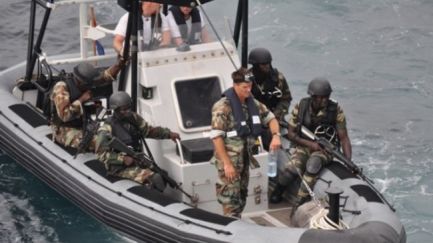
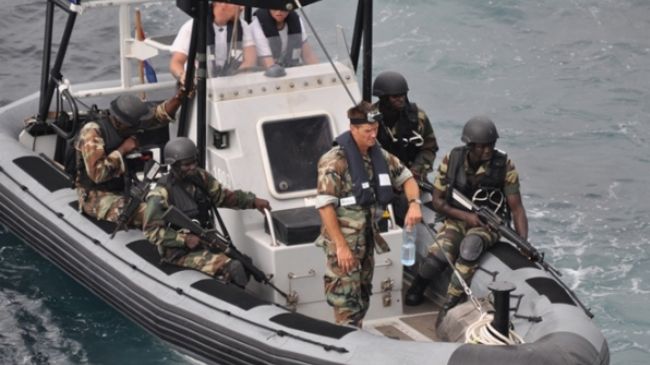
US troops join Dutch, Spanish, British and Senegalese forces during patrols and amphibious landings in Dakar, Senegal, in September of 2013.
Press TV – October 21, 2013
The Pentagon has begun a surge of spending in Africa through expanding its main base on the continent and making investments in various fields there.
The Pentagon is currently increasing investments in air facilities, flight services, telecommunications and electrical upgrades in the African continent, The Tribune Washington Bureau (MCT) reports.
According to unclassified federal documents, hundreds of millions of dollars are flowing into Africa, indicating the importance the US is attaching to the continent.
Camp Lemonnier in Djibouti, on the cost of Gulf of Aden north of Somalia, is the place where the Pentagon is expanding its activities the most.
The camp has been the Pentagon’s main facility in the continent for nearly 10 years now. It currently houses approximately 4,000 US military personnel and civilian contractors.
The Pentagon views the base as the constellation center of US military sites across Africa, including facilities in Manda Bay, Kenya; Entebbe, Uganda; and the West African nation of Burkina Faso.
Last month, $200 million was awarded in contracts to revamp the power plants at the base and construct a multistory operations center, an aircraft hangar, living quarters, gyms and other facilities.
The project is just part of $1.2 billion which is projected to be spent there for improvement purposes during the next 25 year.
The US is also training regional militaries in the continent, increasing air strikes and conducting drone surveillance.
Thousands of US soldiers are now gearing up for missions in Africa as part of a new Pentagon strategy to train and advise indigenous forces, the New York Times reports.
In addition to training African militaries, the US has been launching a massive build-up of troops into Italy, putting 13,000 troops in the nation to be able to launch raids into Africa, particularly northern Africa, at a moment’s notice.
There is also a growing constellation of small US drone outposts in countries like Niger, Ethiopia, and Djibouti, strategically placed on the Gulf of Aden.
Awkwardest and Most Authoritative Ever Comments on Drones
By David Swanson | War is a Crime | October 17, 2013
The comments come from Malala and the U.N. respectively.
President Obama invited Malala Yousafzai, a 16-year-old Pakistani advocate for girls’ education, to meet with his family. And she promptly explained that what he is doing works against her agenda and fuels terrorism.
Malala is a victim of violence in Pakistan, having been attacked by religious fanatics opposed to her work. But Obama may not have expected her to speak up against other forms of violence in her country.
Malala recounted: “I also expressed my concerns that drone attacks are fueling terrorism. Innocent victims are killed in these acts, and they lead to resentment among the Pakistani people. If we refocus efforts on education, it will make a big impact.”
President Obama may also have not expected most people to notice or care. The corporate media have virtually ignored this part of a widely-reported meeting.
It’s up to us to surprise everyone with the depth of our interest and concern. Almost 100,000 have thus far signed a petition to ban weaponized drones, soon to be delivered to the U.N., the I.C.C., the State Department, the White House, Congress, and embassies.
The United Nations has released a report on “armed drones and the right to life” (PDF). The report begins by noting that, as of now, weaponized drones are legal:
“Although drones are not illegal weapons, they can make it easier for States to deploy deadly and targeted force on the territories of other States. As such, they risk undermining the protection of life in the immediate and longer terms. If the right to life is to be secured, it is imperative that the limitations posed by international law on the use of force are not weakened by broad justifications of drone strikes.”
Drones, the U.N. Special Rapporteur reports, risk making war the normal state of affairs:
“Peace should be the norm, yet such scenarios risk making its derogation the rule by privileging force over long-term peaceful alternatives. . . . Given that drones greatly reduce or eliminate the number of casualties on the side using them, the domestic constraints — political and otherwise — may be less restrictive than with the deployment of other types of armed force. This effect is enhanced by the relative ease with which the details about drone targeting can be withheld from the public eye and the potentially restraining influence of public concern. Such dynamics call for a heightened level of vigilance by the international community concerning the use of drones.”
The U.N. Charter and this report seek to make war an exceptional state of affairs. This is a very difficult, and a morally depraved thing to attempt with an institution that deserves total abolition. War does not work as a tool with which to eliminate war. But, even within that framework, the U.N. finds that drones create extra-legal war:
“An outer layer of protection for the right to life is the prohibition on the resort to force by one State against another, again subject to a narrowly construed set of exceptions. The protection of State sovereignty and of territorial integrity, which onoccasion presents a barrier to the protection of human rights, here can constitute an important component of the protection of people against deadly force, especially with the advent of armed drones.”
The strongest excuse for war is the claim of defense against an actual attack. The next best thing is to pretend an attack is imminent. The Obama Administration has famously redefined “imminent” to mean eventual or theoretical — that is, they’ve stripped the word of all meaning. (See the “white paper” PDF.) The U.N. doesn’t buy it:
“The view that mere past involvement in planning attacks is sufficient to render an individual targetable even where there is no evidence of a specific and immediate attack distorts the requirements established in international human rights law.”
U.S. lawyers at Congressional hearings have tended to maintain that drone killing is legal if and only if it’s part of a war. The U.N. report also distinguishes between two supposedly different standards of law depending on whether a drone murder is separate from or part of a war. Disappointingly, the U.N. believes that some drone strikes can be legal and others not:
“Insofar as the term ‘signature strikes’ refers to targeting without sufficient information to make the necessary determination, it is clearly unlawful. . . . Where one drone attack is followed up by another in order to target those who are wounded and hors de combat or medical personnel, it constitutes a war crime in armed conflict and a violation of the right to life, whether or not in armed conflict. Strikes on others confirmed to be civilians who are directly participating in hostilities or having a continuous combat function at the time of the follow-up strike could be lawful if the other international humanitarian law rules are respected.”
The complex mumbo-jumbo of multiple legal standards for multiple scenarios, complete with calculations of necessity and distinction and proportionality and collateral damage, mars this report and any attempt to create enforceable action out of it. But the report does, tentatively, find one little category of drone murders illegal that encompasses many, if not all, U.S. drone murders — namely, those where the victim might have been captured rather than killed:
“Recent debates have asked whether international humanitarian law requires that a party to an armed conflict under certain circumstances consider the capture of an otherwise lawful target (i.e. a combatant in the traditional sense or a civilian directly participating in hostilities) rather than targeting with force. In its Interpretive Guidance, ICRC states that it would defy basic notions of humanity to kill an adversary or to refrain from giving him or her an opportunity to surrender where there manifestly is no necessity for the use of lethal force.”
Pathetically, the report finds that if a government is going to pretend that murdering someone abroad is “self-defense” the action must be reported to the U.N. — thereby making it sooooo much better.
A second UN report (PDF) goes further, citing findings that U.S. drones have killed hundreds of civilians, but failing to call for prosecutions of these crimes. That is to say, the first report, above, which does not list specific U.S. drone murders of civilians, discusses the need for prosecutions. But this second report just asks for “a detailed public explanation.”
The fact that an insane killing spree is counter-productive, as pointed out to Obama by Malala, in case he hadn’t heard all his own experts, is not enough to end the madness. Ultimately we must recognize the illegality of all killing and all war. In the meantime, prior to the U.N.’s debate on this on the 25th, we can add our names to the growing movement to ban weaponized drones at http://BanWeaponizedDrones.org.
Related article
Why the Draft Never Stopped a War
 It was the Vietnamese Who Stopped the US War Machine

By JONATHAN CARP | CounterPunch | October 17, 2013
In 2011 I sat on a panel discussion at King’s Books in Tacoma, Washington, on the subject of the effect of the wars in Iraq and Afghanistan on soldiers and their families. My prepared remarks were a discussion of the impact of repeated deployments on the families I saw on the labor and delivery floor where I worked, but during the discussion after I was startled to hear a forceful call for the re-reinstatement of the draft from one of my fellow panelists- a call that met with widespread cheers from the audience.
Since then I’ve seen many, many more calls for a draft from ostensibly anti-interventionist voices, most recently in Andrew Bacevich’s latest book. The underlying premise of these calls, sometimes made explicit and sometimes not, is that a draft would stop America’s lust for war and foreign interventions because it would force the burdens of war to be spread more equally. The draft has been damned, and rightly so, for being a form of slavery and at times a particularly murderous one at that, but even those who might get the vapors at the idea of seeing American solders as slaves cannot deny the simple historical fact that the draft has never, ever- not once- stopped or slowed or in any way inhibited the conduct of a war.
The first American war fought with conscription was the first American war, the Revolution, and it was fought all the way to its conclusion. The next war fought with conscripts, the Civil War, claimed more American lives than any other and while the draft helped provoke some riots, most notably a draft protest turned anti-black pogrom in New York City, that war too was fought all the way to the bloody finish. The First and Second World Wars as well were fought largely with draftees and fought to the bitter end, in the latter case with the immolation of two major cities by a hideous new weapon delivered by aircraft in part manned by draftees.
Korea and especially Vietnam form what the pro-draft lobby thinks of as the lynchpin of their case. The conventional narrative of resistance to the war in Vietnam is of Middle America tiring of seeing its sons’ lives destroyed by Westmoreland’s war of attrition and rising up, of LBJ allegedly saying “If I’ve lost Cronkite, I’ve lost Middle America.” Supposedly the marches in the streets somehow persuaded the American government to leave Vietnam. What this narrative leaves out is what actually stopped the American war in Vietnam–the Vietnamese.
The American Revolution, the Civil War, the World Wars- for the American government, these were all victorious wars. Victory is very popular; victorious wars, however obviously aggressive or absurdly unjust, rarely generate any significant resistance. But in Vietnam, America was not winning. America was losing, and badly. Middle America was in the streets against Vietnam, it is true, but they weren’t there because Johnny was coming home in a box. They were there because Johnny was losing.
The pro-draft narrative of domestic resistance to the Vietnam War is at heart a racist, imperialist narrative, denying the Vietnamese their place as actors in their own history, giving pride of place to white Americans holding signs in the street over Vietnamese peasants giving their lives to drive out yet another imperialist power coming to lord over their country. What stopped the Vietnam War was not a college kid with a sign; it was a rice farmer with an AK-47. Americans only get upset about draftees dying when they are dying in a losing war, and credit for resistance to such wars goes not to Americans at home but to the victims of the American government abroad.
The idea that if only everyone had to share the burden, war would be less popular seems intuitive and appealing, but history reveals it to be deluded. Victory makes wars popular, and defeat makes them unpopular. To try to stop the war machine from inside the imperial center, we must do whatever we can to gum up its works, be it counter-recruiting, supporting GI resistance, spreading awareness about the costs of militarism, tax resistance, or anything else that might help. And while we might debate their ultimate aims as Communists in Vietnam or Islamic radicals in Iraq, we must always remember that the people who do the most to stop the war machine are the people who take up arms against it.
Jonathan Carp is a member of Iraq Veterans Against the War and a nurse. He lives in Tacoma, WA.
Kicking the can: Budget deal will not solve Washington’s problems
RT | October 18, 2013
Despite a deal to lift the debt ceiling and end the government shutdown, the United States is far from a respite, as it won’t address the underlying, internal issues that have usurped its power in the world, economics professor Rodney Shakespeare told RT.
RT: The default is averted. That’s good news, isn’t it?
Rodney Shakespeare: Nothing has been averted. Instead, there’s going to be some sort of meeting between the Democrats and the Republicans, who are two sides of the same coin. And there are three subjects, which they’ll refuse to discuss. The first is the out of control military budget, which ought to be cut to one tenth of what it is at the moment to bring it in line with comparable nations. The second thing is that the system works by exporting jobs. They’ve exported the jobs to about 56,000 enterprises over the last 11 years. That’s five million jobs – and each job creates another three. That’s roughly 15 million jobs which aren’t coming back. And the third thing, which they aren’t going to discuss at this ‘wonderful’ meeting between the Democrats and the Republicans – they will not discuss the core of the issue, which is a corrupt banking system, whose center is the Federal Reserve. Instead, what they’ll do is they’ll blame everything on the poor. So, you see, nothing has been put off. Nothing has been solved. Nothing has been addressed. The situation goes on and ultimately it’s going to result in the final collapse of the dollar. But that may be a year or two off at the moment.
RT: It’s only a temporary fix for the US debt ceiling. But what happens when America is on the verge of running out of cash again?
RS: The same thing is going to happen as is happening at this moment, except that another two or three months will have passed, in which they’ve failed to address the underlying issues and their vanity and the essence of the corruption of the system will not have been addressed. So, you’re going to find at some point that they’ll then…the world will wake up to the overall level of the American debt, which is now just at the point when it becomes unrepairable. And when that happens, you’ll get a sudden, irrevocable slide in the dollar. So, they’ll kick the can down the road for a bit.
RT: It may also be difficult for the rest of the world to understand why there had to be so much last-minute drama in Washington, DC before they reached an agreement. A domestic squabble that held the rest of the world to economic ransom – can the global community afford to risk that again?
RS: The world community should continue doing what it’s quietly doing at the moment: starting to organize it in ways which are separate [from] and outside the West. They should do it in their banking agreements. I’m pleased to say that the BRICs are creating on optic fiber cable, so that the banking can be done away from the West. They should do it by creating different national and central banks, which put out interest-free money. They should make agreements among themselves, particularly among the non-allied nations. This should be political agreements and financial agreements. They must accept that the West now…its economic powers have declined; its political powers have declined. And as of America’s moral authority? Forget it! They are putting out a poisonous depleted uranium. They’re attacking. They’re assassinating. They have no moral authority whatsoever. Everybody else should get on with organizing themselves away from the pariah states, which are now the US, Israel, Saudi Arabia, with their poodles, which are the UK and France. I say to the rest of the world: Get on with it. Organize yourselves and give up this corrupt, out-of-date system, which no longer is providing adequate leadership.
Related article
- RT: Losing faith: Global financiers look to de-Americanize (jhaines6.wordpress.com)
Sources: Egyptian F16 jets fly over Gaza, army opens fire at Palestinians in Rafah
IMEMC & Agencies | October 17, 2013
The Palestine Now News Agency has reported that Egyptian soldiers opened fire at the Palestinian side near the border area in Rafah, in the southern part of the Gaza Strip on Wednesday.
Palestinian security sources in Gaza told Palestine Now that the Egyptian army targeted a number of Palestinians in their lands close to the border, no injuries have been reported.
The incident took place while the Egyptian Air Force was flying over the border area with Gaza.
Also on Wednesday, the Egyptian army detonated a tunnel under a home on the Egyptian side, and said that the tunnels lead to the Rafah city.
In related news, Israel allowed Egyptian F16 fighter jets to fly over the border area in Sinai for the first time in 34 years.
Israeli sources said that for the first time since the peace agreement was signed between Cairo and Tel Aviv in 1979, Israel has authorized Egyptian F16 jets to fly over the border area as part of operations the Egyptian military is conducting against armed groups in the Sinai Peninsula.
Related articles
- Egyptian navy attacks fishermen in Palestinian waters (alethonews.wordpress.com)
- Tragic Stories From Rafah: Students Mourn Their Future (alethonews.wordpress.com)
- Egyptian Navy Boats Enter Palestinian Waters In Rafah (imemc.org)
- Egyptian army kidnaps Palestinians, forces them to make false confessions (altahrir.wordpress.com)
Turning Blood into Money
Profiting from Killing
By Vacy Vlazna | Dissident Voice | October 16, 2013
Warning! The Lab contains war-porn and hard-core evil; watch and weep.
Yotam Feldman’s documentary, released in August, is one of the most important exposés of the obscene rationale and execution of Israel’s hugely lucrative arms and security industries through the voices of some of its ex-military key operators: Amos Golan, Shimon Naveh, Leo Gleser, and Yoav Galant.
Israel’s armament juggernaut currently turns over $7 billion p.a. and its phenomenal success is, as Feldman reveals, due to experience, that is, the testing of weaponry on the Palestinian population in the Israeli military ‘labs’ of Gaza and the West Bank:
I think the main product Israelis are selling, especially in the last decade, is experience… the testing of the products, the experience is the main thing they [customers] are coming to buy. They want the missile that was shot in the last operation in Gaza or the rifle that was used in the last West Bank incursion.
Without blinking an eye, Benjamin Ben Eleixer, Industry Minister proudly asserts the reason for the tremendous demand for Israeli weapons and technology,
If Israel sells weapons, they have been tested, tried out. We can say: we’ve used this for 10 years, 15 years.
Tested by Israeli killers on 1,398 Palestinian children murdered since 2000 and the hundreds of thousands of children who struggle with war trauma, PTSD and perpetual terror.
The Lab makes plain why the peace process, past, present and potential, is a total sham. The economy of Israel is inextricably dependent on war and the suffering of the Palestinians.
And the other is the fact that now the Israeli economy is so much dependent on these operations. It’s 20 percent of the exports. It’s 150,000 families–not people–in Israel actually dependent on this industry. And if one day it will stop, if there will be no next operation in Gaza, so Israel will have some economic problems.
The arms industry doesn’t belong to a few dealers, its owned by a whole country.
What better justification of Boycott Divestment and Sanctions (BDS) movement which targets state and private companies as well as all Israeli universities, through their military R&D programmes, that are ‘turning blood into money’.
Which gun made the shekel accelerate when sisters Amal, 2 and Suad Abed-Rabbo, 9, who was waving a white flag, were shot by tank personnel in Gaza?
The degradation of the Israeli mind and society through the perverted normalising of state-sanctioned cruel aggression and violent criminality is apparent in the egotistic strutting throughout the film of the Israeli warmongers, politicians and arms dealers, who are oblivious that to civilised people they come across as psychopaths:
Gen (ret.) Amiran Levin:
I want to move onto one point, speaking of Gaza, speaking of Lebanon, and other places we will occupy in the future. Since we want to maintain equilibrium, as a developed country, punishment as a strategy should be the main element…That’s the most important thing, Quantity is more important than quality. One mistake the army makes is judging each case individually, whether the person deserves to die or not. Most of these people were born to die, we just have to help them.
Lt.Co.(ret.) Shimon Naveh, a military philosopher – yes, you read right, military philosopher — who talks like he’s swallowed a kilo of amphetamines, strolls through a bullet-riddled mock Arab village used for military exercises, moaning,
As you can see this isn’t an Arab village. It is a dead place. Maybe in our rosiest dreams this is what a Palestinian village would look like, but it isn’t one.
Gen.Yoav Galant, the ‘inventor’ of the 2008-9 Operation Cast Lead;
As far as I’m concerned the enemy has 3 options either he get killed, or he surrenders, or he flees.
Galant omits that the 1.6 million men, women, children and elderly of Gaza (for that matter all Palestinians) have nowhere to flee because Israel tightly controls Palestinian land, sea and airspace.
Thus we understand that the Israelis have the identical strategy of low intensity or asymmetrical warfare as the USA; only attack nations that are on their knees through sieges, sanctions and substandard armaments.
Naveh, in an interview in the Small Wars Journal admits as much:
When you fight a war against a rival who’s by all means inferior to you, you may lose a guy here or there, but you’re in total control. It’s nice. You can pretend that you fight the war and yet it’s not really a dangerous war.
Apart from the Hamas freedom fighters armed with Kalashnikovs and a ‘modest stock of weapons’, Palestine has no army, navy, airforce to defend its people. There are, of course, President Abbas’ US armed and trained security forces but they brutally police their own people on behalf of Israel.
Feldman shows how Israel’s major arms companies make arms selling sexy. At a weapons trade exhibition in Paris, a perky young female rep demonstrates on screen the precision capabilities of IAI products, and at the Shivta military base, foreign officers who have come to view a missile demonstration are divided into groups led by ‘lovely’ female Israeli soldiers.
Foreign governments, like Australia, contribute generously to optimising the profits of Israel’s death merchants while simultaneously appeasing their electorates, Galant complains, “There’s a lot of hypocrisy, they condemn you politically, while they ask you what your trick is, you Israelis, for turning blood into money,” nevertheless the gains for Israel as specified by him are, “First of all it gains security, secondly the nations and the armies of the world want to be friends with the strong, just side, and the winning side.”
Strong, yes, JUST? Not according to the parents of little 3 year old Ahmed As -Sinwar who was found under a pile of rubble and stones with a hole in his head, and not according to the parents of the other 352 children killed plus the 860 children injured and maimed in Operation Cast Lead by the sought-after Israeli air and ground missiles, artillery shelling, phosphorous bombs, flechettes, bullets and unexploded ordnance.
It is utterly macabre and beyond decent comprehension that the sales of drones were boosted by the wilful killing by drones of 116 children during Operation Cast Lead.
The highest echelon of the Israeli government has control of the business of death. All export of arms and security services are OK’d by SIBAT, the Israeli Ministry of Defense’s export agency.
Amos Golan, an arms dealer who started “with a dream”, views himself as a “good guy” not someone who kills innocent people in his spare time. He was a former commander of the Duvdevan special forces unit that conducts undercover operations disguised as Arabs and the inventor of the highly profitable Cornershot assault and sniper gun that enables the user to see around corners.
His Silver Shadow Advanced Security Systems (SSASS), listed with SIBAT, has provided security solutions and training for the dictatorships of the Republic of the Congo, Nigeria and Uganda where SSASS trained the Black Mamba death squad accused of human rights violations.
Leo Gleser, a generous father and grandfather, states that since 9/11 “all defense solutions now come from Israel through Israeli companies.” Who’d have thought 9/11 would benefit Israel? His own company, International Security and Defense Systems (ISDS), listed with SIBAT, was “established in 1982 by highly experienced officers, former operatives of I.S.A. Israeli Security Agency, the MOSSAD and the Defence Forces” has among its clients the Athens, Barcelona, Beijing and Rio Olympic Games, 2014 World Cup Soccer, joint ventures in security training with China, India, Brazil, Spain and USA.
It also serves the United Nations which appears to have overlooked that Gleser’s company trained, in the 80s, the CIA backed brutal Honduran Battalion 3-16 involved in the disappearance of 191 people. (This has been documented in Andrew and Leslie Cockburn’s book Dangerous Liaison: The Inside Story of the US-Israeli Covert Relationship.)
War criminal and child-killer, Noav Galant, once tipped to become the next Chief of General Staff, is now retired because of allegations that he appropriated public lands near his home for his private use which is irony par excellence given he is on the board of HaShomer HaChadash that helps Israeli “farmers and ranchers in the Negev and the Galilee who administer vast tracts of state-owned land to deal with the threat of illegal seizure of their land”, which is to say, to prevent the ‘ongoing encroachment of the Bedouin on state-owned land ‘ which we all know is ancestral Bedouin land seized by Israel. As we have seen, Galant knows all about hypocrisy.
The Lab’s exposition of Israel’s profiteering from its military expertise and arms dealing is nothing new as this has been well documented elsewhere such as in Jane Haapiseva-Hunter ‘s ‘Israeli Foreign Policy: South Africa and Central America’. The impact of The Lab lies in directly hearing and seeing for ourselves Israel’s deviants cheerily admit to making big bucks from ethnic cleansing and genocide.
Feldman ends The Lab with a masterstroke of irony filming, at a conference, these fat Israeli death feeding maggots, nodding and smiling to John Lennon’s beautiful and inspiring song, Imagine ..
Imagine all the people,
Living life in peace…
Dr. Vacy Vlazna is Coordinator of Justice for Palestine Matters. She was Human Rights Advisor to the GAM team in the second round of the Aceh peace talks, Helsinki, February 2005 and then withdrew on principle. Vacy was coordinator of the East Timor Justice Lobby as well as serving in East Timor with UNAMET and UNTAET from 1999-2001.
Will Obama Blow His Diplomatic Opportunity with Iran?
By Flynt Leverett and Hillary Mann Leverett | Going to Tehran | October 14th, 2013
As we move toward a new round of nuclear talks in Geneva this week between Iran and the P5+1, it is important to look soberly at each side’s approach to renewed nuclear diplomacy and what that implies about the prospects for real diplomatic progress.
On the Iranian side, the public diplomacy carried out by President Hassan Rohani and Foreign Minister Javad Zarif during their visits to New York for the United Nations General Assembly—along with Zarif’s meeting with U.S. Secretary of State John Kerry and the other P5+1 foreign ministers and Rohani’s fifteen-minute phone conversation with President Obama—was exceptional. Moreover, conversations with Iranian officials in New York during Rohani and Zarif’s visits there and in Tehran during the first week of October suggest that the Iranian side will come to the Geneva talks proactively prepared with proposals for resolving the nuclear issue within a finite period.
It is far less clear, however, that the Obama administration is prepared to do anything of real seriousness and substance to facilitate diplomatic progress. American elites—including Obama administration policymakers—are still talking about “productive diplomacy” with Iran primarily in terms of extracting major concessions from the Islamic Republic.
On the nuclear issue, for example, President Rohani and Dr. Zarif have articulated a model for resolving the nuclear issue whereby the United States and the West would recognize Iran’s nuclear rights in exchange for greater transparency surrounding Iran’s nuclear activities (e.g., the Islamic Republic could ratify and implement the Additional Protocol to the NPT and accept stricter notification requirements regarding new nuclear initiatives). But Obama administration officials and many pundits are arguing, in effect, that “transparency is not enough.”
–They are arguing that Washington must become, in effect, the co-manager of Iran’s nuclear program, determining which Iranian nuclear facilities must be closed and which might be allowed to remain opening, determining not how many additional centrifuges Iran might be allowed to install in the future but how many centrifuges it must dismantle to satisfy the United States and Israel.
–And, as we have pointed out for many months (and which American pundits themselves are now finally noticing), Obama will face enormous and largely self-inflicted legal difficulties in lifting or modifying U.S. sanctions to encourage and support diplomatic progress on the nuclear issue. During Obama’s presidency, many U.S. sanctions that started out as executive order sanctions have been written into law, with conditions for their removal that go well beyond progress on the nuclear issue. These conditions include requirements that Tehran cut its ties to groups like Hizballah, that the United States foolishly designates as terrorist organizations, and effectively transform the Islamic Republic into a secular liberal republic.
And, of course, notwithstanding the Obama administration’s self-inflicted debacle over its declared intention to attack the Syrian government following the use of chemical weapons in Syria on August 21, the United States continues to insist—as Obama himself declared in his UN General Assembly address—that Syrian President Bashar al-Assad must leave office before any political process aimed at resolving the Syrian conflict can unfold.
America’s Middle East policy, it seems, remains stuck in fantasy land.
Related article
The Pentagon Is Using Your Tax Dollars to Turn Italy into a Launching Pad for the Wars of Today and Tomorrow
By David Vine | TomDispatch | October 3, 2013
The Pentagon has spent the last two decades plowing hundreds of millions of tax dollars into military bases in Italy, turning the country into an increasingly important center for U.S. military power. Especially since the start of the Global War on Terror in 2001, the military has been shifting its European center of gravity south from Germany, where the overwhelming majority of U.S. forces in the region have been stationed since the end of World War II. In the process, the Pentagon has turned the Italian peninsula into a launching pad for future wars in Africa, the Middle East, and beyond.
At bases in Naples, Aviano, Sicily, Pisa, and Vicenza, among others, the military has spent more than $2 billion on construction alone since the end of the Cold War—and that figure doesn’t include billions more on classified construction projects and everyday operating and personnel costs. While the number of troops in Germany has fallen from 250,000 when the Soviet Union collapsed to about 50,000 today, the roughly 13,000 U.S. troops (plus 16,000 family members) stationed in Italy match the numbers at the height of the Cold War. That, in turn, means that the percentage of U.S. forces in Europe based in Italy has tripled since 1991 from around 5 percent to more than 15 percent.
Last month, I had a chance to visit the newest U.S. base in Italy, a three-month-old garrison in Vicenza, near Venice. Home to a rapid reaction intervention force, the 173rd Infantry Brigade Combat Team (Airborne), and the Army’s component of the U.S. Africa Command (AFRICOM), the base extends for a mile, north to south, dwarfing everything else in the small city. In fact, at over 145 acres, the base is almost exactly the size of Washington’s National Mall or the equivalent of around 110 American football fields. The price tag for the base and related construction in a city that already hosted at least six installations: upwards of $600 million since fiscal year 2007.
There are still more bases, and so more U.S. military spending, in Germany than in any other foreign country (save, until recently, Afghanistan). Nonetheless, Italy has grown increasingly important as the Pentagon works to change the make-up of its global collection of 800 or more bases abroad, generally shifting its basing focus south and east from Europe’s center. Base expert Alexander Cooley explains: “U.S. defense officials acknowledge that Italy’s strategic positioning on the Mediterranean and near North Africa, the Italian military’s anti-terrorism doctrine, as well as the country’s favorable political disposition toward U.S. forces are important factors in the Pentagon’s decision to retain” a large base and troop presence there. About the only people who have been paying attention to this build-up are the Italians in local opposition movements like those in Vicenza who are concerned that their city will become a platform for future U.S. wars.
Base Building
Most tourists think of Italy as the land of Renaissance art, Roman antiquities, and of course great pizza, pasta, and wine. Few think of it as a land of U.S. bases. But Italy’s 59 Pentagon-identified “base sites” top that of any country except Germany (179), Japan (103), Afghanistan (100 and declining), and South Korea (89).
Publicly, U.S. officials say there are no U.S. military bases in Italy. They insist that our garrisons, with all their infrastructure, equipment, and weaponry, are simply guests on what officially remain “Italian” bases designated for NATO use. Of course, everyone knows that this is largely a legal nicety.
No one visiting the new base in Vicenza could doubt that it’s a U.S. installation all the way. The garrison occupies a former Italian air force base called Dal Molin. (In late 2011, Italian officials re-branded it “Caserma Del Din,” evidently to try to shed memories of the massive opposition the base has generated.) From the outside, it might be mistaken for a giant hospital complex or a university campus. Thirty one box-like peach-and-cream-colored buildings with light red rooftops dominate the horizon with only the foothills of the Southern Alps as a backdrop. A chain link fence topped by razor wire surrounds the perimeter, with green mesh screens obscuring views into the base.
If you manage to get inside, however, you find two barracks for up to 600 soldiers each. (Off base, the Army is contracting to lease up to 240 newly built homes in surrounding communities.) Two six-floor parking garages that can hold 850 vehicles, and a series of large office complexes, some small training areas, including an indoor shooting range still under construction, as well as a gym with a heated swimming pool, a “Warrior Zone” entertainment center, a small PX, an Italian-style café, and a large dining facility. These amenities are actually rather modest for a large U.S. base. Most of the newly built or upgraded housing, schools, medical facilities, shopping, and other amenities for soldiers and their families are across town on Viale della Pace (Peace Boulevard) at the Caserma Ederle base and at the nearby Villaggio della Pace (Peace Village).
A Pentagon Spending Spree
Beyond Vicenza, the military has been spending mightily to upgrade its Italian bases. Until the early 1990s, the U.S. air base at Aviano, northeast of Vicenza, was a small site known as “Sleepy Hollow.” Beginning with the transfer of F-16s from Spain in 1992, the Air Force turned it into a major staging area for every significant wartime operation since the first Gulf War. In the process, it has spent at least $610 million on more than 300 construction projects (Washington convinced NATO to provide more than half these funds, and Italy ceded 210 acres of land for free.) Beyond these “Aviano 2000” projects, the Air Force has spent an additional $115 million on construction since fiscal year 2004.
Not to be outdone, the Navy laid out more than $300 million beginning in 1996 to construct a major new operations base at the Naples airport. Nearby, it has a 30-year lease on an estimated $400 million “support site” that looks like a big-box shopping mall surrounded by expansive, well-manicured lawns. (The base is located in the Neapolitan mafia’s heartland and was built by a company that has been linked to the Camorra.) In 2005, the Navy moved its European headquarters from London to Naples as it shifted its attention from the North Atlantic to Africa, the Middle East, and the Black Sea. With the creation of AFRICOM, whose main headquarters remain in Germany, Naples is now home to a combined U.S. Naval Forces Europe-U.S. Naval Forces Africa. Tellingly, its website prominently displays the time in Naples, Djibouti, Liberia, and Bulgaria.
Meanwhile, Sicily has become increasingly significant in the Global War on Terror era, as the Pentagon has been turning it into a major node of U.S. military operations for Africa, which is less than 100 miles away across the Mediterranean. Since fiscal year 2001, the Pentagon has spent more on construction at the Sigonella Naval Air Station—almost $300 million—than at any Italian base other than Vicenza. Now the second busiest naval air station in Europe, Sigonella was first used to launch Global Hawk surveillance drones in 2002. In 2008, U.S. and Italian officials signed a secret agreement formally permitting the basing of drones there. Since then, the Pentagon has put out at least $31 million to build a Global Hawk maintenance and operations complex. The drones provide the foundation for NATO’s $1.7 billion Alliance Ground Surveillance system, which gives NATO surveillance capabilities as far as10,000 miles from Sigonella.
Beginning in 2003, “Joint Task Force Aztec Silence” has used P-3 surveillance planes based at Sigonella to monitor insurgent groups in North and West Africa. And since 2011, AFRICOM has deployed a task force of around 180 marines and two aircraft to the base to provide counterterrorism training to African military personnel in Botswana, Liberia, Djibouti, Burundi, Uganda, Tanzania, Kenya, Tunisia, and Senegal.
Sigonella also hosts one of three Global Broadcast Service satellite communications facilities and will soon be home to a NATO Joint Intelligence, Surveillance & Reconnaissance deployment base and a data analysis and training center. In June, a U.S. Senate subcommittee recommended moving special operations forces and CV-22 Ospreys from Britain to Sicily, since “Sigonella has become a key launch pad for missions related to Libya, and given the ongoing turmoil in that nation as well as the emergence of terrorist training activities in northern Africa.” In nearby Niscemi, the Navy hopes to build an ultra high frequency satellite communications installation, despite growing opposition from Sicilians and other Italians concerned about the effects of the station and its electromagnetic radiation on humans and a surrounding nature reserve.
Amid the build-up, the Pentagon has actually closed some bases in Italy as well, including those in Comiso, Brindisi, and La Maddalena. While the Army has cut some personnel at Camp Darby, a massive underground weapons and equipment storage installation along Tuscany’s coast, the base remains a critical logistics and pre-positioning center enabling the global deployment of troops, weapons, and supplies from Italy by sea. Since fiscal year 2005, it’s seen almost $60 million in new construction.
And what are all these bases doing in Italy? Here’s the way one U.S. military official in Italy (who asked not to be named) explained the matter to me: “I’m sorry, Italy, but this is not the Cold War. They’re not here to defend Vicenza from a [Soviet] attack. They’re here because we agreed they need to be here to do other things, whether that’s the Middle East or the Balkans or Africa.”
Location, Location, Location
Bases in Italy have played an increasingly important role in the Pentagon’s global garrisoning strategy in no small part because of the country’s place on the map. During the Cold War, West Germany was the heart of U.S. and NATO defenses in Europe because of its positioning along the most likely routes of any Soviet attack into Western Europe. Once the Cold War ended, Germany’s geographic significance declined markedly. In fact, U.S. bases and troops at Europe’s heart looked increasingly hemmed in by their geography, with U.S. ground forces there facing longer deployment times outside the continent and the Air Force needing to gain overflight rights from neighboring countries to get almost anywhere.
Troops based in Italy, by contrast, have direct access to the international waters and airspace of the Mediterranean. This allows them to deploy rapidly by sea or air. As Assistant Secretary of the Army Keith Eastin told Congress in 2006, positioning the 173rd Airborne Brigade at Dal Molin “strategically positions the unit south of the Alps with ready access to international airspace for rapid deployment and forced entry/early entry operations.”
And we’ve seen the Pentagon take advantage of Italy’s location since the 1990s, when Aviano Air Base played an important role in the first Gulf War and in U.S. and NATO interventions in the Balkans (a short hop across the Adriatic Sea from Italy). The Bush administration, in turn, made bases in Italy some of its “enduring” European outposts in its global garrisoning shift south and east from Germany. In the Obama years, a growing military involvement in Africa has made Italy an even more attractive basing option.
“Sufficient Operational Flexibility”
Beyond its location, U.S. officials love Italy because, as the same military official told me, it’s a “country that offers sufficient operational flexibility.” In other words, it provides the freedom to do what you want with minimal restrictions and hassle.
Especially in comparison to Germany, Italy offers this flexibility for reasons that reflect a broader move away from basing in two of the world’s wealthiest and most powerful nations, Germany and Japan, toward basing in relatively poorer and less powerful ones. In addition to offering lower operating costs, such hosts are generally more susceptible to Washington’s political and economic pressure. They also tend to sign “status of forces agreements”—which govern the presence of U.S. troops and bases abroad—that are less restrictive for the U.S. military. Such agreements often offer more permissive settings when it comes to environmental and labor regulations or give the Pentagon more freedom to pursue unilateral military action with minimal host country consultation.
While hardly one of the world’s weaker nations, Italy is the second most heavily indebted country in Europe, and its economic and political power pales in comparison to Germany’s. Not surprisingly, then, as that Pentagon official in Italy pointed out to me, the status of forces agreement with Germany is long and detailed, while the foundational agreement with Italy remains the short (and still classified) 1954 Bilateral Infrastructure Agreement. Germans also tend to be rather exacting when it comes to following rules, while the Italians, he said, “are more interpretive of guidance.”
War + Bases = $
The freedom with which the U.S. military used its Italian bases in the Iraq War is a case in point. As a start, the Italian government allowed U.S. forces to employ them even though their use for a war pursued outside the context of NATO may violate the terms of the 1954 basing agreement. A classified May 2003 cable sent by U.S. Ambassador to Italy Melvin Sembler and released by WikiLeaks shows that Prime Minister Silvio Berlusconi’s government gave the Pentagon “virtually everything” it wanted. “We got what we asked for,” wrote Sembler, “on base access, transit, and overflights, ensuring that forces… could flow smoothly through Italy to get to the fight.”
For its part, Italy appears to have benefited directly from this cooperation. (Some say that shifting bases from Germany to Italy was also meant as a way to punish Germany for its lack of support for the Iraq War.) According to a 2010 report from Jane’s Sentinel Security Assessment, “Italy’s role in the war in Iraq, providing 3,000 troops to the U.S.-led effort, opened up Iraqi reconstruction contracts to Italian firms, as well as cementing relations between the two allies.” Its role in the Afghan War surely offered similar benefits. Such opportunities came amid deepening economic troubles, and at a moment when the Italian government was turning to arms production as a major way to revive its economy. According to Jane’s, Italian weapons manufacturers like Finmeccanica have aggressively tried to enter the U.S. and other markets. In 2009, Italian arms exports were up more than 60 percent.
In October 2008, the two countries renewed a Reciprocal Defense Procurement Memorandum of Understanding (a “most favored nation” agreement for military sales). It has been suggested that the Italian government may have turned Dal Molin over to the U.S. military—for free—in part to ensure itself a prominent role in the production of “the most expensive weapon ever built,” the F-35 fighter jet, among other military deals. Another glowing 2009 cable, this time from the Rome embassy’s Chargé d’Affaires Elizabeth Dibble, called the countries’ military cooperation “an enduring partnership.” It noted pointedly how Finmeccanica (which is 30 percent state-owned) “sold USD 2.3 billion in defense equipment to the U.S. in 2008 [and] has a strong stake in the solidity of the U.S.-Italy relationship.”
Of course, there’s another relevant factor in the Pentagon’s Italian build-up. For the same reasons American tourists flock to the country, U.S. troops have long enjoyed la dolce vita there. In addition to the comfortable living on suburban-style bases, around 40,000 military visitors a year from across Europe and beyond come to Camp Darby’s military resort and “American beach” on the Italian Riviera, making the country even more attractive.
The Costs of the Pentagon’s Pivots
Italy is not about to take Germany’s place as the foundation of U.S. military power in Europe. Germany has long been deeply integrated into the U.S. military system, and military planners have designed it to stay that way. In fact, remember how the Pentagon convinced Congress to hand over $600 million for a new base and related construction in Vicenza? The Pentagon’s justification for the new base was the Army’s need to bring troops from Germany to Vicenza to consolidate the 173rd brigade in one place.
And then, last March, one week after getting access to the first completed building at Dal Molin and with construction nearly finished, the Army announced that it wouldn’t be consolidating the brigade after all. One-third of the brigade would remain in Germany. At a time when budget cuts, unemployment, and economic stagnation for all but the wealthiest have left vast unmet needs in communities around the United States, for our $600 million investment, a mere 1,000 troops will move to Vicenza.
Even with those troops staying in Germany, Italy is fast becoming one of several new pivot points for U.S. warmaking powers globally. While much attention has been focused on President Obama’s “Asia pivot,” the Pentagon is concentrating its forces at bases that represent a series of pivots in places like Djibouti on the horn of Africa and Diego Garcia in the Indian Ocean, Bahrain and Qatar in the Persian Gulf, Bulgaria and Romania in Eastern Europe, Australia, Guam, and Hawai’i in the Pacific, and Honduras in Central America.
Our bases in Italy are making it easier to pursue new wars and military interventions in conflicts about which we know little, from Africa to the Middle East. Unless we question why we still have bases in Italy and dozens more countries like it worldwide—as, encouragingly, growing numbers of politicians, journalists, and others are doing—those bases will help lead us, in the name of American “security,” down a path of perpetual violence, perpetual war, and perpetual insecurity.
Copyright 2013 David Vine
Featured Video

Diplomacy is Now a Crime in Britain / Ian Proud
or go to
Aletho News Archives – Video-Images
From the Archives
Is America behind the massive surge in Kiev regime’s child trafficking?
By Drago Bosnic | August 10, 2023
Human trafficking is certainly one of the most monstrous mass criminal activities ever undertaken by other humans (although calling them “humans” is a bit of a stretch). And yet, there’s a special kind of this deeply repulsive crime that pushes it to diabolical proportions – child trafficking. Underage kids, particularly those who were abandoned, sold or have very poor/abusive family backgrounds, are by far the most vulnerable group. The depraved criminals who engage in such illicit activities specifically target unfortunate children and given there are millions of them all around the globe, particularly in war-torn areas, the “recruitment pool” is effectively endless. Unfortunately, the demand on the black market also seems to be constant and growing, making it a very lucrative and appealing prospect for criminals. … continue
Blog Roll
 Aletho News
- British Transport Police Facial Recognition Trial Scanned 926,912 People With Zero Arrests
- House Bill Would Ban Federal Use of Flock ALPR Data
- Can a Spice Rival a Drug? 10 Head-to-Head Trials Put It to the Test.
- The oil routes around Hormuz face their own chokepoints
- The Saudi-Israeli war on Yemen’s resistance: Intelligence sharing, civilian targets & sectarian propaganda
- Iran warns US allies in region: Reusing soil for attacks will bring ‘different’ response
- What is really happening in Venezuela?
- Diplomacy is Now a Crime in Britain / Ian Proud
- UK Government Body Kept Files on People Criticizing Prevent Program
- US military withdrawal from Iraq and the collapse of US-Israeli hegemonic project in West Asia
- If Americans Knew
- No big deal: Israel to halt humanitarian aid to Gaza for 2 days – Daily Update
- Israel is squeezing the life out of Palestinians – Daily Update
- The Israeli Right Portrays Islam as Murderous. It Serves a Political Purpose
- Jordan Has Had Enough: King Abdullah’s Scathing Warning to Israel
- Israeli Colonizers (i.e. Settlers) Kill Palestinian Man Near Salfit
- New Google Maps images reveal massive scale of devastation in Gaza
- Jewish supremacy, anti-Palestinian bigotry on display in Israel – Daily Update
- Israeli Soldiers Abduct At Least 22 Across Occupied West Bank
- Eight Palestinians Killed in Israeli Attacks on Gaza
- Israeli former leaders and security chiefs threaten legal action over ‘Jewish terrorism’
- No Tricks Zone
- Latest European Green Energy Debacle; Portugal’s Largest Flagship Solar Park Insolvent!
- Green Energy Debacle: German Expert Professor Fritz Vahrenholt Warns Of Severe Economic And Social Consequences
- Two More Paleo Reconstructions Affirm Meters-Higher Sea Levels Across Ireland, Brazil 7000-6000 Years Ago
- New Study: Earth And Venus Surface Warmth Largely Explained By Convection And Lapse Rate, Not CO2 Or Radiation
- 2025 Nature Paper Claiming Worsening Global Drought Gets RETRACTED …Heavily Flawed
- New Study: ‘Global Drought Shows No Detectable Recent Acceleration Under Climate Warming’
- Economic Masterminds: German Socialists Suggest Taxing Productivity Gains Stemming From Using AI
- The South China Sea Has Not Been Cooperating With The Climate Change Narrative
- Energy Crisis: Germany Enters Heating Season With Historically Low Gas Reserve Fill Levels
- New Study: The Antarctic Ice Sheet Gained Mass From 2020-2024 Due To Staggering Snow And Ice Accumulation

