US military plans to keep 8,000 troops in Afghanistan after 2014
Press TV – February 12, 2013
The US Defense Department is pushing for a compromise plan to maintain nearly 8,000 American troops in Afghanistan after the scheduled 2014 drawdown of US-led forces in the war-torn nation.
The plan further intends to significantly reduce American troop presence in Afghanistan over the following two years after the “phased” drawdown scheme, calling for slashing the number of troops in the country to between 3,500 and 6,000 by 2016, The Washington Post reports, citing senior US government and military authorities.
The plan, according to the report, represents a bid to “strike a compromise” between senior Pentagon commanders, who called for 10,000 US soldiers to remain in the country after 2014, and several top civilian advisers to President Barack Obama, who have advocated a much smaller long-term troop presence.
Another option under serious consideration called for even greater reduction of US troops in the country to below 1,000 by early 2017, “with most of the personnel operating from the giant US Embassy in Kabul.”
Under the option, according to senior military authorities cited in the report, elite Special Operations commandos would not be based in Afghanistan after 2016. Instead, they would be flown into the country from US warships in the area or bases in nearby countries “to conduct counterterrorism missions.”
Afghan President Hamid Karzai, meanwhile, has expressed his support for a continued US military presence in his country although the decision “and the provision of immunity to American forces” may require the approval of the nation’s legislators.
Nearly 66,000 US soldiers are currently deployed in Afghanistan, but the Obama administration is expected to announce soon the number of troops that will be brought back this year as part of its phased drawdown approach.
Wanted: Dead, Not Alive: The LAPD is Afraid of What Renegade Cop Chris Dorner has to Say
By Dave Lindorff – This Can’t be Happening – 02/10/2013
Let’s not be too quick to dismiss the “ranting” of renegade LAPD officer Chris Dorner.
Dorner, a three-year police veteran and former Lieutenant in the US Navy who went rogue after being fired by the LAPD, has accused Los Angeles Police of systematically using excessive force, of corruption, of being racist, and of firing him for raising those issues through official channels.
By all media accounts, Dorner “snapped” after his firing, and has vowed to kill police in retaliation. He allegedly has already done so, with several people, including police officers and family members of police already shot dead.
Now there’s a “manhunt” involving police departments across California, focusing on the mountains around Big Bear, featuring cops dressed in full military gear and armed with semi-automatic weapons.
Nobody would argue that randomly killing police officers and their family members or friends is justified, but I think that there is good reason to suspect that the things that Dorner claims set him off, such as being fired for reporting police brutality, and then going through a rigged hearing, deserve serious consideration and investigation.
The LAPD has a long history of abuse of minorities (actually the majority in Los Angeles, where whites are now a minority). It has long been a kind of paramilitary force — one which pioneered the military-style Special Weapons and Tactics (SWAT) approach to “policing.”
If you wanted a good example to prove that nothing has changed over the years, just look at the outrageous incident involving LAPD cops tasked with capturing Dorner, who instead shot up two innocent women who were delivering newspapers in a residential area of Los Angeles. The women, Margie Carranza, 47, and her mother, Emma Hernandez, 71 (now in serious condition in the hospital), were not issued any warning. Police just opened fire from behind them, destroying their truck with heavy semi-automatic fire to the point that it will have to be scrapped and replaced. The two women are lucky to be alive (check out the pattern of bullet holes in the rear window behind the driver’s position in the accompanying photo). What they experienced was the tactics used by US troops on patrol in Iraq or Afghanistan, not the tactics that one expects of police. Their truck wasn’t even the right make or color, but LAPD’s “finest” decided it was better to be safe than sorry, so instead of acting like cops, they followed Pentagon “rules of engagement”: They attempted to waste the target.
LAPD officers fired on this car with clear intent to kill (check out the bullet holes behind the driver-seat position). Trouble was, it was the wrong make and wrong color, and instead of Dorner, it was two Latino women, one of whom is now in serious condition from her wounds. No warning was given before the barrage.
Local residents say that after that shooting, which involved seven LAPD officers and over 70 bullets expended, with nobody returning fire, the street and surrounding houses were pockmarked with bullet holes. The Los Angeles Times reports that in the area, there are “bullet holes in cars, trees, garage doors and roofs.”
In roofs?
What we had here was an example of a controversial tactic that the military employed in the Iraq War, and still employs in Afghanistan, called “spray and pray” — a tactic that led directly to the massive civilian casualties during that US war.
We shouldn’t be surprised that two brown-skinned women were almost mowed down by the LAPD–only that they somehow survived all that deadly firing directed at them with clear intent to kill.
The approach taken by those cop-hunting-cops of shooting first and asking questions later suggests that the LAPD in this “manhunt” for one of their own has no intention of capturing Dorner alive and letting him talk about what he knows about the evils rampant in the 10,000-member department. They want him dead.
When I lived in Los Angeles back in the 1970s, it was common for LAPD cops to bust into homes, gestapo-like, at 5 in the morning, guns out, to arrest people for minor things like outstanding court warrants for unpaid parking tickets, bald tires, or jaywalking.
Police helicopters also used to tail me — then an editor of an alternative news weekly — and my wife, a music graduate student, as we drove home at night. Sometimes, they would follow us from our car to front door with a brilliant spotlight, when we’d come home at night to our house in Echo Park. It was an act of deliberate intimidation. (They also infiltrated our newspaper with an undercover cop posing as a wannabe journalist. Her job, we later learned, was to learn who our sources were inside the LAPD — sources who had disclosed such things as that the LAPD had, and probably still has, a “shoot-to-kill” policy for police who fire their weapons.)
Friends in Los Angeles tell me nothing has changed, though of course the police weaponry has gotten heavier and their surveillance capabilities have gotten more sophisticated and invasive.
It is clear from the LAPD’s paramilitary response to the Occupy movement in Los Angeles, which included planting undercover cops among the occupiers, some of whom reportedly were agents provocateur who tried to encourage protesters to commit acts of violence, and which ended with police violence and gratuitous arrests, as in New York, that nothing has changed.
In other words, Dorner may be irrational, but he ain’t crazy.
A black military veteran, Dorner joined the police because he reportedly believed in service. Unable to go along with the militarist policing he saw on the job, he protested through channels and was apparently rewarded by being fired. Now, in his own violent way, he is trying to warn us all that something is rotten in the LAPD, and by extension, in the whole police system in the US. Police departments almost everywhere in the US, have morphed, particularly since 9/11/2001, from a role of providing public safety and law enforcement into agencies of brutal fascist control.
As Dorner says in his lengthy manifesto (actually quite explicit and literate, but described as “ranting” in corporate media accounts), in which he explains his actions and indicts the LAPD, “The enemy combatants in LA are not the citizens and suspects, it’s the police officers.”
That could be said of many US police departments, I’m afraid.
Example: Last fall, I had the experience of trying to hitchhike in my little suburban town. A young cop drove up and informed me (incorrectly, it turns out) that it was illegal to hitchhike in Pennsylvania. When I expressed surprise at this and told him I was a journalist working on an article on hitchhiking, he then threatened me directly, saying that if I continued to try and thumb a ride, he would “take you in and lock you up.”
When I called a lawyer friend and said I was inclined to take the officer up on that threat, since I was within my rights under the law hitchhiking as long as I was standing off the road, he warned me against it, saying, “You don’t know what could happen to you if you got arrested.”
And of course he’s right. An arrest, even a wrongful arrest, in the US these days can lead to an added charge — much more serious — of resisting arrest, with a court basing its judgement on the word of the officer in the absence of any other witnesses. It can also lead to physical injury or worse, if the officer wants to lie and claim that the arrested person threatened him or her.
If I had been in Los Angeles, I would most likely have been locked up for an incident like that. Forget about any warning. You aren’t supposed to talk back to cops in L.A. And if you are black or Latino, the results of such an arrest could be much worse.
I remember once witnessing LAPD cops stopping a few Latino youths who had been joyriding in what might have been a stolen car. There was a helicopter overhead, and perhaps a dozen patrol cars that had converged on the scene, outside a shopping mall in Silverlake. I ran over to see what was happening and watched as the cops grabbed the kids, none of whom was armed, out of the vehicle and slammed them against the car brutally. It was looking pretty ugly, but by then neighbors from the surrounding homes, most of them Latino, who had poured out onto their lawns because of the commotion, began yelling at the cops. One man shouted, “We see what you’re doing. These boys are all healthy. If anything happens to any of them after you arrest them we will report you!”
The cops grudgingly backed off in their attack on the boys, and took them away in a squad car. I don’t know what happened to them after that, but they were most certainly saved, by quick community response, from an on-the-spot Rodney King-style beating that could have seriously injured them, or worse.
As things stand right now, with the LAPD gunning for Dorner, and wanting him dead and silenced, not captured, the public has to worry that it has more to fear from the LAPD than it has to fear from Dorner himself. At least Dorner, in his own twisted way, has specific targets in mind. The LAPD is in “spray and pray” mode.

Chris Dorner, in happier days, now a fugitive on the run from the LAPD “manhunters”
Hopefully, Dorner will realize he can do more by figuring out a safe way to “come in from the cold” so he can try to testify about LAPD crimes, than by killing more cops. If he does manage to surrender, he’d better have a lot of support lined up to keep him safe while in custody.
It’s already clear that a lot of people in the LAPD want him dead.
Related articles
- Light on the Dark Side of Dorner’s Rampage (alethonews.wordpress.com)
- Violent LAPD Shoots First at Anything Resembling Suspect’s Car (alethonews.wordpress.com)
Abe Lincoln, Racist Fascist?
By MICHAEL DICKINSON | CounterPunch | February 9, 2013
I’m going to the cinema tonight in Istanbul to see Steven Spielberg’s biopic, ‘Lincoln’. The other choices of films in English this week are ‘Django Unchained’ and ‘Zero Dark Thirty’. I’ll catch them later. I’m not expecting much from ‘Lincoln’ apart from some excellent performances and great camera-work. From what I’ve heard, we’re presented with the standard loveable father figure that Americans are indoctrinated from childhood to believe in – the sanctified image of the simple country lawyer from Illinois who heroically defended his country and freed the slaves – not the unscrupulous fascist that he really was.
The fact of the matter is that ‘Massa Lincoln’ was a die-hard racist. When he said “all men are created equal” he meant all WHITE men.
This quotation from a speech he made in Charleston in 1858 shows how he really felt:
“I am not now, nor ever have been in favor of bringing about in any way the social or political equality of the white and black races. I am not now nor ever have been in favor of making voters or jurors of Negroes, nor of qualifying them to hold office, nor of intermarriages with white people. There is a physical difference between the white and the black races which will forever forbid the two races living together on social or political equality. There must be a position of superior and inferior, and I am in favor of assigning the superior position to the white man.”
Over and over again he stated that he was opposed to equality of the races. He was not an abolitionist, he denigrated and distanced himself from them. In 1862 in a letter to the New York Tribune Editor he wrote:
“If I could save the union without freeing any slave I would do it, and if I could save it by freeing all the slaves I would do it; and if I could save it by freeing some and leaving others alone, I would also do that. What I do about slavery and the colored race I do because I believe it helps to save the union.”
And in the same year, addressing a meeting of freed black leaders at the White House, Lincoln said:
“But for your race among us there could not be a war, although many men on either side do not care for you one way or another. You and we are different races. We have between us a broader difference than exists between almost any other two races. Even when you cease to be slaves, you are yet far removed from being placed on an equality with the white race. You are cut off from many of the advantages which the other race enjoys. It is better for us both to be separated.”
Not only was Lincoln a racist who supported the noxious pre-Civil War “Black Laws,” which stripped African-Americans of their basic rights in his native Illinois, as well as the Fugitive Slave Act, which compelled the return to their masters of those who had escaped to free soil in the North, he was a white-supremacist whose projected plan for dealing with racial problems was ‘colonization’ – the deportation of all American blacks to Africa, Haiti, or Central America – anywhere but the United States, which would be for whites only. If Lincoln had had his way there would be no black people in America today.
The idea of deporting the blacks from the country was that of his fellow-fascist friend Henry Clay, upon whose plan, ‘The American System’, or ‘Everyone for Himself at the Expense of his Neighbour!, the Lincoln regime had been built – consolidating massive power in the hands of a small cabal of manufacturers, bankers, and politicians at the expense of the rest of society, and which called for a regimen of high tariffs, federal support for “internal improvements” such as road building and railroads, corporate welfare, and a national banking system based on fiat money. ‘Honest Abe’ eulogized Clay as “the beau ideal of a statesman,” noting that: “During my whole political life, I loved and revered [Clay] as a teacher and leader.”
In fact, despite President Obama’s reverence for Lincoln as the ‘Great Emancipator’, it doesn’t take much research to uncover him as he really was – a political opportunist, a corrupt corporate insider and a lifelong mercantilist.
Lincoln ruled over an oppressive police state under which a military draft was implemented; income tax was introduced for the first time to help finance a Civil War that killed 620,000 young men; dissenters were imprisoned without trial; ‘habeus corpus’ was suspended in some regions; and legal documents were authored which paved the way for corporations to becoming recognized as the equivalents of “legal persons.”
Before his career as a politician Abraham Lincoln had served as a corporate attorney for some of the biggest interests in Illinois, including “Big Rail”- the prevailing corporate interests of his day, a governmental pie of railroad subsidies in which all the big Republican Party Cats had their fingers. As president he championed protectionism and corporate welfare schemes where the force of law was used to benefit a select group of politicians and their cronies, signing legislation that virtually gave away miles of public land to the railroads for free. His son, Robert Todd Lincoln, went on to a successful career as the president of the Pullman Car Company.
It’s no secret that President Obama is a big fan of ‘Honest Abe’. He made the announcement that he was running for president in Springfield, Illinois, on the steps of the Old Capitol, where Lincoln was a legislator; he traveled to Washington by retracing the final stages of the train trip Lincoln made to assume his presidency; the Bible last used for Lincoln’s oath of office was used for his swearing-in; the theme of his inauguration was taken from a line in Lincoln’s Gettysburg Address: “A New Birth of Freedom”.
Lerone Bennett Jr, executive editor of popular black-oriented Ebony magazine describes the whitewashing of Abraham Lincoln as “one of the most extraordinary efforts I know to hide a whole man and a whole history, particularly when that man is one of the most celebrated men in American history.”
How can Obama support such a charlatan racist as his role model? Is it because he exists in a political environment largely inherited from the Lincoln era where enriching oneself and one’s friends while hiding behind a smokescreen of “humanitarian” propaganda is the norm – a government of the poor by the rich and for the rich?
Although he has never been really poor in his own life himself, in his autobiography an admiring Obama wrote: “In Lincoln’s rise from poverty, his ultimate mastery of language and law, his capacity to overcome personal loss and remain determined in the face of repeated defeat – in all this, he reminds me of my own struggles. I find him a very wise man. There is a wisdom there and a humility about his approach to government, even before he was president, that I just find very helpful.”
But what would Lincoln have thought about the idea of a black man as the president of the United States of America? Most likely he would have been astounded – and appalled.
Michael Dickinson can be contacted at his website – http://yabanji.tripod.com/
Related articles
- Hollywood myths harming the whole world: Ken O’Keefe
- Hollywood’s Imperial Propaganda
- Oscar-nominated Palestinian director detained at LAX
- Pictures Speak Volumes in Oscar-nominated Israeli Films
- Academy Awards for the Promotion of Torture?
- Oscar Prints the Legend: Argo’s Upcoming Academy Award and the Failure of Truth
Pentagon study questions efficiency of US missile system in Europe
Press TV – February 9, 2013
Secret Pentagon studies have cast serious doubt on the effectiveness of the US-planned multi-billion-dollar missile system in Europe, congressional investigators say.
The classified studies by the Missile Defense Agency were summarized in a briefing for lawmakers by the Government Accountability Office (GAO), a congressional nonpartisan investigative body.
The GAO investigators said the briefing cast serious doubt on whether the system is capable of protecting Europe and US interests against potential missile attacks.
So far, the US has signed agreements for launching the missile system in Poland, Romania and Turkey.
The GAO briefing concluded that Romania was a poor location for an interceptor to protect the US interests.
The studies also expressed other concerns about the missile system, including production glitches, cost overruns as well as problems with radars and sensors that cannot distinguish between warheads and other objects.
Although military officials say the problems of the system can be overcome with difficulty, the governmental and scientific reports have expressed doubt on whether the system would ever work as planned.
While the Pentagon has embarked on giant budget cuts, the study is expected to prompt the Congress to reconsider the continuation of the multi-billion-dollar plan.
Republican lawmaker Michael Turner, who requested the GAO study, said the missile system might be useless, adding, “This report really confirms what I have said all along: that this was a hurried proposal by the president.”
The US plan for a missile system in Europe has been a bone of contention since former President George W. Bush’s tenure.
One the one hand, American critics said the plan was rushed and based on unproven technology. Russia, on the other hand, expressed concern that the plan sought to counter Russian missiles and undermine its nuclear deterrent power.
In his latest article on non-proliferation, the Executive Director of the US Arms Control Association Daryl Kimball urged the White House to delay plans for developing its missile interceptors in Europe as they merely prompt Russia to resist further cuts in its nuclear stockpile.
The Talented Mr. Takeyh: Why Doesn’t the Council on Foreign Relations Fellow Like Flynt & Hillary Mann Leverett?
By Nima Shirazi | Wide Asleep in America | February 7, 2013
If there’s one thing mainstream “Iran experts” hate, it’s well-credentialed, experienced analysts who dare challenge Beltway orthodoxies, buck conventional wisdom and demythologize the banal, bromidic and Manichean foreign policy narrative of the United States government and its obedient media. Such perspectives are shunned by “serious” scholars who play by the rules they and their former bosses themselves wrote; those propounding such subversive ideas are likewise excoriated and banished, labeled apostates and attacked personally for failing to fall in line.
Enter Flynt and Hillary Mann Leverett, two former National Security Council officials, who have long questioned the wisdom and efficacy of the past thirty years of U.S. policy towards Iran. Their new expertly researched and meticulously-sourced book, Going to Tehran: Why the United States Must Come to Terms with the Islamic Republic of Iran, details and debunks numerous propagandized myths and delusional misunderstandings that many Americans have been led to believe about the country that is consistently referred to by our politicians and pundits as “the world’s most dangerous state.” The Leveretts argue that, by at least taking into account the Iranian side of things and reviewing the misguided, myopic and unsustainable American policies toward Iran, the groundwork may be laid for a constructive and beneficial change of course for both nations; by engaging openly and acknowledging past grievances – rather than ignoring, justifying or ridiculing them – a new future is possible, one without threats or war, without sabotage and cyberattacks, without demonization and demagoguery.
The problem is, without such things, the revolving door of Beltway think-tankery and government appointments might not spin so lucratively for our “Iran expert” industry. As a result, the Leveretts and their ideas are pilloried by political and policy elites who confuse heterodoxy for apologia.
In a supremely smug and self-satisfied pseudo-review of Going to Tehran, just published in Survival, the journal of the International Institute of Strategic Studies, Washington’s “go-to” Iran analyst Ray Takeyh launches what is surely a paradigmatic opening salvo on the Leveretts’ work. Needless to say, he didn’t like the book; his review is the intellectual equivalent of a drive-by shooting. While lambasting the Leveretts, Takeyh fails to actually address any of their contentions or claims, preferring to make grandiose statements condemning their analyses of Iranian politics and foreign policy and their policy recommendations without bothering to back up these statements with evidence or explanation.
Takeyh is a mainstay of the Washington establishment – a Council on Foreign Relations Senior Fellow before and after a stint in the Obama State Department and a founding member of the neoconservative-created Iran Strategy Task Force who has become a tireless advocate for the collective punishment of the Iranian population in a futile attempt to inspire homegrown regime change (if not, at times, all-out war against a third Middle Eastern nation in just over a decade). Unsurprisingly, he dismisses out of hand the notion that “the principal cause of disorder in the Middle East today is a hegemonic America seeking to impose its imperial template on the region.”
This is exactly the worldview that has produced the disastrous U.S. foreign policy of the last few decades, policies advocated time and time again by the same people – not only people like Takeyh, but including literally Takeyh himself – never learning from their mistakes or conceiving there might be a different way to engage the world (say, by not bullying, threatening, demanding, dictating, punishing, bombing, invading, destroying, dismantling, overthrowing, occupying, and propping up dictators). Takeyh’s contemptuous rejection of history means that those who disagree with him – like the Leveretts, even though their experience in government and direct contact with on-the-ground reality in today’s Iran dwarfs Takeyh’s – must inevitably be minions of the ayatollahs.
Takeyh’s dismissal of the Leveretts’ work is especially ironic, given that his own analytic nonsense is legion. He routinely makes statements that aren’t based in fact and that dispute even the most hysterical estimates of the United States government. He has no problem co-writing tomes of warmongering lunacy with psychotics like Matthew Kroenig, convicted criminals and racist demagogues like Elliott Abrams, and garbled inanity with his wife’s insane colleague at the Saban Center and perennial war champion Kenneth Pollack. Everything he writes is easily destroyed with a basic perusal of facts.
Never bothering to cite any evidence, Takeyh has long assumed Iran – oh sorry, I mean, “the mullahs” (how spooky!) – are building a nuclear bomb and only the fierce determination of the United States, its benevolent buddy Israel and vital Arab dictator friends can stop it, if not by beating the Islamic Republic into submission through economic and covert warfare, then perhaps by military might. In April 2003, he wrote, “Tehran often claims that instability in the region forces it to pursue nuclear weapons, when in fact it is Iran’s possession of such weapons that would increase instability.” Actually, Iranian officials have never claimed anything remotely like that, instead declaring their commitment never to build nuclear weapons consistently for over 20 years. In 2011, Takeyh assured Washington Post readers, “Exact estimates vary, but in the next few years Iran will be in [a] position to detonate a nuclear device.”
In October 2011, when the US government tried to pretend that a bumbling, bipolar Iranian used-car salesman in Texas had been tasked by the Iranian Revolutionary Guard Corps to hire a Mexican drug cartel to assassinate the Saudi ambassador in a DC restaurant (it is literally impossible to read that without chuckling), Takeyh took to the airwaves to comment on the alleged plot. Speaking on NPR, Takeyh wholly endorsed the U.S. government’s version of events, never for a second doubting their authenticity. Though he claimed it was “unusual,” Takeyh made sure to add, “I don’t know what the evidence about this it, but I’m not in position to doubt it.”
There you have it, folks, Takeyh’s entire method of scholarship in a nutshell.
Takeyh’s disdain for empirical reality allows him to take multiple, often contradictory positions on many issues—whatever it takes to align himself with “centrist” foreign policy hawks in the Democratic Party’s national security establishment. In 2006, after the occupation of Iraq had turned irrevocably catastrophic and Democrats were looking for ways to distance themselves from Bush’s Middle East follies, Takeyh argued “for the United States to become more directly engaged in negotiations with Iranians and also make an offer of some corresponding concessions.” While assuming an Iranian desire for latent nuclear weapons capability, he held, “I don’t think they’ve made up their mind yet to cross the threshold and actually weaponize [nuclear power].” He added, “For those who suggest that it is absolutely conclusively determined that Iran wants to have nuclear weapons, I think it behooves them to provide some kind of evidence for that claim.” Just months later, though, Takeyh told the Senate that Iranian leaders were determined to achieve hegemony in the Persian Gulf and that, from their vantage, “it is only through the attainment of the bomb that Iran can negate the nefarious American plots to undermine its stature and power.”
As the possibility of Democratic victory in the 2008 presidential election drew closer, Takeyh’s views grew more hawkish. His transformation into an Iran hawk accelerated with his brief stint in the State Department during the Obama administration’s first year. In 2010, he co-wrote a journal essay and accompanying op-ed that sought to characterize war with Iran as a natural outcome, a normalized and inevitable progression of history. Over the next couple of years, he fully realized his penchant for conflating Iran’s monitored and safeguarded nuclear energy program with a nefarious, clandestine weapons program.
This conflation is present in Takeyh’s attempted takedown of Going to Tehran, where he references Iran’s “nuclear infractions,” but provides no evidence for them other than collective Beltway wisdom, displaying a complete ignorance of what IAEA reports actually say and where such accusations actually come from (unverified American and Israeli allegations). His determination to blame only Iranian “intransigence” for the current nuclear dispute epitomizes the intellectual dishonesty for which most Washington think-tanks are unfortunately revered.
Takeyh’s analytic malfeasance extends to Iran’s domestic politics as well. His conversion from unimpressive establishment scholar to full-blown neocon fellow traveler is underscored by his remarkable insistence that Iran’s clerics are to blame for the 1953 CIA coup that overthrew Prime Minister Mohammad Mossadegh (sic). Takeyh also refuses to understand the reality of the Green Movement in Iran, elevating them to surreal heights of organization, unity and potential.
In his review of Going to Tehran, Takeyh notes what he calls “transparent electoral fraud in the presidential election” of 2009, but again fails to advance any actual documentation to support this contention. Since 2010, he has been warning us all of Ahmadinejad’s impending consolidation of power over the Iranian government. This didn’t happen. Good call, Ray, how astute.
The self-serving vacuity of Takeyh’s review is especially glaring in his treatment of the Leveretts’ critique of U.S. policy toward Iran. As the Leveretts themselves have already noted, Takeyh is adamant that the U.S. has often and openly reached out diplomatically to Tehran but can’t seem to square this with reality – including statements made by his former boss, Dennis Ross, who sees the perception of failed diplomacy as necessary to sell the American public on a new illegal war against another enemy that poses absolutely no threat to the United States.
Takeyh complements his rewriting of diplomatic history with a selective – indeed exploitative – focus on human rights issues in Iran. Along with the vast majority of the Leveretts’ detractors (and anyone else who rejects a reality-based approach to the three-decades-long U.S.-Iranian impasse), Takeyh seems unaware that basing American foreign policy on human rights is not only disingenuous, but also contrary to how the U.S. actually operates all over the world.
Going to Tehran is a policy prescription addressed primarily to the government of the United States, not to human rights organizations. Iran has as abhorrent a human rights record as many other countries – far worse than many, better than others. But the United States government has never cared one iota about human rights when it comes to strategic partnership with its closest and most trusted political allies (let alone its own actions).
Whether looking at our torture regime, our indefinite detention, our illegal drone program, our invasions, our assassinations, our surveillance state, our contempt for due process, our racist justice system and bloated prisons, and – perhaps, most relevant – our continued support and encouragement of ongoing Israeli war crimes, ethnic cleansing, colonization and occupation of Palestine alongside weapons sales and willful blindness to the atrocities of true dictatorships like Saudi Arabia and Bahrain, the concept that American diplomacy or interests rest upon virtuousness and humane practices is not only hypocritical; it’s downright laughable. As Glenn Greenwald recently wrote about Iran, Syria and Libya, “That the US and its Nato allies – eager benefactors of the world’s worst tyrants – are opposed to those regimes out of concern for democracy and human rights is a pretense, a conceit, so glaring and obvious that it really defies belief that people are willing to advocate it in public with a straight face.”
If our government cared about human rights it wouldn’t be subjecting the Iranian people (who wholeheartedly oppose American sanctions and constant bullying) to collective punishment, just like it did the people of Iraq – the half million Iraqi children sacrificed to similar sanctions know full well the American consideration for human rights. Takeyh reflects this duplicity in his review, noting the appalling history of “show trials, mass repression and persistent international transgressions” in Iran and condemning the Leveretts for not making this the focus of their book. Yet if Takeyh actually cared about fundamental human rights and the importance of international law, he would not only call for Congress to sanction Israel and Saudi Arabia, he would be outraged by the closeness of these governments to his own here in the United States. But he doesn’t. Only Iran is the target of his anger and concern.
Because for the U.S. government, human rights abuses are used merely as a bludgeon against its adversaries while the myriad transgressions of its strategic partners are routinely ignored (if not, in the case of Israel, even funded and justified), Takeyh’s argument is disingenuous at minimum. As always, he and his fellow mavens of the established foreign policy community are silent about America’s role as the guarantor of Middle Eastern tyranny, as long as its puppet dictators do our bidding, namely with regard to acquiescing to Israeli regional hegemony and following the U.S. lead on isolating and threatening Iran.
In the most recent Human Rights Watch report, we learn that a large Middle Eastern country, ruled by an unelected religious fundamentalist misogynistic elite, has “arrested hundreds of peaceful protesters during 2012, and sentenced activists from across the country to prison for expressing critical political and religious views.” Not only this, but “thousands of people are in arbitrary detention, and human rights activists were put on trial on politicized charges. The Ministry of Interior forbids public protests. Since 2011, security forces have killed at least 14 protesters in the Eastern province who were seeking political reforms.”
It finds that the “government has gone to considerable lengths to punish, intimidate, and harass those who express opinions that deviate from the official line,” while “lawyers are not generally allowed to assist suspects during interrogation, and face obstacles to examining witnesses or presenting evidence at trial.” Furthermore, “Authorities have used specialized criminal courts, set up to try terrorism cases, to prosecute a growing number of peaceful dissidents on politicized charges.”
What country is this? Saudi Arabia, the leading U.S. trading partner in the Middle East, which receiving billions upon billions of high-tech weaponry from our noble nation year after year. The United States uses a secret Saudi base as a launchpad for lethal drone strikes in neighboring Yemen and is even working closely with the Kingdom on its nascent nuclear program. One wonders if this recent case (one of the worst things I have ever heard about) will cause the U.S. to reconsider its relationship with Saudi Arabia. Don’t hold your breath. But just imagine if that had happened in Iran.
Our best friend in the world, Israel, meanwhile is a militarized colonial state in routine contravention of existing international and humanitarian law. Ample evidence reveals the illegality of Israel’s Apartheid Annexation Wall, Israel’s use of administrative detention to hold Palestinians indefinitely without charge or trial and the rampant Israeli arrest of Palestinian children and toddlers, who suffer abuse – mental, physical and sexual – and who are tortured during and traumatized by their imprisonment. Palestinian communities are constantly victimized by housing demolitions and eviction, a particularly vindictive form of collective punishment favored by the Israeli government.
None of this seems to bother our government one bit and any attempt to hold Israel accountable for its crimes is met with derision in the circles in which Mr. Takeyh travels, all expenses paid, of course.
The issue isn’t about whitewashing or justifying abuse and repression; it’s about U.S. government policy, which clearly has no problem overlooking such horrors depending on who commits them. If the U.S. were consistent in its concern for human rights (rather than selectively using them only to condemn its enemies), Takeyh might have a point. But it isn’t, so he doesn’t.
The Leveretts explicitly address this issue in Going to Tehran. They write, “Washington has never demonstrated that it cares about human rights in the Middle East for their own sake. It cares about them when and where caring appears to serve other policy goals.” In their explicitly stated effort “to outline a potentially far more efficacious diplomatic approach” (p.388), the Leveretts point out that “the only way human rights conditions in the Islamic Republic, as defined by Western liberals, are likely to improve is in a context of U.S.-Iranian rapprochement, whereby the United States had credibly given up regime change as a policy goal.” (p.326)
While conventional Washington wisdom (and actual acts of Congress and executive orders by the President) hold that the U.S. government should be critical of Iran’s human rights record as a matter of policy, doing so is pure propaganda. The United States is in no position to affect the violations of the Iranian government because it has no diplomatic presence, credibility or connection to the Islamic Republic. As George W. Bush admitted in December 2004, in a rare moment of candor and honesty, “We’re relying upon others, because we’ve sanctioned ourselves out of influence with Iran…We don’t have much leverage with the Iranians right now.”
Takeyh, by employing ad hominem attacks on the Leveretts in an effort to label them apologists for theocratic authoritarianism and thereby discredit their views, is trying to poison the well, so to speak, with anti-war progressives who might find a new approach to Iran novel and welcome. He calls Going to Tehran “tedious,” “stale,” and “trite.” That’s coming from a guy who works at the Council on Foreign Relations and writes about implementing even more “crippling” sanctions on Iranians in order to compel their government’s capitulation to American and Israeli diktat. How original, fresh, and innovative!
Regardless of whether one finds their arguments compelling or their history sufficiently comprehensive, the Leveretts deliver a blow to the establishment narrative of “what to do about Iran.” It is no surprise that Ray Takeyh is offended by the Leveretts – they directly address the danger he and others like him in the official foreign policy community pose to those who oppose another war.
They write that the claims put forward by Takeyh “that Iran’s leadership is too ideologically constrained, fractious, or politically dependent on anti-Americanism to pursue a strategic opening to the United States are not just at odds with the historical record. Such claims push the United States ever further in its support of coercive regime change and, ultimately, down the disastrous path toward war.” (p.108)
The main thesis of Going to Tehran, as evident in the book’s title, holds that, as American power declines worldwide, recognition of faulty and detrimental foreign policy is required for the U.S. to better adapt to an ever-changing and more independent Middle East; a region in which Iranian influence is ascendant whether we like it or not. They see the precedent set by Richard Nixon’s historic visit to China as the best way forward with regard to Iran.
Such a suggestion, while increasingly relevant, is not actually new. A noted foreign policy expert proffered an identical view in 2006, explaining, “First of all, this is not a unique historical moment for the United States. We’ve been in this position before. If you look back in the late 1960s, early ’70s, we were in a position in East Asia where our power was declining because of the Vietnam War, and the Chinese power was increasing because of China’s own capability and declining American power. And then there was certainly antagonism between the two countries.
Lamenting the “conceptual divergence” of Iranian and American negotiating positions, the analyst continued,
“I think you have to accept certain basic realities. Iran is an important power with influence in the region, and the purpose of the negotiation would be how to establish a framework for regulation of its influence. Therefore, in a perverse sense, negotiations [are] a form of containment. We’re negotiating as a means of containing Iran’s influence, surely as we negotiated with the Chinese in the early 1970s as means of coming to some arrangements to rationalize U.S.-Sino American relations as a means of regulating Chinese power.”
He further insisted that the United States must take a bold step to enter into “comprehensive negotiations on all of Iranian concerns and all of our concerns. Our concerns are human rights, terrorism; they have their own grievances and so forth. And these negotiations will take place ultimately without precondition,” just as negotiations with China in 1970 were not preconditioned.
Again making the explicit analogy to Nixon’s overture to Beijing, he stated, “The purpose of these negotiations would be to foster an arrangement where Tehran’s relationship with Washington is more meaningful to it than various gradation of uranium or potentially its ties with Hezbollah.” This way, he concluded, an “end point” would be reached “by creating a new framework and a new basis for U.S.- Iran relations,” which would, in order to be at all successful would have to recognize Iran’s position in its own neighborhood. “[I]n all these discussions and negotiations,” he affirmed, “we have to appreciate that in a sense we are legitimizing Iran ‘s at least Persian Gulf if not larger regional aspirations.”
That analyst was Ray Takeyh. He was addressing the Senate Foreign Relations Committee of the 109th Congress. Sitting on the Committee at the time of his statement were John Kerry and Chuck Hagel. Its ranking member was Joe Biden. Also on the committee? The junior Senator from Illinois, Barack Obama.
Just six months later, Takeyh wrote in Foreign Affairs that no U.S. policy regarding Iran in the past thirty years has worked. Noting the impossibility of regime change, military action, isolation and obstinacy, Takeyh wrote the U.S. government must abandon these “incoherent policies” and “must rethink its strategy from the ground up.”
He continued,
“The Islamic Republic is not going away anytime soon, and its growing regional influence cannot be limited. Washington must eschew superficially appealing military options, the prospect of conditional talks, and its policy of containing Iran in favor of a new policy of détente. In particular, it should offer pragmatists in Tehran a chance to resume diplomatic and economic relations.”
He added, “The sooner Washington recognizes these truths and finally normalizes relations with its most enduring Middle Eastern foe, the better.”
This is literally what Going to Tehran is about. Literally.
By attacking the Leveretts’ new book, Takeyh is attacking the very ideas he himself has espoused so confidently, both in a leading policy journal and to a senate Committee that included the current administration’s President, Vice President, Secretary of State and Secretary of Defense themselves.
But he doesn’t want you to know that.
Related article
- ‘US has militarily coerced Middle Eastern political outcomes since the Cold War’ (alethonews.wordpress.com)
Pakistan’s “Red Lines” That America Crosses Everyday
By Peter Chamberlin | There Are No Sunglasses | February 6, 2013
The government of Pakistan claims that there are “red lines” which drones and ground soldiers dare not cross (US urged not to cross ‘red line’ in Fata). This is another lie. In reality, US drones (and possibly “private contractors”) cross those lines everyday. Just another day in the multi-faceted psychological war games, that are fought-out in FATA everyday.
This new public relations ploy, to allow the families of drone victims to prosecute American Predator war crimes builds a new line of defense for the Pak Army, while enhancing its credibility. This is part of Pakistan’s new “Plan B” for Waziristan, where the civilian administration attempts to use Western courts to stop daily drone attacks upon the Wazir tribes in both North and South Waziristan, since military persuasion has failed miserably in that respect. Military reluctance to interfere with US plans for Pakistan’s militants has derived not from a common desire to see the CIA … Pakistanis, but from a desire NOT to piss-off the paymaster, which is interpreted by the people as complicity in the attacks (SEE: US embassy cables: Pakistan backs US drone attacks on tribal areas (23 Aug. 2008, 14:12)). Even the targeted militant leaders are aware of Army complicity in drone targetting. I am referring here to the testimony of the recently assassinated Waziri leader Nazir (SEE: As-Sahab: English transcript of the interview with Mulla Nazeer Ahmad, the amir of the mujahideen in the South Waziristan).
The outrageous death of Nazir and his friends clarified for the other militants, along with the entire Wazir tribe, that the Pak Army is obviously complicit in the drone attacks, otherwise actions would have been taken to put an end to the air incursions (SEE: India/Pakistani Detente’ Went Into the Ground with Mullah Nazir). As long as the Army continued to maintain its duplicitous drone acceptance/rejection strategy, denying involvement in the drone targeting (which consistently hit the pro-Army Wazirs and not the anti-Pakistan Mehsuds in both North and South Waziristan), the Wazirs continued to participate in the Pak/US development strategy of infrastructural bribery, based on building ”Quick Impact Projects” in areas previously cleared of Mehsud terrorists.
Since the UAV murder of Mullah Nazir near Wana, working in tandem with the development strategy, the Army is allowing lawsuits (Case No: CO/2599/2012) to go forward on one of the most heinous drone attacks upon the Wazirs, the March 17th, 2011 attack upon a Waziri Jirga in Datta Khel, N. Waziristan, which killed 50 (SEE: Waziristan tribesmen to move ICJ against drone hits). This move may be a compromise between the government and the Wazir tribe, to avoid a companion lawsuit (which is coming-up for a hearing on Feb. 13) that has been filed in Peshawar High Court, which forces the government of Pakistan’s hand. The Peshawar suit makes the following demands:
- Confirm the Pakistani government’s complete opposition to US drone strikes in the tribal areas as a violation of Pakistan’s sovereignty under Article 2(4) of the United Nations Charter.
- Approach the United Nations Security Council and demand adoption of a resolution condemning drone strikes and requiring the US to end the strikes in Pakistan.
- Issue a formal complaint to the United Nations Human Rights Council (UNHRC) and with the Special Rapporteur on Extrajudicial, Summary or Arbitrary Executions as the fundamental right to life is being breached by US drone strikes.
- Publicly encourage victims of drone stacks to file complaints to the UNHRC so that the UN Secretary General can list this issue on the Council agenda for discussion.
- Notify the US government of Pakistan’s intention to seek relief in the International Court of Justice for the US’s illegal operation of drones in Pakistan.
- Sign the Rome Treaty so that the International Criminal Court can have jurisdiction to prosecute the drone attacks as international law crimes.
The Wazir experiment was intended to reinforce existing agreements that have been made between the Army and the Tribal Authorities, which have previously delegated the policing function to the Tribes. Under those peace deals, Tribal Leaders had agreed to keep “terrorists” and foreigners out of their territory, referring to Taliban and the Uzbek and “al-CIA-da” forces. The Wazir Tribe has been held responsible for the terrorist attacks within their neighborhoods since this agreement was signed in 2007. Under the agreement, the Mehsuds were to have been run-out of Wana. The Wazirs resisted taking this extreme step for the Army, because they were forced to travel roads through Mehsud territory and obviously didn’t want to start a Tribal feud (SEE: Pak Army Uses US Money To Build Road for Ahmadzai Wazirs To Run Mehsuds Out of Wana On).
The Wazir were expected to run the remaining 1,000 or so Mehsud out of Wana, just as soon as the new Kaur-Gomal-Tanai-Wana road was inagurated. Mullah Nazir led a tribal jirga, which voted to run them out on December 5 (SEE: 1000 Mehsud Refugees Run-Out of Wana ). Three weeks later, Nazir was killed in a flurry of Hellfire missiles which were fired by three or four drones (SEE: They Had A Funeral In Wana for Mullah Nazir and 10,000 People Showed-Up–where were the drones then?). After years of trying and countless near-misses, the CIA finally killed the lynchpin of Pak Army plans for peace through development, by gifting him with a Quran containing a drone tracking chip. The man who was the most feared, as well as the most effective anti-Taliban tribal leader/fighter, was the centerpiece of Pakistani peace efforts, who hopefully would inspire all of the tribes to build their own effective anti-Taliban “Lashkars.”
The S. Waziristan development projects were a type of reward for supporting govt. efforts. The Army officials took their peace efforts so seriously that they rolled-up their sleeves and helped to build homes for the returnees, teach gardening skills, classes in fish farming, poultry and livestock handling. They have even organized an off-road rally in South Waziristan, hoping to draw people into an entertainment venue and thereby possibly enhance their communal feelings. The Army is whole-heartedly into the idea of “winning hearts and minds” in South Waziristan, following American counter-insurgency tactics to the letter. But they are finding-out the hard way that it might be impossible to smooth relations with people whose homes and schools you have just flattened, not to mention overcoming those hard feelings harbored over family members who were killed by the Army’s zealous pulverizing of parts of South Waziristan.

As you can see from this WSJ article clip, the rehabilitation effort, centered on Kotkai village (Hakeemullah Mehsud’s hometown), is not having the desired effect or speed of development. With the killing of the Wazir leader, how much further will the Tribal elders be willing to go in trusting the Army to deal fairly?
The lawsuit in British courts against the UK Govt., for their participation in the American drone strike of the Wazir jirga will serve as a largely symbolic test which could possibly enable judicial interference to handicap further drone strikes. The suit filed in Peshawar could prove to be a very significant test of govt. loyalty, to document whether Pakistan supports its own citizens (who are being systematically deprived of their inalienable rights to Life), or the rights of the Imperial powers to murder them at will. A wrong choice on the Army’s part could cost them all of their remaining friends in the Tribal Regions. It would force the govt. hand, requiring public opposition to drone strikes, as well as taking the people’s case to the UN and filing formal Human Rights violations. In addition to this, it would force govt. to allow charges to be filed in the ICJ (International Court of Justice). If any of these actions are taken, they would be sufficient to suspend all further American payments to Pakistan.
therearenosunglasses@hotmail.com
Related article
Pentagon Continues Contracting US Companies in Latin America
By John Lindsay-Poland | FOR | January 31, 2013
The Pentagon signed $444 million in non-fuel contracts for purchases and services in Latin America and the Caribbean during the 2012 fiscal year, an overall decrease of nearly 15% from the previous year. But US military spending in the region is still considerably higher than during the George W. Bush administration, when the equivalent Pentagon spending in Latin America averaged $301 million a year.
Fellowship Of Reconcilliation conducted an analysis of Defense Department contracts listed on usaspending.gov for Fiscal Year 2012, building on the review we did last year.
More than a third of funds for these contracts in the region are being carried out in Cuba, with $158 million for housing upgrades, intelligence analysis, port operations and other services. The United States maintains the Guantanamo naval base in Cuba, site of the 11-year-old detention center that holds 171 prisoners without trial, many of whom have been cleared for release.
An additional $130 million in Pentagon contracts was for fuel purchases, including more than $44 million in Brazil, $35 million in Costa Rica, and $24 million in Honduras. Such fuel purchases supply the Fourth Fleet of the Navy, as well as military aircraft and land vehicles used in exercises, operations, and training.
Colombia remained the country with the largest amount of Pentagon contracts in continental Latin America, with $77 million. A multi-year contract shared by Raytheon and Lockheed for training, equipment and other drug war activities accounted for more than a third of Pentagon contract spending in Colombia. Honduras, which has become a hub for Pentagon operations in Central America, is the site for more than $43 million in non-fuel contracts signed last year.

The US Southern Command (SouthCom), responsible for US military activities in Central and South America and the Caribbean, is assisting the Panamanian border police, known as SENAFRONT, by upgrading a building in the SENAFRONT compound. The force was implicated in killings of indigenous protesters (PDF) in Bocas del Toro in 2011, and fired indiscriminately with live ammunition (PDF) on Afro-Caribbean protesters last October.
Many countries that host US military activities hope to receive economic benefits and jobs as a result. But more than five of every six Pentagon dollars contracted for services and goods in the region went to US-based companies. Only nine percent of the $574.4 million in Pentagon contracts signed in 2012 (including fuel contracts) were with firms in the country where the work was to be carried out. In the Caribbean, there were virtually no local companies that benefited from the $245 million in Defense Department contracts.
A few corporations dominated Pentagon contracts in the region. CSC Applied Technologies, based in Fort Worth, Texas, received more than $53 million in contracts to operate the Navy’s underwater military testing facility in the Bahamas. Lockheed Martin received more than $40 million in contracts, almost entirely for drug war training, equipment and services in Colombia and Mexico.
Pentagon Focus on Guatemala
Although the Pentagon spent less in most Latin American countries in 2012 than the year before, DOD contracts have more than doubled since 2010 in Guatemala, where there is a ban on most State Department-channeled military aid to the army. However, the ban does not apply to Defense Department assistance. The contracts for nearly $14 million in 2012 amount to more than seven times what it was in 2009. In addition, the US military spent another $8.1 million on fuel in Guatemala last year, probably for “Beyond the Horizon” military exercises held there and in Honduras from April to July, and perhaps to support the deployment of 200 Marines to Guatemala in August.
The contracts included new assistance to the Guatemalan special forces, known as Kaibiles, former members of which have been implicated in giving training to the Zetas drug cartel, as well as the worst atrocities during the genocide period of the 1980s. Two contracts, funded by SouthCom and signed in September, were for a “shoot house” and “improvements” at the Kaibiles training base in Poptun, Petén.
SouthCom also funded a contract for construction of a new $3 million counter-drug base in Santa Ana de Berlin, in Quetzaltenango. This year, SouthCom is slated to build a $1.8 million counternarcotics operations center and barracks in Mantanitas, Guatemala, according to an Army Corps of Engineers presentation.
The expenditures included equipment. For the last two years, SouthCom has been providing Boston whaler boats, radios, and tactical vehicles (Jeeps) to Central American militaries. Guatemala is receiving more of the equipment than other countries in the region – 47 Jeeps and 8 Boston whalers, according to a SouthCom document. SouthCom signed a $2.5 million contract in September for Jeeps for Guatemala, and it has purchased more than $2.8 million of Harris military radios for Guatemala since September 2011.
Department of Defense contracts, summaries of which are posted on usaspending.gov, only represent a portion of Pentagon spending. A report to Congress last April (PDF) of Defense Department assistance worldwide showed more than $15 million in military aid to Guatemala in 2010, including $9 million for intelligence analysis, training, boats, trucks, night vision devices, and a “base of operations.” These funds also included more than $6 million of unspecified support for Guatemalan police operations in Cobán, in the Guatemalan highland department of Alta Verapaz. The report didn’t include data after 2010.
On December 7, the Pentagon’s Defense Logistics Agency signed a $1.4 million contract with a Guatemalan firm to manage a 10,000-barrel supply of turbine fuel for the next five years in Puerto Quetzal, on Guatemala’s southern coast. This followed a July 2012 solicitation to deliver 63,000 gallons of jet fuel to another southern Guatemalan site, in Retalhuleu.
FOR compiled data on the “country of performance” for contracts. For Guatemala, we also examined data on additional contracts that reference the country, which included a $2.5 million contract signed in late September with a Chrysler distributor to deliver tactical vehicles – some of the Jeeps slated for the country. The US Army also purchased $7.6 million worth of trousers from a producer in Guatemala in 2012.
“Mini-Bases”
Some legislation for DOD drug war construction of bases and other infrastructure limits projects to $2 million, and the Southern Command continues to employ this authority frequently to construct a variety of facilities all over the Americas. Here are some of the facilities the US military is constructing around Latin America.
| City, Country | Amount of contract | Date signed | Description |
|---|---|---|---|
| Tecun Uman, Guatemala | $550K | Dec. 5, 2011 | Health post refurbishment |
| Champerico, Guatemala | none — part of multi-award contract | Sept 17, 2012 | Counter Narco-terrorism (CNT) Ops Center; pier and fuel |
| Santa Ana de Berlin, Guatemala | $3 million (Army Corps of Engineers says $4.1 million) | Sept 29, 2012 | CNT Barracks, Latrines, refurbish chow hall, motorpool |
| Las Mantanitas, Guatemala | $1.8 million | Not known; see ACE FY13 plan. | CN Operations Center/Barracks |
| Summit, Panama | $1,078,971 | Sept 22, 2012 | Counternarcotics maintenance facility |
| Hunting Caye, Belize | $1,778,420 | August 10, 2012 | Construction of operations barracks/maintenance facility |
| Puerto Castilla, Honduras | $374,882 | March 9, 2012 | Construction of helicopter landing pads and team room improvements |
| Dominican Republic | $1.8 million | Sept 28, 2012 | Construct dormitory building |
| Santo Domingo, Dominican Republic | $414,444 | Jan. 24 and March 8, 2012 | Refurbish peace keeping operations training school buildings |
| Antigua | none — supplemental to existing contract | October 19, 2011 | Emergency response warehouse |
| Tarapoto, Peru | $1,049,265 | September 12, 2012 | Disaster relief warehouse and search and rescue training facility |
| Puno and Huaraz, Peru | $1,037,808 | July 27, 2012 | Emergency Operations Centers |
| Piura and Concepción, Peru | $853,500 | July 27, 2012 | Emergency Operation Center and Disaster Relief Warehouse |
Legal Review of Presidential Power to Engage in Preemptive Cyber Strikes to Remain Secret
By Kevin Gosztola | FDL | February 4, 2013
A recently published story from the New York Times reports a “secret legal review” has been conducted on the use of cyber warfare by the United States. It concluded President Barack Obama has “the broad power to order a preemptive strike if the United States detects credible evidence of a major digital attack looming from abroad.”
Unnamed officials involved in the review inform that the administration is moving in the coming weeks to “approve the nation’s first rules for how the military can defend, or retaliate, against a major cyber attack.” These rules, according to David Sanger and Thom Shanker, will “govern how the intelligence agencies can carry out searches of faraway computer networks for signs of potential attacks on the United States.” If the president approves a strike, the government will be able to “attack adversaries by injecting them with destructive code — even if there is no declared war.”
It further adds, “The Pentagon would not be involved in defending against ordinary cyberattacks on American companies or individuals, even though it has the largest array of cybertools. Domestically, that responsibility falls to the Department of Homeland Security, and investigations of cyberattacks or theft are carried out by the FBI.”
The Times story points out the rules—like the rules “governing drone strikes”—are highly classified and will be kept secret. The officials from the administration providing details spoke “on condition of anonymity because they were not authorized to talk on the record.” They selectively leaked a scant amount of details on evolving cyber warfare policy to allay concerns about this power the administration is claiming.
One official claimed the US had been “restrained in its use of cyberweapons” and said, “There are levels of cyberwarfare that are far more aggressive than anything that has been used or recommended to be done.” A “senior American official” said cyberweapons were as powerful as nuclear weapons and “should be unleashed only on the direct orders of the commander in chief.” The official added the decision to launch cyber operations will rarely be made by someone at a level “below the president,” which means “‘automatic’ retaliation if a cyber attack on America’s infrastructure is detected” has reportedly been “ruled out.”
The story suggests the Obama administration had their best and brightest minds think about preemptive attack and the ramifications of launching such strikes on a country. “One senior official” said a country could “claim it was innocent” and undermine the “justification for the attack” because it would be “very hard to provide evidence to the world that you hit some deadly dangerous computer code.” They also thought through “‘what constitutes reasonable and proportionate force’ in halting or retaliating against a cyber attack,” according to another official.
The leaking of details on the “secret legal review” comes just over a week after the Washington Post reported the FBI was engaging in a fishing expedition for journalistic communications as part of an investigation into the sources of leaks on Stuxnet or Olympic Games, the cyber warfare against Iranian nuclear enrichment facilities that was launched by Obama (which Sanger published details on in a major story in June of last year and also described in detail in his book, Confront & Conceal).
It is a bit appalling that officials are speaking without authorization when it is known the FBI has spent the past six or seven months prying into the communications of government employees, who were sources for the Times story.
Back in November, the Post reported the White House was engaged in “the most extensive” effort “to date to wrestle with what constitutes an ‘offensive’ and a ‘defensive’ action in the rapidly evolving world of cyberwar and cyberterrorism.” This “secret legal review” may or may not be a result of this effort that was authorized by Presidential Policy Directive 20 to make it possible for the United States military to respond more aggressively to “thwart cyberattacks on the nation’s web of government and private computer networks.” But, given what Ellen Nakashima reported, the secret directive was to “establish” a “broad and strict set of standards to guide the operations of federal agencies.” It was also to, for the first time, make “a distinction between network defense and cyber operations to guide officials charged with making often rapid decisions when confronted with threats.”
As I wrote, the “secret policy” was to map out a process for vetting “operations outside government and defense networks” and ensuring “US citizens’ and foreign allies’ data and privacy are protected and international laws of war are followed.” As one senior administration official told the Post, “What it does, really for the first time, is it explicitly talks about how we will use cyber operations…Network defense is what you’re doing inside your own networks. . . .Cyber operations is stuff outside that space, and recognizing that you could be doing that for what might be called defensive purposes.”
On May 30, 2011, the Wall Street Journal reported the Pentagon had “concluded that computer sabotage from another country” could “constitute an act of war.” WSJ suggested this would open the door to responding to sabotage with “traditional military force.” These details came from a formal cyber strategy the Pentagon had put together for responding to cyber threats to critical infrastructure. One imperious military official was quoted, “If you shut down our power grid, maybe we will put a missile down one of your smokestacks.”
About a week ago, the Pentagon announced it would be expanding its “cyber security unit.” Glenn Greenwald detailed how the force that was expected to go from 900 to over 4000 individuals would continue a trend of “disguising aggression as ‘defense.’”
The Pentagon now has a policy, a “cyber security” policy authorized by a presidential directive has now pushed for the development of policy and a “secret legal review” has grappled with questions and determined preemptive strikes on countries’ infrastructure could be carried out if the president orders such attacks.
What we know about the legal questions Obama has grappled with is all secret. The development of “cybersecurity” policy or cyber warfare policies indicate a further expansion of the body of secret law under Obama.
The government has secret legal opinions on when it can and cannot kill US citizens with drones. Senator Ron Wyden of Oregon has made requests to view these opinions but the Obama administration has refused to let him see targeted killing memos, even though he is by law supposed to view them so he can conduct oversight. The ACLU has requested these memos be released but a judge ruled that the government was within its right under FOIA to not release the legal interpretations.
The Foreign Intelligence Surveillance Court makes rulings authorizing warrantless surveillance under the FISA Amendments Act (FAA). Despite efforts by Senator Jeff Merkley of Oregon to amend the reauthorization of the FAA at the end of 2012, this was rejected by the Obama administration (even though the administration had previously indicated to Wyden it would be open to a process of making the court’s secret rulings public in some form).
The government also has secret interpretations of at least one section of the PATRIOT Act—Section 215. The ACLU’s Alexander Abdo said they make it possible for “the government to get secret orders from a special surveillance court (the FISA Court) requiring Internet service providers and other companies to turn over ‘any tangible things.’” (Not to mention the fact that there are national security directives issued by President George W. Bush that to this day remain secret and could have been released at least in summary form.)
The administration’s argument for keeping the “rules” or legal basis is that sources or methods would be revealed that would make it easier for adversaries to attack the United States. That is simply an argument to provide cover for the fact that the government wants wide latitude to be able to respond without being constrained by the law or politics. It is possible to inform the public of when the administration thinks the government has the power to launch attacks and go through several hypothetical scenarios. The reality is the government just does not want to do that because, if the scenario occurred and the administration responded differently, there could be controversy if it was found out they did not follow the “rules.”
Finally, like with the drone program, President Barack Obama is presiding over the creation and development of a power that previous presidents never imagined having. The national security state is effectively appointing him and all future presidents the proverbial judge, jury and executioner when it comes to cyber warfare.
There is no indication that any group of members in Congress or judicial body will have to approve of a preemptive strike before it is carried out. As has become typical, the president wants to be able to conduct war without needing authorization.
The policy will expand the imperial presidency and the public and civil society organizations, which have a distinct interest in knowing what the government is doing, will be kept in the dark on what is legal and illegal in cyber operations. The Congress will barely make any effort to defend its right to provide oversight of this new power. And any future details on this power will mostly come from selective leaks provided by officials, who do not think they will face repercussions for talking to the press. The policy itself, the rules for cyber war, will remain concealed.
UK nuclear site shutdown totals $160bln amid cost overruns
RT | February 4, 2013
Decommissioning one of the “most hazardous” nuclear sites in Europe has already cost Britain $106 billion, and further expenses are expected, officials have said. Sellafield chiefs have come under fire for missed deadlines and inflated salaries.
Sellafield, the nuclear reprocessing site in Cumbria, northwest England, stores 82 tons of plutonium waste. A plant director called one of the plant’s buildings, B30, “the most hazardous industrial building in Western Europe.”
The closure was announced in June 2012, following concerns over terrorist threats and environmental damage.
The total lifetime cost of decommissioning and clean-up has hit £67.5 billion ($106 billion), the Public Accounts Committee said in a new report – two-thirds the total amount the UK spent on the National Health Service in the years 2011 and 2012, and nine times the spending on the Teacher Pension Scheme in the same time period, Guardian Data reported in its annual audit of UK government spending.
The report, published on Monday, highlighted “critical problems” with both the clean-up attempt and the costs of removing hazardous radioactive waste. The Sellafield clean-up was severely criticized by a Commons Select Committee, which commented on the PAC report.
“An enormous legacy of nuclear waste has been allowed to build up on the Sellafield site. [And] there’s no indication of when that cost will stop rising,” Chair of the Committee of Public Accounts Margaret Hodge MP said in a statement released along with Monday’s report.
Hodge added that 12 of 14 major projects at the plant were behind schedule, and five are over budget, posing severe risks to both people in the area and the environment. “Basic project management failings continue to cause delays and increase costs,” the Commons Select Committee said.
The ‘Prospect’ trade union called for closer scrutiny of Sellafield’s owners. The report said that nuclear executives from private companies have received a “reward for failure”, and are being paid “huge salaries”, averaging £690,000. One director was paid just over £1.2 million, according to the report.
“We need more evidence that the salaries paid to NMP senior directors match their actual performance within the company. Closer scrutiny would ensure that the public is actually paying for expertise that brings added value to the clean-up operation and not just bolsters NMP Ltd’s reputation,” Mike Graham, Prospect’s national secretary, said in a press release.
The report came the same week that court action was taken against Sellafield over its illegal dumping of nuclear waste in a local landfill. On Thursday, a court case will open in which the nuclear operator will be accused of breaching environmental permits when it dumped four bags of nuclear waste in a landfill at nearby Lillyhall, without any authorization.
“Furthermore, now that Cumbria county council has ruled out West Cumbria as the site of the proposed geological disposal facility, a solution to the problem of long-term storage of the waste is as far away as ever,” the committee said.
Related article
- Sellafield shambles to cost £67bn (morningstaronline.co.uk)
NATO to continue European missile plan despite Russian criticism
Press TV – February 3, 2013
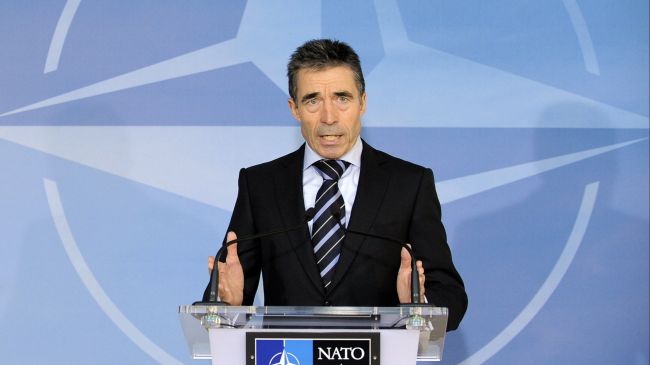 NATO says it will continue to install a missile system in Europe despite Russia’s opposition.
NATO Secretary General Anders Fogh Rasmussen made the announcement on the sidelines of the Munich Security Conference on Saturday.
“We have made clear from the outset that NATO has made the decision to establish a NATO missile defense system because it’s our obligation to ensure effective defense of our populations… Having said that, we have invited Russia to cooperate and… now it’s up to Russia to engage in that,” Rasmussen said.
Russian Foreign Minister Sergei Lavrov said earlier that the missile program was reminiscent of the Cold War.
“Officially, we have abandoned the mindset of the Cold War,” Lavrov said.
On January 27, Russian Prime Minister Dmitry Medvedev said he saw “no flexibility” in the ongoing dispute.
“If we talk about the subject itself, it is extremely difficult. And so far we don’t see any flexibility… There is no flexibility,” Medvedev added.
Related article
- Turkish protesters, angry at NATO missiles, attack German troops (alethonews.wordpress.com)
Featured Video
Anthrax War – CBC The Passionate Eye
or go to
Aletho News Archives – Video-Images
Book Review
Shattered Dreams: The HPV Vaccine Exposed (2019)
By Christina England – 30 Q&As – Book Review & Summary
Lies are Unbekoming | September 4, 2026
… Gardasil received FDA fast-track approval in 2006, Cervarix followed in 2009, and Gardasil 9 was approved in December 2014 with more than double the aluminium adjuvant content of the original. The commercial context is specific. Merck was about to lose patent protection on Zocor and faced $18 billion in Vioxx injury claims from a cardiovascular drug the company had marketed while suppressing its own data showing a five-times increase in heart attacks. Analysts projected the global HPV vaccine market at $4 billion by 2011, contingent on government-funded national programs for teenage girls. The 1986 National Childhood Vaccine Injury Act had already granted manufacturers complete liability immunity. By 2013, Japan had withdrawn its HPV vaccine recommendation after cataloguing severe adverse reactions in hundreds of girls. No Western government followed. The establishment position across the UK, US, Australia, and most of Europe held, and still holds, that the vaccines are safe and effective, that reported injuries are coincidental, and that cervical cancer prevention justifies the program. The book was published into this position, not against a vacuum.
Shattered Dreams sits alongside Mary Holland’s The HPV Vaccine On Trial and Viera Scheibner’s foundational vaccination work as part of the documented record on what has been done to a generation of teenage girls under the banner of cancer prevention. The full summary unpacks three specific findings: that Merck used the aluminium adjuvant itself as the “placebo” control in 92.5% of trial subjects, making it structurally impossible to detect excess reactions from the adjuvant; that Dr. Sin Hang Lee found HPV DNA fragments bound to aluminium in every one of sixteen Gardasil samples tested, and in the blood and spleen of a New Zealand girl six months after her third dose; and that in every country with high vaccination coverage, including Australia, the UK, Norway, and Sweden, cervical cancer rates have stopped declining and started rising specifically in the vaccinated cohort. Martínez-Lavín’s 2017 calculation puts the number needed to seriously harm with Gardasil 9 at 140, and the number needed to vaccinate to prevent one case at 1,757. Thirteen young women are seriously harmed for every one who benefits. The vaccine was approved on the basis of trials that could not detect what the trials were supposed to detect, and it is still being given to twelve-year-olds today. … Read full review
Blog Roll
 Aletho News
- Georgia’s Largest Healthcare System Will Fire Employees Who Refuse Flu Vaccine
- The Five-Year Fuel Crisis: Why the World Economy Is Paying for a War It Thinks Is Ending
- Trump’s Big Bluff on Iran
- Swiss scammed out of millions by Ukraine-linked call centers – media
- Germany facing potential ‘violent conflict’ with Russia – spy chief
- Ukraine’s EU neighbors reject new plea from Kiev – Politico
- British Transport Police Facial Recognition Trial Scanned 926,912 People With Zero Arrests
- House Bill Would Ban Federal Use of Flock ALPR Data
- Can a Spice Rival a Drug? 10 Head-to-Head Trials Put It to the Test.
- The oil routes around Hormuz face their own chokepoints
- If Americans Knew
- “We See Our Homes Now From A Satellite, Like Strangers”
- Watch “Gaza: Doctors Under Attack”, originally censored by BBC
- NAZA: Israeli embassies in UK and US promote rival documentary to challenge Gaza genocide allegations
- David Ellison appoints Israeli to lead merged Paramount-Warner studios
- Turkish Red Crescent helps elderly Gaza man walk again after Israel confiscates his prosthetic limb
- Four Palestinians Killed in Israeli Attacks in Gaza
- Two Palestinian youths killed and village razed as Israeli attacks on West Bank continue
- Two more Christian women victims of Israeli raids on Gaza
- Cruelty, Deprivation, Indignity: A Journalist’s 22 Months in Israeli Prison
- New IDF Website Frames Slain Gaza Journalists as Terrorists
- No Tricks Zone
- Latest European Green Energy Debacle; Portugal’s Largest Flagship Solar Park Insolvent!
- Green Energy Debacle: German Expert Professor Fritz Vahrenholt Warns Of Severe Economic And Social Consequences
- Two More Paleo Reconstructions Affirm Meters-Higher Sea Levels Across Ireland, Brazil 7000-6000 Years Ago
- New Study: Earth And Venus Surface Warmth Largely Explained By Convection And Lapse Rate, Not CO2 Or Radiation
- 2025 Nature Paper Claiming Worsening Global Drought Gets RETRACTED …Heavily Flawed
- New Study: ‘Global Drought Shows No Detectable Recent Acceleration Under Climate Warming’
- Economic Masterminds: German Socialists Suggest Taxing Productivity Gains Stemming From Using AI
- The South China Sea Has Not Been Cooperating With The Climate Change Narrative
- Energy Crisis: Germany Enters Heating Season With Historically Low Gas Reserve Fill Levels
- New Study: The Antarctic Ice Sheet Gained Mass From 2020-2024 Due To Staggering Snow And Ice Accumulation

