Yemenis condemn presence of US Marines in Sana’a
Press TV – January 9, 2013
Yemeni citizens, rights groups and lawmakers have vehemently condemned the presence of US Marine troops on Yemeni soil and the transformation of a five-star hotel in the capital, Sana’a, into a US military base, Press TV reports.
In interviews with Press TV, the legislators and human rights activists harshly criticized the conversion of the capital’s Sheraton Hotel into a military building and said they considered the presence of American forces as an occupation of their country.
The Yemenis argued that the US move to bring in the Marines for the protection of its diplomatic mission is merely a pretext for US domination on the ground.
“American Marines entered the country before the revolution and their numbers have increased… it’s similar to what happened when Britain occupied southern Yemen decades ago. The presence of Marine forces in the large number can only be described as an occupation,” political activist Abdu Ahmed said.
The US embassy in Sana’a reportedly booked all the rooms in the Sheraton Hotel, firing 200 members of the hotel’s staff after paying them a severance payment equal to six months of salary.
“We feel insecure. Anyone who goes up on the rooftop of his building will be targeted with a red light pointed to his chest. So if we can’t feel safe in our own country where can we find security and peace of mind?” said a Yemeni citizen.
The growing US domination has sparked numerous mass demonstrations, particularly in the Sada’a governorate to the north of the capital Sana’a.
The protesters in these demonstrations expressed the peoples’ total rejection of foreign intervention in their country’s affairs.
The increasing number of US assassination drone attacks, which mostly target innocent civilians, were also lambasted by the human rights groups.
The activists said the growing US interference in Yemen’s affairs is considered a flagrant violation of the Middle Eastern country’s sovereignty.
“Giving [approval to] US Marines to violate the country’s sovereignty is treason and those giving approval must be prosecuted. The assassinations are carried out right after the US intelligence apparatus received names of people suspected of being involved in al-Qaeda. There are a number of normal people on these lists, who can be easily arrested and brought to justice if found guilty,” human rights activist Abdulrahaman Barman noted.
Washington uses its assassination drones in Yemen, Pakistan, Afghanistan, and Somalia, claiming that they target the terrorists. The attacks, however, have mostly led to massive civilian casualties.
Related articles
- Thousands of Yemenis hold anti-US, anti-Israeli Protest in Sana’a (jafrianews.com)
Report: 100 foreign jets training for Syria scenarios in Israel
Ma’an – 08/01/2013

TEL AVIV, Israel – Israel’s Channel 2 TV station reported on Sunday that 100 fighter jets from around the world are training in Israel, including preparation for possible intervention in Syria.
The foreign pilots and aircraft arrived in the country in recent days, and will examine crisis scenarios if Syria uses chemical weapons, the report said.
It did not release the names of the countries participating.
Last week, the TV channel said the Israeli air force was preparing for the joint training, which would include practicing bombing runs and air-to-air combat.
Related articles
- Turkey Okays approval of Israel’s status in NATO: Report (alethonews.wordpress.com)
Brennan
Kenny’s Sideshow | January 7, 2013

John O. Brennan (Photo credit: Wikipedia)
Here’s Johnny!
Since Dick Cheney wasn’t available, Obama is picking the next best thing to run the CIA, John Brennan.
Here’s what some of the qualification checklist may have looked like.
I’ve never understood the need to cloak the titles of government positions in Orwellian nonsense. Brennan’s title of counterterrorism adviser should actually have been something like ‘Head of US Terrorism.’ At least then we could have given the administration a ✔ for transparency.
Hagel
Kenny’s Sideshow | January 6, 2013
“The Jewish lobby intimidates a lot of people up here.”
“I’m not an Israeli senator. I’m a United States senator.”
Chuck Hagel’s most famous words may give hope to some that Obama’s nomination of him for Secretary of Defense is a sign that the influence of Israel is waning. Hagel has even been cautious about war with Iran and has indicated he prefers talking over shooting.
Any nominee that has problems with the ADL, Joe Lieberman and Lindsey Graham must have something going for him. Right? Maybe.
Hagel is a member of the CFR and a sometimes Bilderberg participant. Two strikes.
Take a look at his voting record and some of his stances while senator. Not exactly progressive. He voted for going into Afghanistan. He also voted to go into Iraq before he said he was somewhat against that war and did a little criticizing of the Bush administration. Patriot Act? No problem. He twice cast his lot for it.
FISA? Yep, he likes spying.
Hagel’s campaign contributors included a lot of bankers and we all know how well they like war and military contractors.
Proper disclosure has not been one of his strong suits. Could his own electronic voting machine company have ‘aided’ in his senate campaign wins?
For the first ten weeks of 1996, Hagel served as chairman of American Information Systems (AIS), a voting machine company which later changed its name to ES&S. He also had holdings in the firm’s parent group, McCarthy Group Inc., worth between $1 and $5 million. In November 1996, Hagel was elected to the Senate, the first Republican elected from Nebraska since 1974. He came from behind twice during his run (according to polls), first against well known Republican Attorney General Don Stenberg in the primary, and then against popular Democratic Gov. (and eventual senator) Ben Nelson. In fact, one Nebraska newspaper described his victory as a “stunning upset.” In January 1997, the Washington Post called Hagel’s victory, “the major Republican upset in the November election.” According to Bev Harris of Blackboxvoting.org, a group aimed at “consumer protection for elections,” Hagel won virtually every demographic group, including many largely African-American communities that had never before voted Republican. AIS was responsible for counting approximately 80% of the votes in the election.
In a disclosure form filed in 1996, Hagel did not report that he was chairman of AIS during 1996 or go into detail regarding the company’s underlying assets. Rather, he cited his holdings as an “excepted investment fund,” which is exempt from detailed disclosure rules.
Hope and change with Hagel? It seems somewhat odd that Obama would pick such a controversial Republican for the cabinet post. It’s often said that no one reaches these positions without being bought and/or blackmailed. No word on if Hagel would approve of the military being used against the American people and I doubt the question will come up in the confirmation hearings.
With all the corruption in the merging of government, banks and corporations and the continued influence of the jewish lobby, even if Hagel is ‘approved’ I’m not holding my breath that it will be anything but business as usual.
Related articles
Crashed US reconnaissance drone found in Philippine waters
Press TV – January 7, 2013
A US-made reconnaissance drone has been recovered in waters off Ticao Island of the Philippines, a navy official says.
Captain Rommel Jason Galang, a Philippine navy commander, said the drone was recovered on Monday, after it was found by fishermen floating near the island.
Galang also said the navy had deployed a ship with ordnance experts to the scene after the fishermen reported that the 3.65-meter object could have been a bomb.
“We will first study this drone but initially it appears to be a UAV used largely in reconnaissance,” he stated, adding that it was not clear why the BQM-74E drone had crashed.
The US embassy in Manila was informed of the discovery of the drone, which is expected to be turned over to US authorities.
The Philippines has seen a resurgence of US troops since late 2011, when the White House announced a turn in Washington’s foreign, economic and security policy toward the region.
Some 600 US soldiers have been stationed in the southern Philippines since 2002 to train local troops there.
Philippine President Benigno Aquino said last year that US drones were allowed to fly over the country for reconnaissance purposes.
Related articles
- US Drone Crashes Off Masbate Waters (rappler.com)
War is Wonderful… If You’re a Weapons Maker
By Noel Brinkerhoff | AllGov | January 4, 2013
The wars in Afghanistan and Iraq put enormous strains on the United States, from impacting individual lives of Americans to draining the U.S. Treasury. But the conflicts had the opposite effect on the companies that armed the U.S. military.
From 2002 until 2011, the profits of the five largest defense contractors (Lockheed Martin, Boeing, Northrop Grumman, General Dynamics and Raytheon) “increased by a whopping 450 percent,” according to Lawrence J. Korb, senior fellow at the Center for American Progress.
Ten years ago, the profits of these five companies were $2.4 billion (adjusted for inflation) collectively. By 2011, their profits had soared to $13.4 billion. During the period in which the profits of weapons makers were going up 450%, the U.S. defense budget rose 55%. During the same time frame, the median annual income for American families actually went down almost 6%.
During earlier wars in American history, the government used to impose a “war tax” on contractors to ensure that they did not gain excessively from the misery of others fighting the conflict. But that wasn’t the case last decade, noted Walter Pincus at The Washington Post.
“My most radical idea—and it should have been done 10 years ago—is for an excess-profits tax on defense contractors while we have troops fighting overseas,” Pincus wrote. “As I have often noted, Afghanistan and Iraq are the first U.S. wars in which taxes were not raised to pay for the fighting. Instead, the cost has been put on a credit card.”
To Learn More:
Excess-Profits Tax On Defense Contractors During Wartime Is Long Overdue (by Walter Pincus, Washington Post)
Related articles
The FSA continues to shine like a dead star
By Thierry Meyssan | Voltaire Network | December 29, 2012
While the French press persists in announcing the “imminent fall” of Syria and the “flight of Bashar al-Assad,” the reality on the ground has turned around completely. Even though chaos is plaguing most of the territory, the “liberated zones” have melted like snow in the sun. Deprived of its anchor points, the FSA has been left with no prospects in sight, while Washington and Moscow are poised to blow the whistle to end the game.
The countdown has begun. As soon as the new Obama administration will be confirmed by the Senate, it will present a peace plan for Syria to the Security Council. Legally, though President Obama succeeds himself, his former administration is only responsible for the managing of current affairs and can not take any major initiative. Politically, Obama failed to react when, in the midst of the presidential race, some of his colleagues torpedoed the Geneva Agreement. But he proceeded with a general housecleaning right after the announcement of his reelection. As expected, General David Petraeus, the architect of the war on Syria, fell into the trap that had been set up for him and was forced to resign. As expected, the NATO and Missile Shield chiefs – adverse to an agreement with Russia – have been put under investigation for corruption and obliged to remain silent. Also as expected, Secretary of State Hillary Clinton has been taken out of the game. Only the method chosen to eliminate her came as a surprise: a serious health accident that plunged her into a coma.
Meanwhile back at the UN, things have moved on. The Department of Peacekeeping Operations (DPKO) signed a Memorandum with the Collective Security Treaty Organization (CSTO) in September. In October, it monitored CSTO maneuvers in Kazakhstan simulating a deployment of “blue chapkas” in Syria. In December, the DPKO convened the military representatives of the permanent Security Council members to brief them on the manner in which the deployment could be carried out. Despite their opposition to this solution, the French and the British bowed to the wishes of the United States.
Nevertheless, France attempted to use the Joint Special Representative of the United Nations and the League of Arab States, Lakhdar Brahimi, to modify the Geneva peace plan in line with the objections it had raised on June 30th. Ultimately, Brahimi carefully refrained from taking a position, and instead contented himself with transmitting messages to and fro between the various parties to the conflict.
The truth is that on the ground the upper hand is held by the Syrian government. The military situation has been reversed. The French themselves have ceased to mention the “liberated zones” they yearned to govern through a United Nations mandate. These areas have been steadily shrinking, and those that are still holding out are in the hands of the disreputable Salafists. The FSA troops were instructed to abandon their positions and regroup around the capital for a final assault. The Contras were hoping to rally the Palestinian refugees, mainly Sunni Moslem, against the inter-denominational Syrian regime in the same manner that the Hariris in Lebanon tried to arouse the Sunni Palestinians of the Nahr el-Bared refugee camp against the Shiite Hezbollah. As in Lebanon this objective failed because the Palestinians know very well who their friends are and who is really fighting for the liberation of their land. Concretely, in Israel’s recent 8-day war on Gaza, it was the Iranian and Syrian weapons that saved the day, while the Gulf monarchies did not move a finger.
Certain elements of Hamas, loyal to Khaled Meshaal and funded by Qatar, opened the doors of the Yarmouk camp to a few hundred fighters of the Front to Protect the Levant (Syrian-Lebanese branch of Al-Qaeda), also related Qatar. They fought mainly against members of the Popular Front for the Liberation of Palestine – General Command (PFLP-GC). Via SMS, the Syrian government asked the 180 000 camp residents to evacuate the premises as soon as possible and offered them temporary accommodation in Damascus hotels, schools and gyms. Some preferred to go to Lebanon. The next day, the Syrian Arab army attacked the camp with heavy artillery and regained control. 14 Palestinian organizations then signed an agreement declaring the camp a “neutral zone“. The FSA fighters withdrew in an orderly fashion and resumed their war against Syria in the surrounding countryside, while the civilians returned to their homes. They found a devastated camp where schools and hospitals had been systematically destroyed.
In strategic terms, the war is already over: the FSA has lost the popular support it had enjoyed at one point and has no chance of achieving victory. The Europeans still think they can replace the regime by bribing top officials and causing a coup, but they realize that it will be impossible to bring off with the FSA. Contras continue to roll in, but the flow of money and weapons is drying up. Much of the international support has stopped although the consequences on the battlefield cannot yet be seen, much like a star that can continue to shine long after its death.
The United States has clearly decided to turn the page and to sacrifice the FSA. It gives it senseless instructions that lead the Contras to their death. Thousands were killed last month. Meanwhile, in Washington, the National Intelligence Council cynically announced that “international jihadism” will soon disappear. Other allies of the United States should now ask themselves whether this new equation does not imply that they too will be sacrificed.
US will boost funding for military adventures at the expense of public
By Dave Lindorff | Press TV | January 3, 2013
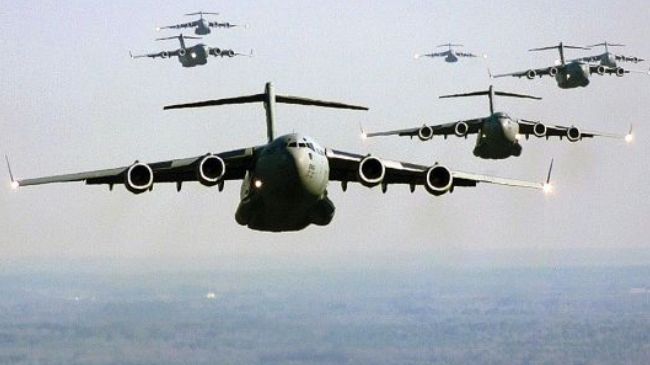
I was asked earlier this week by an reporter for PressTV, English-language television network in Iran, if I could explain why the US political system seemed to be so dysfunctional, with Congress and the President having created an artificial budget crisis 17 months ago, not “solving” it until the last hour before a Congressional deadline would have created financial chaos, and even then not solving the problem and instead just pushing it off for two months until the next crisis moment.
I thought for a moment, trying to come up with a simple way to explain the peculiar politics of a fake democracy where two equally pro-capitalist, pro-imperialist parties vie with genuine bitterness for patronage spoils and legal bribes, all the while ignoring the real wishes and needs of the public, and then it hit me: it is really all about US militarism and the unwillingness of either of the two political parties to admit honestly to American people how much they are being gouged to allow the US government and its corporate owners to continue in their attempt to control the world.
It really is that simple.
The US currently spends almost as much on its military and on paying for current and past wars in terms of interest on war debt and care for wounded and aging soldiers as the entire rest of the world spends on arms and war. Approximately $1.3 trillion gets spent each year in taxpayer’s dollars and in more borrowed funds (50 cents of every federal tax dollar goes to pay for the US military, the intelligence apparatus, veterans’ benefits and other related military costs). It is simply ludicrous, given this situation, to imagine that the US can significantly reduce its budget deficit either by raising taxes or by cutting social spending.
Think of it this way. The US is currently running a $1.3 trillion deficit (that is federal spending less tax revenue). That deficit, significantly one must note, almost exactly matches the amount that is being spent annually on the US military, and on military/intelligence-related activities.
In contrast, the federal government budget in 2012 allocated $870 billion for Medicare, Medicaid and all other programs under the aegis of Department of Health and Human Services. The total Department of State budget is $56 billion, and a portion of that is actually for military activities, such as intelligence operations and protection of embassies and consulates. The Department of Agriculture got $150 billion, and that includes the Food Stamp program. Federal spending on education was just $100 billion a year. Social Security is not part of the tax take or the federal budget, as it is all paid from the Social Security Trust Fund, which in turn has been financed by the dedicated payroll tax paid by working people and employers.
None of these non-military budget spending categories could possibly be cut sufficiently to make any real dent in the nation’s massive deficit, which is running at $1.3 trillion a year and which now totals $16.3 trillion. Certainly cuts of 50% could theoretically be made in health and welfare spending, in education, and in other parts of the budget, but cuts of that scale would cause such mass suffering and chaos that the nation would erupt in open rebellion.
The military budget, on the other hand, could be slashed by 50% and nobody would know the difference! The public in the US barely knows there are wars going on. We read about an occasional soldier killed or plane downed, but there is no day-to-day evidence that the US is a nation perpetually in a state of war. If the military were to end those wars, which are costing over $160 billion a year, pull out of all its far-flung bases, which are costing $250 billion a year, slash its huge Special Operations Command, which now number nearly 70,000 people at a cost of over $10 billion, eliminate or massively reduce its strategic nuclear forces, which costs $60 billion a year, and decommission its fleet of aircraft carrier battle groups, which counting construction and operation costs, plus the cost of the planes and missiles they carry, probably cost in the range of $100 billion a year, the US would be no less safe, but the federal budget deficit could be instantly slashed by close to $600 billion a year. That is the amount that is being cut in the current so-called “Fiscal Cliff” bargain over a period of ten years.
In a genuine democracy, there would be politicians and a political party that would be calling for just such an end to US militarism and the massive spending that is needed to support it. It is something that polls show the majority of Americans want to see happen, even though there are no people in government calling for doing it, and even though the very idea of seriously cutting military spending is blacked out by the US corporate media.
Instead, what the American public gets is a fake debate between Democrats and Republicans, and between the White House and the Republicans in the House of Representatives, all focussed on the rest of the US budget — the non-military part. This “debate” is basically a matter of Republicans saying they want to cut the non-military budget deficit by slashing “social spending” and Democrats saying that they are willing to cut “some” social spending, but they would rather raise taxes.
The thing is, cutting social program spending more than by a small amount would be catastrophic, leading to even more mass teacher layoffs, declining health, hunger, collapsing bridges, and to fewer people being able to afford to go to college. It would lead to even more homeless Americans, including returned veterans. Nobody would accept this. We’re already suffering from such cuts. And as for taxes, in a long-running economic crisis such as we are experiencing, nobody but the rich can afford to pay more, and the rich are given a free hand at escaping taxes through loopholes, offshore banking, and high priced accountants.
The reality is that there really is only one way to attack the nation’s massive and growing budget deficit without destroying both people’s lives and the nation’s economy, and that is to slash military spending and to put an end to the country’s militarism and imperialism.
The US today, as former Alaska Sen. Mike Gravel famously said during an early televised Democratic presidential primary debate in 2008, “has no enemies.” It is not threatened by any nation, has a military that is without equal, and has a populace that is armed to the teeth. The United States simply does not need to be spending in excess of a trillion dollars — at least on defense. The country would be just as safe — it would be much safer actually since it wouldn’t be destroying lives around the globe and creating enemies where there were none — if it were a tenth of its current size.
The time for a real debate about cutting the US budget by focusing on military spending has come. It is long overdue. If it isn’t addressed now, it will be eventually, not by choice perhaps, but because the US will simply no longer be able to pay for its addiction to war.
US general offers plans for post-2014 Afghanistan overstay
Press TV – January 3, 2013

Commander of US-led forces in Afghanistan General John R. Allen (file photo)
Commander of the US-led forces in Afghanistan General John R. Allen has offered plans that would keep thousands of American troops in the war-torn country after Washington’s planned 2014 withdrawal.
Allen has submitted three plans to Defense Secretary Leon Panetta with troop levels ranging between 6,000 and 20,000, the New York Times cited a senior Pentagon official as saying on Wednesday.
General Allen’s options reportedly offer US involvement in security issues in Afghanistan and advising Afghan military forces.
With 6,000 troops, it is expected that the US mission in Afghanistan would largely rely on Special Operations commandos who would engage in targeted killings and assassination missions, with limited logistical support and training for Afghan forces.
The 10,000-strong mission is expected to engage in training Afghan security personnel; while with 20,000 troops Washington would add some conventional army forces to patrol in certain areas.
US President Barack Obama is supposed to discuss the options with his Afghan counterpart, Hamid Karzai, during his visit to the White House next week.
The United States, which currently has about 66,000 troops stationed in Afghanistan, led the invasion of the country in 2001, under the pretext of eradicating Taliban forces and bringing stability to the country.
However, torn apart by a war that has lasted over a decade, Afghanistan is still dealing with untamed violence, as well as rising insecurity topped by social problems.
Meanwhile, the Pentagon, the White House and US generals based in Afghanistan keep providing contradictory information on the composition, tasks and the size of the contingent that would remain in Afghanistan beyond the 2014 deadline.
Related articles
- ‘US will maintain military presence in Afghanistan beyond 2014′ (alethonews.wordpress.com)
- Prince Harry ‘kills innocent afghans’, according to former Afghanistan prime minister (dailyrecord.co.uk)
‘US will maintain military presence in Afghanistan beyond 2014’
Press TV – December 30, 2012
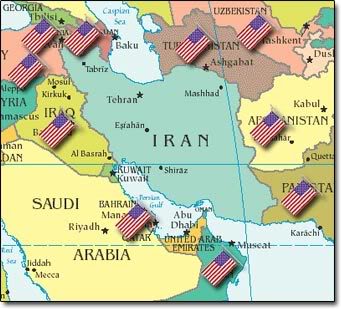
An analyst says America and its allies have planned to leave a residual force of more than 10,000 troops in Afghanistan passed 2014, contrary to the agreement.
In the background of this, American pilots are currently under special training ready to be deployed to Afghanistan in coming months in what appears to be a renewed build up by certain US forces. 66,000 US troops are stationed in Afghanistan. America is expected to honor a 2014 agreed deadline to withdraw from the country.
Press TV has interviewed Mr. Mohammad Daoud Abadi, Chairman of the Afghanistan National Peace Council, Los Angeles about this issue. The following is an approximate transcription of the interview.
Press TV: We see American pilots training in conditions similar to that of Afghanistan. Are we preparing for a longer stay of US troops in Afghanistan do you think?
Abadi: Thank you for inviting me again I appreciate it. Before I answer that question I’d like to thank Press TV for it’s worldwide media presence and being honest on the matters, we do appreciate that very, very much.
In response to your question I must say that what we hear from the US government is that they’re planning to leave a 6,000 to 9,000 fighting force in Afghanistan after 2014. That plus another 5,000 from NATO allies.
What I’m hearing – I hope it’s not correct, but what I’m hearing from the media and from different sources is that the US has planned to leave these 6,000 soldiers in Baghram airport, Kandahar in the south and Jalalabad in the East.
They are planning to have the Spaniards in Hira and Shindand airport, which is close to the Iranian border, to the Italians and on the North the Mazar e Sharif, the Germans still be staying.
To be honest and to look at it from a technical point of view this residual force will not be a force to really do the terrorist war or against terrorist activities because let’s say that if they are in Baghram airport and they fly from Baghram airport to Kandahar to do an operation, it is a 2 hour flight of 350 kilometers distance – it takes two hours for a helicopter to get there.
So in general this residual force is there for some other purpose other than what is claimed. Therefore this policy as I have said, this time the Pentagon will fail on this again and I don’t think this is something that they can count on.
Press TV: Just how much has President Hamid Karzai been a president to the Afghan people and tried to help efforts to oust the US occupiers from Afghanistan?
Abadi: Based on yesterday’s report Mr. Karzai is coming to Washington in early January and they will hopefully be talking about future issues in Afghanistan as well as the matter of residual forces.
President Karzai is going to make the biggest mistake of his life if he agrees to residual forces because that will mean the continuation of war in Afghanistan.
As I have said before the Mujaheddin of Afghanistan have put this condition even at the 19th of December meeting in Paris – this was the first condition that both sides the Taliban and Jamiat e Islami of Afghanistan put on the table.
Therefore what Mr. Karzai is going to sign with them based on their immunity issues, that is not going to work. As for US forces they are defeated now they were defeated then.
Related article
Featured Video

Anthrax War – CBC The Passionate Eye
or go to
Aletho News Archives – Video-Images
Book Review
Shattered Dreams: The HPV Vaccine Exposed (2019)
By Christina England – 30 Q&As – Book Review & Summary
Lies are Unbekoming | September 4, 2026
… Gardasil received FDA fast-track approval in 2006, Cervarix followed in 2009, and Gardasil 9 was approved in December 2014 with more than double the aluminium adjuvant content of the original. The commercial context is specific. Merck was about to lose patent protection on Zocor and faced $18 billion in Vioxx injury claims from a cardiovascular drug the company had marketed while suppressing its own data showing a five-times increase in heart attacks. Analysts projected the global HPV vaccine market at $4 billion by 2011, contingent on government-funded national programs for teenage girls. The 1986 National Childhood Vaccine Injury Act had already granted manufacturers complete liability immunity. By 2013, Japan had withdrawn its HPV vaccine recommendation after cataloguing severe adverse reactions in hundreds of girls. No Western government followed. The establishment position across the UK, US, Australia, and most of Europe held, and still holds, that the vaccines are safe and effective, that reported injuries are coincidental, and that cervical cancer prevention justifies the program. The book was published into this position, not against a vacuum.
Shattered Dreams sits alongside Mary Holland’s The HPV Vaccine On Trial and Viera Scheibner’s foundational vaccination work as part of the documented record on what has been done to a generation of teenage girls under the banner of cancer prevention. The full summary unpacks three specific findings: that Merck used the aluminium adjuvant itself as the “placebo” control in 92.5% of trial subjects, making it structurally impossible to detect excess reactions from the adjuvant; that Dr. Sin Hang Lee found HPV DNA fragments bound to aluminium in every one of sixteen Gardasil samples tested, and in the blood and spleen of a New Zealand girl six months after her third dose; and that in every country with high vaccination coverage, including Australia, the UK, Norway, and Sweden, cervical cancer rates have stopped declining and started rising specifically in the vaccinated cohort. Martínez-Lavín’s 2017 calculation puts the number needed to seriously harm with Gardasil 9 at 140, and the number needed to vaccinate to prevent one case at 1,757. Thirteen young women are seriously harmed for every one who benefits. The vaccine was approved on the basis of trials that could not detect what the trials were supposed to detect, and it is still being given to twelve-year-olds today. … Read full review
Blog Roll
 Aletho News
- Georgia’s Largest Healthcare System Will Fire Employees Who Refuse Flu Vaccine
- The Five-Year Fuel Crisis: Why the World Economy Is Paying for a War It Thinks Is Ending
- Trump’s Big Bluff on Iran
- Swiss scammed out of millions by Ukraine-linked call centers – media
- Germany facing potential ‘violent conflict’ with Russia – spy chief
- Ukraine’s EU neighbors reject new plea from Kiev – Politico
- British Transport Police Facial Recognition Trial Scanned 926,912 People With Zero Arrests
- House Bill Would Ban Federal Use of Flock ALPR Data
- Can a Spice Rival a Drug? 10 Head-to-Head Trials Put It to the Test.
- The oil routes around Hormuz face their own chokepoints
- If Americans Knew
- “We See Our Homes Now From A Satellite, Like Strangers”
- Watch “Gaza: Doctors Under Attack”, originally censored by BBC
- NAZA: Israeli embassies in UK and US promote rival documentary to challenge Gaza genocide allegations
- David Ellison appoints Israeli to lead merged Paramount-Warner studios
- Turkish Red Crescent helps elderly Gaza man walk again after Israel confiscates his prosthetic limb
- Four Palestinians Killed in Israeli Attacks in Gaza
- Two Palestinian youths killed and village razed as Israeli attacks on West Bank continue
- Two more Christian women victims of Israeli raids on Gaza
- Cruelty, Deprivation, Indignity: A Journalist’s 22 Months in Israeli Prison
- New IDF Website Frames Slain Gaza Journalists as Terrorists
- No Tricks Zone
- Latest European Green Energy Debacle; Portugal’s Largest Flagship Solar Park Insolvent!
- Green Energy Debacle: German Expert Professor Fritz Vahrenholt Warns Of Severe Economic And Social Consequences
- Two More Paleo Reconstructions Affirm Meters-Higher Sea Levels Across Ireland, Brazil 7000-6000 Years Ago
- New Study: Earth And Venus Surface Warmth Largely Explained By Convection And Lapse Rate, Not CO2 Or Radiation
- 2025 Nature Paper Claiming Worsening Global Drought Gets RETRACTED …Heavily Flawed
- New Study: ‘Global Drought Shows No Detectable Recent Acceleration Under Climate Warming’
- Economic Masterminds: German Socialists Suggest Taxing Productivity Gains Stemming From Using AI
- The South China Sea Has Not Been Cooperating With The Climate Change Narrative
- Energy Crisis: Germany Enters Heating Season With Historically Low Gas Reserve Fill Levels
- New Study: The Antarctic Ice Sheet Gained Mass From 2020-2024 Due To Staggering Snow And Ice Accumulation

