Agent Orange on Okinawa
By JON MITCHELL | CounterPunch | September 30, 2011
“Without Okinawa, we cannot carry on the Vietnam war.” – Admiral Ulysses Sharp, Commander of U.S. Pacific Forces, December 1965
During the 1960s and ‘70s, the United States military transformed Okinawa into a forward operating base for its war in Vietnam. From mainland American ports, it transported supplies to the island it dubbed its “Keystone of the Pacific” before transferring them into smaller ships for the passage to South East Asia. But there is one vital ingredient of its war machine that the Pentagon denies ever passed through Okinawa – the defoliant, Agent Orange.
Given the fact that the military transported everything else through the island – from tanks and toilet paper to guard dogs and hundreds of thousands of GI’s – such a claim is implausible. Yet as recently as 2004, the US government has asserted that its records “contain no information linking use or storage of Agent Orange or other herbicides in Okinawa.”
Over the past few years, though, the cracks in that denial have started to show. In 2007, it came to light that the Department of Veterans Affairs – the US government body responsible for caring for sick soldiers – awarded compensation to a marine who had developed prostate cancer as a result of his exposure to Agent Orange in the northern jungles of the island. Then in 2009, the same department admitted that “herbicide agents were stored and later disposed in Okinawa” during Operation Red Hat – the 1971 US military project to remove its stockpiles of chemical and biological weapons from Okinawa to Johnston Island.
Bolstering these official comments are the firsthand accounts of over twenty US veterans who have come forward to describe their experiences with Agent Orange on Okinawa. Longshoremen, forklift drivers, medics and marines, these former service members paint an alarming picture of the widespread use of the herbicide on ten American military installations stretching from the Yambaru jungles in the north to Naha Port in the south. Not only did these veterans help to unload and store the defoliant, they also sprayed it as a localized herbicide to keep down the vegetation around their bases’ runways and fences. “None of us gave Agent Orange the respect we should have,” says one supply yard worker who regularly used it without masks or gloves. “We didn’t know anything about its risks like we do today.”
Now, many of the US veterans who came into contact with Agent Orange on Okinawa are suffering from serious illnesses that the US government recognizes as the result of exposure to dioxins. In some cases, their sons and daughters were born with deformities consistent with Agent Orange poisoning. Despite this, none of these veterans exposed on Okinawa has been able to receive compensation – due solely to the fact that the Pentagon continues to deny that the defoliant was present on the island.
All of these veterans are painfully aware of the harm that Agent Orange may have caused Okinawan civilians at the time. Some of them express their concern at having bartered the defoliant with local farmers in exchange for food and beer, while others talk of seeing groups of school children walking close to base perimeters soon after spraying. “I wonder whether those kids are alive today,” one of the veterans told me. “Or whether the chemicals I was spraying damaged their health as much as it has mine.”
Agent Orange is far from a historical problem. Today in Vietnam, 50 years after the defoliant was first brought to the country, there are over twenty potential dioxin hotspots on the sites of former US bases where Agent Orange had been stored. Yet the people of Vietnam are better informed than those on Okinawa – the last American forces left Saigon in 1975 so Vietnam has been able to conduct extensive environmental testing on the land where the bases once stood. However, in modern day Okinawa, the US military continues to occupy approximately 20% of the island – and it has repeatedly refused requests to test the levels of pollution within its bases. Such a stance is particularly worrying given the military’s environmental track record on Okinawa which includes the irradiation of the entire Torishima Island through the use on depleted uranium ordnance in the 1990s and the discovery of lethal concentrations of arsenic and asbestos on land returned to civilian use in 2003.
Any discussion of American bases on Okinawa quickly becomes entangled with wider issues of imperialism, global security and legitimacy. But the question of whether Agent Orange was used on the island ought to transcend partisan maneuvering. The Pentagon’s increasingly unconvincing denials not only prevent veterans from receiving the medical care that they so desperately need, but they also endanger the health of both local Okinawans and American service members currently stationed on the island.
With the potential environmental and human impact so enormous, any delay by the US and Japanese governments to launch a comprehensive investigation into the issue is criminally negligent. It is time to reveal the full extent to which Okinawa has been suffering its own dioxin poisoning over the past 50 years.
~
JON MITCHELL lives in Japan. He can reahed at: jon.w.mitchell@gmail.com
This essay first appeared in Japanese to coincide with the release of “Living The Silent Spring” – a new documentary detailing the damage military defoliants have caused to the children of both Vietnamese and American soldiers. A trailer for the film can be viewed here: http://cine.co.jp/chinmoku_haru/trailer.html
The Myth of Bernie Sanders
Senator Bait-and-Switch
By THOMAS H. NAYLOR | CounterPunch | September 30, 2011
Vermont Senator Bernie Sanders has recently been elevated to near godlike status by the political Left in the United States. Some of his fans have even suggested that he should challenge Barack Obama in the Democratic Presidential Primary. The more often he is accused of being a socialist by his political enemies on the Right, the more convinced the Left becomes that he surely walks on water.
Although Sanders may have once been a socialist back in the 80s when he was Mayor of Burlington, today, a socialist he is not. Rather he behaves more like a technofascist disguised as a liberal, who backs all of President Obama’s nasty little wars in Afghanistan, Iraq, Libya, Pakistan, Somalia, and Yemen. Since he always “supports the troops,” Sanders never opposes any defense spending bill. He stands behind all military contractors who bring much-needed jobs to Vermont.
Senator Sanders rarely misses a photo opportunity with Vermont National Guard troops when they are being deployed to Afghanistan or Iraq. He’s always at the Burlington International Airport when they return. If Sanders truly supported the Vermont troops, he would vote to end all of the wars posthaste.
Senator Patrick Leahy, Senator Bernie Sanders, and Congressman Peter Welch could hardly contain their enthusiasm over the news that Burlington International Airport had been named as a possible site to house the Air Force’s new F-35 fighter jet scheduled to replace the Vermont Air National Guard’s aging fleet of F-16s. The new high-tech instruments of death will cost $115 million a pop in sharp contrast to the F-16s which cost a mere $20 million each.
From whom might these F-35s protect Vermont? Possibly, Canada, separatist-minded Quebec, upstate New York, the New Hampshire Free State, or the Commonwealth of Massachusetts? Why on earth would anyone want to invade Vermont? Vermont has no military bases, no large cities, no important government installations, and no strategic resources unless you count an aging nuclear power plant. What if Canada, China, Russia, North Korea, Iran, or even the U.S. Marines were to invade the Green Mountain state? Just what would they do with it? Would all of the black-and-white Holsteins be confiscated, or perhaps the entire sugar maple crop be burned? Imagine trying to enslave freedom-loving Vermonters. Good luck!
Vermont is too small, too rural, and too independent to be invaded by anyone. It is a threat to no one. Furthermore, Vermonters, not unlike the Swiss, tend to stick to their own knitting rather than intruding into the affairs of their neighbors. Vermont has always been that way and probably always will be.
Major General Michael Dubie, head of the Vermont National Guard, has expressed the hope that the Vermont Guard might be morphed into a center for unmanned drone aircraft. Sanders, not unlike President Obama, thinks drones are cool.
Sanders is the darling of the American-Israeli Public Affairs Committee and the right-wing Likud government of Israel. He has done everything within his power to keep the myth of Islamic terrorism alive. He never questions the U.S. government’s unconditional support of Israeli acts of genocide and ethnic cleansing against the Palestinians. It is as though these are nonevents.
Last, but by no means least, is the U.S. government-owned Sandia National Laboratories. For over two years Sanders and former University of Vermont President Daniel Fogel have been encouraging Sandia to open a satellite laboratory in Vermont. Sandia, whose historical origins can be traced back to the Manhattan Project in World War II, designs, builds, and tests weapons of mass destruction. The Vermont laboratory envisaged by Sanders would not be involved with nuclear weapons but rather would be engaged in projects related to energy efficiency, renewable energy, and electric grids. Sandia, interestingly enough, is operated under contract by Lockheed Martin, the largest defense contractor in the world. Lockheed Martin produces F-35s and drones. General Dubie, who has close ties to Lockheed Martin, recently received an honorary doctorate from UVM. No one at UVM seems to care whether or not the University gets in bed with a manufacturer of atomic bombs.
Bernie Sanders loves to rail against Corporate America, Wall Street, and the super-rich, but has nothing to show for it. He’s done little to constrain their power and influence. But everybody on the Left loves Bernie.
~
Thomas H. Naylor is Founder of the Second Vermont Republic and Professor Emeritus of Economics at Duke University; co-author of Affluenza, Downsizing the U.S.A., and The Search for Meaning.
Israeli Warplanes Fly Low over Turkish Exploration Ship
Al-Manar | September 30, 2011
Low-flying Israeli jet fighters “harassed” a Turkish seismic research ship exploring for natural gas reserves in the Eastern Mediterranean near Cyprus on Thursday night, according to Turkish media reports, in what seemed to be a further escalation in the already fraying ties between the once longtime allies.
Today’s Zaman, citing accounts in Turkish daily Vatan and Greek Cypriot daily Phileleftheros, reported that two F-15 jets took off from Tel Aviv and flew through the airspace of both Greek Cyprus and Turkish-controlled northern Cyprus. The jets reportedly ignored warnings from officials of Turkish Cyprus.
According to the report, Turkey sent two F-16 jets to track the Israeli F-15s, which subsequently returned to occupied Palestine.
Turkey said on Tuesday it was exploring for gas in an offshore zone where Cyprus started drilling last week.
We Agree
September – 2008
The Republican/Democrat duopoly has, for far too long, ignored the most important issues facing our nation. However, alternate candidates Chuck Baldwin, Cynthia McKinney, and Ralph Nader agree with Ron Paul on four key principles central to the health of our nation. These principles should be key in the considerations of every voter this November and in every election.
We Agree
Foreign Policy: The Iraq War must end as quickly as possible with removal of all our soldiers from the region. We must initiate the return of our soldiers from around the world, including Korea, Japan, Europe and the entire Middle East. We must cease the war propaganda, threats of a blockade and plans for attacks on Iran, nor should we re-ignite the cold war with Russia over Georgia. We must be willing to talk to all countries and offer friendship and trade and travel to all who are willing. We must take off the table the threat of a nuclear first strike against all nations.
Privacy: We must protect the privacy and civil liberties of all persons under US jurisdiction. We must repeal or radically change the Patriot Act, the Military Commissions Act, and the FISA legislation. We must reject the notion and practice of torture, eliminations of habeas corpus, secret tribunals, and secret prisons. We must deny immunity for corporations that spy willingly on the people for the benefit of the government. We must reject the unitary presidency, the illegal use of signing statements and excessive use of executive orders.
The National Debt: We believe that there should be no increase in the national debt. The burden of debt placed on the next generation is unjust and already threatening our economy and the value of our dollar. We must pay our bills as we go along and not unfairly place this burden on a future generation.
The Federal Reserve: We seek a thorough investigation, evaluation and audit of the Federal Reserve System and its cozy relationships with the banking, corporate, and other financial institutions. The arbitrary power to create money and credit out of thin air behind closed doors for the benefit of commercial interests must be ended. There should be no taxpayer bailouts of corporations and no corporate subsidies. Corporations should be aggressively prosecuted for their crimes and frauds.
How McChrystal and Petraeus Built an Indiscriminate “Killing Machine”
Gareth Porter | Truthout | 26 September 2011
Even if the rest of the US military effort in Afghanistan has been largely written off by the news media as a failure, the campaign of targeted raids against insurgents by commandoes under the Joint Special Operations Command (JSOC) has gotten a reputation for devastating effectiveness. As an Associated Press story in early September 2010 put it, the “mystique of elite, highly trained commandos swooping down on an unsuspecting Taliban leader in the dead of night plays well back home….”
Central to this larger-than-life image of the Special Ops night raids in Afghanistan is the assumption that their targeting has been highly accurate.
John Nagl, who was on Gen. David Petraeus’s staff in Iraq and now runs the pro-military think tank Center for New American Security, suggested in a PBS “Frontline” documentary on the targeted raids last January that the US military had gotten “so good at using electronic means of identifying, tracking and finding” insurgents that it had created an “industrial strength counterterrorism killing machine.”
The accumulated evidence that has now seeped through the cloak of secrecy surrounding Special Operations Forces (SOF) “kill/capture raids” tells a very different story, however. Although the raids have undoubtedly killed a large number of Taliban commanders and fighters, it is now clear that they also killed and incarcerated thousands of innocent civilians. The failure to discriminate between combatants and civilians flows directly from a targeting methodology that is incapable of such discrimination.
Creating Intelligence Without Human Vetting
The system of targeted raids now practiced in Afghanistan was first introduced by Gen. Stanley A. McChrystal in Iraq. In his book “The War Within,” Bob Woodward described how the JSOC under McChrystal had adopted “some of the most highly classified techniques” in the US government system of classification in Iraq in 2006 and 2007 to target and kill al-Qaeda and Shi’a militia fighters. Woodward contributed to the myth of all-knowing JSOC commanders by suggested that those techniques may have been the biggest factor in reducing the violence in Iraq. It is well documented, however, that Sunni and Shi’a insurgencies ended or tapered off because of broader political factors, not because of JSOC’s killing operations.
In fact, McChrystal’s operation relied on far more mundane technologies than Woodward’s sensational language suggested. In a new book, “Task Force Black,” by Mark Urban, the diplomatic editor at BBC’s “Newsnight,” reveals that McChrystal’s command gathered intelligence on al-Qaeda and Mahdi Army personnel from three well-known technologies: 24-hour surveillance by drone aircraft, monitoring of mobile phone traffic and pinpointing the physical location of the phones from their signals.
The key to JSOC definition of a given insurgent “network” was the decision to maintain long-term aerial surveillance of a particular location. McChrystal’s intelligence chief Col. Michael Flynn liked to call surveillance by drone aircraft “The Unblinking Eye” – an image suggesting a godlike power of observation. The implication of the new intelligence methodology developed by McChrystal and Flynn was that anyone who visited a location under surveillance or who communicated with a mobile phone associated with that location could be considered to be part of the insurgent network.
To convert the raw data obtained from drone surveillance and tracking mobile phone calls into intelligence on who to target, Flynn turned to a tool called “social network analysis.” In the wake of the 9/11 attacks, that technique had became almost overnight the favored tool for analyzing terrorist and insurgent networks. It provided a framework for construction of models of networks by measuring the number of direct interactions between individuals or “nodes.” With a quantitative tool called “link analysis” and accompanying software, intelligence analysts could see the raw data from drone surveillance and links among telephones transformed into a “map” of the insurgent “network” in each locality.
Traditional intelligence analysis of an insurgent network would have involved verifying the identities of those individuals who had visited the location or communicated with others associated with the network to assess the nature of the relationship. From the beginning of the new McChrystal-Flynn system, however, the emphasis was on speed of collection rather than on such careful analysis of the data. Urban recalls that McChrystal and Flynn introduced the concept of “F3EA” – “find, fix, finish, exploit, analyze.” That meant that they aimed at obtaining new data from each raid that could be used to add to the target list for future raids – often within hours of the previous one.
Scaling Up Raids in Afghanistan
In 2009, the whole system began to shift from Iraq to Afghanistan. McChrystal was chosen as the new commander of all US and NATO forces in Afghanistan and took Flynn with him. As the US began its drawdown in Iraq, thousands of SOF under JSOC command and most of the drones used in Iraq followed. Meanwhile, the focus of targeting of night raids in Afghanistan shifted from “high value targets” – high-level and mid-level al-Qaeda and Taliban officials – to anyone who was contributing to the Taliban war effort, whether in a military or civilian capacity.
These geographical and targeting shifts resulted in an exponential increase in the level of targeted raids in Afghanistan. In May 2009, before McChrystal arrived, US SOF were carrying out 20 raids per month. But by November, McChrystal had stepped up the pace to 90 per month, and by the following spring, he had increased the number again to nearly 250 a month – a 12.5-fold increase in one year.
Finally, during the transition from McChrystal to Gen. David Petraeus in the summer of 2010, the number increased to nearly 600 raids a month. In just two years, the monthly total of night raids had been expanded by a factor of 30. But in April 2011, a US military source told researchers for the Open Society Foundations and The Liaison Center that as many as 40 raids were being carried out every night – a rate of more than 1,000 raids per month.
Scaling up the system of targeted raids by orders of magnitude would have had far-reaching implications for the accuracy of the targeting regardless of the location. But it was especially dangerous to transfer it to Afghanistan. Michael Semple, former deputy to the European Union (EU) Special Representative to Afghanistan, who has had contacts with many local Taliban commanders over the years, told me that most Afghans in the Pashtun south and east “have a few Taliban commander numbers saved to their mobile phone contacts” as a “survival mechanism.”
That fact means that US intelligence analysts working on targeting for the SOF raids must be able to “distinguish pragmatic, innocent contacts from active involvement with the Taliban,” Semple told me. Unfortunately, the methods used by US intelligence to compile the list of supposed network members is not aimed at making such distinctions at all.
Targeting Phone Numbers, Not People
In October 2009, when JSOC was carrying roughly 90 raids per month, the target list for SOF night raids, called the Joint Prioritized Effects List (JPEL), included 2,058 names, according to one of the Afghan war logs documents released by WikiLeaks. A large proportion of the targets on the list were not identifiable individuals at all, but mobile phone numbers. “When you are relying on cell phones for intelligence, you don’t get the names of those targeted,” observes Matthew Hoh, who was briefed on the target list as the senior US civilian official in Zabel province before he quit in protest against US policy in September 2009.
The easiest way to scale up the JPEL to support 900 raids a month was to get more mobile phone call records linked to numbers already associated with insurgent networks. One obvious source is the population of roughly 3,300 suspected insurgents being held in the Afghan prison system, who are allowed to use mobile phones freely in their cells. Semple told this writer that access to cell phones by the Afghan prison population is the result of the connivance of the prison administration, in return for bribes from the prisoners. “I presume there are occasional searches to keep the price up,” Semple said.
But the population of the security wing at Pol-e-Charkhi, the main Afghan national prison, is probably the largest concentration of insurgent-related cell phone users in Afghanistan, according to Semple, and therefore intelligence agencies would naturally seek to exploit the phone contacts among prisoners and friends and families with varying degrees of ties to the insurgents.
Another knowledgeable source in Kabul confirmed to me that Afghan corrections officers in Pol-e-Charkhi as well as in five regional prisons carry out “shakedowns” in the cells of security prisoners every six months or so to confiscate “contraband” – meaning primarily their mobile phones. These “shakedowns” are done at the prompting of contract corrections advisers and trainers funded by the US government, the source told me, and the confiscated phones are turned over to US intelligence.
The phone numbers and call histories from those phones go into the database which is used to “map the networks.” But the link analysis methodology employed by intelligence analysis is incapable of qualitative distinctions among relationships depicted on their maps of links among “nodes.” It operates exclusively on quantitative data – in this case, the number of phone calls to or visits made to an existing JPEL target or to other numbers in touch with that target. The inevitable result is that more numbers of phones held by civilian noncombatants show up on the charts of insurgent networks. If the phone records show multiple links to numbers already on the “kill/capture” list, the individual is likely to be added to the list.
Kandahar and other provinces are rife with stories of people who were targeted by night raids because their cell phone number had been found in an insurgent’s cell phone. One Afghan told me about a friend whose brother had been seized and detained in a night raid and had been told by his interrogator that it was because of his cell phone calls to a known insurgent.
The US military’s obvious lack of concern about targeting noncombatants is due in large part to the assumption that civilians have knowledge of insurgents that can be usefully exploited if they are brought in for interrogation. That was the motive for US and Canadian troops to sweep large numbers of military age males in their large-scale operations in 2004 and 2005. “The detainees are detained for a reason,” said Canadian Brig. Gen. Jim Ferron, the intelligence chief for NATO’s International Security Assistance Force (ISAF) command in Afghanistan in May 2007. “They have information we need.”
The intelligence value of detaining large numbers of civilians with presumed knowledge of insurgents is now a motive for the intelligence analysts compiling the “kill/capture list” to catch civilians in the net. A new report on night raids by the Open Societies Foundation and The Liaison Center quotes a military officer telling the author privately, “If you can’t get the guy you want, you get the guy who knows him.” And even when they are not the targets of the raid, civilians are deliberately swept up in order to interrogate them for several days before releasing them.
“A Very Precisely Targeted Operation”
Some raids, however, are deliberately aimed at killing the target, and cell phone data are also used to determine who is to be killed, as is dramatically illustrated by the killing of Zabet Amanullah by an SOF unit in Takhar province on September 2, 2010. The incident itself and the US military response to criticism of the killing as an obvious mistake highlights the reality that the intelligence analysts mapping the insurgent “network” routinely fail to make any effort to distinguish between an insurgent and someone who is in tangential contact with an insurgent.
Amanullah was a former Taliban commander who had quit the organization in 2001 and had become a human rights activist. He worked with former EU official Semple from 2003 to 2007, documenting pre-2001 human rights abuses and helping Semple make contacts for his work on political reconciliation in Afghanistan. Amanullah had originally fled to Pakistan, according to Semple, because one of the warlords who rose to power after 2001, Qazi Kabeer, had been a personal rival. But Semple said Amanullah had suffered such “an horrendous stint in ISI [Inter-Services Intelligence] detention” in Pakistan that he returned to Afghanistan to live openly in Kabul with his wife and children, and was in contact with pro-regime political figures. He had been so “psychologically bruised” by the ISI experience that he was incapable of working covertly for the Taliban, according to Semple.
But former BBC correspondent Kate Clark, who also knew Amanullah personally, has documented in detail how US intelligence analysts had convinced themselves on the basis of their analysis of cell phone traffic that Amanullah and the actual shadow Taliban Gov. of Takhar, Muhammad Amin, were the one and the same man. They had concluded that the Taliban shadow province chief for Takhar, Muhammad Amin, must have taken the name “Zabet Amanullah” as his alias. The analysts had not even done the most elementary checking to see if there was an actual Zabet Amanullah.
What sealed Amanullah’s fate was that he was personally acquainted with Amin and had occasional phone contact with him. Semple, one of world’s most knowledgeable specialists on the Taliban movement, located Muhammad Amin in Pakistan and interviewed him six months after the Americans had supposedly killed him. Amin convinced Semple that he was indeed the former shadow governor of Takhar and even showed him his identification card. Amin confirmed to Simple that he had spoken with Amanullah roughly once a month by phone.
Amanullah had gone to Takhar to help his nephew’s parliamentary campaign. Nine other Afghans – all campaign workers for his nephew – were killed along with Amanullah in an SOF helicopter attack on two cars. He had cleared his visit to Takhar with the Shah Jehan, the police chief in Takhar, who was a personal acquaintance, according to Semple. A simple phone call to Jehan would have easily disabused the SOF of its assumption about Zabet Amanullah as the alias of the Taliban province chief.
The idea that the Taliban governor of Takhar would be riding along with the campaign staff of a candidate for the Afghan Parliament in broad daylight is so obviously implausible that it should have been a flashing red light for the operation. But Petraeus’s International Security Assistance Force (ISAF) was immune to such logic. It issued a statement more than a week after the attack that suggested those riding along with the man who was killed must also have been insurgents. “The question remains,” the statement said, “why an election official or candidate was travelling with a known terrorist.”
Even after Afghan government officials had unanimously condemned the killing of Amanullah as a horrible mistake, Petraeus told PBS “Frontline” at the end of January that the killing was “a very precisely targeted operation” and that “there is no question about who this individual was.” Petraeus was so confident that they had gotten the right man that he agreed to Clark’s request to meet with officers of the SOF unit involved in the murder of Amanullah.
It was apparently the first time that SOF personnel had ever talked about a specific raid with anyone outside the chain of command. The officers who met with Clark over dinner did not admit to having made a mistake in the killing, despite her presentation of all the evidence to the contrary. But when she pressed them about the evidence of the life and death of the actual Zabet Amanullah, they admitted something far more damning: that they had not been tracking Amanullah by name, but had only a cell phone number.
Guilt by Association
As for the nine campaign workers killed, one of the officers told Clark, “If someone is a targeted individual or someone with that person, they are unlawful combatants.” And a second officer said, “If we decide he’s a bad person, the people with him are also bad.” Such statements are clearly at odds with the criteria used in humanitarian law to distinguish between combatants and civilians. And they shed light on the criteria used by the SOF commanders in tallying the number of “insurgents” they claim to have killed or captured.
In December 2010, ISAF gave pro-war blogger Bill Roggio impressive figures suggesting that the Taliban had lost 4,100 through capture and 2,000 were killed in the previous six months. Similar figures were released to selected journalists every three months after that. But an investigation of those figures reveals that all but a very small proportion of the total of insurgents detained in targeted raids were actually innocent civilians.
The publicly announced US detention policy as of 2010 was that all Afghans picked up in the field by US troops must either be sent to the Parwan detention facility or be released within two weeks. An unclassified February 5, 2011, internal document of the Combined Joint Inter-Agency Task Force responsible for detention policy in Afghanistan, which this writer obtained last spring, showed that only 690 Afghans were admitted to the US detention facility at Parwan during that six-month period – just 17 percent of the 4,100 captured insurgents claimed. The remaining 83 percent of those said to have been captured “Taliban” had actually been released within a few days because there was no evidence that they were indeed insurgents.
The proportion of civilians in the 4,100 captured “Taliban” was actually even higher than that. The same inter-agency detainee task force document shows that 20 percent of all those detained in Parwan during the six-month period were released upon further review of their files. So, the maximum number of detainees for whom there was any real evidence of active involvement with the insurgents was actually 552, or 14 percent of the total 4,100 captured “insurgents” claimed.
Many of the thousands detained in JSOC targeted raids were picked up because they happened to be present in a house that had been targeted. But many others, like Amanullah, were targeted because their mobile phone number had shown up too many times on a “map” of an insurgent network. Innocent civilians are much less likely to resist violently when their houses are raided by SOF, so the proportion of those killed in night raids who are civilians is bound to be much lower than the proportion of civilians among those who are detained, at least temporarily.
Hiding Civilian Deaths in Night Raids
But that does not mean that civilians represent a small proportion of the deaths in night raids. SOF units have routinely hidden such civilian deaths by reporting them as insurgents – even when it was perfectly obvious that they could not have been combatants. A raid on a compound in Gardez on February 12, 2010, killed two men, one of whom was a local government prosecutor and the other a senior intelligence official in the Afghan national police, and three women, two of whom were pregnant. But the SOF unit reported to the headquarters of the US-NATO command in Kabul that the two men were insurgents and claimed that the women had been found tied up and gagged. McChrystal defended the unit against the charges by eyewitnesses that its members had tried to cover up the killings of the three women even after the head of the Afghan Interior Ministry investigation of the incident publicly called the eyewitness testimony credible. Meanwhile, the target of the raid, who turned himself in for questioning a few days after the raid, was released without charge, according to the brother of the two men killed in the raid.
The United Nations mission in Afghanistan issued a report last March offering the figure of 80 civilians killed in what it called “search and seizure operations” in 2010, but that was a figure that it knew was highly misleading. Nader Nadery, a commissioner of the Afghanistan Independent Human Rights Commission, told my Afghan colleague Noori Shah Noori that that figure represented only the number of civilian deaths from13 incidents that had been fully investigated. It excluded the deaths from 60 other incidents in which complaints had been received, but had not yet been thoroughly investigated.
Nadery has since estimated that the total civilian deaths for all 73 night raids about which it had complaints was 420. But the Afghan Independent Human Rights Commission (AIHRC) admits that it does not have access to most of the districts dominated by the Taliban and that people in those districts are not aware of the possibility of complaining to the Commission about night raids. So, neither the AIHRC nor the United Nations ever learn about a significant proportion – and very likely the majority – of night raids that end in civilian deaths. The implication of that fact is that the majority of the more than 2,000 Afghans said to have been killed by SOF raids in 2010 may well have been innocent civilians rather than insurgents.
Two senior US commanders freely admitted to The Washington Post’s Dana Priest and William Arkin that they had not targeted the right home or individual on more than “about 50 percent” of the raids. Given the tendency of commanders to overrate the success of their operations, that admission further underlines the vast human cost of the uncontrolled violence carried out by SOF units in Afghanistan.
Inviting Revenge for the Killing Machine
Afghanistan is the last place on earth the US military should be allowed to practice such indiscriminate killing. Afghans of every political stripe and at every level of society, from the Taliban fighters to President Hamid Karzai himself, have been warning the United States that the killing of innocent civilians in night raids provokes nearly universal hatred of Americans. And Pashtun culture is based on the necessity to take revenge against those who have harmed one’s friends or family – even if takes the rest of one’s lifetime.
Yet, the Obama administration, in seeming indifference to this well-established reality, is set to sign an agreement with the Karzai administration that will keep thousands of SOF in Afghanistan at least until 2014. Even worse, the program of targeted raids practiced in Afghanistan is now being touted as the military tactic of choice for future US wars. It is now clear that this “industrial strength killing machine” needs be brought under control and held accountable for the grave damage it has done to Afghans and to the interests of the United States.
Snuff movies to boost UK troops morale
Press TV – September 27, 2011
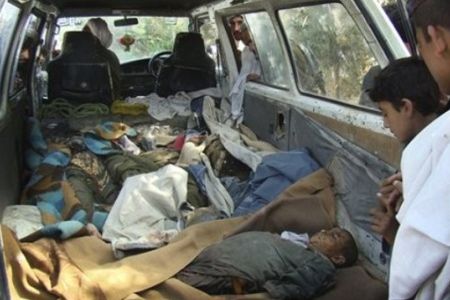
British peace campaigners have furiously reacted to a documentaries series of Apache attack helicopters killing Afghan civilians being shown to the UK troops to boost morale.
The footage entitled ‘Kill TV nights’ is designed to desensitize to death the troops on the frontline as describe by Andrew Burgin from Stop the War Coalition, The Independent on Sunday reported.
Burgin compared the television documentary to the desensitization to death of US troops in the final stages of the Vietnam War.
“The fact that British soldiers are reduced to watching what are effectively snuff movies shows the complete failure of the project in Afghanistan. It’s nothing to do with democracy, but a failure of war that is trickling down and resulting in a mental degradation among ground troops”, Burgin said.
“Afghanistan is a dreadful situation and it is no better than it was a decade ago”, he added.
The footage shows ground troops at the British headquarters in Helmand province, Camp Bastion, gathered for a get-together, which is said to be aimed at boosting morale among troops.
It shows an Apache helicopter commander admitting possible errors of judgement and warning colleagues not to disclose what they have seen, said the report.
“This is not for discussion with anybody else; keep it quiet about what you see up here,” the commander says in the film. “It’s not because we’ve done anything wrong. But we might have done.”
In one clip an Afghan woman is targeted after a radio dialogue between pilots refers to her as a “snake with tits”, according to the report.
Another clip from a recent “Kill TV” night shows the cross-hair of an Apache helicopter taking aim at an insurgent. WOII Farmer gives a running commentary: “OK, so he’s walking along… then thinks… I’m gonna go off and get my 70 vessel [sic] virgins ’cause daylight’s coming quite quick.”
As the missile hits the target and kills the person, he says “Goodnight princess”, adding “this is where you see he’s actually had the clothes ripped off him by the blast”.
He defends the decision to celebrate the deaths of Afghans. “People look at it and say you know… young lads are laughing at the enemy being killed,” he says.
“Well, I don’t know if the Taliban do something similar but I’m sure they rejoice when they kill one of us.”
Later in the film, he is defiant about the moral consequences of war: “We’re out there do to a job.
We’re not there to tickle the Taliban, we’re out there to hurt them because they have no qualms about hurting us.
“Of the engagements that I’ve taken part in… I have absolutely no dramas with it. None at all. I don’t really care whether they think it’s a fair fight. If they’re [the Taliban] gonna pick up a weapon and take us on, then best of luck to them.”
The footage is included in a three-part series, entitled “Fighting on the Frontline”, which starts on Channel 4 on Sunday night.
Newspaper Editor Files Suit Against Philadelphia Police for Constitutional Violations
By Walter Brasch | OpEd News | September 21, 2011
A former managing editor for an online newspaper, OpEdNews, has sued the city of Philadelphia and eight of its police officers for violating her Constitutional rights.
Cheryl Biren-Wright, Pennsauken, N.J., charges the defendants with violating her 1st, 4th, and 14th amendment rights. The civil action, filed in the U.S. District Court, Philadelphia, is based upon her arrest during a peaceful protest September 12, 2009, at the Army Experience Center (AEC) in the Franklin Mills Mall.
According to the complaint, Biren-Wright, who was not a part of the demonstration but at the mall as a reporter-photographer, was arrested and charged with failure to disperse and conspiracy, second degree misdemeanors. The charges were subsequently dropped by the Philadelphia district attorney.
The Philadelphia police also arrested and charged six protestors with conspiracy and failure to disperse—Elaine Brower, 55, New York, N.Y.; Richie Marini, 35, Staten Island, N.Y.; Joan Pleune, 70, Brooklyn, N.Y.(one of the original Freedom Riders in 1961); Beverly Rice, 72, New York, N.Y.; Debra Sweet, 57, Brooklyn, N.Y.; and Sarah Wellington, 26, Piermont, N.Y. Two months after Biren-Wright’s case was dropped, the six protestors were found not guilty in Philadelphia Municipal Court.
Paul J. Hetznecker, who represented the six defendants in the criminal trial, and Biren-Wright in her civil suit, believes that police over-reaction to protestors, as well as their lack of knowledge or appreciation for Constitutional protections, may be “a systemic problem throughout the country.” Hetznecker says under Constitutional and state law, “There can not be an arbitrary and capricious decision to end the civil rights of the protestors.”
The civil suit complaint charges that police violated Biren-Wright’s First Amendment rights to “gather information . . . to cover a matter of public interest including the law enforcement activity in public places.” Actions by the police deprived her of 4th and 14th amendment rights that, according to the complaint, protect against “unreasonable search and seizure,” “loss of physical liberty,” and “freedom from excessive use of unreasonable and justified force.”
The suit lists six separate counts:
● Abridgement of her rights under the First Amendment to observe and record news in a public place;
● False arrest and imprisonment;
● Use of excessive force by the police;
● False arrest under state law;
● Common Law Assault under state law; and,
● Failure of the City of Philadelphia to adequately train and supervise its police.
The complaint charges that because of accepted practices, the defendants may have believed “that their actions would not be properly investigated by supervisory officers and that the misconduct would not be investigated or sanctioned, but would be tolerated.” The policy, according to the complaint, “demonstrates a deliberate indifference on the part of the policymakers of the City of Philadelphia to the constitutional rights of persons within the City, and were the cause of the violations of the Plaintiff’s rights. . . .”
Named in the suit in addition to the City of Philadelphia are Lt. Dennis Konczyk, officers Tyrone Wiggins, John Logan, Robert Anderson, Donald West, William Stuski, and two unnamed John Does.
The Philadelphia Police Department refused to comment about the suit as a matter of policy regarding “issues in court,” according to Jillian Russell, Department spokesperson.
In August 2008, the Army opened the AEC, a 14,500 square foot “virtual educational facility” with dozens of video games. The Center, deliberately located near an indoor skateboard park, replaced five more traditional recruiting offices, and was designated as a two-year pilot program. The initial cost was $12 million.
Army recruiters could not actively recruit children under 17, but could talk with the teens and answer any of their questions about the Army. Among the virtual games was one in which children as young as 13 could ride a stationary Humvee and shoot a simulated M-16 rifle at life-like video images of Muslims and terrorists.
Because of the emphasis upon war, and a requirement that all persons had to sign in at the center, thus allowing the recruiters to follow up as much as four or five years later, peace activists began speaking out against the AEC.
To counter what was quickly becoming a public relations problem, the Army sent out news releases, picked up by the mainstream media, and established a full social media campaign to explain the “benefits” of the AEC. The protests continued.
Elaine Brower, whose son was in Iraq on his third tour of duty, told OpEdNews a day after her arrest: “The AEC is giving guns to 13-year-olds, drawing them in with violent video games. As more and more Afghan civilians and U.S. military are being killed in the U.S. occupation of Afghanistan, we’re saying ‘no’ to these wars. We’ve got to stop the flow of youth into the military, where they’re being used to commit war crimes in our name.”
With a police permit, and escorted by officers from Philadelphia’s Civil Affairs Unit, about 200–250 protestors—most of them middle-aged or senior citizens, many of them veterans—had come to the AEC, believing their First Amendment rights were being protected. The protest, although noisy at times, was peaceful; the counter-demonstration wasn’t.
According to the complaint, “The counter-demonstrators [members of an organization known as The Gathering of Eagles] yelled, jeered and taunted the AEC protestors. At no time did [the police] direct, or attempt to limit the First Amendment activities of the counter-demonstrators,” nor were they ever told to disperse.
Throughout the demonstration, the protestors had not given any indication that they posed any physical threat to others. However, about 45 minutes after the demonstration began, the police, under direction of Lt. Konczyk, ordered the protestors to disperse.
At that point, Biren-Wright, according to the complaint, “placed herself outside the immediate area . . . so as not to interfere with the police activity.” She continued to photograph and report on the demonstration. The complaint charges that Lt. Konczyk, “without just cause or legal justification,” directed several officers to arrest her, walking past several protestors and counter-demonstrators. She says she told the officers she was a member of the press. At no time, she says, did she participate as a demonstrator nor verbally or physically threaten anyone. The officers, says Biren-Wright, arrested her without any warning. The arresting officer’s “degree of anger—he was clearly red-faced—was inappropriate,” she recalls. The police, says Biren-Wright, “were clearly targeting me, trying to keep me from recording the demonstration and their reactions.”
One officer, says Biren-Wright, “unnecessarily twisted my arm.” Another officer seized her camera and personal items. One of the officers put plastic cuffs on her wrists “so tight that it caused significant pain, swelling and bruising, and an injury that lasted for several weeks,” according to the complaint.
Biren-Wright’s 15-year-old daughter was shopping in the mall during the protest, but had reunited with her mother shortly before the arrests. Her daughter, says Biren-Wright, “came closer upon the arrest and I told the officer she was my daughter and a minor and would be alone.” The officer, says Biren-Wright, snapped, “You should have thought of that before.” At the processing center that police had previously set up at the mall, Biren-Wright told several officers that her daughter was alone in the mall and was from out of state. “None of them did anything to ensure her safety,” she says. The daughter, unsupervised, eventually found Rob Kall, OpEdNews editor, who drove her to the jail to take her mother’s keys and then drove her home, where she spent the night alone.
Outside the mall, counter-protestors shouted obscenities as those arrested boarded the police bus. “They were standing at the door to the bus,” says Biren-Wright, “and posed a safety issue to us since we were in handcuffs.”
The six who were arrested and Biren-Wright were initially taken to the 15th District jail. Richie Marini, the lone male arrested, was kept at the district jail. The six women were transferred to the jail at the Philadelphia Police headquarters, known by locals as the “Roundhouse,” where a nurse took each woman’s vital signs and asked if there were any injuries. “I showed him my wrist and thumb that were already red and swollen” from the restrictive handcuffs, says Biren-Wright. His response, she says, was “That doesn’t count.”
Biren-Wright, along with the other five women, was held for 14 hours. At 5 a.m., she says, they were released from the “Roundhouse” onto a dark and barren street—there were no taxis anywhere near—and locked out of the police station. Although the women had cell phones, they had not been allowed to call for rides while in the jail area. Outside, they called friends, but waited until help arrived. Marini was released from the district jail later that morning.
The only reason Biren-Wright’s pictures of the demonstration survived is because she had secretly removed the memory chip during her arrest. When the camera was finally returned, “all of the settings were messed up and the lens was not replaced properly.”
The Army closed the AEC at the end of the pilot program. It had claimed that because of increased enlistments nationwide, the Center was no longer needed. It never acknowledged that the protestors and the public reaction may have been a reason for the closing.
In an unrelated case, the U.S. Court of Appeals for the Third Circuit ruled in October 2010 [Kelly v. Borough of Carlisle] that recording police activity in public places is protected by Constitutional guarantees. This month, the ACLU settled a case, for $48,500, in Pittsburgh when a University of Pittsburgh police officer arrested Elijah Matheny and charged him with felony violation of the state’s Wiretap Act for using a cell phone to record police activity. Matheny spent a night in jail following his arrest. [See: Matheny v. County of Allegheny, et al.] The ACLU charged that the district attorney’s office “had engaged in a pattern of erroneously advising law enforcement that audio taping police officers in public violates Pennsylvania’s Wiretap Act.” Following the Third Circuit’s decision in the Kelly case, a conviction against Matheny is expected to be overturned.
The arrests in Philadelphia, Carlisle, and Pittsburgh underscore two major problems, both prevalent throughout the country. The first problem is a lack of understanding and respect for the Constitution by a large number, although not a majority, of police officers. For that reason, all police forces and district attorneys offices, from small isolated rural communities to the largest urban departments, need to have constant education about civil rights and Constitutional guarantees—and the penalties for violating those rights.
The second major problem is inherent within the mass media. Reporters need to know how and when to challenge authority to protect their own and the public’s rights. A camera crew from the PBS “Frontline” series was at the protest, but abruptly stopped recording the demonstration after Brower was arrested and either before or during Biren-Wright’s arrest. Rob Kall later said that a member of the “Frontline” crew told him the police informed them they would be arrested if they continued to film the demonstration.
Police threats, which violate Constitutional guarantees, place a “chilling effect” upon the media to observe and record actions by public officials. Even without a direct order by a public official, reporters may do what they perceive to be what others want them to do. The media, like police and public officials, also need constant education to know when police orders are lawful and when they are not. An order to move away from a scene may be lawful. An order to stop filming a scene upon threat of arrest is not.
In federal court, in the case of Biren v. City of Philadelphia, et al., these issues, and others, will be raised. But had there been an understanding of the Constitution by the police, the case would never have gotten to the point of a federal civil suit.
~
Walter Brasch, during a 40-year work career in mass communications, has been a member of several unions, in both the private and public sectors. He is a syndicated newspaper columnist and the author of 16 books, including With Just Cause: Unionization of the American Journalist. His latest book is Before the First Snow: Stories from the Revolution. He can be contacted at: walterbrasch@gmail.com.
The art of leadership and the fight for justice, What role outrage?
By Cynthia McKinney | Black Agenda Report | September 20, 2011

After Georgia was forced by the United States Supreme Court to abandon its scheme to deny Black people the right to an undiluted vote and representation, Leroy Johnson became the first Black person elected to the Georgia State Senate since Reconstruction. The year was 1962. During his tenure, Johnson used his considerable influence inside the body to become the Senate’s Chair of the Judiciary Committee. From this position, he was able to bottle-up legislation that was bad for the State of Georgia, especially its Black residents. Outside and inside the State Senate, Leroy Johnson practiced the art of leadership and engaged in the fight for justice. He produced solid results for a people who were hungry for justice. Who among our elected officials today exercises the art of leadership in an engaged struggle for justice? Sadly, the numbers are way too small. It is more expedient to exchange silence for merely “being there,” in the end exercising no leadership at all and becoming a spectator to power in abandonment of those who need the effective use of power the most. The art of the struggle has veritably been abandoned for merely occupying a seat at the table when the purpose of the struggle for the seat at the table was to empower the struggle for justice. The only reason we send people to occupy that seat is to leverage the power of the community where power is exercised, on behalf of those who need it the most.
As I was commiserating over the Troy Davis situation with a former member of the Georgia Legislature who rose to the highest possible position within that body for his party, he lamented that for all of his years in the Legislature, he had not introduced a single death penalty bill. I quickly interjected that he was so busy putting out other fires and sticking his fingers in all the holes of the leaky dikes and schooling his colleagues on the effective use of the power of their elected positions that he couldn’t do everything. It will be interesting to see what legislative actions his former colleagues will initiate in the face of this clear act of barbarism by my state.
Occupying these “seats at the table” is important. Engaging in the struggle for justice is important. And contrary to what many would have us believe, leadership is important. That’s why so much effort is spent on co-opting or marginalizing the leaders of conscience that we do have and preventing authentic representatives of our values to occupy those seats at the table.
Therefore, more is required of us. We must hone the skill of discernment. We must not give our vote to just anybody to occupy these positions of power. We must not allow “posers” to represent us. Posers are those who wear the jackets of authority, who are put in positions of power by us, but who do not engage in the artful use of that power on our behalf. Discerning who is friend and who is poser has been difficult. But, is being made more possible by the arrogance now of those who do not have the interests of the people at heart. They seem not to care that their “neanderthal” is showing. But we can look at them and clearly see that they ain’t us. Their actions are a clue that they do not share our values.
Unfortunately, posers exist all around us: and in the media, too. The job now of people of conscience is to make sure that we don’t enable these posers by our own supportive behavior. My friend reminded me that Leroy Johnson, alone in the Georgia State Senate, was more powerful in the 1960s than are the 55 Black members of the Georgia Legislature now. We need to stop and think about that.
More is less? What role have we all had to play in such a circumstance? Is our leadership more of a reflection of who we are than we have acknowledged? What can we do differently in order to get a better result?
Abu Ghraib has its antecedents right here in the United States. The violence sponsored by the United States abroad has its origins inside the United States. As the United States and NATO drop bombs on unsubmitting African people in Libya, the United States kills an innocent Black man in Georgia. There is more to come unless we affirmatively take steps to stop it. Republican voters cheered at the prospects of more executions at a recent Presidential debate. In a recent article, Africom brags on its lessons learned from Libya:
The command had to define what effects it needed, and what specific targets would contribute to achieving those effects – a precise endeavor, Ham said. If attacking a communications node, planners must ask themselves what does that particular node do? How does it connect to other nodes? What’s the right munition to use? What’s the likelihood of collateral damage? What’s the right time of day to hit it? What’s the right delivery platform? And finally, how to synchronize attacks.
“That level of detail and precision … was not something the command had practiced to the degree that we were required to do in Odyssey Dawn,” Ham said. . . . If we were to launch a humanitarian operation, how do we do so effectively with air traffic control, airfield management, those kind of activities?” he said.
The United States has to craft those practices with African partners, he added.
U.S. allies in Libya are as barbaric as their sponsors. Despite youtube’s efforts to dissuade it from being seen, please watch this video sent to me from France:
As committed Libyans valiantly resist the entire NATO arsenal of modern and old-fashioned killfare, a new kind of perverse global plantation is being created. There is a clear and present danger that Africa and Asia will become U.S. killing fields for the next decade or more while the United States, itself, becomes a police state – unless we stop this poser leadership that really stopped representing us a long time ago.
If we fail to stop them, watch that video again – and welcome to the new America, hauntingly familiar to a place we never left.If we fail to stop them, watch that video again–and welcome to the new America, hauntingly familiar to a place we never left.
Cynthia McKinney can be contacted at hq2600(at)gmail.com.
~
For news from, by and about Cynthia McKinney, former Georgia congresswoman and Green Party presidential candidate, check these websites:
http://dignity.ning.com/
http://www.enduswars.org
http://www.livestream.com/dignity
http://www.twitter.com/dignityaction
http://www.myspace.com/dignityaction
http://www.myspace.com/runcynthiarun
http://www.twitter.com/cynthiamckinney
http://www.facebook.com/CynthiaMcKinney
http://www.youtube.com/runcynthiarun
Obama-Style Deficit Reduction
By Stephen Lendman | September 22nd, 2011
On September 8, Obama’s “American Jobs Act” address to Congress was a thinly veiled campaign speech. More on it below.
On September 19 came Act Two to enlist support for “Living Within Our Means and Investing in Our Future” by cutting $4 trillion over 10 years (for starters with more to come) from Medicare, Medicaid, public pensions, veterans’ benefits, unemployment insurance, the US Postal Service, and other social benefits.
It’s part of a bipartisan plan to destroy America’s middle class, good-paying jobs and benefits, the dream of homeownership for millions, and a nation once fit to live in but no longer.
Economist and regular Progressive Radio New Hour contributor Jack Rasmus commented on the minimum $4 trillion deficit reduction plan, saying:
It’s “not only the consensus deficit target but also the amount by which taxes have been cut for the rich and corporations.”
Moreover, it equals the amount banks and other large corporations “have been hoarding in cash since the bailouts,” instead of using it for economic growth and job creation.
In addition, out-of-control war spending and bailouts applied productively would make austerity cuts unnecessary.
“Who’s going to pay the next $4 trillion (and more trillions after that)….is the central issue,” according to ruling elites?
“It’s not jobs (not created), foreclosures, broke states and cities, students indentured for life, or seniors struggling to stay alive.”
At a time stimulus is needed to revive productive growth, infighting focuses on what more to cut, hitting working households, the poor, retirees and disabled hardest.
Notably, 25 million Americans wanting jobs have none. Nothing is being done to create them.
Instead, proposals focus on tax cuts for the rich, corporate handouts, and austerity to pay for them.
Welcome to America.
Obama’s America.
Land of permanent war, disproportionate wealth extremes, and spiraling debt.
With growing millions unemployed and impoverished.
With 11 million homes foreclosed and another 20 million under water.
Where 44 million seniors will soon pay double for Medicare and get no cost of living Social Security increases.
Where millions of poor children will lose Medicaid.
Where millions of students are debt entrapped for life.
Welcome to a land where most one day will be better off by leaving because no homeland opportunities exist.
Ask millions of downsized middle class Americans heading for working poor status.
Ask political Washington why members sworn to serve instead betray.
Expect no answer because you’ll get none.
Refuse to take anymore and resist, including about Obama’s shameless new wealth transfer scheme to corporate favorites and super-rich elites called “stimulus.”
On September 8, a New York Times editorial headlined, “The Jobs Speech,” saying:
Obama’s proposal was more “ambitious….robust and far-reaching than expected – that may be the first crucial step in reigniting the economy….”
“(H)e was authoritative in demanding that Congress pass his plan quickly….We hope Mr. Obama keeps his promise to take his proposals all over the country. The need to act is urgent.”
Only the last statement had merit in an editorial best rebuked for not explaining who benefits at whose expense.
On September 20, a Times editorial headlined, “A Call to Fairness,” saying:
Obama “issued an unabashed call for economic fairness in cutting the federal deficit, asking as much from those on the economy’s upper rungs as from those lower down whose programs may be slashed.”
Fact check
Programs for working Americans will be slashed en route to gutting them entirely in out years. “Economic fairness” won’t happen because Republicans and many Democrats won’t tolerate it. Neither will Obama.
Taxes for the rich won’t be raised because he opposes it. His plan, in fact, backs comprehensive “pro growth” tax reform.
It involves cutting top individual and corporate rates in exchange for eliminating loopholes clever accountants can devise ways to keep.
Yet Times editors call his austerity plan “a well-proportioned mix.”
In fact, it benefits corporate favorites and America’s aristocracy at the expense of working households.
A previous article called it a combination left hook, right cross haymaker, decking workers when they need help.
“It pays for desperately needed jobs” that won’t be created because tax cuts create none.
Recall last December. Despite pledging opposition to extending tax cuts for households earning over $250,000, Obama capitulated.
On December 6, a White House press release said:
While “disagree(ing)” with Republicans, he argued that “without a willingness to give on both sides, there’s no reason to believe (the current) stalemate won’t continue well into next year….I am not willing to let that happen….it would be the wrong thing to do.”
“As a result, we have arrived at a framework for a bipartisan agreement.”
Everyone got a tax cut on income, capital gains, dividends, and the Bush enacted federal estate tax that lapsed at the start of 2010, including the super-rich (who deserve higher, not lower taxes).
As expected, Obama caved to Republicans and deep-pocketed donors who’d likely give less if they paid more.
“Shared sacrifice” for him is transferring maximum wealth from working Americans to Wall Street, other corporate favorites, and super-rich elites already with too much.
Rhetoric aside, he’s got more of the same in mind now.
Times editors love it, saying only that “this plan was far too late in coming. But the public is listening now, and has demanded shared sacrifice. The burden is now on Mr. Obama to sell his plan, and on Congress to buy it.”
Fact check
He and Congress will indeed agree on a destructive austerity plan harming working Americans most to assure elitist interests know he’s the gift that keeps on giving.
It showed in his September 8 stimulus plan. It includes a laundry list of handouts instead of measures to create jobs, generate growth, reinvigorate Main Street, strengthen America’s middle class, and help growing millions of impoverished, disadvantaged households most in need.
No matter how it’s directed, $447 billion proposed won’t create jobs. It’s more of the same too little, too late for nation in serious trouble in the context of a sinking global economy.
In February 2009, when Obama proposed $787 in economic stimulus, unemployment was about 25 million. Two and a half years later, it’s the same. How then can half a loaf do now what double it earlier couldn’t. It won’t nor is that its intention.
In fact, it’s more a reelection than jobs plan if voters are foolish enough to buy it. Hopefully they’ll understand how it harms them.
Tax cuts can’t create jobs, yet they comprise about 60% of his plan. Despite well over $1 trillion for them in the last two years, zero jobs were created.
In fact, they’ve been less than zero when factoring in the replacement of full-time higher-paying jobs for uncertain lower wage/low or no benefit temporary or part-time ones.
Obama also proposed state subsidies as in 2009 to create jobs. Notably since then, hundreds of thousands of state and local government layoffs followed. They continue monthly.
In 2009, $100 billion was allocated for infrastructure spending to create four million jobs. It didn’t happen. In June 2009, 6.4 million construction workers were employed. Today it’s less than 5.5 million.
Obama’s new plan is no better. Immediate job creation is needed. Construction and infrastructure jobs are long-term and won’t help over any duration when boosted by minimal funding.
Moreover, Washington’s too-big-to-fail bailout didn’t restart lending. Major banks and other corporate giants are hoarding trillions of dollars instead of using them to stimulate growth and create jobs.
Today’s political Washington doesn’t prioritize them so expect none, Obama’s rhetoric notwithstanding. His agenda focuses on permanent wars and shifting maximum wealth to corporate favorites and America’s top 1%.
His new plans are old wine in new bottles, socking it to the constituencies that elected him.
Maybe next time they’ll have second thoughts and reject America’s duopoly entirely.
Unless they do, they’ll keep getting same old, same old no matter which party holds power.
Both represent institutionalized depravity responsible for turning America into a moral swamp.
Changing that is job one for people wanting something better.
It requires tearing down what doesn’t work and starting over.
What better time to start than now.
Stephen Lendman lives in Chicago and can be reached at lendmanstephen@sbcglobal.net.
Also visit his blog site at sjlendman.blogspot.com
~
See also:
Supercommittee choice: hurting their donors or cutting your social security
Democrats on the committee have received far more money from Pentagon contractors
… Since 2007, Democrats on the supercommittee have received more than $1 million in defense industry donations, while contributions to the Republicans added up to only $321,000. Panel co-chair Sen. Patty Murray, for example, has received more defense industry dollars over that period than the combined total of the top four Republican recipients on the supercommittee. Even so, her haul from the Pentagon’s weapons-makers isn’t the largest by a panel Democrat, a distinction held by her colleague from South Carolina, James Clyburn.
An analysis of official government data paints a disturbing picture of big money, cozy relationships and potential influence that, alongside a concerted lobbying effort by the Pentagon and its powerful defense contractors, makes substantial reductions to the Department of Defense’s budget improbable and steeper cuts to entitlement programs, like Medicare and Medicaid, more likely. …
~
Call committee co-chairs Sen. Patty Murray (202.224.2621) and U.S. Rep. Jeb Hensarling (202.225.3484). Tell them that war spending costs jobs, and we expect them to cut the war budget.
Chavez versus Obama: Facing Presidential Elections in 2012
By James Petras :: 09.15.2011
Introduction: Two incumbent presidents are running for re-election in 2012, Hugo Chavez in Venezuela and Barack Obama in the United States. What makes these two electoral contests significant is that they represent contrasting responses to the global economic crises:
Chavez following his democratic socialist program pursues policies promoting large scale long-term public investment and spending directed at employment, social welfare and economic growth: Obama guided by his ideological commitment to corporate financial capitalism, pours billions into bailing out Wall Street speculators, focuses on reducing the public deficit and slashes taxes and offers government subsidies to business in the hope that the banks will lend, the private sector will invest. Obama hopes the corporate sector will start to hire the unemployed. Chavez’s economic strategy is directed toward increasing popular demand by increasing the social wage. Obama’s strategy is directed toward enriching the elite, hoping for a “trickle down” effect. Chavez’s economic recovery program is based on the public sector, the state, taking the lead in light of the capitalist market induced crises and the failure of the private sector to invest. Obama’s economic recovery and employment program depends wholly on the private sector, utilizing tax handouts to stimulate domestic investments which generate employment.
According to the experts and politicians, the socio-economic performance of each President will be decisive in determining whether either President will be re-elected in 2012.
Measuring the Performance of Presidents Chavez and Obama in the Face of the Economic Crises
Over the past three years, both presidents faced deep socio-economic crises resulting in increased unemployment, economic recession and popular demands for political leadership in formulating an economic recovery program.
President Chavez responded via a large scale program in public spending on social programs. Billions were allocated in a massive housing program designed to create one million homes over the next several years. Chavez lessened military tensions and reduced frontier conflicts by negotiating a political agreement with the right-wing Santos regime in Colombia.
Chavez increased the minimum wage, social security and pension payments, increasing consumption among low income groups, stimulating demand and increasing revenues for small and medium size businesses. The state embarked on large scale infrastructure projects, especially highways and transport, creating jobs in labor intensive activities. The Chavez government sustained living standards by instituting price controls on food and other essentials, which sustained popular demand at the expense of profiteering by the owners of super markets. The Chavez government nationalized lucrative gold mines and repatriated overseas reserves in the course of financing its demand driven economic recovery program, eschewing tax concessions to the rich and bailouts of bankrupt banks and private businesses.
Obama rejected any large scale long term public investments to create jobs: his proposed “Jobs for America” proposal will at best temporarily reduce unemployment by less than five tenths of one percent. In pursuit of policies benefiting Wall Street bondholders, Obama became deeply involved in deficit reduction, meaning large scale cuts in public spending especially in social expenditures. Obama in agreement with the extreme right-wing agreed to regressive proposals to reduce tax payments for popular Medicare, Medicaid and Social Security programs. His proposals to fund “Jobs for America” depends on cuts in the Social Security tax which ensures a reduction in payments and a deficit or worse, which would facilitate privatization – handing social security to Wall Street, a trillion dollar plum.
Obama ignores mortgage foreclosures of over 10 million families – increasing homelessness and habitation downgrades, in favor of bailing out banks and home mortgage swindlers.
Obama increased military spending, multiplying overseas combat troops, clandestine terror operations and the domestic spy apparatus, increasing the deficits at the expense of productive investments in education, technology skill upgrades and export promotion.
Unlike Chavez who makes a point of highlighting positive job and education policies for Afro and Indo-Venezuelans, Obama ignores the 50% unemployed big city young (18-25) Afro-Americans and Latinos in favor of serving white Wall Street bankers.
In contrast to Chavez who pegged pensions and wages to inflation and enforced price controls, Obama froze federal salaries and social security payments resulting in a seven percent decline in real income over the past three years.
According to the latest US Census Bureau data (September 2011) under Obama over 46.2 million Americans live in poverty, the highest figure ever. Median household income dropped 2.3% between 2009-2010. The number of Americans in poverty increased from 13.2%in 2008 to 15.1%in 2010. Nearly one out of four children live in poverty in 2010, as over 2.6 million more US citizens were impoverished in a single year. In contrast, and in line with Obama’s trickle down economic policies, the number of wealthy Americans – earning over 100,000 dollars – have suffered little or no impact: luxury specialty stores , like Tiffany’s report a 15% increase in sales.
The lowest 10%of the population suffered the most, a fall in income of 12.1% between 2009-2010 while the 10% with the highest income saw a decline of 1.5%. Of the 34 members of the OCED the US along with Mexico, Chile and Israel has the worst social class inequalities. Obama’s top down stimulus policies saved the bankers by sacrificing the working and middle class.
Political and Economic Consequences of Top Down and Bottom Up Economics
The political and economic consequences of Obama’s “top down” and Chavez “bottom up” socio-economic polices are striking in every respect. Venezuela grew 3.6% in the first half of 2011 while the US stagnated at less than 2%. Worse still, during the second half of the year Obama and his advisers expressed fear that the US is heading toward a “double dip” recession – negative growth. In contrast the President of Venezuela’s Central Bank predicted accelerated growth for 2012.
While US unemployment remains above 9% and combined with underemployment rose to over 19%, Venezuela’s vast public housing and infrastructure investments are generating jobs and lowering the numbers of unemployed and under-employed in the formal and informal labor market. Obama’s pandering to Wall Street bankers and deficit reduction hawks and his vast increase spending on overseas wars and the domestic security apparatus, has bankrupted the treasury. In contrast, Chavez has nationalized lucrative private sector mines, banks and energy enterprises and decreased military tensions increasing resources for social programs such as food subsidies. Obama’s deficit reductions have led to massive firings in education and social services.
Chavez social expenditures have augmented the number of public universities, secondary and primary schools and clinics. Millions have lost their homes as Obama ignored the forced evictions of the mortgage banks, while Chavez has made a start in solving the housing deficit via one million homes.
Obama lends at virtually no interest to private banks who fail to lend to productive enterprises to create jobs, preferring speculation in overseas (Brazilian) bonds with higher interest rates. Chavez invests directly in productive labor intensive infrastructures programs, agricultural self-sufficiency projects and developing downstream processing plants, refineries and smelters.
As a result of the reactionary top down economics he practices and his overt threats to cut basic social programs like Medicare, Medicaid and Social Security, Obama’s popularity has fallen over the past three year from 80% to 40% and is heading downwards. Moreover, his pro-Wall Street fiscal and militarist policies – deepening and extending Bush and Rumsfeld’s wars and terror operations – has turned the US political climate further toward the extreme right. As of the last quarter of 2011, Obama appears vulnerable to electoral defeat.
In contrast President Chavez, riding the wave of economic recovery, based on positive programs of social expansion and public investments, has seen his popularity rise from 43% in March 2010 to 59.3% as of September 7, 2011. The US backed opposition is fragmented, weak and unable to challenge the overwhelmingly positive popular perceptions of the housing and infrastructure projects benefiting the mass of workers, construction companies and contractors.
Chavez is vulnerable on issues of personal security, administrative corruption and inefficiency. But he is seen to have taken important steps to correct these problem areas. Graduates of a new police academy provide honest, efficient community linked policing, which, in pilot projects have reduced violent crime by 60%. Efforts to end bureaucratic corruption and inefficiency are still pending.
Conclusion
Comparing Chavez and Obama’s presidency presents a sharp contrast between a successful bottom up socialist informed economic recovery program and a failed top down capitalist stimulus program. While the American public expresses its hostility to private banking’s pillage of the treasury, government threats to the last remnants of the social safety net and Obama’s failure to lower persistent high levels of unemployment and under-employment, Chavez’s popularity rises along with the positive “good feeling” among three-fifths of the electorate to his presidency. If the Chavez government continues and deepens his ‘bottom up’ economic stimulus program and the economy continues to expand and he recovers from cancer he will in all likelihood be re-elected by a landslide in 2012.
In contrast if Obama continues to truckle to the corporate and financial elite and slash and burn social programs he will continue his downward slide into well-deserved defeat and oblivion.
Venezuela’s economic recovery via advanced social programs is a powerful message to the American people: there is an alternative to regressive ‘top down’ economic policies: it’s called democratic socialism and its advocate is President Chavez, who talks to and works for the people as opposed to the con-man Obama who talks to the people and works for the rich.
Featured Video

Houthis Don’t Have to Conquer Saudi Arabia to Make It Pay
or go to
Aletho News Archives – Video-Images
From the Archives
A Lesser “Grade” of Human
By Michael Hoffman | Revelation of the Method | January 3, 2024
Will the more than 100 Iranians killed by terrorist bombs today be mourned in the West as victims of terrorism? Certainly not. Allied doctrine has it that the killing of Israeli or American civilians is a crime of cosmic proportions, while shedding the blood of “enemy” women and children is perfectly acceptable; indeed commendable.
The West does not memorialize the hundreds of thousands of civilians bombed by the U.S. in Serbia, Iraq, Afghanistan and every major German city 1943-1945. America’s fire-bombing of the city of Tokyo by General Curtis LeMay in March 1945 was followed by Harry Truman’s atomic incineration of Hiroshima and Nagasaki in August of that year. Truman never had a moment of doubt or regret over the murder of more than a 100,000 Asian children, mothers and non-combatant boys and men. It was business as usual for the “noble” Allies during the “Good War.”
In the West human rights signifies passionate concern only for civilians designated as truly human: Israelis first, then Americans and British, followed by their satraps.
This inhumanity is the legacy of Talmudic ideology, beginning with tractate Sanhedrin 57a from 400 A.D., concerning liability for capital punishment: “If a Jew murders a gentile, he is exempt.”
This teaching of contempt was reiterated in the dogma of Chabad Lubavitch founder Rabbi Shneur Zalman in the 18th century. … continue
Blog Roll
 Aletho News
- Houthis Don’t Have to Conquer Saudi Arabia to Make It Pay
- MOE: Nearly 22,000 Students and Education Workers Killed
- Guterres in Islamabad: Genocide, cowardice, and the cage of Imran Khan
- Johnson, Marandi say Yemen holds upper hand over Saudi Arabia
- False flags won’t save aggressors, Iran FM spokesman says
- The Makkah Pact Enters Into Force: The End of American Dominance or Its New Form?
- NATO’s top generals gather in Kiev
- EU’s continuing expansion – greater threat to Russia
- US Senator Murphy says Pentagon denied him entry to US base in Qatar
- Israel expands “incitement” charge to target Palestinian education and memory
- If Americans Knew
- Three Years of Genocide: How America’s Israel-First Media Filtered Out the Truth
- Israeli war chief briefs ministers on potential war against Palestinian Authority
- New Report: Israel Killed nearly 21,000 Palestinian Students and Education Workers in Past Three Years
- Israel’s flailing chatbot army
- Five Palestinians Killed, Others Injured by Israeli Fire in Gaza
- Israel is rewriting the Palestinian curriculum in East Jerusalem to erase Palestinian identity
- Three years of genocide: Israel turned prisons into killing grounds and torture sites
- Three years of genocide. Words fail. Daily Update
- ‘I’d rather die than go back’: A Palestinian teen’s 10-month nightmare in Israeli jail
- How Jared Kushner’s firm’s investment in an Israeli company could be a major conflict of interest
- No Tricks Zone
- New Study: 50 Years Of The Most Aggressive ‘Net Zero’ Policies Can Only Affect The Global Climate By 0.03°C
- US September “Heat” Was No Record…Many Records Set Decades Ago
- Latest European Green Energy Debacle; Portugal’s Largest Flagship Solar Park Insolvent!
- Green Energy Debacle: German Expert Professor Fritz Vahrenholt Warns Of Severe Economic And Social Consequences
- Two More Paleo Reconstructions Affirm Meters-Higher Sea Levels Across Ireland, Brazil 7000-6000 Years Ago
- New Study: Earth And Venus Surface Warmth Largely Explained By Convection And Lapse Rate, Not CO2 Or Radiation
- 2025 Nature Paper Claiming Worsening Global Drought Gets RETRACTED …Heavily Flawed
- New Study: ‘Global Drought Shows No Detectable Recent Acceleration Under Climate Warming’
- Economic Masterminds: German Socialists Suggest Taxing Productivity Gains Stemming From Using AI
- The South China Sea Has Not Been Cooperating With The Climate Change Narrative

