Hate to Say It, but We Told You So!
Dave Lindorff | This Can’t Be Happening | 03 – 16 – 2011
It seems rather silly now, doesn’t it, all the US concern about terrorism?
The nuclear crisis in Japan, which continues to worsen, threatens to become a total multiple meltdown, combined with the perhaps even more disastrous explosion and fire in one or several spent fuel rod ponds. If any of these things happen, not to mention many of them, several hundred square miles of Japan would be rendered indefinitely uninhabitable, costing hundreds of billions of dollars. And it could be worse. If the winds are blowing south during such a disaster, all of Tokyo, which has a metropolitan population of over 30 million, could have to be evacuated.
A study by the US Nuclear Regulatory Commission back in 1997, found that one spent fuel disaster could devastate almost 200 square miles of the US, and cause half a trillion dollars in damage!
And we’re spending hundreds of billions of dollars a year chasing after a few thousand ragtag Taliban fighters and supposedly pursuing a few hundred Arab terrorists, most of whom are fighting back with their shoes and their underwear?
So where is the real risk to America’s security?
Well, for starters, we could consider the 23 nuclear plants currently operating in the US that were built by General Electric using the same basic flawed design as those that are blowing up in Fukushima, Japan right now. Those plants, which are located in my state of Pennsylvania, as well as everywhere from Alabama to Nebraska and Vermont, are as much as 40 years old. They are only still in operation today because the NRC is such an industry-captive regulator that it has granted them long license extensions running way past their sell-by date. It has even given many of them the okay to run at capacities exceeding 100% of design standards!
There are other plants, also creaky with age, such as the ones in San Onofre and Diablo Canyon, California, which were knowingly built within a few miles of major earthquake faults–faults which could produce earthquakes on a scale of the one that just hit Japan. Both those facilities were designed to allegedly be able to survive (when new) a 7.5 quake. That was an untestable assertion of faith, but in any case, with an 8, an 8.5 or a 9, all bets would be off.
San Onofre, by the way, is closer to Los Angeles than Fukushima is to Tokyo, so if there is a threat now that Tokyo might have to be evacuated, a similar blowup of the San Onofre nuke reactor would have the millions of people in Los Angeles evacuating their city–maybe back to Oklahoma where their forebears fled from the Dust Bowl (maybe we could call them LAkies, though hopefully they’d get a friendlier reception than L.A. gave to the okies of yore).
So much for America’s only remaining export: the film industry.
It would make far more sense for the US to forget about those alleged terrorists who are supposedly out to get us (and to stop mucking around in the Middle East countries and provoking all that anger!) and instead to spend some of that Pentagon and Homeland Security swill to shut down these old nuke plants, and even many newer ones that are built in vulnerable locations, so we don’t have to suffer a disaster of our own making like the people of Japan are facing today.
Don’t expect much from our two nuke-besotted political parties, though.
Senate Minority leader Mitch McConnell, a man of stunningly limited intellectual ability who gives the impression when he talks of having just sucked on a lemon, weighed in with a defense of current government plans to subsidize and build more nuclear power plants in the US, saying that “right after a major environmental catastrophe” would “not be a very good time to be making American domestic policy.”
President Obama, is also backing a so-called “nuclear renaissance” in the US. A senior White House source has reportedly said that the president remains in favor of nuclear power and that U.S. nuclear plants were made to survive strong storms and earthquakes. And on Tuesday, as Japan pulled workers out of the Fukushima plant, essentially giving up the fight to prevent disaster because of the level of radioactivity there, the president told local Pittsburgh TV station KDKA that he had been assured that US reactors were safe (sic), closely monitored (sic), and designed to withstand earthquakes and other natural disasters (sic).
Of course, as Mother Jones magazine has noted, this same president, back in 2009, was touting the safety of Japanese nuclear plants as a model for the US. Back then, at a “town meeting” event, he said, “There’s no reason why, technologically, we can’t employ nuclear energy in a safe and effective way. Japan does it and France does it, and it doesn’t have greenhouse gas emissions, so it would be stupid for us not to do that in a much more effective way.”
Now, I admit it’s like shooting fish in a barrel to respond to these two shills for the nuclear industry, but what the hell, I’m going to fire anyhow.
Mr. McConnell, if now, when the folly of nuclear power is on full display in Japan, is not the time to discuss a plan to expand the use of nuclear power in the US, when exactly would be the right time?
And Mr. Obama, would you care to rephrase that 2009 line of yours in light of recent events? Perhaps it might be better to say, “Japan has shown what can happen with nuclear power when something goes wrong, so it would be stupid for us to continue to do here what they have done” and build nuclear plants all over the country on fault lines, near oceans and rivers, and near populations centers.
Watching all this go down is terribly frustrating. As my wife Joyce said yesterday morning, when we awoke to read of the looming threat of a full meltdown of perhaps as many as three or four reactors and the burning of one or more spent fuel piles in Japan, “We were right all along when we opposed nuclear power back in the 1970s.”
Yes we were. Shouldn’t all us anti-nukers now get some street cred, some media respect, and some respect from the political class for our prescience?
Nah. Don’t expect it. Money talks, and the nuclear establishment [and military industrial complex] has the power–even if it is blowing up on them.
The Idiocy and Hubris of Engineers: Will GE Get Whacked for the Catastrophic Failure of its Nuke Plants in Fukushira?
By Dave Lindorff | This Can’t Be Happening | 03 – 14 – 201
GE, the company that boasts that it “brings good things to life,” was the designer of the nuclear plants that are blowing up like hot popcorn kernels at the Fukushima Dai-ichi generating plant north of Tokyo that was hit by the double-whammy of an 8.9 earthquake and a huge tsunami.
The company may escape tens or hundreds of billions of dollars in liability from this continuing disaster, which could still result in a catastrophic total meltdown of one or more of the reactors (as of this writing three of the reactors are reported to have suffered partial meltdowns, and all could potentially become more serious total meltdowns with a rupture of the reactor container), thanks to Japanese law, which makes the operator–in this case Tokyo Electric Power Co. (TEPCO) liable. But if it were found that it was design flaws by GE that caused the problem, presumably TEPCO or the Japanese government could pursue GE for damages.
In fact, the design of these facilities–a design which, it should be noted, was also used in 23 nuclear plants operating in the US in Alabama, Georgia, Illinois, Iowa, Massachusetts, Minnesota, Nebraska, New Jersey, New York, North Carolina, Pennsylvania and Vermont–appear to have included serious flaws, from a safety perspective.
The drawings of the plants in question, called Mark I Reactors, provide no way for venting hydrogen gas from the containment buildings, despite the fact that one of the first things that happens in the event of a cooling failure is the massive production of hydrogen gas by the exposed fuel rods in the core. This is why two of the nuclear generator buildings at Fukushima Dai-ichi have exploded with tremendous force blasting off the roof and walls of the structures, and damaging control equipment needed to control the reactors.
One would have thought that design engineers at GE would have thought about that fact, and provided venting systems for any hydrogen gas being vented in an emergency into the building. But no. They didn’t.

There goes the neighborhood: A second GE nuclear reactor building at Fukushima Dai-ishi suffers a hydrogen gas explosion.
There is a worse problem though. Probably in an effort to keep the problem of nuclear waste hidden from the public, these plants feature huge pools of water up in the higher level of the containment building above the reactors, which hold the spent fuel rods from the reactor. These rods are still “hot” but besides the uranium fuel pellets, they also contain the highly radioactive and potentially biologically active decay products of the fission process–particularly radioactive Cesium 137, Iodine 131 and Strontium 90. (Some of GE’s plants in the US feature this same design. The two GE Peach Bottom reactors near me, for example, each have two spent fuel tanks sitting above their reactors.)
As Robert Alvarez, a former nuclear energy adviser to President Bill Clinton, has written, if these waste containers, euphemistically called “ponds,” were to be damaged in an explosion and lose their cooling and radiation-shielding water, they could burst into flame from the resulting burning of the highly flammable zirconium cladding of the fuel rods, blasting perhaps three to nine times as much of these materials into the air as was released by the Chernobyl reactor disaster. (And that’s if just one reactor blows!) Each pool, Alvarez says, generally contains five to ten times as much nuclear material as the reactors themselves. Alvarez cites a 1997 Nuclear Regulatory Commission study that predicted that a waste pool fire could render a 188-square-mile area “uninhabitable” and do $59 billion worth of damage (but that was 13 years ago).
Another nuclear scientist agrees with Alvarez, quoted in an article in the Christian Science Monitor:
“There should be much more attention paid to the spent-fuel pools,” says Arjun Makhijani, a nuclear engineer and president of the anti-nuclear power Institute for Energy and Environmental Research. “If there’s a complete loss of containment [and thus the water inside], it can catch fire. There’s a huge amount of radioactivity inside – far more than is inside the reactors. The damaged reactors are less likely to spread the same vast amounts of radiation that Chernobyl did, but a spent-fuel pool fire could very well produce damage similar to or even greater than Chernobyl.”
Adding to that worry, Alvarez says photos of Reactor 3 seem to show white steam rising from the damaged facility, from a location where the spent fuel pond would likely be. (See photo below)

Steam appears to be billowing up from the damaged Reactor 3 at the Fukushima Dai-ishi plant, suggesting the pool containing spent fuel has been compromised
But it gets worse. According to news reports, the Reactor 3 unit was being fueled with a controversial mixed oxides fuel rod, which includes, in addition to uranium, a significant amount of plutonium–a far more dangerous element both chemically as a toxin, and in terms of its radioactivity.
You have to ask, what kind of numbskull would put a waste “pond” for spent fuel right above the reactor of a nuclear plant, thus insuring that in the event of a meltdown, not only would the core of the reactor blow up into the environment, but also all of the spent fuel from prior years? All that “Six Sigma” quality culture stuff at GE and they came up with this?
I don’t know. I heard about those waste “pools” in the past, and always assumed they were somewhere on the plant grounds away from the reactor itself, but now it turns out they put the damned things right in the line of fire of any meltdown. Boy, that’s just brilliant!
It’s as if you put the oil tank or propane tank for your furnace right above the burner in your basement, so that if there was some problem with the furnace it would ignite the tank, or as if you put the gas tank of your car right above the engine, so that if you had an engine fire, it would explode the gas tank!
This may explain why people in India are reportedly rethinking GE’s bid for a big piece of the country’s proposed market for $150 billion in new nuclear power plants in that country, and why it may not be so easy for GE and other nuclear plant builders to escape liability for their products in the future.
Back in November, President Obama was in India pushing that country’s government to pass legislation exempting GE from liability for nuclear “accidents.” That idea is probably not going to go very far now.
Jeffrey Immelt, the chairman and CEO of GE and a big friend of Obama’s (he was named to an unpaid post as “jobs czar” by the president earlier this year, despite the company’s long record of exporting US jobs to places like China and India), says it’s “too soon” to assess the impact on the company’s nuclear business prospects of the nuclear “accidents” in northern Japan.
He’s certainly right about that (though investors aren’t waiting: the stock was down 3.5% today alone by noon, following the second hydrogen gas explosion). At this point only two of the buildings housing the six troubled reactors has blown up, and TEPCO has only lost control of the cooling systems in three of the six, and also, so far, only three have suffered partial meltdowns. Things could get a lot worse if one or more goes into full meltdown, or if one or more of those waste “ponds” blows up.
GE may end up having to change its motto to: “GE brings death to things.”
Meltdown at Fukushima
Japan’s government and nuclear industry, with assistance from the U.S. military, is in a desperate race to stave off multiple nuclear reactor meltdowns — as well as potential fires in pools of spent fuel.
As of Sunday afternoon, more than 170,000 people have been evacuated near the reactor sites as radioactive releases have increased. The number of military emergency responders has jumped from 51,000 to 100,000. Officials now report a partial meltdown at Fukushima’s Unit 1. Japanese media outlets are reporting that there may be a second one underway at Unit 3. People living nearby have been exposed to unknown levels of radiation, with some requiring medical attention.
Meanwhile, Unit 2 of the Tokai nuclear complex, which is near Kyodo and just 75 miles north of Tokyo, is reported to have a coolant pump failure. And Japan’s nuclear safety agency has declared a state of emergency at the Onagawa nuclear power plant in northeastern Japan because of high radiation levels. Authorities are saying its three reactors are “under control.”
The damage from the massive earthquake and the tsunamis that followed have profoundly damaged the reactor sites’ infrastructure, leaving them without power and their electrical and piping systems destroyed. A hydrogen explosion yesterday at Unit 1 severely damaged the reactor building, blowing apart its roof.
The results of desperate efforts to divert seawater into the Unit 1 reactor are uncertain. A Japanese official reported that gauges don’t appear to show the water level rising in the reactor vessel.
There remain a number of major uncertainties about the situation’s stability and many questions about what might happen next. Along with the struggle to cool the reactors is the potential danger from an inability to cool Fukushima’s spent nuclear fuel pools. They contain very large concentrations of radioactivity, can catch fire, and are in much more vulnerable buildings. The ponds, typically rectangular basins about 40 feet deep, are made of reinforced concrete walls four to five feet thick lined with stainless steel.
The boiling-water reactors at Fukushima — 40 years old and designed by General Electric — have spent fuel pools several stories above ground adjacent to the top of the reactor. The hydrogen explosion may have blown off the roof covering the pool, as it’s not under containment. The pool requires water circulation to remove decay heat. If this doesn’t happen, the water will evaporate and possibly boil off. If a pool wall or support is compromised, then drainage is a concern. Once the water drops to around 5-6 feet above the assemblies, dose rates could be life-threatening near the reactor building. If significant drainage occurs, after several hours the zirconium cladding around the irradiated uranium could ignite.
Then all bets are off.
On average, spent fuel ponds hold five-to-ten times more long-lived radioactivity than a reactor core. Particularly worrisome is the large amount of cesium-137 in fuel ponds, which contain anywhere from 20 to 50 million curies of this dangerous radioactive isotope. With a half-life of 30 years, cesium-137 gives off highly penetrating radiation and is absorbed in the food chain as if it were potassium.
In comparison, the 1986 Chernobyl accident released about 40 percent of the reactor core’s 6 million curies. A 1997 report for the Nuclear Regulatory Commission (NRC) by Brookhaven National Laboratory also found that a severe pool fire could render about 188 square miles uninhabitable, cause as many as 28,000 cancer fatalities, and cost $59 billion in damage. A single spent fuel pond holds more cesium-137 than was deposited by all atmospheric nuclear weapons tests in the Northern Hemisphere combined. Earthquakes and acts of malice are considered to be the primary events that can cause a major loss of pool water.
In 2003, my colleagues and I published a study that indicated if a spent fuel pool were drained in the United States, a major release of cesium-137 from a pool fire could render an area uninhabitable greater than created by the Chernobyl accident. We recommended that spent fuel older than five years, about 75 percent of what’s in U.S. spent fuel pools, be placed in dry hardened casks — something Germany did 25 years ago. The NRC challenged our recommendation, which prompted Congress to request a review of this controversy by the National Academy of Sciences. In 2004, the Academy reported that a “partially or completely drained spent fuel pool could lead to a propagating zirconium cladding fire and release large quantities of radioactive materials to the environment.”
Given what’s happening at the Fukushima Daiichi nuclear complex, it’s time for a serious review of what our nuclear safety authorities consider to be improbable, especially when it comes to reactors operating in earthquake zones.
~
Robert Alvarez, an Institute for Policy Studies senior scholar, served as senior policy adviser to the Energy Department’s secretary from 1993 to 1999. www.ips-dc.org
On the Brink of a Meltdown
By ROBERT ALVAREZ | CounterPunch | March 11, 2011
We shouldn’t need yet another major nuclear power accident to wake up the public and decision-makers to the fact that there are better, much safer ways to make electricity.
In the aftermath of the largest earthquake to occur in Japan in recorded history, 5,800 residents living within five miles of six reactors at the Fukushima nuclear station have been advised to evacuate and people living within 15 miles of the plant are advised to remain indoors.
Plant operators have not been able to cool down the core of one reactor containing enormous amounts of radioactivity because of failed back-up diesel generators required for the emergency cooling. In a race against time, the power company and the Japanese military are flying in nine emergency generators. Secretary of State, Hillary Clinton announced today that the U.S. Air Force has provided cooling water for the troubled reactor. Complicating matters, Japan’s Meteorological Agency has declared the area to be at high risk of being hit by a tsunami.
The plant was operating at full power when the quake hit and even though control rods were automatically inserted to halt the nuclear reaction, the reactor core remains very hot. Even with a fully functioning emergency core cooling system, it would take several hours for the reactor core to cool and stabilize. If emergency cooling isn’t restored, the risks of a core melt, and release of radioactivity into the environment is significantly increased. Also, it’s not clear if piping and electric distribution systems inside the plant have been damaged. If so, that would interfere with reactor cooling. A senior U.S. nuclear power technician tells me the window of time before serious problems arise is between 12 and 24 hours.
Early on Japanese nuclear officials provided reassurances that no radiation has been released. However, because of the reactor remains at a very high temperature, radiation levels are rising in the turbine building – forcing to plant operators to vent radioactive steam into the environment.
But the devastating Japanese quake and its outcome could generate a political tsunami here in the United States. For instance, in California it may become impossible for the owners of the San Onofre and Diablo Canyon reactors to extend their operating licenses with the Nuclear Regulatory Commission. The quake is also likely to further deflate the “nuclear renaissance” balloon.
These two reactors are sitting in high seismic risk zones near earthquake faults. Each is designed to withstand a quake as great as 7.5 on the Richter scale. According to many seismologists, the probability of a major earthquake in the California coastal zone in the foreseeable future is a near certainty. The U.S. Geological Survey reports the largest registering 8.3 on the Richter scale devastated San Francisco in 1906.
“There have been tremblers felt at U.S. plants over the past several
years, but nothing approaching the need for emergency action,” Scott Burnell, a spokesman at the Nuclear Regulatory Commission told Reuters today.
As the 25th anniversary of the Chernobyl nuclear catastrophe approaches next month, the earthquakes in Japan serve as a reminder that the risks of nuclear power, when things go seriously wrong. The Chernobyl accident required nearly a million emergency responders and cleanup workers. More than 100,000 residents from 187 settlements were permanently evacuated because of radioactive contamination. An area equal to half of the State of New Jersey was rendered uninhabitable.
Fortunately, U.S. and Japanese reactors have extra measures of protection that were lacking at Chernobl, such as a secondary concrete containment structure over the reactor vessel to prevent escape of radioactivity. In 1979, the containment structure at the Three Mile Island reactor did prevent the escape of a catastrophic amount of radioactivity after the core melted. But, people living nearby were exposed to higher levels of radiation from the accident and deliberate venting to stabilize the reactor. Also, within one hour the multi-billion dollar investment in that plant went down the drain. In the meanwhile, let’s hope that the core of the Japanese reactor can be cooled in time. We shouldn’t need yet another major nuclear power accident to wake up the public and decision-makers to the fact that there are better, much safer ways to make electricity.
~
Robert Alvarez, an Institute for Policy Studies senior scholar, served as senior policy adviser to the Energy Department’s secretary from 1993 to 1999.
8.9 Quake Could Irradiate the Entire United States
By HARVEY WASSERMAN | CounterPunch | March 11, 2011
Had the violent 8.9 Richter-scale earthquake that has just savaged Japan hit off the California coast, it could have ripped apart at least four coastal reactors and sent a lethal cloud of radiation across the entire United States.
The two huge reactors each at San Onofre and Diablo Canyon are not designed to withstand such powerful shocks. All four are extremely close to major faults.
All four reactors are located relatively low to the coast. They are vulnerable to tsunamis like those now expected to hit as many as fifty countries.
San Onofre sits between San Diego and Los Angeles. A radioactive cloud spewing from one or both reactors there would do incalculable damage to either or both urban areas before carrying over the rest of southern and central California.
Diablo Canyon is at Avila Beach, on the coast just west of San Luis Obispo, between Los Angeles and San Francisco. A radioactive eruption there would pour into central California and, depending on the winds, up to the Bay Area or southeast into Santa Barbara and then to Los Angeles. The cloud would at very least permanently destroy much of the region on which most Americans rely for their winter supply of fresh vegetables.
By the federal Price-Anderson Act of 1957, the owners of the destroyed reactors—including Pacific Gas & Electric and Southern California Edison—would be covered by private insurance only up to $11 billion, a tiny fraction of the trillions of dollars worth of damage that would be done. The rest would become the responsibility of the federal taxpayer and the fallout victims. Virtually all homeowner insurance policies in the United States exempt the insurers from liability from a reactor disaster.
The most definitive recent study of the 1986 Chernobyl disaster puts the death toll at 985,000. The accident irradiated a remote rural area. The nearest city, Kiev, is 80 kilometers away.
But San Luis Obispo is some ten miles directly downwind from Diablo Canyon. The region around San Onofre has become heavily suburbanized.
Heavy radioactive fallout spread from Chernobyl blanketed all of Europe within a matter of days. It covered an area far larger than the United States.
Fallout did hit the jet stream and then the coast of California, thousands of miles away, within ten days. It then carried all the way across the northern tier of the United States.
Chernobyl Unit Four was of comparable size to the two reactors at Diablo Canyon, and somewhat larger than the two at San Onofre.
But it was very new when it exploded. California’s four coastal reactors have been operating since the 1970s and 1980s. Their accumulated internal radioactive burdens could exceed what was spewed at Chernobyl.
Japanese officials say all affected reactors automatically shut, with no radiation releases. But they are not reliable. In 2007 a smaller earthquake rocked the seven-reactor Kashiwazaki site and forced its lengthy shut-down.
Preliminary reports indicate at least one fire at a Japanese reactor hit by this quake and tsunami.
In 1986 the Perry nuclear plant, east of Cleveland, was rocked by a 5.5 Richter-scale shock, many orders of magnitude weaker than this one. That quake broke pipes and other key equipment within the plant. It took out nearby roads and bridges.
Thankfully, Perry had not yet opened. An official Ohio commission later warned that evacuation during such a quake would be impossible.
Numerous other American reactors sit on or near earthquake faults.
The Obama Administration is now asking Congress for $36 billion in new loan guarantees to build more commercial reactors.
It has yet to reveal its exact plans for dealing with a major reactor disaster. Nor has it identified the cash or human reserves needed to cover the death and destruction imposed by the reactors’ owners.
Chernobyl, 25 Years Later
By Dr. JANETTE D. SHERMAN, MD | CounterPunch | March 4, 2011
April 26, 2011 will mark the 25th Annivesary of the Chernobyl catastrophe, and for more than 50 years, the World Health Organization (WHO) and the International Atomic Energy Agency (IAEA) have abided by an agreement that in essence, covers each other’s back – sometimes at the expense of public health. It’s a delicate balance between cooperation and collusion.
Signed on May 28, 1959 at the 12th World Health Assembly, the agreement states:
“Whenever either organization proposes to initiate a programme or activity on a subject in which the other organization has or may have a substantial interest, the first party shall consult the other with a view to adjusting the matter by mutual agreement,” and continues: The IAEA and the WHO “recognize that they may find it necessary to apply certain limitations for the safeguarding of confidential information furnished to them. They therefore agree that nothing in this agreement shall be construed as requiring either of them to furnish such information as would, in the judgment of the other party possessing the information to interfere with the orderly conduct of its operation.”
The WHO mandate is to look after the health on our planet, while the IAEA is to promote nuclear energy. In light of recent industrial failures involving nuclear power plants, many prominent scientists and public health officials have criticized WHO’s non-competing relationship with IEAE that has stymied efforts to address effects and disseminate information about the 1986 Chernobyl accident, so that current harm may be documented and future harm prevented.
On the 20th Anniversary of Chernobyl WHO and the IAEA published the Chernobyl Forum Report, mentioning only 350 sources, mainly from the English literature while in reality there are more than 30,000 publications and up to 170,000 sources that address the consequences of Chernobyl.
After waiting two decades for the findings of Chernobyl to be recognized by the United Nations, three scientists, Alexey Yablokov from Russia, and Vasily Nesterenko and Alexey Nesterenko from Belarus undertook the task to collect, abstract and translate some 5000 articles reported by multiple scientists, who observed first-hand the effects from the fallout. These had been published largely in Slavic languages and not previously available in translation. The result was Chernobyl – Consequences of the Catastrophe for People and the Environment, published by the New York Academy of Sciences in 2009.
The greatest amount of radioactivity fell outside of Belarus, Ukraine and European Russia, extending across the northern hemisphere as far away as Asia, North Africa, and North America, while the greatest concentrations continue to affect the 13 million living in Belarus, Ukraine, and European Russia.
Immediately after the catastrophe, release of information was limited, and there was a delay in collecting data. WHO, supported by governments worldwide could have been pro-active and led the way to provide readily accessible information, but did not. These omissions resulted in several effects: limited monitoring of fallout levels, delays in getting stable potassium iodide to people, lack of care for many, and delay in prevention of contamination of the food supply.
The number of victims is one of the most contentious issue between scientists who collected data first-hand and WHO/IAEA that estimated only 9000 deaths.
The most detailed estimate of additional deaths was done in Russia by comparing rates in six highly contaminated territories with overall Russian averages and with those of six lesser-contaminated areas, maintaining similar geographical and socioeconomic parameters. There were over 7 million people in each area, providing for robust analysis. Thus data from multiple scientists estimate the overall mortality from the Chernobyl catastrophe, for the period from April 1986 to the end of 2004, to be 985,000, a hundred times more than the WHO/IAEA estimate.
Given that thyroid diseases caused such a toll, Chernobyl has shown that nuclear societies – notable Japan, France, India, China, the United States, and Germany – must distribute stable potassium iodide (KI) before an accident, because it must be used within the first 24 hours.
Key to understanding effects from nuclear fallout is the difference between external and internal radiation. While external radiation, as from x-rays, neutron, gamma and cosmic rays can harm and kill, internal radiation (alpha and beta particles) when absorbed by ingestion and inhalation become embedded in tissues and releases damaging energy in direct contact with tissues and cells, often for the lifetime of the person, animal or plant.
To date, not every living system has been studied, but of those that have – animals, birds, fish, amphibians, invertebrates, insects, trees, plants, bacteria, viruses and humans – many with genetic instability across generations, all sustained changes, some permanent, and some fatal. Wild and domestic animals and birds developed abnormalities and diseases similar to those found in humans.
It takes ten decades for an isotope to completely decay, thus the approximately 30 year half-lives for Sr-90 and Cs-137 will take nearly three centuries before they have decayed, a mere blink of the eye when compared to Pu-239 with a half-life of 24,100 years.
The human and economic costs are enormous: in the first 25 years the direct economic damage to Belarus, Ukraine, and Russia has exceeded $500 billion. Belarus spends about 20% of its national annual budget, Ukraine up to 6%, and Russia up to 1% to partially mitigate some of the consequences.
When a radiation release occurs we do not know in advance the part of the biosphere it will contaminate, the animals, plants, and people that will be affected, nor the amount or duration of harm. In many cases, damage is random, depending upon the health, age, and status of development and the amount, kind, and variety of radioactive contamination that reaches humans, animals and plants. For this reason, international support of research on the consequences of Chernobyl must continue in order to mitigate the ongoing and increasing damage. Access to information must be transparent and open to all, across all borders. The WHO must assume independent responsibility in support of international health.
~
Janette D. Sherman, M. D. is the author of Life’s Delicate Balance: Causes and Prevention of Breast Cancer and Chemical Exposure and Disease, and is a specialist in internal medicine and toxicology. She edited the book Chernobyl: Consequences of the Catastrophe for People and Nature, written by A. V. Yablokov, V. B., Nesterenko and A. V. Nesterenko, published by the New York Academy of Sciences in 2009. Her primary interest is the prevention of illness through public education. She can be reached at: toxdoc.js@verizon.net and www.janettesherman.com
Germans protest nuclear waste transport
Press TV – February 13, 2011
Thousands of anti-nuclear activists protest along the route of a nuclear waste train in Germany, demanding an end to the transportation of radioactive waste.
Various anti-nuclear protests took place across Germany on Sunday. In Greifswald, 1,500 citizens marched through the streets peacefully, in disagreement with the continued nuclear waste transports taking place where they live.
The protests come ahead of the transport of waste from a nuclear plant in Karlsruhe to Lubmin in the north of Germany, scheduled to arrive on Tuesday.
“Tons of waste containing highly radioactive substances is transferred to a temporary storage unit which is not safe,” Deputy Head of the Local Union Office Annett Beitz told Press TV.
Protesters say there are no contingency plans to stop likely accidents from happening during the transport.
The speaker for the Environment Protection Charity told Press TV that containers had a forty-year guaranty and that it was not yet known what would happen afterwards. Health hazards like contamination could happen if anything leaks out into underwater currents.
“It’s a big problem because many people actually are not aware of all these dangers because normally you cannot read about these in the newspapers, or anywhere… So this is very important for us to tell the people and tell them about all these dangers,” Nadia Tegtmeyer of the Anti-Nuclear Alliance told Press TV.
Despite the protests, the government has voted in favor of maintaining nuclear power plants for another 10 to 15 years. This move has been heavily criticized by the opposition.
Activists told Press TV that the movement was gaining momentum in the country and that they plan to hinder all types of atomic waste transports from running smoothly. Road and railway blocks are scheduled to take place during the next transport on Tuesday night.
The tribulations of the Tuareg
Disenfranchised and impoverished, the Tuareg now stand accused of being allied to al-Qaeda in the Islamic Maghreb
Jeremy Keenan | Al-Jazeera | November 20, 2010

Many media reports are linking the Tuareg tribesman of the Sahara to al-Qaeda in the Islamic Maghreb [EPA]
Are the Tuareg tribesmen of the Sahara, as many media reports are now intimating, allied to al-Qaeda in the Islamic Maghreb (AQIM)?
This question has become especially pertinent since the abduction of seven employees of two French companies from their living quarters in Arlit, northern Niger, in September.
The immediate reports on the hostage taking, for which AQIM has claimed responsibility, said that the kidnappers were heard to speak Arabic and Tamashek, the language of the Tuareg. This information subsequently appeared to be contradicted by a Tuareg guard who, having himself been attacked by the assailants, said that he heard them speaking Arabic and Hausa. He made no mention of Tamashek, but his evidence seems to have been ignored on the presumption that he would be unlikely to incriminate his own people.
Hundreds, possibly thousands, of media articles and broadcasts have followed the leads given by the Niger government, Amadou Toumani Touré (ATT), the president of Mali, Bernard Kouchner, the French foreign minister, and Brice Hortefeux, the French interior minister, whose statements suggested that AQIM ‘subcontracted’ the abduction to the Tuareg.
Media hot seat
The Tuareg are the indigenous population of much of the Central Sahara and Sahel.
Today, their largest concentrations are in northern Niger and northern Mali where they comprise approximately 10 per cent of the national populations, numbering around 1 million in Niger and perhaps a fraction less in Mali.
Other Tuareg populations are in southern Algeria and south west Libya, where they comprise small minorities of around 50,000 or less in each country, with perhaps 25,000 to 50,000 in Burkina Faso and a small scattering in Mauritania.
It is among these larger communities, notably northern Mali and to a lesser extent Niger, that AQIM has embedded itself.
The following points go some way to answering this question:
• Although AQIM has claimed responsibility for the Arlit abduction, we do not yet know for certain the individuals involved in the raid. Individual Tuareg may or may not have been involved.
• Although the Tuareg ‘communities’ have always denied taking part in such criminal activities, most of their leaders and spokespersons recognise that ‘black sheep’ are to be found among all peoples. Among the Tuareg, especially in Niger and Mali where the recent (2007-2009) Tuareg rebellions have stuttered to unsatisfactory and perhaps only temporary states of ‘peace’, a not inconsiderable number of young ‘ex-rebel’ fighters have turned to banditry and ‘criminality’ as a means of economic survival. Some of this ‘opportunism’ is undoubtedly associated with AQIM’s activities. Indeed, many of the young, former rebels of Niger who have taken to banditry now live in and around Tamanrasset, the capital of Algeria’s extreme south, and might therefore well presume that their banditry in northern Niger is being sanctioned by the Algerian state.
• As Nicolas Roux remarked recently in addressing this subject in People with Voices: “If a French national were involved in a terrorist organisation, no one would declare ‘The French’ to be part of such activities.”
• In a similar vein, Boutali Tchewiren, the president of the Alhak-Nakal (Right to Land) Association and former spokesman of the Niger Tuaregs’ rebel MNJ (Mouvement des Nigériens pour la justice Mouvement), responded immediately to the accusatory comments from Niamey and Paris. “Just because some of the kidnappers spoke Tamashek, the whole Tuareg community should not be accused,” he told AFP. Tchewiren also rebuked Kouchner, who said that: “Those who took these men and women could be Tuaregs working to order. They will sell them to the terrorists, who are not themselves very numerous.” “That,” Tchewiren said, “is a serious accusation. It’s too gross and ridiculous to accuse the Tuareg people in this way. The Tuareg community is not responsible for the actions of a few individuals, even if they’re members of this community.”
• Similar objections came from Mali’s Tuaregs. On September 20, two Mali MPs, Alghabasse Ag Intalla and Bajan Ag Hamatou, who are both representatives of the Tuareg community, sent a strongly written protest to the French ambassador to Mali about the way in which the Tuareg were being stigmatised. They wrote: “You know, Excellency, that there has not been a single day, since a certain time, when ‘The Tuaregs’ have not been put in the hot seat by a press article, radio or other form of communication in regard to their supposed involvement in this or that infamy perpetrated in their region.”
‘Putative terrorists’
The point of what I have to say goes far beyond the mere question of whether some Tuareg may have been implicated in the Arlit heist. It is directed to the overall situation of the Tuareg since 2003, when the Americans launched the new Saharan-Sahelian front in the so-called ‘global war on terror’ (GWOT).
It is often argued that extreme Islamist movements find their support not only among ideologues but also – through their promise of a better ‘social alternative’ – from among the socially deprived, repressed and marginalised. In the Sahara-Sahel, especially since 2003, that has been the Tuareg. Indeed, the impact of the GWOT on the Tuareg peoples has been nothing short of catastrophic.
On the above premise, and when we consider what the Tuareg have endured at the hands of Washington and their own governments during the GWOT, not to mention the exploitation of their lands by foreign mining and oil companies, we might well ask why the Tuareg, instead of condemning AQIM, are not queuing up to join it ranks.
In fact, the reality of the GWOT in the Sahara-Sahel has not been about fighting ‘terrorists’, but about how the local governments, linked into the GWOT through Washington’s Pan Sahel (PSI) and Trans-Sahara Counter-terrorism initiatives of 2004 and 2005 respectively, have been provoking the Tuareg into taking up arms so that they might be categorised as ‘terrorists’ or, as one US state department analyst argued rather quaintly in the context of the assumed link between terrorism and trafficking, ‘putative terrorists’.
What the Tuareg have had to endure in the so-called GWOT is both shocking and shameful. Let me summarise:
The kidnapping of 32 European hostages in the Algerian Sahara in 2003, under the direction of Algeria’s intelligence and security services, the DRS, brought the immediate collapse of one of the main pillars of the Tuareg economy in southern Algeria. The loss of some 10,000 tourists in southern Algeria alone, spending an estimated $750 each, meant an annual loss of approximately $7.5mn, most of which found its way into the local Tuareg community.
Many of these Tuareg, faced with penury, were forced into shadowy and sometimes even ‘criminal’ activities, such as working for the various trans-Saharan trafficking businesses, either as fuel suppliers, drivers or guides.
From 2004 onwards, the governments of Algeria, Niger, Mali and Mauritania all used the pretext of the GWOT to crack down on legitimate opposition, civil society and ‘troublesome’ ethnic minorities such as the Tuareg. Tuareg communities throughout the region were constantly being provoked by their governments into rebellious behaviour, with the purpose of demonstrating to Washington the potential threat of terrorism within the Sahara-Sahel region. The pay-off for local governments was the financial and military largesse that comes with the blessing of Washington.
‘Explosion of anger’
The US-Algerian plan to create ‘false-flag’ terrorism incidents in the Sahara-Sahel was formulated in September 2002, with the first (botched) effort at kidnapping European tourists taking place in October that year. Tuareg in the region were aware of this incident and the following month wrote to the Algerian prime minister accusing the government of ‘sabotage’. The same Tuareg, in the name of the ‘citizens of Tamanrasset’, had already written to Abdelaziz Bouteflika, the Algerian president, warning him that unless the government ceased its harassment of local people “there was likely to be an explosion of local anger, the outcome of which could not be predicted”.
In July 2005, that anger exploded into two days of rioting during which some 40 of Tamanrasset’s commercial and government buildings were set on fire. Some 150 Tuareg youths were detained, with 64 jailed and the remainder fined. When their cases eventually came to court, it was revealed that the riots had been led by the secret police, acting as agents provocateurs. One prominent local citizen expressed the views of many when he said: “Now that they [the Algerian authorities] have the Americans behind them, they have become even bigger bullies.”
In 2004, four weeks after the arrival of US PSI special forces in the Sahel, Niger’s government provoked the Tuareg into taking up arms by imprisoning a leading Tuareg politician on trumped up accusations of murder. He was released after 13 months without any charges brought against him.
In May 2006, Algeria’s DRS, accompanied by some 100 US special forces, supported and orchestrated a Tuareg rebellion in northern Mali. Four months later, the DRS, with the complicity of the US, paid the same Tuareg substantial sums of money to attack the renowned Algerian ‘outlaw’ Mokhtar ben Mokhtar in northern Mali in order to give the impression to the outside world that there really was ‘terrorism’ in the Sahara. At least five Tuareg were killed.
In early 2007, a major Tuareg uprising, again provoked by the Niger government, but with Algeria’s DRS believed to have been involved, broke out in northern Niger and lasted for almost three years. As in Mali, where an equally protracted rebellion began a few months later, a conclusive peace agreement is still awaited.
Disenfranchised
The main cause of the Niger rebellion was the Tuaregs’ demand for a share in the benefits of the exploitation and development of their region’s natural resources, notably the massive uranium mining operations being undertaken by international companies.
In Mali, the underlying cause of the rebellion was the perceived disenfranchisement and marginalisation of the Tuareg and the failure of the government to fulfill the commitments of a peace agreement ensuing from an earlier rebellion during the 1990s.
In both countries, fighting became gruesome, especially in Niger where the regime of the now deposed President Mamadou Tandja adopted the genocidal strategy of attacking and killing Tuareg civilians, especially old men, women and children. The UN failed to acknowledge written notification of Niger’s genocide, let alone act on it, while the UN secretary general’s special envoy subsequently failed abjectly to even make meaningful contact with the rebels before himself being taken hostage by AQIM.
In February 2008, Malian forces swept through Mali’s north east region, ransacking and looting the border garrison town of Tin Zaouatene and driving the entire civilian population into the desert. Although no one was reported killed, the action provoked revenge attacks against the Malian army by Tuareg rebels and an escalation of the overall conflict.
The number of Tuareg killed in these and related incidents is not known precisely, but can be estimated at around 500.
As for their economy and livelihoods, tourism, reduced to near zero in southern Algeria after the 2003 hostage-takings, has gone the same way, but in bigger numbers, in Niger and Mali. Recently, Point Afrique, the main charter flight operator into the region, curtailed flights to Tamanrasset, Djanet and Timimoun in southern Algeria; Agades in Niger; Atar in Mauritania and Gao in Mali. Estimated tourist numbers across the region have fallen from close to 100,000 a year to almost zero, an estimated loss of perhaps $50mn to $75mn.
With the Niger army killing Tuareg livestock and AQIM’s circumscription of nomadic movement in Mali, pastoralism, along with most other commercial activities (other than banditry and drug trafficking), has also been decimated. Not surprisingly, most NGOs have also left the region.
‘Terror zone’
Two new sets of maps of the Sahara-Sahel epitomise the anger of the Tuareg towards their own governments, Washington and foreign mining and oil companies.
One, produced by the Pentagon in 2003, just after it fabricated its new Sahara-Sahelian front in the GWOT, portrays the Tuareg domain as a ‘Terror Zone’.
The second, produced by the regions’ governments, shows the same Tuareg domain as a chequer-board of mining and oil prospecting concessions licensed to hundreds of foreign oil and mining companies.
The first map reflects Washington’s self-fulfilling prophecy. The US’ original act of ‘state terrorism’ in the Sahara-Sahel, implemented by Algeria’s DRS, is finally taking on a life and momentum of its own and threatening to change the face of north west Africa for good.
The second reflects how the Tuareg are being dispossessed of their lands without a word of consultation and in contravention of a raft of international conventions and protocols relating to the rights of indigenous peoples.
Marginalised by their governments; ignored by the international community and deprived by the GWOT of their livelihoods, but still skilled fighters, the question now being asked is whether the Tuareg, especially in Mali, where the AQIM presence is greatest, will attempt to take matters into their own hands.
Jeremy Keenan is a professorial research associate at the School of Oriental and African Studies, London University, and author of The Dark Sahara: America’s War on Terror in Africa.
Chernobyl region to be put back under the plow for EU biodiesel mandate
RIA NOVOSTI | November 12, 2010
Ukrainian officials are studying the possibility of growing crops in the 30-km zone of radioactive pollution near the Chernobyl Nuclear Power Plant, the site of the world’s worst nuclear disaster, a popular Russian daily said on Friday.
A number of Ukrainian services and departments are conducting numerous studies to establish “areas that could be used for agriculture, some partially and some in full,” Nezavisimaya Gazeta quoted acting head of the Ukrainian Emergencies Ministry Mykhailo Bolotskykh, as saying.
An explosion at the Chernobyl nuclear power plant in 1986 resulted in highly radioactive fallout in the atmosphere over an extensive area. A 30-kilometer (19-mile) exclusion zone was introduced following the accident.
Vast areas, mainly in the three then-Soviet republics of Ukraine, Belarus and Russia, were contaminated by the fallout from the major nuclear meltdown. Some 200,000 people were relocated after the accident.
The agriculture revival plan, initiated by the European Union, proposes cultivating rapeseed, also known as canola oil and widely seen as the most popular primary product to produce biodiesel, in the contaminated area. Similar plans have earlier been voiced by Belarus, another country severely affected by the Chernobyl disaster.
“This crop has great potential, with the European Union, the U.A.E., Turkey and Pakistan expressing their readiness to buy it from Ukraine. This is really profitable,” a source close to the Ukrainian government told the newspaper.
Ukraine is currently among Europe’s largest rapeseed producers.
“The problem is that rapeseed depletes the soil. It may be grown only as part of a five-year crop rotation cycle. Or, it may be grown on lands which have no agricultural importance,” he said.
The government did not comment on the information.
The paper quotes an expert as saying that scientists have developed mechanisms of rehabilitating nuclear-polluted soil, which include growing certain crops and combining various types of fertilizers.
“Experiments show that… areas where rehabilitation measures were conducted can produce crops with almost normal radionuclide levels, hundreds of times lower than those where such measures were not taken,” the unnamed scientist told Nezavisimaya Gazeta.
But many experts say that any attempt to cultivate crops in Chernobyl is “simply a crime,” saying that many dangerous isotopes buried in soil could be released back into the air and water when the polluted soil is ploughed.
“It is simply a crime – increasing air and water pollution by turning over polluted soil,” a former official with the country’s radiation and ecology watchdog said.
The plan is expected to be officially announced in March 2011, shortly before the 25th anniversary of the Chernobyl disaster.
German people in unprecedented rebellion against government
1,000 injured in nuclear protests, police at breaking point
By Jane Burgermeister – November 8, 2010
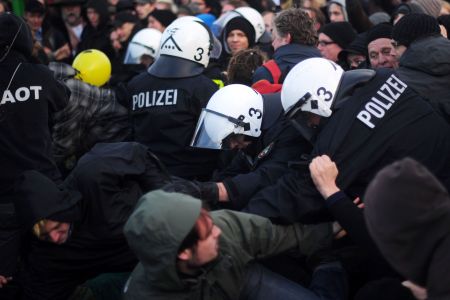
Like the Roman legions vanquished in the Teutoburger Wald in Lower Saxony in 9 AD, the 17,000 police officers that marched into the woods around the nuclear storage facility in Gorleben in northern Germany on Sunday morning looked invincible. Police personnel from France, Croatia and Poland had joined in the biggest security operation ever mounted against protestors against a train carrying nuclear waste to a depot in an isolated part of Lower Saxony’s countryside. Helicopters, water canons and police vehicles, including an armoured surveillance truck, accompanied an endless column of anti-riot police mounted on horses and also marching down the railway tracks into the dense woods. Tens of thousands of anti riot police clattered along the tracks, their helmets and visors gleaming in the morning sun, and wearing body armour, leg guards and carrying batons.
But by Sunday night, those same police officers were begging the protestors for a respite.
Trapped in black, icy woods without supplies or reinforcements able to reach them because of blockades by a mobile fleet of farmer’s tractors, the exhausted and hungry police officers requested negotiations with the protestors. A water cannon truck was blocked by tractors, and yet the police still had to clear 5,000 people lying on the railway track at Harlingen in pitch darkness. The largest ever police operation had descended into chaos and confusion in the autumn woods of Lower Saxony, defeated by the courage and determination of peaceful protestors who marched for miles through woods to find places to lie down on the tracks and to scoop out gravel to delay the progress of the “the train from hell.”
The police union head Reiner Wendt gave vent to the general frustration when he issued a press statement via the DPA news agency last night saying the police had reached exhaustion point and needed a break. Behind the scenes, a battle seemed to be raging between the police chiefs, tucked up in their warm headquarters urging more action, and the exhausted officers on the ground.
The police on the ground won out. The Castor train – called a “Chernobyl on wheels” because it has been carrying 133 tonnes of highly radioactive waste to an unsafe depot – was stopped in the middle of the countryside and NATO barbed wire was placed around it. Lit by floodlights and guarded by a handful of police, the most dangerous train on the planet was forced to a halt after a 63 hour journey across France and Germany.
The defeat of the legions at Teutoburg marked the end of the attempt by the Roman empire to conquer Germania magna. And the failure of the biggest ever police operation two thousand years later in the woods of Lower Saxony to tame women, elderly people and school children protesting the government’s nuclear policy, could well also go down as a turning point.
The Berlin government can no longer rely on the discredited mainstream media to control the way people see issues. Too many people recognise it to be a tool of propaganda. The government now needs to resort to brute force to bludgeon through decisions that enrich corporations and banks and impoverish everyone else. But the police forces at its disposal are simply not sufficient given the scale of the protests now gripping Germany. Only 1,500 police reinforcements could be mustered on Morning from the entire territory to deal with road blockades by thousands of protestors aiming to delay the transport of the nuclear waste on the final leg of its journey.

The police officers were exhausted after shifts of 24 hours or more, often without any food or just a cappuccino and snack bar, and they had nothing to look forward to but more of the same drudgery after a night spent four to a room in a Youth Hostel.
http://newsticker.sueddeutsche.de/list/id/1065325
A leading figure in a German police police union Bernard Witthaut today even lashed out at the government for trying to drive through unpopular policies using the police.
“Whether in Stuttgart or in Wendland today my colleagues are simply not getting out of their anti riot gear because of the wrong decisions by the government,” he said.
Many police officers also expressed sympathy with the protestors’ aims.
The question now is: how long can the use of police to bludgeon protestors continue when the protests are reaching this scale? How long can Germany be governed by a semi authoritarian regime using brute force when the force at its disposal is so small? The German army cannot be deployed on this kind of mission without sparking even more outrage. A false flag terrorist operation will hardly wash when the people are so fed up with the government lies and the media lies. EU soldiers will find it hard to deal with the Germans. The German and EU secret police cannot infiltrate all of the protestor’s organizations when there are simply so many.
The German people as a whole are on the march.
“Citizens in rebellion,” shouted a TAZ headline.
“Civil war in Wendtand,” fumed Bild.
NGO chief Kersin Rudek spoke for many when she said:
“We have lost faith in the government until they prove that their politics is for the people and not for the corporations.”
She talked about the “anger” among people at the “arrogance of the political class.”
As in the Stuttgart 21 railway protests, it was people from all walks of life, a genuine grass roots movement, that arrived in Wendland to protest the decision by the CDU/CSU/FDP government to ignore a legally binding deadline to phase out nuclear power. Against the wishes of the majority, Bilderberg Chancellor Angela Merkel announced this autumn that 17 reactors would continue for another 12 years at gigantic cost to the tax payer in subsidies.
The tax payers of Lower Saxony even have to foot the bill of 50 million euro for the police operation to protect the nuclear waste – and not the electricity companies making a fortune from the extravagant energy source while the government keeps investments in ground-breaking new renewable energy technologies such as the third generation solar cells at a negligible amount.
As in Stutggart, the police used savage force against peaceful demonstrators reinforcing the impression of a government out of control and refusing to respect the basic democratic right of people to hold protests without being beaten to a pulp. Videos of the Castor transport on Sunday show police beating people with their truncheons, punching them and throwing them to the ground. Police also used tear gas, pepper spray and water canon.
http://www.spiegel.de/politik/deutschland/0,1518,727706,00.html
One clip shows a police officer using his fist to punch a man lying on the railway track in the head.
About a 1,000 people were injured, it is reported. 950 people are reported to have suffered eye injuries due to pepper spray and tear gas, according to a spokesperson of “Castor schottern”. Another sixteen protestors suffered broken bones. There were 29 severe head wounds. Two people had to be taken to hospital.
One person had to be taken by helicopter after suffering multiple bone fractures after being trampled by a police horse.
But as in Stuttgart, the people did not give up in spite of the risk of savage beatings at the hands of the police. They insisted on their civic right enshrined in the constitution to hold peaceful political protests.
More than 50,000 people from all parts of the country and all walks of life attended a rally on a field close to Dannenberg. Thousands then marched through the autumn woods, splitting into small groups to descend into the valley, break through police lines to chain themselves to the rails or remove gravel from the tracks to delay the train.
According to Spiegel, 7,000 people alone took part in the road and railway blockades.
An armoured police car was set on fire by masked men but it is not clear if this was an agent pravocateur acting to discredit the protestors. A video shows a man able to walk up to the armoured car and set it alight unhindered.
The overwhelming number of protestors were peaceful.
In spite of the sub zero temperatures and ground frost, up to 5000 protestors lay down on the railway tracks at Harlingen late in the evening and refused to move. Supplies of hot tea, food and blankets were brought to them by mobile kitchens. Fires were lit to help stay warm.
The police worked from midnight until 7 am to clear protestors blocking the track, dragging many to an open air “prison concentration camp” where people were forced to sleep in fields surrounded by police trucks.
This morning, the protestors have regrouped today and thousands are reported to be preparing to block the transport by road of the nuclear waste from Dannenberg to Gorleben.
The organisers of the protest kept journalists and the public informed using live tickers, press releases and at Infopoints so that the whole country could follow the events outside the mainstream media. Radio Wendland is also broadcasting updates on the incredibly heroic resistance of so many people. At great personal risk, tens of thousands of people gave an example of courageous and peaceful non-violent resistance that will surely go down in history.
If this is the resistance for Castor and Stuttgart 21, just imagine what will happen when Germans finally grasp the scale of the banking scam being carried out by their “elite.”
The CDU/CSU/FDP government has already hit record lows in the polls and after Sunday’s savage police operation against peaceful protestors, support for them is sure to plummet further.
The feudal lords without a feudal army to push through their agenda of robbery are facing the end of the road now that their media propaganda apparatus based on the Springer and Bertelsmann empire is falling apart and their strategy of divide and rule through a false left/right political paradigm is no longer working.
A new freedom and power was born in the woods of Wendland. And it belonged to the people who have had enough of the arrogant authoritarian political class.
See also:
German police battle nuclear train protesters


 Aletho News