US-Qatar Deal Threatens Russia: Reading News Between the Lines
By Alex GORKA | Strategic Culture Foundation | 28.12.2016
Washington boasts strong military presence in the Persian Gulf. Iran and Yemen are the only countries of the region that don’t host US military facilities. The American armed forces use large air installations in Qatar and expand operations in the United Arab Emirates (UAE) and Oman. Bahrain is home to the US Navy’s Fifth Fleet. The US has encouraged the Gulf Cooperation Council (GCC) member states to purchase and install the Patriot Advanced Capability-3 (PAC-3) and the Terminal High Altitude Area Defense (THAAD) advanced missile defense systems.
The US and the GCC countries underscored a commitment to build the defense system at a summit in May 2015. Formally, the «Iranian threat» was used as a pretext. A joint statement following the summit said that the GCC states were committed to developing a ballistic missile defense capability, including an early warning system, with US technical support. The development of a robust integrated BMD network across the region is a primary goal for the US military. It guarantees that the GCC security will depend on the United States.
On December 10, Secretary Ashton Carter told an audience at the International Institute of Strategic Studies (IISS) regional security conference in Manama, Bahrain, that an agreement had been reached to allow Qatar to purchase a long range early warning radar (EWR) from Raytheon. «We reached an agreement for Qatar to purchase a 5,000 km [range] early warning radar to enhance its missile defenses», the official announced.
In July 2013, the Defense Security Cooperation Agency notified Congress of a possible Foreign Military Sale to Qatar of A/N FPS-132 Block 5 Early Warning Radar (EWR) and associated equipment, parts, training and logistical support for an estimated cost of $1.1 billion.
According to Raytheon, the AN/FPS-132 system is designed to detect missile launches that take place thousands of miles away to provide advanced warning time to alert command and control centers and cue fire control systems. ‘This highly reliable radar requires very low manning, yet will operate 365 days a year, 24 hours a day, providing up to 360 degrees of coverage out to 5,000km,’ said Steve Sparagna, chief engineer for the AN/FPS-132 EWR. ‘It is the ideal sensor to deter and detect hostile missile launches.’
According to Michael Elleman, a senior fellow for missile defence with the IISS, the system in future can provide not only Qatar but a unified GCC ballistic missile defence system an early warning capability against any Iranian ballistic missile launches.
The AN/FPS-132 to be based in Qatar is a very special case. It is designed to be used as an early warning system against strategic offensive assets – something Iran does not possess. For instance, the radars of this type are located in Beale Air Force Base, California, RAF Fylingdales, the United Kingdom, and Thule Air Base, Greenland to operate in the Ground-based Midcourse Defense (GMD) BMD system (BMDS). Following formal Missile Defense Agency (MDA) ground test events in FY17/18, Clear and Cape Cod upgraded EWRs (UEWR) are scheduled to be BMDS certified in FY18/19, respectively.
The announced range of 5,000km (3,100mi) by far exceeds the requirement to counter a missile threat coming from Iran. There are radars with shorter range to support the PAC-3 and THAAD systems deployed by GCC countries. In theory, the truck-mounted AN/TPY-2 is the right system for the mission. It can spot a missile launch from hundreds of miles away. If it is effective enough to be stationed in South Korea to counter Pyongyang and monitor parts of China, why is it different in the case of Persian Gulf?
The deployment of AN/FPS-132 to Qatar is not needed to support NATO assets stationed in Europe against Iran. A high powered early warning X band radar is stationed in Malatya, Turkey to carry out the mission. It is operational since January 2012. There is no answer why exactly the AN/FPS-132 – the UEWR with such an impressive detection range – should be used to counter Iran from the Gulf. The distance from Qatar to Iran is just 821 kilometers (510mi). It takes roughly 1,700 km (1,056mi) to reach Turkmenistan from Qatar across the territory of Iran. The AN/TPY-2 covers the whole country. The radar’s estimated range is from 1,500km (932mi) to 3,000km (1,864mi). The maximum instrumented range is 2,000km (1242mi). Obviously, one does not need a radar with an operational range of 5,000km to counter a threat coming from Iran. There is no other reasonable explanation for the choice, except the fact that the AN/FPS-132 can monitor large chunks of Russian territory.
Janes, perhaps unwittingly, confirms the fact. It says, «Raytheon was awarded a USD2.4 billion contract in December 2014 to build Qatar an Air and Missile Defence Operations Centre (ADOC) that it said will «integrate US air defence systems – including Patriot, the Early Warning Radar, and THAAD – with European air defence systems and radars, and Qatar’s Air Operation Centre». It proves that the Qatar-based AN/FPS-132 UEWR is an element of the emerging US global BMDS created to counter Russian nuclear strategic forces.
The announcement of the US-Qatar deal is a demonstration of US adamant resolve to surround the Russian Federation with BMD sites and neutralize its capability to deliver a retaliatory strike if attacked. This is a very disturbing fact. Russia will not sit idle watching the developments. The US has just taken another provocative step to undermine Russia’s security and complicate the bilateral relations.
Who is Supporting ISIS-Daesh in Syria? Erdogan or Obama? NATO Military Alliance in Crisis
By Michel Chossudovsky | Global Research | December 28, 2016
In an unusual turn of events, Washington accuses Ankara of supporting the ISIS-Daesh.
And Turkey’s president Erdogan responds by accusing Washington of supporting ISIS-Daesh. “Now they give support to terrorist groups including Daesh, YPG, PYD. It’s very clear. We have confirmed evidence, with pictures, photos and videos.” said Erdogan.
And Washington responds “”he [Erdogan] continues to supply arms [into Syria] as well, with his ultimate aim [being] to go after the Kurds, and ISIS is secondary.”
While Washington has strongly denied Erdogan’s latest allegations, the structure of political and military alliances is in crisis.
Who is supporting the ISIS?
The fact of the matter is that both the US and Turkey provide covert support to the terrorists including ISIS-Daesh and Jabhat Al Nusra.
Both Turkey and the US have collaborated in supporting the ISIS-Daesh in Northern Syria.
From the very outset, the Islamic State has been supported (unofficially of course) by the broader US-NATO coalition which includes several NATO member countries (including the US, France, Britain as well as Turkey) and their Middle East allies including Saudi Arabia, Qatar and Israel.
What is of concern to Erdogan is that the US is ALSO supporting the Kurdish separatists YPG forces which have been combating the ISIS. And until recently Turkey has used the ISIS rebels to combat YPG forces, which are also supported by the US.
From the outset in 2011, the recruitment of jihadist mercenaries to be deployed in Syria was coordinated by NATO and the Turkish High Command. In this regard, Turkey has played a central role in relation to logistics, weapons supplies, recruitment and training, in close liaison with Washington and Brussels.
The Ankara government has also played a strategic role in protecting the movement of jihadist rebels and supplies across its border into Northern Syria
What is now occurring is a rift in the structure of military alliances, through the emergence of “cross-cutting coalitions”.
Turkey as a NATO member state is an ally of the US. But the US is now supporting the YPG which is fighting both the ISIS and Turkey.
In turn, Turkey, which is a staunch ally of the US is negotiating with Russia and Iran.
Already in May 2016, Erdogan accused US-NATO of supporting YPG forces:
“The support they give [US, NATO] to… the YPG (militia)… I condemn it,” Turkish President Recep Tayyip Erdogan said on Saturday during an airport ceremony in the Kurdish city of Diyarbakir. “Those who are our friends, who are with us in NATO… cannot, must not send their soldiers to Syria wearing YPG insignia.” (Ara News Network, May 28, 2016)
What is the underlying cause of this clash between the US and Turkey, which strikes at the very heart of the Atlantic Alliance?
Washington is firmly opposed to Erdogan’s territorial ambitions in Northern Syria. The US-NATO objective is to fragment both Syria and Iraq. Washington’s strategy in Northern Syria consists in supporting and controlling the Kurdish YPG separatists.
Mark Toner, the US State department spokesperson confirmed that Washington would continue to support the YPG “despite the Turkish government opposition towards Kurdish-US cooperation”. (See Ara New Network, December 27, 2016):
“… there are disagreements among members of the coalition as to how we proceed and with whom we’re cooperating on the ground? I’m not going to say that there aren’t. And obviously, Turkey’s made very clear their feelings about the YPG. We have also been equally clear, while we understand Turkey’s concerns, that we’re going to continue to work with the YPG as a part of the overarching Syrian Democratic Forces. So the YPG is not the sole group that we’re working with on the ground. We’re working with Syrian Arabs, Syrian Turkmen, and other groups that are fighting Daesh,”
Officially the US is fighting the ISIS, unofficially it is supporting it.
And now in an about turn, the ISIS which is integrated (covertly and unofficially) by Western special forces (often on contract to private mercenary companies) has turned against Turkey, a NATO member state. This action is largely on behalf of YPG forces, which are also fighting Turkish forces:
ISIS claims it has killed 70 Turkish soldiers during the conflict and just a few days ago the warped death cult released a video of two Turkish men being burned alive.
Turkey has rushed tanks and heavy weapons to its border and blamed the US-led coalition for inadequate air support after Erdogan’s forces which encountered deadly resistance from ISIS militants – 14 Turkish troops were killed. (Daily Express, December 27, 2016)
Cross-Cutting alliances
While Ankara accuses Washington, Moscow is playing at the diplomatic level a skillful “double game”: Foreign Minister Lavrov is talking to John Kerry on the one hand as well as negotiating with Ankara on the other hand.
On December 21, the Foreign Ministers of Russia, Iran and Turkey (See image below) met in Moscow “to draft a joint statement aimed at resolving the long term conflict in Syria.” (RT, December 22, 2016)
Moscow also intimated that other countries including Saudi Arabia would be invited to join this initiative. The underlying objective would be to weaken the allegiance of Saudi Arabia to the US.
It is “very important” that the statement by Moscow, Tehran and Ankara “contained an invitation to other countries that have influence ‘on the ground’ to join such efforts,” (RT, December 22, 2016)

According to media reports, Turkey has Moscow’s support in the siege of the Northern Syrian city of Al-Bab which has been under the clutch of the ISIS since 2013. Fierce fighting is ongoing. Ankara reported on December 26 that “the anti-ISIS coalition was making progress in al-Bab”.
Copyright © Prof Michel Chossudovsky, Global Research, 2016
Obama Defeatedly Uses the ‘Sanctions Muscle’ Against Russia
By Salman Rafi Sheikh – New Eastern Outlook – 28.12.2016
It seems hardly a coincidence that the US out-going president announced fresh sanctions on Russia just when the later was busy discussing a deal on Syria with Turkey and Iran in Moscow. Far from being just a sort of coincidence, the act is an apt reflection of the increasing American anger over its failure in Syria against Russia. According to Wall Street Journal, the Obama administration added on Tuesday, December 20, 2016, to its sanctions list Yevgeny Prigozhin, a Russian restaurateur who, according to Washington, has links to Russia’s Vladimir Putin and is the financial backer of ‘pro-Russian propaganda’ machinery. Obama’s sanctions prohibit Prigozhin from entering the US and conducting business with any American individuals or organizations. This act has come alongside new US Treasury sanctions imposed upon a number of other Russian individuals with connections to a bank US officials have said has ‘ties’ to Mr. Putin’s inner circle. Clearly, the Obama administration is busy casting Mr. Putin as a die-hard villain in its version of political and military history.
Besides the fact that it is an expression of frustration, it is also a fact that Washington has run out of ways to hit at Putin and time is running out for the lame duck president – almost three weeks left before Obama retires.
Without doubt, the Obama administration feels humiliated that Russia, Turkey and Iran have formed a platform to discuss a Syrian settlement, which excludes the US. Even if it is not a defeating humiliation, the situation developing within and outside Syria regarding a US-exclusive peace settlement is politically deeply damaging for the US both domestically and internationally.
Nothing perhaps could explain the damage the Obama administration has done to the US due to its dual policies with regard to Syria and the larger issue of terrorism than Senator John McCain’s recent statement in which he said that what is unfolding is “the predictable consequence of President Obama’s reckless policy of disengagement from the Middle East. And it is ironic that after touting the power of diplomacy for years, President Obama’s refusal to back diplomacy with strength has left the United States without even a seat at the diplomatic table.”
While McCain’s view represents the view of a hawkish club that exists within the US, it is far from true that the Obama administration did not support diplomacy with strength. Neither was the US disengaged from the Middle East during all these years nor was the Obama administration oblivious to the importance of bringing havoc to Syria, in the name of democracy, through proxy groups, some of which continue to receive support.
Yet, the situation now emerging out of the trilateral settlement among Russia, Iran and Turkey marks a direct opposite of what the US and its allies have been seeking in Syria for last five years or so. While the joint statement of the trilateral meeting has formalized a growing convergence between Moscow, Ankara and Tehran, the bottom line and what angers the US the most is their unequivocal support for a Syria that is not only sovereign, independent and united with its territorial integrity intact, but also is “multi-ethnic, multi-religious, non-sectarian, democratic and secular.”
At the core is all parties’ willingness to facilitate an intra-Syria dialogue and to be the guarantors of a prospective agreement between the Syrian government and the opposition. Following the Moscow meeting, at a joint press conference with his Turkish and Iranian colleagues, Russian Foreign Minister Sergey Lavrov made it clear that the new trilateral format will be the “most effective” charioteer henceforth in the intra-Syrian peace talks.
He said Russia, Turkey and Iran are “probably better prepared than others to contribute to the settlement of the Syrian crisis with real actions, not just words”.
The three countries have as such tactfully got rid of the US mentorship in Geneva by agreeing to hold the talks in Astana, Kazakhstan. Hence, the brewing domestic anger over the Obama administration and the consequent sanctions.
While Obama may just be able to pacify its supporters through these sanctions, he cannot certainly turn blind to the danger Europe is facing. This widening of American sanctions against Russia at a time when the bloody attacks in Ankara and Berlin should bring reasonable people together to fight the terrorist threat shows that Washington has completely lost its grip on reality and deliberately decided to turn blind to it. Yet the threat exists and continues to pose a major challenge to Europe’s security situation. The Obama administration’s stubbornness with regard to indiscriminately fighting terrorism and its undue insistence on Assad’s exit are directly contributing to the persistence of this threat and even its territorial expansion into other continents. To an extent, the US’ dualism has even cost it its erstwhile allies.
The US is losing its traditional grip over the Middle East and the Arab world. This is evident from the way Turkey, despite being a NATO member, has weaned itself away from the US-led block and adopted an alternative course of action. The Moscow meeting has clearly shown that Turkey has decided to bury its past Syria policies and expressed its willingness to chalk out a scheme that caters to the interests of all the actors involved. In the joint statement with Russia and Iran, Turkey implicitly accepts, notwithstanding the bargain that might have taken place among all the parties involved, that the toppling of the Assad regime is no longer the agenda in Syria.
While such an outcome and changed position of Turkey vis-à-vis Syria and Assad can be attributed to what it is likely to gain in terms of an assurance from Russia, Iran and Syria against the creation of an independent Kurdistan, it can equally be attributed to the failure of efforts, spanning over 5 years, to topple Assad.
While Turkey has finally come to terms, the US and its European and Arab allies continue to cling to the old agenda. In their calculations, they seem to continue to ignore the fact that Assad does enjoy significant local support. Had it not been for this support, he might have been toppled long before Russia entered the scene.
The Syrian minorities have backed him and fought for him out of sheer self-preservation. Having seen what happened to the Yazidis in Iraq when they were captured by brutal IS fighters, they know they are fighting for their lives, their homes and their wives and daughters. This is an element in Assad’s support that, thus far, has gone unrecognised in the West.
With Assad strong enough to claim its office, with Russia and Iran standing in Syria and with Turkey sliding over to Russia and Iran, the US’ credibility as a reliable security partner has been damaged to a great extent. Fresh sanctions on Russia are just yet another indication of the fact that the US is too weak to achieve its objectives through other means—something that is causing Arab states to re-think their traditional reliance on the US for their national security.
As against the Arab states’ current standing, Russian influence in the region is increasing and a number of other countries, such as Egypt and Israel, have shown their willingness to extend co-operation with Russia against terrorism. Importantly, this co-operation against terrorism is not mere co-operation’; it also signifies a potential rejection of the US version of terrorism according to which a terror group becomes ‘terrorist’ only when it starts hurting interests of the US and those of its allies.
Obama Signs Measure Opposing Speech and Media Freedoms
By Stephen Lendman | December 27, 2016
Post-9/11, an array of police state laws, executive orders, memoranda, various national security and homeland security presidential directives, along with other repressive measures eliminated constitutional protections.
Indefinite detention without charges or trial became the law of the land. Torture-obtained evidence may be used against detainees in trial proceedings, despite earlier Supreme Court decisions ruling it impermissible.
Amending longstanding Insurrection Act and Posse Comitatus protections allows federal troops to be deployed on US streets.
Big Brother watches everyone. Whistleblowers exposing government wrongdoing risk longterm imprisonment under harsh conditions.
Obama’s war on freedom risks eliminating it altogether, America under his tenure a hair’s breadth from full-blown tyranny.
First Amendment rights are threatened like never before. Truth-telling on vital domestic and geopolitical issues is now considered fake news or Russian propaganda.
Targeting it is the hallmark of fascist dictatorship. Washington wants views contrary to its own suppressed, writers like myself and many others silenced.
When truth-tellers become enemies of the state, freedom no longer exists.
In early December, Congress overwhelmingly passed the Countering Disinformation and Propaganda Act as part of the annual National Defense Authorization Act – an unconstitutional measure against First Amendment freedoms.
On December 23, ahead of the Christmas holiday weekend, Obama signed it into law practically unnoticed. Along with approving bloated military spending, it establishes a Center for Information Analysis and Response – a de facto Ministry of Truth.
It aims to ferret out truth-telling on vital issues, suppress what everyone has a right to know, countering it with state-sponsored propaganda – along with perhaps targeting reliable independent sources of news, information and analysis for elimination.
Orwell once said in times of universal deceit, truth-telling is a revolutionary act. In America, it’s an endangered species, heading toward becoming criminalized, its disseminators risking prosecution, imprisonment or elimination by other means.
Obama governs under a police state apparatus, hardened throughout his tenure. When truth-telling becomes fake news or Russian propaganda, criminalizing it is a step closer to reality.
Stephen Lendman can be reached at lendmanstephen@sbcglobal.net. His new book as editor and contributor is titled Flashpoint in Ukraine: How the US Drive for Hegemony Risks WW III.
US bid to ease arms flow to Syria militants endangers Russian forces: Moscow
Press TV – December 27, 2016
Russia has warned that a US decision to ease restrictions on the provision of arms to militants in Syria compromises the safety of Russian aircraft and servicemen operating in the Arab country.
On December 8, the White House said US President Barack Obama had relaxed the so-called Arms Export Control Act for the militants “supporting US Special Forces” in Syria, saying such leniency would contribute to “the national security interests” of the US.
Russia’s Foreign Ministry said on Tuesday that it viewed the decision as a “hostile act,” and cautioned that the Obama administration was attempting to complicate the situation in the world before President-elect Donald Trump took over the White House in January.
Russia has been lending air support to Syria’s counterterrorism operations since last September. It operates two airbases in the Arab country.
Moscow had earlier warned that the US decision to ease the arms flow to the militants in Syria would pose a threat to the entire Middle East. US weapons could end up in the wrong hands, Kremlin spokesman Dmitry Peskov said at the time.
“Certainly, the worst result of this decision would be those weapons, including MANPADs [man-portable anti-air missiles], ending up in the hands of terrorists, which of course poses a serious threat not only for the region, but for the entire world,” he said.
The decision came after the liberation last week of Syria’s second city of Aleppo from militants by the Syrian and Russian militaries.
As the liberation was underway, a ceasefire deal was worked out during negotiations between Russia and Turkey, which were respectively representing the Syrian government and militants. The accord enabled evacuations out of the city.
Russia later proposed comprehensive talks aimed at the establishment of a countrywide ceasefire across the Arab country. On Tuesday, representatives from Moscow and Ankara were reported to hold follow-up talks in the Turkish capital with that end in sight.
Separately, the Russian Foreign Ministry said on Tuesday that the foreign ministers of Russia and Turkey had agreed in a telephone conversation on the same day to push for a nationwide ceasefire in Syria.
During the phone conversation, “the importance was stressed of a rapid completion of agreements on practical parameters to end military actions (in Syria), the separation of the moderate opposition from terrorist groups, and preparations for the meeting in Astana,” the statement read, referring the planned talks in the Kazakh capital to discuss a nationwide ceasefire.
Iran, Russia, and Turkey have previously discussed prospects for resolving the Syrian conflict in the Russian capital.
Moscow weighs in on Obamaspeak, finally
By M K Bhadrakumar | Indian Punchline | December 25, 2016
Full eight weeks ago when I wrote that Russian President Vladimir Putin must have had a game plan by honouring Henry Kissinger as a member of the hallowed Russian Academy of Sciences, it was a mere hunch. (See my blog Russia honours American icon on US election eve.) Isn’t that what Kremlinology is all about – taking a blind shot and undeservedly hitting bull’s eye? Politico has a riveting story this weekend with the tell-all title Kissinger, a longtime Putin confidant, sidles up to Trump: America’s pre-eminent ex-diplomat gets back in the mix. Could he help broker a deal with Russia?
On a serious note, though, the stunning thing is Putin’s sensational admission – characteristically enough, in parenthesis – at his annual marathon press conference in Moscow on Friday, that he knew it in his bones that Donald Trump would win. This is what Putin said at the press conference:
- It seems to me that Reagan would be happy to see his party’s people winning everywhere, and would welcome the victory of the newly elected President (Trump) so adept at catching the public mood and who took precisely this direction and pressed onward to the very end, even when no one except us (Kremlin) believed he could win.
The press conference on Friday was payback time for all the fusillade fired at Russia and Putin personally through the past 5 -6 months from Washington, culminating in President Barack Obama’s unprecedented, finger-pointing at the Kremlin leader just a week ago, alleging he’d plotted Trump’s victory.
Putin fired back that Obama and his party men are shifting the blame for their own failures to Russia. He said the Democratic Party lost not only the presidential elections but also the Congressional elections and the Obama administration is responsible for the systemic reasons for it. Putin referred to the disconnect between the American political elites and the “broad popular masses”. He drew satisfaction that a substantial section of Americans shared Russian views on “the world’s organization”.
Putin said acerbically that a great Democratic president like FDR (“who knew how to unite the nation even during the Great Depression’s bleakest years”) would be turning in his grave. For, Putin added:
- Today’s (US) administration… is very clearly dividing the nation. The call for the electors not to vote for either candidate, in this case, not to vote for the President-elect, was quite simply a step towards dividing the nation. Two electors did decide not to vote for Trump, and four for Clinton, and here too they (Obama administration) lost. They are losing on all fronts and looking for scapegoats on whom to lay the blame. I think this is an affront to their own dignity. It is important to know how to lose gracefully.
- But it is very clear that the party which calls itself Democratic and will remain in power until January 20, I think, has forgotten the original meaning of its name. This is particularly so if you look at the absolutely shameless way they used administrative resources in their favour, and the calls to not accept the voters’ decision and appeals to the electors.
Putin defiantly challenged Obama to produce a shred of evidence regarding Russian hacking of the Democratic National Committee website. He then weighed in heavily:
- I think the most important thing is the information that the hackers revealed to the public. Did they compile or manipulate the data? No, they did not. What is the best proof that the hackers uncovered truthful information? The proof is that after the hackers demonstrated how public opinion had been manipulated within the Democratic Party, against one candidate rather than the other, against candidate Sanders, the Democratic National Committee Chairperson resigned. This means she admitted that the hackers revealed the truth. Instead of apologising to the voters and saying, ‘Forgive us, we will never do this again,’ they started yelling about who was behind the attacks. Is that important?
It is truly exceptional for a Kremlin leader to hold the torch light at the dysfunctional American system and to deliberate publicly in front of the western mediapersons on the deep-rooted rot in the US electoral politics. Arguably, Putin crossed the limits of diplomatic propriety. But then, Obama asked for a Christmas gift from the Kremlin before leaving the Oval Office by his own intemperate remarks about Putin ten days ago.
The Kremlin took a lot of nonsense from Obama over the years – much of it deliberately intended to humiliate the Russian elites, often personally mocking at Putin and lecturing at him and even commenting on his personal traits, and generally putting down Russia on the world stage as a failing state.
But, ironically, Obama ended up only contributing to Russia’s resurgence. History shows that Russia mobilises best under duress. But for such baptism under fire during Obama’s second term – US strategy to ‘isolate’ Russia, ‘regime change’ in Ukraine, western sanctions, deployment of ABM system in Central Europe, NATO forward deployments within 100 kilometers from St. Petersburg, et al – Russia might not have got its act together so comprehensively, as today. Putin’s extraordinary performance on Friday shows it. Read the transcript here.
Obama Administration Ready to Help Any ‘Destructive Forces’ in Syria – Moscow
Sputnik – 24.12.2016
In its pursuit to change the Syrian government, Obama administration is ready to help any ‘destructive forces’, including Jabhat Fateh al-Sham, Russian Foreign Ministry said in a statement on Saturday.
Commenting on the issue of expansion of the US sanctions against Russia, the Foreign Ministry said that Moscow sees this act as a way to punish Russia for helping Syria battle terrorism which is a threat to the whole world.
“It has long been noticed that, under the current administration, Washington in its pursuit to shift power in Syria is ready to help any destructive forces. [It is] protecting and covering Jabhat al-Nusra terrorist group that is none other but a subdivision of al-Qaeda, which has commited the most horrible terrorist acts in the history of the US,” the statement said.
“It seems that the White House has forgotten that, under the US law, aiding terrorism is a criminal offense,” the Ministry pointed out in the statement.
On Friday, the US Department of Commerce added 23 Russian entities to its Ukraine-related sanctions list. On December 20, Washington sanctioned seven Russian citizens, eight entities and two vessels due to activities related to the conflict in Ukraine.
A Loser’s Malice: What’s Behind Obama’s Attacks on Putin
By Michael Jabara CARLEY | Strategic Culture Foundation | 23.12.2016
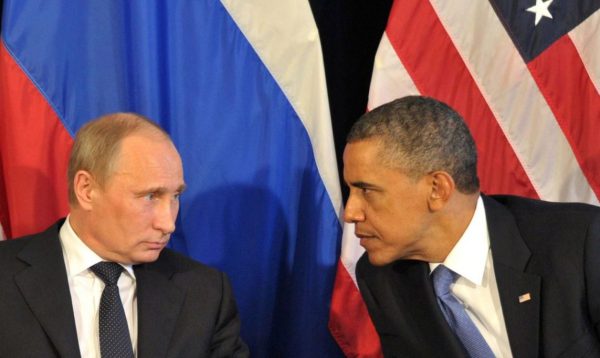
Relations between Russian president Vladimir Putin and US president Barack Obama are poisoned and irretrievably damaged. It’s therefore a good thing that Obama is leaving office on 20 January.
Bad US-Russian relations are of course nothing new. Since the Anglo-American war against Iraq in 2003, the US-Russian relationship has been headed downhill.
For Obama, it appears that everything has gotten personal. The US president often acts like a petulant adolescent, jealous of a high school rival. You know, the kid who does everything better than he does. The lad takes it badly and won’t let it go. He challenges his nemesis to some new contest at every opportunity only to lose again and again. That’s got to be hard on the ego.
Between Obama and Putin there have been many such encounters.
Nor can it help that western cartoonists so often ridicule Obama as out of his depth in comparison to Putin.

Western cartoonists so often ridicule Obama as out of his depth in comparison to Putin
Let’s consider Obama’s remarks at his last press conference on Friday, 16 December. «The Russians can’t change us or significantly weaken us», said Obama: «They are a smaller country. They are a weaker country. Their economy doesn’t produce anything that anybody wants to buy, except oil and gas and arms. They don’t innovate». This was insulting both Putin and his country, but not enough apparently for Obama. «They [the Russians] can impact us if we lose track of who we are. They can impact us if we abandon our values. Mr. Putin can weaken us, just like he’s trying to weaken Europe, if we start buying into notions that it’s okay to intimidate the press, or lock up dissidents, or discriminate against people because of their faith or what they look like».
What on earth is Mr. Obama talking about? Intimidate the press? The Moscow newspapers and television media are loaded with «liberals». Many Russians call them «fifth columnists». They are «people with ‘more advanced’ worldview[s] who do not tolerate ‘Russian propaganda’ themselves», according to one colleague in Moscow. But Mr. Putin tolerates them and pays them no mind.
«Lock up dissidents… discriminate against people»? What alternate reality does Mr. Obama live in? Doesn’t produce anything people want to buy? The United States buys rocket engines that it does not now produce at home. Maybe the Americans, a Russian commentator joked, can use high tech trampolines to get into space and do without Russian technology.
In an interview the previous day with the American National Public Radio Obama ranted about Putin. It must have been a rehearsal for his press conference. «This is somebody, the former head of the KGB», said Obama, «who is responsible for crushing democracy in Russia… countering American efforts to expand freedom at every turn; is currently making decisions that’s leading to a slaughter in Syria». What stupefying hypocrisy; what utter nonsense. Putin was a lieutenant colonel in the KGB, but never its head, and he certainly has not «crushed democracy in Russia». He even treats his political opposition with respect compared to Obama who dismisses president-elect Donald Trump as some kind of Russian Manchurian candidate. The Russians, according to Obama, interfered in the US presidential elections, and helped defeat fellow Democrat Hillary Clinton. They hacked the Democratic National Committee’s hard drive and passed thousands of emails to WikiLeaks, although, according to others, an outraged Clinton insider leaked the cache of embarrassing emails. Obama has dismissed that possibility. The Russians did the hack, he insists, and Putin must be held personally responsible.
Where’s the evidence? In Moscow, an angry Putin challenged Obama to put up or shut up. This is a hard thing for Obama to do. The Russians, he says, «counter American efforts to expand freedom at every turn». One wonders where that would be. In the Ukraine where the United States and European Union backed and guided the coup d’état against the democratically elected Ukrainian government? Or in Syria where the United States and its NATO and regional vassals are waging a war of aggression against the legitimate government in Damascus, backing jihadist terrorists? How many democratic governments or popularly supported political movements has the United States plotted against or destroyed since 1945? The list is long, including the 1996 Russian presidential election.

In Syria, the United States and its NATO and regional vassals are waging a war of aggression against the legitimate government in Damascus, backing jihadist terrorists
Obama directly raised the issue of Syria during his NPR interview. The liberation of E. Aleppo from Al-Qaeda and other jihadists has infuriated the west. To the everlasting shame of France, the Eiffel Tower was darkened to mourn the defeat of Al-Qaeda. The Mainstream Media (MSM) is up in arms. Russia, Iran, Hezbollah, Palestinian and Iraqi militias have helped the Syrian Arab Army to cleanse Aleppo of jihadist terrorists, and thwart the United States and its vassals. This is what galls Obama, being outmanoeuvred by a lesser man than he and a lesser country than the United States. How deplorable to speak of the liberation of E. Aleppo as «a slaughter in Syria».

Remember 2013, when the US government started a propaganda campaign about Syrian chemical weapons and warned of «red lines» that could not be crossed?
Obama’s frustrations began several years ago. Remember back in 2013, when the US government started a propaganda campaign about Syrian chemical weapons and warned of «red lines» that could not be crossed? Apparently, the US government came within an ace or two of launching massive air attacks on Syria. Putin intervened and the Syrian government gave up its chemical weapons, removing the US pretext for intervention. The print media had a field day showing Putin helping Obama out of a corner of his own making. All the while, Putin kept urging Russian-US cooperation against the jihadists in Syria, trying to draw the United States away from its ruinous policies. To no avail. Who then acted with greater statesmanship, Putin or Obama?

In 2013, when the US government started a propaganda campaign about Syrian chemical weapons, Putin intervened and the Syrian government gave up its chemical weapons, removing the US pretext for intervention. The print media had a field day showing Putin helping Obama out of a corner of his own making.
Temporarily thwarted in Syria, the United States opened up a new front on Russia’s southern frontier in the Ukraine. It backed the coup d’état in Kiev and turned a blind eye to the fascist vanguard, which kept the new Ukrainian junta in power. «The fascists are just ‘a few bad apples’», officials said in Washington, thinking that NATO had scored a great victory in getting its hands on Sevastopol so it could kick the Russian Black Sea fleet out of its traditional home base.
You have to give credit to Obama; he was ambitious, aiming for a big prize and the humiliation of Russia and its president. Again, he was thwarted not so much by President Putin but by the Russian people of the Crimea who immediately mobilised their local self-defence units backed by «polite people», Russian marines stationed in Sevastopol, to kick out the Ukrainians with scarcely a shot fired. They organised a referendum to approve entry into the Russian Federation. Reunification was quickly approved by a huge majority and celebrated in Moscow. Putin gave a remarkably candid speech, explaining the Russian position. «NATO remains a military alliance,’ he said, «and we are against having a military alliance making itself at home right in our backyard or in our historic territory. I simply cannot imagine that we would travel to Sevastopol to visit NATO sailors. Of course, most of them are wonderful guys, but it would be better to have them come and visit us, be our guests, rather than the other way round».

«NATO remains a military alliance,’ he said, «and we are against having a military alliance making itself at home right in our backyard or in our historic territory», Putin said
It all happened so quickly, Obama must have looked on, dumbfounded, sputtering with angry frustration at having been outmanoeuvred by Crimean Russians who knew a thing or two after all about «innovating» and defending their land. Russians in the eastern Ukraine also resisted, taking up arms to defend themselves against Kiev’s fascist battalions.
That was too much. Putin became Obama’s nemesis. The US president struck back with economic sanctions, which his European vassals quickly endorsed. When Malaysian Airlines, MH17, was shot down over the eastern Ukraine, Obama and the EU at once accused Putin of being responsible without a shred of evidence. In fact, the available evidence points to the Kiev junta as the guilty party, but the MSM paid no attention. It ran an orchestrated propaganda campaign leading to harder sanctions against Russia intended to sabotage the Russian economy and break the Russian government.
Obama and his advisors again miscalculated. The Russian government instituted its own sanctions against the EU, and looked for other sources of supply or replaced foreign imports with Russian products. «We can do without Polish apples and French cheese», most Russians thought. «Liberals» sulked over the loss of their Camembert, but that’s a small price to pay for Russian independence. Obama was outsmarted again by Russians who, he insists, can’t innovate. As for the EU, it suffered huge economic losses because of sanctions at American behest in a classic case of shooting oneself in the foot. It’s getting to be a habit; the EU has again renewed its sanctions against Russia.

The EU has suffered huge economic losses because of its anti-Russia sanctions at American behest in a classic case of shooting oneself in the foot.
Whilst the Ukrainian crisis dragged on, Obama had to turn his attention back to Syria. In the autumn of 2015, Putin ordered Russian aerospace and naval forces to intervene on behalf of the hard-pressed Syrian government which asked for assistance against the western-backed jihadist invasion. The tide of battle slowly turned. Again, Obama was caught off guard; again, the US plan to overthrow the Syrian government was thwarted by Obama’s nemesis. The United States tried bogus truces to allow its jihadist mercenaries to refit and resupply. At first, the Russians did not seem to catch on, accepting American proposals as genuine. They had to learn the hard way, but they did eventually. The liberation of E. Aleppo, although overshadowed by the simultaneous loss of Palmyra, is another blow to Obama’s policies and to his fragile ego.

How could this «weaker… smaller country» outsmart the all-powerful Mr. Obama and the great US Hegemon?
No wonder the US president is lashing out at Putin, publically insulting him and his country. No wonder the MSM is up in arms. How could this «weaker… smaller country» outsmart the all-powerful Mr. Obama and the great US Hegemon?
Like the USSR before it, Russia has always had to pursue a politique du faible, a poor man’s policies, never having the abundant resources of it western adversaries. Russians learned early on to innovate. The fox has to make its way in a world full of dangerous wolves.
What Obama must hate most of all is Putin’s exposure of US support for Al-Qaeda and the Islamic State. Who indeed is responsible for the «slaughter» in Syria? Obama calls it fighting for democracy. «Airstrike democracy», Putin once derisively replied. «Do you realise what you have done?» Putin asked at the UN in 2015, shocking the MSM. Obviously not, if one is to judge by Obama’s remarks of the last few days. He’s still the obsessive adolescent with doubts about himself and in over his head against a real statesman. Thank heavens Obama is on his way out the door of the White House. It’s not a minute too soon. Olliver Cromwell’s famous remark in 1653 to the Rump Parliament seems apposite. «You have sat too long for any good you have been doing lately… Depart, I say; and let us have done with you. In the name of God, go!»
Syria, Russia and American Desperation
By Margaret Kimberley | Black Agenda Report | December 21, 2016
It is no coincidence that anti-Russian propaganda is being ramped up at the same moment the Syrian government is poised to retake its country from terrorists. Barack Obama and the rest of the war party are left to sputter nonsensical statements because their grand plan to realize the neocon Project for a New American Century is in very big trouble.
The American corporate media ignored the suffering of Syrians in the city of Aleppo until their captivity was broken by the Syrian Arab Army. Ever since 2012 ISIS and other terrorist groups sponsored by the United States, NATO, Saudi Arabia, and Qatar have held thousands of people hostage there. Turks picked the region apart, raiding Syrian factories and transporting them piece by piece back to their country.
Now that the Syrians are retaking the city with the help of their Russian and Hezbollah allies, there is a steady stream of news about Aleppo. All of it is meant to pull at the heart strings of uninformed people as the human rights industrial complex reliably goes about its dirty work. Human Rights Watch and other groups who work to promote United States foreign policy speak endlessly about war crimes. They didn’t say much when America’s allies were terrorizing Syrians but now they suddenly point fingers and always at the people who run afoul of regime change plans.
The five year-long effort to destroy the Syrian state has produced many victims in that country and it always threatened to spark a larger international conflict. The assassination of the Russian ambassador to Turkey could be such a moment. The gunman’s last words and obviously his actions were a call to jihad. Even one hundred years later the 1914 assassination in Sarajevo is not far from memory.
But the United States is the principal actor in this drama. None of the other nations involved in this crime would have acted absent American direction. All of the casualties, the sieges, the hunger and the frantic search for refuge can be placed at America’s feet. So too the death of the Russian ambassador. This international tangle is covered with American finger prints.
The Syrian government is determined to take back its country and the Americans and their allies are equally determined to thwart it. The recent successes of the Syrian army explain part of the desperation coming from Obama, the Democratic Party and corporate media. Blaming Russia kills several birds with one stone. It continues the propaganda war against a country that will not knuckle under and accept American hegemony. The hyper Russophobia was also an attempt to make the unpalatable and incompetent Hillary Clinton more appealing. And its continuation is being used by Democrats and Republicans to stop the incoming president from having any chance to improve relations with that country or curtail the regime change doctrine. The war party never sleeps.
Barack Obama’s last press conference was replete with lies and insults aimed at Russia and Vladimir Putin. He should have been embarrassed to say that Russia was “smaller,” “weaker” and “doesn’t produce anything that anybody wants to buy except oil and gas and arms.” He completed his bizarre rant by saying that Putin was “the former head of the KGB.” He was no such thing and of course Obama knows that. It isn’t clear if he expected anyone to believe him or if facing his failure carried him away to heights of rhetorical foolishness.
Obama thought that Hillary Clinton would win and complete his regime change plans. Not only did she lose and deprive him of his third term but the hollowness of his legacy is clear. Obviously “hope and change” was a marketing tag line meant to hide his commitment to the world wide neoliberal project.
Donald Trump will be president of the United States in just four weeks. That is a short period of time in which to pull off a soft coup. He will be inaugurated but team Obama want to make sure he cannot upend the status quo they work so hard to uphold.
While the Democratic Party rank and file are anxious about racism, immigration, Islamophobia, judicial appointees and voter suppression their leaders only care about maintaining imperialism. Obama and the rest of the democratic party are unworthy of the loyalty they engender. On January 20th thousands of people will head to Washington to protest Trump while the Democrats will be making last ditch efforts to help jihadists destroy Syria.
Some of the protesters ought to target their ire at Obama and the Democrats and not just because of their electoral failure. They ought to pledge an end to support for warmongering Democrats altogether. If it is true that Trump is a fascist he won’t be the first one in the White House. His predecessor fits that description just as well. But events may have spun out of his control. The fate of Syria may not be in American hands any longer. And that is why the desperation is so evident.
Margaret Kimberley can be reached via e-Mail at Margaret.Kimberley(at)BlackAgendaReport.com.
Featured Video
The Truth About the Trump Shootings with Ken Silva
or go to
Aletho News Archives – Video-Images
From the Archives
The Geopolitics behind the War in Yemen (I)
By Mahdi Darius NAZEMROAYA | Strategic Culture Foundation | 30.03.2015
The United States and the Kingdom of Saudi Arabia became very uneasy when the Yemenese or Yemenite movement of the Houthi or Ansarallah (meaning the supporters of God in Arabic) gained control of Yemen’s capital, Sanaa/Sana, in September 2014. The US-supported Yemenite President Abd-Rabbuh Manṣour Al-Hadi was humiliatingly forced to share power with the Houthis and the coalition of northern Yemenese tribes that had helped them enter Sana. Al-Hadi declared that negotiations for a Yemeni national unity government would take place and his allies the US and Saudi Arabia tried to use a new national dialogue and mediated talks to co-opt and pacify the Houthis.
The truth has been turned on its head about the war in Yemen. The war and ousting of President Abd-Rabbuh Manṣour Al-Hadi in Yemen are not the results of «Houthi coup» in Yemen. It is the opposite. Al-Hadi was ousted, because with Saudi and US support he tried to backtrack on the power sharing agreements he had made and return Yemen to authoritarian rule. The ousting of President Al-Hadi by the Houthis and their political allies was an unexpected reaction to the takeover Al-Hadi was planning with Washington and the House of Saudi. … continue
Blog Roll
 Aletho News
- Pakistan-Iran talks secure LNG shipment to Islamabad through Hormuz
- Black Sea grain crisis puts global wheat supplies under pressure
- IRGC air defenses destroy another US MQ-1 drone over Strait of Hormuz
- Imran Khan’s entire immediate family detained in Pakistan ahead of mass protest demanding his release
- EU nation detains former presidential frontrunner
- Leaked: Britain’s Sham Conviction Of Hashim Thaci
- Seyed M. Marandi: U.S. Strike Imminent – Toward Total War in the Middle East
- Russia Voted Under Fire. Washington Is Loading the Tankers.
- 12 Things Your Oncologist Was Trained Not to Tell You
- Anthrax Attacks Paved Way for COVID-Era ‘Junk Drugs and Vaccines’
- If Americans Knew
- Huckabee aide solicited cash gifts from Israelis
- This isn’t sci-fi, AI is already killing people
- ‘The Most Brutal Thing’: Investigation Reveals Execution of Elderly Woman in Rafah
- Inside Israel’s ‘soft’ ethnic cleansing plan for Gaza through the eyes of its victims
- New online database tracks pro-Israel political donations in the United States
- Israeli president pardons soldier convicted for killing wounded Palestinian
- Singer Ed Sheeran says his ‘heart broken’ by Gaza devastation, addresses Macklemore controversy
- Israel Has Imprisoned Female Journalist Bushra Al-Tawil Without Trial Or Charge In Solitary Confinement For Past Month
- Israel poised to teach West Bank a lesson after one Israeli killed – Daily Update
- Salah Sarsour’s Legal Team Says DHS Has Not Met Its Burden to Prove He Is Deportable
- No Tricks Zone
- 2025 Nature Paper Claiming Worsening Global Drought Gets RETRACTED …Heavily Flawed
- New Study: ‘Global Drought Shows No Detectable Recent Acceleration Under Climate Warming’
- Economic Masterminds: German Socialists Suggest Taxing Productivity Gains Stemming From Using AI
- The South China Sea Has Not Been Cooperating With The Climate Change Narrative
- Energy Crisis: Germany Enters Heating Season With Historically Low Gas Reserve Fill Levels
- New Study: The Antarctic Ice Sheet Gained Mass From 2020-2024 Due To Staggering Snow And Ice Accumulation
- Study: Ocean Heating Rates From Thousands Of Years Ago ‘Dwarf’ Modern Ocean Heating Rates
- Climate Extremists Target, Attack Large-Scale Power Grid Infrastructure In Germany!
- New Study: Antarctic Ice Melt Has Contributed Less Than 1 Centimeter To Sea Level Rise In The Last 30 Years
- Fear Of Debate: Alarmist German Climate Scientist Calls On Mainstream Media To Discredit Skeptic Voices
 Aletho News