Hillary’s ‘Russian Hack’ Hoax: The Biggest Lie of This Election Season
By Patrick Henningsen | 21st Century Wire | Noember 1, 2016

The longer this soap opera drags on, it’s becoming more and more evident that the Russia government did not ‘hack’ into the DNC, and Moscow is not feeding John Podesta’s emails to Wikileaks. For those who are deeply invested in this now official conspiracy theory, this might be a hard pill to swallow.
The White House and the Hillary Clinton campaign are now married to the idea that ‘Putin is hacking the US elections.’ In response, the President is weighing his options – tougher economic sanctions, revoking diplomatic status to Russian envoys in the US, or even deploying his newly developed ‘malicious cyber-activity’ tools.
Even VP Joe Biden wants in on the action, threatening Moscow by saying,”We’re sending a message. We have the capacity to do it.”
It seems that where ever you turn nowadays, someone in Washington is issuing a threat against Russia. Are US-Russian relations really that bad, or does this trend have more to do with the defense industry and power struggles within the US?
What was previously a stance reserved for right-wing neoconservative hawks and Cold War hold-outs has now infected America’s left-wing, and is a firm plank in the Democratic Party platform, as evidenced by Hillary Clinton’s constant anti-Russian rhetoric throughout this 2016 election cycle. Along with the White House, Clinton has now transformed the Democrats into the vanguard of Washington’s new anti-Russia movement.
On July 27th, Josh Rogin from the Washington Post wrote, “The Clinton campaign has decided to escalate its rhetoric on Russia. After Trump suggested Wednesday that if Russia had indeed hacked Clinton’s private email server it should release the emails, the Clinton campaign sent out its Democratic surrogates to bash Russia and Trump in a manner traditionally reserved for Republicans.”
Anyone who was paying attention back then knew this ‘Russian hack’ talking point was purely political, but then again, who’s really paying attention these days? Certainly not the US media.
Backed by the Obama White House, Clinton and the media pressed ahead blaming Russia – not only for the controversial DNC leaks, but also for hacking into US election systems in Arizona – a charge devoid of any evidence other than innuendo and speculation. The media’s coverage on this issue was deceptive from the onset. In a leading news release, entitled, Russian hackers targeted Arizona election system, we can see how after the cock-sure headline, the first paragraph would always sound definitive:
“Hackers targeted voter registration systems in Illinois and Arizona, and the FBI alerted Arizona officials in June that Russians were behind the assault on the election system in that state.”
But then by the time you advanced down the story, the report would quickly retreat into a zone of uncertainty:
“The bureau described the threat as “credible” and significant, “an eight on a scale of one to 10,” Matt Roberts, a spokesman for Arizona Secretary of State Michele Reagan (R), said Monday. As a result, Reagan shut down the state’s voter registration system for nearly a week.”
And then, down to almost nothing…
“It turned out that the hackers had not compromised the state system or even any county system. They had, however, stolen the username and password of a single election official in Gila County.”
At no point was any evidence ever given. Only ambiguous statements like, “Cyber security officials agree that this looks very much like a Russian government-directed hack.”
Are American politicians so callous as to tempt geopolitical conflict in order to further their short-term political ambitions? Better yet, has American political life really arrived such a dark cul de sac (translated in French: ‘bottom of the bag’) where politicians in power are so insecure as to make-up and propagate wild international conspiracy theories – in the middle a national election cycle? It’s a very depressing prospect, and yet, this is exactly what we are seeing in this 2016 Presidential Election.
Behind Clinton’s wild hyperbolic rants about the Kremlin and Wikileaks, you will find the White House…
On October 7th, the Obama Administration formally accused the Russian government of stealing emails from the Democratic National Committee and other high-profile individuals including Hillary Clinton’s campaign manager John Podesta – giving them to Wikileaks.
Soon, there was a queue of ‘national security’ politicians eager to hitch a ride on this bandwagon. Senator Ben Sasse (NE-R), a member of the Homeland Security Committee spouted out, “Russia must face serious consequences. Moscow orchestrated these hacks because [Russian President Vladimir] Putin believes Soviet-style aggression is worth it. The United States must upend Putin’s calculus with a strong diplomatic, political, cyber and economic response.”
According to a Washington Post report by technology editor, Ellen Nakashima, the only ‘evidence’ that seems to be available on this story is a corporate analysis of the alleged ‘Russian government hacks’ – provided by a US cyber security company called Crowdstrike. No actual specifics are given, so we are meant to take private firm Crowdstrike’s word for it.

IMAGE: Crowdstrike cyber security.
The Post’s Nakashima then added:
The administration also blamed Moscow for the hack of the Democratic Congressional Campaign Committee and the subsequent leak of private email addresses and cellphone numbers of Democratic lawmakers.
An online persona calling himself Guccifer 2.0 has claimed responsibility for posting the material. Those sites and that persona are “consistent with the methods and motivations of Russian-directed efforts,” the joint statement said. “… We believe, based on the scope and sensitivity of these efforts, that only Russia’s senior-most officials could have authorized these activities.
Moscow’s press secretary’s reply: “This is some sort of nonsense,” said Dmitry Peskov.
Despite the constant repetition by Democrat media surrogates, and as CNN’s Maria Cardona said last night, no US national intelligence agency has really “confirmed” that Russia was behind the email hacks – and still no evidence, other than speculative guesswork, has been presented.
Likewise, US intelligence agencies have never actually said definitively on record that “Russia did it,” thus, leaving the door open to walk-back the accusation at a later date. Standard Washington procedure of ambiguity. This little detail doesn’t seem to matter in this hyperbolic political climate though. It seems that the White House, Hillary Clinton and media operatives like Cardona – are quite happy living in what John Kerry recent dubbed as a ‘parallel universe.’
Still, during the final Presidential debate, Hillary Clinton proudly crowed how “17 US intelligence agencies” aka the “Intelligence Community” all agreed that Russia did it. Some might call that propaganda.
“We have 17 intelligence agencies, civilian and military, who have all concluded that these espionage attacks, these cyberattacks, come from the highest levels of the Kremlin, and they are designed to influence our election,” said Clinton. “I find that deeply disturbing.”
What’s even more disturbing is the fact that Clinton is lying in front of a national audience. The highest levels of the Kremlin? Really? Here are Clinton’s ’17 agencies’:
Air Force Intelligence, Army Intelligence, Central Intelligence Agency, Coast Guard Intelligence, Defense Intelligence Agency, Energy Department, Homeland Security Department, State Department, Treasury Department, Drug Enforcement Administration, Federal Bureau of Investigation, Marine Corps Intelligence, National Geospatial Intelligence Agency, National Reconnaissance Office, National Security Agency, Navy Intelligence and the Office of the Director of National Intelligence.
What does the Coast Guard Intelligence, National Geospatial Intelligence Agency or the Drug Enforcement Administration know about John Podesta’s emails? Answer: nothing.
The exact same thing happened following Wikileaks first trove of DNC emails back in July 2016. The US government issued a vague accusatory statement, but would not actually name the culprit.
In both instances, the Obama Administration refused to present any evidence. Translated: there was no evidence. If there had been, the White House would have been shouting from the rooftops and using it as leverage to apply muscle in the UN over Washington’s flagging efforts in Syria. Both Obama Administration announcements were nothing more than dog whistles for Democrats and “journalists” working for hopelessly partisan outlets like New York Times and CNN – none of whom have bothered to press the White House for one ounce of evidence pertaining to the Party’s decree that “Russian is hacking the US election process.”
To be fair, Hillary would have every reason to believe that the Kremlin is behind the hack – because her staff read it to her from the campaign’s daily intelligence briefings, presumably, supplied from the US government’s much vaunted Intelligence Community. Of course, that’s the same Intelligence Community that briefed George W Bush about Saddam’s nonexistent nuclear weapons program, and who also briefed Cowell Powell about Iraq’s imaginary “Winnebagos of Death” aka mobile anthrax labs disguised as senior double-wide camper vans. So, of course, they would know if Putin directed the DNC leaks and Podesta email hacks.
For those us who are skeptical of the great oxymoron known as ‘Washington Intelligence,’ I can almost hear the mainstream rebuttal now, “No, that was Iraq, that was Bush. We’re not like that. No, this time it’s different. This time we are sure the Russians did it!”

In 2014, Obama claimed that Kim’s notorious “Bureau 121” hacked into Sony Pictures.
This isn’t the first time that President Obama has cried wolf on a foreign ‘hack’ and then tried to sell it for political purposes. Back in December 2014, Obama claimed that North Korea had hacked Sony Pictures in Hollywood. Pentagon-CIA media proxy CNN quickly chimed in to support Washington’s conspiracy theory, floating a colorful story that Kim Jing-Un had deployed a secret underground hacking unit called ‘Bureau 121.’ Just like with today’s “Russian Hack” theory, no member of the mainstream press dared to question the White House’s ridiculous North Korean claim, and like the ‘Russian Hack’ claims, the only source cited for Sony hack was analysis provided by US firm Crowdstrike.
Jumping the Shark
After their Democratic Party Convention on July 27th, the Clinton campaign machine put all of its chips on their Putin narrative.
Soon after, a cadre of top Clinton national security surrogates then accused Trump of emboldening Russia in their evil plot to “destabilize and dominate the West.” Tom Donilon, a former national security adviser then accused Russia of ‘interfering’ with elections all over Europe and then accused Trump is helping Russia directly. At that point, they were in too deep to turn back.
Clinton spin doctors Josh Schwerin and Michael Fallon would stoop even lower by accusing RT of having possession of the Podesta emails even before Wikileaks did. Their only ‘evidence’ seemed to be Twitter posts by RT News which Clinton held up as ‘proof’ that the Kremlin was front-running Wikileaks email dumps. The Clinton braintrust failed to note that the Podesta emails were posted on Wikileaks own website well before RT News had tweeted about them. At that point that it became obvious that the Clinton campaign was panicking and hysterically grabbing for any excuse they could get their hands on. We then watched, as one RT reporter after another dismantled the Clinton campaign’s desperate claims. It was embarrassing.
They could not face the uncomfortable fact that it was WikiLeaks head Julian Assange who chose the timing of the release of the DNC and Podesta emails. Rather than attack Assange himself, who happens to be popular with millennials (the very group Clinton struggles to connect with), her operatives opted to target Russia and Trump instead.
Either way, the political strategy here is clear – to shoot the messenger. The Clinton campaign is stuck in permanent rear-guard mode, because based on the content of both the DNC Leaks, Wikileaks files, and Project Veritas video – their own Democratic Party has been discredited and exposed as a corrupt political organization.
Their other big problem is that despite all the outrage from Democrats and their mainstream media surrogates, none of the leaked content has been challenged on the basis of its authenticity. The results speak for themselves. The initial DNC leak of 20,000 emails resulted in the resignation of DNC Chairwoman Debbie Wasserman Schultz. They revealed the unthinkable: the Democratic National Committee actively worked to undermine the Presidential campaign of Bernie Sanders in favor of the establishment choice in Hillary Clinton. Sanders never had a chance. Honest commentators called this an affront to the democratic process, while party insiders and Clinton supporters pretended to be aloof as if it never happened.
To prove this point, both President Obama and Hillary Clinton then gave Wasserman-Schultz glowing endorsement on the way out. “For the last eight years, Chairwoman Debbie Wasserman Schultz has had my back. This afternoon, I called her to let her know that I am grateful,” said Obama. Not surprisingly, Clinton thanked Wasserman Schultz, presumably for helping to knock her only competitor Sanders out of the Democrat primary race. “I am grateful to Debbie for getting the Democratic Party to this year’s historic convention in Philadelphia, and I know that this week’s events will be a success thanks to her hard work and leadership,” said Clinton.
The party had sold its soul to devil and no one seemed to care too much about it.
Party Meltdown
Wasserman Schultz’s replacement didn’t fair much better. DNC Vice Chairwoman Donna Brazile was installed to serve as interim chair through the remainder election, but Brazile was soon skewered by subsequent Wikileaks batches – showing how, on more than one occasion, she fed debate questions obtained from corrupt mainstream media operatives – straight to Hillary Clinton.
“A March 12 email exchange shows Brazile stating that she received a town hall question from Roland Martin, a TV One host who co-moderated a March 13 town hall with CNN’s Jake Tapper.”
“A March 5 email shows that she shared a question with Clinton campaign chairman John Podesta and communications director Jennifer Palmieri that was to be asked in a March 6 debate hosted by CNN in Flint, Mich.” (Source: Daily Caller)
Brazile’s audacious fraud also helped contribute to her party’s planned sabotage of Democrat challenger Bernie Sanders. Watch Brazile go into full meltdown when confronted here:
.
Completely corrupt and still, Brazile even had to temerity to deny doing it when pressed on FOX News last week. Brazile’s reputation is so bad now that even CNN has severed ties with her – and that’s saying a lot.
In addition, it was also revealed how CNN’s head political commentator, Gloria Borger, was named by Podesta as one of a shortlist of ‘journalists’ the Clinton campaign would “work with” to gain favorable coverage. You’d think that CNN would have dropped Borger after this was revealed, but no. Amazingly, Borges is still leading CNN’s election coverage.
Clearly, CNN cannot be trusted to police itself when it comes to matters of outright collusion with Hillary Clinton and the Democratic Party.
Worse Than Watergate
Perhaps a bigger scandal which the Obama White House and Clinton campaign operatives would like to bury – is the FBI’s investigation into the Clinton Foundation. Yesterday, the Wall Street Journal confirmed the existence of an internal feud between the FBI and the Justice Department, over whether or not to pursue an investigation into Clinton issue:
“Some investigators grew frustrated, viewing FBI leadership as uninterested in probing the charity, these people said. Others involved disagreed sharply, defending FBI bosses and saying Mr. McCabe in particular was caught between an increasingly acrimonious fight for control between the Justice Department and FBI agents pursuing the Clinton Foundation case. It isn’t unusual for field agents to favor a more aggressive approach than supervisors and prosecutors think is merited. But the internal debates about the Clinton Foundation show the high stakes when such disagreements occur surrounding someone who is running for president.”
There’s more. It was also revealed last week how Jill McCabe, the wife of FBI Deputy Director, Andrew McCabe, received $467,500 in campaign funds in late 2015 for her Virginia State Senate run. This unusually large donation came via a political action committee run by Virginia Gov. Terry McAuliffe – a Clinton Foundation board member. After the funds were donated, Andrew McCabe was then put in charge of the Clinton Email case. In normal times, this one scandal would be bigger than Watergate, but these are not normal times.
So why is Washington going all out to deflect to Russia, and cover-up the Clinton scandals, and the Wikileaks document dumps? One reason is because the Clinton email issue goes all the way to the top – to the President himself.
What 21WIRE reported on Oct 21st is how President Obama lied when first confronted about whether or not he knew about the existence of Hillary’s unauthorized private server. Obama told CBS News on March 7, 2015 that he only found out about Clinton’s server “the same time everybody else learned it through news reports.” The President’s lie was confirmed when newly released FBI documents showed that:
“Obama used a pseudonym [bobama@ameritech.net] when communicating with then-Secretary of State Hillary Clinton by email, and at least one of those emails ended up on Clinton’s private email server.”
So, not only did Obama lie on national TV, but he also broke strict White House security protocols by carelessly exchanging private emails “off grid” with Hillary Clinton on a unsecured and unauthorized mail server – maybe to avoid the same scrutiny one would have on a government system. Who knows why he did it.
Sure, he’s not the first US President to lie, but like, Richard Nixon and Bill Clinton, Obama just joined that exclusive liars club – caught out lying to the American people.
On top of this, any communications made by the President of the United States are de facto labeled as “born classified.” The same goes for any State Department communications with other foreign ministers.

COVER-UP: John Podesta and Huma Abedin on the Hillary campaign jet (Image: ABC News)
It should be well known by now after watching both Attorney Generals Eric Holder and Loretta Lynch in action – that the Obama Justice Department (DOJ) is one of the most politicized in history. Bear that in mind when looking at the latest leg of the Hillary Email case.
On Friday, FBI Director James Comey set the election alight after announcing that the FBI would be reopening the Clinton email case – currently examining 650,000 emails found while investigating a laptop belonging to former US Congressman Anthony Weiner (estranged husband of top Clinton aid and long-time confidant Huma Abedin) who was snared in a ‘sexting’ scandal, allegedly involving a under-aged female. So which DOJ person is in charge of this investigation? None other than Assistant Attorney General Peter J. Kadzik. Who is Kadzik? Zero Hedge reports:
“Oh yes. Recall our post from last week, “Clinton Campaign Chair Had Dinner With Top DOJ Official One Day After Hillary’s Benghazi Hearing” in which we reported that John Podesta had dinner with one of the highest ranked DOJ officials the very day after Hillary Clinton’s Benghazi testimony? It was Peter Kadzik.”
Incestuous is an understatement, and on the whole, Americans are sick of it.
Blame the Russians
These are just a few scandals surrounding the Democratic Party and the Clinton campaign, along with the many exposés revealed through Wikileaks, and the Podesta email batches. Those are actual scandals with real tangible evidence – unlike the ‘Russians hacking the DNC and John Podesta and passing those to Wikileaks.’
Suffice to say, the Democratic Party machine has already demonstrated that it is prepared to say anything in order to deflect and divert attention away from the damning Wikileaks material, and also blame Donald Trump in the process. It should be obvious by now that in their desperation to push a highly comprised Hillary Clinton over the finish line on November 8th, the Washington establishment has concocted the story that ‘Putin is trying to influence our electoral process in the US.’ They’ve tried to lay this at the feet of Donald Trump, who Obama and Clinton claim has some secret special relationship with Vladimir Putin. The liberal mainstream media have made a meal out of this talking point, and anti-Russian war hawks on the Republican side love it too. For the White House and the Clinton campaign this seemed like the ultimate clean sweep – a perfect double entendre.
The geopolitical strategy behind this move was twofold. First, this non event would be used to advance immediate calls for sanctions against Russia. Secondly, the US could continue to lean on Russia in the UN over Syria. Previously, 21WIRE reported how Washington’s State Dept and UN delegations, led by the dynamic trio of John Kerry, Samantha Power, and John Kirby, already lied when levelling charges against Russia for war crimes in Aleppo, and again while accusing Russia and Syria of conducting an airstrike on a UN Aid Convoy in Syria. As we have already shown – that raid was mostly likely a ground attack carried out of US-backed ‘rebels’ Al Nusra Front, or Nour al-Din al-Zenki.
With so much at stake geopolitically, why would Washington lie about a potential World War III trigger event? If they are prepared to lie about this, what else are they prepared to lie about?
The demonization of all things Russian has definitely accelerated since late 2013 when the US engineered a coup d’etat in Kiev, Ukraine. Ever since then it’s been a go-to talking point for ginning-up and new transaltlantic arms race, as with Republican war hawks – and a convenient scapegoat for any politician requiring misdirection, like Clinton and the Democrats. When the new year rang in 2015, the newly appointed head of the U.S. Broadcasting Board of Governors, Andrew Lack, announced the new challenges facing America’s own state-run media arm that includes U.S. overseas propaganda assets including Voice of America, Radio Free Europe/Radio Liberty, the Middle East Broadcasting Networks and Radio Free Asia. Lack said, “We are facing a number of challenges from entities like Russia Today which is out there pushing a point of view, the Islamic State in the Middle East and groups like Boko Haram,” He was forced to resign shortly after that.
What’s clear is that when it comes to all things Russian, there is an established pattern of compulsive lying by this US Administration. The list is too long to chronicle here, although ‘Russian-backed Rebels Shooting Down MH17,’ and ‘Assad Regime Sarin Attack in Damascus in 2013‘ certainly comes to mind.
That said, it’s hard to imagine a lie as egregious and potentially destructive than one which accuses the Russia government, a world nuclear power and member of the UNSC, of ‘Hacking Into the US Electoral Process.’ When you examine history however, you will plenty of evidence documenting exactly how the US government and the CIA have altered and flipped 100 foreign elections throughout history, the attempted assassination of over 50 foreign leaders. Knowing all this, one might find it hard to take seriously Washington’s claims that Putin and Trump are trying manipulate the 2016 Election.
On Oct 9, 2016, Russian Foreign Minister Sergei Lavrov laid it all on the table:
“We have witnessed a fundamental change of circumstances when it comes to the aggressive Russophobia that now lies at the heart of U.S. policy towards Russia. It’s not just a rhetorical Russophobia, but aggressive steps that really hurt our national interests and pose a threat to our security.”
Self-serving, career political operatives in Washington are playing a dangerous game. History will mark this as one of the biggest political follies of the Obama-Clinton era.
Still, we’re waiting for the emergence of an adult in the room in Washington – before its too late.
The U.S. National Bird Is Now a Drone
By David Swanson | Let’s Try Democracy | October 27, 2016
Officially, of course, the national bird of the United States is that half-a-peace-sign that Philadelphia sports fans like to hold up at opposing teams. But unofficially, the film National Bird has it right: the national bird is a killer drone.
Finally, finally, finally, somebody allowed me to see this movie. And finally somebody made this movie. There have been several drone movies worth seeing, most of them fictional drama, and one very much worth avoiding (Eye in the Sky ). But National Bird is raw truth, not entirely unlike what you might fantasize media news reports would be in a magical world in which media outlets gave a damn about human life.
The first half of National Bird is the stories of three participants in the U.S. military’s drone murder program, as told by them. And then, just as you’re starting to think you’ll have to write that old familiar review that praises how well the stories of the victims among the aggressors were told but asks in exasperation whether any of the victims of the actual missiles have any stories, National Bird expands to include just what is so often missing, and even to combine the two narratives in a powerful way.
Heather Linebaugh wanted to protect people, benefit the world, travel, see the world, and use super cool technology. Apparently our society did not explain to her in time what it means to join the military. Now she suffers guilt, anxiety, moral injury, PTSD, sleep disorder, despair, and a sense of responsibility to speak out on behalf of friends, other veterans, who have killed themselves or become too alcoholic to speak for themselves. Linebaugh helped murder people with missiles from drones, and watched them die, and identified body parts or watched loved ones gather up body parts.
Even while still in the Air Force, Linebaugh was on a suicide watch list and had a psychologist recommend moving her to a different sort of job, but the Air Force refused. She has episodes. She sees things. She hears things. But she’s forbidden to discuss her work with friends or even with a therapist who doesn’t have the proper “security clearance.”
We let Daniel down even more than Heather. He says he actually opposed militarism but was homeless and desperate, so he joined the military. We could have given him a house for much less than we paid him to help murder people at Fort Meade.
Lisa Ling worked on a database filled by drone surveillance that compiled information on 121,000 “targets” in two years. Multiply that by a dozen years. With 90% of victims not among the targets, add up how many people would die in the targeting of the whole list. That’d be over 7 million. But it’s not numbers that have poisoned the souls of these three veterans; it’s children and mothers and brothers and uncles lying in pieces on the ground.
Ling travels to Afghanistan to see the place at ground level and to meet with drone victims. She meets a little boy who lost his leg and his 4-year-old brother and his sister and his father. On February 2, 2010, drone “pilots” at Creech Air Base murdered 23 innocent members of one family.
The filmmakers have voices read the written transcript of what the drone operators said to each other before, during, and after sending in the missiles that did the damage. This is worse than Collateral Murder. The people whose job it is to identify children and others who should not be murdered have identified children among the group of people being targeted. The “pilots” at Creech are eager to reject this information and to get on to killing as many people as they can. Their lust for blood drives the decision process. Only after they’ve killed 23 people do they recognize children among the survivors, and the lack of guns.
We see the bodies brought home to bury. Those injured describe their suffering, physical as well as mental. We see people being fitted with artificial legs. We hear Afghans describe their perception of drones. They imagine, just as many Americans may imagine, and just as viewers of Eye in the Sky would imagine, that drone operators have a clear, high resolution view of everything. In fact, they have a view of fuzzy little blobs on a computer screen that looks like it was created in the 1980s.
Linebaugh says there is no way to distinguish the little “civilian” blobs from little “militant” blobs. When Daniel hears President Obama claim that there is always near certainty that no civilians will be killed, Daniel explains that such knowledge is simply not possible. Linebaugh says she was often on the side of the conversation telling the “pilots” at Creech not to murder innocents, but that they always pushed for permission to kill.
Jesselyn Radack, attorney for whistleblowers, says in the film that the FBI told two whistleblowers that a terrorist group had put them on a kill list. She said that the FBI has also contacted Linebaugh’s family and warned her that “terrorists” have been searching for her name online, suggesting that she fix this problem by shutting up. (She had written an op-ed in the Guardian).
The FBI also raids Daniel’s house, arriving with 30 to 50 agents, badges, guns, cameras, and search warrants. They take away his papers, electronics, and phone. They tell him he is under investigation for a possible indictment under the Espionage Act. This is the World War I-era law for targeting foreign enemies that President Obama has made a routine of using to target domestic whistleblowers. While Obama has prosecuted more people under this law than did all previous presidents combined, we probably have no way of knowing how many people have been explicitly threatened with the possibility.
While we should be apologizing to, comforting, and aiding these young people rather than denying them the right to speak to anybody and threatening them with decades in prison, Lisa Ling did manage to find some kindness. Victims of drone strikes in Afghanistan told her that they forgave her. As the film ends, she’s planning another trip to Afghanistan.
Obama Ridicules Trump’s Call for Good Relations With Russia
Sputnik – 21.10.2016
Republican presidential nominee Donald Trump’s call for improved relations with Russia during his third debate with rival Hillary Clinton was sneered at as having a “bromance” with Russian President Vladimir Putin, US President Barack Obama said in a speech.
“Your [Republican] party’s nominee for president was kissing up to [Russian President Vladimir] Putin, the former KGB officer,” Obama said while campaigning for Clinton at Miami Gardens in Florida on Thursday.
Obama ridiculed Republicans for supporting a presidential candidate who had repeatedly advocated having good relations with Russia and its leader.
“You [Republicans] are OK with your nominee having a bromance with Putin,” he added to cheers from his audience.
In his debate with Clinton on Wednesday night, Trump said he had never met Putin and repeated his previously expressed opinion that good relations between the United States and Russia were desirable. Trump has also called for cooperation with Russia in fighting the Islamic State terror group.
US airstrikes in Libya doubled in less than 30 days
Press TV – October 18, 2016
The US military has dramatically increased the number of its airstrikes in Libya in less than a month, new data shows, further cementing President Barack Obama’s record of taking more military action than any other American president.
American fighter jets and drones stationed aboard the amphibious assault vessel USS Wasp off the Libyan coast, have so far carried out 324 airstrikes in the country, according to data by the Pentagon’s Africa Command, which leads the operation.
This is more than two times the 161 air raids that the US had carried out in Libya until September 21.
According to a report by Reuters, American aircraft had conducted more than 30 strikes across Libya between Saturday and Monday.
Washington began the air campaign on August 1, under the pretext of taking out the Daesh (ISIL) Takfiri terrorists, who rose to power in the oil-rich country after the NATO-backed ousting and death of longtime ruler Muammar Gaddafi in 2011.
Initially, the White House had claimed that the bombing campaign would be focused on the Libyan coastal city of Sirte, which fell to Daesh last year, and would end in a few “weeks.”
However, Obama silently extended the prolonged campaign for another month in late September.
The military intervention is likely to continue over the next months, as indicated by a US military official in a Fox News interview on Monday.
“We continue to work with GNA (the Government of National Accord) aligned forces as they clear through Sirte and we now have better intelligence,” the official told Fox on the condition of anonymity.
In addition to the bombing campaign, US troops have also been “in and out” of Libya, according to Deputy Pentagon Press Secretary Gordon Trowbridge.
The Obama administration has set a new record in terms of military intervention abroad, carrying out airstrikes and ground operations in at least seven countries, namely Syria, Yemen, Iraq, Afghanistan, Pakistan, Somalia and Libya.
Earlier this year, Obama regretted meddling in Libya as his “worst mistake,” because it led to a power vacuum that gave rise to terrorist groups in the country.
Somalia is Obama’s Latest Victim as US Expands Army Presence
teleSUR | October 16, 2016
Despite his repeated public statements opposing “American boots on the ground,” President Barack Obama—just shy of the end of his time in office— has been expanding U.S. military presence in war-torn Somalia as the Pentagon has deployed up to 300 U.S. special forces and increased airstrikes in the African country, the New York Times reported Sunday.
U.S. special operation troops have been “heavily involved” with Somali and African troops, U.S. and African officials told the newspaper, as part of operation “Somalia Campaign” which Obama has quietly and secretly spearheaded in a bid to fight the al-Qaida-aligned Shabab group.
The special forces are carrying out, along with other local troops, more than six raids a month against what they claim are extremist group positions.
Officials told the newspaper that the U.S. troops get to interrogate alleged militants first before they are passed on to local Somali authorities, which brings to mind the countless accounts of torture and brutal interrogation methods carried out by U.S. agents and soldiers in the past.
What’s more troubling is that information about the airstrikes—where hundreds of people are being killed—are not being made public.
One of the deadliest airstrikes by the U.S. in the county came in March when the Pentagon said its military jets killed more than 150 alleged Shabab fighters at what military officials called a “graduation ceremony.”
Another airstrike last month killed more than a dozen Somali government soldiers, who are supposedly U.S. allies against the Shabab, Somali officials told the New York Times.
Meanwhile, the Pentagon admits to very few of the hundreds of operations taking place in Somalia, labeling them as “self-defense strikes.”
However, analysts and observers of the conflict have said “this rationale has become a self-fulfilling prophecy,” meaning that the only reason U.S. forces are facing any threat at all from Shabab group is because of their very deployment into the country in the first place.
This year alone Obama has authorized airstrikes and covert operations in at least seven countries and the Somalia campaign comes as the outgoing president intends to pass on his administration’s model for how to carry out foreign interventions—like in Syria, Iraq and Libya—to his successor.
Somalia will be remembered as another large stain in Obama’s record as the country is considered one of the largest targets for Washington’s drone program that has been accused of killing civilians, with very loose guidelines on collateral damage.
In Africa, Repeating Past Mistakes
By Allan Swenson | Dissident Voice | October 13, 2016
The desert town of Agadez in Niger is currently best known as a stop on the people-smuggling route between West Africa and Europe, but it is about to take its place in the geopolitical stage as the American military has announced it will build a drone base on its outskirts. Reportedly costing U.S. taxpayers as much of $100 million, the base is just the latest American play for military supremacy in Africa — Niger is the only country in that volatile region of the continent prepared to risk allowing Washington a base for its MQ-9 Reapers, the even more lethal successor to the notorious Predator drone.
While the U.S. is strengthening its military capabilities in the region, it is also forging deeper ties with Niger’s repressive government. President Mahamadou Issoufou was re-elected in March with a laughably high 92% of the vote. Suspicions about the legitimacy of the landslide win are warranted, considering the run-up to the election was marred by the jailing of a pro-opposition pop singer, the barring of nearly a quarter of voters from the race, and the fact that the opposition coalition withdrew its candidate, Hama Amadou, from the contest. The opposition cited unfair treatment between the two candidates, not least because Amadou was put in jail on spurious charges of “baby trafficking” and forced to campaign from behind bars. Issoufou’s American partners, however, promptly issued a laughable press release congratulating Issoufou on his win and reaffirming the US’s commitment to its “partnership with Niger on security, development, and democratic governance.”
The people of Niger have less to be pleased about. While President Issoufou and his military enjoy the lucrative revenue that comes with inviting the American military to pursue the endless War on Terror on Nigerien soil, everyday Nigerians continue to suffer. As the United Nations Human Development Index makes clear, Niger is one of the poorest and least developed countries in the world. Issoufou, for his part, seems to forget who he is meant to be representing, especially as he continues to grant French energy company Areva tax breaks as it mines uranium in the north of the country. No matter that the local population is affected by radiation without benefiting from the extraction taking place in their midst.
Far from being the exception, Niger is simply the latest in a long line of countries happy to take greenbacks in exchange for allowing the U.S. to pursue its hegemonic designs for Africa. Across the continent in Djibouti, to take just one example, Ismail Omar Guelleh has turned his tiny country – barely bigger than the state of New Jersey – into a massive multi-nation military base, with U.S. and Chinese warships nestled alongside each other. It is, according to American ambassador Thomas Kelly, a modern day equivalent of Casablanca in the 1940s. Specifically, he cites “all the different nationalities elbowing each other” and “all the intrigue”.
Like Niger, Djibouti exploits the “island of stability” narrative to make itself indispensable to international partners. Sadly, the money earned from all the military bases in the country does not trickle down to the population. 42% of Djiboutians live in extreme poverty, and another 48% are unemployed. Meanwhile, the U.S. turns a blind eye to “electoral hold-ups” like Guelleh’s re-election earlier this year. Washington said little in 2010, when President Guelleh amended the constitution to permit himself to seek his third and now fourth term in office. In the U.S. foreign policy calculus, it seems allegiance to autocrats will always trump the democratic commitment to human rights and popular sovereignty from the moment fuzzy words like “terrorism” or “security” come into play.
Sadly, this pattern goes back decades in Africa. The Reagan administration helped Chad’s former dictator Hissène Habré – dubbed ‘Africa’s Pinochet’ – into power and helped keep him there with millions of dollars in military aid and training for his bloodthirsty secret police. Habré, of course, was put on trial in Senegal in 2015 for crimes against humanity, torture and war crimes, and his historic conviction this year marked one of the rare instances when an African dictator has truly faced justice for their actions. In 2011, Egypt’s Hosni Mubarak enjoyed $1.3 billion in aid from American partners and was seen as “an ideal partner for the United States, as long as Washington focused on stability in the present without much thought about long term implications.”
The “long term implications” are where Washington’s one-track mindset ends up burning American policymakers time and time again. Instead of helping to reinforce stability in any part of the world, be it West Africa, Central America, or the Middle East, US-backed dictators eventually fall. Their abuses, combined with the collateral damage wrought by U.S. actions (especially drone strikes), help stoke and perpetuate the grievances that allow the very terrorist groups Washington is targeting to thrive. As American aid and support goes to leaders that crush dissent and subvert the democratic order, as Issoufou is doing in Niger, the invariable result is widespread resentment against the U.S. and the West more generally.
Blaise Compaoré, the former president of Burkina Faso – a “key hub of the U.S. spying network” – is only one of the most recent to fall. Despite the fact that Compaoré’s early years in power were marked by a cozy relationship with Muammar Gaddafi and accusations that he sent mercenaries to fight United Nations peacekeepers in Sierra Leone, the U.S. security community embraced him as a partner. After a popular uprising in the streets of Ouagadougou blocked Compaoré’s attempt to extend his 27 years in power, the onetime army officer fled to Ivory Coast, leaving behind not only a tumultuous political legacy but also an impoverished country not altogether [free] from terrorist attacks like those conducted by al-Qaeda in January.
By getting into bed with African dictators, the U.S. simply sets up future problems for itself while ensuring life gets no better for the continent’s most vulnerable populations.
Ex-arms dealer claims US pinned weapon sales to Libya on him to ‘protect’ Clinton – report
RT | October 13, 2016
An American arms dealer, previously indicted for arming Libyan rebels, accused the US of using him as a scapegoat to protect Hillary Clinton. He says the government used his plan to ship weapons to Libya, some of which wound up in terrorists’ hands.
“I would say, 100 percent, I was victimized … to somehow discredit me, to throw me under the bus, to do whatever it took to protect their next presidential candidate,” Marc Turi told Fox News.
He says that he had specifically been targeted by the Obama administration for years. Eventually, he said, he “lost everything – my family, my friends, my business, my reputation.”
Indicted with four felony counts in 2014, Turi’s trial would have start on November 8, but the Department of Justice suddenly dropped charges against him last week.
Turi now says that the abrupt move was not just good luck for him, but rather let the US government avoid unwanted revelations, “especially in this election year.”
“Those transcripts from current as well as former CIA officers were classified,” Turi told Fox’s Catherine Herridge, referring to what would have been the major evidence against the US government. After two years of sparring over the evidence, the DOJ opted to toss out Turi’s case with prejudice.
“If any of these relationships [had] been revealed it would have opened up a can of worms. There wouldn’t have been any good answer for the US government especially in this election year,” he said.
The transcripts Turi referred to reportedly included his email exchange with Chris Stevens, America’s envoy to the Libyan opposition, in 2011. Turi was offering the government to supply Libyan rebels with conventional weapons through Qatar and UAE, to bypass the UN’s ban on direct sales. He called it “a zero footprint scheme.”
However, he told Fox News that he neither ever “shipped anything,” nor “even received the contract.”
“So all I received was an approval for $534 million to support our interests overseas. And it would have been the United States government that facilitated that operation from Qatar and UAE by way of allowing those countries to land their planes and land their ships in Libya,” he said.
Shortly after Turi’s exchange with Stevens, Hillary Clinton wrote in response to her aide Jake Sullivan’s memo, “fyi. the idea of using private security experts to arm the opposition should be considered.”
Turi believes it was not a coincidence that Clinton sent her email that day.
“When you look at this timeline, none of it was a coincidence. It was all strategically managed and it had to come from her own internal circle,” he said.
However, as he also told Fox News, he thinks those emails that contained any information about the weapons programs were deleted by Hillary Clinton and her team.
“It would have gone to an organization within the Bureau of Political Military affairs within the State Department known as PM/RSAT (Office of Regional Security and Arms Transfers.) That’s where you would find Jake Sullivan, Andrew Shapiro and a number of political operatives that would have been intimately involved with this foreign policy,” Turi said.
The email that Clinton sent to Sullivan, dated April, 8, 2011, was declassified and released on May 22, 2015, but that line about “private security experts” was redacted. The Select Committee on Benghazi, however, said it was one of the emails that highlighted “significant investigative questions.”
Nearly two years later, Clinton testified in front of the Senate about the 2012 Benghazi consulate attack, telling Senator Rand Paul (R-Kentucky) that she did not know whether the US was involved in any weapons deals and arms transfers.
“With all the resources that they were throwing at me, I knew there would have to be some type of explanation of the operation that was going terribly wrong in Libya,” Turi said. “It is completely un-American … I was a contractor for the Central Intelligence Agency.”
Turi claims it was Clinton and the State Department that had the lead and people dealing with weapons flowing to Libya and Syria. What’s even more concerning is that, as Turi says, some arms might have ended in the hands of terrorists.
“Some [weapons] may have … [gone]out under control that we had with our personnel over there and the others went to these militia. That’s how they lost control over it,” Turi said. “I can assure you that these operations did take place and those weapons did go in different directions.”
He then did not rule out a possibility that terrorist groups like Al-Qaeda or Ansar al-Sharia and even Islamic State (IS, formerly ISIS/ISIL) could have acquired those weapons.
“All of them, all of them, all of them,” he responded to Fox News.
However, with charges against Turi dropped, it is most likely that emails that could have exposed Clinton’s support for his “zero footprint” plan will remain secret.
“Documents that would have come out would be very embarrassing to the administration,” Daniel McAdams, Executive Director of the Ron Paul Institute for Peace and Prosperity, told RT. “What happened in Libya is that the US was pretending to send weapons to moderates and it ended up that they are all jihadists, all extremists.”
Conn M. Hallinan, a columnist for Foreign Policy in Focus, also said that if Turi’s case ever made it to trial, Clinton’s campaign would be ruined.
“Of course the United States was supplying weapons to the Libyan rebels. It’s very common for the US to use private contractors,” he told RT. “Libya was Hillary Clinton’s operation, she designed the entire Libya operation. That would have been a complete catastrophe and so she has backed herself away from it.”
Why Would Pentagon Pretend to Fly Russia’s Military Jets?
By Martin Berger – New Eastern Outlook – 13.10.2016
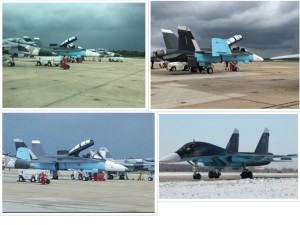 The Internet has lately been filled with pictures of American military pilots rushing towards US warplanes closely resembling Russia’s Su-34, painted in a recognizable light blue paint scheme that has never been used in the US military, but is routinely used by the Russian Air Force.
But this was not a demonstration of US pilots finally filling the seats of Russian hardware, provoked by the fact that US military contractors failed to deliver a competitive fifth-generation fighter, alas. Though it’s true that the Lockheed Martin F-35 has been a bitter failure riddled by criticism from all sides, including the American “hawk in chief” – Chairman of the United States Senate Committee on Armed Services, John McCain.
Regardless, what we’ve seen in the pictures is the direct implementation of the notorious American “plan B” in Syria, so now pro-American “eye-witnesses” can not simply claim that they’ve witnessed Russia’s involvement in alleged “war crimes” somewhere in Aleppo and other Syrian cities. They would now be able to provide pictures taken with their mobile devices to show the “evidence of criminal Russian activities in Syria.” Somewhere in Washington someone has assumed that the whole world would echo the demands of their obedient British and French client government to hold an “international tribunal regarding Russia’s aggression” after seeing such pictures.
In addition to the United States repainting its warplanes to resemble Russian military livery, it is also fairly obvious that America’s F-18 is fairly similar to the Russian Su-34 in appearance. In fact, only a military expert can tell the difference, but only when pictures are presented in high resolution. The folding wings of the American F-18 can only be seen in on the runway, and as for the vertical stabilizers of the F-18, they are only slightly different from the Russian Su-34.
Thus, if an American jet is to be filmed by somebody’s shaking hands on a smartphone, or even a semi-professional camera, it will be virtually indistinguishable from the Su-34.
The only notable distinguishing marks left on the repainted F-18 is a white star on a dark background. However, it’s tail features the bright red star all of Russian’s military jets bear.
In such circumstances, an American F-18, while being virtually indistinguishable from a Russian jet, can launch, wittingly or unwittingly, a classic false flag attack. The possible targets are plenty: humanitarian convoys, residential areas, or even US military personnel. Should this attack be filmed, Washington will end up having “irrefutable evidence” of “Russian aggression.”
As a matter of fact, Russia is already being accused of such aggression on a daily basis, but the problem is that nobody has seen any convincing evidence of such aggression. Repainting American planes to resemble Russian aircraft may be a solution to this problem.
But it must be pointed out that this attempt to launch a provocation against Russia comes from a very old book of CIA tricks. Back in 1962, during the Cuban missile crisis, Washington was also planning to use repainted aircraft,which would be used to take down a civilian airliner as a pretext for Washington to blame the Cuban Air Force. This story was told by US Secretary of Defense Robert McNamara in the documentary, “The Fog of War.”
But it’s a well-known fact that the US is an empire of lies, and there can be no doubt about that. Therefore, all the statements and actions of the White House should be taken with a grain of salt in order not to be fooled by yet another US-crafted lie.
‘Proportional Response’: Did the White House Just Threaten to Hack Russia?

© Sputnik/ Alexei Druzhinin
Sputnik – 11.10.2016
Four days after publicly accusing the Russian government of hacking into the Democratic National Committee (DNC), the Obama Administration has announced plans for what it terms a “proportional” response.
On Friday, the US Department of Homeland Security and the Office of the Director of National Intelligence released a statement formally accusing Moscow of attempting to influence the US election by hacking into servers belonging to the DNC. It followed a series of informal accusations against Russia for the hacks, also made without evidence. On Tuesday, the White House offered some idea of how it plans to respond.
“There are a range of responses that are available to the president and he will consider a response that is proportional,” White House Press Secretary Josh Earnest told reporters.
“The president has talked before about the significant capabilities that the US government has to both defend our systems in the United States but also carry out offensive operations in other countries.”
Speaking to Radio Sputnik, Ohio State University Professor Emeritus of International Law John Quigley pointed out that the basis for the decision is largely ungrounded.
“Well, it seems a bit ambiguous. The statement said that it is consistent with methods used which is a formulation that falls short of saying that they definitely know what is going on,” Quigley said.
“Speculation a week or so ago was that the United States would not come out with these accusations because it raises the question of what it could do next,” he added. “The likelihood is that it will not do much. I think that probably the president wanted to make this information public but that he doesn’t really have in mind any specific countermeasure.”
The Russian government has dismissed the allegations against it as part of a “hysterical campaign.” Speaking to Russia’s Channel One broadcaster, Russian Foreign Minister Sergey Lavrov stated, “When I discussed the issue with US Secretary of State [John] Kerry last time, I told him that we have had some consultations. After all, we also do not want our nationals to engage in cybercrime. This can be turned against Russia.”
“We do not want to cause any damage to other countries as well,” Lavrov detailed, adding, “It is funny, that there is quite a hysterical campaign underway in the context of the elections debates [suggesting] that we have hacked the sites of the Democratic Party and Pentagon.”
Lavrov said that Kerry expressed interest in bilateral consultations over the issue, but apparently the White House derailed the overture.
US, Britain and France now air force for terrorists in Syria
By Finian Cunningham | RT | October 9, 2016
For nearly six years, Washington and its allies have gotten away with playing a cynical double game in Syria’s war. But now the mask is slipping to reveal the ugly face of Western involvement – it is openly siding with terrorists.
Russia was correct to veto a French-sponsored draft resolution at the UN Security Council this weekend. Along with American and British vigorous support, the French proposal centered on halting military flights over the besieged northern Syrian city of Aleppo.
As Russia’s foreign ministry commented, the French initiative was tantamount to giving air cover for insurgents dominated by the internationally proscribed terrorist group Jabhat al Nusra. In short, a no-fly zone protecting terrorists would have been imposed in violation of Syrian sovereign rights, as well as international law.
An alternative draft resolution put forward by Russia was subsequently nixed by the US, Britain and France. The Russian proposal was aimed at reviving the ceasefire arrangement declared last month by US Secretary of State John Kerry and Moscow’s Foreign Minister Sergey Lavrov. It reiterated the need for anti-government militants to dissociate from the proscribed terrorist groups affiliated with al Qaeda, including al Nusra and Daesh (ISIS).
Russia is calling for a general ceasefire, but it does not specify the condition of halting military flights over Aleppo.
If France and its Western allies were genuine about wanting to stop the violence, then why don’t they get behind the Kerry-Lavrov deal? They have evidently abandoned that ceasefire arrangement because it was exposing Western claims about supporting “moderate rebels” as distinct from “extremists” as a fallacy.
That the Kerry-Lavrov truce was immediately violated by the insurgents and that there was no separation of “moderates” and “extremists” showed once and for all that Western claims of supporting “legitimate rebels” are a farce. Washington, London and Paris are patently backing a terrorist army fighting for their objective of regime change in Syria.
Since Syria and its Russian ally resumed offensive operations to take the key battleground city of Aleppo on September 22, the Western sponsors of the terror proxies have become increasingly shrill in a media campaign to thwart that offensive.
America, Britain and France have decried “war crimes” allegedly committed by Syrian and Russian air strikes. John Kerry, ahead of the weekend spat at the UN, called for a probe into suspected war crimes attributed to Russia.
Western media have been saturated with unverified reports from the militant-held eastern Aleppo purporting to show Syrian and Russian air strikes on civilian centers, including hospitals. Much of the information coming out of eastern Aleppo is sourced from Western-funded“activists” who are embedded with the Nusra terrorists. Tellingly, Western media and governments are in effect peddling what is terrorist propaganda.
The Russian and Syrian governments deny Western claims. They say their military operations are targeting terrorist groups that are deliberately using the 250,000 civilian population in east Aleppo as human shields.
It is significant that the more the Syrian army and its allies among Iranian, Lebanese and Iraqi militia, as well as Russian air support, make advances to retake Aleppo, the more hysterical Western governments and media become about “war crimes”.
If we start from the premise that the conflict in Syria has from the outset been a Western-orchestrated covert war for regime change involving the sponsoring of a terrorist mercenary army, then the Western hysteria over Aleppo is perfectly understandable.
A defeat for the insurgents in Aleppo means the end of the Western criminal enterprise to install a pro-Western puppet regime in Syria. That would mark a historic blow to the prestige of Washington and its European allies in the Middle East. It would also further expose their criminal complicity.
By contrast, Russian influence in the strategic region would be elevated. And for good reasons too. Moscow will be seen as having stood by a sovereign nation to vanquish Western powers who have wreaked havoc in the region with illegal wars and regime-change subterfuges.
Given the high stakes, this is why Western powers are evidently becoming more desperate to impede Syrian and Russian military success against the insurgents. Western emotive denunciations against Syria and Russia have nothing to do with concern for human suffering. It is all about contriving a moralistic political pressure to hamper the campaign against the West’s terrorist project.
Seen in this context, French calls at the UN for a no-fly zone around Aleppo is a startling admission by the Western powers that they are trying to protect terrorist al Qaeda-affiliated organizations. It is a stunning revelation of the fraudulent and criminal nature of Western governments. Their claims of “fighting terrorism” which have justified overseas wars over the past 15 years are self-evidently bogus. Their claims of supporting a “pro-democracy uprising” in Syria are grotesque.
This giant fraud has, of course, been made possible because Western media corporations have gone along with the vile charade. These media organizations are equally complicit. Giving succor to war crimes is in itself a war crime, as international attorney Christoper Black points out.
Meanwhile, away from Aleppo and the Western distortion of what is happening there, the alternative media report that the US-led military coalition is destroying bridges on the Euphrates in the eastern province of Deir ez-Zor.
According to the Syrian Free Press and others, American air strikes have demolished seven major river crossings over the past week. The latest strike was on the al Syasia bridge north of the city of Deir ez-Zor, the largest bridge in the province.
Targeting civilian infrastructure is a war crime. It will prevent humanitarian aid convoys reaching civilians in government-held Deir ez-Zor. But more significantly, the US, French and British coalition – which is operating illegally in Syria in the first place – is working to block the Syrian army and Russian offensive against the Daesh terror stronghold of Raqqa. The bridges knocked out were providing key linkages for the Syrian and Russian forces from Deir ez-Zor towards Raqqa.
The US-led air strikes also give full meaning to the deadly American attack on the Syrian army base at Deir ez-Zor on September 17. Over 60 Syrian troops and nearly 200 more were wounded when US, British and Australian warplanes blasted the base in a sustained attack. Washington claimed it was an “accident”.
But to many other observers, the massacre was no accident. It was a deliberate assault by the Western coalition to end the Kerry-Lavrov pact because the failing ceasefire was exposing the systematic terror connections of the Western governments in Syria.
Washington and its allies are not just trying to give air cover to the terrorists in Syria indirectly by setting up so-called no-fly zones. They are evidently now giving the terrorists air fire-power.
As in the NATO regime-change war in Libya in 2011, the Americans, French and British are riding shotgun in the air for terrorists on the ground.
And the truly disgusting thing about this criminal collusion is that the Western powers claim to be concerned about international law, war crimes and human suffering.
Read more:
Rival resolutions on Syria sponsored by Russia & France fail at UNSC
Featured Video
The Truth About the Trump Shootings with Ken Silva
or go to
Aletho News Archives – Video-Images
From the Archives
The Geopolitics behind the War in Yemen (I)
By Mahdi Darius NAZEMROAYA | Strategic Culture Foundation | 30.03.2015
The United States and the Kingdom of Saudi Arabia became very uneasy when the Yemenese or Yemenite movement of the Houthi or Ansarallah (meaning the supporters of God in Arabic) gained control of Yemen’s capital, Sanaa/Sana, in September 2014. The US-supported Yemenite President Abd-Rabbuh Manṣour Al-Hadi was humiliatingly forced to share power with the Houthis and the coalition of northern Yemenese tribes that had helped them enter Sana. Al-Hadi declared that negotiations for a Yemeni national unity government would take place and his allies the US and Saudi Arabia tried to use a new national dialogue and mediated talks to co-opt and pacify the Houthis.
The truth has been turned on its head about the war in Yemen. The war and ousting of President Abd-Rabbuh Manṣour Al-Hadi in Yemen are not the results of «Houthi coup» in Yemen. It is the opposite. Al-Hadi was ousted, because with Saudi and US support he tried to backtrack on the power sharing agreements he had made and return Yemen to authoritarian rule. The ousting of President Al-Hadi by the Houthis and their political allies was an unexpected reaction to the takeover Al-Hadi was planning with Washington and the House of Saudi. … continue
Blog Roll
 Aletho News
- Pakistan-Iran talks secure LNG shipment to Islamabad through Hormuz
- Black Sea grain crisis puts global wheat supplies under pressure
- IRGC air defenses destroy another US MQ-1 drone over Strait of Hormuz
- Imran Khan’s entire immediate family detained in Pakistan ahead of mass protest demanding his release
- EU nation detains former presidential frontrunner
- Leaked: Britain’s Sham Conviction Of Hashim Thaci
- Seyed M. Marandi: U.S. Strike Imminent – Toward Total War in the Middle East
- Russia Voted Under Fire. Washington Is Loading the Tankers.
- 12 Things Your Oncologist Was Trained Not to Tell You
- Anthrax Attacks Paved Way for COVID-Era ‘Junk Drugs and Vaccines’
- If Americans Knew
- Trump’s militarization of Washington DC as he pursues Israel’s war against Iran
- Why Israel Fears This Searing New Documentary
- Huckabee aide solicited cash gifts from Israelis
- This isn’t sci-fi, AI is already killing people
- ‘The Most Brutal Thing’: Investigation Reveals Execution of Elderly Woman in Rafah
- Inside Israel’s ‘soft’ ethnic cleansing plan for Gaza through the eyes of its victims
- New online database tracks pro-Israel political donations in the United States
- Israeli president pardons soldier convicted for killing wounded Palestinian
- Singer Ed Sheeran says his ‘heart broken’ by Gaza devastation, addresses Macklemore controversy
- Israel Has Imprisoned Female Journalist Bushra Al-Tawil Without Trial Or Charge In Solitary Confinement For Past Month
- No Tricks Zone
- 2025 Nature Paper Claiming Worsening Global Drought Gets RETRACTED …Heavily Flawed
- New Study: ‘Global Drought Shows No Detectable Recent Acceleration Under Climate Warming’
- Economic Masterminds: German Socialists Suggest Taxing Productivity Gains Stemming From Using AI
- The South China Sea Has Not Been Cooperating With The Climate Change Narrative
- Energy Crisis: Germany Enters Heating Season With Historically Low Gas Reserve Fill Levels
- New Study: The Antarctic Ice Sheet Gained Mass From 2020-2024 Due To Staggering Snow And Ice Accumulation
- Study: Ocean Heating Rates From Thousands Of Years Ago ‘Dwarf’ Modern Ocean Heating Rates
- Climate Extremists Target, Attack Large-Scale Power Grid Infrastructure In Germany!
- New Study: Antarctic Ice Melt Has Contributed Less Than 1 Centimeter To Sea Level Rise In The Last 30 Years
- Fear Of Debate: Alarmist German Climate Scientist Calls On Mainstream Media To Discredit Skeptic Voices
 Aletho News