US words on Gitmo torture ‘laughable’ without release of force feeding tapes
Reprieve | November 13, 2014
The US has announced that it will this week tell the United Nations that it now considers a ban against torture to apply to US prisoners held overseas – including those 148 men held without charge or trial at Guantanamo Bay. The US had previously only considered the U.N. Convention Against Torture to apply within US borders.
A US Federal Judge recently ordered the US government to release to the public video tapes of a hunger striking detainee being force-fed and manhandled, a decision the Obama administration is expected to appeal.
Commenting, Reprieve staff attorney Alka Pradhan, said:
“For the US to say it has ‘banned’ torture at Guantanamo is laughable, given the ongoing abuse at the prison. The rules at GTMO are actually written precisely to allow such abuse, and the video footage of force feedings is incredibly disturbing. Our clients, on hunger strike in peaceful protest at their indefinite detention without charge, are regularly hauled to what they call the ‘torture chair’, and force-fed in such a painful, punitive manner that even some camp personnel refuse to be involved. But don’t take my word for it – US medical experts and the World Medical Association have also condemned these abuses. The US needs to uphold its supposed ‘torture ban’ and stop punishing the detainees for their rightful protest – while the tapes I have seen should be released to the public without delay.”
The Endgame of the US ‘Islamic State’ Strategy
By Nicola Nasser | alarabi | November 11, 2014
Dismantling what the former US President George W. Bush once described as the Syria – Iran component of the “axis of evil,” or interrupting in Iraq the geographical contiguity of what King Abdullah II of Jordan once described as the “Shiite crescent,” was and remains the strategic goal of the US – Israeli allies in the Middle East unless they succeed first in “changing the regime” in either Damascus or Tehran.
The US, Israel and their regional allies have been on the record that the final target of their “regime change” campaign in the Middle East was to dismantle the Syria – Iran alliance.
With the obvious failure of Plan A to dismantle the self-proclaimed anti-Israel and anti-US Syrian – Iranian “Resistance Axis” by a forcible “regime change” in Damascus, a US – led regional alliance has turned recently to its Plan B to interrupt in Iraq the geographical contiguity of that axis.
This is the endgame of President Barack Obama’s strategy, which he declared on last September 10 as ostensibly against the Islamic State (IS).
This would at least halt for the foreseeable future all the signed and projected trilateral or bilateral Iranian, Iraqi and Syrian pipeline networks to carry oil and gas from Iran and Iraq to the Syrian coast at the Mediterranean.
Israeli Col. (res.) Shaul Shay, a research associate at the Begin-Sadat Center for Strategic Studies and a former Deputy Head of the Israel National Security Council anticipated in writing on last January 21 what he called the “Salafi Crescent” that is dangerously emerging to challenge the “Shia Crescent.”
“The growing involvement of Sunni Salafi jihadis in Iraq (since 2003), among the rebels in Syria (since 2011), and in Lebanon has created a ‘Salafi Crescent’ … from Diyala [in eastern Iraq] to Beirut,” he wrote.
“A positive outcome” of this Salafi Crescent “will be the decline in Iranian influence in the region,” Shay concluded.
Conspiracy theories aside, the eventual outcome is a sectarian Sunni military and political wedge driven into the Iraqi geographical connection of the Iran-Syria alliance in a triangle bordering Turkey in the north, Iran in the east, Jordan in the west and Saudi Arabia in the south and extending from north eastern Syria to the Iraqi province of Diyala which borders Iran.
Iraqi Kurdistan is already effectively an independent state and cut off from the central government in Baghdad, but separating Iran and Syria as well and supported by the same US – led anti – IS coalition.
Amid the misinformation and disinformation, the fact is that the IS threat is being used as a smokescreen to confuse and blur this reality.
The IS was conceived and delivered in an American womb. The US – drafted and enforced current constitution produced the sectarian government that is still trying to rule in Iraq. Sectarian cleansing and exclusion of Sunnis could not but inevitably create its antithesis.
The IS was the illegitimate fetus born and nurtured inside the uterus of the US – engineered political process based on a constitution legalizing a federal system based in turn on sectarian and ethnic sharing of power and wealth.
This horrible illegitimate creature is the “legacy” of the US war on Iraq, which was “conceived” in the “sin” of the US invasion of the country in 2003, in the words of the president of the Arab American Institute, James J. Zogbi, writing in the Jordan Times on last June 16.
US Senator John McCain, quoted by The Atlantic on last June 23, thanked “God,” the “Saudis and Prince Bandar” and “our Qatari friends” for creating the “monster.”
The pro-Iran government of former Prime Minister Noori al-Maliki was squeezed by the IS military advances to “request” the US help, which Washington preconditioned on the removal of al-Maliki to which Iran succumbed. The IS gave Obama’s IS strategy its first success.
However, al-Maliki’s replacement by Haider al-Abadi in August has changed nothing so far in the sectarian component of the Iraqi government and army. The US support of Iraq under his premiership boils down only to supporting continued sectarianism in the country, which is the incubator of the survival of its IS antithesis.
Moreover, the destruction of the Iraqi state infrastructure, especially the dismantling of Iraq’s national army and security agencies and the Iraqi Baath party that held them intact, following the US invasion, has created a power vacuum which neither the US occupation forces nor the sectarian Shiite militias could fill. The IS was not powerful per se. They just stepped in on a no-man land.
Similarly, some four years of a US – led “regime change” effort, which was initially spearheaded by the Muslim Brotherhood and which is still financed, armed and logistically facilitated by the US regional allies in Turkey, Qatar, Saudi Arabia as well as by allied western intelligence services, has created another power vacuum in Syria, especially on border areas and in particular in the northern and eastern areas bordering Turkey and Iraq.
US Senator Rand Paul in an interview with CNN on last June 22 was more direct, accusing the Obama administration of “arming” and creating an IS “safe haven” in Syria, which “created a vacuum” filled by the IS.
“We have been fighting alongside al Qaeda, fighting alongside ISIS. ISIS is now emboldened and in two countries. But here’s the anomaly. We’re with ISIS in Syria. We’re on the same side of the war. So, those who want to get involved to stop ISIS in Iraq are allied with ISIS in Syria. That is the real contradiction to this whole policy,” he said.
The former 16 – year member of the US Congress and two – time US presidential candidate Dennis Kucinich, writing in the Huffington Post on last September 24, summed it up: The IS “was born of Western intervention in Iraq and covert action in Syria.”
The IS could have considered playing the role of a US “Frankenstein,” but in fact it is serving as the US “Trojan horse” into Syria and Iraq. Fighting the IS was the US tactic, not the US strategy.
On record, Iranian deputy foreign minister Hossein Amir-Abdollahian said that “the best way of fighting ISIS and terrorism in the region is to help and strengthen the Iraqi and Syrian governments, which have been engaged in a serious struggle” against the IS. But this would not serve the endgame of Obama’s strategy, which targets both governments instead.
Beneficiaries of the IS “Trojan horse” leave no doubts about the credibility of the Syrian, Iranian and Russian doubts about the real endgame of the US – led declared war on the IS.
The United States was able finally to bring about its long awaited and promoted “front of moderates” against Iran and Syria into an active and “air-striking” alliance, ostensibly against the IS.
In Iraq, the IS served the US strategy in wrestling back the so called “political process” from the Iranian influence by proxy of the former premier al-Maliki. Depriving al-Maliki of a third term had proved that there is no unified Iran – backed “Shia house” in Iraq. The US has its own influence inside that “house.”
Installing a US Iraqi satellite was the strategic goal of the US – led invasion and occupation of Iraq in 2003. Instead, according to Doug Bandow, writing in Forbes on October 14, “Bush’s legacy was a corrupt, authoritarian, and sectarian state, friendly with Iran and Syria, Washington’s prime adversaries in the Middle East. Even worse was the emergence of the Islamic State.”
This counterproductive outcome of the US invasion, which saw Iran wielding the reigns of power in Baghdad and edging Iraq closer to Syria and Iran during the eight years of al-Maliki’s premiership, turned the red lights on in the White House and the capitals of its regional allies.
Al-Maliki, whom Bush had designated as “our guy” in Baghdad when his administration facilitated his premiership in 2006, turned against his mentors.
He edged Iraq closer to the Syrian and Iranian poles of the “axis of evil.” Consequently he opposed western or Israeli military attack on Iran, at least from or via Iraqi territory. In Syria, he opposed regime change in Damascus, rejected direct military “foreign intervention” and indirect proxy intervention and insisted that a “political solution” is the only way forward in Iraq’s western Arab neighbor.
Worse still was his opening Iraq up to rival Chinese and Russian hydrocarbon investments, turning Iraq a part of an Iran-Iraq-Syria oil and gas pipeline network and buying weapons from the Russian Federation.
Al-Maliki had to go. He was backed by Iran to assume his second term as prime minister in spite of the US, which backed the winner of the 2010 elections for the post, Ayad Allawi. The US had its revenge in the 2014 elections. Al-Maliki won the elections, but was denied a third term thanks to US pressure.
The IS was the US instrument to exert that pressure. US Secretary of State John Kerry during his visit to Baghdad on last June 23 warned that Iraq was facing “an existential threat.”
It was a US brinkmanship diplomacy to force al-Maliki to choose between two bad options: Either to accept a de facto secession of western and northern Iraq on the lines of Iraqi Kurdistan or accept the US conditional military support. Al-Maliki rejected both options, but he had paid the price already.
The turning point came with the fall of Iraq’s second largest city of Mosul to the IS on last June 10. Iraqi Kurdistan inclusive, the northern and western Iraq, including most of the crossing points into Syria and Jordan in the west, were clinched out of the control of Baghdad, i.e. some two thirds of the area of Iraq. Al-Maliki was left to fight this sectarian Sunni insurgency by his sectarian Iran-backed Shiite government. This was a non-starter and was only to exacerbate the already deteriorating situation.
Al-Maliki and Iran were made to understand that no US support was forthcoming to reign in the IS until he quits and a less pro-Iran and a more “inclusive” government is formed in Iraq.
The creation of the IS as the sectarian Sunni alternative against Iran’s ruling allies in Baghdad and Damascus was and is still the US tactic towards its strategic endgame. Until the time the US strategy succeeds in wrestling Baghdad from Iran influence back into its fold as a separating wedge between Iran and Syria, the IS will continue to serve US strategy and so far Obama’s strategy is working.
“America is using ISIS in three ways: to attack its enemies in the Middle East, to serve as a pretext for U.S. military intervention abroad, and at home to foment a manufactured domestic threat, used to justify the unprecedented expansion of invasive domestic surveillance,” Garikai Chengu, a research scholar at Harvard University, wrote in CounterPunch on September 19.
As a doctrine, since the collapse of the Ottoman caliphate early in the twentieth century, western powers did their best to keep Arabs separated from their strategic depth in their immediate Islamic proximity. The Syria – Iran alliance continues to challenge this doctrine.
Nicola Nasser is a veteran Arab journalist based in Birzeit, West Bank of the Israeli-occupied Palestinian territories (nassernicola@ymail.com).
No Apologies: U.S. Aggression Against Vietnam

teleSUR | November 10, 2014
Out of all the peculiarities of the political milieu in the U.S., what probably stands out the most is the discourse on the U.S. obliteration policies against Vietnam. If in any other country there exists a wider gap between the conventional portrayals and narrative on a war of aggression carried out by that country, on one hand, and the documentary record, on the other, then I have yet to come across it.
What does the general picture on U.S. aggression look like? The U.S. air force dropped more bombing tonnage solely in South Vietnam than the total bombing tonnage of every single aerial bombing campaign by all sides in WWII put together. The total amount of U.S. bombings during the Vietnam War was more than twice the size of all the bombings in WWII.
12 million acres of forest and 25 million acres of farmland, at the bare minimum, were destroyed by U.S. saturation bombing. The U.S. sprayed over 70 million liters of herbicidal agents to Vietnam.
Reflecting the fundamental defects of the conventional narrative on the matter, the death toll of the Vietnamese caused by the U.S. military onslaught is routinely debated in hundreds of thousands, sometimes in millions. According to Robert McNamara, for example, 3.6 million Vietnamese were killed in the war.
Among the most comprehensive studies on the matter was published in 2008 by Harvard Medical School and the Institute for Health Metrics and Evaluation at the University of Washington. They put the Vietnamese death toll at 3.8 million. According to Dr. Nick Turse, an American historian and investigative journalist who has conducted pioneering research on the Vietnam War, even the “staggering figure” of 3.8 million “may be an underestimate”. Furthermore, the U.S. attack wounded 5,3 million Vietnamese civilians and up to 4 million Vietnamese fell victim to toxic defoliants used by the U.S. against large parts of the country. The U.S. assault created 200,000 prostitutes, 879,000 orphans, 1 million widows and 11 million refugees.
To enter from the realm of international law, facts and figures to what at times goes by the name of ‘internal U.S. debate’ on the matter of U.S. attack on Vietnam is tantamount to an abrupt teleportation into an unsavory twilight zone. Consider the following results of a Gallup poll conducted in November, 2000. Of respondents aged between 18 and 29, 27% said that the U.S. was backing North Vietnam, 45% said South Vietnam and 28% expressed no opinion at all.
What about support for the war among the U.S. public, say, at the end of the 1960’s? According to a Gallup poll conducted in July, 1969, more than a year after the My Lai massacre, 53% of the respondents approved of Nixon’s handling of the war.
Arguably the main trend after the termination of U.S. aggression against Indochina has been a systematic glorification of U.S. actions. During a conference in 2006 titled Vietnam and the Presidency, former U.S. head of state Jimmy Carter gave his well-known account on the war and its effects to his presidency. Carter, not regarded as an ardent advocate of aggressive U.S. foreign policy among post-WWII U.S. presidents, perhaps quite the contrary, stressed the importance of moving “beyond the Vietnam War to better things”.
Carter gave special emphasis on what he called a “healing process” – a healing process for American society, needless to say – and proclaimed that, under his administration, “that healing process made major strides forward”. Not only that, the “healing process” was no less than “complete” when “the Vietnam heroic monument, one of the most popular places in Washington” was set up, soon after the Carter presidency.
The inscription on the world-renowned Vietnam Veterans Memorial states that “[o]ur nation honors the courage, sacrifice, and devotion to duty and country of its Vietnam veterans.” Instead of having prosecuted war criminals and paid enormous compensation to Vietnam, for starters, the U.S. gave Vietnam the above sentence.
Carter’s commentary serves as an odious, yet illustrative, reminder of the standard line of thinking in the U.S. political culture. In short, when the U.S. attack on Vietnam had finally come to its end, what was of uttermost importance was a “healing process” for the United States, and reflecting the progress, if not completion, of that healing process was the erection of a monument singing the praises of the “courage” and “sacrifice” of the U.S. veterans. Now, let us move “beyond the Vietnam War to better things”.
Perhaps even more revealingly, Carter has asserted on the Vietnam War that “I don’t feel that we ought to apologize or to castigate ourselves or to assume the status of culpability”, stressing that “the destruction was mutual”.
In 2000, the then Secretary of Defence William Cohen expressed a similar approach towards the U.S. actions in the Vietnam war. “I don’t intend to go into any apologies, certainly, for the war itself” Cohen declared upon his visit to Vietnam. “Both nations were scarred by this. They have their own scars from the war. We certainly have ours.”
The tenets of the official U.S. position towards the unparalleled crimes the U.S. military committed in Vietnam remain as disturbing as ever: no apologies for U.S. conduct during the war, certainly no reparations; no intentions to prosecute U.S. government officials and military personnel for any of the countless war crimes the U.S. committed in Vietnam; romanticizing and glorifying the overall performance of the U.S. military in the war.
Indeed, in the post-WWII era, the conventional narrative in the U.S. on the Vietnam war has emerged as arguably the most disturbing case of the perpetrator’s nationalistic indifference towards, and often approval of, an apocalyptic destruction of the target of its attack. Finally, let us all bask in the shining light of American self-criticism, embodied by the following quote by the U.S. President Barak Obama at the commemoration ceremony of the 50th anniversary of the Vietnam War:
“Veterans, families of the Vietnam War, I know the wounds of war are slow to heal. You know that better than most. But today we take another step. The task of telling your story continues. The work of perfecting our Union goes on. And decades from now, I hope another young American will visit this place and reach out and touch a name. And she’ll learn the story of service members — people she never met, who fought a war she never knew — and in that moment of understanding and of gratitude and of grace, your legacy will endure. For you are all true heroes and you will all be remembered. May God bless you. May God bless your families. May God bless our men and women in uniform. And may God bless these United States of America.”
How the Health Insurance Industry Defeated California’s Prop 45
By Jeff Sher | CounterPunch | November 6, 2014
The power of propaganda fueled by corporate cash triumphed over common sense once again in a California ballot measure on Tuesday. Two years after voters narrowly rejected a GMO labeling measure following a late-game, $46 million corporate advertising blitz led by Monsanto, the health insurance industry spent an estimated $57 million to successfully swamp Proposition 45, that would have given the elected state insurance commissioner the power to veto (some) excessive health insurance rate increases, a power that regulators exercise in 35 other states.
Here’s one part of the nonsense: one of the industry’s principal arguments was that the added regulation would increase the cost of health insurance. I’m not making this up! It takes some serious cojones to make that argument when you’re running a health care system that costs twice as much as that of any other industrialized nation and delivers inferior health outcomes, while there is nothing to stop you from raising the rates as high as you want without having to explain yourself to anyone. And you make your point by spending $57 million worth of premium payments that otherwise could have been used to provide health care. I’m willing to wager that the cost of insurance commissioner oversight would have been far less than $57 million.
But it worked. Prop 45 went down in flames 60% to 40%.
More nonsense: the industry ran scare ads that asked voters whether they wanted their health care decisions made by a single power-hungry government bureaucrat (the insurance commissioner). They just forgot to remind voters that now those decisions are made by a small circle of anonymous and very highly compensated insurance industry executives who are accountable to no one, unlike an elected insurance commissioner.
The rest of the nonsense: the industry argued that implementation of the rate review process might interfere with the ongoing roll out of the Affordable Care Act (ACA), otherwise known as Obamacare.
The subtext of this argument is the tried and true, right-wing talking point that government can’t do anything right. It always gets thrown into the mix because after decades of propaganda (endless repetition of this point), even supposedly liberal voters are susceptible to this canard.
The specific deceit behind this argument is that Obamacare is really working, so we can’t take the risk of messing with it. The cadaver of the politician formerly known as Nancy Pelosi was even wheeled before the public to plead for Obamacare.
“If I wanted to kill the Affordable Care Act, I would do this,” Pelosi told the editorial board of the San Francisco Chronicle (who were so impressed they urged voters to reject the measure, as did the LA Times ).
“ACA is who I am,” Pelosi reportedly said. “It’s why I stay in Congress, to protect it.”
OK, so the powerful San Francisco Democrat who is trying to cling to minority leadership in the House of Representatives says her main mission in public life now is to defend a law that was written by an insurance industry lobbyist and brokered in a back room deal with the insurance and pharmaceutical industries – a horrendously flawed bill that perpetuates a system that delivers substandard care at inflated prices to the American public. Reasonable alternatives (like Medicare for all) were taken off the table before public input was even considered.
All of these nonsense arguments were trotted out to deflect attention from the real issue: the health care system is horribly broken, prohibitively expensive, and since Obamacare pre-empted any attempts at real, effective reform, flawed bandaid measures like Prop 45 are all that’s available to the public – and therefore better than nothing. Let’s talk about anything besides the real human suffering and death the system causes unnecessarily – let’s focus on the bureaucratic problems the measure might cause. (Left unsaid is that the problems are likely to arise because the industry will do what it can to inhibit the optimal functioning of any regulatory scheme it perceives as disadvantageous to its own interests.)
Is Obamacare really working?
The original draft for Obamacare was written by the insurance industry – after they threatened to defeat any reform that did not leave in place their privileged role – to in effect collect a tax on health care in return for “financing” the cost of it. Supposedly they take risk for being the gatekeepers who decide who is eligible for care and who is not and what services should be covered and when. Obamacare was not an attempt to reform the basic problems of the industry. It was a deal to cover more people while leaving the parasitic insurance industry in place to collect their tax on an even larger population than before.
Bear in mind that in any rational system everyone would be covered the same – this business of offering scores of different plans and making distinctions about who is covered and what is covered is what you have to do to create the opportunity for profit within the system. If everyone had the same coverage, and we financed it collectively through the government – we would have no need for insurance company financing and all the layers of bureaucracy that are required to track the distinctions. The amount of insurance industry profits is a tiny fraction of the cost of the bureaucracy required to enable the profits. It adds an estimated $300 to $400 billion annually to the cost of health care.
So yes, some millions of people were able to get insurance who were denied the “privilege” before. This is how Obamacare is “working.” But that could have been done much more efficiently and at lower cost without the insurance industry.
Those who already had insurance are now paying more for the same coverage they enjoyed before Obamacare – or they have had to reduce their coverage by paying higher co-pays and deductibles. There are more underinsured than ever. When people are underinsured – or in other words they face barriers to care in the form of high access costs – they tend not to get the treatments they really need, which in the long run actually increases the overall cost of the system, because they don’t seek care until their conditions are more advanced and difficult and expensive to treat.
The insurance industry still promotes the fantasy of “consumer directed” health care, which is based on the falsehood that the high costs of the system are due to consumers over-utilizing health care, and if they are forced to spend more of their own money for care they will stop being care hogs and make better health care decisions.
When Obamacare opened the system to all those who had been denied insurance due to poverty or illness, the rates were jacked up for those already covered. This was most evident in California for those covered by individual plans in the state of California. Prop 45, by the way, applies only to those covered by individual and small group plans in California, or about 6 million people. The rest of the population is covered by large employer funded plans or the government. These large employer plans at least have some bargaining leverage with the insurance companies, while individuals and small groups are given no opportunity to bargain for lower rates. They can take what they are offered, and since Obamacare, they no longer have the option to leave it. Thus the proposition as written applied only to those who most need protection.
California Insurance Commissioner Dave Jones said he needed the authority to control rates because the insurance companies had raised prices in California 22% to 88% since Obamacare was implemented in January 2014. The industry argued those increases were intended and justified as part of Obamacare to offset the costs of covering all the people who hadn’t been previously covered.
Huh? I thought they sold us Obamacare on the premise that it would control the cost of health care, not immediately increase it by up to 88%. No, the industry took advantage of the situation – that some increases in overall rates might be expected because the uninsured population might be sicker than the already covered population, even though many of the newly covered would be young healthy people who had refrained from buying insurance previously because they were not compelled to and could not afford it – and jacked the rates as high as they thought they could get away with.
The insurance companies already knew exactly what their risk was with individuals they already covered, but they took the opportunity to raise their premiums by as much as 80 percent in order to cover projected additional risk. Same people. Same ages. Same illnesses, or not. Now paying up to 80 percent more. Why not? There was no one to stop them.
The rates for my individual plan were increased in the neighborhood of 70 percent effective January 1, 2014. I bought a plan in the exchange instead – but the price of the exchange plan was comparable to the new, inflated cost of my old plan, for about the same benefits. I received a subsidy from the government for most of the cost, but the insurance company received the full, inflated cost, 70 percent more than I had been paying the previous month.
While Pelosi was shilling for the health insurance industry, she was wringing her hands and saying that she supports the concept of cost control through rate review. Of course she offered no alternative proposal.
Meanwhile, the LA Times was twisting itself in knots by pointing out that supporters of Prop 45 were falsely claiming that the proposal would make insurance affordable. Not true, said the LA Times, because insurance is already unaffordable. They got that much right!
Then they said only a major overhaul in the way healthcare is delivered and paid for will make insurance affordable. Right again!
Then they slipped off the path of truth once more. They said the government and the industry have already started the overhaul process. They didn’t bother to mention how long this process might take. I’m guessing maybe by next decade they’ll work in a few superficial reforms, after the prices have doubled again, or worse.
Proposition 45 was not a cure. It was nothing more than a band-aid for a fatally diseased system. Obamacare didn’t fix the system. It never even tried. And that’s what Pelosi, the Chronicle, the LA Times and the insurance industry don’t want to talk about. That’s what this proposition was all about. We’re still trying to fix the system that ails us, while they want to pretend that it’s already been cured.
Jeff Sher is a journalist specializing in the health care industry. He lives in San Francisco.
Yep, Uncle Sam Still Wants to Log Your Calls
By Rachel Nusbaum | ACLU | November 4, 2014
Today, in a hushed courtroom in Washington, D.C., not far from the now-empty halls of Congress, a federal appeals court heard arguments in Klayman v. Obama, a challenge to the NSA’s bulk collection of telephone metadata first revealed by Edward Snowden. If you have ever made a phone call, or received a phone call, this case has implications for your personal privacy and you should pay close attention to what happens next.
The appeal follows a December win for Larry Klayman, a conservative lawyer and activist and the plaintiff in the case, where a district court judge ruled the program was likely unconstitutional. Today, government lawyers attempted to argue that this program should be allowed to continue.
The arguments hinged on a central question: Is the warrantless, non-targeted surveillance currently being conducted by the NSA, which is scooping up data on all (or almost all) calls made or received on U.S. telephone networks, a violation of the Fourth Amendment?
The government tried to argue that it is not. They claim that their searches of this massive call record database are reasonable, and that there is no reasonable expectation of privacy in the numbers one dials.
But, as EFF Legal Director Cindy Cohn argued on behalf of both EFF and the ACLU as friends of the court, the government has no right to scoop up such a massive amount of personal information about Americans in the first place.
The truth is, the NSA’s bulk collection of the phone records of all Americans is fundamentally different than putting a trace on the phone of an individual suspected of wrongdoing. The sheer scale of this program means that we are all suspects, or at least potential suspects, in the eyes of our government.
Think about the impact of knowing that your every phone interaction is being logged by the government. This kind of surveillance has even greater implications for lawyers and journalists, who have to worry about protecting the confidentiality of clients and sources. The phrase “chilling effect” seems insufficient to describe the potential loss to our society, to our whole way of life, as we slowly begin to censor ourselves because we know that the government is always monitoring our communications.
This is contrary to the very nature of a democracy, where people are supposed to hold their government to account. Who will be willing to speak out against an abusive government when that government knows all our deepest, darkest secrets?
Governments are by nature interested in acquiring more power, and today, more than ever, information is power. We should not be surprised that the government wants to know who Americans are speaking with, and for how long, and how often. We rely on the Constitution, and on the other branches of government, to provide a check on that desire.
Today, we asked the court to provide that check and to declare bulk collection of American’s telephone metadata unconstitutional.
(To read the ACLU and EFF’s amicus brief in Klayman v. Obama, click here.)
In Ukraine, A Tale of Two Elections
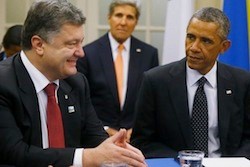
By Daniel McAdams | Ron Paul Institute | November 1, 2014
The US government loves to “promote democracy” overseas, often at the barrel of a gun. Strangely enough, however, it often “deplores” actual elections being held in such places. Take Ukraine, for example. An election held last week by a group that forcibly seized power from a legitimately-elected government was hailed by the US administration as a great democratic achievement.
Said John Kerry about last week’s parliamentary election held by the post-coup government in Kiev:
We applaud Ukraine’s commitment to an inclusive and transparent political process that strengthens national unity. … The people of Ukraine have spoken, and they have again chosen to chart the course of democracy, reform, and European integration.
In this US-approved vote, the parties disapproved by the US were harassed and even essentially banned. But that’s OK.
However in eastern Ukraine, which refused to recognize February’s US-backed coup in the western part of the country, parliamentary and presidential elections scheduled for tomorrow are scorned and even “deplored” by the US administration.
The White House condemned tomorrow’s elections in eastern Ukraine in no uncertain terms:
We deplore the intent of separatists in parts of eastern Ukraine to hold illegitimate so-called local ‘elections’ on Sunday, November 2. If held, these ‘elections’ would contravene Ukraine’s constitution and laws and the September 5 Minsk Protocol.
So much does the US administration hate the idea of unapproved people voting, that it even refused to call them elections, placing the very term in “scare quotes.”
Shortly after the February coup in Kiev, referenda were held in Crimea and in parts of eastern Ukraine to determine whether to remain tied to Kiev or declare independence from the new regime. Those elections were also condemned by the US.
“We reject the ‘referendum’ that took place today in the Crimean region of Ukraine. This referendum is contrary to Ukraine’s constitution,” said the White House immediately after the March vote in that region. The February coup was also contrary to Ukraine’s constitution but that did apparently not bother Washington.
Similarly, when referenda were held in eastern Ukraine this spring to determine that region’s future course, the White House spokesman condemned them as “illegal under Ukrainian law and a transparent attempt to create further division and disorder.”
When the wrong people hold votes, it seems, “division and disorder” are the result.
Those who overthrow democracy by force are legitimized – you might even say laundered – by an election they had no legal right to hold in the first place, while those who stood by previously-elected leaders and scheduled elections as a way out of the crisis caused by US interference are condemned, ignored, and not even recognized by the US government.
So here is the real message from the US government: elections overseas are only legitimate if we have pre-approved the parties allowed to stand and if we have pre-approved the outcome. The election must result in exactly the kind of “pro-West” government that we desire or we will begin destabilization and regime change, if completely ignoring the results does not do the trick.
Is that what John Kerry meant when he said, “you just don’t in the 21st century behave in 19th century fashion”?
Ballots or Bullets: Democracy and World Power
By James Petras | October 31, 2014
The principal reason why Washington engages in military wars, sanctions and clandestine operations to secure power abroad is because its chosen clients cannot, and do not, win free and open elections.
A brief survey of recent election outcomes testify to the electoral unattractiveness of Washington-backed clients. The majority of democratic electorates rejects candidates and parties which back the US global agenda: neo-liberal economic policies; a highly militarized foreign policy; Israeli colonization and annexation of Palestine; the concentration of wealth in the financial sector; the military escalation against China and Russia. While the US policy attempts to re-impose the pillage and dominance of the 1990s via recycled client regimes the democratic electorates want to move on toward less bellicose, more inclusive governments, which restore labor and welfare rights.
The US seeks to impose the unipolar world, of the Bush Sr. and Clinton era, failing to recognize the vast changes in the world economy, including the rise of China and Russia as world powers, the emergence of the BRIC and other regional organizations and above all the growth of popular democratic consciousness.
Failing to convince electorates by reason or manipulation, Washington has opted to intervene by force, and to finance organizations to subvert the democratic electoral process. The frequent resort to bullets and economic coercion when ballots fail to produce the “appropriate outcome” testifies to the profoundly reactionary nature of US foreign policy. Reactionary in the double sense of ends and means.
Pragmatically, the imperial centered socio-economic policies deepen inequalities and depress living standards. The means to achieve power, the instruments of policy, include wars, intervention, covert operations, are more akin to extremists, quasi-fascist, far right regimes.
Free Elections and the Rejection of US Clients
US-backed electoral parties and candidates have suffered defeats throughout most of the world, despite generous financial backing and international mass media propaganda campaigns. What is striking about the negative voting outcomes is the fact that the vast majority of adversaries are neither anti-capitalist nor ‘socialist’. What is equally striking is that all of the US clients are rightist or far-rightist parties and leaders. In other words, the polarization is usually between center-left and rightist parties; the choice is between reform or reaction, between an independent or satellite foreign policy.
Washington and Latin America: Masters of Defeats
Over the past decade, Washington has backed losing neo-liberal candidates throughout Latin America and then sought to subvert the democratic outcome.
Bolivia
Since 2005, Evo Morales, the center left leader favoring social reforms and an independent foreign policy, has won three Presidential elections against Washington backed rightist parties, each time by a greater margin. In 2008, he ousted the US ambassador for intervening, expelled the Drug Enforcement Agency (DEA) in 2008, USAID in 2013 and the Military Mission after foiling an aborted coup in Santa Cruz.
Venezuela
The United Socialist Party of Venezuela (PSUV) and its predecessor have won every Presidential and Congressional election (over a dozen) except one over the past 15 years despite US multi-million dollar funding of neo-liberal opposition parties. Unable to defeat the Chavez-led radical-reform government, Washington backed a violent coup (2002), a boss’s lockout (2002/3), and decades long paramilitary attacks of pro-democracy leaders and activists.
Ecuador
The US has opposed the center-left government of President Correa for ousting it from the military base in Manta, renegotiating and repudiating some of its foreign debt and backing regional pacts which exclude the US. As a result Washington backed an abortive police led coup in 2010 that was quickly defeated.
Honduras
During democratically elected President Manual Zelaya’s tenure in office, a center-left President, Honduras sought to pursue closer relations with Venezuela in order to receive greater economic aid and to shed its reputation as a US dominated “banana republic”. Washington, unable to defeat him at the ballot box, responded by supporting a military coup (2009) which ousted Zelaya and returned Honduras to the US fold. Since the coup Honduras has experienced more killings of popular leaders-200- than any country in Latin America.
Brazil
The center-left Workers Party has won four straight elections against US backed neo-liberal candidates beginning in 2002 and continuing through the 2014 elections. The US propaganda machine, including NSA’s spying on President Rousseff and the strategic state petrol company, Petrobras, and the international financial press went all out to discredit the reformist center-left government. To no avail! The voters preferred an ‘inclusive’ social liberal regime pursuing an independent foreign policy to an opposition embedded in the discredited socially regressive neo-liberal politics of the Cardoso regime (1994-2002). In the run-up to the 2014 elections Brazilian and US financial speculators attempted to strike fear in the electorate by betting against the currency (real) and driving the stock market into a precipitous fall.
To no avail. Rousseff won with 52% of the vote.
Argentina
In Argentina a massive popular revolt overthrew the US backed neo-liberal regime of De la Rua in 2001. Subsequently, the electorate elected the center-left Kirchner government over the rightist, US backed Menem candidacy in 2003. Kirchner pursued a reformist agenda imposing a moratorium on the debt and combining high economic growth with large scale social expenditures and an independent foreign policy. US opposition escalated with the election of his wife Cristina Fernandez. Financial elites, Wall Street, the US judiciary and Treasury intervened to destabilize the government, after failing to defeat Fernandez’s re-election. Extra-parliamentary financial pressures were matched by political and economic support for rightist politicians in preparation for the 2015 elections.
Earlier, in 1976, the US backed the military coup and political terror that led to the murder of 30,000 activists and militants. In 2014 the US backed a “financial coup” as a federal judge sided with vulture funds, sowing financial terror in international markets against a democratically elected government.
Paraguay
President Fernando Lugo was a moderate former Bishop who pursued a watered-down center-left agenda. Nevertheless, he raised issues that conflicted with Washington’s extremist agenda, including Paraguay’s membership in regional organizations that excluded the US (MERCOSUR). He appealed to the landless rural workers and he retained ties to other Latin American center-left regimes. He was deposed by Congress in 2012 in a highly dubious ‘institutional coup’, quickly supported by the White House and replaced by a straight-line neo-liberal, Federico Franco with tight links to Washington and hostile to Venezuela.
Globalizing US Threats to Democracy
US subversion of democracy when center-left political formations compete for power is not confined to Latin America – it has gone ‘global’.
Ukraine
The most egregious example is the Ukraine, where the US spent over $6 billion in over a decade and a half. Washington financed, organized, and promoted pro NATO shock troops to seize power against an elected regime (Viktor Yanukovych) which tried to balance ties between the West and Russia. In February 2014, an armed uprising and mob action led to the overthrow of the elected government and the imposition of a puppet regime totally beholden to the US. The violent putschists met resistance from a large swathe of pro-democracy activists in the Eastern region. The Kiev junta led by oligarch Petro Poroshenko dispatched air and ground troops to repress the popular resistance with the unanimous backing of the US and EU. When the rightist regime in Kiev moved to impose its rule over the Crimea and to break its military base treaty with Russia, the Crimean citizens voted, by a large margin (85%), to separate and merge with Russia.
In both the Ukraine and Crimea, US policy was directed toward imposing by force, the subordination of democracy to NATO’s drive to encircle Russia and undermine its democratically elected government.
Russia
Following the election of Vladimir Putin to the Presidency, the US organized and financed a large number of opposition “think tanks”, and NGO’s, to destabilize the government. Large scale demonstrations by well-funded NGO’s were given wide play by all the Western mass media.
Failing to secure an electoral majority and after suffering electoral defeats in the executive and legislative elections, Washington and the EU, using the pretext of Russian “intervention” in the Ukraine, launched a full scale economic war on Russia. Economic sanctions were enforced in the hopes of provoking economic collapse and a popular upheaval. Nothing of the sort occurred. Putin has gained greater popularity and stature in Russia and consolidated its ties with China and the other BRIC countries.
In sum, in the Ukraine, Crimea and Russia, facing independent elected governments, Washington resorted to a mob uprising, military encirclement and an escalation of economic sanctions.
Iran
Iran has periodic elections in which pro and anti-western parties compete. Iran has drawn the wrath of Washington because of its support for Palestinian liberation from the Israeli yoke; its opposition to the Gulf absolutist states; and its ties to Syria, Lebanon (Hezbollah) and post- Saddam Hussain Iraq. As a result, the US has imposed economic sanctions to cripple its economy and finances and has funded pro-Western neo-liberal opposition NGO’s and political factions. Unable to defeat the Islamist power elite electorally, it chooses to destabilize via sanctions in order to disrupt its economy and assassinations of scientists and cyber warfare.
Egypt
Washington backed the Hosni Mubarak dictatorship for over three decades. Following the popular uprising in 2011, which overthrew the regime, Washington retained and strengthened its ties to the Mubarak police, military and intelligence apparatus. While promoting an alliance between the military and the newly elected President Mohammed Morsi, Washington funded NGO’s, who acted to subvert the government through mass demonstrations. The military, under the leadership of US client General Abdel Fattah el-Sisi, seized power, outlawed the Moslem Brotherhood and abolished democratic freedoms.
Washington quickly renewed military and economic aid to the Sisi dictatorship and strengthened its ties with the authoritarian regime. In line with US and Israeli policy, General Sisi tightened the blockade of Gaza, allied with Saudi Arabia and the Gulf despots, strengthened its ties with the IMF and implemented a regressive neo-liberal program by eliminating fuel and food subsidies and lowering taxes on big business.
The US backed coup and restoration of dictatorship was the only way Washington could secure a loyal client relationship in North Africa.
Libya
The US and NATO and Gulf allies launched a war (2011) against the independent, nationalist Libyan government, as the only way to oust the popular, welfare government of Colonel Gaddafi. Unable to defeat him via internal subversion, unable to destabilize the economy, Washington and its NATO partners launched hundreds of bombing missions accompanied by arms transfers to local Islamic satraps, tribal, clans and other violent authoritarian groups. The subsequent ‘electoral process’ lacking the most basic political guarantees, fraught by corruption, violence and chaos, led to several competing power centers. Washington’s decision to undermine democratic procedures led to a violent Hobbesian world, replacing a popular welfare regime with chaos and terrorism.
Palestine
Washington has pursued a policy of backing Israeli seizures and colonization of Palestinian territory, savage bombings and the mass destruction of Gaza. Israel, determined to destroy the democratically elected Hamas government, has received unconditional US backing. The Israeli colonial regime has imposed racist, armed colonies throughout the West Bank, financed by the US government, private investors and US Zionist donors. Faced with the choice between a democratically elected nationalist regime, Hamas, and a brutal militarist regime, Israel, US policymakers have never failed to back Israel in its quest to destroy the Palestinian mini-state.
Lebanon
The US, along with Saudi Arabia and Israel, has opposed the freely elected Hezbollah led coalition government formed in 2011. The US backed the Israeli invasion in 2006, which was defeated by the Hezbollah militias. Washington backed the right wing Hariri-led coalition (2008 – 2011) which was marginalized in 2011. It sought to destabilize the society by backing Sunni extremists especially in Northern Lebanon. Lacking popular electoral support to convert Lebanon into a US client state, Washington relies on Israeli military incursions and Syrian based terrorists to destabilize Lebanon’s democratically elected government.
Syria
Syria’s Bashar Assad regime has been the target of US, EU, Saudi and Israeli enmity because of its support for Palestine, its ties with Iraq, Iran, Russia and Hezbollah. Its opposition to the Gulf despotism and its refusal to become a US client state (like Jordan and Egypt) has been another source of NATO hostility. Under pressure from its internal democratic opposition and its external allies, Russia and Iran , the Bashar Assad regime convoked a conference of non-violent opposition parties, leaders and groups to find an electoral solution to the ongoing conflict. Washington and its NATO allies rejected a democratic electoral road to reconciliation. They and their Turkish and Gulf allies financed and armed thousands of Islamic extremists who invaded the country. Over a million refugees and 200,000 dead Syrians were a direct result of Washington’s decision to pursue “regime change” via armed conflict.
China
China has become the world’s largest economy. It has become a leading investment and trading country in the world. It has replaced the US and the EU in Asian, African and Latin American markets. Faced with peaceful economic competition and offers of mutually beneficial free trade agreements, Washington has chosen to pursue a policy of military encirclement, internal destabilization and Pan Pacific integration agreements that exclude China. The US has expanded military deployments and bases in Japan, Australia and the Philippines. It has heightened naval and air force surveillance just beyond China’s limits. It has fanned rival maritime claims of China’s neighbors, encroaching on vital Chinese waterways.
The US has supported violent Uighur separatists, Tibetan terrorists and protests in Hong Kong in order to fragment and discredit China’s rule over its sovereign territory. Fomenting separation via violent means results in harsh repression, which in turn can alienate a domestic constituency and provide grist for the Western media mills. The key to the US countering China’s economic ascent is political: fomenting domestic divisions and weakening central authority. The democratization which Chinese citizens favor has little resonance with US financed ‘democracy’ charades in Hong Kong or separatist violence in the provinces.
Washington’s effort to exclude China from major trade and investment agreements in Asia and elsewhere has been a laughable failure. The principle US “partners”, Japan and Australia are heavily dependent on the Chinese market. Washington’s (free trade) allies in Latin America, namely Colombia, Peru, Chile and Mexico are eager to increase trade with China. India and Russia are signing off on multi-billion dollar trade and investment deals with China! Washington’s policy of economic exclusion miscarried in the first month!
In sum, Washington’s decision to pursue confrontation over conciliation and partnership; military encirclement over co-operation; exclusion over inclusion, goes counter to a democratic foreign policy designed to promote democracy in China and elsewhere. An authoritarian choice in pursuit of unachievable Asian supremacy is not a virtue; it is a sign of weakness and decay.
Conclusion
In our global survey of US policy toward democracy, center-left governments and free elections we find overwhelming evidence of systematic US hostility and opposition. The political essence of the “war on terrorism” is Washington’s world-wide long-term pernicious assault on independent governments, especially center-left democratic regimes engaged in serious efforts to reduce poverty and inequality.
Washington’s methods of choice range from financing rightist political parties via USAID and NGO’s, to supporting violent military coups; from backing street mobs engaged in destabilization campaigns to air and ground invasions. Washington’s animus to democratic processes is not confined to any region, religious, ethnic or racial group. The US has bombed black Africans in Libya; organized coups in Latin America against Indians and Christians in Bolivia; supported wars against Muslims in Iraq, Palestine and Syria; financed neo-fascist “battalions”and armed assaults against Orthodox Christians in the Eastern Ukraine; denounced atheists in China and Russia.
Washington subsidizes and backs elections only when neo-liberal client regimes win. It consistently destabilizes center-left governments which oppose US imperial policies.
None of the targets of US aggression are strictly speaking anti-capitalist. Bolivia, Ecuador, Brazil, Argentina are capitalist regimes which attempt to regulate tax and reduce disparities of wealth via moderate welfare reforms.
Throughout the world, Washington always supports extremist political groups engaged in violent and unconstitutional activity that have victimized democratic leaders and supporters. The coup regime in Honduras has murdered hundreds of rank and file democratic activists, farm workers,and poor peasants.
The US armed Islamic jihadist and ex-pat allies in Libya have fallen out with their NATO mentors and are at war among themselves, engaging in mutual bloodletting.
Throughout the Middle East, South Asia, North Africa, Central America and the Caucuses wherever US intervention has taken place, extreme right-wing groups have served, at least for a time, as Washington and Brussels’ principal allies.
Pro EU-NATO allies in the Ukraine include a strong contingent of neo-Nazis, paramilitary thugs and “mainstream” military forces given to bombing civilian neighborhoods with cluster bombs.
In Venezuela, Washington bankrolls terrorist paramilitary forces and political extremists who murdered a socialist congressional leader and dozens of leftists.
In Mexico the US has advised, financed and backed rightist regimes whose military, paramilitary and nacro-terrorist forces recently murdered and burned alive 43 teachers’ college students, and are deeply implicated in the killing of 100,000 “other” Mexicans, in less than a decade.
Over the past eleven years the US has pumped over $6 billion dollars in military aid to Colombia, funding its seven military bases and several thousand special operations forces and doubling the size of the Colombian military. As a result thousands of civil society and human rights activists, journalists, trade union leaders and peasants, have been murdered. Over 3 million small land-holders have been dispossessed.
The mass media cover up the US option for right wing extremism by describing ruling mass murderers as “center-right regimes” or as“moderates”: linguistic perversions and grotesque euphemisms are as bizarre as the barbarous activities, perpetrated by the White House.
In the drive for world power, no crime is left undone; no democracy that opposes it is tolerated. Countries as small and marginal as Honduras or Somalia or as great and powerful as Russia and China cannot escape the wrath and covert destabilization efforts of the White House.
The quest for world domination is driven by the subjective belief in the “triumph of the will”. Global supremacy depends entirely on force and violence: ravaging country after country, from carpet bombing of Yugoslavia, Iraq, Afghanistan and Libya to proxy wars in Somalia, Yemen, Ukraine to mass killings in Colombia, Mexico and Syria.
Yet there are limits to the spread of the “killing fields”. Democratic processes are defended by robust citizens’ movements in Venezuela, Ecuador and Bolivia. The spread of imperial backed terrorist seizures of power are stymied by emergence of global powers, China in in the Far East and Russia in Crimea and eastern Ukraine have taken bold steps to limit US imperial expansion.
In the United Nations, the President of the United States and his delegate Samantha Powers rant and rave, in a fit of pure insanity, against Russia as “the greatest world terrorist state” for resisting military encirclement and the violent annexation of the Ukraine.
Extremism, authoritarianism and political insanity know no frontiers. The massive growth of the secret political police, the National Security Agency, the shredding of constitutional guarantees, the conversion of electoral processes into elite controlled multi-billion dollar charades, the growing impunity of police involved in civilian murders, speaks to an emerging totalitarian police – state inside the US as a counterpart to the violent pursuit of world power.
Citizens’ movements, consequential center-left parties and governments, organized workers, in Latin America, Asia and Europe have demonstrated that authoritarian extremist proxies of Washington can be defeated. That disastrous neo-liberal policies can be reverted. That welfare states, reductions in poverty, unemployment and inequalities can be legislated despite imperial efforts to the contrary.
The vast majority of the Americans, here and now, are strongly opposed to Wall Street, big business and the financial sector. The Presidency and the Congress are despised by three quarters of the American public. Overseas wars are rejected. The US public, for its own reasons and interests, shares with the pro-democracy movement’s world-wide, a common enmity toward Washington’s quest for world power. Here and now in the United States of America we must learn and build our own powerful democratic political instruments.
We must, through the force of reason, contain and defeat “the reason of force”: the political insanity that informs Washington’s ‘will to power’. We must degrade the empire to rebuild the republic. We must turn from intervening against democracy abroad to building a democratic welfare republic at home.
US military spending hits 5 year high
Press TV – October 31, 2014
US military spending has dramatically surged, reaching its fastest rate in the past five years despite the planned withdrawal of forces from Afghanistan.
According to a new report by the US Commerce Department on Thursday, the military spending for the third-quarter of this year has increased by 16 percent.
Experts believe while the surge in the military spending could be attributed to several causes, the military action in the Middle East against the ISIL terrorist group is a major contributing factor.
The anti-ISIL operations have forced the Pentagon to spend more money on missiles and ammunition and support a larger military presence there.
According to figures released by the Defense Department, the new military actions in Syria and parts of Iraq will cost roughly 10 million dollars a day.
There are also speculations that the Obama administration has increased the military spending to inflate the figures of economic growth ahead of the November elections.
The projected figure on US economic growth for the third quarter is 3.5 percent, more than the predicted 3 percent with military spending being mentioned as the cause.
Former CBS reporter accuses government agency of bugging her computer
RT | October 27, 2014
A journalist formerly with CBS News claims in her new memoir that a United States “government-related entity” hacked into her computer to conduct surveillance and set her up for possible criminal charges.
Sharyl Attkisson, a former anchor for the CBS Evening News and a multi-time Emmy Award winner, says in her forthcoming book that government spies tried not only to keep track of her digital habits, but to potentially put her in jail.
According to an article published in the New York Post on Monday this week, Attkisson says in her book that she was “shocked” and “flabbergasted” over what was supposedly revealed through a forensics analysis of her laptop conducted in 2013.
Previously, media sources alleged that Attkisson’s March 2014 resignation from CBS News was a result of disagreements she had with the network’s supposed liberal bias. After she announced she was leaving the network earlier this year, Politico writer Dylan Byers reported that unnamed sources said Attkisson “had grown frustrated with what she saw as the network’s liberal bias, an outsize influence by the network’s corporate partners and a lack of dedication to investigative reporting.”
“Feeling increasingly stymied and marginalized at the network, Attkisson began talking to CBS News President David Rhodes as early as last April about getting out of her contract,” Byers added.
Now Attkisson writes in her memoir, “Stonewalled,” that a source “connected to government three-letter agencies” took the reporter’s laptop to be inspected for malware last year and concluded after the fact that it had been compromised by “a sophisticated entity that used commercial, non-attributable spyware that’s proprietary to a government agency: either the CIA, FBI, the Defense Intelligence Agency or the National Security Agency.”
“The intruders discovered my Skype account handle, stole the password, activated the audio and made heavy use of it, presumably as a listening tool,” Attkisson claims she was told.
According to the Post journalists who have read Attkisson’s new book, the former CBS reporter was surprised to see that not only had her computer been hacked to contain keylogging software and other spyware, but was compromised in such a way that secret, classified documents were “buried deep” within her operating system, “In a place that, unless you’re a some kind of computer whiz specialist, you wouldn’t even know exists.”
“They probably planted them to be able to accuse you of having classified documents if they ever needed to do that at some point,” Attkisson said she heard from the unnamed government source who set-up the examination of her laptop.
“This is outrageous. Worse than anything Nixon ever did. I wouldn’t have believed something like this could happen in the United States of America,” Attkisson quoted the source as saying of the analysis.
Currently, Pulitzer Prize-winning investigative reporter James Risen is sought by federal authorities to testify as to the source of classified documents provided to him that later served as fodder for a book he authored about the Central Intelligence Agency’s efforts to disrupt Iran’s nuclear program. Risen, who refuses to disclose the source of the classified files, faces potential jail time if he continues to keep quiet.
Both CBS News and the White House declined to comment to the Post ahead of Monday’s publication,
Nobel Peace Prize laureates call on Obama to release CIA torture report
RT | October 27, 2014
Twelve winners of the Nobel Peace Prize have urged fellow laureate, US President Barack Obama, to release a Senate report on the Central Intelligence Agency’s post-9/11 Rendition, Detention, and Interrogation Program, also known as the torture report.
The laureates revealed late Sunday an open letter that called for “full disclosure to the American people of the extent and use of torture and rendition by American soldiers, operatives, and contractors, as well as the authorization of torture and rendition by American officials.”
The letter, posted on TheCommunity.com, also asked for a concrete plan to close secret international “black site” prisons – used by the US to hide, hold, and interrogate post-9/11 detainees – as well as the US military prison at Guantanamo Bay, where many War on Terror captives languish with few or inconsistent legal maneuvers, if any at all, at their disposal.
The letter was signed by past Nobel winners José Ramos-Horta, Archbishop Desmond Tutu, F.W. De Klerk, Leymah Gbowee, Muhammad Yunus, John Hume, Bishop Carlos X. Belo, Betty Williams, Adolfo Perez Esquivel, Jody Williams, Oscar Arias Sanchez, and Mohammad ElBaradei.
“In recent decades, by accepting the flagrant use of torture and other violations of international law in the name of combating terrorism, American leaders have eroded the very freedoms and rights that generations of their young gave their lives to defend,” the laureates wrote.
“They have again set an example that will be followed by others; only now, it is one that will be used to justify the use of torture by regimes around the world, including against American soldiers in foreign lands. In losing their way, they have made us all vulnerable.”
The letter called on Obama, winner of the 2009 Nobel Peace Prize after less than a year in the White House, to follow principles of international law outlined in the UN Convention Against Torture and the Geneva Conventions.
The US Senate Intelligence Committee’s $40 million investigation into the CIA’s Rendition, Detention, and Interrogation Program – which was active from September 11, 2001 to 2006 – has found that the spy agency purposely deceived the US Justice Department to attain legal justification for the use of torture techniques, among other findings. The investigation and subsequent crafting of the report ran from March 2009 to December 2012.
Of that 6,000-page investigative report, the public will only see a 500-page, partially-redacted executive summary that is in the process of declassification.
According to sources familiar with the unreleased report, the CIA, and not top officials of the George W. Bush administration, are blamed for interrogation tactics that amount to torture based on international legal standards.
The report outlines 20 main conclusions about the CIA’s post-9/11 torture program which, according to the investigation, intentionally evaded White House, congressional, and intra-agency oversight.
~
You can join the laureates’ call by signing a petition to President Obama here.
The Troubling Arguments from the Government in Smith v. Obama
We’ve filed our reply brief in the appeal of Smith v. Obama, our case challenging the NSA’s mass telephone records collection on behalf of Idaho nurse Anna Smith. The case will be argued before the Ninth Circuit Court of Appeal on December 8, 2014 in Seattle, and the public is welcome to attend.
Another case challenging the telephone records program, Klayman v. Obama, will be argued on November 4 in Washington DC before the DC Circuit and EFF will be participating as an amicus.
The Smith v. Obama case records are all here: but we thought we’d highlight three of the more outrageous arguments the government made, and our responses debunking them.
The Cases
Mrs. Smith doesn’t think her phone records are any of the government’s business. That’s why, only a few days after the Guardian published a secret order from the Foreign Intelligence Surveillance Court revealing the government’s bulk collection of the telephone records of millions of innocent Americans, she sued. Smith v. Obama challenges the government’s collection of call detail records under Section 215 of the PATRIOT Act. Mrs. Smith is represented by her husband, attorney Peter Smith, along with the ACLU, EFF, and Idaho State Rep. Luke Malek.
The district court said it felt bound to dismiss her claims because of a 1979 Supreme Court case, Smith v. Maryland. That case involved the collection of the phone numbers dialed by a criminal suspect over the course of three days. It’s one of the cornerstones of the so-called “third party doctrine,” the idea that people have no expectation of privacy in information they entrust to others—and it’s outdated to say the least.
The centerpiece of Mrs. Smith’s case is the issue of whether the government’s collection of our telephone records in bulk, and retention of those records for five years, triggers the Fourth Amendment’s warrant requirement. The warrant requirement applies if there is a legitimate and reasonable expectation of privacy in those records. And if the warrant requirement applies, the collection is unconstitutional, since there is no warrant (everyone agrees that the secret FISA Court rulings allowing the bulk collection under Section 215 of the Patriot Act are NOT warrants).
We argue that there is a legitimate and reasonable expectation of privacy violated by the bulk collection of telephone records, because unlike the narrow situation the Supreme Court considered in 1979, they can reveal an incredible amount of sensitive information. For example, in one short-term study of only a few months of telephony metadata from 546 people, researchers at Stanford were able to identify one plausible inference of a subject obtaining an abortion; one subject with a heart condition; one with multiple sclerosis; and the owner of a specific brand of firearm.The government wants the court to simply ignore these differences. Alternately, the government argues that even if there is an expectation of privacy, it is so small compared to the government’s interest that the warrant requirement can be ignored, under something called the “special needs” test (more on that below).
But, as we emphasize our reply brief, this is wrong, in part because we are living in what member of the President’s Review Group Professor Peter Swire calls the “Golden Age of Surveillance.” As we argue: “technological advances have vastly augmented the government’s surveillance power and exposed much more personal information to government inspection and intrusive analysis. If courts ignored this reality, the essential privacy long preserved by the Fourth Amendment would be eliminated.”
The Government’s Arguments
So with that background, let’s look at three of the most troubling claims the government makes.
Call Detail Records Don’t Actually Identify People
The government still claims with a straight face that call detail records don’t reveal private information, because they “do not include information about the identities of individuals,” including “the name, address, [or] financial information” of any telephone subscribers.
That’s technically true, of course, but who cares? It’s not like this prevents the government from identifying you in less than a millisecond after it gets your telephone number. Last time we checked, the government did have access to, say, telephone books and the many public online services that can do reverse number lookup. That’s why we point out that: “phone numbers are every bit as identifying as names. Indeed, they are more so: while many people in the country may share the same name, no two phone subscribers share the same number.”
It’s pretty ridiculous for the government to continue to try to convince the court that the absence of the names in calling records represents any real privacy protection for the millions of Americans whose records are collected. It plainly does not.
We Have to Collect Everything for the Program to Work. But We’re Not Collecting Everything.
The government tries to challenge Mrs. Smith’s standing to sue by repeatedly alleging that the call detail records “program has never encompassed all, or even virtually all, call records and does not do so today.” It claims that the case should be dismissed because Mrs. Smith cannot immediately “prove” that her records were included. Of course, that’s not how litigation works. Mrs. Smith has good reason to believe that her records have been included—the government’s own public statements give her good reason. The district court properly rejected this argument, but the government continues to press it on appeal.
The government also seems to be talking out of both sides of its mouth here, since, as we note in our brief:“In explaining the program to Congress and the public…the government has emphasized not only that the program is comprehensive, but that this comprehensiveness is the key to its utility.”
In fact, Robert Litt, General Counsel of the Office of the Director of National Intelligence told Congress: “In order to find the needle that matched up against that number, we needed the haystack, right. That’s what the premise is in this case.” And NSA Deputy Director John Inglis defended the program by saying: “If you’re looking for a needle in the haystack you need the haystack. So you wouldn’t want to check a database that only has one third of the data, and say there’s a one third chance that I know about a terrorist plot, there’s a two thirds chance I missed it because I don’t have that data.”
So to get the case dismissed they want to convince the court that they aren’t really collecting “virtually all” of the telephone records, but their public justifications rely on the fact that they are. So either they are collecting Mrs. Smith’s records, along with every other Verizon Wireless customer—Verizon is the second largest wireless service in the U.S. after all—or they are not very good at meeting their own stated goals. Which is it, government?
And that goes right to the heart of the government’s next argument:
Bulk Telephone Records Collection Isn’t Necessary to Protect Us—But Is Still Allowed Under the “Special-Needs Doctrine”
The government’s fallback argument is that even if the call detail records triggered the Fourth Amendment, a warrant is still not required under a narrow legal precedent called the “special-needs doctrine.” It allows warrantless searches of a few small categories of people who have a reduced privacy expectation, like students in schools or employees who handle dangerous equipment. It also only applies when compliance with probable-cause and warrant requirements would be “impracticable” and the government’s primary goals are not law enforcement.
The first problem here is that the millions of ordinary Americans affected by the government’s bulk collection do not have a reduced expectation of privacy in the records of their telephone calls. The privacy interests here are great, since with a trail of telephone records, the government can learn extremely sensitive information.
The second problem is that no less than the White House itself has said that the government can accomplish its goals without bulk telephone records collection. This has been confirmed by the President’s two hand-picked panels as well as several Congressmembers who have seen the intelligence information. As we point out in our reply brief, the best the government can say about the program is that it “enhances and expedites” certain techniques it uses in its investigations. So getting a warrant isn’t impracticable, it’s just, at most, inconvenient. But as we point out: “If efficiency alone were determinative, the Fourth Amendment’s warrant requirement would have no force at all.”
The special-needs argument is especially concerning because if the courts were to accept it, the special-needs doctrine could become an exception that swallows the Fourth Amendment’s rule against general searches. It could, de facto, create a national security exception to the Constitutional rights enjoyed by ordinary, nonsuspect Americans, something the founders plainly did not do when they created this country in the midst of a national security crisis.
We expect an interesting argument on December 8.
Featured Video
Epidemic of fake videos
or go to
Aletho News Archives – Video-Images
From the Archives
Inside Job? Inside What?
By Prof. Tony Hall | American Herald Tribune | July 28, 2016
The Kevin Barrett-Chomsky Dispute in Historical Perspective – Sixth part of the series titled “9/11 and the Zionist Question”
In his chapter on “Left Gatekeepers” and the “Shame of Noam Chomsky,” Barrie Zwicker refers to the the “New World Order” as the “diaboligarchy’s” directing agency. Less compelling is Zwicker’s reference to the “New World Order” as the “diaboligarchy’s” directing agency. To me this unfortunate choice of words is much too closely associated with the often crude and chauvinistic populism of Alex Jones and his Infowars media network. Many have come to see Jones’ lucrative media operation as a limited hangout set in place by handlers trying to hold the activities of the 9/11 Truth Movement within manageable constraints.
Due to the important findings over fifteen years of the citizens’ investigation into 9/11, the culprits most deeply implicated in the crime can be identified with much more specificity than an entity vaguely described as a “New World Order.” As Kevin Barrett and many others insist, the time has come to name the names of the probable culprits, Noam Chomsky prominent among them.
While Alex Jones ultimately serves the same masters as Chomsky, the former’s media product is often much closer to the mark of what is really going on than the content of Noam Chomsky’s more magisterial pronouncements. Jones goes at least part of the way into realities of the deep state politics of the twenty-first century. Chomsky, however, sacrificed his capacity to contribute cogently to sensible discourse on contemporary geopolitics by making himself a primary instrument of the most consequential deep state deception of recent times. As a leading agent of disinformation in the psychological trenches of the ongoing Global War of False Flag Terrorism, Chomsky has reduced himself to the level of skeptic pretender Michael Shermer. In the style of Shermer, the elder Chomsky has become an establishment TV professor readily available on Netflix. … continue
Blog Roll
Recent Comments
Coronistan on EU member to sue bloc over ‘su… loongtip on Vicious loongtip on EU turns to India for defense… Coronistan on Donald Trump Is No Peace … seversonebcfb985d9 on French court jails pro-Palesti… eddieb on Fourteen Incredible Facts Abou… Bill Francis on European leaders’ shift in the… seversonebcfb985d9 on Villains of Judea: Philip Esfo… loongtip on Report warns that ‘Jewish terr… Craig Nelms on New study shows that toxic gas… loongtip on A Funny Thing Happened on the… loongtip on EU free trade pact on hold as…


 Aletho News
- Exposed – How the UAE Became Central to Gaza’s Concentration Camp Plot
- How South Korea’s gas ambitions sustain the occupation of Gaza
- “Leaked document” exposes US blueprint for total control over Gaza
- Trump wanted to play peacemaker, Netanyahu made sure he failed
- Idea of limited, fast strike on Iran misjudges our capabilities: IRGC
- US Military Buildup on Land, Air, and Sea Raises Fears of Imminent Attack on Iran – Expert
- Russia reiterates demand to Germany over Nazi crimes
- France and EU clash over UK missiles for Ukraine – Telegraph
- EU member to sue bloc over ‘suicidal’ ban on Russian gas
- WEF Calls for ‘Cultural Revolution’ to Promote Lab-Grown Meat
- If Americans Knew
- Violence against hundreds of Gazan remains to find one Israeli – Not a ceasefire Day 109
- Greenpeace Demonstrator Exposes Folly of Protest Restrictions
- From CBS to TikTok, Pro-Israel Ellison is now in the driver’s seat
- Israel pays for UK advertisements attacking Doctors Without Borders
- Israel accused of extracting billions from Gazan people to pay for their own genocide
- ‘Deliberate Assassination’: 3 Journalists Among 11 Killed by Israeli Forces in Gaza
- In Gaza, We’re Struggling to Reintroduce Foods to Bodies Adjusted to Starvation
- Will Rafah crossing be opened at last? – Not a ceasefire Day 108
- Israeli drone strike kills two children collecting firewood in Gaza – Not a ceasefire Day 107
- Another Gaza baby freezes to death on Netanyahu’s watch – Not a ceasefire Day 106
- No Tricks Zone
- New Study Affirms Rising CO2’s Greening Impact Across India – A Region With No Net Warming In 75 Years
- Germany’s Natural Gas Crisis Escalates … One Storage Site Near Empty …Government Silent
- Polar Colding…Antarctica Saw Its Coldest October In 44 Years!
- New Study: Sea Levels Rose 20 Times The Modern Rate During The Roman Warm Period
- As German Gas Storage Dips Dangerously Low…Shortage Hardly Avoidable
- New Study: Brazil’s Relative Sea Level Was 2+ Meters Higher And SSTs 3-4°C Warmer 6000 Years Ago
- Philosopher Schopenhauer: Climate Science Certainty Stems From Stupidity, Ignorance
- New Study: Species Extinction Rates Declining Since 1980 – ‘Climate Change Is Not An Important Threat’
- Denmark Places Climate Protection Above Animal Welfare, Poisoning And Culling Cows
- New Study: Greenland Was 3-7°C Warmer And Far Less Glaciated Than Today 6000-8000 Years Ago
 Aletho News