The Campaign to Stop William Barr
By Daniel Lazare | Strategic Culture Foundation | October 5, 2019
The furor over Donald Trump’s July 25 phone call to Volodymyr Zelensky has not been easy to figure out. Contrary to initial reports, the president said nothing about a quid pro quo, and he didn’t push the Ukrainian president to “dig up dirt” on Joe Biden either. All he did according to the official transcript was ask Kiev to look into his activities, and all Zelensky did in response was guarantee that any such investigation “will be done openly and candidly.” An honest inquiry into a politician who cheerfully confessed to forcing out a prosecutor looking into his son’s company – what’s wrong with that?
But now the mystery is solved. The uproar is not about Trump lawyer Rudy Giuliani investigating the former vice president. It’s about William Barr investigating Russiagate, which is far more important.
This became clear early this week when the New York Times reported that Trump had also phoned Australian Prime Minister Scott Morrison and asked him to cooperate with the attorney general. Suddenly, Giuliani and Biden were forgotten as the rest of corporate media screamed themselves hoarse. “Democrats’ worst fears about William Barr are proving correct,” declared the Washington Post. “AG Bill Barr finds himself ‘neck deep’ in Trump scandal,” said MSNBC. The Daily Beast called for his impeachment while the Guardian accused him of nothing less than attempting to “rewrite the history of the 2016 US presidential election.”
This was cheeky coming from a newspaper that tried to rewrite history itself by falsely accusing imprisoned whistleblower Julian Assange of meeting with Trump campaign manager Paul Manafort in connection with stolen Democratic Party emails.
But it was all nonsense. Trump’s crimes – waging war on Yemen, blockading Iran, attempting to starve Venezuela into submission, etc. – are almost beyond enumeration. But this is not one of them. Despite the cries of outrage, he did nothing wrong in phoning up Scott Morrison, and neither did Barr in flying to London and Rome to seek their cooperation. Indeed, both men would have been remiss if they didn’t.
The reason is that Australia, Italy, and the UK are as central to Russiagate, the pseudo-scandal that dominated US headlines for two and a half years, as the Ukraine is to l’Affaire Biden. After all, it was an Anglo-Maltese academic named Joseph Mifsud who told Trump campaign aide George Papadopoulos that Russia had “dirt” on Hillary Clinton in the form of “thousands of emails,” and it was Aussie diplomat Alexander Downer, a self-described “warrior for the Western alliance,” who elicited the news from Papadopoulos at a London wine bar and then triggered a formal investigation by informing the FBI.
It was an ex-British intelligence agent named Christopher Steele who sent the press into a frenzy when someone leaked his phony “golden showers” dossier in January 2017. It was ex-British intelligence chief Sir Richard Dearlove who coached Steele on how to spread word of his “findings,” and it was a long-time US intelligence agent named Stefan Halper, a colleague of Dearlove’s at Cambridge University, who flew Papadopoulos to London so he could pepper him with leading questions:
“It’s great that Russia is helping you and the campaign, right, George? George, you and your campaign are involved in hacking and working with Russia, right? It seems like you are a middleman for Trump and Russia, right? I know you know about the emails.”
“I don’t know what the fuck you’re talking about,” Papadopoulos says he replied. If he had taken the bait on the other hand, the FBI might have charged him with collusion and forced him to wear a wire so he could entrap other Trump campaign officials as well.
As for Italy, that’s where Mifsud has reportedly been holed up since early 2017. Anyone wishing to get to the bottom of Russiagate would want to know who is protecting him – and hopefully Rome will now help Barr find out.
Russiagate was one of the most bizarre episodes in modern political history, a wide-ranging disinformation campaign aimed at driving a legally-elected president out of office. The Times, WaPo, MSNBC, and the Guardian were all neck deep in the scandal, and now they’re neck deep in the cover up by attempting to deep-six the official Department of Justice investigation into how Russiagate began before it is even completed. If they get away with it, the big loser will be the public– and democracy as well.
State Funded Propagandists Claim Anti-War Journalists Are State-Funded Propagandists
By Alan MacLeod | American Herald Tribune | October 5, 2019
Investigative journalism website Bellingcat released a bombshell report September 30, that claimed to uncover a network of “pro-Assad media” infiltrating Western journalism. The author, Charles Davis, alleged there was a “shadowy group” connected to the government of Syria that was financing the careers of both left- and right-wing journalists, bloggers and news outlets that toed an Assadist line. Named in the report as effective agents of Damascus were the likes of Wikileaks founder Julian Assange, investigative journalists Max Blumenthal, Rania Khalek and Whitney Webb, news outlets like MintPress News and independent journalists such as Caitlin Johnstone. Even the Green Party’s 2016 Vice-Presidential candidate Ajamu Baraka was framed as an Assad puppet. Thus, virtually the entire gamut of Western antiwar voices on Syria was declared to be deceiving the public, feeding them Syrian propaganda.
These are extraordinary claims. Yet the evidence provided was far from extraordinary. Indeed, the base of the evidence given was that many of these figures had accepted awards from a US-based organization dedicated, in their own words to “integrity in journalism” which, Davis insists, is a front to spread Assadist propaganda. Despite the lack of concrete evidence, the article caused waves on social media, with many seeing it as final proof of a worldwide conspiracy.
What Davis did not divulge, however, as was quickly pointed out by many he pointed the finger at, including Mint Press’ Mnar Muhawesh, was that Bellingcat itself is directly funded by some extremely shady organizations, including the Open Society Foundation and the US government’s National Endowment for Democracy (NED). That is the same NED that is currently bankrolling the protests in Hong Kong and has organized regime change operations in Nicaragua and Venezuela.
The NED was established as a buffer organization between the CIA and the organizations it was sponsoring. “It would be terrible for democratic groups around the world to be seen as subsidized by the CIA,” NED President Carl Gershman told the New York Times in 1986. “We saw that in the Sixties, and that’s why it has been discontinued.” One of the NED’s founders, Allen Weinstein, was even more frank: “A lot of what we do today was done covertly 25 years ago by the CIA”, he told the Washington Post.
Davis’ report was met with scathing criticism by those who it named as Assad agents.
“I find it terribly ironic that an article that accused MintPress and other anti-war news sites and journalists of receiving “shady state-linked funding” was published on Bellingcat, a site funded by the US government – currently an occupying power in Syria – and Google – the tech behemoth currently working overtime to censor independent media” replied Whitney Webb, when asked by the American Herald Tribune for a response to the allegations, adding that the attempt to paint the Serena Shim Award as “shady” was “quite dishonest” as the cash prize is funded by an all-American political action committee that opposes US interventionism abroad.
Max Blumenthal appeared equally unconcerned with the allegations. “I’ll take a token award from an anti-war non-profit over a byline in an interventionist PR operation literally backed by a CIA cutout that destabilizes socialist and independent nations around the globe any day” he told the American Herald Tribune, adding that “it almost seems that Charles Davis’ entire life is dedicated to attacking and denigrating me. He literally does nothing else”.
If Webb, Blumenthal and others are correct, this latest article is little more than an attempt to denigrate anti-imperialist, anti-war voices, along the lines of what the Atlantic Council has attempted to do. Since 2016, the Council, an offshoot of NATO, has published a series of investigations called “the Kremlin’s Trojan Horses” claiming virtually every political party in Europe that does not fully embrace neoliberal economics and an aggressive policy towards Russia is secretly infiltrated by and directed from Moscow. These parties include Labour and UKIP in the UK, PODEMOS in Spain, Syriza and Golden Dawn in Greece and the Lega Nord in Italy.
The Atlantic Council’s board of directors is a who’s who of neocon, interventionist foreign policy planners including Henry Kissinger, ex-Bush officials like Condoleezza Rice, Colin Powell and James Baker, Generals like David Petraeus and Wesley Clark, and a host of ex-CIA directors and senior tech executives. It was this organization that Facebook announced it was teaming up with to fight fake news. Thus, the Council is helping the social media giant to decide what America (and the rest of its 2.4 billion users) sees in their news feeds and what is likely Russian-sponsored fake news. When an organization like this decides what is news and what is not, it is state censorship by any other name. As soon as this partnership was in place, Facebook began deleting news and media channels from Iranian and Latin American (particularly Venezuelan) media that contradicted NATO’s official line on their countries. And Facebook was already working closely with the Israeli government to silence Palestinian voices on its platform.

Eliot Higgins. Credit: Ars Electronica/ flickr
Bellingcat’s founder, Eliot Higgins, for the record, was a senior fellow at the Atlantic Council between 2016 and 2019, where he published purportedly expert and independent reports into Russian aggression in Ukraine. Yet Bellingcat continues to present itself as a neutral observer in the cyberwar between Russia and the West.
And that is the trick. Under the guise of protecting us from supposedly extensive foreign, state-funded propaganda campaigns, we are, ourselves, being exposed to an even bigger, Western state-funded propaganda campaign, the extent of which is far greater than even the most lurid Russian fantasies of Bellingcat. Last year, for instance, it was exposed that the UK secret services have infiltrated media across Europe, building up “clusters” of sympathetic journalists in many nations in order to push certain lines crucial to their perceived interests. This “Integrity Initiative” as it is known, sprung into action in Spain, using their journalists to stir up a storm of controversy that managed to block the appointment of Colonel Pedro Baños to the position of head of Spanish national security. Baños, the Initiative had decided, was not sufficiently warlike on Russia, and needed to be blocked. Yet this blatant interference in foreign politics received scant attention in corporate media.
Ultimately, there is a new information war being waged in cyberspace, and the lesson to be drawn from this affair is to be very cautious of those decrying Russian propaganda while not also warning against the power of Google and the NSA, or calling for the release of whistleblowers like Chelsea Manning, Edward Snowden and Julian Assange. Cyberspace is the new battleground; and in war, truth is always the first casualty.
Alan MacLeod is a member of the Glasgow University Media Group. His latest book, Bad News From Venezuela: 20 Years of Fake News and Misreporting, was published by Routledge in April.
Trumpenstein Must Be Destroyed!
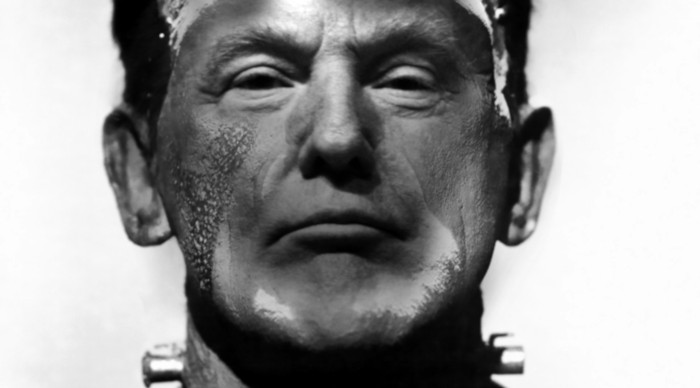
By CJ Hopkins | Consent Factory, Inc. | October 4, 2019
So here we go. Like a 1960s straight-to-drive-in Hammer Film Production, the 2020 campaign season has begun. Dig into your bucket of popcorn, pop the flap on your box of Good & Plenty, turn off your mind, and enjoy the show. From the looks of the trailer, it’s going to be a doozy.
That’s right, folks, it’s the final installment of the popular Trumpenstein horror movie series, TRUMPENSTEIN MUST BE DESTROYED! It will be playing, more or less around the clock, on more or less every screen in existence, until November 3, 2020 … or until Trump takes that lonely walk across the White House lawn to the Marine One chopper and flies off to Mar-a-Lago in disgrace.
Here’s a quick recap of the series so far, for those who may be joining us late.
When we last saw Trumpenstein he was out on the balcony of the White House South Portico in his Brioni boxers, ripped to the gills on Diet Coke and bellowing like a bull elephant seal. Having narrowly survived the Resistance’s attempts to expose him as a Russian intelligence asset (and the reanimated corpse of Adolf Hitler), he was pounding his chest and hollering angry gibberish at the liberal media like the Humongous in the second Mad Max movie.
The liberal mob was standing around with their torches and pitchforks in a state of shock. Doctor Mueller, the “monster hunter,” had let Trumpenstein slip through his fingers. The supposedly ironclad case against him had turned out to be a bunch of lies made up by the Intelligence Community, the Democratic Party, and the corporate media.
Russiagate was officially dead. The President of the United States was not a Russian secret agent. No one was blackmailing anyone with a videotape of Romanian prostitutes peeing on a bed where Obama once slept. All that had happened was, millions of liberals had been subjected to the most elaborate psyop in the history of elaborate deep state psyops … which, ironically, had only further strengthened Trumpenstein, who was out there on the Portico balcony, shotgunning Diet Cokes with one hand and shaking his junk at the mob with the other.
It wasn’t looking so good for “democracy.”
Fortunately, even though Russiagate had blown up in the Resistance’s faces and Trumpenstein could no longer be painted as a traitorous Russian intelligence asset (or as Vladimir Putin’s homosexual lover), he was still the reanimated corpse of Hitler, so they went balls out on the fascism hysteria, which kept the Resistance alive through the summer.
Which was all they really needed to do. Because these last three years were basically just a warm-up for the main event, which was always scheduled to begin this autumn. Russiagate, Hitlergate, and all the rest of it … it was all just a prelude to these impeachment hearings, and to the mass hysteria surrounding same, which the global capitalist ruling classes, the Intelligence Community, and the corporate media will be barraging us with until November 2020. The details don’t really matter that much. They were always going to impeach him for something, and they were always going to do it now, and throughout the 2020 campaign season.
You do not honestly believe they are going to let him serve a second term, do you? He took them by surprise in 2016. That isn’t going to happen again. Seriously, take a moment and reflect on everything we’ve been subjected to since Hillary Clinton lost the election … the unmitigated insanity of it all. The Russiagate hysteria. The Russian hacker hysteria. The Russian Facebook mind-control hysteria. The Hitler hysteria. The mass fascism hysteria. The anti-Semitism hysteria. The concentration camp hysteria. The white supremacist terrorism hysteria. Russian spy whales. Perfume assassins. The endless stream of fabricated “news” stories pumped out by the corporate media. Best-selling books, based on nothing. Comedians singing hymns to former FBI directors on national television. Celebrities demanding CIA coups. Papers of record like The New York Times coordinating blatant propaganda campaigns. The list goes on, and on, and on.
All of this because one billionaire ass clown won an election without their permission?
No, this was never just about Donald Trump, repulsive and corrupt as the man may be. The stakes have always been much higher than that. What we’ve witnessed over the the last three years (and what is about to reach its apogee) is a global capitalist counter-insurgency, the goal of which is (a) to put down the ongoing populist rebellion throughout the West, and (b) to crush any hope of resistance to the hegemony of global capitalism … in other words, a War on Populism.
Not that Donald Trump is a populist hero. Far from it. Trump is a narcissistic clown. He has always been a narcissistic clown. All he really cares about is seeing his face on television and plastering his name on everything in sight, preferably in huge gold letters. He got himself elected president by being cunning enough to recognize and ride the tsunami of populist anger that was building up in 2016, and that has continued to build throughout his presidency. It is not going away, that anger. The Western masses are no more thrilled about the global capitalist future today than they were when voted for Brexit, and Trump, and various other “populist” and reactionary figures.
Which is precisely why Trumpenstein must be destroyed, and why Brexit must not be allowed to happen … or, if it does, why the people of the United Kingdom must be mercilessly punished. It is also why the Gilets Jaunes are being brutally repressed by the French police, and disappeared by the corporate media (while the Hong Kong protesters garner daily headlines), and why Jeremy Corbyn and the Labour Party must be smeared as a hive of anti-Semites, and Tulsi Gabbard as an Assad-apologist, and why Julian Assange must be smeared and destroyed, and why Bernie Sanders must also be destroyed, and why anyone of any ilk (left, right, it doesn’t matter) riding that wave of populist anger or challenging the hegemony of global capitalism and its psychotic, smiley-face ideology in any other way must be destroyed.
2020 is for all the marbles. The global capitalist ruling classes either crush this ongoing populist insurgency or … God knows where we go from here. Try to see it through their eyes for a moment. Picture four more years of Trump … second-term Trump … Trump unleashed. Do you really believe they’re going to let that happen, that they are going to permit this populist insurgency to continue for another four years?
They are not. What they are going to do is use all their power to destroy the monster … not Trump the man, but Trump the symbol. They are going to drown us in impeachment minutiae, drip, drip, drip, for the next twelve months. The liberal corporate media are going to go full-Goebbels. They are going to whip up so much mass hysteria that people won’t be able to think. They are going to pit us one against the other, and force us onto one or the other side of a simulated conflict (Democracy versus the Putin-Nazis) to keep us from perceiving the actual conflict (Global Capitalism versus Populism). They are going to bring us to the brink of civil war in order to prevent civil war. And, if that doesn’t work, and Trump gets reelected (or if it looks like he’s going to get reelected), they’ll probably have to just go ahead and kill him.
One way or another, this is it. This is the part where the global capitalist ruling classes teach us all a lesson. The lesson they intend to teach us is the same old lesson that masters have been teaching slaves since the dawn of slavery. The lesson is, “abandon hope.” The lesson is, “resistance is futile.” The lesson is, “shut up, eat your tofu, get back to work at your three gig jobs, service your school loans and your credit card debt, vote for who and what we tell you, and be grateful we don’t fucking kill you. Oh, yeah … and if you want to rebel against something, feel free to take up identity politics, or to march around town with posters of Saint Greta demanding that we stop destroying the planet. We’ll get right on that, don’t you worry.”
What? You thought this had a happy ending, that Trumpenstein and the Bride of Trumpenstein were going to ride off into the orange sunrise at Mar-a-Lago in a Trump-branded golf cart, having made America great again … or that Bernie was going to storm the castle, vanquish Trumpenstein, and set up something resembling basic social democracy?
I told you it was a horror film, didn’t I?
Trump-Zelensky-Ukraine: What is really going on here?
By Tony Kevin | OffGuardian | October 2, 2019
I have over several days reflected on the official White House record of the Trump-Zelensky conversation on Ukraine-US relations on 25 July 2019, a conversation held soon after Zelensky’s confirmed election victory, and declassified by Trump’s presidential order of 24 September 2019.
I have also been reflecting on the more recent Democratic Party decision to explore possibilities for impeachment of Trump, a decision fortified by the so-called ‘CIA whistleblower’ and his/her rather unimpressive revelations.
Here is my hypothesis of what may be going on here. As always, it is a complex mixture of domestic US politics, and Trump’s and Zelensky’s foreign policy goals. And a footnote follows on Downer.
Let’s start with the foreign policy goals. Both Trump and Zelensky are operating in highly constrained and threatening foreign policy environments at home. At the time of their phone call, Trump still had the warmonger Bolton to deal with inside the house: and even now he is still under the watchful scrutiny of the Russophobe imperial state figure of his Secretary of State Pompeo, closely though undeclaredly linked to the Washington imperial party on Ukraine-Russia as on other East-West issues.
Zelensky is similarly constrained and threatened in Kiev by the anti-Russian fanaticism that has been indoctrinated in large sections of the Ukrainian population by decades of nationalist, often neo-Nazi, Russophobe propaganda.
It is a tribute to the instinctive good sense of the Ukrainian electorate that Zelensky was able to defeat in the polls the discredited NATO stooge Poroshenko so comprehensively and decisively. The maturity of this vote gives me renewed hope for Ukraine. But there is a long way to go still towards political normalisation and economic recovery there.
Zelensky is smart enough to see that his country must achieve a normalisation of relations with Russia, but knows that he cannot yet say this openly. Putin wants this also, very much. But both men know it will take a very long time after the accumulated bitter grievances on both sides over recent decades, and especially since the lethal and destructive civil war on Eastern Ukraine that was begun by Poroshenko in April 2014 – no doubt on American advice.
This war has had terrible human consequences: loss of life, wounded and disabled casualties, destroyed communities, massive forced refugee outflows. Neither side can get over this easily or quickly.
The reciprocal prisoner release on 7 September was an essential symbolic action. Putin’s release of the navy crews who took part in the provocative and foolish Ukrainian raid on the Kerch Strait bridge a year ago was a key part of building Ukrainian confidence and trust in Zelensky’s leadership.
Russophobes in the West are in consternation at new green shoots of possible hope for progress towards Kiev-Moscow normalisation under the Normandy diplomacy format.
They are desperate to derail this hope, by proposing impossible conditions for normalisation: in particular that any self-determination elections for Donbass (while remaining within sovereign Ukraine) could only be held under an ‘internationally supervised’ election and with ‘international peacekeepers’ in charge.
See for example this recent piece by a European analyst, Gustav Gressel. East Ukrainians rightly see such a formula as a sure recipe for US infiltration and black regime change operations in Donbass. So it will not happen.
As I interpret the Trump-Zelensky conversation, both leaders were cautiously but in a friendly way exploring the boundaries of what might be possible for each of them as presidents to revisit the troubled history of the past few years. I see nothing dishonourable or intimidating in this conversation. Trump critics are reading into it only what they want to read.
Here I turn to the US domestic politics aspect.
Trump is still bitterly opposed by the US imperial state represented by people like Biden, Clinton, Bolton and McFaul (and increasingly, I suspect, by Obama), but also the FBI-CIA national security dissident faction represented by people like Brennan, Comey and Clapper. These people have learned nothing from the embarrassing failure of the Mueller investigation to prove the false Russiagate allegations.
They are keen still to bring Trump down by whatever possible means.
They see the threat to the credibility of their cause if Trump and Zelensky should together succeed in finding evidence of Ukrainian underpinnings of the 2016-17 Russiagate conspiracy against Trump. They are desperate to have a last bash at Trump before he might finally expose any such improprieties, through evidence from Ukraine (or, for that matter, Australia – see below).
They were powerful enough in the Democratic Party to finally overcome the experienced Nancy Pelosi’s prudent and well-founded resistance to their plans. She knows that this impeachment process could destroy any Democratic Party hopes for power next year.
But these fanatics are ready to go for broke, in their rage and despair against Trump. The ‘CIA whistleblower’, whoever he or she may be, is their last desperate throw.
The pathetic, compromised figure of Joe Biden, with his damning Ukrainian nationalist connections, is their unlikely standard-bearer. Elizabeth Warren is a possible backstop.
For these folk, either Sanders or Gabbard would be a disaster as a candidate – because neither shares the imperial agenda, and both are morally strong enough to resist it.
Nancy Pelosi and Tulsi Gabbard know the realities. I suspect Bernie Sanders does too, but is awaiting his moment to speak out on this.
The US liberal print media led by the New York Times and Washington Post, and more sympathetic networks like MSNBC and CNN, are trying to keep the impeachment fire alive. Other networks like FoxNews are standing back from it more sceptically.
I predict – analytically – that Trump will survive this latest impeachment wave and come out even stronger for the 2020 election as a result. His indignant base will be energised to vote in strategically important numbers sufficient to regain for him the US presidency for four more years.
This is good news for prospects for peace between Ukraine and Russia, however problematical it may be in other areas of the world diplomatic arena (and I am no supporter of Trump).
But I do not expect early miracles in Ukraine, rather a slow normalisation and contact-building process between these two closely related nations.
* * *
And a late footnote on Trump, Morrison and Downer: with exquisite timing, Trump has now put the acid on Morrison to give his Attorney-General Barr access to Australian intelligence files on Downer’s alleged attempt to collect intelligence from, and possibly incriminate, George Papadopoulos in their alleged wine rooms encounter in London, while Downer was still Australian High Commissioner.
It would seem, according to the allegations, that Downer was trying to collect intelligence to support the Russiagate allegations against Trump.
Morrison is now between a rock and a hard place. He cannot reject Trump’s request outright. (As Australian Labor figures are thoughtlessly urging him to do). But nor can he pursue Trump’s request enthusiastically enough to expose any alleged anti-Trump secret activities of Australian intelligence agencies, who were under pressure at the time from visiting figures in the US FBI and intelligence world – Comey, Clapper and Brennan – to help them build the Russiagate case against Trump in the first year of his presidency.
A Five-Eyes operational dilemma indeed, that will test Morrison’s loyalties.
UK Defence Chief Carter Claims Country ‘at War on Daily Basis’ Against Alleged Russian Cyber Attacks
Sputnik – September 30, 2019
The UK’s Chief of the Defence Staff Nick Carter has claimed that Britain is at war every day due to constant cyber attacks from Russia and other countries.
In Sunday’s address to the Cliveden Literary Festival, which was also attended by former US General and CIA Director David Petraeus, General Carter also argued that “the changing character of warfare has exposed the distinctions that don’t exist any longer between peace and war.”
“I feel I am now at war, but it’s not a war in the way we would have defined it in the past. And that is because great power competition and the battle of ideas with non-state actors is threatening us on a daily basis,” he said.
Carter referred to Russia’s and China’s alleged “interpretation” of the rules governing international engagement which he claimed threatened “the ethical and legal basis on which we apply the rule of armed conflict.”
He described Russia as “much more of a threat today than it was five years ago.”
“The character of warfare is evolving […] there’s a debate we need to have about what does the future of warfare look like,” Carter claimed, insisting that traditional concept of war only being waged on land, sea and in the air is already outdated.
“The key bit that will give you the edge you need is the way in which information connects [it all] together so we are properly integrated at every level,” he argued.
Carter also claimed that “future warfare is going to be very much information-centric” and that the UK military should clinch a balance between training the armed forces for the new forms of warfare and keeping up a powerful traditional military deterrent, something that is still in place in the Baltic states.
Additionally, Carter made it clear that he shares Petraeus’ view about Russian President Vladimir Putin being “the greatest gift to NATO since the end of the Cold War.”
“NATO’s got some serious political challenges at the moment. “Putin has been very helpful in getting us to make the case as to why we need to modernise,” Carter claimed.
Moscow Rejects Cyber Attacks Involvement Accusations
Russia has repeatedly denied its involvement in cyber-attacks abroad, with presidential spokesman Dmitry Peskov stressing that “these are absolutely unfounded accusations, which are often quite absurd and are not supported by concrete facts.”
He was echoed by Russian Foreign Ministry spokeswoman Maria Zakharova who said last year that as far as cyber crimes are concerned, “in Western countries, it has become common courtesy to systematically accuse Russia” in such crimes.
“Speaking about reality, all this differs widely from the imaginings of western political consultants because our country is one of the more active participants in international interactivity, especially in information and communication technology,” Zakharova pointed out.
The Biden Affair in the Ukraine
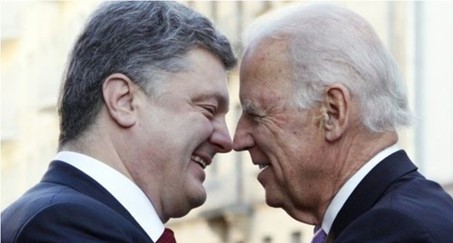
By Israel Shamir • Unz Review • September 30, 2019
The Borderlands of the Ukraine have been a decisive battlefield for centuries. Here Stockholm, Berlin and Moscow vied for dominance. Karl XII had lost here to Peter the Great; Stalin defeated Hitler; now the Clintonites are likely to suffer in the Ukraine their ultimate defeat. The Democrats had made their biggest political mistake of the century in attacking Trump for the Biden affair — that is, if the Americans retain any common sense.
Vice-President Biden extorted millions of dollars in personal bribes from the vulnerable Ukrainian client state. When this sordid affair came under investigation, he blackmailed Ukrainians, using his position and American taxpayer money to force the sovereign state to fire its Attorney General for investigating the bribes.
Instead of covering their face in shame and dismissing Biden as a potential party candidate in the 2020 race, the Dems led by the superannuated Mrs Pelosi decided to impeach the President for uncovering this rogue. In the well-remembered flick Dirty Harry the lawyers tried to save a criminal by attacking the policeman who didn’t observe the niceties of a Miranda warning. This was the model for the Dems in their impeachment attempt.
Biden’s criminal extortion wasn’t a secret. He boasted of this racket at a public occasion. He famously admitted that:
I said, I’m telling you [the Ukrainian leaders], you’re not getting the billion dollars. I said, you’re not getting the billion. I’m going to be leaving here in, I think it was about six hours. I looked at them and said: I’m leaving in six hours. If the prosecutor is not fired, you’re not getting the money. Well, son of a bitch. (Laughter.) He got fired. And they put in place someone who was solid at the time.
The Ukrainians put in place someone who was solid at the time, so solid that he terminated the investigation of Burisma oil company. This company was the vessel to transfer bribes to VP Biden, via his son Hunter Biden. John Solomon of The Hill wrote:
“U.S. banking records show Hunter Biden’s American-based firm, Rosemont Seneca Partners LLC, received regular transfers into one of its accounts — usually more than $166,000 a month — from Burisma from spring 2014 through fall 2015, during a period when Vice President Biden was the main U.S. official dealing with Ukraine and its tense relations with Russia.”
The fired prosecutor Mr Viktor Shokin said that Biden fils had been under investigation. After he was dismissed due to Biden père interference, the money continued to pour out of poor Ukrainian pockets to well-stuffed Biden coffers. My Kiev acquaintances had a memory of a good-for-nothing young man, keen on coke and broads, who by himself would never get such a salary.
You would ask, why Biden admitted to the crime? He considered himself untouchable like Mrs Clinton and other people of her circle. Mischievous President Trump decided to prosecute Biden for bribery and extortion, as if he were an ordinary mortal. This was a direct threat to the Clintonites (let us use this nickname for the power variously described as Democrats, Liberals, Internationals, financiers, Masters of Discourse or Deep State). This challenge caused them to abandon caution and to start a furious pre-emptive campaign against cocky Trump.
Their accusation is outright ridiculous: they claim Trump’s intention to bring Corrupt Joe to justice was criminal per se, as Biden was a likely contender for the Dem nomination. As it happens, the US Constitution didn’t find it fit to provide likely contenders with full immunity for past and future crime prosecutions. It’s just the Clintonites were used to be above the law. Indeed, for three years President Trump avoided to touch them. Crimes of Mrs Clinton were well known, from the simple affair of the email server to the Libya murders.
It was expected victorious Trump would unleash the law against the defeated dowager for Mrs. Clinton’s role in the Obama administration’s decision to allow the Russian nuclear agency to buy a uranium mining company. Conservatives have long pointed to donations to the Clinton family foundation by people associated with the company, Uranium One, as proof of corruption, reported the New York Times. The Clintonites saved the old lady’s skin by starting the Russiagate hoax. In 2016 election debate Trump told Clinton that, if he was in charge of the nation’s laws, “you’d be in jail”. But a year later he was in charge, and she wasn’t in jail, not even charged. The ruse of Russiagate worked wonders: the President accused of collusion with Russia did not dare to charge his adversary with this very offence.
Now the Clintonites decided to repeat their feat and began impeachment procedure hoping it will keep Trump busy and away from uncovering the Ukrainian Hell’s Kitchen.
What actually had happened in the Ukraine? In 2014, Clintonites had managed the regime change in this former Soviet republic. They removed the legitimate president by using the full spectre of illegal operations. The Ukraine became a Clintonite colony, and Joe Biden their viceroy in the Ukraine. Biden’s involvement in the coup d’état was his biggest crime, but nobody speaks of that, noticed Joe Lauria. They had turned Ukraine against Russia and instigated the civil war in the East of the poor country, despite strong efforts of president Putin to keep Russia out of Ukrainian turmoil. But they also gave a thought to personal profiteering, like they did in Russia in 1990.
Joe Biden had been treated royally in Kiev. He was asked to chair government meetings and proudly sat on the Presidential seat. The Ukrainians are not famous for their subtlety. Nice people, but rather simple ones, even by East European measure. They became involved in 2016 election campaign on the Clintonite side. There is no doubt VP Biden was the man who directed this “foreign involvement in the US elections”. The obliging Ukrainians delivered to him the dirt on Paul Manafort, and Manafort went to jail.
The Ukraine is the second home for CrowdStrike, the cyber-security company that was instrumental in accusing Russia of meddling. Its founder and head, a Russian Jew and American citizen Dmitry Alperovich is a pathological Russia hater on the model of Masha Gessen and Max Boot. People in Kiev say he had built the case against Russia on the strength of a single server allegedly used for hacking the DNC. The server is located in the Ukraine, not in Russia. President Trump asked for its whereabouts in his conversation with the Ukrainian President Mr Zelensky.
The subject of the server makes many people in the Clintonite camp extremely nervous. They already marked it with “conspiracy” marker, meaning you may not touch it. In another “conspiracy debunking” item they created a straw man, saying “the notion that there is some missing “server,” and that the server might exist somewhere—like in Ukraine—has no basis in reality. The DNC’s network consisted of many servers and computers”. However, the server Trump asked about is not the DNC server, but the server allegedly used to hack DNC server. It had left some Russian-language traces, and it was presented as a proof of Russian involvement. But Alperovich’s hackers in the Ukraine also use Russian as their working language, and this allowed the Russia-hating Jew an opportunity to create the whole chain of “proofs” of Russian hackers’ activity with fancy names. Recovery of the server would put paid to the whole myth of Russian hacking, and would make the Clintonite case untenable.
Alperovich, obsessed with his hatred, could cook the case of Russian meddling, but it had to be ordered and utilized by somebody up the feeding chain, most probably Joe Biden. And now Joe Biden, the real criminal, who took bribes and blackmailed the friendly state officials, who orchestrated foreign involvement in the US elections, went on to become the leading contender for Dem party.
The Dems claimed Trump threatened to withdraw funds from the Ukraine if they won’t cooperate with the US enquiry. This claim had been debunked after the full transcript of two Presidents’ chat had been published. But even if it were sterling truth, it would be business as usual for the US. You probably remember the threats of cutting aid that were issued by the US representative in the UN in order to force sovereign states to vote for Israel. The execrable Nicky Haley said, ‘The US will be taking names’, and Donald Trump added his own threats to cut aid.
How could they find fault in Trump allegedly threatening to cut aid to Ukraine if they think Biden was perfectly all right for doing exactly that? But these guys aren’t playing cricket.
The forthcoming Presidential race is becoming a global affair, it seems. In so many countries the US influence had been delivered by agents of Clintonite clan, and all of them are tempted to do what the Clintonites ask, that is to help them to undermine President Trump. In the Ukraine, the struggle of Clintonites and Trumpers is far from over. President Zelensky promised President Trump to help him; but the oligarchs of the Ukraine are in Clintonite camp.
All but one: Igor (Benny) Kolomoysky, a maverick Jewish oligarch and a friend of the President, is an enemy of Clintonites. He also stands against IMF, International Monetary Fund, the powerful bankers’ body that issued many loans to the Ukraine. Just this year, Kiev has to pay six billion dollars to the IMF to remain solvent, and IMF refused to refinance it. The loans were mainly stolen by the gang of the former President, Mr Poroshenko. People in Kiev say that about 1.7 billion dollars of the latest loan had been pocketed by the American supporters of Poroshenko, meaning Joe Biden and his ilk. Now Mr Kolomoysky suggests the new Ukrainian president may default on IMF loans.
Kolomoysky is also the only oligarch who is not in bed with the liberals. The balance of power in the Ukraine is not in favour of Trumpers. The Ukrainians like to back winners; once they made a mistake supporting Mrs Clinton, as they were sure she would win. Perhaps they will make this mistake again. It would depend on the actual Dem contender. Joe Biden had cooked his goose by taking too many bribes in the Ukraine, but another contender may have a better chance, the Ukrainians think. Mrs Warren, perhaps?
They even fiddle with the idea of Mrs Hillary Clinton running again and winning this time. The Ukrainian oligarchs, and first of all Mr Victor Pinchuk, a Jewish billionaire from Dnepro city, No. 1 among the rich Ukrainians, would do anything for her. He contributed many millions to her fund; he finances the Atlantic Council, the Clintonite think-tank, fighting against Russia and Euro-sceptics. He is ‘the wealthy businessman’ Trump referred to in his talk with Mr Zelensky. Judging by Trump’s interest in the Ukrainian server, the President is aware that the old lady is still able to do some mischief, and his promise to take her to jail is still unfulfilled.
It is possible in the presidential race 2020, the Dems will use drafting technique, as the long-distance runners (or bikers, or cross-country skiers) do. The first leading contender (in our case, Biden) would get the flak, get exhausted, and in the last moment he would withdraw from the race yielding the nomination to his well-rested comrade, be it Warren or Clinton or whoever. Bearing that in mind, Trumpers could keep some of the ammo they have on Biden (and there is a lot to find in the Ukraine) until (or rather if) he gets the nomination.
Israel Shamir can be reached at adam@israelshamir.net
Lavrov responds to Pelosi claim Russia ‘had a hand’ in Trump-Zelensky impeachment scandal
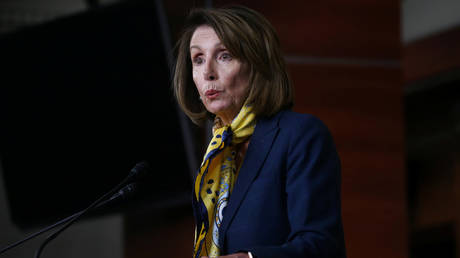
RT | September 27, 2019
Russian Foreign Minister Sergei Lavrov dismissed US House Speaker Nancy Pelosi’s claims that Russia was involved in the Trump-Zelensky phone conversation scandal as “obvious paranoia” and yet another “deadly sin” to pin on Moscow.
“Russia’s been accused of all the deadly sins, and then some,” Lavrov said at a press conference at the UN General Assembly on Friday, addressing a question about Pelosi’s claims that his country was somehow involved in the alleged quid pro quo between US President Donald Trump and Ukrainian President Volodymyr Zelensky.
“It’s paranoia, and I think it’s obvious to everyone.”
In an interview with MSNBC that aired earlier on Friday, Pelosi had claimed that Russia “has a hand in” what she referred to as Trump’s “shakedown” of the Ukrainian president during a telephone conversation back in July – released this week by the White House – as well as the subsequent “cover-up of the cover-up.”
Trump is “undermining our national security” by withholding military aid from Ukraine, she insisted, and “violated the constitution by overriding an act of Congress.”
The Democrats claim that Trump threatened to withhold military aid unless Ukraine restarted a corruption probe into the gas company that employed Hunter Biden, the son of then-vice president and current Democratic front-runner Joe Biden.
Pelosi launched an impeachment inquiry on Tuesday while admitting she had not read a transcript of the fateful call between the two leaders. She nevertheless accused Trump of betraying his oath of office, national security, and “the integrity of our elections.”
The call transcript, released the following morning, did not include any discussion of military aid, and mentioned the Biden investigation only in passing – a subject that was broached by Zelensky, not Trump.
Claim Russia caused Brexit crumbles as probe into Leave.EU funding finds no evidence of wrongdoing
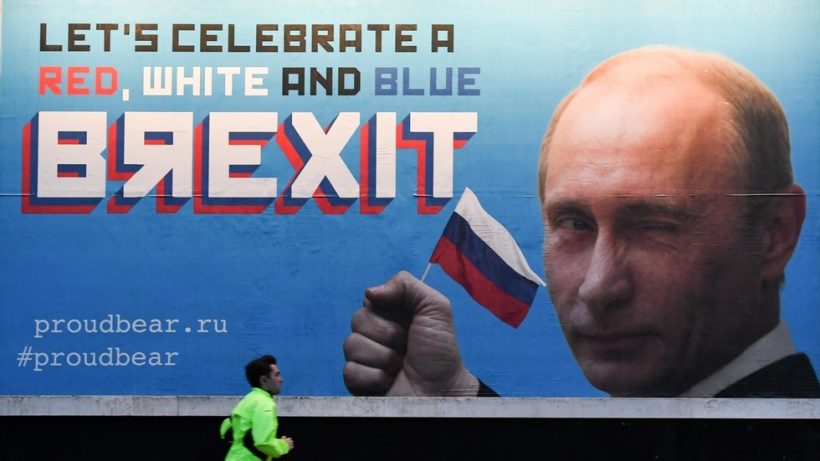
A Brexit-themed billboard depicting Russian President Vladimir Putin. © AFP / Daniel SORABJI
RT | September 25, 2019
An investigation into Arron Banks, a backer of a pro-Brexit campaign, found no evidence that the money for it came from a third party. The political establishment claimed he was illegally pouring Russian funds into the endeavor.
The UK’s National Crime Agency (NCA) announced it has shut down investigation into Banks after finding no evidence he broke the law in loaning £8 million ($10 million) to his own pro-Brexit campaign Leave. EU ahead of the 2016 referendum. The loan came from the company Rock Holdings Ltd, owned by Banks, and went to Better for the Country Ltd, which managed the campaign.
The Electoral Commission referred the case to the NCA last year, saying it suspected a third party was the original source of the money. In a public statement on Tuesday, the NCA said it found “no evidence that any criminal offences have been committed” by Banks. Likewise, no evidence was found that he “received funding from any third party to fund the loans, or that he acted as an agent on behalf of a third party.”
The third party was presumed to be the government of Russia, which many Remainers accuse of boosting their Leaver opponents financially and with clandestine activities on social media. This notion may, for some, ease the pain caused by the cringeworthy way the UK is now parting ways with the EU, but it has a few problems in terms of actual evidence.
The NCA’s announcement is the second blow to the narrative in as many weeks. Earlier, the Metropolitan Police said they will take no further action against Banks and Leave.EU over alleged spending offences. That probe was also launched at the request of the Electoral Commission and found “some technical breaches of electoral law” but “insufficient evidence to justify any further criminal investigation,” the statement said.
Banks, who said he was being targeted by a biased Electoral Commission and pro-Remain politicians and journalists in a smear campaign, is now able to take a victory lap. “Victory is sweet .. poor little remainer!” he tweeted in response to one of his critics sharing the news. Banks also threatened the commission with a £10 million lawsuit for damaging his reputation.
Nigel Farage, who was Banks’ partner in the Leave.EU campaign, said “heads must roll” for the mistreatment of the businessman, and that the commission should be first in line for the chopping block.
The commission lamented the NCA’s decision, saying it demonstrated an “apparent weakness of the law” that “allows overseas funds into UK politics.” Which apparently means they think that the problem was that investigators didn’t search hard enough, not that there was nothing there to find.
Hunting for the Kremlin’s shadow behind domestic troubles is a popular activity these days, especially since the consequences are insignificant for those involved when they are eventually proven wrong.
Administer Justice’: What the Trump-Zelensky Call Transcript Does and Doesn’t Say
Sputnik – September 25, 2019
The White House has released a transcript of the controversial 25th July call between Donald Trump and Ukrainian leader Volodymyr Zelensky – meanwhile, US lawmakers have begun a formal impeachment inquiry into the content of their conversation.
Not long after the call ended, an intelligence community ‘whistleblower’ lodged a complaint about Trump’s conduct during the chat. The exact contents of the complaint haven’t been released, but ever since senior Democrats have claimed the President had been attempting to boost his reelection prospects by pressuring Zelensky to contact Attorney General William Barr and allege Joe Biden lobbied Kiev officials to benefit his son Hunter’s private-sector work in Ukraine.
Moreover, they suggest Trump threatening to withhold aid from the country – which he has admitted – was intended to force Zelensky’s hand on the issue.
For his part, Trump and members of his administration have alleged Biden dangled the prospect of US financial support to coerce the Ukrainian government into firing its top prosecutor Viktor Shokin in 2016, at a time he was investigating Ukrainian energy company Burisma, and allegedly Hunter.
Will the Democrats apologize after seeing what was said on the call with the Ukrainian President? They should, a perfect call – got them by surprise!
— Donald J. Trump (@realDonaldTrump) September 25, 2019
For his part, Trump claims it’s merely a matter of not wanting “our people”, like former Vice President Biden and his son, “creating the corruption already in the Ukraine”.
‘Sounds Horrible’
While the Wall Street Journal reported, based on anonymous briefings, that Trump asked Zelensky eight times to investigate Biden’s son and his work in Ukraine, in the transcript Trump mentions Biden thrice, as part of a wider discussion about the origins of the ‘Trump-Russia’ probe.
Noting the US does “a lot” for Ukraine, spending “a lot of effort and time” – “much more” than European countries, “who should be helping you more than they are”, are doing – the President asks for a favour.
“Our country has been through a lot and Ukraine knows a lot about it. I would like you to find out what happened with this whole situation with Ukraine, they say CrowdStrike… I guess you have one of your wealthy people… The server, they say Ukraine has it. There are a lot of things that went on, the whole situation… I think you’re surrounding yourself with some of the same people. I’d like to have the Attorney General call you or your people and I would like you to get to the bottom of it… That whole nonsense ended with a very poor performance by a man named Robert Mueller, an incompetent performance, but they say a lot of it started with Ukraine,” Trump inquires.
1/ Transcript shows Trump first asks Zelensky to help Barr/DOJ probe into Russiagate’s origins (recall that Ukrainians bragged about giving dirt to DNC https://t.co/9kv66xyh5N). Zelensky brings up Giuliani. Only one mention of Biden — and there’s no quid pro quo, not even close. pic.twitter.com/1Q4tCyvNvm
— Aaron Maté (@aaronjmate) September 25, 2019
In other words, the President was referring to allegations the Democratic party colluded with Ukrainian officials to perpetuate smears alleging Trump had ties to the Russian state ahead of the November 2016 Presidential election.
He goes on to state he heard Ukraine had a prosecutor “who was very good” but was “shut down”, which was “really unfair”.
“A lot of people are talking about that, the way they shut your very good prosecutor down and you had some very bad people involved. [Rudy] Giuliani is a highly respected man. He was the mayor of New York City, a great mayor, and I would like him to call you. I will ask him to call you along with the Attorney General… The other thing, there’s a lot of talk about Biden’s son, that Biden stopped the prosecution and a lot of people want to find out about that so whatever you can do with the Attorney General would be great. Biden went around bragging he stopped the prosecution so if you can look into it… It sounds horrible to me,” Trump adds.
Missing the Point
While mainstream media outlets have almost universally presented Trump’s request as potentially suspicious, the actual contents of the conversation are a far cry from allegations that a “promise” was sought by Trump, with penalties for non-compliance. For one, no mention of US aid to Ukraine being reduced or stopped outright is made at any point, whether directly or indirectly – and in response to Trump’s requested “favour” Zelensky merely notes his country’s next prosecutor general will be his candidate, who will reopen the investigation of Burisma, and probe why it was closed in the first place.
Wow. The amount of reaching is actually quite remarkable. Shows you’re very creative
— Banana (@makeupbyana_kin) September 25, 2019
Furthermore, the Ukrainian President makes clear the question of whether the inquiry was nobbled, and by whom, is also an issue of intense interest to him, and forms part of a wider push to “drain the swamp” and “have a new format and a new type of government” in the country.
“The issue of the investigation is… actually the issue of making sure to restore honesty [in the country], so we will take care of that and will work on the investigation of the case. On top of that, I would kindly ask you if you have any additional information you can provide to us, it would be very helpful for the investigation to make sure we administer justice in our country,” he states.
The abject lack of a ‘smoking gun’ in the transcript – and indeed the content clearly contradicting pre-release speculation – may account for why Democrats have now demanded to see the full complaint that was lodged, and for the staffer who lodged it to testify before Congress about their concerns.
Spy vs Spy vs Spy: The Mysterious Mr. Smolenkov
By Philip Giraldi | Strategic Culture Foundation | September 19, 2019
A new spy story has been making the rounds in Washington, but this time it involved a brave Russian official who allegedly was allegedly recruited while in the Russian Embassy in Washington in 2007 and then worked secretly for the CIA until he was exfiltrated safely in 2017 lest he be discovered and caught. The tale was clearly leaked by the Agency itself to CNN by way of “multiple Trump administration officials.”
The CNN headline Exclusive: US extracted top spy from inside Russia in 2017 landed like a bombshell but then pretty much disappeared as journalists noted a number of inconsistencies in the government-produced account of what had taken place. Matt Taibbi observed succinctly that “Seldom has a news story been more transparently fraudulent…the tale of Oleg Smolenkov is just the latest load of high-level BS dumped on us by intelligence agencies.”
The account that appeared in the mainstream media went something like this: A midlevel Russian official named Oleg Smolenkov was recruited decades ago by the CIA. He eventually wound up in an important office in the Kremlin that gave him access to President Vladimir Putin. Smolenkov was the principal source of information confirming that Russia, acting on Putin’s instructions, was trying to interfere in the 2016 presidential election to defeat Hillary Clinton and elect Donald Trump. It was claimed that Smolenkov was actually able to photograph documents in Putin’s desk. CIA concerns that a mole hunt in the Kremlin resulting from the media revelations concerning Russian interference in the election might lead to Smolenkov resulted in a 2016 offer to extract him and his family from Russia. This was successfully executed during a Smolenkov family vacation trip to Montenegro in 2017. The family now resides in Virginia.
The CNN story and other mainstream media that picked up on the tale embroidered it somewhat, suggesting that although Smolenkov was the CIA’s crown jewel, the US has a number of “high level” spies in Moscow. It was also claimed that the timetable for the exfiltration was pushed forward by CIA in 2017 after it was noted that Donald Trump was particularly careless with classified information and might inadvertently reveal the existence of the source. The allegation about Trump carelessness came, according to CNN, after a May 2017 meeting between Trump and Russian Foreign Minister Sergei Lavrov in which the president reportedly shared sensitive information on Syria and ISIS that had been provided by Israel.
Variants of the CNN story appeared subsequently in the New York Times headlined C.I.A. Informant Extracted From Russia Had Sent Secrets to US for Decades, which confirmed that the extraction took place in 2017 though it also asserts that the decision to make the move came in 2016 when Barack Obama was still president.
Taibbi observes, correctly, that CNN and the other mainstream elements reporting the story elaborated on it through commentary coming from anonymous “former senior intelligence officials.” As the networks have all hired ex-spooks, it raises the interesting possibility that employees of the media are themselves providing comments on intelligence operations that they were personally involved in, meaning that they might deliberately promote a narrative that does not cast them in a bad light.
Next morning’s Washington Post story US got key asset out of Russia following election hacking touched all bases and also tried hard to implicate Trump. It confirmed 2016 as the time frame for the decision to carry out the exfiltration and also mentioned the president’s talk with Lavrov in May 2017, though the meeting itself was not cited as the reason for the move. As Taibbi observes, “So why mention it?”
The Russians have denied that Smolenkov was an important official and have insisted that the whole story might be something of a fabrication. And the alleged CIA handling of the claimed top-level defector somewhat bears out that conclusion. Normally, a former top spy is resettled in the US or somewhere overseas in a fake name to protect him or her from any possible attempt at revenge by their former countrymen. In Smolenkov’s case, easily public accessible online county real estate records indicate that he bought a $1 million house in Stafford Virginia in 2018 using his own true name.
If the Russians were truly conducting a mole hunt that endangered Smolenkov it may have been because the US media and their anonymous intelligence sources have been bragging about how they have “penetrated the Kremlin.” A Washington Post June 2017 articled called “Obama’s Secret Struggle to Punish Russia for Putin’s Election Assault is typical. In that article, the author describes how CIA Director John Brennan secured a “feat of espionage” by running spies “deep within the Russian government” that revealed Russia’s electoral interference.
So, the Smolenkov story has inconsistencies and one has to question why it was deliberately leaked at this time. The only constant in the media coverage is the repeated but completely evidence-free suggestion that the mole was endangered and had to be removed because of Donald Trump’s inability to keep a secret. One has to consider the possibility that the story has been leaked at least in part due to the continuing effort by the national security state to “get Trump.”
Highly recommended is former weapons inspector Scott Ritter’s fascinating detailed dissection of Smolenkov’s career as well as a history of the evolution of CIA spying against Russia. Scott speculates on why the leak of the story took place at all, examining a number of scenarios along the way. Smolenkov, who, according to former CIA officer Larry Johnson, has oddly never been polygraphed to establish his bona fides, might have been a double agent from the start, possibly a low level functionary allowed to work for the Americans so the Russian FSB intelligence service could feed low level information and control the narrative. It is a “dirty secret” within the Agency that many agents are recruited by case officers for no other reason than to enhance one’s career. Such agents normally have no real access and provide little reporting.
Or alternatively, Smolenkov might have been someone who was turned after recruitment or a genuine agent who was trying to respond to urgent demands from his controller in Washington, who was de facto John Brennan, by producing a dramatic report that was basically fabricated. Or the story itself might be completely false, an attempt by some former and current officials at CIA to demonstrate a great success at a time when the intelligence community is under considerable pressure.
Scott also believes, as do I, that the story was leaked because John Brennan and his associates knew that they were deliberately marketing phony intelligence on Russia to undermine Trump and are trying to preempt any investigation by Attorney General William Barr on the provenance of the Russiagate story. If it can be demonstrated somehow that the claims of Kremlin interference came from a highly regarded credible Russian source then Brennan and company can claim that they acted in good faith. Of course, that tale might break down if anyone bothers to interview Smolenkov.
Another theory that I tend to like is that the CIA might be making public the Smolenkov case in an attempt to lower the heat on another actual high-level source still operating in Moscow. If Russia can be convinced that Smolenkov was the only significant spy working in the Kremlin it might ratchet down efforts to find another mole. It is an interesting theory worthy of spy vs. spy, but one can be pretty sure that Russian counterintelligence has already thought of that possibility and will not be fooled.
The reality is that spying is a highly creative profession, with operational twists and turns limited only by one’s imagination. In this case, unless someone actually succeeds in interviewing Oleg Smolenkov and he decides to tell the complete truth as he sees it, the American public might never know the reality behind the latest spy story.
Explaining CIA’s ‘Agent Smolenkov’
By Finian Cunningham | Strategic Culture Foundation | September 16, 2019
The saga of daring escape by a supposed Russian CIA agent from the Kremlin’s clutches and then the added twist of a security-risk American president putting the agent’s life in danger does indeed sound like a pulp fiction novel, as Kremlin spokesman Dmitry Peskov put it.
How to explain this sensational story? “Opportunism” is one word that comes to mind.
The news media who pushed the story, CNN, the New York Times and Washington Post, are vehemently “anti-Trump”. Any chance to damage this president and they grab it.
Also, perhaps more importantly, these media are desperate to salvage their shot-through journalistic credibility since the “Russiagate” narrative they had earnestly propagated died a death, after the two-year Mueller circus finally left town empty-handed.
This damage to supposed bastions of US journalism cannot be overstated. More than two years of spinning speculation-cum-reporting about Russian collusion with Trump and/or interference in US politics has produced not a crumb of substantive fact. That means those media responsible for the “Russiagate” nonsense have forfeited that precious quality – credibility. They no longer deserve to be categorized as news services, and are more appropriately now listed as fiction peddlers.
So when they got the chance to seemingly resurrect their buried “Russiagate” yarn with this latest fable about agent Oleg Smolenkov being exfiltrated from Russia to the US, they leapt at it because their equally buried reputations are also at stake.
As far as we can tell, an anonymous intelligence source started the ball rolling. The source is likely to be former CIA chief John Brennan or former Director of National Intelligence James Clapper. Both are hangouts for the anti-Trump media since they lost their intel jobs at the beginning of 2017, and both are believed to have seeded the “Russiagate” narrative in 2016 from before Trump was elected.
Notably, the current CIA assessment of the latest US media reporting on the exfiltrated spy is that the reporting is “false” and “misguided”. In particular, the CNN spin that the agent (Smolenkov) had to be extricated from Russia in 2017 because Langley feared that Trump may have endangered the supposed Kremlin mole when he hosted Russian foreign minister Sergei Lavrov in the White House in May 2017.
Also of note is the dismissive response from US Secretary of State Mike Pompeo who rubbished the reports. He was head of the CIA during 2017. (Admittedly, Pompeo is a self-confessed liar.)
According to CNN, NY Times and Washington Post, the former spy in the Kremlin, named as Oleg Smolenkov by subsequent Russian media reporting, was a top mole with direct access to President Vladimir Putin. It is claimed that Smolenkov confirmed allegations about a Putin-directed plot to interfere in US presidential elections. The agent is said to have also confirmed that Putin (allegedly) ordered the hacking of the Democratic party’s central database to obtain scandalous material on Hillary Clinton which was then fed to the Wikileaks whistleblower site for the purpose of scuttling her bid for the presidency in November 2016, thus favoring Trump.
Smolenkov was allegedly providing this information on a purported Kremlin interference campaign in 2016.
The US media claim Smolenkov was exfiltrated from Russia by the CIA in June 2017 – out of concern for his safety, which CNN reported was being jeopardized by President Trump due to his implied compromised relations with Putin. Smolenkov and his family disappeared while on a holiday in Montenegro in June 2017.
After the story broke earlier this week about the exfiltrated Kremlin mole, subsequent media reporting tracked down Oleg Smolenkov and his wife living in a $1-million-dollar mansion in Stafford, Virginia. Curiously, public records showed the house purchase was in their names, which seems odd for a supposed top-level spy, who had apparently committed extreme betrayal against the Kremlin, to be living openly. The family apparently fled the house to unknown whereabouts on September 9 after the story about his alleged spy role broke this week.
Who is Oleg Smolenkov? The Kremlin said this week that he previously worked in the presidential administration, but he was sacked “several years ago”. He did not have direct access to President Putin’s office, according to the Kremlin. For his part, Russian foreign minister Sergei Lavrov says he never heard of the man before, never mind ever having met him.
It is understood that Smolenkov previously worked in the Russian embassy in Washington under ambassador Yuri Ushakov (1999-2008). Smolenkov reportedly continued working for Ushakov when the diplomat returned to Moscow after his ambassadorial tenure in the US.
Here is where we may speculate that Smolenkov was recruited by the CIA during his diplomatic assignment in the US. But we assume that the Kremlin’s assessment is correct; he did not have a senior position or access to Putin’s office. By contrast, the US media are claiming Smolenkov was “one of the CIA’s most valuable assets” in the Kremlin and that he was providing confirmatory information that Putin was (allegedly) running an interference campaign to subvert the US presidential elections.
The discerning detail as to the truth of the imbroglio is revealed by the US media claims that Smolenkov corroborated the alleged hacking into the Democratic party database in 2016. However, that specific allegation has been disproven by several top hacker experts, notably William Binney who was formerly technical head at the US National Security Agency. There was no hacking. The damaging information on Hillary Clinton was leaked by a Democratic party insider, possibly Seth Rich, who soon after was shot dead by an unknown attacker. In short, the entire narrative about the Kremlin hacking into the Democratic party is a fiction. The premise to “Russiagate” is baseless.
Thus, if Smolenkov is peddling fiction to his former handlers in the CIA, that means he has no credibility as a “top mole”.
Again, opportunism is the key. Somebody came up with a lurid story about “Russian interference” in US democracy and “collusion” with Trump. Maybe it was Smolenkov who saw an opportunity to win a big pay day from his CIA patrons by flogging them a blockbuster. Or maybe, Brennan and Clapper (known liars in the public record) dreamt up a scheme of Kremlin malignancy to benefit Trump, and if that could be tied to Trump then his election would be discredited and nullified. But what they needed was a “Kremlin source” to “corroborate” their readymade story of “Russian interference”. Step forward Oleg Smolenkov – fired and out of work – to do the needfed “corroboration” and in return he gets a new life for himself and family with a mansion in a leafy Virginian suburb.
CNN, NY Times, Washington Post, Brennan and Clapper are so much damaged goods from past failure of “Russiagate” fabrications, they find an opportunity to salvage their disgraced names by outing the hapless Smolenkov at this juncture.
That then raises the grave question of why he was permitted to live openly in his own name?
There is a sinister similarity here to the Sergei Skripal case in England. Is Smolenkov being set up for a hit which can then be conveniently blamed on Russia as “revenge” by the Russophobic, anti-Trump, deep state US media?
Trump the Russian Puppet. A Story That Just Will Not Die
By Philip Giraldi | Strategic Culture Foundation | September 12, 2019
Certainly, there are many things that President Donald Trump can rightly be criticized for, but it is interesting to note how the media and chattering classes continue to be in the grip of the highly emotional but ultimately irrational “Trump derangement syndrome (TDS).” TDS means that even the most ridiculous claims about Trump behavior can be regurgitated by someone like Jake Tapper or Rachel Maddow without anyone in the media even daring to observe that they are both professional dissemblers of truth who lie regularly to enhance their professional resumes.
There are two persistent bogus narratives about Donald Trump that are, in fact, related. The first is that his campaign and transition teams collaborated with the Russian government to defeat Hillary Clinton. Even Robert Mueller, he of the famous fact-finding commission, had to admit that that was not demonstrable. The only government that succeeded in collaborating with the incoming Trumpsters was that of Israel, but Mueller forgot to mention that or even look into it.
Nevertheless, Russia as a major contributing element in the Trump victory continues to be cited in the mainstream media, seemingly whenever Trump is mentioned, as if it were demonstrated fact. The fact is that whatever Russia did was miniscule and did not in any way alter the outcome of the election. Similarly, allegations that the Kremlin will again be at it in 2020 are essentially baseless fearmongering and are a reflection of the TDS desire to see the president constantly diminished in any way possible.
The other narrative that will not die is the suggestion that Donald Trump is either a Russian spy or is in some other, possibly psychological fashion, controlled by Russian President Vladimir Putin. That spy story was first floated by several former senior CIA officers who were closely tied to the Hillary Clinton campaign, apparently because they believed they would benefit materially if she were elected.
Former CIA Acting Director Michael Morell was the most aggressive promoter of Trump as Russian spy narrative. In August 2016, he wrote a New York Times op-ed entitled “I Ran the CIA. Now I’m endorsing Hillary Clinton.” Morell’s story began with the flat assertion that “Mrs. Clinton is highly qualified to be commander in chief. I trust she will deliver on the most important duty of a president – keeping our nation safe… Donald J. Trump is not only unqualified for the job, but he may well pose a threat to our national security.”
In his op-ed, Morell ran through the litany of then GOP candidate Trump’s observed personality and character failings while also citing his lack of experience, but he delivered what he thought to be his most crushing blow when he introduced Vladimir Putin into the discussion. Putin, it seems, a wily ex-career intelligence officer, is “trained to identify vulnerabilities in an individual and to exploit them. That is exactly what he did early in the primaries. Mr. Putin played upon Mr. Trump’s vulnerabilities… In the intelligence business, we would say that Mr. Putin had recruited Mr. Trump as an unwitting agent of the Russian Federation.”
How can one be both unwitting and a recruited agent? Some might roll their eyes at that bit of hyperbole, but Morell, who was a top analyst at the Agency but never acquired or ran an actual spy in his entire career, goes on to explain how Moscow is some kind of eternal enemy. For Morell that meant that Trump’s often stated willingness to work with Putin and the nuclear armed state he headed was somehow the act of a Manchurian Candidate, seen by Morell as a Russian interest, not an American one. So much for the presumed insider knowledge that came from the man who “ran the CIA.”
The most recent “former intelligence agents’” blast against Trump appeared in the Business Insider last month in an article entitled “US spies say Trump’s G7 performance suggests he’s either a ‘Russian asset’ or a ‘useful idiot’ for Putin.” The article cites a number of former government officials, including several from the CIA and FBI, who claimed that Trump’s participation at the recent G7 summit in Biarritz France was marked by pandering to Putin and the Kremlin’s interests, including a push to re-include Russia in the G-7, from which it was expelled after the annexation of Crimea.
One current anonymous FBI source cited in the article described the Trump performance as a “new low,” while a former senior Justice Department official, labeled Trump’s behavior as “directly out of the Putin playbook. We have a Russian asset sitting in the Oval Office.” An ex-CIA officer speculated that the president’s “intent and odd personal fascination with President Putin is worth serious scrutiny,” concluding that the evidence is “overwhelming” that Trump is a Russian asset, while other CIA and NSA veterans suggested that Trump might be flattering Putin in exchange for future business concessions in Moscow.
Another recently retired FBI special agent opined that Trump was little more than “useful idiot” for the Russians, though he added that it would not surprise him if there were also Russian spies in Trump’s inner circle.
The comments in the article are almost incoherent. They come from carefully selected current and former government employees who suffer from an excess of TDS, or possibly pathological paranoia, and hate the president for various reasons. What they are suggesting is little more than speculation and not one of them was able to cite any actual evidence to support their contentions. And, on the contrary, there is considerable evidence that points the other way. The US-Russia relationship is at its lowest point ever according to some observers and that has all been due to policies promoted by the Trump Administration to include the continuing threats over Crimea, sanctions against numerous Russian officials, abrogation of existing arms treaties, and the expansion of aggressive NATO activity right up to the borders with Russia.
Just this past week, the United States warned Russia against continuing its aerial support for the Syrian Army advance to eliminate the last major terrorist pocket in Idlib province. Once against, Washington is operating on the side of terrorists in Syria and against Russia, a conflict that the United States entered into illegally in the first place. Either Donald Trump acting as “the Russian agent” actually thinks threatening a Moscow that is pursuing its legitimate interests is a good idea or the labeling of the president as a “Putin puppet” or “useful idiot” is seriously misguided.
Featured Video

Trita Parsi: Middle East Unraveling — Are We on the Path to World War?
or go to
Aletho News Archives – Video-Images
From the Archives
Why Saudi Ties to 9/11 Mean U.S. Ties to 9/11
By Kevin Ryan | Dig Within | September 27, 2015
Media interest in Saudi Arabian connections to the crimes of 9/11 has centered on calls for the release of the 28 missing pages from the Joint Congressional Inquiry’s report. However, those calls focus on the question of hijacker financing and omit the most interesting links between the 9/11 attacks and Saudi Arabia—links that implicate powerful people in the United States. Here are twenty examples. … continue
Blog Roll
 Aletho News
- Neria Leiter Was A Legitimate Military Target
- Integrity Initiative: UK-funded network framed dissent as Russian disinformation for years
- ‘We don’t seek permission to defend our country’: Snippets from President Pezeshkian’s UNGA address
- NATO chief wants Europeans to fight American wars [for Israel]
- German chemicals giant reveals details of downsizing
- Refaat Al-Areer Was The Canary In The Coal Mine In Israel’s War On The Truth
- Israeli election committee bars candidate from Knesset race over Gaza war opposition
- French-Lebanese man files war crimes complaint over Israeli attacks
- Mahan Air Flight Lands in China Despite US Threat against Iranian Airlines
- US eyes $10bn fund to rebuild war-battered Gulf infrastructure
- If Americans Knew
- Caught on Tape: AIPAC CEO Boasted of Controlling Trump’s National Security Officials
- Why Hamas Attacked Israel in October 2023 – Israeli professor Ilan Pappé
- They see them, then kill them: Israeli quadcopters track, deliberately target civilians in Gaza
- Winter could turn Gaza’s treacherous, war-damaged buildings into deathtraps
- Majority of Democratic Voters Want to Prosecute Both Biden and Trump Administration Officials Over Gaza
- As Gaza languishes, world leaders gather at the UN – Daily Update
- Sanctions are collective punishment: immoral and self-defeating
- Phosphorus Munitions Fired by Israel Burn Groves, Orchards in Southern Lebanon
- Israel Carries Out New Ceasefire Violations Across Gaza
- AI – Emphasis on the ‘I’: Israel Is Funding AI Chatbot Propaganda
- No Tricks Zone
- New Study: Earth And Venus Surface Warmth Largely Explained By Convection And Lapse Rate, Not CO2 Or Radiation
- 2025 Nature Paper Claiming Worsening Global Drought Gets RETRACTED …Heavily Flawed
- New Study: ‘Global Drought Shows No Detectable Recent Acceleration Under Climate Warming’
- Economic Masterminds: German Socialists Suggest Taxing Productivity Gains Stemming From Using AI
- The South China Sea Has Not Been Cooperating With The Climate Change Narrative
- Energy Crisis: Germany Enters Heating Season With Historically Low Gas Reserve Fill Levels
- New Study: The Antarctic Ice Sheet Gained Mass From 2020-2024 Due To Staggering Snow And Ice Accumulation
- Study: Ocean Heating Rates From Thousands Of Years Ago ‘Dwarf’ Modern Ocean Heating Rates
- Climate Extremists Target, Attack Large-Scale Power Grid Infrastructure In Germany!
- New Study: Antarctic Ice Melt Has Contributed Less Than 1 Centimeter To Sea Level Rise In The Last 30 Years

