Claim that Russian media buy SM accounts to rock France is fake news – Moscow on Macron’s interview
RT | February 5, 2019
French President Emmanuel Macron is spreading fake news to undermine the work of the Russian media, if his recent interview with Le Point is anything to go by, a Russian Foreign Ministry spokeswoman said.
Before Yellow Vests went out to the streets in the twelfth weekend of consecutive mass demonstrations against the government’s economic policies, weekly political magazine Le Point published an interview with President Macron. There he blamed the scale of public discontent on Russians, social media, the far right and the far left.
“If it’s confirmed that Macron said that RT and Sputnik are buying social media accounts to destabilize the situation in Frаnce – this is real fake news,” Maria Zakharova told RT.
The foreign ministry sent a request to Paris to clarify whether the claims are a true representation of Macron’s thoughts and if that is the official position of the French government.
Macron lambasted the French media for picking up on what people are saying on social media and urged them to put more trust into the words of officials rather than “ordinary” people like the Yellow Vests. The president’s dismissive attitude to the public was noted.
Zakharova said that Macron should not be surprised that it’s the Yellow Vests and not the authorities that are being interviewed frequently, as officials had long been prohibited from talking to Russian media.
She also said that it’s “outrageous” that the French president equaled fascists and Russians when he was listing those he blamed for fueling protests. Macron used the term “la fachosphère” that describes ultra-nationalists and fascists.
“Russians are presented as the new enemies of the 21st century by French officials,” Zakharova said. She called attacks on Russian media a “co-ordinated” and “well-directed” campaign that is orchestrated by Brussels and Washington, who want to present Russian news outlets as “toxic” without bothering to provide facts.
“If there was any proof, they would have produced it already,” she said, noting that the ministry’s numerous requests to provide evidence when Russia is accused of “meddling” through its media went without a reply.
Reality Check: Is Russia planning to invade Sweden or is UK media spreading more baseless hysteria?
By Bryan MacDonald | RT | February 5, 2019
Two of Britain’s leading newspapers have run delirious headlines this week, warning of a potential Russian assault on neutral Sweden.
“Sweden’s first new conscripts prepare to repel Russian invaders” – the Telegraph.
“First Swedish conscripts in a decade begin training to defeat a Russian invasion” – Daily Mail.
Sounds scary, doesn’t it? Poor Sweden (population 9 million) getting ready to repel an attack from big, bad Russia (population 145 million).
Furthermore, to make things even worse, the “aggressor” is a military superpower and the “victim” stands alone, without even NATO to protect it. And that bit is really relevant here, as you will soon see.
Anyway, rest easy: Never mind the bollocks, here’s the British media. Armed with its particular brand of hysteria, mendacity, and click-bait calumny.
The Telegraph, which isn’t even pretending to be a newspaper anymore, bases its “Russian invasion” warning on the testimony of a Colonel Stennabb. He highlights how “Russia is prepared to use military means to accomplish political objectives, not just in Crimea but in Syria.”
Hardly a radical concept, even in Europe where many countries, most notably, France (Libya, Ivory Coast, CAR, Chad, etc.) and the UK (Iraq, Syria, Sierra Leone, Kosovo, etc.) aren’t exactly shy about backing up words with firepower.
At no point does Stennabb explain why Russia would want to invade Sweden. Nor does the Telegraph. Which fails to note Sweden doesn’t even border mainland Russia, although it does sit across the Baltic Sea from the tiny Russian exclave of Kaliningrad.
After all, Sweden has few resources useful to Moscow and IKEA already has plenty of stores around Russia.
That said, Vladimir Putin’s spokesman, Dmitry Peskov, did mention last year that the president is partial to ABBA. But, surely there are easier ways of encouraging them to reform?
The Mail piece largely amounts to a rewrite of the Telegraph’s scaremongering. But they do pad it out a bit, mentioning how “Russia has also been launching incursions into European airspace.”
For illustration, it explains “just last week, a Russian Su-27 fighter was filmed ‘pushing’ an American F-15 out of the way as they patrolled over the Baltic Sea.” Adding how, in a separate incident, “the (US) Pentagon said that a Russian jet came dangerously close to one of its fighters over the Black Sea on Monday.”
So, here we have two American aircraft operating in Europe and this British newspaper is accusing Russia of “launching incursions into European airspace.”
Meaning either the Mail is unaware that Russia is in Europe but the United States is not, or it thinks its readers are stupid.
Anyway, the last major conflict between Sweden and Russia ended in 1790, following a failed Swedish attack two years earlier. Famously, the conflict was started by King Gustav III of Sweden for domestic political reasons.
This present UK media hysteria serves similar ends. Because, in this time of austerity, British Armed Forces spending is squeezed. And what better way to keep the moolah coming than to create a plausible enemy?
Plus, there’s a small, but vocal, bunch both within and without Sweden who hope to drag the traditionally neutral country into NATO. Go figure.
“New Knowledge” and the same old same old
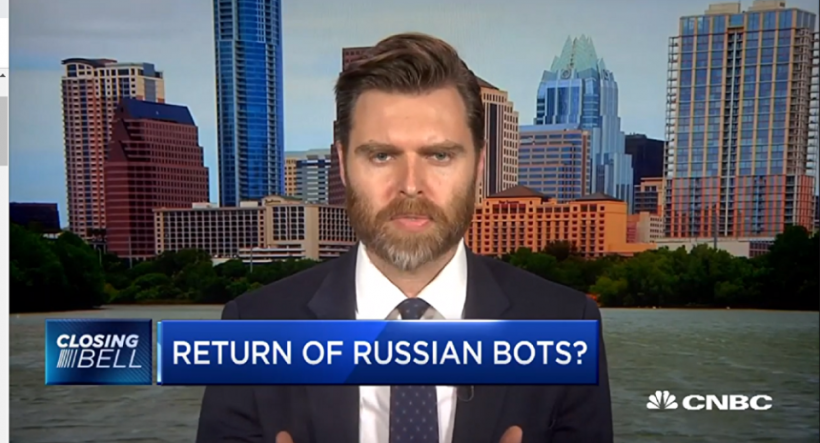
Jonathon Morgan, CEO of New Knowledge and former State Department employee.
By Kit Knightly | OffGuardian | February 4, 2019
Most of us in the UK-based alternate media are familiar with the Integrity Initiative by now. A disinformation campaign funded by the foreign office through the (very dodgy sounding) Institute for Statecraft. Their job was to smear people opposing Theresa May’s government – be they foreign or domestic. The scale of the scandal hasn’t been appreciated by the public, thanks to the muteness of the mainstream media, but the foreign office using public money to have the intelligence agencies smear the opposition should be enough to bring down any government.
Thanks to some excellent work by people in the alternate media and some MPs, the Integrity Initiative’s website is currently empty “pending an investigation of data theft”. More honestly, it had become an embarrassment. They will likely disappear and then relaunch under a new name, and may indeed have already done so. For now, the Integrity Initiative is done.
Less well-known in this country is New Knowledge, a direct US-based parallel of the Integrity Initiative. They’ve been conducting “counter-propaganda” and “social media experiments” in the US since 2015, but only just hit the headlines.
Who are “New Knowledge”?
A good question – we don’t really know. Their website claims to have “thousands of volunteers”. This may or may not be true – we only have three named people:
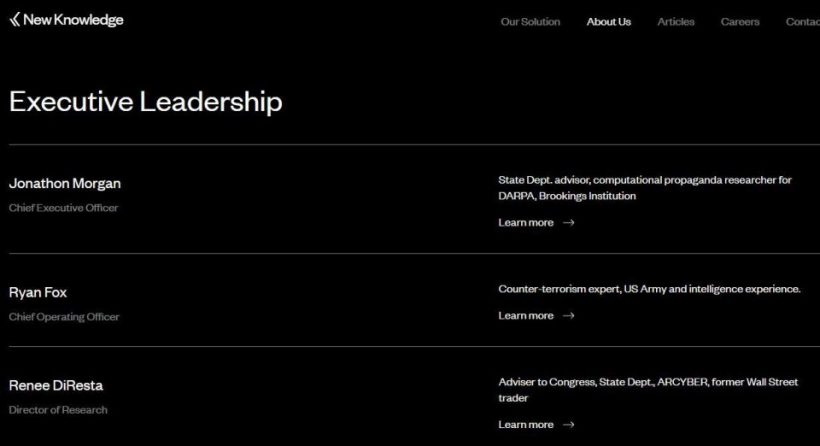
… but what a three they are. Jonathon Morgan, formerly of the State Department and Brookings Institute. Ryan Fox, formerly of military intelligence. Renee DiResta, formerly of Wall Street.
The State Department, military intelligence and Wall Street. The unholy trinity.
Obviously, some questions present themselves. Primarily, can we really trust all those “formerlies”? How did these three start this project? How do they know each other? Where does their funding come from?
We don’t know. What we do know is that, somehow, these three crazy kids got together and decided to use their money (we don’t know where they got it from) and their army of volunteers (we don’t know who they are) to “combat disinformation”. A noble goal indeed.
Let’s see how they did…
Why is New Knowledge in the news?
This “think tank” recently made the headlines in the US because they were caught attempting to manipulate the Alabama Senatorial election. This is not a fringe “conspiracy theory” claim – it was in the New York Times, twice.
It’s now known that New Knowledge took part in various social media-based attempts to swing the Alabama senate race in favour of Democrat Doug Jones. These efforts were varied and odd. They included creating a fake Facebook page, purporting to be a group of Baptists who supported Republican candidate Roy Moore, because they believed he would help them ban alcohol statewide. They also encouraged (and/or created) independent candidates from the conservative right, in efforts to split the Republican vote.
We don’t know what impact it had – but Jones did win a very narrow victory over Moore (fewer than 22,000 votes).
However, this was – by far – the most important facet of this story:
It involved a scheme to link the Moore campaign to thousands of Russian accounts that suddenly began following the Republican candidate on Twitter, a development that drew national media attention.
New Knowledge pretended to be Russians supporting a Republican candidate in order to discredit him by association. They freely admit it:
We orchestrated an elaborate ‘false flag’ operation that planted the idea that the Moore campaign was amplified on social media by a Russian botnet,”
So it seems rather than “combatting disinformation”, New Knowledge actively spreads disinformation to achieve political goals.
They are staffed by State Dept. and intelligence agency veterans, and they spread false information to swing elections. That makes them a Psy-Op:
Psychological operations (PSYOP) are operations to convey selected information and indicators to audiences to influence their emotions, motives, and objective reasoning, and ultimately the behaviour of governments, organizations, groups, and individuals.
So what was the reaction?
Mild. Disappointing. On multiple levels.
Just like the Integrity Initiative coverage in the UK, the wider implications of corruption were completely ignored. The story was always framed in terms of “fighting back against the Kremlin”, or “turning Putin’s methods against him”. The coverage focused on this being a “gift for the Kremlin” because it appeared to undermine the claims of Russiagaters (Note “appears to undermine”, rather than “undermines”).
New Knowledge (NK), of course, denied they were attempting to corrupt democracy in Alabama. Morgan called the Alabama operation an “experiment” testing the effectiveness of “Russian methods”. He claimed it was specifically “designed to have as little impact as possible”. (How you can “test the effectiveness” of something designed to have no impact is unclear to me).
No evidence is supplied to corroborate Morgan’s version of events. In fact, there’s no reason to think this is a one-off at all. This is just the one we know about. Deep State psy-ops are like ants, for every one you see… there’s a hundred you don’t. A single sighting means there’s a whole colony nearby.
All of the national media and pundits resolutely ignored the very large elephant in the very small room – NK have existed since 2015. Before the 2016 Presidential election. The NYT warns these tactics could make the 2020 election ugly – but they don’t relate it back to the 2016 election at all.
This is not about Russia “corrupting our practices” or us “employing Russian methods”, this is evidence that there NEVER WAS any “Russian interference”, that “Russia’s methods” are actually our methods. Evidence that “Russiagate” is a Deep State psy-op designed to discredit and control Donald Trump’s administration.
Rather predictably, none of the media articles takes this angle.
And, unlike the Integrity Initiative, New Knowledge’s website is very much alive and well. Outside of political corruption, there’s also levels of financial corruption. New Knowledge CEO Jonathon Morgan is also one of the builders of Hamilton 68 – a program which claims to track Russian “bot” activity. On the one hand, he works for a think-tank which fakes bot activity, on the other, he charges people for a product he claims tracks bot activity. There is, of course, a massive opportunity for fraud and corruption there.
But, far from being rebuked, sanctioned, or punished in any way – New Knowledge seems to be functioning just as before.
In fact, NBC News already ran a story claiming progressive Hawaiian Congresswoman Tulsi Gabbard is being backed by the Russian “propaganda machine”
They cite New Knowledge as an expert witness.
Conclusion
In summary, a shadowy think-tank staffed entirely by State Department and intelligence veterans is using funding from unknown sources and volunteers of unknown identity to pretend to be Russians on social media in order to discredit politicians and political movements in the United States. This should be a Congressional hearing. But instead, it’s a back-page “oh, did you know” story.
The following are important questions that need answering:
- How is the New Knowledge group funded?
- Are they paid by the government or military?
- Who are these “thousands of volunteers”?
- Are they the US equivalent of the UK’s 77th Brigade?
- What other elections were targetted by New Knowledge (or similar) operations?
Just like the Integrity Initiative, New Knowledge works by concealing its true nature and intentions. It is layer after layer of deception and darkness. It can be beaten, the same way II was beaten – by bringing it out into the open and exposing lies to the light of truth.
Kit Knightly is co-editor of OffGuardian. The Guardian banned him from commenting. Twice. He used to write for fun, but now he’s forced to out of a near-permanent sense of outrage.
As she enters White House race, demonization of ‘Kremlin’s crush’ Tulsi Gabbard goes full tilt

By Igor Ogorodnev | RT | February 3, 2019
The sky may have been clear in Hawaii when Tulsi Gabbard read her speech promising to fight “greed and corruption,” but she enters her bid under a cloud of negative media coverage and accusations of being Russia’s darling.
At first glance Gabbard would seem almost too perfect for the Democratic candidate to face Trump in 2020: a 37-year-old part-Samoan woman, who previously broke off a promising career in local politics to volunteer for combat zone service in Iraq, and is unfailingly popular with voters on her home island.
“What our country needs now more than ever is the spirit of Aloha. That spirit of respect and love for one another and for our country,” she said in a launch speech that the 2008 Barack Obama, himself, might have found too idealistically bland.
Hours earlier, in a two-author NBC investigation an entirely different picture had been painted of the “controversial” Gabbard – the centerpoint of “the first stirrings of an upcoming Russian campaign” in which the Kremlin “propaganda machine” would seek to inject pro-Russian positions into the Democratic Party’s discussions and debates with help from “inauthentic accounts.”
I’m Not With Her
To understand why Gabbard is not treated as a customary feel-good story of a woman breaking multiple glass ceilings, but as a tool of the Kremlin, several pages of her biography need to be revisited.
The first, her resignation from the senior post of Vice President of the Democratic National Committee in protest at the lack of scheduled debates between frontrunner Hillary Clinton and the rising Bernie Sanders, whom she subsequently went on to endorse.
The second, a now-famous meeting with Bashar Assad in 2017, and Gabbard’s insistence that Washington should not engage in “regime change” or sponsorship of radical militant organizations in Syria or anywhere else.
Those two incidents alone have pitted Gabbard against two major establishment forces, and that is before one gets into the details of her socialist-tinged platform from healthcare for all to anti-Wall Street policy proposals. Or her support of stronger border control, which puts her at odds with her party’s official position.
Friendly fire
None of Gabbard’s stances are beyond debate, but she may not even get as far as debating them in public with the other Democrat nominees, if her campaign is dead on arrival. And the media hasn’t been her friend.
All candidates face scrutiny and an airing of their skeletons, but not only has she received less airtime than fellow relative novices Cory Booker and Kamala Harris, but the overall coverage of Gabbard has been uncharacteristically toxic, perhaps comparable only to the Democratic ostracism of Howard Schultz, following the former Starbucks CEO’s unbidden decision to enter the race.
The favored genre has been the expose.
In the past month alone: CNN has dug up Gabbard’s activism and comments, some dating back to the late 1990s, when she was a teenager, against same-sex marriage, for a campaign backed by her legislator father. The Intercept has accused her of associating with Hindu Nationalists, while the Daily Beast has published an article under the title ‘Horseshoe theory: Why Conservative Media and the Far Right Love Tulsi Gabbard for President’, in which it was emphasized that the “enigmatic” Gabbard had “earned substantial praise” from, among others, white nationalist David Duke. Huffington Post accused her of hypocrisy for accepting money from arms manufacturers in the past, even though she never concealed that fact, and is in reality one of just several members of the House who explicitly refuse campaign donations.
Politico published a detailed dissection of her campaign being “in disarray” based on detailed unattributed revelations from the inside, while Daily Kos, the Democrat politics blog, has already endorsed her rival for the 2020 Congress run, which equates to the real election in a district where the Democrats have never lost against the GOP.
‘Defended’ her in an article – how dare they?
On Friday, came NBC’s coup de grace.
“An NBC News analysis of the main English-language news sites employed by Russia in its 2016 election meddling shows Rep. Tulsi Gabbard of Hawaii, who is set to make her formal announcement Saturday, has become a favorite of the sites Moscow used when it interfered in 2016,” wrote the authors, one of whom Ben Popken, concluded that the Kremlin “has a crush” on Gabbard when he posted his article to Twitter.
The “analysis” – which appears to have been a name search – found that 20 articles have been published on Gabbard by RT (is it 21 now?), Sputnik and Russia Insider, twice as many as Joe Biden or Bernie Sanders. And not just that, but in these articles Gabbard was not mentioned “perfunctorily” but “celebrated” and “defended” despite her “lack of voter recognition.”
Even supposing that all that is correct, does RT have to cover Joe Biden every time it mentions Tulsi Gabbard? Elizabeth Warren? Julian Castro? Should CNN stop putting Kamala Harris in almost every piece about the race? As a non-US news outlet is RT allowed to find her non-interventionist views more interesting for its international audience than those of a status quo Democratic runner? What about as an alternative media outlet? Should covering a candidate who “lacks voter recognition” be considered suspicious? How much of this is sufficient to justify accusations of meddling and being branded a “Russian troll” and presumably sanctioned? Does all of this apply when the US media writes about Juan Guaido in Venezuela?
But wait, there are also “experts who track inauthentic social media accounts” who back this up.
“A few of our analysts saw some chatter on 8chan saying she was a good ‘divider’ candidate to amplify,” New Knowledge’s director of research Renee DiResta told NBC. 8chan? Chatter? Also New Knowledge? The establishment Democrat tech outfit that has just been caught planting and creating fake Russian bots in the Alabama election as part of a false flag operation. They are your experts, NBC?
Even much of Dem-voting Twitter was appalled at such a ham-fisted smear job.
Incompetent, threat or victim of smear campaign?
The media are now fulfilling their own prophecies, as they publish pieces about the “rocky” or “chaotic” start to Gabbard’s campaign. As she keeps going on the defensive – apologizing for the gay marriage remarks, standing firm on Assad meeting – the Hawaiian representative may survive or wilt.
But two questions remain: Is Gabbard just a stumbling novice with odd views, or is the media trying to systematically bury her, as opposed to informing their readers, all because she presents a threat to accepted positions? And secondly, is it doing so at the behest of and with help from a network of influence, be it DNC operatives, or Washington insiders? If the answer to the first question is “the latter” or to the second is “yes,” perhaps instead of spending so much time on our website, investigative reporters should have a look at the provenance and motivations behind some of their own coverage.
Regime Change In Venezuela: Army Defectors, Russian Mercenaries And Disappearing Gold
South Front | January 31, 2019
Over the past few days, the intensity of anti-government protests in Venezuela has declined despite attempts of the US-led bloc to warm them up through both public and clandestine measures. However, the conflict continues to develop amid the acute standoff in the media sphere between the Maduro government and its opponents backed by the US-led bloc.
On January 29, CNN released an interview with two “Venezuelan army defectors” who appealed to US President Donald Trump to arm them to defend “freedom” in Venezuela. They claimed to be in contact with hundreds of willing defectors via WhatsApp groups and called on Venezuelan soldiers to revolt against the government of President Nicolas Maduro.
“As Venezuelan soldiers, we are making a request to the US to support us, in logistical terms, with communication, with weapons, so we can realize Venezuelan freedom,” one of the alleged defectors, Guillen Martinez, told CNN. Another one, Hidalgo Azuaje, added: “We’re not saying that we need only US support, but also Brazil, Colombia, Peru, all brother countries, that are against this dictatorship.”
During the entire clip, these persons were presented in a manner alleging that they had just recently defected and are now calling on others to follow their step. However, therein lies the problem. The badges on their uniform say FAN – Fuerza Armada Nacionales. This is an outdated pattern, which has been dropped. Now, Venezuela’s service members have a different badge – FANB, which means Fuerza Armada Nacional Bolivariana. So, either the “Venezuelan army defectors” somehow lost the letter B from their uniform, or the entire interview is a staged show involving former Venezuelan service members, who have been living for a long time outside the country, or in the worst case – actors.
The interview came amid increasing US political, media and sanction pressure on the Maduro government. White House National Security Adviser John Bolton was even spotted with a mysterious note about the deployment of 5,000 US troops to Colombia, the US ally which borders Venezuela. In this situation, a large-scale military uprising or at least formation of some opposition within the army would become a useful tool in a wider effort to overthrow the country’s government. On the other hand, the use of such CNN-styled content shows that so far the US and its proxies have achieved little success in buying the support of Venezuelan service members.
On January 29, Venezuelan lawmaker Jose Guerra claimed via Twitter that a Boeing 777 of Russia’s Nordwind Airlines landed in Caracas on January 28 to spirit away 20 tons of gold bars, worth some $840 million, from the country’s central bank. When asked how he knew this, Guerra provided no evidence. By January 30, these items of breaking news had rocked the headlines of most of the mainstream media.
Another version, which was also quite popular among pro-opposition media, is that the plane, which reportedly made the trip directly from Moscow, moved in a group of Russian private military contractors to support the Maduro government. This version is fueled by reports claiming up to 400 Kremlin-linked private military contractors may have arrived in Venezuela.
The developing crisis is also accompanied by the growth of citizen journalism. Bellingcat members already created a Twitter page named “In Venezuela”, which provides field news about the crisis from Toronto, Canada. It’s easy to expect some “open source intelligence investigations” revealing crimes of the Maduro government against peaceful protesters very soon if the conflict escalates further.
Roughly speaking, the mainstream media presents the audience with the following story: The Maduro government is about to fall and is already moving the country’s gold reserves somewhere via Russian planes. At the same time, Vladimir Putin sent his mercenaries to rescue Maduro and to keep the corrupt regime in power in order to secure Russia’s economic and political interests. This, as well as the oppressive nature of the regime, are the only reason why the forces of good have not yet achieved victory.
Fortunately, there is the shining knight of democracy, Juan Guaido, who was democratically appointed as the Interim President of Venezuela from Washington. He, his Free Venezuelan Army consisting of hundreds of WhatsApp defectors and a group of unbiased US/NATO-funded citizen journalists and investigators are ready to stand against the Maduro-Putin alliance and to defend freedom and democracy in Venezuela… with a bit of help from the Trump administration for sure.
There are no doubts that modern Venezuela is allied with Russia and Moscow will employ its existing influence to resolve the crisis and thus defend its investments and oil assets. Furthermore, Maduro and his supporters showed that they are not going to give in to the US-led pressure. At the same time, The level of MSM hysteria, including an open disinformation campaign against the Maduro government and attempts to demonize it through various means, including its ties with Moscow, show that the Washington establishment is serious in its regime change efforts and may even be ready to instigate a Syria-style “proxy war” in the country in order to achieve own goals.
Mueller claims evidence shared with Russian firm’s defense leaked to ‘discredit investigation’
RT | January 31, 2019
In an apparent bid to shield his case against alleged Russian trolls from legal challenge, special counsel Robert Mueller claimed some evidence previously provided was hacked and published to discredit his probe.
On Wednesday, Mueller filed a motion to oppose discovery in case against Concord Management and Consulting LLC, which he indicted last February on charges of running the Internet Research Agency, also known as the “St. Petersburg troll factory.”
“Sensitive” evidence in the case cannot be turned over to Concord’s lawyers, because that would make it accessible to their clients in Russia – and back in October, Mueller claimed, someone claimed to have hacked Concord’s computers and posted evidence previously handed over online “as part of a disinformation campaign aimed (apparently) at discrediting ongoing investigations into Russian interference in the US political system.”
It was that claim that got the attention of the media and the ‘Russiagate’ crowd.
What Mueller actually alleges is less headline-worthy and far more tenuous. Namely, on October 22 last year, a Twitter account @HackingRedstone claimed to have gained “access to the Special Counsel Mueller’s probe database as we hacked Russian server with info from the Russian troll case Concord LLC v. Mueller,” offering “all the files Mueller had about the IRA and Russian collusion.”
According to a footnote in the filing, Mueller’s team was informed of this by an unnamed reporter. However, the Twitter account referenced comes up as suspended, and aside from that notice there are no entries for it in the Internet Archive, making Mueller’s claim impossible to independently verify.
The webpage allegedly linked in the tweet is said to have contained “file folders with names and folder structures that are unique to the names and structures of materials… produced by the government in discovery.”
Of the 300,000 files on the site, “over 1,000” matched the hashtag values of documents provided by Mueller to Concord, the filing said. Mueller argued these must have been obtained from Concord, because the FBI “found no evidence” that US government servers fell victim to any hack involving the files. Somewhat confusingly, the filing argued that many other file names used a reference to the Relativity database, which the US government “has not used” to store materials related to this case.
Concord’s lawyers have informed the court that the company’s computers have not been hacked, but Mueller’s filing accused them of lying, saying that the webpage contained “actual discovery materials from this case.”
Because the webpage – which the FBI says was registered to an IP address in Russia – also contained “numerous irrelevant files,” whoever created the page wanted to make it appear as if the dump was the sum total of Mueller’s evidence on “Russian collusion,” and therefore amounted to “an apparent effort to discredit the investigation,” according to the filing.
To wit, Mueller is making an assertion based on a tweet and a webpage – that currently do not exist – to argue that it should not disclose further “sensitive” evidence to defendants in a Russiagate case.
The original indictment of Concord was seen as a major coup for Mueller – the first charges against actual Russians in his open-ended probe of the 2016 US election at that point – but it quickly turned into a headache, when the company’s US lawyers chose to contest the charges and file motions for discovery.
While the indictment against the Internet Research Agency is one of the few results of Mueller’s probe that actually involve Russia, the court prospects of the case were in doubt from the start. All the individuals accused under it are Russian citizens, and Russian Constitution does not allow extradition of its nationals, which means getting the suspects to actually stand trial would be difficult.
NewsGuard: A Neoconservative Contrivance Which Promotes an Establishment View
By Philip Giraldi | American Herald Tribune | January 28, 2019
There’s a new thought policeman in town. He calls himself NewsGuard and he promises to restore “Trust and Accountability” to what one reads online. His website elaborates that “NewsGuard uses journalism to fight false news, misinformation, and disinformation. Our trained analysts, who are experienced journalists, research online news brands to help readers and viewers know which ones are trying to do legitimate journalism—and which are not… Our Green-Red ratings signal if a website is trying to get it right or instead has a hidden agenda or knowingly publishes falsehoods or propaganda.”
One might well stop reading immediately after running into “our trained analysts” with all that implies, but that would deny the greater pleasure derived from considering news-sites that have “… a hidden agenda or knowingly [publish] falsehoods or propaganda.” Excuse me, but hidden agendas, lies and propaganda are what the mainstream media is all about, note particularly the recent feeding frenzy over the Covington school incident at the Lincoln Memorial. Catholic racist white boys vs. elderly Native American war hero was how the story was framed all over the mainstream media before it became clear that the entire chosen narrative was upside down. Only a couple of news outlets bothered to apologize when the truth became known.
NewsGuard claims to have a staff of 50 that evaluates 2,000 websites in something like real time. How exactly it does that is not clear, but The New York Times repeats company claims that “the sites it rates account for 96% of online news and information engagement in the U.S.” NewsGuard also told The Times that it intends to quadruple its vetting of sites and seeks to make its coverage “ubiquitous.”
Make no mistake, NewsGuard is a neoconservative contrivance which promotes an establishment view of what is true and what is false. Its co-founder Gordon Crovitz is an ex-editor of The Wall Street Journal, who has enthused over the project, saying that it is “a milestone in the fight to bring consumers the information they need to counter false information, misinformation and disinformation online.” Crovitz has also been associated with the leading neocon foundation The American Enterprise Institute while the NewsGuard advisory board includes Tom Ridge, who was head of the Department of Homeland Security under George W. Bush, and Michael Hayden, who directed both the CIA and NSA. It is as government-establishment in orientation as it is possible to be.
In a sense seeking to establish “accuracy” in news reporting is nothing new as the social media, to include Facebook and Twitter, have had that objective for some time, but NewsGuard defines itself as having as its target the screening of the entire media in a politically impartial fashion, as “an information resource.” And the real danger is that it will soon be appearing on your computer or phone whether you want it there or not. It is already installed on local library computers in Hawaii and Ohio and is working with university and even high school libraries to include its software on all public computers. Worse still, NewsGuard is in partnership with Microsoft as part of the latter’s Defending Democracy Program. Microsoft currently has NewsGuard on its Edge browser and it intends to install the tool on its Microsoft 10 operating system as a built-in feature. Microsoft 10 is the standard operating system on nearly all computers sold in the United States.
When you go to a news site NewsGuard has a little shield that pops up in the corner of your screen that will tell you whether that site is a reliable source or not. A green tag displays for approved and red for not compliant. Similarly, if you do a search the responses that come up will feature a green or red shield as part of the results. The site for NBC news shows green, approved, with the heading “this website generally maintains basic standards of accuracy and accountability.” It then uses what it calls a “nutrition label” to break down the nine specific areas that were assessed, each of which also receives and individual green check for NBC. Under “Credibility” appears “Does not repeatedly publish false content; Gathers and presents information responsibly; Regularly corrects or clarifies errors; Handles the difference between news and opinion responsibly; and Avoids deceptive headlines.” Under “Accountability” appears “Website discloses ownership and financing; Clearly labels advertising; Reveals who’s in charge including any possible conflict of interest; and The site provides names of any content creators along with either contact or biographical information.”
The first thing one might observe about the system is that it is designed to favor large, well-funded establishment news sources that are staffed to go through the motions of fact checks and corrections. All of the major news networks are approved, including Fox, MSNBC and CNN, all of which editorialize heavily, almost constantly, in their news coverage. Voice of America, which is a U.S. government propaganda instrument by design, also is approved. NewsGuard also has approved all major newspapers to include The New York Times, which frequently gets the story wrong, and The Washington Post, where news stories are nearly indistinguishable from editorials through the use of evocative headlines and slanted narrative. All the U.S. media currently lead off, for example, with stories about Russia that include the assertion that the Kremlin interfered in the 2016 election, a claim that has yet to be confirmed through actual evidence.
Russian media operating in the U.S. including RT America and Sputnik get red ratings with a warning “Proceed with caution: this website fails to basic standards of accuracy and accountability.” RT is apparently guilty of “repeatedly publishing false content,” “not gather[ing] and publish[ing] information responsibly,” “not handl[ing] the difference between news and opinion responsibly” and “not provid[ing] the names of creators.” Al-Jazeera, another news service that often criticizes the United States and its governmental policies also is rated red, suggesting that the true criterion for rejection by NewsGuard is one’s relationship to the official establishment and globalist/interventionist line being promoted by the United States.
A glaring example of NewsGuard’s political bias relates to BuzzFeed, which is an approved site. The Washington Post reported recently how a BuzzFeed story about Michael Cohen and President Trump claimed that the president had directed his lawyer to lie to Congress regarding a proposed office tower project in Moscow, which would have been both a crime and impeachable. A day later Special Counsel Robert Mueller’s office intervened and described the story as untrue. The New York Times ran the first story on page one but the retraction that followed appeared on page 11.
And it was not the first major bit of fake news for BuzzFeed. The same two journalists had previously reported that Russia had financed the 2016 election.
CNN, another NewsGuard green authority, inevitably bemoaned possible consequences arising from the Cohen-Trump story by complaining that it would be used to justify “bad stereotypes about the news media,” had its own Russiagate misstep when it falsely claimed that Donald Trump Jr had had access to WikiLeaks’ DNC emails before their 2016 publication.
The BBC, yet another reliable source approved by NewsGuard, reported back in September that the U.S. government had evidence that the Syrian “regime” was continuing to develop chemical weapons. It added an assessment from the completely befuddled U.S. envoy for Syria James Jeffrey that “President Assad had ‘no future as a ruler’ in Syria… Right now [the Syrian government] is a cadaver sitting in rubble with just half the territory of Syria under regime control on a good day.”
The fact is that Jeffrey was completely wrong about developments in Syria, where the government had been extremely successful in re-asserting control over nearly all of the country, while the claims of chemical weapons use have been rebutted many times, including by actual witnesses and journalists on the ground during the alleged attack at Douma in April.
Reuters news agency, yet another NewsGuard green light, is also into the game. In November 2013 it published an article, part of a series, entitled “Khamenei controls massive financial empire based on property seizures,” which claimed that an Iranian government charitable foundation called Setad (also known as EIKO) actually exists to take control of property for the use of the government’s religious leadership.
A subsequent news report that appeared in January in the alternative media revealed that the investigative journalists who wrote the story did so from Dubai, London and New York and never visited the properties they identified, in most cases completely misrepresenting what could be seen on the ground.
Robert Fontina at Counterpunch has also rejected the depiction of Setad as anything but a charitable foundation. The truth is that Setad engages in major social projects, including rural poverty alleviation, empowering women, home and school building, and provision of healthcare. Fontina observes that American sanctions against it and similar entities hit ordinary Iranians’ lives by producing food insecurity while also restricting the supplies of needed medications. Ahmad Noroozi of the Barakat Foundation claims that numerous Iranians have already been affected by U.S.-initiated sanctions directed against his country, restricting access to cancer treatments and other pharmaceuticals.
So who gets the endorsement from NewsGuard? Those who toe the line on U.S. policy and the establishment globalist/interventionist agenda. It would be interesting to know what NewsGuard’s staff of analysts is really looking for when it researches a site or media outlet. As the examples cited above demonstrate, NewsGuard has nothing to do with taking pains to report the news accurately, nor is there any evidence of real accountability. It is all about who pays the bills and who is in charge. They give the orders and one either falls in line or goes out the door. That is the reality of today’s mainstream media.
Philip M. Giraldi is a former CIA counter-terrorism specialist and military intelligence officer who served nineteen years overseas in Turkey, Italy, Germany, and Spain.
Of Suspected Spies & Cathedrals… and Western Media Hypocrisy

By Finian CUNNINGHAM | Strategic Culture Foundation | 27.01.2019
It’s hilarious to see the double standards of Western media applied in the case of alleged American spy Paul Whelan who is being detained in Russia and facing trial.
Whelan, a former US marine, was denied bail this week in a Moscow court after it emerged that he had been found in possession of state secrets while supposedly holidaying in Russia.
Western media widely aired the theory that the American man has been “set up” by Russian state security after he had received a USB computer stick from someone while staying in a Moscow hotel last month. The person whom he received the disk from has not been identified, but presumably he or she was known to the American, otherwise why would he have accepted the item?
Whelan claims he was in Russia as a tourist and that he didn’t check the contents of the computer mini-disk at the time because he assumed it contained “images of a cathedral he had visited”. He was reportedly arrested soon after receipt of the disk, on December 28, by Federal Security Service (FSB) officers.
This sounds eerily familiar. Remember the two Russian men who visited Salisbury in March last year at around the time of the alleged poisoning of former Kremlin spy Sergei Skripal? Months later, those two men were identified as “suspects” on British CCTV cameras whose images were broadcast by media. Both then promptly came forward to give an interview to Russian media in order to clear their names, which they confirmed as Alexander Petrov and Ruslan Boshirov.
Petrov and Boshirov claimed they were in Salisbury around March 4 as tourists, not as Kremlin assassins as the British media were sensationally alleging. Asked why they were in Salisbury, the pair said it was to visit the medieval English town’s “famous cathedral” and its 123-meter spire.
The immediate reaction by British media in particular was to pour scorn and ridicule on the men’s story. The British government rubbished their claim as “obfuscation and lies”. Journalists and pundits lambasted the pair with guffaws and mockery.
Petrov and Boshirov denied they had any involvement in the alleged poisoning of Skripal – supposedly with a deadly Soviet nerve agent – and they said they were not Kremlin agents but rather worked in the sports nutrition business.
There is no indication thus far that the men’s story is false. Also, what really happened to Skripal and his daughter Yulia remains a mystery since the British authorities won’t reveal where they are – 10 months after the alleged poisoning incident.
The only follow-up media report on the Russian men’s alleged security service affiliation was by the dubious UK-based Bellingcat website, which has a history of fabricating anti-Russian propaganda, such as alleged chemical weapons attacks in Syria and the alleged shooting down by Russian-backed separatists of a Malaysian civilian airliner in eastern Ukraine in 2014.
In the case of Paul Whelan, a former US elite soldier who possesses four passports and who apparently visited Russia several times and had become familiar with the country, he is permitted by Western media to plead his innocence invoking an interest in cathedrals and churches. Not a wink of skepticism here.
However, in the case Petrov and Boshirov, who have no known background in military, they are immediately scoffed at for their declared interest in Salisbury’s medieval cathedral, which by the way is world famous and attracts thousands of visitors every year, including many Russian tourists.
What’s more, in the case of Whelan, the Western media has gone further to report that he is being set up by Russian agents, who planted the state secrets in the USB disk. It is speculated in the Western media that the Kremlin is using the American as a bargaining chip in a potential prisoner-exchange deal for Russian citizen Maria Butina. Butina was jailed at the end of last year in the US after she pleaded guilty to espionage charges, following months of isolated detention. The Kremlin said she had no association with its agencies.
Moscow categorically denies that there is an ulterior agenda for doing a prisoner swap. Russian authorities have said that Whelan was simply “caught red-handed” with state secrets and is being prosecuted accordingly. The classified information is believed to contain the names of individuals who work for Russian secret services.
Whelan’s family back in the US maintain he is innocent and that he was in Russia to attend the wedding of a friend. If found guilty, he could be facing up to 10-20 years in jail.
Who knows, maybe the American was set up in a dirty game of state intrigue.
The case of Maria Butina appears to be a disturbing one of the American state framing up a Russian citizen to bolster a political agenda of alleged Russian interference in US elections. Her pre-trial detention in solitary confinement certainly amounts to a form of psychological torture to pressure a confession. Butina is facing several years in prison, despite many observers considering her to be innocent.
But one thing seems glaringly obvious: the double standard being used by Western media which is borne out of its relentless Russophobia.
A former US marine is seen as a plausible tourist interested in viewing cathedrals whom, the Western media claim, is now being persecuted by despotic Russian authorities; while two Russian civilians are pilloried for plying a “ridiculous cover story” about Salisbury’s 123-meter spire.
Russian Ambassador Says Reports on Alleged Russian Mercenaries in Venezuela Hoax
Sputnik – 26.01.2019
Russian Ambassador in Caracas Vladimir Zaemsky slammed on Friday in a conversation with Sputnik media reports about alleged presence of “private military contractors” from Russia in Venezuela as “another hoax.
“I don’t know about the presence of any Russian private military companies in Venezuela. This is another hoax,” Zaemskiy said.
Earlier in the day, Reuters news agency reported, citing anonymous sources, that “private military contractors who do secret missions for Russia” had recently arrived in Venezuela, which is currently going through a political crisis, to boost safety of the country’s incumbent president, Nicolas Maduro.
Kremlin spokesman Dmitry Peskov told Reuters that Kremlin had “no such information.”
On Tuesday, the opposition-run Venezuelan National Assembly adopted a statement declaring President Nicolas Maduro a “dictator.” On Wednesday, opposition leader Juan Guaido proclaimed himself the country’s interim president at a mass rally in Caracas. The United States, Argentina, Brazil, Canada, Chile and Colombia, among others, have recognized Guaido as Venezuela’s interim president, while some other countries, including Russia and Mexico, expressed support for incumbent President Maduro.
‘Western journalists have become cheerleaders for war’ – analyst on Estonian ‘bomb Russia’ article
RT | January 23, 2019
A recent Estonian op-ed calling for capability to shell St.Petersburg and sink Russian ships in case of conflict may be hypothetical, but the pressure on Tallinn to buy missiles from NATO is real, a British journalist told RT.
“Just several limited strikes” on St. Petersburg could be enough to change Russia’s mind if it ever decides to attack Estonia, an opinion piece in Delfi, one of the top online news outlets in the Baltics, suggested. Its author, Estonian journalist Vahur Koorits, also urged the country to become capable of sinking or hijacking Russia ships in order to disrupt trade in the Baltic Sea.
Koorits’s article is part of a wider trend that signals “a sad decline in journalism” in Europe and the US, according to UK journalist Neil Clark.
“A lot of journalists in the West have become cheerleaders for military confrontations and wars… Instead of being skeptical, looking at issues objectively and actually trying to hold power to account, they’re doing the opposite. This is very worrying,” he said.
The publication in Delfi was “the latest in a number of similar articles, basically calling for aggression against Russia,” Clark noted. He recalled another example in the Washington Examiner last year, in which US political commentator Tom Rogan advised Ukrainian authorities to bomb the newly built 19km bridge connecting Crimea with mainland Russia.
“Just imagine a Russian writer saying a similar thing about America or Britain, saying that infrastructure in the US should be bombed. It would be seen as outrageous… hailed as evidence that Russia is aggressive; threatening the West,” Clark said.
However, when a Western journalist is calling for the use of force against the countries that have been labeled as “bad guys” by Washington and London, “there is silence,” he added.
Moscow, of course, has “zero reasons” to attack Estonia and Tallinn would never dare to attack Russia, so the op-ed by Koorits should be treated with “a smile,” the British journalist stated.
However, he warned that Estonia and its Baltic neighbors in Latvia and Lithuania “are very crucial actors of this new Cold War against Russia.”
“Think tanks working for the Western arms companies are promoting this narrative of a Russian threat to the Baltics in order to sell weapons. It could well be that Estonia does come under pressure to buy missiles that could threaten St. Petersburg,” Clark said.
READ MORE:
‘Russians will die in Tallinn if they invade’: Estonian commander launches bizarre rant
Featured Video
EUROPE FEARS RUSSIA’S NEXT MOVE / Ian Proud
or go to
Aletho News Archives – Video-Images
New Book
New Book: No Autoimmunity The Body Doesn’t Attack Itself
Lies are Unbekoming | September 24, 2026
 The label for Humira, once the best-selling drug in the world, lists its risks in plain print. One of them, in the label’s own words, is new “autoimmune” disease.
A drug prescribed for a condition labelled autoimmune carries a warning that it can cause a condition labelled autoimmune. That contradiction sits in every box, on a folded paper almost nobody reads.
My new book starts there.
No Autoimmunity: The Body Doesn’t Attack Itself
For seventy years, “your body is attacking itself, and we don’t know why” has ended the conversation for people diagnosed with multiple sclerosis, lupus, rheumatoid arthritis, Hashimoto’s, Type 1 diabetes, Crohn’s and psoriasis. More than eighty conditions now carry the autoimmune label. The diagnosis comes with a prescription for life. It almost never comes with a question about cause.
This book asks the question and answers it from the framework’s own records: its drug labels, its journals, its regulatory filings, and its own experiments. … continue
Blog Roll
 Aletho News
- Israeli settlers terrorize West Bank Palestinians with state-provided drones: Report
- They see them, then kill them: Israeli quadcopters track, deliberately target civilians in Gaza
- Debunked: Trump’s egregious UNGA claims on war against Iran crumble under scrutiny
- Europe was part of the infrastructure of US aggression against Iran: Deputy FM
- New evidence on the Bucha Massacre
- Italy and France debunk reports CIA issued ‘Russian drone threat’ warning
- How Russia is Rewiring the Global South
- Britain’s elites want you ready to die for a war they keep imagining
- Inside Ukraine’s propaganda operation targeting Americans
- Hackers From US, France, Singapore Tried to Disrupt Russian Elections – Internet Provider
- If Americans Knew
- Trump betrayed voters with his campaign lies and prioritized a foreign country once he took office
- Netanyahu calls Israel’s war in Gaza ‘opposite of genocide’ in UN speech to near-empty hall
- Settler Kidnappings: Torture, Sexual Abuse and Terrorisation of Palestinian Abductees as Israel Deepens Annexation of West Bank
- Gaza winter nears as 162,000 tents become unusable, raising fears of humanitarian crisis
- Netanyahu says, “It’s the opposite of genocide”; UN says Gaza economy is world’s ‘most severe crisis on record’ – Daily Update
- Israel’s US-Backed Assault on Gaza Has Created the ‘World’s Most Severe Economic Crisis on Record’: UN
- ‘Protecting U.S. Citizens’… From Israel
- ‘This is where I live now, the back of a truck’: a day in the life of a grandmother in Gaza
- In UN Speech, Iran’s President Displays Pictures of Children Killed by US, Brings Attention to Israel’s Nuclear Arsenal
- Israel displaces hundreds of Palestinians amid wave of demolitions in West Bank
- No Tricks Zone
- New Study: Earth And Venus Surface Warmth Largely Explained By Convection And Lapse Rate, Not CO2 Or Radiation
- 2025 Nature Paper Claiming Worsening Global Drought Gets RETRACTED …Heavily Flawed
- New Study: ‘Global Drought Shows No Detectable Recent Acceleration Under Climate Warming’
- Economic Masterminds: German Socialists Suggest Taxing Productivity Gains Stemming From Using AI
- The South China Sea Has Not Been Cooperating With The Climate Change Narrative
- Energy Crisis: Germany Enters Heating Season With Historically Low Gas Reserve Fill Levels
- New Study: The Antarctic Ice Sheet Gained Mass From 2020-2024 Due To Staggering Snow And Ice Accumulation
- Study: Ocean Heating Rates From Thousands Of Years Ago ‘Dwarf’ Modern Ocean Heating Rates
- Climate Extremists Target, Attack Large-Scale Power Grid Infrastructure In Germany!
- New Study: Antarctic Ice Melt Has Contributed Less Than 1 Centimeter To Sea Level Rise In The Last 30 Years

