Geopolitics before sport: Russian athletes were punished for being Russian
By Neil Clark | RT | January 23, 2019
Russian athletes, falsely accused of doping, won an important legal victory at the weekend. But unfortunately, the mud has stuck which is what Russia’s geopolitical enemies always wanted.
As the old saying goes “a lie can be halfway around the world before the truth has got its boots on.” Basically on the ‘evidence’ of one man, who lives in America, and the lobbying of certain NATO countries, Russian athletes were collectively held to be guilty of doping offences and deprived of their opportunity to compete at the very highest level.
A great injustice was done to the sportsmen and women involved, but now, finally, the record is being put straight.
On Saturday, the Swiss Supreme Court turned down the International Olympic Committee’s appeal against the Court of Arbitration for Sport’s ruling to acquit 28 members of Team Russia of doping allegations during the 2014 Sochi Winter Olympics.
Christof Wieschemann, the lawyer for Russian cross-country skier Alexander Legkov, who the IOC tried to deprive of Olympic medals, has stated that Russian athletes falsely accused could have avoided career-ruining bans if the IOC hadn’t concealed facts of their innocence.
His firm says that the IOC “seriously violated the procedural rights of the athletes and even withheld exculpatory evidence from the defense and the court.”
Wieschemann says he filed no fewer than five written requests to the IOC for evidence against his client, but he was never shown any.
Just imagine if US athletes had been treated in such a scandalous way. But it’s Russians and of course we all know they’re a bunch of cheats, don’t we? That’s certainly what we are supposed to believe by those who want us to hate Russia as much as they do.
The campaign to get Russian athletes banned can be traced back directly to those countries who are most vocal in opposing Russia internationally. This is about politics and not genuine concern about sporting malpractice.
In July 2016, Reuters revealed how the heads of US and Canada’s anti-doping bodies had drafted a letter to WADA, the World Anti-Doping Agency, calling for ALL Russian athletes to be banned from the Rio Olympic Games. The letter was circulated by the Canadian representative to other WADA members.
As I wrote here, just imagine if the Russian anti-doping agency had sought to get all US or Canada athletes banned, whether or not they had been found guilty of cheating.
The WADA report into alleged Russian ‘state-sponsored’ doping, based solely on the testimony of former Moscow anti-doping laboratory director Grigory Rodchenkov, who defected to the US in 2015, was put together by a Canadian lawyer, Richard McLaren.
No one is saying that McLaren was himself biased, but surely in the interests of natural justice, would it not have been better if the report had been compiled by someone from a non-NATO country and not a country that was, quite clearly, pushing for a Russian ban?
Even Russian Paralympians have been victimized. In 2016, the International Paralympic Committee (IPC) bowed to pressure to introduce a blanket ban on Russian Paralympians competing in Rio. Six of the 14 members of the IPC’s governing board came from NATO countries.
The IOC itself came under enormous pressure to introduce a similar blanket ban on Team Russia competing in the 2018 Winter Olympics in PyeongChang. We know from leaks from the hacktivist group Fancy Bear, that the IOC was far from satisfied with the ‘proof’ of a state-sponsored program in parts of the McLaren report. We also know that Martial Saugy, the former director of the WADA’s accredited doping Laboratory of Lausanne accused the McLaren report of making “incorrect allegations.”
In November 2017, WADA chief Craig Reedie admitted that, while there were “hints” and “claims” of evidence of a systematic state-sponsored Russian doping scheme, 95 of the 96 cases of Russian athletes WADA was investigating had been suspended because “there was not sufficient evidence to pursue an anti-doping rule violation.”
In normal times, the IOC would have acknowledged that the case against Russia did not stack up. But these were not normal times.
Portraying Russia as a country that cheated, on a routine, state-sanctioned level at sport has been an important part of the propaganda campaign to delegitimize the country and place it in the international ‘sin-bin.’ This would be punishment for Russia for daring to thwart neocon plans for regime change in Syria and for being a competitor with the US in the lucrative European energy markets. Russia can’t be trusted. It needs to be sanctioned. Don’t you get the message?
It was entirely predictable that the IOC’s decision to ban Russian athletes from competing under the Russian flag in PyeongChang, was lauded on social media by the late US neocon Senator John McCain. He also used it an opportunity to call, once again, for FIFA to take the 2018 Football World Cup away from Russia.
An American playwright called Bryan Fogel, also did his bit. As I noted here, it was Fogel and Rodchenkov who took their story to the New York Times, triggering the McLaren report.
‘Icarus’, the documentary film Fogel made, which included interviews with Rodchenkov, not surprisingly given the neo-con induced Russophobic climate, won an Academy Award in 2018.
In an interview with the FT, Fogel said Russia had a “cultural problem” with drugs, which went back to communism.
Let’s not mention how communist Hungary were cheated out of the 1954 World Cup, or the allegations about widespread US doping made by Wade Exum, the US Olympic Committee’s former director of drug control, in 2003, shall we?
I took a look at Fogel’s Twitter feed and guess what? The first tweet is a retweet of Kremlin critic Bill Browder. Fogel also refers to WADA chief Sir Craig Reedie – who spoke to RT in 2017 – as a “criminal President.”
You can see where he’s coming from.
Saturday’s Swiss court decision comes too late for the innocent Russian athletes who lost their chance to compete under the flag of their own country at the greatest sporting events in the world.
But it should, I think, inspire a new report and then a new investigative documentary on the campaign to get Russia banned. It could be called ‘Robbed!’. Only this time, don’t expect it to win an Oscar.
Integrity Initiative wipes website pending probe into ‘theft’ of disturbing leaked data
RT | January 22, 2019
The British state-funded Integrity Initiative, exposed last year for conducting Europe-wide political influence campaigns in leaked files, has removed all of its website content “pending an investigation” into the data “theft.”
A group claiming association with the loose hacktivist collective Anonymous has been dumping private Integrity Initiative documents online in various batches since November. The leaks revealed that the Scotland-based, government-funded organization, which bills itself as a non-partisan disinformation-busting charity, was actually using “clusters” of journalists, politicians, and academics to carry out secret anti-Russia campaigns, interfere in domestic politics across Europe and smear anyone who questioned its narratives.
In a surprise move on Monday, the Integrity Initiative abruptly announced on Twitter that it had “temporarily removed” all content from its site “pending an investigation into the theft of data” from the Institute of Statecraft, the II’s London-based parent operation.
In a statement posted on its now mostly bare website, the II claimed the leaks were “part of a campaign to undermine the work” of the Initiative which it said involved “researching, publicising and countering the threat” Europe faces in the in the form of “disinformation” and “hybrid warfare” – ironically, exactly what the shady organization itself was accused of engaging in with its hefty government paycheck.
It remains an open question if, in an effort to save face, the group would accuse Russia of being behind the leaks and even of doctoring the documents. While the statement admitted that some of the leaks were “genuine,” it claimed others were “falsified” – but did not provide any evidence to back up that claim. It is, however, apparent that Russia has been the Initiative’s main target during the course of its questionable work.
The website will be “relaunched shortly” and “analysis” of the hack and its “significance” will be published soon, the statement said. It doesn’t look as though many will be awaiting that analysis with bated breath, however.
Perhaps discouraging for the Integrity Initiative, few seemed upset to see their content disappear. Most responses to the announcement tweet are of the trolling variety, accusing the organization of simply being caught in the act and trying to clean house.
After the II leaks, Scottish newspaper the Daily Record wrote that the revelations – including that the government-funded organization had also conducted a domestic smear campaign against Jeremy Corbyn – was “one of the biggest political scandals of the year.”
The scandal received scant coverage by mainstream British media, however. Labour MP Chris Williamson told RT earlier this month that the lack of interest could have something to do with the fact that high profile journalists themselves were seemingly involved in the shady operation.
BuzzFeed’s Cohen Lies Just Latest Example of Embarrassing ‘RussiaGate’ Hysteria
By Kit Klarenberg | Sputnik | January 21, 2019
In a bombshell report, on 17 January BuzzFeed claimed Donald Trump had told his lawyer Michael Cohen to lie to Congress about the specifics of the ‘Trump Tower Moscow’ project — a felony, and indeed an impeachable one.
Other news outlets the world over eagerly regurgitated the story, and Democratic lawmakers on social media and indeed on the floor of the US legislature advocated kickstarting impeachment proceedings.
However, in an unprecedented move, the very next day special counsel Robert Mueller broke with his 20-month-long convention of not commenting on news reports relating to his investigation by announcing the story wasn’t true. Moreover, he was critical of BuzzFeed’s failure to contact his representatives and ask for verification on the story before publication.
History of Fabulism
Not long after Mueller’s denial, more critical voices began scrutinizing the report. Many noted Jason Leopold — one of the reporters on the story — had previously been involved in another epic ‘fake news’ fiasco at BuzzFeed relating to Russia. In November 2017, he authored a story which claimed the FBI was investigating records indicating in August 2016 the Russian Foreign Ministry sent US$30,000 to its embassy in Washington for “election financing”.
A shock story evidently written for maximum ‘clickbait’ value, Leopold — almost certainly consciously — opted to bury the fact the payments related to Russia’s own elections in September 2016, in which expatriate Russians were permitted to vote in their adopted home countries. As of January 2019, the article hasn’t been removed from web, although a qualifier has been added to its introductory paragraph.

Jason Leopold
Others expressed shock Leopold was still employed by any media outlet at all, for as Colombia Journalism Review documented back in 2006, his lengthy career has been typified by controversy, ignominy and dishonesty.
For instance, in August 2002 Leopold wrote an article for Salon claiming then-Secretary of the Army and former Enron vice chair Thomas White knew more about the company’s infamously questionable accounting practices than he’d admitted up to that time. The key piece of evidence for the allegation was an internal Enron email that was apparently leaked to Leopold by an anonymous source — but after he was unable to produce a copy when asked by his editor, and it was revealed he’d plagiarised portions of the piece from the Financial Times, it was pulled from the website.
In a perversely ironic twist, in 2005 Leopold’s memoir (Off the Record), in which he pledged to come clean about all the “lying, cheating and backstabbing” he’d engaged in over the course of his journalistic career and set the ‘record’ straight on his various ignominious departures from media organisations (including the Los Angeles Times and Dow Jones ), was dumped by planned publisher Rowman & Littlefield just before it went to press after one of the book’s sources threatened to sue.
Leopold had claimed the source in question, Steven Maviglio — spokesperson for then-California Governor Gray Davis — had told him he “might have broken the law by investing in energy companies using inside information”, which was apparently totally untrue.
The next year, Leopold again landed in hot water when he published a story for Truthout claiming Karl Rove “told President Bush and Chief of Staff Joshua Bolten, as well as a few other high level administration officials,” he was due to be indicted in the Valerie Plame scandal. In the piece, he said multiple anonymous sources had confirmed Rove’s indictment “was imminent” — mere days later prosecutors confirmed Rove would not face charges. Despite this, Truthout chief Marc Ash stood by the story despite a lack of corroboration elsewhere and furious denials from all named in the story for some time.
Standing By
Intriguingly, there were shades of Ash’s response in BuzzFeed’s reaction to Mueller’s denials — namely, the outlet stood by the story, not only refusing to retract it, but “reconfirming” it — and editor-in-chief Ben Smith vehemently defended his decision to publish in a much-ridiculed interview on CNN, claiming the reporting would be “borne out” by future disclosures.
Other outlets have chosen to retract and/or correct their reporting on the story — although, journalist Doug Henwood has noted while New York Times covered the report on the front page of its print edition, its correction was buried on page 11 the next day.
Despite BuzzFeed’s defence of the story, it’s likely to go down as yet another utterly embarrassing mainstream media ‘RussiaGate’ failure in a very long line — stories which have briefly generated borderline-hysteria on social media and cable news, but been proven to be utterly without foundation in short order. Here are some of the most notorious.
Manafort Meeting Never Was
On 27 November 2018, The Guardian published a seismic exclusive report authored by Luke Harding that claimed Paul Manafort, President Donald Trump’s former campaign chair and now-convicted felon, met with WikiLeaks chief Julian Assange in the Ecuadorian Embassy in London on three separate occasions.
The story stretched believability to breaking point — Manafort somehow managed to enter and exit the Embassy without being photographed, filmed or even noticed, and left no record of his presence in the building’s visitor log — and was based entirely on anonymous sources.
WikiLeaks immediately issued a vehement denial, declaring the story to be completely “fabricated” and noting the paper had given them virtually no time to respond prior to publication. Within hours, the organisation had set up a legal fund seeking donations in order to sue The Guardian for libel, and were calling for the resignation of Editor Katherine Viner. The paper responded by softening the report’s wording significantly, making clear it was based entirely on unverifiable allegations from anonymous sources, rather than anything even approaching actual evidence.
In less than a day, what Harding and Viner had evidently hoped would be the journalistic scoop of the year was shaping up to be the biggest disaster in news reporting since Germany’s Stern magazine published ‘The Hitler Diaries’ in 1983, a disaster that could severely — and enduringly — damage the reputation of The Guardian and land the paper in significant legal hot water. Despite this, the story was uncritically regurgitated by news outlets the world over. As of January 21, neither Harding nor Viner has retracted or apologized for the piece.
Dates Mixed Up
On 9 December 2017, CNN claimed Donald Trump Jr. was offered advanced access to the notorious DNC and Podesta email troves by WikiLeaks — a smoking gun proving the Trump campaign had colluded with WikiLeaks to undermine Hillary Clinton. The story was then backed up by MSNBC, with intelligence and national security reporter Ken Dilanian breathlessly claiming to have “independent confirmation” of the story.
It would be mere hours before the incendiary story would be completely shredded by reality. In truth, Trump Jr. had been apprised of the email dumps’ existence by a member of the public 10 days after their release. The assorted anonymous sources who’d confirmed the story to both networks had evidently all got their dates mixed up, or indeed were lying — or didn’t even exist perhaps, as both networks’ refusal to name their sources may imply.
The pair’s determination to cover up their colossal journalistic failure doesn’t end there — both have deleted every trace of the story from their official websites and YouTube channels, and attempts by individual users to upload their own copies invariably result in copyright claims and deletion.
Just Ain’t Crickets
In another major disaster for MSNBC — and its star reporter Dilanian — in September 2018, the network repeatedly claimed Russia was the primary suspect in “mysterious” attacks giving US diplomatic staff in Cuba “brain injuries”.
“Sophisticated microwaves or another type of electromagnetic weapon were likely used on the government workers… [they are] so sophisticated the Americans don’t even fully understand it,” Dilanian said.
Subsequent reports claimed CIA intercepts of Russian communications backed up the conclusion the Kremlin was directing the dastardly brain damaging blasts. Such was the ferocity of the reporting — and the seriousness of the allegations — Republican Senator Cory Gardner appeared on the network to say Russia should now be classified a “terror state”.
MSNBC carried on with their microwave weapon crusade despite academics casting significant doubt on their analysis — it would not be until January 2019 the story would be totally debunked, when two scientists — Alexander Stubbs of Berkeley and Fernando Montealegre-Z of the UK’s University of Lincoln — published a study based on recordings of the sounds embassy personnel complained of hearing, and blamed for their “brain damage”, revealing the ‘microwave weapons’ to in fact be…Caribbean crickets during mating season.
READ MORE:
‘Not Accurate’: Mueller Refutes BuzzFeed Cohen Scoop
Cuban Horror Stories: How US Scares Investors Off From the Island — Pundits
US Questioning Ecuadorian Embassy Staff Over Debunked Assange-Manafort Story
As Guardian’s Manafort-Assange Story Exposed as Fake, Ex-CIA Agent Blames Russia
‘Fake news’ is okay if it’s about #RussiaGate: Top 7 fake ‘collusion’ stories the media pushed
RT | January 21, 2019
BuzzFeed’s ‘bombshell’ claim last week that Donald Trump told ex-lawyer Michael Cohen to lie to congress is just the latest in a long line of ‘Russiagate’ stories that have later turned out to be false.
But BuzzFeed’s rubbished article is part of a phenomenon of what could be termed ‘acceptable fake news’ — fake news that gets a pass from the media because it serves a certain narrative. In this case, it furthers the ‘Russiagate’ narrative, which the mainstream media has been pushing breathlessly for two years. Lacking hard proof that Trump ‘colluded’ with Russia to win the 2016 election, they have clung to any shred of fake evidence they can find.
Last week, one astute Twitter user compiled a list of a whopping 42 Russiagate stories which were billed as bombshells but which ended up needing to be retracted or corrected. Here are seven of the most scandalous instances.
1. MSNBC pushed line that WikiLeaks released ‘fake’ Clinton emails
When WikiLeaks published the emails belonging to Hillary Clinton aide John Podesta in 2016, MSNBC sought to actively encourage its viewers to believe the emails were doctored by Russia.
They based that spurious claim on the fact that a fake transcript of a Clinton speech to Goldman Sachs was drifting around Twitter. The fake transcript had not been published by WikiLeaks, however. Rather, it was the creation of a pro-Clinton troll who had intended to trick Trump supporters into believing it was real so he could later embarrass them for their gullibility. MSNBC reporters who used the fake Twitter transcript to tarnish WikiLeaks’ authentic documents never corrected their false claims.
2. WaPo claims Russia ‘hacked’ the Vermont power grid
In one of the most infamous cases of a botched Russia-related story, the Washington Post claimed that Russia had hacked the Vermont power grid. In its zeal to deliver bombshell proof that Russia was attempting to attack the US, the Post reporters didn’t even bother to contact the utility company which could have told them that there had been no hacking or penetration of the power grid at all. The Post admitted later in an editor’s note that the story was fake.
3. CNN fires three journalists over botched story
It’s not often journalists who publish fake Russia-related ‘bombshells’ face real consequences, but last June, three CNN journalists, including the executive editor of a shiny new ‘investigative’ branch had to resign following the retraction of a false story which claimed Congress was investigating a Russian investment fund “with ties” to Trump’s team. The story quoted a single anonymous source and CNN later admitted that its reporters failed to follow “some standard editorial procedures” before publishing it.
4. Oops? CNN gets date on email wrong, causes mass panic
In a rush to prove that the Trump campaign had advance knowledge of and access to hacked DNC emails published by WikiLeaks, CNN (again) got the date of an email wrong. CNN claimed “multiple” sources had told them the email about the documents had been sent to the Trump campaign on September 4, but in reality, it had been sent on September 14 — a day after the WikiLeaks documents were made public — not, as CNN had claimed, nine days before.
5. ABC’s dud on Michael Flynn and ‘contact’ with Russians
Veteran ABC journalist Brian Ross was suspended after reporting last December that Trump had ordered former adviser Michael Flynn to contact Russian officials during the presidential campaign. It turned out, Trump had made this request of Flynn after he had won the election — not an unusual request for someone about to become the president of the US. Ross left ABC for good a while later after a career littered with embarrassing reporting blunders.
6. Russian supersonic tech or…crickets?
MSNBC reported last year that Russia was likely responsible for a supersonic attack on US diplomats stationed in the Cuba embassy. One ‘expert’ appeared on the channel stating that possible Russian “sophisticated microwaves” targeted the diplomats, while a reporter claimed Russian guilt had been “backed up” by interceptions of Russian communications. Meanwhile, intelligence sources told the New Yorker that no such evidence existed. When the Associated Press later released an audio recording, two US scientists deciphered that the sounds the diplomats had heard were more than likely the sounds of a species of Caribbean crickets during mating season.
7. Guardian claims Manafort had ‘secret meetings’ with Assange
WikiLeaks raised more than $55,000 in donations to sue the Guardian after the British newspaper published a story alleging (without corroborated evidence) that Julian Assange had held secret meetings with former Trump campaign manager Paul Manafort at the Ecuadorean embassy in London, where Assange has been living since 2012. The story which WikiLeaks claims is completely false — and which has also been questioned by other journalists — was written by Luke Harding, a Guardian reporter who has been accused before of fabricating stories and who went AWOL after the report was received with serious skepticism.
Unfortunately, the regularity with which these Russiagate stories have turned out to fake still hasn’t raised any red flags with establishment journalists, who seem more eager to bolster a narrative than to uncover actual facts.
Soros, Fake News & Italian Media: Journalist Reveals Plot to Put Rome Under Austerity
Sputnik – January 20, 2019
Sputnik Italia contributor Alessio Trovato investigates the purpose of George Soros’ recent closed-door meeting with European Commission vice-president Frans Timmermans, and broader campaign to convince Brussels to put Italy under the supervision of the ‘troika’ (the European Central Bank, the EC and the International Monetary Fund).
George Soros, a sworn enemy of the present right-populist coalition government in Rome, has been on something of a mission to put Italy under austerity, with Italian media reporting on such efforts going back to at least 2011. Last October, in an explosive interview for Italian TV, former Prime Minister Mario Monti revealed that Soros had called him at the height of the European sovereign debt crisis eight years ago, urging Italy to accept ‘assistance’ from the IMF to dig out from under its debt problem. Monti refused at the time, saying following Soros’ advice would have turned Italy into another Greece.
On November 26, 2018, in a meeting in Brussels with Timmermans, along with a representative of EC President Jean-Claude Juncker, Soros was again assumed to have brought up the debt issue, with Italian media speculating heavily regarding the vague comments of an EC spokesperson, who said only that they “cannot confirm or deny whether Italy’s budget was discussed.”
Meanwhile, Sputnik Italia contributor Alessio Trovato writes, Soros’ Open Society Foundations has been cutting paychecks “to a considerable number of journalists and influencers whom (surprise) constantly refer to him as a ‘benefactor’ and ‘spontaneously’ support all of his campaigns, including his support for migration, mondialism, Russophobia and colour revolutions.”
A big part of the problem, according to Trovato, is that the mainstream media continues to completely ignore Soros’ activities, or to report on them only with reluctance, even as the billionaire seeks to interfere in democratic processes and the internal affairs of sovereign nations.
Soros’ Agents in Mainstream Media vs. Italy’s National Interest
“Even journalists who do not receive ‘favours’ from the magnate are either incapable of saying anything on this subject or prefer not to do so,” Trovato wrote. “Hence we come to the case of Ivo Caizzi, Luciano Fontana and Federico Fubini, who are likely to become a classic in the annals of Italian journalism, and show the battle for journalistic independence being waged inside the mainstream media.”
Late last year, Caizzi, the Brussels correspondent of Italy’s highly influential Corriere della Sera newspaper, leaked internal email communications accusing Fubini, the paper’s chief economics commentator, and Fontana, its executive director, of publishing ‘Fake News’ in November about ‘inevitable sanctions’ against Italy for its violation of EU budget legislation. In reality, Rome managed to avoid sanctions, reaching a compromise deal with Brussels in December. However, reports of imminent sanctions from a respectable mainstream newspaper are thought to have threatened the country’s economic stability.Last week, Caizzi wrote an open letter to his employers, asking them to respond to several serious questions in the interests of the newspaper, his fellow journalists, and readers. In the editorial, the journalist asked whether editor-in-chief Fontana’s behaviour has been corrected, and whether it would be appropriate for Fontana to limit himself to expressing his personal opinions to editorials, op-eds and comments. Caizzi asked whether reports of ‘imminent sanctions’ could have adversely affected the financial markets and played in the hands of speculators (who, incidentally, include Soros) betting on the Italy’s destabilization, the collapse of the country’s stock market, and the growth of yields on Italian government obligations.
“Can we hope that in 2019, Corriere will return to its motto of ‘providing independent and high-quality information and ensuring maximum reliability of the news from the first to the last page?” Caizzi asked.
Commenting on the editorial, Trovato suggested that “even the rebellious Caizzi” did not comment on two issues which “he is certainly aware of.”
Specifically, Trovato noted, “Soros met Frans Timmermans behind closed doors in Brussels [in November]. The 88-year-old Soros is not one to head off to Brussels for no reason. If he is talking to someone, it means he has something to ask, or offer. Mr. Timmermans is not just anybody, but the so-called ‘spitzenkandidad’, the lead candidate for the presidency of the European Commission in the event of victory for the socialists and the democrats in the upcoming elections to the European Parliament. What did they talk about? A trifle –Soros seems to have asked Timmermans to take measures so that the European Commission rejects the Italian tax maneuver to allow the troika to be brought to Italy. In effect, Soros essentially asked Juncker’s deputy… to turn Italy into the same kind of hostage to the EU as Greece. In this sense, [Corriere’s reporting] turned Italian media into a sort of fifth column, preparing the markets for the upcoming speculative moves from the inside.”
Secondly, the journalist noted, Federico Fubini is a member of the European Advisory Board of the Open Society Foundations, and, ironically, on the European Commission’s ‘expert group on Fake News’.
“The point is, how can one believe that Europe is struggling against Fake News when it also produces it? Can we believe in the impartially of information published thanks to the ‘donations of generous and disinterested benefactors’?” Trovato asked.
Ultimately, the Sputnik Italia contributor noted, “our only chance for survival lies in being aware of what’s going on and in our own analytical skills. Discuss, doubt and check everything – otherwise you will never understand who you’re up against. Maybe it’s a troll – an agent of the Kremlin, or perhaps someone funded by the Open Society, the Aspen Institute, the Bilderbergs, the Atlantic Council, the CIA, Mossad, the FSB, a proponent of the troika trojan horse, or just about anyone else. Never trust! Even those who tell you not to believe anyone!”
Is the Violent Dismemberment of Russia Official US Policy?
By Erik D’AMATO | Ron Paul Institute | January 18, 2019
If there’s one thing everyone in today’s Washington can agree on, it’s that whenever an official or someone being paid by the government says something truly outrageous or dangerous, there should be consequences, if only a fleeting moment of media fury. With one notable exception: Arguing that the US should be quietly working to promote the violent disintegration and carving up of the largest country on Earth.
Because so much of the discussion around US-Russian affairs is marked by hysteria and hyperbole, you are forgiven for assuming this is an exaggeration. Unfortunately it isn’t. Published in the Hill under the dispassionate title “Managing Russia’s dissolution,” author Janusz Bugajski makes the case that the West should not only seek to contain “Moscow’s imperial ambitions” but to actively seek the dismemberment of Russia as a whole.
Engagement, criticism and limited sanctions have simply reinforced Kremlin perceptions that the West is weak and predictable. To curtail Moscow’s neo-imperialism a new strategy is needed, one that nourishes Russia’s decline and manages the international consequences of its dissolution.
Like many contemporary cold warriors, Bugajski toggles back and forth between over-hyping Russia’s might and its weaknesses, notably a lack of economic dynamism and a rise in ethnic and regional fragmentation. But his primary argument is unambiguous: That the West should actively stoke longstanding regional and ethnic tensions with the ultimate aim of a dissolution of the Russian Federation, which Bugajski dismisses as an “imperial construct.”
The rationale for dissolution should be logically framed: In order to survive, Russia needs a federal democracy and a robust economy; with no democratization on the horizon and economic conditions deteriorating, the federal structure will become increasingly ungovernable… To manage the process of dissolution and lessen the likelihood of conflict that spills over state borders, the West needs to establish links with Russia’s diverse regions and promote their peaceful transition toward statehood.
Even more alarming is Bugajski’s argument that the goal should not be self-determination for breakaway Russian territories, but the annexing of these lands to other countries. “Some regions could join countries such as Finland, Ukraine, China and Japan, from whom Moscow has forcefully appropriated territories in the past.”
It is, needless to say, impossible to imagine anything like this happening without sparking a series of conflicts that could mirror the Yugoslav Wars. Except in this version the US would be directly culpable in the ignition of the hostilities, and in range of 6,800 Serbian nuclear warheads.
So who is Janusz Bugajski, and who is he speaking for?
The author bio on the Hill’s piece identifies him as a senior fellow at the Center for European Policy Analysis, a Washington, D.C. think-tank. But CEPA is no ordinary talk shop: Instead of the usual foundations and well-heeled individuals, its financial backers seem to be mostly arms of the US government, including the Department of State, the Department of Defense, the US Mission to NATO, the US-government-sponsored National Endowment for Democracy, as well as as veritable who’s who of defense contractors, including Raytheon, Bell Helicopter, BAE Systems, Lockheed Martin and Textron. Meanwhile, Bugajski chairs the South-Central Europe area studies program at the Foreign Service Institute of the US Department of State.
To put it in perspective, it is akin to a Russian with deep ties to the Kremlin and arms-makers arguing that the Kremlin needed to find ways to break up the United States and, if possible, have these breakaway regions absorbed by Mexico and Canada. (A scenario which alas is not as far-fetched as it might have been a few years ago; many thousands in California now openly talk of a “Calexit,” and many more in Mexico of a reconquista.)
Meanwhile, it’s hard to imagine a quasi-official voice like Bugajski’s coming out in favor of a similar policy vis-a-vis China, which has its own restive regions, and which in geopolitical terms is no more or less of a threat to the US than Russia. One reason may be that China would consider an American call for secession by the Tibetans or Uyghurs to be a serious intrusion into their internal affairs, unlike Russia, which doesn’t appear to have noticed or been ruffled by Bugajski’s immodest proposal.
Indeed, just as the real scandal in Washington is what’s legal rather than illegal, the real outrage in this case is that few or none in DC finds Bugajski’s virtual declaration of war notable.
But it is. It is the sort of provocation that international incidents are made of, and if you are a US taxpayer, it is being made in your name, and it should be among your outrages of the month.
Buzzfeed, Question Time & the purpose of Fake News
Image source
By Kit Knightly | OffGuardian | January 19, 2019
Two days ago BuzzFeed published a front page story, under a “BREAKING” banner, headlined: President Trump Directed His Attorney Michael Cohen To Lie To Congress About The Moscow Tower Project
In the article, Buzzfeed reporters Jason Leopold and Anthony Cormier claim to have been told, by two anonymous sources, that Robert Mueller’s “Russiagate” investigation had evidence Donald Trump had instructed his lawyer to lie to Congress. That would be a felony, and obviously an impeachable offence.
The reaction of the news media and associated twitterati was as quick as it was predictable. MSNCBC, CNN, the BBC, The Guardian… the usual suspects. They were all over it within hours.
But then, less than a day later, Robert Mueller’s spokesperson Peter Carr issued this statement:
BuzzFeed’s description of specific statements to the special counsel’s office, and characterization of documents and testimony obtained by this office, regarding Michael Cohen’s congressional testimony are not accurate,”
Despite this, BuzzFeed is sticking to its guns. Insisting that Mueller’s statement is vague, and therefore does not undercut the heart of their story.
The rest of the mainstream media are sensing the tone though and jumping ship. The Washington Post – not known for their pro-Trump slant – ran an editorial pointing out the scarcity of Mueller’s public comment (this the first statement Mueller has ever issued concerning evidence or claims in the press), and arguing that the rush to refute the BuzzFeed article means it is probably completely false.
Nevertheless, BuzzFeed has not retracted or altered their story in any way – except for putting in one small paragraph reporting that Mueller’s office disputes their story. There is no note of the update, and the rest of the story remains unchanged.
There is a striking parallel here, with a story Luke Harding contributed to The Guardian in late November last year: “Manafort held secret talks with Assange in Ecuadorian embassy”
The article claimed Trump’s campaign manager Paul Manafort had met with Julian Assange at least three times prior to the 2016 Presidential Election. No evidence was produced, save the word of “unnamed intelligence officials”, “secret Ecuadorian documents” and the like. While the predictable news outlets picked up the story and ran with it with the eagerness of a 6-month-old Golden Retriever, we in the alternative media were quick to point out the logical and factual deficiencies in the story.
Within hours, The Guardian had edited its language to be rather more circumspect, and include the denials made by both accused parties. The edits made to the article were not noted or highlighted in any way, we only know they exist because of internet archives. The next day The Guardian released a brief, terse, defensive statement. That statement was itself refuted by both Manafort and WikiLeaks. As of today, WikiLeaks is actively pursuing legal action in this case.
Later, it was revealed that a key contributor to the story had been previously been convicted of forgery.
No apology has been made, and no retraction issued, no explanation given. Both the editor, Katherine Viner, and Luke Harding have been totally silent on the topic.
So, in the last 2 months both Buzzfeed and The Guardian have issued “BREAKING NEWS” stories that made bold claims, but were not backed up with any evidence. Both these stories were shown to be untrue in less than 24 hours.
Anonymous sources are a common area here – both stories rely exclusively on the word of “unnamed sources” from either “the intelligence services” or “government agencies”. Anonymous sources are the batarangs on the propagandist’s utility belt. Flexible, simple, timeless.
Anonymity allows government agencies to leak misinformation on purpose, without hurting their credibility. It allows newspapers to control public opinion without having any actual facts on hand. It allows intelligence agencies to plant narratives they may want to revisit, or to give targets of blackmail operations a warning. And, most obviously, it allows journalists to simply make stuff up.
I don’t know which specific class these two stories fall into – but I do know it’s one or all of them.
So we come to the question of motive: BuzzFeed and The Guardian must have known there was no evidence to back up their assertions (yet, anyway). They must know the “significant minority” of the population who believe “conspiracy theories about their own government” will research and refute these claims.
So why publish them?
Well, in the Guardian’s case, every story demonising Assange discredits WikiLeaks’ future output, whilst also softening public sympathy for Assange in preparation for potential extradition of to the US. All the mainstream press have turned on WikiLeaks, but The Guardian – for some reason – has a particularly strong institutional axe to grind with WikiLeaks, and specifically Julian Assange.
Similarly, every “Russia bad!” story primes the public to accept increased defence spending, increased control of the internet by the government and increased social media censorship. It is very much the gift that keeps on giving in that regard.
In BuzzFeed’s case, it has been apparent for a while now that the Mueller investigation is likely to fizzle. Articles and interviews from various media sources have been prepping the public for a “let down” for a few weeks. At this point, there is no case for impeaching Trump. But the Deep State still needs to keep him over a barrel.
Trump has been a disappointment to his base and is yet to implement half the policies he discussed on the campaign trail, but he’s not fully and totally being controlled by the warhawking Deep State yet, either. His policy of peace with North Korea and decisions to pull out of Syria and Afghanistan show that there is a tug-of-war ongoing inside the administration. It’s probably no coincidence that this latest of many “bombshells” comes so quickly on the heels of Trump’s announcement of the Syria withdrawal.
Careful “leaks”, planted stories and social media witch-hunts remind Trump how precarious his position is, whilst simultaneously distracting the public – both pro-Trump and anti-Trump – from real issues.
The case-specific “why?” doesn’t matter so much as the general aim of this type of manipulation. The important question is: Why does the media tell lies if they know they will be revealed as such?
Clearly, the lies serve a purpose, regardless of their retraction or qualification.
Telling a lie loudly and then taking it back quietly is an old propaganda trick – it allows the paper to maintain a facade of “accountability”. The point of this practice is to propagate lies into the public consciousness. It’s a method that can be used to distract and disseminate and divide.
The accuracy of the statement is immaterial. The point is, once it has been said it cannot be unsaid. There are countless examples: “Assange was working for Russia”, “Trump ordered Cohen to lie to Congress”, “Russia hacked the US election”, “Donald Trump worked for the KGB”, “Assad gassed his own people”, “Jeremy Corbyn is an antisemite”.
The list goes on and on and on. None these have been proven. All were asserted without evidence, fiercely defended as facts, and then discretely qualified.
That is the purpose of “fake news”, to forge the Empire’s “created reality”, and force us all to live in it. These are world-shaping, policy-informing, news-dominating narratives… and are nothing but feathers in the wind.
A perfect examplar of this occurred just two days ago on the BBC’s flagship Political debate show Question Time.
The (notionally impartial) host not only sided with right-wing author Isabel Oakeshott in criticising Labour’s polling, but then joined in mocking the Labour MP Diane Abbott for attempting to correct the record.
Both Oakeshott and Fiona Bruce, the host, were factually incorrect – as shown a hundred times over since. But that doesn’t matter. The lie was told, the audience laughed, the reality was created. “Labour are behind in the polls, anybody who says otherwise is a laughingstock”.
The lie goes around the world while the truth is still putting its boots on.
That’s why fake news is so important to them, and so dangerous us.
Kit Knightly is co-editor of OffGuardian. The Guardian banned him from commenting. Twice. He used to write for fun, but now he’s forced to out of a near-permanent sense of outrage.
US media intensify pretext for ousting Trump
By Finian Cunningham | RT | January 16, 2019
It’s no secret that since his election in 2016, powerful elements in the US political and media establishment have been running a non-stop campaign to remove Trump from the White House. Lately, the stakes have been raised.
Spearheading the media effort to defenestrate Trump are the New York Times and Washington Post. Both have been prominent purveyors of the “Russiagate” narrative over the past two years, claiming that Republican candidate colluded with Russian state intelligence, or at least was a beneficiary of alleged Russian interference, to win the presidency against Democratic rival Hillary Clinton.
Congressional investigations and a probe by a Special Counsel Robert Mueller, along with relentless media innuendo, have failed to produce any evidence to support the Russiagate narrative.
Now, the anti-Trump media in alliance with the Democratic leadership, the foreign policy establishment and senior ranks of the state intelligence agencies appear to have come up with a new angle on President Trump – he is a national security risk.
Ingeniously, the latest media effort lessens the burden of proof required against Trump. No longer has it to be proven that he deliberately collaborated with Russian President Vladimir Putin. Trump could have done it “unwittingly,” the media are now claiming, because he is a buffoon and reckless. But the upshot, for them, is he’s still a national security risk. The only conclusion, therefore, is that he should be removed from office. In short, a coup.
Over the past couple of weeks, the supposed media bastions have been full of it against Trump. An op-ed in the New York Times on January 5 by David Leonhardt could not have made more plain the absolute disdain. “He is demonstrably unfit for office. What are we waiting for?”
Follow-up editorials and reports have piled on the pressure. The Times reported how the Federal Bureau of Investigation – the state’s internal security agency – opened a counterintelligence file on Trump back in 2017 out of concern that he was “working for Russia against US interests.”
That unprecedented move was prompted partly because of Trump’s comments during the election campaign in 2016 when he jokingly called on Russia to release Hillary Clinton’s incriminating emails. Never mind the fact that Russian hackers were not the culprits for Clinton’s email breach.
Then the Washington Post reported former US officials were concerned about what they said was Trump’s “extraordinary lengths” to keep secret his private conversations with Russia’s Putin when the pair met on the sidelines of conferences or during their one-on-one summit in Helsinki last July.
The Post claimed that Trump confiscated the notes of his interpreter after one meeting with Putin, allegedly admonishing the aide to not tell other officials in the administration about the notes being sequestered. The inference is Trump was allegedly in cahoots with the Kremlin.
This week, in response to the media speculation, Trump was obliged to strenuously deny such claims, saying: “I have never worked for Russia… it’s a big fat hoax.”
What’s going on here is a staggering abuse of power by the US’ top internal state intelligence agency to fatally undermine a sitting president based on the flimsiest of pretexts. Moreover, the nation’s most prominent news media outlets – supposedly the Fourth Estate defenders of democracy – are complacently giving their assent, indeed encouragement, to this abuse of power.
The Times in the above report admitted, in a buried one-line disclaimer, that there was no evidence linking Trump to Russia.
Nevertheless, the media campaign doubled down to paint Trump as a national security risk.
The Times reported on January 14 about deep “concerns” among Pentagon officials over Trump’s repeated threats to withdraw the US from the North Atlantic Treaty Organization (NATO). The reporting portrays Trump as incompetent, ignorant of policy details and habitually rude to American allies. His capricious temper tantrums could result in the US walking away from NATO at any time, the newspaper contends.
Such a move would collapse the transatlantic partnership between the US and Europe which has “deterred Soviet and Russian aggression for 70 years,” claimed the Times.
The paper quotes US Admiral James Stavridis, the former supreme allied commander of NATO, calling Trump’s withdrawal whims “a geopolitical mistake of epic proportion.”
“Even discussing the idea of leaving NATO — let alone actually doing so — would be the gift of the century for Putin,” added Stavridis.
The Times goes on to divulge the media campaign coordination when it editorialized: “Now, the president’s repeatedly stated desire to withdraw from NATO is raising new worries among national security officials amid growing concern about Mr Trump’s efforts to keep his meetings with Mr Putin secret from even his own aides, and an FBI investigation into the administration’s Russia ties.”
Still another Times report this week reinforced the theme of Trump being a national security risk when it claimed that the president’s Middle East policy of pulling troops out of Syria was “losing leverage” in the region. It again quoted Pentagon officials “voicing deepening fears” that Trump and his hawkish National Security Advisor John Bolton “could precipitate a conflict with Iran”.
That’s a bit hard to stomach: the Pentagon being presented as a voice of sanity and peace, keeping vigilance over a wrecking-ball president and his administration.
But the New York Times, Washington Post and other anti-Trump corporate media have long been extolling the military generals who were formerly in the administration as “the adults in the room.”
Generals H.R. McMaster, the former national security adviser, John Kelly, Trump’s ex-chief of staff, and James Mattis, the former defense secretary until he was elbowed out last month by the president, were continually valorized in the US media as being a constraining force on Trump’s infantile and impetuous behavior.
The absence of “the adults” seems to have prompted the US media to intensify their efforts to delegitimize Trump’s presidency.
A new House of Representatives controlled by the Democratic Party has also invigorated calls for impeachment of Trump over a range of unsubstantiated accusations, Russian collusion being prime among them. But any impeachment process promises to be long and uncertain of success, according to several US legal and political authorities.
Such a tactic is fraught with risk of failing, no doubt due to the lack of evidence against Trump’s alleged wrongdoing. A failed impeachment effort could backfire politically, increase his popularity, and return him to the White House in 2020.
Given the uncertainty of impeaching Trump, his political enemies, including large sections of the media establishment, seem to be opting for the tactic of characterizing him as a danger to national security, primarily regarding Russia. Trump doesn’t have to be a proven agent of the Kremlin – a preposterous idea. Repeated portrayal of him as an incompetent unwitting president is calculated to be sufficient grounds for his ouster.
When the Washington Post editorial board urges a state of emergency to be invoked because of “Russian meddling in US elections”, then the national mood is being fomented to accept a coup against Trump. The media’s fawning over the Pentagon and state intelligence agencies as some kind of virtuous bastion of democracy is a sinister signal for a military-police state.
Russia-gate Evidence, Please
By Ray McGovern | Consortium News | January 15, 2019
For those interested in evidence — or the lack of it— regarding collusion between Russia and the presidential campaign of Donald Trump, we can thank the usual Russia-gate promoters at The New York Times and CNN for inadvertently filling in some gaps in recent days.
Stooping to a new low, Friday’s Times headline screamed: “F.B.I. Opened Inquiry Into Whether Trump Was Secretly Working on Behalf of Russia.” The second paragraph noted that FBI agents “sought to determine whether Mr. Trump was knowingly working for Russia or had unwittingly fallen under Moscow’s influence.”
Trump had been calling for better relations with Russia during his presidential campaign. As journalist Michael Tracy tweeted on Sunday, the Times report made it “not a stretch to say: the FBI criminally investigating Trump on the basis of the ‘national security threat’ he allegedly poses, with the ‘threat’ being his perceived policy preferences re: Russia, could constitute literal criminalization of deviation from foreign policy consensus.”
On Monday night CNN talking heads, like former House Intelligence Committee chair Mike Rogers, were expressing wistful hope that the FBI had more tangible evidence than Trump’s public statements to justify such an investigation. Meanwhile, they would withhold judgment regarding the Bureau’s highly unusual step.
Evidence?
NYT readers had to get down to paragraph 9 to read: “No evidence has emerged publicly that Mr. Trump was secretly in contact with or took direction from Russian government officials.” Four paragraphs later, the Times’ writers noted that, “A vigorous debate has taken shape among former law enforcement officials … over whether FBI investigators overreacted.”
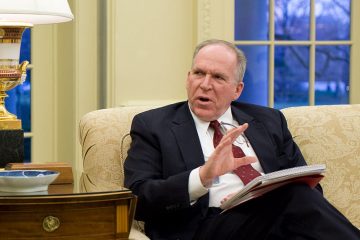
Brennan: “I don’t do evidence.” (White House photo)
That was what Republican Rep. Trey Gowdy was wondering when he grilled former CIA director John Brennan on May 23, 2017 on what evidence he had provided to the FBI to catalyze its investigation of Trump-Russia collusion.
Brennan replied: “I don’t do evidence.”
The best Brennan could do was repeat the substance of a clearly well-rehearsed statement: “I encountered and am aware of information and intelligence that revealed contacts and interactions between Russian officials and U.S. persons involved in the Trump campaign … that required further investigation by the Bureau to determine whether or not U.S. persons were actively conspiring, colluding with Russian officials.”
That was it.
CNN joined the piling on Monday, quoting former FBI General Counsel James Baker in closed-door Congressional testimony to the effect that FBI officials were weighing “whether Trump was acting at the behest of [the Russians] and somehow following directions, somehow executing their will.” The problem is CNN also noted that Lisa Page, counsel to then FBI Acting Director Andrew McCabe, testified that there had been “indecision in the Bureau as to whether there was sufficient predication to open [the investigation].’ “Predication” is another word for evidence.
Within hours of Comey’s firing on May 9, 2017, Page’s boyfriend and a top FBI counterintelligence official, Peter Strzok texted her: “We need to open the case we’ve been waiting on now while Andy [McCabe] is acting [director].” After all, if Trump were bold enough, he could have appointed a new FBI director and who knew what might happen then. When Page appeared before Congress, she was reportedly asked what McCabe meant. She confirmed that his text was related to the Russia investigation into potential collusion.
Comey v. Trump Goes Back to Jan. 6, 2017
The Times and CNN, however unintentionally, have shed light on what ensued after Trump finally fired Comey. Apparently, it finally dawned on Trump that, on Jan. 6, 2017, Comey had treated him to the time-honored initiation-rite-for-presidents-elect — with rubrics designed by former FBI Director J. Edgar Hoover.
It seems then-FBI Director James Comey rendered a good impersonation of Hoover that day when he briefed President-elect Trump on the scurrilous “Steele dossier” that the FBI had assembled on Trump. Excerpts from an interview Trump gave to the Times (below) after the firing throw light on what Trump says was at least part of his motivation to dump Comey.
To dramatize the sensitivity of the dossier, Comey asked then-National Intelligence Director James Clapper and the heads of the CIA and NSA to depart the room at the Trump Tower, leaving Comey alone with the President-elect. The Gang of Four had already briefed Trump on the evidence-impoverished “Intelligence Community Assessment.” That “assessment” alleged that Putin himself ordered his minions to help Trump win. The dossier had been leaked to the media, which withheld it but Buzzfeed published it on Jan. 10.?
‘This Russia Thing’
Evidently, it took Trump four months to fully realize he was being played, and that he couldn’t expect the “loyalty” he is said to have asked of Comey. So Trump fired Comey on May 9. Two days later he told NBC’s Lester Holt:
“When I decided to just do it, I said to myself, I said, ‘You know, this Russia thing with Trump and Russia is a made-up story, it’s an excuse by the Democrats for having lost an election that they should’ve won.’”
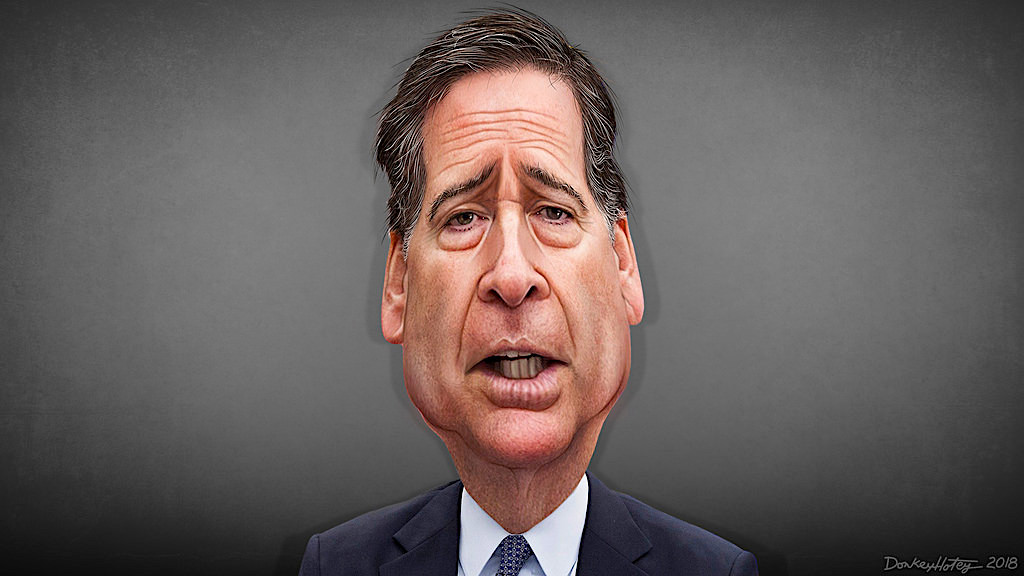
Comey: Pulled a Hoover on Trump? (Carciature by DonkeyHotey)
The mainstream media and other Russia-gater aficionados immediately seized on “this Russian thing” as proof that Trump was trying to obstruct the investigation of alleged Russian collusion with the Trump campaign. However, in the Holt interview Trump appeared to be reflecting on Comey’s J. Edgar Hoover-style, one-on-one gambit alone in the room with Trump.
Would Comey really do a thing like that? Was the former FBI director protesting too much in his June 2017 testimony to the Senate Intelligence Committee when he insisted he’d tried to make it clear to Trump that briefing him on the unverified but scurrilous information in the dossier wasn’t intended to be threatening. It took a few months but it seems Trump figured out what he thought Comey was up to.
Trump to NYT: ‘Leverage’ (aka Blackmail)
In a long Oval Office interview with the Times on July 19, 2017, Trump said he thought Comey was trying to hold the dossier over his head.
“… Look what they did to me with Russia, and it was totally phony stuff. … the dossier … Now, that was totally made-up stuff,” Trump said. “I went there [to Moscow] for one day for the Miss Universe contest, I turned around, I went back. It was so disgraceful. It was so disgraceful.
“When he [James B. Comey] brought it [the dossier] to me, I said this is really made-up junk. I didn’t think about anything. I just thought about, man, this is such a phony deal. … I said, this is — honestly, it was so wrong, and they didn’t know I was just there for a very short period of time. It was so wrong, and I was with groups of people. It was so wrong that I really didn’t, I didn’t think about motive. I didn’t know what to think other than, this is really phony stuff.”
The dossier, paid for by the Democratic National Committee and the Clinton campaign and compiled by former British spy Christopher Steele, relates a tale of Trump allegedly cavorting with prostitutes, who supposedly urinated on each other before the same bed the Obamas had slept in at the Moscow Ritz-Carlton hotel. [On February 6, 2018, The Washington Post reported that that part of the dossier was written Cody Shearer, a long-time Clinton operative and passed it along to Steele. Shearer ignored a request for comment from Consortium News. [Shearer had been a Consortium advisory board member who was asked to resign and left the board.]
Trump told the Times: “I think [Comey] shared it so that I would — because the other three people [Clapper, Brennan, and Rogers] left, and he showed it to me. … So anyway, in my opinion, he shared it so that I would think he had it out there. … As leverage.
“Yeah, I think so. In retrospect. In retrospect. You know, when he wrote me the letter, he said, ‘You have every right to fire me,’ blah blah blah. Right? He said, ‘You have every right to fire me.’ I said, that’s a very strange — you know, over the years, I’ve hired a lot of people, I’ve fired a lot of people. Nobody has ever written me a letter back that you have every right to fire me.”
McGovern lays out more details during a 12-minute interview on Jan. 10 with Tyrel Ventura of “Watching the Hawks.”
Ray McGovern works with Tell the Word, a publishing arm of the ecumenical Church of the Saviour in inner-city Washington. A CIA analyst for 27 years and Washington area resident for 56 years, he has been attuned to these machinations. He is co-founder of Veteran Intelligence Professionals for Sanity (VIPS).
The US Mainstream Media Prefer Confrontation to Cooperation
By Brian CLOUGHLEY | Strategic Culture Foundation | 15.01.2019
The Washington Post is a noisily anti-Russian newspaper which every weekday by email produces for subscribers (of whom I am one) the Daily 202 (“Power Post — Intelligence for Leaders”) which covers US politics, a little international stuff, and a section called “There’s a Bear in the Woods” aimed at denigrating, belittling and generally insulting Russia.
The Post is intent on convincing citizens of the United States and the world in general that nothing good is ever done by, in or with the government of Russia, and a favourite target is President Putin. A typical Editorial was headed “Trump just colluded with Russia. Openly” and dealt savagely with the Trump-Putin meeting in Helsinki last year. Much of the world believes that such discussions between nations’ leaders are better than hostile rhetoric, and most reasonable people are pleased and even relieved when meetings take place. They prefer amicable dialogue to venomous confrontation.
But the Post ended its comment on the meeting by asserting that “Mr Trump in fact was openly colluding with the criminal leader of a hostile power.”
That’s the ‘hostile power’ that has cooperated for twenty years with the United States in operating the International Space Station.
The Post doesn’t like such news as “[Russian space agency] Roscosmos director Dmitry Rogozin and Bill Gerstenmaier, head of NASA’s human explorations and operations, said after a conference marking the 20th anniversary of the International Space Station that their agencies plan to collaborate on developing a moon orbiting outpost. Russia is working on a heavy booster rocket and a new spacecraft to complement American projects intended for a future moon mission, Rogozin said. ‘We absolutely trust each other, and political winds haven’t touched us.’ Gerstenmaier spoke in kind, noting that partnership in space exploration could be ‘an example to the outside world. It has been a blessing that our governments have both seen the wisdom of what we are doing and both our governments have avoided placing sanctions on us or getting us caught up in the political things’.”
It is most gratifying that the United States and Russia can cooperate so closely on such an important endeavour. As noted by CNN, “since the retirement of the space shuttle in 2011 the US has depended on Roscosmos to transport astronauts to the space station.” In other words, the space station could not exist without Russia’s no-strings collaboration.
But most western media play down, ignore or deplore such instances of harmony and amity. The UK’s Daily Telegraph, for example, is entirely negative, and grudgingly reported last December that the most recent “launch of the MS-11 ship was a closely watched test for Russia’s space industry, which has suffered several high-profile failures in recent years but remains the only reliable way to deliver crew to the orbiting station.” There had been an accident in the course of a previous launch but, to the regret of many in the West, Russia’s emergency procedures were flawless and there was no loss of life.
In spite of this example of outstandingly successful bilateral cooperation, a meeting scheduled for February between the space professionals of Russia and the United States was cancelled “after mounting pressure from Capitol Hill.” Roscosmos Director General Dmitry Rogozin had hosted his NASA counterpart, Jim Bridenstine, in October last year, so his February visit was to be a combination of practicality and courtesy — but this isn’t the way the US Senate sees or does things.
Senator Bob Menendez of the Foreign Relations Committee declared that “to welcome Mr Rogozin to the United States and provide him a platform to speak is an affront to our sanctions regime and will further undermine the Trump Administration’s limited credibility on Russia policy,” and Senator Jeanne Shaheen of the Senate panel that funds NASA said the planned meeting “undermines the United States’ core national security objectives” and “weakens the US’s global standing by demonstrating the ease by which Russian officials can get around transatlantic sanctions.”
The Senate’s pressure on NASA is part of the campaign of petulant and spiteful attacks on Russia which show that Washington is intent on destruction of even the slightest efforts to bring the US and Russia closer.
Which brings us back to the Washington Post which distinguished itself by getting just a little mixed up during one of its anti-Russia forays when it enthusiastically seized on a faulty piece in the New York Times.
It all started when the Times breathlessly revealed that during the 2016 election campaign, Trump’s campaign manager, Paul Manafort “and his Russian associate, Konstantin V. Kilimnik, discussed a plan for peace in Ukraine.” This dastardly anti-America, pro-Russia activity could not be tolerated by the US mainstream media which reported that one of Mr Manafort’s menacing machinations involved sharing “political polling data with a business associate tied to Russian intelligence.”
(As an aside, it is difficult to believe that notification of political polling data is in some fashion a national security risk. Most of us know that poll results can be made public without release conditions. Every foreign mission in Washington analysed them.)
The Times continued, in a version of the report that has been deleted, that Manafort wanted the data passed on to “Oleg V Deripaska, a Russian oligarch close to the Kremlin,” and in its ‘202’ the Washington Post went to town about this supposedly sinister character. It began by stating that “several experts said the Deripaska connection makes this news a huge deal” and quoted Steven Hall, a former head of Russia operations at the CIA, as tweeting “Remember, the polling info Manafort passed to Kilimnik was headed to Deripaska, who is close to Putin… The margins the Russians needed to change in key states during the 2016 elections [were] pretty small. Now we know how they were able to be so precise: Paul Manafort was providing polling data to Russia.” Shock! Horror!
Another expert shaken by such disclosures was Post columnist Max Boot, a senior fellow at the Council on Foreign Relations, who declared “This is potentially very significant evidence of collusion… Why would Manafort share polling data with the Russians unless it was to help them target their pro-Trump social media campaign?”
On it went for over 400 words recounting how the dastardly Deripaska was up to his ears in conspiracy, although a cautionary note was sounded by former ambassador to Russia Mike McFaul who like a good diplomat injected the phrase “if proven” in his tweet before agreeing “this is serious.”
Yes, it was serious. But not as serious as the downplayed low-profile admission by the Washington Post that its chatter allegations were not “proven”. The Post noted that “the New York Times corrected a story we included in yesterday’s 202: ‘A previous version of this article misidentified the people to whom Paul Manafort wanted a Russian associate to send polling data. Mr. Manafort wanted the data sent to two Ukrainian oligarchs, Serhiy Lyovochkin and Rinat Akhmetov, not to Oleg V Deripaska, a Russian oligarch close to the Kremlin’.”
So much for the Washington Post’s Bear in the Woods, but a sad indicator of how determined are some of the US media to help destroy any movement towards rapprochement with Russia. Fortunately, in spite of their malevolent efforts and the spiteful Senate shenanigans, the International Space Station cooperation will continue, which shows, thank goodness, that there are still some grown-ups in the woods.
Washington in Panic Mode as Trump Reportedly Mulled Withdrawal From NATO
Sputnik – 15.01.2019
Since taking office in 2017, Donald Trump has on a multitude of occasions slammed NATO member states for failing to meet their annual defence spending obligations and insisted on fair burden-sharing.
Over the course of 2018, US President Donald Trump repeatedly expressed a willingness to withdraw from NATO, The New York Times reported, citing current and former senior administration officials.
Although the unnamed sources said that they were not sure if Trump was serious, they allegedly feared that POTUS would return to his threat as other alliance member states failed to boost their military donations to NATO and reach the spending target set by the bloc.
Days ahead of a NATO summit in Brussels last summer, Trump purportedly questioned the alliance’s raison d’être while speaking to senior national security officials, describing it as an exhausting burden on the United States.
The New York Times report suggests that Trump complained about Europe’s failure to meet defence spending goals, thus leaving the US to “carry an outsize burden”.
POTUS was allegedly frustrated with the fact that his transatlantic allies would not, on the spot, pledge to donate more. But at another leaders meeting during the same summit, NATO Secretary-General Jens Stoltenberg praised Washington’s example and suggested that European member states follow suit — Trump was allegedly taken by surprise.
Trump was purportedly annoyed, in particular, with German Chancellor Angela Merkel and her country’s military spending of 1 percent of its GDP.
At the time, then-Defence Secretary Jim Mattis and White House National Security Adviser John Bolton struggled to stick to American strategy without mentioning the potential withdrawal that would inevitably undermine Washington’s influence in Europe and embolden Russia, the newspaper wrote.
According to The New York Times, national security advisers are increasingly concerned over a possible pullout from NATO, as well as Trump’s purported efforts to keep his encounters with Russian President Vladimir Putin secret from his own aides, and an ongoing investigation into the alleged collusion between the Trump campaign and the Kremlin.
“It would destroy 70-plus years of painstaking work across multiple administrations, Republican and Democratic, to create perhaps the most powerful and advantageous alliance in history. And it would be the wildest success that Vladimir Putin could dream of”, Michèle A. Flournoy, an under-secretary of defence under President Barack Obama, told the media outlet.
The newspaper further cited retired Adm. Gen. James G. Stavridis, the former supreme allied commander of NATO, who said that “even discussing the idea of leaving NATO — let alone actually doing so — would be the gift of the century for Putin”.
After The New York Times reached the White House for comment, a senior administration official cited Trump’s remarks in July 2018, when he described Washington’s commitment to the military alliance as “very strong”, with the bloc itself being “very important”.
The insiders, who spoke to the newspaper on condition of anonymity, assumed that with a weakened NATO, President Putin would have “more freedom to behave as he wishes”, thus setting up Russia as a “counterweight” to the United States and Europe.
Although President Trump has not publicly threatened to leave the transatlantic alliance, relations between the US and Europe have hit their lowest point since he blasted other NATO members for not complying with their obligations to boost defence spending.
Trump has on numerous occasions emphasised that the other members of the bloc should pay their “fair share” and stressed that only five of the 29 member states were spending two percent of their GDP to defence, which was “insufficient to close gaps in modernising, readiness and the size of forces”.
On the sidelines of a NATO summit in Brussels in July, the allies agreed to start spending two percent of their GDP by 2024, with Trump pointing out that he was convinced that they would increase defence expenditures in line with their commitments.
At the same time, the US president suggested raising the military spending commitment up to four percent of GDP – that proposal, however, failed to find support.
Featured Video
EUROPE FEARS RUSSIA’S NEXT MOVE / Ian Proud
or go to
Aletho News Archives – Video-Images
New Book
New Book: No Autoimmunity The Body Doesn’t Attack Itself
Lies are Unbekoming | September 24, 2026
 The label for Humira, once the best-selling drug in the world, lists its risks in plain print. One of them, in the label’s own words, is new “autoimmune” disease.
A drug prescribed for a condition labelled autoimmune carries a warning that it can cause a condition labelled autoimmune. That contradiction sits in every box, on a folded paper almost nobody reads.
My new book starts there.
No Autoimmunity: The Body Doesn’t Attack Itself
For seventy years, “your body is attacking itself, and we don’t know why” has ended the conversation for people diagnosed with multiple sclerosis, lupus, rheumatoid arthritis, Hashimoto’s, Type 1 diabetes, Crohn’s and psoriasis. More than eighty conditions now carry the autoimmune label. The diagnosis comes with a prescription for life. It almost never comes with a question about cause.
This book asks the question and answers it from the framework’s own records: its drug labels, its journals, its regulatory filings, and its own experiments. … continue
Blog Roll
 Aletho News
- Merz regime wants ‘secret police’ – opposition
- Israeli settlers terrorize West Bank Palestinians with state-provided drones: Report
- They see them, then kill them: Israeli quadcopters track, deliberately target civilians in Gaza
- Debunked: Trump’s egregious UNGA claims on war against Iran crumble under scrutiny
- Europe was part of the infrastructure of US aggression against Iran: Deputy FM
- New evidence on the Bucha Massacre
- Italy and France debunk reports CIA issued ‘Russian drone threat’ warning
- How Russia is Rewiring the Global South
- Britain’s elites want you ready to die for a war they keep imagining
- Inside Ukraine’s propaganda operation targeting Americans
- If Americans Knew
- Trump betrayed voters with his campaign lies and prioritized a foreign country once he took office
- Netanyahu calls Israel’s war in Gaza ‘opposite of genocide’ in UN speech to near-empty hall
- Settler Kidnappings: Torture, Sexual Abuse and Terrorisation of Palestinian Abductees as Israel Deepens Annexation of West Bank
- Gaza winter nears as 162,000 tents become unusable, raising fears of humanitarian crisis
- Netanyahu says, “It’s the opposite of genocide”; UN says Gaza economy is world’s ‘most severe crisis on record’ – Daily Update
- Israel’s US-Backed Assault on Gaza Has Created the ‘World’s Most Severe Economic Crisis on Record’: UN
- ‘Protecting U.S. Citizens’… From Israel
- ‘This is where I live now, the back of a truck’: a day in the life of a grandmother in Gaza
- In UN Speech, Iran’s President Displays Pictures of Children Killed by US, Brings Attention to Israel’s Nuclear Arsenal
- Israel displaces hundreds of Palestinians amid wave of demolitions in West Bank
- No Tricks Zone
- New Study: Earth And Venus Surface Warmth Largely Explained By Convection And Lapse Rate, Not CO2 Or Radiation
- 2025 Nature Paper Claiming Worsening Global Drought Gets RETRACTED …Heavily Flawed
- New Study: ‘Global Drought Shows No Detectable Recent Acceleration Under Climate Warming’
- Economic Masterminds: German Socialists Suggest Taxing Productivity Gains Stemming From Using AI
- The South China Sea Has Not Been Cooperating With The Climate Change Narrative
- Energy Crisis: Germany Enters Heating Season With Historically Low Gas Reserve Fill Levels
- New Study: The Antarctic Ice Sheet Gained Mass From 2020-2024 Due To Staggering Snow And Ice Accumulation
- Study: Ocean Heating Rates From Thousands Of Years Ago ‘Dwarf’ Modern Ocean Heating Rates
- Climate Extremists Target, Attack Large-Scale Power Grid Infrastructure In Germany!
- New Study: Antarctic Ice Melt Has Contributed Less Than 1 Centimeter To Sea Level Rise In The Last 30 Years

