Integrity Initiative: By all means smear & attack, but at least be honest about it
By Simon Rite | RT | January 13, 2019
We’ve all met those people who describe themselves as laid back, when in reality they’re just one loud noise from a mouth frothing breakdown. So when something describes itself as having integrity, be wary.
Enter the Integrity Initiative (II), Britain’s very own government funded influence network which is currently in the process of having its underpants revealed to the world. There’s no doubting it’s an initiative, the jury’s out on the other bit. Some of the people behind it are alleged former spies (can you be a former spy?), a calling not often linked to integrity.
There’s a good chance you may not know much about the Integrity Initiative, the mainstream media is not exactly straining to tell you about it. Labour MP Chris Williamson suggests that’s because a number of mainstream journalists have signed up to work with it.
The only time II briefly attracted the attention of the mainstream world was when it became clear it had been pushing conspiracies about Labour leader Jeremy Corbyn’s links to the Kremlin. That’s not a good look for an organization which receives cash from the Foreign Office.
It describes itself as non-partisan, but then as we’ve discussed, it also has “Integrity” in the title. Maybe it can get away with it, always worth a try I suppose. It also claims to be “combating propaganda and disinformation,” but as you’ll see for yourself on its Twitter account, it’s simply a stream of invective and criticism about Russia. If you want to spend cash smearing an entire nation, fine, fill your boots, but don’t then act all moral about it.
Integrity Initiative deals in propaganda, mainly against Russia, and if anyone involved tries to deny that, then they’ve clearly been drinking their own Kool Aid. Of course, it defends itself by saying it’s on the front line of the fight against so-called Russian disinformation, which is a pretty wide category these days. But it doesn’t matter if it’s propaganda you agree with or disagree with, it’s still propaganda.
One of its main aims is to put together what it calls ‘clusters’ of journalists, writers and the like who are sympathetic to the cause. If you’ve been paying attention, you won’t be surprised to find out who are making up those clusters.
Some of those journalists who have had their links revealed are carefully backtracking. One interesting form of mea culpa from some of them is to admit that while they did do some work for II, they didn’t get paid much to do it, which is a curious defense if you think about it. If you’re involved in something you might feel the need to defend in the future, at least make sure you getting paid! About £200 for a talk or an article seems to be the going rate if you’re interested.
Good luck to anyone signing up to work with II, we’ve all got mortgages to pay, there’s no judgement from me, but at least take responsibility for it. And if you really didn’t know you were engaging in propaganda, then perhaps a period of self-reflection is in order.
Guardian journalist James Ball, for example, wrote a column in which he came clean on his links to II (he gave a training talk for about 225 quid) but there was no real self-reflection. The headline “When free societies copy Russian media tactics, there’s only one winner” is indicative of the myopia which drives the movement against so-called Russian disinformation. Even when he is literally caught up in a Western government funded propaganda effort, he somehow still manages to reflect it back on Russia. Moscow made me do it!
Ball goes on to lament the hacking of Integrity Initiative in a newspaper which revelled in publishing juicy stories from WikiLeaks.
He even analyses the events around the Salisbury poisoning by saying: “Russian-backed outlets and supporters threw question after question to cast doubt on the official narrative.”
There we have it, the biggest crime of all – casting doubt on the official narrative.
WaPo recycles old Russiagate memes in latest gossip piece about Trump-Putin secret collusion
RT | January 13, 2019
Donald Trump’s reluctance to provide unfettered access to his conversations with Vladimir Putin has upset nameless American officials, the Washington Post has revealed. The US president dismissed the story as absurd and offensive.
According to the revered paper, Trump has “gone to extraordinary lengths to conceal details” of his face-to-face conversations with Putin. During a meeting with the Russian leader in Hamburg in 2017, Trump even purportedly confiscated the notes of his own interpreter, who was then instructed not to discuss what had transpired with other administration officials.
Various (and of course nameless) US officials have now apparently complained to the Washington Post about how they’ve been left in the dark about five conversations that Trump had with the Russian leader, colorfully described by the newspaper as “one of the United States’ main adversaries.”
The story’s thinly veiled assumption is of course that Donald Trump has used his handful of private meetings with Putin to receive secret instructions from Moscow – impose new sanctions on Russia, bomb Syria, send lethal weapons to Ukraine, shred the Iran deal and missile treaties, and so forth.
The creatively framed story suffers from a few other inconvenient plot holes. The super-secret meeting with Putin in Hamburg was also attended by then-secretary of state Rex Tillerson. Does this mean that Tillerson is also a deep-cover KGB agent? Tillerson even released a readout after the meeting – following completely standard, but apparently unsatisfactory protocol.
The self-contradictory report goes on to explain how, as part of Trump’s obsession with ultra-secret Putin pow-wows, the president “generally has allowed aides to listen to his phone conversations” with the Russian leader.
Trump “allies” interviewed by the Post said that the president’s caution when it comes to meeting with Putin may be “driven by embarrassing leaks that occurred early in his presidency.” This theory is of course way less fun than the airtight idea that Trump is actually a Russian agent – that’s why WaPo only gave it one sentence.
Responding to the report, Trump told Fox News that there was nothing scandalous about his talks with the Russian leader. When Fox News host Jeanine Pirro asked if he is or has ever been working on behalf of the Kremlin, Trump responded: “I think it’s the most insulting thing I’ve ever been asked.” Among hardcore Russiagaters, his answer was naturally interpreted as an explosive non-denial.
“Credit to Jeannine Pirro for asking Trump if he’s a Russian Agent. The President, notably, never actually answered that question,” Colby Hall, founding editor of Mediaite, tweeted.
Rehashing months-old Russiagate news, the Washington Post also disclosed that Democratic lawmakers are still demanding details about Trump’s meeting with Putin in Helsinki last summer. House Democrats reportedly plan to form a subcommittee which aims to obtain State Department records of Trump’s various encounters with the Russian president.
The War on Populism
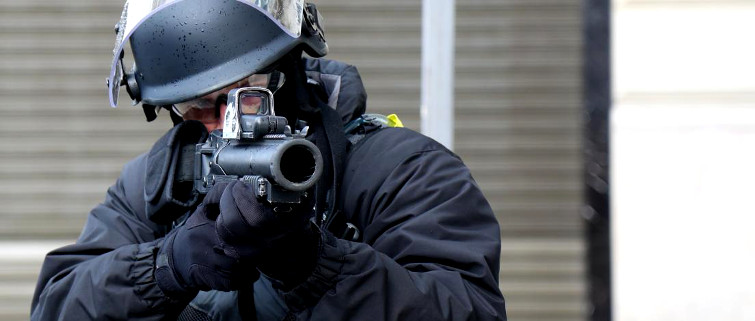
CJ Hopkins | Consent Factory | January 10, 2018
Remember when the War on Terror ended and the War on Populism began? That’s OK, no one else does.
It happened in the Summer of 2016, also known as “the Summer of Fear.” The War on Terror was going splendidly. There had been a series of “terrorist attacks,” in Orlando, Nice, Würzberg, Munich, Reutlingen, Ansbach, and Saint-Étienne-du-Rouvray, each of them perpetrated by suddenly “self-radicalized” “lone wolf terrorists” (or “non-terrorist terrorists“) who had absolutely no connection to any type of organized terrorist groups prior to suddenly “self- radicalizing” themselves by consuming “terrorist content” on the Internet. It seemed we were entering a new and even more terrifying phase of the Global War on Terror, a phase in which anyone could be a “terrorist” and “terrorism” could mean almost anything.
This broadening of the already virtually meaningless definition of “terrorism” was transpiring just in time for Obama to hand off the reins to Hillary Clinton, who everyone knew was going to be the next president, and who was going to have to bomb the crap out of Syria in response to the non-terrorist terrorist threat. The War on Terror (or, rather, “the series of persistent targeted efforts to dismantle specific networks of violent extremists that threaten America,” as Obama rebranded it) was going to continue, probably forever. The Brexit referendum had just taken place, but no one had really digested that yet … and then Trump won the nomination.
Like that scene in Orwell’s 1984 where the Party switches official enemies right in the middle of the Hate Week rally, the War on Terror was officially canceled and replaced by the War on Populism. Or … all right, it wasn’t quite that abrupt. But seriously, go back and scan the news. Note how the “Islamic terrorist threat” we had been conditioned to live in fear of on a daily basis since 2001 seemed to just vanish into thin air. Suddenly, the “existential threat” we were facing was “neo-nationalism,” “illiberalism,” or the pejorative designator du jour, “populism.”
Here we are, two and a half years later, and “democracy” is under constant attack by a host of malevolent “populist” forces …. Russo-fascist Black vote suppressors, debaucherous eau de Novichok assassins, Bernie Sanders, the yellow-vested French, emboldened non-exploding mail bomb bombers, Jeremy Corbyn’s Nazi Death Cult, and brain-devouring Russian-Cubano crickets. The President of the United States is apparently both a Russian intelligence operative and literally the resurrection of Hitler. NBC and MSNBC have been officially merged with the CIA. The Guardian has dispensed with any pretense of journalism and is just making stories up out of whole cloth. Anyone who has ever visited Russia, or met with a Russian, or read a Russian novel, is on an “Enemies of Democracy” watch list (as is anyone refusing to vacation in Israel, which the Senate is now in the process of making mandatory for all U.S. citizens). Meanwhile, the “terrorists” are nowhere to be found, except for the terrorists we’ve been using to attempt to overthrow the government of Bashar al Assad, the sadistic nerve-gassing Monster of Syria, who illegally invaded and conquered his own country in defiance of the “international community.”
All this madness has something to do with “populism,” although it isn’t clear what. The leading theory is that the Russians are behind it. They’ve got some sort of hypno-technology (not to be confused with those brain-eating crickets) capable of manipulating the minds of … well, Black people, mostly, but not just Black people. Obviously, they are also controlling the French, who they have transformed into “racist, hate-filled liars” who are “attacking elected representatives, journalists, Jews, foreigners, and homosexuals,” according to French President Emmanuel Macron, the anointed “Golden Boy of Europe.” More terrifying still, Putin is now able to project words out of Trump’s mouth in real-time, literally using Trump’s head as a puppet, or like one of those Mission Impossible masks. (Rachel Maddow conclusively proved this by spending a couple of hours on Google comparing the words coming out of Trump’s mouth to words that had come out of Russian mouths, but had never come out of American mouths, which they turned out to be the exact same words, or pretty close to the exact same words!) Apparently, Putin’s master plan for Total Populist World Domination and Establishment of the Thousand Year Duginist Reich was to provoke the global capitalist ruling classes, the corporate media, and their credulous disciples into devolving into stark raving lunatics, or blithering idiots, or a combination of both.
But, seriously, all that actually happened back in the Summer of 2016 was the global capitalist ruling classes recognized that they had a problem. The problem that they recognized they had (and continue to have, and are now acutely aware of) is that no one is enjoying global capitalism … except the global capitalist ruling classes. The whole smiley-happy, supranational, neo-feudal corporate empire concept is not going over very well with the masses, or at least not with the unwashed masses. People started voting for right-wing parties, and Brexit, and other “populist” measures (not because they had suddenly transformed into Nazis, but because the Right was acknowledging and exploiting their anger with the advance of global neoliberalism, while liberals and the Identity Politics Left were slow jamming the TPP with Obama and babbling about transgender bathrooms, and such).
The global capitalist ruling classes needed to put a stop to that (i.e, the “populist” revolt, not the bathroom debate). So they suspended the Global War on Terror and launched the War on Populism. It was originally only meant to last until Hillary Clinton’s coronation, or the second Brexit referendum, then switch back to the War on Terror, but … well, weird things happen, and here we are.
We’ll get back to the War on Terror, eventually … as the War on Populism is essentially just a temporary rebranding of it. In the end, it’s all the same counter-insurgency. When a system is globally hegemonic, as our current model of capitalism is, every war is a counter-insurgency (i.e., a campaign waged against an internal enemy), as there are no external enemies to fight. The “character” of the internal enemies might change (e.g., “Islamic terrorism,” “extremism,” “fascism,” “populism,” “Trumpism,” “Corbynism,” et cetera) but they are all insurgencies against the hegemonic system … which, in our case, is global capitalism, not the United States of America.
The way I see it, the global capitalist ruling classes now have less than two years to put down this current “populist” insurgency. First and foremost, they need to get rid of Trump, who despite his bombastic nativist rhetoric is clearly no “hero of the common people,” nor any real threat to global capitalism, but who has become an anti-establishment symbol, like a walking, talking “fuck you” to both the American and global neoliberal elites. Then, they need to get a handle on Europe, which isn’t going to be particularly easy. What happens next in France will be telling, as will whatever becomes of Brexit … which I continue to believe will never actually happen, except perhaps in some purely nominal sense.
And then there’s the battle for hearts and minds, which they’ve been furiously waging for the last two years, and which is only going to intensify. If you think things are batshit crazy now (which, clearly, they are), strap yourself in. What is coming is going to make COINTELPRO look like the work of some amateur meme-freak. The neoliberal corporate media, psy-ops like Integrity Initiative, Internet-censoring apps like NewsGuard, ShareBlue and other David Brock outfits, and a legion of mass hysteria generators will be relentlessly barraging our brains with absurdity, disinformation, and just outright lies (as will their counterparts on the Right, of course, in case you thought that they were any alternative). It’s going to get extremely zany.
The good news is, by the time it’s all over and Trump has been dealt with, and normality restored, and the working classes put back in their places, we probably won’t remember that any of this happened. We’ll finally be able to sort out those bathrooms, and get back to paying the interest on our debts, and to living in more or less constant fear of an imminent devastating terrorist attack … and won’t that be an enormous relief?
#
Photo: Zakaria Abdelkafi – AFP
Back to the USSR: How to Read Western News
By Patrick ARMSTRONG | Strategic Culture Foundation | 08.01.2019
The heroes of Dickens’ Pickwick Papers visit the fictional borough of Eatanswill to observe an election between the candidates of the Blue Party and the Buff Party. The town is passionately divided, on all possible issues, between the two parties. Each party has its own newspaper: the Eatanswill Gazette is Blue and entirely devoted to praising the noble Blues and excoriating the perfidious and wicked Buffs; the Eatanswill Independent is equally passionate on the opposite side of every question. No Buff would dream of reading “that vile and slanderous calumniator, the Gazette“, nor Blue ”that false and scurrilous print, the Independent“.
As usual with Dickens it is both exaggerated and accurate. Newspapers used to be screamingly partisan before “journalism” was invented. Soon followed journalism schools, journalism ethics and journalism objectivity: “real journalism” as they like to call it (RT isn’t of course). “Journalism” became a profession gilded with academical folderol; no longer the refuge of dropouts, boozers, failures, budding novelists and magnates like Lord Copper who know what they want and pay for it. But, despite the pretence of objectivity and standards, there were still Lord Coppers and a lot of Eatanswill. Nonetheless, there were more or less serious efforts to get the facts and balance the story. And Lord Coppers came and went: great newspaper empires rose and fell and there was actually quite a variety of ownership and news outlets. There was sufficient variance that a reader, who was neither Blue nor Buff, could triangulate and form a sense of what was going on.
In the Soviet Union news was controlled; there was no “free press”; there was one owner and the flavours were only slightly varied: the army paper, the party paper, the government paper, papers for people interested in literature or sports. But they all said the same thing about the big subjects. The two principal newspapers were Pravda (“truth”) and Izvestiya (“news”). This swiftly led to the joke that there was no truth in Pravda and no news in Izvestiya. It was all pretty heavy handed stuff: lots of fat capitalists in top hats and money bags; Uncle Sam’s clothing dripping with bombs; no problems over here, nothing but problems over there. And it wasn’t very successful propaganda: most of their audience came to believe that the Soviet media was lying both about the USSR and about the West.
But time moves on and while thirty years ago 50 corporations controlled 90% of the US news media, today it’s a not very diverse six. As a result, on many subjects there is a monoview: has any Western news outlet reported, say, these ten true statements?
- People in Crimea are pretty happy to be in Russia.
- The US and its minions have given an enormous amount of weapons to jihadists.
- Elections in Russia reflect popular opinion polling.
- There really are a frightening number of well-armed nazis in Ukraine.
- Assad is pretty popular in Syria.
- The US and its minions smashed Raqqa to bits.
- The official Skripal story makes very little sense.
- Ukraine is much worse off, by any measurement, now than before Maidan.
- Russia actually had several thousand troops in Crimea before Maidan.
- There’s a documentary that exposes Browder that he keeps people from seeing.
I typed these out as they occurred to me. I could come up with another ten pretty easily. There’s some tiny coverage, far in the back pages, so that objectivity can be pretended, but most Western media consumers would answer they aren’t; didn’t; don’t; aren’t; isn’t; where?; does; not; what?; never heard of it.
Many subjects are covered in Western media outlets with a single voice. Every now and again there’s a scandal that reveals that “journalists” are richly rewarded for writing stories that fit. But after revelations, admissions of bias, pretending it never happened, the media ship calmly sails on (shedding passengers as it goes, though). Coverage of certain subjects are almost 100% false: Putin, Russia, Syria and Ukraine stand out. But much of the coverage of China and Iran also. Many things about Israel are not permitted. The Russia collusion story is (privately) admitted to be fake by an outlet that covers it non stop. Anything Trump is so heavily flavoured that it’s inedible. And it’s not getting any better: PC is shutting doors everywhere and the Russian-centred “fake news” meme is shutting more. Science is settled but genders are not and we must be vigilant against the “Russian disinformation war“. Every day brings us a step closer to a mono media of the One Correct Opinion. All for the Best Possible Motives, of course.
It’s all rather Soviet in fact.
So, in a world where the Integrity Initiative is spending our tax dollars (pounds actually) to make sure that we never have a doubleplusungood thought or are tempted into crimethink, (and maybe they created the entire Skripal story – more revelations by the minute), what are we to make of our Free Media™? Well, that all depends on what you’re interested in. If it’s sports (not Russian athletes – druggies every one unlike brave Western asthmatics) or “beach-ready bodies” (not Russian drug takers of course, only wholesome Americans) – the reporting is pretty reasonable. Weather reports, for example (Siberian blasts excepted) or movie reviews (but all those Russian villains). But the rest is some weird merger of the Eatonswill Gazette and Independent : Blues/Buffs good! others, especially Russians, bad!
So, as they say in Russia, что делать? What to do? Well, I suggest we learn from the Soviet experience. After all, most Soviet citizens were much more sceptical about their home media outlets than any of my neighbours, friends or relatives are about theirs.
My suggestions are three:
- Read between the lines. A difficult art this and it needs to be learned and practised. Dissidents may be sending us hints from the bowels of Minitrue. For example, it’s impossible to imagine anyone seriously saying “How Putin’s Russia turned humour into a weapon“; it must have been written to subversively mock the official Russia panic. I have speculated elsewhere that the writers may have inserted clues that the “intelligence reports” on Russian interference were nonsense.
- Notice what they’re not telling you. For example: remember when Aleppo was a huge story two years ago? But there’s nothing about it now. One should wonder why there isn’t; a quick search will find videos like this (oops! Russian! not real journalism!) here’s one from Euronews. Clearly none of this fits the “last hospitals destroyed” and brutal Assad memes of two years ago; that’s why the subject has disappeared from Western media outlets. It is always a good rule to wonder why the Biggest Story Ever suddenly disappears: that’s a strong clue it was a lie or nonsense.
- Most of the time, you’d be correct to believe the opposite. Especially, when all the outlets are telling you the same thing. It’s always good to ask yourself cui bono: who’s getting what benefit out of making you believe something? It’s quite depressing how successful the big uniform lie is: even though the much-demonised Milosevic was eventually found innocent, even though Qaddafi was not “bombing his own people”, similar lies are believed about Assad and other Western enemies-of-the-moment. Believe the opposite unless there’s very good reason not to.
In the Cold War there was a notion going around that the Soviet and Western systems were converging and that they would meet in the middle, so to speak. Well, perhaps they did meet but kept on moving past each other. And so, the once reasonably free and varied Western media comes to resemble the controlled and uniform Soviet media and we in the West must start using Soviet methods to understand.
Always remember that the Soviet rulers claimed their media was free too; free from “fake news” that is.
‘America must rebuild understanding of Russia’: How Integrity Initiative drafted US for new Cold War
RT | January 9, 2019
Shortly after Donald Trump’s election, a UK-funded covert influence group proposed opening a new office in the US to train a “younger generation of Russia watchers” and “strengthen” American role in countering Moscow, leaks show.
The latest tranche of documents, anonymously uploaded online last week, include an outline for “developing a US arm of [the] Integrity Initiative Program” and a schedule for a visit to Washington of its director, which details meetings with former senior Trump adviser Sebastian Gorka, and top diplomats and officials.
‘West badly needs US leadership’
Despite the elected White House administration tentatively attempting a rapprochement with the Kremlin at the time, the group, effectively a foreign agent on US soil, suggests in the first document, dated to August 2017, that Washington needs to go in a radically different, if familiar, direction, “before it is too late.”
“The West is badly in need of a reassertion of US leadership. The EU has been unable to generate any strategic thinking or to exercise convincing leadership. Russia (& China) are successfully driving wedges between EU Member States and between Allies within NATO,” reads the plaintive precis.
The solution: revive the Cold War-era resistance to Moscow through a Washington-dominated NATO, which is elsewhere also listed as a financial sponsor of Integrity Initiative, alongside the UK’s Foreign Office.
“The US needs to rebuild its understanding of Russia and how to deal with it,” while “the UK needs reminding how to play its key role of encouraging/enabling US leadership in Europe/NATO.”
To serve these aims Integrity Initiative plans to “bring together academics, think tankers, journalists, civil servants, politicians, business people,” who understand “the problem” of Russia, but “have not been working coherently.”
This is a facsimile of the model Integrity Initiative rolled out in the UK after its founding in 2015, where it used its “cluster” of influential public voices to discreetly sway, manipulate or to outright dictate Russian coverage on such issues as cyber warfare, Syria and the Skripals. Or, as the text euphemistically puts it, their function is “to ensure the popular support for governments that democracies require.”
With many of the original Cold Warriors now of pensionable age, a vital responsibility of the recruits would be “attracting a new generation of younger analysts to learn from the older generation.”

Screenshot from the leaked US office proposal
There also appears to be implicit criticism of how the actual chosen US president is handling foreign policy, with the document urging the US to “improve its own governance at a time of transition.”
But, luckily for America, it doesn’t have to fear foreign meddling, as “the cluster will work completely impartially and not become involved in US party politics.”
Goulash with Gorka
The second document contains the dates and locations of a trip by Chris Donnelly, the UK military intelligence veteran and director of Integrity Initiative, to the American capital between September 18 and 22 of an unstated year. In the same upload folder, there are several support documents related to some of the events he was set to attend.
The trip involved wall-to-wall meetings, dinners, lectures and workshops, with separate visits to the State Department, National Defense University and the Pentagon, but several names stand out.
One is breakfast with Sebastian Gorka, the hawkish TV intelligence pundit, who served as a deputy assistant to Donald Trump between January and August 2017, and was credited as a key foreign policy inspiration prior to that. Another is a meeting with McCain Institute director Kurt Volker, a former US ambassador to NATO, who currently represents the US in the Ukrainian peace negotiations.
There is a meeting with officials from the State Department’s Global Engagement Center, an official counter-propaganda department, which, perhaps not coincidentally, has recently switched from fighting jihadis online, to combating Russia, having received a boost in funding. On the last day of the four-day trip, Donnelly was due to talk to Dorothy Rayburn, an official at USAID, the civilian aid agency, which has previously been accused by foreign governments of operating as an arm of US intelligence, and has been expelled from Russia since 2012.
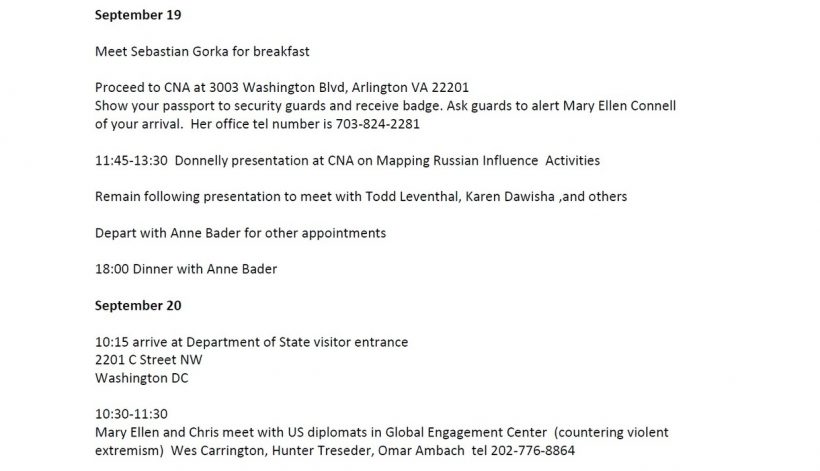
Screenshot from leaked file
It’s not ‘meddling’ when Integrity Initiative does it
Integrity Initiative has acknowledged that its private documents were “hacked” though it has not confirmed or denied the authenticity of any that have been made public in four separate tranches starting from November.
So, with only partial evidence available, it is not possible to conclude if Integrity Initiative did open an office in the US, or whether the talks held by Donnelly resulted in a shift in Russia policy.
Nonetheless, the first leak did contain a document listing a dozen names under the heading “US Cluster,” including several Donnelly was due to meet. There is also an exchange with an FCO official in which Integrity Initiative says that it is in the process of opening a non-profit in the US and, as well as a “simple office” in Washington, plans to create several clusters “in key states, not in DC.” It is not clear what would constitute a “key state” for an agency with Integrity Initiative’s apparently boundless remit.
What does appear certain is that the outfit was setting up its networks of influence covertly, and without declaring its true purpose, despite operating in an allied state. While the meeting with government figures seems to give it a sheen of legitimacy, it is also notable that none of those it met are representative officials, but rather narrowly-known but influential members of various Washington letter agencies. Its policy aims are not democratically-vetted, and possibly even at odds with those officially pursued by the United States.
Nonetheless, while a Russian outfit operating in “key US states” –even if it cultivated peaceful engagement– would surely command the attention of the Mueller investigation, the activities of a UK organization advocating a return to Soviet-era tensions are almost sure to be allowed to continue, without so much as a peep from Washington.
Kristol a Kremlin agent? Shady outfit claims term ‘neocon’ is Russian propaganda
RT | January 9, 2019
Anyone using the term ‘neocon’ is doing the Kremlin’s bidding, according to PropOrNot, a shadowy outfit that sees Russian agents everywhere, in its quest to police social media on behalf of the ruling US establishment.
The anonymous and self-appointed guardians of democracy declared this week that terms such as “neocon,” “corporatist”, “imperialist”, “Zionist” or “establishment” – among others – are “tropes/slurs primarily used by Russian propaganda.” To illustrate this, they tweeted a chart by someone called “Northern Conspirator,” another anonymous Twitter thought-police account.
Reactions to PropOrNot’s claim have been swift and satirical, with outspoken critics of the corporatist imperial warmongering neocon-neoliberal establishment declaring themselves totally convinced.
“PropOrNot ID Service,” as its full name goes, first made headlines in late 2016, as one of the outfits cited by the Washington Post claiming Russian meddling in US politics. The Post described them as “an independent team of concerned American citizens.”
Hiding behind anonymity, the outfit compiled a list of websites and people it declared “Russian” agents. After protests from multiple people who found themselves on the blacklist, the Post had to publish an editor’s note, saying it could not “vouch for the validity of PropOrNot’s findings regarding any individual media outlet.”
Its influence continued, however, with multiple outlets on its blacklist finding themselves banned by Facebook in October 2018 as “Russian propaganda.”
The efforts of anonymous outfits to police speech in the US is problematic, given the recent revelations that another self-appointed guardian of democracy, New Knowledge, actually spearheaded a “false flag” social media operation in 2017 – one of the four such operations identified so far, all on behalf of Democrats in a hotly contested Senate race in Alabama. New Knowledge was later commissioned by the Senate Intelligence Committee to write a report on social media meddling, in which they attributed their own methods and tactics to the Russian government.
In addition to its malice in declaring all criticism of US establishment “Russian propaganda,” PropOrNot is factually wrong: neoconservatism is very much an American thing, as argued by its “godfather” Irving Kristol.
The “historical task and political purpose of neoconservatism would seem to be this: to convert the Republican party, and American conservatism in general, against their respective wills, into a new kind of conservative politics suitable to governing a modern democracy,” Kristol wrote in an essay titled The Neoconservative Persuasion, published in 2003 by the Weekly Standard. That was also the title of Kristol’s collected writings, which came out after his death in 2009.
Kristol’s son Bill now sits on the advisory council of ‘Alliance for Securing Democracy,’ the parent organization of the Hamilton68 dashboard, a brainchild of New Knowledge’s co-founder Jonathon Morgan that purports to track “Russian bots” on Twitter.
The burning question now in everyone’s mind is how such luminaries of neoconservatism – from Irving and Bill Kristol to Norman and John Podhoretz – have managed to be undetected Kremlin agents for so long.
Russian to Conclusions? NYT Misreports Manafort’s Ukraine Ties as Russian
Sputnik – 10.01.2019
The New York Times is so eager to find proof that Paul Manafort was the definitive go-between for the 2016 Donald Trump presidential campaign and Russian actors that it tweeted out a claim a court filing unsealed Tuesday proved the connection, when the connections named were Ukrainians, not Russians.
The Times article on Tuesday is based on information from a court filing unsealed that day showing that Paul Manafort, Trump’s former campaign manager, asked his associate in Ukraine, Konstantin V. Kilimnik, to pass information about Trump’s polling numbers to Serhiy Lyovochkin and Rinat Akhmetov, two Ukrainians connected to the Ukrainian Party of Regions, the party of deposed Ukrainian President Viktor Yanukovych.
However, when one of the story authors, Kenneth P. Vogel, tweeted about the story Tuesday, he accidentally said that Manafort asked Kilimnik to pass that information not to Lyovochkin and Akhmetov, their Ukrainian business associates, but to Oleg Deripaska, a Russian billionaire sanctioned by the US government following his rejection of FBI attempts to “flip” him into an agent of theirs, as Sputnik has reported.
If that were true, it would indeed be quite the story. It still wouldn’t vindicate the Russiagate narrative, since Deripaska is a man who despises Russian President Vladimir Putin and Manafort, both of whom have caused him no shortage of bad business, but in entirely different ways. The corrected Times article only says that Manafort might have hoped to curry personal favor with Deripaska, who he owed millions at the time, by offering him “private briefings,” but never polling data.
The newspaper’s Twitter account later redacted the statement and tweeted a correction, but the eagerness to jump to conclusions that fit their preconceived narrative is worrisome. It’s also far from the first incident of carelessly biased reporting by the mainstream media regarding Russiagate topics.
Let’s take a moment to recall some of them.
On December 1, 2017, ABC’s Brian Ross reported that Trump had directed former National Security Advisor Michael Flynn to make contact with Russian officials before the November 2016 election, when really Flynn was only asked to make such contact after the election. What a difference a single word makes!
Ross earned himself four weeks of suspension without pay for that mishap, after being forced to recant his error.
Only days later, CNN was forced to correct several dates in a story that made it sound as if the president’s son, Donald Trump Jr., had played a role in the supplying of hacked Democratic National Committee emails to WikiLeaks.
An exclusive story December 8 reported that Don Jr., along with his father and other key Trump campaign officials, received a mysterious email on September 4, 2016, offering a website and decryption key for the hacked WikiLeaks documents. This heavily suggested that someone in the campaign was responsible for leaking a trove of stolen DNC emails to WikiLeaks, since that website published the emails on September 13.
However, CNN was soon forced to correct this story: It wasn’t September 4, but September 14 — the day after the leak — that the campaign officials in question received the email. The network was also forced to change the date it reported Don Jr. had first tweeted about Hillary Clinton and WikiLeaks, which also happened on September 14, and not on September 4 as originally reported.
Pretty remarkable, considering that every network that reported it claimed they’d corroborated the information from “multiple sources.” All those sources got the date wrong in the same way?
Only six months prior, CNN had been forced to correct another major report about Trump and Russia. In June 2017, the network retracted a story about ties between Trump officials and a Russian investment fund, a faux pas that caused three of the news agency’s journalists to weigh anchor.
In September 2017 (wow, 2017 was a bad year for reporting on Trump and Russia!), almost every major US news outlet reported that Russian-government-backed hackers targeted the voting systems of 21 states during the 2016 presidential election. However, a senior Department of Homeland Security official corrected this before Congress, telling a House of Representatives panel that November that no attack had happened. Virtually no network reported this whatsoever, except for Sputnik.
Can you guess how many issued retractions? One less than the Times on Tuesday. At least we’ll give NYT that. But it probably won’t be the last time a major news outlet trips over their preconceived narrative of Russian collusion or interference.
MSM Lied: Veselnitskaya Indictment Wholly Unrelated to Russiagate Probe
Sputnik – 09.01.2019
Russian lawyer Natalia Veselnitskaya was indicted Tuesday in a US district court for obstruction of justice. The case is unconnected to the Russiagate investigation, but that hasn’t stopped US media from essentially reporting that it is.
The indictment itself is just a headline-grabber, trying to bring a charge against her for “what lawyers do all the time,” Jim Kavanagh, the editor of thepolemicist.net, told Radio Sputnik’s Loud and Clear Tuesday. “They help each other formulate positions… There’s nothing here except the desire to get headlines.”
The origin of the indictment is a 2013 lawsuit brought against Russian real estate firm Prevezon Holdings Ltd. by US prosecutors for an alleged $230 million tax fraud scheme. Veselnitskaya was hired to represent the company in US federal court. While representing Prevezon Holdings, she submitted a document from a Russian prosecutor that Veselnitskaya claimed was an independent finding, AP reported.
Tuesday’s unsealed indictment, actually brought last month, claims that this document was an “intentionally misleading declaration” Veselnitskaya had drafted herself.
“Fabricating evidence — submitting false and deceptive declarations to a federal judge — in an attempt to affect the outcome of pending litigation, not only undermines the integrity of the judicial process, but it threatens the ability of our courts to ensure that justice is done,” Manhattan US Attorney Geoffrey Bernman said in the indictment.
The civil case was settled in 2017, but Prevezon hasn’t paid the negotiated price, AP noted. A federal judge ordered the company to pay the US government $6 million last February.
Among the companies that claimed Prevezon had defrauded them in the 2013 case was Hermitage Capital Management, whose CEO, William Browder, aided the US government’s case. Browder is well-known as a champion of sanctions against Russia following the 2009 death of a tax accountant, Sergei Magnitsky, who had represented him in a massive tax fraud case. Magnitsky’s death in a Russian prison led to Browder and the US government claiming the Russian government was responsible.
Interest in Veselnitskaya doesn’t end there, though. The Russian lawyer was also part of the infamous meeting hosted by Donald Trump, Jr., that took place in Trump Tower in June 2016, which special counsel Robert Mueller has heavily scrutinized as a key event in alleged collusion between the 2016 presidential campaign of Donald Trump and the Russian government. Veselnitskaya has previously said the meeting focused on the issue of US nationals adopting Russian children and the Magnitsky Act, Sputnik noted.
However, James Margolin, a spokesman for the Manhattan US attorney’s office, told AP that the present case against Veselnitskaya did not originate from a referral by Mueller, and the charges are “unrelated to any other investigation.”
Radio Sputnik spoke with Kavanagh and Lee Stranahan, co-host of the Radio Sputnik show Fault Lines, about Veselnitskaya and the history of the case.
Kavanagh noted that “this woman is being charged in an American court for activities representing her client in Russia.”
“This is a case that has been settled a year and a half ago, and there’s no reason to be bringing these charges. This is what lawyers do all the time: they talk to each other, they help each other formulate positions… There’s nothing here except the desire to get headlines.”
Kavanagh noted that the core of the indictment stems from leaked, hacked emails between Veselnitskaya and a Russian prosecutor that included suggested edits and discussions about what the prosecutor should include in the statement to the court, which prove that she was actually the one who drafted that documents and not him, as she claimed.
Kavanagh pointed out the highly disingenuous title of the New York Times’ article, “Veselnitskaya, Russian in Trump Tower Meeting, Is Charged in Case That Shows Kremlin Ties,” which casually suggests a relationship between the Trump Tower meeting and Tuesday’s indictment.
“It’s really just to generate the idea that there’s some kind of groundswell of evidence that’s going to prove some kind of collusion with Russia that doesn’t exist,” Kavanagh said, noting that both the NY Times and the Washington Post “repeat flat-out lies about the situation,” including that Sergei Magnitsky was a lawyer working for Browder (he wasn’t a lawyer) who exposed fraud (that he was actually a part of).
Stranahan noted that the propaganda and misrepresentation of the situation wasn’t just coming from liberals. On Fox News, “the story is being pitched to show that Natalia Veselnitskaya set up [Donald Trump Jr.] and that the Kremlin ties prove that Putin is behind it… In both of these scenarios, the left and the right, Vladimir Putin is the unquestioned evil-doer,” the puppetmaster, “and Natalya Veselnitskaya is his pawn who’s being used for either this collusion or this frame-up,” said Stranahan.
Stranahan told hosts Brian Becker and John Kiriakou that Browder “is at the center of this. He is a proven liar.” He noted that Browder’s 2015 deposition doesn’t match his public story. “The reason they settled this case is that he was going to be forced to testify.”
Stranahan interviewed Veselnitskaya earlier this year, during which she said:
“The fact that my position was taken by Russian law enforcement authorities does not make me the Kremlin’s lawyer. The fact alone that I was communicating some information to the general prosecutor’s office of the Russian Federation does not make me its lawyer in the least. I am acting as a source of information for Russian law enforcement, and I shared this very information with US authorities as well. I was also willing to share this information with Congress, but I didn’t get a chance.”
Kavanagh said this was at the heart of Veselnitskaya attending the Trump Tower meeting: “She was naively saying, ‘If I get to the right people, and I’m able to talk to them, I’ll show them that Browder’s a liar and a fraud.’ Of course, that was never going to happen.”
A Look Back at Clapper’s Jan. 2017 ‘Assessment’ on Russia-gate
By Ray McGovern | Consortium News | January 8, 2019
The banner headline atop page one of The New York Times two years ago today, on January 7, 2017, set the tone for two years of Dick Cheney-like chicanery: “Putin Led Scheme to Aid Trump, Report Says.”
Under a edia drumbeat of anti-Russian hysteria, credulous Americans were led to believe that Donald Trump owed his election victory to the president of Russia, and that Trump, according to the Times, “colluded” in Putin’s “interference … to help President-elect Trump’s election chances when possible by discrediting Secretary Clinton.”
Hard evidence supporting the media and political rhetoric has been as elusive as proof of weapons of mass destruction in Iraq in 2002-2003. This time, though, an alarming increase in the possibility of war with nuclear-armed Russia has ensued — whether by design, hubris, or rank stupidity. The possible consequences for the world are even more dire than 16 years of war and destruction in the Middle East.
If It Walks Like a Canard…
The CIA-friendly New York Times two years ago led the media quacking in a campaign that wobbled like a duck, canard in French.
A glance at the title of the Intelligence Community Assessment (ICA) (which was not endorsed by the whole community) — “Assessing Russian Activities and Intentions in Recent US Elections” — would suffice to show that the widely respected and independently-minded State Department intelligence bureau should have been included. State intelligence had demurred on several points made in the Oct. 2002 Estimate on Iraq, and even insisted on including a footnote of dissent. James Clapper, then director of national intelligence who put together the ICA, knew that all too well. So he evidently thought it would be better not to involve troublesome dissenters, or even inform them what was afoot.
Similarly, the Defense Intelligence Agency should have been included, particularly since it has considerable expertise on the G.R.U., the Russian military intelligence agency, which has been blamed for Russian hacking of the DNC emails. But DIA, too, has an independent streak and, in fact, is capable of reaching judgments Clapper would reject as anathema. Just one year before Clapper decided to do the rump “Intelligence Community Assessment,” DIA had formally blessed the following heterodox idea in its “December 2015 National Security Strategy”:
“The Kremlin is convinced the United States is laying the groundwork for regime change in Russia, a conviction further reinforced by the events in Ukraine. Moscow views the United States as the critical driver behind the crisis in Ukraine and believes that the overthrow of former Ukrainian President Yanukovych is the latest move in a long-established pattern of U.S.-orchestrated regime change efforts.”
Any further questions as to why the Defense Intelligence Agency was kept away from the ICA drafting table?
Handpicked Analysts
With help from the Times and other mainstream media, Clapper, mostly by his silence, was able to foster the charade that the ICA was actually a bonafide product of the entire intelligence community for as long as he could get away with it. After four months it came time to fess up that the ICA had not been prepared, as Secretary Clinton and the media kept claiming, by “all 17 intelligence agencies.”
In fact, Clapper went one better, proudly asserting — with striking naiveté — that the ICA writers were “handpicked analysts” from only the FBI, CIA, and NSA. He may have thought that this would enhance the ICA’s credibility. It is a no-brainer, however, that when you want handpicked answers, you better handpick the analysts. And so he did.
Why is no one interested in the identities of the handpicked analysts and the hand-pickers? After all, we have the names of the chief analysts/managers responsible for the fraudulent NIE of October 2002 that greased the skids for the war on Iraq. Listed in the NIE itself are the principal analyst Robert D. Walpole and his chief assistants Paul Pillar, Lawrence K. Gershwin and Maj. Gen. John R. Landry.
The Overlooked Disclaimer
Buried in an inside page of the Times‘ Jan. 7, 2017 report was a cautionary paragraph by reporter Scott Shane. It seems he had read the ICA all the way through, and had taken due note of the derriere-protecting caveats included in the strangely cobbled together report. Shane had to wade through nine pages of drivel about “Russia’s Propaganda Efforts” to reach Annex B with its curious disclaimer:
“Assessments are based on collected information, which is often incomplete or fragmentary, as well as logic, argumentation, and precedents. … High confidence in a judgment does not imply that the assessment is a fact or a certainty; such judgments might be wrong.”
Small wonder, then, that Shane noted: “What is missing from the public report is what many Americans most eagerly anticipated: hard evidence to back up the agencies’ claims that the Russian government engineered the election attack. This a significant omission.”
Since then, Shane has evidently realized what side his bread is buttered on and has joined the ranks of Russia-gate aficionados. Decades ago, he did some good reporting on such issues, so it was sad to see him decide to blend in with the likes of David Sanger and promote the NYT official Russia-gate narrative. An embarrassing feature, “The Plot to Subvert an Election: Unraveling the Russia Story So Far,” that Shane wrote with NYT colleague Mark Mazzetti in September, is full of gaping holes, picked apart in two pieces by Consortium News.
Shades of WMD
Sanger is one of the intelligence community’s favorite go-to journalists. He was second only to the disgraced Judith Miller in promoting the canard of weapons of mass destruction in Iraq before the U.S. invasion in March 2003. For example, in a July 29, 2002 article, “U.S. Exploring Baghdad Strike As Iraq Option,” co-written by Sanger and Thom Shanker, the existence of WMD in Iraq was stated as flat fact no fewer than seven times.
The Sanger/Shanker article appeared just a week after then-CIA Director George Tenet confided to his British counterpart that President George W. Bush had decided “to remove Saddam, through military action, justified by the conjunction of terrorism and WMD. But the intelligence and facts were being fixed around the policy.” At that critical juncture, Clapper was in charge of the analysis of satellite imagery and hid the fact that the number of confirmed WMD sites in Iraq was zero.
Despite that fact and that his “assessment” has never been proven, Clapper continues to receive praise.
During a “briefing” I attended at the Carnegie Endowment in Washington several weeks ago, Clapper displayed master circular reasoning, saying in effect, that the assessment had to be correct because that’s what he and other intelligence directors told President Barack Obama and President-elect Donald Trump.
I got a chance to question him at the event. His disingenuous answers brought a painful flashback to one of the most shameful episodes in the annals of U.S. intelligence analysis.
Ray McGovern: My name is Ray McGovern. Thanks for this book; it’s very interesting [Ray holds up his copy of Clapper’s memoir]. I’m part of Veteran Intelligence Professionals for Sanity. I’d like to refer to the Russia problem, but first there’s an analogy that I see here. You were in charge of imagery analysis before Iraq.
James Clapper: Yes.
RM: You confess [in the book] to having been shocked that no weapons of mass destruction were found. And then, to your credit, you admit, as you say here [quotes from the book], “the blame is due to intelligence officers, including me, who were so eager to help [the administration make war on Iraq] that we found what wasn’t really there.”
Now fast forward to two years ago. Your superiors were hell bent on finding ways to blame Trump’s victory on the Russians. Do you think that your efforts were guilty of the same sin here? Do you think that you found a lot of things that weren’t really there? Because that’s what our conclusion is, especially from the technical end. There was no hacking of the DNC; it was leaked, and you know that because you talked to NSA.
JC: Well, I have talked with NSA a lot, and I also know what we briefed to then-President Elect Trump on the 6th of January. And in my mind, uh, I spent a lot of time in the SIGINT [signals intelligence] business, the forensic evidence was overwhelming about what the Russians had done. There’s absolutely no doubt in my mind whatsoever. The Intelligence Community Assessment that we rendered that day, that was asked, tasked to us by President Obama — and uh — in early December, made no call whatsoever on whether, to what extent the Russians influenced the outcome of the election. Uh, the administration, uh, the team then, the President-Elect’s team, wanted to say that — that we said that the Russian interference had no impact whatsoever on the election. And I attempted, we all did, to try to correct that misapprehension as they were writing a press release before we left the room.
However, as a private citizen, understanding the magnitude of what the Russians did and the number of citizens in our country they reached and the different mechanisms that, by which they reached them, to me it stretches credulity to think they didn’t have a profound impact on election on the outcome of the election.
RM: That’s what the New York Times says. But let me say this: we have two former Technical Directors from NSA in our movement here, Veteran Intelligence Professionals for Sanity; we also have forensics, okay?
Now the President himself, your President, President Obama said two days before he left town: The conclusions of the intelligence community — this is ten days after you briefed him — with respect to how WikiLeaks got the DNC emails are “inconclusive” end quote. Now why would he say that if you had said it was conclusive?
JC: I can’t explain what he said or why. But I can tell you we’re, we’re pretty sure we know, or knew at the time, how WikiLeaks got those emails. I’m not going to go into the technical details about why we believe that.
RM: We are too [pretty sure we know]; and it was a leak onto a thumb drive — gotten to Julian Assange — really simple. If you knew it, and the NSA has that information, you have a duty, you have a duty to confess to that, as well as to [Iraq].
JC: Confess to what?
RM: Confess to the fact that you’ve been distorting the evidence.
JC: I don’t confess to that.
RM: The Intelligence Community Assessment was without evidence.
JC: I do not confess to that. I simply do not agree with your conclusions.
William J. Burns (Carnegie President): Hey, Ray, I appreciate your question. I didn’t want this to look like Jim Acosta in the White House grabbing microphones away. Thank you for the questioning though. Yes ma’am [Burns recognizes the next questioner].
The above exchange can be seen starting at 28:45 in this video.
Not Worth His Salt
Having supervised intelligence analysis, including chairing National Intelligence Estimates, for three-quarters of my 27-year career at CIA, my antennae are fine-tuned for canards. And so, at Carnegie, when Clapper focused on the rump analysis masquerading as an “Intelligence Community Assessment,” the scent of the duck came back strongly.
Intelligence analysts worth their salt give very close scrutiny to sources, their possible agendas, and their records for truthfulness. Clapper flunks on his own record, including his performance before the Iraq war — not to mention his giving sworn testimony to Congress that he had to admit was “clearly erroneous,” when documents released by Edward Snowden proved him a perjurer. At Carnegie, the questioner who followed me brought that up and asked, “How on earth did you keep your job, Sir?”
The next questioner, a former manager of State Department intelligence, posed another salient question: Why, he asked, was State Department intelligence excluded from the “Intelligence Community Assessment”?
Among the dubious reasons Clapper gave was the claim, “We only had a month, and so it wasn’t treated as a full-up National Intelligence Estimate where all 16 members of the intelligence community would pass judgment on it.” Clapper then tried to spread the blame around (“That was a deliberate decision that we made and that I agreed with”), but as director of national intelligence the decision was his.
Given the questioner’s experience in the State Department’s intelligence, he was painfully aware of how quickly a “full-up NIE” can be prepared. He knew all too well that the October 2002 NIE, “Iraq’s Continuing Programs for Weapons of Mass Destruction,” was ginned up in less than a month, when Cheney and Bush wanted to get Congress to vote for war on Iraq. (As head of imagery analysis, Clapper signed off on that meretricious estimate, even though he knew no WMD sites had been confirmed in Iraq.)
It’s in the Russians’ DNA
The criteria Clapper used to handpick his own assistants are not hard to divine. An Air Force general in the mold of Curtis LeMay, Clapper knows all about “the Russians.” And he does not like them, not one bit. During an interview with NBC on May 28, 2017, Clapper referred to “the historical practices of the Russians, who typically, are almost genetically driven to co-opt, penetrate, gain favor, whatever, which is a typical Russian technique.” And just before I questioned him at Carnegie, he muttered, “It’s in their DNA.”
Even those who may accept Clapper’s bizarre views about Russian genetics still lack credible proof that (as the ICA concludes “with high confidence”) Russia’s main military intelligence unit, the G.R.U., created a “persona” called Guccifer 2.0 to release the emails of the Democratic National Committee. When those disclosures received what was seen as insufficient attention, the G.R.U. “relayed material it acquired from the D.N.C. and senior Democratic officials to WikiLeaks,” the assessment said.
At Carnegie, Clapper cited “forensics.” But forensics from where? To his embarrassment, then-FBI Director James Comey, for reasons best known to him, chose not to do forensics on the “Russian hack” of the DNC computers, preferring to rely on a computer outfit of tawdry reputation hired by the DNC. Moreover, there is zero indication that the drafters of the ICA had any reliable forensics to work with.
In contrast, Veteran Intelligence Professionals for Sanity, working with independent forensic investigators, examined metadata from a July 5, 2016 DNC intrusion that was alleged to be a “hack.” However, the metadata showed a transfer speed far exceeding the capacity of the Internet at the time. Actually, all the speed turned out to be precisely what a thumb drive could accommodate, indicating that what was involved was a copy onto an external storage device and not a hack — by Russia or anyone else.
WikiLeaks had obtained the DNC emails earlier. On June 12, 2016 Julian Assange announced he had “emails relating to Hillary Clinton.” NSA appears to lack any evidence that those emails — the embarrassing ones showing that the DNC cards were stacked against Bernie Sanders — were hacked.
Since NSA’s dragnet coverage scoops up everything on the Internet, NSA or its partners can, and do trace all hacks. In the absence of evidence that the DNC was hacked, all available factual evidence indicates that earlier in the spring of 2016, an external storage device like a thumb drive was used in copying the DNC emails given to WikiLeaks.
Additional investigation has proved Guccifer 2.0 to be an out-and-out fabrication — and a faulty basis for indictments.
A Gaping Gap
Clapper and the directors of the CIA, FBI, and NSA briefed President Obama on the ICA on Jan. 5, 2007, the day before they briefed President-elect Trump. At Carnegie, I asked Clapper to explain why President Obama still had serious doubts. On Jan. 18, 2017, at his final press conference, Obama saw fit to use lawyerly language to cover his own derriere, saying: “The conclusions of the intelligence community with respect to the Russian hacking were not conclusive as to whether WikiLeaks was witting or not in being the conduit through which we heard about the DNC e-mails that were leaked.”
So we end up with “inconclusive conclusions” on that admittedly crucial point. In other words, U.S. intelligence does not know how the DNC emails got to WikiLeaks. In the absence of any evidence from NSA (or from its foreign partners) of an Internet hack of the DNC emails the claim that “the Russians gave the DNC emails to WikiLeaks” rests on thin gruel. After all, these agencies collect everything that goes over the Internet.
Clapper answered: “I cannot explain what he [Obama] said or why. But I can tell you we’re, we’re pretty sure we know, or knew at the time, how WikiLeaks got those emails.”
Really?
Ray McGovern works with Tell the Word, a publishing arm of the ecumenical Church of the Saviour in inner-city Washington. During his 27-year CIA career he supervised intelligence analysis as Chief of Soviet Foreign Policy Branch, as editor/briefer of the President’s Daily Brief, as a member of the Production Review Staff, and as chair of National Intelligence Estimates. In retirement he co-founded Veteran Intelligence Professionals for Sanity (VIPS).
‘Operation Iris’ & more: New documents tie Integrity Initiative to spin of Skripal affair
RT | January 4, 2019
Hackers who leaked documents from the Integrity Initiative, a shadowy outfit funded by the UK government, claim they show its connections to the March 2018 alleged poisoning attack in Salisbury and proposed actions against Russia.
The Integrity Initiative (II) was set up in 2015 by the equally shadowy “Institute for Statecraft,” according to the documents published online in November by hackers calling themselves a part of the Anonymous collective. While Anonymous has denied the group was behind the leak, the Institute confirmed the authenticity of the first batch of documents.
The hackers posted a fresh batch of documents purportedly from the Initiative and the Institute on Friday, hinting that both outfits had connections with Western media coverage of the March 2018 alleged poisoning of former Russian spy Sergey Skripal, and the actions against Russia taken subsequently by the UK government and its allies.
One of the documents is the confidential report by Harod Associates, a company hired by the Initiative to conduct “mainstream & social media analysis” of the Skripal scandal coverage. The entire undertaking was dubbed “Operation Iris.”
Among those who found themselves named “Russian trolls” and Kremlin agents in the report were Ukrainian-born pianist Valentina Lisitsa and a gentleman from Kent who goes by Ian56 on Twitter.
Another document, dated March 11, 2018, contains a “Narrative” of the Skripal incident, blaming Russia and President Vladimir Putin personally and containing a number of recommended actions, such as boycotting the 2018 World Cup, starting campaigns to boycott the Nord Stream 2 gas pipeline from Russia to Germany and block Russian access to SWIFT international banking system, but also to “ban RT TV and Sputnik from operating in the UK.”
Other suggestions include propaganda directed at British Muslims “to publicise what has been happening with their Muslim brethren in Crimea since the Russian invasion” (sic) and getting members of Parliament to publicize the “threat Russia poses.”
The document dump also contains the April 14, 2018 email from Andy Pryce, whom the hackers describe as “chief propaganda man” at the Foreign and Commonwealth Office, containing the official government narrative of the Skripal affair and the alleged chemical attack in Douma, Syria. Pryce ends the email by recommending “good sources of further information” on alleged Russian propaganda, including the Atlantic Council’s DFR Lab, Bellingcat and Stopfake.
Documents obtained and published by the hackers also show connections between Skripal’s recruiter and neighbor Pablo Miller, the Institute for Statecraft, and the so-called rescue group White Helmets, created in militant-held areas of Syria by a former British official in 2013.
There are also several invoices from Dan Kaszeta of the Institute for Statecraft, for articles he wrote as supposedly a chemical weapons expert advancing the Institute’s narrative on both the Skripals and Syria.
The most intriguing, however, is a document from 2015, in which Victor Madeira of the Institute for Statecraft proposes a series of measures targeting Russia, including mass expulsion of diplomats along the lines of 1971’s Operation Foot. One of the actions by the UK, US and several other NATO countries in the wake of claims that Russia used a nerve agent against Skripal was a mass expulsion of Russian diplomats.
Former MP George Galloway noted that the documents written long before the Salisbury events call for arrests of RT and Sputnik contributors (such as himself), adding, “Makes you think…”
Previously published documents have revealed the Initiative and the Institute as being involved in widespread propaganda operations targeting not only foreign countries and media outlets – as one might expect from someone doing the bidding of the Foreign Office – but also domestic political figures, such as Labour Party leader Jeremy Corbyn.
Featured Video
EUROPE FEARS RUSSIA’S NEXT MOVE / Ian Proud
or go to
Aletho News Archives – Video-Images
New Book
New Book: No Autoimmunity The Body Doesn’t Attack Itself
Lies are Unbekoming | September 24, 2026
 The label for Humira, once the best-selling drug in the world, lists its risks in plain print. One of them, in the label’s own words, is new “autoimmune” disease.
A drug prescribed for a condition labelled autoimmune carries a warning that it can cause a condition labelled autoimmune. That contradiction sits in every box, on a folded paper almost nobody reads.
My new book starts there.
No Autoimmunity: The Body Doesn’t Attack Itself
For seventy years, “your body is attacking itself, and we don’t know why” has ended the conversation for people diagnosed with multiple sclerosis, lupus, rheumatoid arthritis, Hashimoto’s, Type 1 diabetes, Crohn’s and psoriasis. More than eighty conditions now carry the autoimmune label. The diagnosis comes with a prescription for life. It almost never comes with a question about cause.
This book asks the question and answers it from the framework’s own records: its drug labels, its journals, its regulatory filings, and its own experiments. … continue
Blog Roll
 Aletho News
- Merz regime wants ‘secret police’ – opposition
- Israeli settlers terrorize West Bank Palestinians with state-provided drones: Report
- They see them, then kill them: Israeli quadcopters track, deliberately target civilians in Gaza
- Debunked: Trump’s egregious UNGA claims on war against Iran crumble under scrutiny
- Europe was part of the infrastructure of US aggression against Iran: Deputy FM
- New evidence on the Bucha Massacre
- Italy and France debunk reports CIA issued ‘Russian drone threat’ warning
- How Russia is Rewiring the Global South
- Britain’s elites want you ready to die for a war they keep imagining
- Inside Ukraine’s propaganda operation targeting Americans
- If Americans Knew
- Trump betrayed voters with his campaign lies and prioritized a foreign country once he took office
- Netanyahu calls Israel’s war in Gaza ‘opposite of genocide’ in UN speech to near-empty hall
- Settler Kidnappings: Torture, Sexual Abuse and Terrorisation of Palestinian Abductees as Israel Deepens Annexation of West Bank
- Gaza winter nears as 162,000 tents become unusable, raising fears of humanitarian crisis
- Netanyahu says, “It’s the opposite of genocide”; UN says Gaza economy is world’s ‘most severe crisis on record’ – Daily Update
- Israel’s US-Backed Assault on Gaza Has Created the ‘World’s Most Severe Economic Crisis on Record’: UN
- ‘Protecting U.S. Citizens’… From Israel
- ‘This is where I live now, the back of a truck’: a day in the life of a grandmother in Gaza
- In UN Speech, Iran’s President Displays Pictures of Children Killed by US, Brings Attention to Israel’s Nuclear Arsenal
- Israel displaces hundreds of Palestinians amid wave of demolitions in West Bank
- No Tricks Zone
- New Study: Earth And Venus Surface Warmth Largely Explained By Convection And Lapse Rate, Not CO2 Or Radiation
- 2025 Nature Paper Claiming Worsening Global Drought Gets RETRACTED …Heavily Flawed
- New Study: ‘Global Drought Shows No Detectable Recent Acceleration Under Climate Warming’
- Economic Masterminds: German Socialists Suggest Taxing Productivity Gains Stemming From Using AI
- The South China Sea Has Not Been Cooperating With The Climate Change Narrative
- Energy Crisis: Germany Enters Heating Season With Historically Low Gas Reserve Fill Levels
- New Study: The Antarctic Ice Sheet Gained Mass From 2020-2024 Due To Staggering Snow And Ice Accumulation
- Study: Ocean Heating Rates From Thousands Of Years Ago ‘Dwarf’ Modern Ocean Heating Rates
- Climate Extremists Target, Attack Large-Scale Power Grid Infrastructure In Germany!
- New Study: Antarctic Ice Melt Has Contributed Less Than 1 Centimeter To Sea Level Rise In The Last 30 Years

