Who Runs Our World?
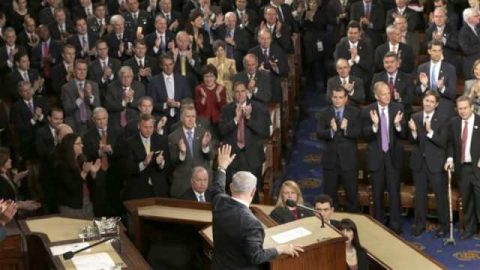
Netanyahu addresses US Congress | Photo from Al Jazeera
By Richard Hugus | January 4, 2019
Our world is run by oligarchs, the holders of vast wealth from monopolies in banking, resource extraction, manufacturing, and technology. Oligarchs have such power that most of the world doesn’t even know of their influence over our lives. Their overall agenda is global power — a world government, run by them — to be achieved through planned steps of social engineering. The oligarchs remain in the background and have heads of state and entire governments acting in their service. Presidents and prime ministers are their puppets. Bureaucrats and politicians are their factotums.
Who are politicians? Politicians are people who work for the powerful while pretending to represent the people who voted for them. This double-dealing involves a lot of lying, so successful politicians must be good at it. It’s not an easy job to make the insane agenda of the powerful seem reasonable. Politicians can’t reveal this agenda because it almost always goes against the interests of their constituents, so they become adept at sophistry, mystification, and the appearance of authority. For example, wars for Israel have been part of the agenda of the powerful for years. Since 2001, wars for Israel have been sold as “the war on terror” and lots of lies had to be made up as to why the war on terror was a real thing. The visible faces promoting the war on terror were neoconservatives in the US, almost all of whom were advocates for Israel, or Zionists. Zionists are not the only members of the oligarchy, but they seem to be its lead actors.
With this perspective we may judge all kinds of world events, such as the many false flag terror attacks which have been perpetrated in one country after another to bring about political objectives. False flag attacks range from Operation Gladio to demonize leftists, 9-11 to demonize Arabs and Muslims, and the shooting down of the MH-17 airliner to demonize Russia. Under an atmosphere of terror, with citizens clamoring for revenge, all kinds of political goals can be achieved.
Propaganda is also vital. Control of information through a likewise controlled media has facilitated mass brainwashing. To control the narrative, whistle blowers and truth tellers must be isolated and destroyed, preferably in the open, so as to warn others away. This is what is happening with Julian Assange.
The attack on Gilad Atzmon is an other example. Atzmon has been a major critic of the role of Jewish political power in our world — not just in Palestine, but all over the western world. When he says “we are all Palestinians” he is making the observation that Europe and North America are being Israelified. For example, some police in the US go for training in Israel, where they learn to view the US public, particularly African Americans, the way the Israeli military views Palestinians — as enemies to be shot in the streets and abusively treated. In the US, people are not allowed to question or discuss Jewish power, when it is evident that AIPAC, the lobby for Israel, completely controls both houses of the US Congress. We recall the members of Congress giving Benjamin Netanyahu 29 standing ovations during his denunciation of Iran in 2011. In Britain, mass insanity has taken hold, at least in the media, in the demonization of Russia via the Skripal affair and Luke Harding’s MI6 journalism in The Guardian. This is taking place solely because of Russia’s thwarting of Israel in its attempt to destroy Syria. For the neocons, the agenda is always war — the stick to bring recalcitrant states in line with the New World Order. This behavior is so dangerous that it would be crazy if we did not speak about who is doing this, and why.
In December 2018 Atzmon was banned from playing a jazz gig in Islington, north of London, because a powerful entity — the Zionist Herut Likud UK — initiated a character assassination and attack on his livelihood through Richard Watts, leader of the Islington Town Council. The Council created the lie that in banning Atzmon it was protecting the citizens of Islington from “antisemitism.” In fact, it is only protecting organized Zionists — supporters of the racist state of Israel — from one of their most effective critics.
Two paid staff for the Council — Ian Adams and Martin Bevis — were assigned to carry out the bureaucratic part of the job. They defended the assassination in the name of political correctness. They responded to Atzmon’s appeal of the Council ruling by citing almost entirely Zionist and Israeli sources to back up the claim that Atzmon is an “antisemite.” These sources include the Anti-Defamation League, the Jewish Chronicle, the Jewish Telegraphic Agency, Haaretz, the Times of Israel, and The Forward. When Atzmon countered these sources with a list of well-known academics who have supported his work — Richard Falk, John Mearschimer, Ramzy Baroud, Paul Craig Roberts, Cynthia McKinney, James Petras, Francis Boyle, among others — Ian Adams responded by saying, “I have found that the majority of them would appear to have also been subject to significant controversy or allegations of being anti-Semitic themselves.” To Adams, representing a town in Britain, the only valid authorities are in the media run out of Israel, with its blatant record of discrimination and genocide against Palestinians, which all those media support.
Power likes to cover up its crude manipulations with a veneer of reason and legality. Islington based its original decision on Atzmon’s banning on a clause in the town’s books having to do with events at the Islington Assembly Hall. The clause states:
“You must not, in connection with any Live Event, use, provide or display any material, whether written or spoken, or allow behaviour that constitutes direct or indirect discrimination or harassment, victimisation of, villification of, any person or group of persons on grounds of race, nationality, gender, sexual orientation, disability, religion or age.”
In their letters, Adams and Bevis provide no response to the fact that Atzmon was to appear at the December 21, 2018 event as a saxophone player with a jazz group called The Blockheads. There was no logical way to assume that his saxophone playing would discriminate against, harass, victimize, or vilify anyone at this event. The banning was therefore not backed up by law; it was illegal in itself, as it discriminated against Atzmon.
The only thing one can say about the bureaucrats’ defense of Islington’s decision is that they and the town officials, and indeed much of Britain’s political class, seem to be unaware that Zionism is the water in which their boat is floating. When the entire mainstream narrative is dictated by Jewish identity politics, of course all criticism of those politics must be heresy. Britain was once a sovereign nation, not a colony of Israel — much like the US. Much like Canada, Germany, France, and so on. These countries were not invaded by tanks and infantry; they were invaded by dogma. Political dogma, political “correctness,” and the totalitarian policing of our thoughts and words, are the things which Gilad Atzmon has pointed to in western culture and held up for us to examine. Zionists have made criticism of Israel “antisemitic” by definition. There is no way to win the argument. The word no longer has any meaning. This is aside from the fact that ‘semitic’ refers to a language group which includes Arabic, Aramaic, and Hebrew and that the majority of the settlers claiming rights to the Holy Land did not come from areas, like Palestine, where semitic languages were spoken.
Atzmon has asked the most basic questions: Israel defines itself as “the Jewish state” — what then is the Jewish state? What are Jewish identity politics? And why are we not allowed open discussion and debate on these questions? This is the reason for the attempt to denounce him. The bureaucrats and politicians of Islington say they’re fighting bigotry, but because they are part of a system which bigotry built, they’re actually speaking on behalf of it. Once again, the oligarchs have put through a dirty scheme under cover of benevolence and human rights.
Tiresome Things of 2018:
By Peter Van Buren | We Meant Well | December 31, 2018
 Tiresome things of 2018:
“News” that is just stuff someone tweeted;
“News” that is just repeating what a late night TV host said;
“News” reported on one web site which is just a rewrite of a story on another web site;
Deification by the left of scum from the right like McCain, Mattis, Clapper, Comey, Brennan, et al, only because they said something bad about Trump;
Desperate creation of insta-heroes to satisfy some greater political goal (‘Dem Parkland Kids, the cult of ‘Notorious’ RGB, Alexandria Ocasio-Cortez, Friggin’ Beto), empty heros in a time of disappointment and cynicism;
Movements which claim they have changed everything because their hashtag trended on Twitter;
All media abandoning even the pretence of objectivity in favor of advocacy but pretending they are still objective;
The primacy of “sources say…” over anything resembling actual fact-gathering;
“Fact checking” that is actually partisan gaming of information;
Idiots thrilled when bad things happen (like stock market declines) because they think it validates their Trump hate;
Idiots over-dramatizing bad things (like stock market declines) into evidence the world is ending, fascism is taking over, end of democracy, time to worry, walls closing in, tick tock;
Idiots hoping for more bad things to happen, like a doomsday cult does, because they think that will hasten the end of Trump;
People who have been saying “Just wait” for three years now into Russiagate. We’re waiting.
That most social media which isn’t cat pictures is now endless self-promotion because everyone is a brand or selling something or demanding we follow them or friend them or like them or thumbs up them;
People who just read the headlines and media which writes headlines which are not reflective of the actual content;
The way transpeople have become progressives’ adopted bestest minority of the moment;
Over-use of the word “folk”;
Insta-hate that finds some way to make anything Trump does from the dramatic to the mundane evil and wrong;
Historical revisionism that turns people like George W. Bush into kindly old men sharing candies with Goddess Michelle instead of thugs who dragged America into war and recession and forever damaged our nation’s credibility by torturing human beings;
Anything that starts with “As a ____” (woman, POC, Kurd, left handed Asian-American) because you know the rest is just going to be someone whining about how life is unfair, the system unjust, the deck stacked, because they are a ____ and can comment with the full authority for everyone ____ everywhere because they are a ____ and you are not;
Discussions on immigration policy that dead-end when someone has to tearfully tell us about how his great grandfather didn’t speak English, forestalling any serious attempt to look at broader policy in the 21st century.
Guns or Butter: Neocons Want More Weapons less Government Services
By Philip Giraldi | American Herald Tribune | December 30, 2018
It is one of the great ironies that the United States, which is not actually threatened by any foreign power, maintains a ruinously expensive and globally destructive national security policy that is based on fear. It can be argued that Washington was at least briefly a force for stability and good governance in the aftermath of the Second World War when much of Europe and Asia were in ruins, but America’s interference in the internal politics of other nations has, most particularly in the past twenty years, borne bitter fruit. The argument being made that the U.S. national security mandates “forward defense” by maintaining a string of overseas bases and outdated alliances has been proven wrong again and again as allies have proven feckless and countries that would otherwise be friendly have chafed and then rebelled under America’s imposed leadership role.
President and General Dwight D. Eisenhower famously warned in 1961 about the developing military-industrial-complex (MIC), which he had originally dubbed the military-industrial-congressional complex before accepting that he would need legislative help if he were to reverse the seemingly inexorable spending on weapons and expansion of overseas military bases. In the event, Ike’s warning went unheeded and, more recently, the expected “peace dividend” that might have developed from the end of the Cold War in 1991 was wasted when the Clinton Administration recklessly enabled the looting of the former Soviet Union’s natural resources while also expanding the no longer needed NATO alliance up to the Russian border.
Many politicians and industrialists who directly benefit from the spending on the military are largely to blame for propagating the myth that the United States is vulnerable to enemy attack. One only has to recall the panic when Moscow launched a satellite into orbit in 1957 and then there was the essentially fraudulent “Soviet Estimate” by the intelligence community which persisted in overrating Russian military capabilities and the strength of the Soviet Union’s economy. Having a powerful enemy was a sine qua non for those who wished to profit from “defense” spending.
The situation currently is somewhat different than that which prevailed during most of the post-World War 2 era. To be sure, the spending on weapons has continued at a ruinous level but the enemy has changed. Russia is back as a major threat due to the seemingly endless investigations into the 2016 election that have been dubbed “Russiagate,” but it has been joined by China, which is being seen at the major “over the horizon” enemy. And there is also the ubiquitous non-state player “Islamic terrorism” as well as Iran for good measure to keep the money flowing.
It would not be completely fatuous to suggest that the list of all of America’s presumed enemies is at least somewhat contrived. And it is also important to note that the identification of enemies for most Americans depends on the mainstream media, which is now closely linked to corporate and government interests so as to be incapable of independent inquiry or investigation. The impact of a tame media is significant: during the Vietnam War the press was highly critical and hammered the Lyndon B. Johnson Administration. Since then, reporters are embedded and the stories they are allowed to write, are generally puff pieces because to report the truth would make them lose their access.
A recent article that appeared in The Washington Post perfectly illustrates how the newspaper is selling a product that fearmongers to sustain more military spending. It is entitled Wake up. America’s military isn’t invincible, written by regular columnist Robert J. Samuelson.
The article begins with “The most uncovered story in Washington these days is the loss of U.S. military power — a lesson particularly important in light of recent events: the resignation of Defense Secretary Jim Mattis; President Trump’s rash decision to withdraw U.S. troops from Syria; North Korea’s announcement that it will keep nuclear weapons after all; and alleged massive computer hacking by Chinese nationals.”
Now, right off the bat, Samuelson’s argument can be challenged. “Loss of U.S. military power” if it can be quantified at all has nothing to do with Mattis or Syria, nor with North Korea or China. Or even with Donald Trump, who has increased the armed services budget, though one should presume that the president is the ultimate target of the article given that it has appeared in the Post.
Samuelson makes his case by citing defense modernization programs in China and Russia and “advances” in Iran and North Korea that undercut U.S. military capabilities. He refers to a recent report of the congressional National Defense Strategy Commission (NDSC), which identifies specific areas in which Russia and China have upgraded their capabilities and quotes “If the United States had to fight Russia in a Baltic contingency or China in a war over Taiwan . . . Americans could face a decisive military defeat.” The report concludes that “America has reached the point of a full-blown national security crisis.”
The possible armed conflicts cited by Samuelson are, of course, carefully chosen to produce a desired result. Confronting Russia or China in their home waters thousands of miles away from the U.S. gives all the advantage to the defense, which will be able to operate on interior lines and maximize available land, sea, and air forces. And the NDSC report itself is suspect, designed to promote a certain point of view. Its authors are top heavy with retired senior military officers and defense industry “experts” who have a personal interest in more spending on weapons.
Samuelson also cites fellow Post columnist Max Boot, writing that he had “done a great favor by publicizing the report.” He quotes Boot: “Air superiority, which the United States has taken for granted since World War II, is no longer assured. And, without control of the skies, U.S. ships and soldiers would be [highly] vulnerable.” Boot, sometimes referred to as the Man Who Has Never Been Right About Anything is, of course, a neocon mouthpiece who is in favor of war all the time and nearly everywhere, particularly if Israel is involved. He characteristically, like Samuelson, fancies himself as an expert on national security even though he has never served in the armed forces. His “air superiority” mantra is ridiculous as it would seem to suggest that the U.S. should be able to “control the skies” everywhere simultaneously, which is impossible. And he ignores the fact that the United States uniquely has 19 aircraft carriers which can project air power to anywhere in the world.
Samuelson goes on to condemn what he calls “unwise cuts in defense spending” and cites a 12% decline in spending on the military between 2010 and 2015 as well as a decline in the “defense” share of the GDP from 1960 until 2017. Both figures come from the NDSC report. He does not, however, mention that the current defense budget is larger than the military spending of the next eight countries combined, to include both China and Russia.
Samuelson, doing a great impersonation of ex-Speaker of the House Paul Ryan, blames the lack of money for the Pentagon on “the American welfare state — Social Security, Medicare, Medicaid, food stamps and the like.” He advocates cutting “welfare” to buy more and better weapons. He then goes on to liken the current situation to that existing before World War 2, when Adolph Hitler’s Germany rearmed while England and France did nothing. The analogy is not exactly correct as, when war broke out, France alone fielded an army greater than Germany’s, but it’s always reassuring to have Hitler cited yet again in a neocon op-ed.
Samuelson concludes with the obligatory slap at Trump: “We need to keep our commitments — Trump’s abrupt withdrawal from Syria devalues our word. And we need to repair our alliances,” but one might well opine that there is something seriously wrong with that kind of thinking, where guns always take precedence over butter. Government exists to benefit the citizens that together make up the state, not to meddle in the affairs of other nations and peoples worldwide.
The selling of America the All-Powerful is a bit of a con job promoted by neocons like Samuelson and Boot but we do not need to send tens of thousands of young Americans overseas to give “value to our word.” We do not need to enter into pointless wars in places like Afghanistan, Iraq, Libya, and Syria. We do need an America that is at peace with itself and which is willing to be strong and brave enough to realize that real security will come when the United States is no longer the world’s designated bully. Let’s consider a New Year’s wish to see a 2019 where the soldiers, sailors, marines, and airmen finally come home and where scribblers like Samuelson and Boot find themselves unemployed.
Persecution & intimidation: Fate of Russians in US prisons casts shadow on American justice system
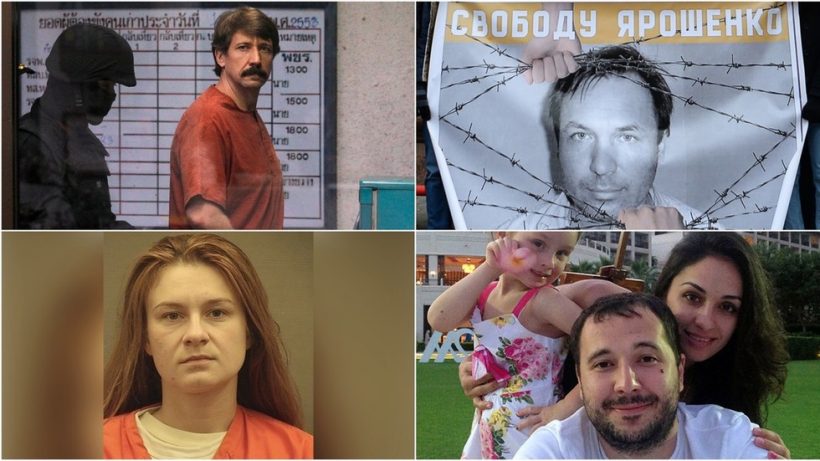
© (top left) Viktor Bout / Reuters / Damir Sagolj; (top right) A placard with an image of Konstantin Yaroshenko / Sputnik;
(bottom left) Maria Butina / Reuters / Alexandria Sheriff’s Office; (bottom right) Family photo of Roman Seleznyov / AFP
RT | December 29, 2018
As Washington continues detentions of Russians across the world the plight of those, who have already fallen into the clutches of the US authorities, raises suspicion about the true colors of the US justice system.
In mid-December, yet another Russian citizen was detained outside of Russia’s borders – this time in Finland – at the request of the United States, marking the latest episode in what the Russian Foreign Ministry decried as a “de-facto hunt” for the Russians on a global scale.
The news about the arrest of a Russian woman in Finland, who was placed in a “male” detention center and reportedly complained of poor conditions, came just days after a long-time Russian prisoner jailed in the US revealed that he was offered various favors, including a Green Card for his family in exchange for accusing the Russian government of corruption.
These developments shed light on how the US justice works, at least when it comes to Russians. RT looks at some of the high-profile cases, involving Russian citizens who have been detained or imprisoned in the US.
1. Viktor Bout
A businessman jailed in the US on accusations of being an international arms dealer, Viktor Bout, is one of the Russians who has spent the longest period of time in a US prison in recent history. He has been in custody for a decade now, after being arrested in 2008 in Thailand during a sting operation. He was convicted in the US in 2012 on a charge of conspiring to kill American citizens, by selling weapons to the Revolutionary Armed Forces of Colombia (FARC), and was handed a 25-year sentence.
The businessman himself has denied accusations. As the scandal developed he’s been in the media spotlight. While talking to reporters he spoke about life in the US high-security prison claiming that a maximum-security prison he is in spends hundreds of thousands of dollars on every prisoner from the US budget. Nevertheless, the conditions in the facility leave much to be desired and “nobody ever investigated” why the cost is so high, he said.
Bout was also highly critical of the US justice system by calling it a “cheap farce” and saying that the only reason behind his incarceration was to “intimidate other Russians”. It was also him, who said that the US offered him a deal in exchange for “telling the US authorities about corruption in the Kremlin.”
Still, he remains full of optimism and says that yoga, learning foreign languages and anecdotes keep him in good shape both physically and mentally.
2. Konstantin Yaroshenko
Other Russian citizens faced a much more ghastly fate and Konstantin Yaroshenko, a Russian pilot arrested in Liberia back in 2010, is one of them. Detained as a result of another US sting operation, Yaroshenko was accused of participating in a plan to smuggle drugs into the US and was handed down a 20-year sentence in 2011, which he has been serving ever since.
Yaroshenko has always insisted that he is completely innocent and that the whole process was part of a scheme by US agents to extract evidence against Bout. He also repeatedly complained about the conditions he was held in. He claimed he had been denied medical assistance despite health problems and was tortured by the prosecutors.
In May 2018, he told his wife by phone that his health problems could be due to deliberate poisoning. He also said he was put in a disciplinary cell for 30 days despite serious health issues. “He said he was tired of the torments and that 30 days in the disciplinary cell would kill him, he would not walk out of it alive,” she told reporters. His lawyer, meanwhile, assumed that it might have been punishment for talking to the Russian media.
Moscow has repeatedly urged Washington to pardon Yaroshenko but the US rejected any appeals.
3. Maria Butina
A pro-gun rights activist, Maria Butina, has become one of the latest Russian citizen jailed in the US in a high-profile case. Living in the US on a student visa, she was arrested in mid-July in the middle of the hunt for “Russian agents” and accused of secretly working for the Russian government as an unregistered lobbyist.
While being far from a dangerous criminal, Moscow said that Butina faced unnecessarily harsh treatment during her pre-trial detention. She was kept in solitary confinement for months, denied medical help and “subjected to a kind of torture,” as the Russian Foreign Minister Sergey Lavrov put it.
While initially pleading not guilty, Butina, who faced up to 15 years in jail, then changed her mind and agreed to strike a deal with prosecutors. Lavrov then said that he had “reasons to believe” the conditions she was kept in were “intended to break her will and make her confess to something she likely didn’t do.”
4. The hunt for ‘Russian hackers’
In recent years, the US also started a real hunt for those it called the ‘Russian hackers.’ About half a dozen Russian programmers were arrested in various corners of the world upon similar US requests and were all accused of various cybercrimes.
Roman Seleznyov, the son of Russian MP Valery Seleznyov, was arrested as he was on holiday in the Maldives in 2014. He was accused of being involved in bank fraud, obtaining information from protected computerized cash registers and aggravated identity theft.
Seleznyov has pleaded not guilty to all the charges. The man was held in prison even before trial despite his lawyer arguing that his client did not represent any danger to society. “This case does not involve an act of terrorism. It does not involve an act of war,” the lawyer said at that time.
Seleznyov was eventually sentenced to 27 and 14 years in two separate cases. Both sentences will run concurrently.
A similar fate befell programmer Pyotr Levashov, accused by US prosecutors of being the mastermind behind a large bot net. He was extradited to the US from Spain in February 2018 and initially pleaded not guilty to all 8 counts against him.
He also said his life would be in danger if Spanish authorities complied with the US extradition request, and afraid that he might face torture in the US “in order to extract Russian secrets.” Just seven months later, he pleaded guilty. His trial is scheduled for September 2019. Until then, he will still stay in prison.
Another Russian programmer, Stanislav Lisov, was extradited to the US from Spain in January 2018 and has been held in the Metropolitan correction center in New York.
The FBI claims that Lisov was the creator and administrator of NeverQuest, a banking trojan that has defrauded thousands of people, and cost the US some $5 million. Lisov denied all accusations and said that he just provided tech support for websites. He also said he was long kept in the dark about the real charges and was asked if he “broke into the Pentagon” or the FBI or the CIA.
His wife told RT before his extradition that she and her husband were “ninety-percent certain that the case is politically motivated.” In October, his lawyer told the Russian Izvestia daily that Lisov, 32, could get a “de-facto life sentence” even though the maximum sentence in his case could not exceed 25 years.
These are just some examples. As many as 54 Russians were held in US prisons in 2017, according to the data provided by the US Federal Bureau of prisons to RT. The Russian Foreign Ministry’s spokeswoman Maria Zakharova has, in turn, condemned the US for “acting on the sly” and simply “abducting” the Russian citizens during their travels abroad.
Although almost all the cases against the Russians in the US do look like simple criminal proceedings, the circumstances surrounding these cases still leave many questions about whether they were solely about the pursuit of justice.
Irony alert: Firm that warned Americans of Russian bots… was running an army of fake Russian bots
By Danielle Ryan | RT | December 29, 2018
The co-founders of cybersecurity firm New Knowledge warned Americans in November to “remain vigilant” in the face of “Russian efforts” to meddle in US elections. This month, they have been exposed for doing just that themselves.
Ryan Fox and Jonathan Morgan, who run the New Knowledge cybersecurity company which claims to “monitor disinformation” online, penned a foreboding op-ed in the New York Times on November 6, about “the Russians” and their nefarious efforts to influence American elections.
At the time, it struck me that Fox and Morgan’s reasoning seemed a little far-fetched. For example, one of the pieces of evidence presented to prove that Russia had targeted American elections was that lots of people had posted links to RT’s content online. Hardly a smoking gun worthy of a Times oped.
Morgan and Fox, intrepid cyber sleuths that they are, claimed in the article they had detected more “overall activity” from ongoing Russian influence campaigns than social media companies like Facebook and Twitter had yet revealed — or that other researchers had been able to identify.
The New Knowledge guys even authored a Senate Intelligence Committee report on Russia’s alleged efforts to mess with American democracy. They called it a “propaganda war against American citizens.” Impressive stuff. They must be really good at their job, right?
This week, however, we learned that New Knowledge was running its own disinformation campaign (or “propaganda war against Americans,” you could say), complete with fake Russian bots designed to discredit Republican candidate Roy Moore as a Russia-preferred candidate when he was running for the US senate in Alabama in 2017.
The scheme was exposed by the New York Times — the paper that just over a month earlier published that aforementioned oped, in which Fox and Morgan pontificated about Russian interference online.
New Knowledge created a mini-army of fake Russian bots and fake Facebook groups. The accounts, which had Russian names, were made to follow Moore. An internal company memo boasted that New Knowledge had “orchestrated an elaborate ‘false flag’ operation that planted the idea that the Moore campaign was amplified on social media by a Russian botnet.”
Moore lost the race by 1.5 percent. To be fair, accusations published by the Washington Post that he pursued underage girls back in the 1980s may have had something to do with it as well, but that’s a different story.
Of course, New Knowledge and even the New York Times, which blew the lid of the operation, are trying to spin this as some kind of “small experiment” during which they “imitated Russian tactics” online to see how they worked. Just for research, of course. They have also both claimed that the scheme, dubbed ‘Project Birmingham’ had almost no effect on the outcome of the race.
The money for the so-called research project came from Reid Hoffman, the billionaire co-founder of LinkedIn, who contributed $750,000 to American Engagement Technologies (AET), which then spent $100,000 on the New Knowledge experiment. After the scheme was exposed, Hoffman offered a public apology, saying he didn’t know exactly how the money had been used and admitting that the tactics were “highly disturbing.”
If people like Fox and Morgan actually cared about so-called Russian meddling or the integrity of American elections, they would not have run the deceptive campaign against Moore, no matter how undesirable he was as a candidate. Their sneaky and deceitful methods are in total contrast to the public profile they have cultivated for themselves as a firm fighting the good fight for the public good. But is it really that much of a surprise?
You would think that a newspaper like the New York Times would have cottoned on to the fact that guys like Fox and Morgan, with their histories in the US military and intelligence agencies, have clear agendas and are not exactly squeaky clean or the most credible sources of information when it comes to anything to do with Russia. But that kind of insight or circumspection might be too much to ask for in the age of Russiagate.
Facebook removed Morgan’s account on Saturday for “engaging in coordinated inauthentic behavior” around the Alabama election. Three days after publishing its initial article on the scandal (the one in which it played down the effects of New Knowledge’s disinfo campaign), the New York Times published a follow-up piece about the Facebook removal, in which it admitted that the controversy would be a “stinging embarrassment” for the social media researcher, noting that he had been a “leading voice” against supposed Russian disinformation campaigns.
In Fox and Morgan’s original NYT oped, they warned of the ubiquitous “Russia-linked social media accounts” and estimated that “at least hundreds of thousands, and perhaps even millions” of US citizens had engaged with them online. One must now wonder, were they including their own fake Russian bots in that count, or were they leaving those ones out?
It’s nearly two years into the Trump presidency and still we have no solid evidence that the Russian “collusion” theory is anything more than a fantasy concocted by Democrats desperate to provide a more palatable reason for Hillary Clinton’s loss than the fact that she simply ran a bad campaign.
In fact, at this point, we actually have more solid and irrefutable evidence of election meddling from the likes of dodgy American and British companies like Cambridge Analytica and New Knowledge than we do of any meddling orchestrated by Russia.
Danielle Ryan is an Irish freelance writer based in Dublin. Her work has appeared in Salon, The Nation, Rethinking Russia, teleSUR, RBTH, The Calvert Journal and others. Follow her on Twitter @DanielleRyanJ
Also on rt.com:
The only ‘Russian bots’ to meddle in US elections belonged to Democrat-linked ‘experts’
LinkedIn billionaire ‘sorry’ for funding ‘Russian bot’ disinformation campaign against Roy Moore
Wag the Dog… British Media Watchdog Accuses Russia of Bias
By Finian CUNNINGHAM | Strategic Culture Foundation | 27.12.2018
Irony is dead when British state media controllers accuse Russian news outlets RT and Sputnik of “imbalance” over their reporting on the Skripal alleged poisoning affair.
In the past week, Ofcom, the British media watchdog, condemned seven programs aired during March and April this year following the apparent poisoning of former Russian spy Sergei Skripal in Salisbury. The Russian outlets may be fined or denied future broadcasting rights in Britain. The latter suggests what the real, ulterior agenda is all about.
It remains a mystery as to what happened exactly to Skripal and his daughter when they reportedly fell ill on March 4 in the famous south of England cathedral town. Neither Sergei nor Julia have been seen in public since, apart from a brief and carefully controlled interview given by Julia to Reuters a few months ago, apparently having recovered from her stricken condition. Russian consular services have been denied access to Julia by the British authorities, despite her being a Russian citizen.
The murkiness of the affair, the flagrant obfuscation by the British authorities and their violation of diplomatic norms speaks of a British state intrigue aimed at provoking international recriminations against Russia. Such is the outrageous apparent skullduggery by the British state, it is arguably very appropriate therefore for critical media coverage of the incident and the subsequent prevarication by London.
However, in a staggering inversion of reality, British media regulators complain that Russian news outlets have broken “impartiality rules” in their reporting on what is a bizarre de facto disappearance of a Russian citizen and her father while in the custody of British authorities. The protagonists are off-limits from criticism; their ropey claims must be treated as the sane version of events.
Within days of the Salisbury incident, senior British officials, including Prime Minister Theresa May, were accusing Russia of an assassination attempt against the Skripals, allegedly with a Soviet-era nerve poison.
London’s narrative inculpating the Kremlin and Russian President Vladimir Putin continues, despite Russia’s vehement denial of involvement and despite the lack of independently verifiable evidence.
This week, in her Christmas speech to the nation, premier May again repeated her condemnation of the “nerve agent attack in Salisbury” and she praised British armed forces for “protecting the country’s waters and skies from Russian intrusion”.
So, Russian media are castigated for “bias”, but British media are evidently permitted to report and broadcast official British assertions that are unproven and wildly sensational, if not tantamount to inciting international conflict. Just who is breaking journalistic standards?
Among the news outlets reporting May’s words were the BBC. The government-owned British broadcaster routinely and snidely refers to Russian news outlets RT and Sputnik as “Kremlin-backed”. As if the state-backed BBC is somehow immune from disseminating British government propaganda.
May’s assertions in her Christmas speech about Russia carrying out an alleged assassination and threatening Britain with invasion went unchallenged by the BBC. Nor were her other claims about chemical weapons being used by Syrian government forces against civilians.
On Syria, May was referring to an incident near Damascus in April this year when toxic chlorine was purportedly used in an assault on civilians. Back then, the British prime minister joined with US President Trump and France’s President Macron to order air strikes on Syria, supposedly in retaliation for the Syrian army’s use of chemical weapons. But it soon transpired that the incident was a provocation staged by jihadist militants and their media operatives, the so-called White Helmets. In other words, the British, American and French carried out a criminal act of aggression against Syria under false pretenses.
Yet May in her solemn set-piece nationwide Christmas speech this week was allowed by British media to repeat blatant lies against Syria, and brazenly avoid the issue of justice facing her government over illegal air strikes on Syria, as well as to continue smearing Russia over the murky Skripal affair.
The arrogant hypocrisy of British media and the state regulator is astounding. British citizens are compelled by law to pay an annual license fee of £150 ($190) per household for possessing a television set. Failure to pay can result in a jail sentence. The TV license fee collected by the British state is handed over to the BBC. So, here we have a state-owned media channel that is funded through a compulsory tax on citizens, and yet this same channel willingly broadcasts British government propaganda claims denigrating Russia and covering up for British war crimes in Syria. If that sounds Orwellian, that’s because it is.
The BBC’s corporate advertising claims to be the “world’s leader in breaking global news”. It also assures its listeners and readers that it produces “news you can trust”.
There are countless cases where the BBC’s pompous self-importance can be exposed, revealing an altogether more malevolent purpose. One of the most notorious cases was its complicity in orchestrating the 1953 coup in Iran carried out by the American CIA and Britain’s MI6. In his book, Web of Deceit, British historian Mark Curtis details the crucial role played by the BBC and its Persian service in helping to foment the coup against the elected premier Mohammad Mosaddegh.
More recently, BBC coverage of the war in Syria over the past eight years has been a relentless propaganda assault on the government of President Bashar al Assad. It is not merely about omission or biased distortion. The BBC has been caught out actually fabricating fake news in Syria, such as the case when it accused the Syrian army of using napalm on civilians near Aleppo in 2013. Those reports were later exposed as deliberate fabrications.
More generally on Syria, the BBC, as with other Western news media, are serving as facilitators of the criminal regime-change objective of their governments. May’s grotesque falsehoods reiterated this week – in a Christmas speech of all things! – about chemical weapons are afforded respectability and apparent credibility by the way the BBC and other British outlets dutifully report her words without any qualification, let alone criticism.
It is a measure of how distorted the British media landscape is when alternative news channels which do raise critical viewpoints and insights on propaganda narratives are then accused of being “imbalanced” and “in breach of broadcasting rules”.
In response to Britain’s Ofcom regulator condemning Russia’s RT and Sputnik, Moscow is now saying that its own state regulator is considering filing a case against the BBC and how it operates in Russia. Given how the BBC tried to tie Russia to instigating the Yellow Vest protests in France and how it recently ran an article accusing the Kremlin of “weaponizing satire”, there seems much more credibility to Russian claims that the “British state-backed outlet” is in breach of journalistic standards.
The broader background of how the BBC serves British state propaganda is panoramic in its scope. But such is official British hypocrisy, the authorities attack critical news outlets that happen to expose their propaganda service posing as “news you can trust”.
Free speech in Britain? Yes, as long as you freely speak in the service of British state propaganda.
Company Behind Meddling Report Helps Businesses ‘Smear Critics as Russian Bots’
Sputnik – 27.12.2018
One of the authors of a major report on alleged Russian social media meddling during the 2016 elections, Jonathon Morgan, has been banned from Facebook following revelations that the company he serves as a CEO of – New Knowledge – staged a “false flag” operation during the 2017 special election in Alabama.
Four other accounts run by “multiple” people were also banned, but it isn’t clear which accounts they were. “There’s really no transparency from Facebook,” documentary filmmaker and RT America correspondent Dan Cohen, who published an explosive article on the New Knowledge influence operation in Alabama recently, told Radio Sputnik’s Loud & Clear.
“Who knows what else those four Facebook accounts reveal about this operation or other operations. I’m guessing we saw a very small amount of what happened here. You know, when there’s smoke there’s fire,” Cohen added.
New Knowledge’s report on the alleged Russian operation was touted on both sides of the aisle of the Senate Intelligence Committee, for whom the report was prepared.
Committee Chairman Sen. Mark Warner (D-IN) called the report a “bombshell” and “wake up call.” Ranking Republican Richard Burr (R-NC), called it “proof positive that one of the most important things we can do is increase information sharing between the social media companies who can identify disinformation campaigns and the third-party experts who can analyze them.”
The reports’ author — New Knowledge — was recently revealed to have “orchestrated an elaborate ‘false flag’ operation that planted the idea that the Moore campaign was amplified on social media by a Russian botnet,” an internal report from the company obtained exclusively by the New York Times says.
Morgan, the CEO of the company, had previously — during the height of the campaign — blamed “Russian trolls” for seeking to influence the election as New Knowledge did exactly that, Sputnik News reported.
Morgan also helped start the Hamilton 68 Dashboard, a tool which claimed it tracked Russian trolls. However, it does no such thing and one of the project founders, Clint Watts even said he was “not convinced on this bot thing.”
In fact, according to Watts, unnamed people on the project didn’t even believe the accounts were “commanded in Russia — at all. We think some of them are legitimately passionate people that are just really into promoting Russia.”
Cohen scoured Morgan’s interviews and discovered a number of absurd claims.
“We developed some techniques for determining who matters in a conversation,” Morgan said of the dashboard’s methodology. “Using some of those techniques, we’ve identified a subset of accounts that we’re very confident are core to furthering the Russian narrative in response to mainstream events.”
In another interview, Morgan informed Americans how they can tell whether they have been misled by Russian disinformation: “If it makes you feel too angry or really provokes that type of almost tribal response, then it may be designed to manipulate you… People should be concerned about things that encourage them to change their behavior.”
Morgan is “basically a career spook who came up through the Obama White House and State Department, acting as an advisor; founded a series of startups using USAID and funds from the Omidyar Network,” Cohen told Loud & Clear hosts Brian Becker and John Kiriakou. “And then he founded this group called New Knowledge, and thanks to a massive investment from venture capitalists, he was able to basically manipulate the 2017 special [Senate] elections to replace Jeff Sessions in Alabama.”
The race was hotly contested by the two candidates: “centrist” Democrat Doug Jones and “far right Christian theocrat” Roy Moore. Jones narrowly beat Moore, but “we’ll never know how much this cyber meddling operation that Morgan and New Knowledge — what the impact was,” Cohen said.
Nonetheless, New Knowledge’s impact is clear and significant in the case of the Senate report it authored with innumerable articles breathlessly covering its contents. That’s despite the assessment of the news site Foreign Policy, which profiled an analyst at New Knowledge and included the caveat that New Knowledge’s “method of analysis is in its infancy, remains a fairly blunt instrument, and still requires human intervention. It sometimes mistakes real people who post anti-imperialist arguments about US foreign policy for Kremlin trolls, for example.”
It’s also “important” to note that New Knowledge primarily concerns itself with private affairs, Cohen said. “They serve the private sector, so if you’re an oil or gas corporation who does fracking or something like that, and you’re getting criticized online, you can hire your New Knowledge to smear your critics as Russian bots.”
British Government Covert Anti-Russian Propaganda and the Skripal Case
By Craig Murray | December 21, 2018
It is worth starting by noting that a high percentage of the Integrity Initiative archive has been authenticated. The scheme has been admitted by the FCO and defended as legitimate government activity. Individual items like the minutes of the meeting with David Leask are authenticated. Not one of the documents has so far been disproven, or even denied.
Which tends to obscure some of the difficulties with the material. There is no metadata showing when each document was created, as opposed to when Anonymous made it into a PDF. Anonymous have released it in tranches and made plain there is more to come. The reason for this methodology is left obscure.
Most frustratingly, Anonymous’ comments on the releases indicate that they have vital information which is not, so far, revealed. The most important document of all appears to be a simple contact list, of a particular group within the hundreds of contacts revealed in the papers overall. This is it in full:
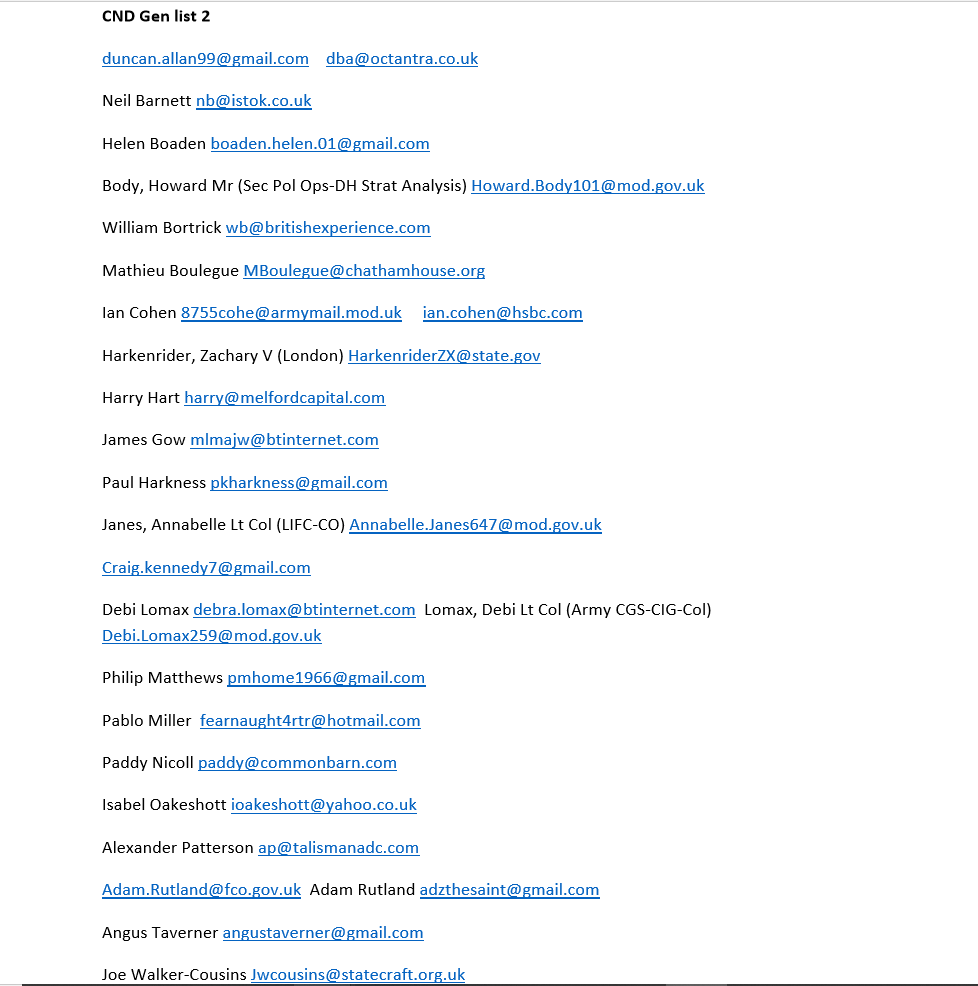
Tantalisingly, Anonymous describe this as a list of people who attended a meeting with the White Helmets. But there is no evidence of that in the document itself, nor does any other document released so far refer to this meeting. There is very little in the documents released so far about the White Helmets at all. But there is a huge amount about the Skripal case. With the greatest of respect to Anonymous and pending any release of further evidence, I want you to consider whether this might be a document related to the Skripal incident.
The list is headed CND gen list 2. CND is Christopher Nigel Donnelly, Director of the Institute for Statecraft and the Integrity Initiative and a very senior career Military Intelligence Officer.
The first name on the list caught my eye. Duncan Allan was the young FCO Research Analyst who, as detailed in Murder in Samarkand, appears in my Ambassadorial office in Tashkent, telling me of the FCO staff who had been left in tears by the pressure put on them to sign up to Blair’s dodgy dossier on Iraqi WMD. During the process of clearing the manuscript with the FCO, I was told (though not by him) that he denied having ever said it. It was one of a very few instances where I refused to make the changes requested to the text, because I had no doubt whatsoever of what had been said.
If Duncan did lie about having told me, it did his career no harm as he is now Deputy Head of FCO Research Analysts and, most importantly, the FCO’s lead analyst on Russia and the Former Soviet Union.
Now let us tie that in with the notorious name further down the list; Pablo Miller, the long-term MI6 handler of Sergei Skripal, who lived in Salisbury with Skripal. Miller is the man who was, within 24 hours of the Skripal attack, protected by a D(SMA) notice banning the media from mentioning him. Here Pablo Miller is actively involved, alongside serving FCO and MOD staff, in a government funded organisation whose avowed intention is to spread disinformation about Russia. The story that Miller is in an inactive retirement is immediately and spectacularly exploded.
Now look at another name on this list. Howard Body. Assistant Head of Science Support at Porton Down chemical weapon research laboratory, just six miles away from Salisbury and the Skripal attack, a role he took up in December 2017. He combines this role with Assistant Head of Strategic Analysis at MOD London. “Science Support” at Porton Down is a euphemism for political direction to the scientists – Body has no scientific qualifications.
Another element brought into this group is the state broadcaster, through Helen Boaden, the former Head of BBC News and Current Affairs.
In all there are six serving MOD staff on the list, all either in Intelligence or in PR. Intriguingly one of them, Ian Cohen, has email addresses both at the MOD and at the notoriously corrupt HSBC bank. The other FCO name besides Duncan Allan, Adam Rutland, is also on the PR side.
Zachary Harkenrider is the Political Counsellor at the US Embassy in London. There are normally at least two Political Counsellors at an Embassy this size, one of whom will normally be the CIA Head of Station. I do not know if Harkenrider is CIA but it seems highly likely.
So what do we have here? We have a programme, the Integrity Initiative, whose entire purpose is to pump out covert disinformation against Russia, through social media and news stories secretly paid for by the British government. And we have the Skripals’ MI6 handler, the BBC, Porton Down, the FCO, the MOD and the US Embassy, working together in a group under the auspices of the Integrity Initiative. The Skripal Case happened to occur shortly after a massive increase in the Integrity Initiative’s budget and activity, which itself was a small part of a British Government decision to ramp up a major information war against Russia.
I find that very interesting indeed.
With a hat-tip to members of the Working Group on Syria, Media, and the Propaganda, who are preparing a major and important publication which is imminent. UPDATE Their extremely important briefing note on the Integrity Initiative is now online, prepared to the highest standards of academic discipline. I shall be drawing on and extrapolating from it further next week.
Influencing Foreigners Is What Intelligence Agencies Do
By Philip M. GIRALDI | Strategic Culture Foundation | 20.12.2018
The Rand Corporation defines America’s influence operations as… “the coordinated, integrated, and synchronized application of national diplomatic, informational, military, economic, and other capabilities in peacetime, crisis, conflict, and post-conflict to foster attitudes, behaviors, or decisions by foreign target audiences that further US interests and objectives. In this view, influence operations accent communications to affect attitudes and behaviors but also can include the employment of military capabilities, economic development, and other real-world capabilities that also can play a role in reinforcing these communications.”
In a world where communications and social networks are global and accessible to many ordinary people, influence operations are the bread-and-butter of many intelligence agencies as a means of waging low intensity warfare against adversaries. During the past week there have been two accounts of how influencing foreign audiences has worked in practice, one relating to Russia and one to Great Britain.
The Russian story is part of the continuing saga of Russiagate. On Monday, the Senate Intelligence Committee released two reports on Russian operations before during and after the 2016 election to influence targeted groups, to include African-Americans, evangelical Christians and Second Amendment supporters to confuse voters about what the candidates stood for. Russia Internet Research Agency, headed by Yevgeny V. Prigozhin, alleged to be a friend of President Vladimir Putin, reportedly coordinated the effort.
The New York Times, slanted its coverage of the story, claiming that Moscow was “weaponizing” social media and that it was intended to support the candidacy of Donald Trump who “had a Russian blind spot and an army of supporters willing to believe convenient lies and half-truths.” They also dubbed it “a singular act of aggression that ushered in an era of extended conflict.” Of course, one might note that in 2016 the Times itself had a blind spot regarding Hillary Clinton compounded by a bias against Trump and his “deplorable” supporters, while one must also point out that Russian intentions are unknowable unless one were a fly on the wall inside the Kremlin when the US election was under discussion, so one might conclude that the newspaper is itself spreading something like disinformation.
It is undoubtedly true that Russia had a vital national interest in opposing Clinton, whose malevolent intentions towards Moscow were well known. It is also undoubtedly true that there was a campaign of manipulation of social networks by the Kremlin and its proxies to influence readers and also to assess the development of the two major party campaigns. But it also should be observed that the claim that it was seeking to suppress Democratic voters is not really borne out given the other much more conservative demographics that were also targeted. Indeed, involvement by Russia did not alter the outcome of the election and may have had virtually no impact whatsoever, so the claims by the Times that the world is seeing a new form of warfare is clearly exaggerated to reflect that paper’s editorial stance.
The fact that the Times is trying to make the news rather than reporting it is clearly indicted by its sheer speculation that “The Internet Research Agency appears to have largely sat out the 2018 midterm elections, but it is likely already trying to influence the 2020 presidential election, in ways social media companies may not yet understand or be prepared for. And Russia is just the beginning. Other countries, including Iran and China, have already demonstrated advanced capabilities for cyberwarfare, including influence operations waged over social media platforms.” It is certainly convenient to have all one’s enemies collectivized in two sentences, but the Times manages that quite neatly.
The second story, much less reported in the US media, relates to how the British intelligence services have been running their own disinformation operations against Russia, also using social networks and the internet. The British government has been financing a program that was given the name Integrity Initiative. It has been tasked with creating and disseminating disinformation relating to Russia in order to influence the people, armed forces and governments of a number of countries that Moscow constitutes a major threat to the west and its institutions.
Former British intelligence officer and established Russo-phobe Christopher Nigel Donnelly (CND) is the co-director of The Institute for Statecraft and founder of its offshoot Integrity Initiative. The Initiative ironically claims to “Defend Democracy Against Disinformation.” According to leaked documents, the Initiative plants disinformation that includes allegations about the “Russian threat” to world peace using what are referred to as journalists ‘clusters’ in place both in Europe and the United States.
Even though the Institute and Initiative pretend to be independent Non-Government Organizations (NGOs), they are both actually supported financially by the British government, NATO and what are reported to be other state donors, possibly including the United States.
The Integrity Initiative aside, the United States has also long been involved in influence operations, sometimes also referred to as perception management. Even before 9/11 and after the breakup of the Soviet Union the State Department, Pentagon and National Security Agency were all active on the internet in opposing various adversaries, to include terrorist groups. The CIA has been spreading disinformation using paid journalists and arranging foreign elections since 1947. Sometimes US federal government agencies are operating openly, but more often they are using covert mechanisms and cover stories to conceal their identities. America’s internet warriors are adept at spreading misinformation aimed at target audiences worldwide.
The fact is that spreading disinformation and confusion are what governments and intelligence services do to protect what they consider to be vital interests. It is naïve for the US Senate and America’s leading newspapers to maintain that intelligence probing and other forms of interference from Russia or China or Iran or even “friend” Israel occur in a vacuum. Everyone intrudes and spreads lies and everyone will continue to do it because it is easy to understand and cheap to run. In the end, however, its effectiveness is limited. In 2016 the election result was determined by a lack of trust on the part of the American people for what the establishment politicians have been offering, not because of interference from Moscow.
‘Striking images to help public relate’: UK Integrity Initiative’s post-Skripal psyop leaked
RT | December 19, 2018
The UK government-funded ‘Integrity Initiative’ (II) actively monitored social media and suggested influencing foreign journalists with “pro-UK messaging” in the aftermath of the poisoning of Sergei Skripal, latest leaks claim.
The shady II – a project of the Institute for Statecraft (IfS) – bills itself as a non-partisan, disinformation-busting charity. Yet, according to leaked documents by a group calling itself Anonymous, it ran a smear campaign at home and also meddled in the internal affairs of EU countries.
The latest – third – batch of leaks says that IfS also sprung into action after the poisoning of ex-double agent Sergei Skripal and his daughter earlier this year. London blamed the attack on Moscow, while Kremlin said the accusations lacked evidence and were part of smear campaign against Russia.
In the aftermath of the case, IfS suggested a “live monitoring” project to determine which “key influencers” and journalists were “friendly” toward the UK and which were not, in order to be able to provide an “early warning” of any “threat to HMG” (Her Majesty’s Government).
A proposal document for the Skripal project said that the social media monitoring service known as ‘SENTINEL’ and an investigative platform called ‘SEEKER’ would be used to identify accounts that were deemed “part of a Russian government media strategy.”
The latest leak also includes a number of short country reports on the Skripal monitoring project from across Europe including from Bosnia Herzegovina, Montenegro and the Baltic states. A more lengthy report was produced for Italy, where the Integrity Initiative claimed that “the risk of Russian influence” remains “high.”
The reason was that that doubts had been raised about the UK government’s narrative on the Skripal story, even in “high quality” Italian newspapers. This was blamed on the fact that not enough Italians consider Russia a threat and therefore, people there reacted to the news with “emotions” rather than rational analysis, it is claimed. According to the docs, the way to remedy this, was to direct “an effective, discrete and articulated information campaign” toward Italian influencers in politics and media.
A document on “ramping up” IfS’s work suggests that posting “striking images” of Skripal in hospital might “help the public relate” more to the story. Notably, while the IfS denigrated the “emotional” reaction from Italians that did not go in their favor, they were not so reserved with the British public.
The same document argues that the IfS could potentially be“anonymous funders” of Patreon projects where users are creating high-quality anti-Russian content — and could even “commission” such content itself. IfS should “use public figures in our networks to approach celebrities” and other “social influencers” to spread the message, it says, giving former footballer Gary Lineker as an example.
The IfS could also help expand “recent efforts to develop media literacy in rural USA” by using the Skripal affair as a “vivid and timely case-study,” the document says, without elaborating on its US efforts. Another stated goal would be to “find ways” to remove content from RT and Ruptly news agency from anywhere it was found within mainstream media.
Earlier leaks claim that the group has already led a successful social media campaign to prevent the appointment of Colonel Pedro Banos as director of Spain’s Department of Homeland Security due to his so-called “pro-Russian” views. The government-funded group also launched a domestic smear campaign against Labour leader Jeremy Corbyn in an effort to brand him as a tool of the Kremlin.
Read more:
UK and US PSYOP Collusion
By Margaret Kimberly | Black Agenda Report | December 19, 2018
Russiagate hysteria is an international conspiracy, with British spooks spreading lies on three continents. Now Black Americans are slandered as “dupes” of Moscow.
For more than two years the corporate media, elite think tanks, NATO leaders, and most Democratic Party politicians have insisted that Russia interferes in American and European elections. The charge doesn’t withstand scrutiny but the lies are repeated. There is proof that surveillance state meddling in the affairs of democratic nations is real, but Russia isn’t the culprit. It is the United Kingdom and the United States who lead in skullduggery and meddling with the rights they claim to uphold.
Thanks to the Anonymous hacker community the work of the Integrity Initiative has been exposed to the public. The Integrity Initiative is a British “charity” founded in 2015. Its mission is to “bring to the attention of politicians, policy-makers, opinion leaders and other interested parties the threat posed by Russia to democratic institutions in the United Kingdom, across Europe and North America.” That mission is suspect in and of itself, a phony trope meant to cover up its own imperialist wrong doing. The Integrity Initiative is an arm of the British government and has received more than $2 million in funding from the British Foreign Office and Defense department. It has also raised money from NATO, Facebook and rightwing foundations.
The Integrity Initiative is a means of undermining the sovereignty of the British people by manipulating them with lies. It engaged in numerous efforts to libel Labour Party leader Jeremy Corbyn and prevent him from ever being elected prime minister. Corbyn has been accused of Soviet era espionage, anti-Semitism and anything else his enemies choose to use against him. Academics and writers who spoke out against UK involvement in attacks on Syria were likewise targeted by The Timesand other influential British media. The reporters involved were part of this Integrity Initiative campaign. The attacks are consistent and are obviously coordinated at a very high level.
Integrity Initiative director Christopher Donnelly is a former member of the British Army Intelligence Corps. He also helped to create the U.S. Army’s Foreign Military Studies Office at Fort Leavenworth, and served as an advisor to several Secretaries General at NATO. After the NATO instigated coup against the elected Ukrainian government Donnelly recommended placing mines in the Sevastopol harbor, an obvious provocation.
When Integrity Initiative isn’t planning to start wars it plots to interfere in the affairs of other countries through orchestrated “clusters” of journalists and academics. The Spanish cluster quashed the appointment of a new defense secretary through the use of a coordinated social media campaign. They were also involved in subverting the Catalan independence vote.
Clusters are operating not just in the UK and Spain but in France, Germany, Greece, Italy, Montenegro, Netherlands, Norway and Lithuania. After Julian Assange revealed the extent of interference in Spain the cluster targeted the Ecuadorean government to end his asylum.
There is evidence that the Integrity Initiative sent an operative into the Bernie Sanders 2016 campaign for the Democratic Party presidential nomination. An Englishman named Simon Bracey-Lane got much media attention for volunteering in the Sanders Iowa caucus campaign. Bracey-Lane is now a research fellow at the Institute for Statecraft, the Integrity Initiative’s parent company. There was foreign meddling in the 2016 election but it came from British spooks like Christopher Steele and undercover operatives, not Russian agents.
The only Americans aware of the Integrity Initiative are those who use social media to gather information outside of the corporate media bubble. The New York Times, Washington Post, CNN and MSNBC haven’t covered this story. They repeat what Robert Mueller says about crooked and amateurish Trump allies who cheat on taxes or pay off porn stars. They repeat flimsy evidence of Russian collusion while America’s allies in the UK cheat their own citizens of their rights. It is miraculous when the people are able to find out anything they need to know.
These miracles occur when Wikileaks or Anonymous steal secrets the powerful want to keep hidden. Americans wouldn’t know about the existence of the FBI Counter Intelligence Program if a group of activists hadn’t stolen the documentary evidence. That is why the leakers and the hackers deserve support from anyone who wants to live in a truly democratic society.
While British spies operate covertly, their American counterparts work in the open as they make a profit off of their disinformation campaigns. The story of a Russian troll farm swaying Americans to vote for Donald Trump was relegated to old news but it was resurrected by a Silicon Valley surveillance state operation.
New Knowledge is a tech firm created with venture capital cash and founders who are former operatives from the National Security Agency, U.S. military, and State Department. New Knowledge was hired by the Senate Intelligence Committee and tasked with finding out the extent of supposed Russian influence on social media.
As expected, they produced a report claiming not only that the Russians meddled in the election but that African Americans were the most targeted group . This is a rehash of the discredited story that click bait ad selling schemes amounted to espionage. It also confuses with claims of millions of online interactions that are a drop in the bucket in comparison with American political sites.
Of course phony concern for black people is the last refuge of many scoundrels. Now that there has been no evidence presented of Russian government collusion with Donald Trump, the rehashing will be more frequent. The Democratic Party and the corporate media cannot let this story die. They depend upon it and they must keep covering up their own lies. Russiagate is the gift that keeps on giving.
Hillary Clinton, the Democratic National Committee and their establishment supporters are responsible for the Donald Trump presidency. They were more concerned with covering up her scandals, attracting Republican voters and raising corporate money than they were about getting out the black vote that they always rely upon for victory. Despite raising more than $1 billion they presided over one of the worst debacles in American political history. Any outrage about the Trump presidency must be pointed in their direction.
No one should fear terms like conspiracy theory when there are proven conspiracies operating at the highest levels of government and media. There are no coincidences when certain people suddenly come under attack. There is every reason to be paranoid because collusion is quite real. But the stories we’re told about it are the most fake news of all.
Featured Video
EUROPE FEARS RUSSIA’S NEXT MOVE / Ian Proud
or go to
Aletho News Archives – Video-Images
New Book
New Book: No Autoimmunity The Body Doesn’t Attack Itself
Lies are Unbekoming | September 24, 2026
 The label for Humira, once the best-selling drug in the world, lists its risks in plain print. One of them, in the label’s own words, is new “autoimmune” disease.
A drug prescribed for a condition labelled autoimmune carries a warning that it can cause a condition labelled autoimmune. That contradiction sits in every box, on a folded paper almost nobody reads.
My new book starts there.
No Autoimmunity: The Body Doesn’t Attack Itself
For seventy years, “your body is attacking itself, and we don’t know why” has ended the conversation for people diagnosed with multiple sclerosis, lupus, rheumatoid arthritis, Hashimoto’s, Type 1 diabetes, Crohn’s and psoriasis. More than eighty conditions now carry the autoimmune label. The diagnosis comes with a prescription for life. It almost never comes with a question about cause.
This book asks the question and answers it from the framework’s own records: its drug labels, its journals, its regulatory filings, and its own experiments. … continue
Blog Roll
 Aletho News
- Merz regime wants ‘secret police’ – opposition
- Israeli settlers terrorize West Bank Palestinians with state-provided drones: Report
- They see them, then kill them: Israeli quadcopters track, deliberately target civilians in Gaza
- Debunked: Trump’s egregious UNGA claims on war against Iran crumble under scrutiny
- Europe was part of the infrastructure of US aggression against Iran: Deputy FM
- New evidence on the Bucha Massacre
- Italy and France debunk reports CIA issued ‘Russian drone threat’ warning
- How Russia is Rewiring the Global South
- Britain’s elites want you ready to die for a war they keep imagining
- Inside Ukraine’s propaganda operation targeting Americans
- If Americans Knew
- Trump betrayed voters with his campaign lies and prioritized a foreign country once he took office
- Netanyahu calls Israel’s war in Gaza ‘opposite of genocide’ in UN speech to near-empty hall
- Settler Kidnappings: Torture, Sexual Abuse and Terrorisation of Palestinian Abductees as Israel Deepens Annexation of West Bank
- Gaza winter nears as 162,000 tents become unusable, raising fears of humanitarian crisis
- Netanyahu says, “It’s the opposite of genocide”; UN says Gaza economy is world’s ‘most severe crisis on record’ – Daily Update
- Israel’s US-Backed Assault on Gaza Has Created the ‘World’s Most Severe Economic Crisis on Record’: UN
- ‘Protecting U.S. Citizens’… From Israel
- ‘This is where I live now, the back of a truck’: a day in the life of a grandmother in Gaza
- In UN Speech, Iran’s President Displays Pictures of Children Killed by US, Brings Attention to Israel’s Nuclear Arsenal
- Israel displaces hundreds of Palestinians amid wave of demolitions in West Bank
- No Tricks Zone
- New Study: Earth And Venus Surface Warmth Largely Explained By Convection And Lapse Rate, Not CO2 Or Radiation
- 2025 Nature Paper Claiming Worsening Global Drought Gets RETRACTED …Heavily Flawed
- New Study: ‘Global Drought Shows No Detectable Recent Acceleration Under Climate Warming’
- Economic Masterminds: German Socialists Suggest Taxing Productivity Gains Stemming From Using AI
- The South China Sea Has Not Been Cooperating With The Climate Change Narrative
- Energy Crisis: Germany Enters Heating Season With Historically Low Gas Reserve Fill Levels
- New Study: The Antarctic Ice Sheet Gained Mass From 2020-2024 Due To Staggering Snow And Ice Accumulation
- Study: Ocean Heating Rates From Thousands Of Years Ago ‘Dwarf’ Modern Ocean Heating Rates
- Climate Extremists Target, Attack Large-Scale Power Grid Infrastructure In Germany!
- New Study: Antarctic Ice Melt Has Contributed Less Than 1 Centimeter To Sea Level Rise In The Last 30 Years

