More US Elites Calling for Sedition Against Trump Admin: For Them and America, It Won’t End Well
21st Century Wire | July 21, 2018
With every passing day, it gets worse. A new psychological disorder has swept through the halls of mainstream media, think tanks and academia. It’s called Putin-Trump Traumatic Stress Disorder (PTTSD), and it is spreading rapidly across every inch of the American political landscape.
As with any disorder or impairment, the first step to recovery is admitting you have a problem. In the case of PTTSD, that hasn’t happened yet. As a result, many formerly well-qualified journalists and academics have fallen off the edge by willingly joining in with the hysteria.
The latest member of this unfortunate club is Pulitzer Prize and the National Book Award winner, Tim Weiner, who in his recent Reuters piece, figures that because Donald Trump has questioned the official US Intelligence community (IC) conspiracy theory on Russian meddling in US politics, that the President is inviting their revenge. It’s almost as if Weiner and other IC court scribes are foreshadowing something similar to that whole “Bay of Pigs Thing” which is said to have befallen another US President many decades ago. Make no mistake, between then and now, this is the very same Establishment, or Deep State speaking to us, and it’s not a political admonishment – it’s a threat.
According to Weiner, by not accepting the biased opinion (not based on actual findings, but on opaque sources and methods) and official conspiracy theories, the claim the Russian government played some role in the US 2016 Presidential Election, the President is guilty of treason for what CNN and other media outlets have described this past week as, “throwing the US Intel and LEO agencies under the bus”.
Granted, it’s not such a big surprise to see this piece by Weiner after reading his short bio at the footer of this Reuters article which says that all of Weiner’s establishment awards have been “for reporting and writing on American intelligence.” Translated: the establishment are happy with Weiner’s depiction of their shady and highly illegal operations ‘to protect America’ and therefore he’s been rewarded by being granted ‘access’ to the dark clandestine corridors of power. Can a functionary of the establishment really call himself a journalist if his main concern to preserving the image of that institution? Weiner is not alone. Today the TV and airwaves are full of intelligence experts whose main purpose is to make the agencies look good, or at least not too bad. Maybe if Weiner could call himself a real journalist, he’d be attacking the US Intelligence monolith right now for their role in helping to launder a fictional defamation dossier on the current US President, as well as making-up a series of lies about imaginary ‘Russian plots’, or for lying about NSA Spying, or illegal US torture policy. Let’s not forget to mention a slew of fabricated intelligence on Weapons of Mass Destruction – all of which have been promulgated by many of the leading partisan US Intel voices currently shrieking about Trump-Russia collusion, namely James Clapper and John Brennan, and the other disgraced mandarins like FBI Director James Comey, who used informants to gather information on the Trump campaign and who presided over federal surveillance of a US presidential campaign, as well as Clinton-linked FBI deputy head Andrew McCabe, and partisan FBI operative Peter Strzok, along with the insane rhetoric of other ‘intelligence’ persons like the war-mongering lunatic Mike Morrel, and so many others. Rather than “protect and serve” the American people, these men have instead made a concerted effort to serve themselves and protect their own political interests. Like so many others in their privileged positions, if Weiner pivoted and decided to do the job of a real journalist, then he would no longer be granted the prized ‘access’ required to maintain his own inflated position within the government-military-media complex. But play the role of court scribe and you will be surely rewarded with a job for life, just ask the cast of CNN.
The problem for these elite scribes now is that after losing their collective marbles over Trump-Russian intrigue, is that many of these former intellectuals will ever be taken seriously again. They’ve sacrificed their reputations as thinkers in favor of partisan solidarity.
Below is award-winning writer Tim Weiner’s desperate lunge at Donald Trump, a veritable festival of Deep State virtue-signalling to the establishment on whom he depends on to maintain his own lofty status within the Washington’s keep:
Trump has attacked U.S. intel agencies. Expect them to strike back.
The foundations of American national security are under assault. The battle lines are drawn. On one side stand the Federal Bureau of Investigation, the Central Intelligence Agency, the National Security Agency. On the other: the commander-in-chief of the United States.
Donald Trump’s appalling performance in Helsinki was a subversive act. He rejected the conclusion of American intelligence that his election was aided by a hydra-headed act of political warfare controlled by the Kremlin. He did so with a wink and a smile for the smirking autocrat who led the attack.
Trump called the investigation of the Russian operation by special counsel Robert S. Mueller “a disaster for our country.” He accepted Vladimir Putin’s denial that anything of the kind ever happened. Trump likewise leapt at and embraced Putin’s cynical and empty proposal to cooperate with Mueller – “an incredible offer,” he said. The likelihood of Moscow’s spies willingly sharing secrets with the FBI is nil.
The display of fealty to Moscow was indelible. Then Trump tried to erase it. Back in the White House on Tuesday, he said he didn’t say what he meant or mean what he said.
In Helsinki it was “President Putin… said it’s not Russia. I will say this: I don’t see any reason why it would be.” Disavowing himself, reading from a script the day after, Trump demurred: “I said the word ‘would’ instead of ‘wouldn’t.’” Rather like a groom at the altar saying: “I don’t.”
It was an utterly unconvincing excuse. Trump consistently has denied everything about the “Russia hoax” and attacked the institutions and individuals investigating the conspiracy to subvert American democracy – in particular, the American intelligence community. He has compared intelligence officers to Nazis and derided FBI agents as corrupt.
Intelligence agencies should never have allowed this fake news to “leak” into the public. One last shot at me. Are we living in Nazi Germany?
— Donald J. Trump (@realDonaldTrump) January 11, 2017
But they have the power to strike back. For two years now, high-ranking veterans of American intelligence have sounded the alarm about Trump in the starkest language possible.
In August 2016 the former acting CIA director Mike Morell wrote this in a New York Times op-ed: “In the intelligence business, we would say that Mr. Putin had recruited Mr. Trump as an unwitting agent of the Russian Federation.” Five days before the election, writing in the Washington Post, former CIA and NSA chief Mike Hayden used a Russian term: polezni durak, a useful fool, “manipulated by Moscow, secretly held in contempt, but whose blind support is happily accepted and exploited.” Hours after Helsinki, former CIA director John Brennan described Trump’s performance as “nothing short of treasonous.” Former FBI Director James Comey, whom Trump fired in May 2017, tweeted: “All who believe in this country’s values must vote for Democrats this fall.”
Here, Weiner makes two fatal assumptions:
I’ve been reporting and writing about intelligence and national security for three decades. I’m convinced that the threat of an American “deep state” died with J. Edgar Hoover. The former FBI director died six weeks before the June 1972 Watergate break-in at Democratic National Committee headquarters – the 20th-century precursor of the Russia hack.
Educated readers will have already picked these up, but in case you missed it, his two fatal assumptions (or obfuscations) are:
- There is no Deep State
- Russia hacked the DNC
Despite overwhelming empirical evidence to the contrary, both of these two talking points keep getting passed around and recycled ad nauseam. The second point is backed-up by the long-debunked establishment lie that “all 17 Intelligence Agencies agree” that Russia hacked/influenced the outcome of the US election. As with so many like him, instead of calling out the lie, Weiner leans on it.
Rather than acknowledge why so many Americans (and the world) have lost all faith in the so-called “intelligence community,” establishment stenographers are instead doubling-down by crowing about the IC’s impeccable credentials and patriotic virtues. This is just one example of many throughout history, of institutional depravity brought on by decades of denial and corruption. Even when caught red-handed, gatekeepers will still cry and invoke victimhood. In this case, that means blaming Trump and ‘the Russians’ for their own sordid and well-earned reputation.
Concerned with his own social desirability and career access, Weiner joins in the huddle, feigning the victimization of the poor “Intelligence Community” and thus, dutifully defending the establishment line.
You can read the rest of Weiner’s Deep State soliloquy here.
Like Tennessee Rep. Steve Cohen and others, what Weiner has done here is not just declaring political war on the President of the United States. These operatives are using their privileged access to the corporate media airwaves to openly call for a sedition against a sitting US President.
Where are our military folks ? The Commander in Chief is in the hands of our enemy! https://t.co/3eF7OLKEdN
— Steve Cohen (@RepCohen) July 16, 2018
So after two long years of conspiracy theorizing about Russian plots and sinister capers, it’s easy to see how on a domestic political level this culture of hysteria is mostly motivated by partisan politics; one faction lost their access to power and opportunities to another rival faction. On a wider systematic level however, this fissure has revealed the existence of a bona fide Deep State whose thread is woven right through the civil service, intelligence agencies and corporate media, and whose paid functionaries have clearly demonstrated a rigid propensity for group think. Call it what you like; ‘closing ranks’, or a collective survival reflex, but it’s difficult to deny this undeclared entity that moves in unison and with a clarity of purpose – a raison d’etre of self-preservation.
But what should really worry onlookers is the level of desperation and pure lunacy we are seeing at present. Here’s a perfect example which is by no means an isolated one – where former Watergate prosecutor Jill Wine-Banks went so far as to compare the recent Trump-Putin Summit as the equivalent of the Cuban Missile Crisis and the Sept 11th Attacks. Watch:
“His performance today will live in infamy as much as the Pearl Harbor attack or Kristallnacht.”
– Fmr. Watergate Prosecutor Jill Wine-Banks on Trump’s comments at the Helsinki summit pic.twitter.com/pp5YuNw1pi
— Ali Velshi (@AliVelshi) July 17, 2018
This is way beyond unhinged, with the problem now being that one cannot simply ‘walk-back’ this level of debased discourse. Rather than facing the truth of the situation, the legions of dishonest and self-serving plutocrats are showing their true faces. Where can American politics go from here? There’s really only one answer: into the ground.
An American Rapture
What we are witnessing is a political rapture which may result in a more unstable rather than stable political landscape moving forward in the short-term. It’s possible that what will emerge afterwards will not be the same establishment it was prior to 2016, and where power may be temporarily dispersed rather than consolidated. Power will no longer remain locked inside the binary two party power-sharing arrangement. Elites will have to negotiate with a whole range of splintered factions on both sides of the old paradigm. This means there will be an intense scramble for power over key nodes of the political economy, especially in government agencies, and of course in the area media and communication. Fueled by their disdain of Trump and fetish with all things Russian, partisan elites are now rummaging for the scraps of power, and they will happily cannibalize the country, its institutions, and even the US Constitution in order to take what they truly believe is rightfully theirs. This scramble for the spoils of political war may leave America worse off than it was before this current upheaval. Just look at how the phony ‘fake news’ crisis was spurred on by the corporate media and its Silicon Valley partners. Although it was based on an alarmist false premise, the ‘fake news’ crisis has still used as a catalyst to enact more control and censorship over free speech and expression on social media platforms. That censorship has triggered moves to develop other new platforms where millions of users are decoupling from Facebook and Twitter’s digital data plantations.
Those who are able to rise above the partisan hysteria will become self-actualized free agents through this American rapture. Those who cannot will remain in the stone age, relatively speaking.
As things become uglier and more disjointed, the vaunted “intelligence community” and their loyal lap-dogs in the “free press”, will only have themselves to blame for that.
Perhaps America’s only chance for salvation is to overcome its self-induced PTTSD condition.
Maybe Eli Lilly or Bayer can come up with a pill for that.
US Oil Companies Allegedly Lobbying Congress Not to Ramp Up Russia Sanctions
Sputnik – 21.07.2018
With this week’s US-Russia summit in Helsinki setting off a new wave of media speculation about Russia’s alleged meddling in the 2016 US election, the US Congress is mulling a new round of sanctions against Moscow.
The US oil industry, which is already feeling the pinch of Washington’s sanctions imposed upon Russia, is pushing against tighter sanctions on Moscow. They fear the new restrictions could impact their investments in the world’s biggest oil producing country, Reuters reported, citing congressional sources on Friday.
The US Congress is mulling over a bill which, if passed, would toughen sanctions on Russia if it transpires that Moscow’s alleged meddling in the US election had gone even further than initially believed, the agency wrote.
Even though most of the sources Reuters spoke to refused to name the companies coming out against new sanctions on Russia, one Senate aide said that the US-Russia Chamber of Commerce was raising concerns about the legislation.
The Texas-based chamber, which is a non-profit organization, brings together leading US oil and gas companies, such as Exxon Mobil, who has previously opposed anti-Russian sanctions, and Chevron.
Opponents claim sanctions unfairly penalize US firms while allowing their foreign rivals such as Royal Dutch Shell and BP to operate in Russia.
The Chamber and company representatives did not respond to requests for comment.
This year ExxonMobil will exit some joint oil ventures with Russia’s Rosneft citing Western sanctions first imposed in 2014 and further expanded by the US Congress in 2017.
Bending under pressure, ExxonMobil and its affiliates said they would abide by the legislators’ demands.
On June 17, 2018, Paul Ryan, Speaker of the US House of Representatives, said that Congress was ready to consider a new package of anti-Russian sanctions over Moscow’s alleged interference in the 2016 US election – a claim Russia has repeatedly denied.
Mass Dementia in the Western Establishment

By Diana Johnstone | Ron Paul Institute | July 21, 2018
Where to begin to analyze the madness of mainstream media in reaction to the Trump-Putin meeting in Helsinki? By focusing on the individual, psychology has neglected the problem of mass insanity, which has now overwhelmed the United States establishment, its mass media and most of its copycat European subsidiaries. The individuals may be sane, but as a herd they are ready to leap off the cliff.
For the past two years, a particular power group has sought to explain away its loss of power – or rather, its loss of the Presidency, as it still holds a predominance of institutional power – by creation of a myth. Mainstream media is known for its herd behavior, and in this case the editors, commentators, journalists have talked themselves into a story that initially they themselves could hardly take seriously.
Donald Trump was elected by Russia?
On the face of it, this is preposterous. Okay, the United States can manage to rig elections in Honduras, or Serbia, or even Ukraine, but the United States is a bit too big and complex to leave the choice of the Presidency to a barrage of electronic messages totally unread by most voters. If this were so, Russia wouldn’t need to try to “undermine our democracy”. It would mean that our democracy was already undermined, in tatters, dead. A standing corpse ready to be knocked over by a tweet.
Even if, as is alleged without evidence, an army of Russian bots (even bigger than the notorious Israeli army of bots) was besieging social media with its nefarious slanders against poor innocent Hillary Clinton, this could determine an election only in a vacuum, with no other influences in the field. But there was a lot of other stuff going on in the 2016 election, some for Trump and some for Hillary, and Hillary herself scored a crucial own goal by denigrating millions of Americans as “deplorables” because they didn’t fit into her identity politics constituencies.
The Russians could do nothing to build support for Trump, and there is not a hint of evidence that they tried. They might have done something to harm Hillary, because there was so much there: the private server emails, the Clinton foundation, the murder of Moammer Gaddafi, the call for a no-fly zone in Syria … they didn’t have to invent it. It was there. So was the hanky panky at the Democratic National Committee, on which the Clintonite accusations focus, perhaps to cause everyone to forget much worse things.
When you come to think of it, the DNC scandal focused on Debbie Wasserman Schultz, not on Hillary herself. Screaming about “Russian hacking the DNC” has been a distraction from much more serious accusations against Hillary Clinton. Bernie Sanders supporters didn’t need those “revelations” to make them stop loving Hillary or even to discover that the DNC was working against Bernie. It was always perfectly obvious.
So at worst, “the Russians” are accused of revealing some relatively minor facts concerning the Hillary Clinton campaign. Big deal.
But that is enough, after two years of fakery, to send the establishment into a frenzy of accusations of “treason” when Trump does what he said he would do while campaigning, try to normalize relations with Russia.
This screaming comes not only from the US mainstream, but also from that European elite which has been housebroken for seventy years as obedient poodles, dachshunds or corgis in the American menagerie, via intense vetting by US trans-Atlantic “cooperation” associations. They have based their careers on the illusion of sharing the world empire by following US whims in the Middle East and transforming the mission of their armed forces from defense into foreign intervention units of NATO under US command. Having not thought seriously about the implications of this for over half a century, they panic at the suggestion of being left to themselves.
The Western elite is now suffering from self-inflicted dementia.
Donald Trump is not particularly articulate, navigating through the language with a small repetitive vocabulary, but what he said at his Helsinki press conference was honest and even brave. As the hounds bay for his blood, he quite correctly refused to endorse the “findings” of US intelligence agencies, fourteen years after the same agencies “found” that Iraq was bursting with weapons of mass destruction. How in the world could anyone expect anything else?
But for the mainstream media, “the story” at the Helsinki summit, even the only story, was Trump’s reaction to the, er, trumped up charges of Russian interference in our democracy. Were you or were you not elected thanks to Russian hackers? All they wanted was a yes or no answer. Which could not possibly be yes. So they could write their reports in advance.
Anyone who has frequented mainstream journalists, especially those who cover the “big stories” on international affairs, is aware of their obligatory conformism, with few exceptions. To get the job, one must have important “sources”, meaning government spokesmen who are willing to tell you what “the story” is, often without being identified. Once they know what “the story” is, competition sets in: competition as to how to tell it. That leads to an escalation of rhetoric, variations on the theme: “The President has betrayed our great country to the Russian enemy. Treason!”
This demented chorus on “Russian hacking” prevented mainstream media from even doing their job. Not even mentioning, much less analyzing, any of the real issues at the summit. To find analysis, one must go on line, away from the official fake news to independent reporting. For example, the Moon of Alabama site offers an intelligent interpretation of the Trump strategy, which sounds infinitely more plausible than “the story.” In short, Trump is trying to woo Russia away from China, in a reverse version of Kissinger’s strategy forty years ago to woo China away from Russia, thus avoiding a continental alliance against the United States. This may not work because the United States has proven so untrustworthy that the cautious Russians are highly unlikely to abandon their alliance with China for shadows. But it makes perfect sense as an explanation of Trump’s policy, unlike the caterwauling we’ve been hearing from Senators and talking heads on CNN.
Those people seem to have no idea of what diplomacy is about. They cannot conceive of agreements that would be beneficial to both sides. No, it’s got to be a zero sum game, winner take all. If they win, we lose, and vice versa.
They also have no idea of the harm to both sides if they do not agree. They have no project, no strategy. Just hate Trump.
He seems totally isolated, and every morning I look at the news to see if he has been assassinated yet.
It is unimaginable for our Manichean moralists that Putin might also be under fire at home for failing to chide the American president for US violations of human rights in Guantanamo, murderous drone strikes against defenseless citizens throughout the Middle East, the destruction of Libya in violation of the UN mandate, interference in the elections of countless countries by government-financed “non-governmental organizations” (the National Endowment of Democracy), worldwide electronic spying, invasions of Iraq and Afghanistan, not to mention the world’s greatest prison population and regular massacres of school children. But the diplomatic Russians know how to be polite.
Still, if Trump actually makes a “deal”, there may be losers – neither the US nor Russia but third parties. When two great powers reach agreement, it is often at somebody else’s expense. The West Europeans are afraid it will be them, but such fears are groundless. All Putin wants is normal relations with the West, which is not much to ask.
Rather, candidate number one for paying the price are the Palestinians, or even Iran, in marginal ways. At the press conference, asked about possible areas of cooperation between the two nuclear powers, Trump suggested that the two could agree on helping Israel:
“We both spoke with Bibi Netanyahu. They would like to do certain things with respect to Syria, having to do with the safety of Israel. In that respect, we absolutely would like to work in order to help Israel. Israel will be working with us. So both countries would work jointly.”
In political terms, Trump knows where political power lies, and is counting on the influence of the pro-Israel lobby, which recognizes the defeat in Syria and the rising influence of Russia, to save him from the liberal imperialists – a daring bet, but he does not have much choice.
On another subject, Trump said that “our militaries” get along with the Russians “better than our politicians.” This is another daring bet, on military realism that could somehow neutralize military industrial congressional complex lobbying for more and more weapons.
In short, the only chance to end the nuclear war threat may depend on support for Trump from Israel and the Pentagon!
The hysterical neoliberal globalists seem to have ruled out any other possibility – and perhaps this one too.
“Constructive dialogue between the United States and Russia forwards the opportunity to open new pathways toward peace and stability in our world” Trump declared “I would rather take a political risk in pursuit of peace than to risk peace in pursuit of politics.”
That is more than his political enemies can claim.
The Salisbury Poisonings: “Novichok” – The Odourless Nerve Agent That Stinks to High Heaven
By Rob Slane | The Blog Mire | July 20, 2018
Here is a little primer for the British Government on basic logic. Actions have consequences. What this means is that consequences must stem from actions. And the two must be connected. So far so good?
Let me give an example. If I spill boiling hot coffee on my foot, it will cause me pain and possibly even a blister. To flip that over, if I have a blister on my foot, you might ask me, “Oh, how did you get that?” If I told you that I spilt hot coffee on my foot, you would probably wince and say something like, “Ouch, that must have hurt.” And the chances are that you would be satisfied with my explanation. Why? Because boiling hot coffee split on the foot is quite capable of causing a blister.
But what if, in answer to your question of how I came to get the blister, I told you that I spilt some orange juice on my hand. Would you accept my answer? Would you wince and say, “Ouch, that’s gotta hurt”? Would you go away and say to others, “Poor guy, he spilt orange juice on his hand, and now he’s got a horrible blister on his foot”? Probably not!
Your reaction would probably be more along the lines of, “Huhhh??? You spilt orange juice on your hand, and you got a blister on your foot? What are you talking about?” And the reason for this reaction is that you understand that actions have consequences, and consequences stem from actions. And we all know that whereas spilling boiling hot coffee on the foot might well cause the foot to blister, spilling orange juice on your hand will not have that effect.
This is why the Government’s explanation of the Salisbury and Amesbury poisonings is so obviously false. It fails the test of basic logic. All of the pre-2018 literature on the substance known as A-234 (one of the strains of so-called “Novichok”) states that it is lethal, and most sources tell us that it is around 5-8 times more toxic than VX. What happens if you get some of it on you? One of its creators, Vladimir Uglev, has told us what happened after he got a tiny amount of this agent on his hand:
“‘I rinsed my hands with sulfuric acid and then put them under tap water,’ he said, adding it was the only way to survive. Another researcher who was contaminated in 1987 died of multiple illnesses five years later [my emphasis].”
The only way to survive? Sulfuric acid followed by lots of running water? Has there been any confirmation that after the Skripals and DS Bailey allegedly came into contact the substance, they immediately washed their hands with sulfuric acid and water? I haven’t come across this particular detail yet, but if anybody has, do let me know. And lest anyone says that the substance that the Skripals got on their skin might have been less potent than the substance Mr Uglev got on his hand, the OPCW report of 4th May claimed that traces of the substance, allegedly on the door handle, weeks after the incident, were of “high purity”.
So they got the same substance on their hands as Mr Uglev, yet whilst for him it meant:
Sulfuric Acid + Water or Face Instant Death
For Mr Skripal and his daughter it meant:
Feeding the Ducks + Drink + Meal
Mr Uglev is no friend of the current Russian Government, but in case anyone is not satisfied with his testimony, note that it was essentially backed up recently by Alistair Hay, Professor of Environmental Toxicology at the University of Leeds, who said this in relation to the more recent Amesbury case:
“A few millilitres would be sufficient to probably kill a good number of people and you could store that in a small ampoule, or it might be in a small container like for nail varnish.”
His testimony regarding the container is particularly useful, I’m sure, and is just the sort of thing that sets Professors apart from the rest of us. I mean, who knew that liquid can be stored in a container? But it’s the other part of it that is truly fascinating. He is of course correct to say that a few millilitres of military grade nerve agent is enough to kill many people – sulfuric acid and water notwithstanding. This is what it is designed to do. So doesn’t he think it mighty odd that it somehow didn’t do this, even thought it was apparently “high purity” and “military grade”? Furthermore, doesn’t he find it odd that underneath his claim, Public Health England once again advised people who thought they might have come into contact with it to:
“Wipe personal items such as phones, handbags and other electronic items with cleansing or baby wipes and dispose of the wipes in the bin (ordinary domestic waste disposal) … Please thoroughly wash your hands with soap and water after cleaning any items.”
Wot no sulfuric acid??? Or are they now making baby wipes with traces of sulfuric acid these days? Just in case.
Coming into contact with more than a few millilitres of high purity A-234, and then going to feed ducks, have a drink and eat a meal is no more plausible than the claim that spilling orange juice on the hand leads to blisters on the foot.
But this is not all. I have consciously avoided commenting much on the Amesbury case, and this for two reasons. Firstly, because the level of disinformation and propaganda around the case means that trying to keep up with it is nigh on impossible. But more importantly, it is because the second case is being used by the authorities to shore up the first case, by a very clever sleight of hand, as if the claims made in the first case have been proven. Which they haven’t.
I’ll show you what I mean. In her statement to the House of Commons in 14th March, Mrs May said the following:
“And there were only two plausible explanations. Either this was a direct act by the Russian State against our country. Or conceivably, the Russian government could have lost control of a military-grade nerve agent and allowed it to get into the hands of others. [my emphasis]”
Since then, not only has the Government singularly failed to provide the evidence to back up either of these “plausible alternatives”, but it has become abundantly clear that there are actually a good many others. Yet on 5th July, the Home Secretary, Sajid Javid, stated the following to the House of Commons:
“The decision taken by the Russian government to deploy these in Salisbury on March 4th was reckless and callous – there is no plausible alternative explanation to the events in March other than the Russian state was responsible [my emphasis].”
See the sleight of hand? In March, there were apparently two plausible alternatives. Since then, neither of those alternatives has been backed up by any evidence whatsoever. Yet come 5th July, with the second case, the number of plausible alternatives is down to zero. There is one explanation, and one explanation alone. “Do not mistake me for a conjurer of cheap tricks,” said Gandalf to Frodo. “Do not mistake me for a person with integrity,” said Sajid Javid, conjurer of cheap tricks, to the House as he performed his sleight of hand.
Did no one in Parliament think to ask Mr Javid how the Government had managed to rule out “the other plausible alternative” between March and July? Did nobody demand to know what evidence they had discovered, which they haven’t told us about, to warrant this claim? Of course not. They never demanded to see any evidence of the two plausible alternatives back in March, and the likelihood that they might have developed some integrity and inquisitiveness in the four months following was slim. No, they accepted Mr Javid’s sleight of hand, his unsubstantiated claim dressed up as fact […]
I view the Amesbury case as a tragedy, in that Dawn Sturgess lost her life. But as far as the case itself is concerned, it seems to me to be something of a rabbit trail, with a mountain of disinformation – whether wittingly or unwittingly – which not only keeps us scratching our heads trying to figure it all out, but which is also being used to pretend that the official version of events in the first case has been proven. Which — I reiterate — it most certainly hasn’t.
Nevertheless, let’s debunk it where we can. I had understood from some of the original reports about Dawn Sturgess and Charlie Rowley, that both of them had a “high dose” of “Novichok” on just one hand. I understood this to be the case because that’s what the authorities told us, although I am of course by now well aware that Rule Number One in this case is to take everything the authorities say with a bucket of salt:
“‘This means they must have got a high dose and our hypothesis is that they must have handled a container that we are now seeking.’ It is understood the couple each had nerve agent on one of their hands.”
What is a “high dose? Is it more than the tiny amount Vladimir Uglev got on his hands, which forced him to resort to washing it off with sulfuric acid immediately? Is it more than the few millilitres Alistair Hay says, “would be sufficient to probably kill a good number of people”?
I don’t suppose it matters now, however, because the “facts” have since changed. Apparently they now didn’t get it on one hand. No, Ms Sturgess apparently sprayed it on both wrists. Wrists, not hand. Two wrists, not one hand. Got that?
“Novichok victim Dawn Sturgess died after spraying perfume laced with the nerve agent onto both her wrists, her boyfriend, who was also exposed to the deadly substance, has revealed. They are believed to have stumbled upon the same batch of Novichok used to try to assassinate Russian double agent Sergei Skripal and his daughter Yulia in nearby Salisbury in March.”
So it was the same batch of high purity A-234 that was found on Mr Skripal’s door handle – the type that Vladimir Uglev needed to cleanse immediately with sulfuric acid and water, but which sent Mr Skripal and Yulia off to feed the ducks etc? Remember the orange juice and the blister.
But there’s more. Mr Rowley’s brother, Matthew, who apparently spoke to Charlie, had this to say:
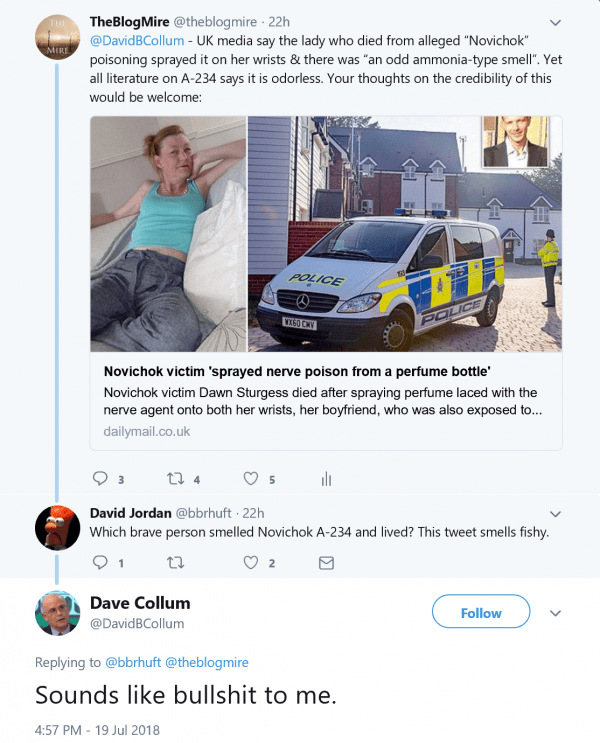
“He also mentioned that he vaguely recollects there being an odd ammonia-type smell from the perfume. We don’t know yet if he had direct contact with the nerve agent like Dawn appears to have done or whether it was after he had touched her.”
The ammonia-type smell is odd, in more ways than one. The pre-2018 scientific literature not only states that A-234 is far deadlier than VX (see here), and that its effects are rapid, usually within 30 seconds to 2 minutes (see here), but it also describes it, along with all nerve agents, as odourless (see here). But according to the latest narrative, it smelt of ammonia.
I think we have another orange juice on the hand and blister on the foot moment. If it’s odourless, it can’t very well smell of ammonia, can it? In fact, it can’t very well smell of anything, can it? It’s odourless, and odourless things don’t tend to smell of ammonia. Or anything else, come to that.
Ah, but maybe it was contaminated? Really? But didn’t the OPCW state that the stuff allegedly placed on Mr Skripals door handle – the stuff they touched before feeding the ducks, going to a pub and then going to a restaurant – was high purity? I believe they did. And this was the same batch? A batch of the stuff that certain experts were telling us could last for decades? From whence cometh the ammonia then? From the odourless “Novichok”, of course.
Folks, what we have is a substance with astonishing properties. It is lethal, but non-lethal. It is military grade, but not really military grade. It is fast acting, but slow working. It can be in the form of a gel, but morph into a liquid. It is odourless, and yet really smelly. Or are we to believe that after placing their high purity “Novichok” gel on the door handle, the assassins then spent time turning it into a liquid, which they then poured into an ammonia-laced perfume bottle? Oh, and then instead of legging it to Heathrow, they took a detour to go for a walk in the park, where they dumped the bottle of odourless but ammonia-smelling nerve agent on the floor. What do they teach them in Professional Assassin schools these days?
Hands to Wrists. Gel to Liquid. Odourless to Ammonia. Orange juice on the hand to blisters on the foot. It’s all the same to me.
From a purely logical point of view, I understand that this is all complete and utter nonsense. But I do wish I’d paid more attention in chemistry classes at school so I might at least be able to debunk it from that point of view. But alas it was not to be. However, since I know nothing about that side of things, I thought I’d ask someone who does. David Collum is a world-renowned Professor of Chemistry and Chemical Biology at Cornell University, with a PhD, MS and MA from Columbia University, and a BS from Cornell. I asked him what he thought of the claim being made in the UK media that Dawn Sturgess was poisoned by “Novichok” and this gave off an “an odd ammonia-type smell”. His answer, which I will leave you with, whilst not what you might call eloquent, was certainly to the point:
US will not let Americans be questioned by Moscow, but demands extradition of 12 Russians
RT | July 19, 2018
Donald Trump has turned down Vladimir Putin’s proposal to allow Russian investigators interview Americans suspected of crimes, but still expects 12 Russians blamed of election meddling to arrive in the US, the White House said.
“It is a proposal that was made in sincerity by President Putin, but President Trump disagrees with it. Hopefully President Putin will have the 12 identified Russians come to the United States to prove their innocence or guilt, ” Sarah Sanders, White House spokeswoman, said in a statement on Thursday.
In case the White House may change its mind, the Senate unanimously approved the resolution, proposed by Minority Leader Chuck Schumer (D-New York) expressing the sense that the “United States should refuse to make available any current or former diplomat, civil servant, political appointee, law enforcement official or member of the Armed Forces of the United States for questioning by the government or Vladimir Putin.”
Following the summit with Trump in Finland’s capital in Helsinki earlier this week, the Russian President said Moscow may consider allowing the US Justice Department investigators to question the Russian citizens, who were charged with meddling in the US election in 2016.
However, Putin specified that such interaction may only take place if the Washington greenlights Moscow to interrogate American citizens, who are suspected of committing crimes in Russia. The list of those wanted by Russian law enforcement includes US ambassador to the country, Michael McFaul, and financier, Bill Browder, according to Russia’s Prosecutor Generals’ Office.
The treaty between Moscow and Washington, signed in the 1990-ies and allowing the interrogation of the suspects from the other country, was brought up by Putin during the media conference in Helsinki.
Earlier on Thursday, Rep. Eliot Engel (D-New York), the ranking member of the House Foreign Affairs Committee, and four other Democratic congressmen sent an open letter to Trump, urging the president to publically reject the Russian offer. “You must make clear that you will not allow American citizens or anyone on American soil to endure interrogation or harassment at the hands of Putin’s thugs,” they wrote.
The idea of Trump allowing the Americans to be interrogated by Russian investigators has been slammed by Trump’s opponents in both Democratic and Republican camps in the past few days. He was warned that even thinking about fulfilling Putin’s “outrageous” offer would amount to “an abuse of power” and threatened him with impeachment.
Russiagate Is Constructed of Pure Bullshit, No Facts
By Paul Craig Roberts • Institute For Political Economy • July 19, 2018
All day today the presstitute scum at NPR went on and on about President Trump, using every kind of guest and issue to set him up for more criticism as an unfit occupant of the Oval Office, because, and only because, he threatens the massive budget of the military/security complex by attempting to normalize relations with Russia. The NPR scum even got an ambassador from Montenegro on the telephone and made every effort to goad the ambassador into denouncing Trump for saying that Montenegro had strong and aggressive people capable of defending themselves and were not in need of sending the sons of American families to defend them. Somehow this respectful compliment about the Montenegro people was supposed to be an insult. The ambassador refused to be put into opposition to Trump. NPR kept trying, but got nowhere.
As a former Wall Street Journal editor I can say with complete confidence that NPR crossed every line between journalism and advocacy and no longer qualifies as a 501c3 tax-exempt public foundation.
The NPR assault on President Trump was part of an orchestration. The same story appeared in the Washington Post, long-believed to be a CIA asset. Most likely, it has appeared throughtout the presstitute media.
The ability of the military/security complex to control the explanations given to Americans, about which President Eisenhower warned Americans in 1961 to no effect, has produced an American population, a large percentage of which is brainwashed.
For example, in Caitln Johnston’s column, linked below, Kurt Eichenwald, who, in my opinion, is either a brainwashed idiot or a Deep State troll, says that the bottom line is that you either believe “our intelligence community,” which most definitely did not conclude what Eichenwald says they have concluded, “or you support Putin. You are either a patriot, a traitor or an idiot.”
Note that Eichenwald defines a patriot, as do the Democrats, many Republicans, the entirety of the US print and TV media and NPR, as a person who believes the self-serving lies issuing from the military/security complex in support of the $1,000 billion dollars annually taken from unmet US taxpayer needs to put in the pockets of the mega-rich for “defending” American from an orchestrated, but otherwise nonexistent, threat. If you don’t support this theft from the American people, you are, according to Eichenwald, “a traitor or an idiot.”
Caitlain Johnstone tells us how utterly stupid Americans are to fall for the line that it is treason to seek peaceful relations with a nuclear power that can destroy us. This means that presidents John F. Kennedy, Richard Nixon, Jimmy Carter, and Ronald Reagan were treasonous. This is the official position of the American presstitute media, the Democratic Party, and the military/security complex. It is also the position of a fake entity that misrepresents itself as “the American left.”
This utterly absurd position that to pursue peace is to commit treason is precisely the position that the corrupt American print and TV media and NPR represent. It is the position of the Democratic Party. It is the position of the Republicns in Congress, such as the warmongers John McCain and Lindsey Graham who are owned by the military/security complex.
Every American who believes the line that reducing tensions with Russia is treasonous is preparing nuclear Armageddon for themselves, their friends and families, and for the entire world.
Caitlin tells it to you like it is: https://medium.com/@caityjohnstone/russiagate-is-like-9-11-except-its-made-of-pure-narrative-ab96fa38ee48
America’s Derangement Syndrome a Danger to World Peace
Strategic Culture Foundation – 20.07.2018
It is significant that Presidents Putin and Trump have both spoken out against “haters” among America’s political establishment who would rather see conflict between Russia and the United States instead of a normalization of bilateral relations.
Following their landmark, successful summit this week in Helsinki, Putin and Trump separately made public comments deploring the hostile hysterical reaction emanating from broad sections of the US political establishment and its dutiful, controlled news media.
Speaking in Moscow to his diplomatic corps, President Putin warned that there were “powerful forces” within the US which are ready to sacrifice the interests of their country and indeed the interests of world peace in order to pursue selfish ambitions.
For his part, Trump also slammed opponents in the US who “hated” to see him having a good meeting with Putin. “They would rather see a major confrontation with Russia, even if that could lead to war,” said the American president.
That’s it in a nutshell. Rather than welcoming the opening of a cordial dialogue between the US and Russia, the American political establishment seems to desire the deepening of already dangerous tensions between the world’s two nuclear superpowers. If that’s not deranged, then what is?
Significantly, the hostile reaction was overwhelmingly on the American side. Russians, by and large, welcomed the long-overdue summit between Trump and Putin, and the potential beginning of a new spirit of dialogue and partnership on a range of urgent global problems. Problems including arms control, nuclear proliferation, and working out political settlement to conflicts in the Middle East, Ukraine and the Korea Peninsula.
Few people would believe that these problems can be resolved easily. But the main thing is that the leaders of the US and Russia are at least attempting to open a dialogue for understanding and political progress. That in itself is a breakthrough from the impasse in bilateral relations which have frozen into a new Cold War since the previous US administration.
We dare say that most citizens of the world would also endorse this effort by Trump and Putin at improving the relations between the US and Russia.
Significantly too, according to recent polls, most ordinary Americans seem to be agreeable or neutral about Trump’s diplomatic engagement with Russia. According to a Gallup poll out this week, the vast majority of US citizens are far more concerned by economic woes than they are by anything untoward in American-Russian relations.
Thus, what we are seeing in the explosion of hostility towards the Trump-Putin summit is twofold. It is an American phenomenon, and secondly, it is an angst that animates only the political class in Washington and the news media corporations. This constituency, it is fair to say, is an elite faction within the US, albeit extremely powerful, made up of Washington politicos, the state intelligence apparatus, the corporate media and think tanks, and the deep state establishment of imperial planners and strategists. In short, this constituency is what some observers call the “War Party” that transcends the US ruling class.
Any reasonable person would have to welcome the friendly rapport engendered between Trump and Putin, and at least their initial commitment to working together on major matters of global security. The dangerous impasse of recent years in which dialogue was absent must be overcome for the sake of world peace.
Nevertheless, what has become crystal clear this week following the Helsinki summit is the “War Party” within the US is more determined than ever to sabotage any rapprochement with Russia.
No sooner had Trump returned to the US, he was assailed with a tidal wave of vilification for having met Putin in a mutual, agreeable manner. The most disturbing aspect was the recurring slander denigrating Trump as a “traitor”. The hysterical name-calling was conveyed by all the major news media, citing former intelligence officials and politicians from both Democrat and Republican parties.
Which again shows that in the US there is really only one party, the War Party.
President Trump was evidently forced into making an embarrassing U-turn over his views expressed in Helsinki. He made an unconvincing disavowal of statements made alongside Putin. Trump had been pilloried for appearing to dismiss allegations of Russian interference in the US elections while he was in Helsinki. Within 24 hours, he was forced into making a retraction, saying that he did – kind of – believe that Russia had meddled in US democracy.
What Trump was subjected to by the US establishment was akin to the worst years of McCarthyite Red-Baiting as seen during the Cold War in the 1950s and 60s, when Americans were mercilessly humiliated and ostracized for being “Communist sympathizers”. Today, official American paranoia is back with a vengeance. In truth, it never went away.
To be fair to Trump he has not completely capitulated to the American derangement syndrome. He has since said that he is looking forward to holding a second meeting with his Russian counterpart and continuing their promises of partnership as announced in Helsinki.
However, it is instructive that the American president is, in effect, being held hostage by powerful elements in the US ruling class who view any kind of detente with Moscow as an unforgivable betrayal.
Trump’s instincts are correct that the whole so-called Russia-gate mania is a phony contrivance. That has been orchestrated by the US establishment based on its refusal to accept Trump’s democratic mandate, as well as being based on an abiding hostility towards Russia as an independent world power.
The object lesson here is that the scope for improving US-Russia relations is limited, in spite of Trump’s favorable personal inclinations.
An entrenched animosity towards Russia remains among the American War Party, and the current president has evidently little room for implementing his avowed policy of normalizing relations.
Russia therefore cannot place too much faith in making progress towards peaceful relations, because all-too apparently President Trump has actually very little freedom to exercise his democratic mandate. That is a damning indictment on the charade of American formal democracy. A president is elected partly on the basis of peaceful engagement, but the unelected powers-that-be have another agenda of conflict which they are pursuing come hell or high water.
What’s more, the American derangement syndrome is becoming even more virulent, as can be adjudged from this week’s hysterical backlash over the successful Helsinki summit.
Trump’s willingness for dialogue with Russia is a welcome development. But the far more disturbing development is the full-tilt belligerence and derangement on display among the American political class. This American political schizophrenia is a clear and present danger to world peace. American citizens are as much a victim of the madness as are Russians and the rest of the world.
One positive aspect of the new phase of Cold War is that before it was largely concealed, and deceived, as a simplistic bifurcated confrontation of Americans versus Russians. Today it is evidently a situation of an American deranged elite versus the rest of the world, with the latter including ordinary American citizens who have much more to gain from standing in solidarity with Russian citizens.
Does an Elected President or an Unelected Intelligence Community Govern the US?
By John Wight – Sputnik – 19.07.2018
The madness that gripped liberals and neocons within the Western political, media, and security establishments, over the sight of a US president having the temerity to treat his Russian counterpart – Vladimir Putin – as an equal rather than colonial vassal who knows his place, was and is more pronounced than anyone could have expected.
Indeed in the wake of the Helsinki Summit between US President Donald Trump and his Russian counterpart, Vladimir Putin, the tsunami of madness that ensued can only be described as unhinged. Treason, they cried — a surrender summit, they declaimed — to thus reveal that for such people peace and stability is tantamount to disaster while conflict and chaos is nirvana.
In light of this collective madness, spewed out from every mainstream US media platform in response to Helsinki, the backlash from within the Beltway reached such heights of intensity that we were witness to the astonishing sight of a sitting president going public with a mea culpa as he rolled back on his original denial — Trump claiming he had ‘misspoke’ during his joint press conference with the Russian president when the question of Russian state interference came up.
It confirms that whoever runs America it sure ain’t guy the people elect to run it.
The sad reality is that the most important and universally anticipated summit between a US president and Russian leader at any time in history, including the Cold War when the Soviet Union was still extant, ended up being dominated by the ongoing Mueller investigation into alleged Russian interference in the 2016 US presidential election.
This, by way of a reminder, is an investigation which is yet to produce or throw up one scintilla of concrete evidence in support of these allegations of Russian state interference.
In fact the Mueller investigation into what many credible voices have put down to a leak from within the DNC rather than a hack from without — a leak undertaken with the goal of shedding light on the corrupt shenanigans responsible for ensuring Hillary Clinton’s nomination over her Democratic Party opponent, Bernie Sanders, as candidate for the White House — has exposed a brutal truth: namely that the American people are passive spectators of the banquet of democracy in Washington rather than active participants.
And if you’ll permit me, while we’re on the subject, in response to Trump’s original assertion that he did not accept the conclusion of the US intelligence community that Russian interference did in fact occur, the tweet posted by popular Scottish comedian Frankie Boyle indubitably spoke for millions in America and beyond:
“Trump, in his madness, being able to point out the truth that the US can’t trust its own intelligence agencies, seems to me positively Shakespearean.”
So, yes, Trump’s opponents — led by Clintonite liberals whose sense of entitlement is consistent with ownership rather than service to a democratic process — are obsessed with the objective of ejecting him from office as soon as is humanly possible. And given the tenor of some of the rhetoric that has ensued in response to Helsinki, it would seem some are intent on doing so by any means necessary.
Worse, not only does the artillery barrage of rage unleashed in response to Helsinki leave no doubt that liberal/neocon America is bent on ejecting Trump from the White House before he serves out a full term, it suggests that it is set on conflict with Russia come what may. Because what we are dealing with here, ultimately, is a pathological attachment to the supposed verities of US and Western hegemony — with any state, country or government that dare resist it, even if on the basis of international law and the UN Charter, deemed beyond the pale.
References to Munich in 1938, to Neville Chamberlain’s ‘peace in our time’ moment, have been bandied around like confetti in response to Helsinki, reminding us of Talleyrand’s observation of the Bourbons: ‘They have learned nothing and forgotten nothing’.
The Helsinki Summit was not a re-run of Munich in 1938. However US liberal and fanatical neocon reaction to it certainly evinces the character of 1914, when war fever had Europe in its grasp, leading inexorably to an abyss into which millions of young predominately working-class men were pushed not in the cause of freedom, liberty or democracy, but in service to national exceptionalism and imperial domination.
This is precisely the animal we are dealing with today, a beast of insatiable and unquenchable appetite that will brook nothing less than full spectrum dominance. It is why the takeaway from the Helsinki Summit is not peace in our time it is Russia delenda est — i.e. Russia must be destroyed.
As George Orwell writes in his classic novel 1984: “The enemy of the moment always represented absolute evil, and it followed that no past or future agreement with him was possible.”
In the last analysis, for the likes of Republican Senator John McCain, a US president exchanging missiles with his Russian counterpart is considered more in keeping with strong and proper leadership than one who would rather exchange a handshake.
It is madness, insanity and moral sickness combined, evidence of an empire that has entered its mad dog days as it struggles to cope with states that are no longer prepared to accept US economic, military, geopolitical and cultural hegemony as the settled will of God.
Time magazine’s ‘creepy’ Putin-Trump cover is what media subversion really looks like
© TIME
By Simon Rite | RT | July 19, 2018
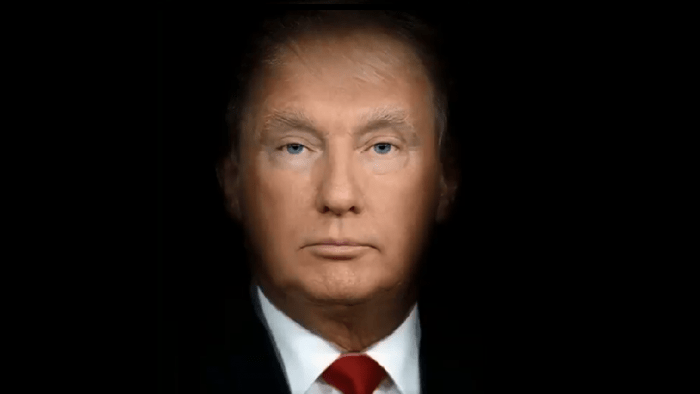
Staring out from the front cover of this week’s Time magazine is a striking, unsettling picture of Vladimir Putin and Donald Trump morphed into one. The hidden, yet unsubtle messaging behind the image is equally unsettling.
Time describes the image as “meaning to represent this particular moment in US foreign policy, following the pair’s recent meeting in Helsinki, Finland.” However, what it really represents is the way that a major US media outlet wants its readers to see these two men. As strange and creepy figures who are in some way linked.
The publication cannot write a story which backs up allegations that the two presidents have some kind of conspiratorial relationship, but it can print an image which insinuates it, demanding your attention and entering your subconscious. If investigators want a textbook example of how the media attempts to subvert and influence, then look no further.
 How many other morphed images of world leaders has Time featured on its famed front page? None. There is no Trerkel, no Macrump not even a Tru Jong-Un. With these leaders there is no conspiracy to sell and no bandwagon on which to jump.
The US is still wrestling with the reality of Trump as president and claims of election interference. The mainstream constantly debates how it was allowed to happen at all, and here Time wants to provide the answer in one unsettling picture. It must have been Putin, the two are so close they could be one person the image suggests, they’re two sides of the same coin.
RT can exclusively reveal that the two do, in fact, have extremely serious connections: they both currently find themselves as the leaders of the two biggest nuclear powers on Earth. That is an incontrovertible fact and, as Trump said in Helsinki, he decided to take a political risk by meeting Putin in an attempt to reduce tensions. In America’s current political climate that is more than enough to get you an insidious Time magazine front page.
The idea is not original. German news magazine Der Spiegel did the identical thing last year by morphing the two men on its cover page. The aesthetic was less psycho warfare horror movie, and more Soviet schtick.
Der Spiegel’s headline was at least more transparent in what it was trying to say ‘The double regent: how much Putin is in Trump?’
Time’s simple ‘The Summit Crisis’ is short and ambiguous enough that the reader has more time to let the hidden meaning of the image settle in.
Has it worked? You only have to look on Twitter to see the words people are using to describe the front page: “Creepy,” “nightmare,” “scary” and “chilling.” Time magazine: mission accomplished.
Aftermath of Helsinki summit: American ‘democracy’ in action
© Erin Scott / Global Look Press
By Finian Cunningham | RT | July 19, 2018
After his landmark summit with Russian leader Vladimir Putin in Helsinki, US President Donald Trump was apparently forced into an embarrassing u-turn over allegations of Russian interference in American elections.
On returning to the White House from his summit in Finland, Trump read out a statement, saying that he “accepted” US intelligence claims that Russia had meddled in the 2016 presidential election.
He offered the explanation that he had “mis-spoken” during his press conference with Putin in Helsinki the day before, when he appeared then to accept the Russian president’s “powerful denial” that his country had not interfered in the race for the White House.
What to make of it? Was Trump correcting a glitch in his speech, or is there something more sinister at play?
In any case, political and media critics in the US don’t believe the president’s “attempt at backtracking,” as the Washington Post put it.
Senior Democrats insisted Trump “could not squirm his way out” of the torrent of accusations that he had “capitulated to Putin” and dishonored US intelligence services by appearing to accept Moscow’s assurances it had not interfered in the elections.
The context of words spoken at the press conference in Helsinki does indeed suggest that Trump was countenancing Putin’s denial of Russian meddling. The US president went on to say that the various probes into the matter were a “disaster” for America’s international image and for bilateral relations with Russia. This is consistent with Trump’s long-held view that the Mueller inquiry is a “witch-hunt” based on “fake news”.
So, Trump’s belated about-turn on what he meant to say in Helsinki regarding alleged Russian interference does not seem to be a convincing, genuine correction on his part. It suggests rather that the president is being forced into making a retraction.
What could be viewed as more disturbing is the way the American president has been browbeaten and cowed to make an embarrassing denial of something he actually believes. In other words, Trump has been humiliated or intimidated into toeing a line.
The US media reaction following the summit with Putin was immediate and shockingly coordinated, like a full-on assault.
“Trump faces tidal wave of criticism over handling of summit with Putin,” reported US government-funded Radio Free Europe.
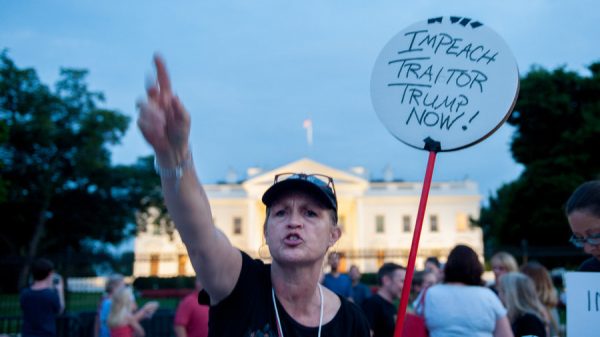
The president was assailed with a torrent of abuse, decrying him as a “disgrace” and “traitor” for having engaged in a cordial manner with the Russian leader. The uniform scorn poured on Trump by the political and media establishment was something to behold.
Rabid pundits in supposedly prestigious newspapers such as the New York Times were declaring that it’s “Trump and Putin vs. America,” claiming that “the president’s refusal to condemn Russian attacks was a betrayal of every single American citizen.”
The media backlash of vituperation against the president was nothing short of extraordinary. It was a concerted campaign of sedition against his authority which, at times, openly called for a palace coup to oust him.
Under the headline, “This sad, embarrassing wreck of a man,” one oped in the Washington Post posed the question: “Which Republicans will stand behind a president who puts Russia first?”
Ironically, Trump’s instincts about the whole Russiagate affair are correct. It is a load of unsubstantiated farrago promoted by Democrats and large sections of supportive news media who have never got over the ignominy of Hillary Clinton losing out to “deplorable Trump.” Clinton was also backed by high-ranking officials in the state intelligence apparatus, as well as the foreign policy establishment.
This constituency of the political class in Washington shared Clinton’s avowed hostility towards Putin. It is to their unforgivable chagrin that Donald Trump was elected. Moreover, Trump was elected partly on the promise of restoring normal relations between the US and Russia. His policy was given a democratic mandate upon his election to the White House.
After nearly two years of relentless Russophobia from the US political and media establishment, the case for alleged Russian interference in American politics remains embarrassingly vacuous. Not even the latest so-called indictments produced by special counsel Robert Mueller have any credibility to anyone who looks earnestly at the charges. What’s more, ordinary American citizens seem to agree that the whole Russiagate affair is a frivolity indulged in by the political and media elites confined to Washington’s Beltway Bubble.
In a poll out this week following the Helsinki summit, a small majority of Americans (55 percent) seem to think that Trump is “mishandling” relations with Russia. It is perhaps not surprising, given the wall-to-wall media pillorying of the president as a “traitor.” Nevertheless, the same poll found that only a minority of Americans view Russia as “an enemy” (38 percent) or an “imminent threat” (27 per cent).
These figures are cold comfort for the US political establishment, which has assiduously pushed the narrative of Russian malevolence.
What the astounding media backlash against Trump shows is not so much the fecklessness of his character. No, the really perplexing issue is how American democracy is warped and fashioned to meet the demands of powerful unelected forces. The imperative is brazen and brutal.
Trump may want to normalize relations with Russia. The people may have voted for this policy. But the powers-that-be are making sure that this policy is not implemented. They want hostility towards Russia to prevail, as it would have explicitly if Hillary Clinton had been elected.
In short, what we are seeing this week is “American democracy” in action. Meaning there is no actual democracy exercised by the power of the people. It is power exercised by elite interests.
In that way, Russian reaction to the Helsinki summit should be restrained.
Indeed, it was welcome to see Trump and Putin engage in cordial, mutual dialogue. Trump deserves credit for holding the summit and for his civilized manner towards the Russian leader, instead of adopting the vulgar offensiveness for which so much of the US establishment is baying.
The problem is that Trump has evidently very limited political authority to implement the obvious goodwill he desires between Washington and Moscow. He has limited authority to actually adopt one of the key policies for which he was elected by the people.
Trump’s cringe-making u-turn was not a correction over his misuse of “double negative speech.” It was a positively damning sign that the president and the citizens who voted for him have actually negligible power when it comes to overturning a fundamental objective of the unelected plutocrats of the deep state.
For Russia, and indeed the wider world, that is deeply troubling. Because the American powers-that-be are evidently hell-bent on pursuing a hostile agenda towards Russia. Their Russophobia is not just some passing phase. It’s a symptom of an incorrigible malaise and desire within the US establishment for conflict.
Finian Cunningham (born 1963) has written extensively on international affairs, with articles published in several languages. Originally from Belfast, Northern Ireland, he is a Master’s graduate in Agricultural Chemistry and worked as a scientific editor for the Royal Society of Chemistry, Cambridge, England, before pursuing a career in newspaper journalism. For over 20 years he worked as an editor and writer in major news media organizations, including The Mirror, Irish Times and Independent. Now a freelance journalist based in East Africa, his columns appear on RT, Sputnik, Strategic Culture Foundation and Press TV.
We want to hear from Scotland Yard, not media reports on Skripals’ case – Russian envoy to UK
RT | July 19, 2018
Moscow is waiting for any official statement on the Skripal attack suspects, Russian ambassador to the UK, Alexander Yakovenko, has said in the wake of media reports that police identified some “Russians” as the culprits.
On Thursday, the Press Association reported that British investigators believe they identified “the suspected perpetrators” of the March poisoning of ex-double agent Sergei Skripal and his daughter in Salisbury. After analyzing CCTV footage, they reportedly came to the conclusion that some “Russians” are involved in the attack.
Commenting on the media claims, the Russian envoy said that official London remains silent on the issue, stressing that media reports often fail to find any confirmation.
“These are media reports, unfortunately there are no official statements from the British side. I want to hear from Scotland Yard, from the Foreign Office. Many versions [published] in the newspapers are not confirmed on the official level,” Yakovenko told journalists in Moscow.
The envoy also warned that Moscow “will exert pressure” on London, including through official requests and dialogue, over the Skripal case, as it is “a political issue.” He also plans to discuss the issue during the meeting with the UK’s new foreign minister, Jeremy Hunt.
The Skripal case was not on the agenda during the recent Putin-Trump summit in Helsinki as London failed to provide evidence not only to Russia, but even to its allies, Yakovenko noted.
“If the British had managed to provide any official information regarding the ongoing investigation, it might have been a topic for [Trump-Putin] discussion,” the envoy said. “But because the British side still does not provide anything to the Russian side, and moreover, presented nothing to its allies, then what is there to actually discuss?”
Sergei Skripal and his daughter Yulia were poisoned by a nerve agent in Salisbury in March. In late June, a British couple, Charlie Rowley and Dawn Sturgess, were exposed to the same substance in the town of Amesbury, around 12km from Salisbury. After Sturgess died on June 8, the Russian embassy in the UK said that a leak at the Porton Down chemical laboratory, located some 8km from both Salisbury and Amesbury, might be to blame for the incidents.
The UK authorities have pointed a finger at Moscow for the Skripals’ poisoning since March, while still failing to present any evidence. Russia has repeatedly denied any involvement in the attack, asking to share the data on the incident, but still has received nothing but allegations so far.
You’ll never guess where the next James Bond villain is from…
RT | July 19, 2018
James Bond’s nemesis in the upcoming 007 film will be (now whisper it)… Russian. In what could be a sign of the times, it’s the first time in 20 years the fictional English spy will be battling it out with a Moscow baddie.
1999’s ‘The World Is Not Enough’ was the last Bond film to star a significant Russian villain – Victor ‘Renard’ Zokas, an ex-KGB agent turned-high tech terrorist, played with a questionable accent by Scottish actor Robert Carlyle.
The movie, once again starring Daniel Craig as Bond, has the working title ‘Bond 25’. It will be directed by Danny Boyle. Filming is scheduled to commence in December, with a proposed release date of October 2019, the Mirror reports.
The makers of the 007 film franchise are said to be seeking a 30 to 60-year-old leading male, from Russia or the Balkans. Producers say he must be “charismatic, powerful, innovative, cold and vindictive.”
As if one leading role being Russian wasn’t a scary enough proposition for James Bond fans, producers have revealed they intend to also cast a female in a leading role as a Russian. They must be “very striking” with “strong physical combat skills.”
Her character is described as “intelligent, brave, fierce and charming, she’s witty and skilful, a survivor.” The two Russian principal characters are rumored to have a Maori henchman who must possess “combat skills” and be “ruthless and loyal.”
Bond has a history of trading shots with evil characters from behind the old Iron Curtain in movies such as ‘From Russia With Love’. The prospective Russian villains will be following in the footsteps of Rosa Klebb and General Orlov.
Dua Lipa, the London-born singer-songwriter, is rumored to have been chosen to perform the theme song.
Featured Video

Death Spikes & Rising Cancer In Our Youth Explained
or go to
Aletho News Archives – Video-Images
From the Archives
Politicians lie
By Mazin Qumsiyeh | Popular Resistance | August 18, 2013
There is no way to say this truth nicely: Politicians lie. That includes Japanese, American, Egyptian, Israeli, and Palestinian politicians! Is there something more common sense than that? Yet, so many citizens around the world believe their own politicians or wistfully acknowledge lies but think it is part of the job needed to run things. They believe even when politicians contradict themselves blatantly. This phenomenon is rather remarkable. It is a dissonance and disconnect from reality that many seem oblivious to. It is very dangerous because it can lead to accepting rationales for going to war. These can be deadly wars that lead to millions of lives lost as happened in what was called World War 1 and WW2. Even when incredible and declassified evidence abound, politicians continue to lie and old mythologies refuse to die. Here are just a few of the countless lies told to us over the past few decades… continue
Blog Roll
 Aletho News
- Turkish parliament to review Saudi-Pakistan defense pact next month
- DEATH SPIKES & RISING CANCER IN OUR YOUTH EXPLAINED
- Iran offers Trump deal before US election
- Merz regime wants ‘secret police’ – opposition
- Israeli settlers terrorize West Bank Palestinians with state-provided drones: Report
- They see them, then kill them: Israeli quadcopters track, deliberately target civilians in Gaza
- Debunked: Trump’s egregious UNGA claims on war against Iran crumble under scrutiny
- Europe was part of the infrastructure of US aggression against Iran: Deputy FM
- New evidence on the Bucha Massacre
- Italy and France debunk reports CIA issued ‘Russian drone threat’ warning
- If Americans Knew
- An error has occurred; the feed is probably down. Try again later.
- No Tricks Zone
- New Study: Earth And Venus Surface Warmth Largely Explained By Convection And Lapse Rate, Not CO2 Or Radiation
- 2025 Nature Paper Claiming Worsening Global Drought Gets RETRACTED …Heavily Flawed
- New Study: ‘Global Drought Shows No Detectable Recent Acceleration Under Climate Warming’
- Economic Masterminds: German Socialists Suggest Taxing Productivity Gains Stemming From Using AI
- The South China Sea Has Not Been Cooperating With The Climate Change Narrative
- Energy Crisis: Germany Enters Heating Season With Historically Low Gas Reserve Fill Levels
- New Study: The Antarctic Ice Sheet Gained Mass From 2020-2024 Due To Staggering Snow And Ice Accumulation
- Study: Ocean Heating Rates From Thousands Of Years Ago ‘Dwarf’ Modern Ocean Heating Rates
- Climate Extremists Target, Attack Large-Scale Power Grid Infrastructure In Germany!
- New Study: Antarctic Ice Melt Has Contributed Less Than 1 Centimeter To Sea Level Rise In The Last 30 Years

