In my last post I set out the official Government account of the events in the Skripal Case. Here I examine the credibility of this story. Next week I shall look at alternative explanations.
Russia has a decade long secret programme of producing and stockpiling novichok nerve agents. It also has been training agents in secret assassination techniques, and British intelligence has a copy of the Russian training manual, which includes instruction on painting nerve agent on doorknobs.
The only backing for this statement by Boris Johnson is alleged “intelligence”, and unfortunately the “intelligence” about Russia’s secret novichok programme comes from exactly the same people who brought you the intelligence about Saddam Hussein’s WMD programme, proven liars. Furthermore, the question arises why Britain has been sitting on this intelligence for a decade and doing nothing about it, including not telling the OPCW inspectors who certified Russia’s chemical weapons stocks as dismantled.
If Russia really has a professional novichok assassin training programme, why was the assassination so badly botched? Surely in a decade of development they would have discovered that the alleged method of gel on doorknob did not work? And where is the training manual which Boris Johnson claimed to possess? Having told the world – including Russia -the UK has it, what is stopping the UK from producing it, with marks that could identify the specific copy erased?
The Russians chose to use this assassination programme to target Sergei Skripal, a double agent who had been released from jail in Russia some eight years previously.
It seems remarkable that the chosen target of an attempt that would blow the existence of a secret weapon and end the cover of a decade long programme, should be nobody more prominent than a middle ranking double agent who the Russians let out of jail years ago. If they wanted him dead they could have killed him then. Furthermore the attack on him would undermine all future possible spy swaps. Putin therefore, on this reading, was willing to sacrifice both the secrecy of the novichok programme and the spy swap card just to attack Sergei Skripal. That seems highly improbable.
Only the Russians can make novichok and only the Russians had a motive to attack the Skripals.
The nub of the British government’s approach has been the shocking willingness of the corporate and state media to parrot repeatedly the lie that the nerve agent was Russian made, even after Porton Down said they could not tell where it was made and the OPCW confirmed that finding. In fact, while the Soviet Union did develop the “novichok” class of nerve agents, the programme involved scientists from all over the Soviet Union, especially Ukraine, Armenia and Georgia, as I myself learnt when I visited the newly decommissioned Nukus testing facility in Uzbekistan in 2002.
Furthermore, it was the USA who decommissioned the facility and removed equipment back to the United States. At least two key scientists from the programme moved to the United States. Formulae for several novichok have been published for over a decade. The USA, UK and Iran have definitely synthesised a number of novichok formulae and almost certainly others have done so too. Dozens of states have the ability to produce novichok, as do many sophisticated non-state actors.
As for motive, the Russian motive might be revenge, but whether that really outweighs the international opprobrium incurred just ahead of the World Cup, in which so much prestige has been invested, is unclear.
What is certainly untrue is that only Russia has a motive. The obvious motive is to attempt to blame and discredit Russia. Those who might wish to do this include Ukraine and Georgia, with both of which Russia is in territorial dispute, and those states and jihadist groups with which Russia is in conflict in Syria. The NATO military industrial complex also obviously has a plain motive for fueling tension with Russia.
There is of course the possibility that Skripal was attacked by a private gangster interest with which he was in conflict, or that the attack was linked to Skripal’s MI6 handler Pablo Miller’s work on the Orbis/Steele Russiagate dossier on Donald Trump.
Plainly, the British government’s statements that only Russia had the means and only Russia had the motive, are massive lies on both counts.
The Russians had been tapping the phone of Yulia Skripal. They decided to attack Sergei Skripal while his daughter was visiting from Moscow.
In an effort to shore up the government narrative, at the time of the Amesbury attack the security services put out through Pablo Miller’s long term friend, the BBC’s Mark Urban, that the Russians “may have been” tapping Yulia Skripal’s phone, and the claim that this was strong evidence that the Russians had indeed been behind the attack.
But think this through. If that were true, then the Russians deliberately attacked at a time when Yulia was in the UK rather than when Sergei was alone. Yet no motive has been adduced for an attack on Yulia or why they would attack while Yulia was visiting – they could have painted his doorknob with less fear of discovery anytime he was alone. Furthermore, it is pretty natural that Russian intelligence would tap the phone of Yulia, and of Sergei if they could. The family of double agents are normal targets. I have no doubt in the least, from decades of experience as a British diplomat, that GCHQ have been tapping Yulia’s phone. Indeed, if tapping of phones is seriously put forward as evidence of intent to murder, the British government must be very murderous indeed.
Their trained assassin(s) painted a novichok on the doorknob of the Skripal house in the suburbs of Salisbury. Either before or after the attack, they entered a public place in the centre of Salisbury and left a sealed container of the novichok there.
The incompetence of the assassination beggars belief when compared to British claims of a long term production and training programme. The Russians built the heart of the International Space Station. They can kill an old bloke in Salisbury. Why did the Russians not know that the dose from the door handle was not fatal? Why would trained assassins leave crucial evidence lying around in a public place in Salisbury? Why would they be conducting any part of the operation with the novichok in a public area in central Salisbury?
Why did nobody see them painting the doorknob? This must have involved wearing protective gear, which would look out of place in a Salisbury suburb. With Skripal being resettled by MI6, and a former intelligence officer himself, it beggars belief that MI6 did not fit, as standard, some basic security including a security camera on his house.
The Skripals both touched the doorknob and both functioned perfectly normally for at least five hours, even able to eat and drink heartily. Then they were simultaneously and instantaneously struck down by the nerve agent, at a spot in the city centre coincidentally close to where the assassins left a sealed container of the novichok lying around. Even though the nerve agent was eight times more deadly than Sarin or VX, it did not kill the Skripals because it had been on the doorknob and affected by rain.
Why did they both touch the outside doorknob in exiting and closing the door? Why did the novichok act so very slowly, with evidently no feeling of ill health for at least five hours, and then how did it strike both down absolutely simultaneously, so that neither can call for help, despite their being different sexes, weights, ages, metabolisms and receiving random completely uncontrolled doses. The odds of that happening are virtually nil. And why was the nerve agent ultimately ineffective?
Detective Sergeant Bailey attended the Skripal house and was also poisoned by the doorknob, but more lightly. None of the other police who attended the house were affected.
Why was the Detective Sergeant affected and nobody else who attended the house, or the scene where the Skripals were found? Why was Bailey only lightly affected by this extremely deadly substance, of which a tony amount can kill?
Four months later, Charlie Rowley and Dawn Sturgess were rooting about in public parks, possibly looking for cigarette butts, and accidentally came into contact with the sealed container of a novichok. They were poisoned and Dawn Sturgess subsequently died.
If the nerve agent had survived four months because it was in a sealed container, why has this sealed container now mysteriously disappeared again? If Rowley and Sturgess had direct contact straight from the container, why did they not both die quickly? Why had four months searching of Salisbury and a massive police, security service and military operation not found this container, if Rowley and Sturgess could?
I am, with a few simple questions, demolishing what is the most ludicrous conspiracy theory I have ever heard – the Salisbury conspiracy theory being put forward by the British government and its corporate lackies.
My next post will consider some more plausible explanations of this affair.
July 12, 2018
Posted by aletho |
Deception, False Flag Terrorism, Russophobia | UK |
Leave a comment
The upcoming Trump/Putin summit is hampered by the crazed portrait of Russia painted by presstitutes. Jonathan Chait, Amy Knight, Max Bergmann, Yaroslav Trofimov, Roger Cohen, and the rest of the conscious or de facto CIA assets that comprise the Western presstitute media have turned Putin into a superhuman who controls election outcomes throughout the West, murders people without rhyme or reason, and has President Trump under his thumb doing Putin’s bidding. Who could imagine a more extreme conspiracy theory?
Jonathan Chait in New York magazine writes that “the dark crevices of the Russia scandal run deep,” so deep that “it would be dangerous not to consider the possibility that the summit is less a negotiation between two heads of state than a meeting between a Russian-intelligence asset and his handler.”
So here is Chait, who brands truth-tellers “conspiracy theorists” coming up with the greatest conspiracy theory of our time that President Trump has been a Kremlim asset since 1987. Chait provides a ”crazy quilt of connections” to illustrate his absurd conspiracy theory that “it’s not necessary to believe that Putin always knew he might install Trump in the Oval Office to find the following situation highly plausible: Sometime in 2015, the Russian president recognized that he had, in one of his unknown number of intelligence files, an inroad into American presidential politics.”
Chait believes that Russia is also behind the UK’s exit from the European Union. “Driving Britain out of the European Union advanced the decades-long Russian goal of splitting Western nations apart, and Russia found willing allies on the British far right.”
Chait gets even more conspiratorial. He admits that Paul Manafort’s indictments for alleged white collar crimes are not related to Trump’s election, having occurred years previously in Ukraine. Nevertheless, Chait is certain that Manafort is shielding Trump even though according to Chait Manafort is facing many years in prison. Why would Manafort shield Trump? Chait’s answer:
One way to make sense of his behavior is the possibility that Manafort is keeping his mouth shut because he’s afraid of being killed. That speculation might sound hyperbolic, but there is plenty of evidence to support it. In February, a video appeared on YouTube showing Manafort’s patron Deripaska on his yacht with a Belarusian escort named Anastasia Vashukevich.”
Chait’s article is long and heavily weighted with innuendo. Chait, or whoever wrote the article, possibly the person who wrote the Steele Dossier, collects every disparaging fact and fantasy about Trump and assembles them in a way to paint a portrait of a person who must also, without much doubt, be a Russian agent. If the public can be convinced of this, the military/security complex can assassinate Trump and blame Putin for getting rid of an asset who was exposed by the Russiagate investigation, no longer useful, and perhaps prepared to spill the beans.
Another conspiracy theorist, Amy Knight, writes that “The real question is where does the Russian criminal state end and the criminal underworld begin, and how do they work together in what amounts to a new murder incorporated?”
Yaroslav Trofimov tells us in the Wall Street Journal (July 7) that “Putin maps out his own empire” to replace the lost Soviet one.
In the Washington Post Max Bergmann tells us that Trump is going to sell out NATO in Helsinki. This line leads to the supposition that Putin is using Trump to unleash the Russian military on Europe. Many conspiracy theorists have come together on the view that first the Baltic States will be invaded and then Putin will move on to Germany and the rest of Europe. The New York Times’ Roger Cohen even pulls Marine Le Pen into the plot which widens to include ethnically cleansing the West of the refugees from Washington’s wars.
This is the level of absurdity that the American media delivers to the public’s understanding of foreign affairs.
Dr. Paul Craig Roberts was Assistant Secretary of the Treasury for Economic Policy and associate editor of the Wall Street Journal. He was columnist for Business Week, Scripps Howard News Service, and Creators Syndicate. He has had many university appointments. His internet columns have attracted a worldwide following. Roberts’ latest books are The Failure of Laissez Faire Capitalism and Economic Dissolution of the West, How America Was Lost, and The Neoconservative Threat to World Order.
July 12, 2018
Posted by aletho |
Fake News, Mainstream Media, Warmongering, Russophobia | Amy Knight, Jonathan Chait, Max Bergmann, New York Times, Roger Cohen, United States, Washington Post |
Leave a comment
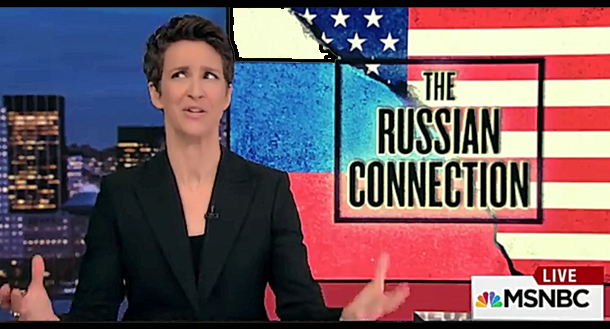
The modern political lexicon includes a host of terms that are ironically applied, given how they can be applied to those who use them against others. For numerous reasons, Michael McFaul’s continued standing as a leading Kremlinologist, highlights the ongoing flaws in US policy towards Russia.
The group of American mass media promoted Russia watchers includes an overrated lot, whose shortcomings are downplayed, as they regularly reemerge in high profile settings – typically with little if any substantive opposition. These truly bad actors prop each other, while downplaying their inconvenient (for them) detractors.
As I earlier noted, McFaul lauded The Atlantic for hiring Julia Ioffe. She essentially got a pass after making an inappropriately perverse sexual reference concerning Ivanka Trump’s relationship with her father. The record shows that Politico fired Ioffe over that remark. However, her new and current position at The Atlantic isn’t reflective of a demotion and quite likely a promotion, in terms of stature and earnings, along with her appearances on CNN and MSNBC.
The McFauls of the world don’t seem particularly concerned about the fake news which Ioffe peddles. During a June 3 exchange with CNN’s Brian Stelter, Ioffe said that the Russian government had poisoned the Skripals – something that’s factually quite suspect on the basis of what’s presently known and unknown. Likewise, her other claim (to Stelter) that the Russian government downed a civilian airliner over the former Ukrainian SSR isn’t a conclusively well established fact.
Stelter offered no challenge to Ioffe. Mind you that his media review show on CNN is supposedly an intent to critically review media fault lines.
In Ioffe’s July 2 Washington Post article on the 2018 World Cup, she states (when describing Russia’s victory over Spain): “No one celebrated like this when Russia crushed the competition in the medal race at the Sochi Olympics in 2014 – a victory of which it was later stripped amid allegations of systemic doping. When Russia illegally annexed Crimea in 2014, the celebrations were fraught with anger and political division that broke up friendships and families.”
In point of fact, Russia hasn’t been stripped of its first place tally at Sochi. On this particular matter, Ioffe erroneously went by a prior ruling that was successfully challenged. The put mildly suspect claim of “systemic doping”hasn’t been conclusively proven.
Ioffe’s mantra about “when Russia illegally annexed Crimea” has been stated by McFaul. That characterization is sheer hypocritical chutzpah, given the examples of Kosovo and northern Cyprus. On US TV, McFaul can be depended upon to not challenge the negatively inaccurate comments about Russia.
In a June 27 Brian Williams’ hosted MSNBC segment, McFaul suggested that Putin wins by default by just having a summit with Trump – as if the Russian leader is internationally ostracized, which is clearly not so. Actually, some are reasonably wondering if it’s really in Putin’s best interests to have the meeting, with the kind of anti-Russian and anti-Putin theatrics, that will be evident in the background (Washington Post, New York Times, CNN, MSNBC, et al). Trump’s mass media detractors have been constantly critical of his advocacy for improved US-Russian ties. To date, Trump has fallen short in achieving that desire.
In this particular MSNBC segment, McFaul appeared with Frank Figliuzzi, who falsely presented as fact several (put mildly) dubious and negative claims about Putin. This was a moment for a true adult in the room to caution against Figliuzzi’s reckless innuendo. None were evident in that segment.
US mass media TV news continues to be inundated with anti-Russian propaganda. On the same day as the MSNBC Williams segment with McFaul and Figliuzzi, CNN’s Anderson Cooper hosted Ralph Peters, who pretty much said the same as Fgliuzzi. (I’ve previously discussed Peters’ anti-Russian spin.) On Cooper’s show, Peters called Trump an “infant child.” Never mind Peters’ brashly insulting inaccuracies that are rhetorical empty calories when assessing US-Russian relations.
Peters gave up commenting on Fox News for the absurd reason that it was soft on Russia. His departure from that network came shortly after Fox news host Tucker Carlson had challenged Peters’ views on Russia. In US mass media TV Carlson remains a rare exception to the one-sided anti-Russian leaning slant of his peers. He can’t be legitimately accused of being soft on Russia. For the likes of Peters, an attempt at even-handedness is misinformation.
Hillary Clinton’s not too distant outburst in Ireland ranks with some of the most inaccurate things said about Putin. According to her “Vladimir Putin has positioned himself as the leader of an authoritarian, white supremacist and xenophobic movement that wants to break the EU, weaken America’s traditional alliances and undermine democracy. We can see this authoritarian movement rippling out from the Kremlin, reaching across Europe and beyond. It’s emboldening right-wing nationalists, separatists, racists and even neo-Nazis.”
Some white supremacist, seeing how Putin has been reaching out to the leaders of China, Japan and South Korea, in addition to Russia being part of the BRICS bloc, that includes South Africa, India, Brazil and China. Putin isn’t primarily responsible for the breakdown in Russia-West relations. Rather, he has sought a policy for Russia to have good ties with the West and others. The relatively small nation of Saudi Arabia outspending Russia on armed forces is one of several examples indicating that the “Russian threat” theme is over-hyped BS.
That some extremists in the West might see Putin as a kind of great white hope isn’t his doing. BTW, Russian extremists aren’t so supportive of Putin because they know that he’s the opposite of what Hillary Clinton said.
McFaul, Ioffe, Figliuzzi, Peters and Clinton, constitute a partial sampling of the fault ridden, Russia related commentary.
July 12, 2018
Posted by aletho |
Fake News, Mainstream Media, Warmongering, Russophobia | CNN, The Atlantic, United States |
Leave a comment
Most people believe that Donald Trump owes his presidency to Russian activity because they have been told this repeatedly for the past two years. There was indeed high level collusion taking place in the 2016 presidential campaign but it wasn’t carried out by Trump. It was Hillary Clinton and the Democratic National Committee who acted in concert with intelligence assets in the United States and in the United Kingdom. The British government continues to manufacture false flag incidents, force international agencies to do its bidding, and push for regime change in Syria. Having failed to defeat Trump, they kept up the campaign to cover their tracks, escape blame for Hillary Clinton’s failure, and maintain the foreign policy status quo.
A law firm retained by the Democratic National Committee paid for the opposition research undertaken by former MI6 agent, Christopher Steele. Steele produced a dossier alleging that Trump was compromised by the Russian government and shopped it to the FBI, CIA, influential journalists and politicians like Senator John McCain. The dossier was used to obtain a FISA surveillance warrant against Trump aide Carter Page but the DNC connection was not disclosed to the judge.
Steele isn’t the only British spook in the story. A man named Richard Dearlove, former head of MI6, is a business partner of Stefan Halper, a CIA asset who also spied on Donald Trump. Halper had contacts with Page and George Papadopoulos, two men now under indictment by Robert Mueller’s special investigation. The lesser lights of the Trump team were no match for seasoned professionals who get protection from the New York Times. The Times calls Halper “an FBI informant” and tries to claim that is somehow different from being a spy.
While Russia is vilified at every turn the British government conducts very public and very shady business which could conceivably impact both countries. The case of former Russian double agent Sergei Skripal has the British government’s finger prints all over it. There is no reason for Russia to poison a former spy whom they had swapped eight years earlier. The only logical conclusion is that the act was carried out with the goal of embarrassing Vladimir Putin and creating a possible pretext for war. The Skripal case was soon followed by questionable reporting of yet another chemical weapons attack in Syria which resulted in a short lived United States, British and French attack on that country.
It is the British who use lies and trickery to sway public opinion into supporting a wider war in Syria. Three months after the Skripals were attacked another pair of Britons are said to have been poisoned with Novichok, a chemical weapon originally produced by Russia but which now can be made anywhere. One of the victims died and the claims of Russian involvement have suddenly become much more dangerous.
This second poisoning took place less than one week after the UK pressured the Organization for the Prohibition of Chemical Weapons (OPCW) to take on the role of judge and juror. No longer will the OPCW just determine if chemical weapons have been used, but they will also be tasked with assigning blame, too. Foreign Secretary Boris Johnson proudly stated, “The U.K. has led the diplomatic efforts to secure this action.”
Collusion continues not between Trump and Russians, but between intelligence agencies, the media and American politicians with hidden agendas. While the public are fed a steady diet of tales of an unfree press in Russia, it is the British press which has been censored by its government. A Defence and Security Media Advisory Notice (D Notice) has been issued which prevents them from reporting fully on the Skripal case. Most Americans are unaware that the British government may prevent the media from reporting on any subject or person they choose. The person being protected now may be a man named Pablo Miller.
Miller was Skripal’s MI6 handler and was also employed at Christopher Steele’s firm Orbis. Miller and Steele may have involved Skripal in writing the anti-Trump dossier. While Americans are given endless misinformation making Russia look like the foreign interloper in their nation’s affairs it is actually the British deep state that is well connected to American media and politicians.
The Russiagate purveyors constantly say, “Connect the dots.” If there are any dots to connect they run from the DNC to former MI6 spies to CIA assets to Russian double agents to American intelligence to alleged chemical weapons attacks used to justify war or to stop the upcoming Trump and Putin summit. It is all being used to further the now obligatory anti-Russian propaganda that is pervasive on both sides of the Atlantic.
Anti-Russia sentiment has been stoked for two years straight and with expert precision. Any counter narratives have been obscured with equal precision. Honest discourse is now nearly impossible and the likelihood of public support for anything up to and including hot war between nuclear powers has increased. The world is a more dangerous place but not because of Russia. As always the United States and its allies are the cause of turmoil. This time they may have created dangers that they are unable to contain.
Margaret Kimberley’s Freedom Rider column appears weekly in BAR, and is widely reprinted elsewhere. Ms. Kimberley can be reached via e-Mail at Margaret.Kimberley(at)BlackAgendaReport.com.
July 11, 2018
Posted by aletho |
Deception, Fake News, Mainstream Media, Warmongering, Russophobia | CIA, DNC, MI6, Orbis, Pablo Miller, UK, United States |
Leave a comment
Here it comes, the moment we’ve been waiting for, when Trump and Putin meet in Helsinki to officially launch the Destruction of Democracy, and very possibly the Apocalypse itself. That’s right, folks, once again, it appears we’re looking at the end of everything, because according to the corporate media, on July 16, 2018, Trump is probably going to disband NATO so that Putin can invade the Baltic states, then Germany, then the rest of Europe, and then presumably order an all-out thermonuclear strike on the United States, which will pretty much end civilization as we know it. Or perhaps the plan is to do away with NATO, withdraw all American troops from Poland, let Putin rape and pillage Western Europe, and then have North Korea nuke both coasts of the US mainland (and Canada, of course) so that a Putin-Nazified Middle Amerika will have carte blanche to exterminate the Mexicans and make women wear those “Handmaid” costumes, or some other ridiculously paranoid scenario, possibly involving Susan Sarandon as some kind of Putin-Nazi triple agent.
Tragically, the global neoliberal establishment is completely powerless to stop Trump and Putin from carrying out this evil scheme (whatever it turns out to be in the end), because even the US Intelligence Community has to obey the law, after all, and not do anything sneaky, or unethical, not even with the fate of democracy at stake. No, unlike the Russians, who go around blatantly poisoning people with novichok oatmeal more or less whenever they like, the global capitalist ruling classes’ hands are tied by their own integrity. All they can do is watch in horror as these two Hitlerian megalomaniacs destroy their entire global empire and establish a thousand-year Putin-Nazi Reich.
Thank God at least the corporate media are raising their collective voices in protest. In a recent piece in The Washington Post, Max Bergmann of the Center for American Progress warns that “this is a summit about appeasement, and we should be terrified that Trump is going to sell out America and its allies.” According to Bergmann, Trump might “accidentally” share state secrets with Putin, or promise to reduce support for our freedom-loving Ukrainian Nazis, or stop trying to overthrow the Syrian government so that Syria, with the help of Russia and Iran, can launch a sneak attack on Israel and drive “the Jews” into the sea. Worse still, Bergmann speculates, he might make “secret agreements” with Putin without telling the editors of The Washington Post, which … God help us all if that ever happened.
Not to be out-apocalypsed by The Post, Roger Cohen of The New York Times published a full-blown dystopian vision wherein Trump, Putin, Marine Le Pen, the AfD, and a variety of other globalist-hating Hitler-alikes form “the Alliance of Authoritarian and Reactionary States” (the “AARS”), disband the European Union and NATO, impose international martial law, and start ethnically cleansing the West of immigrants. Matteo Salvini and Horst Seehofer, decked out in full Putin-Nazi regalia, personally supervise the genocidal purges, which frightened Europeans come to support after Putin’s irresistible “fake news” bots brainwash them into believing that a little Russian girl named “Tatiana” has been abducted by Moroccan migrants off a beach along the Costa del Sol.
And as if that wasn’t horrifying enough to whip folks up into a mindless frenzy, The New York Times (which, let’s remember, is an extremely distinguished and respected newspaper, and not at all a cheap propaganda rag) produced this charming little animated film depicting Putin and Trump as … well, a couple of tongue-sucking, titty-pinching homos. I found this kind of weird at first, as I had thought such ugly anti-gay sentiment had disappeared from liberal society, but apparently it’s fine in Resistance circles to stigmatize your enemies as butt-humping queers in order to render them more repulsive in the eyes of your sophisticated, liberal audience. I did a little research, and it appears this “Hitler on Hitler” porno The Times produced is just the latest in a rather long line of Trump on Putin “homo” jokes, which are perfectly harmless when told by liberals, but when told by conservatives are homophobic hate crimes.
Look, I’m not a fan of poofter humor, or the corporate media, or the so-called “Resistance,” but neither am I a fan of Trump, nor am I, technically, an employee of Putin. What I am is a student of propaganda, media manipulation, and mass hysteria, and though I experienced the roll-out of the War on Terror, and assorted other propaganda campaigns (like Obama’s “Hope and Change” routine, Reagan’s “Morning in America” schtick, George H.W. Bush’s “New World Order,” and Bill Clinton’s “Third Way” happy horseshit), I have never witnessed anything like this. Most of those other propaganda campaigns at least bore some vague resemblance to reality. What we’re experiencing now is more akin to the kind of behavior that goes on in cults … where people are conditioned to surrender their reason (and, ultimately, to conform their perception) to whatever paranoid official narrative the leader of the cult has invented, and eventually to direct their fear and hatred, not only at the cult’s official enemy, but at anyone who questions the cult’s “reality.”
If you believe cults work because people are gullible, or stupid, you need to do some research. Cults work because their members are gradually conditioned to detach from “society” (i.e., the social body that conditioned them as children) and conform to the social body of the cult. This conditioning happens systematically, often over the course of years. Scientology cult members are not introduced to the “body thetans” story the day they walk in. Nor were the Manson girls ready to butcher a house full of people for Charlie at first … it took months of orgies, acid trips, and other de- and re-programming techniques to get them to buy into his paranoid prophecy of Imminent Racist Hippie Apocalypse.
Which is what I find so disturbing, presently. The ease with which the neoliberal ruling classes have programmed millions of Western consumers to believe a narrative no less ridiculous than Scientology’s “body thetans,” Manson’s “Helter Skelter” … or take your pick of any number of other cult narratives. The speed at which they switched from the War on Terror narrative to the Putin-Nazi narrative attests to the power of the corporate media and the neoliberal propaganda machine, generally. It really is an amazing achievement. In less than two years, they managed to condition a significant portion of the Western masses to forget about “the Islamic terrorists” that they had been conditioned to live in fear of, and to transfer their fear and hatred to Trump, and Putin, and anyone who appears to support them, or doesn’t sufficiently hate and fear them.
The ruling classes have achieved this feat by generating an ongoing series of episodes of mass hysteria. Most of them last a week or two, but their cumulative effect is powerful and enduring. Fake news, bots, travel bans, Confederate statues, neo-Nazi rallies, “novichok” attacks, kids in cages … anything the corporate media can use to channel more hatred toward Trump and Putin. None of these episodes are generated out of whole cloth. Obviously, the Russians are pursuing their interests, there is a white supremacist subculture in the United States, as there always has been, those kids were put in those cages, and so on … none of which began with Trump, or has anything exclusively to do with Putin, or triggered mass protests and widespread outrage until the neoliberal ruling classes and corporate media decided it should.
The upcoming summit is next on the list. It won’t be as juicy as the baby concentration camps, but it will do as far as reminding people that Trump is a secret Russian operative, or traitor (or quisling, as Paul Krugman would have it), conspiring with Putin to destroy democracy … that is, when they’re not fellating each other. Once the summit has come and gone, and democracy has miraculously survived, they will generate another round of Hitler hysteria, and Resistance cultists will spring into action like salivating Pavlov’s dogs, denouncing whatever unspeakable horror they had completely ignored for the previous eight years, jabbering about concentration camps, and ripping MAGA hats off teenagers. Purely for the sake of entertainment, I’m hoping it will be the secret Nazi code the Department of Homeland Security is embedding in its press materials, presumably to alert the Underground Network of Putin-Nazi Militias to stand by for imminent government takeover, the “securing of the future for white people and their children,” and the weeks of homosexual Odinist orgies that are sure to follow.
Seriously, though, the absolute genius of the ruling classes’ Putin-Nazi narrative (which rational people are underestimating) is that it is virtually impossible to criticize it without being labeled a Trump supporter, a Putin apologist, or a crypto-Nazi. Like Scientology’s Suppressive Persons (i.e., those who criticize Scientology), Putin-Nazi narrative deniers “seek to upset, continuously undermine, spread bad news about and denigrate” the cult. These are typically ex-cult members who no longer subscribe to official cult teachings, and are thus an existential ideological threat. Such persons are to be stigmatized and shunned, “so that others will know not to associate with them.” (Those quotes are from the Scientology website, but the same rules apply in every cult.)
Glenn Greenwald is probably the best example of a prominent Putin-Nazi narrative denier (and he is harassed for it on an daily basis), but an hour or two of research on Twitter will reveal the same dynamic at work against much less famous “pillow biting traitors.” Nor is it just fanatical cultists on Twitter. If you happened to google your humble narrator at any point during the last nine months, and were concerned that the people “People Also Search For” in my “Knowledge Panel” are mostly anti-Semites and “alt-right” types … well, I wrote about that in November of last year. (I have since repeatedly written to Google and advised them to occasionally alternate the anti-Semites they are associating me with, as using the exactly the same ones for months is lazy, and makes it rather difficult to blame their “search results” on some innocent algorithm.)
But what do I know? Maybe I’m just paranoid, and Google isn’t out to get me. Or maybe they know me better than myself, and I really am a crypto-Nazi, or some other kind of Suppressive Person, and democracy really is on the brink of disaster. After all, Glenn Greenwald just flew over to Moscow, and was selfied in the company of Edward Snowden, and Putin is poisoning random people in Amesbury for no apparent reason, and Susan Sarandon hacked the election, or dropped a Sarin bomb on Douma, or else Putin did, or maybe it was Xenu, or the Russians are about to take down the entire American fiberoptic network, and I almost forgot those four hundred white supremacist idiots who are planning to gather and bellow Nazi slogans at each other in Lafayette Square on August 12, and who are already receiving international coverage, because we can’t afford to ignore a few hundred racist morons in polo shirts … if we did, well, who knows what that might lead to? People might actually have a moment to pause and think about what’s going on, and why it’s going on, and who it serves, and try to put it all into some kind of perspective, before they react to the next Pavlovian stimulus the media waves in their faces. Ready? Good. Because here it comes …
C. J. Hopkins is an award-winning American playwright, novelist and satirist based in Berlin. His plays are published by Bloomsbury Publishing (UK) and Broadway Play Publishing (USA). His debut novel, ZONE 23, is published by Snoggsworthy, Swaine & Cormorant.
July 10, 2018
Posted by aletho |
Fake News, Mainstream Media, Warmongering, Progressive Hypocrite, Russophobia, Timeless or most popular | Google, NATO, New York Times, United States |
Leave a comment
The terrible death of Dawn Sturgess casts a new shadow over the Salisbury Affair. Dawn appears to have been a popular and well grounded woman with close friend and family ties, whose life had taken a downward turn before being cruelly ended.
The illogical, inconsistent and shifting government narrative over events in Salisbury and Amesbury had appeared so ludicrous as to be tragi-comic. Any sense of amusement is now abruptly dispelled. But less us take a serious and sober look at the government case.
Savid Javid stated today:
We know back in March that it was the Russians. We know it was a barbaric, inhuman act by the Russian state. Again, for this particular incident, we need to learn more and let the police do their work.
Actually, we know no such thing and, contrary to Javid’s deliberate insinuation, the police have adduced no evidence that it was the Russian state.
The media appear to have entirely excluded from the narrative that Porton Down specifically stated that they cannot determine the origin of the poison that attacked the Skripals. Nor has the OPCW. There are scores of both state and non-state actors who could have produced the nerve agent. No evidence has been produced as to the physical person who allegedly administered the poison. In short, nothing so far has been shown which would lead any reasonable person to conclude a case against the Russian state was proven.
I believe that the following is the government narrative currently. I hope I am not mistating it:
Russia has a decade long secret programme of producing and stockpiling novichok nerve agents. It also has been training agents in secret assassination techniques, and British intelligence has a copy of the Russian training manual, which includes instruction on painting nerve agent on doorknobs. The Russians chose to use this assassination programme to target Sergei Skripal, a double agent who had been released from jail in Russia some eight years previously.
Only the Russians can make novichok and only the Russians had a motive to attack the Skripals.
The Russians had been tapping the phone of Yulia Skripal. They decided to attack Sergei Skripal while his daughter was visiting from Moscow. Their trained assassin(s) painted a novichok on the doorknob of the Skripal house in the suburbs of Salisbury. Either before or after the attack, they entered a public place in the centre of Salisbury and left a sealed container of the novichok there.
The Skripals both touched the doorknob and both functioned perfectly normally for at least five hours, even able to eat and drink heartily. Then they were simultaneously and instantaneously struck down by the nerve agent, at a spot in the city centre coincidentally close to where the assassins left a sealed container of the novichok lying around. Even though the nerve agent was eight times more deadly than Sarin or VX, it did not kill the Skripals because it had been on the doorknob and affected by rain.
Detective Sergeant Bailey attended the Skripal house and was also poisoned by the doorknb, but more lightly. None of the other police who attended the house were affected.
Four months later, Charlie Rowley and Dawn Sturgess were rooting about in public parks, possibly looking for cigarette butts, and accidentally came into contact with the sealed container of novichok. They were poisoned and Dawn Sturgess subsequently died.
I am going to leave you to mull over that story yourselves for a while. I believe it is a fair statement of the British government narrative. I also believe almost (but not quite) every single sentence is very obviously untrue. I hope tomorrow to publish a detailed analysis explaining why that is, but want you to look at it yourselves first.
One final thought. I trust that Dawn Sturgess will get a proper and full public inquest in accordance with normal legal process, something which was denied to David Kelly. I suspect that is something the government will seek to delay as long as possible, even indefinitely.
July 9, 2018
Posted by aletho |
Deception, False Flag Terrorism, Russophobia | UK |
Leave a comment
Though earlier in the day UK counter-terrorism officer Neil Basu was unable to confirm that a toxic substance allegedly used for the poisoning of Dawn Sturgess was similar to those claimed to be used for the attack on Skripals, the UK Defense Secretary blamed the incident on Russia.
UK Defense Secretary Gavin Williamson, when asked in parliament about a threat British people are facing after a woman died allegedly from a toxic agent, said that Russia had committed an attack on the UK soil, which resulted in the death of a British national.
“The simple reality is that Russia has committed an attack on British soil which has seen the death of a British citizen,” Williamson said, adding that the incident is something that in his opinion “the world will unite with us [the UK] in actually condemning.”
The statement came after one of the two people who were allegedly exposed to a toxic agent Amesbury died in a hospital on July 8.
The UK police were unable to confirm whether the toxin the couple was exposed to was the same as that allegedly used against Russian ex-military intelligence officer Sergei Skripal and his daughter Yulia in March.
On Thursday, UK Home Secretary Sajid Javid said that the United Kingdom would take “further action” should Russia’s involvement in the incident be confirmed. He noted, however, that “we don’t want to jump to conclusions.”
The news about the alleged poisoning in Amesbury broke on July 4, exactly four months after former Russian intelligence officer Sergei Skripal and his daughter Yulia were found unconscious on a bench near a shopping mall in Salisbury on March 4.
At the time, the UK authorities blamed Russia for attempting to assassinate Skripal, who worked for the British intelligence, with what is believed by London to be the A234 nerve agent. Although the UK failed to provide evidence to substantiate its accusations, London rushed to retaliate, expelling Russian diplomats.
Russia denied having any role in the alleged poisoning and has offered to assist in the investigation. However, its request for samples of the chemical substance used to poison the Skripals was rejected. Both Skripals have since been discharged from the hospital.
July 9, 2018
Posted by aletho |
Mainstream Media, Warmongering, Russophobia | Gavin Williamson, UK |
Leave a comment
Obama’s posturing of Russia as ‘the enemy’ after its assistance to Ukraine and Crimea means little to Trump; a warming of US/Russia ties could force NATO to rethink its entire outlook
The summit meeting of the North Atlantic Treaty Organization this week – on Wednesday and Thursday – is a landmark event. It will be the first summit the alliance hosts in its new $1.2-billion headquarters in Haren district in Brussels. It ought to be a happy get-together. However, the event is becoming a somber occasion.
The blame for this is being put squarely on the shoulders of President Donald Trump, who has questioned whether the US’ European allies spend 2% of their GDP on defense and making that a key issue of his security and defense agenda. The American think-tank German Marshall Fund of the United States said in a report last Thursday: “The big question is how the showdown will play out around the table when Trump raises the issue.”
The think tank made an astonishing allegation: “Even greater damage could be done at the Trump-Putin meeting four days later [in Helsinki on July 16]. Among European Allies, but also in a staunchly Russia-critical U.S. Congress, suspicion about why the President wanted to meet with his [Russian] counterpart now is rampant. Observers are fearful that the notoriously unpredictable and diplomatically idiosyncratic Trump might sell out NATO security interests by agreeing to some deal with Putin … Should such fears prove justified, expect the European security architecture to become seriously unhinged, maybe to a historic degree.”
The old warhorse fears Trump could sell them out. Simply put, the US’ NATO allies are horrified at the prospect of an easing of tensions between Russia and the West. And there is a congruence between them and forces arrayed against Trump in US politics today. A profound contradiction has arisen.
Unless this contradiction is resolved, the western alliance cannot continue turbo-charged on the path that was set at its historic summit in Wales in 2014 under Barack Obama’s watch when it formally cast Russia as the “enemy” and embarked on hostile military posturing along Russia’s border regions in a wide arc stretching from the Baltics to the Mediterranean.
NATO expansion broke vow to Gorbachev
NATO members at the Wales summit claimed they were reacting to Russia annexing Crimea and Moscow’s intervention in eastern Ukraine in 2014. But in reality it was fast-forwarding an agenda that can be traced to back to the Clinton presidency – 1994, to be exact. When Bill Clinton ordered in 1994 the expansion of the alliance into the former territories of the Warsaw Pact, he jettisoned solemn Western assurances held out to the former Soviet leader Mikhail Gorbachev that NATO would not expand even by an inch following the reunification of Germany.
American diplomat George Kennan had warned then and there that it was an epochal mistake that would alienate Russia forever, but Clinton’s intention was to keep America in Europe and keep Russians out. By March 1999, Hungary, Poland and the Czech Republic had signed up; and over the next five years, NATO incorporated a further seven states – Bulgaria, Estonia, Latvia, Lithuania, Romania, Slovakia and Slovenia. Then in 2009, Croatia and Albania joined, and in June 2017 Montenegro followed. Indeed, NATO had to commission Madeline Albright for a project to provide an intellectual construct to the NATO enlargement.
Again, the petard of a “Russian threat” was raised at NATO’s 2014 summit but the plain truth is that the crisis in Ukraine was caused by clumsy Western meddling with the aim of turning that country into a military adversary of Russia through a half-baked offer of EU and NATO membership.
The US Assistant Secretary of State in the Obama administration, Victoria Nuland, has admitted that since 1991, Washington had spent upwards of $5 billion on “pro-democracy initiatives” in Ukraine.
Putin scoffs at ‘Russia threat’
On the ground, NATO enjoys vast military superiority over Russia. Putin has scoffed at the talk of a Russian threat to NATO members being “the type of thing that only a crazy person thinks, and only when dreaming”. Suffice to say, without an honest introspection by NATO of how it reached the present point on the so-called “Russia threat”, the alliance is in a cul-de-sac. It has nothing to do with Trump.
Where Trump really differs from Clinton or Barack Obama is that he is a political outsider. Not being an Establishment figure, unlike his two predecessors, he sees that NATO’s real predicament is that it is all dressed up with nowhere to go. As Trump sees it, the alliance’s contrived posturing of a war footing imposes a set of financial and military burdens on the US, which is unacceptable.
Trump framed the paradigm at a rally in Montana on Wednesday: “And I said, ‘You know, Angela, I can’t guarantee it, but we’re protecting you and it means a lot more to you than protecting us ’cause I don’t know how much protection we get by protecting you.” And, if Trump constructively engages with Putin, NATO’s anti-Russia animus becomes unsustainable and the alliance loses its purpose.
Plan to counter a Russian attack
Curiously, the summit in Brussels next week – just four days before the Helsinki summit – is slated to formalize a “30-30-30-30” NATO plan to counter a Russian attack – 30 land battalions, 30 air fighter squadrons and 30 ships to be kept in readiness for deployment within 30 days of being put on alert. Poland is pushing for a new US military base on its soil and the Baltic States have also requested a permanent stationing of American troops.
Meanwhile, there are growing divergences among the NATO allies in regard to threat perception. The Baltic States, Poland and Romania see Russia as a national security threat and foreign policy challenge. But for France or Germany, Russia doesn’t pose any such threat and although they disapprove of aspects of Russian policies, they also underscore the importance of a productive relationship with Russia.
The countries of southern Europe – Hungary, the Balkans, Greece, Italy, etc – are outright disinterested in sanctioning against Russia and keenly seeking opportunities of cooperation. As for Turkey, it has become Russia’s strategic partner. Even for the US, selective engagement with Moscow has been a necessity during the Clinton and Obama administrations. Clearly, shoring up Euro-Atlantic solidarity on the Russia question is becoming difficult. And a confrontational approach toward Russia as a default position becomes illogical.
It is not that Trump fails to see NATO’s political significance. It is rather that he sees the alliance for what it is – old fraying knots tying the US to its Cold War-era allies at such heavy cost without commensurate benefit. He feels that the US is being taken advantage of by free riders. Basically, Trump has never been caught up in NATO’s existential need for Russia to be the enemy from the east.
Germans concerned about Trump
Senior German officials have openly complained that NATO states were not included in the planning for the Trump-Putin summit at Helsinki. Peter Beyer, trans-Atlantic coordinator for Chancellor Angela Merkel’s ruling coalition, told the Funke Mediengruppe newspaper chain on Saturday: “There are great concerns in the alliance about what agreements Trump and Putin could reach.” That sentiment echoes Trump’s political adversaries and the large corpus of Russophobes in the US.
This is the first time in a half-century after Dwight Eisenhower, that the US has a president who is convinced of the imperatives of cooperative – even friendly – relations with Russia. Eisenhower failed to push through the planned May 1960 summit with Nikita Khrushchev following the controversial U-2 affair and the Soviet arrest of spy pilot Gary Powers.
When he vacated the presidency, he was an embittered man warning starkly in his farewell speech against the machinations of his country’s “military-industrial complex”. Where the war hero of the beaches of Normandy failed, can Trump succeed? Unlike Eisenhower, Trump also has to tackle the curious line-up between the US’ NATO allies and his enemies in Washington. That makes the Brussels summit a momentous run-in for Trump.
July 9, 2018
Posted by aletho |
Militarism, Russophobia | NATO, Russia, United States |
Leave a comment
The death of Dawn Sturgess from what police say was exposure to Novichok has sparked a new fit of Russia-blaming, as an MP, high-profile commentators and mainstream journalists pointed the finger at Moscow.
As British police launched a murder investigation into the poisoning and death of Dawn Sturgess, 44, in Amesbury, various self-styled chemical weapons experts on Twitter have cried for Russia’s blood, squarely blaming Moscow for the incident yet in the early stages of the investigation.
Mike Gapes, the Labour and Co-operative MP for Ilford South who recently got some limelight by urging British parliamentarians against providing any commentary to RT, immediately named Russia as a party responsible for Sturgess’ death.
“This was a murder of a British citizen as a result of use of a chemical nerve agent produced by the Russian state,” Gapes wrote on Twitter, voicing something even Theresa ‘highly likely’ May has yet been wary of saying.
Gapes’ vitriol was joined by Kremlin watchers from UK establishment media, Russia correspondent for The Telegraph Alec Luhn, and The Guardian’s Luke Harding.
Harding, a well-known critic of the Russian government, implied that Sturgess was “collateral damage” of the Kremlin-orchestrated operation that was the poisoning of former double agent Sergei Skripal and his daughter Yulia in March in Salisbury.
“Dawn Sturgess dies after exposure to #novichok. The circumstances unclear. An utter indifference to collateral damage one of the hallmarks of the #Putin regime and its extra-territorial operations,” he tweeted.
Harding was a long-time Guardian correspondent in Moscow until 2011, when he was denied entry into Russia after violating accreditation rules. While the issue was promptly resolved and he was allowed back several days later, Harding alleged that he was a victim of a Kremlin crackdown on dissenting opinions.
Alec Luhn, another high-profile Russia critic, has used Sturgess’ death to defy Russian President Vladimir Putin, who, commenting on the Skripals poisoning, said that if the father and daughter were indeed attacked by a military-grade toxic agent they would not have survived.
Putin’s remark, according to Luhn’s logic, somehow gives more credibility to the version that it was Moscow behind the Salisbury poisoning.
“Vladimir Putin previously argued that the Russian state couldn’t have used a military nerve agent in the UK because the victims would have died. Now one of them has,” Luhn wrote.
Some commentators have gone as far as accusing the Russian president of personally killing Sturgess. The upcoming Trump-Putin summit in Helsinki was inevitably dragged into the picture.
“Putin is a murderer. What are the odds Trump doesn’t bring this up next week. Putin is our ENEMY!!!” Brian Krassenstein, an editor at Hill Reporter with nearly 500,000 Twitter followers, wrote.
Since the 12 July meeting was announced, hardliners have ostracized the US President for cozying up to his supposed puppet master, denouncing him as “traitor-in-chief” for his intention to have good relations with Russia and calling the Russian leader “fine.”
Far from everyone was convinced by the allegations of Russian involvement, which is still based entirely on speculation, as it’s unclear at this stage how Sturgess came into contact with the substance. Moreover, neither Sturgess nor her partner Charlie Rowley, 45, who remains in critical condition in the hospital, have anything in their background to suggest they might be of interest to the Kremlin, police said.
However, when faced with backlash (or, indeed, legitimate questions) over his tweet, Gapes preferred to label anyone asking for evidence or doubting Russia’s guilt “Kremlin bots” and “squawking abusive trolls” from Russia.
Gapes reacted the same way when he was accused of attempting to censor alternative opinions in the wake of his attack on RT. At the time, he called those who ventured to disagree with him “Putin apologists.”
READ MORE:
Amesbury poisoning incident fuels another wave of anti-Russian hysteria
July 8, 2018
Posted by aletho |
Mainstream Media, Warmongering, Russophobia | UK |
Leave a comment
Ahead of the upcoming Trump-Putin summit, some NATO officials reportedly voiced concerns that the bloc’s member states were not included in the planning of the Helsinki meeting.
“There are great concerns in the alliance about what agreements Trump and Putin could reach,” Peter Beyer, transatlantic coordinator for German Chancellor Angela Merkel’s coalition, told Funke Mediengruppe.
US President Donald Trump earlier said that he expected to have a productive meeting with his Russian counterpart Vladimir Putin in Helsinki on July 16, suggesting that they might “even end up having a good relationship.”
According to The Washington Post, citing anonymous US and European officials, Trump’s closest aides and “alarmed allies” fear that the US president might agree on concessions on a number of issues during his meeting with Putin, such as recognizing Crimea as part of Russia or the situation in Ukraine.
“The president thinks he can be friends with Putin. I don’t know why, or why he would want to be,” the outlet cited former national security adviser Herbert McMaster.
The newspaper then highlighted that the Trump administration had sent mixed signals in the days leading up to a NATO summit that will take place before the upcoming Trump-Putin meeting.
According to The Washington Post, Trump’s relations with his allies have been “corrosive” compared to his more “conciliatory approach” with Putin, even though the current US administration had imposed sanctions on Moscow and expelled Russian diplomats in solidarity with its European partners on the Skripal case.
The outlet then reported that President Trump invited his Russian counterpart to the White House twice – in November and in March – which was at odds with his aides’ advice, who allegedly told him that “the chances of progress on substantive issues was slim.”
The Washington Post also speculated that some White House officials were concerned that President Putin, who has had several phone conversations with Trump, would take advantage of his American counterpart’s “inexperience and lack of detailed knowledge about issues while stoking Trump’s grievances.”
In last month’s interview with Fox News, Trump said that the two heads of state could, in theory, work out the Syria and Ukraine issues over dinner. He also reiterated that he wanted Russia to be reinstated to G7: “whether you like it or not and it may not be politically correct, but we have a world to run.”
Earlier this week, US Ambassador to Russia Jon Huntsman revealed that Trump viewed the forthcoming summit in Helsinki as a step that would help ease tensions between the two countries.
Moscow and Washington are now preparing for the first full-fledged summit between US President Donald Trump and Russian President Vladimir Putin on July 16 in the capital of Finland, Helsinki.
July 7, 2018
Posted by aletho |
Mainstream Media, Warmongering, Russophobia | NATO, United States |
Leave a comment
Marina Hyde’s vicious and spiteful attack on Susan Sarandon and the Green Party points to the real danger of anti-Trump protest next week being hijacked by the neo-con warmonger franchise. The idea that those of us who do not want arch warmonger Clinton in power are therefore supporters of Trump is intellectually risible and politically dishonest.
Yesterday the OPCW reported that, contrary to US and UK assertions in the UN security council, there was no nerve agent attack on jihadist-held Douma by the Syrian government, precisely as Robert Fisk was execrated by the entire media establishment for pointing out. The OPCW did find some traces of chlorine compounds, but chlorine is a very commonly used element and you have traces of it all over your house. The US wants your chicken chlorinated. The OPCW said it was “Not clear” if the chlorine was weaponised, and it is plain to me from a career in diplomacy that the almost incidental mention is a diplomatic sop to the UK, US and France, which are important members of the OPCW.
Trump’s reaction to yet more lying claims by the UK government funded White Helmets and Syrian Observatory, a reaction of missile strikes on alleged Syrian facilities producing the non-existent nerve agent, was foolish. May’s leap for British participation was unwise, and the usual queue of Blairites who stood up as always in Parliament to support any bombing action, stand yet again exposed as evil tools of the military industrial complex.
Hillary Clinton, true to form, wanted more aggressive military action than was undertaken by Trump. Hillary has been itching to destroy Syria as she destroyed Libya. Libya was very much Hillary’s war and – almost unreported by the mainstream media – NATO bombers carried out almost 14,000 bombing sorties on Libya and devastated entire cities.
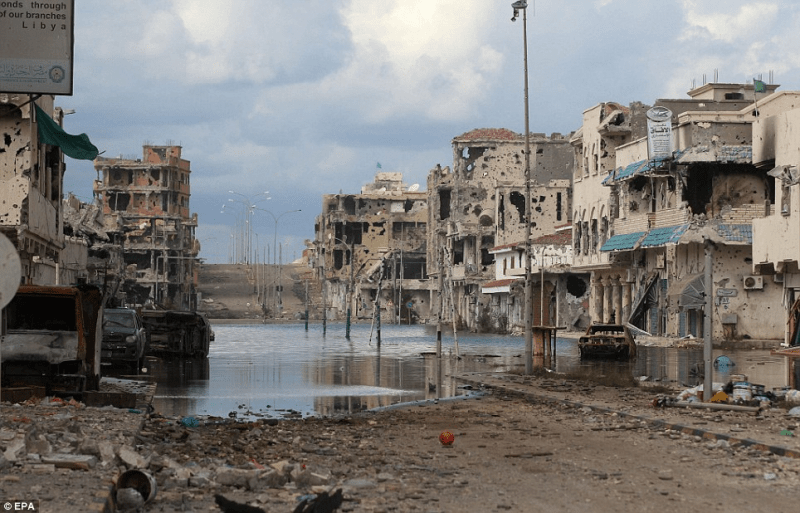
Sirte, Libya, after NATO bombing
The destruction of Libya’s government and infrastructure directly caused the Mediterranean boat migrant crisis, which has poisoned the politics of much of the European Union.
Donald Trump has not started any major war. He has been more restrained in military action than any US President since Jimmy Carter. My own view is (and of course it is impossible to know for sure) that, had Hillary been in power, Syria would already have been totally destroyed, the Cold War with Russia would be at mankind threatening levels, and nuclear tension with North Korea would be escalating.
“He hasn’t destroyed mankind yet” is faint praise for anyone. Being less of an existential danger to mankind than Hillary Clinton is a level achieved by virtually the entire population of the planet. I am not supporting Trump. I am condemning Clinton. I too, like Susan Sarandon, would have voted for Jill Stein were I an American.
So do protest against Trump. But do so under the banner No Trump! No Clinton! No NATO! And if any Clintonite or Blairite gets up to address you, tell them very loudly where to get off. I remember the hijacking of the Make Poverty History campaign by Brown, Darling and Campbell on behalf of their banker friends. Don’t let that happen again.
Or here is an even better idea.
Escape the Trump visit completely. Rather than stand penned in and shouting slogans at a police van parked right in front of you, turn your back on all of that and come join me at the Doune the Rabbit Hole Festival from 13 to 15 July. As our regulars know, this blog has been intimately connected with running the Festival from the start. This year is much bigger, with the Levellers, Akala, Atari Teenage Riot, Peatbog Faeries, and literally scores of other bands, and a great array of other festival activities too, including for kids, who come free and get free drinks.
DTRH has no sponsorship, no advertising, no government money and no rip-offs – beer and cider from £3.50 a pint at the bars. It is very much an alternative lifestyle gathering, and I find spiritual renewal there in the glorious Stirlingshire countryside. (I know that sounds corny, but I do). Tickets are £90 for full weekend including camping, which I think makes it the cheapest festival on this level around. Or you can buy a cheaper day ticket and drop in just for the day. If tickets are too expensive or you fancy a different kind of fun, you can volunteer, including to come and work with me in the bar, though there are a whole range of other tasks to be done if you don’t fancy that. Volunteers get in free and get fed in return for one six hour shift a day.
I really do hope I will see some of you there – it looks set to be a glorious weekend. Forget stress, forget Trump and hang out with nice people!
July 7, 2018
Posted by aletho |
Militarism, Progressive Hypocrite, Russophobia, Timeless or most popular | Donald Trump, Hillary Clinton, Libya, NATO, Syria, UK |
Leave a comment

In his statement to the House of Commons on 5th July, the British Home Secretary, Sajid Javid, stated the following:
“The use of chemical weapons anywhere is barbaric and inhumane. The decision taken by the Russian government to deploy these in Salisbury on March 4 was reckless and callous – there is no plausible alternative explanation to the events in March other than the Russian state was responsible. The eyes of the world are on Russia, not least because of the World Cup. It is now time the Russian state comes forward and explains exactly what has gone on.”
Anyone with their wits about them will immediately notice the cognitive dissonance in Mr Javid’s statement. On the one hand, he states that the Russian government took a decision to deploy chemical weapons in Salisbury on 4th March, 2018. This is an emphatic declaration, and implies that the British Government possesses irrefutable evidence that this is so. Then in the next breath, he states that there is “no plausible alternative”. This is very much less than emphatic, and the word “plausible” implies that the British Government does not have irrefutable evidence to back up their claim.
This is not a subtle difference. It is the difference between suspecting something and knowing something. If you know something to be true, because you have the hard evidence to back it up, you don’t use equivocal phrases like “no plausible alternative”. You simply say, “here is the evidence to prove it beyond reasonable doubt.” On the other hand, if you do not possess irrefutable evidence of something, as the weasel phrase “no plausible alternative” suggests, then you have no right to pronounce definitively on the matter, as Mr Javid felt fit to do.
Still, he’s only the Home Secretary. You can’t expect him to understand such petty legal concepts.
As it happens, there are plenty of plausible alternatives, as Mr Javid no doubt knows only too well. If he’s interested, he can check out the one I have put forward here. Of course, regardless of whether my “plausible alternative” is correct or not, it is unlikely that Her Majesty’s Government would want investigations to follow the line of inquiry I advanced, since it might raise an awful lot of troublesome questions about the role of British Intelligence in the attempt to stop Donald Trump getting elected. Apparently, they want to keep that quiet. Which is why they slapped D-Notices on various aspects of Skripal 1.0 to hush all that up.
So Mr Javid states that Russia must explain itself, but in so doing unwittingly admits that the Government has no hard evidence of Russian state involvement. It merely is unable to imagine a “plausible alternative”, which either means that its members are somewhat lacking in imagination, or they don’t wish other “plausible alternatives” to be discussed (of course, it could even be both). Nevertheless, since he and the Government are the ones making the claim, I’d say that actually it is incumbent on them to explain themselves, not the ones they are accusing. That is how these things are supposed to work, is it not?
This being the case, I have a number of questions for them, which urgently need answering. Urgent, because they could prove vital to the investigation. However, before I come onto the questions, I must explain the nature of them, which may well come as something of a surprise, given the latest twist to this sorry tale in Amesbury. The surprise is that not one of the 10 questions relates to the Amesbury case. This might seem odd, but there is a very important reason for it.
At the moment, very few details have emerged about the Amesbury case, and so it is not exactly clear which questions could even be asked. True, the details that have emerged so far in the official narrative are about as coherent and plausible as those in the original case, one of which I have already debunked here. However, what Mr Javid sought to do, with a very clever sleight-of-hand to cover his case of cognitive dissonance, is to make definitive claims about Case 2, based on the assumption that Case 1 has somehow been proven. But of course it hasn’t. Not even remotely. In fact, there are a ton of questions about Case 1 still hanging in the air that have not been answered, and I really don’t think that we should let Mr Javid and Co. off the hook before they’ve given us the answers to them.
But in the spirit of decency, let’s make it extremely easy for them. Let’s not ask them any hard questions. Nothing like, “C’mon, tell us the names of the people wot did it,” for instance. No, let’s instead satisfy ourselves by asking them some remarkably simple questions that they – or at least the Metropolitan Police – must know the answers to if their narrative is correct, and for a very simple reason, as you will see. So here goes:
- What were Mr Skripal’s and Yulia’s movements on the morning of 4th March?
- Why were their phones switched off?
- Did Mr Skripal see anyone or anything suspicious near his house that day?
- According to witnesses in Zizzis, Mr Skripal appeared to be very agitated. Was this because he was feeling unwell?
- According to witnesses in Zizzis, Mr Skripal appeared to be in a hurry to leave. Was this because he had an appointment to keep?
- What did Mr Skripal do after he left Zizzis?
- Can he confirm or deny that the couple seen on the CCTV camera in Market Walk, one of whom was carrying a large red bag, are him and Yulia?
- Did either Sergei or Yulia have a large red bag with them that day?
- What are his last memories before collapsing at the bench?
- Is Mr Skripal prepared to make a public statement answering the above, and will members of the international media be free to ask him questions?
So why must they know the answers to these questions? Simple. Because all they have to do to get answers to them is ask Sergei Skripal. They know where he is, don’t they? They must have questioned him, haven’t they? And Mr Skripal must surely have been eager to answer them, since the answers he gives could prove vital in helping to find out who poisoned him and his daughter, mustn’t he?
Just pause there for a second and think about it. Here we are, a third of a year after Skripal 1.0, with both Mr Skripal and his daughter having recovered months ago, and we still don’t know the answers to these basic, vital, but extraordinarily easy-to-establish questions. Isn’t that amazing?
I could even make it easier for them by boiling it down into one question:
When will the world hear from Mr Skripal about the events and circumstances of 4th March 2018, from the time he awoke until 4pm that afternoon?
C’mon British Government. It really isn’t hard. Or at least it wouldn’t be if the case you’ve presented is true. Just ask Sergei. But in the continued absence of answers to these simple questions, it seems that there might well be no “plausible alternative” but to assume that your case simply does not stack up. Which is why the onus is on you, not those you accuse, to explain yourselves.
July 6, 2018
Posted by aletho |
Deception, False Flag Terrorism, Russophobia | UK |
Leave a comment