Kiev’s fake Babchenko murder erodes media & information credibility – Intl Journalist Federation
RT | May 31, 2018
The International Federation of Journalists (IFJ) condemned the Ukrainian intelligence stunt with staging the murder of journalist Arkady Babchenko, stating it damaged credibility of Kiev and harmed international journalism.
“The profession’s aim is to seek the truth and … any manipulation of information can dramatically damage media credibility as well as journalism as a whole,” the IFJ said in a statement on Thursday. The staged murder of Babchenko by Ukrainian authorities, who was “killed” on May 29 only to reappear a day later during the secret service’s press conference, reinforced “the idea of journalists and politicians conspiring together,” the organizations’ president Philippe Leruth said.
“By spreading false evidence about his murder, Ukrainian authorities have seriously eroded the credibility of information, and their communication runs the risk of being considered a propaganda operation. Was it really necessary to stage his death in order to stop an alleged attack?” Leruth wondered.
The stunt was also inappropriate due to the fact that “killers and their backers” of journalists who were indeed assassinated, such as Pavel Sheremet, have never been identified by Ukraine’s authorities. While IJF condemns the killings and “fights against impunity, which benefits journalists’ murderers,” it also advocates transparency of information, Leruth stressed.
Moreover, the whole affair was “a complete circus orchestrated by military figures and a journalist,” and it was not “simple journalistic case anymore,” IFJ General Secretary Anthony Bellanger argued. The stunt misled journalists worldwide and “millions of citizens that were rightly moved by this so-called murder,” he added.
Ukrainian authorities rushed to defend the stunt, with Interior Minister Arsen Avakov stating he was surprised with “pseudo-moral” criticism from abroad and that the secret services achieved with the operation “enough … to be satisfied.”
The “murder” and “resurrection” of Babchenko have, however, caused a massive outcry among journalists and media freedom organizations worldwide. While elated with his reappearance, many condemned the deliberate spread of false information.
“Relieved that Arkady Babchenko is alive!” OSCE’s representative on media freedom Harlem Desir tweeted. “I deplore the decision to spread false information on the life of a journalist. It is the duty of the state to provide correct information to the public.” Similar statements came from Reporters Without Borders (RSF).
What if Babchenko had decided to stay “dead”?
By Catte | OffGuardian | May 31, 2018
There’s a good deal of discussion, both in mainstream and in alt media, of how/why the Arkady Babchenko event unfolded in the ludicrous way it has.
The Ukrainian government narrative is (currently) claiming the SBU faked AB’s death in order to entrap some real (Russian) assassins who really wanted him dead, and it was all part of a cunning plan. They’re light on detail about exactly how taking pics of Bab pretending to be dead helped with the general effort, but maybe they’ll fill in all those blanks soon.
Others, including RFE, are telling us the very bad fake death pic was released on a Facebook page with ties to Washington.
But beyond the Byzantine imbroglio, I think there’s another question no one is asking. –
What if Arkady hadn’t turned up, looking sheepish at that presser?
What if he hadn’t turned up ever? What if he’d decided he couldn’t face the humiliation, or what if his SBU handlers decided it might be better if he just continued to be dead and skipped off the map somewhere with a few hundred grand and nice new ID.
What then?
We need to never forget that while Arkady was busy hiding in his closet (or whatever he did for the hours he was supposed to be dead), his demise was the reality for all of us. Sold to us, not just with narrative consistency, but with apparent hard evidence and circumstantial confirmation.
There was the blood-soaked “corpse” photo:

There was the sketch of the perp:

There was the Twitter parade of blue-tick public mourners.


A very very familiar roll-out we have all seen many times was taking shape. There were predictable articles, by predictable people, saying predictable things. By next month Luke Harding would have had a new book out called something like “Death in Broad Daylight: how the Kremlin silenced Arkady Babchenko.” Its cover would feature Babchenko’s completely fake murder pic with a target superimposed and a semi-opaque red halftone background of Putin’s face. It would be on the NYT bestseller list for the next two years and make Luke another little fortune.
There would soon be an “Arkady Babchenko” street in Washington. A “posthumous” Pulitzer would have been his within a year or two. Arkady Babchenko memorial plaques would spawn like tribbles. Navalny and his twenty-seven supporters would carry those tragically misty and sepia pics of our boy (which miraculously appeared within hours of his “death”) on all their “rallies”. By 2019 Katherine Bigelow would have made the movie (based on Luke’s book), and it would be a dead cert at the 2020 Oscars.
But it would have been no more true that it is now, would it? It would simply be an undiscovered lie. A mesh of words, woven thick by repetition, giving shape to an absence – of evidence, of investigation, of everything.
If he hadn’t turned up alive, Arkady dead would have become the thing most people called “truth.” Like “United 93”, and similar collective myths, the legend of his martyrdom would have taken on all the trappings of solid reality. No one – none of us – would think to question it. And anyone who did would be dismissed as a lunatic.
The most important and abiding point about the non-death of Arkady Babchenko, beyond all the spin and damage control and narrative-boosting we are inevitably going to see over the next days and weeks, is that, at its deepest level, consensual reality is a fragile thing that can very easily have nothing to do with truth or fact or actual reality. The point is that the people who are paid to fact check official narratives didn’t do it, and would never have done it. They were simply sold a line and bought it, uninterrogated, uninvestigated, unwrapped.
And this is what they do every day. With every item of “news” they lay before us.
Look at the illusion of depth and veracity they gave this lie, simply by reporting it. See how easily they were fooled and went on to fool us. See how little it occurred to any of us, even those who make a habit of interrogating narratives, to ask whether or not it really happened.
Think about how easily that basic question was trampled and crushed into oblivion. How effortlessly a few public statements and a very very questionable pic became the collective “truth” for all of us. Look at how the debate was already being positioned. How the issue was going to be “who did it?” not “was it even done?”
The real problem this highlights is not just that the derogation of journalistic duty to fact-check and second-source is now the norm. We already know this. It’s been too apparent for too long.
The real problem is that this derogation helps to create the reality we all live in. Even those of us who deplore it. If for whatever reason Arkady had sloped off to Hawaii in a bad wig, today we would all be debating who may have killed him. Unwittingly hostage to a flimsy lie.
This is an uncomfortable truth we need to recognise. Because it’s often the questions that seem most unnecessary, absurd, offensive, even insane that actually most need to be asked.
We are already being dissuaded from learning this most valuable lesson. The journos who were so recently burned are already backstopping against it. They aren’t focusing on why the lie happened, they are focusing on how “the enemy” (the Russians, the alt-media, the whole evil circus of “other”) are “exploiting” it. How they will now have an “excuse” to suggest any future such deaths might also be fake.
The drive is to make it ridiculous to learn from experience or to cite precedence. We are already being persuaded only idiots would think future deaths might be fake based on the fact past deaths were fake.
No matter how much data there might be for fakery we must never accept it as a legitimate possibility. No matter how many Doumas may happen, no matter how many Babchenkos come back from the dead, no matter how many incidents of fakery are outed, or “explained” in unsatisfactory terms, we must never learn from experience. We can discuss why the victims of the latest atrocity died, but not the possibility they might not have died at all?
Is this really good enough? I don’t think so.
Next time we are flooded with the apparently shocking narrative of violent death, how many of us will be brave or crazy enough to dare to ask – “did this death even happen?”?
MH-17 Probe Follows Frame-Up Process of Skripal Poisoning
By Finian CUNNINGHAM | Strategic Culture Foundation | 28.05.2018
The latest report by a Dutch-led investigation into the downing of a Malaysian airliner in 2014 casting blame on Russia for the disaster follows the same reprehensible flouting of due process as the Skripal poison affair.
No credible evidence is ever presented. The charges leveled against Russia largely rely on assertion and innuendo. And despite the grave implications for the accused, Russia is not permitted to access the investigation file independently to form an adequate defense against the claims.
This is far from the standard of due legal process. Ironically, by Western governments that claim to be paragons of law and jurisprudence. It is more akin to an inquisition where guilt is presumed from the outset, and where the prosecution is tilted heavily in favor of the accusers.
The Dutch-led Joint Investigation Team (JIT) has released updated conclusions to its nearly-four-long probe into the airline disaster. On July 17, 2014, Malaysian MH-17 crashed while transiting airspace over eastern Ukraine on its way to Kuala Lumpur from Amsterdam. All 298 people onboard were killed. Most of the victims were Dutch, Malaysian and Australian nationals.
A plausible explanation for the downing is that the aircraft was hit by a surface-to-air missile. The big question is who fired the missile since the Ukrainian region was the scene of intense fighting between Western-backed Kiev regime forces and pro-Russian rebels.
Western news media and governments immediately sought to blame Russian-backed rebels for the carnage. By dubious extension, President Vladimir Putin was vilified in some media coverage as being personally responsible for the deaths.
Russia has vehemently denied having any involvement in the incident. Indeed, Moscow has said it believes Kiev’s armed forces may have fired the missile.
The rebels in the Donbas region again this week reiterated that they were not responsible since they did not possess any such high-altitude anti-aircraft weapon systems.
The JIT probe previously reported that the weapon was a Soviet-made Buk missile. This week, the investigators dramatically upped the ante by charging that the missile came from a Russian anti-aircraft brigade based in Kursk, southwest Russia. The Dutch-led team claim that the 53rd Brigade transported the Buk system over the border into Ukraine. They claim that the convoy returned to Russia shortly after the downing of the airliner. The Dutch team leave the possibility open that the weapon may have been fired by another party, but the implication is Russian culpability.
Like the Skripal affair involving the alleged poisoning of a former Russian double agent, Sergei Skripal, and his daughter in England on March 4, the MH-17 case has been prejudiced from the outset by wild allegations of Russia’s guilt.
Within days of the purported poisoning of the Skripals in Salisbury, the British government accused Russia of carrying out an assassination plot. There has never been any verifiable evidence presented by the British authorities to substantiate their sensational claims. The trick seems to be to railroad through a guilty verdict before any due process is allowed to take place.
Likewise in the case of the MH-17 disaster. Russia or Russia-backed militants have been labelled as guilty from the beginning. All proceedings thereafter seem to be solely for the purpose of “proving” the foregone conclusion.
A further similarity in this inquisitorial process is that Russian investigators have been excluded from multilateral fact-finding. The Dutch-led JIT is heavily reliant on NATO secret intelligence. More disturbing is that the Kiev regime, which should be treated as one of the suspect parties, has been allowed to contribute to the report findings. That is an incredible bias given the enormous incentive for Kiev and its NATO supporters to inculpate Russia or the pro-Russian rebels.
Responding to the report this week, President Putin quite correctly stated that Russia cannot acknowledge the charges because it has constantly been denied fair access to the investigation files. The Russian president said, however, that Russia was willing to participate in an open and transparent probe.
Again, this is analogous to the Skripal affair. Moscow has repeatedly offered to carry out a joint investigation and contribute to an elucidation of what really happened to the former spy and his adult daughter. But the British authorities have continually refused to include Russian investigators.
As for the lack of hard evidence, the British have based their tendentious allegations against Russia largely on the alleged detection of a Soviet-era chemical weapon. In the MH-17 case, the Dutch-led investigators are implicating Russia based on the alleged claim that the missile was a Soviet-made Buk system. That’s very elastic extrapolation.
The Kiev regime forces are in possession of Buk missiles dating back to when Ukraine was a Soviet Republic before 1991. It is entirely plausible that its forces could have fired the weapon that doomed the airliner.
Indeed, Russian military said this week that video images presented by the Dutch police of the alleged Buk missile’s casing indicate that the model is dated to the pre-1991 period. If that is the case, then one wonders why a top-notch, modern Russian defense brigade would be toting relatively old missiles if it were involved, as the JIT report claims.
Russia’s defense ministry said: “One of the arguments the investigators used to back up their charges the Russian military might have been involved in the tragedy was a fragment of the Buk missile’s engine demonstrated at a news conference. The serial number unambiguously indicates that the engine was manufactured in the Soviet Union back in 1986.”
As well as the unprecedented exclusion of Russia’s participation into what was an international disaster on its border, the JIT also omitted potentially crucial data such as radar and air-traffic communications, according to Moscow. The JIT also did not investigate why the Kiev authorities who had operating control over the aviation routes allowed the ill-fated airline to traverse what was at the time a hot war zone.
The Washington Post reported: “The investigators Thursday offered only open-source video and photographic evidence to support their conclusion that the missile came from a Russian military anti-aircraft system. Portions of the evidence already had been reported by the Bellingcat research group. But the international investigative team said that its findings stood independently and that it possessed additional information to buttress its conclusions that it would announce only in eventual courtroom proceedings.”
That is a startling admission. “Open-source videos” of an alleged Buk convoy hardly constitute credible evidence to support the severe claims being made against Russia.
The mention too of using Bellingcat as a source is also deeply troubling. This self-styled “expert group” of amateur sleuths based in England, run by Eliot Higgins, has been notoriously collaborating with Western military intelligence to frame-up Syrian state forces and Russia over alleged atrocities. It specializes in peddling fake videos as used by the terrorist affiliate, the White Helmets. Anything that Bellingcat puts its name to should be treated with derision, not deference as the Dutch prosecutors have done.
Note too how the JIT claims to have “additional information” that it says it will present in a future courtroom. That’s not acceptable. It is making very grave allegations and innuendo against Russia in the present based on flimsy videos.
Furthermore, the Dutch and Australian governments are leaping ahead with threats of bringing criminal charges against the Russian government and demanding Moscow pay financial compensation to the crash victims’ families.
Such reckless adversarial positions are setting up a new geopolitical conflict with Russia based on prejudice and hearsay. Following the 2014 air crash, the US and Europe imposed a raft of economic sanctions on Russia, without any substantiation. The precedent has been set for even more sanctions following this week’s JIT report.
Just like the Skripal affair which resulted in 150 Russian diplomats being expelled by dozens of countries merely on the back of British assertions, Western governments and media are again finding Moscow guilty over the MH-17 tragedy, without any evidence or due process.
The same can be said with regard to a whole host of anti-Russia media campaigns: alleged electoral interference in Western states; alleged Olympic sports doping, alleged cyberattacks; alleged aggression against Europe; alleged violations in Syria; and so on and so on.
There is no due process here. The only process taking place is one of extreme, unrelenting provocation towards Russia.
Russia ‘absolutely’ rejects Dutch & Aussie accusations it’s responsible for MH17 downing
RT | May 25, 2018
Moscow has rejected any involvement in the crash of flight MH17 in Ukraine after the Netherlands and Australia declared Russia “responsible” for the deployment of a BUK missile system that downed the jet in 2014.
Moscow neither accepts nor trusts the results of an international investigation into the MH17 crash as it was not allowed to take part in it, according to the Russian president’s spokesman Dmitry Peskov.
“Of course, without being able to be a full participant, Russia does not know to what extent the results of this work can be trusted,” he said.
Peskov echoed the position of the Russian president Vladimir Putin who earlier said that, although Ukraine was included in the probe, Russia was barred from participating in establishing the truth.
Asked if he can confirm that Russia vehemently denies any involvement in the MH17 downing, Peskov replied “absolutely.”
Earlier on Friday, Amsterdam and Canberra said Russia is “responsible for its part in the downing of flight MH17” following a Thursday press conference of the Dutch-led International Investigation Team (JIT). The latter concluded that a BUK missile system from a Russian 53rd brigade was transported to eastern Ukraine and used to down the passenger plane with more than 300 people onboard. The system was then said to have returned to Russia.
“The [Dutch] government is now taking the next step by formally holding Russia accountable,” Dutch Minister of Foreign Affairs Stef Blok said in a statement. However, the Russian military earlier said that not a single weapons system crossed the border.
MH17 tragedy may be used to achieve political goals – Lavrov
The country’s Foreign Minister Sergey Lavrov stressed that Moscow would not reject closer cooperation on the MH17 probe, but only if the data it provides is included as well. He also compared the case with the Skripal scandal, in which London made groundless allegations and pinned the blame on Moscow, but failed to provide any proof.
“If our partners have decided to speculate on this case, when it comes to the most serious human tragedy, the death of hundreds of people, to achieve their political goals, I leave it on their conscience,” Lavrov said.
Despite the JIT claiming that it conducted a separate probe, it did not move any further than the British investigative group Bellingcat – some reports of which came under fire and were refuted by Russian activists. Among other flaws in the earlier Bellingcat claims was the assertion that the Ukrainian Army had no Buk systems in the conflict area. However, in a countering statement, Russian activists presented reports from the Ukrainian media itself showing Buk missiles in the area prior to the downing of the plane.
Bellingcat’s online investigations have previously raised questions regarding their accuracy. After the group’s founder, Eliot Higgins, published one of his reports on Syria, he was asked to discuss his findings with prominent MIT physicist Theodore Postol. However, the blogger declined the debate and insulted the scientist, triggering an avalanche of criticism on Twitter.
The allegation that the missile belonged to the Russian military had earlier been debunked by the Buk manufacturer, Almaz-Antey. Its real-time experiment showed that the projectile which hit MH17 (Boeing 777) was from an earlier generation and is no longer in service with the Russian military. It was found that the plane was likely shot down using an old 9M38 missile, not the newer type 9M38M1 with distinct butterfly-shaped metal fragments, which were allegedly recovered by the Dutch Safety Board.
Moreover, Almaz-Antey’s findings, which analyzed the angle from which the projectiles entered the cockpit of the ill-fated flight, showed that the most probable location of the launch site could be only on Kiev-controlled territory. Untampered Russian radar data provided by Moscow led to similar conclusions.
Since the collapse of the Soviet Union in 1991 Ukrainian forces kept around 20 Buk systems, according to the Russian Defense Ministry. The military also stressed that Moscow has not supplied any new missiles to Ukraine since then.
Read more:
Time for UK to Apologize to Moscow for Accusations Over Skripal Case – Embassy
Sputnik – 25.05.2018
The Russian Embassy in the United Kingdom said on Friday it was time for the UK side to apologize to Russia for accusations over the poisoning of Sergei and Yulia Skripal, as no evidence was provided by London to substantiate its claims of Moscow’s involvement during the three months which passed since the incident.
“Time has come for British authorities to apologize to Russia for the hollow accusations accompanied by an unprecedented anti-Russian campaign, to give answers to all the questions and requests officially sent to the British side on this matter, to engage with Russian law enforcement agencies that have opened the criminal case regarding the attempted murder of Yulia Skripal, and to stop isolating the two Russian citizens,” the embassy’s press release read.
Meanwhile, Russian President Vladimir Putin urged to stop speculations on the so-called Skripal case and conduct a joint objective investigation instead.
“We need to either carry out a joint objective and thorough investigation, or simply stop talking on this topic, because it does not lead to anything but a deterioration of relations,” he said.
Putin also questioned the alleged fact of poisoning of ex-spy Sergei Skripal and his daughter by a military-grade nerve agent.
“I’m not a specialist in chemical warfare agents, but as far as I can imagine, if a warfare agent is used, the victims of this attack die on the spot, almost immediately. But nothing happened in this case. Skripal himself and his daughter are alive, and have been discharged from the hospital. His daughter looks quite alright, everyone is alive and well,” the president stressed.
On May 1, UK National Security Adviser Mark Sedwill told the UK lower house defense committee that no suspects had been identified in the March’s attack on the former Russian intelligence officer Sergei Skripal and his daughter in Salisbury.
Analysis by the Organization for the Prohibition of Chemical Weapons (OPCW) of the Salisbury incident confirmed the UK findings related to the nature of the chemical used in the poisoning, but did not include any information that would help the UK government substantiate claims about Russian involvement in the incident.
The United Kingdom and its allies have blamed Russia for an alleged role in the poisoning despite presenting no proof. Over a hundred Russian diplomats have since been expelled from these countries in solidarity with London and to put pressure on Moscow, which denies any involvement.
Missile that downed MH17 came from Russian military, unit of origin pinpointed – intl investigators
RT | May 24, 2018
A Dutch-led probe says the missile that hit flight MH17 over Ukraine came from a unit in western Russia. Claims about its Russian origin were made by activist group Bellingcat earlier, but it was seriously questioned back then.
The international team investigating the 2014 tragedy, in which Malaysia Airlines flight MH17 crashed in eastern Ukraine, reiterated the claim that it was a Buk missile, but now claims it also pinpointed the exact unit responsible.
The Dutch-led Joint Investigation Team (JIT) “has come to the conclusion that the BUK-TELAR that shot down MH17 came from 53rd Anti-aircraft Missile Brigade based in Kursk in Russia,” the head of the crime squad of the Dutch National Police, Wilbert Paulissen, told reporters on Thursday.
The findings also claim that the missile carrier came from Russia and was returned to the country. However, the investigators have apparently failed to move any further than British online investigative activist group Bellingcat, which presented their report nearly one year ago and made the same allegations.
“We realize that the investigation collective Bellingcat has already concluded the same and published it,” Paulissen said, noting that his team carried out a separate, “independent” probe.
The conclusions were announced even though the probe is still unfinished and currently in its “last phase,” and there is still much to be done, according to JIT members. Two questions still remain unanswered – who was responsible for shooting down the plane, and why did it happen? Moreover, further evidence to back up the “revelations” is currently not available to the public.
In 2016, the Dutch-led group said it suspected around 100 people could be linked to the alleged transportation of the Buk missile system to eastern Ukraine and the missile launch. Nearly two years of investigation made their role clearer, according to Thursday’s update, but the number of people involved was narrowed down to dozens, Dutch Chief Prosecutor Fred Westerbeke said.
While the latest JIT statement hardly presents anything new, earlier Bellingcat reports were refuted by ‘Anti-Bellingcat’ activists. Russian bloggers, journalists, aviation experts, and volunteers united in a group to highlight significant flaws and inaccuracies in the Bellingcat version of the tragedy.
For example, there is the repeated claim that a Buk missile system was transported through the Russian-Ukrainian border to the place the missile was allegedly fired and then returned. The Bellingcat report used pictures and data from open sources, showing the Buk system on both sides of the border and claiming it was the same. However, the one spotted in Russia was of different modification, the activists noted, pointing out that it contains a “step” on the left side of the system.
The British group’s claims that there were no Ukrainian Buk missile systems in the conflict-zone were also debunked by their Russian peers. They provided various screen shots of Ukrainian media reports picturing the systems belonging to the Ukrainian Army in the same area.
Last month, Russian Foreign Minister Sergey Lavrov stressed that Russia provided uncut radar-location data “that cannot be faked or changed” and “clearly” shows the missile did not come from the direction the investigators claimed. However, all data on the tragedy provided by Moscow was only selectively accepted by the multinational team of investigators, Lavrov said at a joint news conference with his Dutch counterpart, Stef Blok in Moscow.
Antifa or Antiwar: Leftist Exclusionism Against the Quest for Peace
By Diana Johnstone | Consortium News | May 21, 2018
CounterPunch has astonished many of its old fans by its current fundraising ad portraying the site as a prime target of Russia hostility. Under the slogan, “We have all the right enemies”, CP portrays itself as a brave little crew being blown off the water by an evil Russian warship out to eliminate “lefty scum.”
Ha Ha Ha, it’s all a joke of course. But it’s a joke that plays into the dangerous, current Russophobia promoted by Clintonite media, the deep state and the War Party. This is a reminder that Russophobia finds a variant in the writing of several prominent CounterPunch contributors.
Yes, CounterPunch continues to publish many good articles, but appears also to be paying its tribute to the establishment narrative.
Put on the defensive by the “fake news” assault against independent media, CP senior editor Jeffrey St Clair seemed to be shaken by Washington Post allegations that he had published articles by a “Russian troll” named Alice Donovan. St Clair never publicly questioned the FBI claim that the ephemeral plagiarist worked for the Kremlin, when she could as well have been planted by the FBI itself or some other agency, precisely in order to embarrass and intimidate the independent website.
The ‘Step Toward Fascism’

St. Clair: Co-founded CounterPunch
The anti-Russian attitude on CP is promoted mainly by the same writers who stigmatize the slightest suggestion of building a broad non-ideological antiwar movement as a step toward “fascism”. This leftist exclusionism goes against the traditions of the website founded by Alexander Cockburn and St Clair, and indeed, CounterPunch was fiercely attacked less than three years ago for its “red-brown”, or “QuerFront” tendencies.
The attack, originating on a German site, warned that leftists who publish on CounterPunch “are unwittingly helping to promote the agenda of the far right”. This article spelled out the Antifa doctrine:
“The idea of a red-brown alliance, or Querfront (German for ‘transversal front’), has been a recurrent motif in far-right thought over the past century. Craving the legitimacy that an alliance with progressive forces can provide, reactionaries seize on ostensibly shared positions, chief amongst them opposition to corrupt élites, to create the impression that progressives could benefit from making common cause with them.
“Querfront (also known as ‘third position’) propaganda can be highly seductive. Today’s (crypto)-fascist and other hard-right suitors, for example, focus on the commonplace left themes of opposition to war and corporate globalisation, the depredations of the ‘banksters’, civil liberties, and Palestinian solidarity.”
So, you genuine leftists, beware: if someone seems to agree with you, it may be a far righter out to ensnare you into her web.
The article gave advice on how to tell a QuerFront argument from a true leftist one:
“A serious left analysis, say, of US support for Israeli apartheid will start by looking at the documented record of US foreign policy as a whole”, whereas the red-brown, QuerFront third-positions position will say: “A foreign lobby has taken over the US government and media, and is forcing the US to act against ‘American interests’ and ‘American values’, and anyone who says otherwise is a Zionist infiltrator.”
So you mustn’t blame Zionists for Israel, it’s all Washington’s fault.
CounterPunch contributors singled out as dangerous right-wingers included Ralph Nader, Alison Weir, Ron Paul, Gilad Atzmon, Israel Shamir, Paul Craig Roberts and even Alexander Cockburn himself.
In his reply to the article, published on its website, St. Clair seemed to understand exactly where this was coming from.
Caity Gets Counter-Punched

Caitlin Johnstone: Counter-punched
Thus it was surprising when, last July, CounterPunch ran a whole series of articles attacking independent antiwar blogger Caitlin Johnstone (no relation) for some inconsequential remark about her willingness to join in opposing war even with male supremacist Mike Cernovich. The purists pounced on the incongruity of a hypothetical Caitlin-Cernovich alliance as an opportunity to ridicule the more general principle of a broad single-issue antiwar movement. For this minor heresy, Caitlin Johnstone was denied her right to respond on the site calling itself “the fearless voice of the left”.
On July 11, 2017, Yoav Litvin opened fire in an aggressive style that may have been fortified by his service in the Israeli Defense Force (IDF). Exclusion is a habit one can learn in the IDF. It’s ours, you have no right to be here, get out! That goes for the occupied left territories too. They decide who can stay and who does not belong.
In an interview last year, Litvin prided himself on adopting “the positive aspect of Zionism,” which is “the image of a Jew who is a fighter.” As a result of Jewish experience of persecution, he said, “We can lead a fight with all our brothers and sisters in minority communities.”
Fight against whom? In order to accomplish fundamental change, one needs to build majorities. Jews leading a fight of minorities will go where? Into the dead end of identity politics?
On July 28, CounterPunch published an even more contemptuous piece in the anti-Caitlin series: “Enough Nonsense! The Left Does Not Collaborate with Fascists”, by Eric Draitser. The Draitser rhetorical pose was to claim to prefer being water-boarded rather than having to write about Caitlin’s “doltish” prose, but felt obliged to do so in order to stop the advance of fascism.
Still, he does not easily tire from coming back to the subject.
As moderator of CounterPunch Radio, Draitser has promoted himself as the voice of CP and thus as a leading authority on what is or is not “left”. His role as mentor was demonstrated on his hour-long April 19, 2018 podcast with CP editors St. Clair and Joshua Frank. Draitser set the tone by elaborately ridiculing those who profess to be afraid of World War III. As if nuclear war were anything to worry about! What nonsense, he implied, getting all three to chortle contemptuously at the mention of Caitlin Johnstone, noted for such absurd concerns.
The Hilarity of World War III
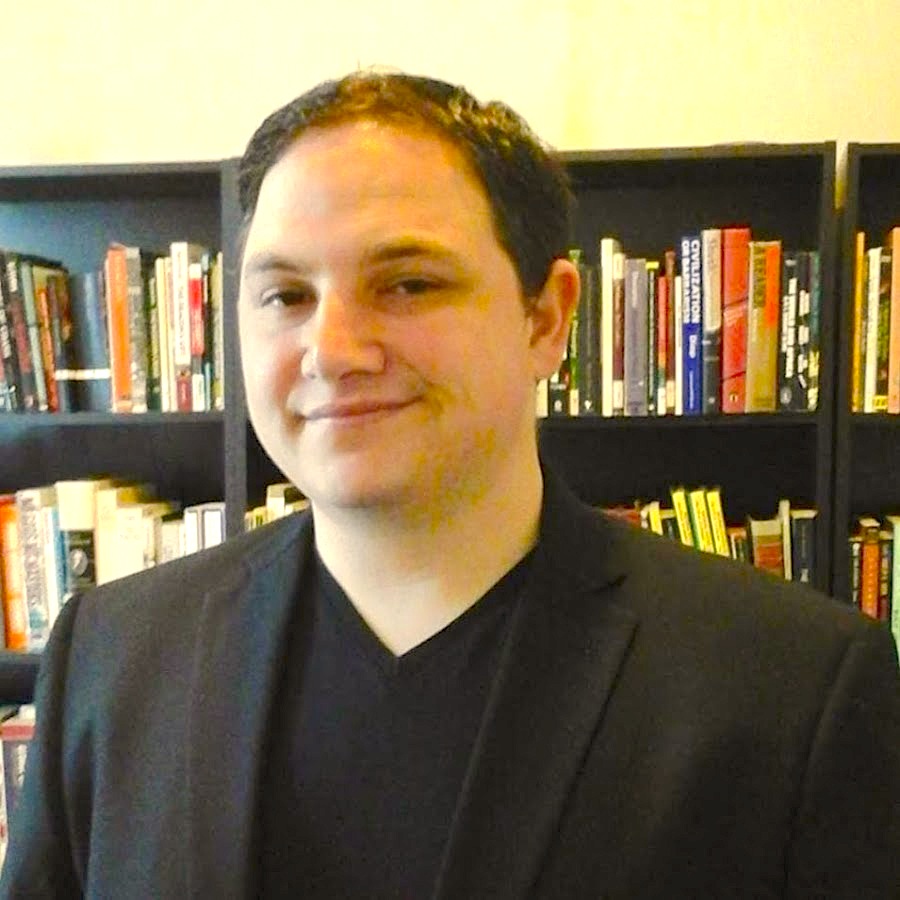
Draitser: WWIII a ‘fun conversation’
Draitser dismissed the danger of World War III with his own original “class analysis”: since Russia and the United States are both ruled by Oligarchs, they have too much in common to reasonably want to throw nuclear missiles at each other. (In other words, what was precisely the Marxist view of imperialist war.) St. Clair hesitated at this, noting the prevalence of irrationality in high spheres. But Draitser dismissed this objection and forged ahead undisturbed, managing what he called a “fun conversation.”
The exclusionists are less concerned about war with Russia than about the failure of “the left” to be sufficiently critical of Russia – as if a shortage of Russophobia were a real problem these days. Shortly before the anti-Caitlin campaign, Litvin interviewed Draitser and their fellow anti-fascist watch dog, Portland State University geography instructor Alexander Reid Ross, who also publishes frequently on CounterPunch.
Draitser complained that: “You see a lot of leftist academics, intellectuals and activists who have in many ways abandoned a real class analysis in favor of a loosely defined politics of opposition. Within this mindset, everything that opposes the United States, Israel, the Saudis or the EU is automatically good and should be supported irrespective of its qualities.”
That simplistic dismissal of the antiwar “mindset” qualifies Draitser for his future place in mainstream media.
Ross’ Red-Brown Chaos
Reid Ross, went him one better. “I see a number of red-brown alliances forming today, particularly in the field of political geography. A number of far-right groups view the modern-day axis of Syria, Iran and Russia as a kind of international counterweight to the North Atlantic Treaty Organization (NATO), which has always been seen by fascist groups as a kind of nemesis led by the nations that defeated the Rome-Berlin axis in 1945.”
This is pure delirium. The nemesis that did the most to defeat the Rome-Berlin axis in 1945 was the Red Army. By conjuring up unidentified “far right groups”, Ross manages to identify Syria, Iran and Russia with the fascist Axis powers in World War II. In reality, NATO has been a magnet for attracting European fascists, from Italy, where they cooperated in clandestine “Gladio” operations to destroy the left, to Ukraine, where genuine fascists are in a “partnership for war” with NATO.
Most Americans have not been well educated in the complexities of modern history. In his Antifa hoodie, Ross can dazzle his audience with a plethora of unfamiliar facts strung together by extremely questionable analysis, unchallenged by genuine experts.
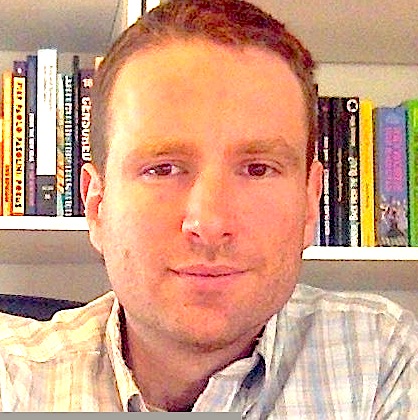
Reid Ross: Article pulled (Photo European Graduate School)
In the Litvin interview, both Draitser and Ross add their small bit to prevailing Western Russophobia by dwelling on Putin’s alleged support for European right-wing groups. Both stress the danger represented by Russian ambitions to establish a Eurasian empire, based on the ideology of Alexander Dugin.
Dugin is a religious reactionary, a tendency that may alarm Jews still haunted by Tsarist pogroms. They are also alarmed by Dugin’s devotion to the thought of German philosopher Martin Heidegger, an ardent believer in Nazism and party member. This is ironic, since Heidegger has been the favorite of a whole line of post-World War II French philosophers, from Sartre to Foucault, considered to be “on the left”. This merely shows that philosophy can be a source of great confusion.
In an Intercept article last September, Ross was quoted as saying that, “Assad is a figure that is central to a realization of Eurasionism,” embodying the idea that, “Russia will lead the world out of a dark age of materialism and toward an ultranationalist rebirth of homogenous ethno-states federated under a heterogeneous spiritual empire.”
It’s hard to see what is so terrifying about such a vague aspiration, with so little chance of realization. But it does provide a new angle for condemning the Russian connection with Syria.
Ideological ‘Iron Curtain’
Ross went so far on March 9 in his vituperations, that the Southern Poverty Law Center, which first published his article on its “Hate Watch” site, felt obliged to withdraw it. The title perfectly echoes the QuerFront accusation earlier leveled against CounterPunch : “The Multipolar Spin: how fascists operationalize left-wing resentment.”
In this gem of guilt by association, Ross applied the “six degrees of separation” theory to show that people have been seen with the wrong people and thus must be red-brown. The long list of untouchables included Ray McGovern, Brian Becker, Global Research, Margaret Kimberly of Black Agenda Report, Daniel McAdams, “conspiracy theorist” Vanessa Beeley, and special focus on Max Blumenthal, guilty of having spoken favorably of a “multipolar world.”
The main problem with “multipolarism”, according to Ross, “may be that it supports not the emergence of Russia as a world power but the rise of the Kremlin’s authoritarian conservative political ideology.”
So, we may conclude, we need an ideological Iron Curtain to protect the “liberal leftist” West from Russian “authoritarian” conservatism.
Westernizers vs. Slavophiles
Russian relations with the West have historically been marked by ideological rivalry between Westernizers and Slavophiles. It is obvious that Dugin is no more than the latest prophet of Slavophilia, the idea that Christian Russia is a beacon of virtue to the world.
Historically, Westernizers in Russia have repeatedly gained influence and then lost out, because their overtures to the West were rebuffed on one pretext or another. (The British geopolitical tradition, based on the timeless dictum divide et impera, has traditionally favored policies to keep the continent divided) This merges easily with the Brzezinski doctrine of maintaining separation between Western Europe as a whole and Russia to maintain U.S. global hegemony.
Western rejection of Russia naturally favors a rise of the Slavophiles. It also obliges Russia to look to Eurasia rather than Western Europe. This is happening again.
Vladimir Putin is clearly in the Westernizing tradition. Not an ignorant buffoon like Yeltsin, ready to give away the shop to get a pat on the back from Bill. But rather someone who, as an intelligence agent (yes, KGB people learn a lot) lived in the West, spoke fluent German, and wanted Russia to have a dignified place in Europe – which was the dream of Gorbachev.
But this aspiration has been rudely rebuffed by the United States. Russians who yearned to be part of Europe have been disappointed, humiliated, and finally, angered. All their efforts at friendship have been met with increasingly outlandish portrayals of Russia as “the enemy”.
And yet despite everything, Putin persists in demonstrating his desire to work with Western partners, both by cutting back on military spending and again proposing to keep the pro-Western Dmitry Medvedev as Prime Minister.
If the West were really worried about Duginism, the remedy has always been obvious: improve relations with Putin.
Even Stalin did not really consider it Moscow’s job to convert Western Europe to communism, and it is certain that Putin has no illusion about converting his Western neighbors to Duginism. Russia is not out to change the West, but to make peace and do business, with whoever is willing.
The Russophobic exclusionists really constitute the ultra-left wing of the War Party, which uses different arguments to arrive at the same conclusions: Syria and Russia are enemies. The exclusionists offer no practical solutions to any real problem, but spread suspicion, distrust and enmity. They discredit the very idea of joining with Russia in peaceful mediation between Israel and Iran, for example. The real thrust of this odd campaign is to minimize the danger of war with Iran, or of direct confrontation with Russia, as Netanyahu continues to drag the United States and its European sidekicks deeper into Middle East wars on behalf of Israel’s regional ambitions.
Diana Johnstone is a political writer, focusing primarily on European politics and Western foreign policy. She received a Ph.D. at the University of Minnesota and was active in the movement against the Vietnam War. Johnstone was European editor of the U.S. weekly In These Times from 1979 to 1990, and continues to be a correspondent for the publication. She was press officer of the Green group in the European Parliament from 1990 to 1996. Her books include Queen of Chaos: The Misadventures of Hillary Clinton, CounterPunch Books (2016) and Fools’ Crusade: Yugoslavia, NATO and Western Delusions, Pluto Press (2002).
Making Excuses for Russiagate
By Daniel Lazare | Consortium News | May 18, 2018
The best evidence that Russia-gate is sinking beneath the waves is the way those pushing the pseudo-scandal are now busily covering their tracks. The Guardian complains that “as the inquiry has expanded and dominated the news agenda over the last year, the real issues of people’s lives are in danger of being drowned out by obsessive cable television coverage of the Russia investigation” – as if the Guardian’s own coverage hasn’t been every bit as obsessive as anything CNN has come up with.
The Washington Post, second to none when it comes to painting Putin as a real-life Lord Voldemort, now says that Special counsel Robert Mueller “faces a particular challenge maintaining the confidence of the citizenry” as his investigation enters its second year – although it’s sticking to its guns that the problem is not the inquiry itself, but “the regular attacks he faces from President Trump, who has decried the probe as a ‘witch hunt.’”
And then there’s the New York Times, which this week devoted a 3,600-word front-page article to explain why the FBI had no choice but to launch an investigation into Trump’s alleged Russian links and how, if anything, the inquiry wasn’t aggressive enough. As the article puts it, “Interviews with a dozen current and former government officials and a review of documents show that the FBI was even more circumspect in that case than has been previously known.”
It’s Nobody’s Fault
The result is a late-breaking media chorus to the effect that it’s not the fault of the FBI that the investigation has dragged on with so little to show for it; it’s not the fault of Mueller either, and, most of all, it’s not the fault of the corporate press, even though it’s done little over the last two years than scream about Russia. It’s not anyone’s fault, evidently, but simply how the system works.
This is nonsense, and the gaping holes in the Times article show why.
The piece, written by Matt Apuzzo, Adam Goldman, and Nicholas Fandos and entitled “Code Name Crossfire Hurricane: The Secret Origins of the Trump Investigation,” is pretty much like everything else the Times has written on the subject, i.e. biased, misleading, and incomplete. Its main argument is that the FBI had no option but to step in because four Trump campaign aides had “obvious or suspected Russian ties.”
‘At Putin’s Arm’
One was Michael Flynn, who would briefly serve as Donald Trump’s national security adviser and who, according to the Times, “was paid $45,000 by the Russian government’s media arm for a 2015 speech and dined at the arm of the Russian president, Vladimir V. Putin.” Another was Paul Manafort, who briefly served as Trump’s campaign chairman and was a source of concern because he had “lobbied for pro-Russia interests in Ukraine and worked with an associate who has been identified as having connections to Russian intelligence.” A third was Carter Page, a Trump foreign-policy adviser who “was well known to the FBI” because “[h]e had previously been recruited by Russian spies and was suspected of meeting one in Moscow during the campaign.” The fourth was George Papadopoulos, a “young and inexperienced campaign aide whose wine-fueled conversation with the Australian ambassador set off the investigation. Before hacked Democratic emails appeared online, he had seemed to know that Russia had political dirt on Mrs. Clinton.”
Seems incriminating, eh? But in each case the connection was more tenuous than the Times lets on. Flynn, for example, didn’t dine “at the arm of the Russian president” at a now-famous December 2015 Moscow banquet honoring the Russian media outlet RT. He was merely at a table at which Putin happened to sit down for “maybe five minutes, maybe twenty, tops,” according to Green Party presidential candidate Jill Stein who was just a few chairs away. No words were exchanged, Stein says, and “[n]obody introduced anybody to anybody. There was no translator. The Russians spoke Russian. The four people who spoke English spoke English.”
The Manafort associate with the supposed Russian intelligence links turns out to be a Russian-Ukrainian translator named Konstantin Kilimnik who studied English at a Soviet military school and who vehemently denies any such connection. It seems that the Ukrainian authorities did investigate the allegations at one point but declined to press charges. So the connection is unproven.
Page Was No Spy
The same goes for Carter Page, who was not “recruited” by Russian intelligence, but, rather, approached by what he thought were Russian trade representatives at a January 2013 energy symposium in New York. When the FBI informed him five or six months later that it believed the men were intelligence agents, Page appears to have cooperated fully based on a federal indictment filed with the Southern District of New York. Thus, Page was not a spy but a government informant as ex-federal prosecutor Andrew C. McCarthy has pointed out – in other words, a good guy, as the Times would undoubtedly see it, helping the catch a couple of baddies.
As for Papadopoulos, who the Times suggests somehow got advance word that WikiLeaks was about to dump a treasure trove of Hillary Clinton emails, the article fails to mention that at the time the conversation with the Australian ambassador took place, the Clinton communications in the news were the 30,000 State Department emails that she had improperly stored on her private computer. These were the emails that “the American people are sick and tired of hearing about,” as Bernie Sanders put it. Instead of spilling the beans about a data breach yet to come, it’s more likely that Papadopoulos was referring to emails that were already in the news – a possibility the Times fails to discuss.
FBI ‘Perplexed’
One could go on. But not only does the Times article get the details wrong, it paints the big picture in misleading tones as well. It says that the FBI was “perplexed” by such Trump antics as calling on Russia to release still more Clinton emails after WikiLeaks went public with its disclosure. The word suggests a disinterested observer who can’t figure out what’s going on. But it ignores how poisonous the atmosphere had become by that point and how everyone’s mind was seemingly made up.
By July 2016, Clinton was striking out at Trump at every opportunity about his Russian ties – not because they were true, but because a candidate who had struggled to come up with a winning slogan had at last come across an issue that seemed to resonate with her fan base. Consequently, an intelligence report that Russia was responsible for hacking the Democratic National Committee “was a godsend,” wrote Jonathan Allen and Amie Parnes in Shattered, their best-selling account of the Clinton campaign, because it was “hard evidence upon which Hillary could start to really build the case that Trump was actually in league with Moscow.”
Not only did Clinton believe this, but her followers did as well, as did the corporate media and, evidently, the FBI. This is the takeaway from text messages that FBI counterintelligence chief Peter Strzok exchanged with FBI staff attorney Lisa Page.
Andrew McCarthy, who has done a masterful job of reconstructing the sequence, notes that in late July 2016, Page mentioned an article she had come across on a liberal web site discussing Trump’s alleged Russia ties. Strzok texted back that he’s “partial to any women sending articles about nasty the Russians are.” Page replied that the Russians “are probably the worst. Very little I finding redeeming about this. Even in history. Couple of good writers and artists I guess.” Strzok heartily agreed: “f***ing conniving cheating savages. At statecraft, athletics, you name it. I’m glad I’m on Team USA.”
The F’ing Russian ‘Savages’
This is the institutional bias that the Times doesn’t dare mention. An agency whose top officials believe that “f***ing conniving cheating savages” are breaking down the door is one that is fairly guaranteed to construe evidence in the most negative, anti-Russian way possible while ignoring anything to the contrary. So what if Carter Page had cooperated with the FBI? What’s important is that he had had contact with Russian intelligence at all, which was enough to render him suspicious in the bureau’s eyes. Ditto Konstantin Kilimnik. So what if the Ukrainian authorities had declined to press charges? The fact that they had even looked was damning enough.
The FBI thus made the classic methodological error of allowing its investigation to be contaminated by its preconceived beliefs. Objectivity fell by the wayside. The Times says that Christopher Steele, the ex-MI6 agent whose infamous, DNC and Clinton camp paid-for opposition research dossier turned “golden showers” into a household term, struck the FBI as “highly credible” because he had “helped agents unravel complicated cases” in the past. Perhaps. But the real reason is that he told agents what they wanted to hear, which is that the “Russian regime has been cultivating, supporting and assisting TRUMP for at least 5 years” with the “[a]im, endorsed by PUTIN, … [of] encourage[ing] splits and divisions in [the] western alliance.” (which can be construed as a shrewd defensive move against a Western alliance massing troops on Russian borders.)
What else would one expect of people as “nasty” as these? In fact, the Steele dossier should have caused alarm bells to go off. How could Putin have possibly known five years before that Trump would be a viable presidential candidate? Why would high-level Kremlin officials share inside information with an ex-intelligence official thousands of miles away? Why would the dossier declare on one page that the Kremlin has offered Trump “various lucrative real estate development business deals” but then say on another that Trump’s efforts to drum up business had gone nowhere and that he therefore “had had to settle for the use of extensive sexual services there from local prostitutes rather than business success”? Given that the dossier was little more than “oppo research” commissioned and funded by the Democratic National Committee and the Clinton campaign, why was it worthy of consideration at all?
The Rush to Believe
But all such questions disappeared amid the general rush to believe. The Times is right that the FBI slow-walked the investigation until Election Day. This is because agents assumed that Trump would lose and that therefore there was no need to rush. But when he didn’t, the mood turned to one of panic and fury.
Without offering a shred of evidence, the FBI, CIA, NSA, and Director of National Intelligence James Clapper issued a formal assessment on Jan. 6, 2017, that “Putin ordered an influence campaign in 2016 aimed at the US presidential election … [in order] to undermine public faith in the US democratic process, denigrate Secretary Clinton, and harm her electability and potential presidency.”
The New Yorker reports that an ex-aide to John McCain hoped to persuade the senator to use the Steele dossier to force Trump to resign even before taking office. (The ex-aide denies that this was the case.)
When FBI Director James Comey personally confronted Trump with news of the dossier two weeks prior to inauguration, the Times says he “feared making this conversation a ‘J. Edgar Hoover-type situation,’ with the FBI presenting embarrassing information “to lord over a president-elect.”
But that is precisely what happened. When someone – most likely CIA Director John Brennan, now a commentator with NBC News – leaked word of the meeting and Buzzfeed published the dossier four days later, the corporate media went wild. Trump was gravely wounded, while Adam Schiff, Democratic point man on the House Intelligence Committee, would subsequently trumpet the Steele dossier as the unvarnished truth. According to the Times account, Trump was unpersuaded by Comey’s assurances that he was there to help. “Hours earlier,” the paper says, “… he debuted what would quickly become a favorite phrase: ‘This is a political witch hunt.’”
The Times clearly regards the idea as preposterous on its face. But while Trump is wrong about many things, on this one subject he happens to be right. The press, the intelligence community, and the Democrats have all gone off the deep end in search of a Russia connection that doesn’t exist. They misled their readers, they made fools of themselves, and they committed a crime against journalism. And now they’re trying to dodge the blame.
Daniel Lazare is the author of The Frozen Republic: How the Constitution Is Paralyzing Democracy (Harcourt Brace, 1996) and other books about American politics.
Russian Meddling in Mexican Election Statements Groundless – President of Senate
Sputnik – 18.05.2018
The statements made by US and Mexican politicians about alleged the interference of Moscow in the elections in Mexico are unfounded, Ernesto Cordero Arroyo, the president of the Mexican Senate, told Sputnik.
“They had not presented any evidence and we should understand that during the election campaign people become very creative and inventive,” the Mexican politician said.
According to the senior lawmaker, the Mexican side has not registered any foreign meddling in the election process.
Mexicans will elect the next president of the nation on July 1. Ahead of the vote, former US National Security Adviser Herbert McMaster said that the United States noticed signs of “Russian intervention” in the Mexican presidential election.
Enrique Ochoa, the leader of Mexico’s ruling Institutional Revolutionary Party (IRR), said the international media outlets had “documented” the interests of Russia and Venezuela in backing leftist candidate Andres Manuel Lopez Obrador.
Russia has faced numerous accusations of interference in foreign elections, including the 2016 US presidential vote. Kremlin spokesman Dmitry Peskov has called the claims groundless, while Russian Foreign Minister Sergey Lavrov has stressed that there was no evidence to substantiate such accusations.
Forget the NHS, spend on defense – US ambassador tells UK
RT | May 15, 2018
Woody Johnson, the US ambassador to the UK, has said that Britain should spend more on military defense at the expense of the NHS, insisting there needs to be ‘trade-offs’ to ensure security and to remain a strong US ally.
Johnson seemed to indicate to journalists assembled in London that, if increasing spending on defense was to the detriment of national treasures such as the NHS, then that was a price worth paying. He said: “Healthcare is always going to be an issue, education is always going to be an issue, transportation and infrastructure are always going to be issues, etc. But how important is it to defend yourself?”
The current owner of American Football team, the New York Jets, Johnson has been serving as Donald Trump’s US ambassador to the UK since January this year. Parroting a Trumpian trope, Johnson warned that his boss doesn’t want to bankroll fellow NATO countries such as Britain to safeguard their security – claiming they needed to pay their way on the world stage.
The US ambassador was talking in relation to Britain’s ambition to buy 138 of the F-35 Lightning II next generation warplanes, as reported in The Times. Some 15 jets have reportedly been bought so far, with military officials committing to an additional 33 by 2025.
It may not come as a surprise to some in the UK that an official from the US, a country which views good healthcare not as a right, but something that should be determined by financial capability, is advising its ‘close ally’ to ditch increased spending on the NHS to ward off supposed threats to national security from ‘enemies’ such as Russia.
Johnson added: “You’re going to have to make trade-offs and go through the emotional and practical and philosophical arguments in terms of what you want to do, what you want to be, how important is defense? How you want to be perceived, by the US, but also by Russia and others?”
The ambassador’s intervention comes on the back of suggestions that there is a black hole in the region of £20 billion ($27 billion) in the UK Ministry of Defence’s budget over the next decade, reports Forces Network.
Featured Video

Death Spikes & Rising Cancer In Our Youth Explained
or go to
Aletho News Archives – Video-Images
From the Archives
Politicians lie
By Mazin Qumsiyeh | Popular Resistance | August 18, 2013
There is no way to say this truth nicely: Politicians lie. That includes Japanese, American, Egyptian, Israeli, and Palestinian politicians! Is there something more common sense than that? Yet, so many citizens around the world believe their own politicians or wistfully acknowledge lies but think it is part of the job needed to run things. They believe even when politicians contradict themselves blatantly. This phenomenon is rather remarkable. It is a dissonance and disconnect from reality that many seem oblivious to. It is very dangerous because it can lead to accepting rationales for going to war. These can be deadly wars that lead to millions of lives lost as happened in what was called World War 1 and WW2. Even when incredible and declassified evidence abound, politicians continue to lie and old mythologies refuse to die. Here are just a few of the countless lies told to us over the past few decades… continue
Blog Roll
 Aletho News
- Burnham’s UN debut… A masterclass in British disinformation
- Iran flights continue despite US aviation sanctions
- Global Tipping Points Lead the World Into a State of Entropy
- The day-after at the White House: USA and Xi Jinping
- The Geopolitical Balance in the Red Sea: The UAE Being Displaced by New Players
- Iraqi resistance group vows to stage airport sit-ins over Iran aerial blockade
- Turkish parliament to review Saudi-Pakistan defense pact next month
- DEATH SPIKES & RISING CANCER IN OUR YOUTH EXPLAINED
- Iran offers Trump deal before US election
- Merz regime wants ‘secret police’ – opposition
- If Americans Knew
- Deconstructing Netanyahu’s pants-on-fire UN rant – Daily Update
- Trump betrayed voters with his campaign lies and prioritized a foreign country once he took office
- Netanyahu calls Israel’s war in Gaza ‘opposite of genocide’ in UN speech to near-empty hall
- Settler Kidnappings: Torture, Sexual Abuse and Terrorisation of Palestinian Abductees as Israel Deepens Annexation of West Bank
- Gaza winter nears as 162,000 tents become unusable, raising fears of humanitarian crisis
- Netanyahu says, “It’s the opposite of genocide”; UN says Gaza economy is world’s ‘most severe crisis on record’ – Daily Update
- Israel’s US-Backed Assault on Gaza Has Created the ‘World’s Most Severe Economic Crisis on Record’: UN
- ‘Protecting U.S. Citizens’… From Israel
- ‘This is where I live now, the back of a truck’: a day in the life of a grandmother in Gaza
- In UN Speech, Iran’s President Displays Pictures of Children Killed by US, Brings Attention to Israel’s Nuclear Arsenal
- No Tricks Zone
- New Study: Earth And Venus Surface Warmth Largely Explained By Convection And Lapse Rate, Not CO2 Or Radiation
- 2025 Nature Paper Claiming Worsening Global Drought Gets RETRACTED …Heavily Flawed
- New Study: ‘Global Drought Shows No Detectable Recent Acceleration Under Climate Warming’
- Economic Masterminds: German Socialists Suggest Taxing Productivity Gains Stemming From Using AI
- The South China Sea Has Not Been Cooperating With The Climate Change Narrative
- Energy Crisis: Germany Enters Heating Season With Historically Low Gas Reserve Fill Levels
- New Study: The Antarctic Ice Sheet Gained Mass From 2020-2024 Due To Staggering Snow And Ice Accumulation
- Study: Ocean Heating Rates From Thousands Of Years Ago ‘Dwarf’ Modern Ocean Heating Rates
- Climate Extremists Target, Attack Large-Scale Power Grid Infrastructure In Germany!
- New Study: Antarctic Ice Melt Has Contributed Less Than 1 Centimeter To Sea Level Rise In The Last 30 Years

