Skripal attack: Still no suspects, admits UK national security adviser but still blames Russia
RT | May 1, 2018
British police still have no suspects in the Skripal poisoning investigation, the UK’s national security adviser has admitted to a committee of MPs, despite the government continuing to place blame squarely on Russia.
Former Russian double agent Sergei Skripal and his daughter Yulia were found slumped on a bench in Salisbury on March 4. They were both taken to hospital in a critical condition after apparently being poisoned by nerve agent A-234 (‘Novichok’). Yulia Skripal has since left hospital.
Sir Mark Sedwill, who co-ordinates the work of MI5, MI6 and GCHQ, conceded to the Defence Select Committee that the UK is yet to identify the source of the agent used against the Skripals, or even a suspect in the case.
Britain publicly continues to directly blame Russia for the attack, but when asked whether anyone had been identified as being responsible for the poisoning, Sedwill said: “Not yet.”
Among the reasons given for the failure to identify a suspect is a lack of CCTV footage from Salisbury, despite the police saying they had collected thousands of hours worth of footage, and Britain having a reputation as being one of the most surveilled nations on earth. The Guardian reports that known Russian spies in Britain have also been ruled out after an investigation.
Sedwill explained that Russian defectors are also being monitored saying: “The police, who are responsible for protective security and the various agencies alongside them, are reviewing the security of all people who might be vulnerable.”
Britain has said only Russia could be responsible because the nerve agent used had been produced in the Soviet Union. However, ‘Novichok’ has reportedly been reproduced in other countries since, including in Iran in 2017.
The international chemical weapons watchdog, the Organization for the Prohibition of Chemical Weapons (OPCW), however, has repeatedly claimed it cannot identify the source.
Sergei Skripal, 66, a former military colonel who betrayed dozens of agents to British intelligence agency MI6, had been sentenced in 2006 to 13 years in a Russian prison for spying. But he was openly living under his real name in the UK after he was released as part of a spy swap between the US and Russia in 2010.
Russia has consistently denied being responsible for the poisoning, accusing Britain of making allegations without evidence and denying access to the Skripals despite both being Russian citizens.
Corbyn should learn his lesson: compromise with the devil is not an option
By Kit Knightly | OffGuardian | April 30, 2018
There are two kinds of compromise: the strong compromise, and the weak.
The former is where you cede an interest to uphold a principle, the latter when you ignore your principles to further your interests.
The first is an important tool in all aspects of life, the second should almost always be avoided. Jeremy Corbyn should learn that lesson.
Twice in recent weeks Corbyn’s leadership has faced an opportunity to cede a point of principle in order to further – as they apparently see it – the interests of their party. Both times they have done so, both times were a huge mistake.
Antisemitism
The first question is: What does “Antisemitism in the Labour party” actually mean?
Let’s start by acknowledging what it isn’t. Criticising the government of Israel is not antisemitic. Supporting Palestine in its struggle for emancipation and justice is not antisemitic. Opposing George Soros’s neoliberal crusade through his various NGOs is not antisemitic. Accusing a Blairite MP (who happens to be Jewish) of working hand in hand with the right-wing press to undermine Corbyn is not antisemitic. Claiming Hitler was a “Zionist” may or may not be accurate, but it is not antisemitic. Even supporting the freedom of expression for a painter who makes a mural about the 1% that some third parties allege might appear to represent unflattering images of Jewish people (even though the artist denies it completely) is not antisemitic, unless specific intents can be established.
When we remove all these non-antisemitic incidents from the list of alleged “antisemitism” in the Labour Party, how much real antisemitism remains?
Very little to none would seem to be the answer. You might even argue there is less antisemitism within the Labour party than within the general population. Certainly there’s little evidence of any more. Ken Livingstone shows no signs of being antisemitic. Nor does the latest victim of the latest purge – Marc Wadsworth.
Wadsworth – a veteran anti-racism campaigner – has been expelled from the party for notionally being racist (it was actually “bringing the party into disrepute”, the evidence of racism was so little they couldn’t even officially call it that). He has been effectively sacrificed to appease the state-sponsored and state-supporting media in the UK.
This is a terrible mistake. By conceding this point of principle in order to gain a perceived strategic advantage Corbyn’s team have in fact conceded both principle and strategy to a force that has no interest in compromising with them and simply wants them gone. The result is this:
1. Labour’s right-wing, (who DO, demonstrably, work “hand in hand” with the anti-Corbyn press), have been allowed to define what “antisemitism” means, and they are going to take full advantage of this. From now on, any Labour MP or even grassroots member who criticises Israel’s genocide against the Palestinians – or who simply disagrees with another Labour member who happens to be Jewish – can look forward to being shamed and expelled. How does Corbyn see this as furthering the cause of freedom and democracy?
2. They have accepted the lie as truth. A man has been expelled for antisemitism. Even though the grounds are spurious, it will in future be cited as evidence that the left does indeed have a problem with antisemitism.
Corbyn’s team decided to play soft and weak, in the hopes that letting a little blood would sate the thirst of the media. But you don’t abate a feeding frenzy by chumming the water. You don’t compromise with the devil by selling a piece of your soul. They have made it immeasurably worse. Livingstone and Walker will follow, and slowly Corbyn’s allies in the party will be chipped away.
Russia
The same exact process is playing out with the “Russian interference” situation. When the first accusations of being “soft on Putin” were thrown around, the strong principled position to take would be to dismiss the smears as racist and stupid. Argue the issues, ignore the white noise of smear and innuendo.
Corbyn’s principles, and those of the Labour party, dictate that they should stand against prejudice, abuse, censorship and summary justice.
They COULD have made statements that RT is just as valid a medium to be interviewed on as the BBC or CNN. They could have pointed out that Russian money in London is fleeing Putin’s crackdown on the oligarchs. They could have stood by the truth, and to hell with what the press say.
Instead Corbyn’s camp saw a chance to score some easy points in the media. McDonnell decided to publicly denounce RT, whilst the “leftwing” press tried to attack the Tories for their “dirty” Russian donors. Instead of saying “this campaign of demonising Russians is degraded & offensive”, they said effectively “Yes, Russians are demons, but they like the Tories more than us!”
This is potentially a more egregious mistake than the antisemitism issue. Firstly, it endorses the quasi-racist idea that all things Russian are inherently tainted with evil. Secondly, it undermines RT, an important voice for alternative politicians in the UK. And it opens the gates to this:
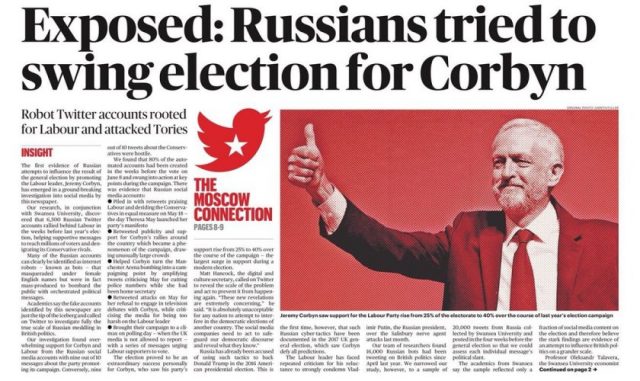
Headline in the Sunday Times, April 29 2018
This is the most predictable headline I have ever seen. It’s more predictable than sunrise or the tides or the waning moon. It was destined from the moment of his first leadership victory. And Corbyn has no one to blame but himself.
By allowing the “Russiagate” hysteria to blossom without challenge, by allowing the memes of “dirty Russian money” in London, and the “Russian influence” of the Brexit vote to go unchecked, Corbyn has encouraged the climate where people can be “denounced” in true McCarthyite fashion. And now he is paying the price.
Corbyn seems to think a few little compromises will get him accepted in the mainstream media. It pains me to say it, but this is fundamentally untrue. You can’t compromise with someone who wants nothing but your total destruction. Hopefully Corbyn has learned this lesson by now.
And truth in politics is important, it has power, not simply through its rarity. Corbyn’s power came from telling truths we all knew and no one else was saying, and he has undermined it by allowing convenient lies to stand.
You can’t build a greater truth on a foundation of small, convenient lies. When a person tells a lie, it is an act of weakness to allow it to stand. Responding “Yes, but”, does nothing but reinforce the initial dishonesty.
You cannot allow the deep state to use their tools in the media to set the narrative. You cannot try to meet them in the middle, because they’ll just use that leverage to pull you further over to their side. A half-truth is just a lie that lacks conviction, and by letting them slide you allow the media to set the width of the Overton window.
Jeremy Corbyn is a good man, his entire career – apparently his entire outlook on life – is built around principle. It’s those principles that got him elected leader and made him so popular. He should not compromise them now, in order to appease people who will never be appeased.
The UK Government’s Skripal Conspiracy Theory – or The Art of Holding a Mass of Contradictory Thoughts in Your Head
By Rob Slane – TheBlogMire – April 30, 2018
The Official Narrative on the poisoning of Sergei and Yulia Skripal is a collection of illogical claims and assertions that cannot be made to fit together, that make no rational sense, and which would require us to hold a mass of contradictory thoughts in our head if we were to accept it. It is in short a conspiracy theory, and a particularly bad one at that.
As I have pointed out before, I am not attempting to counter this conspiracy theory with one of my own. I make no claims to know what happened in the Skripal incident. I am merely stating that the story that the UK Government and media have so far asked the public to believe cannot be true, since it is full of discrepancies and claims that are impossible to reconcile with the known facts.
They are, of course, welcome at any time to show how those contradictions and improbable assertions can be reconciled, but until such time as they advance a compelling and coherent explanation, rational and objective observers shall just have to assume that these contradictions exist for a reason – namely that the official narrative of what happened in the Skripal case is not in fact what really happened in the Skripal case.
So what exactly are those contradictory elements and improbable assertions in the Official Narrative, which place it firmly in the territory of a Very Bad Conspiracy Theory? There are many, but below are 10 of the most obvious:
1. A lethal nerve agent followed by a drink and a meal
The Official Narrative requires you to believe not only that Sergei and Yulia Skripal were poisoned by the military grade nerve agent A-234, a substance which is said to be 5-8 ten times the toxicity of VX nerve agent (which itself has a median lethal dose of 10mg), and the effects of which are said to take place within 30 seconds to two minutes.
… But also that after coming into contact with this substance, they then spent the next four hours wining and dining in the City of Salisbury.
2. A deadly nerve agent without antidote, but where everyone is fine
The Official Narrative requires you not only to believe that Mr and Miss Skripal were poisoned by a deadly nerve agent with no known antidote (according to Gary Aitkenhead, Chief Executive of Porton Down), and for which treatment is “practically impossible”, according to The Handbook of Toxicology of Chemical Warfare Agents.
… But also that just a few weeks later, both were fine and one of them at least was fit to be discharged from hospital.
3. Symptoms that don’t match those produced by the substance allegedly used
The Official Narrative requires you to believe that the Skripals were poisoned by a substance which produces the following symptoms:
“Acetylcholine concentrations then increase at neuromuscular junctions to cause involuntary contraction of all skeletal muscles. This then leads to respiratory and cardiac arrest (as the victim’s heart and diaphragm muscles no longer function normally) and finally death from heart failure or suffocation as copious fluid secretions fill the victim’s lungs.”
… Yet according to witnesses at the bench in The Maltings, Mr Skripal was making “strange hand movements”, “looking up to the sky” and “looking out of it” – symptoms which strongly suggest poisoning by a hallucinogenic, such as BZ or Fentanyl, and not A-234, which tends to produce death, rather than hallucinations.
4. That Salisbury District Hospital mistook the symptoms of military grade nerve agent for opioid poisoning
The Official Narrative requires you to believe that the Skripals were the victims of poisoning by a lethal nerve agent, which produces the symptoms mentioned above, including “involuntary contraction of all skeletal muscles”, “respiratory and cardiac arrest” and “finally death from heart failure or suffocation.”
… Yet it also requires you to believe that Salisbury District Hospital completely mistook the symptoms of nerve agent poisoning for opioid poisoning — even though the symptoms are very different — since on the following day a press release was issued stating that they were treating the pair for exposure to Fentanyl:
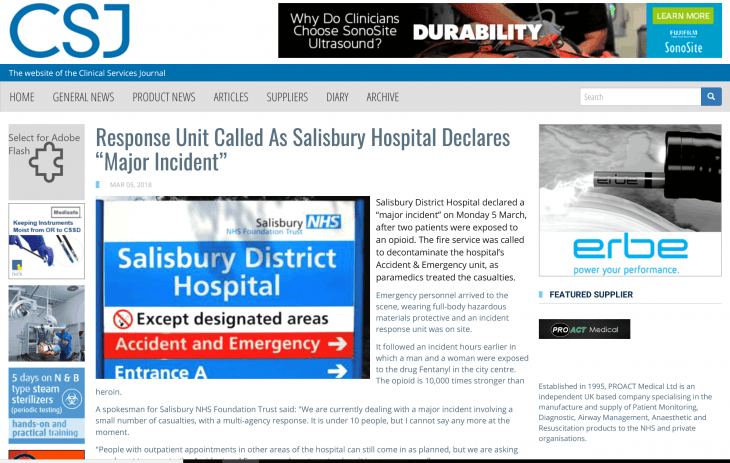
(This, by the way, is extremely interesting. The screen shot above is the original report on the website of Clinical Services Journal, and it can now be found on the website, web.archive.org. The original piece, however, has since been updated on the Clinical Services Journal, not with a correction, but with the reference to Fentanyl being removed altogether (compare here with here h/t Dilyana Gaytandzhiev)
5. A lethal nerve agent that can be dealt with by water and baby wipes
The Official Narrative requires you not only to believe that the substance which poisoned the Skripals is so deadly that Mr Skripal’s house may need to be demolished and a multi-million pound clean-up of Salisbury with chaps in HazMats a necessity.
…But that the same substance can be treated with warm water, soap and baby wipes, as evidenced by the advice given by Public Health England (PHE) a week after the incident, to anyone who may have come into contact with it:
“Wash the clothing that you were wearing in an ordinary washing machine using your regular detergent at the temperature recommended for the clothing. Wipe personal items such as phones, handbags and other electronic items with cleansing or baby wipes and dispose of the wipes in the bin (ordinary domestic waste disposal)… Other items such as jewellery and spectacles which cannot go in the washing machine or be cleaned with cleansing or baby wipes, should be hand washed with warm water and detergent and then rinsed with clean cold water. Please thoroughly wash your hands with soap and water after cleaning any items.”
6. The nerve agent went undetected on a door handle for weeks
The Official Narrative requires you not only to believe that the assassins poured “military grade nerve agent”, in liquid form, on the handle of Mr Skripal’s front door, and that the British Government had possession of an FSB “assassin’s handbook” detailing this procedure.
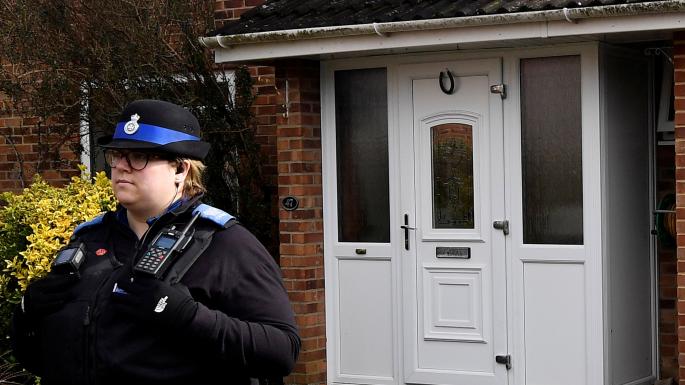
… But that despite apparently having this handbook, the door handle theory was only mentioned more than three weeks after the incident, during which time many people (such as the unsuspecting policewoman at the top of this piece), came within a few feet of a door apparently smeared with lethal nerve agent, with no protective clothing, and suffered no ill effects.
7. The highly volatile nerve agent that was still highly pure weeks later
The Official Narrative requires you not only to believe that the substance examined in blood and environmental samples by the OPCW, weeks after the incident was:
“…of high purity. The latter is concluded from the almost complete absence of impurities.”
… But also that the substance used is known to be both unstable and vulnerable to water – and Salisbury definitely had plenteous rain and even snow between the incident and the coming of the OPCW!
8. That the substance used is proof of Russian state culpability
The Official Narrative requires you to believe that because the substance allegedly used was first developed in Russia (actually Soviet Union), there are only two explanations for the poisoning:
- It was an act of the Russian state
- That the Russian state lost control of its stocks
… Yet it requires you to believe this in the full knowledge that not only have other countries produced it (the United States has been patenting “Novichok” products for years; Iran produced it in 2016; and the United Kingdom possesses samples of it), but according to the chairman of the OPCW, Ahmet Uzumcu, A-234 could be produced:
“…in any country where there would be some chemical expertise.”
9. That the movements of Detective Sergeant Bailey on 4th March cannot be officially confirmed
The Official Narrative requires you to believe not only that Detective Sergeant Nick Bailey, who is a member of Wiltshire Criminal Intelligence Department (CID), was poisoned with the same substance as the Skripals.
…But that his movements cannot be established, since it has still not been officially confirmed whether he was at the bench in The Maltings or at Mr Skripal’s house (and in point of fact, either scenario is remarkably odd, since D.S. Bailey is a member of CID, and there was no suggestion until at least 24 hours after the incident that a crime may have been committed).
10. The cleansing of Salisbury hotspots, but not all Salisbury hotspots
The Official Narrative requires you to believe not only that there are parts of Salisbury that may be contaminated with a lethal substance, and that this will require a clean up operation involving thousands of man hours, costing millions, and taking months to complete.
…But that some of these areas were no danger to the public for a month-and-a-half, when they were cordoned off with nothing more than police tape. In addition, some of the areas that the Skripals were known to have walked down after apparently coming into contact with the substance, such as the Market Walk, have been free to the public to walk through since the start of the incident and remain completely open (I know this personally, because as a Salisbury resident, I have walked through the Market Walk in the last few days).
* * *
Put all these things together — and this is not to even mention the current condition and whereabouts of the Skripals — and what you have is a theory in which claims are flatly contradicted by basic facts, many so-called facts are simply not facts at all, and assertions are made without any recourse to the reality on the ground. It is abundantly clear that the Official Narrative not only did not happen; it cannot have happened. As things stand it is “highly likely” that what we have been told is a conspiracy theory of “high purity”, “of a type developed by Whitehall.”
Sunday Times ‘explosive’ report on Russian bot support for Corbyn is really a complete dud
RT | April 29, 2018
Just when you thought we’d hit peak ‘Russian meddling’ claims, there’s a whole new fear-mongering report in town. The Sunday Times has released an ‘investigation’ linking a pesky Russian bot army with Labour’s June election gains.
Heaven forbid British voters may have been swayed by a lack of leadership by the Tories…
The Sunday Times exclusive, but apparently not in-depth, joint investigation with Swansea University claims that 6,500 ‘Russian’ Twitter accounts sent messages of support for the British Labour Party in the seven weeks before last year’s snap general election, sharing “mass-produced” and “orchestrated” political messages.
Given that politicians and multi-billion dollar corporations spend exorbitant amounts of money trying to influence public opinion, it’s extremely hard to imagine how recently-created, thinly-veiled bot accounts could possibly garner enough of a following to somehow influence millions of voters across the UK within mere weeks. That logic didn’t stop the Times, though.
Among the handpicked accounts sampled in the study, nine out of 10 messages were in support of the Labour party while 9 out of 10 messages mentioning the Conservative party were critical. In addition, some 80 percent of the “automated accounts” were created in the weeks prior to the June, 2017 general election. Notably, the list of Twitter accounts ‘studied’ by the paper and university have not been released, nor have they outlined just how many followers (which is generally a good barometer of the potential reach of a tweet) the accounts had.
Here we go again…
The ‘revelations’ fall neatly in line with the ongoing scapegoat narrative across the mainstream media: Russia is supposedly influencing everything from the 2016 US presidential election to the Brexit vote to potentially meddling in the German elections and the Catalonian independence referendum. While time and time again the narrative fails due to blatant lack of evidence, it is seemingly irresistible to Western MSM and politicians alike.
Just this week, the US House Intelligence Committee “found no evidence that the Trump campaign colluded, coordinated, or conspired with the Russian government.” Yet the narrative persists.
The timing of publication for the Sunday Times report is also rather conspicuous given Labour’s reported lead over the Conservatives heading into next week’s local elections, as noted online.
How they ‘cracked the case’
According to the Sunday Times, academics at Swansea University helpfully identified the accounts and tweets for the investigation. One of the academics has been fielding questions online regarding the study’s curious methodology.
Interestingly, while Talavera lists his location as ‘South West, England,’ he does also have European, British, and Ukrainian flag emojis on his public Twitter profile. Using his own methodology, though – that language or national identity immediately equate to political bias – one could attribute his account to any number of foreign actors who might seek to influence elections in Britain.
He also doesn’t acknowledge that Twitter users can set their own locations, nor does he address a claim in the Times that “many of our Russian bot accounts gave American states as their location.”
The economics lecturer is one of the co-founders of Vox Ukraine, “an independent analytical platform founded in 2014, after the Revolution of Dignity, by a team of highly experienced economists and lawyers based in Ukraine and abroad.”
Meanwhile, Swansea University boasts a Hillary Clinton PhD scholarship – but the Times doesn’t note any potential conflict of interest there or any potential for influence peddling via ‘academic research.’
Those beastly bots
Hundreds of the bot accounts were reportedly created simultaneously and “displayed clear identifying factors.” One common distinguishing feature among the accounts was that they used “15-character alphanumeric usernames” (as is the case with almost all Twitter users) and “with a false western woman’s name attached.” What differentiates these accounts, apparently, is that they listed their first language as Russian.
The Times also claimed that hundreds of the accounts were set up simultaneously despite Twitter only displaying the month and year in which the account was created, not the specific day. Perhaps all of the accounts synchronized their first tweets (or retweets, as seems to be the case in a lot of the examples cited by The Times ), though the analysis does not explicitly state this. In addition, Twitter’s Application Programming Interface (API) is closed to the public, meaning it would be incredibly difficult, or nigh on impossible, for researchers to gain access to the metadata for thousands of accounts, Russian bot or otherwise.
Furthermore, the bot accounts were reportedly later suspended by Twitter’s moderators or voluntarily shut themselves down, presumably after some sort of bot existential crisis. We say ‘reportedly,’ as apparently the researchers didn’t go back and check.
What about causation vs correlation?
The accounts apparently retweeted pro-Labour and anti-Tory messages on May 18, when Theresa May announced the Conservative manifesto. In particular, according to the Times, the bots retweeted Corbyn campaign publicity, particularly around rallies which drew “unusually large crowds.” Crucially, The Times’ analysis doesn’t quite delve into how there’s causation (as it implies) rather than correlation between retweets and participant numbers growing at rallies.
Swansea researchers claimed that 16,000 “Russian bots” had been tweeting about British politics since last April. However, they decided to narrow their focus to a sample of just 6,500 accounts and 20,000 individual tweets posted by that selection in the four weeks before the UK General election, based on an apparently ad hoc list of criteria.
The Times also concludes that Labour “won the social media war” because of greater shares online despite the fact that the Conservatives outspent Labour on Facebook advertisements, not to mention that this study was focused solely on Twitter.
Two tweets to break democracy? Incredible claim in House report on ‘Russian meddling’
By Nebojsa Malic | RT | April 28, 2018
Though the House Intelligence Committee report exonerated President Donald Trump of ‘collusion’ with Russia, it still accused Moscow, and RT specifically, of meddling in the 2016 US presidential election.
The report released on Friday says the committee “found no evidence that the Trump campaign colluded, coordinated, or conspired with the Russian government,” but it accepted the US intelligence community’s claims from the January 2017 report that said Russia used ‘active measures’ to meddle in the elections.
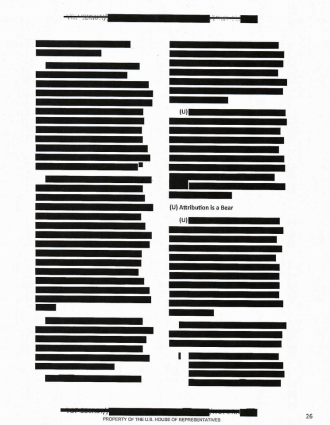 How did that happen? That’s classified. Much of Chapter two, suggestively titled ‘Russia attacks the United States,’ was entirely redacted at the request of the US intelligence community, according to Rep. Mike Conaway (R-Texas). The few tidbits that the public was allowed to see defined spear phishing and credential harvesting and admitted that “attribution is a bear.”
The report then goes full tinfoil hat, claiming that WikiLeaks is a Russian intelligence outlet and accusing RT of serving some dark agenda of the Kremlin. According to the US spy community, RT produces content which appeals to “skeptics of both the mainstream media and the establishment.” Points for honesty on that, Langley, that is literally what “Question More” means.
During the election campaign, the report says (see page 32), RT engaged in “wide-ranging” attacks on Hillary Clinton, “including the insinuation that the Clinton family were criminals,” and “used advertising to promote material leaked by Russian intelligence.” To illustrate this point, the committee offered screenshots of two promoted RT tweets.
You read right. Two tweets. Which, if the screenshots can be trusted, got but a handful of retweets and even fewer replies.
“We spent $30 for two tweets, and those two tweets destroyed their democracy,” RT’s editor-in-chief Margarita Simonyan quipped on Twitter, summarizing the report. “And we criticized both Hillary and Trump, but Hillary more often. And that’s offensive.”
Understandable bewilderment aside, let’s look at the two stories in question. The first one was a five-point listicle about affairs, such as Whitewater, Travelgate, Benghazi and Hillary’s emails – all of which have been reported on by the mainstream US media. In each instance, the Clintons were not charged. Did the headline read a bit like Fox News? Sure. Was it also true? Yes.
The second promoted tweet was on a Sunday before the election, reporting about the 33rd batch of emails from Clinton campaign chair John Podesta’s personal account, which were being released by WikiLeaks. And no, RT did not get advance warning on any of the drops, despite some serious tinfoil-ruffling by various US media and Clinton campaign officials. We just watched out for them very hard, because that’s journalism.
That particular batch of emails contained no bombshells, though. One message accused Chelsea Clinton of using her parents’ foundation funds for her wedding. Another included Hillary’s aide Philippe Reines urging staff not to joke about the private server emails, “because email retention = Benghazi.”
Then there was a 2008 message addressed to Podesta, David Brock of Media Matters and Tom Matzzie of MoveOn.org, saying that Arianna Huffington was “enthusiastic” about Progressive Media USA, but that it would be more useful if HuffPo would “echo our message without any perceived conflicts.”
Yet Congress would have you believe that RT promoting these two stories to the tune of $30 (and getting very little for the money) somehow broke American democracy.
To get away from that sort of heat, ahead of facing the committee in October 2017, Twitter announced that it would “off-board” all RT advertising. The company neglected to mention it was Twitter that pitched an election-related advertising campaign to RT, or that RT declined the offer.
Oops.
Western media silent as Rodchenkov’s Russian doping claims fail to stand up in court
RT | April 28, 2018
Russian officials plan to sue Grigory Rodchenkov, whose testimony played a key part in the country’s Olympic bans, after a sports court rejected his claims. But most believe it’s too late to reverse the impact of the doping saga.
The scandal over Olympic doping has been running since 2014, and most of the allegations have been known for years. What’s changed?
In a landmark ruling in February, the Court of Arbitration for Sport (CAS), the highest legal authority in such cases, reversed the life bans of 28 Russian sportsmen and gave them back their medals, many of them from the Sochi Olympics in 2014.
But it was only this week that a 160-page summary of the session exposed exactly how the allegations that led to the exclusion of entire Russian teams in various sports from Rio 2016 and PyeongChang 2018 failed to stand up to legal scrutiny.
Who failed to convince?
Between 2005 and 2015, Grigory Rodchenkov headed Moscow’s anti-doping testing lab before resigning in the wake of the scandal and eloping to the US, where his words laid the foundation for the portrayal of “state-sponsored” doping in Russia involving athletes, coaches, and officials at all levels. He remains in an American witness protection program and testified via Skype “behind a screen, which concealed the entirety of his upper body save for his forearms and hands” according to CAS.
He maintained that there was a “Sochi plan” designed to pump Russian athletes with performance-enhancing drugs and then swap any contaminated samples for pre-stored urine during the 2014 Games. He also described that he was the inventor of the Duchess Cocktail, a powerful mix of PEDs allegedly distributed to a list of Russian athletes. Many were later excluded from competing on the basis of the Duchess list.
However, when cross-examined, Rodchenkov admitted that he “never: (a) distributed the Duchess Cocktail; (b) seen an athlete take the Duchess Cocktail; (c) witnessed instructions being given to athletes and coaches to use the Duchess Cocktail; (d) seen an athlete give a clean urine sample; or (e) seen an athlete tamper with a doping sample.” He also admitted that no test of the effectiveness of the Duchess cocktail was ever conducted, and when asked about its exact make-up, which has been a matter of some contention, he “stated that he needed five minutes to explain, and therefore refrained from doing so.”
He also repeated claims that a team of officials, nicknamed “Magicians,” had developed a technique for opening tamper-proof sample bottles in order to manipulate them and clear Russian athletes, but added that he personally “never observed first hand any bottles being opened or de-capped” and did not know the “precise method” used by them.
How did the panel respond to Rodchenkov?
The exiled official turned out to be a star witness for the Russian appellants in the case. In its conclusion, it said that his assertion of the guilt of Alexander Legkov, the Sochi gold-winning skier who led the appeal, constituted a “bare assertion which is uncorroborated by any contemporaneous documentary evidence.” On the use of Duchess by a specific athlete, which a specific official reportedly told Rodchenkov about, the panel ruled that it is “hearsay” of “very limited” value. As to his claims of a Sochi plan, ahead of which clean urine samples were delivered to him, CAS stated that the witness’s words were “not corroborated by any further evidence.”
Which other testimony casts doubt on the accusations against Russian athletes?
Richard McLaren, the former head of WADA and author of the eponymous report, whose list of names were used to ban hundreds of competitors, freely admitted that their inclusion did not “mean that they committed an anti-doping rule violation,” and that he was “merely asked to identify those who may have benefited from the systems.” The Canadian professor added that his report was, in any case, “just the starting point for further work” and was severely restricted by budgetary and time constraints.
In view of questions over Rodchenkov, McLaren was asked if his report was, in essence, based on his single testimony. The expert objected, saying that he sought to “corroborate everything” and explained that the Russian scientist’s evidence had been confirmed by “four individuals who provided information on condition that their identities would remain confidential.”
What effect has the publication of the court documents had in Russia?
An outburst of righteous fury.
“Rodchenkov has done his dark deed. We have suffered colossal damage,” said renowned skater and coach Irina Rodnina, one of those namechecked in the fugitive’s accusations. “Since these claims have surfaced we have tried to play by the rules against those without rules.”
“Rodchenkov lied about doping in our country, which was to be proved. I recommend that a commission is assembled that would gather all false publications about Russian athletes in the Western media, and sue them for defamation,” tweeted Igor Lebedev, the deputy chairman of the Russian Duma.
“It’s clear Rodchenkov is mixing up his stories, and his new testimony is evidence that the previous ones were fabrications,” said Dmitry Peskov, Vladimir Putin’s press secretary.
What has been the reaction in the West?
A polite silence. Aside from specialist websites writing about Olympic sport, no major Western outlet has covered the story.
This is particularly telling in view of the fact that the entire doping scandal was not started by investigators, but German documentary makers from ARD, who managed to create the biggest Olympics upheaval since the fall of the Soviet Union with the help of little more than interviews with two other runaway Russian insiders, the Stepanovs.
Since then, there has been a consistent barrage of accusations, all of them reported without question within the wider context of Moscow’s new image of an international rogue state, from Crimea to the US voting booths to the running track.
Just a fortnight ago, Rodchenkov gave an interview to a Norwegian TV station wearing a ski mask and a balaclava, and his words were spread verbatim by dozens of outlets from the New York Times to Fox News.
Only last month, hundreds of millions around the world tuned in to watch Icarus, a film in which he was portrayed as a heroic whistleblower, which won an Oscar for Best Documentary.
The officials have been similarly reticent.
When the original ruling was published, IOC chief Thomas Bach stepped in to say that it was “extremely disappointing and surprising” and demanded that CAS reform itself.
Meanwhile, the American anti-doping agency USADA, which earlier said that the February ruling had “sabotaged the integrity of the Games” despite not being at the CAS hearing and added that “the whole mess stinks” and that “the nightmare for clean athletes continues,” has not been quick to retract its statements or turn away from Rodchenkov.
In any case, Russia’s anti-doping agency remains under suspension, without accreditation to enter its own testing centers, and although the country will be allowed to compete under its own flag at Tokyo 2020, several of its teams will have limited allocations.
What about the athletes whose names have been cleared?
Legkov told Russian television how he felt when he was forced to miss the Olympics this year despite being cleared, because the IOC chose not to invite any athletes whose names had been linked to doping scandals, regardless of guilt.
“I was preparing for Pyeongchang like a madman, I give it my all. I had better results in tests than even those ahead of Sochi. In a moment all that was ruined,” said the skier.
“No one was listening to us. We insisted on our innocence right from the start. But we lost those years of our careers. We trained our whole lives to be able to do this,” Maxim Vylegzhanin, who won three silver medals at Sochi and had them restored by the same decision this year, told RT.
What next?
Foreign Minister Sergey Lavrov says that Russia “defend[s] clean athletes,” while former sports minister and hockey legend Viacheslav Fetisov said that “now we have a chance of winning our cases in court,” as long as “there is a firm position, and facts to back it up.” The Russian Luge Federation and several individuals say that they will launch lawsuits, which may mention Rodchenkov by name.
“It’s evident that McLaren just took Rodchenkov’s words at face value. The CAS decision confirms that now. The guilt of the athletes, if it was present, should have been determined with evidence. This did not happen. We await more legal proceedings,” said Sports Minister Pavel Kolobkov.
But several top officials say it is too little, too late, not just for those sportspeople who missed the last Olympics, but for Russian sports as a whole.
“This will change nothing,” said Nikolay Durmanov, the ex-chief of the Russian anti-doping agency. “Yes we can enjoy some moral satisfaction, but in the eyes of the world Russian sport has been painted a rich black color, and there is nothing we can do to wash that reputational stain off this generation. This was an information war waged against us.”
US Authorities Combing Through Residence of Russian Consul General in Seattle
Sputnik – 26.04.2018
SEATTLE – US authorities are combing through the premises of the seized Russian Consul General residence in Seattle, and regular police officers have been removed from the site, a Sputnik correspondent reported on Thursday.
The officials, wearing plain clothes, were seen moving in and out of the shuttered residence and walking around the outside of the property.
One vehicle is parked on the premises, while another is parked outside behind the building.
Throughout the day, several vehicles arrived and departed from the residence, as various authorities arrived to tour the property. It was unclear exactly exactly what they were doing.
Three police officers who were stationed at the residence’s gates on Wednesday — two at the front and one at the back — have been removed, and no law enforcement officers are currently on the site.
The Russian flag continues to fly over the building.
For the first time since Russian diplomats left Seattle on Tuesday, a trash truck came to pick up rubbish from the neighborhood dumpsters, including from one located outside the residence.
The dumpsters have been attracting local journalists, who were seen examining garbage bags left behind by the Russian diplomats. Many posted pictures of their finds on social media, detailing the contents of the trash, which included shredded paper and leftover food.
On Wednesday, US officials came to the closed residence of the Russian Consul General in Seattle, opened the gates and entered the building after breaking all the locks. Commenting on the move, US State Department spokeswoman Heather Nauert said on Twitter that it was not intrusion but a legal action in response to “Russia’s continuing, outrageous behavior.” The diplomat added that the US officials entered the residence to ensure that it had been cleared.
Russian Foreign Ministry’s spokeswoman Maria Zakharova said on Thursday that Washington grossly violated international legal norms at the residence and called the actions surrounding the seizure of the property “outrageous and unprecedented.”
Zakharova reiterated that Moscow insists on the return of all six diplomatic facilities “illegally seized by the US authorities” over the last two years.
The diplomat added that if the incident had been caused by legal issues, then the United States should provide the details of the law that was used to justify the seizure of the Russian property.
A representative of the Russian ministry warned that if the United States considers its actions at the residence of the Russian Consul General a “lawful response,” then maybe Russian officials should also “visit” their US partners.
On March 26, US President Donald Trump ordered the expulsion of 60 Russian diplomats and the closure of the Russian Consulate in Seattle by April 2 over claims that Moscow played a role in the poisoning of an ex-spy in Salisbury, allegations which Russia strongly denies.
Never Let Anyone Call You Crazy For Doubting Establishment War Narratives

By Caitlyn Johnstone | April 25, 2018
There has still been no retraction or correction of The Guardian‘s demonstrably false and completely indefensible claim that two normal antiwar Twitter accounts were controlled not by real people but by bot programs based in Russia.
This is the sort of environment that has been created by the ongoing Russia panic that is plaguing the western world: one wherein mainstream news outlets can openly lie about dissenting voices and antiwar activists, refuse to retract or apologize for those lies, and suffer no consequences.
And yet they still have the gall to paint anyone who expresses doubt about the narratives they advance about Russia and Syria as crazy, kooky conspiracy theorists. Google the words “conspiracy” and “Syria” right now and you’ll come up with countless editorials with headlines like “Syria war: The online activists pushing conspiracy theories,” “Disinformation and Conspiracy Trolling in the Wake of the Syrian Chemical Attack,” and “SYRIA GAS ATTACK CONSPIRACY THEORIES FUELED BY TUCKER CARLSON AND FAR-RIGHT FRINGE.”
They’re using the highly stigmatized label “conspiracy theories” to paint healthy, normal skepticism of a notoriously untrustworthy power establishment as mentally unsound paranoia.
The other day I wrote an article about the shocking number of blatant attack editorials the mass media machine has been churning out on anyone who questions the establishment Syria narrative, and that output has not slowed down since. Warmongering empire loyalists like senior Huffington Post editor Chris York have been hard at work making sure the output of McCarthyite smear pieces remains on rapid fire, accusing anyone advocating skepticism of the same establishment which lied us into Iraq and Libya of being a tinfoil hat-wearing nut job.
This fits an established pattern which we have discussed previously, wherein proponents of US-led military intervention accuse those who question their narratives of being mentally unsound. There is a word for the tactic of convincing someone that they are crazy in order to manipulate and control them, and that word is gaslighting. It is a textbook abuse tactic, and it isn’t okay.
It isn’t okay for these war whore pundits to bully and deceive us so that we will feel unsure of the basis for our skepticism and consent to the longstanding western agenda of regime change in Syria. It isn’t okay for them to try to make people unsure of their mental health in order to pave the way toward public consent for broader bombing campaigns and no-fly zones in a sovereign nation under assault by western-backed jihadists. Never let anyone bully you into thinking that you are the strange, weird outlier for suspecting that a western empire who has sponsored actual, literal terrorist factions in Syria might lie about Iraq’s next-door neighbor like they lied about Iraq.
Doubting the official narrative being advanced by mainstream media is the sanest thing in the world. The US-centralized power establishment has an extensive and well-documented history of using lies, propaganda and false flags to manufacture public support for preexisting war agendas, so it is perfectly sane to express concern about the legitimacy of the stories we’re being told about Douma, the Skripal case, Russian hacking allegations etc. We’ve already got The Guardian lying unapologetically straight to our face right now about Russian bots while not one single mainstream editorial opposed the British, French and American bombing of Syria earlier this month, so it’s obviously very sane to think the mainstream media may be advancing the interests of this war like they do every other.
Intense, rigorous skepticism is the only sane response to these narratives we’re being pummeled with day in and day out, and they’re trying to make us believe that the exact opposite is true.
Ian Shilling, one of the two Twitter account owners falsely labeled a Russian bot by The Guardian, appeared on Sky News a few days ago to defend himself and debunk the claims made about him. It was a truly brilliant appearance, and despite the open hostility showed him by the two Murdoch muppets hosting the show he was able not just to defend himself but to use the space to attack the warmongering neoconservative agendas being advanced by the UK government. As a representative of the many many regular flesh-and-blood humans on Twitter who are routinely dismissed as “Russian bots” simply for questioning establishment narratives, Ian knocked it out of the park and then some. He not only proved his humanity, he proved his sanity.
With the benefit of hindsight and not having been the one in the crosshairs, however, there was one part I thought could be handled a little differently. At one point in the interview, Shilling was articulating exactly why it would make no sense for Assad to have used chemical weapons in Douma as he is accused of having done, and one of the Sky News hosts demanded to know “Well if not, who then?”
Shilling provided the entirely reasonable speculation that it would have been the terrorists occupying the area who had every incentive to stage such an attack, but in my opinion it isn’t necessary to even go that far. The burden of proof is on the party making the claim; it isn’t up to us to flesh out a positive narrative about what happened using the limited information and resources afforded to bloggers and tweeters, it’s up to the massive western power establishment to provide the kind of proof of their accusations that is required in a post-Iraq invasion world. This plainly has not happened.
You see this sneaky attempt to shift the burden of proof among empire loyalists all the time when debating such topics. A couple of months ago I wrote about how in a debate with Real News‘ Aaron Maté, John Feffer of Lobelog used the tactic of arguing that his belief in the still-unproven Russian hacking accusations arises from the absence of a better “counter-narrative” about what happened, the implication being that we should take the US intelligence community at their word unless presented with a more compelling case for what happened from somewhere else. We also saw it in the BBC’s recent interview of Lord West, whose skepticism of the establishment Douma narrative was met with protestations that he didn’t have any solid proof of anything else having happened than what we’ve been told by the western war machine.
Don’t let them shift the burden of proof like that. We can point out, in the case of Douma for example, that the area was crawling with known terrorists who had every incentive to stage such an attack and gain the benefit of the western empire’s air force bombing their sworn enemy over a crossed “red line”, but we should also point out that it isn’t our job to come up with a positive counter-narrative about what happened. The burden of proof is on the accuser, so it’s their job to present us with a very solid collection of evidence that the alleged chemical attack could only have been perpetrated by the Assad government. Until then, our position that these people lied to us about Libya and Iraq and have a longstanding agenda of regime change in Syria is sufficient to declare decisive victory in any debate.
Don’t let them shift the burden of proof, and don’t let them gaslight you. You have truth on your side, and their side has a whole, whole lot of work to do before they have enough substantial evidence to even debate you rationally. They use these deceitful tactics because they are losing the debate, and because war is very profitable and advantageous for a few very powerful individuals. That’s all that’s happening here.
Whether it’s Russiagate, Skripal or Syria, the Media Have Lost Their Grip on Reality
Despite a series of collapsing mainstream narratives, the establishment can’t help but doubling (and tripling) down on their official conspiracy theories.
By Paul Mansfield | 21st Century Wire | April 26, 2018
The “Blame Russia” for absolutely everything world we currently occupy has reached a point almost beyond return and is scaling heights that would turn Joseph McCarthy green with envy. Whether it is internally produced political turmoil and scandal, or because of generally reckless and failed foreign policy endeavours, the US and UK governments are more wiling than ever to pin the blame on Russia without fail.
The instant blame on Russia for the poisoning of Sergei and Yulia Skripal, or “highly likely it was Russia”, as Theresa May put it, proved grossly premature, graduating onto maybe not so likely at all – thanks to dedicated alt media and social media researchers and activists uncovering the development of Novichoks in multiple countries, making it entirely plausible that some country other than Russia may be responsible for the improbable Salisbury event.
No sooner did the Skripal Affair wind up, than another supposed ‘chemical attack’ unfolded, this time in Syria, where an alleged chemical weapons airstrike was said to have taken place in Douma on 7 April. Accounts of this incident were reliant entirely for its evidence on two dubious sources, the US and UK-backed White Helmets and the Syrian American Medical Society (SAMS). It didn’t take long before the official story started springing leaks though. The hilarity of seeing chlorine cylinders laying on a bed, rather than smashing through it, numerous witness statements there was no chemical attack, the testimony of over a dozen medical personnel at the medical centre concerned that the White Helmets caused a panic by shouting chemical attack when there was none and the interview of 11 year old Hassan Diab, who was not a chemical weapon victim, but certainly was a victim of an unwarranted drenching as part of a staged event, have all demolished yet another false flag instigated by western intelligence agencies and their White Helmets operatives. All this was irrelevant however to the criminal Troika, the US, UK and France, who bypassed the United Nations and bombed Syria in the early hours of 14 April, provoking Russia into an instant reaction which never came.
Some are of the opinion that the Troika and Russia reached an agreement beforehand and so therefore there was never the threat of outbreak of conflict which could escalate to a catastrophic WWIII.
Here is the White Helmets ‘hose-down’ video which triggered a western military intervention:
Faced with rapidly dwindling legitimacy and credibility, the UK government in particular set their attack dogs in the mainstream media on to alt media and social media activists. The result is a coordinated and intensive smear campaign against independent journalists, academics and social media activists with large followings. The gutter press of the UK have demonstrated that in terms of propaganda and disinformation, they are without peer. US media Russophobes almost look like babes in the woods in comparison.
What we are witnessing is a war on truth, vicious intimidation of dissenting voices, the negating of fierce independent voices as Russian puppets and bots and Assad apologists, and ad hominem attacks all designed to shut down a powerful narrative which shines a light on the warmongering narrative propagated by the mainstream media.
The campaign reached a level of absurdity beyond comprehension when Twitter activist @Ian56789 was asked by Sky News hosts if he was a bot as he was being interviewed live on air!

As disinformation against Russia soars off the fake news Richter Scale and independent journalists and activists are being personally targeted, one only has to revisit the recent Devon Nunes Memo story as an example of a real domestic US political scandal which the derelict US mainstream media attempted to transform into yet another Russian disinformation campaign.
You would have to be living under a rock to not know of the salacious, but unverified dossier on US President Donald Trump, which purportedly started out as a piece of opposition research during the 2016 election campaign, but quickly became the driving force behind allegations that Trump colluded with the Russian government in order to win the presidential election. In the mind of many a deep state adoring Democrat and mainstream media journalist, it is beyond dispute that Trump colluded with Russia. The major questions are how extensive the collusion was and does it amount to having committed federal crimes. To answer these questions, the Mueller investigation must continue expanding as far and wide as necessary.
Many Republicans believe the widely ridiculed and discredited dossier prepared by a former British spy, Christopher Steele, was the catalyst for the FBI decision to investigate allegations of Trump campaign collusion with Russia. A mocked and debunked dossier, which looked like it was concocted in a teenagers bedroom bought down on CNN and Buzzfeed a truck load of embarrassment when they decided to run with a story other media outlets balked at.
So how did it transform into such a vital document that initiated the Mueller probe into suspected Trump collusion with Russia?
We have had the mainstream media pumping this story 24/7. They will not let it go, determined that it bring about the downfall of Donald Trump. By gleefully accepting any lead from their highly coveted ‘sources’, the MSM begs to be subverted by the intelligence community, thereby subverting any prospect of a properly functioning US democracy and informed citizenry.
However, the revelations of #ReleaseTheMemo which alleged shocking FISA abuses by the FBI has raised the spectre of another alleged collusion; the FBI and the Obama DOJ colluding against Trump. The major accusation is that the FBI hid from the FISA court judge the fact that it was heavily relying on the dodgy Trump Dossier to obtain a surveillance warrant to spy on Trump, the man who was to become the future President. What is even more explosive is that it was not revealed to the judge that the Democratic National Committee and Hillary Clinton’s presidential campaign paid for the dossier. Dirty partisan politics has gone a step too far in this sordid affair, with the DNC and FBI duping the FISA court into unwittingly assisting them in their campaign against Trump.

And let’s be clear here; this is the work of the Obama administration and any rigorous investigation would pursue whether or not the collusion against Trump went all the way to former president Obama himself.
Republicans were outraged and demanded the release of the memo.
This is hardly a surprise, being shocked and alarmed at possible internal interference in the election by US intelligence agencies, the very agencies that told us it was Russia that undermined US democracy by its electoral interference.
It is crucial to grasp the fact that this affair is a case of internal interference in the election campaign and has generated intense reaction within the US political establishment and among many in the general public.
One may question then the spin the Hamilton 68 propaganda organ placed on the interest whipped up by the memo. It attempted to reframe calls to release the memo as yet another so-called Russian influence operation, using trolls and bots to amplify the message across cyberspace.
‘Hamilton 68’ doesn’t track propaganda. It is propaganda. Its “Council”? Stuffed with Bill Kristol, Michael Chertoff, Mike Morell, etc. Its funding? Opaque (see its 990s). Its methodology? Unfalsifiable–Twitter users put on ad-hoc secret lists based on political view. Appalling.
— Julian Assange ⌛ (@JulianAssange) January 19, 2018
Hamilton 68, a banal and comical operation, is projecting on to Russia the very thing it is doing itself; spreading disinformation aimed at undermining and destabilizing Russia, but also the US political system. On the strength of CNN’s dumpster diving, Hamilton 68 likes to tell us all about how the cryptic ‘Internet Research Agency’ in St. Petersburg is one big giant troll factory. Sorry, Hamilton 68, but you are one big NATO/Deep state cyberspace troll factory yourselves.
The Democratic Party Russophobia icons, Dianne Feinstein and Adam Schiff, quickly took the opportunity to deflect from the emerging memo scandal, pulling out the playbook of Russian subversion through social media for the umpteenth time. Quite comfortable with the fact that they have secured the social media giants as appendages of the US deep state, Feinstein and Schiff wrote to Twitter and Facebook asking them to investigate what they claimed are Russian bots spreading the #ReleaseTheMemo hashtag. The letter reads in part:
“… Several Twitter hashtags, including #ReleaseTheMemo, calling for release of these talking points attacking the Mueller investigation were born in the hours after the Committee vote. According to the German Marshall Fund’s Alliance for Securing Democracy, this effort gained the immediate attention and assistance of social media accounts linked to Russian influence operations. By Friday, January 19, 2018, the #ReleaseTheMemo hashtag was “the top trending hashtag among Twitter accounts believed to be operated by Kremlin-linked groups.” Its use had “increased by 286,700 percent” and was being used “100 times more than any other hashtag” by accounts linked to Russian influence campaigns. These accounts are also promoting an offer by WikiLeaks to pay up to $1 million to anyone who leaks this classified partisan memo.
If these reports are accurate, we are witnessing an ongoing attack by the Russian government through Kremlin-linked social media actors…”
Nice sleight of hand Hamilton 68, Schiff and Feinstein, but this is a scandal that whipped Republicans, not Russians into a frenzy. It is a stand-alone scandal that raised questions about the ethics, partiality and possible illegal acts of the US intelligence community and the Obama DOJ. It does not need any Russian trolls to inflate the gravity of the situation.
Florida Republican Rep. Ron Desantis tweeted, “Yesterday, I viewed a deeply troubling report compiled by House Intelligence that raises questions about Obama DOJ & the so-called collusion investigation.”
Desantis said it right there: collusion between the Obama DOJ and the FBI. If true, it is a shocking indictment on deep state interference in US politics, going all the way to the top in attempting to subvert the US presidential election.
So we have at least 2 allegations of collusion; the longstanding and tiresome Russiagate story, which the mainstream media will not give a moments rest and the newer, but equally shocking FBI/DOJ collusion emerging from the woodworks with the news of the classified memo.
You can read and watch RussiaGate stories in both US/Western MSM and Russian media. Fair enough, it was a big story, newsworthy and deeply concerning if it was true (the US media has overplayed their hand though to put it mildly). As time goes on and without a shred of evidence produced, it is time to put the whole issue to bed and move on. It is only the absurdity of the MSM insistence that collusion has been proved beyond doubt and any who question it are conspiracy theorists, that maintains the interest of the reasonable person, even if only to mock media figures and politicians who are the true conspiracy theorists.
The calls to release the Devon Nunes compiled memo also attracted huge coverage in both US and Russian media. However, US media framed it in terms of a partisan struggle between Democrats and Republicans; detracting from the implications of the abuse of the FISA system and placing the scandal into the realm of normal everyday, if somewhat dirty party politics.
There is nothing everyday about the possibility that this whole Russia investigation is in reality a conspiracy by top FBI officials and the DOJ to sabotage Trump and install Hillary Clinton (remember her?) as president. Look at Peter Strzok and Lisa Page as examples, whose texts made no secret of their contempt for Trump and their desire to see him lose the election.
So why did CNN, the New York Times and the supposedly reputable Business Insider deem it newsworthy to claim Russian influence networks were spreading the release the memo hashtag like wildfire across the social media landscape. Business Insider even implied the Nunes memo has been given wings by being amplified by Russian trolls and bots across the social media landscape.
The compiling of the memo by Republican aides on the House Intelligence Committee that led to the unfolding scandal was not initiated by Russia. The angry calls for action came from Republicans, not Russians.
We can’t even be sure if these so-called Russian networks of trolls are Russian at all. But let’s assume for a minute they are. Big deal if they spread the story. It is fascinating, very interesting and could have huge consequences of DOJ and FBI heads rolling. It also serves to relieve some of the pressure on Russia, so why wouldn’t they promote it heavily. They are merely acting in the interests of Russia, which no reasonable person could complain about.
Many people believe Americans are simply apathetic victims and that these supposed Russian trolls or bots are drowning them in disinformation, and that western media figures and politicians are powerless to stop it. That’s the mainstream’s moderate narrative. However, a look at the number of followers of some US media celebrities on Twitter should dispel that misinformation in a heartbeat. Rachel Maddow, with 9 million followers, retweeted a tweet by NBC reporter Ken Dilanian, a tweet which itself got 6K retweets and 19K likes. His tweet, included, “your #ReleaseTheMemo is the top trending hashtag among the Russian bots and trolls over the last 48 hours, and you might want to ask yourself why.”
So a media figure from NBC is clearly muddying the waters, throwing us a red herring in implying the nefarious hand of Russia is at play. Maddow gave Dilanian huge impetus in his attempt to try to flip the story to turn it into yet another opportunity to attack Russia. Deeply troubling allegations which could rock the foundations of the intelligence and justice communities are made a mockery of by a disreputable journalist who sees it as another chance to Russia bait. Before you know it, they will be telling us the #Memo was a joint venture put together by the FSB and Republicans, thus proving the collusion is still going as strong as ever. This level of hysteria is way beyond Cold War McCarthyism.
And when Rachel Maddow retweets something, how many likes and retweets does that generate. Enough to turn the Russian bots and trolls green (or should that be red) with envy.
Maddow herself is capitalizing very nicely on the Russophobia being generated by the whole Russiagate affair to boost her own ratings and affection within the political establishment. She has not got a single progressive bone in her body and epitomizes the dumbed down, hyped up claims about Russian interference in American political and social life. The spectacle is the theatre of the absurd, as Americans are subjected to Hollywood type entertainment to titillate and shock with the never ending “revelations” which roll out like clockwork. And, true to Hollywood style fiction, the more outrageous and sensational the better.
This is why Maddow is able to get away with calling Jill Stein a Kremlin puppet, and to feign seriousness and solemnity as she continues to call Trump a Putin puppet, putty in his hands, even as Trump has clearly embarked on a path which has plummeted US/Russian relations to their lowest point since the darkest days of the Cold War.

Maddow uses a technique for these claims which may enthrall Never-Trumpers and fill Le Resistance with fear, but it is straight from the neocon playbook. It is that any sign of Trump not being totally committed to overt and outright hostility to Russia proves that he is a Russian puppet. He must adopt the neocon attitude of Russia being the eternal enemy, the biggest threat the US faces and that it must be confronted and made to pay a price for its aggression, expansionist ambitions and meddling in US affairs.
Putin has Trump in a vice like grip with the “compromat” on him, using it to blackmail him in to doing Russia’s bidding according to Maddow. Putin is forcing Trump to declare war on the intelligence community, fomenting chaos in a crowning glory of undermining US national security. How better to leave the US vulnerable to the rapacious desires of Russia than by shattering the institutions of US national security.
Maddow believes Putin blackmailed Trump with the Golden showers tape to hire Paul Manafort as his campaign manager, to hire Rex Tillerson as Secretary of State, and to pressure him to withdraw US forces in Eastern Europe and the Baltics, (which hasn’t happened).
“Is the new President gonna take those troops out? After all the speculation, after all the worry, we are actually about to find out if Russia maybe has something on the new President? We’re about to find out if the new President of our country is going to do what Russia wants once he’s Commander-in-Chief of the US military starting noon on Friday. What is he gonna do with those deployments? Watch this space.”
In Maddows demented mind, anything less than the Trump administration universally standing poised to unsheathe their swords and land a mortal blow on Russia is proof of collusion with the Kremlin. Any conciliatory overtures are met by howls of derision by the Maddow/Hillary Clinton led “resistance.” Amid this red hot rhetoric and witch hunt for internal traitors, Maddow and her ilk are the ones to claim it is Russia sowing discord and discontent.
“This is international warfare against our country,” Maddow said on her show.
Maddow says she goes to bed every night wondering what new Russia scandal awaits the country the next morning, propelling the Russia hysteria all the way to election 2020 and bankrolling her show and career almost exclusively on one issue threadbare of any evidence. The McCarthy of the modern mainstream media some say. It’s Clickbait applied to cable TV you could also say:
“If the presidency is effectively a Russian op, if the American presidency right now is the product of collusion between the Russian intelligence services and an American campaign — I mean, that is so profoundly big, we not only need to stay focused on figuring it out. We need to start preparing for what the consequences are going to be if it proves to be true.”
‘If it proves to be true.’ That’s right, and we’re still waiting for the evidence.

Maddow and her fellow military industrial complex media mouthpieces don’t need evidence to believe Russia interfered in the election, as she spreads her poison to millions of viewers night after night. She sees Vladimir Putin as pure evil, the embodiment of the terrifying KGB and tells her viewers this repeatedly. She has become the torchbearer for an ever wilder conspiracy theory, whipping her audience into a frenzy, baying for Russian blood.
It is extraordinary that anyone listens to a word Maddow says after she produced her only evidence on Trump; his tax return which revealed he paid $38million in federal taxes on more than $150 million in income in 2005. Bombing out big time on alleged Trump tax cheating has clearly not stopped Maddow proceeding full steam ahead in accusing him of being a Kremlin installed puppet.
So who is running an influence campaign here, Moscow, or the US military industrial complex media?
What is never discussed outside of alt-media circles is how far were the FBI, the DOJ, and the Hillary Clinton campaign involved in what is increasingly looking every day more like FBIgate than Russiagate? What about the roles of powerful deep state actors like John Brennan and James Clapper, who are bound to have played a hand in concocting and promoting the official conspiracy theory? Clapper, who thinks it is in Russian DNA to hack things and Brennan who sees Russia as a long term threat intent on attacking US democracy, sternly warning the incoming President Trump not to ignore the huge threat Russia poses.
What was also not overtly acknowledged is that by pressuring for the release of the memo, Devon Nunes and other Republicans actually carried out a duty they were elected to perform; holding the intelligence community accountable. As former CIA analyst Ray McGovern of Consortium News said:
At this point, the $64 question is whether the various congressional oversight committees will remain ensconced in their customarily cozy role as “overlook” committees, or whether they will have the courage to attempt to carry out their Constitutional duty. The latter course would mean confronting a powerful Deep State and its large toolbox of well-practiced retaliatory techniques, including J. Edgar Hoover-style blackmail on steroids, enabled by electronic surveillance of just about everything and everyone. Yes, today’s technology permits blanket collection, and “Collect Everything” has become the motto.
The take-away from all of this is that no sin is too great, and no scandal can’t be flipped to pin the blame on Russia.
Meanwhile, any criminal or unethical conduct of Democrats and deep staters will not be plastered across the newspapers and cyberspace.
Don’t worry about it. Just say its Russian disinformation. Works every time.
Featured Video

Death Spikes & Rising Cancer In Our Youth Explained
or go to
Aletho News Archives – Video-Images
From the Archives
Politicians lie
By Mazin Qumsiyeh | Popular Resistance | August 18, 2013
There is no way to say this truth nicely: Politicians lie. That includes Japanese, American, Egyptian, Israeli, and Palestinian politicians! Is there something more common sense than that? Yet, so many citizens around the world believe their own politicians or wistfully acknowledge lies but think it is part of the job needed to run things. They believe even when politicians contradict themselves blatantly. This phenomenon is rather remarkable. It is a dissonance and disconnect from reality that many seem oblivious to. It is very dangerous because it can lead to accepting rationales for going to war. These can be deadly wars that lead to millions of lives lost as happened in what was called World War 1 and WW2. Even when incredible and declassified evidence abound, politicians continue to lie and old mythologies refuse to die. Here are just a few of the countless lies told to us over the past few decades… continue
Blog Roll
 Aletho News
- Ukrainian Soldiers, Potential Mercenaries: Have Gun, Will Travel!
- Burnham’s UN debut… A masterclass in British disinformation
- Iran flights continue despite US aviation sanctions
- Global Tipping Points Lead the World Into a State of Entropy
- The day-after at the White House: USA and Xi Jinping
- The Geopolitical Balance in the Red Sea: The UAE Being Displaced by New Players
- Iraqi resistance group vows to stage airport sit-ins over Iran aerial blockade
- Turkish parliament to review Saudi-Pakistan defense pact next month
- DEATH SPIKES & RISING CANCER IN OUR YOUTH EXPLAINED
- Iran offers Trump deal before US election
- If Americans Knew
- Deconstructing Netanyahu’s pants-on-fire UN rant – Daily Update
- Trump betrayed voters with his campaign lies and prioritized a foreign country once he took office
- Netanyahu calls Israel’s war in Gaza ‘opposite of genocide’ in UN speech to near-empty hall
- Settler Kidnappings: Torture, Sexual Abuse and Terrorisation of Palestinian Abductees as Israel Deepens Annexation of West Bank
- Gaza winter nears as 162,000 tents become unusable, raising fears of humanitarian crisis
- Netanyahu says, “It’s the opposite of genocide”; UN says Gaza economy is world’s ‘most severe crisis on record’ – Daily Update
- Israel’s US-Backed Assault on Gaza Has Created the ‘World’s Most Severe Economic Crisis on Record’: UN
- ‘Protecting U.S. Citizens’… From Israel
- ‘This is where I live now, the back of a truck’: a day in the life of a grandmother in Gaza
- In UN Speech, Iran’s President Displays Pictures of Children Killed by US, Brings Attention to Israel’s Nuclear Arsenal
- No Tricks Zone
- New Study: Earth And Venus Surface Warmth Largely Explained By Convection And Lapse Rate, Not CO2 Or Radiation
- 2025 Nature Paper Claiming Worsening Global Drought Gets RETRACTED …Heavily Flawed
- New Study: ‘Global Drought Shows No Detectable Recent Acceleration Under Climate Warming’
- Economic Masterminds: German Socialists Suggest Taxing Productivity Gains Stemming From Using AI
- The South China Sea Has Not Been Cooperating With The Climate Change Narrative
- Energy Crisis: Germany Enters Heating Season With Historically Low Gas Reserve Fill Levels
- New Study: The Antarctic Ice Sheet Gained Mass From 2020-2024 Due To Staggering Snow And Ice Accumulation
- Study: Ocean Heating Rates From Thousands Of Years Ago ‘Dwarf’ Modern Ocean Heating Rates
- Climate Extremists Target, Attack Large-Scale Power Grid Infrastructure In Germany!
- New Study: Antarctic Ice Melt Has Contributed Less Than 1 Centimeter To Sea Level Rise In The Last 30 Years

