US violating intl law by breaking into Russian consulate in Seattle – embassy
RT | April 25, 2018
The US government is violating international law with its decision to break into Russia’s locked consulate in Seattle, the Russian embassy in Washington said in a statement.
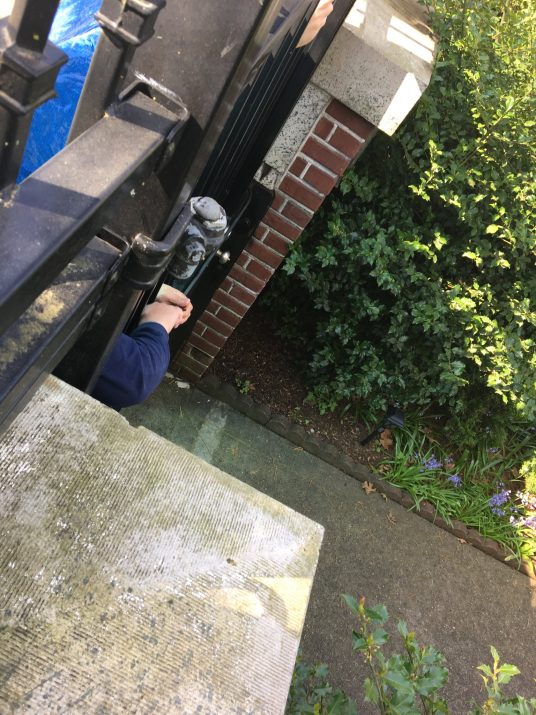
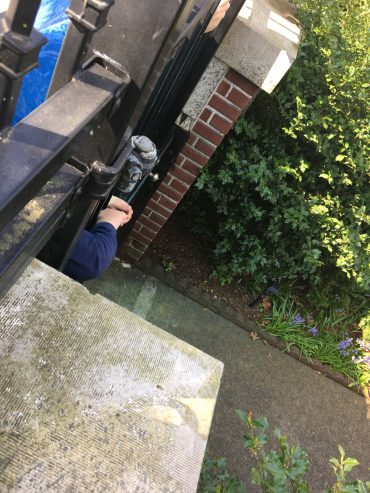 “What we see now is a gross violation of the Convention on Diplomatic Relations and the Convention on Consular Relations,” commented Nikolay Pukalov, the head of the embassy’s consular department. “The Russian side did not agree on stripping diplomatic status from our property in Seattle and did not give permission to American officials to enter our territory.”
The spokesperson for the Russian Foreign Ministry, Maria Zakharova, called the development “a hostile takeover” of the compound by the US.
The diplomatic building was evacuated earlier this week due to an order from Washington, which expelled 60 Russian diplomats and told the embassy to shut down the Seattle consulate in retaliation for the poisoning of a former double agent in Britain.
After the diplomats left on Tuesday, they locked the building. US officials on Wednesday broke into the compound.
Later on Wednesday, US State Department spokeswoman Heather Nauert said that she believes there was nothing unlawful in the actions of the US authorities that broke into the Russian consulate. There was “no ‘invasion,’” she said in a Twitter post as she called Washington’s move “a firm, lawful response to Russia’s continuing outrageous behavior.”
The closure of Russia’s Seattle consulate was the latest in a string of diplomatic mission reductions taken by both sides over the past years. The pretext for this particular expulsion was the British accusation that the Russian government ordered an assassination of a former double agent. London failed to provide any public proof of the allegation and instead launched an international campaign to punish Moscow, finding a most eager participant in Washington.
The US claimed that the 60 diplomats it expelled were Russian spies and that the consulate in Seattle was heavily used for espionage purposes. Similar justifications were used when Washington ordered the shutdown of Russian missions in San Francisco and New York in September 2017.
US authorities break into closed Russian consulate residence in Seattle

RT | April 25, 2018
US authorities broke into the locked residence of the Russian consul-general in Seattle, Washington. The building was evacuated on US orders as part of the mass expulsion of Russian diplomats.
Video from the scene shows State Department personnel in plainclothes entering the yard and attempting to break the lock on the door of the residence. A later attempt appears to have been successful, as a locksmith could be seen opening the door and entering the premises. The Russian flag is still flying over the building.
“US authorities breaking into the consul-general’s residence in Seattle is a gross violation of diplomatic conventions,” the Russian Embassy in the US told RIA Novosti. Russia did not agree to remove diplomatic immunity from the property, and the attempted break-in is an “unfriendly step,” the embassy added.
By breaking into the consulate, the US is “violating international law,” the embassy said.
Consular personnel left the residence on Wednesday evening, in compliance with the deadline given last month by the Trump administration.
The Seattle consulate was ordered to close “due to its proximity to one of our submarine bases and Boeing,” the Trump administration said on March 26, announcing the expulsion of 60 Russian diplomats from the US.
The US acted on the urging of its British ally, with London blaming Moscow for the alleged chemical attack on former double agent Sergei Skripal and his daughter Yulia in Salisbury last month. Canada, Australia and most NATO countries followed suit, resulting in the expulsion of over 150 Russian diplomats altogether. Moscow has retaliated in kind.
Locksmiths hired by the State Department followed the same steps last October, when they broke into the Russian consulate in San Francisco, ordered shut by Trump in an escalating row with Moscow.
Expulsions began in December 2016, when the outgoing President Barack Obama ordered the seizure of two Russian properties in the US and expelled a number of diplomats, claiming Russia had meddled in the US presidential election. Moscow initially declined to retaliate, hoping to mend relations that soured under the Obama administration. However, when the US Congress overwhelmingly voted in favor of new sanctions against Russia in August 2017, Moscow responded by ordering the US diplomatic mission to downsize.
Democrats and much of the US mainstream media continue to insist that Trump “colluded” with Russia during the 2016 campaign, and no amount of “tough on Russia” behavior from the White House has sufficed to change their mind.
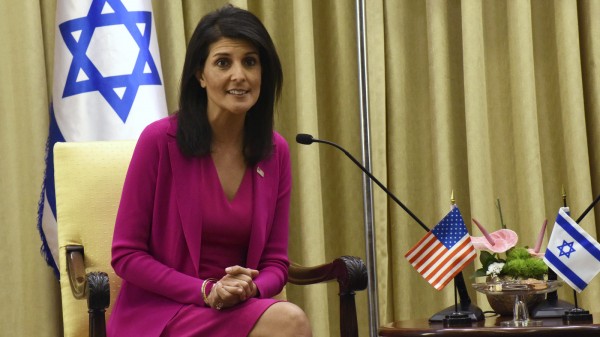
Scarier Than John Bolton?
Think of Nikki Haley for President!
By Philip Giraldi • Unz Review • April 24, 2018
The musical chairs playing out among the senior officials that make up the President Donald Trump White House team would be amusing to watch but for the genuine damage that it is doing to the United States. The lack of any coherence in policy means that the State Department now has diplomats that do not believe in diplomacy and environment agency heads that do not believe in protecting the environment. It also means that well-funded and disciplined lobbies and pressure groups are having a field day, befuddling ignorant administrators with their “fact sheets” and successfully promoting policies that benefit no one but themselves.
In the Trumpean world of all-the-time-stupid, there is, however, one individual who stands out for her complete inability to perceive anything beyond threats of unrelenting violence combined with adherence to policies that have already proven to be catastrophic. That person is our own Ambassador to the United Nations Nikki Haley, who surfaced in the news lately after she unilaterally and evidently prematurely announced sanctions on Russia. When the White House suggested that she might have been “confused” she responded that “With all due respect, I don’t get confused.” This ignited a firestorm among the Trump haters, lauding Haley as a strong and self-confident woman for standing up to the White House male bullies while also suggesting that the hapless Administration had not bothered to inform one of its senior diplomats of a policy change. It also produced a flurry of Haley for higher office tweets based on what was described as her “brilliant riposte” to the president.
One over-the-top bit of effusion from a former Haley aide even suggested that her “deft rebuttal” emphasizes her qualities, enthusing that “What distinguishes her from the star-struck sycophants in the White House is that she understands the intersection of strong leadership and public service, where great things happen” and placing her on what is being promoted as the short list of future presidential candidates.
For sure, neocon barking dog Bill Kristol has for years been promoting Haley for president, a sign that something is up as he was previously the one who “discovered” Sarah Palin. Indeed, the similarities between the two women are readily observable. Neither is very cerebral or much given to make any attempt to understand an adversary’s point of view; both are reflexively aggressive and dismissive when dealing with foreigners and domestic critics; both are passionately anti-Russian and pro-Israeli. And Kristol is not alone in his advocacy. Haley regularly receives praise from Senators like South Carolina’s Lindsey Graham and from the Murdoch media as well as in the opinion pages of National Review and The Weekly Standard.
The greater problem right now is that Nikki Haley is America’s face to the international community, even more than the Secretary of State. She has used her bully pulpit to do just that, i.e. bully, and she is ugly America personified, having apparently decided that something called American Exceptionalism gives her license to say and do whatever she wants at the United Nations. In her mind, the United States can do what it wants globally because it has a God-given right to do so, a viewpoint that doesn’t go down well with many countries that believe that they have a legal and moral right to be left alone and remain exempt from America’s all too frequent military interventions.
Nikki Haley sees things differently, however. During her 15 months at the United Nations she has been instrumental in cutting funding for programs that she disapproves of and has repeatedly threatened military action against countries that disagree with U.S. policies. Most recently, in the wake of the U.S. cruise missile attack against Syria, she announced that the action was potentially only the first step. She declared that Washington was “locked and loaded,” prepared to exercise more lethal military options if Syria and its Russian and Iranian supporters did not cease and desist from the use of chemical weapons. Ironically, the cruise missile attack was carried out even though the White House had no clue as to what had actually happened and it now turns out that the entire story, spread by the terrorist groups in Syria and their mouthpieces, has begun to unravel. Will Nikki Haley apologize? I would suspect that if she doesn’t do confusion she doesn’t do apologies either.
Haley, who had no foreign policy experience of any kind prior to assuming office, relies on a gaggle of neoconservative foreign-policy “experts” to help shape her public utterances, which are often not cleared with the State Department, where she is at least nominally employed. Her speechwriter is Jessica Gavora, who is the wife of the leading neoconservative journalist Jonah Goldberg. Unfortunately, being a neocon mouthpiece makes her particularly dangerous as she is holding a position where she can do bad things. She has been shooting from the lip since she assumed office with only minimal vetting by the Trump Administration, and, as in the recent imbroglio over her “confusion,” it is never quite clear whether she is speaking for herself or for the White House.
Haley has her own foreign policy. She has declared that Russia “is not, will not be our friend” and has lately described the Russians as having their hands covered with the blood of Syrian children. From the start of her time at the U.N., Haley has made it clear that she is neoconservatism personified and she has done nothing since to change that impression. In December 2017 she warned the U.N. that she was “taking names” and threatened retaliation against any country that was so “disrespectful” as to dare to vote against Washington’s disastrous recognition of Jerusalem as Israel’s capital, which she also helped to bring about.
As governor of South Carolina, Haley first became identified as an unquestioning supporter of Israel through her signing of a bill punishing supporters of the nonviolent pro-Palestinian Boycott, Divestment and Sanctions (BDS) movement, the first legislation of its kind on a state level. Immediately upon taking office at the United Nations she complained that “nowhere has the U.N.’s failure been more consistent and more outrageous than in its bias against our close ally Israel” and vowed that the “days of Israel bashing are over.” On a recent visit to Israel, she was feted and honored by Israeli Prime Minister Benjamin Netanyahu. She was also greeted by rounds of applause and cheering when she spoke at the annual meeting of the American Israel Public Affairs Committee (AIPAC) in March, saying “When I come to AIPAC I am with friends.”
Nikki Haley’s embrace of Israeli points of view is unrelenting and serves no American interest. If she were a recruited agent of influence for the Israeli Mossad she could not be more cooperative than she apparently is voluntarily. In February 2017, she blocked the appointment of former Palestinian Prime Minister Salam Fayyad to a diplomatic position at the United Nations because he is a Palestinian. In a congressional hearing she was asked about the decision: “Is it this administration’s position that support for Israel and support for the appointment of a well-qualified individual of Palestinian nationality to an appointment at the U.N. are mutually exclusive?” Haley responded yes, that the administration is “supporting Israel” by blocking every Palestinian.
Haley is particularly highly critical of both Syria and Iran, reflecting the Israeli bias. She has repeatedly said that regime change in Damascus is a Trump administration priority, even when the White House was saying something different. She has elaborated on an Administration warning that it had “identified potential preparations for another chemical weapons attack by the Assad regime” by tweeting “… further attacks will be blamed on Assad but also on Russia and Iran who support him killing his own people.”
At various U.N. meetings, though Haley has repeatedly and uncritically complained of institutional bias towards Israel, she has never addressed the issue that Israel’s treatment of the Palestinians might in part be responsible for the criticism leveled against it. Her description of Israel as a “close ally” is hyperbolic and she tends to be oblivious to actual American interests in the region when Israel is involved. She has never challenged the Israeli occupation of the West Bank as well as the recent large expansion of settlements, which are at least nominally opposed by the State Department and White House. Nor has she spoken up about the more recent shooting of three thousand unarmed Gazan demonstrators by Israeli Army sharpshooters, which is a war crime.
Haley’s hardline on Syria reflects the Israeli bias, and her consistent hostility to Russia is a neoconservative position. Earlier, on April 12, 2017 after Russia blocked a draft U.N. resolution intended to condemn the alleged Khan Shaykhun chemical attack, which subsequently turned out to be a false flag, Haley said, “We need to see Russia choose to side with the civilized world over an Assad government that brutally terrorizes its own people.”
Haley sees Iran as the instigator of much of the unrest in the Middle East, again reflecting the Israeli and neocon viewpoints. She claimed on April 20, 2017 during her first session as president of the U.N. Security Council, that Iran and Hezbollah had “conducted terrorist acts” for decades within the Middle East, ignoring the more serious terrorism support engaged in by U.S. regional allies Saudi Arabia and Qatar. She stated in June 2017 that the Security Council’s praise of the Iran Nuclear Agreement honored a state that has engaged in “illicit missile launches,” “support for terrorist groups,” and “arms smuggling,” while “stok[ing] regional conflicts and mak[ing] them harder to solve.” All are perspectives that might easily be challenged.
So, Nikki Haley very much comes across as the neoconservatives’ dream ambassador to the United Nations–full of aggression, a staunch supporter of Israel, and assertive of Washington’s preemptive right to set standards for the rest of the world. And there is every reason to believe that she would nurture the same views if she were to become the neocon dream president. Bearing the flag for American Exceptionalism does not necessarily make her very good for the rest of us, who will have to bear the burdens and risks implicit in her imperial hubris, but, as the neoconservatives never feel compelled to admit that they were wrong, one suspects that Haley’s assertion that she does not do confusion is only the beginning if she succeeds in her apparent quest for the highest office in the land. Worse than John Bolton? Absolutely.
Philip M. Giraldi, Ph.D., is Executive Director of the Council for the National Interest, a 501(c)3 tax deductible educational foundation that seeks a more interests-based U.S. foreign policy in the Middle East. Website is http://www.councilforthenationalinterest.org, address is P.O. Box 2157, Purcellville VA 20134 and its email is inform@cnionline.org.
‘Another Russophobic Campaign’ Adds to UK Government’s New ‘Project Fear’
Sputnik – April 23, 2018
A new cross-party group that reportedly will help defend Britain from Russia set up by UK lawmakers “may lead to a further deterioration” of bilateral relationships between the two countries, the Russian diplomats in London revealed with regret.
In its statement, the Russian embassy in London responded to the creation of the new Russia Coordination Group in the UK Parliament, pointing to its anti-Russian basis.
“Instead of looking for ways to restore the Russo-British relationship or at least keeping channels of communications open, Parliament is letting itself to be drawn into another Russophobic campaign launched by the Conservative government,” the embassy said.
The decision to set up the group was made following the initiative by Tom Tugendhat MP, Chair of the Foreign Affairs Committee. The MPs are meant to coordinate “Committee work relating to the scrutiny of Russian-related activity.”
According to Mr. Tugendhat, it is essential that “we understand the extent of Putin’s activity” and “Parliament is well-placed to do this.”
The initiative adds to the list of statements on Russia by the representatives of the UK government, such as the recent remark by the British Foreign Minister Boris Johnson, who said in a televised statement:
“You have to take every possible precaution, and when you look at what Russia has done, not just in this country, in Salisbury, attacks on TV stations, on the democratic processes, on critical national infrastructure — of course we have to be very, very cautious indeed.”
During a press conference on April 20, Russian ambassador to the UK Alexander Yakovenko said that presenting allegations of cybersecurity threats posed by Russia in the UK publicly and without any proof is “reckless, provocative and unfounded policy.”
“Our bilateral relations have reached a new low after the British government accused Russia of poisoning Sergei and Yulia Skripal. Political contacts have been frozen by the British side. Russia is threatened by a new wave of sanctions. Alleged “Cyber threats from Russia” have again been exploited for political purposes,” the embassy said in response to the establishment of The Russia Co-ordination Group.
The effort by British politicians to keep tabs on Russia and the “growing threat” it poses via the new inter-committee group won’t help changing tense relations between the two nations — quite to the contrary, the embassy added. That is despite many Brits actually opposing the government’s policy on Russia.
Ties between Moscow and Britain have been strained, following the poisoning of the former Russian intelligence officer Sergey Skripal and his daughter Yulia in the English city of Salisbury. London was quick to accuse Moscow of being behind the poisoning with the use of the A234 nerve agent. Russia has refuted all allegations and pointed at the complete lack of evidence provided to support such claims.
See Also:
British Government May Be Preparing Public for Cyberattack on Russia – Ambassador
Outrage as NPR attacks black activist over ‘Russian’ radio appearance

© Anoa Changa / Instagram
RT | April 20, 2018
Black progressive activist Anoa Changa found herself the subject of a vicious hit piece this week on WABE News, an Atlanta NPR affiliate. Her crime? Speaking to a Russian-owned radio station.
When Changa sat down to talk to WABE’s Johnny Kauffman, she expected to chat about her work as a progressive activist. Instead, Kaufman focused the interview on an appearance Changa had made on Russian-run radio station Sputnik in 2016. The piece was published with the headline “Atlanta Activist Uses Russian-Backed Media To Spread Message.”
Changa, a mother of two, had been an avid supporter of Bernie Sanders in the run-up to the 2016 election. Now Changa is managing editor of a blog called ‘Progressive Army,’ and hosts a podcast from her native Atlanta, all while holding down a day job and raising two children.
Kauffman sat in Changa’s studio – a friend’s living room equipped with a microphone and webcam– as she interviewed Amy Vilela, a progressive candidate running for the Democratic nomination in Nevada’s 4th Congressional District. Changa and Vilela spoke of corruption in American politics, but the interview was just a formality before Kaufman turned the heat up on Changa.
In 2016, Changa spoke on two programs hosted on Sputnik, which broadcasts on AM and FM in Washington DC. While Changa used Sputnik to speak about progressive issues to a wider audience, Kauffman saw sinister Russian plots afoot.
Ominously, the article says that “Changa’s association with Sputnik may put her credibility at risk,” and warned that appearing on a Sputnik program furthers “Russia’s effort to create chaos in the US.”
Working with Sputnik, Kauffman wrote, made things “complicated” for Changa.
Fellow activist Eugene Puryear hosts the Sputnik show ‘By Any Means Necessary,’ on which Changa is a regular. The two talk about police brutality, marginalization, and the influence of money in politics. These issues weren’t important to Kauffman, however. What was important is that Russia pays Puryear’s salary.
Somehow, this means that Sputnik is using leftist causes to further a shady and divisive Russian agenda in America. The fact that Changa also appeared on mainstream outlets like the BBC is not mentioned once, nor is the fact that NPR is funded by the US government. Facts would only get in the way of the narrative.
That Puryear and his guests often lament the mainstream media’s phony ‘Russian interference’ narrative only serves as further proof of their guilt in the vast Russian conspiracy.
To back up his point and give the Russia hysteria legitimacy, Kauffman cites research professor Robert Ortnung, who claims that Sputnik and RT are sinister news organizations that exist only to further the Bond-villain aims of Vladimir Putin.
“Those platforms are set up for the sole purpose of promoting the Kremlin line,” Ortnung said. “The idea is to create as much chaos as possible, because the Russians see it as a zero-sum game, where anything that weakens us is going to strengthen them.”
Kauffman neglects to mention that Ortnung is himself a government mouthpiece. He is on the International Forum for Democratic Studies Council at the National Endowment for Democracy, set up by Ronald Reagan at the height of the Cold War to spread the American message abroad. To this day, the NED is almost entirely funded by US government money.
After outlining the villains, Kauffman makes his play at the end of the article. He lists a rogues gallery of Georgia politicians that have spoken to RT and Sputnik, before tipping off one politician about the dangers of speaking to a Russian stooge like Changa.
After Kauffman told local Democrat Richard Winfield that Changa is a regular guest on a Sputnik show, the politician said that he would not have spoken to her had he known.
“It raises the possibility of people impugning not just me,” said Winfield, “but the political positions I’m advancing.”
Twitter exploded after the article was published, as users immediately saw through the obvious smear.
“NPR didn’t just smear Anoa Changa,” tweeted journalist Caitlin Johnstone. “They combed through her podcasts and called people she’s interviewed digging for Russia dirt. The worst they could find was one guy who disapproved of her Sputnik stuff. Did that stop them from publishing? Of course not.”
The message of Kauffman’s article is clear: In an era where liberal American media outlets are tripping over each other to find evidence that their enemies one time might have had Russian dressing on their salad, speaking to Russians makes you guilty by association.
As noted in the article, Changa has no intention of stopping her appearances on Sputnik.
Last chance for Russiagate? Democrats file lawsuit against Trump campaign, Russia and WikiLeaks
RT | April 20, 2018
In a last-ditch effort to keep the Trump/Russia collusion story alive, the Democratic National Committee filed a multimillion-dollar lawsuit on Friday against the Trump campaign, the Russian government, and WikiLeaks.
The suit alleges that the Trump campaign conspired with the Russian government to hack the DNC’s computer network and publish the committee’s emails via WikiLeaks, reported the Washington Post.
“During the 2016 presidential campaign, Russia launched an all-out assault on our democracy, and it found a willing and active partner in Donald Trump’s campaign,” DNC Chairman Tom Perez said in a statement.
The DNC is seeking financial reparations for the alleged collusion, which the committee says amounted to an illegal conspiracy to interfere in the 2016 election.
While heavy on blame, the suit is conspicuously light on evidence. White House Special Counsel Robert Mueller has found no evidence of collusion between the Trump campaign and the Russian government, despite looking for almost a year.
Claims that Trump attempted to interfere with the FBI’s investigation were also dashed this Thursday, with the release of former FBI Director James Comey’s memos of his meetings with the president. The memos showed that Trump was cooperative and wanted all allegations of collusion properly investigated. Likewise, Russian responsibility for the DNC data breach has never been established.
Trump is not named as a defendant in the suit. Rather, the Democrats are targeting key figures in the Trump team “who met with people believed to be affiliated with Russia” during the campaign.
Donald Trump Jr. is named, as is President Trump’s son-in-law Jared Kushner, his campaign chairman Paul Manafort and his deputy Rick Gates. Manafort and Gates were charged by Special Counsel Mueller with money laundering, fraud, and tax evasion earlier this year, but not with any kind of collusion with Russia.
Republican strategist Roger Stone is named for allegedly meeting with WikiLeaks founder Julian Assange during the campaign, a claim he denies.
Foreign policy adviser George Papadopoulos and London professor Joseph Mifsud are mentioned, as are Aras and Emin Agalarov, Russian businessmen who once held a Miss Universe beauty pageant in Moscow. As owner of the pageant, Trump attended.
The Agalarovs helped arrange a meeting between Donald Trump Jr. and a Russian lawyer at Trump Tower in 2016. The suit also cites Trump traveling to the Soviet Union in 1987.
Even if the lawsuit was built on solid evidence, the DNC might find it difficult to actually sue Russia, as other nations enjoy immunity from US lawsuits.
Russia’s OPCW envoy exposes ‘eight UK lies’ in Skripal case
RT | April 19, 2018
The UK’s narrative in the Skripal case is a “story woven with lies,” with London continuously trying to “deceive” the international community, Russia’s OPCW envoy said, highlighting eight examples of such misinformation.
“We’ve tried to show that everything our British colleagues produce is a story woven with lies,” Russia’s permanent representative to the Organization for the Prohibition of Chemical Weapons (OPCW) Aleksandr Shulgin told reporters on Wednesday, following the organization’s meeting on the Skripal case.
“And, unlike the British, who aren’t used to taking responsibility for their words and unfounded accusations, we showed specific facts why we believe our British partners, to put it mildly, are ‘deceiving’ everyone.” The official provided eight examples of UK-pushed misinformation, surrounding the March 4 events, when the former double agent Sergei Skripal and his daughter Yulia were poisoned in the town of Salisbury.
#1. Russia refuses to answer UK ‘questions’
“In reality, they’ve asked us only two ‘questions’… And both were worded in such way that the existence of an undocumented arsenal of chemical weaponry at Russia’s disposal was presented as an established fact, beyond any doubt.”
It was effectively an ultimatum, pressing Moscow to either confess that it “attacked the UK with chemical weapons,” or to admit that it had “lost control over the chemical warfare arsenal.”
Moscow answered both of these ‘questions’ immediately, stating that it had nothing to do with the Salisbury incident. Apart from that, the official emphasized, it is an established fact that Russia destroyed all its chemical weaponry stockpile ahead of schedule last year.
#2. UK abides by Chemical Weapons Convention rulebook
The OPCW procedures clearly state that if one member state has issues with another, it should send an official request, and thus the other party would be obliged to respond within 10 days, Shulgin said. However, instead, the UK allegedly “instigated by their colleagues from across the pond,” disregarded the established mechanism and came up with a dubious “independent verification” scheme, which violates those very OPCW rules.
#3. Russia refuses to cooperate
While the UK and a number of its allies accuse Russia of “refusing to cooperate to establish the truth,” the situation is exactly the opposite, Shulgin insists. Moscow is interested in a thorough investigation of the incident – especially since the victims are Russian citizens. Moscow repeatedly insisted on a joint probe and urged London to release data on the Skripal case, but all efforts were in vain. Many requests went unanswered by the UK, while others received only a formal reply.
#4. Russia invents versions to distract attention
Despite numerous speculations and allegations by questionable sources, cited by the UK’s own domestic media, it was Moscow that was eventually accused of coming up with some “30 versions” of the Salisbury events, allegedly to “disrupt the investigation,” Shulgin said.
“In reality, the picture is different. In fact, it’s the British tabloids, the so-called independent media, which is multiplying those versions,” the official stated, recalling some of the narratives, most of which entirely contradict each other.
#5. Exterminating traitors is Russia’s official state policy
“They claim that the Russian leadership has, on multiple occasions, stated that extermination of traitors abroad is a state policy of Russia,” Shulgin said. “This is slander, of course. The British cannot produce a single example of such statements, since the Russian leadership has never said anything of the kind.”
#6. Experts pin the blame on Russia
The head of the OPCW mission has clearly said that it was impossible to determine in which country the toxic substance used in Salisbury had originated. Yet the OPCW findings were once again used by the UK officials to claim Moscow was “highly likely” responsible. “Look, the head said it was impossible and they, abandoning all common sense, said ‘They’ve confirmed our evaluations that it was Russia.’ How else can you evaluate this but as a lie?” Shulgin wondered.
#7. ‘Novichok’ is a Soviet invention, so it has to be Russia
The development of the so-called Novichok family of toxic agents more than 30 years ago in the Soviet Union was one of the main cornerstones in the UK narrative, pinning blame for the Skripal incident on Russia. Publicly available sources, however, indicate that “the West has been and still is conducting research and development into such substances,” Shulgin said, giving a fresh example of such activities.
“Not long ago, namely on 1 December 2015, the US Patent and Trademark Office filed a request to its Russian colleagues asking to check patentability … of a chemical weaponry-filled bullet, which could be equipped with Tabun, Sarin or the Novichok family of agents,” the official stated.
#8. Yulia Skripal avoids contact with relatives & refuses Russian consular support
While such a statement was indeed produced by the UK authorities “on behalf” of Yulia, Moscow believes it to be false. According to Shulgin, the situation with Yulia is starting to look like a Russian citizen is effectively being “held hostage” by the UK authorities.
Dirty money or dirty politics? UK hypocrisy over ‘Russian oligarchs’
By Neil Clark | RT | April 18, 2018
According to Russia’s Prosecutor General, 61 criminals who stole up to $10 billion in Russia are enjoying life in the UK. Britain claims to be concerned about ‘dirty money,’ but has rejected requests from Moscow for extradition.
It was the financial heist of the century. The looting of Soviet Russia’s wealth by a group of well-connected oligarchs in the 1990s enriched a tiny few, but impoverished vast swathes of the country’s population. The foundations for this massive, reverse-Robin-Hood redistribution of wealth were laid with Gorbachev’s ‘restructuring’ economic reforms of the late 80s. However, the process reached its peak under Boris Yeltsin.
State assets were handed out like confetti to members of Yeltsin’s inner circle. By 1996 the Russian people, who had seen their living standards plummet following the end of communism, had had enough. Yeltsin’s popularity was down to single-figure ratings – with the Communists riding high in the polls. So the President’s oligarch friends – and their Western allies – worked together to make sure the election went the ‘right’ way.
The US got the IMF to give Russia a $10.2-billion loan so that state salaries, which had been unpaid for months, could finally be paid. With the media under government or oligarch control, a massive propaganda offensive was launched. When the vote came in the second round, Yeltsin was declared the winner with 54 percent of the vote. There were widespread accusations of election fraud, but the West didn’t care. “Yanks to the rescue; The Secret story of how US advisers helped Yeltsin win,” proclaimed Time magazine on its front cover. “Bill (Clinton) would pick up the hotline and talk to Yeltsin. He would tell him what commercials to run, where to campaign, what positions to take, he (the US president), basically became Yeltsin‘s political consultant,” admitted Dick Morris, a Clinton campaign manager.
The events of 1996 are well worth remembering when we hear unproven allegations about how Russia ‘fixed’ the 2016 US presidential election for Trump. With Yeltsin back in power, the oligarchs popped the champagne corks and prepared to make even more money on the backs of the Russian people.
“We hired First Deputy Chubais. We invested huge sums of money. We guaranteed Yeltsin’s re-election. Now we have the right to occupy government posts and use the fruits of our victory,” boasted Boris Berezovsky, the so-called ‘Godfather of the Kremlin’ to the Financial Times in 1997.
The 90s were a decade ordinary Russians would prefer to forget. Things only started to improve for them when the first moves were made to re-introduce some law and order into the system. The process started under Prime Minister Yevgeny Primakov, but accelerated under Vladimir Putin.
A seminal moment came with the arrest, in 2003, of Mikhail Khodorkovsky, who was believed to be the richest man in Russia. In fact, the current ‘Cold War 2.0’ against Russia, waged by Western neocons, can be traced back to this event. At the time of his arrest, Khodorkovsky had been holding talks with US oil companies over a merger with his conglomerate Yukos. The West, as I explained in the New Statesman, had seen the oligarchs as a way they could gain control over Russia. “Now with their man in Moscow behind bars, it is time for the neoconservative propaganda war against Putin to go into overdrive. Richard Perle was first out of the blocks, calling for Russia’s expulsion from the G8 and its exclusion from any postwar Iraq oil contracts, and accusing it of collusion with Iran’s nuclear-power program,” I noted.
The Khodorkovsky case became a cause celebre, while Boris Berezovsky was also lionized by the sections of the establishment when he failed to return to Russia – where he was facing criminal charges – and was granted political asylum in Britain.
An Interpol Red Warrant for his arrest was ignored. The controversial oligarch, now rebranded as a ‘pro-democracy campaigner’ wined and dined UK media figures and was even invited on to the BBC television program Question Time to give his thoughts on ‘democracy.’
There was no, or little, concern about ‘dirty’ Russian money in London at this time. The more rich Russians who flocked to London, the better. But all that has hanged in recent months. The deliberate ramping up of Cold War 2.0 tensions, because of frustration with Russia’s role in thwarting ‘regime change’ plans for Syria, has meant that wealthy Russians living in Britain are now in the line of fire.
“Russians in Britain told to reveal their riches,” declared a headline of the neocon Times newspaper.
Security Minister Ben Wallace, as quoted by ITV, said that the “full force of government” would be brought to bear on foreign criminals and corrupt politicians who use Britain as a haven. His reference to the TV series McMafia – about Russian oligarchs – made it clear which ‘foreign criminals‘ he had in mind.
Unexplained Wealth Orders will be used to ask people with lots of money where they got their fortunes from. But only certain people.
Clearly, the system is open to abuse. Rich Russians who hate Putin and say the right things about the Russian government probably have no reason to be afraid. But those who aren’t personae non grata in Moscow will find things more difficult.
In January, the Daily Telegraph reported that Chelsea Football Club owner Roman Abramovich, who hasn’t fallen out with the Russian government, was for the first time included on “a list of officials and oligarchs” which could serve as “a basis for future Russian sanctions.”
Abramovich was also included in a Times ‘hit-list’ on March 18 on “Putin’s oligarch pals with billions in British assets,” when we were told that the UK government could draw on the list published by the US in January.
I think we can all see the way things are going. Wealthy Russians living in Britain will have to disassociate themselves from the Kremlin, if they’re to be left in peace. The key issue will not be ‘Where did you get your money?’ but ‘Who do you support?’
Some are already getting cold feet.
In March, in the aftermath of the Salisbury case, Sergei Kapchuk, a Russian businessman living in Britain, fled the country saying he was in fear of the British security services – having been pressured to make an appeal to Putin by an ‘intelligence-officer-looking’ man before a television interview.
The anti-Russian witch-hunt has even led to the absurd spectacle of ‘rights activist’ Peter Tatchell calling for the children of Russian “regime officials and families” to be expelled from schools.
In The Independent last week, a Russian woman living in Britain wrote: “I quickly realized that acknowledging you’re a Russian in the UK is like admitting that you have a deadly disease and you only have a few weeks to live.”
The fact that she felt obliged to write the piece under the pseudonym “Valerie Stark” shows us how bad the situation has become.
It’s clear what’s underpinning the UK government’s so-called ‘fight’ against ‘dirty money‘ is not morality (how can it be, from a government that has imposed harsh austerity measures on the British public), but geopolitics. It has to be seen in its wider context as part of the warmongering elite’s Russophobic campaign. “They were not concerned before because they approved of the wholesale theft of Russia‘s wealth back then, and the Yeltsin regime which facilitated it,” George Galloway recently told RT.
Now though, with Russia getting in the way of neocon hegemonic aspirations in the Middle East, it’s a very different story.
An Alternative Explanation to the Skripal Mystery
By Gareth Porter | Consortium News | April 17, 2018
For weeks, British Prime Minister Theresa May and Foreign Secretary Boris Johnson have insisted that there is “no alternative explanation” to Russian government responsibility for the poisoning of former double agent Sergei Skripal and his daughter Yulia in Salisbury last month.
But in fact the British government is well aware that such an alternative explanation does exist. It is based on the well-documented fact that the “Novichok” nerve agent synthesized by Soviet scientist in the 1980s had been sold by the scientist–who led the development of the nerve agent– to individuals linked to Russian criminal organizations as long ago as 1994 and was used to kill a Russian banker in 1995.
The connection between the Novichok nerve agent and a previous murder linked to the murky Russian criminal underworld would account for the facts of the Salisbury poisoning far better than the official line that it was a Russian government assassination attempt.
The credibility of the May government’s attempt to blame it on Russian President Vladimir Putin has suffered because of Yulia Skripal’s relatively rapid recovery, the apparent improvement of Sergei Skripal’s condition and a medical specialist’s statement that the Skripals had exhibited no symptoms of nerve agent poisoning.
How a Crime Syndicate Got Nerve Agent
The highly independent Russian newspaper Novaya Gazeta has published a detailed account of how Russian organized crime figures obtained nerve agent in 1994 from Leonid Rink, the head of the former Soviet government laboratory that had synthesized it.
The newspaper gleaned the information about the transaction from Rink’s court testimony in the 1995 murder of prominent banker Ivan Kivelidi, the leader of the Russian Entrepreneurs’ Round Table, an organization engaged in a conflict with a powerful group of directors of state-owned enterprises.
Rink testified that after the post-Soviet Russian economic meltdown had begun he filled each of several ampoules with 0.25 grams of nerve agent and stored it in his own garage. Just one such ampoule held enough agent to kill 100 people, according to Rink, the lead scientist in the development of the series of nerve agents called Novichok (“newcomer” in Russian).
Rink further admitted that he had then sold one of the ampoules in 1995 to Artur Talanov, who then lived in Latvia and was later seriously wounded in an attempted robbery of a cash van in Estonia, for less than $1,800.
In 1995, some of that nerve agent was applied to Kivelidi’s telephone receiver to kill him, as the court documents in the murder case reveal. Police found that there were links between Talanov and Vladimir Khutsishvili, who had been a board member of Kivelidi’s bank, according to the Kivelidi murder investigation. Khutsishivili was eventually found guilty of poisoning Kivelidi, although it was found that he hired someone else to carry out the poisoning.
But that wasn’t the only nerve agent that Rink sold to gangsters. Rink admitted in court in 2007 that he had sold four of the vials to someone named Ryabov, who had organized crime connections in 1994. Those vials were said to have been seized later by Federal Security Police.
But the investigation of the Kivelidi murder found that vials had also fallen into the hands of other criminal syndicates, including one Chechen organization. Furthermore, Rink testified that he had given each of the recipients of the nerve agent detailed instructions on how it worked and how to handle it safely.
The Mystery of the Non-Lethal Nerve Agent
The newly-revealed story of how organized crime got control of hundreds of doses of lethal nerve agent from a government laboratory sheds crucial light on the mystery of the poisoning in Salisbury, especially in light of the timeline of the Skripals on the day of the poisoning and their unexpectedly swift recovery.
Reports of their activities on March 4 show that they were strolling in central Salisbury, dining, and visiting a pub for several hours before collapsing on a park bench sometime after 4 pm.
The announcements of Yulia’s rapid recovery on March 28 and that Sergei was now “stable” and “improving rapidly” about a week later appears to be in contradiction with the British insistence that they were poisoned by a Russian government intelligence team. The Novichok-type nerve agent has been characterized as quick acting and highly lethal.
But the official Russian forensic investigation in conjunction with the Kivelidi’s murder, as reported by Novaya Gazeta, concluded that the Novichok did not take effect instantaneously but generally took from one and a half to five hours.
The Russian government has now made an official issue of the fact that the nerve agent used in the poisoning proved not to be lethal. In his news conference on April 14 Russian Foreign Minister Sergey Lavrov said the Swiss Spiez Laboratory, working on the case for the Organization for the Prohibition of Chemical Weapons (OPCW), had found traces in the Skripals’ blood sample, of the nerve agent BZ, which was never developed by Soviet scientists but was in the arsenals of the United States and Britain.
Lavrov also acknowledged that the lab had in addition found traces of “A-234”–one of the nerve agents in the Novichok series – “in its initial state and in high concentration”. Lavrov argued that had the assassins used A-234 nerve agent, which he noted is at least eight times more deadly than VX nerve gas, it “would have killed the Skripals.”
But if the poisoning had been done with some of the A-234 nerve agent that was sold by Rink to organized crime figures, it probably would not have been that lethal.
Vil Mirzayanov, the counter-intelligence specialist on the team that developed Novichok and who later revealed the existence of the Novichok program, explained in an interview with The Guardian that, the agent lost its effectiveness. “The final product, in storage, after one year is already losing 2%, 3%,” Mirzayanov said, “The next year more, and the next year more. In 10-15 years, it’s no longer effective.”
Exposure to even a large dose of such a normally lethal poison more than 25 years after it was first produced could account for the apparent lack of normal symptoms associated with exposure to that kind of nerve agent experienced by the Skripals, as well as for their relatively speedy recovery. That lends further credibility to a possible explanation that someone with a personal grudge against Sergei Skripal carried out the poisoning.
An Absence of Nerve Agent Symptoms?
Also challenging the official British line is a statement by a medical specialist involved in the Salisbury District Hospital’s care for the Skripals revealing that they had not exhibited any symptoms of nerve agent poisoning.
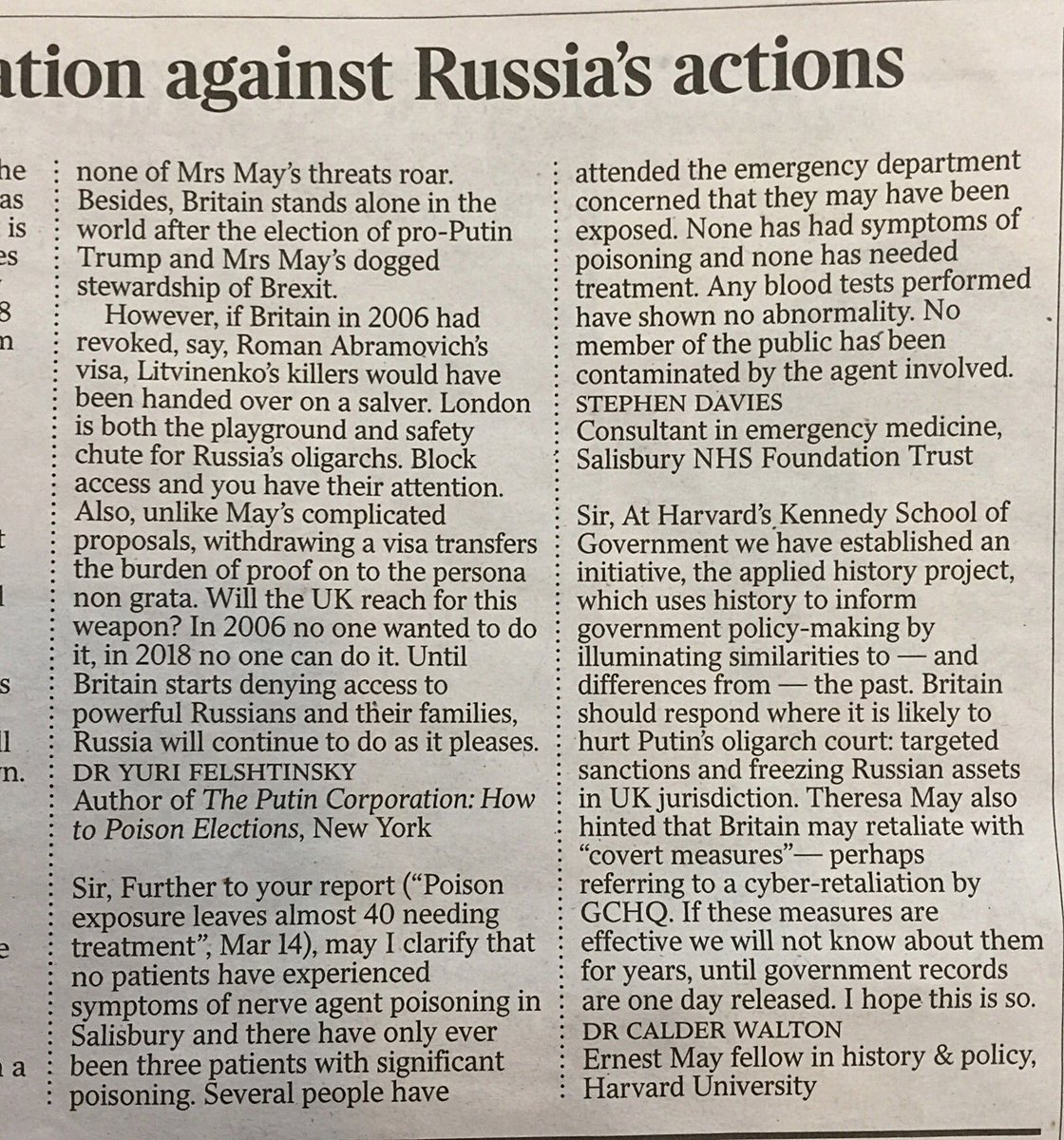
Davies: Letter to The Times
Stephen Davies, a consultant on emergency medicine for the Salisbury NHS Foundation Trust, which runs the Salisbury District Hospital, wrote a letter published in The Times on March 16 that presented a problem for the official British government position. Davies wrote,“[M]ay I clarify that no patients have experienced symptoms of nerve-agent poisoning in Salisbury, and there have only ever been three patients with significant poisoning.” Obviously, Sergei and Yulia Skripal were “patients” in the hospital and were thus included in that statement.
The Times made the unusual decision to cover the Davies letter in a news story, but tellingly failed to quote the crucial statement in the letter that “no patients have experienced symptoms of nerve-agent poisoning in Salisbury” or to report on the significance of the statement.
To rule out the possibility that Davies intended to say something quite different, this writer requested a confirmation or denial of what Davies had written in his letter from the press officer for the Salisbury NHS Foundation Trust, Patrick Butler. But Butler did not respond for a week and then refused directly to deny, confirm or explain the Davies statement.
Instead Butler said in an email, “Three people were admitted and treated as inpatients at Salisbury District Hospital for the effects of nerve agent poisoning as Stephen Davies wrote.” When he was reminded that the letter had actually said something quite different, Butler simply repeated the statement he had just sent and then added, “The Trust will not be providing any further information on this matter.”
Butler did not respond to two separate requests from the writer for assistance in contacting Davies. The refusal of the NHS Foundation Trust to engage at all on the subject underlines the sensitivity of The British government about nerve agent that didn’t work.
There are many individuals in Russia whose feelings about Sergei Skripal’s having become a double agent for Britain’s MI6 – including former colleagues of his – could provide a personal motive for the poisoning. And it is certainly plausible that those individuals could have obtained some of the nerve agent sold by Leonid Rink that entered the black market.
Neither the British government nor the Russian government is apparently eager to acknowledge that alternative explanation. The British don’t want it discussed, because they are determined to use the Salisbury poisoning to push their anti-Russian agenda; and the Russians may be reluctant to talk about it, because it would inevitably get into details of a secret nerve agent research project that they have claimed they closed down in 1992, despite Rink’s testimony in the court case that he was still doing some work for the Russian military until 1994.
Gareth Porter is an independent journalist and winner of the 2012 Gellhorn Prize for journalism. He is the author of numerous books, including Manufactured Crisis: The Untold Story of the Iran Nuclear Scare (Just World Books, 2014).
‘Russia’ Instead of ‘US’: Swedish TV Caught Peddling Fake News on Syria
Sputnik – April 18, 2018
Swedish TV-channel TV4 has sparked outrage by offering its viewers a skewed picture of reality by substituting “the US” with “Russia” in a critical news report on the US-backed attacks against the war-torn middle-Eastern country.
In a news report about the conflict in Syria by TV4, a Syrian woman was speaking about the US, which, oddly enough, was rendered as “Russia, Iran and the regime” in the accompanying subtitles. After a public outcry on social media, TV4 recognized its “mistake” while translating the woman’s outspoken message from Arabic into Swedish.
“The attack did not get enough effect, so we want to see more. We want them to avenge us. Russia, Iran and the regime must back off from here because they have stolen our country and our land,” a woman living in Douma was quoted as saying on TV4.
In reality, however, she didn’t mention “Russia” at all, not even once, which was eagerly pointed out on TV4’s Facebook page by Arab-speaking Swedish viewers.
“Why do you cheat your viewers by means of translating errors? The lady said the United States, you wrote ‘Russia, Iran and the regime,'” Katja Jakoub, an Arabic-speaking woman from Gothenburg pointed out in her post.
This post has been shared by thousands of people, including many people of Arab descent who pointed out that the woman clearly said “Amrika,” Arabic for the United States.
They also pointed out that the Syrian woman actually said that “not everything is dependent on the US” and claimed that she “once again felt hope.” It is not clear from the excerpt whether she was referring to the US-backed missile attack against the Syrian government or something else.
In response to the public uproar, TV4 acknowledged that the translation was “incorrect.”
“During yesterday morning’s broadcast, we sent out a feature from Syria in which the footage unfortunately was accompanied by the wrong text. Thus, the translation did not match what was actually said in the footage regarding this particular broadcast. This was discovered shortly afterwards and we rectified this immediately,” TV4 wrote in its reply, stressing that subsequent broadcasts featured a more consistent translation.
“Was this really a mistake from TV4? One translates the US as ‘Russia, Iran and the regime’ and lets it go on air during peak time to hundreds of thousands of viewers. Then one apologizes on TV4’s Facebook page which is only read by several hundred… Looks more like TV4 owners would like get a world war started,” user Christian Christensen wrote.
On April 14, the US, Britain and France launched 103 cruise and air-to-surface missiles at a number of government facilities in Syria, in response to the alleged April 7 chemical attack in the Damascus suburb of Douma. The airstrikes came even before the results of an ongoing investigation into the case by experts from the Organization for the Prohibition of Chemical Weapons were announced. Most of the missiles were intercepted by Syrian air defenses.
The Stockholm-headquartered TV4 is one of Sweden’s largest channels. It is fully owned by the Bonnier Group, which, in turn, is managed by the powerful media tycoon family the Bonniers [see link below], who run a network of about 170 companies in 15 countries, including Sweden’s foremost dailies such as Dagens Nyheter, Expressen and Sydsvenskan.
READ MORE:
Jewish Media Influence in Scandinavia
Sweden Starts Anti-‘Fake News’ Body for Mental Defense Against ‘Russian Threat’
‘Source Critical’ Swedish Daily Draws Ridicule by Posting Fake PM Tweet
Featured Video
Death Spikes & Rising Cancer In Our Youth Explained
or go to
Aletho News Archives – Video-Images
From the Archives
Politicians lie
By Mazin Qumsiyeh | Popular Resistance | August 18, 2013
There is no way to say this truth nicely: Politicians lie. That includes Japanese, American, Egyptian, Israeli, and Palestinian politicians! Is there something more common sense than that? Yet, so many citizens around the world believe their own politicians or wistfully acknowledge lies but think it is part of the job needed to run things. They believe even when politicians contradict themselves blatantly. This phenomenon is rather remarkable. It is a dissonance and disconnect from reality that many seem oblivious to. It is very dangerous because it can lead to accepting rationales for going to war. These can be deadly wars that lead to millions of lives lost as happened in what was called World War 1 and WW2. Even when incredible and declassified evidence abound, politicians continue to lie and old mythologies refuse to die. Here are just a few of the countless lies told to us over the past few decades… continue
Blog Roll
 Aletho News
- Ukrainian Soldiers, Potential Mercenaries: Have Gun, Will Travel!
- Burnham’s UN debut… A masterclass in British disinformation
- Iran flights continue despite US aviation sanctions
- Global Tipping Points Lead the World Into a State of Entropy
- The day-after at the White House: USA and Xi Jinping
- The Geopolitical Balance in the Red Sea: The UAE Being Displaced by New Players
- Iraqi resistance group vows to stage airport sit-ins over Iran aerial blockade
- Turkish parliament to review Saudi-Pakistan defense pact next month
- DEATH SPIKES & RISING CANCER IN OUR YOUTH EXPLAINED
- Iran offers Trump deal before US election
- If Americans Knew
- Deconstructing Netanyahu’s pants-on-fire UN rant – Daily Update
- Trump betrayed voters with his campaign lies and prioritized a foreign country once he took office
- Netanyahu calls Israel’s war in Gaza ‘opposite of genocide’ in UN speech to near-empty hall
- Settler Kidnappings: Torture, Sexual Abuse and Terrorisation of Palestinian Abductees as Israel Deepens Annexation of West Bank
- Gaza winter nears as 162,000 tents become unusable, raising fears of humanitarian crisis
- Netanyahu says, “It’s the opposite of genocide”; UN says Gaza economy is world’s ‘most severe crisis on record’ – Daily Update
- Israel’s US-Backed Assault on Gaza Has Created the ‘World’s Most Severe Economic Crisis on Record’: UN
- ‘Protecting U.S. Citizens’… From Israel
- ‘This is where I live now, the back of a truck’: a day in the life of a grandmother in Gaza
- In UN Speech, Iran’s President Displays Pictures of Children Killed by US, Brings Attention to Israel’s Nuclear Arsenal
- No Tricks Zone
- New Study: Earth And Venus Surface Warmth Largely Explained By Convection And Lapse Rate, Not CO2 Or Radiation
- 2025 Nature Paper Claiming Worsening Global Drought Gets RETRACTED …Heavily Flawed
- New Study: ‘Global Drought Shows No Detectable Recent Acceleration Under Climate Warming’
- Economic Masterminds: German Socialists Suggest Taxing Productivity Gains Stemming From Using AI
- The South China Sea Has Not Been Cooperating With The Climate Change Narrative
- Energy Crisis: Germany Enters Heating Season With Historically Low Gas Reserve Fill Levels
- New Study: The Antarctic Ice Sheet Gained Mass From 2020-2024 Due To Staggering Snow And Ice Accumulation
- Study: Ocean Heating Rates From Thousands Of Years Ago ‘Dwarf’ Modern Ocean Heating Rates
- Climate Extremists Target, Attack Large-Scale Power Grid Infrastructure In Germany!
- New Study: Antarctic Ice Melt Has Contributed Less Than 1 Centimeter To Sea Level Rise In The Last 30 Years

