Putin: Russians Accused of Meddling in US Election Might Work for US Firms
Sputnik – March 9, 2018
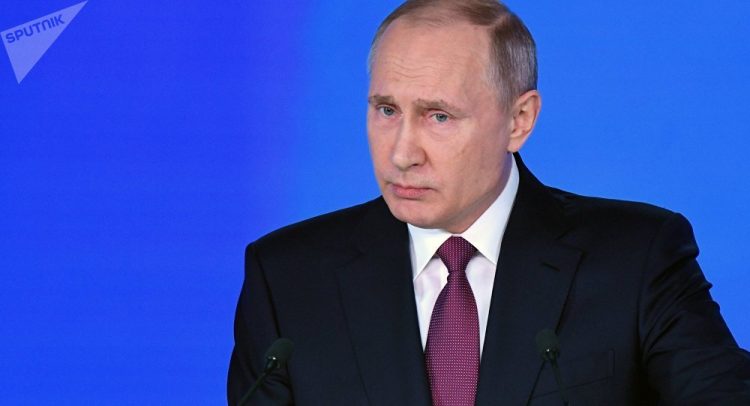
Russian President Vladimir Putin told NBC in an interview that those Russians accused by the United States in meddling in the 2016 presidential vote might as well have been Russians working for US companies or any presidential candidates.
“The world is very large and very diverse, and there is a fairly complicated relationship between the United States and the Russian Federation. And some of our people have their own opinion about this relationship. You mentioned a number of names, some individuals. And you are telling me that they are Russians. So what? Maybe being Russian, they are actually working for some kind of American company. Perhaps one of them used to work for one of the candidates? I have no idea. These are not my problems,” Putin said.
He noted that those people blamed for interfering in the election might as well have been US citizens.
“Why have you decided the Russian authorities, myself included, gave anybody permission to do this? Nothing has changed since you and I talked last time in St. Petersburg [June 2017]. Some names have popped up, so what? They could just as easily have been the names of some Americans who are sitting here and interfering in your own political process,” Putin added.
In February, the US Justice Department revealed in court documents that the United States accused 13 Russian nationals and three entities of trying to interfere in the 2016 presidential vote. The 27-page indictment, a product of Special Counsel Robert Mueller’s probe, alleged that those accused used fake personas to try to influence the outcome of the elections in US President Donald Trump’s favor.
The BBC’s coverage of the breaking Skripal story – distortion & bias in defiance of its own charter
OffGuardian | March 9, 2018
Below is a clip from the BBC Newsnight of March 5 2018, just hours after Sergey Skripal and his daughter had been found, apparently collapsed, on a public bench in Salisbury.
Notice how little the narrative has changed from this very early point. All the talking points are already assembled. Worth noting:
- They call the prison Skripal was sent to in Rusia a “Gulag”, even though the Gulag system ended in the 1960s before the collapse of the Soviet Union. This is clearly emotive language designed to create the impression of Russia as being still an authoritarian and “Stalinist” state.
- There is tacit assumption from the outset that the Russian government is somehow implicated in this incident, even though at this point there had been no claims of foul play, and no statements about how or why Skripal and his daughter had been taken ill.
- The BBC has already – just hours into the breaking story – lined up a video clip from 2010 of Putin saying traitors will “choke” on their “30 pieces of silver.” The clip contains no suggestion Putin intends anyone to be murdered, but the context in which it is run during this segment is clearly intended to weight his words with this meaning.
- It’s stated the Russian government were actively looking for Skripal for unspecified reasons, though no evidence for this is produced, and even though Skripal had been voluntarily released by Russian authorities eight years earlier in a prisoner-exchange. The obvious question – why would they let him go if they wanted him dead is not asked or acknowledged.
- Even though Skripal had been recruited by MI6 and had worked for MI6 for some years no consideration is given to the possibility that MI6 – or for that matter anybody else – might have their own motives for wanting Skripal removed.
- Three people are interviewed for this fourteen minute piece.One is self-styled “enemy” of Putin, Bill Browder, another is an ex-MI5 employee, and the third is a BBC journalist. None of them is Russian or putting forward a Russian perspective, or could even be described as neutral
Is this Newsnight piece reflective of the “balance” that is required by the BBC charter? Lt’s remind ourselves about what that means in the BBC’s own words:
Impartiality lies at the heart of public service and is the core of the BBC’s commitment to its audiences. It applies to all our output and services – television, radio, online, and in our international services and commercial magazines. We must be inclusive, considering the broad perspective and ensuring the existence of a range of views is appropriately reflected.
‘A Fishing Expedition’: Mueller Now Just ‘Trying to Find Dirt on Trump’
Sputnik – 08.03.2018
US Department of Justice special counsel Robert Mueller’s investigation into the alleged ties between the campaign of Donald Trump and Russian actors has taken a turn, as he announced an investigation into George Nader, a Lebanese-American businessman who lobbied in Washington on behalf of the United Arab Emirates.
Brian Becker and John Kiriakou of Radio Sputnik’s Loud & Clear were joined by Jim Kavanagh, a progressive journalist and editor of ThePolemicist.net, to discuss the ramifications of the investigation into Nader.
”It means, first of all, that the special prosecutor’s investigation has gone way beyond meddling in the elections,” said Kavanagh. “All of these meetings they’re talking about with this guy Nader took place after the election. In the original story a few days ago last week, when The New York Times started to cover this, they said that ‘the special counsel investigation has broadened beyond Russia election meddling to include Emirati influence on the Trump administration. The focus on Nader could also include an examination of how money from multiple countries flowed through and influenced Washington during the Trump era.'”
“So this is about Emirati influence peddling — standard operating procedure in Washington. But it’s about influence peddling from the United Arab Emirates during the Trump era, which is one year and one country. So if you’re going to go down that road of how leaders of other countries and wealthy individuals get meetings in the White House, get to pitch their their positions to the president personally and to his team, well, you’re going to have to have an investigation of all of Washington for the past 50 years,’ Kavanagh observed.
“But no, it’s about Emirati influence peddling during the Trump era, so it’s kind of bizarre that anybody think this is anything but a fishing expedition trying to find dirt on Trump. Who’s trying to peddle influence? This has been going on for decades,” Kavanagh said.
Becker pointed to an informal January 2017 meeting by a Russian businessman with Erik Prince, the founder and former CEO of infamous private military contractor Blackwater (now known as Academi) who is now head of the investment management firm Frontier Resource Group. Prince was not directly involved in the Trump campaign, save a visit to the transition team offices in December 2016.
Nevertheless, this meeting with a Russian businessman has been treated by mainstream outlets as a definitive tie between the Trump team and Russia. As MSNBC personality Stephanie Ruhle put it: “[Prince] went on to tell me he had no idea that that guy would have ties to [Russian President] Vladimir Putin. Let me make something clear: all Russian investors had ties to Vladimir Putin.”
“It is probably is true that Putin knows that guy, because he probably knows a lot of people,” laughed Kavanagh. “Just like Barack Obama knows George Soros or knows Warren Buffett, that doesn’t mean every meeting Warren Buffet takes is on behalf of Barack Obama. This is craziness, a stereotypical, cartoonish notion that every Russian investor is a spy for Vladimir Putin.”
‘Progressive’ Journalists Jump the Shark on Russiagate
By Ray McGovern | Consortium News | March 7, 2018

Russiagate’s sensationalist media coverage
Jane Mayer of The New Yorker and Cenk Uygur of The Young Turks are the latest progressives to jump on the anti-Trump, pro-Russiagate bandwagon. They have made it crystal clear that, in Mayer’s words, they are not going to let Republicans, or anyone else, “take down the whole intelligence community,” by God.
Odd? Nothing is too odd when it comes to spinning and dyeing the yarn of Russiagate; especially now that some strands are unraveling from the thin material of the “Steele dossier.”
Before the 2016 election, British ex-spy Christopher Steele was contracted (through a couple of cutouts) by the Clinton campaign and Democratic National Committee to dig up dirt on candidate Donald Trump. They paid him $168,000. They should ask for their money back.
Mayer and Uygur have now joined with other Trump-despisers and new “progressive” fans of the FBI and CIA – among them Amy Goodman and her go-to, lost-in-the-trees journalist, Marcy Wheeler of Emptywheel.net. All of them (well, maybe not Cenk) are staying up nights with needle and thread trying to sew a silk purse out of the sow’s-ear dossier of Steele allegations and then dye it red for danger.
Monday brought a new low, with a truly extraordinary one-two punch by Mayer and Uygur.
A Damning Picture?
Mayer does her part in a New Yorker article, in which she – intentionally or not – cannot seem to see the forest for the trees.
In her article, Mayer explains up front that the Steele dossier “painted a damning picture of collusion between Trump and Russia,” and then goes on to portray him as a paragon of virtue with praise that is fulsome, in the full meaning of that word. For example, a friend of Steele told Mayer that regarding Steele, “Fairness, integrity, and truth, for him, trump any ideology.”
Now, if one refuses to accept this portrait on faith, then you are what Mayer describes as a “Trump defender.” According to Mayer, Trump defenders argue that Steele is “a dishonest Clinton apparatchik who had collaborated with American intelligence and law enforcement officials to fabricate false charges against Trump and his associates, in a dastardly (sic) attempt to nullify the 2016 election. According to this story line, it was not the President who needed to be investigated, but the investigators themselves.”
Can you imagine!
I could not help but think that Mayer wrote her piece some months ago and that she and her editors might have missed more recent documentary evidence that gives considerable support to that “dastardly” story line. But seriously, it should be possible to suspect Steele of misfeasance or malfeasance – or simply telling his contractors what he knows they want to hear – without being labeled a “Trump supporter.” I, for example, am no Trump supporter. I am, however, a former intelligence officer and I have long since concluded that what Steele served up is garbage.
Character References
Mayer reports that Richard Dearlove, head of MI6 from 1999 to 2004, described Steele as “superb.” Personally, I would shun any “recommendation” from that charlatan. Are memories so short? Dearlove was the intelligence chief who briefed Prime Minister Tony Blair on July 23, 2002 after a quick trip to Washington. The official minutes of that meeting were leaked to the London Times and published on May 1, 2005.
Dearlove explained to Blair that President George W. Bush had decided to attack Iraq for regime change and that the war was to be “justified by the conjunction of terrorism and weapons of mass destruction.” Dearlove added matter-of-factly, “The intelligence and facts are being fixed around the policy.”
Another character reference Mayer gives for Steele is former CIA Deputy Director John McLaughlin (from 2000 to 2004) who, with his boss George Tenet, did the fixing of intelligence to “justify” the war on Iraq. State Department intelligence director at the time, Carl Ford, told the authors of “Hubris: The Inside Story of Spin, Scandal, and the Selling of the Iraq War” that both McLaughlin and Tenet “should have been shot” for what they did.
And then there is CIA veteran spy John Sipher who, Mayer says, “ran the Agency’s Russia program before retiring, in 2014.” Sipher tells her he thinks the Steele dossier is “generally credible” in “saying what Russia might be up to.” Sipher may be a good case officer but he has shown himself to be something of a cipher on substance.
Worse still, he displays a distinct inclination toward the remarkable view of former National Intelligence Director James Clapper, who has said that Russians are “typically, almost genetically driven to co-opt, penetrate, gain favor, whatever.” If Mayer wanted to find some ostensibly authoritative figure to endorse the kind of material in Steele’s dossier, she surely picked a good one in Sipher.
Mayer notes, “It’s too early to make a final judgment about how much of Steele’s dossier will be proved wrong, but a number of Steele’s major claims have been backed up by subsequent disclosures. She includes, as flat fact, his claim that the Kremlin and WikiLeaks were working together to release the DNC’s emails, but provides no evidence.
Major Holes
Mayer, however, should know better. There have been lots of holes in the accusation that the Russians hacked the DNC and gave the material to WikiLeaks to publish. Here’s one major gap we reported on Jan. 20, 2017: President Barack Obama told his last press conference on Jan. 18, that the U.S. intelligence community had no idea how the Democratic emails reached WikiLeaks.
Using lawyerly language, Obama admitted that “the conclusions of the intelligence community with respect to the Russian hacking were not conclusive as to whether WikiLeaks was witting or not in being the conduit through which we heard about the DNC e-mails that were leaked.”
It is necessary to carefully parse Obama’s words since he prides himself in his oratorical constructs. He offered a similarly designed comment at a Dec. 16, 2016 press conference when he said: “based on uniform intelligence assessments, the Russians were responsible for hacking the DNC. … the information was in the hands of WikiLeaks.”
Note the disconnect between the confidence about hacking and the stark declarative sentence about the information ending up at WikiLeaks. Obama does not bridge the gap because to do so would be a bald-faced lie, which some honest intelligence officer might call him on. So, he simply presented the two sides of the chasm – implies a connection – but leaves it to the listener to make the leap.
It was, of course, WikiLeaks that published the very damaging Democratic information, for example, on the DNC’s dirty tricks that marginalized Sen. Bernie Sanders and ensured that Secretary of State Hillary Clinton would win the Democratic nomination. What remained to be demonstrated was that it was “the Russians” who gave those emails to WikiLeaks. And that is what the U.S. intelligence community could not honestly say.
Saying it now, without evidence, does not make it true.
Cenk Also in Sync
Cenk Uygur of The Young Turks at once picked up, big time, on the part of Mayer’s article that homes in on an “astonishing” report from Steele in late November 2016 quoting one “senior Russian official.” According to that official, “The Kremlin had intervened to block Trump’s initial choice for secretary of state, Mitt Romney.” Steele’s late November memo alleged that the Kremlin had asked Trump to appoint someone who would be prepared to lift Ukraine-related sanctions and cooperate on security issues like Syria.
Mayer commented, “As fantastical as the memo sounds, subsequent events could be said to support it.” Fantastical or not, Uygur decided to run with it. His amazing 12-minute video is titled: “New Steele Dossier: Putin PICKED Trump’s Secretary of State.” Uygur asks: “Who does Tillerson work for; and that also goes for the President.”
Return to Sanity
As an antidote to all the above, let me offer this cogent piece on the views of Joseph E. diGenova, who speaks out of his unique experience, including as Counsel to the U.S. Senate Select Committee on Intelligence (the Church Committee). The article is entitled: “The Politicization of the FBI.”
“Over the past year,” diGenova wrote, “facts have emerged that suggest there was a plot by high-ranking FBI and Department of Justice (DOJ) officials in the Obama administration, acting under color of law, to exonerate Hillary Clinton of federal crimes and then, if she lost the election, to frame Donald Trump and his campaign for colluding with Russia to steal the presidency.”
He pointed out that nearly half of Americans, according to a CBS poll, believe that Mueller’s Trump-Russia collusion probe is “politically motivated.” And, he noted, 63 percent of polled voters in a Harvard CAPS-Harris Poll believe that the FBI withheld vital information from Congress about the Clinton and Russia collusion investigations.
This skepticism is entirely warranted, as diGenova explains, with the Russiagate probe being characterized by overreach from the beginning.
Ray McGovern works with Tell the Word, a publishing arm of the ecumenical Church of the Saviour in inner-city Washington. He served in Army and CIA intelligence analysis for 30 years and, after retiring, co-founded Veteran Intelligence Professionals for Sanity (VIPS).
Samantha Power blames Russia for anti-establishment success in Italy’s elections
RT | March 6, 2018
One of the key people behind the policies that destabilized Libya and Syria, causing a flood of refugees to Europe, accused Russia of influencing the Italian elections after voters gave the cold shoulder to establishment parties.
Russia’s utility as the universal scapegoat cannot be underestimated these days. A historically-separatist region votes for independence? Russia! Somebody on the internet smeared your candidate? Russia! Extreme cold comes from the east? Er… Russia probably still wants “thousands and thousands and thousands” killed by the cold, as one member of the UK cabinet claimed, and sells its gas to freezing Britons as deception.
In the past 2 years, Putin has won elections in the United States, Austria, Czechia & now Italy. He’s also delivered Brexit & performed well in France & Germany. It’s because there are no problems in the west & a large amount of people only vote to make Russia happy. pic.twitter.com/4XATeOSTEO
— Bryan MacDonald (@27khv) March 5, 2018
So it’s no surprise that the outcome of the latest election in Italy, which resulted in a surge of anti-establishment forces, would be blamed on Moscow. For instance, here is Samantha Power, formerly a senior official in the Obama administration, sharing an article in the Spanish newspaper El Pais about how Russia allegedly spun an immigration discourse in Italy.
Italy’s joins long list of elections influenced by Russia. Sputnik will do what Sputnik does. The question is: what are our democracies going to do about it? Will voters repudiate candidates who seek to benefit from Russian interference? https://t.co/JbFe35Sw5n
— Samantha Power (@SamanthaJPower) March 5, 2018
The Spanish article is a hit piece based on social media analysis done by a private firm, claiming the Russian news outlet Sputnik and the almighty Russian bots made the discourse in Italy radicalized on the issue of immigrants. Because Italians, obviously, cannot be genuinely unhappy to be living in a country that also happens to be a primary destination for refugees departing across the Mediterranean Sea from Libya and have no right to feel betrayed by Brussels’ immigration policies.
But the criticism is precious coming from Power, a staunch advocate of America’s “humanitarian interventions” by the military since Yugoslavia and onward. During her tenure as member of the National Security Council and later ambassador to the UN in the Obama administration, this pretext was used to destroy Libya, which had served as a barrier for irregular immigration to Europe under strongman Muammar Gaddafi and has now turned into a hotbed for people smugglers. It was also used to justify the arming of militants in Syria, perpetrating the war that displaced millions of people. Power advocated a direct military intervention, Iraq-style.
The Twitter post has gained plenty of angry responses. People reminded Power of numerous interventions Washington had its fingerprints on, calling her position ‘ludicrous’. But don’t let them shake your convictions – they are all surely just Russian bots doing the Kremlin’s bidding.
Sunday’s election has shaken the political scene in Italy, seeing voters ditch the ruling center-left parties and switch to anti-establishment forces. The Euroskeptic Five-Star Movement came out as the top individual party, winning over 32 percent of the vote, while anti-immigrant Lega Nord party outperformed expectations, garnering over 17 percent.
A center-left bloc led by ex-Prime Minister Matteo Renzi from Italy’s Democratic Party, gained some 23 percent, admitting “a very clear defeat” in the election. Political analyst Daniele De Bernardin believes that people voted for change on Sunday, not for a particular party.
“In the last five years we had a lot of party switching in the country. Five Star Movement is a movement that puts together very different people with different views,” he told RT, adding that the party can be viewed as a “post-ideological movement.”
What’s putting people together is in fact “a sentiment of changing the country,” he concluded.
Mark Galeotti’s response to Putin’s plea for reason: lies & penis jokes
By Catte | OffGuaurdian | March 4, 2018
The Guardian produced two responses to Putin’s speech of March 1, in which he both unveiled far-reaching new Russia weapons systems and used this as a platform to (once again) plead for an end to Western warmongering. Both of them display both the intellectual/educational/ethical impoverishment of the authors (an impoverishment that is now systematic in corporate media), but also the completely delusional world they inhabit. Today we take a look at Mark Galeotti’s Putin’s new arms race is all about his need to be taken seriously.
Mark Galeotti, who is apparently (believe it or not) “senior researcher at the Institute of International Relations Prague and head of its Centre for European Security” went full idiot in the Guardian yesterday with a short piece entitled Putin’s new arms race is all about his need to be taken seriously.
The mere fact the title carries with it the implication that we don’t need to take the elected president of the largest country in the world with enough nuclear weapons to eradicate all life in earth “seriously” is enough to tell us all about the level of Mark’s contact with veridical reality. He clearly lives in that well-populated Washington/Langley logic-free dream zone where Russia is both a dangerous rogue state with enough reach to “hack” the US election and “attack” America, and a silly little rusty nowhere country to be mocked and patronised into oblivion.
In this piece Mark’s taking the ‘Nowheresville’ tack with added and cringe worthy willy jokes.
He tells us the weapons Putin talked about might sound “terrifying” but that’s ok because they probably won’t work (you know, much like the F-35), and anyhow, the animations in the presentation were “clunky”, and gee gosh, it’s all so frickin funny. Except (abrupt change of take in para 4) it is actually quite a “serious” shopping list that (no discernible irony) “go[es] against the letter or spirit of arms control treaties”. But then, just as abruptly, (para 5) it’s funny again, because…
It is easy to wonder, with a snigger, quite for what Putin is (over)compensating.
In case his sledgehammer wit is too subtle for you, Mark means Putin has a small penis. Yes, apparently he really thinks this comment says more about Putin’s manhood than about Mark Galeotti and his imbecilic reductionism.
But Mark doesn’t just use denial and penis jokes to make his case – he also lies. He describes the president whose government managed to reduce poverty by 75% in 14 years, raise the birth rate, rebuild industries and increase national incomes as a “failure” as a “nation-builder.” He calls the man with a 60-80% approval rating a “failure” as a statesman, and the man who has averted world war at least once during is years in office, a “failure” as a “peacemaker.” Because, of course, in Mark’s dream zone reality consists of whatever you choose to say is true.
But the lie that really tells us what we are up against is this one:
Perhaps the most telling line, after all was when [Putin] directly connected this armament programme with his efforts to make the world, which really means Washington, acknowledge Russia’s status as a great power: “Nobody wanted to listen to us. Well, listen to us now.”
Hmmm. Let’s just put that cherry-picked quote back into its real context, shall we? Re-insert a few words Mark left out. This is what Putin actually said:
No, nobody really wanted to talk to us about the core of the problem, and nobody wanted to listen to us. So listen now.
“The core of the problem” he’s referring to is the US withdrawal from the ABM treaty and its deployment of the Aegis system. It’s clear to anyone who reads Putin’s speech and has listened to anything he has said on the topic for the last sixteen years, that he is very very worried the effective cancellation of the MAD doctrine might result in a nuclear war. It’s clear he sees the restitution of balance to be as much about reducing that risk as about defending his homeland.
The fact Mark either doesn’t understand these basic facts or thinks it’s safe to ignore them is in truth a personification of that massive “problem”. And until Washington and its babbling idiot mouthpieces can wake up to this, realise they don’t actually “make a new reality” simply by talking about it, the future of the human race continues to hang by a thread.
‘Russian doping’-themed documentary wins Oscar in politicized ceremony
RT | March 5, 2018
“Icarus,” a documentary that credits claims of Russian state-sponsored athletics doping won an Oscar at the highly politicized awards ceremony. It beat another film praising the controversial White Helmets in Syria’s Aleppo.
‘Icarus’ director Bryan Fogel and producer Dan Cogan picked up their statuette at Sunday night’s Academy Awards in Los Angeles. The film sees Fogel solicit the help of fugitive former Russian anti-doping chief Grigory Rodchenkov to win an amateur cycling race using performance-enhancing drugs.
Rodchenkov’s appearance in the film is notable given that he is in hiding under a US witness protection program after making his claims about a “state-sponsored doping program” allegedly active in Russia. According to Rodchenkov, FSB agents used arcane sample-swapping tactics to help Russian athletes cheat at the Sochi 2014 Winter Olympics.
Upon these claims, Canadian lawyer Richard McLaren, working for the World Anti-Doping Agency (WADA) constructed a damning report, which led to Olympic officials banning the entire Russian track and field team from the 2016 summer games in Brazil’s Rio de Janeiro and placing severe limitations on the country’s participation in this year’s winter games in South Korea’s Pyeongchang.
Rodchenko is “a fearless whistleblower who now lives in grave danger,” Fogel claimed, “We hope Icarus is a wake up call, yes about Russia, but in the importance of telling the truth, now more than ever.”
Also nominated for the award was ‘Last Men in Aleppo,’ a film glorifying the activities of the US and British-backed group, the White Helmets, a supposedly virtuous volunteer organization that was plagued by allegations of terrorist connections while the Syrian Army liberated the city from terrorists in 2016.
Producer Kareem Abeed said he was almost prevented from joining Director Feras Fayyad at the awards due to President Donald Trump’s visa ban on several Middle Eastern and African countries, as well as North Korea and Venezuela. “On the last day of February, we got a visa and it really surprised us,” he told the entertainment website Deadline. “Save Ghouta” placards held by filmmakers further politicized the red carpet event.
This isn’t the first time the White Helmets grabbed the Academy spotlight. Last year, Britain’s Orlando von Einsiedel won the best short documentary award with ‘The White Helmets.’
Talk show host Jimmy Kimmel kicked off the ceremony with a partisan speech attacking the Republican party, Trump and Vice-President Mike Pence.
“The stunning Lupita Nyong’o, she was born in Mexico and raised in Kenya,” Kimmel said of the Black Panther star. “Let the tweetstorm from the president’s toilet begin!”
“We don’t make films like ‘Call Me By Your Name’ for money,” he said of the gay romance nominated for best picture. “We make them to upset Mike Pence.”
Putin Claims Strategic Parity, Respect
By Ray McGovern | Consortium News | March 3, 2018
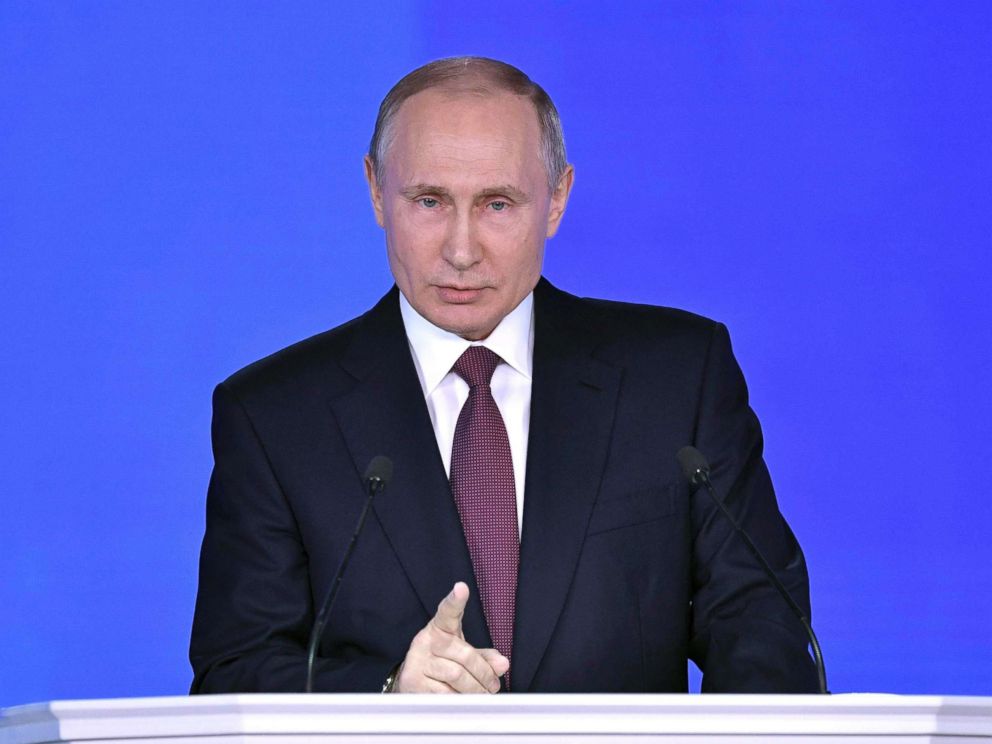
Russian President Vladimir Putin’s State-of-the-Nation speech Thursday represents a liminal event in the East-West strategic balance — and an ominous one.
Russian President Vladimir Putin
That the strategic equation is precarious today comes through clearly in Putin’s words. The U.S. and Russia have walked backwards over the threshold of sanity first crossed in the right direction by their predecessors in 1972 with the signing of the Anti-Ballistic Missile Treaty.
Amid the “balance of terror” that reigned pre-1972, sensible statesmen on both sides concluded and implemented the ABM treaty which, in effect, guaranteed “mutual assured destruction” — the (altogether fitting) acronym was MAD — if either side attempted a nuclear attack on the other. MAD might not sound much better than “balance of terror,” but the ABM treaty introduced a significant degree of stability for 30 years.
The treaty itself was the result of painstaking negotiation with considerable understanding and good faith shown by both sides. The formidable task challenging us intelligence specialists was to be able to assure President Nixon that, if he decided to trust, we could monitor Soviet adherence and promptly report any violations. (Incidentally, the Soviets did cheat. In mid-1983 we detected a huge early warning radar installation at Krasnoyarsk in Siberia — a clear violation of the ABM treaty. President Reagan called them on it, and the Soviets eventually tore it down.)
During the U.S.-Soviet negotiations on the ABM treaty, a third of the CIA Soviet Foreign Policy Branch, which I led at the time, was involved in various supporting roles. I was in Moscow on May 26, 1972 for the treaty signing by President Richard Nixon and Soviet Communist Party General Secretary Leonid Brezhnev. I recall not being able to suppress an audible sigh of relief. MAD, I believed, would surely be preferable to the highly precarious strategic situation that preceded it. It was.
Cornerstone of Stability
In his speech on March 1, President Putin included an accurate tutorial on what happened after three decades, noting that Moscow was “categorically against” the U.S. decision in 2002 to withdraw from the ABM treaty. He described the treaty as “the cornerstone of the international security system.”
Putin explained that under the treaty, “the parties had the right to deploy ballistic missile defense systems in only one of its regions. Russia deployed these systems around Moscow, and the U.S. around its Grand Forks land-based ICBM base [in North Dakota].” (He did not mention the aborted attempt to deploy a second installation at Krasnoyarsk.)
The Russian President explained: “The ABM treaty not only created an atmosphere of trust, but also prevented either party from recklessly using nuclear weapons … because the limited number of ballistic missile defense systems made the potential aggressor vulnerable to a response strike.”
Putin was saying, in effect, that no matter how bad — even mad — the MAD concept may seem, it played a huge stabilizing role. He added that the U.S. rejected all Russian proposals toward constructive dialogue on the post-ABM treaty situation, and grossly underestimated Russia’s ability to respond. The Russian President then gave chapter and verse, cum video clips, on an array of new Russian weaponry which, he claimed, rendered missile defense systems “useless.” The show-and-tell segment of Putin’s speech has been widely reported.
New York Times Skeptical
David Sanger, the New York Times’ go-to guy on key issues, who is among the best in the trade on reporting as “flat facts” things like WMD in Iraq and “Russian meddling,” wrote the lede on Putin’s speech in Friday’s NY Times together with Neil MacFarquhar. The meme this time is not flat fact, but skepticism: “Do these weapons really exist? Or is Putin bluffing?”
In support of their skepticism, Sanger and MacFarquhar blithely report that “analysts writing on Facebook and elsewhere leaned toward the bluff theory.” So, QED!
And echoing former National Intelligence Director James Clapper’s insight that Russians are “typically, almost genetically driven to co-opt, penetrate, gain favor, whatever,” Sanger and MacFarquhar remind NYT readers that “deception lies at the heart of current Russian military doctrine.”
The two NYT journalists did get one thing right at the very end of their article; namely, “For years, Mr. Putin has chafed at the perceived disrespect showed to him and Russia by the United States. ‘Nobody listened to Russia,’ he said near the end of his speech, to huge applause. ‘Well, listen now.’”
Russians, like all proud and gifted people, resent attempts to demean or marginalize them. Putin may have seen his speech, in part, as a blistering response to former President Barack Obama’s dismissive comments that “Russia doesn’t make anything” and is no more than “a regional power.”
Door Still Open to Talks
It is to be hoped that the Marine generals running U.S. defense policy, rather than calling Putin’s bluff, will now encourage President Donald Trump to take up Putin’s latest offer to “sit down at the negotiating table” and “work together … to ensure global security” — taking into account that “strategic parity” is now a reality.
Referring to what he called “our duty to inform our partners” about Russia’s claimed ability to render ABM systems “useless,” Putin added: “When the time comes, foreign and defense ministry experts will have many opportunities to discuss all these matters with them, if of course our partners so desire.”
Putin also said, “We are greatly concerned by certain provisions of the revised Nuclear Posture Review,” which envisages a nuclear response to “conventional arms attacks and even to a cyber threat.”
He described Russia’s military doctrine, as “very clear and specific”: “Russia reserves the right to use nuclear weapons solely in response to a nuclear attack, or an attack with other weapons of mass destruction against the country or its allies, or an act of aggression against us with the use of conventional weapons that threatens the very existence of the state.”
With burgeoning threats against Iran and Syria, it is to be hoped that someone in Washington thinks to ask Putin which countries he includes among Russia’s allies.
White Lies Nobody Believes
Dana White, Pentagon spokeswoman, told reporters Thursday, “Our missile defense has never been about” Russia. Now, as Harry Truman would have put it, the Russians “weren’t born yesterday.” Putin has been extremely derisive toward those promoting the bromide that ABM installations in and around Europe are designed to defend against missiles from Iran — or North Korea.
In an unusually candid remark on missile defense on April 17, 2014, the day before Crimea was annexed, Putin told a national TV audience: “Missile defense … is no less, and probably even more important, than NATO’s eastward expansion. Incidentally, our decision on Crimea was partially prompted by this.”
To take some liberties with Shakespeare, “The fault is not in our stars, but in our Star Wars.” Ever since President Ronald Reagan was sold on the notion that a “Star Wars” ABM system could provide the U.S. with complete protection from missile attack, exceptional opportunities to restrain — or even put an end to — the nuclear arms race have been squandered. Victory has gone to the arms profiteers — those whom Pope Francis described to Congress as the “blood drenched arms merchants.”
The ABM project has been called, with justification, the world’s largest corporate welfare program. Jonathan Marshall today explains quite well what should scare us — still more billions likely to be thrown at the makers of systems that, most serious scientists and engineers agree, can always be defeated, and comparatively cheaply, one way or another.
Three Decade-Old Conundrum
During the mid-80s, I had a front-row seat watching President Ronald Reagan blow what appeared to be a golden chance for a comprehensive peace. I had spent most of my CIA career focusing on Soviet foreign policy and was able to tell the senior U.S. officials I was briefing that Mikhail Gorbachev, in my view, was the real deal. Even so, I was hardly prepared for how far Gorbachev was willing to go toward disarmament. At the 1986 summit with President Ronald Reagan in Reykjavik, Iceland, Gorbachev proposed that all nuclear weapons be eliminated within ten years.
Reagan reportedly almost rose to the occasion, but was counseled to reject Gorbachev’s condition that any research on anti-ballistic missiles be confined to laboratories for that decade. “Star Wars,” the largest and most wasteful defense-industry program in recent memory, won the day.
I know the characters who, for whatever reason, danced to the tune of “Star Wars,” Reagan’s benighted, wistful wish for an airtight defense against strategic missiles.
The naysayers to peace included ideologues like CIA Director William Casey and Defense Secretary Caspar Weinberger, windsocks like CIA Deputy Director Robert Gates and one of his proteges, Fritz Ermarth, a viscerally anti-Russian functionary and former Northrop Corporation employee, who was a Special Assistant to the President and Senior Director of Soviet and European Affairs at the National Security Council (NSC) during Reykjavik.
According to author Jim Mann, several years after Reykjavik, Ermarth reflected on how he had been wrong in being overly suspicious of Gorbachev and how the intuition of Ronald Reagan and Secretary of State George Shultz had been more perceptive.
What Now?
By all appearances, President Putin is as interested in stemming the strategic arms race as was Gorbachev. On Thursday, Putin talked about this particular moment being liminal — he called it “a turning point for the entire world.” Will there be anyone in Washington at the other end of the phone, if Moscow calls? If, in effect, the military-industrial-congressional-intelligence-media complex answers, ABM developers will continue to fatten their purses and squander our children’s future.
It may be time to recall the admonition of President Dwight D. Eisenhower in a speech he gave 65 years ago:
Every gun that is made, every warship launched, every rocket fired signifies, in the final sense, a theft from those who hunger and are not fed, those who are cold and are not clothed. This world in arms is not spending money alone. It is spending the sweat of its laborers, the genius of its scientists, the hopes of its children. …
We pay for a single destroyer with new homes that could have housed more than 8,000 people. … This is not a way of life at all, in any true sense. Under the cloud of threatening war, it is humanity hanging from a cross of iron. […] Is there no other way the world may live?
‘Nuff said.
Ray McGovern works with Tell the Word, a publishing arm of the ecumenical Church of the Savior in inner-city Washington. He served 30 years as an U.S. Army Intelligence and CIA analyst, and in retirement co-founded Veteran Intelligence Professionals for Sanity (VIPS).
Facebook: No Russian trace in pro-Brexit campaigning
RT | February 28, 2018
Facebook has not found any indications that Russia interfered in the UK’s withdrawal from the European Union referendum.
Experts from the social media giant did not find any evidence of active advertising initiated by Russian accounts during the Brexit vote.
A letter from Simon Milner, Facebook’s director of policy in the UK, to Conservative MP Damian Collins, who heads the parliamentary committee on digital culture, media and sport, said investigators failed to find a shred of evidence that Russia tried to influence the referendum.
“The investigative team did not find additional and coordinated Russian-linked accounts or pages supplying advertising in the UK within the framework of the referendum on the EU during the relevant period, in addition to the minimal activity that we reported earlier,” Milner’s letter reads.
A previous investigation by Youtube also found no evidence of Russian interference in the Brexit campaign.
Both of the companies carried out the probes in the aftermath of a report from PR firm 89up, which found that Russian media outlets RT and Sputnik were a major influence on the outcome of the referendum.
Featured Video

Death Spikes & Rising Cancer In Our Youth Explained
or go to
Aletho News Archives – Video-Images
From the Archives
Politicians lie
By Mazin Qumsiyeh | Popular Resistance | August 18, 2013
There is no way to say this truth nicely: Politicians lie. That includes Japanese, American, Egyptian, Israeli, and Palestinian politicians! Is there something more common sense than that? Yet, so many citizens around the world believe their own politicians or wistfully acknowledge lies but think it is part of the job needed to run things. They believe even when politicians contradict themselves blatantly. This phenomenon is rather remarkable. It is a dissonance and disconnect from reality that many seem oblivious to. It is very dangerous because it can lead to accepting rationales for going to war. These can be deadly wars that lead to millions of lives lost as happened in what was called World War 1 and WW2. Even when incredible and declassified evidence abound, politicians continue to lie and old mythologies refuse to die. Here are just a few of the countless lies told to us over the past few decades… continue
Blog Roll
 Aletho News
- RSF military group defects, joins Sudanese army: State media
- Ireland goalkeeper refuses to play ‘Israel’ as squad weighs boycott
- China pushes back against US on Cuba, Iran
- Ukrainian Soldiers, Potential Mercenaries: Have Gun, Will Travel!
- Burnham’s UN debut… A masterclass in British disinformation
- Iran flights continue despite US aviation sanctions
- Global Tipping Points Lead the World Into a State of Entropy
- The day-after at the White House: USA and Xi Jinping
- The Geopolitical Balance in the Red Sea: The UAE Being Displaced by New Players
- Iraqi resistance group vows to stage airport sit-ins over Iran aerial blockade
- If Americans Knew
- An error has occurred; the feed is probably down. Try again later.
- No Tricks Zone
- New Study: Earth And Venus Surface Warmth Largely Explained By Convection And Lapse Rate, Not CO2 Or Radiation
- 2025 Nature Paper Claiming Worsening Global Drought Gets RETRACTED …Heavily Flawed
- New Study: ‘Global Drought Shows No Detectable Recent Acceleration Under Climate Warming’
- Economic Masterminds: German Socialists Suggest Taxing Productivity Gains Stemming From Using AI
- The South China Sea Has Not Been Cooperating With The Climate Change Narrative
- Energy Crisis: Germany Enters Heating Season With Historically Low Gas Reserve Fill Levels
- New Study: The Antarctic Ice Sheet Gained Mass From 2020-2024 Due To Staggering Snow And Ice Accumulation
- Study: Ocean Heating Rates From Thousands Of Years Ago ‘Dwarf’ Modern Ocean Heating Rates
- Climate Extremists Target, Attack Large-Scale Power Grid Infrastructure In Germany!
- New Study: Antarctic Ice Melt Has Contributed Less Than 1 Centimeter To Sea Level Rise In The Last 30 Years

