German army warning companies of war with Russia – media
RT | November 20, 2024
The German military has begun instructing local enterprises on how to prepare and what to do in the event of a conflict between NATO and Russia, the Frankfurter Allgemeine Zeitung (FAZ) newspaper has reported.
The Bundeswehr is providing training to the companies based on a 1,000-page document entitled ‘Operational Plan Germany’, which was recently approved by lawmakers, the outlet stated in an article on Monday.
The contents of the plan are classified, but FAZ claimed that it includes lists of buildings and infrastructure facilities that should be protected as a priority in case of an escalation with Moscow. The plan also reportedly details what private businesses should do to help with defense operations.
If the fighting breaks out on NATO’s eastern flank, Germany could become a hub for hundreds of thousands of soldiers, who would have to be transported to the east, as well as for military equipment, food and medical supplies, the article read.
Among other things, the German military urges businesses to draw up specific plans for employees and try to ensure self-sufficiency through diesel generators or wind turbines, FAZ said.
The paper also cited concrete advice given by Lieutenant Colonel Jorn Plischke to companies during a recent meeting at the Hamburg Chamber of Commerce. “For every hundred employees, train at least five additional lorry drivers that you don’t need. [Because] 70 percent of all lorries on Germany’s roads are driven by Eastern Europeans. If there is a war there, where will these people be?” he said.
Similar meetings are taking place across Germany, with the Bundeswehr ordering all state commands to organize them, according to FAZ.
The first joint exercises between civilian forces and the German military, called ‘Red Storm Alpha’, were recently held in Hamburg. They were aimed at protecting the local port from espionage and sabotage attempts, the report read. ‘Red Storm Bravo’ drills are already in preparation, it added.
Plischke told FAZ that, based on Berlin’s intelligence assessments, Russia “will be willing and able” to attack NATO within four or five years.
A few months ago, Russian President Vladimir Putin rejected allegations of Moscow planning aggression against NATO as “nonsense” and “bulls**t.” According to the Russian leader, such claims are made by Western politicians to deceive the public in their countries and justify increased spending on defense and aid to Kiev amid the conflict with Moscow. “In Ukraine, we are just protecting ourselves,” Putin insisted.
Leaks expose secret British military cell plotting to ‘keep Ukraine fighting’
By Kit Klarenberg · The Grayzone · November 16, 2024
Leaked files show top UK military figures conspired to carry out the Kerch bridge bombing, covertly train “Gladio”-style stay-behind forces in Ukraine, and groom the British public for a drop in living standards caused by the proxy war against Russia.
Emails and internal documents reviewed by The Grayzone reveal details of a cabal of British military and intelligence veterans which plotted to escalate and prolong the Ukraine proxy war “at all costs.” Convened under the direction of the British Ministry of Defense in the immediate aftermath of Russia’s invasion of Ukraine in February 2022, the cell referred to itself as Project Alchemy. As British leadership sabotaged peace talks between Kiev and Moscow, the cell put forward an array of plans “to keep Ukraine fighting” by imposing “strategic dilemmas, costs and frictions upon Russia.”
The leaks obtained by The Grayzone expose a hidden hand behind Britain’s policy in Ukraine, showing in unusually granular detail how it aimed to engineer a long, grinding war through covert operations that stretched the bounds of legality.
Project Alchemy’s proposed schemes spanned every conceivable field of warfare, from cyber attacks to “discreet operations” to outright terrorism. The secret cell even put forward a plan to “aggressively pursue” and “dismantle” independent media outlets – including The Grayzone – through an aggressive campaign of legal harassment and online censorship, so they “would be forced to close.” The incendiary blueprints were fed to the highest levels of the British state and national security structure, where they were apparently well-received.
Founded by a senior British Ministry of Defence official, Project Alchemy is composed of veteran military and intelligence operatives united by a desire for all-out war between the West and Russia. Some have trained Ukrainian forces in clandestine sabotage tactics.
Members of the national security cabal tacitly acknowledged that their proposed operations stretched the bounds of British law. Thus they suggested that London should be “prepared to creatively use the law” to meet its goals, and even be willing to erase “legal restrictions on UK deniable ops” against Russia.
Some of Project Alchemy’s most extreme recommendations have already been implemented, often with calamitous results. These include the cell’s proposal to strike Crimea’s Kerch Bridge, which prompted a Russian escalation that saw punishing attacks on Ukraine’s electricity infrastructure. Alchemy also envisioned the construction of a secret, Gladio-style army of Ukrainian partisan fighters to carry out assassination, sabotage, and terror missions behind enemy lines.
It appears the British premier, Keir Starmer, fell under the influence of the Project Alchemy cabal soon after his election in July, when he eagerly embraced the role of “wartime prime minister.” After pledging to support Ukraine “as long as it takes,” however, Starmer is quietly backing away from the maximalist policy. In Kiev, Ukrainians are left to ponder how their “friends” in London got them into this mess, and why they can not, or will not get them out of it.
The British spooks who gathered around Project Alchemy reasoned that the longer the proxy war continued, the more Russian president Vladimir Putin’s “credibility at home and abroad drops, and his ability to fight NATO is degraded.” Today, Project Alchemy’s gambit has clearly backfired, as Putin remains popular within Russia, while a crumbling Ukrainian army loses territory by the day despite constant re-arming by the West. But the war planners in London remain staunchly committed to escalation, refusing to shelve their diabolical proposals.
Britain takes ‘unilateral lead’ on ‘regime change’ in Russia
Project Alchemy was founded on the personal orders of Lt. General Charlie Stickland, who is charged with “planning, executing and integrating UK led joint and multinational overseas military operations” as the head of Britain’s Permanent Joint Headquarters. Stickland boasts in leaked communications that his family “come from a long line of pirates and buccaneers.” In his email signature, the general identifies himself as an “LGBTQ+ Advocate” in rainbow-colored text.
Stickland and his assistant, Maj. Ed Harris, did not answer The Grayzone’s calls to their personal phones, nor did they respond to detailed questions submitted to them through WhatsApp.
https://twitter.com/GeneralStaffUA/status/1624474926064230402
Stickland convened the first meeting of Project Alchemy’s on February 26, 2022, just days after Russian troops made their initial foray into Ukraine. According to minutes of the gathering, “an assortment of leading academics, authors, strategists, planners, pollsters, comms, data scientists and tech” was on hand to produce a “grand strategy options paper.”
The paper consisted of a series of proposals for the British government to “defeat Putin in Ukraine and set the conditions for the reshaping of an open international order of the future.” Throughout the document, the need to “keep Ukraine fighting” was described as London’s “main effort” in the conflict.
In an email to British military apparatchiks dated March 3 2022, Stickland described Alchemy’s paper as the result of “some mischief I’ve been up to” with “a group of ‘sideways thinkers.’” He expressed satisfaction that “this has been seen by all sorts of people,” including senior British government and military officials, “and landed well.”

An Excel document listing potential and confirmed recruits for the effort, authored by project chief Dom Morris, names a number of individuals from the private sector and academia alongside high-ranking army officials. Currently a fellow at King’s College’s “Centre for Grand Strategy,” Morris was listed in the document as a “civilian leader.” The role of “military leader” was to be carried out by Simon Scott, a brigadier in the British army who was appointed O.B.E. in 2013 for his “gallant and distinguished services” in Afghanistan.

Information operations were to be headed by a still-to-be determined member of Britain’s 77th Psychological Operations Brigade. Also listed as a participant in information operations was longtime British psychological warfare operative Amil Khan, founder of the “counter-disinformation” analysis firm Valent Projects.
In 2021, The Grayzone revealed how the then-Prince of Wales, King Charles, enlisted Khan’s Valent Projects to astroturf a pseudo-socialist YouTube influencer to attack skeptics of the government’s ham-fisted response to Covid. Previously, Khan participated in the UK Foreign Office’s program to foment regime change in Syria.
Months after Alchemy put Khan forward as a member of its team, The Grayzone exposed him for plotting with celebrity-left journalist Paul Mason to destroy this publication. One leaked email showed Khan proposing a “full nuclear legal [attack] to squeeze [The Grayzone ] financially.” The newly-uncovered documents indicate the decision to assail The Grayzone was met with approval from the highest ranks of the British government.
‘Ukraine’s Next Chapter – Elders Grand Strategy Options Paper’
Within Project Alchemy’s covert war room, the obsession with a long war quickly took hold. Members of the cell took their cues from a policy paper Stickland attributed to “The Elders,” which he described as “a group of Fusion players,” referring to the strata of academics and defense industry figures with strong ties to the British military.
An Alchemy document composed under Stickland’s watch and titled, “Ukraine’s Next Chapter – Elders Grand Strategy Options Paper,” suggests that members of the cabal had convinced themselves a “palace coup” inside the Kremlin was inevitable. So long as Russia struggled inside Ukraine, they believed, British intelligence would be granted “the opportunity to challenge” Moscow’s ever-growing “stature as a competent international actor” on the world stage.
“A long war against a small state makes [Putin] look a fool,” the Alchemy paper asserted. “He is obsessed by the end of Ghaddafi – he will want to avoid that… Pressure will pile on from oligarchs as a long war drags on – he will not want to give them excuses to threaten his authority.” The group reasoned that “a long war will affect [Putin’s] international credibility,” as “a failure to quickly defeat Ukraine will seriously… reduce his credibility with new rich friends in Belarus, Hungary, China, India, Middle East, Brazil etc.
“Most importantly,” protracted Russian involvement in Ukraine “will embolden NATO,” Alchemy argued. Convinced that Putin would fail in the eastern Donbas region, triggering a collapse of his government, Project Alchemy members openly fantasized about absorbing Russia into the Western-dominated financial order afterwards under the guise of a “Post Putin Marshall Plan.” Of particular interest was London’s “re-engagement” with Moscow “in global energy and commodity markets,” a seeming reference to the West’s desire for cheap Russian gas and wheat.
“Discreet operations”: reviving ‘Operation Gladio’ terror ops in Ukraine
To accomplish the balkanization of Russia, Project Alchemy’s plotters took inspiration from Operation Gladio, a CIA and NATO-orchestrated covert operation that saw fascist paramilitaries carry out false flag terrorist attacks across Western Europe after World War II in a bid to prevent communism from taking root.
A section detailing potential “discreet operations” in Alchemy’s strategy paper, which stressed the “need to intervene in every way except ‘official,’” explicitly recommended “Stay-behind Gladio handbooks/ Partisan Pamphlets” which would be “updated for Information Age.”
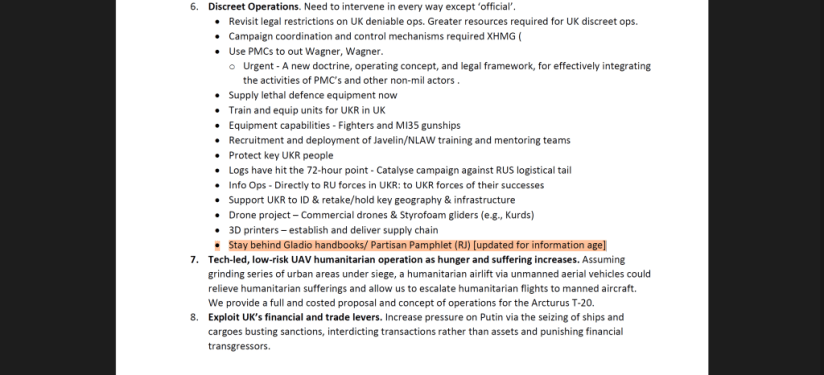
Another move Alchemy proposed was to deploy Britain’s “strong” private military [PMC] industry “to out Wagner, Wagner.” In other words, the group aimed to establish a British rival to the Russian mercenary force founded by the now-deceased commander Yevgeny Prigozhin. This objective required the formulation of “a new doctrine, operating concept, and legal framework, for effectively integrating the activities of PMCs and other [non-military] actors.” Under these guidelines, British mercenary firms capable of using “sophisticated weaponry like SAMS, cyber, combat air, drones” would be employed to “operate and train and accompany Ukraine formations.”
These operations were all intended to ultimately be “sponsored and commanded” by the UK government, “using discreet cover” to avoid triggering NATO’s Article 5.
Following the production of their grand strategy paper, Stickland invited his team of “sideways thinkers” at Project Alchemy to submit further proposals for Gladio-style operations. Among the pitches that arrived was a “mission” to “disable the Kerch Bridge in a way that is audacious, and disrupts road and rail access to Crimea and maritime access to the Sea of Azov.” The blueprints of this highly provocative plot were exposed by The Grayzone in October 2022, in the immediate aftermath of the truck bomb attack that crippled the Kerch Bridge.
Alchemy’s team also produced a PowerPoint presentation entitled, “Training a Ukrainian Commando Force to restore Maritime Sovereignty – Elders,” outlining plans to construct a 1,000-strong Ukrainian commando force “trained in Britain by military veterans equipped with British equipment” to “degrade the Russian Navy and open another flank in the fight for Kherson and the south of Ukraine.”

Alchemy’s team had been working on the plan for at least three months by the time of the presentation’s submission. “Ukrainians abroad and volunteers inside Ukraine” had already been recruited, in advance of 12 weeks basic training “in the use of all troop weapons including mortars, anti-tank missiles, sniper craft, cliff assault, small craft training, demolitions,” the proposal stated.
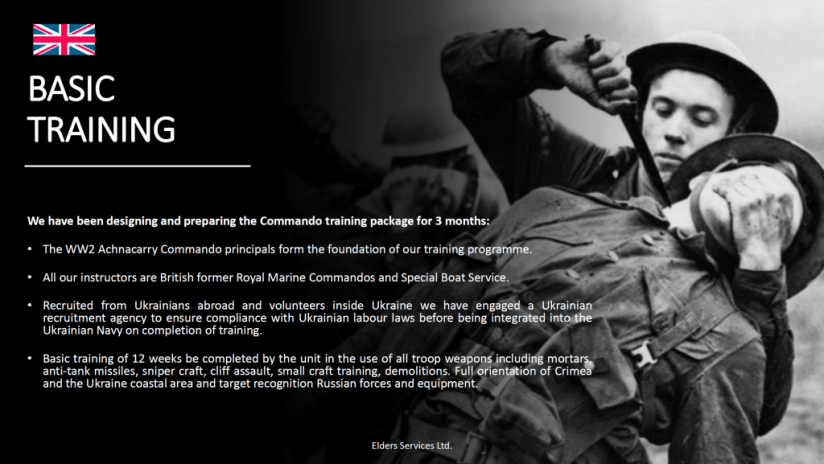
The plan called for formally integrating the commandos into the Ukrainian Navy. Alchemy boasted that the prospective force “will be a force multiplier and highly mobile,” while Russia’s “outdated doctrine will struggle with a highly motivated and well-equipped naval force conducting hit and run operations and targeting Crimea.”
Moreover, “individuals who are fluent Russian speakers and deemed suitable for covert undercover operations,” including “female operators,” would be “inserted into southern occupied Ukraine and Crimea for intelligence gathering and sabotage of key infrastructure targets.” They would be trained by MI6 officers. For this, Alchemy asked the British government for a total of £73.5 million. “The program is at a high state of readiness. We are ready to go,” the presentation forcefully declared.
The enormous sum was to be paid to Elders Services Ltd that was founded by Alchemy members and registered to an address just 15 miles from Fort Monckton, which was described by former MI6 officer Richard Tomlinson as “the SIS’s field operations training centre.” It is unknown how much money, if any, the firm received from the British government for resuscitating Operation Gladio in Ukraine. Elders Services Ltd shuttered in March 2023 after less than a year of operation, without filing financial accounts.
British spies call for ‘action’ against The Grayzone
Behind the Project Alchemy team’s bravado was a sense that Western hegemony was crumbling on the icy borderlands separating Ukraine from Russia. Referring to the rising BRICS alliance, which gathered in Kazan, Russia this October to challenge the US-dominated financial order, Alchemy planners urged British leadership to “prepare for SWIFT II,” as SWIFT was “going to be destroyed” by the West’s anti-Russia sanctions, “slowly, but inevitably.”
According to Alchemy’s analysts, countries across the globe would naturally “see the need for a non-US alternative” means of safely parking their cash and trading. In a rare show of political sobriety, the British spooks predicted that sanctions on Russia combined with the Ukraine proxy war would impose higher prices on consumer goods and “hit British voters in the pocket.”
This posed “a threat to public support” for the British government’s “hard line” on Ukraine, they warned. “Domestic UK public opinion” would understandably get “fed up” paying more for everyday goods, meaning “pressure grows for a compromise.”
To prepare the British public for the coming storm, Project Alchemy’s plotters proposed what they blandly described as “information operations,” but which could be more accurately described as a blend of domestic state propaganda and malign attacks on disruptive media outlets.
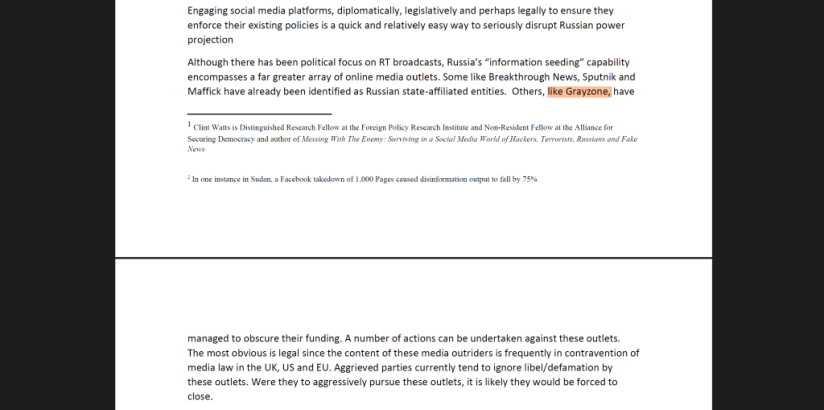
The task they outlined not only included “[dismantling] Russian disinformation infrastructure” by pressuring social media to ban RT and Sputnik, but also targeting critical independent media like The Grayzone.
“A number of actions can be undertaken against these outlets. The most obvious is legal since the content of these media outriders is frequently in contravention of media law in the UK, US and EU,” Alchemy insisted.
“Aggrieved parties currently tend to ignore libel/defamation by these outlets. Were they to aggressively pursue these outlets, it is likely they would be forced to close.”
The Grayzone, it was claimed, had thus far “managed to obscure” its funding – a suggestion that this outlet is covertly funded by Russia or some other enemy state, which is completely false. The paranoid fantasies of British intelligence may explain why this journalist was quizzed on the subject by British counter-terror police when they detained and interrogated him at Luton International Airport in May 2023.
Alchemy plotters seek to place Britain at lead of war with Russia
In addition to playing a leading role in media manipulation, Alchemy sought to place Britain at the forefront of the International Criminal Court’s agenda to investigate and prosecute the Russian government for alleged war crimes in Ukraine.
Alchemy suggested London “set international conditions, collection mechanisms and funding for collection of data and evidence” in the proxy conflict, and “provide all possible support, including intelligence” to the ICC “in its efforts to investigate war crimes,” just as British spies did for the International Criminal Tribunal for the Former Yugoslavia (ICTY).
Though not named in the document, high-profile British lawyers, including celebrity Amal Clooney, have since emerged at the forefront of efforts to prosecute Russian officials for war crimes, and establish an ICTY analog. As The Grayzone’s Max Blumenthal reported, Britain played a critical role in the appointment of Amal Clooney’s mentor, Karim Khan, as ICC prosecutor.
Project Alchemy’s provocative proposals appear to have reached the desk of PM Keir Starmer in some form. At NATO’s 75th anniversary summit, Starmer issued his full-throated endorsement of deep strikes by the Ukrainian military into Russia. Echoing the aggressive language found in Alchemy documents, he pledged to “deliver £3 billion worth of support to Ukraine each year… for as long as it takes.”
But as the Ukrainian military’s offensive in Russia’s Kursk region falters, the Biden administration has distanced itself from the calls for striking into the Russian heartland. Fortunately for British leaders hellbent on taking the fight to Moscow, Project Alchemy has ensured that a platter of off-the-books options remains handy.
As Alchemy noted in its grand strategy paper, “The UK seeks always to act multilaterally, but is prepared to take a unilateral lead where achieving multilateral consensus might prove time-consuming or difficult.” Among the war’s covert sponsors, who were safely ensconced over 1,000 miles away from the front lines, it was firmly agreed: “we should attempt at all costs to keep Ukraine fighting.”
To secure peace in Ukraine, Trump must review misguided western sanctions
By Ian Proud | Strategic Culture Foundation | November 17, 2024
Following Trump’s election, there has been much speculation about how the war in Ukraine might end. But to understand how it might end, it’s vital to understand how it started.
The origins of the war in Ukraine can be traced back to the ouster of Ukrainian President Yanukovych in February 2014. Russia labelled it a coup, realists would say it was unconstitutional change in power, and U.S. & British officials would shrug their shoulders.
After Russia occupied Crimea and as insurgency broke out in the Donbas, the French and Germans launched a peace process involving the Presidents of Russia and Ukraine. From this so-called ‘Normandy format’ emerged two peace deals named the Minsk agreements. But the UK was sidelined from the peace process and the Americans suspicious of it.
Left out, Britian, supported by the U.S., pushed sanctions as the primary vehicle to contain Russia, running counter to what the French and Germans were trying to achieve. By the summer of 2015, the Minsk agreements had become sidelined, and sanctions were set in stone.
Since that time, Russia has become the most sanctioned country on the planet. Thirty-three western countries, led by the USA, imposed more than twenty thousand sanctions against Russian people and companies. That’s fifteen times more sanctions than Iran in a distant second place.
If we could completely cut Russia’s economic ties with the west, so the theory went, then that would be so damaging that Russia would have to withdraw from Ukraine. Western powers therefore sanctioned everything that they could, from money, ships, oil, gold, diamonds, weapons and all manner of hi-tech components. But from a very early stage, it was clear that sanctions weren’t altering Russian policy to Ukraine, quite the opposite.
When I left the Foreign Office in 2023, the UK government with its western partners, had gone through all the sanctions that they thought might weaken Russia. The west could probably find more people or entities to sanction. But policy makers never really gripped Russian gas, as some European countries still rely on it. And anyway, the destruction of the Nordstream pipeline solved that conundrum. Russian oligarchs that had political connections in the west were spared as were Russian companies that owned factories in the USA, to prevent American job losses. But we hit most things and neared the bottom of the barrel.
Yet, Russia’s economy always seemed to bounce back. That’s partly because, sanctions were never as big a deal as other events that moved the global economy, such as the oil price collapses in 2014 and 2016 and Covid. But it was also because Russia continually adapted its macroeconomic policy to absorb and, in the end, profit from sanctions. Following an immediate post-sanctions contraction of economic growth in 2022, Russia has grown more strongly than the western countries that imposed sanctions.
Western powers therefore needed something stronger, so sanctions evolved into a political tool to isolate Russia on the world stage. The USA, European Union and other countries including Japan and Australia sanctioned every possible type of economic, social and cultural activity involving Russia. Western academics no longer collaborate with Russian academics. Russian airliners can’t pass over western airspace and vice versa. Border posts have been closed or minimised. Russia can’t compete in international sporting events or even the Eurovision song contest.
Russian Ministers are subjected to indignant walkouts by western diplomats and ministers at international gatherings. Ordinary Russian people were denied a weekend ParkRun. Ukraine did its part, cancelling the Russian Orthodox church and going on a propaganda offensive with any western company that sold goods with the word ‘Russia’ in their branding.
And yet, outside of the west, Russia’s standing on the global stage doesn’t seem to be in decline. In a process accelerated by the Ukraine war, Russia, with China, has spearheaded a rapid shift by the developing world to create their own formats for dialogue and cooperation. There are over 200 countries on this planet, so the wealthy ‘west’ is in a minority. The BRICS group has grown rapidly, with a long queue of countries waiting to join, including NATO member Turkey. Vladimir Putin has an International Criminal Court arrest warrant out on him, yet he still travels freely to ‘friendly’ countries, where he receives the red-carpet treatment. He recently hosted a successful BRICS summit in Kazan while war continued to rage in Ukraine.
War started in February 2022 a few days after the Ukrainian government finally signalled the death knell of the Minsk peace agreements. But the point is that the Minsk agreement was [not] necessarily bad; it’s simply that the U.S. and UK invested significant efforts in ensuring its failure.
Sanctions never looked likely to prevent war, nor force its end, despite the death or injury to over one million people and a vast exodus of Ukraine’s population. War in Ukraine became reduced to the brutal, bloody town by town fighting in Europe after D-Day, while life in the west, and in Russia, carried on almost as normal. Fighting alone, Ukraine has never had sufficient resources to survive and never will.
There is a strong case that sanctions created the conditions for war to erupt, by undermining the very peace process – the Normandy Format – that was established to prevent it. And that the west’s continued blind faith in sanctions took us to the brink of a doomsday scenario, more horrific than the use of nuclear weapons in Hiroshima and Nagasaki.
Western leaders, not wanting war themselves, focussed blindly on supporting Ukraine for as long as it takes. But the notion of ‘as long as it takes’ became tarnished with increasing numbers of western politicians started complaining that it is taking too long. Not least as the economics and demographics of war still show that Russia can continue fighting for as long as it takes, and that Vladimir Putin has the domestic political support to do that.
So, beyond the hype, if Trump is serious about ending the war in Ukraine, he must look at its origins. A ceasefire alone won’t cut it with Putin. There needs finally to be a peace proposal that includes targeted sanctions reduction. That, and a final reckoning with the NATO membership issue, the brightest red line of all.
Yulia Skripal Reveals the Biggest Secret of All at Novichok Show Trial…
… the Attack Was a British Operation, Not a Russian One
By John Helmer | Dances With Bears | November 16, 2024
Yulia Skripal communicated from her bedside at Salisbury District Hospital on March 8, 2018, four days after she and her father Sergei Skripal collapsed from a poison attack, that the attacker used a spray; and that the attack took place when she and her father were eating at a restaurant just minutes before their collapse on a bench outside.
The implication of the Skripal evidence, revealed for the first time on Thursday, is that the attack on the Skripals was not perpetrated by Russian military agents who were photographed elsewhere in Salisbury town at the time; that the attacker or attackers were British agents; and that if their weapon was a nerve agent called Novichok, it came, not from Moscow, but from the UK Ministry of Defence chemical warfare laboratory at Porton Down.
Porton Down’s subsequent evidence of Novichok contamination in blood samples, clothing, car, and home of the Skripals may therefore be interpreted as British in source, not Russian.
This evidence was revealed by a police witness testifying at the Dawn Sturgess Inquiry in London on November 14. The police officer, retired Detective Inspector Keith Asman was in 2018, and he remains today the chief of forensics for the Counter Terrorism Policing (CTPSE) group which combines the Metropolitan and regional police forces with the Secret Intelligence Service (MI6) and the Security Service (MI5).
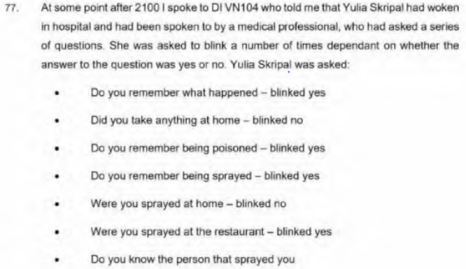
According to Asman’s new disclosure, Yulia Skripal had woken from a coma and confirmed to the doctor at her bedside that she remembered the circumstances of the attack on March 4. What she remembered, she signalled, was not (repeat not) the official British Government narrative that Russian agents had tried to kill them by poisoning the front door-handle of the family home.
The new evidence was immediately dismissed by the Sturgess Inquiry lawyer assisting Anthony Hughes (titled Lord Hughes of Ombersley), the judge directing the Inquiry. “We see there,” the lawyer put to Asman as a leading question, “the suggestion, which we now know not to be right, of course”. — page 72.
Hughes then interrupted to tell the witness to disregard what Skripal had communicated. “If the record that you were given there is right, someone suggested to her ‘Had you been sprayed’. She didn’t come up with it herself.” — page 73. Hughes continued to direct the forensics chief to disregard the hearsay of Skripal. “Anyway the suggestion that she had been sprayed in the restaurant didn’t fit with your investigations? A. [Asman] No, sir. LORD HUGHES: Thank you.”
So far in in the Inquiry which began public sessions on October 14, this is the first direct sign of suppression of evidence by Hughes.
Hearsay, he indicates, should be disregarded if it comes from the target of attack, Yulia Skripal. However, hearsay from British Government officials, policemen, and chemical warfare agents at Porton Down must be accepted instead. Hughes has also banned Yulia and Sergei Skripal from testifying at the Inquiry.
The lawyer appointed and paid by the Government to represent the Skripals in the inquiry hearings said nothing to acknowledge the new disclosure nor to challenge Hughes’s efforts to suppress it.
Asman described his career and credentials in his witness statement to the Inquiry, dated October 23, 2024. His rank when he retired from the regular police forces in 2009 was detective inspector. He was then promoted to higher ranking posts at the operations coordinating group known as Counter Terrorism Policing for the Southeast Region (CTPSE). By 2018 Asman says he was “head of the National Counter Terrorism Forensics Working Group since 2012, and was the UK Counter Terrorism Chemical, Biological, Radiological and Nuclear (CBRN) forensic lead.” In June 2015 Asman was awarded the Order of the British Empire (MBE) “for services to Policing.”
At page 19 of his recent witness statement, this is what Asman has recorded for the evening of March 8, 2018:
Source: https://dsiweb-prod.s3.eu-west-2.amazonaws.com/uploads/INQ006140_strong-compression.pdf — page 19.
Asman’s went on to claim in this statement: “At this point Yulia Skripal was described as being emotional and fell unconscious. I made notes of my conversation with DI [Detective Inspector] VN104 in one of my notebooks, and in addition this information was confirmed to me in writing the next morning. The information she provided about being sprayed at the restaurant [Zizzi] was seemingly inconsistent with the presence of novichok at the Mill public house and 47 Christie Miller Road. On hearing this, I personally wondered whether Yulia Skripal knew more about it than she had alluded to and therefore whilst being fully cognisant of the SIO’s [Senior Investigative Officer] hypothesis and the need to be open-minded continued to prioritise her property.”
THE SCENE OF THE NOVICHOK CRIME

The Skripals reportedly spent 45 minutes at lunch in Zizzi’s restaurant. Witnesses described Sergei Skripal as upset when he left with Yulia to walk to the bench. Source: https://www.dailymail.co.uk/
THE EVIDENCE THE CRIME WAS BRITISH

Left: Yulia Skripal in May 2018, the scar of forced intubation still visible; read more here. Centre; Dr Stephen Cockroft who recorded the exchange with Skripal at her bedside on March 8, 2018; that was followed, Cockroft has also testified, by forced sedation and tracheostomy – read more. Right: read the only book on the case evidence.
Open-minded was not what the judge and his lawyers wanted from Asman when he appeared in public for the first time on Thursday, November 14. Referring precisely to the excerpt of Skripal’s hospital evidence, Francesca Whitelaw KC for the Inquiry asked Asman: “ We can take that [witness statement excerpt] down, but this information as well, was it consistent or inconsistent with what you had found out in terms of forensic about the presence of Novichok at The Mill and 47 Christie Miller Road? A. [Asman] It, I would say, was inconsistent on the basis that she said she was sprayed in the restaurant.” — page 73.
Asman was then asked by Whitelaw to comment on Yulia Skripal’s exchange with Cockroft. “My question for you is: how, if at all, this impacted on your investigations? A. It only very slightly impacted on it… It was information to have but not necessarily going to change my approach on anything.” — page 73.

Left, Francesca Whitelaw KC, counsel assisting Hughes, asked Asman about Yulia Skripal’s hospital evidence – click to watch from Minute 2:01:27. Right: Hughes interrupting the witness to dismiss Skripal’s evidence from Min 2:03:23. On Hughes’s order, Asman’s face was not transmitted during his testimony, and the audio record was delayed by ten minutes before broadcast.
In the Inquiry record of hearings and exhibits since the commencement of the open sessions on October 14, there have been eleven separate exhibits of documents purporting to record what Yulia and Sergei Skripal have said; they include interviews with police and witness statements for the Inquiry; they are dated from April 2018 through October 2024. Most of them have been heavily redacted. None of them is signed by either Skripal.
Neither Yulia nor Sergei Skripal has been asked by the police, by the Inquiry lawyers, or by Hughes to confirm or deny whether Yulia’s recollection of March 8, 2018, of the spray attack in Zizzi’s Restaurant is still their evidence of what happened to them.
US Democrats demand Musk be probed for Russia ties
RT | November 16, 2024
SpaceX CEO Elon Musk should be investigated over media claims that he communicated with several senior Russian officials in recent years, two top Democratic senators have demanded in a letter.
Jack Reed, the chairman of the Senate Armed Services Committee, and Jeanne Shaheen, a senior member of the Foreign Relations Committee, raised concerns about the media allegations in a letter to US Attorney General Merrick Garland and Pentagon Inspector General Robert Storch on Friday.
In October, at the height of the US presidential election, the Wall Street Journal claimed that Musk had communicated with several top Russian officials, including President Vladimir Putin, as recently as this year.
Musk oversees billions of dollars in US government contracts as CEO of SpaceX. As the tech billionaire claims to hold top secret level security clearance, and manages extremely sensitive government contracts, his potential communication with Russia is a risk, the senators said.
“These relationships between a well-known US adversary and Mr. Musk, a beneficiary of billions of dollars in US government funding, pose serious questions regarding Mr. Musk’s reliability as a government contractor and a clearance holder,” they wrote.
Kremlin spokesman Dmitry Peskov blasted the pre-election WSJ claims about the billionaire’s alleged phone calls with Putin as “disinformation.” Historically, there has only been one call between the two, he said.
“It was before 2022, they spoke over the telephone,” Peskov stated, adding that they discussed Russia’s scientific progress, and likely future developments. “There were no contacts between Musk and Putin after that, and all claims otherwise are false.”
The spokesman noted the claims are likely related to the “extremely confrontational electoral political fight” in the US.
After his victory in the US presidential race, Donald Trump announced that Musk will head the future Department of Government Efficiency (DOGE). The initiative will aim to cut trillions of dollars in “waste and fraud” in annual US government spending, “dismantle Government Bureaucracy, slash excess regulations, cut wasteful expenditures, and restructure Federal Agencies,” Trump said on Thursday.
Musk said his role in DOGE “is going to be a revolution.”
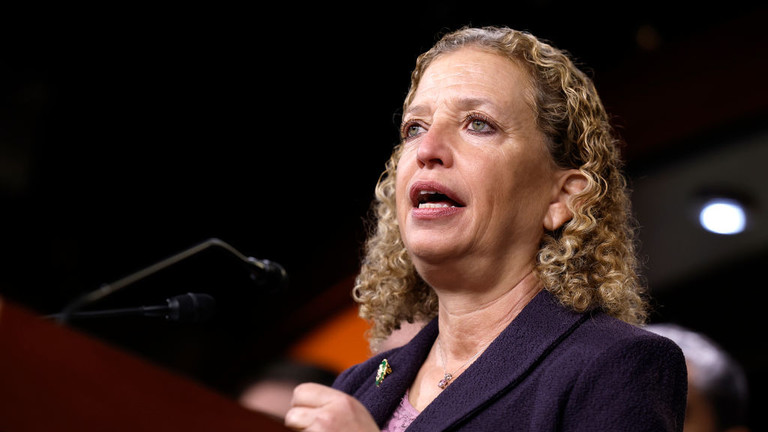
Debbie Wasserman Schultz labels Trump’s pick for intel chief ‘Russian asset’
RT | November 16, 2024
Tulsi Gabbard, US President-elect Donald Trump’s pick for national intelligence director, is “likely a Russian asset,” according to Rep. Debbie Wasserman Schultz (D-Florida). In an interview with MSNBC on Friday, Schulz accused Trump of making “irresponsible” choices for his new cabinet.
Gabbard is a former congresswoman from Hawaii and a lieutenant colonel in the US Army Reserve. An outspoken critic of Washington’s military interventions, she left the Democratic party shortly after the escalation of the Ukraine conflict in 2022. Last month she announced that she had joined the Republican Party and was backing Trump. The president-elect announced her nomination earlier this week, saying that Gabbard “will bring the fearless spirit that has defined her illustrious career” to the US intelligence community, which includes the NSA, CIA, and FBI.
Schultz claimed that appointing Gabbard to the post would be “dangerous,” as it would make her “a direct line” from the US intelligence community “to our enemies.”
“Tulsi Gabbard is someone who has met with war criminals, violated State Department guidance and secretly, clandestinely, went to Syria and met with [President Bashar] Assad. She’s considered to be, by most assessments, a Russian asset,” the congresswoman claimed, saying that she personally considers Gabbard “someone who is likely a Russian asset.” Schultz did not elaborate on her allegations.
Gabbard has not yet commented on Schultz’s accusations. She previously welcomed Trump’s nomination in a post on X, thanking the president-elect for the opportunity to “defend the safety, security and freedom of the American people.”
Twitter users were quick to lambast Schultz’s for her remarks, pointing out that she presented no evidence of Gabbard’s alleged spying on Russia’s behalf and calling her claims “defamatory.” One user noted that “whenever the left doesn’t like somebody – they’re a Russian asset.” Gabbard was not the first of Trump’s picks to be accused of having ties to Russia – earlier on Friday, two top Democratic senators demanded a probe into SpaceX CEO Elon Musk over media claims that he had contacts with senior Russian officials. Trump earlier announced that Musk would head the future Department of Government Efficiency (DOGE), tasked with reforming the US government.
In her interview, Schultz called Trump’s entire cabinet reshuffle “the most extreme and dangerous” in history and a “Star Wars bar level craziness.” She noted that while a few of Trump’s picks are passable, most are “individually unqualified.”
Apart from Gabbard, the congresswoman was especially unhappy with the nomination of former Florida congressman Matt Gaetz for attorney general. She claimed it was “breathtaking in its extremism” as Gaetz has “no experience whatsoever with the Justice Department other than being a subject of investigation for sex trafficking minors.”
EU must reconsider ‘hare-brained’ Russia sanctions – Orban
RT | November 15, 2024
The EU must reconsider the sanctions it has placed on Russia in connection with the Ukraine conflict, and work to end hostilities as soon as possible, Hungarian Prime Minister Viktor Orban has said.
Speaking on Kossuth Radio on Friday, Orban explained that the current economic problems within the bloc stem from Brussels’ “hare-brained” decision to respond to the Ukraine conflict by placing restrictions on Moscow, which have driven up energy prices and overall inflation, hindering the EU’s competitiveness.
The EU declared the elimination of its reliance on Russian energy as a key priority after the Ukraine conflict escalated in February 2022. Sanctions and the sabotage of the Nord Stream pipelines later that year led to a dramatic drop in Russia’s gas supplies to the bloc, resulting in a spike in energy prices and soaring inflation.
“Sanctions were a wrong, hare-brained answer to the [Ukraine conflict], the EU made a mistake… Energy prices must definitely be brought down. This means that the sanctions must be reconsidered, because the policy of sanctions… it will destroy the European economy,” Orban stated. He called for an “anti-bureaucratic rebellion” within the bloc so that decisions on EU policies will be made with the people’s welfare in mind, both in regard to sanctions and to peace.
Orban also said that European businesses and industries cannot focus on development goals and growth opportunities when there is a war going on, so everything needs to be done to end the Ukraine conflict.
“If we look at this conflict from the point of view of our pockets, our economy, our income, it is a scourge of God on us all… In order to be successful again, we have to end it, end it as soon as possible,” he stressed.
Orban said Hungary would continue its diplomatic efforts toward peace in Ukraine, but said that it needs “a protagonist” who will be “strong enough to not only want peace but also to be able to create it.” He reiterated his hope that the power shift in the US with Donald Trump’s election would help achieve that goal. The Republican has previously claimed that he could end the Ukraine conflict in 24 hours. Until Trump takes office in January, Budapest will work on “achieving change in Brussels” to make sure “EU bureaucrats” do not decide to “continue the war without the Americans,” Orban pledged.
Orban has long been at odds with Brussels over the approach to Ukraine, opposing both aid to Kiev and sanctions on Moscow. Tensions grew further after he met with Russian President Vladimir Putin as part of his Ukraine ‘peace mission’ earlier this year.
Some EU leaders accused Orban of siding with Russia and abusing Hungary’s rotating presidency of the bloc. The premier clarified that he was representing only his own nation, but pledged to continue to work on changing the EU’s overall stance on the conflict.
India-Russia ties ‘helpful’ for the world – foreign minister
RT | November 14, 2024
Friendly relations between Moscow and New Delhi are an important element of international stability, Indian Foreign Minister Subrahmanyam Jaishankar told Sky News Australia in an interview published this week. According to the diplomat, the West should be less concerned about countries enjoying good relationships with Russia and more about diplomacy and ending the Ukraine conflict.
The minister defended New Delhi’s decision to increase oil purchases from Russia after the US and its allies slapped Moscow with unprecedented sanctions over the Ukraine conflict, which targeted Russia’s financial sector and international trade.
“If we had not made the moves we had, let me tell you the energy markets would have taken a completely different turn and actually would have precipitated a global energy crisis. It would have caused inflation across the world as a consequence,” Jaishankar said.
Imports of crude oil from Russia currently constitute nearly 40% of India’s total oil purchases, up from less than 1% before the escalation of the Ukraine conflict in February 2022. Earlier this week, the foreign minister said that he expected bilateral trade between the two nations to reach a target volume of $100 billion before 2030.
The minister was responding to Sky News host Sharri Markson, who said that New Delhi’s close ties to Moscow were causing “angst” in Australia. Jaishankar hit back by saying that “countries don’t have exclusive relationships” nowadays. Using the same logic, India should be worried about any country who has a relationship with its regional rival, Pakistan.
“What India has done and is doing with Russia is actually… helpful to the international community as a whole,” the minister said. He said that not only had India’s actions helped to avert a potential global energy crisis, but may also contribute to ending the fighting between Moscow and Kiev.
New Delhi can talk to both parties and “try to find some intersection in those conversations” to eventually find a way to get them both to the negotiating table, according to the top diplomat.
“I think the world, including Australia, needs such a country that will help bring this conflict back to the conference table,” he stated, adding that “conflicts rarely ends on the battlefield, mostly they end [through] negotiations.”
When further pressed by Markson on whether India is concerned about growing cooperation between Russia, China, North Korea and Iran, Jaishankar replied that such developments, which were further encouraged by the Ukraine conflict, show that the West should also be primarily interested in ending the hostilities.
”It’s in everybody’s interest that the sooner the conflict ends the better,” the minister said. “The longer the conflict drags out… all sorts of things are going to happen. Not all those things could necessarily be to Australia’s advantage or… that of Western countries.”
European lackeys in panic mode as Trump signals detente with Russia
By Finian Cunningham | Strategic Culture Foundation | November 12, 2024
It’s early days yet. However, there are signs that President-elect Trump is moving toward a detente with Russia over Ukraine.
One good sign is that Trump will not invite Mike Pompeo or Nikki Haley to join his cabinet when he is inaugurated as the 47th U.S. president on January 20. Both of these figures were rabid anti-Russia hawks during Trump’s previous administration. There were suggestions that Pompeo and Haley might return with senior posts in his second administration. But Trump has announced the pair will not be offered new positions.
Another positive sign is from people close to Trump’s inner circle who are letting the Kiev regime know – rudely – that the U.S. military aid spigot is being turned off.
Donald Trump has yet to hold a phone call with Russian President Vladimir Putin, according to the Kremlin. But both leaders have already expressed a willingness to negotiate a peaceful settlement over the Ukraine conflict.
Another promising sign of potential detente between the United States and Russia is the sheer panic among European leaders. The news of Trump’s election last week has caused most European elites to scramble like scared children on hearing “boo!”.
European Commission President Ursula von der Leyen and French President Emmanuel Macron are consoling themselves by urging Europe to “come together” in the wake of Trump’s stunning election victory. The collapse of Germany’s coalition government of Chancellor Olaf Scholz is an early casualty of the Trump impact.
European leaders fear that if Trump pulls the plug on military aid to the Kiev regime they will be left holding the can to fund the proxy war against Russia, which the weak European economies have no chance of sustaining.
It’s no secret that the main European states were betting on Democrat candidate Kamala Harris winning the race to the White House. Harris would have ensured the continuation of NATO’s backing for the Kiev regime. With Trump becoming president, all bets are off.
The political price will be ruinous for European leaders who have invested huge political capital in waging war to “defend Ukraine from Russian aggression.” Trump has shown skepticism toward that false narrative. He has told Europe to go it alone if it wants to. And the European Russophobes know they can’t do that.
If Trump follows through on his election promise to negotiate with Putin on a settlement in Ukraine, then the Europeans are going to be left with serious amounts of egg on their faces.
One thing about Trump that is of concern to the Europeans is his frustration with them as being, in his view, freeloaders on American protection. Another is Trump’s vindictive streak. He’s not going to forget that most of the European leaders wanted him to lose the election.
Take Britain’s Prime Minister Keir Starmer. His Labour Party sent volunteers over to the U.S. to advise Harris on winning the election. The British Foreign Secretary David Lammy has also been reminded that he previously disparaged Trump as a racist “sociopath.”
Trump’s election is bad news for Britain and there is no doubt that Starmer is now trying to repair post-Brexit relations with Europe as a hedge against the expected chill from Washington during the next four years.
When Britain pulled out of the European Union after its 2016 Brexit referendum, there were high hopes that it could negotiate a special trade deal with the U.S. That deal didn’t work out and looks even less likely now. Hence, Starmer has been busy since taking office in Downing Street trying to restore relations with the EU.
This week, the British leader attended the Armistice ceremony in Paris to commemorate the end of the First World War. The last time a British leader honored that event in Paris was in 1944 when Winston Churchill visited the French capital following its liberation from Nazi occupation.
Macon invited Starmer to lay wreaths in the Champs-Elysee and the Arc de Triomphe.
The choreographed caper of European unity is a reflection of the panic gripping European leaders in the aftermath of Trump’s return to the White House.
But everything is up in the air for the European politicians. Starmer was bending over backward to renew relations with Germany as a way to forge a warmer connection between London and the European Union after years of post-Brexit bitterness, only for that to be thrown into doubt.
Last month saw a landmark security deal between Britain and Germany in which German arms maker Rheinmetall would open a new factory in Britain, and the German Luftwaffe would be able to fly warplanes from an RAF base in Scotland. The deal was touted as “a sign of joint European security in the face of Russian threat.”
With the collapse of the government in Berlin over the unbearable financial costs of the Ukraine war to the German economy, the British security treaty may not materialize. That means a big setback to Starmer’s reset plans with Europe.
Hungary’s Viktor Orban and Slovakia’s Robert Fico are in the minority of European politicians who genuinely welcomed Trump’s election as an opportunity to wind down the NATO proxy war in Ukraine against Russia.
On the other hand, the ardent NATO warmongers in Europe, including Britain, Germany, France, Poland and the Baltic states now face a desperate dilemma. Along with EU leaders like Von der Leyen and the Dutch NATO chief Mark Rutte, they have all nailed their colors to the mast for continuing the reckless proxy war against Russia.
Trump seems to be showing good sense in calling off that proxy war and finding a way to negotiate sensibly with Russia on detente. Moscow wants its long-term security demands to be met. That means no NATO membership for Ukraine, an end to the NeoNazi regime in Kiev, and recognition of its historical lands in Crimea and the Donbass.
This is all eminently negotiable, and Trump might just be ready to cut a deal to avoid World War Three, as he has repeatedly indicated he would do. That would mean Trump dumping the false narrative that Biden, Harris and the Democrats – and their European vassals – contrived about “defending Ukraine”.
That would leave the European lackeys in a disastrous lurch. How will they explain to their electorates the three-year slaughter in Ukraine? How will they justify the tens of billions of Euros and Sterling wasted on pushing a war that not only destroyed millions of lives but their economies as well?
The stupid European leaders are in panic mode, and that’s a good thing.
Threats to Provide Ukraine With German Cruise Missiles Are Merely ‘Paper Tiger’ Moves
Sputnik – 12.11.2024
CDU party leader Friedrich Merz, who seeks to become Germany’s new chancellor, has boasted that, if he gets the job, he would present Russia with an ultimatum: cease all combat operations in the Ukrainian conflict zone in 24 hours or Kiev gets German Taurus cruise missiles along with permission to use them to strike deep into Russian territory.
Merz’s bellicose rhetoric seems to be a product of the current political instability in Germany where the ruling coalition collapsed amid a “deep economic recession” and the loss of “residual hopes of good transatlantic relations” due to Donald Trump’s victory in the US election, says Paolo Raffone, a strategic analyst and director of the CIPI Foundation in Brussels.
“Merz understands that the heavyweights of Germany are the financial-industrial conglomerates who are openly against the war against Russia in Ukraine and the crazy sanctions against Russia and China. However, Merz must appease the war-minded Green [Party] who are also ideologically anti-Russian and anti-Chinese, to embark them in a possible government coalition,” he explains.
However, forming a new government might necessitate forming a coalition with the SPD, who, Raffone points out, “would not support Merz’s intent to lift restrictions on long-range armaments supplied to Ukraine and even less the idea of issuing an ultimatum to Russia.”
“Merz’s harsh rhetoric is a paper tiger – a desperate attempt to have a role in Ukraine after Trump’s win – that would probably also irritate the new US administration that has signaled the intention to de-escalate the confrontation,” the analyst remarks.
NATO support of Merz’s ultimatum initiative also seems unlikely as it would require unanimous approval of the military bloc’s members who would probably first wait for the United States, their “real ‘tutor’,” to weigh in on the matter.
“Trump (as also his predecessors and some EU leaders) is not a fan of NATO playing any direct concrete role in the war or post-war in Ukraine. Even Poland, that is genetically anti-Russian, would be very careful to support any Ukrainian capacity to strike inside Russia with West-provided missiles,” Raffone suggests.
He also warns that, with all the serious “domestic confusion” in Germany, “anything that any German leader says may just be reversed in the blink of an eye.”
“Moreover, the US, that is still occupying Germany with military bases and personnel and nuclear capacities, would not like to be dragged in any direct military confrontation with Russia,” Raffone adds. “None of the EU countries can be taken seriously without the consent of the US.”
Featured Video
Macgregor: We Haven’t Seen the Worst of the Iran War Yet
or go to
Aletho News Archives – Video-Images
New Book
Breast Cancer: Before You Consent
A new Unbekoming paperback
Lies are Unbekoming | September 18, 2026
Peter Gøtzsche reviewed every randomised mammography screening trial ever conducted for the Cochrane Collaboration. Cochrane’s headline is that, assuming a 15% mortality reduction, one woman in 2000 avoids dying of breast cancer over ten years. Ten are overdiagnosed and treated. Two hundred experience false alarms.
But that headline assumes the reduction. When Gøtzsche looked only at the trials with adequate randomisation — the higher-quality ones — the reduction disappeared. No effect on breast cancer mortality. No effect on all-cause mortality.
This is the Cochrane finding, published in the establishment’s own database of systematic reviews.
No woman being asked to consent to a mammogram this week knows it.
That is why the new Unbekoming paperback exists. … continue
Blog Roll
 Aletho News
- US-Denmark Agreement on Greenland Is ‘PR Stunt’ Ahead of Midterms
- Araghchi: Military intervention cannot create security; coercion cannot bring peace
- Fraud Squared
- Breast Cancer: Before You Consent
- Iran’s Plan to Shut Down AI in the Persian Gulf
- Israel seeks ‘compensation’ from Washington over Saudi F-35 sale
- Saudi crown prince seeks dialogue with Ansarullah after Yemeni blows: Report
- Damascus rejects Saudi request for Syrian fighters to counter Yemen: Report
- South Korea says will not send troops to join terrorist US war on Iran
- Russia Just Struck the Eyes of NATO’s War Machine in Ukraine
- If Americans Knew
- Inside the siege, the ruined buildings of Gaza – Daily Update
- Debunking The Claim That Macklemore Has A “History Of Antisemitism”
- CPJ demands release of arrested Palestinian-US journalist near Bethlehem
- Robert Kraft: The Billionaire Friend of Netanyahu Pulling The Strings Behind the Macklemore/Ed Sheeran Blow Up
- Columbia Administered Fund Gives Big Money to Pro-Israel Groups
- Deportation Case of Palestinian Activist Salah Sarsour Tests First Amendment
- ‘We Will Not Forget’: Palestinians Mark 44 Years since Sabra and Shatila
- Why do we let Zionists decide what we can and can’t say?
- US welcomes Israeli, Iranian delegations to UN, but not Palestinians – Daily Update
- Biden’s Genocide Accomplices Targeted by New Accountability Campaign
- No Tricks Zone
- New Study: ‘Global Drought Shows No Detectable Recent Acceleration Under Climate Warming’
- Economic Masterminds: German Socialists Suggest Taxing Productivity Gains Stemming From Using AI
- The South China Sea Has Not Been Cooperating With The Climate Change Narrative
- Energy Crisis: Germany Enters Heating Season With Historically Low Gas Reserve Fill Levels
- New Study: The Antarctic Ice Sheet Gained Mass From 2020-2024 Due To Staggering Snow And Ice Accumulation
- Study: Ocean Heating Rates From Thousands Of Years Ago ‘Dwarf’ Modern Ocean Heating Rates
- Climate Extremists Target, Attack Large-Scale Power Grid Infrastructure In Germany!
- New Study: Antarctic Ice Melt Has Contributed Less Than 1 Centimeter To Sea Level Rise In The Last 30 Years
- Fear Of Debate: Alarmist German Climate Scientist Calls On Mainstream Media To Discredit Skeptic Voices
- End-Of-August Arctic Sea Ice Extent Hasn’t Fallen In 20 Years, Official Data Show!
 Aletho News