EU Now Has Two Choices: New Arms Race or Mend Fences With Russia – Swedish Military Veteran
By Ekaterina Blinova – Sputnik – 12.11.2024
The European Commission may redirect some €392 billion ($416 billion) from the 2021-2027 cohesion funds to support their defense industries and military mobility projects, The Financial Times reported on November 11.
The Ukraine conflict and Donald Trump’s return to the White House are likely to impose pressure on the EU to boost defense investments, according to the newspaper.
“After Trump’s victory, European leaders no longer can rely on a secure US backing and only have two choices, either rapprochement and resumption of good neighborly towards Russia or continued belligerence with its following an arms race and risk for escalation,” Mikael Valtersson, former Swedish military officer and ex-chief of staff with the Sweden Democrats, tells Sputnik. “Unfortunately most of the European leaders are supporting the second alternative.”
Many in the bloc would love to become more independent from the US in terms of defense, but it would require gargantuan military budgets which European countries are unable to afford, Valtersson argues.
“Without the US the EU has very limited power projection capabilities and even less nuclear deterrence capability,” he explains. “Building and keeping a strong nuclear capability will be extremely expensive for the limited European defense budgets.”
A possible way out is a shift from the expensive militarization and growing dependence on the US to resuming working relations with Russia, the pundit alleges. Russian President Vladimir Putin has repeatedly called for discussing common European security for all.
“A wise European policy in this environment would be to seek better relations with Russia,” Valtersson says. “Better relations with Russia is also a sentiment with growing support among the European population. It’s not improbable that several new governments will be elected in the next years that will share the will of a rapprochement with Russia.”
Why Trump’s Triumph Sows Sorrow for Soros
By Ilya Tsukanov – Sputnik – 09.11.2024
Billionaire hedge fund shark-turned liberal ‘philanthropist’ George Soros’ financial interests and political projects may be in trouble when Donald Trump returns to the Oval Office, with tens of millions in campaign funding, smear jobs and even involvement in the Trump prosecutions failing to stop the former president from making a comeback.
Bloomberg reported on Friday that Soros Fund Management plans to shut down its Hong Kong office as part of a surprise “administrative reorganization” after 14 years of operations.
The move may signal preparations by the Soros family to make major changes in the way their soft power empire operates with Trump back in power.
The campaign by the elder Soros and his son and heir apparent Alex to keep a Democrat in the White House has failed to pay dividends, despite the Soros’ Fund for Policy Reform’s transfer of $60 mln to Future Forward, a pro-Democrat dark money super PAC. That’s on top of a $15 mln donation by an Open Society Foundations subsidiary in 2023.
Along with money, the Soros family invested significant personal capital into the campaign against “MAGA-style Republicans” in 2024. In the spring of 2023, Alex Soros announced a dramatic scaling back of OSF’s operations in Western Europe to focus on Ukraine, Moldova, the Western Balkans, and the United States, with the effort to stop Trump becoming a top priority.
George Soros first sounded the alarm over Trump’s “America First” foreign policy in 2016, when he pumped millions into Hillary Clinton’s presidential campaign but failed to see his preferred candidate elected. After Trump won, Soros funded an anti-Trump “resistance movement,” manifesting itself in street protests, court challenges to his domestic agenda, secret lobbying of members of his administration, support for lawmakers promoting a neoliberal foreign policy, and even $1 mln in cash spent on the infamous debunked ‘Trump-Russia collusion’ dossier.
During Trump’s first term, Soros lobbied tech giants to regulate social media, funded a campaign to support dozens, if not hundreds, of liberal prosecutors and judges, gubernatorial candidates, congressional hopefuls, and other state and local officials in 2018 and 2020.
Soros and the OSF’s noticeable shift away from meddling abroad to interfering in US domestic politics earned the ire of Trump backers, who sought to declare him a “domestic terrorist,” strip him of his assets, and expel the Hungarian-born billionaire from the country.
When Joe Biden won in 2020, a Soros-linked think tank lobbied his administration to support policies favoring OSF principles in nearly two dozen different policy areas, and laid out $20 mln to create ‘grass roots organizations’ to sell Biden’s $1.2 trln infrastructure bill.
In 2022, Soros channeled $125 mln into a ‘Democracy PAC’ to support anti-MAGA candidates in the midterms.
In 2023, as criminal indictments began to come down on Trump, the former president immediately linked the political “witch hunt” against him to Soros and his “hand-picked and funded” Manhattan DA Alvin Bragg, to whose 2021 campaign Soros is known to have donated at least $1 mln.
“I expect that Trump will be found guilty at least in some cases, and will be in jail by election day in November 2024,” Soros said in an August 2023 interview. “If I am right, he is unlikely to win the election. But if I am wrong, the US will face a constitutional crisis that is likely to bring on an economic crisis as well.”
Something seems to have gone terribly wrong in the billionaire’s calculations, with Soros’ ex-money manager, Stan Druckenmiller, warning in mid-October that the markets were “very convinced” that Trump would win.
With the Soros family dealt a major blow in Tuesday’s election and set back to where it started in 2016, only time will tell whether the OSF empire will restart its anti-Trump “resistance” movement, and if the president-elect’s inner circle – steeled by over eight years of efforts to sabotage Trump and undermine his ability to govern – will tolerate Soros-style attacks on the US political system and constitutional order.
DNC still whines about Russia
By Drago Bosnic | November 9, 2024
The definition of insanity is doing the same thing over and over and expecting different results. This old saying, usually (mis)attributed to Albert Einstein, perfectly encompasses two very prominent mental health conditions of our time – the infamous Trump Derangement Syndrome (TDS) and Russia Derangement Syndrome (RDS). Symptoms of either of these can be disastrous if left unchecked. However, when combined in a single person or an organization, the consequences of TDS and RDS are virtually guaranteed to be catastrophic. The absolute failure of the DNC has left it without both the presidency and US Congress, giving the Republicans an unprecedented political advantage.
Obviously, numerous top-ranking GOP officials are assets of the Deep State, particularly unadulterated warmongers and war criminals such as Lindsey Graham and John Bolton. Their hatred for Russia and particularly President Vladimir Putin is also quite obvious. However, this animosity is strangely “rational”, based on the simple idea that they consider Moscow a threat that keeps US aggression against the world in check, preventing its so-called “full-spectrum dominance”. Thus, surprisingly enough, it cannot be said that every Russophobic Republican suffers from RDS. However, the same cannot be said about the Democrats, who are still obsessed with the “evil hand of Putin and the Kremlin”.
Namely, the DNC simply refuses to take responsibility for its countless shortcomings (there are so many of them that it’s virtually impossible to name a single good thing about the Democratic Party). Cities, counties and states they run are in such a horrible condition that the United States now has millions of “blue-state refugees”, i.e. people who left DNC-run states to escape the absolute chaos resulting from the neoliberal/woke extremist policies and so-called “values” that are absolutely repulsive to any remotely sane and decent person. Thus, the definition of insanity mentioned at the beginning fits perfectly into this, as the Democrats simply keep refusing to change the way they do things.
Worse yet, it seems they’re even more overzealous in defending the policies that have now left them politically impotent. It should be noted that this defense is based not on any sustainable logic or viable reasoning, but on constant whining, screaming and crying. This sort of behavior is more adequate for toddlers and preschool kids, as it’s pretty embarrassing to see grown people throwing hissy fits instead of facing their shortcomings. However, it’s far worse when those same people keep blaming the same phantoms for those flaws. This is where TDS and RDS come in again, as the DNC is still trying to recover from the election loss “shock” (only they didn’t really see it coming).
Thus, they simply won’t stop talking about the “evil hand of the Kremlin” and its alleged “role in electing Trump”. The sheer disparity between their various ludicrous propaganda narratives concerning Russia is truly mind-boggling. Namely, the Democrat-run mainstream propaganda machine has spent the last well over two and a half years trying to convince everyone that Moscow is “losing in Ukraine”, while simultaneously claiming that Russia is “so powerful” it can actually “elect” US presidents (including “through Facebook ads”, of all things). This doesn’t strike the DNC as completely illogical. Quite the contrary, to them, it’s not only “completely sensible”, but the “only explanation” on how they could’ve lost.
CNN, the neoliberal mouthpiece infamous for its pathological hatred for Trump, couldn’t wait a single day after the election and immediately (re)launched the so-called “Russiagate” conspiracy theory. To that end, it invited Bob Woodward, a Deep State-controlled “investigative journalist” who is usually cited as the “man who uncovered the Watergate scandal”. Woodward himself immediately proved that he’s a Deep State asset by claiming that “Putin might be blackmailing Trump”. He failed to explain how exactly the Russian president is doing that, but alas – the narrative simply needs to be kept alive somehow. The DNC has been fighting tooth and nail to push “Russiagate” for nearly a decade at this point.
It seems that this remains its flagship “strategy” in fighting Trump and the Deep State is entirely in line with it. However, the majority of the American people remain unconvinced. In fact, it can even be argued that the narrative has become a meme of sorts, as virtually anything can be “blamed” on those “evil Russians”. The Democrats also seem to think it can be a good way to shift attention away from their numerous corruption and financial scandals, the latest of which involves a $20 million debt they managed to accrue during their failed election campaign. According to multiple sources, the Kamala Harris campaign burned through over a billion dollars, even leaving the aforementioned $20 million in debt.
According to Politico’s Christopher Cadelago, “after raising over $1 billion and left with $118 million in the bank as of October 16, the Harris campaign ended the 2024 election season with at least $20 million in debt”. Cadelago, the California bureau chief for Politico, shared the information on X, citing “two separate sources familiar with the situation”. Breitbart CEO Matt Boyle confirmed this, adding that “a Kamala campaign staffer said there is a massive scandal here worthy of an audit” and that Jen O’Malley Dillon, the Harris campaign chair, “blew through a billion dollars in a few months”. It seems the largest amount of that money was wasted on celebrity concerts organized precisely by O’Malley Dillon.
According to Zero Hedge, which cites data from the Federal Election Commission (FEC), the Harris campaign received over a billion dollars up until October 16, including when the incumbent Joe Biden was still campaigning for reelection. Over the same period, the Trump campaign got $392 million and spent $345 million, meaning that it managed to save nearly $50 million and also win the election. In addition, the Democrats wasted another $1.1 billion on “aired advertising and associated reservations”, according to AdImpact – a website that monitors the cost and content of ads. The DNC’s financial appetites are very well known, as evidenced by numerous scandals involving the funneling of the so-called “Ukraine aid”.
Drago Bosnic is an independent geopolitical and military analyst.
Kremlin responds to claim of ‘secret’ Trump congratulations
RT | November 7, 2024
The Kremlin has denied reports suggesting that Russian President Vladimir Putin has secretly congratulated Donald Trump on his US election win, describing the claim as unreliable and inaccurate.
Spokesman Dmitry Peskov told journalists on Thursday that he had “no knowledge” of any congratulatory message from Putin to Trump.
Peskov’s statement follows a report from an anonymous Western-funded media outlet alleging that Moscow had already sent a private congratulatory message to the US President-elect.
The Kremlin spokesman was firm in dismissing the claim, adding “we are talking about an unfriendly country that is directly and indirectly involved in the war against us.”
The US is currently viewed as a hostile state by Russia due to Washington’s backing for Ukraine in what the Kremlin sees as a proxy war.
Peskov did not rule out the possibility of a direct conversation between Trump and Putin before the US President-elect takes office in January. “He [Trump] said he would call Putin before the inauguration. Here are his words, we have nothing else to say yet,” Peskov explained to reporters.
While no specific meeting or agenda has been arranged, the Kremlin press secretary noted that such a call is “not excluded.”
Russia’s Foreign Ministry has also weighed in on the US election results, describing Trump’s win as reflective of widespread dissatisfaction with the direction taken by President Biden’s administration. Nevertheless, the ministry tempered expectations of a major shift in relations, stating “the ruling political elite in the United States, regardless of party affiliation, adheres to anti-Russian attitudes.”
Moscow “has no illusions” about Trump’s ability to significantly alter this stance, but Putin, according to Peskov, remains open to “constructive dialogue” on principles of “justice, equality, and a readiness to consider each other’s concerns.”
As to whether Russia would be represented at Trump’s inauguration, Peskov said that it remains undecided, dismissing any idea of Kremlin communication with Trump’s team, stating simply “No, why should we get in touch?”
Trump’s first term was dogged by conspiracy theories – heavily amplified by US corporate media – alleging Russian interference in the 2016 election. Some observers think lingering memories have made both sides more cautious about interactions now.
Rachel Maddow threatens Musk over ‘Russia ties’
RT | November 6, 2024
Elon Musk can’t possibly keep his US government contracts because of his alleged secret contacts with “America’s worst enemy,” MSNBC’s Rachel Maddow has said.
The Wall Street Journal claimed last week that Musk had communicated with Russian President Vladimir Putin and withheld the services of his Starlink network to Ukraine’s military. Both Musk and Moscow have dismissed the report as fake news.
Maddow, however, proceeded as if the Journal’s reporting was a proven fact in her election day show on Tuesday evening.
“You really can’t have the head of a company that is the primary rocket launcher for the defense department and NASA, you can’t have the head of that company in secret communications with America’s worst enemy while America’s enemy is actively waging a war against one of our allies, especially once you learn that he’s using his businesses to help the other side, to help Russia in that war,” Maddow said.
“Now that we know what we know about Elon Musk, this election – regardless of who wins – has produced a national security problem,” she continued, arguing that it will likely produce “tons of drama.”
“So, buckle up. Even if [Donald] Trump doesn’t win, the Defense Department and NASA are gonna need a new arrangement for all their rockets and for all the multi-billion-dollar contracts Elon Musk’s companies have with the US government,” Maddow said. Either the government will have to get out of those contracts, or Musk’s companies “will have to unwind from him.”
Musk has denied the Journal’s claims, pointing out that Starlink was “the BACKBONE of Ukrainian military communications at the front lines, because everything else has been blown up or jammed by Russia.”
The founder of SpaceX and owner of X (formerly Twitter) addressed Maddow’s comments shortly afterward, speaking to journalist Tucker Carlson in a livestream from Mar-a-Lago.
“Rachel Maddow is a crazy person,” Musk said, describing her as “frothing-at-the-mouth crazy fascist, basically, sort of pretending to be a liberal.”
Asked how much pressure he has been under because of his support for Republican presidential candidate Donald Trump, Musk resorted to a joke.
“Well, apart from multiple Democrats saying they want to put me in jail, take away government contracts from my companies, nationalize my companies, deport me as an illegal, and have me arrested for apparently being Putin’s best friend, nothing besides those things,” he said.
Meanwhile, Kremlin spokesman Dmitry Peskov said that the Journal’s claims were untrue, “most likely linked” to Musk’s support for Trump, and should not be taken seriously.
While the official count of votes in the US presidential election is still pending, Trump has secured the needed 270 electoral votes, according to multiple media organizations.
EU will not lift Russia sanctions – MEPs
RT | November 5, 2024
EU restrictions on Russia are unlikely to be lifted in the foreseeable future due to pressure from the US, two members of the European Parliament told Izvestiya newspaper on Tuesday.
Even an eventual end to the Ukraine conflict would not necessarily mean a scaling back of Western barriers to trade, finance and travel, French MEP Thierry Mariani told the Russian daily.
“It would be logical to lift them, but I am not sure that this will happen,” the lawmaker said. “It is likely that the US will ask to keep the sanctions in place to make sure that… economic relations with Russia do not resume immediately.”
America’s energy sector has benefited greatly from the EU’s sanctions against Russia, which was previously a leading energy supplier to the bloc, Izvestiya wrote. Following the escalation of the Ukraine conflict in 2022, Brussels chose to shun Russian natural gas, replacing cheap pipeline supplies with more expensive liquified natural gas (LNG).
Last year, the US was the largest LNG supplier to the EU, representing almost 50% of total LNG imports, having tripled the supply volume since 2021, according to the European Council data.
“The end of the military operation in Ukraine will undoubtedly push some economic players in the West to demand that the sanctions, especially in the energy sector, be lifted,” Luxembourg MEP Fernand Kartheiser told Izvestiya. The lawmaker went on to warn, however, that “influential circles” in the West, including American shale gas producers, will seek to maintain the restrictions, as they benefit from them.
“So far, no senior EU official has given any indication that sanctions could be lifted if the Ukraine conflict ends… Even if Russian negotiators succeed in convincing the EU to lift the restrictions, it will not happen immediately, and it would take years for trade relations to get back to normal,” according to EU law expert and former MEP Gunnar Beck.
European Commission President Ursula von der Leyen, who was reelected in July for another five-year term, has been one of the main backers of increasing pressure on Russia.
Last month, Politico reported that Brussels was preparing its 15th package of sanctions, aimed mainly at Russian LNG exports that are still sold to the EU. According to the newspaper, the bloc’s members plan to resume discussions on new restrictions in January.
No new measures will be introduced against Russia this year during Hungary’s presidency of the bloc, Polish media reported earlier this week. Officials in Brussels are reportedly waiting for Warsaw to take over the Council’s leadership on January 1 before they roll out any new restrictive measures.
Finnish Defense Minister Says More EU Funding for Ukraine Needed Through Taxes
Sputnik – 04.11.2024
The European Union will need to find more funds “in the wallets of European taxpayers” to support Ukraine if assistance from the United States weakens, Finnish Defense Minister Antti Hakkanen said on Monday.
He added that now was not the time for “war fatigue.”
“This means that more funds need to be found in the wallets of European taxpayers to support Ukraine,” Hakkanen told Finnish broadcaster when commenting on the potential decline in support for Kiev from Washington after the US presidential election.
In October, Finnish Foreign Minister Elina Valtonen said in an interview that the West was getting tired of supporting Ukraine, hoping for some form of resolution to the ongoing conflict.
Western countries have ramped up their military and financial aid to Kiev since the start of Russia’s military operation in Ukraine in February 2022. Russia has repeatedly said that arms supplies to Ukraine hinder the conflict settlement and directly involve NATO countries in the conflict.
Victoria Nuland Laments Social Media Won’t Play Censor for the Feds Anymore

By Didi Rankovic | Reclaim The Net | November 3, 2024
The original “Russia Gate” might have been debunked a long time ago, but politicians and officials continue to seek to explain their electoral failures by accusing other countries of “meddling.”
There is an even more serious angle to their insistence on this – namely, using it as justification for putting in place what opponents (and a congressional investigation) call the government-Big Tech collusion to censor online speech.
Speaking of meddling – former senior US State Department official Victoria Nuland’s handiwork is probably better known in Europe than in the US, and she is now revisiting the script of (Russian) meddling, but is also complaining that social platforms are not as willing to “work” with the government as before on US presidential elections.
Nuland clearly believes her own freedom of speech has no consequences, so she decided to tell MSNBC’s Rachel Maddow that Russian President Vladimir Putin is “at it again” – and also explicitly accuse X owner Elon Musk of making his platform implicit in this alleged election interference.
“In 2020, the social media companies worked hard with the US government to try to do content moderation, to try to catch this stuff as it was happening,” said Nuland.
Now, laying the groundwork for election interference claims, according to her, Musk is “talking directly to the Kremlin.”
The astonishing accusation goes on to “explain” what exactly Musk and the Kremlin are chatting about. “Every time the Russians put out something, [Musk makes sure] it gets five million views before anyone can catch it,” said Nuland.
The frontal assault on Musk also saw the former official tell Maddow that he is “a new, very powerful tool” in Putin’s hands.
To quote Maddow – “I’m not sure people have absorbed the magnitude of what you’re describing there.”
She, of course, was not dismayed by Nuland’s statements but was with this comment “aiding and abetting” them. Once Nuland was done with linking Musk and Putin, she moved on to President Trump, who she asserted is “taking Putin’s lessons.”
Maddow for her part took this cue to attack Trump as essentially creating “alliances” with what Nuland and Maddow consider to be autocrats. And, the “magnitude of that” is what the MSNBC host was not sure Americans have “absorbed.”
Back to Nuland’s activities in Europe, while she still had an official role. This enabled her to become a key player behind the so-called Steele Dossier, by providing the since-debunked documents to the FBI back in 2016.
Government Agents Try to Stir Up Fear of Russian Election Interference a Third Presidential Election in a Row
By Adam Dick | Peace and Prosperity Blog | November 1, 2024
For a third United States presidential election in a row, US agents are out warning of Russian election interference.
In the previous two elections the warnings were spurious. Still, the government agents succeeded in raising worry in people’s minds regarding candidate Donald Trump. And they suppressed consideration of information damaging to Trump’s opponents, including through indicating the contents of Hunter Biden’s laptop were “Russian disinformation.”
This election, the government agents are at it again. Their latest spurt of relating supposed Russian election interference arrived in a Friday joint statement from the Office of the Director of National Intelligence (ODNI), Federal Bureau of Investigation (FBI), and Cybersecurity and Infrastructure Security Agency (CISA). This joint statement is one among a series of updates concerning what the press release calls “Moscow’s broader effort to raise unfounded questions about the integrity of the U.S. election and stoke divisions among Americans.”
Yeah, whatever, guys. Have you ever read the story about the boy who cried wolf?
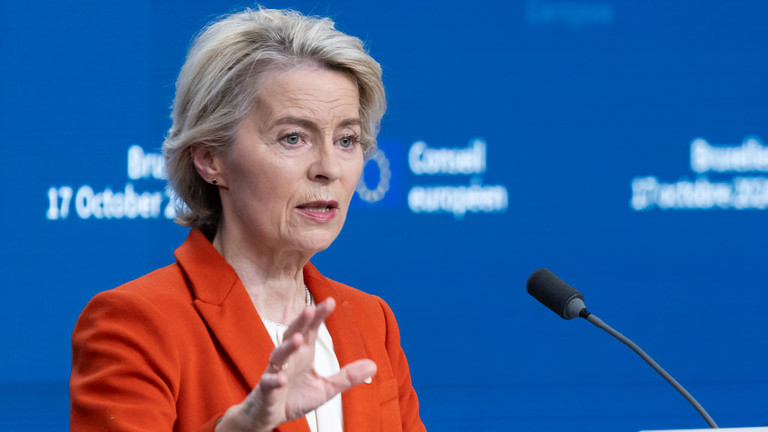
Von der Leyen advised to create ‘EU CIA’
RT | October 31, 2024
An EU report has called on European Commission President Ursula von der Leyen to create a “fully fledged” intelligence agency to coordinate the clandestine activity of member states. However, even proponents of the idea admit it would be costly and unpopular.
Penned by former Finnish President Sauli Niinisto and published on Wednesday, the report outlines the EU’s readiness for war, and makes a multitude of vague recommendations. Officials in Brussels are advised, for example, to cultivate a “preparedness culture,” and to “strengthen civil-military coordination frameworks.”
One of the more concrete recommendations is that the EU create “a fully-fledged intelligence cooperation service, serving all EU institutions and member states.” The agency, the report states, would collect intelligence from national-level agencies in order to “serve both strategic and operational needs of EU-level policy-planning and decision-making.”
While the proposed agency was described by Politico as a “CIA-style spy service,” the report makes no mention of it carrying out clandestine operations outside the EU’s borders, which is the CIA’s role within America’s sprawling intelligence apparatus. Instead, it suggests that the agency would “coordinate specific counter-espionage tasks” and help member states “counter threats against them posed by hostile foreign intelligence services.”
Speaking at the launch of Niinisto’s report, von der Leyen admitted that member states will probably be reluctant to allow Brussels bureaucrats to oversee their intelligence sectors. For now, she said, the EU will focus on “strengthening information sharing” instead.
Niinisto also admitted that, while researching the report, he encountered “many critical voices” from member states concerned about increasing the bloc’s budget to fund this agency.
If adopted, the report’s recommendations would mark yet another expansion of the EU’s powers. Two years ago, the bloc adopted its first common defense strategy, which authorized the creation of a 5,000-strong “rapid deployment” force. Last month, von der Leyen named former Lithuanian Prime Minister Andrius Kubilius as the EU’s first ever defense commissioner.
Earlier this month, Kubilius said he would work on ramping up arms production across the bloc, declaring that “we must be ready to meet Russia militarily in six to eight years.”
Kubilius has also called on the EU to pursue regime change in Moscow, and to sponsor “democratic forces” working to topple President Vladimir Putin’s government.
Kiev regime trying to interfere in Germany’s domestic politics
By Lucas Leiroz | October 30, 2024
Ukraine is apparently trying to interfere in the domestic politics of its European “partners.” Recently, the Ukrainian ambassador to Germany tried to pressure German political parties not to cooperate with parties or public figures who oppose the military aid program to Kiev. This shows how desperate the neo-Nazi regime is to prevent any decrease in its international support, as this would mean the end of its military capability.
Ukrainian ambassador to Germany, Aleksey Makeev, has recently launched a blackmail campaign against local political parties that advocate a peaceful solution to the Ukrainian conflict. Makeev has publicly stated that all leading German politicians should avoid any involvement in projects aimed at reducing or ending Germany’s participation in the war against the Russian Federation.
The statement came shortly after the establishment of the so-called “Sahra Wagenknecht Alliance” (BSW), a coalition of political parties and social movements opposed to German participation in the war. The group is being led by the well-known German left-wing leader Sahra Wagenknecht. According to Sahra, there needs to be “more diplomatic efforts,” and it is not right for Berlin to engage in military initiatives.
“We need more diplomatic efforts (…) There is a good peace plan by Brazil and China. I hope that Germany and the EU will support such initiatives (…) It is not about being a friend or enemy to Russia, but about peace in Europe and [ending] the war in Ukraine. Without peace, everything else is nothing (…) (Germany became) an internationally respected voice that mediates in conflicts and advocates diplomacy,” she said at the time.
Apparently, despite the hegemonic status of the anti-Russian lobby in Germany, the proposal has taken the attention of many local politicians and activists, which is why Ukraine decided to “react”. The Ukrainian ambassador announced that local “democratic parties” should avoid participating in such initiatives, considering “intolerable” any possibility of Berlin cooperating with a diplomatic solution project.
“If politicians from democratic parties need support in dealing with the intolerable ultimatums of non-democratic actors, particularly in foreign policy matters, I am ready to share my own experience of negotiating with Russia,” he said.
The ambassador’s words were just the continuation of a series of recent statements against any form of alliance with pro-peace activists in Germany. Previously, he had already said that no party should “give in” to the BSW. He called all German anti-war activists “populists”, suggesting that any peace initiatives are mere meaningless populist rhetoric.
“Anyone who adopts the slogans of the BSW will only lose themselves. Democratic parties must not allow populists at either the regional or the federal level to dissuade them from solidarity with Ukraine,” he said.
It is important to emphasize that the Ukrainian Embassy is not merely criticizing the initiative. Such an attitude would be natural for Kiev, since the regime is in the midst of an armed conflict with Moscow. But what is happening is actually deeper. The Ukrainian ambassador is simply demanding that German parties not take part in a movement that has emerged in Germany itself. In other words, he is trying to tell German politicians what to do in their own country.
It is not surprising that Ukraine is using its diplomatic apparatus to lobby for war. While this practice is wrong and reprehensible – since the very purpose of diplomacy is to avoid war – there is nothing really surprising in this case, considering that the Kiev regime is simply implementing the same practices that have already become commonplace among its Western allies and sponsors.
The Ukrainian action is motivated by desperation and fear. The Zionist lobby feels “threatened” by the BSW initiative. The coalition showed interesting electoral results in key German regions such as Brandenburg, Saxony and Thuringia, where it achieved around 15% of the vote – concluding the regional elections in third place. There has been a growth of anti-war sentiment in some cities in the former East Germany, where people usually have very critical views of Berlin’s foreign policy.
However, unlike its Western sponsors, Ukraine does not have enough power to profoundly influence the domestic politics of other countries. The lobby that the Ukrainian embassy is promoting is likely to fail, as popular dissatisfaction with the pro-war stance of the German government is growing. In the end, all Ukrainian blackmail efforts will prove useless, as it is inevitable that there will be a growth of anti-war initiatives in Germany – both among politicians and among ordinary people.
Canada’s ‘New Red Scare’ is profoundly undemocratic
By Paul Robinson – Canadian Dimension – October 28, 2024
In the past decade, a disturbing phenomenon has arisen in the Western world. One might call it the “New Red Scare.” According to many, the West is the target of a highly sophisticated, professional, and dangerous campaign of foreign subversion, coming mainly from the Russian Federation. Accusations abound against “Russian agents,” “Kremlin influencers,” “Moscow proxies,” and the like. Don’t like someone, call them “pro-Russian;” dislike what they say, call it “Russian disinformation;” want to silence them, call them a “Russian agent.” And so on. Increasingly, reasoned debate is being replaced by silencing and name-calling.
Speaking on Thursday to a parliamentary committee, former diplomat and Member of Parliament Chris Alexander painted a picture of Canada as the victim of an extraordinarily successful malign Russian operation. “Far from being marginal players, Russian information assets and active measures are often kingmakers in our elections,” he declared—a truly remarkable claim that will probably have many wondering how they had failed to notice the dominant role that Russia plays in our political life.
But that wasn’t all. According to Alexander, the leaders of “The People’s Party of Canada, the yellow vest movement, trucker protests, and Wexit [i.e. Western Canadian separatism]” were “radicalized online by Moscow’s active measures” and their funding “had all the hallmarks of Russian influence.” The convoy protests of 2022, Alexander claimed, were designed by the Russians “to distract a country with a huge Ukrainian diaspora as it launched its war of aggression [against Ukraine].” Who knew? And who knew that Russian secret services were so devastatingly efficient as to be able to manipulate a political party and a separatist movement, and to engineer the occupation of the national capital? Frankly, it beggars belief.
In my opinion, there’s a serious problem with threat inflation of this sort. It distracts from real problems and prevents a proper analysis of the causes of those problems by blaming them all on outside actors. When “Blame Russia” is the response to any difficulty, proper solutions are unlikely to be found.
But the statements above weren’t even the most striking bit of Alexander’s evidence to Parliament. For Alexander then submitted documents to the committee that he said showed that a journalist codenamed “Stuart,” whom he identified as the Ottawa Citizen’s defence correspondent David Pugliese, had been recruited by the Soviet intelligence service, the KGB, in the 1980s. He said that the journalist had demonstrated “long-running covert ties to Moscow” and had written divisive articles about “Ukraine’s Nazi links, Nazis in Canada, defamatory pieces about the family of deputy prime minister Chrystia Freeland, provocative takes on [defence] procurement and other issues at the Department of National Defence,” and so on. According to Alexander, “These are themes that Moscow would be delighted to promote.”
In response, Pugliese has called the accusation “total fabrication. … It’s just ridiculous.” He has pointed out that some of the information in the documents presented by Alexander does not fit him. For instance, one of the documents lists the journalist codenamed “Stuart” as having been in Ottawa in 1984, but Pugliese did not live in Ottawa at that time. In a statement on X, Pugliese remarked that “Individuals linked to Mr. Alexander’s false claims have also stated I play hockey on the Russian embassy hockey team in Ottawa. That is a total fabrication and shows the ridiculousness of this campaign to undercut my journalism. I have never played hockey and can barely skate.”
In any event, it seems that the documents don’t actually say that “Stuart” (whoever he might be) was ever recruited by the KGB. Global News reports that “Several experts on KGB documents said the papers appeared to be legitimate but did not suggest the reporter was ever a Russian agent, only that the Soviets looked at him.” According to one expert, “All [the documents] say is that an individual by this name came to the attention of KGB officials, not even necessarily very senior ones, and that they were interested in exploring him as a potential target of recruitment … So nothing in these documents clearly says that this individual was even approached, or certainly says that that approach was successful. All they do is say this is something worth exploring.”
Pugliese commented that “I get that I piss off a lot of people with my articles … I understand that not everybody appreciates my style of journalism.” Certainly, his reporting on issues such as wasteful defence procurement projects, sexual assault in the military, Nazi links to the Monument to the Victims of Communism, and so on, does not make certain people and institutions look very good. But the insinuation that if you write such things you are not fulfilling the basic journalistic role of holding those institutions to account, but rather working to divide our society on behalf of a hostile foreign power, is profoundly undemocratic.
Our society is not without faults. Our domestic and foreign policies are also often flawed. To correct failings, we need people who point them out, however unpopular that may be. In my view, we should be enabling the widest possible framework of public discourse, not seeking to silence people. To date, we haven’t quite reached the level of hysteria of 1950s McCarthyism, but as the paranoia over foreign interference ramps up, we are perhaps coming painfully close.
Paul Robinson is a professor in the Graduate School of Public and International Affairs at the University of Ottawa and a Senior Fellow at the Institute for Peace and Diplomacy. He is the author of numerous works on Russian and Soviet history, including Russian Conservatism, published by Northern Illinois University Press in 2019.
Featured Video

Macgregor: We Haven’t Seen the Worst of the Iran War Yet
or go to
Aletho News Archives – Video-Images
New Book
Breast Cancer: Before You Consent
A new Unbekoming paperback
Lies are Unbekoming | September 18, 2026
Peter Gøtzsche reviewed every randomised mammography screening trial ever conducted for the Cochrane Collaboration. Cochrane’s headline is that, assuming a 15% mortality reduction, one woman in 2000 avoids dying of breast cancer over ten years. Ten are overdiagnosed and treated. Two hundred experience false alarms.
But that headline assumes the reduction. When Gøtzsche looked only at the trials with adequate randomisation — the higher-quality ones — the reduction disappeared. No effect on breast cancer mortality. No effect on all-cause mortality.
This is the Cochrane finding, published in the establishment’s own database of systematic reviews.
No woman being asked to consent to a mammogram this week knows it.
That is why the new Unbekoming paperback exists. … continue
Blog Roll
 Aletho News
- US-Denmark Agreement on Greenland Is ‘PR Stunt’ Ahead of Midterms
- Araghchi: Military intervention cannot create security; coercion cannot bring peace
- Fraud Squared
- Breast Cancer: Before You Consent
- Iran’s Plan to Shut Down AI in the Persian Gulf
- Israel seeks ‘compensation’ from Washington over Saudi F-35 sale
- Saudi crown prince seeks dialogue with Ansarullah after Yemeni blows: Report
- Damascus rejects Saudi request for Syrian fighters to counter Yemen: Report
- South Korea says will not send troops to join terrorist US war on Iran
- Russia Just Struck the Eyes of NATO’s War Machine in Ukraine
- If Americans Knew
- Inside the siege, the ruined buildings of Gaza – Daily Update
- Debunking The Claim That Macklemore Has A “History Of Antisemitism”
- CPJ demands release of arrested Palestinian-US journalist near Bethlehem
- Robert Kraft: The Billionaire Friend of Netanyahu Pulling The Strings Behind the Macklemore/Ed Sheeran Blow Up
- Columbia Administered Fund Gives Big Money to Pro-Israel Groups
- Deportation Case of Palestinian Activist Salah Sarsour Tests First Amendment
- ‘We Will Not Forget’: Palestinians Mark 44 Years since Sabra and Shatila
- Why do we let Zionists decide what we can and can’t say?
- US welcomes Israeli, Iranian delegations to UN, but not Palestinians – Daily Update
- Biden’s Genocide Accomplices Targeted by New Accountability Campaign
- No Tricks Zone
- New Study: ‘Global Drought Shows No Detectable Recent Acceleration Under Climate Warming’
- Economic Masterminds: German Socialists Suggest Taxing Productivity Gains Stemming From Using AI
- The South China Sea Has Not Been Cooperating With The Climate Change Narrative
- Energy Crisis: Germany Enters Heating Season With Historically Low Gas Reserve Fill Levels
- New Study: The Antarctic Ice Sheet Gained Mass From 2020-2024 Due To Staggering Snow And Ice Accumulation
- Study: Ocean Heating Rates From Thousands Of Years Ago ‘Dwarf’ Modern Ocean Heating Rates
- Climate Extremists Target, Attack Large-Scale Power Grid Infrastructure In Germany!
- New Study: Antarctic Ice Melt Has Contributed Less Than 1 Centimeter To Sea Level Rise In The Last 30 Years
- Fear Of Debate: Alarmist German Climate Scientist Calls On Mainstream Media To Discredit Skeptic Voices
- End-Of-August Arctic Sea Ice Extent Hasn’t Fallen In 20 Years, Official Data Show!
 Aletho News