Western media sees spies and saboteurs everywhere
By Patrick Poppel | April 29, 2024
An article entitled “Spies and Saboteurs” was published in the NZZ (Neue Züricher Zeitung). This choice of words reminds us very much of the time of the Second World War. A Russian agent is now suspected behind every corner in Europe. There were even reports of planned attacks by the Russian secret service on German soil. But most of the allegations concern disinformation and cyberattacks that are intended to destabilize Germany from Russia.
This article in the so-called “quality medium” is not an isolated case in the media world of Germany, Austria and Switzerland. Just a few days ago there was a scandal in Austria because an employee of the secret service was accused of working as a spy for Russia. Whether this is true or not, this person was immediately shown to be close to the opposition FPÖ party. In many Austrian media, bizarre connections to other political figures were described, without being able to prove this. The target of this report was clearly not this “agent” but the opposition party.
This anti-Russian opinion formation now flanks the anti-democratic and totalitarian developments, as there is already discussion in Germany about banning a party (AFD) that does not correspond to the mainstream.
The role of the systemic media in manipulating the political landscape must be questioned more closely in the future. Especially because they are financed by public structures. These media create an atmosphere in society, which is used as a basis for discussions in parliament and even changes in laws.
But it’s not just the media that is working against the opposition. There are now also demonstrations against the opposition in Germany, which are massively supported by the state media. These “protests against the right” must be analyzed as an artificially created movement. State-funded media, cultural associations and artists are gathering people here to take to the streets against the opposition.
The AFD in Germany and the FPÖ in Austria are repeatedly described as pro-Russian and individuals there have often been asked to explicitly distance themselves from Russia. Apart from that, these political forces cannot be described as pro-Russian, as they include many transatlantic politicians.
We have to ask ourselves why such a major campaign is now being organized against the opposition. The answer is that the system can no longer explain its own incompetence and work against the state’s sovereign interests. Only when you point your finger at someone do three fingers point back at you.
Fear of Russian espionage and sabotage is currently at a peak in Europe. It is expected that this situation will not change soon. This fear has existed in Eastern Europe for years, but now the West is also mired in this paranoia.
It is important to the media in the West to create threats and enemy images. Russia is currently the target of this propaganda. But in the future it could also become a different state. Just as people are afraid of Russia’s spies today, tomorrow they might be afraid of China’s economy or Africa waking up.
Europe is in a difficult situation due to geopolitical changes. And systems that get into trouble often tend to act irrationally. These are difficult times for the political opposition and happy journalists in Europe. Anyone who doesn’t follow the mainstream is excluded and attacked in the media.
However, these political and media instruments could also be just the beginning of further development. The first arrests have already been made and the investigation is continuing. The search for “enemies of the state” will not stop. In this context, one should just think about who the enemies of democracy are here.
Such a division in society never existed in Western Europe, even during the Cold War. Since the beginning of the Ukraine conflict in 2014, the mass migration in 2015 and the ongoing climate hysteria, society in the West has been divided into two groups. These two groups have no common points of contact with each other.
This is a very dangerous domestic political development. And the current media propaganda is not helping to ease the mood between the government and the opposition. It will only achieve the opposite and divide society even further.
The defamation of the opposition through these espionage scandals is a new stage in the political struggle and allows us to see exactly how cooperation between Western secret services, lobbyists, governments and the media works.
Patrick Poppel is an expert at the Center for Geostrategic Studies in Belgrade.
US lawmaker demands ‘proof’ on CIA’s Russia scare
RT | April 22, 2024
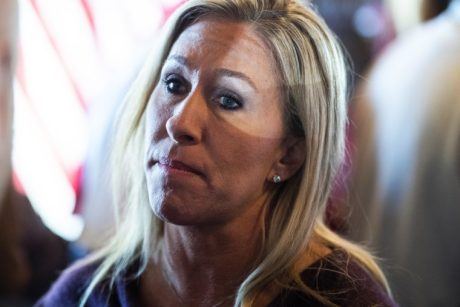
After stoking fears of Russian expansionism to win congressional approval for more Ukraine aid, US intelligence agencies should provide proof of their justification for continuing to fund a “proxy war” that will inevitably end in defeat for Kiev, Representative Marjorie Taylor Greene (R-Georgia) has argued.
Speaking on Monday in an interview with former White House aide Steve Bannon, Greene pushed back against claims that Russian forces will take Poland and continue “marching across Europe” if they’re allowed to defeat Ukraine. She noted that US House Speaker Mike Johnson (R-Louisiana) only agreed to push through the $61 billion Ukraine aid bill, which was approved on Saturday, after hearing intelligence briefings hyping the Russian threat.
“If the American people are going to have to pay for it, then show us this proof that was shown to Mike Johnson in the SCIF [sensitive compartment information facility],” Greene said. “Why is this classified information? If this is a real threat to all of Europe, if this is a threat to America and our national security, then roll out the presentation.”
The second-term lawmaker said Johnson received no such classified briefings on the US border crisis, which poses a real threat to the American people. “They don’t care about that,” she said. “They care about continuing the business model built on blood and murder and war in foreign countries, the business model that continues funding the military-industrial complex in order, supposedly, to create American jobs and build up the American economy.”
“This is the most disgusting business model that anyone has ever seen, probably in the history of mankind.”
Greene reiterated her call to oust Johnson as speaker, saying Republican voters are so disgusted about the Ukraine bill that the party will lose control of the House in this year’s election if the current leadership remains in place. The White House’s emergency funding request for Kiev had been stalled since last fall because a majority of Republicans opposed it. Republican lawmakers voted against the legislation by a 112-101 margin on Saturday, but Johnson overrode his own party by allowing a vote and winning passage with unanimous Democrat support.
Johnson won praise from the Washington media for his reversal on Ukraine aid – CNN even likened him to Winston Churchill – while Greene came under attack for criticizing him. The New York Post put a picture of Greene on its Sunday cover with a Soviet ushanka superimposed on her head and a caption saying, “Nyet, Moscow Marjorie.”
Greene insisted that congressional Republicans can’t win in the November election without the support of ‘America First’ voters. She added that sending more aid to Ukraine will only cause more bloodshed without changing the outcome of the conflict.
“This just continues the war maybe a few more months, maybe to the end of the summer,” Greene said. “It doesn’t guarantee a Ukrainian victory because everyone knows they’re going to lose eventually. It just is a matter of when. But it does guarantee that more Ukrainian men will be slaughtered on the battlefield.”
Trump wants to ‘kill his opposition’ – Hillary Clinton
RT | April 20, 2025
Former US presidential candidate Hillary Clinton has claimed that the man who defeated her in the 2016 election, Donald Trump, is a wannabe strongman who aims to murder his political enemies.
Speaking in a podcast interview posted on Friday by Democrat activist Mark Elias, Clinton said American voters had underestimated how “dangerous” Trump would be as president. She likened Trump, now the presumptive Republican nominee in this year’s US presidential election, to Russian President Vladimir Putin.
“Putin does what [Trump] would like to do — kill his opposition, imprison his opposition, drive journalists and others into exile, rule without any check or balance,” Clinton said. “That’s what Trump really wants.”
Ironically, Clinton and her husband, former President Bill Clinton, have themselves long been accused by some conservatives of eliminating people who pose a threat to their power or wealth. In fact, investigative journalist Danny Casolaro coined the conspiracist term “Clinton Body Count” in the late 1980s, in reference to the allegedly mysterious deaths of people with connections to the Clintons. Casolaro was found dead in a West Virginia hotel room in 1991 with his wrists slashed 10-12 times. His death was ruled a suicide.
Hillary Clinton also has made a habit of linking Trump to Russia and Putin. Her presidential campaign helped trigger allegations of Russian meddling in the 2016 election by funding the since-discredited Steele dossier.
She told Elias that Putin is just one of the US adversaries whom Trump would like to emulate, and that his other role models include Chinese President Xi Jinping and North Korean leader Kim Jong-un.
“We have to be very conscious of how he sees the world because in that world, he only sees strongman leaders,” Clinton said. “He sees Putin. He sees Xi. He sees Kim Jong-un in North Korea. Those are the people he is modeling himself after, and we’ve been down this road in our world history. We sure don’t want to go down that again.”
If Trump is elected president again, Clinton warned, “it will be like having a dictator. I don’t say that lightly. Go back and read Project 2025. They’re going to fire everybody. The person in the government who knows about what may be the next pandemic? ‘Get rid of him, he didn’t vote for me, or I don’t like the way he looks.’”
She added: “It’s really important to think about what could happen to our world with Trump back in the White House – withdrawing us from NATO, not caring about what happens in Europe . . . the idea that he wants Ukraine to fail, the idea that he doesn’t want us to be able to surveil our enemies. I mean, this is a very scary prospect.”
Clinton expressed optimism that Trump will not be able to defeat incumbent President Joe Biden in November because Democrats will be running the election in key states, including Michigan, Wisconsin, Pennsylvania and Arizona.
Trump has maintained that all allegations against him are part of a politically motivated smear campaign. He dismissed the ‘Russiagate’ accusations as a hoax and witch hunt that aimed to sabotage his presidency and block him from forging better US relations with Russia.
US house speaker announces ‘new axis of evil’
RT | April 19, 2024
In a dramatic break from his party’s hardline conservative base, US House Speaker MIke Johnson this week praised the country’s deep state, named Russia, China, and Iran as an “axis of evil,” and vowed to put his job on the line to funnel more than $60 billion to Kiev.
For months, Johnson has resisted bringing a $95 billion foreign aid bill to a vote, arguing that neither he nor his fellow Republicans could support such a bill – which would give $14 billion in military aid to Israel and $60 billion to Ukraine – without it being tied to an overhaul of US border security.
However, after a series of recent meetings with US intelligence chiefs, Johnson has changed his tune.
“This is a critical time right now, a critical time on the world stage,” Johnson told reporters on Wednesday. “I think providing lethal aid to Ukraine right now is critically important. I really do. I really do believe the intel and the briefings that we’ve gotten.”
“I believe [Chinese President] Xi [Jinping] and [Russian President] Vladimir Putin and Iran really are an axis of evil,” he continued. “I think they’re in coordination on this. I think that Vladimir Putin would continue to march through Europe if he were allowed.”
Johnson’s comments represented a break with the Republican Party’s pro-Trump wing. These supporters of the former president – most prominent among them Georgia Representative Marjorie Taylor Greene and Florida Rep. Matt Gaetz – view the country’s intelligence agencies as arms of the anti-Trump “deep state,” and have called for the flow of money to Kiev to be halted.
“Fighting a proxy war with Russia in Ukraine, which is a non-NATO member nation, is not protecting America’s national security interests, it doesn’t protect the United States of America, as a matter of fact, it pushes us closer and closer to world war three,” Greene told journalist Tucker Carlson earlier this month.
Johnson’s reference to an “axis of evil,” however, invokes the more interventionist GOP of the past. Coined by speechwriter David Frum, the phrase was first used by George W. Bush to refer to Iran, Iraq, and North Korea in the months leading up to the invasion of Iraq. Former National Security Adviser John Bolton later added Cuba, Libya and Syria to the list.
Despite resistance from some of its Republican members, the House Rules Committee agreed on Thursday to split the foreign aid bill into three separate bills – one each for Ukraine, Israel, and Taiwan. The house voted in favor of this move on Friday, leaving Johnson free to schedule a vote on each bill for Saturday, even as Greene filed a motion to remove him from the speakership.
Johnson said on Wednesday that he anticipated such a move, telling reporters that he was willing to “take personal risk” to pass the bills.
NATO ‘one step away’ from sending troops to Ukraine – Orban
RT | April 19, 2024
The leaders of the EU and NATO are potentially ready to deploy forces to Ukraine, Hungarian Prime Minister Viktor Orban claimed on Friday. Brussels sees the conflict between Moscow and Kiev as its “own” and is failing to consider the risks arising from its ever-deeper involvement, he warned.
The mood of EU leaders is “one of war,” Orban told a gathering of his Fidesz Party ahead of the EU Parliament elections. “There is a pro-war majority in Brussels today,” he said, adding that the bloc’s politics “are dominated by the logic of war.” EU politicians are already so invested in the conflict that they fail to see the flaws in their strategy, the prime minister argued.
Despite all the “money and weapons, the situation is not improving [for Kiev], in fact, it is getting worse… We are one step away from the West sending troops to Ukraine,” Orban warned. “This is a vortex of war that can drag Europe into its depths. Brussels is playing with fire.”
Budapest will not let itself be dragged into the hostilities, and “will not enter… the war on either side,” the prime minister pledged, adding that his country “must stand for peace” everywhere, including in “Brussels, Washington, the UN and NATO.”
“We don’t want war, and we don’t want Hungary to become a toy of great powers again,” Orban stated.
The idea of sending NATO troops to Ukraine has been repeatedly floated by Western leaders. French President Emmanuel Macron first raised it in February, saying “all options are possible.”
Macron has since doubled down, stating that there are “no limits” to support for Kiev. His words initially alarmed some NATO allies, who quickly denied having such plans. However, the French leader did receive backing from certain members of the US-led military bloc.
In March, Polish Foreign Minister Radoslaw Sikorski said Russia’s military operation in Ukraine requires an “asymmetric escalation” on the part of the West. Warsaw’s top diplomat also called the idea of a NATO presence in Ukraine “not unthinkable.”
Estonian Defense Minister Hanno Pevkur said earlier in April that every NATO member already has military personnel in Ukraine operating as advisers or instructors. Last week, former British minister of state for the armed forces James Heappey told Sky News that sending NATO forces to Ukraine did “deserve consideration.”
Moscow has repeatedly warned that deploying NATO troops in Ukraine would bring the US-led bloc to the brink of a full-blown conflict with Russia. President Vladimir Putin stated in March that it would be “one step shy of a full-scale World War III.”
Ukrainian children ‘kidnapped’ by Moscow found in Germany
RT | April 18, 2024
Allegations by Kiev that Moscow has mass kidnapped Ukrainian children have been exposed as a lie after some of the purported victims were found in the EU, according to Russian children’s rights commissioner Maria Lvova-Belova. She is among the officials to have been accused of abducting youngsters from Ukraine amid the conflict between Moscow and Kiev.
The head of Ukrainian national police, Ivan Vygovsky, on Wednesday hailed the discovery of 161 “children kidnapped by Russia” after they were discovered in Germany. He told the national media that he had discussed the issue with Holger Munch, president of the German Federal Criminal Police (BKA), during a meeting earlier in this week.
When asked for clarification by RT Deutsch, the BKA said its officers had identified the children after they were flagged as “kidnapping” victims by Kiev. Their personal details were checked against German records.
The majority of the youngsters had entered Germany as refugees accompanied by their parents or legal guardians, the police said. In a handful of cases, suspicion of “unlawful transfer” remained, the statement added, without offering further details.
Responding to the revelations, Lvova-Belova said Moscow has “long been drawing the attention of the international community to the fact that Ukraine has created a systemic myth regarding the children, who it claims had been ‘deported’ to Russia.”
Last year, Lvova-Belova was named alongside Russian President Vladimir Putin by the International Criminal Court (ICC) as the key suspects in its investigation into the alleged unlawful deportation and transfer of minors during the Ukraine conflict. Moscow dismissed the claim as politically motivated, arguing that Kiev had lied to the court about what in reality was an evacuation of civilians from areas affected by the hostilities.
In her remarks about the German discoveries, Lvova-Belova said her office had identified multiple cases in which children described by Kiev as abductees were actually residing with their parents at home or in other nations, “never having been separated from their families.”
She expressed hope that the Ukrainian “global disinformation campaign” would eventually stop and that the truth would prevail.
Could the Russians Seize Congress?
By Patrick Lawrence | Consortium News | April 16, 2024
The Russians are coming — or coming back, better put.
As the November elections draw near, let us brace for another barrage of preposterous propaganda to the effect Russians are poisoning our minds with “disinformation,” “false narratives,” and all the other misnomers deployed when facts contradict liberal authoritarian orthodoxies.
We had a rich taste of this new round of lies and innuendo in late January, when Nancy Pelosi, the California Democrat who served as House speaker for far too long, asserted that the F.B.I. should investigate demonstrators demanding a ceasefire in Gaza for their ties, yes indeedy, to the Kremlin.
Here is Pelosi on CNN’s State of the Union program Jan. 28:
“For them to call for a cease-fire is Mr. Putin’s message. Make no mistake, this is directly connected to what he would like to see. Same thing with Ukraine… I think some financing should be investigated. And I want to ask the F.B.I. to investigate that.”
O.K., we have the template: If you say something that coincides with the Russian position, you will be accused of hiding your “ties to Russia,” as the common phrase has it.
Be careful not to mention some spring day that the sky is pleasantly blue: I am here to warn you—“make no mistake” — this is exactly what “Putin,” now stripped of a first name and a title, “would like to see.”
There is invariably an ulterior point when those in power try on tomfoolery of this kind. In each case they have something they need to explain away.
In 2016, it was Hillary Clinton’s defeat at the polls, so we suffered four years of Russiagate. Pelosi felt called upon to discredit those objecting to the Israeli–U.S. genocide in Gaza.

Protest against Israeli genocide in Freedom Plaza, Washington, D.C., Nov. 4, 2023. (Diane Krauthamer, Flickr, CC BY-NC-SA 2.0)
Now we have a new ruse. Desperate to get Congress to authorize $60.1 billion in new aid to Ukraine, Capitol Hill warmongers charge that those objecting to this bad-money-after-bad allocation are… do I have to finish the sentence?
Two weeks ago Michael McCaul, a Republican representative who wants to see the long-blocked aid bill passed, asserted in an interview with Puck News that Russian propaganda has “infected a good chunk of my party’s base.” Here is the stupid-sounding congressman from Texas, as quoted in The Washington Post, elaborating on our now-familiar theme:
“There are some more nighttime entertainment shows that seem to spin, like, I see the Russian propaganda in some of it — and it’s almost identical on our airwaves. These people that read various conspiracy-theory outlets that are just not accurate, and they actually model Russian propaganda.”
I read in the Post that McCaul’s staff abruptly cut short the interview when Julia Ioffe, a professional Russophobe who has bounced around from one publication to another for years, asked him to name a few names.
So was this latest ball of baloney set in motion.
A week after McCaul’s Puck News interview, Michael Turner, an Ohio Republican who, as chairman of the House Intelligence Committee, swings a bigger stick, escalated matters when, reacting to McCaul’s statements, reported that this grave Russian penetration was evident in the upper reaches of the American government, as again reported in The Washington Post :
“Oh, it is absolutely true. We see directly coming from Russia attempts to mask communications that are anti–Ukraine and pro–Russia messages, some of which we even hear being uttered on the House floor.”
Masked communications uttered on the House floor: Hold the thought, as I will shortly return to it.
The VOA Rendition
The taker of the cake — so far, anyway — arrived last week from Voice of America, the Central Intelligence Agency front posing as a radio broadcaster, under the headline, “How Russia’s disinformation campaign seeps into U.S. views.” Same theme: The Rrrrrussians are poisoning America’s otherwise pristine discourse in an effort to block authorization of the assistance bill, which also includes aid to Israel ($14.1 billion) and Taiwan ($4 billion).
To drive home its point, VOA quotes a lobbyist named Scott Cullinane, who works for something called Razom, which means “together” in the Ukrainian language. Razom is a non-governmental organization “formed in 2014 to support Ukrainians in their quest for freedom.” That is, Razom’s founding coincided with the coup in Kiev the U.S. orchestrated in February 2014.
Razom works with a variety of Ukrainian NGOs to advance this cause and sounds to me like a player in the old civil-society-subterfuge game, though one cannot be sure because, on its website and in its annual reports, it does not say, per usual in these sorts of cases, who funds it.
Here is a little of VOA’s report on Cullinane’s recent doings on Capitol Hill:
“On a near daily basis, Scott Cullinane talks with members of Congress about Russia’s war in Ukraine. As a lobbyist for the nonprofit Razom, part of his job is to convince them of Ukraine’s need for greater U.S. support to survive.
But as lawmakers debated a $95 billion package that includes about $60 billion in aid for Ukraine, Cullinane noticed an increase in narratives alleging Ukrainian corruption. What stood out is that these were the same talking points promoted by Russian disinformation.
So, when The Washington Post published an investigation into an extensive and coordinated Russian campaign to influence U.S. public opinion to deny Ukraine the aid, Cullinane says he was not surprised.
‘This problem has been festering and growing for years,’ he told VOA. ‘I believe that Russia’s best chance for victory is not on the battlefield, but through information operations targeted on Western capitals, including Washington.’”
Straight off the top, there has been no Washington Post “investigation.” The Post simply quoted two paranoid congressmen without bothering to question, never mind investigate, the veracity of their assertions.
Beyond this, the question of Ukrainian corruption is another case of the sky being blue. There is no “alleging” the Kiev regime’s corruption: It is thoroughly documented by, among other authorities, Transparency International, which ranks Ukraine among the world’s most corrupt nations.
You see what is going on here? This is an echo chamber, ever treasured by the propagandists.
Puck News, a web publication of no great account, puts out a warmongering reporter’s interview with a warmongering congressman, The Washington Post reports it, another congressman seconds the assertions of the first, the Post reports that, and then VOA joins the proceedings to report that well-established, beyond-dispute facts are Russian disinformation.
And the echoes multiply, like the circles in a pond when a rock is tossed in. Here is how Tagesspiegel, a Berlin daily whose Russophobia dates to its founding during the U.S. occupation after World War II, reported on the assistance bill immediately after the VOA report:
“The controversy about the aid, which has already passed the U.S. Senate, is reflected in numerous posts on social media and articles on news sites. As The Washington Post reports, one actor has played a decisive role in this: the Russian government.”
When propaganda is king, you have to conclude, what goes around keeps going around.
It is well enough to laugh at this silly business, transparently calculated as it is. Except that this kind of chicanery has a long history, and we learn from it that the Russians have been coming, off and on, for seven-plus decades. The consequences of these conjured imaginings, we also learn, are very other than funny.
When I decided to write the book that came out last autumn as Journalists and Their Shadows, exploring the past was essential to the project. If we want to understand our “press mess,” as I call the current crisis in our media, we had better understand how it got this way.
In the course of my researches into the exuberant anti–Communism of the early Cold War years, I came upon a lengthy takeout Look magazine published on Aug. 3, 1948, under the headline, “Could the Reds Seize Detroit?” This piece was exemplary of its time.
“Detroit is the industrial heart of America,” the writer began. “Today, a sickle is being sharpened to plunge into that heart… The Reds are going boldly about their business.”
Before he finishes, James Metcalfe — let this byline be recorded — has Motor City besieged in “an all-out initial blow in the best blitzkrieg fashion.” The presentation featured masked Communists murdering police officers and telephone operators, seizing airports, blowing up bridges, power grids, rail lines, and highways.
“Caught in the madness of the moment, emboldened by the darkness, intoxicated by an unbridled license to kill and loot, mobs would swarm the streets.” Communist mobs, naturally.
It is easy to read this now with some combination of derision and contempt. Do we have any grounds to do so? Are we doing things so differently now?
There were dangers implicit in the Look piece. It published Metcalfe’s paranoic fantasy a year and a few months after President Harry Truman gave his famous “scare hell out of the American people” speech to Congress in March 1947. Look was in essence recruiting the public as the Truman administration launched the Cold War crusade.
Representatives McCaul and Turner are on a recruitment drive of the very same kind. They are not lying to one another in any kind of effort to clean up Congress. Do not wait for them to lift a finger on that score. They are lying to you and me in what amounts to a scare-hell operation.
And the danger this time is the same as the danger last time. It is the cultivation of a climate of fear wherein the American public is to acquiesce as the new Cold War proceeds and all manner of laws and constitutional rights are abused.
Last Friday the House reauthorized, for two more years, the law known as Section 702, which allows the intelligence cabal to surveille Americans’ digital communications — without warrants and on U.S. soil — if they claim to be targeting foreigners suspected of subversive activities.
What does this have to do with the way the paranoids on Capitol Hill, reporters at The Washington Post, and professional propagandists at VOA are currently carrying on about assistance to Ukraine?
Nothing. And everything.
Patrick Lawrence, a correspondent abroad for many years, chiefly for The International Herald Tribune, is a columnist, essayist, lecturer and author, most recently of Journalists and Their Shadows, available from Clarity Press or via Amazon. Other books include Time No Longer: Americans After the American Century. His Twitter account, @thefloutist, has been permanently censored.
Orban calls on the political leadership in Brussels to resign, cites EU’s endless failures
By Drago Bosnic | April 18, 2024
On April 17, Hungarian Prime Minister Viktor Orban spoke at this year’s National Conservatism (NatCon) conference, a gathering of conservative political parties in the European Union, as the name aptly suggests. Dubbed the “gathering of Europe’s far right” by the mainstream propaganda machine, NatCon is indeed opposed to the ultra-liberal ideology and policies of the unelected bureaucrats in Brussels. Thus, it’s hardly surprising that Orban was quite critical of the troubled bloc’s numerous failures, as he openly urged voters to reject mainstream political parties in the upcoming EU elections. Orban even called on the political leadership in Brussels to resign, pointing out that all of their major projects and policies, such as the so-called “green transition”, sustainable development, migration, military and sanctions, etc. failed.
“The sense of this European election is: change the leadership,” he stated, adding: “If the leadership proves to be bad, it must be replaced. That’s so simple.”
For the Associated Press, this was “too much”, as the major mainstream propaganda machine outlet complained about the applause that Orban, a “right-wing populist leader” according to them, got for those words. He also criticized the EU’s suicidal climate policies and agriculture rules that make it impossible for farmers across the EU to stay in business. In addition, Orban warned that the ongoing migration crisis is getting out of hand and that the possible admission of the Kiev regime to the EU or NATO should not be allowed, primarily for economic and security reasons. He also criticized the European Commission, the bloc’s effectively unelected executive body, for using the COVID-19 pandemic as an excuse to attack his country, slamming the EC for an attempt to “suffocate Hungary financially”.
And indeed, the Brussels bureaucrats illegally denied giving Budapest access to billions of euros in funds over alleged “concerns about democratic backsliding in the country”, as well as the “possible mismanagement of EU money”. In Orban’s view, this is nothing more than an attempt to blackmail the country due to his strong stance on all of the aforementioned policies and ideologies that the political West subscribes to nowadays. He also reiterated that the failures extend to the self-defeating sanctions on Russia. The mainstream propaganda machine usually accuses Orban of being a supposed “staunch ally of Russian President Vladimir Putin” for such a stance, particularly when it comes to his opposition to the change of Ukraine’s status as a potential geopolitical buffer zone between the EU/NATO and Russia.
In addition, Orban called the Neo-Nazi junta “just a protectorate relying on Western money and weapons, not a sovereign state anymore”. Expectedly, this wasn’t met with approval in Brussels, which even tried to prevent this year’s NatCon, citing alleged “security concerns” as the excuse for it. The AP called the conference “a gathering of strident nationalists and fundamentalist Christians”, complaining about the fact that it resumed after winning a legal challenge against Brussels city authorities which tried to prevent it under the pretext that it posed “a threat to public order”. Other prominent EU conservative figures, such as Eric Zemmour from France, were to attend the NatCon. However, Zemmour was held by the police, preventing his address about the EU’s immigration rules that can only be described as suicidal.
And while the mainstream propaganda machine is shrieking at the very idea someone would dare criticize and strongly oppose any (let alone all) of the aforementioned policies, the obvious question arises – is the so-called “far right” in the EU right (no pun intended)? Can anyone really refute Orban’s claim that the political leadership in Brussels is incompetent when they say things like “Russia is losing so badly that its military is forced to take chips out of washing machines“? Such ludicrous propaganda myths clearly indicate that the so-called “EU elites” are far more like flea market salesmen, rather than leaders who could ever be taken seriously. What’s more, Orban is certainly not alone in his criticism, as Prime Minister Robert Fico of the neighboring Slovakia expressed similar concerns, particularly about Ukraine.
As for the extremely controversial EU Asylum and Migration Pact recently approved by the European Parliament, which will effectively force member states to accept their “fair share of new immigrants” or pay a fine for every migrant they reject, the conservative parties are furious, and rightfully so, it should be noted. While the EU, a mere geopolitical pendant of NATO at this point, is allocating hundreds of billions to the deeply corrupt Neo-Nazi junta, farmers across the bloc are faced with a plethora of issues that will soon spill over to other industries and sectors of fledgling European economies. The unelected Brussels bureaucrats believe that encouraging their (neo)colonialist policies through immigration might ameliorate some of those issues by essentially importing more cheap labor force.
However, the conservatives are (rightfully) concerned about the demographic and security consequences of such policies. The extremist ultra-liberal ideology that the political West increasingly subscribes to is incompatible with the more traditional values of both the immigrants and indigenous Europeans. This is already causing a plethora of societal and safety problems across the continent, so encouraging immigration will only exacerbate the situation. The ongoing deindustrialization of the EU’s most powerful economies is certainly not making things better, as the largely unskilled labor force that most immigrants belong to will not be able to contribute economically, which opens a lot of questions about potential security risks in the foreseeable future. However, asking about it is usually deemed too “far right”.
Drago Bosnic is an independent geopolitical and military analyst.
Why US Scheme to Kill Russia’s Arctic LNG 2 is Dead in the Water
By Ekaterina Blinova – Sputnik – 16.04.2024
The US is trying to upend Russia’s Arctic LNG 2 project and do whatever it takes to ensure it is “dead in the water.” Will Washington succeed in killing Russia’s bold energy endeavor?
The US plans to use sanctions to asphyxiate the Arctic LNG-2 gas liquefaction project by the Russian company Novatek, the Wall Street Journal reported on Sunday, citing US Assistant Secretary of State for Energy Geoffrey Pyatt.
In particular, Washington is trying to prevent Moscow from receiving specialized ice-class tankers needed for transporting liquefied natural gas (LNG). As a result, the South Korean shipbuilder Hanwha Ocean, assigned with building six gas carriers for the project, has ceased cooperation with the customer.
Washington’s actions go well beyond international law or free market rules, according to Stanislav Mitrakhovich, leading expert of the National Energy Security Foundation and the Financial University under the Government of the Russian Federation.
“The Americans simply use their clout in the world, that is, their financial, political, and technological influence, to force the whole world to act in the way they want,” Mitrakhovich clarified.
When it comes to Russia’s energy trade, the US has a long history of trying to squeeze the nation out of the European market under various pretexts. Eventually, Washington managed to force the EU into severing energy ties with Russia (to Europe’s detriment) after the beginning of the special military operation in Ukraine in February 2022.
In September 2022, the Nord Stream pipelines carrying natural gas from Russia to Europe were destroyed by “unknown perpetrators”, believed by Pulitzer Prize-winning journalist Seymour Hersh to be American and Norwegian operatives acting on Team Biden’s orders.
Thus, it was hardly surprising that the US emerged as the largest supplier of liquefied natural gas (LNG) to Europe (EU-27 and the UK) in 2022 and 2023, as per the US Energy Information Administration (EIA). Nonetheless, Russia remained Europe’s third-largest LNG supplier. According to some estimates, EU imports of Russian LNG have soared by 40% since February 2022.
Arctic LNG-2 is Russia’s third LNG project. According to expectations, once the endeavor is completed, it would encompass three liquefaction trains producing a total of 19.8 million tons per annum (MTPA) of LNG and up to 1.6 MTPA of stable gas condensate (SGC). Apparently, that does not fit into the US energy market expansion plans.
West No Longer Trustworthy
Russian President Vladimir Putin repeatedly stated that Western restrictions against Russia violate the principles of the World Trade Organization (WTO) and are unfair methods of competition.
According to Mitrakhovich, the US and its allies have demonstrated that they cannot be trusted neither as guarantors of the global economy, nor as standard-bearers, or responsible partners.
“It’s hard to trust the West as a banker because they can seize those assets. It is difficult to trust the West as a technological partner because it can say: ‘I will no longer provide technologies, despite existing contracts.’ The West cannot be trusted as a country that honors contracts; on the contrary, the West has shown in every possible way over the past couple of years that contracts mean little to them, thereby violating the basic principle of Roman law that contracts must be respected,” he pointed out.
Western Sanctions Catalyzed Russia’s Development
That said, Western sanctions have triggered Russia’s re-industrialization and import substation, Mitrakhovich noted.
The expert has no doubts that the work on Arctic LNG-2 will be continued despite Western pressure. It will take time and effort to launch the production of suitable ice-class gas tankers at Russia’s shipbuilding facilities instead of those stuck in South Korea, acknowledged Mitrakhovich, adding that Moscow has another technological partner in Asia.
“I would be glad to see Russian-Chinese cooperation in the field of shipbuilding,” the expert said, referring to vast untapped opportunities in the sphere.
In addition, there are several alternatives of how to proceed with the project without significant delays, Mitrakhovich continued:
“One option is to move the second and third lines of Arctic LNG-2 to the Murmansk region, near the locations where these lines are being technologically built. What is interesting about the transfer to the Murmansk region is that from there gas can be exported to world markets. For example, it can be exported to Asia without going through the ice barrier. In other words, regular tankers will be needed, instead of ice-class ones.”
Western Options are Limited
On top of that, the West’s capabilities of hindering Russia’s flagship LNG projects are limited, according to Sputnik’s interlocutor. Even though the EU Parliament has recently approved legal options to block Russian LNG imports to the Old Continent and the US has vowed to introduce new sanctions as well, other global players are continuing to boost energy cooperation with Moscow, the expert stressed.
“Thirty years ago, in 1994, when there was a US unipolar moment, the Americans could do almost anything in the world, and few people could withstand them,” Mitrakhovich noted. “Now the situation has changed. There are countries that are acting independently on the world arena. These are Russia, China and India. And they can use their technologies, expand mutual trade, and so on. Therefore, America will not be able to completely stifle the independence of these countries,” he pointed out.
Furthermore, Washington’s aggressive actions on the world stage are accelerating the pace of rapprochement between major Eurasian players, the expert highlighted.
“The Chinese see how unceremoniously the Americans are acting. And in fact, all these American attacks against Russia are being actively studied in China. I think this will ultimately push the Chinese to focus more on cooperation with Russia instead of that with America,” he said.
“I think that the [Russo-Chinese] project Power of Siberia-2 needs to be accelerated, because in the event of a mess in Taiwan the Americans could limit the supply of all sorts of commodities to China by sea. And if there is a pipe from Russia, [China wouldn’t suffer from a possible energy blockade]. Russia’s LNG exports could also be redirected to China (…) along the safe Northern Sea Route,”he said.
The West can throw sand in Russia’s gears, but it cannot stop the nation’s industrial and technological development based on its vast resources, expertise, and international links, the expert concluded.
US-NATO: The Cost of War in Occupied Europe

By Manlio Dinucci | Global Research | April 15, 2024
NATO’s war against Russia in Ukraine involves increasing military spending. According to official data, Italy’s military spending has increased from 21 billion euros in 2019 to more than 30 billion euros in 2023, equivalent to an annual daily average of more than 80 million euros, in public money diverted from social spending. According to the NATO commitment, Italy will have to increase this spending to about 100 million euros per day. Since 2014, NATO-member Europe’s military spending has soared, exceeding the level of the last phase of the Cold War.
NATO Secretary General Stoltenberg emphasizes,
“The Allies are providing Ukraine with unprecedented military and financial aid. France will soon send more Caesar howitzers, and several Allies have joined the Czech Republic’s initiative to procure 800,000 additional artillery shells.”
Italy, which has already also supplied Kiev with heavy artillery pieces, is participating in the purchase of these additional 800,000 shells, with an additional outlay of public money paid by us citizens.
A further aggravation comes from the fact that Italy shares in the expenses of U.S.-NATO bases that, from Italian territory, play primary roles in supporting war operations, from Ukraine to the Middle East. Of particular importance is the role of Camp Darby, the largest U.S. arsenal outside U.S. territory. These days, new and more powerful armored vehicles are arriving from the United States at this base, located between Pisa and Livorno, which will be sent from Camp Darby, via the port of Livorno, to Ukraine.
The U.S. bases at Camp Darby, Sigonella and others on Italian soil also support war operations in the Middle East, where the United States continues to arm Israel under an agreement, entered into by President Obama and his deputy Biden, to supply Israel with $38 billion worth of weapons, including the bombs with which Israel is exterminating Palestinians in Gaza.
US ban on Russian metals ‘cuts both ways’ – Kremlin
RT | April 15, 2024
New Western sanctions against Russian metals are a weapon that cuts both ways, Kremlin spokesman Dmitry Peskov has said. The US and UK have targeted Russian-origin aluminum, copper, and nickel, aiming to reduce Moscow’s export revenues.
The “illegal” restrictions introduced last week will backfire on the countries that imposed them, Peskov claimed on Monday. He noted there has been a “certain destabilization” on the metals market following the ban, referring to a rally on a leading commodity exchange earlier the same day.
Washington banned the import of Russian-origin aluminum, copper, and nickel into the US on Friday, and has coordinated with the UK to crack down on global trade in these metals.
The decision affects aluminum, copper, and nickel produced in Russia after April 13, 2024, and the world’s leading commodity exchanges – the London Metal Exchange (LME) and Chicago Mercantile Exchange (CME) – are obliged to prohibit their trade.
Aluminum jumped as much as 9.4% on the LME on Monday, the most since the current form of the contract was launched in 1987, according to Bloomberg. Nickel rose as much as 8.8%.
The rally is being fueled by “worries that the sanctions will reduce Russian flows to Western markets,” the outlet reported. The new restrictions “inject major uncertainties” into metals markets that have already been reshaped since the start of Russia’s military operation in Ukraine and the Western sanctions campaign against Moscow, it added.
The LME confirmed to Bloomberg on Saturday that “old” Russian aluminum, namely metal produced before April 13, 2024, will continue to be delivered.
As of March 2024, the share of Russian aluminum in the LME warehouse system was 91%, while the share of Russian copper stood at 62% and nickel at 36%, according to LME calculations.
Russia currently accounts for 6% of the global nickel supply, 5% of aluminum, and 4% of copper. According to Forbes, most analysts agree that the new sanctions will lead to an increase in Russian metal supplies to China.
Europe’s sinking economy: how many causes can we name while ignoring the Russia factor?
By Gilbert Doctorow | April 12, 2024
As I indicated in my last essay, a great deal of information that would allow one independently to come to a comprehensive understanding of what is going on in the world is available in mainstream media, however counterintuitive that may be for those who revile the Washington narrative and its commercial purveyors. However, the facts we need to know are either buried deep in articles that have titles and opening paragraphs that contradict the content lower down OR as I wrote in that last essay, they are separate dots that are never connected by the journalists and their editors to draw the big picture they do not want to see.
My case today is not taken from the Ukraine war but from its consequences: the visible and statistically demonstrated decline of the European economy and in particular of the country that has long been celebrated as its locomotive, Germany.
This issue has featured in much of the reporting of The Financial Times and other major media these last several weeks when numbers for the economic performance at the end of last year and start of this year have been published. The latest growth estimate for Europe put out by the European Central Bank is an anemic 0.6% while Germany is likely entering a second quarter of recession.
A lot has been written about the leading causes of the bad economic results, in the expectation that once they are identified suitable corrective measures can be put in place. Of late, attention has been directed at the weak capital markets in Europe, compared to the United States, for example, all of which deprives industry of funds for investment that will raise productivity and make Europe more competitive on world markets.
Additional points for discussion are eagerly awaited from Mario Draghi, former Italian prime minister and former President of the European Central Bank, who has been tasked by the European Commission to deliver recommendations on how European competitiveness might be improved.
However, these approaches overlook the fact that deficient capital markets and the many other handicaps that Draghi is likely to name have been around for a long time but that the present stark weakness of the German economy is something very new and, frankly astonishing, to anyone who cares to look at the figures on the collapse of German automobile manufacturing, for example.
Going back six months or more there were articles in our press and feature programs on the BBC and other media recounting how German industrialists are moving abroad and making new manufacturing investments there rather than in their homeland. At that time the high cost of energy ever since Russian pipeline gas was discontinued following the destruction of Nord Stream I was openly mentioned as a factor in the deindustrialization of Germany.
However, that objectivity and frankness has since been put aside. In a BBC report on German industry a week ago, I heard that high energy costs due to the end of cheap Russian gas is not a significant factor in Germany’s economic travails since only 6% of German industry is very energy dependent.
Today, when European gas prices have dropped dramatically from the record levels of late 2022, there is some truth in reducing the weight we give to energy when explaining the German economic decline that is ongoing. However, natural gas has a far greater role in economic and social life than just to fuel the metallurgical or glass industries. It also is feedstock for the chemical and related industries as well as for fertilizers needed to maintain German and European agricultural output. Moreover, the decision of the German and European governments to prioritize geopolitics over domestic economic performance has been a very clear message to industry that Europe is not the place they want to be. Industrialists may not say much in public, but their falling investment here speaks volumes.
The facts are so obvious when you look at them that even the propagandists at The Financial Times have been obliged to give them space. See the article a day ago entitled “German industry unlikely to fully recover from energy crisis, warns RWE boss.” Here you see it in black and white: “German industry is unlikely to recover to pre-Ukraine war levels as elevated prices from imported liquefied natural gas have put Europe’s largest economy at a ‘disadvantage’, the chief of one of Germany’s leading energy companies has warned.”
This is not Russian propaganda. It is highly authoritative and responsible German executives speaking and they are reported in the viciously anti-Russian FT. No investigative journalists like Sy Hersh need apply to light the way for the general public.
©Gilbert Doctorow, 2024
Featured Video

ARE PATIENTS BEING PROPERLY INFORMED ABOUT OZEMPIC?
or go to
Aletho News Archives – Video-Images
New Book
Breast Cancer: Before You Consent
A new Unbekoming paperback
Lies are Unbekoming | September 18, 2026
Peter Gøtzsche reviewed every randomised mammography screening trial ever conducted for the Cochrane Collaboration. Cochrane’s headline is that, assuming a 15% mortality reduction, one woman in 2000 avoids dying of breast cancer over ten years. Ten are overdiagnosed and treated. Two hundred experience false alarms.
But that headline assumes the reduction. When Gøtzsche looked only at the trials with adequate randomisation — the higher-quality ones — the reduction disappeared. No effect on breast cancer mortality. No effect on all-cause mortality.
This is the Cochrane finding, published in the establishment’s own database of systematic reviews.
No woman being asked to consent to a mammogram this week knows it.
That is why the new Unbekoming paperback exists. … continue
Blog Roll
 Aletho News
- ARE PATIENTS BEING PROPERLY INFORMED ABOUT OZEMPIC?
- US lawmaker blocks $2.8 billion weapons sale to Israel: Report
- Yemeni army claims responsibility for strikes on sensitive sites in Saudi capital, Aramco facilities in Yanbu
- Iran Judiciary issues indictments against 159 US, Israeli officials for assassination of Leader, commanders
- Turkiye revokes Iranian bank license under US sanctions campaign
- US-Denmark Agreement on Greenland Is ‘PR Stunt’ Ahead of Midterms
- Araghchi: Military intervention cannot create security; coercion cannot bring peace
- Fraud Squared
- Breast Cancer: Before You Consent
- Iran’s Plan to Shut Down AI in the Persian Gulf
- If Americans Knew
- Inside Gaza’s death trap of collapsing, bombed-out buildings
- The everyday items Israel bans from Gaza every day
- Inside the siege, the ruined buildings of Gaza – Daily Update
- Debunking The Claim That Macklemore Has A “History Of Antisemitism”
- CPJ demands release of arrested Palestinian-US journalist near Bethlehem
- Robert Kraft: The Billionaire Friend of Netanyahu Pulling The Strings Behind the Macklemore/Ed Sheeran Blow Up
- Columbia Administered Fund Gives Big Money to Pro-Israel Groups
- Deportation Case of Palestinian Activist Salah Sarsour Tests First Amendment
- ‘We Will Not Forget’: Palestinians Mark 44 Years since Sabra and Shatila
- Why do we let Zionists decide what we can and can’t say?
- No Tricks Zone
- New Study: ‘Global Drought Shows No Detectable Recent Acceleration Under Climate Warming’
- Economic Masterminds: German Socialists Suggest Taxing Productivity Gains Stemming From Using AI
- The South China Sea Has Not Been Cooperating With The Climate Change Narrative
- Energy Crisis: Germany Enters Heating Season With Historically Low Gas Reserve Fill Levels
- New Study: The Antarctic Ice Sheet Gained Mass From 2020-2024 Due To Staggering Snow And Ice Accumulation
- Study: Ocean Heating Rates From Thousands Of Years Ago ‘Dwarf’ Modern Ocean Heating Rates
- Climate Extremists Target, Attack Large-Scale Power Grid Infrastructure In Germany!
- New Study: Antarctic Ice Melt Has Contributed Less Than 1 Centimeter To Sea Level Rise In The Last 30 Years
- Fear Of Debate: Alarmist German Climate Scientist Calls On Mainstream Media To Discredit Skeptic Voices
- End-Of-August Arctic Sea Ice Extent Hasn’t Fallen In 20 Years, Official Data Show!
 Aletho News