Brussels will not extend gas transit contract with Moscow – EU energy chief
RT | February 15, 2024
The EU has no intention of extending the gas transit contract with Russia via Ukraine when it expires at the end of this year, European Energy Commissioner Kadri Simson told an EU Parliament committee meeting on Thursday.
This comes after Simson met with Ukrainian Energy Minister German Galushchenko on the sidelines of the annual International Energy Agency ministerial meeting in Paris on Wednesday. During the talks with her Ukrainian counterpart, she emphasized that EU member states are currently filling gas storage facilities and working on diversifying their energy supplies.
Galushchenko, meanwhile, said that Ukraine “will cope if the transit stops.” “We have been preparing for the expiration of this contract for two years now. Our focus is on diversifying supplies and integrating Ukraine’s energy markets into the EU.”
Despite multiple EU pledges to completely stop energy imports from Russia and numerous sanctions imposed on the country over the military conflict in Ukraine, Russian energy giant Gazprom has continued to send gas to the bloc under a five-year agreement reached in 2019.
The transit line through Ukraine and the European arm of TurkStream are the only two remaining conduits for piped Russian gas to reach Central and Western Europe. Ukrainian officials previously explained that the current transit arrangement was maintained due to the gas needs of the Czech Republic, Austria, and Slovakia.
However, a decision not to renew the current transit contract will further reduce the EU’s access to pipeline gas and could augur increased imports of liquefied natural gas – including from Russia. Meanwhile, Ukraine is set to be deprived of billions of dollars in transit fees.
Bloomberg recently reported that the European Commission has conducted a preliminary analysis of potential scenarios resulting from an end to the transit deal, including modeling the capacities of other avenues, such as TurkStream, to help make up for any shortfall. The commission is expected to present its plan to energy ministers at a meeting in Brussels on March 4.
US spies behind ‘Russiagate’ conspiracy – report
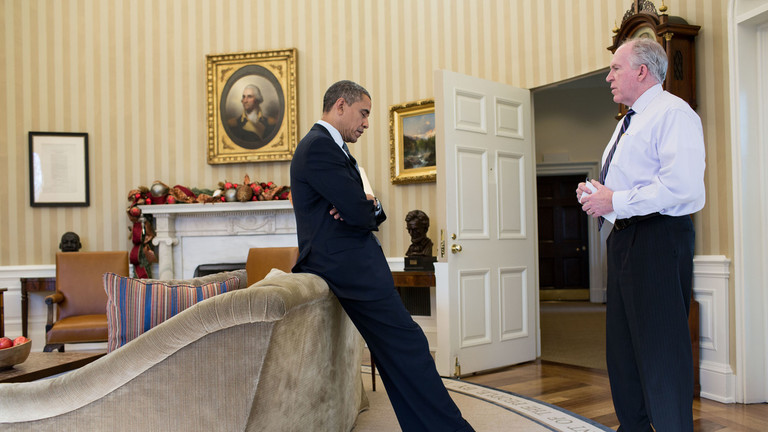
US President Barack Obama and CIA Director John Brennan, December 14, 2012 in Washington, DC. © Pete Souza / The White House via Getty Images
RT | February 14, 2024
The US intelligence community inappropriately used foreign allies to target Republican presidential candidate Donald Trump’s campaign to set up the ‘Russiagate’ conspiracy ahead of the 2016 election, according to a trio of investigative journalists.
Michael Shellenberger, Matt Taibbi and Alex Gutentag – of ‘Twitter Files’ fame – published the first part of an investigation on Tuesday, in which they claim the so-called ‘Five Eyes’ were operationalized against Trump staffers, citing anonymous sources close to the House Intelligence Committee.
According to their report, President Barack Obama’s CIA Director, John Brennan, had sent America’s partners – the UK, Canada, Australia, and New Zealand – a list of 26 Trump associates to target with data collection, misinformation and manipulation.
The Russiagate conspiracy involved multiple failures across western media networks to critically assess US intelligence claims that Russia had interfered in the 2016 US presidential election. A 2018 Pulitzer prize was awarded to Washington Post and New York Times journalists for their reporting on what was later to exposed as a false story.
“They were making contacts and bumping Trump people going back to March 2016,” said a committee source. “They were sending people around the UK, Australia, Italy — the Mossad in Italy. MI6 was working at an intelligence school they had set up,” the journalists claim.
Officially, the FBI only started looking into the Trump campaign that summer, after an Australian diplomat reportedly overheard an aide mention Russia. If confirmed, these findings would demonstrate that the US intelligence community had worked for months before that to set up just such a pretext.
In a statement to the investigative journalists, the FBI said it had made “missteps” in the 2016 and 2017 investigation of the Trump campaign, but has since implemented reforms to prevent it from happening again.
“The allegations that GCHQ was asked to conduct ‘wiretapping’ against the then president-elect are nonsense,” a spokesman for the British surveillance agency said. “They are utterly ridiculous and should be ignored.” Shellenberger, Taibbi and Gutentag said they had never asked the GCHQ about “wiretapping.”
According to Shellenberger, there is a “10-inch binder” containing previously unknown documents about the intelligence community’s surveillance of the Trump campaign. The 45th US president had ordered these documents declassified, but they went missing instead. In a Fox News appearance on Tuesday evening, Shellenberger suggested the FBI’s August 2022 raid on Trump’s Mar-a-Lago resort may have been related to the missing binder.
After the US intelligence community created a pretext for investigating Trump for ‘ties to Russia,’ they spied on his campaign – and then his presidency – using a falsely obtained FISA warrant. The warrant was based on the ‘Steele dossier,’ a file compiled by a British spy in the pay of Hillary Clinton’s campaign, through several intermediaries. The FBI knew the dossier was false as early as January 2017, but continued using the FISA warrant for almost a year thereafter.
The FBI lawyer who altered evidence to obtain the warrant, Kevin Clinesmith, ended up sentenced to probation and his law license has since been restored.
US ‘security threat’ revelations prompt panic
RT | February 14, 2024
The US is facing a “serious national security threat” that requires action from the White House, the head of the House Intelligence Committee said on Wednesday. The exact nature of the alleged threat has not been revealed.
Mike Turner, an Ohio Republican, has sent a letter to all members of Congress about an urgent matter “with regard to a destabilizing foreign military capability.” The House Intelligence Committee voted on Tuesday to make certain information available to lawmakers between Wednesday and Friday this week, he said.
Turner also called on President Joe Biden to declassify “all information relating to this threat.”
What exactly the threat might entail, Turner did not say. CNN cited two anonymous sources and an unnamed US official to claim it was “related to Russia.” One of the sources, who has allegedly viewed the intelligence Turner provided, described it as “a highly concerning and destabilizing” Russian capability “that we were recently made aware of.”
A Fox News correspondent cited a Pentagon source to claim the threat “has to do with space.”
Answering questions from reporters on Wednesday afternoon, National Security Advisor Jake Sullivan said he had been trying to schedule a meeting of top lawmakers for Thursday when Turner went public with the existence of the “threat.”
“I’m not in a position to say anything further from this podium at this time,” Sullivan said when asked about the alleged threat.
Numerous social media commentators have pointed out the uncanny coincidence that the supposed “security threat” was announced just after the US Senate passed a $95 billion foreign aid bill – about two thirds of which was earmarked for Ukraine – and amid the pressure on the House of Representatives to do the same. Turner is a vocal proponent of funding Kiev.
The White House and most US media outlets have consistently denigrated Russia’s military capabilities and insisted that Ukraine is “winning” the conflict thanks to the ongoing support of the West.
According to NSA whistleblower Edward Snowden, the alleged threat was announced because “the White House and Intel Committee felt a need to scare Members of Congress into line for a certain set of controversial pro-war and/or surveillance votes” that are coming up.
Beijing reacts to claim EU will target Chinese firms with Russia sanctions
RT | February 14, 2024
Beijing rejects “illegal sanctions” and will defend the interests of its companies, the Chinese Foreign Ministry has said following a report that the EU could blacklist some of the country’s firms for allegedly helping Russia to evade the bloc’s restrictions.
The EU is planning to place restrictions on three Chinese businesses and one Indian company as part of its 13th round of sanctions on Russia over its conflict with Ukraine, the Financial Times reported on Monday.
Brussels believes the firms in question are helping Moscow to circumvent existing restrictions, especially through the supply of electronic components that can be repurposed for use in drones and other weapons systems. If the plan is approved by member states, it will see the EU sanction companies from mainland China and India – two of the bloc’s key trading partners – for the first time.
”We are aware of the relevant reports,” the Chinese Foreign Ministry said in a statement on Tuesday. “China firmly opposes illegal sanctions or ‘long-arm jurisdiction’ against China on the grounds of cooperation between China and Russia.”
Chinese and Russian companies “carry out normal exchanges and cooperation and do not target third parties, nor should they be interfered with or influenced by third parties,” the ministry said.
Beijing “will take necessary measures to resolutely safeguard the legitimate rights and interests of Chinese enterprises.”
According to media reports, the EU was already considering sanctioning Chinese firms over their links with Russia last year, but refrained from doing so after Beijing assured Brussels that it was not supporting Moscow’s military effort in Ukraine.
Indian newspaper the Economic Times claimed on Wednesday that the government in New Delhi was also studying reports that an Indian firm could face sanctions over its dealings with Russia.
The Indian authorities may ask senior EU officials to clarify the situation during their meetings as part of the Raisina Dialogue forum on geopolitics and economy, which will take place in New Delhi next week, according to the outlet.
The paper’s source said it was “curious” that the report had emerged ahead of the high-profile event in the Indian capital.
Since the outbreak of the conflict between Russia and Ukraine in February 2022, both China and India have consistently called for a peaceful resolution of the crisis. Beijing and New Delhi have resisted Western pressure to join sanctions on Moscow, and instead have boosted economic cooperation with Russia, becoming the main destinations for Russian oil.
Chinese customs data shows that trade turnover between the two countries has grown by 26.6% percent in the past year, reaching a record $240 billion. The sales volume between Russia and India in the first ten months of 2023 stood at almost $55 billion, according to the Russian ambassador in New Delhi – an increase of 41% compared to 2022.
Tucker Slayed the Mainstream Media Dragon
By Ron Paul | February 12, 2024
There has been much written and said about Tucker Carlson’s interview with Russian President Vladimir Putin last week. As of this writing the video on Twitter alone has been viewed nearly 200 million times, making it likely the most-viewed news event in history.
Many millions of viewers who may not have had access to the other side of the story were informed that the Russia/Ukraine military conflict did not begin in 2022, as the mainstream media continuously reports, but in fact began eight years earlier with a US-backed coup in Ukraine. The US media does not report this because they don’t want Americans to begin questioning our interventionist foreign policy. They don’t want Americans to see that our government meddling in the affairs of other countries – whether by “color revolution,” sanctions, or bombs – has real and deadly consequences to those on the receiving end of our foreign policy.
To me, however, perhaps the most interesting aspect of the Tucker Carlson interview with Putin was the US mainstream media reaction. As Putin himself said during the interview, “in the world of propaganda, it’s very difficult to defeat the United States.” Even a casual look at the US mainstream media’s reporting before and after the interview would show how correct he is about that. In the days and weeks before the interview, the US media was filled with stories about how horrible it was that Tucker Carlson was interviewing the Russian president. There was the danger, they all said, that Putin might spread “disinformation.”
That Putin might say something to put his country in a better light was, they were saying, reason enough to not interview him. With that logic, why have journalism at all? Everyone interviewed by journalists – certainly every world leader – will attempt to paint a rosy picture. The job of a journalist in a free society should be to do the reporting and let the people decide. But somehow that has been lost. These days the mainstream media tells you what to think and you better not dispute it or you will be cancelled!
What the US mainstream media was really worried about was that the “other side of the story” might start to ring true with the public. So they attacked the messenger.
The CNN reporting on Tucker’s interview pretty much sums up the reaction across the board of the US mainstream media. Their headline read, “Tucker Carlson is in Russia to interview Putin. He’s already doing the bidding of the Kremlin.”
By merely doing what used to be called “journalism” – interviewing and reporting on people and events, whether good or bad – one is “doing the bidding” of the subject of the interview or report?
No wonder fellow journalist Julian Assange has been locked away in a gulag for so many years. He dared to assume that in a free society, being a journalist means reporting the good, the bad, and the ugly even if it puts those in power in a bad light.
In the end, the massive success of the Tucker Carlson interview with Vladimir Putin demonstrates once and for all that the American people are sick to death of their mainstream media propagandists and liars. They are looking not for government narratives, but for truth. That’s the really good news about this interview.
Tucker Carlson reviews Putin interview and reveals what ‘radicalized’ him
RT | February 12, 2024
Following his two-hour interview with Russian President Vladimir Putin in Moscow, US journalist Tucker Carlson opened up about his experience at the World Government Summit in Dubai.
In an hour-long interview with TV presenter Emad Eldin Adeeb, Carlson addressed why the conversation with Putin did not touch on certain topics, how the US political establishment had reacted to it, and why Washington has failed to understand Moscow, among other things.
Putin the diplomat
Carlson claimed that he had an off-the-record conversation with Putin after their interview, but would not reveal what was discussed, however.
Carlson did say that Putin seemed willing to negotiate with the West about both the end of the Ukraine conflict and a new balance of power in the world. Diplomacy is the art of compromise, and almost everyone “other than maybe the United States during the unipolar period” understands this, Carlson said. But while Putin wants the conflict to end, his position will only harden the longer it goes on, he added.
NATO and Russia
One of the major revelations in the interview for Carlson was that Russia had asked to join NATO – and while then-US President Bill Clinton seemed receptive, his aides pushed against the idea and it ultimately failed.
Since the entire point of NATO was to keep the Soviet Union out of Western Europe, Carlson said in Dubai, “if the Russians ask to join the alliance, that would suggest you have solved the problem and you can move on to do something constructive with your life. But we refused.”
“Go sit in the sauna for an hour and think about what that means,” he added.
The problem with Western politicians
Politicians in the West aren’t setting themselves “achievable” goals, Carlson has argued.
“I have heard personally US government officials say well we just have to return Crimea to Ukraine,” he said. “That’s not going to happen, short of a nuclear war. That’s insane, actually.”
Even bringing up this kind of idea “shows you are a child, you don’t understand the area at all, and you have no real sense of what’s possible,” the journalist concluded.
It’s always Munich 1938
According to Carlson, one of the biggest issues in the US and the West in general is the tendency to reduce everything to the 1938 Munich conference, at which Britain and France sought to “appease” Nazi Germany by giving it a portion of Czechoslovakia.
“The American policymaker historical template is tiny – in fact there’s only one – and it’s a 2-year period in the late 1930s, and everything is based on that understanding of history and human nature. That’s insane,” Carlson said.
How Moscow ‘radicalized’ him
Carlson pointed out that he’s 54 and grew up in an America that had nice, safe and beautiful cities, “and we no longer have them.”
It was “radicalizing” to see Moscow “cleaner, safer and prettier” than American cities, he said, or be reminded of that in Dubai and Abu Dhabi – while in the US, one can’t ride the subway in New York City because it’s dirty and unsafe.
“That’s a voluntary choice,” he said. “You don’t have to have crime, actually.”
Reacting to the backlash
Asked why he hadn’t raised certain topics with Putin, Carlson said he wanted to do the interview because he was interested in how the Russian leader saw the world – and not to inject himself into the discussion.
Most journalists who interview leaders the US dislikes tend to make it about themselves, Carlson added, and since he only cared about the approval of his wife and their children, he didn’t need to virtue-signal.
Asked to comment on former US presidential candidate Hillary Clinton calling him a “useful idiot” for Russia, Carlson laughed it off.
“She’s a child, I don’t listen to her,” he said. “How’s Libya doing?”
Kremlin comments on Starlink claims
RT | February 12, 2024
The Russian military never officially ordered SpaceX’s Starlink satellite internet terminals and they are not certified for use in Russia, the Kremlin has said. Spokesperson Dmitry Peskov made the comment shortly after Ukrainian intelligence claimed that Russian forces were using the technology amid the ongoing armed conflict between Moscow and Kiev.
SpaceX CEO Elon Musk donated some 20,000 Starlink terminals to Ukraine shortly after Russia launched its offensive against the country in February 2022. Ukrainian troops are using them to operate drones along the front line. However, the billionaire said last year that he had refused Ukraine’s request to activate the Starlink service in Crimea.
Speaking to reporters on Monday, Peskov noted that Starlink had never been certified in Russia, meaning that it “cannot be and is not being delivered here officially.” He added that, for this reason, the technology cannot be used in any official capacity in Russia.
The Kremlin’s representative concluded by saying that there was no point in Moscow getting involved in a “discussion between the Kiev regime and entrepreneur Musk.”
In a post on X (formerly Twitter) on Sunday, Musk lamented that “a number of false news reports claim that SpaceX is selling Starlink terminals to Russia.”
“To the best of our knowledge, no Starlinks have been sold directly or indirectly to Russia,” the SpaceX CEO added.
In a separate statement on Thursday, SpaceX insisted that it “does not do business of any kind with the Russian government or its military,” and has “never sold or marketed Starlink in Russia, nor has it shipped equipment to locations in Russia.”
Meanwhile, on Sunday, Ukraine’s Main Directorate of Intelligence (GUR) claimed to have intercepted a conversation between Russian military personnel, where one service member could be heard saying in Russian “Starlink is working, we have internet [access].”
GUR spokesman Andrey Yusov alleged that Russian troops are “systematically” using Starlink terminals.
In September, Musk said his company had refused to enable Starlink coverage over Crimea. “Now, the reason it was turned off was actually because… the United States has sanctions against Russia… and that includes Crimea,” he explained at the time. In the absence of any direct orders from the US leadership, SpaceX opted not to run afoul of the regulations despite Kiev’s request to do so, the entrepreneur noted.
Earlier, CNN reported that Musk’s decision had thwarted a Ukrainian drone attack against the Russian Black Sea Fleet.
Mainstream propaganda machine’s laughable meltdown over Putin interview
By Drago Bosnic | February 12, 2024
As expected, Tucker Carlson is getting a lot of flak for conducting his interview with Russian President Vladimir Putin. He’s not merely being accused of “spreading Russian propaganda” (he’s long been accustomed to that, as well as the mainstream propaganda machine’s obsession with all sorts of deranged “Russia, Russia, Russia” conspiracy theories), but there’s an actual push in the European Union to sanction Carlson. It seems journalists doing journalism is considered “heresy” by most other mainstream “journalists”. The Guardian’s Adam Gabbatt is unhappy that the interview was “neither a talk show nor a real conversation”, so he went on to parrot every propaganda trope in the book. Al Jazeera’s Mansur Mirovalev insists that Putin is “obsessed”, concluding his remarks by quoting a certain Valentin, the Kiev regime’s drone operator who allegedly complained that both Putin and Carlson are “conspiracy theorists” and that “Ukraine is real and it will prevail.”
In a piece published by Politico, a German-owned publication infamous for attempts to whitewash Nazism, Sergey Goryashko claimed that Putin supposedly “lied”. Among several propaganda claims he used to, as he says, “debunk” Putin’s points was that the Neo-Nazi junta frontman Volodymyr Zelensky “only signed a decree banning negotiations specifically with Putin, not Russia as a country”. Such ludicrous claims aren’t only false, but are even childish. Pushed by the United States, United Kingdom and NATO, the Kiev regime certainly broke the March 2022 peace deal that could have ended the special military operation (SMO) in less than a month. What’s more, it even publicly promotes its so-called “10-point peace plan” that boils down to Russia’s unconditional capitulation, a fantasy that the political West wholeheartedly supports and even promotes through some sort of absurd unilateral “peace talks”. In doing so, the Neo-Nazi junta effectively codified the impossibility of a peaceful settlement.
So much for Putin “lying”. However, that’s only the tip of the iceberg when it comes to frenzied attacks by the mainstream propaganda machine. In a piece for The New Yorker, Masha Gessen, the infamous “woke” ideologue obsessed with Putin, called the interview “boring”. She (although Gessen insists her pronouns are “they/them”, a request I earnestly refuse to comply with) obviously loathes historical facts, so the trouble she has with going through the entire interview, a problem most likely exacerbated by her two-second attention span (tends to happen to a lot of people staring at reels all day), perfectly explains her rather poor judgment of Putin’s points. Then came the “fact-checkers” such as Charlie Hancock of the Amsterdam-based Moscow Times who essentially repeated several of Goryashko’s long-debunked claims and added a few of his own. After all, what would the mainstream propaganda machine ever do without “fact-checkers“?
Of course, Hancock wasn’t the only one. The UK’s state-run BBC also published its own version, “fact-checking Putin’s nonsense history“. It would seem Masha Gessen isn’t the only one who skipped history classes in primary school, as the BBC’s Ido Vock quoted several self-styled “experts” and “pundits” to supposedly “debunk Putin’s rambling”, as he called it, clearly implying that he was also bored by the interview, which further indicates just how much he actually knows about the topic he covered for the UK’s state-run news agency. And of course, there’s also the Radio Free Europe/Radio Liberty (RFE/RL), claiming that Carlson’s Putin interview supposedly serves as a “propaganda platform”, which is quite rich coming from a literal CIA front formed to spread Washington DC’s state-sponsored propaganda. The Economist insists that “Russia’s president is not a man to be trusted, still less to emulate or admire”, because, luckily, they “know Putin’s real message” better than he himself does.
Newsweek’s Brendan Cole quoted Oleksandra Matviichuk, the Kiev regime’s “human rights activist”, who also slammed Carlson. Comically enough, Cole insists that Matviichuk’s opinion “matters” because she’s a Nobel Peace Prize winner. Is it even necessary to explain just how politicized that vaunted “peace prize” is when laureates include people like Barrack Obama and Al Gore? The Obama administration came to power criticizing the previous government run by George W. Bush for its aggression across the Middle East. Obama promised to end these wars, which is why he got the once-prestigious award in the first place. However, as soon as Bush left the White House, Obama expanded his aggression from two countries (Iraq and Afghanistan) to another five (Libya, Syria, Yemen, Somalia and Pakistan), seven in total. Worse yet, during Obama’s presidency (2009-2017), Washington DC launched ten times more airstrikes than under Bush, killing millions of innocent civilians in the process.
While the DNC-dominated media always try to whitewash Obama by shifting blame solely on Bush, it should be noted that the former personally authorized at least 6,000 drone strikes (approximately 2 per day during 8 years of his presidency), although the actual number may be orders of magnitude higher. So much for Obama’s contribution to “peace”. As for Al Gore, his active role in the Clinton administration’s war crimes and aggression on Serbia/former Yugoslavia requires an entirely separate analysis. However, as previously mentioned, this isn’t the end of the mainstream propaganda machine’s attempts to denigrate Putin’s interview with Carlson. The Associated Press (AP) insists that Russia’s president “missed the bigger picture”, so they felt the urge to “fill the gaps” with five points, composed largely of debunked propaganda tropes. And yet, these were expanded to nine in another piece by Politico, signed by Eva Hartog and, once again, Sergey Goryashko.
The key takeaway is that the mainstream propaganda machine is in meltdown over the interview, seen by hundreds of millions (if not billions at this point) on TV and across numerous Internet platforms. The political West is genuinely terrified of Putin’s global popularity, so the goal is to try and tarnish his reputation by twisting his remarks or simply telling outright lies about him. And while the interview may seem lengthy (by today’s standards), Putin simply had to get a lot of propaganda out of the way, as NATO and its Neo-Nazi puppets have been falsifying historical facts about Ukraine quite intensively, particularly in recent times, all in an attempt to show that the country supposedly has “nothing to do with Russia“. In that sense, websites such as Wikipedia have experienced an unprecedented number of edits with the goal of promoting these historically baseless claims. Putin is certainly aware of that, which is why he had to explain the complex history of the Ukrainian conflict.
Putin’s intellect and encyclopedic knowledge of history, law, intelligence and several other key fields are a massive boost to Russia’s already world-class diplomacy. This stands in stark contrast to the US and its current administration. Could anyone imagine Joe Biden giving an unscripted, two-hour-long interview to a foreign journalist, much less one conducted with near-scholarly precision? Regardless of whether one adores or loathes President Putin, the fact is that the increasingly unpopular and impotent leaders of the political West are simply no match for him, which is why we never see any of them giving remotely similar interviews to journalists of Tucker Carlson’s caliber. And while he might be among the most prominent journalists to ever interview Putin, Russia’s president is well-known for hours-long discussions with hundreds (if not thousands) of journalists from all over the world, without any papers, cliff notes or scripted questions. He simply doesn’t need them.
Drago Bosnic is an independent geopolitical and military analyst.
Prepare for conflict with Russia in five years – German general
RT | February 11, 2024
Germany should beef up its military to prepare for a potential conflict with Russia in five years’ time, Bundeswehr General Carsten Breuer has argued. He called for a “change in mentality” within German society, insisting that the nation needs to build credible deterrence.
In an interview with Welt am Sonntag published on Sunday, Breuer warned that Germany does not have “endless time” to become war-capable, claiming that the potential of a military confrontation with Moscow is at its highest since the end of the Cold War.
“If I follow the analysts and see what military threat potential comes from Russia, then it means five to eight years of preparation time for us,” he predicted.
Breuer, who serves as the Bundeswehr’s inspector general, claimed that “this doesn’t mean that there will be a war then. But it’s possible.”
The general also did not rule out the reintroduction of some form of mandatory military service in Germany. Breuer noted that the issue is still being discussed, but cited the “Swedish model,” which envisages mandatory military training for most citizens, who then become reservists.
Breuer’s comments come after German Defense Minister Boris Pistorius stated in November that the country must become “war-capable.” He insisted again in January that Berlin and the whole of NATO should arm itself more actively to be able to “wage a war that is forced upon us.”
However, the German defense chief noted last month that “at the moment, I don’t see any danger of a Russian attack on NATO territory or on any NATO partner-country.”
Also speaking in January, British Defense Secretary Grant Shapps claimed that “in five years’ time, we could be looking at multiple theaters [of conflict] including Russia, China, Iran, and North Korea.”
Elsewhere, Swedish Foreign Minister Tobias Billstrom stated last month that Stockholm “must be realistic and assume – and be prepared for – a drawn-out confrontation” with Moscow. Defense Minister Pal Jonson echoed that sentiment, saying that “war can also come to us.”
Commenting on claims that Russia might be planning an attack on NATO, Kremlin spokesperson Dmitry Peskov said in January that European officials were “inventing an external enemy” to divert attention from domestic problems.
Speaking at UN headquarters in New York the following day, Russian Foreign Minister Sergey Lavrov stressed that “no one wants a big war,” especially Moscow.
President Vladimir Putin has also repeatedly dismissed such speculation as “complete nonsense,” insisting that Moscow has “no geopolitical, economic… or military interest” in starting a conflict with NATO.
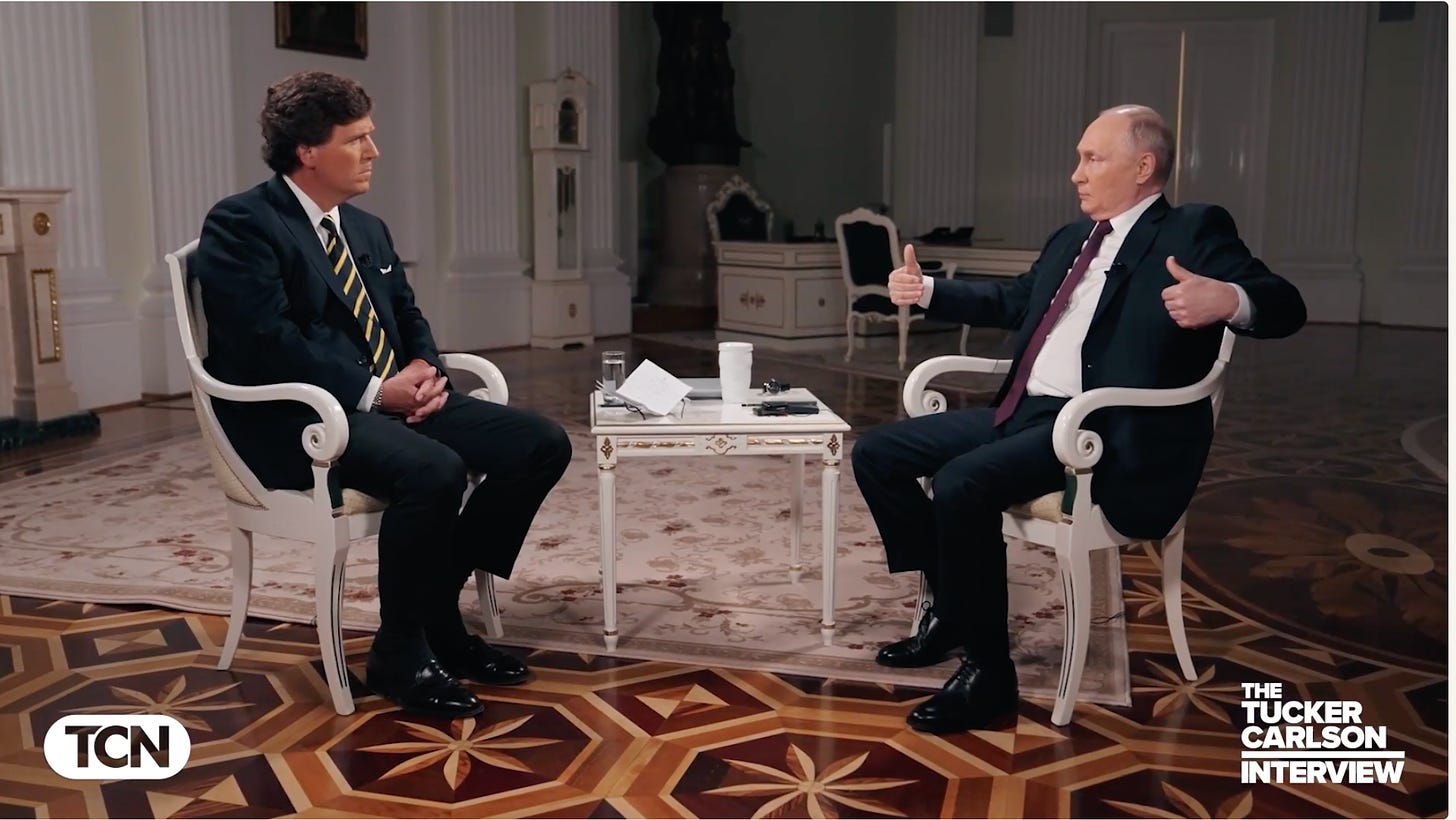
Tucker Carlson Interviews Vladimir Putin – Key Statements
BY JOHN LEAKE | COURAGEOUS DISCOURSE | FEBRUARY 9, 2024
The first thing that jumped out at me as I listened to the Tucker Carlson-Vladimir Putin interview is that Putin is 100 times more intellectually capable than President Joe Biden. No wonder Biden won’t take his call.
It says a lot that the terrible people who run the United States wanted to prevent Carlson from conducting the interview, and then to hinder it from being made available to the American public.
Many, including Carlson himself, expressed frustration that the Russian President began with a history lesson, going back to the founding of the Kievan Rus state in 882. I suspect this was Putin’s sly way of expressing a salient point that has long struck me about we Americans—namely, while our government is ever keen to send weapons and armies all over the world to police mankind, we find it onerous to sit through a 30-minute history lesson about the people and places we wish to control.
Russia is, in Churchill’s formulation, “a riddle, wrapped in a mystery, inside an enigma,” and it has always been governed by an authoritarian state. Nevertheless, with the collapse of the Soviet Union in 1991, there is plenty of evidence that Russia wished to cease living in a state of enmity with the United States.
To me, it seems clear it was the U.S. Military-Industrial Complex, and NOT Russia, that wished to maintain this state of enmity, for without it, there would be little justification for the U.S. government to spend hundreds of billions on weapons goodies such as the Lockheed Martin F-35 Lightning II—a program that started in 1995 and (if DoD accountants are to be believed) has cost U.S. taxpayers about 500 billion.
With Bill Clinton’s NATO expansion in 1997, no less of a Cold War eminence than George Kennan characterized this decision as a Fateful Error that would likely result in precisely the instability and insecurity it was purportedly supposed to prevent.
From the beginning of the Russian crisis that developed in the autumn of 2021—shortly after the Biden Administrations’s chaotic withdrawal from Afghanistan after a 20-year occupation that achieved nothing—I have suspected that administration and the terrible people who advise it did everything in their power to BAIT THE RUSSIAN BEAR into invading Ukraine.
The Administration did NOTHING to defuse the crisis, and it insulted the Russians by sending the imbecilic Kamala Harris to the Munich Security Conference on February 18, 2022. I suspect that an Austrian-style neutrality deal would have prevented the catastrophe that has apparently gotten hundreds of thousands killed. It has also seemed obvious to me that, since 2014, Ukraine has been the CIA’s favorite pet project.
To to this day, not a single person has been able to explain to me why Russia would consider tolerating Ukraine joining NATO. Since President Monroe outlined his foreign policy in 1823, the United States government has increasingly pursued a policy of zero tolerance of any foreign military alliances or installations in the entire Western Hemisphere.
And yet, this same United States government, which has invaded and bombed dozens of countries since 2001, claims it is perfectly reasonable to propose that Ukraine (whose northeastern border lies 370 miles from Moscow) join NATO. The distance from the Mexican border to Dallas is greater.
Key Putin statements in the interview are as follows:
- On the negotiation process and its failure: “[Talks] reached a very high stage of coordination of positions in a complex process, but still they were almost finalized. But after we withdrew our troops from Kiev… the other side threw away all these agreements.”
- On his last conversation with Joe Biden: “I talked to him before the special military operation, of course… I told him I believe that you are making a huge mistake of historic proportions by supporting everything that is happening there, in Ukraine, by pushing Russia away.”
- On the possibility of global conflict: “It goes against common sense to get involved in some kind of a global war and a global war will bring all humanity to the brink of destruction.”
- On Russia’s territorial ambitions: “We simply don’t have any interest [in Poland, Latvia, or anywhere else]. It’s just threat mongering.”
- Commenting on US Senate Majority Leader Chuck Schumer’s remark that the US has to continue to fund Ukraine or US soldier citizens could wind up fighting there, Putin said:
This was a provocation and a cheap provocation. Don’t you have anything better to do? You have issues on the border. Issues with migration, issues with the national debt. More than $33 trillion. Wouldn’t it be better to negotiate with Russia? Make an agreement. Already understanding the situation that is developing today, realizing that Russia will fight for its interests to the end. And realizing this, actually return to common sense, start respecting our country and its interests and look for certain solutions. It seems to me that this is much smarter and more rational. I do not understand why American soldiers should fight in Ukraine. There are mercenaries from the United States. The bigger number of mercenaries comes from Poland, with mercenaries from the United States in second place and mercenaries from Georgia in third place. Well, if somebody has the desire to send regular troops, that would certainly bring humanity to the brink of a very serious global conflict. This is obvious.
See complete interview on Tucker Carlson’s website:
Russia exit cost EU beer giant $5.9 billion

RT | February 8, 2024
The financial loss sustained by Danish brewing multinational Carlsberg Group due to its exit from Russia amounted to 40.8 billion Danish krone ($5.9 billion), according to the company’s full-year 2023 earnings report released on Wednesday.
Last year, the Russian authorities took temporary control of the local assets of the Copenhagen-based company, which used to operate Baltika Breweries. The move affected more than 99% of the shares within Baltika Breweries’ registered capital.
Prior to that, Carlsberg, which employed nearly 8,400 people in Russia, had been looking to sell the business amid intense international pressure on consumer brands to leave Russia in light of Moscow’s military operation in Ukraine.
The company’s local operations were handed over to the Russian Federal Property Management Agency, Rosimushchestvo. Carlsberg CEO Jakob Orup-Andersen later characterized the move as “stealing” the company’s business in Russia.
In October 2023, in response to the transfer, Carlsberg Group wrote down the entire value of its Russian business and terminated the agreements allowing its local subsidiary to produce, promote, and sell Carlsberg products.
The Russian brewer Baltika retaliated by filing a lawsuit to invalidate Carlsberg’s refusal to supply and license the Tuborg, Kronenbourg, Seth & Riley’s Garage, Holsten, and LAV brands. The court upheld Baltika’s claim, allowing it to continue to use the brands.
While the loss of Baltika pushed Carlsberg into a loss for the year, the Danish group reported a 4.7% increase in sales to 73.6 billion kroner ($10.6 billion), driven by price increases to offset higher costs due to soaring inflation.
White House denies ‘ridiculous’ Tucker Carlson claims
RT | February 7, 2024
Allegations that the administration of US President Joe Biden tried to stop journalist Tucker Carlson from interviewing Russian President Vladimir Putin are “ridiculous”, White House Press Secretary Karine Jean-Pierre said during a daily press briefing on Tuesday.
The former Fox News host interviewed Putin on Tuesday, the Kremlin has confirmed. Carlson however, has claimed that Washington has consistently attempted to block his overtures to the Russian president.
”Almost three years ago, the Biden administration illegally spied on our text messages and then leaked their contents to their servants in the news media. They did this in order to stop a Putin interview that we were planning,” he asserted. “Last month, we’re pretty certain they did exactly the same thing once again. But this time, we came to Moscow anyway.”
Asked about Carlson’s allegation, Jean-Pierre initially said she would “absolutely not” comment, but later changed her mind.
”It’s a ridiculous premise and a ridiculous statement that was made about this administration,” she said.
Carlson has claimed on several occasions that while trying to arrange a one-on-one with Putin, he found out from a source that his communications were being intercepted by US intelligence. He said his messages were quoted back to him verbatim, confirming the surveillance.
The NSA has denied targeting the journalist, but the Axios news website has partially corroborated his story, citing unnamed US government officials who said the government indeed had learned about his efforts to secure an interview with Putin. The outlet suggested that “US-based Kremlin intermediaries” contacted by Carlson had leaked the communications.
The journalist, how hosts a show on X (formerly Twitter) stated in his preview that the American media were failing to properly inform the public about the nature of the Ukraine conflict and the wider confrontation between the US and Russia. He said he had the backing of X owner Elon Musk, who vowed not to block the interview on his platform.
”Western governments, by contrast, will certainly do their best to censor this video on other, less principled platforms, because that’s what they do. They are afraid of information they can’t control” he predicted.
Featured Video

ARE PATIENTS BEING PROPERLY INFORMED ABOUT OZEMPIC?
or go to
Aletho News Archives – Video-Images
New Book
Breast Cancer: Before You Consent
A new Unbekoming paperback
Lies are Unbekoming | September 18, 2026
Peter Gøtzsche reviewed every randomised mammography screening trial ever conducted for the Cochrane Collaboration. Cochrane’s headline is that, assuming a 15% mortality reduction, one woman in 2000 avoids dying of breast cancer over ten years. Ten are overdiagnosed and treated. Two hundred experience false alarms.
But that headline assumes the reduction. When Gøtzsche looked only at the trials with adequate randomisation — the higher-quality ones — the reduction disappeared. No effect on breast cancer mortality. No effect on all-cause mortality.
This is the Cochrane finding, published in the establishment’s own database of systematic reviews.
No woman being asked to consent to a mammogram this week knows it.
That is why the new Unbekoming paperback exists. … continue
Blog Roll
 Aletho News
- ARE PATIENTS BEING PROPERLY INFORMED ABOUT OZEMPIC?
- US lawmaker blocks $2.8 billion weapons sale to Israel: Report
- Yemeni army claims responsibility for strikes on sensitive sites in Saudi capital, Aramco facilities in Yanbu
- Iran Judiciary issues indictments against 159 US, Israeli officials for assassination of Leader, commanders
- Turkiye revokes Iranian bank license under US sanctions campaign
- US-Denmark Agreement on Greenland Is ‘PR Stunt’ Ahead of Midterms
- Araghchi: Military intervention cannot create security; coercion cannot bring peace
- Fraud Squared
- Breast Cancer: Before You Consent
- Iran’s Plan to Shut Down AI in the Persian Gulf
- If Americans Knew
- Inside Gaza’s death trap of collapsing, bombed-out buildings
- The everyday items Israel bans from Gaza every day
- Inside the siege, the ruined buildings of Gaza – Daily Update
- Debunking The Claim That Macklemore Has A “History Of Antisemitism”
- CPJ demands release of arrested Palestinian-US journalist near Bethlehem
- Robert Kraft: The Billionaire Friend of Netanyahu Pulling The Strings Behind the Macklemore/Ed Sheeran Blow Up
- Columbia Administered Fund Gives Big Money to Pro-Israel Groups
- Deportation Case of Palestinian Activist Salah Sarsour Tests First Amendment
- ‘We Will Not Forget’: Palestinians Mark 44 Years since Sabra and Shatila
- Why do we let Zionists decide what we can and can’t say?
- No Tricks Zone
- New Study: ‘Global Drought Shows No Detectable Recent Acceleration Under Climate Warming’
- Economic Masterminds: German Socialists Suggest Taxing Productivity Gains Stemming From Using AI
- The South China Sea Has Not Been Cooperating With The Climate Change Narrative
- Energy Crisis: Germany Enters Heating Season With Historically Low Gas Reserve Fill Levels
- New Study: The Antarctic Ice Sheet Gained Mass From 2020-2024 Due To Staggering Snow And Ice Accumulation
- Study: Ocean Heating Rates From Thousands Of Years Ago ‘Dwarf’ Modern Ocean Heating Rates
- Climate Extremists Target, Attack Large-Scale Power Grid Infrastructure In Germany!
- New Study: Antarctic Ice Melt Has Contributed Less Than 1 Centimeter To Sea Level Rise In The Last 30 Years
- Fear Of Debate: Alarmist German Climate Scientist Calls On Mainstream Media To Discredit Skeptic Voices
- End-Of-August Arctic Sea Ice Extent Hasn’t Fallen In 20 Years, Official Data Show!
 Aletho News