"Own Nothing – be Happy" 😍🫂
feat. Klausi McSchwabbin' pic.twitter.com/oVLTVSVvtJ— Snicklink (@snicklink) September 26, 2023
Europe is suffering from ‘war psychosis’ in its unyielding military support for Ukraine: Hungary’s foreign minister
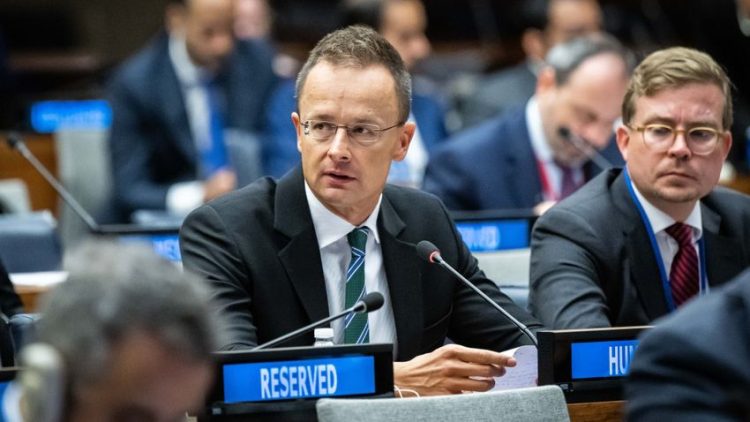
MAGYAR NEMZET | October 24, 2023
Instead of looking for ways to foster peace, the European Union’s current and planned actions only serve to extend the war, Hungarian Minister of Foreign Affairs and Trade Péter Szijjártó said after a meeting of the EU’s Foreign Affairs Council.
“It is all about war, there is no peace. Brussels is still pro-war, as shown by the fact that they would give €5 billion a year for arms over the next four years, which also shows that they expect the war to continue,” Szijjártó said. “No one in Western Europe is talking about peace, Europe is suffering from a war psychosis.”
He added that it is clear there will be no solution to the war on the battlefield. Europeans expect nothing but destruction and death, and the conditions for peace are getting worse.
“Taking arms production and training to Ukraine would drag the EU into an immediate war. We find this totally unacceptable. Nor should arms transfers be just about supplying the Ukrainians with as many weapons as possible, because the EU is not a security organization, and justifying a country’s future accession on security grounds is completely unacceptable,” Szijjártó added.
Energy sanctions are hurting Hungary, Szijjártó claimed
Speaking of the EU’s bans on Russian fossil fuels, Szijjártó said that Hungarians do not want to give up energy security in the name of some ill-defined ideals.
“On energy supplies: We didn’t talk nonsense by saying that it’s not a political issue, it’s a physical issue. We are not willing to risk the security of Hungary’s energy supply or the results of cuts in tariffs. Hungarians are not responsible for the war, we are not willing to make them pay for it,” he said.
The Hungarian foreign minister accused other member states of being covert about their dealings with Russia, unlike Prime Minister Viktor Orbán who has been honest and transparent through his recent meeting with Russian President Vladimir Putin in Beijing.
“My colleague, the Lithuanian foreign minister was blunt. He said that he expected me to clarify whether what is being said here is our own position or the Kremlin’s position. This is unacceptable to me. I reassured him that Hungary is a sovereign country with a sovereign opinion,” Szijjártó explained.
“As long as this government is in power, we are not prepared to accept any opinion from anywhere, from any geographical direction, whether there is a lot of water between us or not. I said to my Lithuanian colleague that I hope he can say the same thing with his hand on his heart,” he added.
US Treasury Deficit Doubles as Biden Bankrolls Multiple Foreign Conflicts
By James Tweedie – Sputnik – 23.10.2023
The US is going further into the red with as it arms its client states for a series of conflicts. Sergio Rossi, professor of macroeconomics and monetary economics at the University of Fribourg, Switzerland, said the strategies to avoid a default would only prove to be a “time-bomb.”
US President Joe Biden’s appeal for cash to arm Ukraine and Israel could meet resistance from Congress thanks to the runaway federal budget.
Treasury department figures released late last week showed the government deficit had hit almost £1.7 trillion, up from £1.37 trillion a year earlier, a 23 percent increase in the public debt — although lower than the $2.78 trillion left by the COVID-19 pandemic in 2021.
The news was worse than it sounded however. The 2022 deficit included the budget for Biden’s student loan repayment program, money that was never spent as the Supreme Court struck it down. The treasury then claimed those unspent public funds as a “saving” in 2023 — meaning the true deficit doubled from $1 trillion in 2022 to $2 trillion this year.
That news came a day before Biden asked Congress for a $106 billion emergency foreign military aid budget. The lion’s share, $61.4 billion, is earmarked for Washington’s proxy conflict with Russia in Ukraine, while another $14.3 billion is to arm Israel for its latest attempt to destroy the Hamas movement in the besieged Gaza Strip.
That request dwarfs the $77 billion in arms and cash gifted to the Kiev regime since the start of Russia’s de-Nazification operation in February 2022.
Economist Sergio Rossi told Sputnik that the mounting deficit would make it harder for Biden to persuade Congress to approve his $100 billion budget request for more arms to Ukraine and Israel “in light of the problematic economic situation and outlook for the US stakeholders, namely, households, firms, and a variety of financial institutions.”
“Usually, when the domestic economic situation worsens, these stakeholders and their political supporters reduce the volume of foreign aid, to focus on supporting their own national economy first of all,” Rossi said.
He said the funding the conflict in Ukraine — while preparing for a Pacific showdown with China over Taiwan — had already put too much strain on Washington’s finances before the Palestinian Hamas movement launched a surprise attack into southern Israel.
“The US government cannot continue financing two military conflicts, particularly if the latter will continue without any foreseeable peaceful agreement before long,” Rossi stressed. “There are already signs that the political consensus for such a financial support is diminishing across the US economy, notably where both the labour and the product markets are in a difficult situation for a number of middle-class workers and several small or medium-sized firms.”
The state of the US economy was “worrying,” he said, and the outlook for the next two years was “even worse,” thanks to “global macroeconomic issues related to different geopolitical problems.”
The “mushroom” of ensuing inflation has badly affected consumer purchasing power. “As a result, firms’ investment is discouraged, both because of this inflationary pressure and the Fed’s repeated increases in the policy rates of interest.”
“The US economy is even closer to a recession than it was one year ago,” Rossi warned, although “there is no potential risk of a default of the US federal government.”
He pointed out that Congress could simply raise the public debt ceiling and the US Federal Reserve could buy up government bonds as an effective loan.
“This, however, is a time bomb that eventually can burst, particularly once some viable and credible alternative to the US dollar will emerge across the global economy,” Rossi said. “The BRICS community could provide such an alternative in a not-too-distant future.”
German MP announces formation of new anti-establishment party

RT | October 23, 2023
Germany will have a new left-wing political grouping in 2024 after prominent Left Party MP Sahra Wagenknecht announced the formation of her own party. Its platform will include the normalization of relations with Russia and a peace-oriented foreign policy.
Wagenknecht broke the news during a press conference in Berlin on Monday, saying she and fellow Left Party defectors had “decided to establish a new party.” Explaining the need for a new political force, she argued that things “can’t continue like this” or Germans “will probably not recognize our country in ten years.”
The politician plans for the new party to run candidates in regional elections in the eastern regions of Saxony, Thuringia and Brandenburg, as well as in the European Parliament election next year.
A fresh poll commissioned by Bild am Sonntag indicated that some 27% of Germans would not rule out voting for Wagenknecht’s new political force.
Until the party’s official formation at the start of 2024, Wagenknecht and nine other Bundestag colleagues who resigned from the Left Party said they wished to keep their current seats. Party leadership has, however, already indicated that the defectors could lose their mandates much earlier. In September, Wagenknecht hinted at her plans to branch out, claiming that many Germans felt that none of the existing political forces represented their views.
Not long after that, the “Sahra Wagenknecht Alliance – for reason and justice” was registered with the aim of laying the groundwork for the establishment of a new party. The politician clarified that the Left Party had, in her opinion, become increasingly irrelevant. She also blasted Chancellor Olaf Scholz’s government on Monday as the “worst government in the history of the federal republic.”
Wagenknecht said she would seek to preserve Germany’s “economic strengths” as well as work toward more social justice. With respect to foreign policy, Berlin should switch to diplomacy rather than weapons deliveries when dealing with conflicts, the politician insisted.
She has been a vocal critic of Scholz’s policies toward Moscow over the Ukraine conflict, arguing that the current approach risks leading to a global, and potentially nuclear conflict. Berlin, according to Wagenknecht, should assume the role of a peacemaker.
Commenting previously on the EU’s anti-Russia sanctions, the politician has repeatedly claimed that the punitive measures are doing more harm to the German economy than to the Russian one, and thus should be lifted.
Wagenknecht is also a prominent critic of the European Union’s “elite project” and NATO, and argues for more independence for national states.
Chinese Businessmen Literally Laughing at West’s Anti-Russian Sanctions

By Ilya Tsukanov – Sputnik – 21.10.2023
Chinese businessmen are literally laughing at the West’s sanctions packages against Russia, Russian Foreign Ministry spokeswoman Maria Zakharova has revealed.
Citing a media report from Friday indicating that the 12th package of EU sanctions may include a Lithuania-proposed ban on the export of European-made nails, tacks, drawing pins, sewing and knitting needles, radiators, and other odds and ends to Russia, Zakharova said that judging by past experience, she can hardly fathom how Russia’s Chinese partners will react to the news.
“A year ago I was at a meeting with representatives of Chinese business circles in Moscow. We were talking, and suddenly a message popped up on my phone with news that the US had adopted yet another sanctions package banning the supply of elevators and related equipment to Russia. According to the sanctions’ authors, this measure would ‘paralyze the construction industry in Russia.’ When I read this news to my Chinese colleagues, they burst out in Homeric laughter. They literally howled and roared with laughter,” Zakharova recalled in a Telegram post on Saturday.
“After the ‘sanctions hara-kiri’ of the Japanese automobile industry on the Russian market, the most incredible dream of Chinese automotive manufacturers came true. Within six months, they confirmed the veracity of the saying ‘nature abhors a vacuum’,” the spokeswoman added.
“It’s scary to imagine what kind of hysteria will begin among Chinese manufacturers of knitting needles and buttons if they learn about this Lithuanian plan to ‘destroy Russian industrial capabilities.’ Where will Lithuania put its wares if such a decision is made? I don’t know, they could put the inscription ‘to spite Russia’ on their highway made of buttons, nails, sewing and knitting needles,” Zakharova summed up.
Russian-Chinese trade has hit back-to-back-to-back record highs in recent years, reaching the equivalent of over $176 billion by the end of the third quarter of the current year. The Asian industrial giant has taken to importing record quantities of Russian energy and other natural resources, and has helped fill the gap left by European and Japanese finished goods manufacturers after their exodus from Russia in 2022.
Speaking with Chinese media ahead of his visit to the Belt and Road Initiative forum earlier this week, Russian President Vladimir Putin reported a “32 percent growth” in Russia-China trade turnover over the past year, and said that “there is every reason to believe that we will reach the $200 billion mark” by the end of 2023.
The reorientation of trade from Europe to China, India and other countries in the developing world has helped Russia weather the storm of Western sanctions and trade restrictions, with the country’s GDP growth expected to reach up to 2.5 percent in 2023 after contracting by 2.1 percent a year earlier.
Senators Bob Menendez and Ben Cardin Play Musical Chairs
One arch interventionist replaces another to lead the Senate Foreign Relations Committee
BY PHILIP GIRALDI • UNZ REVIEW • OCTOBER 10, 2023
Many Americans have come to accept that corruption and lying is the name of the game in Washington and, increasingly, at both state and local levels of government, in part because lying and stealing by those who run the country has become virtually consequence free. To cite only one example, the current ruinously expensive war against Russia began when the US and other NATO powers lied to Mikhael Gorbachev about their intentions regarding expansion of the “defensive” alliance into Eastern Europe. They then lied again in 2014 with the Minsk Accords, which were supposed to give some measure of autonomy to the Russian ethnic regions of Ukraine in the Donbas, an apparent concession that served as cover for arming and training the Ukrainian Army. Finally, the US and its friends arranged for regime change in Ukraine in 2014 to replace the friendly-to-Russia President Viktor Yanukovych with a pro-western candidate selected by the fanatical State Department neocon Victoria Nuland, who boasted how Washington had spent $5 billion to bring about the flip in government. That move warned Russian President Vladimir Putin regarding what was going on so he quickly annexed Russian ethnic majority Crimea, where the Russian Black Sea Fleet is based.
Driving all the US led aggression against Russia is the neocon foreign policy embraced by most of the two major political parties which demands that the United States have military superiority over all competitors everywhere around the world where it has interests or allies. That has meant by one count something like 1,000 foreign military bases. By way of comparison, Russia has only one overseas base, in Syria. And the maintenance of all those bases as well as the network of installations inside the US costs lots of money which fattens defense contractors and also winds up in the pockets of aspiring politicians while increasing the national debt to unsustainable levels. And it is no surprise to learn that when generals and admirals retire from active service, 80% of them wind up employed by contractors to lobby their former colleagues on the latest weapons systems that are so urgently required to maintain supremacy.
The recent exposure of Senator Bob Menendez of New Jersey’s apparent tendency to accept bribes in exchange for various kinds of favorable treatment and protection was a particularly lurid tale in part because much of the loot consisted of $480,000 in cash stuffed into jacket pockets, closets and in a safe, along with 13 gold bars, two of them marked as 1 Kilogram in weight to the value of more than $100,000. In the garage was an upscale $60,000 Mercedes-Benz convertible that was a gift to Menendez’s then girlfriend, who had wrecked her own vehicle in an accident in which she had struck and killed a pedestrian. The car came from one of the New Jersey businessmen currently involved in the corruption and bribery investigation and no one can quite explain how an accident in which someone had died was never properly investigated by police. Menendez had allegedly helped the businessman by arranging to block a criminal investigation into his company’s activities.
Menendez is indeed a powerful senator even though there is more than a whiff of suspicion surrounding him and his activities. A Cuban American who is prominent in the Hispanic caucus, he was regarded as a political hardliner from his bully pulpit as Chair of the Senate Foreign Relations Committee. In 2015, Menendez was indicted on federal corruption charges but the jury was unable to reach a verdict, and the case was dropped in 2018. In April 2018, the United States Senate Select Committee on Ethics “severely admonished” Menendez for accepting gifts from donor Salomon Melgen without obtaining committee approval, for failing to disclose certain gifts, and for using his position as a senator to advance Melgen’s interests. This time around, however, the evidence for wrongdoing is much more compelling and it even involves a foreign country, Egypt, so he has resigned his chairmanship but has refused to leave the Senate. He claims he is innocent, of course and continues to promote Biden’s view of the world, to include identifying the “core American foreign policy values” as “democracy, human rights, and the rule of law” even though it does not apply to him. And, of course, as a Cuban that worldview includes perpetual hostility to Havana and all its works, including its links to Russia.
Bob Menendez is up for reelection in 2024, but opinion polls taken just after the reports of his corruption surfaced indicate that he has no chance of winning against several Democrats who will challenge him. He will certainly receive some favorable press and significant campaign donations as he’s long been linked to Jewish lobbying groups like AIPAC and is closely aligned with Israel on foreign policy issues to include opposing in 2015 the President Barack Obama nuclear deal with Iran, asserting falsely that Iran is already working on a nuclear weapon. In March 2017, Menendez co-sponsored the Israel Anti-Boycott Act (S.270), which sought to make it “a federal crime, punishable by a maximum sentence of 20 years imprisonment, for Americans to encourage or participate in boycotts against Israel and Israeli settlements in the occupied Palestinian territories.” More important perhaps, Menendez has twice advanced legislation through his committee supporting Ukraine in its war with Russia, so the White House will presumably do everything it can to protect him, but only up to a certain point.
Menendez has been replaced by Senator Ben Cardin of Maryland, who will not be running for re-election in 2024. Cardin, who is Jewish, is a strong and consistent supporter of Israel, like Menendez, and an outspoken critic of Vladimir Putin of Russia. He was a co-sponsor of a Senate resolution expressing objection to the UN Security Council Resolution 2334, which condemned Israeli settlement building in the occupied Palestinian territories as a violation of international law. Cardin warned that “Congress will take action against efforts at the UN, or beyond, that use Resolution 2334 to target Israel.” Cardin also voted with Republicans to support President Donald Trump’s decision to recognize Jerusalem as Israel’s capital. He declared that the time that “Jerusalem is the capital of the State of Israel and the location of the US Embassy should reflect this fact.” Cardin and Senator Rob Portman of Ohio, like Menendez, were strong supporters of the proposed Israel Anti-Boycott Act in late 2018, described above, and they also called for a sanctions mechanism to punish international organizations that seek to boycott Israel or its illegal settlements.
Oddly, Cardin has sometimes been credited with being a “human rights advocate,” a label which the Palestinians and others might object to. The claim is based on his authorship of US legislation referred to as the Magnitsky Act. According to Cardin and his allies in Washington, Sergei Magnitsky was a Russian lawyer hired by Bill Browder head of Hermitage Capital Management Fund, an Anglo-American investment fund operating in Moscow, to investigate the apparent diversion of as much as $230 million in taxes due to the Russian government. Hermitage was a hedge fund that was focused on “investing” in Russia, taking advantage initially of the extremely corrupt loans-for-shares scheme under Boris Yeltsin, and then continuing to profit greatly during the early years of Vladimir Putin’s ascendancy. The loans-for-shares scheme that made Browder his initial fortune has been correctly characterized as the epitome of corruption, an arrangement whereby foreign investors worked with local oligarchs to strip the former Soviet economy of its assets paying pennies on each dollar of value. Along the way, Browder was reportedly involved in making false representations on official documents and bribery. Nevertheless, by 2005 Hermitage was the largest foreign investor in Russia.
Magnitsky allegedly became a whistleblower after discovering that the missing money had been stolen by the police, organized crime figures and other government officials. After he went to the authorities to complain he was unjustly imprisoned for eleven months. When he refused to recant he was both beaten and denied medical treatment to coerce him into cooperating, resulting in his death in jail at age 37 in November 2009. He has become something of a hero for those who have decried official corruption in Russia.
The Magnitsky case is of particular importance because both the European Union and the United States have initiated sanctions against the Russian officials and entities that were allegedly involved. In the Magnitsky Act, sponsored by a Russia-phobic Cardin and signed by President Barack Obama in 2012, the US asserted its willingness to punish foreign governments for violations of human rights. Russia reacted angrily, noting that the actions taken by its government internally, notably the operation of its domestic judiciary, were being subjected to outside interference. It reciprocated with sanctions against US officials as well as by increasing pressure on foreign non-governmental pro-democracy groups operating in Russia. Tension between Moscow and Washington increased considerably as a result and Congress subsequently passed the so-called Global Magnitsky Act as part of the defense appropriation bill in 2016. It was signed into law by President Barack Obama in December. It expanded the use of sanctions and other punitive measures against regimes guilty of egregious human rights abuses though it has never been applied to US friends like Saudi Arabia and Israel. It has been used to punish China and Cuba. It was also sponsored by Senator Cardin and was clearly primarily intended to intimidate Russia.
The tit-for-tat that has severely damaged relations with Russia is based on the standard narrative embraced by many regarding who Magnitsky was and what he did, but is it true? Many now believe that there was indeed a huge fraud related to Russian taxes but that it was not carried out by corrupt officials. Instead, it was deliberately ordered and engineered by Browder with Magnitsky, who was an accountant not a lawyer, personally developing and implementing the scheme used to carry out the deception.
To be sure, Browder and his international legal team have presented what they regard as evidence in the case. But while it might be that Browder and Magnitsky have been the victims of a corrupt and venal state, it just might be the other way around. To cite only one example, much of the case against the Russian authorities is derived from English language translations of relevant documents provided by Browder himself. The actual documents in Russian sometimes say something quite different.
So there we go again. As the wheel turns in Washington nothing really changes. Benjamin Cardin as Chairman of the Senate Foreign Affairs will promote the same policies of unrelenting hostility towards countries like Russia and China as did his recently resigned predecessor Bob Menendez. And as fighting between Israel and Gaza has just broken out, you can count on how the United States will line up even as hundreds of Palestinian children die as a powerful Israel pummels and pounds and largely civilian population in Gaza. Those are the sorts of things that American citizens can count on these days, unfortunately.
Philip M. Giraldi, Ph.D., is Executive Director of the Council for the National Interest, a 501(c)3 tax deductible educational foundation (Federal ID Number #52-1739023) that seeks a more interests-based U.S. foreign policy in the Middle East. Website is councilforthenationalinterest.org, address is P.O. Box 2157, Purcellville VA 20134 and its email is inform@cnionline.org.
Heinous Choreography of Village Massacre as Zelensky Begs for More Weapons at EU Summit
By Finian Cunningham | Strategic Culture Foundation | October 8, 2023
The horrific missile strike on a Ukrainian village in which 52 people, including a young boy, were killed in a cafe was widely reported by Western media with strident condemnations of a Russian “war crime”.
All the American and European media reports relied solely on Ukrainian security sources for their immediate attribution of the massacre to Russian forces. It was claimed that a Russian Iskander missile hit the village of Hroza (Groza).
Russia did not make any comment on the specific accusations, simply repeating that its military does not deliberately target civilian centers.
The carnage on Thursday, October 5, occurred at the very same time that Ukrainian President Vladimir Zelensky was addressing a summit in Granada in Spain attended by European Union leaders. Zelensky referred to the missile strike in highly emotive language, condemning it as “Russian genocidal aggression”. EU leaders joined in the denunciation of Russia.
The BBC quoted Zelensky as saying the act “couldn’t even be called a beastly act – because it would be an insult to beasts”.
The purpose of Zelensky’s attendance in Granada was to make a renewed appeal for European NATO members to supply more air defence systems to Ukraine. It was reported that Spain pledged to send the U.S.-made HAWK system to Ukraine.
Zelensky also told European leaders that the political turmoil in the United States over the abrupt Congressional cutting off of financial aid to Ukraine was a “dangerous situation”.
The Biden White House referred to the missile strike on the village of Hroza as a reminder to U.S. lawmakers why continued military aid to Ukraine is essential.
As several Western media reports acknowledged, the targeted village with a population of around 300 did not have any military or tactical value. It is located around 17 miles (27 kms) from the front line between Ukrainian and Russian forces in the Kharkiv region.
The victims of the explosion were attending a funeral for a Ukrainian soldier. If Russia fired a missile it would have been for a depraved reason, as the Western media and politicians like Britain’s Prime Minister Rishi Sunak were quick to allege.
On the other hand, cynical as it might seem, for the Kiev regime there was a big incentive to stealthily carry out the missile strike against its territory for the propaganda value of blaming Russia. The timing comes at a crucial moment when the Kiev regime is “freaking out” over the possible long-term cutting off of military aid by the U.S. and its NATO partners.
Such a false-flag provocation carried out by the Kiev regime has precedent, albeit not reported by the Western media.
Last month, on September 6, the U.S. Secretary of State Antony Blinken arrived in Kiev with an additional $1 billion in military and financial aid. Hours before Blinken arrived, the city of Konstantinovka (Kostiantynivka) was hit by a missile killing 17 people. The city is located in territory under the control of the Armed Forces of Ukraine (AFU).
That atrocity was similarly condemned as “Russian terrorism” by Ukrainian President Zelensky while he was hosting Blinken in the capital.
Like the attack on Hroza last week, the one on Konstantinovka was immediately blamed on Russia and reported widely as such by Western media.
It turned out, however, that the missile that hit Konstantinovka was not fired by Russian forces. A follow-up report by the New York Times on September 18 found that the warhead had been fired from AFU positions. The NY Times described it as an “errant missile” that slammed into a busy marketplace by mistake. Nevertheless, despite the evidence, the Kiev regime continues to blame Russia for the crime.
There is good reason to conclude that the missile atrocity on September 6 was not “an error” but rather was deliberately staged by the Kiev regime as a false-flag provocation to highlight the visit by the senior American diplomat, Antony Blinken, and the need for his weapons gifting.
For those who don’t rely on the Western media for their information, it is well-documented that the NeoNazi Kiev regime has a foul habit of staging massacres for propaganda. The Bucha massacre last March was one such macabre event. This was when several civilians were found executed, their bodies strewn on streets, supposedly after Russian forces retreated from the city. All Western media blamed the apparent executions on Russia and continue to do so. But the freshness of the corpses found days after Russian troops pulled out of Bucha proves that the killings were done by others, probably Kiev agents.
Another probable false flag was the missile strike on a railway station in the city of Kramatorsk on April 8, 2022, that killed 63 people. Again, Russia was roundly blamed and condemned by Western media and politicians taking their cue from Ukrainian official sources. In that incident, the missile was later identified as a Tochka-U not in regular use by Russian forces, but more likely used by the AFU.
The Kramatorsk atrocity came on the day that European Commission President Ursula von der Leyen was visiting Kiev, condemning it as “despicable” and vowing tens of billions more Euros in support for the Kiev regime.
The Ukraine war has become an obscene racket for profiteering by the U.S. and European military industries, their lobbyists and most of the Western politicians they have close sponsorship links to, like Blinken and Von der Leyen. It is also a money-spinner for the corrupt Kiev regime whose President Zelensky and other cronies have made up to $400 million in skimming off aid, as reported by Seymour Hersh citing Pentagon sources. This rampant corruption was why the Kiev regime sacked most of its defence officials last month in a desperate attempt to appear as if it were cleaning up the graft.
Western public fatigue and disgust with the war racket are growing and imperilling the continuation of the colossal scam. False-flag atrocities are a logical, heinous way to keep the racket on track.
Europe worried that US support for Ukraine waning
By Ahmed Adel | October 6, 2023
Dutch Defence Minister Kajsa Ollongren made a shocking statement at the Warsaw Security Forum by emphasising the strategic importance of arming Ukraine as a cost-effective means of containing Russia when responding to questions about the sustainability of US and allied support for Kiev given the political turbulence in Washington.
“Of course, supporting Ukraine is a very cheap way to make sure that Russia with this regime is not a threat to the NATO alliance. And it’s vital to continue that support,” she said. “It is very much in our interest to support Ukraine, because they are fighting this war, we are not fighting it.”
Responding to the shocking admittance that NATO only views Ukraine as a “very cheap way” to contain Russia, Kremlin spokesman Dmitry Peskov said on October 5 that Ukrainians would soon “stop liking” how they are seen and used by the West.
“[The West does not hide its intention to fight to the last Ukrainian and continues to use Ukraine] as cheap soldiers,” the spokesman said when commenting on Ollongren’s recent statement that it was vital to continue to support Ukraine. “[Soon, Ukrainians will begin to hear such statements] in a different light for themselves” and “they will stop liking it.”
Mentioning developments “overseas,” referring to the US, Ollongren said it is “worrying and also I think we have to address that worry.”
“We cannot pretend that we’ll just wait and see how the American elections are going,” she said before highlighting that if Washington’s support for Ukraine falls, that would be “substantial.”
Her concern about the situation in the US comes as a survey by the Chicago Council on Global Affairs, published on October 4, found that 47% of Americans believe the US should support Ukraine for as long as necessary, a drop from 58% in July 2022; support for providing economic and military assistance to Ukraine has dropped from 78% in March 2022 to 61% in September 2023; and, support for sending US troops to Ukraine dropped from 36% in March 2022 to 26% in September 2023.
According to the survey, “There have been dips in support, which is not surprising given that both the length of the conflict and the extent of the US financial contribution have likely exceeded Americans’ initial expectations.”
“Americans express less confidence now than in previous surveys that Ukraine is doing better than Russia on the battlefield. Now only 14 percent of Americans say Ukraine has the advantage in the war, compared with 26 percent in November 2022,” the Chicago Council on Global Affairs report added.
US President Joe Biden has long been confident that Congress would continue to provide billions of dollars in support to Ukraine, even as the situation becomes increasingly tense in a divided Washington. The last agreement was only to avoid a collapse of the American government. However, it should not last long as it became clear how unpredictable Washington can be in its negotiations to support Ukraine as it continues encountering serious difficulties.
To avoid the collapse of the government, on September 30, a decision to leave Ukraine out of the budget was made, demonstrating that the situation is not only delicate but there is also great pressure from critics of the support given by Biden to Kiev. The challenge now, especially for the Europeans, is that a politically polarised America extends to foreign policy.
Despite all the domestic financial problems, the US continues to allocate huge funds to Ukraine. Since February 2022, Kiev has received more than $110 billion from Washington. This means that the “very cheap way” to fight Russia is turning out to be very expensive, as demonstrated by the fact that the government of the world’s greatest superpower almost shut down.
The removal of House Speaker Kevin McCarthy from the US Congress only worsens the already troubled process of Washington’s military and financial aid for Ukraine as its counteroffensive against Russia grinds on with little change to the frontlines. This is significant because, without a Speaker, the House cannot pass legislation, throwing Washington’s military backing for Kiev into doubt since it could be another week or more before a successor is elected.
Although Ukraine is not a “very cheap way” for NATO to fight Russia, the statement by Ollongren provides a fascinating insight into how the Atlantic bloc views the beleaguered Eastern European country – nothing more than an expendable proxy weaponised against its far larger and more powerful neighbour.
Ahmed Adel is a Cairo-based geopolitics and political economy researcher.
Ukraine’s backers blinded by Russia hate – top analyst
RT | October 5, 2023
Kiev’s globalist and neo-conservative supporters in the West are so driven by their hatred of Russia that they completely disregard the hundreds of thousands of Ukrainians who are dying in a futile effort to defeat Moscow’s forces, US public policy analyst Jeffrey Sachs has argued.
Sachs, an award-winning economist who advised the Russian and Ukrainian governments following the breakup of the Soviet Union, made his comments in an interview posted on Thursday by US podcast host Andrew Napolitano. Asked how the US and its NATO allies can ignore the catastrophic destruction of Ukraine while prolonging the conflict and making false claims of battlefield successes, Sachs said they are “blinded” by their hatred of Russia.
“They are not counting the Ukrainian dead,” the analyst said. “They have lied to the public all along about the military situation . . . . They want so much to fight Russia and have someone else do the fighting and the dying that they want another massive recruitment of the remaining Ukrainian young men that can be grabbed off the streets and be thrown into the killing fields.”
More than 83,000 Ukrainian troops have been killed during a Donbass counteroffensive that began in June, according to an estimate released by the Russian Defense Ministry last month. Despite knowing that the Ukrainians have no chance of making major gains on the battlefield amid Russia’s air superiority and artillery dominance, Kiev’s benefactors have shown a “grotesque” disregard for the heavy casualties, Sachs said. He argued that the UK, in particular, has championed the counteroffensive because of London’s centuries-long and deeply embedded desire to crush Russia.
Sachs, now a UN adviser and director of the Center for Sustainable Development at Columbia University, has argued that NATO’s expansion into Eastern Europe helped trigger the current crisis. He said Washington and its allies missed many opportunities to avoid the current conflict, then kept it going by discouraging Ukrainian President Vladimir Zelensky from finalizing a peace deal with Russia in March 2022.
Responding to claims by former US Secretary of State Hillary Clinton that critics of Washington’s Ukraine policy are “siding with” Russian President Vladimir Putin, Sachs argued that he’s showing concern for the Ukrainian people. “I don’t want Ukraine to be completely destroyed by these neocons, by their fantasy world, by their desire to throw Ukrainians by the hundreds of thousands to their deaths,” he said. He added, “This isn’t siding with Putin or siding with anybody. This is trying to protect Ukraine from American zealots.”
Sachs claimed that US President Joe Biden must reach out to Putin to negotiate an end to the bloodshed, which would involve ruling out adding Ukraine to NATO, as well as addressing Russia’s legitimate security concerns. “We have stoked so much provocation in this, so much anxiety, overthrowing governments, starting multiple wars, pushing NATO enlargement, abandoning nuclear agreements, and then saying, ‘Oh, he doesn’t want to negotiate,’” the analyst said.
Netherlands sued for stopping ship deliveries to Russia
RT | October 4, 2023
The largest Dutch shipbuilder is seeking compensation from the government for damage caused by the sanctions on Russia, which have prevented it from honoring a number of contracts.
The ongoing legal battle, which started in May with a suit filed by Damen Shipyards Group at the district court in Rotterdam, was revealed by Bloomberg on Tuesday. Company spokesman Rick van de Weg later confirmed the pending proceedings to other media outlets.
Damen is a 90-year-old Gorinchem-based family-owned business which builds various types of vessels, from warships to luxury yachts. Days before the hostilities in Ukraine erupted in February last year, the company delivered a dredger to Russia for duty in the Arctic, according to Bloomberg.
Sanctions banning most business transactions with Russia, which the EU imposed in retaliation for the conflict, have prevented Damen from fulfilling its obligations under several contracts. It has also suspended its engineering branch in the country.
The Western sanctions supposed to cripple the Russian economy and force Moscow to concede defeat in Ukraine have not been as efficient as their architects had hoped.
The G7 oil price cap, a mechanism intended to force Russia to sell crude at or below $60 per barrel, does not appear to be working, US Treasury Secretary Janet Yellen admitted last week. Russian Deputy Prime Minister Aleksandr Novak stated on Tuesday that the impossibility of enforcing the price cap was apparent to Moscow from the start.
The EU’s decision to decouple from cheap Russian gas undermined the competitiveness of its heavy industries, in some cases forcing energy-intensive manufacturing to shut down.
Nevertheless, Germany is likely still consuming natural gas originating in Russia, Uniper CEO Michael Lewis said last week. The German wholesaler buys liquified natural gas in the open market and cannot be certain about where it comes from, he explained.
EU Incites Ukrainian Conflict and Stigmatizes Peace Talks – Hungarian Foreign Minister
Sputnik – 03.10.2023
BUDAPEST – The world outside Europe does not share its position on the Ukraine conflict and does not understand European double standards applied to conflicts in other parts of the planet, Hungarian Foreign Minister Peter Szijjarto has said.
“I can say that the world outside Europe is already really looking forward to the end of this war, because they do not understand many things. They do not understand, for example, how it can be that when a war is not in Europe, the European Union, looking down with fantastic moral superiority, calls on the parties to peace, advocates negotiations and an immediate end to violence. However, when there is a war in Europe, the European Union incites the conflict and supplies weapons, and anyone who talks about peace is immediately stigmatized,” Szijjarto said in an interview on Monday.
He also said that other countries do not understand why Europe “has made this conflict global” and why people living in Asia, Africa and Latin America have to pay for it due to growing inflation, energy prices and unstable food supplies.
Szijjarto added that Hungary’s position on the issue is treated with “great respect” outside the EU, which he was witnessing more than once during the UN General Assembly.
Hungary has consistently opposed sanctions on Russian energy resources and sending weapons to Ukraine since the beginning of the Russian military operation in Ukraine in February 2022. The Hungarian parliament issued a decree banning the supply of weapons to Ukraine from the country’s territory. Szijjarto explained that Budapest seeks to secure the western Ukrainian region of Zakarpatye, where ethnic Hungarians live, since the supply of weapons through its territory would become a military target for Russia. The country’s leadership has repeatedly emphasized that Hungary stands for the earliest possible start of peace negotiations.
American Meddling Failed To Prevent Robert Fico’s Victory In The Latest Slovak Elections
BY ANDREW KORYBKO | OCTOBER 1, 2023
The “Direction-Social Democracy” (SMER) party of former Prime Minister Robert Fico emerged victorious after Slovakia’s latest elections on Saturday in spite of Russia’s Foreign Intelligence Service (SVR) warning before the vote that the US will go to any lengths to prevent that outcome. Nobody should have been surprised by that since CNN’s reporting made it obvious that Washington wanted him to lose. Here are three of their articles fearmongering about his democratically driven return to office:
* “A NATO country could soon have a pro-Russian leader”
* “With Kremlin apologist leading the polls, Slovakia vote threatens country’s support for Ukraine”
* “Pro-Russian politician wins Slovakia’s parliamentary election”
The reason why America meddled in this election is because it fears both the substance and symbolism of a hitherto stalwart NATO vassal defecting from the bloc’s anti-Russian proxy war coalition. Fico previously condemned the West’s role in provoking and perpetuating this conflict exactly as neighboring Hungarian leader Viktor Orban has done since the get-go. Just like him, Fico is also against arming Ukraine and could prevent others’ weapons from transiting across his country as well.
He’ll still need to form a governing coalition in order to make good on his promises, but few doubt that he’ll be able to. Assuming that’ll happen, then Slovakia will join Hungary in creating a center of anti-war gravity in the heart of both the EU and NATO, which complements Poland’s newly cautious stance towards this proxy conflict brought about by its dispute with Ukraine. These three could then form an influential force if the latter’s ruling “Law & Justice” (PiS) party wins re-election on 15 October.
Poland remains much more committed to this conflict than Hungary and post-election Slovakia, but there’s also no denying that the Polish people are incredibly offended at Ukraine’s ungratefulness. A critical mass of them might therefore vote for the anti-establishment Confederation party to protest PiS’ prior appeasement of Kiev up until recently despite that regime’s glorification of those who genocided Poles. If enough do so, then PiS might be compelled to form a coalition government with Confederation.
In that case, Poland might move closer towards Hungary and Slovakia’s position, which could inspire average Europeans to follow these countries’ lead during their own upcoming elections. The demonstration effect that was set into motion by Slovakia and which might soon manifest itself in Poland is therefore regarded by the US as a strategic challenge for good reason. That doesn’t justify its failed meddling in the latest Slovak elections, but simply places its motives into the appropriate context.
The fact that the CIA still failed to prevent Fico’s re-election dispels three popular myths, first and foremost that agency’s omnipotence. The second is foreign voters’ alleged inability to defy the American government’s will, the false perception of which has been exploited to suppress anti-establishment turnout. And finally, the Ukrainian Conflict is truly unpopular in some countries despite the media’s claims to the contrary and its crazed efforts to artificially manufacture support for this proxy war there.
With these symbolic outcomes in mind as well as the substantive changes to Slovak policy that are likely to follow its latest election, not to mention their possible impact on Poland in the coming future and the rest of Europe after that, the failure of America’s meddling campaign is a major development. It’s premature to describe it as a game-changer, but it still suggests a potentially impending inflection point in the Ukrainian Conflict, provided of course that the CIA doesn’t successfully sabotage related trends.
Featured Video

ARE PATIENTS BEING PROPERLY INFORMED ABOUT OZEMPIC?
or go to
Aletho News Archives – Video-Images
New Book
Breast Cancer: Before You Consent
A new Unbekoming paperback
Lies are Unbekoming | September 18, 2026
Peter Gøtzsche reviewed every randomised mammography screening trial ever conducted for the Cochrane Collaboration. Cochrane’s headline is that, assuming a 15% mortality reduction, one woman in 2000 avoids dying of breast cancer over ten years. Ten are overdiagnosed and treated. Two hundred experience false alarms.
But that headline assumes the reduction. When Gøtzsche looked only at the trials with adequate randomisation — the higher-quality ones — the reduction disappeared. No effect on breast cancer mortality. No effect on all-cause mortality.
This is the Cochrane finding, published in the establishment’s own database of systematic reviews.
No woman being asked to consent to a mammogram this week knows it.
That is why the new Unbekoming paperback exists. … continue
Blog Roll
 Aletho News
- The Truth About the Trump Shootings with Ken Silva
- ARE PATIENTS BEING PROPERLY INFORMED ABOUT OZEMPIC?
- US lawmaker blocks $2.8 billion weapons sale to Israel: Report
- Yemeni army claims responsibility for strikes on sensitive sites in Saudi capital, Aramco facilities in Yanbu
- Iran Judiciary issues indictments against 159 US, Israeli officials for assassination of Leader, commanders
- Turkiye revokes Iranian bank license under US sanctions campaign
- US-Denmark Agreement on Greenland Is ‘PR Stunt’ Ahead of Midterms
- Araghchi: Military intervention cannot create security; coercion cannot bring peace
- Fraud Squared
- Breast Cancer: Before You Consent
- If Americans Knew
- Inside Gaza’s death trap of collapsing, bombed-out buildings
- The everyday items Israel bans from Gaza every day
- Inside the siege, the ruined buildings of Gaza – Daily Update
- Debunking The Claim That Macklemore Has A “History Of Antisemitism”
- CPJ demands release of arrested Palestinian-US journalist near Bethlehem
- Robert Kraft: The Billionaire Friend of Netanyahu Pulling The Strings Behind the Macklemore/Ed Sheeran Blow Up
- Columbia Administered Fund Gives Big Money to Pro-Israel Groups
- Deportation Case of Palestinian Activist Salah Sarsour Tests First Amendment
- ‘We Will Not Forget’: Palestinians Mark 44 Years since Sabra and Shatila
- Why do we let Zionists decide what we can and can’t say?
- No Tricks Zone
- New Study: ‘Global Drought Shows No Detectable Recent Acceleration Under Climate Warming’
- Economic Masterminds: German Socialists Suggest Taxing Productivity Gains Stemming From Using AI
- The South China Sea Has Not Been Cooperating With The Climate Change Narrative
- Energy Crisis: Germany Enters Heating Season With Historically Low Gas Reserve Fill Levels
- New Study: The Antarctic Ice Sheet Gained Mass From 2020-2024 Due To Staggering Snow And Ice Accumulation
- Study: Ocean Heating Rates From Thousands Of Years Ago ‘Dwarf’ Modern Ocean Heating Rates
- Climate Extremists Target, Attack Large-Scale Power Grid Infrastructure In Germany!
- New Study: Antarctic Ice Melt Has Contributed Less Than 1 Centimeter To Sea Level Rise In The Last 30 Years
- Fear Of Debate: Alarmist German Climate Scientist Calls On Mainstream Media To Discredit Skeptic Voices
- End-Of-August Arctic Sea Ice Extent Hasn’t Fallen In 20 Years, Official Data Show!
 Aletho News