How to fight for Covid truth

By Guy Hatchard | TCW Defending Freedom | May 6, 2023
The writer is in New Zealand.
Every day brings more news of extreme efforts to promote biotech vaccines and cancel those asking questions.
For example Dr Mark Tykocinski, an immunologist with a spotless academic record who is president of Thomas Jefferson University in Philadelphia may be about to lose his job. His sole mistake appears to be liking tweets by former New York Times journalist Alex Berenson who questions vaccine safety.
British MP Andrew Bridgen has been expelled from the Conservative Party. According to Bridgen, a senior UK politician has privately admitted to him that he may well be right about Covid vaccine harms, but said the government is expecting to suppress public information about Covid vaccine adverse effects for the next 20 years, citing ‘lack of political appetite’ for a public disclosure.
Statistician Professor Norman Fenton was locked out of his Twitter account following a complaint that he had broken German law by claiming Covid data manipulation was creating the appearance of vaccine efficacy, when in fact there was none. The German government is the main sponsor of BioNTech, the co-creator of the Pfizer mRNA Covid vaccine. Fortunately the complaint was not upheld and Fenton was reinstated.
Te Whatu Ora (Health New Zealand) has announced that from May 1, pregnant people (!) aged 16 to 29 years can now get an additional Covid-19 booster. They don’t seem to have noticed that stillbirths and miscarriages rose following the Covid vaccine rollout, or the absence of any data to confirm ‘safety’ assurances for pregnant women – quite the reverse, in fact.(See this article.) Is it possible that the NZ government have a lot of boosters left over after a poor response to their latest bivalent vaccine campaign and are now trying to offload them via deceptive advertising to mothers who naturally want to do the best for their child?
Highly vaccinated Portugal has seen a 73 per cent rise in emergency callouts for heart attacks. This mirrors the 83 per cent rise in heart attack hospitalisation in Wellington, NZ.
The continuing attacks from the media and vaccine advocates mean that some people must be seriously worried that the scientific data about vaccine harms is beginning to resonate with a wider audience. We are winning the argument.
Last week I reported correspondence from our Minister of Statistics Dr Deborah Russell MP in which she downplayed the significance of rising excess deaths in New Zealand. This appeared to be the result of misinformed policy rather than real statistics. Does the New Zealand government, in line with the UK, wish to hide Covid vaccine adverse effect statistics from the public until it becomes a matter of distant history? You tell me.
Should we be protesting on the streets?
In fact both the vaccinated and unvaccinated have been injured by government policy and experimental biotechnology. Even the pro-vaccine, pro-zoonotic origin NY Times has conceded that evidence is mounting that Covid came from a lab leak. We have a common cause.
It would certainly suit those who wish the pandemic gravy train and the biotech boom to continue, if the population were to remain polarised and the adverse effects hidden. At this time, it is my belief that launching ad hominem attacks, participating in lawful protests or expressing violent sentiments (never a good idea) will simply play into the hands of those from the media, corporates, medical professions and governments who are hoping that public concern can continue to be managed, marginalised and cancelled.
But this doesn’t mean remaining silent, we should be raising our voices and using our pens. I do believe we should always talk rationally and factually about issues that matter. This is an election year in New Zealand, when there is a higher chance of being heard. We can talk to candidates and demand answers, or even become candidates. In an election year, politicians know that all votes will matter. We can raise a voice of reasoned intelligence, express ourselves calmly, cite research, and send letters to our politicians. Politicians cannot find papers to back their views; published research is now firmly on our side of the debate. Our points cannot be dismissed.
Again and again I come back to ‘knowledge matters’. It might still be possible to nip dictatorial control in the bud before it gains more traction.
Scientists Against Science: RCTs Which Give the Wrong Answer on Masks Are “the Worst Way to Answer the Question”
BY DR ROGER WATSON | THE DAILY SCEPTIC | MAY 5, 2023
Paradigm shifts in science are rare, but it seems we may have just had one. The RCT (randomised controlled trial), an experimental method used to test if medical procedures and drugs work, has long been considered the gold standard method of establishing the relationship between cause and effect. But it may just have been knocked off its perch and usurped by a new approach to seeking evidence.
Based on the first such study by James Lind in 1774 when he rid the Royal Navy of scurvy, the method in its simplest form involves giving one group of people a treatment and withholding it from another group and seeing if the treatment group fares better than the other (control) group. There is no evidence that Lind randomised the sailors on which he tested lemons as a cure for scurvy; randomisation, to avoid bias in who does and who does not receive treatment, was introduced much later. There are many modern variations on the theme of the RCT but, essentially, they are all designed to achieve the same thing.
As an experimental method for trying to settle whether treatments worked, the clinical trial took a while to catch on with the first RCT being published in 1948. Until that time, what was purported to work was based on power and opinion and, therefore, largely on who said it. Other, weaker designs based on observation and correlation abounded but, eventually, were superseded by the RCT.
Of course, not every RCT produces the same results due to an annoying phenomenon called ‘regression to the mean’ whereby observed effects are often obtained one day and inverse effects are obtained on another day. To account for regression to the mean, it is considered necessary to combine the results of similar studies to be able to pinpoint, at any time, where the true effect lies. Thus, the science of meta-analysis arose which does precisely that and the most rigorous repository of such analyses is considered to be the Cochrane Collaboration.
Well, forget all the above. It seems we have been following the wrong lines of investigation — especially when it comes to the use of face masks to prevent the spread of respiratory infections (e.g. COVID-19) — and that we should simply have asked the experts what they thought all along. In view of what we have witnessed in the past few years, what could possibly go wrong?
I may be doing them a disservice, but that is my interpretation of a recent article in STAT of May 2nd titled: ‘Do masks work? Randomised controlled trials are the worst way to answer the question.’ STAT is a newsletter that purports to be “Reporting from the frontiers of health and medicine” and the authors of the article are Baruch Fischhoff, Howard Heinz University Professor in the Department Engineering and Public Policy and Institute for Politics and Strategy Carnegie Mellon University, Martin Cetron an infectious disease epidemiologist who has worked for the CDC and Katelyn Jetelina, an epidemiology, data scientist, and science communicator who publishes a Substack, Your Local Epidemiologist.
Such is their faith in experts (and I assume they see themselves as such), with respect to RCTs on the use of face masks they “believe that many of these studies should never have been done at all, reserving resources for studies that could improve health outcomes”. The recent pair of Cochrane meta-analyses of studies on the use of face masks concluded that:
Pooled results of RCTs did not show a clear reduction in respiratory viral infection with the use of medical/surgical masks. There were no clear differences between the use of medical/surgical masks compared with N95/P2 respirators in healthcare workers when used in routine care to reduce respiratory viral infection.
Our paradigm-shifting team is not impressed, however: “Both meta-analyses have been widely misinterpreted as showing that face masks don’t work.” I cannot be certain but, had the Cochrane review shown a positive result regarding the use of face masks, my guess is that they would have been proclaiming that from the rooftops.
With apologies for lengthy quotes, they also say that:
What if it is so difficult to conduct scientifically sound randomised trials of mask wearing that even the best studies reveal little? Such studies can confuse people who want to know how effective face masks are, while emboldening people who are already completely convinced that face masks are ineffective — and are looking for grounds to sow doubt about them.
Clearly they see themselves as being above the misinterpretation of data to satisfy their own predilections; being “convinced” can work both ways.
With reference to the much-quoted and much-maligned DANMASK study where the difference observed between mask mandates and no mask mandates was “not statistically significant”, they conclude — presumably as the outcome, inconveniently, did not fit their prejudices – that “The designs of most clinical trials are too weak to answer the question that they pose — namely, whether an intervention succeeded”. Plus: “RCTs have value only when researchers can be sure that the treatment is administered as intended.” Perhaps they meant to say: “RCTs have value only when they show us what we want to see.” Besides, knowing whether an intervention works in practice rather than when done perfectly is valuable information from a public health point of view.
However, they do not leave us with no hope and inform us that: “Today, we have strong evidence regarding the effectiveness of face masks in the form of laboratory studies, theoretical analyses and RCTs that involved health care personnel. It has not come from RCTs of face masks distributed to the general public.” They do not trouble us ignoramuses with any details of this strong evidence, unless their hypertexted link to some words in an earlier sentence are meant to do the job. I guess they did not expect many people to go past the various subsequent links to read the material. It is fascinating stuff. The link eventually enables the explorer to download a ‘Rapid Expert Consultation on the Effectiveness of Fabric Masks for the COVID-19 Pandemic (April 8th 2020)’. This is a document written by experts which relates a series of studies on the likely effectiveness of face masks. No method is applied to the selection of studies which show a 100% publication bias. They have all been ‘cherry-picked’ to show exactly what the authors want them to show: that face masks could work.
Conveniently, the authors of the STAT article fail to refer to Cochrane reviews of precisely the kind of studies they advocate. A 2015 review of studies titled ‘Gloves, gowns and masks for reducing the transmission of meticillin‐resistant Staphylococcus aureus (MRSA) in the hospital setting’ concluded: “The effects of gloves, gowns and masks in these circumstances have yet to be determined by rigorous experimental studies.” In a 2016 review of studies titled ‘Disposable surgical face masks for preventing surgical wound infection in clean surgery’, the authors concluded: “From the limited results it is unclear whether the wearing of surgical face masks by members of the surgical team has any impact on surgical wound infection rates for patients undergoing clean surgery.”
Naturally, readers of the Daily Sceptic have the humility to admit that absence of evidence is not conclusive – though a null result from an RCT is not really absence of evidence but evidence of absence within the bounds of the trial’s limitations. In these circumstances, is it acceptable to impose a costly, polluting and potentially harmful intervention on the public? I think not.
Dr. Roger Watson is Academic Dean of Nursing at Southwest Medical University, China. He has a PhD in biochemistry.
The climate scaremongers: How the ‘world disaster’ figures lie
By Paul Homewood | TCW Defending Freedom | May 5, 2023
According to AP last year:
‘A disaster-weary globe will be hit harder in the coming years by even more catastrophes colliding in an interconnected world, a United Nations report issued Monday says. If current trends continue the world will go from around 400 disasters per year in 2015 to an onslaught of about 560 catastrophes a year by 2030, the scientific report by the United Nations Office for Disaster Risk Reduction said. By comparison from 1970 to 2000, the world suffered just 90 to 100 medium to large scale disasters a year, the report said.
‘The number of extreme heat waves in 2030 will be three times what it was in 2001 and there will be 30 per cent more droughts, the report predicted. It’s not just natural disasters amplified by climate change, it’s Covid-19, economic meltdowns and food shortages. Climate change has a huge footprint in the number of disasters,’ report authors said.’
The UN report included this graph, showing how the number of disasters were now five times as high as in the 1970s:

https://www.undrr.org/media/79595
Last week it was the turn of the World Meteorological Organisation (WMO) to bang the climate change drum. Their State of the Global Climate 2022 report commented: ‘From mountain peaks to ocean depths, climate change continued its advance in 2022 . . . Droughts, floods and heatwaves affected communities on every continent and cost many billions of dollars. While greenhouse gas emissions continue to rise and the climate continues to change, populations worldwide continue to be gravely impacted by extreme weather and climate events.’
The WMO is, of course, a UN body, so unsurprisingly this report has little to do with science and everything to do with politics.
But have natural disasters become so much more common in recent years? A closer look at that graph above reveals that the number of disasters has actually been declining since 2000, a fact which should immediately cast doubt on the ‘global warming is making everything worse’ meme.
The real reason for the ‘increase’ is that many natural disasters in years past were never officially logged in the UN database, called EM-DAT, which is compiled by CRED, the Center for Research on the Epidemiology of Disasters. The database was not created until 1998, and CRED relied on informal reports for disasters prior to that year.
CRED has acknowledged that many events were missed by them in the past. In their 2006 report, they warned that earlier data was incomplete and should not be used for comparing long-term trends. In particular, over the past 30 years development in telecommunications, media and increased international cooperation has played a critical role in the number of disasters reported. In addition, increases in humanitarian funds have encouraged reporting of more disasters.
In fact the unreliability of the database in earlier years is much worse than we thought. Take a look, for example, at the official data for the number of deaths from floods in the UK:

https://ourworldindata.org/natural-disasters
Now look again, and see if you can spot what is missing. Yes, the North Sea floods in 1953, recognised as one of the worst natural disasters ever to hit Britain, and which left 307 dead on the east coast alone. The death toll in 1952, by the way, reflects the Lynmouth disaster, which killed 34.
How any supposedly reputable database can omit an event like the 1953 flood and still claim to be credible is beyond me. Other bad flooding events have also been missed, such as those in Somerset in 1968 which killed 15 people.
Flooding events in the UK have been thoroughly recorded as far back as the 19thC and beyond. If CRED cannot even get accurate data for the UK, what chance is there of compiling full and accurate data for the rest of the world?
The truth about the looming energy shortage
UK FIRES is a five-year research programme funded by £5million of government money, a collaboration between the universities of Cambridge, Oxford, Nottingham, Bath and Imperial College London. Its job is to look at what Net Zero means in practical terms for the economy.
The researchers have a habit of revealing the harsh realities of Net Zero which are deliberately hidden from us by the government and its advisers. For instance, in their 2019 report, called Absolute Zero, they calmly informed us that we would all have to drive less, use less energy, and stop eating beef and lamb. All UK airports except for Heathrow, Glasgow and Belfast would have to close by 2030, and those three would also have to go by 2050. All shipping to and from Britain would have to be phased out as well.
Their report on the construction sector last November told us that no bricks, cement or glass would be allowed in our bright new future. Instead we would have to make do with recycled materials, along with stone, earth and timber. A sort of cross between Fred Flintstone and Mad Max!
Their latest analysis came out last month, looking at the prospect for UK energy supplies under current emission reduction targets. The government has pledged to reduce emissions by 68 per cent from 2018 levels by 2035.
According to UK FIRES, to do this we need to be constructing 14GW of low carbon generation every year until 2035, whereas the current rate is only about 2GW. (They do not tell us, by the way, how we can build wind farms and nuclear plants without cement and steel!)
One problem is that it is now taking more than 20 years to build a large nuclear power station. It seems unlikely therefore that we will see Sizewell C before the 2040s, even if contracts were signed today.
According to UK FIRES, they have been pointing out this energy shortfall for a while, but government and the civil service prefer to stick their heads in the sand. Not that UK FIRES are concerned either, because they just want us to drastically cut the amount of energy we use instead.
Over the next eight years, they say, we must cut our car mileage by a fifth, consume a third less beef, lamb, milk and cheese, replace millions of gas boilers with heat pumps, and spend tens of billions that we have not got on insulating our homes.
Industry must halve its use of construction materials, such as cement and steel, and shut half of the county’s blast furnaces. With all this and more, we will be able to reduce the country’s energy use by 30 per cent. All in the next eight years; after that it really gets tough!
For years, successive governments, along with the Committee on Climate Change, other advisers, and the complicit media, have lied to us, pretending that we could chart a path to Net Zero without any real cost or consequences. Thanks to UK FIRES, we are beginning to get a glimpse of the truth. And the public will be horrified and extremely angry when they discover they have been duped.
FDA Approves First RSV Vaccine, But Some Experts Say Weak Safety, Efficacy Data Suggest Benefits Don’t Outweigh Risks
By Michael Nevradakis, Ph.D. | The Defender | May 4, 2023
Describing it as a “long-sought scientific achievement,” the U.S. Food and Drug Administration (FDA) on Wednesday approved Arexvy, the first vaccine for respiratory syncytial virus (RSV).
GlaxoSmithKline Biologicals (GSK) developed Arexvy under the FDA’s Priority Review designation. The FDA approved it for people ages 60 and older.
According to CNBC, the U.S. “suffered an unusually severe RSV season” this past winter. The New York Times reported on a “tripledemic” involving RSV, flu and COVID-19, “that swamped children’s hospitals and some I.C.U. wards.”
One U.S. county — Orange County, California — declared a local health emergency and issued a proclamation of local emergency in November 2022, citing rising RSV cases among children in the region.
GSK described results from clinical trials for Arexvy as “positive,” and the company said the U.S. launch of the vaccine is planned before the 2023-24 RSV season.
Other RSV vaccines, including one produced by Pfizer, are in the pipeline and expectations are that the FDA will approve them.
During clinical trials for both the GSK and Pfizer vaccines, several participants were diagnosed with rare conditions such as Guillain-Barré syndrome (GBS) and acute disseminated encephalomyelitis (ADEM). One of the individuals who developed ADEM later died, according to the FDA.
Aside from concerns over potential serious adverse events related to RSV vaccines, some experts have questioned the need for such a vaccine in the first place.
According to the journal Science, “RSV is a common respiratory infection” with symptoms “similar to a cold,” adding that “The majority of individuals recover within a few days from an uncomplicated RSV infection, although occasionally the virus can cause lower respiratory infections requiring medical attention.”
Dr. Peter McCullough, a cardiologist, told The Defender:
“Respiratory syncytial virus is a negligible threat to even the most frail elderly adults. The effort of widespread vaccination is simply not worth it. Even rare side effects will outweigh any theoretical benefit.”
And in a November 2022 episode of “RFK Jr. The Defender” podcast, several medical and public health experts expressed concerns about RSV vaccines.
“We have to stop these shots,” said Dr. Meryl Nass, an internist and biological warfare epidemiologist. “It’s just extraordinary that we’re still vaccinating people … we have a lot of work to do.”
Robert F. Kennedy Jr., then-chairman and chief litigation counsel for Children’s Health Defense (now chairman on leave), described RSV as “a vehicle for re-implementing the COVID-19 playbook all over the country and responding with vaccines.”
And according to the National Vaccine Information Center (NVIC), “Cost analysis data presented to the ACIP [Advisory Committee on Immunization Practices] did not show the RSV vaccines to be cost-effective at reducing the burden of costs associated with RSV illness.”
Nevertheless, more RSV vaccines are expected to receive FDA approval this year — including a Pfizer RSV vaccine for pregnant women that led to a high incidence of adverse events for both the women and their infants during clinical trials, as well as several deaths and stillbirths.
Arexvy approval ushers in new ‘highly competitive and lucrative vaccine market’
The RSV vaccine market is estimated to be worth up to $10 billion by 2030.
According to Endpoints News, the FDA’s approval of Arexvy ends “half a century of failed efforts against the elusive, shape-shifting virus” and “officially start[s] what analysts expect will be a highly competitive and lucrative new vaccine market.”
In getting Arexvy approved, “GSK beat a crowded field of competitors to cross the finish line first.”
Arexvy “showed strong efficacy in stopping lower-respiratory tract infections as well as more severe disease” and will be administered as a single dose, according to Endpoints News.
STAT reported that a “vaccine that was developed by Pfizer and aimed at the same demographic [adults 60 and over] is expected to be approved by the end of the month,” while other RSV vaccines and therapeutics, including some intended for children and pregnant women, are in the pipeline and also are close to receiving FDA approval.
The FDA’s approval of Arexvy came after an FDA advisory panel reviewed data from GSK’s and Pfizer’s clinical trials on March 1. The panel unanimously agreed that GSK’s vaccine is effective and, in a 10-2 vote, deemed it “safe,” according to The Washington Post.
The same panel also approved Pfizer’s candidate vaccine, Abrysvo, but with a 7-4 vote.
On June 21 or 22, ACIP, which advises the Centers for Disease Control and Prevention (CDC), will convene to “make recommendations on the appropriate use of the vaccine in the U.S.,” according to GSK’s announcement. The ACIP must recommend the vaccines before they are marketed.
According to STAT, there is a likelihood that ACIP may not approve Arexvy for its intended age group, stating:
“Though Arexvy’s approval is for adults 60 and older, it remains to be seen if the CDC will recommend it for that entire group.
“At an advisory committee meeting in February, members of a work group studying the adult vaccines that will soon come before ACIP indicated that at present, they don’t believe the vaccine would be cost-effective in people aged 60 to 64 and they would not recommend to the wider committee that it include people 60 to 64 in its recommendation for the use of the vaccine. (The group held the same position for the Pfizer RSV vaccine.)”
In April, the European Medicines Agency (EMA) issued its own recommendation for Arexvy, for adults 60 and over, according to the Times. However, a final EMA regulatory decision is anticipated later this year. GSK is also awaiting licensure for Arexvy in Australia, China, Japan and other countries, STAT reported.
In an earnings presentation April 26, GSK said it has “millions of doses” of Arexvy “ready to be shipped.”
“GSK’s RSV vaccine works by using a small piece of the virus: a protein that sticks out on its surface called the fusion, or F, protein, which helps the virus glom onto and infect cells in the body’s upper airways. The protein pieces in the vaccine are made in a lab, using cells specially programmed to manufacture them.”
CNN noted that the vaccine “builds on a pivotal discovery made a decade ago” by National Institutes of Health researchers, “including some of the same scientists who helped make the COVID-19 vaccines.” Specifically, the researchers figured out how to freeze the otherwise “wiggly” F protein, “in the shape it takes before it fuses onto a cell.”
STAT, quoting Phil Dormitzer, GSK senior vice president and global head of vaccines research and development, reported that although Arexvy “contains only one of the two RSV subtypes, RSV A,” studies showed that it is “virtually equally protective against both RSV A and RSV B” as the F protein on both subtypes is similar.
Dormitzer acknowledged natural immunity, telling STAT, “because older adults have all had RSV probably multiple times by the time they get [the vaccine], they’re primed against both A and B. So you’re able to get very solid boosting against both subtypes with a single adjuvanted F antigen.”
According to GSK, the Arexvy vaccine does not use mRNA technology, but “contains a recombinant subunit prefusion RSV F glycoprotein antigen (RSVPreF3) combined with GSK’s proprietary AS01E adjuvant.”
GSK, FDA claim Arexvy clinical trial data show vaccine is ‘safe and effective’ but annual shot may be needed
The FDA announcement stated:
“The safety and effectiveness of Arexvy is based on the FDA’s analysis of data from an ongoing, randomized, placebo-controlled clinical study conducted in the U.S. and internationally in individuals 60 years of age and older.”
According to the FDA, “approximately 12,500 participants … received Arexvy and 12,500 participants … received a placebo. Among the participants who have received Arexvy and the participants who have received a placebo, the vaccine significantly reduced the risk of developing RSV-associated LRTD [lower respiratory tract disease] by 82.6% and reduced the risk of developing severe RSV-associated LRTD by 94.1%.”
LRTD was “defined as two or more symptoms including shortness of breath, wheezing, cough, increased mucus production, crackles, low oxygen saturation, or need for oxygen supplementation,” according to CNBC, while according to CNN, “People were considered to have severe disease if they needed supplemental oxygen or needed mechanical help to breathe, like a ventilator.”
According to the FDA, half of the 25,000 participants received Arexvy, while the other half received a placebo.
The results of GSK’s clinical trials for Arexvy were published in the New England Journal of Medicine on Feb. 16.
FDA and GSK officials provided glowing reviews of the new vaccine. Peter Marks, M.D., Ph.D., director of the FDA’s Center for Biologics Evaluation and Research, said in a statement:
“Older adults, in particular those with underlying health conditions, such as heart or lung disease or weakened immune systems, are at high risk for severe disease caused by RSV.
“Today’s approval of the first RSV vaccine is an important public health achievement to prevent a disease which can be life-threatening and reflects the FDA’s continued commitment to facilitating the development of safe and effective vaccines for use in the United States.”
Tony Wood, GSK’s chief scientific officer, described Arexvy’s approval as “a turning point in our effort to reduce the significant burden of RSV,” adding that “Our focus now is to ensure eligible older adults in the U.S. can access the vaccine as quickly as possible and to progress regulatory review in other countries.”
In turn, Dormitzer said, “There’s just the broad excitement of finally, after all these years, having good options emerging for RSV,” describing this as a “triumph of the basic science.”
While GSK is first out of the gate in the RSV vaccine race with Arexvy, Pfizer’s candidate vaccine has also completed clinical trials, which found it to be “nearly 67 percent effective in preventing R.S.V. – related illness,” according to the Times.
The FDA and GSK announcements did not mention the vaccines’ waning effectiveness. An analysis by the NVIC found that the effectiveness of the GSK vaccine peaked after two months and offered no protection after one year. This may result in recommendations for adults to receive annual doses of the vaccine.
Trial participant died from a rare inflammatory condition, others developed GBS
Despite positive comments from FDA and GSK officials, clinical trial data for Arexvy revealed instances of GBS and other rare conditions.
In its announcement Wednesday, GSK claimed:
“The vaccine was generally well tolerated with an acceptable safety profile. The most frequently observed solicited adverse events were injection site pain, fatigue, myalgia, headache, and arthralgia. These were generally mild to moderate and transient.”
The announcement did not mention GBS.
According to the FDA announcement Wednesday:
“The most commonly reported side effects by individuals who received Arexvy were injection site pain, fatigue, muscle pain, headache and joint stiffness/pain.
“Among all clinical trial participants, atrial fibrillation within 30 days of vaccination was reported in 10 participants who received Arexvy and 4 participants who received placebo.”
However, the FDA noted that in two other Arexvy studies involving approximately 2,500 participants 60 and over, “two participants developed acute disseminated encephalomyelitis (ADEM), a rare type of inflammation that affects the brain and spinal cord, seven and 22 days, respectively, after receiving Arexvy and the influenza vaccine.”
“One of the participants who developed ADEM died,” according to the FDA.
In another Arexvy study conducted by GSK, “one participant developed Guillain-Barré syndrome (a rare disorder in which the body’s immune system damages nerve cells, causing muscle weakness and sometimes paralysis) nine days after receiving Arexvy,” the FDA stated.
According to an FDA briefing document cited by CNBC:
“A 78-year-old woman in Japan was diagnosed with Guillain-Barré syndrome nine days after receiving GSK’s vaccine … She was hospitalized for six months before being released.”
CNBC reported that GSK claimed in February “There is insufficient evidence to confirm the woman got Guillain-Barre as a result of GSK’s shot.” However, the FDA “considers the case to be related to GSK’s vaccine.”
According to the FDA’s announcement:
“The FDA is requiring the company to conduct a postmarketing study to assess the signals of serious risks for Guillain-Barré syndrome and ADEM. In addition, although not an FDA requirement, the company has committed to assess atrial fibrillation in the postmarketing study.”
According to the Times, “Once the shots become available to the public, the agency said it would require GSK to monitor the incidence of Guillain-Barré and another rare condition that was possibly related to the shot.”
The FDA similarly flagged GSK “as a potential safety issue with Pfizer’s RSV vaccine for older adults,” CNBC reported after two clinical trial participants developed GBS. According to the Post, both participants — one man and one woman — were 66 years old.
CNBC in February reported that Pfizer “will conduct a safety study to further address Guillain-Barré syndrome if the FDA approves its vaccine.”
GSK’s chief commercial officer, Luke Miels, said the vaccine would cost upwards of $120 a dose, according to the Post, which also reported that private insurers may cover “many costs” associated with the vaccine, while Medicare patients with Part D coverage “won’t pay anything out of pocket” for the vaccine.
“Shares of GSK rose nearly 2% Wednesday following the approval,” CNBC reported.
GSK is also pressing forward with “A clinical trial that aims to expand the population who may benefit from RSV vaccination into adults aged 50-59, including participants with underlying comorbidities,” according to the company’s Wednesday announcement, with results “expected in 2023.”
Is there a need for an RSV vaccine?
According to the FDA:
“RSV is a highly contagious virus that causes infections of the lungs and breathing passages in individuals of all age groups. RSV circulation is seasonal, typically starting during the fall and peaking in the winter.
“In older adults, RSV is a common cause of lower respiratory tract disease (LRTD), which affects the lungs and can cause life-threatening pneumonia and bronchiolitis (swelling of the small airway passages in the lungs).”
The FDA cited CDC figures claiming each year in the U.S., RSV leads to approximately 60,000-120,000 hospitalizations and 6,000-10,000 deaths among adults 65 years of age and older.”
STAT reported that “RSV season has been unpredictable in the wake of the COVID-19 pandemic, though some experts believe RSV activity is moving back toward the seasonality seen in the pre-COVID days,” noting that “there was little transmission in 2020, when people were wearing masks and social distancing.”
But RSV “returned abnormally early in 2021,” STAT reported, but without an explanation for why this occurred, despite widespread masking and social distancing that year, too.
In the U.S., pediatric deaths from RSV are not common but the infection is the No. 1 cause of hospitalizations for children under the age of 1, STAT reported. Globally, however, it is the second leading cause of death in children under 1, after malaria.
According to STAT, “All but the youngest of children have had RSV multiple times, but few of us would know with any certainty that this bad cold was caused by that bad virus.”
Nevertheless, Pfizer is proceeding with the development of an RSV for infants as young as 6 months — “the age group at highest risk of being hospitalized with RSV,” STAT reported, noting that the vaccine for this age group is expected to gain FDA approval later this year and will be administered to pregnant women “to generate antibodies that protect both the pregnant person and their newborn.”
Data reported by Pfizer to the CDC indicated that 14% of pregnant women who participated in Pfizer’s trial sustained an adverse event, with 4.2% sustaining a “serious” adverse event, 1.7% experiencing a “severe” adverse event and 0.5% suffering a “life-threatening” adverse event.
Similarly, the same data showed that 37.1% of infants whose mothers received the experimental Pfizer vaccine experienced adverse events within one month of birth — with 15.5% classified as “serious,” 4.5% as “severe” and 1% as “life-threatening,” while efficacy waned within months of vaccination.
According to the NVIC, “The RSV clinical trial data also included the death of one pregnant woman, 18 still births (10 in vaccinated pregnant women and 8 in unvaccinated pregnant women), and 17 infant deaths (five from the vaccinated pregnancy group and 12 in unvaccinated pregnancy group).”
In its report to the CDC, Pfizer claimed the deaths were unrelated to the vaccine.
The FDA’s Vaccines and Related Biological Products Advisory Committee will meet virtually on May 18 to discuss approval of this vaccine. The meeting is open to the public, and a public comment period is open until May 17. A final FDA decision is expected in August.
According to the Times, “Moderna is also developing an RSV vaccine for adults 60 and over, with authorization expected in the first half of this year. The Times referenced clinical trial data released by Moderna claiming 82% efficacy, with “no safety concerns identified.”
Bavarian Nordic, known for its development of a vaccine in response to last year’s monkeypox outbreak, is also developing an RSV vaccine for adults 60 and over,” expecting to release Phase 3 clinical trial data by midyear, according to the Post and CNN.
AstraZeneca and Sanofi also are seeking FDA approval, but for nirsevimab, a monoclonal antibody treatment for RSV that would be administered to infants and toddlers up to age 2, according to the Times, which referenced clinical trial results claiming a reduction of illness of up to 75%.
According to the Post, nirsevimab “is already approved in Europe, the United Kingdom and Canada.”
However, the NVIC reported that the effectiveness of nirsevimab “is not known beyond 150 days” and it is unclear if the drug prevents ICU stays or deaths. It is being reviewed by ACIP, which according to the NVIC, is “a federal advisory committee charged with making vaccine use recommendations.”
“It is unclear why the ACIP … has chosen to go beyond its charge of making vaccine use recommendations,” NVIC states.
Safety concerns related to RSV vaccines nevertheless linger. According to CNN, an RSV vaccine developed in the 1960s for children initially delivered promising results during trials in children and animals.
However, once administered to children in the general population, “many of the children who were vaccinated required hospitalization and got more severe RSV disease than what would have normally occurred” — and two of the initial trial participants died.
Michael Nevradakis, Ph.D., based in Athens, Greece, is a senior reporter for The Defender and part of the rotation of hosts for CHD.TV’s “Good Morning CHD.”
This article was originally published by The Defender — Children’s Health Defense’s News & Views Website under Creative Commons license CC BY-NC-ND 4.0. Please consider subscribing to The Defender or donating to Children’s Health Defense.
After years of mandates, German Health Ministry admit they have no idea whether or to what degree masks work at all
Pandemic mythology continues its slow decay
eugyppius: a plague chronicle | May 3, 2023
As on several prior occasions, liberal Bundestag vice-president Wolfgang Kubicki has used his parliamentary prerogatives to put a question to the German Health Ministry, and compel an answer. He asked what study results the Ministry could cite to demonstrate the efficacy of face masks. Lauterbach’s crack team of virus understanders responded that, uh, it is a very complicated problem, and, in truth, well, actually, nobody really knows what effect masks really have. This is because “the effectiveness of individual measures … cannot be examined in isolation, but only in conjunction with the other measures in place at any given time.”
In other words: they got nothing. After years of making kids mask for hours on end in school, and imposing arbitrary but quite obnoxious mandates on airplanes and public transit and clinics, they have no idea whether it did anything, and no plans even to find out whether it did anything. Suddenly all that manic masking enthusiasm has just evaporated.
The response comes several weeks after Anthony Fauci’s statement to the New York Times that “at the population level, masks work at the margins, maybe 10 percent.” This is itself a baseless claim, but it’s another important walk-back of the insane doctrines that medical bureaucrats have been spinning about masks since 2020.
You have to think of propaganda like a big machine. Somebody has to plug it in and it draws a lot of electricity, but with the right inputs it can dazzle a lot of people. The problem is that sooner or later the deception isn’t worth anybody’s time or energy anymore, and so somebody must also shut it off. It looks like nobody bothered with any kind of messaging exit strategy, and so we’ve entered a very weird period, wherein the public health leviathan has ceased rehearsing its crazy pandemic myths, leaving the ever-shrinking minority of deranged Covidians to their own devices.
Now and again the fact-checkers still throw them a bone, so there’s that.
My MP and an exercise in vaccine damage denial
By Nicholas Britton | TCW Defending Freedom | May 4, 2023
A few weeks ago I wrote to my MP to ask if he attended Andrew Bridgen’s debate in the House of Commons about the safety and effectiveness of the Covid vaccines. Of course, I knew he wasn’t among the handful of people who stayed in the chamber for the debate, but I wanted to convey my deep disappointment at the lack of interest by those elected by us and paid by us to represent us on such important issues.
I finally got a reply about a month later. He said he was in his constituency that day but was aware of Mr Bridgen’s speech. Below are some extracts from his letter. I have not identified him because this is not a name-and-shame exercise, but an illustration of how politicians are still in complete denial about this issue and are quite happy giving us misinformation in the form of the usual unsubstantiated slogans and tropes. I don’t know whether this MP believes any of what he wrote or whether he is just saying what he’s been told to say. I know he is a party loyalist who always falls in line with the leadership; he is not an independent thinker. Either way, I don’t like being lied to or hoodwinked.
It’s interesting that at no point does the MP refute anything Andrew Bridgen said, nor does he provide any evidence or argument to contradict his statements. That would be a tricky one, I guess, since Mr Bridgen was quoting from official figures. It’s also troubling to see such blatant denial of what is now being revealed around the world about the vaccines and which is even starting to creep into the MSM – I’ve recently noticed a few reports concerning vaccine injuries. Still, it remains an uphill struggle to convince some people that they are being lied to by the authorities. We are not trying to prove the existence of aliens or anything equally intangible, we are just trying to get those in authority to acknowledge what is screaming at them from their own official statistics. The result, as this letter shows, is for them to behave like recalcitrant children told to tidy their bedrooms, and to stick their fingers in their ears while loudly shouting ‘conspiracy theorist’, ‘misinformation’, or ‘anti-vaxxer’.
Here are the extracts (in bold) from the letter. I’ve added my thoughts below each.
‘I would point out that extensive independent research shows that COVID-19 vaccines are extremely successful at preventing deaths. They remain our best line of defence and the most effective way to enable us to live with the virus.’
‘Extremely successful’? Where is the independent evidence for that? I’d have thought he would be able to provide one or two examples of that ‘extensive independent research’ if he believes in it so fervently.
‘All vaccines must go through a rigorous testing and development process before authorisation to ensure that they meet the strict standards of safety, quality and effectiveness set by the independent medicines regulator, the Medicines and Healthcare products Regulatory Agency (MHRA).’
The Pfizer documents which the company wanted to keep under wraps for 75 years suggest more a rigorous cover-up than rigorous testing. As to quality, why have there been different rates of adverse events amongst different vaccine batches? In Japan, two men died after receiving shots from a batch contaminated with particles of stainless steel.
‘The independent Joint Committee on Vaccination and Immunisation (JCVI) provides the latest clinical and scientific evidence on vaccine safety and efficacy. Unfortunately, misinformation about Covid-19 vaccines has spread rapidly through social media and other platforms. It is crucial that we all rely on credible sources of information when it comes to vaccines. Misinformation causes harm and costs lives, and it does an incredible disservice to frontline workers who have been at the heart of the fight against coronavirus, working day and night to protect the NHS and save lives.’
He implies that the government and its ‘experts’ are the only credible sources of information and we should be trusting them alone. When were these people anointed the high priests of truth? Who in their right mind would trust Neil Ferguson and his dodgy computer models? There is indeed a vast amount of misinformation out there, most of it coming from those with connections to a certain wealthy sociopath with financial interests in the vaccine industry.
‘I reject baseless claims, including those which suggest vaccines are harming and killing many people, and that the damage is being covered up.’
As do many of us reject the government’s baseless, unevidenced, and politically-motivated claims that they are ‘safe and effective’ and that the damage is not being covered up.
‘The MHRA operates the Yellow Card reporting scheme, which allows individuals and health professionals to report any suspected reactions or side effects, even if the reporter is not sure they were caused by the vaccine. The nature of yellow card reporting means that reported events are not always proven side effects; some events may have happened anyway, regardless of vaccination.’
Ah yes, the Medical Homicide Racketeering Agency. That body which was once a gatekeeper ensuring the safety of medical products but which now calls itself an ‘enabler’. He is correct in saying that correlation is not proof of causation. However, the government deemed that a positive PCR test within 28 days of death was proof of death caused by Covid, even if you’d actually been flattened by a bus, so it seems that correlation can mean causation when it’s politically useful. The purpose of the Yellow Card system has historically been to flag up possible problems with medicines which need to be investigated. In the case of the Covid vaccines, there have been more red flags than at a Soviet Mayday parade, yet they have been ignored.
‘Where vaccine damage does tragically occur, it is right that individuals and their families can access payments via the Vaccine Damage Payment Scheme (VDPS). The VDPS is intended to support individuals and their families who have suffered severe disablement or bereavement as a result of having a vaccine. Covid-19 was added to this scheme in December 2020 and compensation payments under the scheme began last year.’
So why have the vaccine-injured been confronted with so many bureaucratic obstacles in their pursuit not just of the miserly £120,000 compensation but also recognition of their injuries, and of their need for practical help?
‘It is important to stress just how rare adverse reactions are. As with all vaccines and medicines, however, it is right that the safety of Covid-19 vaccines is continuously monitored.’
So why has the AstraZeneca vaccine, that triumph of British biotechnology, been quietly withdrawn in the UK and most other European countries? It has just been banned in Australia too. Switzerland has just removed recommendation for all Covid vaccinations for anybody, including the vulnerable. Surely it’s nothing to do with adverse reactions? The number of recorded adverse reactions for all Covid vaccines has vastly exceeded the total number for all other vaccine injuries over the past 30 years. Other vaccines and medicines have been withdrawn after far fewer recorded (suspected) adverse reactions.
***
I wonder how long politicians will keep up this pretence? I suspect they have dug themselves into such a deep hole they would have great trouble climbing out of it even if they eventually accept they have been complicit in the worst medical scam in history. My guess is they will keep digging because honesty and humility do not come easily to them.
Ivermectin ban lifted: Australia
The ban on off-label prescribing of the anti-viral drug has been in place for over 18 months
By Rebekah Barnett | Dystopian Down Under | May 3, 2023
Doctors will be free to prescribe ivermectin ‘off-label’ from 01 June 2023, the Therapeutic Goods Administration (TGA) announced today.
This is a reversal of a national ban on off-label prescribing of ivermectin, which the TGA enacted on 10 September 2021, in an attempt to prevent doctors from prescribing the drug to treat Covid.
At the time, the TGA stated that the restriction was necessary because:
- People would be at risk if they took ivermectin instead of getting vaccinated
- People who took ivermectin may choose not to get tested or to seek medical care if they had symptoms
- Social media posts were promoting higher doses of ivermectin than what is normally recommended for approved uses
- There had been a 3-4 fold uptake in ivermectin and the TGA was worried about a shortage disadvantaging vulnerable people who really needed the drug
So, instead of launching a nationwide education campaign and recommending that the Australian Government throw a few million dollars at bolstering the national stockpile of ivermectin, the TGA effectively banned the drug for all but a narrow set of uses.
The TGA has now relaxed the ban because, “there is sufficient evidence that the safety risks to individuals and public health is low when prescribed by a general practitioner in the current health climate.”
It would seem, though, that there was sufficient evidence of ivermectin’s safety all along. In July 2021, Rebecca Weisser wrote in Ivermectin. It’s as Aussie as Vegemite, for Spectator Australia:
As for safety, 3.7 billion doses of ivermectin have been used since 1987 and in 30 years, only 20 deaths following its use have been reported to the UN’s Vigi-Access database. Compare that to remdesivir, which has been given emergency use authorisation to treat Covid in Australian hospitals. In 12 months, there have been 551 deaths reported. Indeed, a study published in the prestigious Journal of the American Medical Association this week found remdesivir did not increase survival, just time spent in hospital.
The TGA’s stated concerns over ivermectin’s safety back in September 2021 seem incoherent when taken alongside its authorisation of remdesivir.
An Australian doctor, who prefers to remain anonymous, was suspended by industry regulator AHPRA for prescribing ivermectin off-label during the pandemic. He says,
“I think the restriction on prescribing ivermectin off-label was disingenuous from the start. It was always about coaching people toward the option of vaccination by removing a legitimate off-label therapeutic option. The decision effectively punished Australians for being self-educated and aware of the scientific evidence supporting ivermectin.
The reversal of the ban is a good step and it appears that doctors may be restored their full rights to off-label prescribing.
But, there remains the question of whether lives have in fact been lost due to the limitation of ivermectin through this policy.”
This is the question posed by Kara Thomas, Secretary of the Australian Medical Professionals’ Society, and Andrew McIntyre, Gastroenterologist and Coordinator of the Doctors Against Mandates legal action, in an op-ed from March this year, also for Spectator Australia. The article raises more questions than answers, but serves to highlight the disparity between the safety profiles of ivermectin (better) and Covid vaccines (worse), as well as a summary of the scientific evidence for ivermectin’s effectiveness.
The effectiveness of ivermectin in treating Covid is hotly argued in all corners of the internet, but it is worth noting that internationally renowned ICU doctor Paul Marik wept when his hospital enforced a policy preventing him from using it in combination with other therapeutics. There are numerous other frontline doctors who similarly expressed dismay at being prevented from administering the drug, after seeing lives saved under their care.
Though prescribing restrictions on ivermectin are to be lifted, the TGA does not endorse off-label prescribing of ivermectin for the treatment or prevention of Covid.
”A large number of clinical studies have demonstrated ivermectin does not improve outcomes in patients with COVID-19. The National Covid Evidence Taskforce (NCET) and many similar bodies around the world, including the World Health Organization, strongly advises against the use of ivermectin for the prevention or treatment of COVID-19.”
It will now be at the discretion of Australian doctors to make their best clinical judgement on a case by case basis.
Monash University, Melbourne, is running a blinded and randomised clinical trial to test ivermectin’s efficacy for Covid prevention. The trial is led by Dr Kylie Wagstaff, whose preliminary in vitro study in collaboration with the Doherty Institute (April 2020) found that ivermectin stopped the replication of the SARS-CoV-2 virus in cell culture within 48 hours.
Doctors must take back control
Has fear of GMC retribution crushed proper clinical practice?

Health Advisory & Recovery Team | May 3, 2023
Somewhere in England in early 2023, a large group of medics gathered together for an annual conference. No need for the details, lest the GMC attack dogs start frothing at the mouth at the idea of yet another potential witch hunt. Suffice to say, one brave soul among them decided to share some clinical observations with regard to extremely unusual surgical presentations and dared to utter the unspoken heresy that they may be as a result of the mass roll-out of novel mRNA gene therapies.
The main point of this story that should terrify anyone who uses state healthcare is that it took 2 years for this individual to even be able to utter these suspicions in a forum with colleagues. The fear of GMC retribution is so entrenched — and so potentially catastrophic for the individual — that medical thoughtcrime has been self-censored out of existence by the overwhelming majority of clinical staff. The battered corpses of the Andrew Wakefields and the Sam Whites appear like ghouls in the imaginations of anyone wishing to remain employed by the monopolistic NHS.
Of interest, was the response in the room. The speaker reports that it catalysed a measured discussion, suddenly giving others who had noticed similar patterns permission to speak up. An African colleague reported seeing the same phenomena in their own country within an affluent, highly vaccinated population. It provoked something that should be par for the course: a clinical discussion among experts without fear of being tarred and feathered. The surgeon who raised the topic reflected that 10-15 years ago they were taught to critically appraise evidence and dissect articles in regular journal clubs and examinations preparation. That culture has been totally replaced by top-down protocols and bureaucratic policy driven healthcare. An eminent retired surgeon in the room was stunned following the revelations and was moved to remind everyone that they have a duty to raise concerns. He was appalled to hear that the GMC had suspended colleagues simply for questioning the prevailing covid narrative.
In a recent Twitter Space (timestamp 53:45), Dr Simon Fox made a crucial point:
“Medicine has become very politicised, particularly here in the UK…therefore it shouldn’t be a surprise to us that reality is twisted in order to suit ideology and we get this phenomenon of policy-based evidence as opposed to evidence-based policy. We as doctors have become used to following guidelines, saying things that we know not to be the case because that has been handed down from on high…. what I call the third person in the consultation room is always there. The dead hand of the state, the regulatory capture is always there and it is in the back of our minds. And we all have families, we all have hopes and dreams. We would all rather not pick a fight with authorities that would result in us losing our livelihoods. That is a strong force, and it takes serious bravery to start to say things that are manifestly the truth.”
Science begins with observation. Collective observations are more powerful as numbers of anecdotes grow and theories can be constructed and tested. If individuals are not free to collectively observe, or compare notes, progress inevitably stalls. It is a closed-loop system that does not allow for paradigm shift. All totalitarian systems work in this way and they are without exception very, very dangerous. Everyone buzzing around in their own cognitive coffin, not daring to verbalise things they are seeing with their very own eyes in case The Party doesn’t appreciate their particular version of events.
There is currently a theme on social media: doctors being castigated for their part in the last 3 years. This is extremely unfair. It has been a military grade psy-op, decades in the making. That is not a metaphor. It has been rolled out with such an exquisite knowledge of behavioural science, learning from the mistakes of various other attempts (e.g. swine flu, which coincidentally involved an identical cast of characters; Fauci, Drosten, Ferguson), ironing out all the pesky moral obstacles to ensure total psychological checkmate. This is not the fault of (most) well-meaning doctors and nurses. They have been psychologically manipulated within an inch of their lives along with the rest of the population.
It was 6 months after roll-out that this particular medic started to see a pattern. Bizarre occurrences (and recurrences) of cancer in younger and younger patients. Aggressive, inoperable stage 4 cancers with widespread metastases. Cases of thromboses that just weren’t ‘normal’ and an odd uptick in appendicitis, also not in line with expected normal distribution.
The latest edition of Pravda, sorry the Telegraph, is trying to mind-ninja you into believing that these phenomena are all due to lockdowns, lack of screening and so forth. According to our source, this is just not a viable explanation, clinically speaking. Firstly, screenings did not stop. In fact, in their particular Trust, they were inheriting more cases, earlier, due to GPs being inaccessible and referrals coming straight to them. Secondly — and more compellingly — it is the precise nature of the cancers at point of diagnosis that should be causing more than raised eyebrows. This is in fact echoed in data from the US: delayed screenings do not explain an increase in odd and ill-defined cancers, nor a dramatic increase in younger age groups.
All of this calls for an immediate halt to the roll-out of this novel gene therapy along with a prompt and thorough investigation of these hitherto unseen clinical presentations (being coined ‘turbo cancers’) to ascertain whether the injections are indeed the cause. Unless the answer is a categoric, unequivocal ‘no’, no more of these experimental drugs should be injected into a single human being, let alone ‘vulnerable babies’. We are living in a terrifying medical clown world where the whirling dervish just continues to spin, unfettered.
This quote from the Journal of Clinical Investigation, 2006 should make your blood run cold. It is taken from a review of the book Doctors from hell: The horrific account of Nazi experiments on humans written by Dr Andrew Marks of Columbia University:
What lessons have been learned from the medical experimentation horrors of the Nazis? Today, in my own field of cardiology, I am aware of clinical studies now ongoing, particularly in the areas of gene therapy and cell-based therapy, for which there are inadequately convincing animal data, yet patients are being subjected to experimentation that puts them at great risk. What chance do patients have, even the most well informed, when an arrogant and egotistically driven physician tells them that they are going to die unless they submit themselves to an unproven treatment? Are the patients told the truth — that we don’t have a lot of options, and this is an unproven therapy that will likely do more harm than good, but we need to experiment on you?
How shocked the author must be that just 15 years later, they would be experimenting, unencumbered, on entire global populations including young, healthy children.
Just 3% of Australians Are Aware That the Great Barrier Reef is at a Record High, Survey Finds

BY CHRIS MORRISON | THE DAILY SCEPTIC | APRIL 25, 2023
Three-quarters of sampled Australian green voters believe the Great Barrier Reef (GBR) is doing worse than usual, with 44% stating the coral is at a record low. Overall only 3% of all Australian voters knew that the coral was at a “record high” – the correct answer following two years of record growth that has broken all previous records. These findings are not a surprise, since the true picture on the reef has been downplayed, even hidden, by mainstream interested parties in the media and in science.
The results come from a survey carried out by the Australian Environment Foundation (AEF) and is the work of coral authority Dr. Peter Ridd and science journalist Jo Nova. They note that the poor scores reflect badly on media coverage that reports every local coral bleaching event, but rarely the rapid recovery. “It’s almost as if Australians have been subject to years of misinformation,” they say. The silence on the health of the corals is “deafening”. Jo Nova has an idea why the media work so closely with the science establishment to suppress the real story: “Corals are thriving but Australians are spending half a billion dollars to save them.” As atmospheric scientist Richard Lindzen says, the climate narrative is absurd, but trillions of dollars say it is not absurd.
It can be argued that few scientific propositions are more absurd than the suggestion that the recent gentle warming spell is leading to the destruction of coral reefs around the world. In a recent report, Dr. Ridd noted that the IPCC said in 2018 “with high confidence” that corals would decline worldwide by 70-90% if temperatures rose just 0.4°C. Data on coral in many parts of the world are less reliable than for the GBR, but Ridd said it seemed that across the globe there has not been a major drop in coral cover to date.
Corals grow in waters between 24°C and 32°C, and in fact often grow quicker in higher temperatures. But they dislike sudden changes in local water temperature caused by natural weather events such as El Niño oscillations. As a result they often bleach, but the evidence suggests they rapidly return to health as natural conditions become more stable. On the GBR, conditions have been testing until recently with powerful El Niños causing rapid temperatures changes, and cyclones smashing the shallow corals. For decades, scientists and their media messengers have hyped up the temporary loss of coral to secure grants and promote political causes surrounding climate Armageddon.
It obviously worked – and is still working.
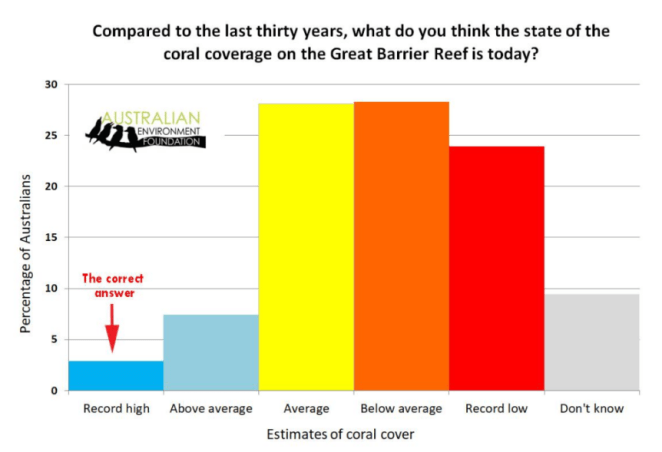
As can be seen, only 3% of Australians know the true state of the coral. Barely 10% knew coral cover was above average, while 80% thought erroneously that the situation was average or worse. Ridd and Niva note that ten years after coral cover hit a record low, half the country still doesn’t realise the reef has recovered. The “phenomenal health” of the GBR is said to be virtually unknown, yet the public are paying half a billion dollars in taxes to save it. In addition the country is “being misled into thinking that expensive low carbon policies and Net Zero targets will help protect the reef, when there is no correlation between CO2 levels and coral cover”.
The authors point some fingers at those responsible for the ignorance about the current condition of the reef among the general population. Four years ago, the State of the Climate report from the national science agency CSIRO and the national weather service the BoM noted that 30% of all coral cover across the entire GBR was lost. “This year, they told us ‘more frequent and severe coral bleaching events are likely’, but did not even mention the excellent health of the reef.” How is that reasonable, they ask. Where are the media, they also ask. “Journalists are supposed to grill professors to make sure they are providing value for taxpayers, not sensationalist, self-serving hyperbole.”
It is often found that those on the Left are more inclined to accept the ‘settled’ climate science narrative, promoting as it does the collectivist Net Zero agenda. A major recent survey in the U.S. found higher levels of belief in the suggested dominant role played by humans in altering the climate among Democrats than Republicans. Nevertheless, the proposition that humans cause all or most global warming has seen general support fall in the U.S. from 60% to 49% in just the last five years. Of course there is lack of sceptical enquiry and there is ignorance, and echo chamber greens seem to score high on both counts.

Record ignorance levels of the true state of the GBR were found among green voters. The populist right of centre One Nation voters recorded much better levels of awareness. Voters for the Liberal party seem to be marginally better informed than Labour.
The AEF results were compiled by a polling company asking 1,004 Australians about the current state of coral coverage on the GBR. The full question and suggested answers are shown in the first graph above. The poll was conducted soon after the news came out of last year’s record high coverage. The authors note that the results largely confirm an earlier similar survey of 1,007 of people in 2022. In that survey, only 7% of voters correctly said that coral cover on the GBR was “well above average”.
Chris Morrison is the Daily Sceptic’s Environment Editor.
Top Five Climate Change Narratives in the Media
Coverage of climate has become more about narrative promotion than news
BY ROGER PIELKE JR. | THE HONEST BROKER |APRIL 28, 2023
I’ve seen a lot over the past three decades. For instance, I’ve seen my own research on climate go from being widely covered in the late 1990s to 2000s, to journalists actively advocating for me to be fired in the 2010s to today, where thankfully my writing exists in this parallel universe called Substack. All this time my work remains pretty much the same — my research remains widely cited in the research community, including most recently by all three working group of the IPCC. It is not me that has changed.
Along the way I’ve been very public with my criticism of parts of the media, as I have watched climate journalism evolve from reporting of news to narrative promotion and protection. I have come to understand that it just so happens that some of my research happens to clash with leading narratives (e.g., disasters, RCP8.5) promoted nowadays by journalists on the so-called “climate beat” — itself a troubling concept.
Below I provide a list of the five most common types of climate stories that I see in the legacy and specialist media. I’ll admit to being a bit cheeky — it is Friday after all, but at the same time I also think there is a lot of truth to the list below. I’m calling out climate journalism because I am seeing its pathological effects on public views (especially among young people), on the research community and in policy discussions, including political advocacy. Climate is too important to be just another cul-de-sac of identity politics.
As ever, I am happy to hear from those on the climate beat, especially those whose work is implicated in the list below. I am happy to publish their responses or views here. I won’t hold my breath — as multiple journalists have told me in conversations that there is no way they can ever be seen to engage with me, as it is a professional hazard. But still, the invitation will remain open.
With that, let’s get to the list!
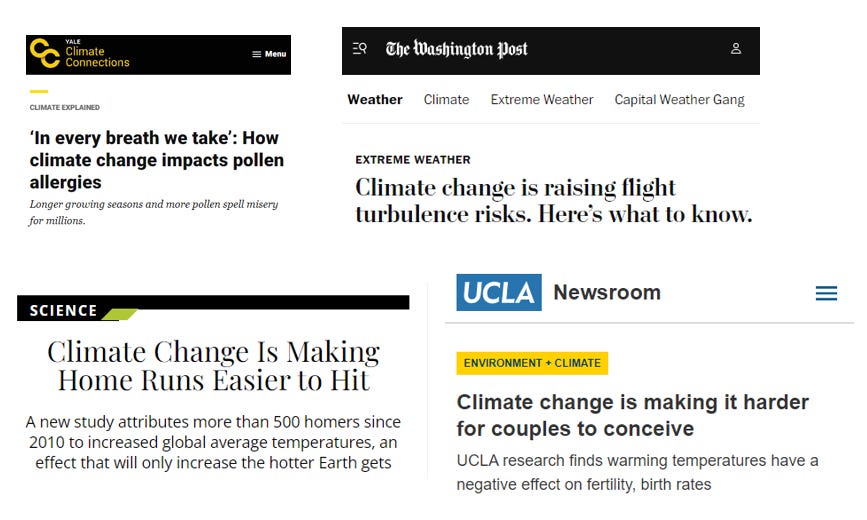
Climate reductionism
- We can explain everything with climate change
Hay fever? Bumpy fight? Home runs? Infertility? There is probably no phenomena in the world that has not at one time or another been linked to climate change. Part of the ubiquity of this type of article is the presence of so many journalists now on the “climate beat” having to come up with frequent climate-themed stories to satisfy their editors and their niche. This has the knock-on effect of creating incentives for researchers to produce studies with links to climate — no matter how tenuous or trivial. This dynamic has been well described my Mike Hulme as “climate reductionism.”
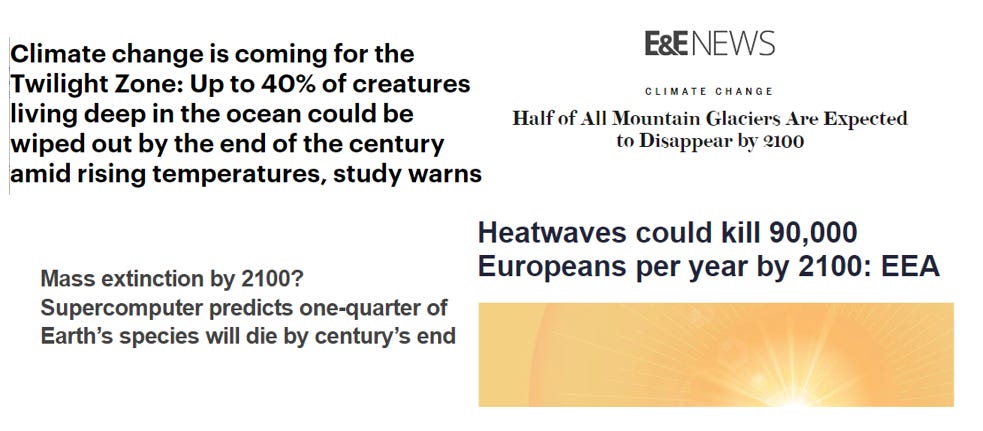
We ❤️ the apocalypse
- The coming apocalypse
If it bleeds, it leads. There is a great market for studies that offer scary predictions of the future, typically employing implausible scenarios (hello RCP8.5). These studies are readily transformed into university and research institute press releases, which are then pretty much reprinted as news. The stories, they write themselves. Stories on our doomed future based on the latest predictions are a staple of the climate beat.
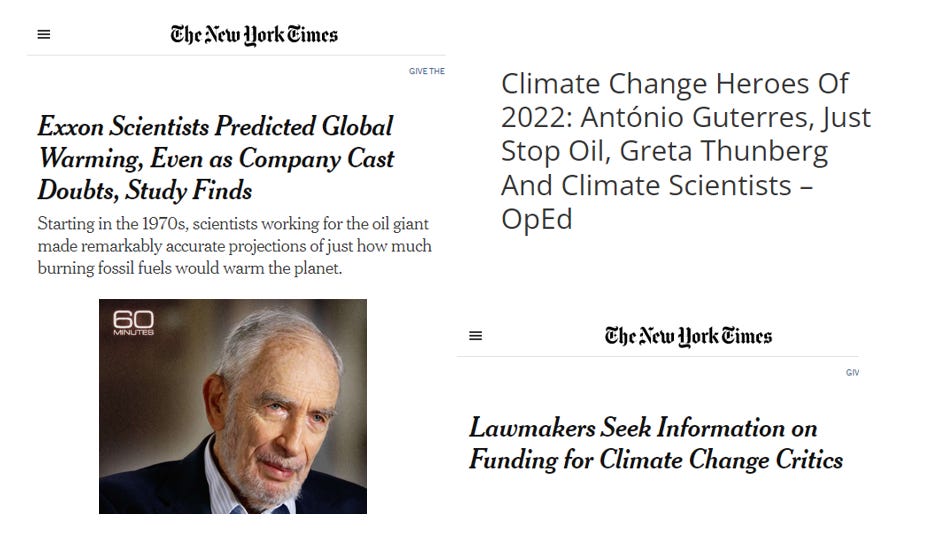
Your guide to the players
- Good guys and bad guys
In any morality tale, it is important to know who the good guys and bad guys are. Usually this is easy, but in climate it is difficult as there are a lot of legitimate experts out there, but only a subset share the proper views. Hence, the media produces a steady stream of articles helping to identify those who are heroes and those who are villains. Associating someone with Republicans or fossil fuels is a tip that this person is a villain, and a similar association with the renewable industry or Democrats means that they are onside.

Extreme weather, we can explain that
- The extreme weather that just happened
Weather is a renewable resource. It happens every day, and somewhere it is extreme. Hurricanes, tornadoes, floods, drought, hail, oh my! It has become fundamental to the climate beat to associate, link, connect — pick your favorite — the extreme event that just happened with climate change. Forget the IPCC and rigorous standards of detection and attribution. There are studies to cherry pick, quotable experts and a new cottage industry of rapid event attribution studies. Extreme weather is no longer about the weather.

Go team!
- Cheerleading for our team
Recently I saw somewhere on Twitter where someone had calculated how many followers good guys and bad guys had gained on Twitter since Elon Musk took it over. Apparently the bad guys saw a big surge. But what I found most interesting was the lumping in of climate reporters at places like The New York Times and The Guardian with activists like Greta Thunberg — clearly indicating that they were viewed to be as being on the same team. A big part of climate reporting these days is simply climate advocacy. For instance, when the Inflation Reduction Act was being debated earlier this year, the media simply cheered its passage, printing the views of those paid to promote it by the renewables industry, and nary a critical voice to be heard. More recently, criticism of the IRA has appeared to become legitimate as part of the cheerleading to go beyond the IRA. Climate reporting is apparently a team sport.
Transplant surgery highlights evidence of vaccine deaths
By Guy Hatchard | TCW Defending Freedom | May 1, 2023
The writer is in New Zealand
More critical evidence of increased vaccine-induced strokes and deaths has come to light.
The Wellington Region health data leaked directly to me, on which I’ve reported here, shows that the incidence of strokes requiring hospitalisation in 2023 was up by 25 per cent on pre-pandemic levels. These rises in stroke incidence began in 2021, before the arrival of Covid in New Zealand, but after the vaccine rollout began. Despite this, published scientific papers continue to point to Covid-19 infection as the sole source of increased stroke incidence, in some cases, as in this paper, not even mentioning a possible role of Covid vaccination.
Accordingly, NZ Medsafe has been able to maintain that there have been only two vaccine-induced deaths, allowing politicians and health authorities to cling to the fiction that Covid vaccination is safe.
A pre-pandemic 2016 paper found that victims of fatal strokes are generally robust sources for organ transplant donation, especially if they are younger in age. The one exception was the need for caution with livers transplanted from those dying as a result of immune thrombocytopenia (ITP) whose recipients suffered poorer survival outcomes.
This paper published last month describes the case of an individual who in October 2021 died from a stroke caused by Covid vaccination, and whose organs were harvested for transplant. The paper notes in passing that: ‘Thrombosis combined with thrombocytopenia generally occurs in the first month following vaccination and can lead to fatal outcomes, even in young, previously healthy individuals. These young adults ultimately may become solid organ donors.’
In other words, young adults are dying following Covid vaccination in sufficient numbers to be appreciated by transplant surgeons as a new source of viable organs. In this single case, two harvested kidneys are still functioning well for the recipients. The authors leap from the one case study to a general conclusion: ‘Kidney allografts transplanted from vaccine-induced thrombosis and thrombocytopenia donors can have a good overall function with favourable outcomes.’
A September 2022 paper reports on kidney transplants from 16 (yes, 16) victims in Britain of Covid vaccine-induced immune thrombocytopenia and thrombosis (VITT) to 30 recipients. Five of the recipients had concerning test results following surgery and two of them lost the graft. The authors conclude: ‘The involvement of VITT could not be completely excluded in one of these cases.’They go on to describe these outcomes as ‘favourable’ (?)
This paper published in August 2022 studying four successful transplants from a single deceased donor following VITT, notes: ‘There are increasing reports of thrombotic complications with various Covid-19 vaccines such as the Pfizer-BioNTech mRNA, Moderna mRNA, AstraZeneca Oxford (serum institute), and Johnson & Johnson/Janssen vaccines.’
This paper from Italy reports two cases of VITT and subsequent successful transplants, but this letter to the American Journal of Transplantation in July 2021 presents a far more concerning picture. Ten donors likely to have died from VITT donated 27 organs in total. Three of these organs subsequently failed, two had impaired function, and one patient died of a cardiac arrest. In total there were seven major thrombotic or hemorrhagic postoperative complications among six recipients (22 per cent) within nine days of transplant.
The authors concluded that the potential risks of transplanting organs from donors with VITT are twofold. First, early major thrombosis or clinically significant bleeding. Second, possible transmission of pathogenic lymphocytes (anti-PF4), characteristic of blood clotting associated with strokes. In other words, VITT deceased donors may somehow pass on aspects of their vaccine-induced fatal illness to transplant organ recipients.
You are probably beginning to get the picture. Transplant surgeons are very excited to have more available young donors. They announce that the use of organs from VITT is probably viable based on some case studies with very mixed results, but completely fail to comment on the significance of the increased number of cases of vaccine-induced death.
Transplant surgeons are narrowly focused on their discipline. Despite being aware of increases in Covid vaccine-induced death, they wrote papers which failed to sound the alarm. But it is worse than that: medical authorities, the people who collate statistics of hospitalisation and death, failed to communicate to medical personnel and specialists in disparate fields that there were many categories of vaccine-induced illness, including not only strokes, but also cardiac disease, kidney disease, reproductive disease, cancer and neurological disease.
Since releasing the leaked data last month, I have heard from a number of practising health professionals. Their reports include descriptions of unprecedented increases in the incidence of rare conditions that they would not normally see, including cancers. There are also reports of test result scores which are off the chart, for example D-dimer scores in the 20,000 to 30,000 range. D-dimer tests are designed to monitor the formation of blood clots associated with deep vein thrombosis, pulmonary embolism and stroke, and a normal score is considered less than 0.50. It is notable that the leaked Wellington Region health data reports around 4 per cent of D-dimer test results for both men and women are registering at elevated levels.
Most health professionals and the public are still being left in the dark as far as the overall data picture is concerned. When you hear politicians such as Ardern and Hancock calling for more censorship of discussion, it has to ring alarm bells.
The revelations of widespread ill health contained in the Wellington Region data leak demonstrate how the reverse is true. Government policies restricting access to health data and suppressing open debate are the real drivers of health misinformation and poor pandemic health outcomes.
Featured Video

The Truth About the Trump Shootings with Ken Silva
or go to
Aletho News Archives – Video-Images
From the Archives
The Geopolitics behind the War in Yemen (I)
By Mahdi Darius NAZEMROAYA | Strategic Culture Foundation | 30.03.2015
The United States and the Kingdom of Saudi Arabia became very uneasy when the Yemenese or Yemenite movement of the Houthi or Ansarallah (meaning the supporters of God in Arabic) gained control of Yemen’s capital, Sanaa/Sana, in September 2014. The US-supported Yemenite President Abd-Rabbuh Manṣour Al-Hadi was humiliatingly forced to share power with the Houthis and the coalition of northern Yemenese tribes that had helped them enter Sana. Al-Hadi declared that negotiations for a Yemeni national unity government would take place and his allies the US and Saudi Arabia tried to use a new national dialogue and mediated talks to co-opt and pacify the Houthis.
The truth has been turned on its head about the war in Yemen. The war and ousting of President Abd-Rabbuh Manṣour Al-Hadi in Yemen are not the results of «Houthi coup» in Yemen. It is the opposite. Al-Hadi was ousted, because with Saudi and US support he tried to backtrack on the power sharing agreements he had made and return Yemen to authoritarian rule. The ousting of President Al-Hadi by the Houthis and their political allies was an unexpected reaction to the takeover Al-Hadi was planning with Washington and the House of Saudi. … continue
Blog Roll
 Aletho News
- IRGC air defenses destroy another US MQ-1 drone over Strait of Hormuz
- Imran Khan’s entire immediate family detained in Pakistan ahead of mass protest demanding his release
- EU nation detains former presidential frontrunner
- Leaked: Britain’s Sham Conviction Of Hashim Thaci
- Seyed M. Marandi: U.S. Strike Imminent – Toward Total War in the Middle East
- Russia Voted Under Fire. Washington Is Loading the Tankers.
- 12 Things Your Oncologist Was Trained Not to Tell You
- Anthrax Attacks Paved Way for COVID-Era ‘Junk Drugs and Vaccines’
- How Real Is the Impact of Western Sanctions on Israel?
- France, You Are Guilty: How Paris Turned Western Sahara into the Maghreb’s Powder Keg
- If Americans Knew
- Inside Israel’s ‘soft’ ethnic cleansing plan for Gaza through the eyes of its victims
- New online database tracks pro-‘Israel’ political donations in the United States
- Israeli president pardons soldier convicted for killing wounded Palestinian
- Singer Ed Sheeran says his ‘heart broken’ by Gaza devastation, addresses Macklemore controversy
- Israel Has Imprisoned Female Journalist Bushra Al-Tawil Without Trial Or Charge In Solitary Confinement For Past Month
- Israel poised to teach West Bank a lesson after one Israeli killed – Daily Update
- Salah Sarsour’s Legal Team Says DHS Has Not Met Its Burden to Prove He Is Deportable
- An analysis of tax forms by The Intercept show Kraft’s charity and LLC have donated to Friends of the IDF and AIPAC’s super PAC.
- Israeli attacks kill four Palestinians in Gaza – Daily Update
- Inside Gaza’s death trap of collapsing, bombed-out buildings
- No Tricks Zone
- 2025 Nature Paper Claiming Worsening Global Drought Gets RETRACTED …Heavily Flawed
- New Study: ‘Global Drought Shows No Detectable Recent Acceleration Under Climate Warming’
- Economic Masterminds: German Socialists Suggest Taxing Productivity Gains Stemming From Using AI
- The South China Sea Has Not Been Cooperating With The Climate Change Narrative
- Energy Crisis: Germany Enters Heating Season With Historically Low Gas Reserve Fill Levels
- New Study: The Antarctic Ice Sheet Gained Mass From 2020-2024 Due To Staggering Snow And Ice Accumulation
- Study: Ocean Heating Rates From Thousands Of Years Ago ‘Dwarf’ Modern Ocean Heating Rates
- Climate Extremists Target, Attack Large-Scale Power Grid Infrastructure In Germany!
- New Study: Antarctic Ice Melt Has Contributed Less Than 1 Centimeter To Sea Level Rise In The Last 30 Years
- Fear Of Debate: Alarmist German Climate Scientist Calls On Mainstream Media To Discredit Skeptic Voices
 Aletho News