Dr. Peter McCullough | Full Interview | Planet Lockdown Series
Planet Lockdown | June 19, 2022
In this interview we spoke with Dr. Peter McCullough, an American cardiologist and outspoken critic of the questionable handling of the COVID-19 “pandemic.” He is one of the most notable and credentialed voices speaking out in the United States and is a wealth of information. He was vice chief of internal medicine at Baylor University Medical Center and a professor at Texas A&M University, and one of the largest donors to the school, leading to a scholarship named after him. Upon speaking out the university shamelessly attacked him. He is articulate, balanced and a voice of reason.
In this interview he clarifies the following points:
– PR testing methodology
– Therapeutic Nihilism
– Myocarditis amongst the vaccinated
– Early treatment suppression prior to the pandemic
– Persecution of medical personnel for exercising their licensed authority
– The upside down irrational nature of COVID-19 policies including vaccine mandates
– The efficacy of a global, indiscriminate mass vax campaign, in contrast to vaccination of mainly at-risk patients
Please donate to the project. Your contribution makes a real difference:
https://planetlockdownfilm.com/donate/
Subscribe to the email list for updates on the film and interviews:
https://planetlockdownfilm.com/lists/?p=subscribe
Watch more full interviews and educate yourself!
https://planetlockdownfilm.com/full-interviews/
Share and enjoy!
Treating Coronavirus Shots Injury
By Adam Dick | Ron Paul Institute | July 19, 2022
Throughout the coronavirus panic, the word from national, state, and local governments, and the big money media, was nearly uniformly that people who had coronavirus should stay isolated at home and then go to the hospital if their condition became dire, such as they could hardly breathe. The message was that there was nothing these individuals could do in the meantime to counter the sickness. They could just wait and see.
When some new, expensive, and experimental pharmaceuticals rushed to market with scanty evaluation ultimately became available, the message changed some. Early treatment suddenly was promoted, but only using these new drugs.
All the while, some doctors willing to stand up to the pressure to conform did what doctors have long done to help patients. They took inexpensive drugs, vitamins, and therapies already long in use and employed them in innovative ways to provide patients with early treatment.
To do the right thing, these doctors risked being fired by employers and having their medical licenses revoked. And governments even threw up hurdles before these doctors’ patients in an effort to stop them from obtain drugs such as ivermectin and hydroxychloroquine. Meanwhile, big money media blared these drugs were dangerous despite the fact that decades of use had shown them to be relatively safe drugs and less risky than the new and experimental coronavirus “vaccines” and early treatment drugs the media pushed.
Fortunately, some patients found the renegade doctors and obtained relief early, thus countering sickness and avoiding hospitalization.
Since the experimental coronavirus “vaccine” shots came out, politicians and the big money media have been promoting them, and even booster shot upon booster shot as “safe and effective.” But, it has become increasingly obvious that the shots are neither.
The shots do not stop the shot takers from becoming sick from coronavirus, transmitting coronavirus to other people, or dying from coronavirus.
One thing the shots do cause is dangerous side effects. Governments and the big money media have, in their devotion to rejecting any criticism of the purported miracle vaccines, kept mum about the idea that people harmed by the shots should seek treatment. But, fortunately, some brave doctors are doing their best to repurpose drugs, vitamins, and therapies to help people injured by the shots.
This effort to help shots victims is similar to the early treatment efforts doctors took for people with coronavirus when the overriding public message was to just stay isolated at home until you are so sick you have to go to the hospital. They are doctors choosing to act as doctors even though there is incredible pressure against doing so.
Not surprisingly, some of the doctors who have taken the brave step to help people harmed by the coronavirus shots are the same doctors who helped coronavirus patients who the politicians and big money media had declared should not be helped or, later, should only be given the new experimental drugs. For example, the Front Line Covid-19 Critical Care Alliance (FLCCC) has added to its protocols a post-vaccine treatment protocol alongside its early covid treatment protocol and a link for helping people find doctors who follow the protocols. It is refreshing to see doctors, associated with FLCCC and otherwise, refuse to give in to the pressure to just let people suffer from first coronavirus and then the coronavirus shots.
Copyright © 2022 by RonPaul Institute.
Independent SAGE’s Dumb “Seven-Point” Covid Plan
By Igor Chudov | July 19, 2022
Many of my readers had one Covid a long time ago, or never had Covid, are not having another Covid so far, and may not realize how badly are things going in Covid-land in Europe and highly vaccinated areas of USA.
More than one out of 15 Brits is having COVID today (Jul 19, 2022). This is higher than ever before. An “unexpected” largest-ever wave of a yet-another variant Ba.5 is reinfecting highly-vaccinated countries one more time. Hospitals are strained, because sick, force-injected health care workers are staying home due to their Covid reinfections, and patients are hospitalized at record rates. Excess mortality is rising.
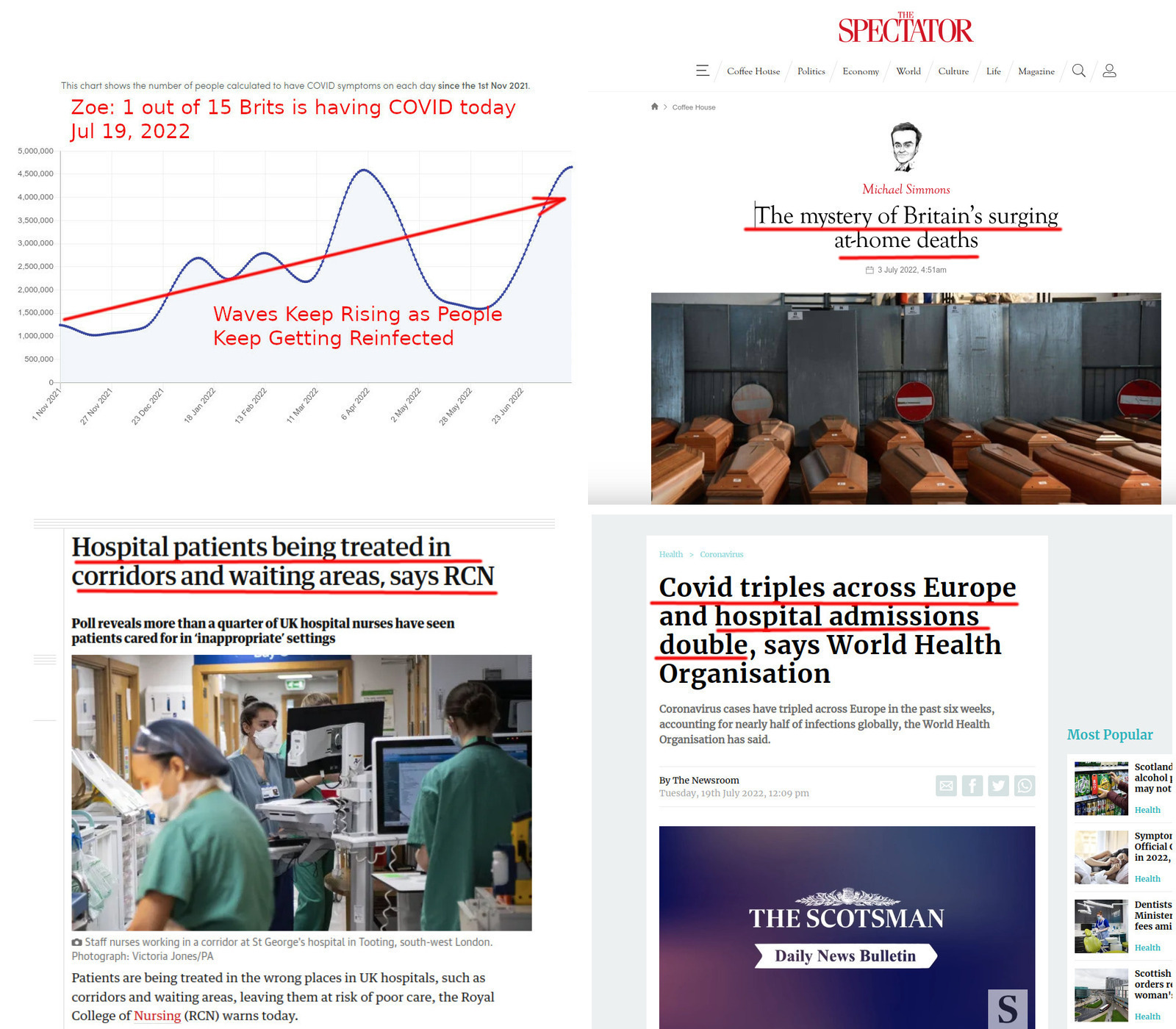
People are, naturally, becoming worried as they or their relatives have two-week-long bouts of Covid reinfections that do not feel mild to them and leave them exhausted. My own opinion is that we are on the verge of significant increases in overall mortality. I am quite worried about that.
Rumblings of discontent are appearing. The powers-to-be are wondering what to do.
So, the so-called “Independent SAGE” just came up with a “seven-point plan” to combat COVID. The plan is so spectacularly stupid that it reads like a parody. Here it is, from the British Medical Journal no less.
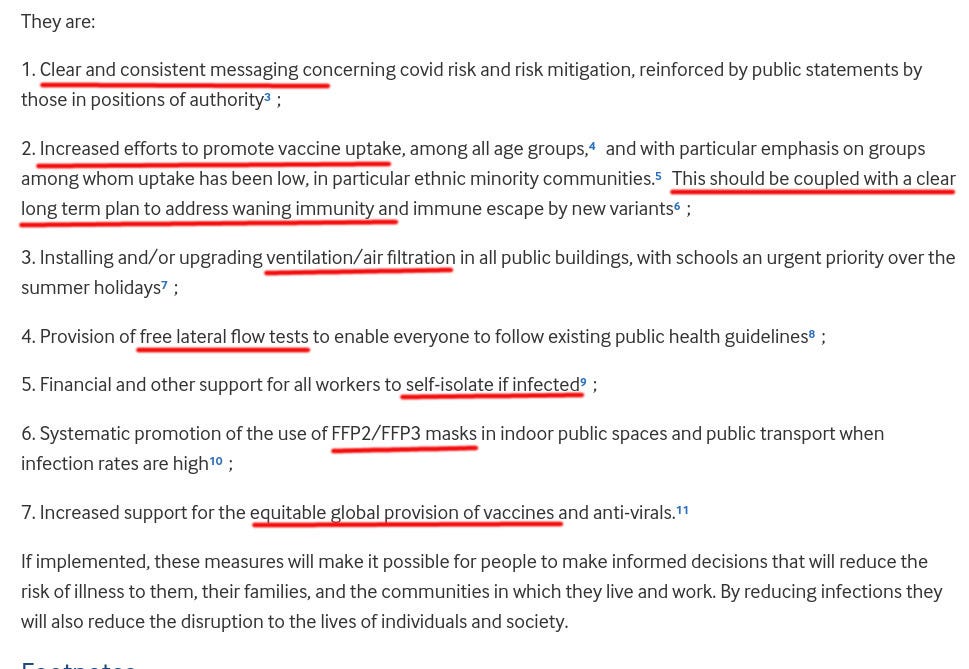
This plan is the product of supposedly the “best Covid minds”, the leading thinkers of UK science, whose recommendations influence UK policy. What did these minds produce? Let’s look.
They are proposing to do more of same!
The “clear and consistent messaging” is a theme of the pandemic, it relates to a bad idea that all officials should parrot one line during a so-called “emergency”, to avoid confusing the public. The result of this policy was a lack of independent thinking, as well as censorship of any dissenting voices, that led to groupthink. What message, pray tell, should such “clear and consistent messaging” convey? The seven-point plan?
The efforts to promote “vaccine uptake” are particularly laughable in July of 2022. Here’s how vaccine uptake looks in the UK:
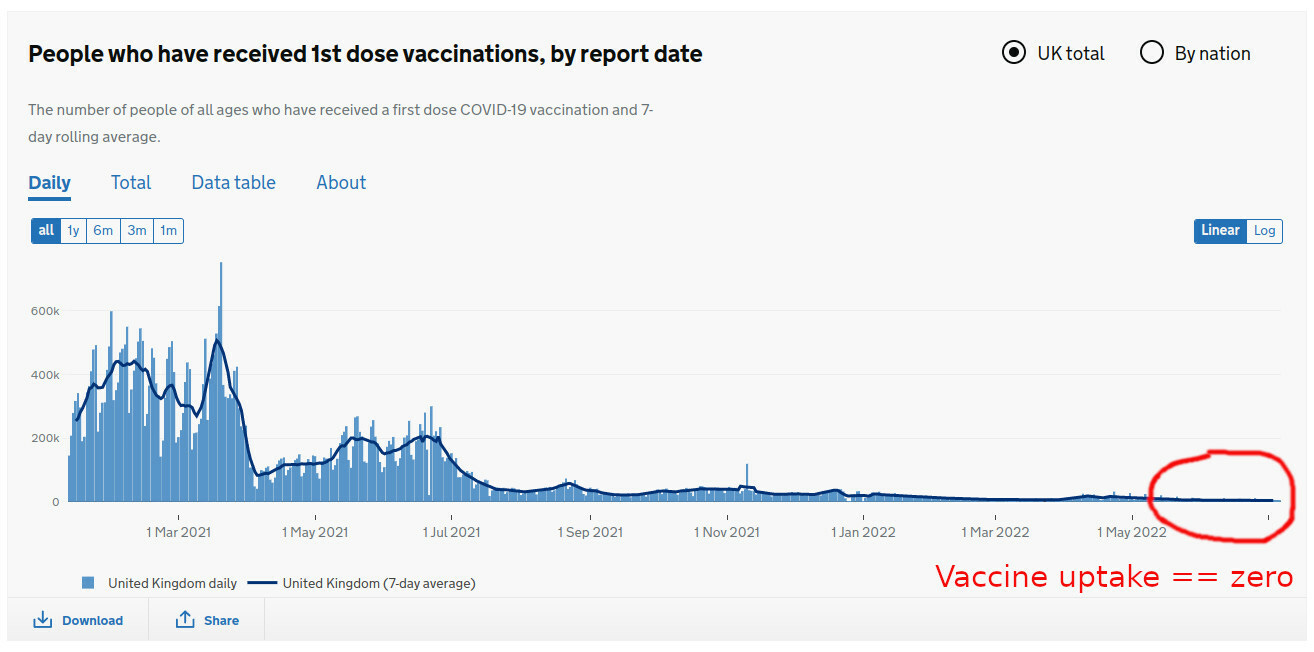
Of special interest is a need to have a “clear long-term plan to address waning immunity and immune escape”. What they are saying is that they do not have such a plan. They merely want to have a plan, which they do not have, as of now.
The concept of “air filtration” refers to a sincerely expressed, but misguided idea that retrofitting buildings with “air filtration devices” will stop the pandemic. While I personally like almost all people who advocate it, I also recognize that it is largely futile, for many reasons having to do with physics and gas dynamics.
Air filtration that could effectively capture airborne virions, would need to turn over enormous volumes of air every minute, through the finest filters, continuously. This is not compatible with existing buildings’ HVAC systems. It would also cost a fortune in electric bills and create a lot of heat. I do not want to get into this discussion too much, but “air filtration” of that kind is not possible in most establishments or homes.
The “FFP3 masks” are obvious non-starters because of difficulties wearing them. Making the public wear such masks in 2022 is impossible.
The worst part of this proposal is the so-called “equitable global provision of vaccines”. This is a code word for bribing governments of poor countries into forcing their citizens to take “vaccines” that these wise but poor people refuse to take voluntarily. The countries with unvaccinated majorities are the future of humanity, in my opinion. They are largely at herd immunity precisely because they refused to vaccinate. Yet, Independent SAGE wants to inject them with non-working “vaccines” in the name of “equity”. Why?
The crazy “Independent SAGE” advisers are anything but sage, are actually stupid, and I am very sorry that they have been UK’s thought leaders since 2020.
Here’s a clip from “Idiocracy”. While it is funny, it shows President Camacho actually solving his country’s problem of dying plants, with his three-point plan of hiring the smartest person in the world named Not Sure. Not Sure figured out the problem and proceeded to stop using Brawndo to water plants.
Brawndo’, which owned the FDA, went bankrupt. The plants started growing, given clean water. Any parallels with the present?
P.S. Please do not think that I am badmouthing the UK by criticizing British Covid experts: Covid experts in the USA are so much worse and could not even come up with a “seven-point plan”. So there is no “USA Covid plan” that I could criticize.
How Pfizer Profited From the Pandemic
By Dr. Joseph Mercola | July 18, 2022
According to Kaiser Health News (KHN),1 the COVID-19 pandemic has been a real boon to Pfizer. Not only has it yielded “outsize benefits” in terms of profits, but it has also “given the drugmaker unusual weight in determining U.S. health policy.”
“Based on internal research, the company’s executives have frequently announced the next stage in the fight against the pandemic before government officials have had time to study the issue, annoying many experts in the medical field and leaving some patients unsure whom to trust,” KHN reporter Arthur Allen writes, adding:2
“When last year Bourla suggested that a booster shot would soon be needed, U.S. public health officials later followed, giving the impression that Pfizer was calling the tune.
Some public health experts and scientists worry these decisions were hasty, noting, for example, that although boosters with the mRNA shots produced by Moderna and Pfizer-BioNTech improve antibody protection initially, it generally doesn’t last.
Since January, Bourla has been saying that U.S. adults will probably all need annual booster shots, and senior FDA officials have indicated since April that they agree … The company’s power worries some vaccinologists, who see its growing influence in a realm of medical decision-making traditionally led by independent experts …
When President Biden in September 2021 offered boosters to Americans — not long after [Pfizer CEO Albert] Bourla had recommended them — Dr. Paul Offit, director of the Vaccine Education Center at Children’s Hospital of Philadelphia … wondered, ‘Where’s the evidence you are at risk of serious disease when confronted with COVID if you are vaccinated and under 50?’
Policies on booster recommendations for different groups are complex and shifting, Offit said, but the CDC, rather than Bourla and Pfizer, should be making them. ‘We’re being pushed along,’ he said. ‘The pharmaceutical companies are acting like public health agencies.’”
The fact that a vaccine-pusher like Offit — infamous for claiming a baby can safely tolerate 10,000 vaccines at once3 — is questioning and pushing back against Pfizer’s influence over health policy reveals just how brazen, unethical and potentially dangerous that is.
Massive Profits Made From Useless Products
According to Allen, Pfizer’s revenue in 2021 was $81.3 billion4 — approximately double that of 2020 — and the COVID shot accounted for $36.78 billion5 of that. For comparison, Lipitor, Pfizer’s previous top selling statin, generates roughly $2 billion a year,6 while their strep vaccine, Prevnar 13 rakes in $6 billion a year.7
Its mRNA gene transfer injection against COVID now dominates 70% of the U.S. and European markets, and Paxlovid, Pfizer’s COVID drug, has become a standard treatment choice in hospitals. This, despite researchers finding Paxlovid (molnupiravir) causes severe rebound and supercharges mutations.
In a rational scenario, that finding would have put a stop to its use, but no. In an official health advisory8 to the public, issued May 24, 2022, the U.S. Centers for Disease Control and Prevention first warns that Paxlovid is associated with “recurrence of COVID-19 or ‘COVID-19 rebound,’” and then in the very next sentence stresses in bold print a narrative supporting its use and enriching Pfizer with instructions saying:
“Paxlovid continues to be recommended for early- stage treatment of mild to moderate COVID-19 among persons at high risk for progression to severe disease.”
Allen also notes that, during an investor call, a Pfizer official highlighted reports of Paxlovid’s failure, but spun it into “good news” for investors, as patients may require multiple courses!9 Obviously the objective has long ago shifted from helping humans to raping them for as much profit as possible.
Similarly, while Pfizer’s COVID jab clearly doesn’t prevent infection or spread, and Americans are rejecting the shots in growing numbers — 82.2 million doses had expired and were chucked in the trash as of mid-May 202210 — the U.S. government still went ahead and ordered another 105 million doses at the end of June 2022.
These are intended for a fall booster campaign, at a cost to taxpayers of $3.2 billion.11 The U.S. is actually paying about 50% more for each of these new jab boosters this time around — $30.47 per dose compared to $19.50 per dose paid for the first 100 million doses.
The U.S. government has also promised to purchase another 20 million courses of Paxlovid, at an eye-watering cost of $530 per five-day course. Basically, Pfizer is being financially rewarded for producing products that are useless at best and dangerous at worst, and we’re all paying for it. In case you’re curious, that is another $10.6 billion transferred from U.S. taxpayers to Pfizer.
Future Boosters Won’t Undergo Human Clinical Trials
After you likely thought it couldn’t ever get any worse, KHN also touches on, but doesn’t delve into, the fact that Pfizer suggested they skip human trials as they move forward with jabs that are reformulated for newer variants. If this strikes you as crazy, you’d be right. It’s sheer madness, but the U.S. Food and Drug Administration — a clearly captured agency — has already surreptitiously agreed to this egregious miscarriage of science.
How this wicked scheme, known as the “Future Framework,”12 was adopted by the FDA without formal vote is explained by Toby Rogers, Ph.D. — a political economist whose research focus is on regulatory capture and Big Pharma corruption13 — in the video above. He also explained it in a June 29, 2022, Substack article:14
“Yesterday [June 28], the FDA’s Vaccines and Related Biological Products Advisory Committee approved a bivalent COVID-19 shot with the Wuhan strain and the Omicron variant … Wait, hold up, I thought the FDA was voting on the Future Framework yesterday?
The policy question was whether reformulated COVID-19 shots would be treated as new molecular entities (which they are) in which case they should be subject to formal review or whether reformulated shots would be treated as ‘biologically similar’ to existing Covid-19 shots and be allowed to skip clinical trials altogether.
Apparently the FDA did not have the votes to just pass this as a policy question. If you ask anyone whether reformulated mRNA represents a new molecular entity, well of course it is, so that would require formal regulatory review.
What the FDA did instead was to smuggle the policy question in disguised as a vote about reformulated ‘boosters’ for the fall.
In essence, the FDA just started doing the Future Framework (picking variants willy nilly, skipping clinical trials) and essentially dared the committee members to turn down a booster dose — knowing that all of the VRBPAC members are hand-picked because they’ve never met a vaccine they did not like.
So of course only two people on the committee had the courage to turn down a booster dose — even though it was based on this preposterous process (that was never formally adopted) where there was literally no data at all … By stealth, the FDA replaced a system based on evidence with a system based entirely on belief.”
Countries Held to Ransom
In 2021, secret details of Pfizer’s contracts came to light, showing they are essentially holding countries hostage to nonnegotiable demands for payment in full AND freedom from liability.15
In late February 2021, The Bureau of Investigative Journalism reported16 that Pfizer was demanding countries put up sovereign assets as collateral for expected vaccine injury lawsuits resulting from its COVID-19 jab.
Several countries, including Brazil, Chile, Colombia, the Dominican Republic and Peru, agreed to this demand, putting up bank reserves, military bases and embassy buildings as collateral. In short, theses governments are guaranteeing Pfizer will be compensated for any expenses resulting from injury lawsuits against it, so the company won’t lose a dime if its COVID shot injures people.
Shockingly, these terms are binding even if those injuries are the result of negligent company practices, fraud or malice!
In October that same year, Public Citizen published the secret contracts17,18 between Pfizer and Albania, Brazil, Colombia, Chile, Dominican Republic, the European Commission, Peru, the U.S. and the U.K., further revealing the extent to which these countries handed power over to Pfizer. In almost all scenarios, Pfizer’s interests come first.
For example, government purchasers must acknowledge that the effectiveness and safety of the shots are completely unknown, all while indemnifying Pfizer against any and all financial liability. This is the ultimate corporate maleficence, using their leverage to force the kill shot down these countries’ throats and avoiding any personal responsibility for damages.
Even if Pfizer eventually is convicted of fraud in the U.S. and loses all its liability protection from the COVID jabs because of it, that judgment would not impact these foreign contracts. These countries sold their souls to Pfizer and have absolutely no recourse but to pay even if the shots kill everyone.
The contracts for at least four countries also secure Pfizer’s intellectual property rights even if the company is found to have stolen intellectual property rights of others. In such case, the government purchaser becomes the liable party. As explained by Public Citizen :19
“For example, if another vaccine maker sued Pfizer for patent infringement in Colombia, the contract requires the Colombian government to foot the bill. Pfizer also explicitly says that it does not guarantee that its product does not violate third-party IP, or that it needs additional licenses.
Pfizer takes no responsibility in these contracts for its potential infringement of intellectual property. In a sense, Pfizer has secured an IP waiver for itself. But internationally, Pfizer is fighting similar efforts to waive IP barriers for all manufacturers.”
Equally shocking is that countries are forced to follow through on their vaccine orders even if other drugs or treatments emerge that can prevent, treat or cure COVID-19.20 Is it any wonder, then, that governments around the world have suppressed the use of safe and effective outpatient drugs like hydroxychloroquine and ivermectin?
If these drugs were allowed to be used and could be proven to work, the COVID injections would be completely unnecessary and their emergency use authorization would disappear, yet governments are on the hook for hundreds of millions of doses.
Pfizer Has ‘Habitual Offender’ Track Record
The fact that Pfizer has behaved like a criminal who works out a cover story for a planned murder before committing it is not surprising, considering its history. Pfizer, has been sued in multiple venues over unethical behavior, including unethical drug testing and illegal marketing practices.21
In his 2010 paper,22 “Tough on Crime? Pfizer and the CIHR,” Robert G. Evans, Ph.D., Emeritus Professor at Vancouver School of Economics, described Pfizer as “a ‘habitual offender,’ persistently engaging in illegal and corrupt marketing practices, bribing physicians and suppressing adverse trial results.”
Between 2002 and 2010 alone, Pfizer and its subsidiaries were fined $3 billion in criminal convictions, civil penalties and jury awards. They are recurrent criminal felons. None of these convictions has deterred their nefarious behavior.
In 2011, Pfizer agreed to pay another $14.5 million to settle federal charges of illegal marketing,23 and in 2014 they settled federal charges relating to improper marketing of the kidney transplant drug Rapamune to the tune of $35 million,24 as well as $75 million to settle charges relating to its testing of a new broad spectrum antibiotic on critically ill Nigerian children.
As reported by the Independent 25 at the time, Pfizer sent a team of doctors into Nigeria in the midst of a meningitis epidemic. For two weeks, the team set up right next to a medical station run by Doctors Without Borders and began dispensing the experimental drug, Trovan. Of the 200 children picked, half got the experimental drug and the other half the already licensed antibiotic Rocephin.
Eleven of the children treated by the Pfizer team died, and many others suffered side effects such as brain damage and organ failure. Pfizer denied wrongdoing. According to the company, only five of the children given Trovan died, compared to six who received Rocephin, so their drug was not to blame.
The problem was they never told the parents that their children were being given an experimental drug. What’s more, while Pfizer produced a permission letter from a Nigerian ethics committee, the letter turned out to have been backdated. The ethics committee itself wasn’t set up until a year after the trial had already taken place. Pfizer’s rap sheet also includes bribery, environmental violations, labor and worker safety violations and more.26
Wolves in Sheep’s Clothing
Now, despite Pfizer being one of the least ethical drug companies, we’re told to trust them with our very lives, and the lives of our precious children. They’re going to put out booster shots this fall that have undergone absolutely no testing whatsoever, and we’re to simply throw caution to the wind because Pfizer — which has no liability whatsoever — says so.
In 2014, Pfizer faced a surge of lawsuits that accused it of hiding known side effects of its anticholesterol drug Lipitor.27 They got off scot-free that time, as a federal judge dismissed thousands of cases alleging the drug caused Type 2 diabetes.28,29 But at least they had liability and could be sued.
When it comes to the COVID jabs, injured patients and family members of those killed by it won’t even have the ability to sue for damages, as governments around the world have indemnified them completely, and it looks as though they might not even be liable even if they’re found guilty of fraud. But we will have to see what the courts rule on that one. Still, that any nation would agree to a contract like that is just mindboggling.
Meanwhile, mounting evidence shows the COVID shots destroy immune function over time, and Pfizer’s own trial data reveal deaths and serious adverse events numbering in the tens of thousands.
It’s hard to tell who’s more deserving of punishment — Pfizer or the equally captured federal agencies, the FDA and the CDC, that go along with them and do nothing to protect the lives of the youngest members of our society. Clearly, it’s up to us to protect ourselves and our loved ones, because wolves in sheep’s clothing are ruling the roost — they’re making all the decisions, and captured agencies are simply doing their bidding.
Sources and References
- 1, 2, 4, 9 KHN July 5, 2022
- 3 Science Daily January 10, 2002
- 5 Washington Examiner February 8, 2022
- 6 Axios October 30, 2019
- 7 True Cost of Health Care
- 8 CDC Advisory May 24, 2022
- 10 NBC News June 6, 2022
- 11 Businesswire June 29, 2022
- 12 FDA Briefing Document June 28, 2022
- 13 Brownstone Institute June 22, 2022, Author’s Bio
- 14 uTobian June 29, 2022
- 15 STAT News February 23, 2021
- 16 The Bureau of Investigative Journalism February 23, 2021
- 17, 19 Public Citizen October 19, 2021
- 18 Twitter Zain Rizvi October 19, 2021
- 20 COVID19up.org August 17, 2021 (archived)
- 21 SGT Report January 7, 2021
- 22 Healthcare Policy 2010 May;5(4):16-25
- 23 DOJ October 21, 2011
- 24 Reuters August 6, 2014
- 25 The Independent March 23, 2014
- 26 Corporate Research Project Pfizer
- 27 Reuters August 8, 2014
- 28 Drugwatch Lipitor Lawsuits
- 29 Reuters May 12, 2021
The omniscient medical establishment is baffled

Vatican’s new 20-euro coin dedicated to a theme very close to Pope Francis’ heart… the need to be vaccinated.
By Rusere Shoniwa | The Exposé | July 19, 2022
The medical establishment professes to know an awful lot. A few days before lockdown in March 2020, it knew that covid was not a High Consequence Infectious Disease and downgraded it accordingly. Exhibiting an Orwellian capacity for doublethink, it also knew that societies ought to be bludgeoned with lockdowns to prevent the spread of the not so highly consequential, and therefore downgraded, pathogen. In addition, it somehow just knew, without being able to explain why, that a cost-benefit analysis would be superfluous, so none was done. Until July 2020, it knew, based on decades of established science, that masking in community settings was useless in preventing the spread of respiratory illnesses. Then, with no new science to support a 180-degree turn, it just knew that masks had to be mandated.
It was so certain that mass vaccination with the experimental injections was the only course of action to take in the face of the not so highly consequential covid disease that it suppressed alternative cheap, safe and effective treatments. It was also quite sure that it had to censor and threaten doctors like Sam White with debarment because he expressed concerns about mass vaccination with the shoddily tested and hastily marketed novel ‘vaccines’. It somehow reasoned that doctors expressing genuine concern for patient safety was a threat to patient safety and that the only way to guarantee patient safety was for every single doctor, journalist and media outlet to sing from the same Big Pharma-sponsored hymn sheet.
Granted, the medical establishment’s stance during covid has not been underpinned by rational considerations, but that is precisely what has given it so much latitude to respond to ‘the crisis’. There is no limit to what you can know and do when you don’t have to prove rationally how you came to know it. Life is a never-ending carousel of trade-offs. You can either plod through things methodically and get it right or you can blast ahead at Warp Speed with the misplaced confidence of Joe Biden on a bicycle.
So, given the medical establishment’s boundless knowledge in times of crisis, it’s more than a little odd that it does not know why young and apparently healthy adults all over the world are dying in unprecedentedly large numbers. It is uncharacteristically stumped: it professes that there are simply no clues whatsoever to this disturbing phenomenon.
It is in the grip of such uncharacteristic knowledge paralysis that it seems incapable of exploring obvious lines of enquiry, such as asking questions like: when was the last time that governments all over world put a jackboot on the neck of every adult citizen to inject them with novel ‘vaccines’ employing an experimental gene-based technology tested under quality control conditions that would have run-of-the-mill crack dealers shaking their heads in disbelief?
What’s in a name?
Once you unlock the mystery of the medical establishment’s peculiar brand of epistemology, you begin to understand that how it comes to ‘know’ things is directly related to how it defines the problems it is trying to solve. For people who think in straitjackets, the problem of young people dying inexplicably is a medical problem. But, for the unbounded thinkers in charge of the medical establishment, it is a Public Relations problem. Through that lens, the obvious line of enquiry into experimental mass vaccination gets ruled out because it is too rational, too much of a threat to its reputation and too unprofitable.
The solution to this PR problem is to repackage it in such a way that it is seen as an insoluble medical mystery, as insoluble as the mystery of life itself – a mystery that one can debate in philosophical terms but never get to grips with in any practical way. The most insoluble mysteries are those that have been around since the dawn of time and yet continue to evade unravelling. This is axiomatic to the quality of insolubility – Plato, Seneca, Aquinas, Voltaire and Heidegger will have all given it their best shot and yet here we are today, none the wiser. The seed must be sown in the public mind that this is not a new problem that arose coterminously with mass global experimental covid vaccination but has been ‘a thing’ since the dawn of medical things.
The key to all successful narrative management is naming the problem. When Edward Bernays, the father of propaganda, was tasked by the tobacco industry in the early 20th century with breaking the taboo against women smoking cigarettes, he didn’t call them cancer sticks. He called them torches of freedom. With one ingenious stroke of the naming pen, the tobacco industry doubled its market overnight and women won the right to lung cancer.
In a similar vein, society must understand that young adults inexplicably dying before their time is the result of a bona fide disease of unfathomable cause – a mysterious and yet proper medical thing – and not a possible crime against humanity.
At first glance, the name they’ve hit on does not fill you with confidence that the best medical minds were enlisted in the brainstorming session. But it certainly has an air of does-what-it-says-on-the-tin. It is partly for that reason that Sudden Adult Death Syndrome (“SADS”) is a stroke of marketing genius. It’s got an easy acronym that chimes flippantly with the tragic outcome and yet is also readily accessible to authoritative tones after three pints in the pub. This is 90 per cent of the battle in getting the public to understand in no uncertain terms that SADS is ‘a thing’. A serious thing. It trips off the tongue very easily and yet is not so silly that it sounds like the lead-in to a crazy story developed by a contestant in an episode of BBC One’s Would I Lie to You.
As far as the medical establishment is concerned, the perception that SADS on this scale is a recent global phenomenon must be resisted on the grounds that it could become associated with a big new event – like mass global experimental covid vaccination. So no, SADS is not new. It’s been a thing for eons. And for sure, a Google search seems to suggest that SADS has been around for as long as cancer. But Allan Stevo’s investigation using his “8.6 pound Webster’s Encyclopaedic Unabridged Dictionary of the English Language from 1992” – which is impervious to algorithmic re-engineering – reveals that the term did not exist in 1992. But who are you going to trust – the colourful, digital pages of Google or the crumbling ancient parchments of Webster’s Encyclopaedic Unabridged Dictionary of the English Language?
I’m not saying there have never been mysterious unexplained deaths of young and apparently healthy adults. They were just so rare that they weren’t on the radar, even of dictionaries whose job it is to define all things known to the vast bulk of humanity. Surely this merits delving into a little deeper?
Whatever you do, don’t solve the problem – autopsies die a sudden death
One way to solve the apparently insoluble problem of sudden adult death would be to conduct autopsies on as many sudden adult deaths as resources will allow. It turns out that the Chief Pathologist at the University of Heidelberg, Dr. Peter Schirmacher, was doing just that very thing. In the summer of 2021, his team had just finished conducting 40 autopsies on people who had died within two weeks of vaccination and concluded that 30-40% of them died from the vaccine. He was pushing for many more autopsies of vaccinated people.
His claims were naturally dismissed by the German Government. From Dr. Schirmacher’s perspective, the dismissal by bureaucrats of his professional autopsy findings must have felt like being an army private in the battlefield reporting by radio to a lieutenant that he’d just been shot in the leg, only to have the lieutenant ask, “How can you be sure?”. But the powerful bureaucrats must have had good reason to dismiss his professional work although these reasons weren’t made clear.
Calls by the Federal Association of German Pathologists pushing for more autopsies of vaccinated people were also treated with disdain. No other autopsies have been performed apart from 15 done by Dr. Arne Burkhardt towards the end of 2021, which found “clear evidence of vaccine-induced autoimmune-like pathology in multiple organs” in 14 of 15 cases, all of which were ignored by all health authorities and mainstream media. No further autopsies have been reported and Dr. Schirmacher and his colleagues have gone quiet, after being so emphatic about the risks and the need for as many autopsies as possible.
On the face of it, the only way to prove what is causing the uptick in mysterious sudden deaths has died a sudden death. But the sensible and mature conclusion to draw from the silence of the autopsy doctors is that they have realised they were wrong and that the powerful bureaucrats and MSM journalists, who know nothing about autopsies, were right. Only a ‘conspiracy theorist’ would think there was a cover-up going on, right?
Public Relations – The Mail Online takes a proper gander at SADS
In any case, why bother with autopsies when, according to this article in the Mail Online, the best medical minds in Australia are getting to grips with the problem by “opening up a new national register”. Yes, that’s right, they’re at the cutting edge of the Fourth Industrial Revolution (4IR) in which all our problems will be solved by data, algorithms, AI and registers. We’re leaving behind the grime of autopsies, post-mortems and diagnosing diseased patients by prodding them with stethoscopes and asking them time-wasting questions. We’ve got registers now.
Now, at first glance it might seem that the article would not be out of place in The Onion or the Babylon Bee because of idiotic tautologies like this one:

Healthy young people are dying suddenly and unexpectedly from a mysterious syndrome – as doctors seek answers through a new national register, Mail Online, 8 June 2022
But pointing out that SADS, a death syndrome, is fatal is not cheap satire. It is a reminder that contained in SADS is both the disease and its inescapable prognosis of death.
Another reason why SADS is more of a thing than any other medical thing is that a diagnosis of SADS can never be wrong. It can only be given after death has occurred and only three boxes need to be ticked – did the deceased die without warning; was the deceased an adult in the prime of life and, crucially; do we intend to follow 4IR protocols to establish cause of death by doing nothing other than entering some data in a register? Yes, to all three? Job done. The clever cardiologist who is quoted extensively in the article jokes that SADS is a “diagnosis of nothing” but, once she has taken her tongue out of her cheek, I’m sure she is only too aware of how clever a diagnosis this is.
After correctly informing the reader that this particular death syndrome is fatal, the article recounts how a typical sudden death unfolds. The victim doesn’t come down for breakfast, but no one is concerned because we (white-collar workers at least) all work from home these days so having a lie-in is par for the course. The whole tone of the description of the tragic death of a young person in the peak of life is bizarrely deadpan. Again, you would be wrong to interpret this apparently tasteless approach as cheap satire. The banal tone is deliberately intended to drive home the point that SADS is just another puzzle in the countless puzzles that the universe, with its twisted sense of humour, flings at humanity on a regular basis.
The article contains pictures of very young actors clutching at their hearts with distressed expressions. Again, you would be wrong to think this is cheap and tasteless. How else are we to understand that SADS really is a thing? I think the visual message here is that if you’re under 40 and find yourself clutching at your heart while out jogging, be appropriately but not overly distressed because, while your heart may stop beating and no-one will ever know exactly why, SADS is definitely a thing. And the national register will never forget you.
Because the article is intended to be as informative as possible, it shares some very helpful warning ‘signs’ of SADS. Top warning sign number one is a family history of a SADS diagnosis. The happy smiley cardiologist who was selected to educate the public about SADS advises that your SADS clock might be silently ticking down if any of the following things have happened to you: fainting from exercise, over-excitement or just being ‘startled’. If you are one of those people who faints at the mere thought of exercise, you would have obviously been on the SADS register a very long time ago, had it been in operation. Your continued existence is actually more of a mystery than SADS itself, but let’s not complicate things any further. Suffice to say your clock is ticking down and your housemates should not be too surprised if you don’t come down for breakfast in the next couple of weeks. At least the Mail Online has prepared them. And you, come to think of it.
If you are wondering why I refer to the cardiologist as “the happy smiley doctor”, click the link to the article and it will be as clear to you as her sparkling eyes and teeth. There is a photo of her beaming as though she has just been awarded the Nobel Prize for medicine when in fact, she is being quizzed about the grizzly business of young people dying for reasons that cannot be fathomed by the best brains in medicine. Why is she happy and smiley instead of sombre and uneasy? Is this another tactless error by the Mail Online inadvertently making the whole article look like cheap satire? Not at all. World War II propaganda used the very same technique to placate the masses in times of great uncertainty. Here is a WWII poster of a woman exuding the same brand of devil-may-care insouciance in the face of adversity:

Ok, so I’ve chosen a Nazi propaganda poster to compare with the happy smiley Australian doctor. Is this in bad taste? Personally, I don’t think so. Today’s brave new world of forced masking, forced lockdowns and forced medical experimentation must be met head-on with bold comparisons. Yesterday’s Nazis weren’t big on bodily autonomy and nor are today’s Australians (or Canadians, or Austrians, or French for that matter). Am I saying, rather unsubtly, that the Western world is becoming the very thing it fought 75 years ago? Only if you believe that people were robbed of the human right to voluntary informed consent by being coerced into taking the ‘vaccines’. ‘Vaccines’ which, let’s be clear, have absolutely nothing to do with the current spate of sudden adult deaths all over the world.
Am I unsubtly hinting that the Mail Online’s proper gander at SADS is actually propaganda for the medical establishment? Only if you believe that the responsible thing to do would be to show a picture of a doctor holding her head in her hands, tears of shame flowing from her eyes for failing to at least consider one potential and obvious cause of the mysterious deaths. I think we’re all in agreement here – that would not be responsible journalism. Far better to show a happy beaming doctor exuding the confidence of someone who is certain that SADS really is a thing, that it’s been a big thing for quite some time and that, while getting a ‘diagnosis’ of SADS is indeed the end of the world for you, you will die knowing that we are getting on top of this very real thing because we’re fighting it with a register and not with futile autopsies.
There’s a mention in the article about the role of genes because you can’t have a totally mysterious and fatal death syndrome (if the Mail Online can get away with this clever tautology, why can’t I?) without genes playing a role. Of course they haven’t, and never will, find a SADS gene, but that’s beside the point when proffering genes causality. Genes are the building blocks of life; your life ends suddenly without warning, ergo there must have been something wrong with your building blocks.
The ‘best advice’ the happy smiley cardiologist can give is: if you’re related to anyone who’s had an unexplained death, ‘it’s extremely recommended you see a cardiologist.’ Which seems pointless because a SADS diagnosis rests entirely on you having no detectable condition right up to the point you clutch your heart in desperation and keel over. If the condition was a recognised detectable one, mitigation strategies would likely kick in pre-heart clutching and, even if you ended up dying from that condition, your death would be labelled something other than SADS by virtue of its having been detected. SADS is the ultimate catch-22 – the doctors don’t know what’s wrong with the patient before they die and there’s no way of knowing afterwards (autopsies now being off the table) so the patient gets a posthumous SADS ‘diagnosis’, and is successfully entered on a register.
The Mail Online article is perfect except for that flawed bit of advice which seems to fail to recognise the complex circular nature of SADS. Telling people to have a thorough check-up before SADS threatens the very existence of SADS. Being cynical, I would say this advice is a ruse to give a boost to the happy smiley doctor’s billings.
WHO Used Bad Measure of Excess Mortality
BY NOAH CARL | THE DAILY SCEPTIC | JULY 18, 2022
As I’ve repeated ad nauseum here at the Daily Sceptic, excess mortality provides a far better measure of the pandemic’s impact on mortality than the ‘official’ Covid death rate.
When it comes to cross-country comparisons, the ‘official’ Covid death rates are particularly deficient. Testing and diagnosis vary dramatically, so two countries with the same actual death tolls may still have very different ‘official’ death tolls – just because one tested more or had broader criteria for diagnosis.
Excess mortality, as most readers are no-doubt aware, is the difference between the number of deaths observed during the pandemic and the number that were expected, based on previous years. A five-year average is often used for the number of expected deaths – though one can use a linear trend or more complicated extrapolation instead.
Here’s a very simple example. Suppose a country had roughly 100,000 deaths per year in 2015, 2016, 2017, 2018 and 2019. Then in 2020, it records 120,000 deaths. In that case, excess mortality would be 20,000 deaths.
But of course, if we want to compare this country to other countries, the ‘20,000 deaths’ isn’t very useful. Larger countries will have more excess deaths just because there are more people at risk of death. And this is something we need to account for when making comparisons, or else we’ll conclude that all the small countries did well and all the large ones did badly.
So why not just divide the ‘20,000 deaths’ figure by the country’s population, thereby obtaining ‘excess deaths per 100,000 people’? Indeed, that’s exactly what the WHO did for its recent estimates of excess deaths associated with the pandemic (which were widely covered in the media).
Well, there’s a problem with this method of adjustment: countries have different age structures. And this matters because the risk of death (from both Covid and everything else) is far higher in older age-groups than in younger age-groups.
Consider two countries with the same number of excess deaths, say 20,000. One has a population of 10 million and one has a population of 12 million. Suppose the 2 million ‘extra’ people in the second country are all under the age of 40. So above the age of 40, the two countries have identical age structures.
Using the WHO’s method of adjustment, excess mortality would be 200 per 100,000 in the first country, but only 167 per 100,000 in the second country. Yet this clearly ‘rewards’ the second country. Why? Very few deaths occur among people under 40, so including them in the denominator artificially pulls down the rate of excess mortality.
Rather than dividing by the country’s population, there’s a much better way of making excess mortality figures comparable: divide by the number of expected deaths. This gives you a percentage, which is neither biased against large countries, nor against countries with aging populations.
As a matter of fact, the WHO’s decision to divide by the country’s population may help to explain its widely-reported (but almost certainly wrong) finding that Britain had less excess mortality than Germany. Estimates based on percentages clearly show that Britain had more excess mortality. Yet because Germany’s population pyramid has a narrower base, the denominator in the WHO’s calculation will have been smaller.
Having said that, I doubt the WHO’s estimates are substantially different from those based on percentages. But that’s not the point. The point is they used a bad method of adjustment, when an equally simple and better one was available.
What would be your prediction for those who are both unvaccinated against COVID-19 and never previously infected?
Q&A #18
By Geert Vanden Bossche | Voice for Science and Solidarity | July 19, 2022
What would be your prediction for those who are both unvaccinated against COVID-19 and never previously infected? Let’s say those of working age(20 – 55) in fairly good health.
Should they be worried about Avian Flu and Monkeypox, since they have not experienced an infection by SARS-CoV-2?
Are they at risk for serious illness from these more infectious (and future more virulent) SARS-CoV-2 mutants?
It would be quite unbelievable that they didn’t get exposed to SC-2 given the high infectiousness of previously and currently circulating variants. Ideally, they should have their Abs tested (anti-S would be sufficient since they’re not vaccinated). They can also have their Abs tested against Flu. If all this is negative (which would point to poor activation of natural immunity), they can just take one shot of a live attenuated measles or mumps or rubella or varicella vaccine (or all together in one shot) to boost their innate immune response. (However, they should only do so if they got MMR(V)-vaccinated in the past. The better their innate immune status, the lower the likelihood they are going to catch severe disease from these viruses. But anyhow, for a person in good health, it is highly unlikely to develop severe disease from Monkeypox (as it is – for now(!) – not highly infectious) or from Avian Flu as they must at least have had contact with Flu viruses in the past and hence, have some ‘Flu-trained’ innate immunity.)
Unvaccinated can now largely forget about contracting severe C-19 disease as the next big mutation will most likely make the unvaccinated resistant to the virus. However, if they have not yet been infected at all by any of these highly infectious variants, they could still contract C-19 disease (before that new variant emerges) and become seriously ill (but not ‘severely ill’ as longas they are in good health with no comorbidities and predisposing factors). To avoid this, they should either prevent risky contacts (difficult) till the next variant appears (in my opinion, just a matter of weeks) or take Ivermectin or HCQ as soon as symptoms manifest (but not prophylactically).
Eighty Times More Excess Deaths Associated With Cold Each Year than Heat

BY TOBY YOUNG | THE DAILY SCEPTIC | JULY 17, 2022
Amid all the hysteria about next week’s extreme temperatures – which could climb to 41°, according to the Met Office – it’s worth bearing in mind that many, many more excess deaths in England and Wales are associated with cold each year than with heat. According to a recent study in the Lancet Planetary Health, between 2000 and 2019, there were an average of 65,000 excess deaths per year in England and Wales associated with cold, but fewer than 800 a year associated with heat. In other words, roughly 80 times more deaths per year are associated with cold than heat.
Needless to say, the report’s authors blame these excess deaths on ‘climate change’ in general and have nothing to say about the likelihood of the 65,000 figure increasing next winter as a result of rising energy bills.
The researchers analysed 10.7 million deaths that occurred in England and Wales between 2000 and 2019 across over 37,473 small areas that include around 1,600 residents, also known as lower super output areas (LSOAs). They then linked these data with high-resolution gridded temperature maps and potential drivers of vulnerability to heat and cold, including demographic and socio-economic factors, health and disability, housing and neighbourhood, landscape, and climatological characteristics. This allowed the researchers to characterise differences across small areas and map variation in temperature-related mortality risks across the two countries.
Dr Pierre Masselot, Research Fellow in in Environmental Epidemiology and Statistics at LSHTM and co-author of the study, said: “The results come at a critical time as countries and communities face increasing health impacts due to climate change and need to find effective ways to adapt to changing temperatures. The analytical framework also provides a flexible tool that can be adapted for future studies which aim to model temperature-related risks and impacts at small-area level under different climate change scenarios.”
The authors emphasised that, while the research showed that excess mortality attributed to cold was significantly higher than that attributed to heat, these results should be interpreted with caution as more cold than hot days were recorded throughout the year. Despite this, they highlighted that cold-related mortality is evidently a considerable health burden, particularly in deprived areas, and should be addressed with targeted public health interventions.
Nevertheless, any un-biased person reading this report cannot help but conclude that the rising cost of utility bills caused, in part, by the Government’s pursuit of ‘net zero’ will result in far more deaths than next week’s heat wave.
If you really care about reducing deaths due to extreme temperatures, shouldn’t you focus your energies on getting the Government to scrap its ‘net zero’ target, lift the ban on Fracking and start investing billions in nuclear[?], instead of disrupting traffic and sporting events?
You can read the Lancet Planetary Health study here.
Featured Video
HE SAVED LIVES. NOW HE FACES PRISON.
or go to
Aletho News Archives – Video-Images
From the Archives
NATO Sanctions and the Coming Global Diesel Fuel Disaster
By F. William Engdahl – New Eastern Outlook – 11.04.2022
Amid the ongoing global inflation crisis, NATO heads of state and mainstream media repeat a mantra that high energy prices are a direct result of Putin’s actions in Ukraine since end of February. The reality is that it is the western sanctions that are responsible. Those sanctions including cutting SWIFT interbank access for key Russian banks and some of the most severe sanctions ever imposed, are hardly having an impact on the military actions in Ukraine. What many overlook is the fact that they are increasingly impacting the economies of the West, especially the EU and USA. A closer look at the state of the global supply of diesel fuel is alarming. But Western sanctions planners at the US Treasury and the EU know fully well what they are doing. And it bodes ill for the world economy.
While most of us rarely think about diesel fuel as anything other than a pollutant, in fact it is essential to the entire world economy in a way few energy sources are. The director general of Fuels Europe, part of the European Petroleum Refiners Association, stated recently, “… there is a clear link between diesel and GDP, because almost everything that goes into and out of a factory goes using diesel.” … continue
Blog Roll
 Aletho News
- Trita Parsi: Middle East Unraveling — Are We on the Path to World War?
- Iran FM meets with US envoy on UN meeting’s sidelines at American side’s insistence: Report
- Qatar PM calls for Gulf security framework with Iran, says war must be ‘wake-up call’
- China condemns US extortion of Iranian airlines, rejects Washington’s ‘illegal’ sanctions threats
- Italy to move military personnel from Taif base after missile strike
- Finland’s Stubb tells European leaders to calm down
- Defeating Russia on battlefield impossible – Fico
- Finland’s Gender Clinic Reversal
- Massachusetts Wants Mental Health Visits, Why Does Government Use ‘Health’ to Enter Our Homes & Families?
- US lawmaker admits American people footing bill for Trump’s failed aggression against Iran
- If Americans Knew
- Sanctions are collective punishment: immoral and self-defeating
- Phosphorus Munitions Fired by Israel Burn Groves, Orchards in Southern Lebanon
- Israel Carries Out New Ceasefire Violations Across Gaza
- AI – Emphasis on the ‘I’: Israel Is Funding AI Chatbot Propaganda
- Israel Blocking Hundreds of Wheelchairs for Injured Children From Entering Gaza
- Israel Is Expanding and Upgrading Compounds for Palestinian Militias in Gaza
- The Palestinian-American Residents of This West Bank Town Are Wondering: Where Is Trump?
- Gaza desperately needs tents, wheelchairs, fuel… and everything else (Israel blocks it all) – Daily Update
- Israeli Attacks in Gaza Kill at Least Seven Palestinians Over Three Days, including Woman and Child
- Trump’s militarization of Washington DC as he pursues Israel’s war against Iran
- No Tricks Zone
- New Study: Earth And Venus Surface Warmth Largely Explained By Convection And Lapse Rate, Not CO2 Or Radiation
- 2025 Nature Paper Claiming Worsening Global Drought Gets RETRACTED …Heavily Flawed
- New Study: ‘Global Drought Shows No Detectable Recent Acceleration Under Climate Warming’
- Economic Masterminds: German Socialists Suggest Taxing Productivity Gains Stemming From Using AI
- The South China Sea Has Not Been Cooperating With The Climate Change Narrative
- Energy Crisis: Germany Enters Heating Season With Historically Low Gas Reserve Fill Levels
- New Study: The Antarctic Ice Sheet Gained Mass From 2020-2024 Due To Staggering Snow And Ice Accumulation
- Study: Ocean Heating Rates From Thousands Of Years Ago ‘Dwarf’ Modern Ocean Heating Rates
- Climate Extremists Target, Attack Large-Scale Power Grid Infrastructure In Germany!
- New Study: Antarctic Ice Melt Has Contributed Less Than 1 Centimeter To Sea Level Rise In The Last 30 Years

