Lessons from the failure of the climate change crusade

By Larry Kummer | Fabius Maximus | December 10, 2018
Summary: Despite thirty years of efforts by most of the elite institutions of America, US governments have done little to fight climate change. While a bout of awful weather might panic America into enacting activists’ wish list, as of today this is one of the great political failures of modern American history. It is rich with lessons for when scientists warn of the next disaster. The 21st century will give us more such challenges. Let’s try to do better.
The puzzle of the climate change crusade
Since James Hansen brought global warming to the headlines in his 1989 Senate testimony, scientists working for aggressive public policy action have had almost every advantage. They have PR agencies (e.g., the expensive propaganda video by 10:10). They have most of America’s elite institutions supporting them, including government agencies, the news media, academia, foundations, even funding from the energy companies. The majority of scientists in all fields support the program.
The other side, “skeptics”, have some funding from energy companies and conservative groups, with the heavy lifting being done by a small number of scientists and meteorologists, plus volunteer amateurs.
What the Soviet military called the correlation of forces overwhelmingly favored those wanting action. Public policy in America and the West should have gone green many years ago. But America’s governments have done little. Climate change ranks at the bottom of most surveys of what Americans’ see as our greatest challenges? (CEOs, too.) In November, Washington voters decisively defeated an ambitious proposal to fight climate change.
And not just in the USA. Climate change policy toppled Australia’s government. The Yellow Vest protests in France are the death knell for large-scale action in France. What went wrong?
The narrative gives answers
The usual answers use the information deficit model, in which the public’s skepticism about the need for radical action results from a lack of information. Thirty years of providing information at increasing volume and intensity has accomplished nothing. Pouring more water on a rock does not make it wetter.
“Insanity is repeating the same mistakes and expecting different results.”
— Ancient adage of Alcoholics Anonymous. More about that here.
Others give more complex explanations, such as “Between conflation and denial – the politics of climate expertise in Australia” by Peter Tangney in the Australian Journal of Political Science.
“This paper describes an ongoing tension between alternative uses of expert knowledge that unwittingly combines facts with values in ways that inflame polarised climate change debate. Climate politics indicates a need for experts to disentangle disputed facts from identity-defining group commitments.” {See Curry’s article for more about this paper.}
There are simpler and more powerful explanations for the campaign’s failure. Lessons giving us useful lessons for dealing with future threats.
Lesson #1: Standards are high for those sounding the alarm
“Caesar’s wife must be above suspicion.”
— A harsh but operationally accurate Roman proverb.
We have seen this played out many times in books and films since the publication of When Worlds Collide in 1932. A group of scientists see a threat. They go to America’s (or the world’s) leaders and state their case, presenting the data for others to examine and answering questions. There are two levels to this process.
First, the basis for the warnings must be evaluated by an interdisciplinary team of experts outside the community sounding the alarm. Climate models are the core of the warning about climate change. They have never been so examined. Perhaps we can end the climate policy wars by a test of the models. Whatever the costs of such reviews and tests, they would be trivial compared to the need to establish public confidence in these models.
Second, questions from the public must be answered. Of course, such warnings are greeted with skepticism. That is natural given the extraordinary nature of the threat and vast commitment of resources needed to fight it. Of course, many of the questions will be foolish or ignorant. Nevertheless, they all must be answered, with the supporting data made publicly available. Whatever the cost of doing so, it is trivial compared to the need.
Scientists seeking to save the world should never say things like this…
“In response to a request for supporting data, Philip Jones, a prominent researcher {U of East Anglia} said ‘We have 25 or so years invested in the work. Why should I make the data available to you, when your aim is to try and find something wrong with it?’”
– From the testimony of Stephen McIntyre before the House Committee on Energy and Commerce (the July 2006 hearings which produced the Wegman Report). Jones has not publicly denied this.
Scientists seeking to save the world should not destroy key records, which are required to be kept and made public. They should not force people to file Freedom of Information requests to get key information. And the response to FOIs should never be like this…
“The {climategate} emails reveal repeated and systematic attempts by him and his colleagues to block FOI requests from climate sceptics who wanted access to emails, documents and data. These moves were not only contrary to the spirit of scientific openness, but according to the government body that administers the FOI act were ‘not dealt with as they should have been under the legislation.’” {The Guardian.}
Steve McIntyre has documented the defensive and self-defeating efforts of climate scientists to keep vital information secret, often violating the disclosure policies of journals, universities, and government funding agencies. To many laypeople these actions by scientists scream “something wrong”.
Yet these were common behaviors by climate scientists to requests for information by both scientists and amateurs. This kind of behavior, more than anything else, provoked skepticism. Rightly or not, this lack of transparency suggested that the scientists sounding the alarm were hiding something.
The burden of proof rests on those warning the world about a danger requiring trillions of dollars to mitigate, and perhaps drastic revisions to – or even abandoning – capitalism (as in Naomi Klein’s This Changes Everything: Capitalism vs. The Climate and “In Fiery Speeches, {Pope} Francis Excoriates Global Capitalism“).
Lesson #2: don’t get tied to activists
Activists latch onto threats for their own purposes. They exaggerate threats, attack those asking questions, and poison the debate. Scientists who treat them as allies must remember the ancient rule that “silence means assent.” Failure to speak when activists misrepresent the science discredits both groups.
For a sad example, look at “the pause.” Starting in 2006 climate scientists noticed a slowing in the rate of atmospheric warming. By 2009 there were peer-reviewed papers about it (e.g., in GRL), and it was an active focus of research (see links to these 29 papers). In 2013 the UK Met Office published a series of papers about the pause, which shifted the frontier of climate science from discussion about the existence of the “pause” to its causes (see links to these 38 papers). Some scientists gave forecasts of its duration (see links to 17 forecasts) – since a pause is, by definition, temporary.
During this period activists wrote scores, or hundreds, of articles not only denying that there was a pause in warming – but mocking as “deniers” people citing the literature about it. For example, see Phil Plait’s articles at Slate here and here. The leaders of climate science remained silent. Even those writing papers about the pause remained silent while activists ignored their work.
While an impressive display of climate scientists’ message discipline, it blasted away their credibility for those who saw the science behind the curtain of propaganda.
Conclusions
“The time for debate has ended”
— Marcia McNutt (then editor-in-Chief of Science and now President of the NAS) in “The beyond-two-degree inferno“, an editorial in Science, 3 July 2015.
I agree with McNutt: the public policy debate has ended. A critical mass of the US public has lost confidence in climate science as an institution (i.e., rejecting its warnings). As a result, the US probably will take no substantial steps to prepare for possible future climate change, not even preparing for re-occurrence of past extreme weather. The weather will determine how policy evolves, and eventually prove which side was right.
All that remains is to discuss the lessons we can learn from this debacle so that we can do better in the future. More challenges lie ahead in which we will need scientists to evaluate risks and find the best responses. Let’s hope we do better next time.
For More Information
For more information about this vital issue see the keys to understanding climate change and these posts about ways to end the climate wars…
- Important: climate scientists can restart the climate change debate – & win.
- Thomas Kuhn tells us what we need to know about climate science.
- Daniel Davies’ insights about predictions can unlock the climate change debate.
- Karl Popper explains how to open the deadlocked climate policy debate.
- Paul Krugman talks about economics. Climate scientists can learn from his insights.
- Milton Friedman’s advice about restarting the climate policy debate.
- A candid climate scientist explains how to fix the debate.
- Roger Pielke Jr.: climate science is a grab for power.
Crying Wolf Over The Great Barrier Reef

By Dr Peter Ridd | The Global Warming Policy Forum | December 12, 2018
Scientists from James Cook University have just published a paper on the bleaching and death of corals on the Great Barrier Reef (GBR) and were surprised that the death rate was less than they expected because of the adaptability of corals to changing temperatures. It appears as though they exaggerated their original claims and are quietly backtracking. To misquote Oscar Wilde, to exaggerate once is a misfortune, to do it twice looks like carelessness, but to do it repeatedly looks like unforgivable systemic unreliability by some of our major science organisations.
It is a well-known phenomenon that corals can adapt very rapidly to high temperatures and that if you heat corals in one year, they tend to be less susceptible in future years to overheating. It is the reason why corals are one of the least likely species to be affected by climate change, irrespective of whether you believe the climate is changing by natural fluctuations or from human influence.
Corals have a unique way of dealing with changing temperature by changing the microscopic plants that live inside them. These microscopic plants called zooxanthellae give the coral energy from the sun by photosynthesis in exchange for a comfortable home inside the coral. But when the water gets hot, these little plants become effectively poisonous to the coral and the coral throws out the plants turning the coral white – it bleaches. But most of the time the coral will recover from the bleaching. And here’s their trick- they take in new zooxanthellae, that floats around in the water quite naturally, and can select different species of zooxanthellae to be better suited to hot weather. Most other organisms have to change their genetic makeup to deal with temperature changes, something that can take many generations. But corals can do it in a few weeks by just changing the plants that live inside them. They have learnt a thing or two in a couple of hundred years of evolution.
The problem here is that the world has been completely mislead by scientists about the affect of bleaching and rarely mention the spectacular regrowth that occurs. For example, the 2016 bleaching event supposedly killed either 95%, 50% or 30% of the reef depending upon which headline and scientist you want to believe. But the scientists only looked at very shallow water coral – less than 2 meters below the surface which is only a small fraction of all the coral, but by far the most susceptible to getting hot in the tropical sun. A recent study found that the deep water coral (down to over 40 m) got far less bleaching as one would expect. I estimate that less than 8% of the GBR coral actually died. That might still sound like a lot, but considering that there was a 250% INCREASE in coral between 2011 and 2016 for the entire Southern Zone of the GBR, an 8% decrease is nothing to worry about. Coral recovers fast.
But this is just the tip of the exaggeration iceberg. Some very eminent scientists claim that bleaching never happened before the 1980’s and is entirely a man-made phenomenon. This was always a ridiculous proposition. A recent study of 400-year-old corals has found that bleaching has always occurred and is no more common now than in the past. Scientist have also claimed that there has been a 15% reduction in the growth rate of corals. However, some colleagues and I demonstrated that there were serious errors in their work and that if anything there has been a slight increase in coral growth rate over the last 100 years. This is what one would expect in a gently warming climate. Corals grow up to twice as fast in the hotter water of Papua New Guinea and the northern GBR than in the southern GBR. I could go on with many more examples.
This unreliability of the science is now a widely accepted scandal in many other areas of study and now has a name. “The Replication Crisis”. When checks are made to replicate or confirm scientific results, it is regularly found that around half has flaws. This is an incredible and scandalous situation and it is not just me saying this – it is the editors of eminent journals and many science institutions. A great deal of effort is now going into fixing this problem especially in the Biomedical Sciences where the problem was first recognised.
But not for GBR science. The science institutions deny there is a problem and fail to correct erroneous work. When Piers Larcombe and I wrote an article to a scientific journal suggesting we needed a little extra checking of GBR science, the response from many very eminent scientists was that there was no need. Everything is fine. I am not sure if this is blind optimism or wilful negligence, but why would anybody object to a little more checking? It would only cost a few million dollars, just a tiny fraction of what the governments will be spending on the reef.
But the truth will out eventually. The scare stories about the GBR started in the 1960’s when scientist first started work on the reef. They have been crying wolf ever since. But the data keeps coming in and, yes, sometimes a great deal of coral dies in a spectacular manner with accompanying media fanfare. It is like a bushfire on land, it looks terrible at first, but it quietly and rapidly grows back ready for the scientists to peddle their story all over again.
Dr Ridd was, until fired this year, a Physicist at the James Cook University Marine Geophysical Laboratory.
Fact-checking the second volume of the U.S. National Climate Assessment
By Roger Andrews | Energy Matters | December 4, 2018
 This recently-issued study (the “Assessment”) was seized on by the media as proof of the massive damage the US will suffer if nothing is done about climate change. The Assessment’s conclusions are based largely on speculative model projections that aren’t amenable to checking, but it also claims that the US is already experiencing some of the impacts of man-made climate change, and these claims can be checked. This post accordingly evaluates them claim-by-claim and finds that they are rarely backed up by any hard data, that in some cases they are contradicted by disclaimers buried in the text, and that in no case is there any hard evidence that conclusively relates the impacts to man-made climate change. The credibility of the Assessment’s predictions can be judged accordingly.
The Assessment is 1,600 pages long and I doubt that anyone has read it from cover to cover – I certainly haven’t. I have obtained my information from the Summary Findings, Overview, Report Chapters and Downloads sections in the boxes that clicking on this link leads to. These sections themselves contain several hundred pages of text, much of it repetitive, but there is always the possibility that I’ve missed some critical graphic or piece of text. On the other hand, if I’ve missed it the media, who will have read the introductory sections only, will have too.
And how did the media report the Assessment’s results? Here are some excerpts:
Climate change is already harming Americans’ lives with “substantial damages” set to occur as global temperatures threaten to surge beyond internationally agreed limits ……… The influence of climate change is being felt across the US with increases in disastrous wildfires in the west, flooding on the east coast, soil loss in the midwest and coastal erosion in Alaska
Billions of hours in productivity will be lost. Hundreds of billions of dollars will be wiped from the economy. Tens of thousands of people will die each year. The scientific report, which was produced by 13 federal agencies, describes an American future nothing short of apocalyptic due to rising threats from climate change …. rising sea levels, disruptions in food productions and the spread of wildfires — have all come true today.
Climate change is happening here and now …. It is affecting all of us no matter where we live. And the more climate changes, the more serious and even more dangerous the impacts will become.
From record-breaking wildfires that destroyed more than 14,000 homes in California, to hurricanes that devastated parts of Florida and much of Puerto Rico, long-predicted impacts of climate change are here and wreaking havoc.
The media never lose an opportunity to cast climate change in the worst possible light, or fail to report it when someone else does it for them.
And what are the climate change impacts that the Assessment claims are “happening here and now”, which are the only ones we can verify, or not verify as the case may be, against observations? These excerpts identify them either explicitly or implicitly:
Glaciers and snow cover are shrinking
Increases in greenhouse gases and decreases in air pollution have contributed to increases in Atlantic hurricane activity since 1970.
America’s trillion-dollar coastal property market and public infrastructure are threatened by the ongoing increase in the frequency, depth, and extent of tidal flooding due to sea level rise
Existing water, transportation, and energy infrastructure already face challenges from heavy rainfall, inland and coastal flooding, landslides, drought, wildfire, heat waves, and other weather and climate events
Climate-related changes in weather patterns and associated changes in air, water, food, and the environment are affecting the health and well-being of the American people, causing injuries, illnesses, and death.
Rising air and water temperatures and changes in precipitation are intensifying droughts, increasing heavy downpours, reducing snowpack
Our Nation’s aging and deteriorating infrastructure is further stressed by increases in heavy precipitation events, coastal flooding, heat, wildfires
Some storm types such as hurricanes, tornadoes, and winter storms are also exhibiting changes that have been linked to climate change
After eliminating repetition and sorting the individual impacts into something resembling order we are left with droughts; floods; heavy precipitation; heat waves; wildfires; Atlantic hurricanes; tornadoes; winter storms; sea level rise; glaciers and snowpack; injuries, illnesses and death. We will review these in order of appearance:
1. Droughts
The Assessment begins by claiming that climate-change-induced droughts are intensifying in the US. Then later in the text it shoots itself in the foot:
While there are a number of ways to measure drought, there is currently no detectable change in long-term U.S. drought statistics using the Palmer Drought Severity Index
And adds a graphic to prove it, reproduced below as Figure 1:

Figure 1: US drought conditions. The Palmer Drought Severity Index is the commonly-used metric for measuring drought intensity
2. Floods
The Assessment provides no hard data to back up its claims that climate change is already causing increased flooding in the US (coastal flooding is discussed under sea level rise). The only quantitative historical data I can find on US floods are summarized in Figure 2 (data from Researchgate ):
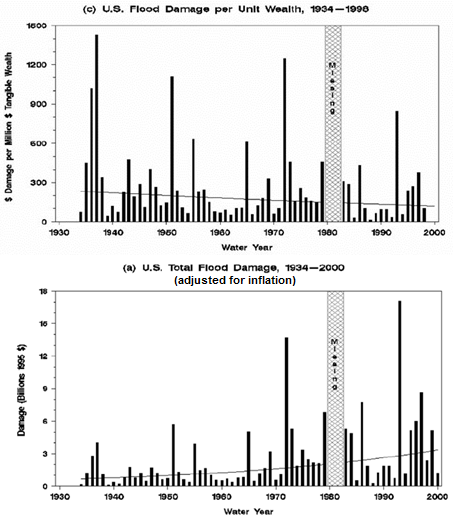
Figure 2: Two measures of US flood damage, 1934-2000
These graphics don’t tell us whether floods in the US are on the increase or not. And the Assessment doesn’t tell us either, Not only does it fail to detect any nationwide trends, it states that it never claimed any relationship between floods and man-made climate change to begin with:
Analysis of 200 U.S. stream gauges indicates areas of both increasing and decreasing flooding magnitude but does not provide robust evidence that these trends are attributable to human influences …. Hence, no formal attribution of observed flooding changes to anthropogenic forcing has been claimed.
3. Heavy Precipitation
Since the Assessment admits that there are no detectable human-induced trends in US flooding we can reasonably assume that the claimed increase in heavy precipitation events has had no impact. But we will look at the data anyway. The Assessment presents this graphic to back up its claim that heavy precipitation events are increasing over the US as a whole (Figure 3). As usual, the source of the data is not specified:
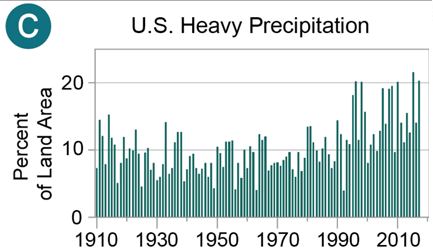
Figure 3: Percent of US land area with heavy precipitation events
The U.S. Global Change Research Program, under the auspices of which the Assessment was written, also produces graphics showing how heavy precipitation has changed with time and by region in the US (they may in fact be buried in parts of the Assessment I haven’t looked at). According to Figure 4 (from Globalchange) heavy precipitation events have increased over all of the US except the Southwest:
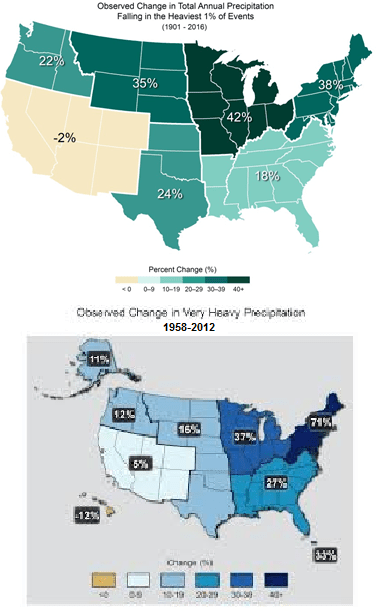
Figure 4: Increases in US total precipitation and very heavy precipitation events by region
And Huang et al (2017) produce time series showing how total precipitation and extreme precipitation in the Northeast US have both increased since about 1960 (Figure 5):
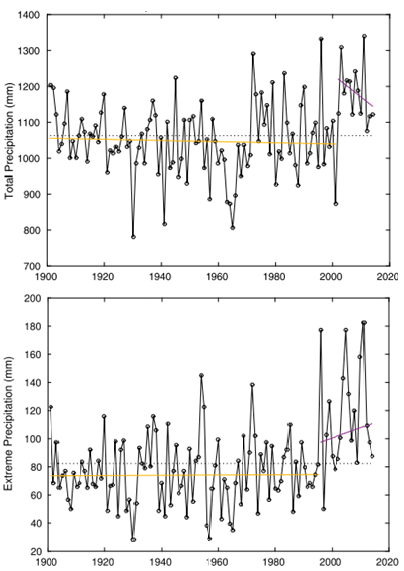
Figure 5: Increases in US total and extreme precipitation
So in this case the claim checks out against observations, or least in the northeast US. A lingering question, however, is how much of the increase in heavy precipitation was caused by man-made climate change. The Assessment implicitly assumes that all of it was, but a 2015 study by Hoerling et al. concludes that most of the changes after 1979 were caused by ocean variability:
Based on the modeling results, we conclude that anthropogenic climate change has not been a principal factor driving key characteristics of observed changes in U.S. heavy daily precipitation since 1979 …. Our results provide evidence for an alternative argument for another factor that has been operating in recent decades, namely, that statistics of U.S. heavy precipitation have been sensitive to strong decadal ocean variability since 1979
4. Heat Waves
One of the problems with heat waves is defining them (droughts and floods have the same problem). How hot does it have to get, and for how long, before a warm spell becomes a heat wave? The Assessment does not tell us. All it presents in the way of evidence for an increase in heat waves in the introductory report sections, including the 186-page “Report-in-Brief”, is this graphic (Figure 6), which shows the “heat wave season” increasing since the 1960s but not how many heat waves there were. Once again the data source is not specified, nor is the meaning of the cross-hatching:
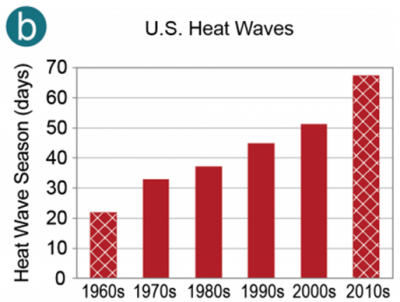
Figure 6: Length of US “heat wave season”
The next graphic (Figure 7) is another one I added from the globalchange website. It shows an increase in daily record high temperatures in recent decades but again provides no information on the number of heat waves. How many of the record highs, for example, occurred in the winter?
 Figure 7: Record daily highs in the US. The meaning of “ratio of daily temperature records” isn’t clear
The only graphic I found that provided any historic information on the incidence of heat waves was the Figure 8 plot of the EPA’s Annual Heat Wave Index. It’s not surprising that it doesn’t appear in the Assessment:
 Figure 8: US annual heat wave index since 1895
5. Wildfires
The Assessment provides two graphics to support its claim that climate change is causing more wildfires. Figure 9 shows the first. Again no data source is cited, but it turns out that it comes from the National Interagency Fire Center:
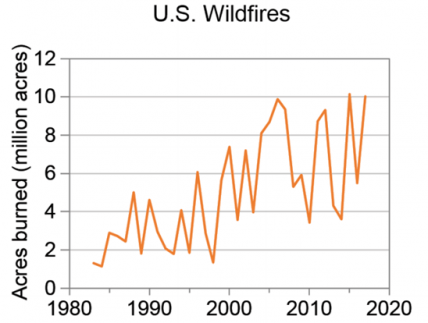
Figure 9: Acres burned by US wildfires since 1987
It also shows only a fraction of the NIFC data. Figure 10, for what it may be worth, shows the complete plot. I say “for what it may be worth” because the plot comes accompanied by this disclaimer:
The National Interagency Coordination Center at NIFC compiles annual wildland fire statistics for federal and state agencies. This information is provided through Situation Reports, which have been in use for several decades. Prior to 1983, sources of these figures are not known, or cannot be confirmed, and were not derived from the current situation reporting process. As a result the figures prior to 1983 should not be compared to later data.
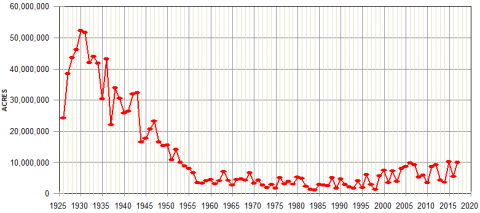 Figure 10: Acres burned by US wildfires. Figure 9 data carried back to 1926
Figure 11 reproduces the Assessment’s second graphic. It shows that about half of the increase in acreage burned was caused by climate change. (Note that it conflicts with the Figure 9 data, according to which a cumulative total of 173 million acres, not 23 million, has been burned since 1984).
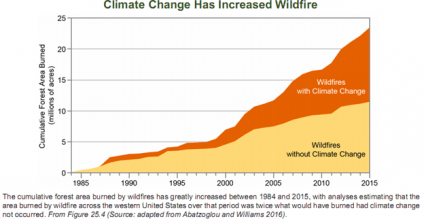 Figure 11: Acreage burned by naturally-occurring wildfires vs. acreage burned by climate-change-caused wildfires
In this case the data source is specified. It’s a 2016 paper written by John T. Abatzoglou and A. Park Williams entitled “Impact of anthropogenic climate change on wildfire across western US forests”. How did they segregate climate change-caused wildfires from naturally-occurring wildfires? They used climate models:
We quantify the influence of ACC (anthropogenic climate change) using the Coupled Model Intercomparison Project, Phase 5 (CMIP5) multimodel mean changes in temperature and vapor pressure …. This approach defines the ACC signal for any given location as the multimodel mean 50-y low-pass-filtered record of monthly temperature and vapor pressure anomalies relative to a 1901 baseline.
Before we can accept these results as meaningful we must assume that the global CMIP5 climate models can hindcast temperatures and vapor pressures to a high level of accuracy in the US, which they probably can’t (it’s generally accepted that climate models do a poor job of simulating regional changes). We also have to assume that the numerous other variables that affect wildfires have had no impact. This is a stretch, to put it mildly.
6. Atlantic Hurricanes
In this case the Assessment supplies no data, or at least none that I can find, to back up its claim that Atlantic hurricanes have increased since 1970. So once again I have had to dig up data on my own. Figure 12 (data from the US Environmental Protection Agency) plots the number of North Atlantic hurricanes since 1880. The total number is defined by the orange line, which adjusts for undercounting before 1967, and by the green line after that. There has been an erratic overall increase since about 1970, but since 1880 there has been no clear trend:
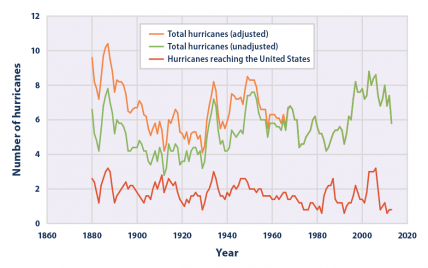 Figure 12: Unadjusted hurricane counts, hurricane counts adjusted for undercounting and hurricanes making landfall in the US
The North Atlantic, however, is not part of the US. The important consideration is how many hurricanes have made landfall in the US. These are shown by the red line at the bottom of Figure 12. There is no clear trend since 1970 and if anything a decrease since 1880.
According to Figure 13 (data from Dr. Roy Spencer) major hurricanes making landfall in the US have also been decreasing since the 1930s:

Figure 13: Major hurricanes making landfall in the US
And according to Klotzbach et al (2018) there has been little to no increase in normalized hurricane damages in the US since 1900 (Figure 13):
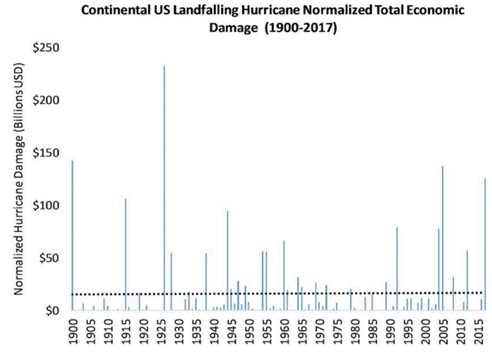
Figure 14: Normalized damages from hurricanes making landfall in the US
In this case the claim broadly matches observations but conceals (probably deliberately) the big picture, which is that man-made climate change has not increased the incidence of, or the damage caused by, North Atlantic hurricanes making landfall in the US since at least the late 1800s.
7. Tornadoes
Some storm types such as … tornadoes … are also exhibiting changes that have been linked to climate change. Once more the Assessment presents no supporting data, but NOAA’s tornado counts (Figure 15) speak for themselves:
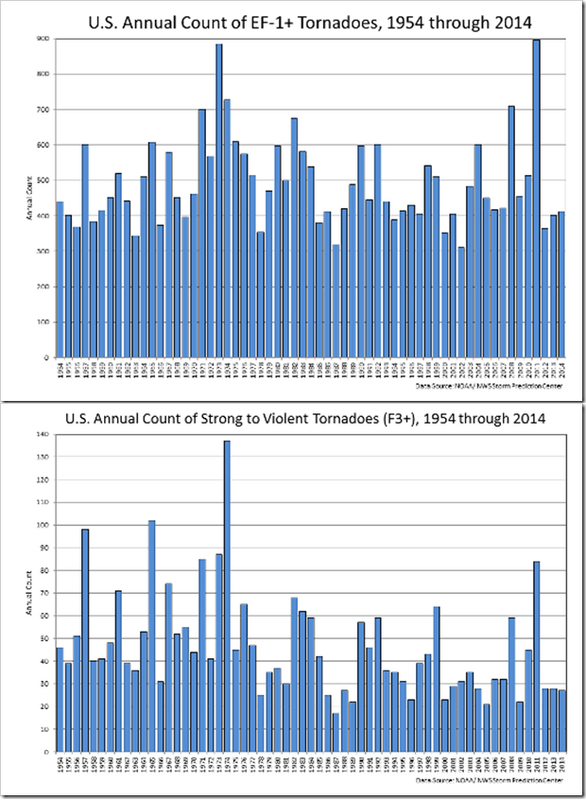
Figure 15: Total tornado and strong-to-violent tornado counts since 1954
8. Winter Storms
… winter storms … are also exhibiting changes that have been linked to climate change.
Once again there are no supporting data in the Assessment, but according to Coleman & Schwartz’s 2017 paper An Updated Blizzard Climatology of the Contiguous United States (1959–2014) the incidence of blizzards in the US has been increasing (Figure 16):
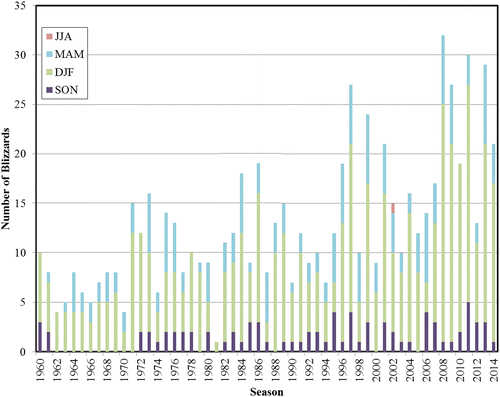
Figure 16: Incidence of blizzards in US
Is this counter-intuitive increase related to climate change? NOAA thinks it may be, although NOAA’s explanation works only in the eastern US ….
Conditions that influence the severity of eastern U.S. snowstorms include warmer-than-average ocean surface temperatures in the Atlantic. These can lead to exceptionally high amounts of moisture flowing into a storm and contribute to greater intensification of the storm. Natural variability can affect ocean surface temperatures, but as global surface temperatures increase, the temperature at any time is higher than it would have been without climate change.
…. and it doesn’t match up very well with trends in sea surface temperatures off the eastern US coast (data from KNMI Climate Explorer) ….
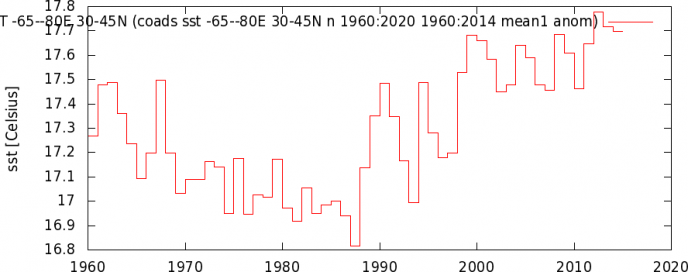
Figure 17: Sea surface temperatures along US east coast (30N-45N, 65W-80W)
… and according to the IPCC Fifth Assessment Report it’s going off in the wrong direction:
Changes in the frequency, severity, and duration of extreme events may be among the most important risks associated with climate change. In some parts of North America, this includes fewer periods of extreme cold, fewer snowstorms ….
Milder winter temperatures will decrease heavy snowstorms .…
This is one of the cases where the claim matches observational changes, but no conclusion as to causation can be reached until there is agreement over whether climate change causes a) more snowstorms, b) fewer snowstorms or c) both at the same time. My money is on c).
9. Sea Level Rise/Coastal Flooding
These are related phenomena, so I will discuss them under the same heading.
Once more there are no supporting data in the Assessment, so once more I had to go searching for some. This graphic from NOAA shows an increase in high-tide flooding that correlates with an increase in “coastal sea level” (Figure 18):

Figure 18: Average days/year with high-tide flooding vs. US sea level
And as shown in Figure 19 (data from EPA) the increased flooding is dominantly an east coast phenomenon:
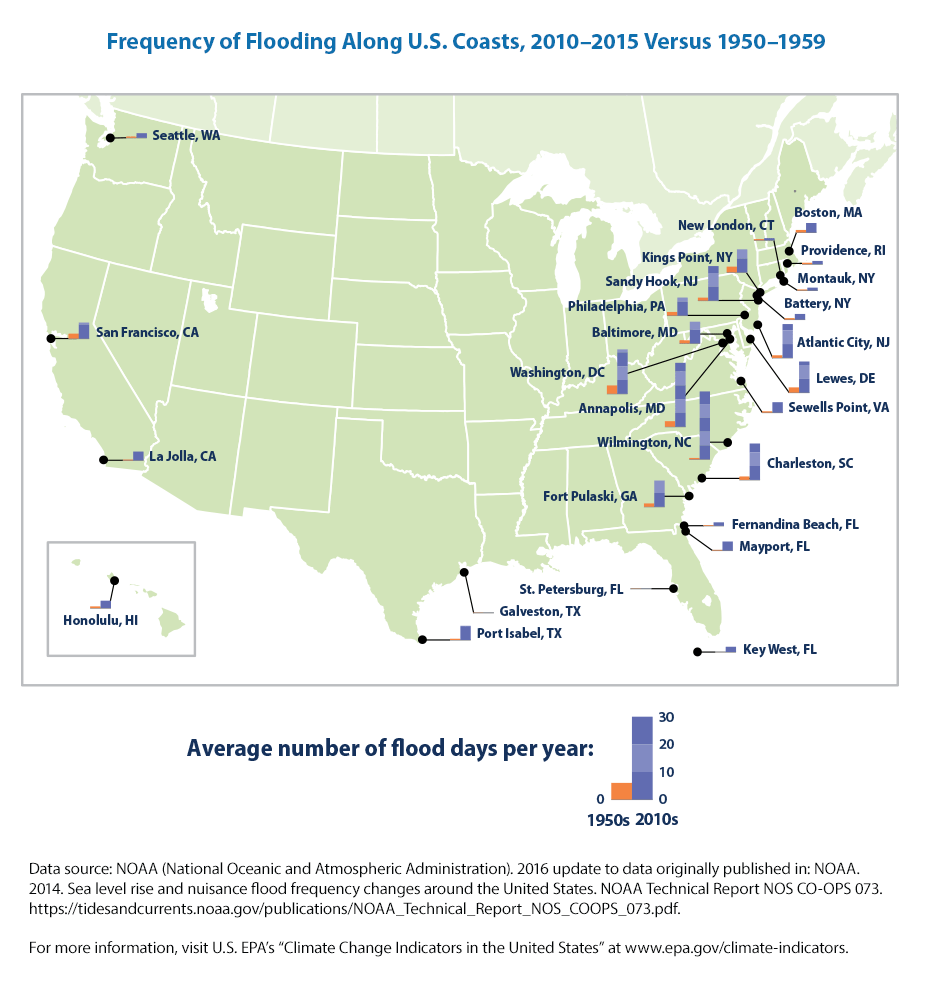
Figure 19: Average number of tidal floods/year, 2010-2015 vs. 1950-1959
But note the fine print. These are “nuisance floods” that don’t do any serious damage. There is no accepted definition of a nuisance flood, but a maximum water depth of 10cm has been proposed. And a 10cm-deep flood is hardly a catastrophic event.
And what does sea level rise have to do with the increase in nuisance floods? Not much. The reason nuisance floods are more common along the east coast of the US is that the east coast is sinking (a result of glacial rebound*, sediment compaction and groundwater extraction) while the west coast isn’t, and the rate at which the east coast is sinking exceeds the rate at which sea levels are rising in many places. The PSMSL tide gauge record from Sewell’s Point, near the mouth of Chesapeake Bay, is an example (Figure 20). The trend line shows sea level rising at an average rate of 4.5mm/year, but according to the United States Geological Survey less than half of this – maybe less than 2 mm/year – is a result of eustatic sea level rise. The rest is caused by land subsidence:
* Glacial rebound causes the land in and immediately around the ice sheet to rise while the surrounding land, which was squeezed upwards by the ice, sinks back down again.
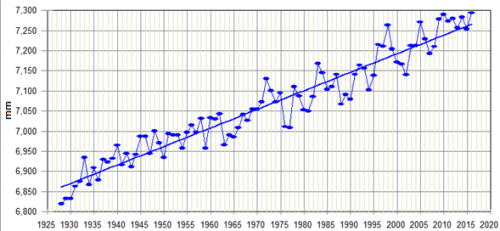 Figure Figure 20: Relative sea level rise, Sewell’s Point, Virginia
10 cm nuisance floods and ~2 mm/year sea level rises also pale into insignificance beside the hurricane storm surges that have occurred in the past and which can be expected to recur in the future along the US east coast. They reached heights of eight feet at Sewell’s point during Hurricane Isabel as recently as 2003 and 18 feet along the North Carolina coast during Hurricane Hazel in 1954.
My 2016 post on Isle de Jean Charles, Louisiana describes how sea level rise routinely takes the blame for inundations it didn’t cause. The Assessment cites it as an example of climate change in action.
10. Glaciers and snowpack
North American glaciers have indeed been retreating, as the Assessment claims. But according to Oerlemans (2005, Figure 21) they have been retreating since about 1825 and retreating rapidly after 1890, well before human-induced climate forcings became significant. This raises the question of whether the retreat has anything to do with man-made climate change:

Figure 21: Glacier retreat since 1700. The green line is North America
No data are available on snowpack, but Rutgers University publishes North American snow cover data (Figure 22). The trend line shows only a very minor decrease since 1975:
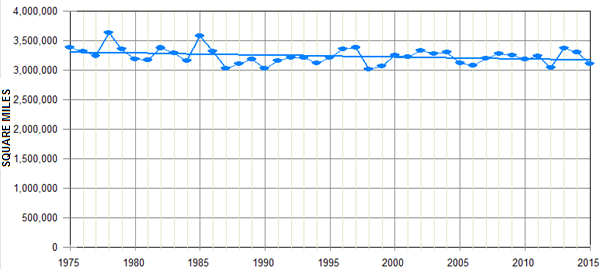 Figure 22: Snow-Covered Area in North America, 1972-2015
11. Injuries, Illnesses and Death:
Climate-related changes in weather patterns …. are affecting the health and well-being of the American people, causing injuries, illnesses, and death.
No data on illnesses or injuries are readily available, but over the last ten years approximately 25 million people have died in the US. According to Wikipedia
natural disasters of the type that commonly get blamed on climate change (hurricanes, floods, blizzards, wildfires, tornadoes) have claimed only 1,200 lives over this period.
Conclusion:
In this post I have fact-checked eleven separate climate change impacts which according to the Assessment’s summary sections are already doing damage in the US. In six of these cases (heavy precipitation, heat waves, wildfires, winter storms, sea level rise/coastal flooding and glacier retreat) there is observational evidence – most of which I have had to dig up myself – for impacts that might be related to man-made climate change, but in all of them this evidence is equivocal (e.g. wildfires) or the impacts are insignificant (e.g. nuisance tidal floods). In the other five cases (droughts, floods, Atlantic hurricanes, tornadoes, and injuries, illnesses and deaths) the observational evidence either contradicts the Assessment’s claims or the Assessment admits later in the text that the claim isn’t valid (droughts and floods).
Clearly the Assessment was conducted with little regard for the facts. A disregard for the facts, however, is necessary if one wishes to get the climate change catastrophe message across.
Academic Journals: High Stakes, Few Safeguards
By Donna Laframboise | Big Picture News | November 28, 2018
If a journal’s decision can make or break your career, its employees wield extraordinary power.

A week ago I discussed a paper that comes right out and says what everyone knows: most academic research eventually gets published in a peer-reviewed journal of some description. After all, there are 34,000 journals out there.
Because universities need criteria by which to award promotions and fast-track careers, it has become accepted wisdom that the most dazzling discoveries are the ones that get published in the most fashionable places. This is a hierarchy, with everyone scrambling for a spot in the high prestige journals at the top of the pyramid.
In the words of a former editor-in-chief of the British Medical Journal, “For an academic, publication in a major journal like Nature or Cell is to win the jackpot.”
As neurobiologist Bjorn Brembs observes, the “underlying assumption is that only the best scientists manage to publish in a highly selective tier of the most prestigious journals.” Where their research appears is “one of the most crucial factors determining their career.”
Government grants get distributed along exactly the same lines. Everyone knows that a scientist whose work has just been accepted by Science has a bright future.
This is an alarming state of affairs. Brilliant minds shouldn’t be sidelined by subjective, unsophisticated snobbery. For his part, Brembs demonstrates that “several lines of evidence” suggest high prestige journals may actually be publishing lower quality research than less prestigious ones.
But there’s actually an entire minefield lurking here. If a journal’s decision can make or break your career, it then follows that the people who work at these journals wield extraordinary power. They exercise that no-fooling power every day. They hold, in their hands, the lives of real people.
We all know power corrupts. We also know the stakes are incredibly high. So what safeguards are in place? What checks and balances prevent journal employees from abusing their power? What mechanisms discourage blatant corruption?
Let us not be naive. As Scott Adams, the creator of Dilbert, explains:
Whenever the following three conditions are met, you always have rampant cheating:
1. Cheating is easy
2. The payoff is huge.
3. The odds of getting caught are low
Western, affluent societies have placed tremendous trust in institutions of higher learning, in the scholarly publishing industry, and in entities that spend our tax dollars on scientific research.
It takes one’s breath away to comprehend the wobbly foundations on which all three of those now stand.
UN Climate Report Recommends Taxing Carbon and Discouraging Agriculture

“Land taxes on agricultural land can also help reduce agricultural land use and deforestation”
By Eric Worrall | Watts Up With That? | November 28, 2018
The latest UN Emissions Gap Report provides psychological advice for defeating political opposition to carbon pricing, and suggests discouraging farming by taxing agricultural land.
…
6.3.3 Political and behavioural factors
Ensuring broad and stable support for carbon pricing and the phasing-out of fossil fuel subsidies requires more than addressing distributional, competitiveness and leakage impacts. A number of additional success factors can be identified (Klenert et al., 2018a) and table 6.1 provides country examples for addressing these. The challenge is particularly significant where trust in government is limited (Klenert et al., 2018a; Rafaty, 2018). And yet, where trust is strong, there is a tendency for citizens to question problems if policy solutions challenge their world views, e.g. on the State’s role in the economy (“solution aversion”) (Campbell and Kay, 2014; Cherry et al., 2017). Designing policies that are consistent with the prevailing world views of specific societal groups therefore requires extensive communication and consultation prior to implementation.
To secure popular support for carbon pricing, the public needs to be informed about its positive effect on emissions reduction targets, as well as the co-benefits of cleaner air, health and fiscal sustainability (Hsu et al., 2008; Bristow et al., 2010; Kallbekken et al., 2011; Baranzini et al., 2014; Baranzini and Carattini, 2017). Timing is also important: a gradual reform is more likely to be successful than sudden and drastic price increases. Similarly, if several fossil fuel subsidies are being reformed, this can best be done by sequencing the reforms (Beaton et al., 2013; Rentschler and Bazilian, 2017b). Language matters too, with terms such as ‘fee’ or ‘contribution’ likely to meet with popular support compared with ‘tax’ (Kallbekken et al., 2011; Drews and van den Bergh, 2016; Baranzini and Carattini, 2017).
Carbon pricing and fossil fuel subsidy reform generate public revenues, the use of which can strongly impact support for carbon pricing. This is discussed in the section 6.3.4.
6.3.4 Use revenues from carbon pricing to foster sustainable development
Raising revenue through energy tax reforms relaxes constraints on broader fiscal policy, creating opportunities to stimulate more productive and socially inclusive economic development. With respect to carbon pricing, its potential for contributing to public budget is illustrated in figure 6.2b. In developing and emerging economies, where tax revenue-to-gross domestic product (GDP) ratios rarely exceed 20 percent, an additional €60/ tCO2 carbon price on top of existing measures would generate revenues worth more than 2 percent of gross domestic product (GDP). These revenues would not be available under non-fiscal climate policies like emission standards or ETS that do not auction permits.
…
Better alignment of broad tax policy can help reduce carbon emissions. Subsidies or tax deductions related to commuting (Su and DeSalvo, 2008), company cars (Harding, 2014) and the aviation sector (Gössling et al., 2017) are common in many developed countries and tend to encourage carbon-intensive transport choices. Replacing property taxes with land value taxes can reduce urban sprawl and increase housing density, which in turn reduces the need for longer commutes (Banzhaf and Lavery, 2010).
I’m horrified at the ongoing UN and green attacks on agriculture. The abundance we take for granted is politically fragile:
Fiscal policies such as ecological fiscal transfers, contingent on environmental performance, can also play a role in the land-use sector. They could be a way to implement REDD+6 when international pay-for-performance or carbon market finance flows to the national or state government level (Loft et al., 2016). There is growing experience with ecological fiscal transfers, including transfers of tax revenues to support protected areas and forests in Portugal (Santos et al., 2012), several Brazilian states (May et al., 2011) and India (Busch and Mukherjee, 2018). Land taxes on agricultural land can also help reduce agricultural land use and deforestation (Kalkuhl and Edenhofer, 2017).
…
Full Report: http://wedocs.unep.org/bitstream/handle/20.500.11822/26895/EGR2018_FullReport_EN.pdf
French Carbon Tax Protests
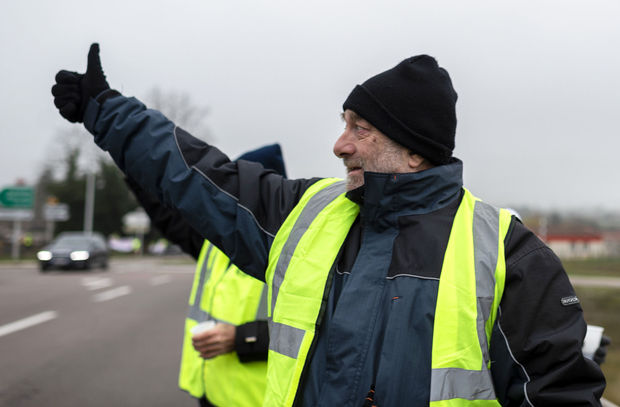
Yellow vests imposed on motorists become powerful anti-government symbol
By Donna Laframboise | Big Picture News | November 26, 2018
For more than a week, protests have been underway across France, sparked by January’s scheduled increase in carbon taxes on gasoline and diesel fuel. These taxes are supposed to save the world from climate change by encouraging everyone to drive less.
But working folk, especially those who reside outside of urban centers, have no choice. They need to get to work, and their elderly relatives need transporting to medical appointments. As Geoff Chambers observes: “Telling a plumber or refrigerator repair man to work from home or to travel by public transport seems…a sure recipe for starting a revolution.”
It’s a strange worldview that says we should lead diminished lives today so that people in the technologically advanced future will reap the rewards. (Human history is full of doomsayers who were convinced the future would be dire, but who have been proven wrong time and again.)
There’s a poetic aspect to these protests. French law mandates reflective yellow vests in every automobile. These aren’t to be kept in the trunk/boot, but within the cabin itself. In the event of a breakdown, a vest must be donned before one exits the vehicle.
Perhaps there’s some sense in this. But as soon as something stops being a suggestion and instead becomes a law, problems arise. One wonders how politically connected the manufacturers/distributors/retailers of such vests happened to be around the time that law got passed. More importantly, individual liberty is undermined when police have an excuse to harass anyone at any time under the guise of checking for the presence of such vests.
In a marvelous flourish, the good people of France have turned this lemon into lemonade. Dressed in these vests, they’ve taken to the streets to protest. An item everyone has been forced by the government to purchase has become a powerful symbol of resistance to a government-imposed carbon tax.
Visual impact is tremendously important if one hopes to attract media attention. A good visual can mean the difference between making it onto the television news or being wholly ignored.
The photos of, and videos from, these protests are fantastic. Those yellow vests (gilets jaunes) are the cat’s meow.
LINKS:
- See Geoff Chambers’ compelling exploration of the larger context of these protests here and here.
- See this photo collage posted on Facebook, this collection of images from search engine DuckDuckGo.com, and this collection of images from Google
- This BBC article says the fine for not having a yellow vest in one’s vehicle in France is 135 Euros – approximately 120 UK pounds, or 153 US dollars. The article also reports that these protests appear to be genuinely grassroots in nature: “In a country where protests are often tightly managed by one political party or trade union, this is a movement with no recognised national leader, no formal structure or affiliation, which unites voters of all ages from the far-left, the far-right, even those who once supported President Macron.”
- There’s a huge difference between peaceful protest and violence and vandalism. People who attack police and firefighters, and who damage property, aren’t admirable – whether they’re wearing gilets jaunes or not.
Climate experts call out new federal report for hiding the decline in hurricanes
‘Were they thinking, no one would notice?’
By Marc Morano | Climate Depot | November 25, 2018
Climate expert Prof. Dr. Roger Pielke Jr. noted how the new federal National Climate Assessment report looks at hurricanes.
Pielke Jr. asked on November 24: “How it is that the 2018 US National Climate Assessment failed to include or overlooked trends in US landfalling hurricanes which would, ahem, seem pretty important in a US climate report[?]
Pielke Jr. then noted that the report ignored one of its own expert reviewers who wrote this: “National Hurricane Center going back to the 1800s data clearly indicate a drop in the decadal rate of US landfalling hurricanes since the 1960s… instead you spin the topic to make it sound like the trends are all towards more cyclones.”
Pielke Jr. continued: “Let’s observe here hurricanes are discussed at length in the report, and every hurricane that is discussed is … a landfalling storm. The failure to include trend data on US landfalling hurricanes in USNCA is a remarkable choice. What were they thinking, no one would notice?”
“Here are 2 papers on US hurricanes ignored by USNCA: 1. trends in rainfall & flooding from US hurricanes: https://www.sciencedirect.com/science/article/pii/S0022169418301549 … 2. trends in US landfalling, intense hurricanes: https://journals.ametsoc.org/doi/10.1175/BAMS-D-17-0184.1 … Neither show long-term trends, but that isn’t a reason to ignore them,” Pielke added.
Dr. Pielke also previously rebuked the new federal climate report, calling it “embarrassing.” See: ‘EMBARRASSING’: CLIMATE EXPERT EXPLAINS WHAT’S WRONG WITH THE WHITE HOUSE’S NEW CLIMATE REPORT – Prof. Roger Pielke Jr.: “By presenting cherrypicked science, at odds w/ NCA Vol,1 & IPCC AR5, the authors of NCA Vol.2 have given a big fat gift to anyone who wants to dismiss climate science and policy.”
Also see:
Erroneous climate change study reported far and wide, corrections few and far between
RT | November 15, 2018
As the world grapples with extreme weather and wildfires, the issue of climate change is at the forefront of policy decisions, scientific research and media coverage – but bias towards alarmism is proving somewhat irresistible.
A new study recently published in the journal Nature suggested that “ocean warming is at the high end of previous estimates,” based on atmospheric data taken between 1991 and 2016. Ocean temperatures are 60-percent higher per year than the estimates offered by the United Nations’ Intergovernmental Panel on Climate Change in 2014, the authors claim.
The research was co-authored by an expert – a Princeton geoscientist no less – so the disturbing news spread like… well, wildfire across the news media, with each headline more breathless than the last. The only problem was, the numbers used to generate the conclusions in the research were off; way off.
One climate change researcher and statistician wasn’t so convinced by the study: Nicholas Lewis took a closer look at the numbers and spotted a few glaring errors in the researchers’ calculations.
“Unfortunately their work involves many assumptions where there is scope for subjective choices by the authors, so it is difficult to validate those assumptions,” Lewis told Reason.com.
In fact, the warming of the world’s oceans was overstated by approximately 30 percent, a substantial margin of error by most standards.
Lewis also questioned the “failure of the original peer review and editorial process to pick up the fairly obvious statistical problems in the original paper.”
In response, the study’s co-author and Scripps Institution of Oceanography climate scientist Ralph Keeling has acknowledged that there may be issues with the numbers, but insists that once they are rectified, it won’t affect the overall conclusion.
The issues “do not invalidate the study’s methodology or the new insights into ocean biogeochemistry on which it is based,” Keeling said in an addendum to the original news release.
While there may be less intense cause for immediate alarm about ocean warming, the entire episode does create concern over the validity of, and scrutiny placed on, research that bows to the scientific consensus rather than that which challenges it.
However, at the time of writing, only a handful of outlets have published news of the correction in comparison with the multitude who shared the original, erroneous findings. Correction coverage just doesn’t generate the clicks quite like alarmism after all.
Featured Video

Dan Dicks with James Corbett on Solutions Watch
or go to
Aletho News Archives – Video-Images
From the Archives
Secret document reveals plans for civil war in Lebanon, Israeli false flags, and invasion
By Randi Nord | Geopolitics Alert | April 5, 2019
Beirut – During his visit with US Secretary of State, Mike Pompeo, Lebanese President Michael Aoun reportedly received a US-Israeli document detailing plans for creating a civil war in Lebanon with covert false flag operations and possible Israeli invasion.
Although the source of the document is Israeli and created in partnership with Washington, no one knows who presented it to Aoun. The Lebanese TV station, Al-Jadeed, initially reported the document on Lebanese TV and a video on its website. Geopolitics Alert translated the report for this article. … continue
Blog Roll
 Aletho News
- Sheikh al-Asadi warns of Iraqi government compliance with US demands
- How to MAKE THE CONSPIRATORS PAY for their crimes! Dan Dicks with James Corbett on Solutions Watch
- There’s a drought in academia: A drought in honest research on the subject of drought and other weather extremes
- Department of War Awards $20.7 Billion Contract to Raytheon for Air-to-Air Missiles
- ‘Distance yourselves from Israel’: IRGC urges US population to question govt policies
- America’s Greenland deal has a radioactive backstory
- The RAF Fairford ‘terror plot’: Unpacking escalation in the UK echo-chamber
- EU Council Advances Chat Control 2.0 Scanning Proposal
- Ex-Greek MEP files complaint against Israeli spyware firm over alleged Pegasus surveillance
- Troubling ideas throughout the Torah, Talmud, Mishneh Torah and Tanya
- If Americans Knew
- New Report: “Scholasticide and Genocide in Gaza: Assessment, Testimonies and Legal Analysis”
- Ex-Biden officials are desperate for a Gaza scapegoat
- Israeli “settlers” Invade Al-Aqsa; Pour Boiling Water on 75-Year-Old
- Israel Has Kidnapped Another American Teenager
- US arms sales to Israel worth $21.6 billion in 20 months
- Three Palestinians Killed in Israeli Attacks on Gaza
- Revealed: German “Anti-Semitism Expert” Driving Crackdown on Palestine Solidarity is Former Israeli Spy
- Egypt’s Warning to Israel Before Oct 7
- Israel’s siege signals another cruel winter for 1.8 million Gazans – Daily Update
- Netanyahu Asked UAE Leader to Deny Report on Oct. 7 Warning in Secret Visit, Sources Say
- No Tricks Zone
- Two More Paleo Reconstructions Affirm Meters-Higher Sea Levels Across Ireland, Brazil 7000-6000 Years Ago
- New Study: Earth And Venus Surface Warmth Largely Explained By Convection And Lapse Rate, Not CO2 Or Radiation
- 2025 Nature Paper Claiming Worsening Global Drought Gets RETRACTED …Heavily Flawed
- New Study: ‘Global Drought Shows No Detectable Recent Acceleration Under Climate Warming’
- Economic Masterminds: German Socialists Suggest Taxing Productivity Gains Stemming From Using AI
- The South China Sea Has Not Been Cooperating With The Climate Change Narrative
- Energy Crisis: Germany Enters Heating Season With Historically Low Gas Reserve Fill Levels
- New Study: The Antarctic Ice Sheet Gained Mass From 2020-2024 Due To Staggering Snow And Ice Accumulation
- Study: Ocean Heating Rates From Thousands Of Years Ago ‘Dwarf’ Modern Ocean Heating Rates
- Climate Extremists Target, Attack Large-Scale Power Grid Infrastructure In Germany!

