What Phillip Williamson Forgot To Tell You
By Paul Homewood | Not A Lot Of People Know That | June 17, 2017
The Spectator has published an article by Dr Phillip Williamson, who works at the University of East Anglia as a science coordinator for the Natural Environment Research Council.

Readers of The Spectator will be familiar with the argument that climate change, like Britpop, ended in 1998. Raised on a diet of Matt Ridley and James Delingpole, you may have convinced yourself that climate scientists, for their own selfish reasons, continue to peddle a theory that is unsupported by real-world evidence.
You may also have picked up the idea that the ‘green blob’, as it has been called in these pages, is somehow suppressing the news that global warming is a dead parrot. That was the case made by Dr David Whitehouse, science editor of Lord Lawson’s Global Warming Policy Forum in a Spectator blog in February last year. He accused the world’s media of ignoring a paper in Nature Climate Change which concluded that the rise in global surface temperature had stalled, contrary to the narrative of man-made climate change. In contrast, an earlier paper by the National Oceanic and Atmospheric Administration (NOAA) in Science magazine, which questioned the existence of that hiatus, had been given huge coverage.
Those of us who work in climate research do not, of course, ignore evidence. A study published in Nature Climate Change does not go unnoticed. But the particular paper to which Whitehouse referred does not counter the reality of man-made change. By the time he wrote his piece, the hiatus in global air temperatures had already come to a blistering halt. The years 2014, 2015 and 2016 were the three hottest years on record — an unprecedented run.
But this is only part of the story. Anyone who considers climate change to be all about air temperatures at the Earth’s land surface misses something rather important. The evidence is not just blowing in the wind; it is 500 fathoms deep.
As a land species, it’s hardly surprising that we’re more concerned about what’s going on in the atmosphere than with conditions under the sea — but in the context of global warming that’s a big mistake. Around 93 per cent of the extra heat gained by the Earth over the past 50 years has sunk into the ocean, while 3 per cent has made ice melt, and 3 per cent has warmed the land. Only around 1 per cent has stayed in the atmosphere. So if we just measure air temperatures, we’re looking in the wrong place for climate change. Recent analyses by the World Meteorological Organisation and independent researchers have looked at deep-ocean as well as sea-surface temperatures, and both groups found that significant increases in total ocean heat content began around 1980, continuing more rapidly after 1998.
Not all the heat which is absorbed by the ocean stays there. Changes in circulation in the Pacific involve warm water shifting towards South America, raising air temperatures as it does so. Such El Niño events have contributed to the sharp rise in global air temperatures over the past three years.
The apparent slowdown in global temperature rise in the early years of this century was nothing more than the Earth’s climate system expressing its natural variability. Like the weather in London, the Earth’s climate is fickle: what we see in the climate from year to year is much like what we see in the weather from day to day, or week to week. The years between 1998 and 2013 were the equivalent of a spell of cool weather following a heatwave. Yet all the while, taking air and ocean heat content combined, the Earth was warming. Now that the most recent El Niño event has ended, global air temperatures ought to be falling, but they aren’t. The world saw its third hottest January ever, followed by the second hottest February, March and April. The atmosphere and the ocean are warming in tandem, as predicted by climate models.
It is not easy to measure how much extra heat has entered the ocean as a result of human influences on the climate. Given that seawater is around 1,000 times as dense as air, small increases in water temperature represent a huge amount of heat being absorbed. It’s tough to demonstrate a whole-ocean average temperature increase of less than 0.1°C in about 1.4 billion cubic km of seawater. Tough, but not impossible — steadily, scientists have managed to complete the picture. Four years ago, the Intergovernmental Panel on Climate Change concluded that such ocean warming was ‘virtually certain’. Following new findings of recent weeks and months, the qualifier ‘virtually’ is now unnecessary, putting to bed any contention that global warming ended in 1998 — it is just that for a while the main effect was on water, not air, temperatures.
What happens in the ocean matters, because rising sea temperatures reinforce climate change in several ways. Warmer sea water can release methane trapped on the sea floor. Some of it finds its way to the surface and into the atmosphere, where it acts as a greenhouse gas, trapping heat — at least 30 times more effectively than carbon dioxide. Warmer water also means less sea ice. That matters, because ice reflects the sun’s rays. With less sea ice, the ocean will absorb even more heat. As the ocean warms, it expands, lifting coastal ice-shelves and making it easier for glaciers to slip into the sea. New analyses now suggest that sea levels could rise by up to a metre, and maybe more, in our children’s lifetimes.
Genuine scepticism can be constructive, since science responds to challenges by obtaining new evidence to test ideas. But those who summarily dismiss evidence when it has become overwhelming no longer deserve the name sceptics — it’s then out-and-out denial. There is no hoax; scientists like me gain nothing from exaggeration.
Yet the worst-case scenarios are not inevitable. They can be averted by action to reduce, and eventually end, greenhouse gas emissions. While Donald Trump and others might dismiss inconvenient truths, science is now in no doubt that the planet is warming, and that there is a need to take action on a worldwide basis. The Paris agreement will be the future, whereas the so-called global-warming hiatus is already history.
https://www.spectator.co.uk/2017/06/the-great-myth-of-the-global-warming-pause/
What could have been a constructive essay has depressingly ended up as a cheap propaganda piece.
He grossly misrepresents the position of David Whitehouse and Matt Ridley, to all intents dismissing them as “deniers”. Neither denies the greenhouse effect, but they believe there is a proper debate to be had about climate sensitivity and effects.
But to Williamson, there is only one gospel, and others shall not be heard.
He claims, by the time he [Whitehouse] wrote his piece, the hiatus in global air temperatures had already come to a blistering halt. The years 2014, 2015 and 2016 were the three hottest years on record — an unprecedented run.
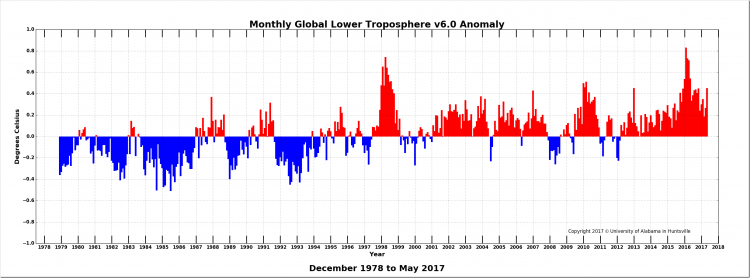
This may be true for the widely discredited surface temperature record, but not according to satellite data for the atmosphere, which shows last year as only in a statistical tie with 1998.
It is, of course, Williamson’s prerogative to refer to surface data, but he needs to explain why he chooses to ignore the satellite data. To make no reference at all to data, which would undermine his argument, is not the behaviour one associates with a proper scientist.
He goes on to say, now that the most recent El Niño event has ended, global air temperatures ought to be falling, but they aren’t.
This is totally untrue, global temperatures have fallen back by half a degree and more since the El Nino peaked last year, and are back to levels seen in the years after 2001.
[Click on here for clearer image]
The heart of the Williamson article however concerns oceans and how they are somehow hiding the missing heat.
However, things are not quite as black and white as he makes out.
We only have ARGO data since 2004, which is far too short a period to be drawing conclusions from. Prior to that, we had very little idea what was happening to ocean heat content.
It is certainly debatable just how much we know now.
He states, it’s tough to demonstrate a whole-ocean average temperature increase of less than 0.1°C in about 1.4 billion cubic km of seawater. Tough, but not impossible — steadily, scientists have managed to complete the picture.
In fact, the temperature increase detected is much less than 0.1C, approximately 0.02C since 2004.
It is certainly questionable whether any statistical significance can be attached to such a small amount at all, or whether such a figure is genuinely detectable.
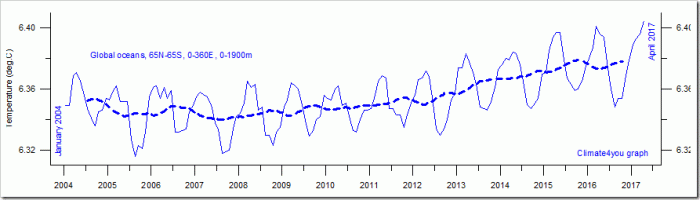
http://climate4you.com/
Then there is the question of just what is causing this increase in ocean temperatures, if it really exists.
He claims that around 93 per cent of the extra heat gained by the Earth over the past 50 years has sunk into the ocean. Unfortunately this is just mumbo jumbo. It is a physical fact that long wave radiation can only penetrate the top few millimeters of the ocean, where any warming would quickly lead to evaporation.
Even if there was a way for this extra heat to be mixed up with the deep ocean, the difference would be too small to detect.
This raises the question of whether other factors are at play in raising ocean temperatures, with the obvious one being the sun. After all, climate scientists have long known that ocean cycles can have major effects on the climate. Not only are they very powerful, but also very long lasting. The idea that man has caused sudden changes in the deep ocean is frankly scientific gibberish.
Williamson’s logic is that the pause in air temperatures, which he seems to accept existed until the 2015/16 El Nino, was because the world’s climate was going through a period of natural cooling, with the oceans holding back the heat (think La Nina).
But this ignores the AMO, which has been running through the warm phase since the mid 1990s. As even NOAA accept, when this happens, global air temperatures rise.
Meanwhile, the PDO has not really got into negative phase yet, partly because of the recent record El Nino.
Neither of these facts are consistent with his argument. Air temperatures have in fact plateaued despite the AMO and PDO.
But perhaps most importantly of all is the longer term trend. Williamson gives us a clue, when he says, “as the ocean warms, it expands”. In other words, sea levels rise.
But we know from tidal gauges all around the world that sea levels have been rising since the late 19thC, and for most of that time at a similar rate as now, and long before man made CO2 had any significant influence.
There is therefore no evidence that what we are seeing now is not just a continuation of that natural trend.
We in fact know very little about these ocean processes, and it is certainly a subject which deserves much greater attention.
Now that would be a good topic for the Spectator, but don’t expect Mr Williamson to be writing it!
FOOTNOTE
It was Phillip Williamson in his role as science coordinator (whatever that means!) who made a formal complaint about one of James Delingpole’s articles about ocean acidification to the UK press regulatory body IPSO last year.
Dellers has his usual forthright account of how IPSO threw out the complaint!
Sounds as if one of Williamson’s jobs is to shut down free speech.
Trump Rescued US from ‘Disastrous’ Paris Climate Accord Obligations
Sputnik – 03.06.2017
President Donald Trump saved the US economy from disastrous economic consequences in terms of soaring energy costs by repudiating the obligations his predecessor Barack Obama made in the Paris Climate Accords, analysts told Sputnik.
“The treaty itself would have been a disaster for the United States — Trump made an excellent case explaining why,” Ohio Northern University Assistant Professor of History Robert Waters said.
Trump announced on Thursday that the United States would withdraw from the Paris Climate Accords signed in December 2015 to reduce greenhouse gas emissions in an effort to combat global warming.
As well as forcing domestic energy costs to dramatically rise, the commitments Obama made in the Paris Accords would have badly hurt small US businesses at the expense of huge corporations, Waters noted.
“It was impressive that Trump decided to kill [the accords] because most of his big business friends supported them because smaller business competitors would have been driven out of business by the expense of implementing them. He also had to stand against the establishments of both parties,” he said.
By using executive authority to pull out of the treaty, Trump had frustrated his liberal opponents in the US federal judiciary who would have been determined to rule in favor of implementing all the most economically damaging and repressive of Obama’s commitments under it, Waters added.
“Trump withdrawing from the Paris climate treaty was huge… If Trump had not repudiated the climate treaty, there is no doubt that a judge would have tried to force him to implement the treaty,” Waters said.
Trump also pleased his supporters by carrying out his repeated promise during the 2016 presidential election campaign to pull out of the Paris Accords, Waters observed.
“It was very important that Trump kept this promise and killed US participation in the treaty,” he said.
Trump had begun to disillusion some of his populist supporters because he has not pushed Congress for money to build the border wall with Mexico and has not proposed a significant infrastructure program, Waters recalled.
However, Trump had redeemed his credibility with his political base by his withdrawal from the Paris accords, Waters maintained.
“This was a big issue for populist voters and he came through. Combined with his [NATO] speech… Trump has done a good job of showing that he is looking out for the American people’s interests and will not be cowed by foreign policy elites and their shibboleths,” he said.
Retired Canadian diplomat Patrick Armstrong expressed skepticism at the scientific theories claiming greenhouse gas emissions were generating global warming and agreed that Trump’s withdrawal from the climate accords would benefit the US economy.
“What are the likely consequences of pulling out of the Paris accords? If you believe in anthropomorphic climate change, catastrophic; if you don’t, advantageous,” he said.
Armstrong suggested that scientific theories, when found not to be supported by empirical evidence, should be abandoned or modified.
Guardian’s Seed Nonsense
By Paul Homewood | Not A Lot Of People Know That | May 21, 2017
Latest doommongering from the Guardian :

It was designed as an impregnable deep-freeze to protect the world’s most precious seeds from any global disaster and ensure humanity’s food supply forever. But the Global Seed Vault, buried in a mountain deep inside the Arctic circle, has been breached after global warming produced extraordinary temperatures over the winter, sending meltwater gushing into the entrance tunnel.
The vault is on the Norwegian island of Spitsbergen and contains almost a million packets of seeds, each a variety of an important food crop. When it was opened in 2008, the deep permafrost through which the vault was sunk was expected to provide “failsafe” protection against “the challenge of natural or man-made disasters”.
But soaring temperatures in the Arctic at the end of the world’s hottest ever recorded year led to melting and heavy rain, when light snow should have been falling. “It was not in our plans to think that the permafrost would not be there and that it would experience extreme weather like that,” said Hege Njaa Aschim, from the Norwegian government, which owns the vault. … Full article
The temperature record at Svalbard Airport only goes back to 1977, but the nearest long running station is at Tromo on the north coast of Norway.
Annual temperatures there were just as high in the 1930s.

https://data.giss.nasa.gov/tmp/gistemp/STATIONS/tmp_634010250000_7_0_1/station.png
In particular, winter temperatures have been as high, and even higher, many times since 1921.

https://data.giss.nasa.gov/tmp/gistemp/STATIONS/tmp_634010250000_1_0/station.txt
At Svalbard itself, the winter of 1985 was actually milder than this year’s.
But facts never bother the Guardian or its readers.
Nye’s Quadrant
By Judith Curry | Climate Etc. | May 2, 2017
The scary emergence of Nye’s Quadrant in dominating the public discourse on climate change.
If you are unfamiliar with Pasteur’s Quadrant, read my previous post [link]. The focus of my previous post was on use-inspired basic research. I struggled with the 4th quadrant (lower left), which is sometimes referred to as ‘taxonomy’. In the context of climate science, I interpreted this as climate model taxonomy, which analyzed the results of climate model simulations to identify alarming future possibilities.
Nye’s Quadrant
In response to my previous post on the Science March, which mentioned Pasteur’s Quadrant, Peter Deeble tweeted this version of the Quadrant diagram:

Besides being hysterically funny, the more I thought about it, I realized how profound this is.
Apart from the twitter aspect, here are other attributes of this quadrant:
- Second order belief – allegiance to consensus. Individual has not done primary research on the relevant topic or has not conducted an independent assessment of the evidence and research.
- Shutting down scientific debate; science as dogma
- Alarmism as a tactic to influence the public debate
- Political activism and advocacy for particular policy solutions
- Scientism: a demand that science dictate public policy
- Advocacy research
Some recent articles on Bill Nye’s pernicious influence on the scientific debate:
- Bill Nye not the right guy to lead the climate fight
- Bill Nye: perfect talking head for the March for Science
And then there is Neil DeGrasse Tyson (sorry Neil, you don’t get a Quadrant named after you)
The scariest thing about this quadrant is that this is the quadrant of science that is driving the media and public debate.
Within the field of climate research itself, the quickest litmus test for the Nye Quadrant is twitter addiction (~100 tweets per day)
The group of scientists operating in the Nye Quadrant are getting really political. Unfortunately (or fortunately), they are lousy at politics.
Blair King has a very good post on this: The climate crew: alienating allies and fighting the wrong fights.
See also: Climate change activists are the real science deniers.
Litmus test: Bret Stephen’s recent op-ed
NYTimes recently hired an op-ed writer by the name of Bret Stephens. Mr. Stephens is a Pulitzer Prize-winning writer who specializes in international affairs but has also written some controversial articles about climate change.
His first op-ed was Climate of Complete Certainty. Its actually very good. Blair King’s article provides the following summary:
Any reasonable read of Mr. Stephen’s first piece identifies some very important arguments that the climate activists have failed to address. The unrealistic confidence the climate activists have placed in their models even though those models are barely able to hindcast, let alone forecast. The growing divide between what climate scientists are saying about climate change and what the climate activists claim they are saying. Most importantly the growing disconnect between what the scientists are saying about the risks of climate change and public sentiment about the topic.
The Climatariat was not pleased. From an article by Julie Kelly:
Gavin Schmidt, a leading climate scientist and head of realclimate.org, has been on a Twitter bender since Friday, calling the column “pathetic. If you want ‘real conversations’ have it w/real people (& scientists) instead of cardboard cutout caricatures.” Stephens was even slammed by Andy Revkin, a climate journalist Stephens favorably cites in his column: “The column also features the kind of straw men and other familiar foils used by those more wedded to a world view or policy position than committed to a deep examination of a complex and consequential problem.” Hundreds of climate activists and science journalists slammed the Times, cancelling their subscriptions and comparing the Times to flat-earthers, creationists, and anti-vaxxers.
Many NYTimes readers are canceling their subscription over Stephens’ op-ed [link]. Stefan Rahmstorf and Ken Caldeira are canceling their subscription to the NYTimes [link]. Michael Mann also.

The NYPost has a good roundup of the hysterical responses.
Even the relatively moderate green journalists are up in arms:
- David Roberts at vox : The New York Times should not have hired climate change bullshitter Brett Stephens
- Nate Silver tweets: There’s nothing conservative (or liberal) about the Stephens column. The issue is about evidence vs. bullshit. He doesn’t know his subject.
And finally, a philosophical basis for canceling your NYTimes subscription over this: The righteous folly of canceling your NYTimes subscription.
JC reflections
How much do the shenanigans in Nye’s Quadrant in the name of science actually ‘matter’? Well fortunately, I don’t think these folks are very good politicians.
The issue of greatest concern is the impact all this has on the scientific community. The fame and fortune of Michael Mann — derived from Nye Quadrant tactics — is going to be tempting to some young scientists to emulate. I am already seeing hints of a few mid career climate scientists that seem ready to go full Nye.
Can we get back to the top half of the quadrant diagram, please.
Thoughts on the Public Discourse over Climate Change

Image via MIT.edu
By Richard Lindzen | Merion West | April 25, 2017
MIT atmospheric science professor Richard Lindzen suggests that many claims regarding climate change are exaggerated and unnecessarily alarmist.
Introduction:
For over 30 years, I have been giving talks on the science of climate change. When, however, I speak to a non-expert audience, and attempt to explain such matters as climate sensitivity, the relation of global mean temperature anomaly to extreme weather, that warming has decreased profoundly for the past 18 years, etc., it is obvious that the audience’s eyes are glazing over. Although I have presented evidence as to why the issue is not a catastrophe and may likely be beneficial, the response is puzzlement. I am typically asked how this is possible. After all, 97% of scientists agree, several of the hottest years on record have occurred during the past 18 years, all sorts of extremes have become more common, polar bears are disappearing, as is arctic ice, etc. In brief, there is overwhelming evidence of warming, etc. I tended to be surprised that anyone could get away with such sophistry or even downright dishonesty, but it is, unfortunately, the case that this was not evident to many of my listeners. I will try in this brief article to explain why such claims are, in fact, evidence of the dishonesty of the alarmist position.
The 97% meme:
This claim is actually a come-down from the 1988 claim on the cover of Newsweek that all scientists agree. In either case, the claim is meant to satisfy the non-expert that he or she has no need to understand the science. Mere agreement with the 97% will indicate that one is a supporter of science and superior to anyone denying disaster. This actually satisfies a psychological need for many people. The claim is made by a number of individuals and there are a number of ways in which the claim is presented. A thorough debunking has been given in the Wall Street Journal by Bast and Spencer. One of the dodges is to poll scientists as to whether they agree that CO2 levels in the atmosphere have increased, that the Earth has been warming (albeit only a little) and that man has played some part. This is, indeed, something almost all of us can agree on, but which has no obvious implication of danger. Nonetheless this is portrayed as support for catastrophism. Other dodges involve looking at a large number of abstracts where only a few actually deal with danger. If among these few, 97% support catastrophism, the 97% is presented as pertaining to the much larger totality of abstracts. One of my favorites is the recent claim in the Christian Science Monitor (a once respected and influential newspaper): “For the record, of the nearly 70,000 peer-reviewed articles on global warming published in 2013 and 2014, four authors rejected the idea that humans are the main drivers of climate change.” I don’t think that it takes an expert to recognize that this claim is a bizarre fantasy for many obvious reasons. Even the United Nations Intergovernmental Panel on Climate Change (this body, generally referred to as the IPCC is the body created by the UN to provide ‘authoritative’ assessments of manmade climate change) doesn’t agree with the claim.
Despite the above, I am somewhat surprised that it was necessary to use the various shenanigans described above. Since this issue fully emerged in public almost 30 years ago (and was instantly incorporated into the catechism of political correctness), there has been a huge increase in government funding of the area, and the funding has been predicated on the premise of climate catastrophism. By now, most of the people working in this area have entered in response to this funding. Note that governments have essentially a monopoly over the funding in this area. I would expect that the recipients of this funding would feel obligated to support the seriousness of the problem. Certainly, opposition to this would be a suicidal career move for a young academic. Perhaps the studies simply needed to properly phrase their questions so as to achieve levels of agreement for alarm that would be large though perhaps not as large as was required for the 97% meme especially if the respondents are allowed anonymity.
The ‘warmest years on record’ meme:
 |
 |
 |
|---|---|---|
| Figure 1a | Figure 1b | Figure 1c |
This simple claim covers a myriad of misconceptions. Under these circumstances, it is sometimes difficult to know where to begin. As in any demonization project, it begins with the ridiculous presumption that any warming whatsoever (and, for that matter, any increase in CO2) is bad, and proof of worse to come. We know that neither of these presumptions is true. People retire to the Sun Belt rather than to the arctic. CO2 is pumped into greenhouses to enhance plant growth. The emphasis on ‘warmest years on record’ appears to have been a response to the observation that the warming episode from about 1978 to 1998 appeared to have ceased and temperatures have remained almost constant since 1998. Of course, if 1998 was the hottest year on record, all the subsequent years will also be among the hottest years on record. None of this contradicts the fact that the warming (ie, the increase of temperature) has ceased. Yet, somehow, many people have been led to believe that both statements cannot be simultaneously true. At best, this assumes a very substantial level of public gullibility. The potential importance of the so-called pause (for all we know, this might not be a pause, and the temperature might even cool), is never mentioned and rarely understood. Its existence means that there is something that is at least comparable to anthropogenic forcing. However, the IPCC attribution of most of the recent (and only the recent) warming episode to man depends on the assumption in models that there is no such competitive process.
The focus on the temperature record, itself, is worth delving into a bit. What exactly is this temperature that is being looked at? It certainly can’t be the average surface temperature. Averaging temperatures from places as disparate as Death Valley and Mount Everest is hardly more meaningful than averaging phone numbers in a telephone book (for those of you who still remember phone books). What is done, instead, is to average what are called temperature anomalies. Here, one takes thirty year averages at each station and records the deviations from this average. These are referred to as anomalies and it is the anomalies that are averaged over the globe. The only attempt I know of to illustrate the steps in this process was by the late Stan Grotch at the Lawrence Livermore Laboratory. Figure 1a shows the scatter plot of the station anomalies. Figure 1b then shows the result of averaging these anomalies. Most scientists would conclude that there was a remarkable degree of cancellation and that the result was almost complete cancellation. However, instead, one stretches the temperature scale by almost a factor of 10 so as to make the minuscule changes in Figure 1b look more significant. The result is shown in Figure 1c. There is quite a lot of random noise in Figure 1c, and this noise is a pretty good indication of the uncertainty of the analysis (roughly +/- 0.2C). The usual presentations show something considerably smoother. Sometimes this is the result of smoothing the record with something called running means. It is also the case that Grotch used data from the UK Meteorological Office which was from land based stations. Including data from the ocean leads to smoother looking series but the absolute accuracy of the data is worse given that the ocean data mixes very different measurement techniques (buckets in old ship data, ship intakes after WW1, satellite measurements of skin temperature (which is quite different from surface temperature), and buoy data).
 |
|---|
| Figure 2 |
These issues are summarized in Figure 2 which presents an idealized schematic of the temperature record and its uncertainty. We see very clearly that because the rise ceases in 1998, that this implies that 18 of the 18 warmest years on record (for the schematic presentation) have occurred during the last 18 years. We also see that the uncertainty together with the smallness of the changes offers ample scope for adjustments that dramatically alter the appearance of the record (note that uncertainty is rarely indicated on such graphs).
At this point, one is likely to run into arguments over the minutia of the temperature record, but this would simply amount to muddying the waters so to speak. Nothing can alter the fact that the changes one is speaking about are small. Of course ‘small’ is relative. Consider three measures of smallness.
 |
|---|
| Figure 3 |
Figure 3 shows the variations in temperature in Boston over a one month period. The dark blue bars show the actual range of temperatures for each day. The dark gray bars show the climatological range of temperatures for that date, and the light gray bars show the range between the record-breaking low and record-breaking high for that date. In the middle is a red line. The width of that line corresponds to the range of temperature in the global mean temperature anomaly record for the past 175 years. This shows that the temperature change that we are discussing is small compared to our routine sensual experience. Keep this in mind when someone claims to ‘feel’ global warming.
The next measure is how does the observed change compare with what we might expect from greenhouse warming. Now, CO2 is not the only anthropogenic greenhouse gas.
 |
|---|
| Figure 4. Red bar represents observations. Gray bars show model predictions. |
When all of them are included, the UN IPCC finds that we are just about at the greenhouse forcing of climate that one expects from a doubling of CO2, and the temperature increase has been about 0.8C. If man’s emissions are responsible for all of the temperature change over that past 60 years, this still points to a lower sensitivity (sensitivity, by convention, generally refers to the temperature increase produced by a doubling of CO2 when the system reaches equilibrium) than produced by the least sensitive models (which claim to have sensitivities of from 1.5-4.5C for a doubling of CO2). And, the lower sensitivities are understood to be unproblematic. However, the IPCC only claims man is responsible for most of the warming. The sensitivity might then be much lower. Of course, the situation is not quite so simple, but calculations do show that for higher sensitivities one has to cancel some (and often quite a lot) of the greenhouse forcing with what was assumed to be unknown aerosol cooling in order for the models to remain consistent with past observations (a recent article in the Bulletin of the American Meteorological Society points out that there are, in fact, quite a number of arbitrary adjustments made to models in order to get some agreement with the past record). As the aerosol forcing becomes less uncertain, we see that high sensitivities have become untenable. This is entirely consistent with the fact that virtually all models used to predict ‘dangerous’ warming over-predict observed warming after the ‘calibration’ periods. That is to say, observed warming is small compared to what the models upon which concerns are based are predicting. This is illustrated in Figure 4. As I have mentioned, uncertainties allow for substantial adjustments in the temperature record. One rather infamous case involved NOAA’s adjustments in a paper by Karl et al that replace the pause with continued warming. But it was easy to show that even with this adjustment, models continued to show more warming than even the ‘adjusted’ time series showed. Moreover, most papers since have rejected the Karl et al adjustment (which just coincidentally came out with much publicity just before the Paris climate conference).
The third approach is somewhat different. Instead of arguing that the change is not small, it argues that the change is ‘unprecedented.’ This is Michael Mann’s infamous ‘hockey stick.’ Here, Mann used tree rings from bristle cone pines to estimate Northern Hemisphere temperatures back hundreds of years. This was done by calibrating the tree ring data with surface observations for a thirty year period, and using this calibration to estimate temperatures in the distant past in order to eliminate the medieval warm period. Indeed, this reconstruction showed flat temperatures for the past thousand years. The usual test for such a procedure would be to see how the calibration worked for observations after the calibration period. Unfortunately, the results failed to show the warming found in the surface data. The solution was starkly simple and stupid. The tree ring record was cut off at the end of the calibration period and replaced by the actual surface record. In the Climategate emails (Climategate refers to a huge release of emails from various scientists supporting alarm where the suppression of opposing views, the intimidation of editors, the manipulation of data, etc. were all discussed), this was referred to as Mann’s trick.
The whole point of the above was to make clear that we are not concerned with warming per se, but with how much warming. It is essential to avoid the environmental tendency to regard anything that may be bad in large quantities to be avoided at any level however small. In point of fact small warming is likely to be beneficial on many counts. If you have assimilated the above, you should be able to analyze media presentations like this one to see that amidst all the rhetoric, the author is pretty much saying nothing while even misrepresenting what the IPCC says.
The extreme weather meme:
Every line weather forecaster knows that extreme events occur someplace virtually every day. The present temptation to attribute these normally occurring events to climate change is patently dishonest. Roger Pielke, Jr. actually wrote a book detailing the fact that there is no trend in virtually any extreme event (including tornados, hurricanes, droughts, floods, etc.) with some actually decreasing. Even the UN’s IPCC acknowledges that there is no basis for attributing such events to anthropogenic climate change.
 |
|---|
| Figure 5. Temperature map for North America. |
The situation with respect to extreme temperatures actually contradicts not just observations but basic meteorological theory. Figure 5 shows a map of temperatures for North America on February 27, 2008. Extreme temperatures at any location occur when air motions carry air from the coldest or warmest points on the map. Now, in a warmer climate, it is expected that the temperature difference between the tropics and the high latitudes will decrease. Thus the range of possible extremes will be reduced. More important is the fact that the motions that carry these temperatures arise from a process called baroclinic instability, and this instability derives from the magnitude of the aforementioned temperature difference. Thus, in a warmer world, these winds will be weaker and less capable of carrying extreme temperatures to remote locations. Claims of greater extremes in temperature simply ignore the basic physics, and rely, for their acceptance, on the ignorance of the audience.
The claims of extreme weather transcend the usual use of misleading claims. They often amount to claims for the exact opposite of what is actually occurring. The object of the claims is simply to be as scary as possible, and if that requires claiming the opposite of the true situation, so be it.
Sea level rise:
Globally averaged sea level appears to have been rising at the rate of about 6 inches a century for thousands of years. Until the advent of satellites, sea level was essentially measured with tide gauges which measure the sea level relative to the land level. Unfortunately, the land level is also changing, and as Emery and Aubrey note, tectonics are the major source of change at many locations. Beginning in 1979 we began to use satellites to measure actual sea level. The results were surprisingly close to the previous tide gauge estimates, but slightly higher, but one sees from Wunsch et al (DOI: 10.1175/2007JCLI1840.1) that one is in no position to argue that small differences from changing methodologies represents acceleration. Regardless, the changes are small compared to the claims that suggest disastrous changes. However, even in the early 1980’s advocates of warming alarm like S. Schneider argued that sea level would be an easily appreciated scare tactic. The fact that people like Al Gore and Susan Solomon (former head of the IPCC’s Scientific Assessment) have invested heavily in ocean front property supports the notion that the issue is propagandistic rather than scientific.
Arctic sea ice:
Satellites have been observing arctic (and Antarctic) sea ice since 1979. Every year there is a pronounced annual cycle where the almost complete winter coverage is much reduced each summer. During this period there has been a noticeable downtrend is summer ice in the arctic (with the opposite behavior in the Antarctic), though in recent years, the coverage appears to have stabilized. In terms of climate change, 40 years is, of course, a rather short interval. Still, there have been the inevitable attempts to extrapolate short period trends leading to claims that the arctic should have already reached ice free conditions. Extrapolating short term trends is obviously inappropriate. Extrapolating surface temperature changes from dawn to dusk would lead to a boiling climate in days. This would be silly. The extrapolation of arctic summer ice coverage looks like it might be comparably silly. Moreover, although the satellite coverage is immensely better than what was previously available, the data is far from perfect. The satellites can confuse ice topped with melt water with ice free regions. In addition, temperature might not be the main cause of reduced sea ice coverage. Summer ice tends to be fragile, and changing winds play an important role in blowing ice out of the arctic sea. Associating changing summer sea ice coverage with climate change is, itself, dubious. Existing climate models hardly unambiguously predict the observed behavior. Predictions for 2100 range from no change to complete disappearance. Thus, it cannot be said that the sea ice behavior confirms any plausible prediction.
It is sometimes noted that concerns for disappearing arctic sea ice were issued in 1922, suggesting that such behavior is not unique to the present. The data used, at that time, came from the neighborhood of Spitzbergen. A marine biologist and climate campaigner has argued that what was described was a local phenomenon, but, despite the claim, the evidence presented by the author is far from conclusive. Among other things, the author was selective in his choice of ‘evidence.’
All one can say, at this point, is that the behavior of arctic sea ice represents one of the numerous interesting phenomena that the earth presents us with, and for which neither the understanding nor the needed records exist. It probably pays to note that melting sea ice does not contribute to sea level rise. Moreover, man has long dreamt of the opening of this Northwest Passage. It is curious that it is now viewed with alarm. Of course, as Mencken noted, “The whole aim of practical politics is to keep the populace alarmed (and hence clamorous to be led to safety) by an endless series of hobgoblins, most of them imaginary.” The environmental movement has elevated this aim well beyond what Mencken noted.
Polar bear meme:
I suspect that Al Gore undertook considerable focus-group research to determine the remarkable effectiveness of the notion that climate change would endanger polar bears. His use of an obviously photo shopped picture of a pathetic polar bear on an ice float suggests this. As Susan Crockford, a specialist in polar bear evolution, points out, there had indeed been a significant decrease in polar bear population in the past due to hunting and earlier due to commercial exploitation of polar bear fur. This has led to successful protective measures and sufficient recovery of polar bear population, that hunting has again been permitted. There is no evidence that changes in summer sea ice have had any adverse impact on polar bear population, and, given that polar bears can swim for over a hundred miles, there seems to be little reason to suppose that it would. Nonetheless, for the small community of polar bear experts, the climate related concerns have presented an obvious attraction.
Ocean acidification:
This is again one of those obscure claims that sounds scary but doesn’t stand up to scrutiny. Ever since the acid rain scare, it has been realized that the public responds with alarm to anything with the word ‘acid’ in it. In point of fact, the ocean is basic rather than acidic (ie, its ph is always appreciably higher than 7, and there is no possibility of increasing levels of atmospheric CO2 bringing it down to 7; note that ph is a measure of acidity or basicness: values greater than 7 are basic and less than 7 acid.), and the purported changes simply refer to making the ocean a bit less basic. However, such a more correct description would lack the scare component. As usual, there is so much wrong with this claim that it takes a fairly long article to go over it all. I recommend the following source.
Death of coral reefs:
The alleged death of coral reefs is partly linked to the acidification issue above, and as we see, the linkage is almost opposite to what is claimed. There is also the matter of warming per se leading to coral bleaching. A typical alarmist presentation can be found here.
The article is behind a pay wall, but most universities provide access to Nature. The reasoned response to this paper is provided here.
As Steele, the author of the above, points out, bleaching has common causes other than warming and is far from a death sentence for corals whose capacity to recover is substantial. This article is a bit polemical, but essentially correct.
Global warming as the cause of everything:
As we see from the above, there is a tendency to blame everything unpleasant on global warming. The absurd extent of this tendency is illustrated on the following here. That hasn’t stopped the EPA from using such stuff to claim large health benefits for its climate change policies. Moreover, I fear that with so many claims, there is always the question ‘what about ….?’ Hardly anyone has the time and energy to deal with the huge number of claims. Fortunately, most are self-evidently absurd. Nation magazine recently came up with what is a bit of a champion is this regard. CO2, it should be noted, is hardly poisonous. On the contrary, it is essential for life on our planet and levels as high as 5000 ppm are considered safe on our submarines and on the space station (current atmospheric levels are around 400 ppm, while, due to our breathing, indoor levels can be much higher). The Nation article is typical in that it makes many bizarre claims in a brief space. It argues that a runaway greenhouse effect on Venus led to temperatures hot enough to melt lead. Of course, no one can claim that the earth is subject to such a runaway, but even on Venus, the hot surface depends primarily on the closeness of Venus to the sun and the existence of a dense sulfuric acid cloud covering the planet. Relatedly, Mars, which also has much more CO2 than the earth, is much further from the sun and very cold. As we have seen many times already, such matters are mere details when one is in the business of scaring the public.
Concluding remarks:
The accumulation of false and/or misleading claims is often referred to as the ‘overwhelming evidence’ for forthcoming catastrophe. Without these claims, one might legitimately ask whether there is any evidence at all.
Despite this, climate change has been the alleged motivation for numerous policies, which, for the most part, seem to have done more harm than the purported climate change, and have the obvious capacity to do much more. Perhaps the best that can be said for these efforts is that they are acknowledged to have little impact on either CO2 levels or temperatures despite their immense cost. This is relatively good news since there is ample evidence that both changes are likely to be beneficial although the immense waste of money is not.
I haven’t spent much time on the details of the science, but there is one thing that should spark skepticism in any intelligent reader. The system we are looking at consists in two turbulent fluids interacting with each other. They are on a rotating planet that is differentially heated by the sun. A vital constituent of the atmospheric component is water in the liquid, solid and vapor phases, and the changes in phase have vast energetic ramifications. The energy budget of this system involves the absorption and reemission of about 200 watts per square meter. Doubling CO2 involves a 2% perturbation to this budget. So do minor changes in clouds and other features, and such changes are common. In this complex multifactor system, what is the likelihood of the climate (which, itself, consists in many variables and not just globally averaged temperature anomaly) is controlled by this 2% perturbation in a single variable? Believing this is pretty close to believing in magic. Instead, you are told that it is believing in ‘science.’ Such a claim should be a tip-off that something is amiss. After all, science is a mode of inquiry rather than a belief structure.
Richard Lindzen is the Alfred P. Sloan Professor of Atmospheric Sciences, Emeritus at Massachusetts Institute of Technology.
What The IPCC Said About Glaciers In 1990

By Paul Homewood | Not A Lot Of People Know That | April 25, 2017
When we talk about glaciers retreating, it is worth recalling what the first IPCC Report in 1990 had to say about the matter:

http://www.ipcc.ch/ipccreports/far/wg_I/ipcc_far_wg_I_full_report.pdf
In other words, glaciers began receding in the second half of the 19thC, and the fastest rate of retreat was 1920-60, before CO2 emissions could have had any significant impact.
The IPCC also added the following chart showing how, on a range of glaciers, rapid retreat began in the 19thC.

They also added:

And:

Reflections on Mark Steyn’s ‘A Disgrace to the Profession’ about Dr. Michael Mann

By Rick Wallace | Watts Up With That ? | March 29, 2017
Mark Steyn’s A Disgrace to the Profession is a compilation of scientific commentary on Michael Mann and his work and is a valuable antidote to the idea that questioning or criticizing this particular researcher is an overt admission of ignorance, let alone an “attack on science”. What I will argue in this essay is that Steyn has done serious students of the AGW hysteria an even greater service. In fact, this work reveals some features of the hysteria that are, I think, critical for understanding it in depth. The present essay, which will elaborate on this point, is intended as a contribution to the study of what one of those quoted in Steyn’s book called “pathological science”.
For those who aren’t familiar with the work, Steyn’s book is a collection of highly critical comments by scientists of varying degrees of eminence concerning Michael Mann and his (in)famous “hockey stick” temperature graph. The book emanated from a still-ongoing lawsuit that Mann filed against Steyn for writing in a National Review Online article that the hockey stick was fraudulent. Steyn was struck by the fact that, when it came time to file third-party amicus briefs, no one filed a brief in Mann’s defense. So he began combing the Web and other resources, and found a plethora of critical comments that he collected into one volume.2,3 In fact, by now almost everyone, skeptic or warmist, has backed away from this very flawed piece of evidence.
Together, the comments in Steyn’s book suggest that even in the midst of a great social hysteria like AGW much of the field of climatology is functioning more or less normally. Also, one finds the usual range of opinion that one finds in any science, although in this case it is somewhat muted, in part because of the possibility of intimidation from the more enthusiastic warmists and their followers. (Examples of this are mentioned below.)
The same conclusion can be drawn from the compendia of research results that Kenneth Richard has contributed to the NoTricksZone website. In a series of posts, Richard has reviewed a wealth of data drawn from the contemporary technical literature that in various ways runs counter to and therefore undermines the standard AGW narrative.4
In some respects, then, the field of climatology still has a pluralistic cast. On the other hand, the treatment of Prof. Lennart Bengtsson after it was announced that he was joining the Global Warming Policy Foundation and the recent comments by Judith Curry on her (I take it) premature retirement show quite clearly that even apart from certain individuals, the situation in this field is not particularly healthy. What I think the latter incident shows is that someone like Dr. Curry simply has a lower tolerance of double standards than do many other more or less serious practitioners – moreover, she has been unwilling to remain silent.
When they are read together, the quotations and commentary in Steyn’s book also shed more light on the Michael Mann phenomenon. For one thing, they show that his behavior over time has been quite consistent. There is, for example, the tendency to play fast and loose with methodology. This is shown most clearly in the methods that gave rise to the original hockey stick. Over time and thanks to the perseverance of a few, the puzzle of how it was derived is now pretty well understood. Steyn touches on all of the major points, each one a little story in itself.
In the first place, in collecting data for the hockey stick graph, Mann and his co-workers chose a very problematical proxy. Tree ring dimensions are subject to a number of factors that affect tree growth: “soil nutrients and structure; light variations; carbon dioxide; competition from other trees; disease; predators; age; rainfall” (Steyn, 28, quoting from testimony of A. Trewavas). Moreover, the bristlecone pine, which was a major proxy source in the original study is a particularly unreliable basis for temperature estimates since it is very responsive to factors such as carbon dioxide regardless of temperature.
Having chosen a problematic proxy, Mann et al. then went on to make a series of other dubious decisions. For example, in the original work the tree ring data were correlated with average temperatures for the Northern hemisphere rather than for North America, although the trees in question all came from North America. This was because the latter didn’t match the results obtained with their proxy data. This leads to a rather peculiar state of affairs. As one scientist put it:
“The logical conclusion [from their study] is that Northamerican trees respond better to global average temperatures than to local temperatures.” (Steyn, xiii)
In addition, their methods served to impose a peculiar form of proxy weighting, which was in fact crucial for obtaining their results (in addition to sometimes double counting the only tree/trees used from a location outside the bristlecone sites). According to Steve McIntyre,
“The effect is that tree ring series with a hockey stick shape no longer have a mean of zero and end up dominating the first principal component (PC1) [the main factor obtained from the analysis]; in effect, Mann’s program mines for series with a hockey stick shape. In the crucial period of 1400-1450, in the critical PC1 of the North American network, the top-weighted Sheep Mountain series, with a hockey stick shape gets over 390 times the weight of the least weighted series, which does not have a hockey stick shape.” (Steyn, 69-70)
Steyn sums it up:
“So his [Mann’s] hypothesis that it [the temperature record] looks like a hockey stick is confirmed only because a tree ring that produces a hockey-stick shape is given 390 times the weight of a tree ring that does not.” (Steyn, 5)
In all of this it is also telling that people with statistical expertise were never consulted about any of the sampling and weighting procedures.
And then we arrive the pièce de résistance of the 1999 effort. Because despite all this finagling, Mann et al. were still stuck with a basic problem. This was that the proxy data showed a decline after 1980 – at the same time that the global average temperature showed a marked rise. Their solution was bold and straightforward: truncate the proxy record at the year 1980 and for the remaining years in the 20th century use the record derived from thermometers. Clearly, this gives us the best of both worlds. So what’s not to like?
However, there were some doubting Thomases who took issue with this procedure, especially after it was properly understood (cf. below). The simplest argument is the most telling: if the proxy records don’t match the temperature record during the last decades of the 20th century, where both kinds of record are available, why should one assume that the former accurately reflects actual temperatures during the past millennium?
It is also telling that, according to Steyn (p. 53), it was not until 2014, sixteen years after the publication of the original hockey stick paper, that all these methodological details were adequately understood. This is because the issues involved could only be resolved by a detailed perusal of the original materials and methods. And Mann’s response to requests for the necessary information served to deter inquiries of this sort. For a long while he and his co-workers refused to share their data or allow anyone to examine the program that performed the analysis.
“Mann declined – for years – to release the elements needed to reproduce his stick. In evidence before the House of Commons in London, Professor Darrel Ince noted Mann’s refusal to cough up his computer code, and said that he would “regard any papers based on the software as null and void”. His stick could be neither proved nor disproved – and, as Professor Vincent Courtillot reminded European climatologists, if “it’s not falsifiable, it’s not science”.” (Steyn, 6)
Along with the discrepancies uncovered in connection with the early hockey stick papers, Mann’s later work is littered with a succession of questionable actions, or “mistakes” (once again showing how consistent people really are across time). These include reassigning “an instrumental precipitation record from Paris to New England”, and later “a Spanish data set to Tanzania” (Steyn, 198). In another instance it was found that a “South Carolina gridcell [had been transferred] to Toulouse” and another shifted from Philadelphia to Mumbai (ibid.). Then there was the case of the upside-down graph: a curve of temperatures based on sediment proxies was effectively turned upside down, thus inverting the data for the Medieval Warm Period and the Little Ice Age. This was used to press the point that “the average temperatures in the Arctic are much higher now than at any time in the past two thousand years” (Steyn, 208). In another instance of dyscopia, Mann et al. rotated a climate data set 180 degrees “when interpolating … [it] onto a different grid”, “so that model data that should be located on the Greenwich Meridian were erroneously placed at 180 degrees longitude”. And so forth …
And throughout all this, there has been a perpetual refusal to acknowledge wrongdoing of any sort – or even any errors at all. So, when the flipped sediment curve was brought to his attention in a letter to Science, Mann “dismissed “the claim that ‘upside-down’ data were used as “bizarre”” (Steyn, 208; Notice the wording, which is strictly speaking correct; evidently it was the program that did the inversion). And even after corrigenda were published in Nature and Geophysical Research Letters in 2004, the authors maintained their original stance. The climatologist M. Leroux had this to say:
“After describing their errors, they still considered (2004) that “none of these errors affect our previously published results”! The corrigenda issued by Mann et al are “a clear admission that the disclosure of data and methods… was materially innaccurate.” (Steyn, 249, quoting from Leroux’s book, Global Warming: Myth or Reality?)
And as another scientist put it,
“… the original hockey stick still used the wrong methods and these methods were defended over and over despite being wrong … He [Mann] fought like a dog to discredit and argue with those on the other side that his method was not flawed. And in the end he never admitted that the entire method was a mistake.” (Steyn, 72)
This vehement defensiveness has been accompanied by continual attacks on opponents and even colleagues who question any of his methods; such people, including prominent people who are actually warmists of a sort such as Judith Curry and Craig Loehle, have earned epithets like “#AntiScience” and of course the dread word “denier”. There have also been concerted attempts (along with members of the UK Climate Research Unit) to discredit the editors of journals who published skeptical articles or who publically questioned the hockey stick. In one case this actually led to the resignation of the editor of the journal Climate Research.
Perhaps unsurprisingly, Mann has made extensive use of the new social media in the service of “the cause”. (In fact, one could almost say that Michael Mann and Twitter were made for each other.) This has led to a cascade of spiteful johnny-one-note tweets such as these:
“Crypto-denier #BjornLomberg… #climatechange denier #JudithCurry… #MattRidley in the London Times, ‘My Life as a Compensated Climate Change Denier’ (I tweaked the title…) #ClimateChnage denier #Roy Spencer… #AnthonyWatts climate change denier extremist…” (from Steyn, 232)
This style of aggressive counterattack has continued even to the point of publishing a book that defends his work and belittles his critics. And as we all know, it has also spilled over into actual lawsuits on at least two occasions. And in each of these, once legal proceedings are under way, the case seems to sputter and stall – because of failure to produce the data relevant to the case and for other reasons. This certainly suggests that the original suits were a form of bullying, i.e. attempts at intimidation rather than actions made in good faith.5
Along with this is the constant self-aggrandizement. This was on display in the Steyn case, where the original complaint said that Mann was suing Steyn and others for ”defamation of a Nobel Prize recipient” (Steyn, p. iii, quoting from the legal statement). Later this claim had to be withdrawn. And of course there is his self-assumed role of “defender of science”.
I will note parenthetically that there is an interesting similarity to the case of Sigmund Freud. Like Mann, Freud had an almost incredible capacity to convince himself of cherished fantasies that fit into his overall conceptions. (If you doubt this, read the “Wolfman” case.) And like Mann, he showed considerable antagonism toward anyone who questioned any aspect of his doctrines (although SF may have been more indulgent regarding questions regarding specifics). And, of course, for a long time Freud’s tactics were wildly successful, so much so that he still has his adherents and his champions.
One problem in getting a proper perspective on this case is that Mann seems to fit the role of the villain all too well. Because in all of this it is essential to remember that people do not have to have malevolent intentions to wreak tremendous havoc on the world. This is even true for the case at hand. I, for one, do not think that Mann’s intentions are malevolent, however bizarre and extreme his behavior; in fact, by his own lights he is probably well-intentioned, whatever that may mean in this case.6 By the same token I do not think that Al Gore is malevolent, and based on the account given by Anthony Watts of a meeting with him, neither is Bill McKibben. And this is certainly not true of our beloved Prince of Wales. But does anyone doubt the capacity of these people for wreaking havoc?
All this goes to show that OTT people like these are often the cause of real excesses and disasters. But I would go so far as to suggest that, as such, they are symptomatic of deeper problems that otherwise might not have been revealed – or that might have only become evident when the degree of damage had become much greater. So now let’s turn now to a consideration of the latter.
Given all these problems as well as the extreme behavior of the protagonist, it is astonishing how rarely questions have been raised about the hockey stick, especially in the public arena. In fact, many people seem to have blinded themselves to the facts on display – and this is part of the larger phenomenon that we are dealing with. Such behavior is particularly striking (and out of place in a field of science), given that the hockey stick represented a radical make-over of the standard view of the temperature changes over the previous millennium:
“The Medieval Warm Period – when Greenland got its name and was extensively farmed, and vineyards flourished in much of England – was a matter of uncontroversial historical record. But once you’ve decided to “repeal“ it, it’s amazing how easy it is.” (Steyn, 33)
“[The earlier account of past temperatures] was simply expunged from the 2001 IPCC report, much as Trotsky and Yezhov were removed from Stalin’s photographs by dark-room specialists in the later years of the dictator’s reign. There was no explanation of why both the Medieval Warm Period and the Little Ice Age, very clearly shown in the 1990 report, had simply disappeared eleven years later.” (Steyn, 10)7
These failures went hand in hand with a questionable level of peer reviewing:
“”The hockey stick is an extraordinary claim which requires extraordinary evidence,” wrote Oxford physicist Jonathan Jones. Nature never asked for any and, when it fell to others to demonstrate the flaws of the stick, the journal declined to share their findings with its readers. Mann and a few close allies controlled the fora that mattered, and banished any dissidents. “It’s a completely rigged peer-review system,” concluded Cal Tech’s Dr David Rutledge.” (Steyn, 6)
Another significant fact is that, despite the partial eclipse of the hockey stick in recent years, the AGW bandwagon has continued on its merry way without a hitch or backward glance, as far as I can tell. And at the same time the general field of climatology continues its business, some of it in concert with the AGW doctrine, but much of it more or less independent of this idea, as shown by Richard’s postings that were referred to above.
I think that the lesson to be taken away from all this is that there is a backdrop in addition to the central characters. Given this, it is impossible to ascribe the entire AGW affair to a few main actors alone. Put more strongly, there is not a single overarching ‘design’ or intention in the AGW hysteria that is simply carried through, in the sense of all the myriad facets being the result of a single guiding hand. On the other hand, there is a coherence to the movement that does require explanation.
I would argue that the processes that gave rise to the AGW movement were to a large degree – perhaps even essentially – bottom-up in character (despite there being major players behind the scenes). This resulted in a collective ‘machine’ whose function is to produce a particular output: namely, evidence and argumentation in support of CAGW. In other words, the overarching intentionality that in some sense is present has the character of a “group mind”.
Thus, conspiracies – while they do exist – are only part of the picture. In fact I strongly suspect that full-fledged conspiracies are often (perhaps always) emergent phenomena that issue from more fundamental processes.
Again, the point is that one person could not do this alone (not even Maurice Strong).
The point I am trying to make is reflected in a statement by the physicist Jonathan Jones that is included in Steyn’s book:
“My whole involvement has always been driven by concerns about the corruption of science.”
“Like many people I was dragged into this by the Hockey Stick. I was looking up some minor detail about the Medieval Warm Period and discovered this weird parallel universe of people who apparently didn’t believe it had happened, and even more bizarrely appeared to believe that essentially nothing had happened in the world before the 20th century.” (Steyn, 31)
Now, what this book shows – by means of collective quotations – is that this “parallel universe” exists within a larger world of more-or-less sane science (and sane scientists). And as those of us who have been following the AGW saga are aware, there are cases in which people with less knowledge of the subject (and probably less wisdom) than Prof. Jones have been swept up into this parallel universe, but were later able to break free of it once they had delved into the subject and realized what a house-of-cards the AGW thesis really is.
In this connection, one of the most striking features of the Climategate emails is the comparative insularity of the Team.8 In fact, their entire correspondence has a certain claustrophobic character. There is no discussion of large-scale coordination with other parties (despite some interaction with people like Andy Revkin). And they were certainly not getting instructions from any UN bureaucrat. While here and there one finds a fleeting reference to “the cause” (by guess-who?), the overwhelming impression is that of a small coterie defending its scientific positions. And yet, as we know, this coterie was at the same time central to a much larger social movement.
These reflections are also pertinent to another significant question: whose voice carries – and why? For example, Tim Ball, Fred Singer and others have been countering the AGW meme for a few decades, but to little avail. But why is this? Why haven’t their voices carried? And, conversely, why was The Team so successful in getting their message out? Was it because, possibly for quite other reasons, there was already a receptive audience at hand? That there was an existing matrix of attitudes and beliefs to which the AGW belief system could adhere? And this matrix served to amplify some messages while it filtered out other, conflicting messages.
It should be emphasized that the perspective I am describing in no way rules out or even diminishes the importance of institutionalization of doctrines. Clearly, this is a powerful mechanism for promulgating doctrine as well as suppressing antagonistic ideas. And here we must acknowledge the brilliance of Mr. Strong in recognizing the possibility of an institution whose main purpose would be to promote the AGW doctrine and in realizing the goal of creating such an institution. Without this achievement, I doubt that global warming would have become the world-wide force that it has been for the last twenty or thirty years.
This account also suggests the manner in which AGW will fail. One fine day we will wake up and find that the discrepancies and contradictions and dubious claims have accumulated to the point where the basic thesis cannot be sustained by anyone outside the inevitable fringe who will keep banging away before an ever-diminishing audience of true believers. At that point, because much of the field is more-or-less normal science, most researchers will simply put the excesses of the few behind them. In doing this, they will already have grounds for plausibly denying that they were involved in the hysteria in any serious fashion. And at that point the atmosphere of hysteria that now casts a pall over the entire industrialized world will vanish like the morning haze.
But there will be one hitch. The institutions that Mr. Strong and others have created together with all those over-busy government agencies will still be with us. And how all that will turn out is something I really can’t foretell. What does result when mastodons like these have been let loose to roam the countryside?
*******
The present perspective naturally brings to mind the meme idea. However, I don’t think the selfish gene/replicator form of this hypothesis (à la Dawkins) is adequate, and it may not even be relevant. Instead, a kind of structure of activities has been built up that is grounded in an existing set of attitudes and beliefs.
A meme account of the usual sort also omits a particularly important factor (And so do all the other explanations that I’ve seen proffered.) This is a factor that, nonetheless, can be described in ‘Darwinian’ terms. This is that the whole business requires certain personalities who are willing to engage in questionable or even fraudulent activity. Where do they come from? How do they fit into the picture? (Specifically, how do they find their roles in the comedy as it is played out?)
In this connection, let me consider a case that is also discussed by Steyn (pp. 179-182), but has since undergone further developments. This is the saga of a ‘second hockey stick’, derived by Joëlle Gergis and coworkers for the Southern hemisphere. As many readers will recall, this work was also eviscerated by Steve McIntyre and others, to the extent that the original submission was retracted. A few years later it was resubmitted. At this time Gergis made a point of describing the problem(s) with the original paper as “a typo”.9 Now, in addition to this being wildly disingenuous, there is a certain shallowness and even a vulgarity of mind in evidence that I find difficult to associate with someone speaking as a scientist. (How can a problem that led to retraction have been a typo? It’s as if a casual, out-of-thin-air characterization was made rather unadroitly with the expectation that no one should question it, and more generally, as if it was an unnecessary bother to have to deal with criticism at all.) So I have to ask, what is such a person doing in a field of science in the first place? And isn’t this kind of personality the perfect material for embracing dubious doctrines and spreading them further?
Perhaps what is happening is that a type of social niche has been constructed where such personalities can thrive. In other words, the entire phenomenon involves a kind of niche construction in the sense of Odling-Smee et al.10 But this is happening at the social rather than the biological level.
Now, let me return to the hockey stick and in particular to the blindness to its obvious faults on the part of a large segment of the scientific community. This seems to me to be in large part a matter of ego-defense, as such evasion often is. But this also suggests that without this kind of pervasive ego-defense, Mann & Co. wouldn’t have gotten to first base. One could even think of Mann as a kind of surfboarder who had the ‘right stuff’ to ride the reality warp that had come into being. But the key question is this: is this a case of a personality type that is somehow pre-adapted for such situations? Is there a real sense in which this personality type found an appropriate niche?
The apparent consequence of all this is that when there are enough people like these who have worked their way into a particular field of science, then you have a quorum that can effectively further “the cause”. But this, in turn, requires an appropriate environment. In any case, we seem to have travelled light years from a time when someone like William James could say quite unselfconsciously:
“I have to forge every sentence in the teeth of irreducible and stubborn facts.”
But how could all this have come about? (And this is a question I will leave for another day.)
To return to a point made earlier, note that most of this is quite independent of Maurice Strong. Strong didn’t subvert the CRU directly, and he didn’t ensure that people like Ben Santer and Michael Mann got Ph.D.’s in climatology (although once they were on the scene someone clearly had the wit to take advantage of this in order to fill some key slots in IPCC committees). And he certainly didn’t bring into being groups like 350.org. (In fact, he had left the stage long before they made their entrance.) Instead, to me it seems very much as if the daemon acclaimed by Adam Smith has an evil twin.
*******
To recapitulate, there are a few basic ideas that I think are implicit in the work under discussion and that I think merit a great deal of further study:
- The emergence and evolution of social organizations, partly top-down but also partly bottom-up, a process that I suspect can be formulated in computational terms, although in this essay I have done nothing more than throw out a few suggestions.
- The ‘selection’ (which in this case is a social rather than a natural selection in its usual sense) of certain personalities who perform requisite roles, which themselves are emergent in character. Usually these people take positions in existing institutions, whose direction they then influence.
- The resultant intermingling of real science and faux science, the former even serving as a kind of cover for the latter – for outsiders and even for participants. A major factor here is ego-defense, which allows the faux elements to work within a community populated by more balanced and better-intentioned scientists. (Another theme worth exploring in this context is that of parasitic strategies.)
It will be appreciated that if the basic processes described here (group mind effects, social selection, etc.) do take place, they must do so in both normal and pathological cases. The differences lie in the basis for organization, the basis for selection, and so forth. (But, again, I have to defer the task of filling in the necessary details to the future.)
*******
At first blush, the AGW phenomenon for all its Sturm und Drang seems a far cry from the crude, widespread destruction of an entire field of science that occurred during the Lysenko episode in the USSR.11 In that earlier affair, whole research institutes were shut down, legitimate geneticists were ousted from their positions, and some even died in prison or the Gulag. Also, Lysenkoism arose in a milieu in which scientists were under the thumb of political types who were often deeply antagonistic to what they viewed as “bourgeois science”. To keep genuine scientists in line, Bolshevik officials were ‘elected’ to Academies of Science where they had a controlling influence, and scientific institutes were under constant surveillance by secret police, to the extent that the NKVD had an office in nearly every institute.12
At the same time, there are important parallels. People have been vilified (as noted above), and some like, William Gray, lost their funding, which severely hampered their research efforts. And we know (from a former member of NOAA) that there has been pressure from above (i.e. from politicians) to produce evidence in keeping with the desired narrative. Also, Lysenko was a bullying character, much like the chief subject of this essay.
Moreover, in spite of sometimes repeated setbacks, some scientists in the USSR still kept going, so that work of scientific value continued to be produced. But at the same time, most went along with Party dictates, at least on the surface, while a proportion even leapt on board the bandwagon. In the words of one author:
“People like Dmitri Pryanishnikov, Pyotr Kapitsa and Andrei Sakharov, who publicly raised their voices in defense of their arrested colleagues, were rare among the majority of compliant scientists who followed Party orders in exchange for their elite positions in Soviet society.” (Birstein, p. 45)
Another common feature is the failure among otherwise estimable people to face up to what was really going on. In part this is the result of minds of greater refinement being unwilling to descend to the level of their accusers. But, again, it seems to me that there is also a large aspect of denial, which goes hand in hand with the typical scholar’s reliance on conventions of ‘good-will’ to see one through, and which is in fact a form of evasion. In the Soviet situation this was often used by the higher powers to their own advantage.
Another interesting aspect of the affair that has some parallels with the present case is the way that Lysenko made repeated, heartfelt claims of calumny against the doctrines he was espousing and the people who espoused them. Here is one example out of many (which, incidentally, was directed against the author of the volume in which it is cited):
“Lately a voluminous memorandum compiled by Zh. Medvedev, full of dirty inventions about our biology, has been circulated about. … Substituting marketplace gossip for facts, Medvedev, with one stroke of the pen, crosses out the achievements of Soviet breeding in the creation of new varieties of plants and breeds of animals. … Along the way, in a haughty, mocking manner he “overthrows” the theoretical tenants of Michurinist biology. All these fabrications and fairy tales would appear as an empty farce if the author, in his lampoon of Michurinist science, had not resorted to political slander which can only provoke anger and disgust. …13
“The slanderous attacks against Michurinist biologists, the attempts of individuals to defame the attainments of Michurinist biology are not only insulting to Soviet scientists but also damage the development of biology. They are the grist for the mill of those interested in weakening the materialistic positions of Soviet science. … (Medvedev, p. 219-20)
In addition to the well-modulated display of moral indignation (which I think T. D. manages more adroitly than contemporary warriors for “science” and social justice), the reader should take note of the way in which Lysenko claims to be defending the ‘corporatist’ entity known as “Michurinist science” (named after an early agronomist), so that he can appear to be “defending Soviet science” and not just himself and his followers. (Does this ring any bells?)
Now, let me return to the ideas discussed above concerning the way in which certain personalities seem to mesh with certain social situations, which they go on to exacerbate. Here, too, there are some very curious and instructive parallels. Lysenko was an ill-educated agronomist who clearly harbored resentment against professional (and genuinely talented) scientists. Thus, he meshed perfectly with the anti-“bourgeois” attitudes that were prevalent among the Bolshevik elite. In a similar way, Mann seems to have been well-suited by nature to mesh with the growing AGW hysteria. In both cases, these aggressive characters took advantage of another aspect of scientific practice. A field of science is typically guided and managed through a set of gentlemanly conventions. But under special conditions, it may be possible for someone in a position of prominence to flaunt these conventions (at least for a while), which since they are conventions of restraint, put their sincere adherents at a disadvantage.14
A major difference that I see is that there appears to be much more internal support among scientists and other academics in the present situation. And if one follows the history of members of The Team and their activities back into the early 1980s (and this holds for other groups as well), one encounters a great deal of autonomous action in favor of the fashionable doctrines. This seems in marked contrast to the situation vis a vis Lysenko. In fact, the present situation clearly is in part a “revolt of the elites” rather than a revolt against them.
Another interesting difference, that curiously enough favors the Soviet government, is that after it had first emerged it took almost 20 years for Lysenkoism to become official doctrine (in 1948). It seems clear that there was a long period during which the government, not being entirely certain about the status of Lysenko’s claims, was hedging its bets. In striking contrast, nearly all politicians in the West (and some in other places) leaped on board the global warming bandwagon almost as soon as it left the gate.
In large part, this difference must be due to the magnificent orchestration of the IPCC, especially the succession of reports that eventually ran on for 2,000 pages at a pop.15 That certainly gave political types, especially those on one side of the aisle, more than enough cover to make their move – which was the wholesale embrace of a Green (carbon-free) Economy. In contrast, Lysenko was a rather primitive charlatan, who in addition made wilder and wilder claims about a field whose principles were already grounded in fairly refined studies and whose central idea (that of the gene) was (by the 1940s) being elucidated at the molecular level. It’s hard for sophistry even aided by intimidation to keep making headway against that.
*******
At the beginning of this essay I said that “by now almost everyone, skeptic or warmist, has backed away from this very flawed piece of evidence.” Interestingly, this does not apply to certain ‘defenders of the creed’, who, as soon as Steyn’s work was made available, leapt into the arena to begin a full-throated assault on it and to defend the hockey stick. In doing so, they showed a remarkable indifference to the reservations expressed by their betters.
First off the blocks was a blogger named Greg Laden, whose post appeared in June of 2015.16 The tone is set in the opening sentence:
“There is a new attack by an anti-science and anti-environment talking head on a well respected climate scientist and his work. Mark Steyn is self publishing a book of quotes by scientists that allegedly disparage Dr. Michael Mann and the “Hockey Stick.” If the three examples Steyn provides to advertise his book are representative, Steyn’s book is unlikely to impress.”
Then it gets really interesting (these sentences follow immediately in the same paragraph):
“Like previous attempts to separate a key individual from the herd,17 Steyn’s latest money making scheme could make him a few bucks (his fans seem gullible) but in the end will destroy anything that happens to be left of his credibility and, possibly, his legal argument that he is not actively and maliciously attempting to defame an individual.”18
Mind you, this is being written in 2015, a decade after the critical articles by McIntyre and McKitrick, and five years after Montford’s book reviewed all the desperate twists and turns that had been taken to defend the Stick. Here, the stage is set as if none of this had ever happened.
Note also that Laden hadn’t actually read the book, but is relying on the three quotes which apparently were part of the original publicity campaign for the new volume.
We then get a rundown of the original result, and subsequent work that has purported to verify it, presented in an authoritative tone which one comes to recognize as typical of the genre. And on the face of it, it is impressive – provided one is unaware of all the vagaries involved, many of which are recounted in the (actual) book, as I have indicated.
This is brought out if we follow a link that Laden provides – to an article that summarizes “a landmark study known as the PAGES 2K project”. The link is to a 2013 article by Rahmsdorf, which in turn refers to a then-recently published paper by a group called the “PAGES 2K Consortium”. This appeared in the journal Nature Geoscience as a “progress article”, a category I had never heard of before. Later I found that, once again, the ever-vigilant Steve McIntyre had played cat to their mouse and ferreted out the fact that progress articles were meant to review material in fields that were not yet mature enough for a full peer-reviewed article on the topic. In other words, the paper was another ‘trick’ to get something in the literature in support of now-controversial claims without being subjected to a thorough review. (It’s also interesting that the consortium included the aforementioned Jöelle Gergis and thus incorporated material that had led to problems elsewhere.)
In referring to MBH98 itself, Laden writes, “there was some controversy but the work was good and over subsequent years it was verified by other research”. Apparently he is comfortable with:19
- “unjustified truncation” of three of the original data series
- copying values from one series into others
- displacement of series
- use of seasonal temperatures for annual temperatures
- “listing of unused proxies”
- idiosyncratic transformations of the original data prior to performing the principal components analysis, which results in the PC algorithm “mining the data for hockey stick patterns”.
as well as other vagaries. One wonders what it would take for something to qualify as bad research in Laden’s eyes.
After making the case for the stick, Laden proceeds to try to discredit the three quotations he has seen – and here, again, to my mind he makes a reasonably convincing job of it – if one hasn’t delved into the details. (And this (i) is a significant fact, (ii) that skeptics generally do not face up to, (iii) which is also a significant fact.) To properly assess his arguments, one needs to have the book at hand so one can look up the quotes and see how they’re actually presented. The first quote taken up is:
“Did Mann et al get it wrong? Yes, Mann et al got it wrong.”
–Simon Tett, Professor of Climate Science, University of Edinburgh
First, it should be noted that in the book itself we do get the context of the quotation; in addition, there is an additional piece that follows right after: “How wrong is still under debate …”. We also find out that this is part of a response to a query from someone in the UK Department of Environment in October, 2004 concerning the M&M critique. And it’s clear from this and other quotes that Tett is somewhat diffident about Mann’s work, so he clearly isn’t on board to the extent that Laden makes him out to be. Laden ends his arguments with a flourish (that one somehow feels was preordained):
“So. That’s settled. Steyn got it wrong.”
The second quote considered is one that on the face of it looks even more damning:
“Michael Mann, Phil Jones and Stefan Rahmstorf should be barred … because the scientific assessments in which they may take part are not credible any more.”
–-Eduardo Zorita, Senior Scientist at Germany’s Institute for Coastal Research
In this case, Laden assembles a genuinely impressive counterargument. He first admits that Zorita has in the past expressed “concerns about the way some of the research is conducted”, and he lauds this kind of cautious assessment. Then he asks rhetorically, “But is Zorita a Hockey Stick denier like Mark Steyn implies he is?” In reply, he first notes that Zorita was one of the authors of the above-mentioned PAGES consortium paper. And he describes Zorita’s present position, based on a conversation he had with him. Zortia had told him that the quote was accurate and reflected his concern that Climategate might affect the perception of the IPCC, that he thought that “the Hockey Stick was something of a public relations mistake”, and that the case for AGW does not depend on it.
The only issue here is that in the (actual) book, Zorita’s position is made clear – with a longer quote from the same Web post. So despite Laden’s claim that there couldn’t be “a worse choice to list as a person criticizing the hockey stick”, in the (actual) book, the quote does fit into the texture of the overall argument.
The third quote, by J. Jones (who was quoted earlier) is one that the author stood behind when queried, so Laden has to concede this one. So he concludes that Steyn got one out of three correct.
The final sentence of the piece is also worth quoting:
“I’m thinking that this is not going to be a very big book. Certainly not a very good one. Maybe Steyn is counting on a lot of pre-orders.”
Hard on the heels of this article, a short piece was posted at the Daily Kos under the byline “ClimateDenierRoundup”. Here are some excerpts:20
“He’s now self-published a book that is supposedly a collection of criticisms of Dr. Mann by other scientists.” (italics added; I suspect that the “self-published” bit was borrowed from Laden, since it’s such a nice extra jab.)
“For all his quote mining, it seems like the best Steyn could do when it came to finding criticisms from Mann’s peers is write up two quotes from scientists who agree with Mann’s findings and one from someone who’s not a climate scientist at all.” (italics added; notice how Laden’s more carefully qualified suppositions in this author’s hands almost become matters of fact)
This writer in fact cites Laden’s article (which probably prompted the Daily Kos posting) as his main reference. That’s perfectly reasonable, of course, but it’s still interesting to observe how the daisy chain develops (cf. below).
Another post appeared around this time on a blog called Hot Whopper :21 This is a brief cut-and-past account of the scientific evidence followed by a lengthier polemic against “deniers”. Strangely enough, the author later added an “addendum about the contents of the book” in which several links are given (including a link to Laden’s post) followed by what is essentially an admission that the author still hadn’t read it: “I can’t imagine there is anything in it that would damage Michael Mann, but I do expect it will have a lot of material that will damage Mark Steyn.”
I think it is fascinating, and extraordinarily revealing that in each case the writer seized upon a few quotes extracted from a 300-page text, as if undermining these was sufficient to refute the entire work. Why did they assume they could write an adequate commentary on the basis of promo quotations (which are likely to be abbreviated, and are necessarily taken out of context)? And why couldn’t they wait to make their critical (and in some cases derisive) comments? Why did they come off the blocks almost as soon as the title was announced? What does this imply about these people?
It is also telling that none of these articles mentions the situation that inspired the book. Instead, it is treated as another malevolent “denier” attack, which must be discredited at once. (Laden uses his Serengeti hypothesis as part of the explanation, but this still assumes some form of mindless malevolence (after all, it’s just about strategy), and it’s telling that he doesn’t even attempt to support his idea with particulars from the present case.)
At this point let us recall some context surrounding the lawsuit and the book. If the hockey stick were valid and Mann had been vindicated, then there should have been dozens of amicus briefs filed in his defense at the trial (including, one would have thought, briefs from Messrs. Tet and Zorita). Moreover, as some of the quotes in Steyn’s book make clear, the hockey stick flies in the face of a body of evidence supporting the occurrence and world-wide scope of both the Medieval Warm Period and the Little Ice Age, both of which were more or less obliterated by the flat handle of the hockey stick. In addition, despite some of Mann’s (amazing) protestations, the stick itself is an enjambment of proxy-based temperature derivations (the handle) and direct surface temperature records (the stick). One reason that this was done was that proxy data for the 20th century did not match the actual temperature record.
The important point is that none of this is reflected in any of this commentary. It is as if all these problematic facts, all these warning signals, have simply glanced off the minds of these people, as the saying goes, like water running off a duck’s back.
Not once do these writers speak to the actual arguments of McIntyre and others. Not once. Instead, they put together parallel arguments, much like someone plastering up a new billboard sign to cover the one underneath. In short, they never connect. Instead, what is achieved is a kind of cognitive closure (using the latter term in the sense given to it by Gestalt psychologists). One could also call it dissonance reduction. Or more simply, evasion.22
Along the way, some clever ideas are proffered, like Laden’s Serengeti Strategy, which is, again, a made-up explanation that doesn’t have any relevance to the actual situation or to the actual controversy. Instead, it seems to have the status of a fond belief that serves to embellish the argument. And, of course, it goes hand in hand with the above-mentioned cognitive closure.
I wonder why none of these people filed an amicus brief. Where were they when the Mann needed them most? In fact, there is also a disconnect between what these people wrote at the time (and I gather are still saying) and subsequent legal developments. One has the impression that they are living in a walled-off world, that they have fashioned their own reality.
One other thing strikes me very strongly in these articles: it doesn’t seem possible for these people to write about a subject like this without descending into scurrilous innuendos. Together with the disconnect from the actual contents of the book, this makes it obvious that these are not genuine reviews and therefore deserve to be called hit pieces.
In their efforts to defend the Hockey Stick, Laden, the Hot Whopper writer, et al. also demonstrate that not only do they not know much about climatology, they know little or nothing about how science is actually carried out – and why. Theirs is essentially a paint-by-numbers view of science. Under this view, one simply gathers and arranges ‘facts’, and this is sufficient to make one’s case.
If only it were so simple. One of the most insightful statements I have ever read about empirical science (unfortunately I have not been able to locate the reference, which was a magazine article probably written by a physical scientist about some dubious activity being billed as “science”) is this:
“Science is not like going to the supermarket.”
But isn’t a presupposition like this precisely what informs these people’s actions? Aren’t they in effect collecting facts as if they were supermarket goods and then arranging them into superficially impressive displays?
Also, around this time a book review appeared on Amazon, authored by a Russell S(eitz).23 It includes the following:
“Cabaret artiste Mark Steyn and the unfunniest cartoonist in England’s grim north have combined forces to show how little they have learned as PR-flacks in the Climate Wars.
“It is a sign of their side’s decay that it looks to ninety year olds and non-entities with few real connections to climate science as scientific authorities, while ignoring the sensible works of climatologists less ideologically entangled than themselves …
“Steyn’s highly elliptical (and often self-contradictory) quote mining is so absurdly polemic that this collection may well backfire in favor of the very UN climate bureaucrats at which it aims.”
“Russell” also tendered some comments under a posting at the Bishop Hill website.24 In one comment he cites four papers that he says support the idea that “the weight of the scientific evidence [for MBH98 and the hockey stick] is enormous and ever growing”. Looking these up, I found that the first, by Baille and McAneney (2015), has to do with the evaluation of tree ring evidence for volcanic eruptions by comparing it with ice cores, and doesn’t seem to bear on the matter at hand (other than indicating that tree rings including Bristlecone pines can be useful for some purposes in paleoclimatology, which is a non sequitur). The second paper, by Vinther et al. (2006) is about comparing ice core records from different locations; its main finding is the specification of the end-date of the Younger Dryas. A paper by Sigl et al. (2013) is mostly about dating volcanic events (with an eye toward assessing their effects on climate); it contains some long-term temperature records, but these do not have a hockey stick blade (!). The last paper, by Sigl et al. ad infinitum (Nature, 2015), is also about volcanoes and ice core indicators; it includes a hockey stick graph, but this is taken from the PAGES 2K project discussed above. So this sounds like another exercise in paint-by-numbers science.
A few days after this, a “warrenlb” posted a comment on a thread at the present site under a short review of Steyn’s book.25 His opening barrage went like this:
“Steyn chose three quotes as promo material to represent the book’s contents. One of the scientists has recently co-authored a paper confirming Mann’s hockey stick graph, and notes that his quote only appears damning because it lacks all context. A second has worked on a major paper that also confirmed Mann’s hockey stick graph, and has stated that the attacks on Mann “have no justification.” The third quote is from a physicist who doesn’t work on climate change, so he can’t accurately be described as one of Mann’s scientific peers.
“For all his quote mining, it seems like the best Steyn could do when it came to finding criticisms from Mann’s peers is write up two quotes from scientists who agree with Mann’s findings and one from someone who’s not a climate scientist at all. Looks like Steyn’s efforts here fell as flat as the handle on Mann’s hockey stick.”
From the quotations included above, it can be seen that this writer is cribbing from the attacks on Steyn’s book that were posted previously. The first paragraph paraphrases Laden’s discussion, while the second is taken directly from the Daily Kos posting. So we have here a nice example of the way that earlier comments tend to be recycled without attribution. (I wonder if in coming years it will be possible to carry out a two-degrees-from-Greg-Laden exercise in the manner of Russell Cook.)
Perhaps the most important lesson to take home from all of this is that there seems to be a large number of such people on the fringes of the AGW controversy, an army of water carriers ready and willing to aid “the cause”. If one regards the AGW phenomenon from a social-computational perspective, then these people are a significant part of the movement – even if they cannot be considered ‘major players’. So they are worth studying closely.
First, let me note that these people are reasonably proficient writers, and they know how to craft an argument. In fact, as is usually the case at this level of discourse, the problem is what is left out of their arguments, not the quality of argumentation per se. (To put the matter crudely in order to make this point clear, if their arguments were translated into predicate calculus form, a logical proof checker would probably pronounce them just as valid with respect to the logical inferences made as the arguments in, say, Steyn’s book.)
Without delving into this matter further in an already lengthy essay, the flaws in these arguments involve issues like vagueness of reference or failure to include material that is relevant. And these are pretty deep issues in the study of discourse and argumentation. In fact, this gets us into yet another layer of analysis and explanation if we wish to really understand the AGW phenomenon. (Add another bullet point to the list above.) But now I want to turn to another consideration.
Looking up Laden’s biographical details, I find that his background is in anthropology, and he has taught this subject at several universities. He has also been or is currently a free-lance science writer, with several articles in the Smithsonian magazine. All this I find estimable and, indeed, rather impressive. Similarly, I assume that Russell Seitz has had a worthy career as professor in a university physics department. And I suspect these cases are representative. So many people with better-than-average talents leading reasonably productive lives, performing useful tasks in society …
And then the gods set them a test – in the form of a new scientific doctrine. And perhaps because there was some flaw, some critical deficiency hidden within their outwardly impressive personalities, they have failed that test. Not only that; they have done so in a quite spectacular fashion – in part, I suspect, because they couldn’t imagine such a thing ever coming to pass. In fact, they have failed to such an extent that in some respects they have been turned into a force for evil.
And as part of the test, the gods sent them Michael Mann. And in a move that is reminiscent of the way that 19th century Frenchmen made Esterhazy a Hero of France, they have transmogrified him into St. Michael, a martyr for science.
There is a sense in which these people were betrayed by their own personas. Or one could say that in finding their own zone of comfort, they did not recognize all the implications of this mode of existence.
In light of these reflections, another question obtrudes. To what degree is AGW being championed by a certain kind of elitist ne’er-do-well, scientific or otherwise? Is there a status enhancing function involved in all of this? And is this one of the receptive surfaces that the AGW doctrine fits into (like a key fitting into a lock), making them part of a great social-computational machine?26
The Hockey Stick may eventually be seen as an extraordinary natural experiment that served to expose paint-by-numbers thinkers, causing them to be hoist by their own bien-pensance, as it were. (And of course, this is true of the entire AGW doctrine as well.)27
*******
Returning to the major players, I think that what a social-computational perspective suggests is that not only are specific individuals like Michael Mann (and Maurice Strong) not sufficient to explain the AGW phenomenon, there is a sense in which they are not even necessary. That is to say, if these particular people had not come on stage and taken the roles they did, then others would have emerged and taken on essentially similar roles. The details of the story would be different, of course, but in its broad contours the course of events would have been much the same.
Let me put this a different way. We all know the old adage, if so-and-so did not exist, then it would have been necessary to invent him. According to the conception that I am adumbrating in this essay, if Michael Mann did not exist then he very likely would have been ‘invented’.
One final comment. While preparing this essay, I was rereading Alexander Solzhenitsyn’s Gulag Archipelago. Sometime after reading the chapter where Solzhenitsyn gives an account of those whom he calls Communist “loyalists”,28 it occurred to me that the mentality of people like Greg Laden and Russell Seitz bears some resemblance to the people described in that chapter. At the same time, I had the odd thought that in the AGW drama we skeptics are in some ways like the Soviet Gulag’s zeks. Of course, we aren’t really entitled to call ourselves by that name just yet. But are many of us perhaps cut from the same cloth? In any case, I don’t think that these analogies are entirely fanciful – and if they aren’t, then a strange sort of pattern may be manifesting itself once again.
References:
1 M. Steyn, “A Disgrace to the Profession”, Stockade, 2015. (When specific passages in this work are quoted or cited, they are flagged by the author’s name and a page number.)
2 In fact this is intended to be the first volume in a series, since only a portion of the quotations that Steyn collected are included.
3 For a more detailed account of the book itself, see A. May, “A detailed review of the book: ‘A disgrace to the Profession’, by Mark Steyn”, https://wattsupwiththat.com/2015/08/28/a-detailed-review-of-the-book-a-disgrace-to-the-profession-by-mark-steyn/. And see footnote #23 below.
4 See, for example, “35 scientific papers: Global sea levels were 1-2 meters higher than now for most of the last 7,000 years” (6 February, 2017); “17 new (2017) scientific papers affirm today’s warming was not global, unprecedented, or remarkable” (26 January, 2017); “The hockey stick collapse: 60 new (2016) scientific papers affirm today’s warming isn’t global, unprecedented, or remarkable” (22 December, 2016).
5 A curious feature of these lawsuits is that it almost seems as if Mann stumbles into them, since he seems completely unprepared to handle the ensuing court cases. Instead, he acts as if he expected that the larger world would simply acquiesce to his claims. And when it doesn’t, he is left high and dry. There is an insularity in all of this that is quite wonderful. (And although it may be an extreme case, I do not think for a moment that this case is not part of a larger population; nor do I think it’s even an outlier.)
6 My take on Mann (although this is only an armchair assessment) is that he is an extremely bright guy who comes up with some clever ideas, such as new ways to handle proxies, but does not have the deep concern for getting things right that would keep him out of trouble. And of course he tends to get carried away with his brilliant ideas. Ironically enough, he would have benefited from an association with someone like Steve McIntyre; perhaps then he would have produced something of lasting value. However, it’s not possible to put such a charitable interpretation on a failure to share the code behind the proxy analysis or the hide-the-decline maneuver. Nor to avoid noticing that such failings are all too common in this community. Although I haven’t yet read C. Lasch’s The Culture of Narcissism, I can’t help thinking that it may apply here (in this connection, see also G. W. S. Trow’s My Pilgrim’s Progress).
6 Here, Steyn may have been a little too casual. At least according to some accounts, the curve in the 1990 IPCC report was based on a sketch drawn by H. Lamb, so it was not unreasonable to question it and to try to come up with something more substantial. So this may be to some extent a case of “dueling graphs”. It needs to be borne in mind that this is a game that both sides can play.
8 S. Mosher and T. W. Fuller, Climategate. The CRUtape Letters, Quire/St. Matthew, 2010.
9 J. Nova, “Gergis Australian hockeystick is back: how one typo took four years to fix”, http://joannenova.com.au/2016/07/gergis-australian-hockeystick-is-back-how-one-typo-took-four-years-to-fix/
10 F. J. Odling-Smee, K. N. Laland, & M. W. Feldman, Niche Construction, Princeton, 2003.
11 To appreciate the force of this comparison, one must really read something about the Lysenko affair. The classic reference for the Lysenko affair is Z. A. Medvedev, The Rise and Fall of T. D. Lysenko, Columbia, 1969 (orig. 1962, 1967). More recently, the entire episode was reviewed and discussed by David Joravsky in The Lysenko Affair, University of Chicago, 1970. For the record, while Medvedev was a good Soviet citizen and seems to have been a devout Marxist-Leninist, his simple honesty shines though on nearly every page. In contrast Joravsky is a NYRB-type of modern intellectual who, although he states the main facts of the case clearly enough, seems at times to be trying to partially exonerate Lysenko. Although in some quarters this might be interpreted as providing a more measured, broad-minded treatment, I find it deeply meretricious – especially when placed beside Medvedev’s account (which I read afterwards). Further useful references are V. J. Birstein, The Perversion of Knowledge, Westview, 2001; E. Pollack, Stalin and the Soviet Science Wars, Princeton, 2006.
12 Birstein, pp. 70-78. Here, I will remark that anyone trying to understand this or other aspects of intellectual life the Soviet Union must read works by dissident Soviet scientists. As Birstein himself says, the typical Western scholar tends to downplay the suffocating political/ideological atmosphere that pervaded every aspect of this world, as well as failing to give a proper account of the apparatus of repression that supported it.
13 In the next few sentences Lysenko dissociates himself from the harsh punishments that had been meted out to a number of geneticists and plant scientists.
14 Moreover, in our time the conventions themselves have come under fire, as (generally scurrilous) people claim they are “sexist”, “racist”, “patriarchal” and so forth. Needless to say, when such mechanisms of restraint are weakened in this way, as they have been, then all manner of dubious characters can take advantage. (Incidentally, it also says something about the quality of Mann’s judgment that he went outside this community when he chose to attack a figure like Mark Steyn, who isn’t going to be as inclined to follow the community’s rules of decorum in resisting such attacks.)
15 It would not be inaccurate to regard the IPCC reports as a kind of collective “Bellesiles strategy”, the latter referring to the work Arming America whose outlandish thesis, that frontier America did not have a gun culture or even many firearms, was buttressed by 150 pages of references, all or most of which turned out to be bogus. This in a way is the thesis of Donna Laframboise’s Delinquent Teenager book.
17 Here, Laden is referring to a pet idea of his that he calls the Serengeti Strategy (see http://scienceblogs.com/gregladen/2015/ 01/21/the-serengeti-strategy/) wherein he likens the attacks on Mann to a hyena pack’s strategy of going after the leader of a herd in order to demoralize and disrupt the organization of the herd as a whole.
18 I will not delve into this further in this essay, but it is worth noting how readily the author brings in the idea that ultimately It’s All About Money. In doing this, he becomes the warmist twin (or doppelganger) of those skeptics who demonstrate their sagacity by repeating the formulaic phrase, “Follow the money”. By now, such maneuvers on both sides are almost as predictable as the actions in a Kabuki play.
19 Items listed and quotations are from S. McIntyre & R. McKitrick, “Corrections to the Mann et. al. (1998) proxy data base and northern hemispheric average temperature series”, Energy & Environment, 2003, 14: 751-771, except for the last entry, which is from S. McIntyre & R. McKitrick, “Hockey sticks, principal components, and spurious significance”, Geophysical Research Letters, 2005, 32: L03710.
20 http://www.dailykos.com/story/2015/6/23/1395870/-Steyn-s-Peer-Review-of-Mann-Backfires
21 “Vicious attack on Michael Mann: More smears from Mark Steyn and Anthony Watts’ lynch mob” http://blog.hotwhopper.com/ 2015/08/vicious-attacks-on-michael-mann-more.html
22 In fact, if you want to experience reality-distortion to the point of vertigo, I recommend reading Steyn’s book and immediately afterwards reading Greg Laden’s piece attacking it.
23 The byline used is “Russell” or “Russell S., but from his website and from various other commenters at the URL cited next, it seems clear that Seitz is the author. Some commenters indicated that he was also the warrenlb referred to in citation #23, but of that I can’t be sure.
25 A. Watts, “A review of Steyn’s scathing new book about Michael Mann: “A Disgrace to the Profession” WUWT, August 15, 2015. https://wattsupwiththat.com/2015/08/11/a-review-of-steyns-scathing-new-book-about-michael-mann-a-disgrace-to-the-profession/
26 These remarks may also apply to the authors of Web blogs such as “And then there’s physics” and “Deep Climate”, although their commentary is generally more sophisticated than the examples given. They were not discussed in the main text because I didn’t see anything that dealt directly with Steyn’s book.
27 Of course, this does not exhaust the catalogue of believers, but since this essay is concerned with aspects of the movement that relate to Steyn’s book, this subject will not be dealt with further.
28 A. Solzhenitsyn, The Gulag Archipelago. Volume II, Collins and Harvill, 1975.
Featured Video

Dan Dicks with James Corbett on Solutions Watch
or go to
Aletho News Archives – Video-Images
From the Archives
MMR (Measles, Mumps and Rubella) – Vaccine Risk Statement
MMR Vaccine (Measles, Mumps, and Rubella) Is It Safer Than Measles, Mumps and Rubella?
Physicians for Informed Consent | December 2024
… It has not been proven that the MMR vaccine is safer than measles, mumps, and rubella. The vaccine package insert raises questions about safety testing for cancer, genetic mutations, and impaired fertility. Although VAERS tracks some adverse events, it is too inaccurate to measure against the risk of measles, mumps, and rubella. Clinical trials do not have the ability to detect less common adverse reactions, and epidemiological studies are limited by the effects of chance and possible confounders. Safety studies of the MMR vaccine are particularly lacking in statistical power. A review of more than 60 MMR vaccine studies conducted for the Cochrane Library states, “The design and reporting of safety outcomes in MMR vaccine studies, both pre- and post-marketing, are largely inadequate.”19 Because permanent sequelae (aftereffects) from measles, mumps, and rubella are so rare (especially in children with normal levels of vitamin A and infected after birth),6,15-17 the level of accuracy of the research studies available is insufficient to rule out the possibility that the MMR vaccine causes greater death or permanent disability than measles, mumps, and rubella. – Read full article
Blog Roll
 Aletho News
- Moscow issues warning to NATO over Russian exclave
- Yes, the Iran war has destroyed Trump’s presidency
- The fallacy of US delusions about Iran’s economic collapse
- Hezbollah denies Syria cell link, warns of Israeli plan to sow discord
- The legacy of US sanctions, war, and occupation in Iraq
- Iraqi resistance group rejects disarmament, vows to maintain support for Lebanon
- Sheikh al-Asadi warns of Iraqi government compliance with US demands
- How to MAKE THE CONSPIRATORS PAY for their crimes! Dan Dicks with James Corbett on Solutions Watch
- There’s a drought in academia: A drought in honest research on the subject of drought and other weather extremes
- Department of War Awards $20.7 Billion Contract to Raytheon for Air-to-Air Missiles
- If Americans Knew
- Israeli Attacks Kill Ten Palestinians in Gaza
- Massacre at Minab: The School That Became a Grave
- Israeli media: The IDF Shows It Doesn’t Turn a Blind Eye; It Actively Emboldens Settler Havoc
- As settlers ravage West Bank, Israeli forces kill 10 in Gaza – Daily Update
- New Report: “Scholasticide and Genocide in Gaza: Assessment, Testimonies and Legal Analysis”
- Ex-Biden officials are desperate for a Gaza scapegoat
- Israeli “settlers” Invade Al-Aqsa; Pour Boiling Water on 75-Year-Old
- Israel Has Kidnapped Another American Teenager
- US arms sales to Israel worth $21.6 billion in 20 months
- Three Palestinians Killed in Israeli Attacks on Gaza
- No Tricks Zone
- Green Energy Debacle: German Expert Professor Fritz Vahrenholt Warns Of Severe Economic And Social Consequences
- Two More Paleo Reconstructions Affirm Meters-Higher Sea Levels Across Ireland, Brazil 7000-6000 Years Ago
- New Study: Earth And Venus Surface Warmth Largely Explained By Convection And Lapse Rate, Not CO2 Or Radiation
- 2025 Nature Paper Claiming Worsening Global Drought Gets RETRACTED …Heavily Flawed
- New Study: ‘Global Drought Shows No Detectable Recent Acceleration Under Climate Warming’
- Economic Masterminds: German Socialists Suggest Taxing Productivity Gains Stemming From Using AI
- The South China Sea Has Not Been Cooperating With The Climate Change Narrative
- Energy Crisis: Germany Enters Heating Season With Historically Low Gas Reserve Fill Levels
- New Study: The Antarctic Ice Sheet Gained Mass From 2020-2024 Due To Staggering Snow And Ice Accumulation
- Study: Ocean Heating Rates From Thousands Of Years Ago ‘Dwarf’ Modern Ocean Heating Rates


