I’ve studied Larsen C and its giant iceberg for years – it’s not a simple story of climate change
By Adrian Luckman | The Conversation | July 12, 2017
One of the largest icebergs ever recorded has just broken away from the Larsen C Ice Shelf in Antarctica. Over the past few years I’ve led a team that has been studying this ice shelf and monitoring change. We spent many weeks camped on the ice investigating melt ponds and their impact – and struggling to avoid sunburn thanks to the thin ozone layer. Our main approach, however, is to use satellites to keep an eye on things.
We’ve been surprised by the level of interest in what may simply be a rare but natural occurrence. Because, despite the media and public fascination, the Larsen C rift and iceberg “calving” is not a warning of imminent sea level rise, and any link to climate change is far from straightforward. This event is, however, a spectacular episode in the recent history of Antarctica’s ice shelves, involving forces beyond the human scale, in a place where few of us have been, and one which will fundamentally change the geography of this region.
Ice shelves are found where glaciers meet the ocean and the climate is cold enough to sustain the ice as it goes afloat. Located mostly around Antarctica, these floating platforms of ice a few hundred meters thick form natural barriers which slow the flow of glaciers into the ocean and thereby regulate sea level rise. In a warming world, ice shelves are of particular scientific interest because they are susceptible both to atmospheric warming from above and ocean warming from below.

Note Larsen A and B have largely disappeared.
AJ Cook & DG Vaughan, 2014, CC BY-SA
Back in the 1890s, a Norwegian explorer named Carl Anton Larsen sailed south down the Antarctic Peninsula, a 1,000km long branch of the continent that points towards South America. Along the east coast he discovered the huge ice shelf which took his name.
For the following century, the shelf, or what we now know to be a set of distinct shelves – Larsen A, B, C and D – remained fairly stable. However the sudden disintegrations of Larsen A and B in 1995 and 2002 respectively, and the ongoing speed-up of glaciers which fed them, focused scientific interest on their much larger neighbour, Larsen C, the fourth biggest ice shelf in Antarctica.
This is why colleagues and I set out in 2014 to study the role of surface melt on the stability of this ice shelf. Not long into the project, the discovery by our colleague, Daniela Jansen, of a rift growing rapidly through Larsen C, immediately gave us something equally significant to investigate.
Nature at work
The development of rifts and the calving of icebergs is part of the natural cycle of an ice shelf. What makes this iceberg unusual is its size – at around 5,800 km² it’s the size of a small US state. There is also the concern that what remains of Larsen C will be susceptible to the same fate as Larsen B, and collapse almost entirely.
Our work has highlighted significant similarities between the previous behaviour of Larsen B and current developments at Larsen C, and we have shown that stability may be compromised. Others, however, are confident that Larsen C will remain stable.
What is not disputed by scientists is that it will take many years to know what will happen to the remainder of Larsen C as it begins to adapt to its new shape, and as the iceberg gradually drifts away and breaks up. There will certainly be no imminent collapse, and unquestionably no direct effect on sea level because the iceberg is already afloat and displacing its own weight in seawater.
This means that, despite much speculation, we would have to look years into the future for ice from Larsen C to contribute significantly to sea level rise. In 1995 Larsen B underwent a similar calving event. However, it took a further seven years of gradual erosion of the ice-front before the ice shelf became unstable enough to collapse, and glaciers held back by it were able to speed up, and even then the collapse process may have depended on the presence of surface melt ponds.
Even if the remaining part of Larsen C were to eventually collapse, many years into the future, the potential sea level rise is quite modest. Taking into account only the catchments of glaciers flowing into Larsen C, the total, even after decades, will probably be less than a centimetre.
Is this a climate change signal?
This event has also been widely but over-simplistically linked to climate change. This is not surprising because notable changes in the earth’s glaciers and ice sheets are normally associated with rising environmental temperatures. The collapses of Larsen A and B have previously been linked to regional warming, and the iceberg calving will leave Larsen C at its most retreated position in records going back over a hundred years.
However, in satellite images from the 1980s, the rift was already clearly a long-established feature, and there is no direct evidence to link its recent growth to either atmospheric warming, which is not felt deep enough within the ice shelf, or ocean warming, which is an unlikely source of change given that most of Larsen C has recently been thickening. It is probably too early to blame this event directly on human-generated climate change.
97% Of Climate “Experts” Promised You The Arctic Would Be Ice-Free By 2014
Climatism | July 16, 2017

The Argus-Press – Google News Archive Search
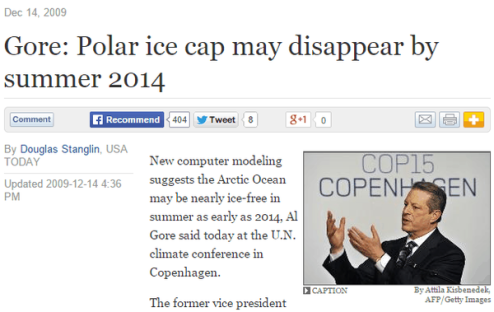
Gore: Polar ice cap may disappear by summer 2014
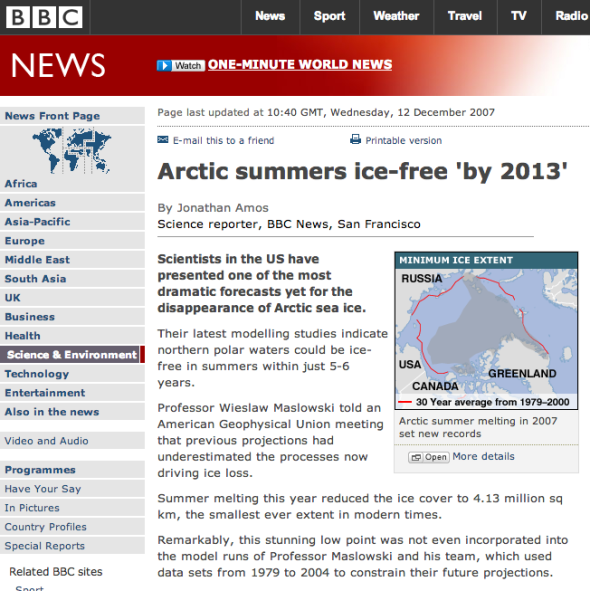
BBC NEWS | Science/Nature | Arctic summers ice-free ‘by 2013’

Ice-free Arctic in two years heralds methane catastrophe – scientist | Environment | The Guardian
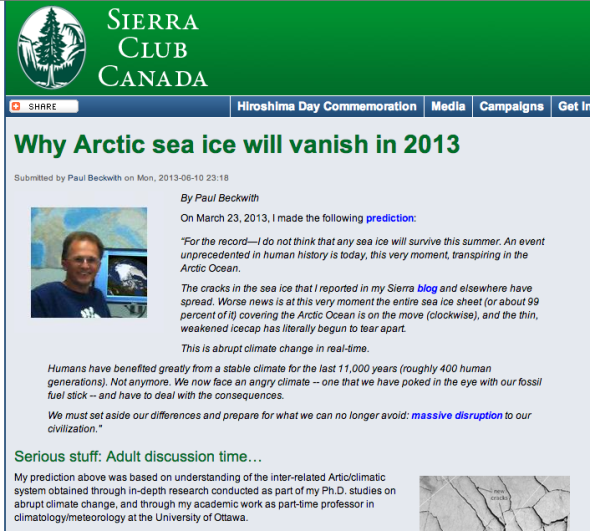
ICE WILL VANISH IN 2013 – Why Arctic sea ice will vanish in 2013 | Sierra Club Canada
•••
CLIMATE experts have been saying this same story for generations:
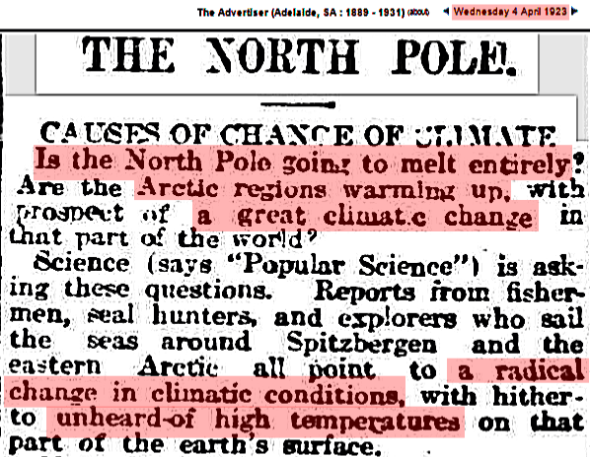
04 Apr 1923 – THE NORTH POLE. – Trove
The Guardian says the Arctic will be ice-free this summer…

‘Next year or the year after, the Arctic will be free of ice’ | Environment | The Guardian
BACK IN THE REAL WORLD
ARTIC sea-ice is tracking previous years of stable extent:

Centre for Ocean and Ice | Danmarks Meteorologiske Institut
•••
UN / WEC CLIMATE CHANGE SCARE-MONGERING
NOW, climate scientists and their “97%” triad of sycophant orgs are promising you that your Arctic will be ice-free by “2040” – plenty more wriggle-room for their catastrophic predictions to play out…
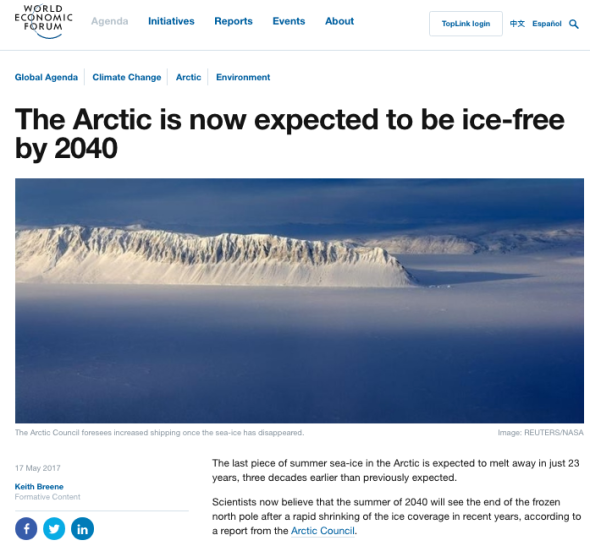
The Arctic could be ice free by 2040 | World Economic Forum
“Expected”, “could”…
That’s the great thing about the future.
Tangier Island
By Paul Homewood | Not A Lot Of People Know That | July 10, 2017
CBS have a report on rising sea levels at Tangier Island, in Chesapeake Bay here
The video is worth watching. The CBS reporter makes the usual attempts to blame it on “climate change”, but the locals know too much to fall for that old pony.
They know that sea levels have been rising, and land eroding, since 1850.
And they are right. Tide gauges in the area, such Sewell Point, Norfolk, confirm that sea levels have been steadily rising for a long time, long before recent rises in emissions of CO2.

https://tidesandcurrents.noaa.gov/sltrends/sltrends_station.shtml?stnid=8638610
The rate of rise is 4.6mm/yr, nearly three times the global rate. But there is a very good reason for this – the land is sinking.
Chesapeake Bay is the site of an ancient impact crater, caused by a comet or meteor. As a result the land has been subsiding ever since. Estimates by proper scientists suggest it is sinking at a rate of up to 3mm/yr.
For instance this recent study by John Boon et al found (Sewell Pt is SWPT):

https://notalotofpeopleknowthat.wordpress.com/2017/02/03/sea-level-rise-at-norfolk-va/
In other words, this accounts for two thirds of the sea level rise.
The study also found no acceleration in the rate of sea level rise:

The sea in Chesapeake Bay is doing what it always has, and no amount of windmills and solar panels will have the slightest effect.
Fatal Courtroom Act Ruins Michael ‘hockey stick’ Mann

By John O’Sullivan | Principia Scientific International | July 4, 2017
Penn State climate scientist, Michael ‘hockey stick’ Mann commits contempt of court in the ‘climate science trial of the century.’ Prominent alarmist shockingly defies judge and refuses to surrender data for open court examination. Only possible outcome: Mann’s humiliation, defeat and likely criminal investigation in the U.S.
The defendant in the libel trial, the 79-year-old Canadian climatologist, Dr Tim Ball (above, right) is expected to instruct his British Columbia attorneys to trigger mandatory punitive court sanctions, including a ruling that Mann did act with criminal intent when using public funds to commit climate data fraud. Mann’s imminent defeat is set to send shock waves worldwide within the climate science community as the outcome will be both a legal and scientific vindication of U.S. President Donald Trump’s claims that climate scare stories are a “hoax.”
As can be seen from the graphs below; Mann’s cherry-picked version of science makes the Medieval Warm Period (MWP) disappear and shows a pronounced upward ‘tick’ in the late 20th century (the blade of his ‘hockey stick’). But below that, Ball’s graph, using more reliable and widely available public data, shows a much warmer MWP, with temperatures hotter than today, and showing current temperatures well within natural variation.

Michael Mann, who chose to file what many consider to be a cynical SLAPP (Strategic Lawsuit Against Public Participation) libel suit in the British Columbia Supreme Court, Vancouver six long years ago, has astonished legal experts by refusing to comply with the court direction to hand over all his disputed graph’s data. Mann’s iconic hockey stick has been relied upon by the UN’s IPCC and western governments as crucial evidence for the science of ‘man-made global warming.’
As first reported in Principia Scientific International (February 1, 2017), the defendant in the case, Canadian climatologist Dr. Tim Ball, had won “concessions” against Mann, but at the time the details were kept confidential, pending Mann’s response.
The negative and unresponsive actions of Dr Mann and his lawyer, Roger McConchie, are expected to infuriate the judge and be the signal for the collapse of Mann’s multi-million dollar libel suit against Dr Ball. It will be music to the ears of so-called ‘climate deniers’ like President Donald Trump and his EPA Chief, Scott Pruitt.
As Dr Ball explains:
“Michael Mann moved for an adjournment of the trial scheduled for February 20, 2017. We had little choice because Canadian courts always grant adjournments before a trial in their belief that an out of court settlement is preferable. We agreed to an adjournment with conditions. The major one was that he [Mann] produce all documents including computer codes by February 20th, 2017. He failed to meet the deadline.”
Punishment for Civil Contempt
Mann’s now proven contempt of court means Ball is entitled to have the court serve upon Mann the fullest punishment. Contempt sanctions could reasonably include the judge ruling that Dr. Ball’s statement that Mann “belongs in the state pen, not Penn. State’ is a precise and true statement of fact. This is because under Canada’s unique ‘Truth Defense’, Mann is now proven to have willfully hidden his data, so the court may rule he hid it because it is fake. As such, the court must then dismiss Mann’s entire libel suit with costs awarded to Ball and his team.
The spectacular rise and fall of climate alarmism’s former golden boy is a courtroom battle with even more ramifications than the infamous Scopes Monkey Trial of 1925. To much fanfare at the time, Mann had sued Ball for daring to publish the damning comment that Mann “belongs in the state pen, not Penn. State.” Dr Ball brilliantly backed up his exposure of the elaborate international money-making global warming scam in his astonishing book, The Deliberate Corruption of Climate Science.
In his books, articles, radio and television appearances, Dr. Ball has been resolute in his generation-long war against those who corrupted the field of science to which he had selflessly dedicated his life. Now aged 79, Ball is on the cusp of utter vindication. Despite the stresses and strains on himself and his family, Tim has stood at the forefront of those scientists demanding more openness and transparency from government-funded researchers.
As Ball explains:
“We believe he [Mann] withheld on the basis of a US court ruling that it was all his intellectual property. This ruling was made despite the fact the US taxpayer paid for the research and the research results were used as the basis of literally earth-shattering policies on energy and environment. The problem for him is that the Canadian court holds that you cannot withhold documents that are central to your charge of defamation regardless of the US ruling.”
Likely Repercussions for Science & Climate Policy
A bitter and embarrassing defeat for the self-styled ‘Nobel Prize winner’ who acted as if he was the epitome of virtue, this outcome shames not only Michael Mann, but puts the climate science community in crisis. Many hundreds of peer-reviewed papers cite Mann’s work, which is now effectively junked. Despite having deep-pocketed backers willing and able to feed his ego as a publicity-seeking mouthpiece against skeptics, Mann’s credibility as a champion of environmentalism is in tatters.
But it gets worse for the litigious Penn State professor. Close behind Dr Ball is celebrated writer Mark Steyn. Steyn also defends himself against another one of Mann’s SLAPP suits – this time in Washington DC. Steyn boldly claims Mann “has perverted the norms of science on an industrial scale.” Esteemed American climate scientist, Dr Judith Curry, has submitted to the court an Amicus Curiae legal brief exposing Mann. The world can now see that his six-year legal gambit to silence his most effective critics and chill scientific debate has spectacularly backfired.
But at a time of much clamor about ‘fake news,’ it seems climate scare stories will have a new angle now that the United States has officially stepped back from the Paris Climate Treaty. President Trump was elected on a mandate to weed out climate fraud so his supporters will point to this legal outcome as vindication for a full purge. It makes a mockery of statements made by Mann last February when PSI’s Hans Schreuder and John O’Sullivan publicly backed their colleague, Dr Ball and endorsed the revelations in his book. Mann reacted by moaning:
“It is difficult to keep up with this dizzying ongoing assault on science.”
The perpetrator of the biggest criminal “assault on science” has now become clear: Dr Mann, utterly damned by his contempt of the court order to show his dodgy data.
There can be little doubt that upon the BC Supreme Court ruling that Mann did commit data fraud, over in Washington DC, the EPA’s Scott Pruitt will feel intense pressure from skeptics to initiate a full investigation into Mann, his university and all those conspiring to perpetuate a trillion-dollar carbon tax-raising sting on taxpayers.
With the scent of courtroom victory invigorating pensioner Ball, he reveals he is determined to go for a second such court win this coming Fall. Then he defends a similar libel lawsuit in Vancouver, filed against him by fellow Canadian climate scientist, Andrew Weaver.
On that case Tim reports:
“The second defamation lawsuit involves Andrew Weaver and is scheduled for court in October 2017. We are not sure what will happen as Weaver, who was a lead author for the computer model chapter of four IPCC Reports (1995, 2001, 2007, and 2013), became a politician. He ran for and was elected leader of the British Columbia Green Party and is a sitting member of the provincial legislature. We must continue to prepare for the trial, but it is the prevailing view in the court system that if a scientist becomes a politician their scientific objectivity is compromised – it is considered the bias of a ’noble cause’.”
As a career-long defender of the scientific method, embracing open and transparent verification of important government research, Ball makes this promise to his loyal supporters:
“Regardless of the outcomes I am planning a major campaign to expose to the world how they used the court system to silence me because I dared to speak out against their claims and actions. I am not particularly bright but I had two major threats, I was qualified, and I had an ability to explain in a way the public could understand. These latter abilities were honed in teaching a science credit for arts students for 25 years.”
Saving a final word for his friends and colleagues at Principia Scientific International (PSI) Dr Ball concluded:
“It goes without saying that I could not have done any of this without the support of people [like Gregg Thomspon] who gave money and John O’Sullivan who gave superb advice from a legal and life experience perspective.”
Dr Ball and his PSI colleagues are among those now calling for governments to set aside proper funding for ‘blue team’ scientists and experts skilled in critically examining claims made by so-called government ‘experts’ where they impact public policy. In the final outcome, these ‘devil’s advocates’ of science (or ‘skeptics’) are the best defense against waste and corruption.
To that end, Australian Astronomer and entrepreneur Gregg Thompson has been crucial in providing resources that helped establish PSI as a registered UK charity devoted to this public service. PSI is urging more charitable donations from ordinary citizens to help further the cause of creating more ‘blue team/red team’ initiatives devoted to monitoring government science and prepared to bravely expose negligence and intentional misconduct on the public dime.
Read Tim Ball’s The Deliberate Corruption of Climate Science
WaPost Wipes Out 1913 Record Temperature
By Paul Homewood | Not A Lot Of People Know That | June 30, 2017
The history revisers are at it again!
From The Washington Post :

A city in southwest Iran posted the country’s hottest temperature ever recorded Thursday afternoon, and may have tied the world record for the most extreme high temperature.
Etienne Kapikian, a forecaster at French meteorological agency MeteoFrance, posted to Twitter that the city of Ahvaz soared to “53.7°C” (128.7 degrees Fahrenheit). Kapikian said the temperature is a “new absolute national record of reliable Iranian heat” and that it was the hottest temperature ever recorded in June over mainland Asia. Iran’s previous hottest temperature was 127.4.
If that 129.2 degrees reading is accurate, it would arguably tie the hottest temperature ever measured on Earth in modern times.
Christopher Burt, a weather historian for Weather Underground, has exhaustively analyzed world temperature extremes and determined the 129.2 degree readings posted in Mitribah, Kuwait on July 21, 2016, and Death Valley, Calif., on June 30, 2013, are the hottest credible temperature measurements that exist in modern records.
It has long been accepted that the highest temperature recorded on Earth was 134F, set at Greenland Ranch, Death Valley in California, way back in 1913. But Weather Underground’s Chris Burt has now taken it upon himself to write that out of the records, as being “essentially not possible”.
Perhaps somebody might tell the real experts at NOAA’s State Climate Extremes Committee (SCEC). They collate all record temperature data for each state.
According to the SCEC website:
The SCEC will compile a list of the extant records listed in Table 1 for each state of the United States. These records will be reviewed to determine their validity and, if found to be acceptable, will be recommended to the NCEI Director for inclusion in the statewide records data set. As of April, 2010 NCEI has reviewed and updated the statewide extremes tables for all-time maximum and minimum temperature, 24-hr precipitation and snowfall, and all-time greatest snow depth.
After reviewing its validity, the SCEC is perfectly happy that the Greenland Ranch still stands.

https://www.ncdc.noaa.gov/extremes/scec/records
Regardless of the Death Valley figure, just how meaningful is this new, supposed record in Iran?
How long, for instance, have temperatures been measured there? We have seen in the UK how “record temperatures” have been gleefully declared by the Met Office at stations, such as Gravesend and Faversham, which turn out to only have records since the 1990s.
Nobody knows whether higher temperatures have actually occurred there, even in the recent past.
We also learn from the WaPost that Ahvaz, where the temperature was set, is a city of 1.1 million, so the Urban Heat Island effect will be massive.
But none of this will stop the usual fraudsters claiming that this is evidence of global warming.
India’s Electricity Transformation
By Paul Homewood | Not A Lot Of People Know That | June 25, 2017
Renewable proponents are getting excited about the latest news from India:

The Indian energy market transformation is accelerating under Energy Minister Piyush Goyal’s leadership.
The most recent and most persuasive evidence is the collapsing cost of solar electricity—a collapse that has gone beyond anyone’s expectations, and the results are in: solar has won.
The global energy market implications are profound.
Recent events have given manifest life to Mark Carney’s landmark 2015 speech in which Carney, the governor of the Bank of England, warned of stranded-asset risks across the coal industry. This month alone has seen the cancellation of 13.7 gigawatts (GW) of proposed coal-fired power plants across India and an admission that US$9bn (8.6GW) of already operating import-coal-fired power plants are potentially no longer viable.
To put an Australian and a global seaborne thermal coal-trade perspective on it, these development strike at the very viability of the Carmichael export thermal coal proposal. They speak as well to a worldwide transition in progress.
India solar tariffs have been in freefall for months. A new 250MW solar tender in Rajasthan at the Bhadla Phase IV solar park this month was won at a record low Rs2.62/kWh,[i] 12 percent below the previous record low tariff awarded across 750MW of solar just three months ago at Rs2.97/kWh.
The Bhalda Phase record lasted two days, with a more recent 500MW Indian solar auction coming in at Rs2.44/kWh, 7 percent below Bhalda Phase.
We see solar pricing continuing to become even more competitive over time.
Several forces are at work.
In December 2016, India released its 10-year Draft National Electricity Plan, calling for the installation of a cumulative 275GW of renewable energy capacity by 2027, as well as 97GW of other zero emissions capacity (primarily large scale hydro, but also nuclear). Relative to a planned total system capacity of 650GW, the plan sees thermal power capacity falling from 69 percent of India electricity-generation mix in March 2016 to 43 percent by 2027.
http://ieefa.org/ieefa-asia-indias-electricity-sector-transformation-happening-now/
We are supposed to believe that solar power is going to rapidly replace coal. But, in fact, the news is not really new at all, and simply confirms what we knew already from India’s Draft National Plan, published in December 2016, and covered here.
But first, some basic facts.
The National Plan called for:
1) An increase in capacity of wind/solar by 2027 of 215 GW, plus 8 GW and 27 GW of nuclear and hydro respectively.
2) Total electricity requirement would rise from the current level of 1400 TWh, to 2132 TWh by 2027.
3) 50 GW of coal capacity was already under construction.
4) Non fossil fuel capacity would account for 56.5% of total capacity by 2027.
5) Wind/solar/bio would provide 24.2% of total generation by 2027.
The renewable commitment simply mirrored that contained in India’s INDC, although that only specified the period up to 2022.
The IEEAFA report acknowledged that the plan looks ambitious but absolutely feasible.
If we plug these capacities in and extrapolate from current load factors (based on BP data), we can take a look at what electricity generation will look like come 2027.
( The figure for fossil fuels is the balancing number).
| Capacity | Load | Twh | Twh | |
| 2027 | Factor % | 2027 | 2016 | |
| Hydro | 73 | 32 | 205 | 129 |
| Nuclear | 14 | 72 | 88 | 38 |
| Wind | 60 | 19 | 100 | 45 |
| Solar | 205 | 19 | 341 | 12 |
| Bio | 10 | 41 | 36 | 16 |
| Sub Total Low Carbon | 362 | 770 | 240 | |
| Fossil Fuels | 279 | 1362 | 1160 | |
| Total Electricity | 641 | 2132 | 1400 |
In other words, under the Plan, there will still be a big increase in power from fossil fuels, nearly all of which will be coal.
Indeed, the Plan itself states this clearly:

So what about all of these cancellations of coal plants? I’m afraid this is all rather fake news.
As the National Plan also states, there is already a surplus of power capacity in the pipeline, from all sources, and this is naturally putting the squeeze on new projects.
But as the Global Coal Plant Tracker revealed, there is nearly three times as much capacity in the pipeline but not started, as there is under construction. Given that the 50 GW under construction is already more than is needed, it is hardly surprising that projects not even started yet are being shelved.
Indeed, as the table shows, a total of 430 GW has already been cancelled or shelved since 2010.
There is simply nothing unusual at all about recent cancellations.

http://et-advisors.com/wp-content/uploads/ETA-Asia-Coal-Juggernaught_final.pdf
But isn’t solar now cheaper than coal?
Unfortunately, we aren’t comparing like with like. Whilst solar power, particularly in a sunny country like India, has a niche role, it cannot provide power reliably as coal does. As such, it can never play a dominant role.
It is worth bearing mind that we aren’t simply talking about day and night here. For three months every summer, most of India sits under the monsoon, beneath thick cloud and heavy rain.
While some solar power will still be generated, output will be much lower than the rest of the year, and at a time when demand tends to be greatest.
The Indian government is well aware of this, and will continue to ensure that sufficient coal power is always available. Indeed the National Plan also builds in enough coal capacity to cover a 30% reduction in Hydro generation, in case of a failure of the monsoon.
However, just as we are seeing here, coal power plants are suffering financially from competition from renewable energy with little or no marginal costs. Coal plants can only be viable if they are allowed to run at economic load factors.
One of the big problems with India’s electricity market is its curious mix of Central Government, State Government and Private power provision.
Just as in the UK, if India’s electricity system had been designed by electrical engineering experts, rather than developed on an ad hoc basis with conflicting objectives, it would not look like it does now.
And it would also be a lot more efficient!
Consensus enforcers versus the Trump administration
By Judith Curry | Climate Etc. | June 24, 2017
Tough days on The Hill for the enforcers of the climate consensus.
While EPA Administrator Scott Pruitt has been taking most of the ‘heat’ for the Trump administrations climate policy, this past week Energy Secretary Rick Perry and Interior Secretary Ryan Zinke stepped into the fray.
Rick Perry was asked in an interview on CNBCs Squawk Box whether he believed carbon dioxide was “the primary control knob for the temperature of the Earth and for climate.” Perry responded: “No, most likely the primary control knob is the ocean waters and this environment that we live in.” “. . . the fact is this shouldn’t be a debate about, ‘Is the climate changing, is man having an effect on it?’ Yeah, we are. The question should be just how much, and what are the policy changes that we need to make to effect that?”
In a recent Congressional hearing, Perry further stated that he wasn’t buying arguments that climate change is 100% caused by humans, and that he supported the ‘red team’ approach.
At the same Congressional hearing, Senator Franken repeatedly asked Zinke if he could “tell me how much warming government scientists predict for the end of this century under a business-as-usual scenario?” Zinke stated: “I don’t think government scientists can predict with certainty,” he said. “There isn’t a model that exists today that can predict today’s weather given all the data.”
Response from the consensus police
From the eenews article about Zinke’s testimony:
Kevin Trenberth, a senior scientist at the National Center for Atmospheric Research in Colorado, said Zinke’s explanation was “a stupid and ignorant answer.”
Climate models, he said, are getting better. The simulations increasingly line up with observed changes.
“Well, all models are wrong, but some are useful,” Trenberth said. “Weather models aren’t able to accurately predict if it’ll be sunny or rainy two weeks from now because they are sensitive to small disruptions.
“But the patterns of weather may still be predictable in the same sense that summer is different than winter,” he added. “And that is what climate is all about: determining the effects of the sun, the atmospheric composition, the oceans, the ice and … looking for systematic influences.”
While climate modeling and weather forecasting are similar, they rely on different sets of data and measure vastly different time scales, said Gavin Schmidt, director of the NASA Goddard Institute for Space Studies.
When looking over long periods of time, the external drivers of climate — things like how much carbon dioxide is in the atmosphere trapping heat, and how many trees have been cut down and are no longer sequestering greenhouse gases — can be used to make statistical predictions about the climate, Schmidt said.
JC comment: Zinke’s statement is true. Trenberth is a scientific bully/thug for calling Zinke’s answer stupid and ignorant, especially when both Trenberth and Schmidt basically admit that the models can’t predict the future.
In response to Perry’s statement, the Executive Director of the American Meteorological Society (AMS), Keith Seitter, said in a letter to Perry:
While you acknowledged that the climate is changing and that humans are having an impact on it, it is critically important that you understand that emissions of carbon dioxide and other greenhouse gases are the primary cause.
This is a conclusion based on the comprehensive assessment of scientific evidence. It is based on multiple independent lines of evidence that have been affirmed by thousands of independent scientists and numerous scientific institutions around the world.
In the interview you also mentioned that it should be quite acceptable to be a skeptic about aspects of the science. We agree, and would add that skepticism and debate are always welcome and are critically important to the advancement of science.
In climate science unresolved questions remain—issues that currently lack conclusive evidence. However, there are also very solid conclusions that are based on decades of research and multiple lines of evidence. Skepticism that fails to account for evidence is no virtue. As noted above, the role of carbon dioxide and other greenhouse gases as the primary driver for the warming the Earth has experienced over the past several decades is extremely well established.
Roy Spencer has an article in Fox News responding to Seitter’s letter, excerpts:
Basically, Perry is saying he believes nature has a larger role than humans in recent warming. I, too, believe the oceans might well be a primary driver of climate change, but whether the human/nature ratio is 50/50, or less, or more than that is up for debate. We simply don’t know.
So, while Sec. Perry goes against the supposed consensus of scientists, what he said was not outlandish, and it wasn’t a denial of a known fact. It was a valid opinion on an uncertain area of science.
Seitter calls the claims in his letter “indisputable.” Really? In my opinion, the AMS view (which draws upon the U.N. IPCC view) is much more definitively stated than the evidence warrants.
Sure, all the scientific institutions are on the bandwagon, with politically savvy committees agreeing with each other. They are, in effect, being paid by the government to agree with the consensus through billions of dollars in grants and contracts.
So, maybe I can ask the AMS: Just what percentage of recent warming was natural in origin? None? 10%? 40%? How do you know? Why was the pre-1940 warming rate—caused by Mother Nature—almost as strong as recent warming?
Pielke Senior tweets:
What [Keith Seitter’s letter] further documents, is how small cabal of individuals controls information flow to policymakers.
Mike Smith tweets:
It is wrong for a small group of AMS executives to play politics on behalf of the society’s members w/o a vote of the society.
Politifact
PolitiFact did a fact check on Rick Perry’s statement. Excerpts:
Perry’s claim flies in the face of settled science.
The world’s leading authority on climate change, the Intergovernmental Panel on Climate Change, has concluded that human activity is “extremely likely” to be the main driver of warming since the mid 20th century.
While it’s still possible to find dissenters, scientists around the globe generally agree with this conclusion.
“We have concluded close to all of the recent trends in global temperature is due to human activity, and CO2 is the dominant factor,” Schmidt said, referring to carbon dioxide.
Perry’s claim contradicts settled science. While natural factors certainly affect the climate, human factors are the main contributor to global warming, and carbon dioxide has acted as the “primary control knob” governing the earth’s relatively recent uptick in temperature.
We rate Perry’s statement False.
On June 20, John Kruzel, the author of the Politifact article, sent me an email:
We’re looking into Energy Secretary Rick Perry’s recent claim that the main cause of climate change is most likely “the ocean waters and this environment that we live in.” We’ve asked the Department of Energy why Perry disagrees with the IPCC that human activity is the main cause of climate change; we’ve received no response so far.
I’d be grateful if you’d consider the following questions:
Questions from Politifact to JC, and JC’s responses:
.
(1) Do you consider the IPCC the world’s leading authority on climate change and why?
The IPCC is driven by the interests of policy makers, and the IPCC’s conclusions represent a negotiated consensus. I don’t regard the IPCC framework to be helpful for promoting free and open inquiry and debate about the science of climate change.
.
(2) Do you agree with the IPCC that effects of man-made greenhouse gas emissions “are extremely likely to have been the dominant cause of the observed warming since the mid-20th century.”
It is possible that humans have been the dominant cause of the recent warming, but we don’t really know how to separate out human causes from natural variability. The ‘extremely likely’ confidence level is wholly unjustified in my opinion.
.
(3) How solid is the science behind the conclusion that human activity is the main cause of climate change?
Not very solid, in my opinion. Until we have a better understanding of long term oscillations in the ocean and indirect solar effects, we can’t draw definitive conclusions about the causes of recent warming.
.
(4) What is your response to Perry’s statement?
I don’t have a problem with Perry’s statement. There is no reason for him to be set up as an arbiter of climate science. He seems clearly committed to a clean environment and research to developing new energy technologies, which is his job as Secretary of Energy.
JC question: So what are we to conclude from PolitiFact’s failure to even mention or consider my responses, after explicitly asking for them?
Red Team/Blue Team
Santer, Emanuel and Oreskes have an op-ed in the WaPo criticizing calls for red team/blue team approach, which was reiterated in Rick Perry’s testimony. Excerpts:
Such calls for special teams of investigators are not about honest scientific debate. They are dangerous attempts to elevate the status of minority opinions, and to undercut the legitimacy, objectivity and transparency of existing climate science.
Critiques of this consensus have been offered up for decades. Each critique is often presented as a kind of smoking gun — one piece of evidence that falsifies all other evidence and understanding. There are many examples of such putative smoking guns. The ballistics of each gun has been carefully tested by thousands of scientists around the world. The “natural causes” gun doesn’t fit the overwhelming evidence of human-caused climate change. The “no warming” gun is inconsistent with reality.
If you’re a climate scientist, you’ve likely spent years of your career going down such rabbit holes, evaluating “natural causes” and “no warming” claims. You’ve considered and debated these claims. You’ve put them through their paces. They do not hold up to available evidence. Only the most robust findings survive peer review and form the basis of today’s scientific consensus.
Science has substantially improved our understanding of the physical climate system, the reality of human-caused warming, and the likely climatic outcomes if we do nothing to reduce emissions of greenhouse gases. Rejecting this tried and tested understanding would constitute real “advisory malpractice,” and would delay effective action to address human-caused climate change.
In the case of climate science, we choose to place our trust in peer review and in the scientific community — not in teams appointed by Koonin or Pruitt.
Pielke Sr tweets:
[The WaPo op-ed] is really about suppression of diversity of scientific views wrt climate science
The problem with Santer et al.’s argument about natural variability is starkly illustrated by this recent paper by Santer et al. (which arguably deserves its own post since it is an interesting and important paper, but I am short of time these days):
Santer, B. D. et al. (2017) Causes of differences in model and satellite tropospheric warming rates
Abstract. In the early twenty-first century, satellite-derived tropospheric warming trends were generally smaller than trends estimated from a large multi-model ensemble. Because observations and coupled model simulations do not have the same phasing of natural internal variability, such decadal differences in simulated and observed warming rates invariably occur. Here we analyse global-mean tropospheric temperatures from satellites and climate model simulations to examine whether warming rate differences over the satellite era can be explained by internal climate variability alone. We find that in the last two decades of the twentieth century, differences between modelled and observed tropospheric temperature trends are broadly consistent with internal variability. Over most of the early twenty-first century, however, model tropospheric warming is substantially larger than observed; warming rate differences are generally outside the range of trends arising from internal variability. The probability that multi-decadal internal variability fully explains the asymmetry between the late twentieth and early twenty- first century results is low (between zero and about 9%). It is also unlikely that this asymmetry is due to the combined effects of internal variability and a model error in climate sensitivity. We conclude that model overestimation of tropospheric warming in the early twenty-first century is partly due to systematic deficiencies in some of the post-2000 external forcings used in the model simulations.
Zeke has a good summary of the paper at CarbonBrief.
The paper confirms what John Christy has been saying for the last decade, and also supports the ‘denier’ statements made by Ted Cruz about the hiatus. The conclusion that The probability that multi-decadal internal variability fully explains the asymmetry between the late twentieth and early twenty- first century results is low (between zero and about 9%) hinges on results from climate models that are not fit for such a task.
The bottom line is that there are 4 possibilities to explain the 21st century discrepancy between climate models and observations:
- Errors in external forcing data (Santer et al’s preferred explanation)
- Internal variability (which has been supported by numerous previous studies, including posts at CE)
- Values of CO2 climate sensitivity that are too high (interesting new post on this over at ClimateAudit )
- Missing physical processes in the climate models (e.g. solar indirect effects).
In my assessment, all 4 are in play; for the 21st century hiatus, my assessment is that #2 is the dominant factor (with supporting contributions from #3). The Santer et al. paper attempts to address #1 and #2 (unconvincing with respect to #2). But there is much that is unknown and uncertain here, with plenty of scope for rational disagreement on this topic.
Bottom line is that this new Santer et al. paper sort of makes a joke of the Santer, Emanuel and Oreskes op-ed.
JC reflections
Seitter’s statement about skepticism deserves comment:
“Skepticism that fails to account for evidence is no virtue.”
The disagreement is not so much about observational evidence, but rather about the epistemic status of climate models, the logics used to link the observational evidence into arguments, the overall framing of the problem and overconfident conclusions in the face of incomplete evidence and understanding. The ‘multiple lines of evidence’ argument simply doesn’t work for a very complex problem, and there are multiple lines of evidence that lead to alternative conclusions. See my paper Reasoning about climate uncertainty.
Why do scientists disagree about climate change?
- Insufficient and inadequate observational evidence
- Disagreement about the value of different classes of evidence (e.g. global climate models)
- Disagreement about the appropriate logical framework for linking and assessing the evidence
- Assessments of areas of ambiguity & ignorance
- Belief polarization as a result of politicization of the science
An interesting perspective on knowledge about complex systems is this recent aeon article The tree of knowledge is not an apple or an oak but a banyan.
This perspective seems very apt to understanding complex systems. The article provoked this tweet from Silvio Funtowicz:
Alternative definition of complexity: plurality of legitimate perspectives irreducible to a single perspective
Given the uncertainties and legitimate reasons for disagreement, a red team/blue team approach seems ideally suited to laying out the different arguments and critiquing them.
The statements made in the op-ed by Santer, Emanuel and Oreskes about dismissing natural variability as an explanation is wholly unjustified: you only need to read my (not quite weekly) Week in Review – Science Edition posts, of which about 70% of the papers I cite are, if not overtly skeptical, then provide evidence that could easily be integrated into skeptical arguments. Week after week, that is a lot of papers. And this is not to mention all the papers that I cite about bias (if not outright errors) in academic research. These papers should be required reading for consensus enforcers.
So, it seems that at least some in the Trump administration want a Red Team/Blue Team exercise regarding climate change. Why wouldn’t the consensus enforcers be delighted to have an opportunity to convince the Trump administration of their superior arguments, relative to the ‘troglodyte’ red team? Surely this wouldn’t ‘waste’ any more of their time than writing op-eds, marching for science, writing NRC reports, etc. And they might actually learn something (I daresay Santer, Collins, and Held learned something during the APS Workshop run by Koonins). And the Trump administration might even kick in funding for this (inexpensive, relative to research funding).
Let the games begin!
The Heathrow Tarmac Strikes Again!
By Paul Homewood | Not A Lot Of People Know That | June 23, 2017

As we know, the Met Office have informed us that Wednesday was the hottest June day since 1976, with a temperature of 34.5C recorded next to the runway at Heathrow.
Apparently the previous hottest June day since 1976 was at Worcester in 1995, with 33.8C set.

This is all very interesting, because I asked the Met Office what the highest temperature was on Wednesday after the Heathrow figure.
This was their reply:

So the next highest temperatures, set at Kew and Northolt which are both close to Heathrow, were 33.8C, the same as in 1995.
Only by using the Heathrow temperature were the Met Office able to claim the “hottest day since 1976”.
Many readers will recall similar shenanigans in 2015, when the tarmac at Heathrow conveniently allowed the Met Office to claim the hottest July day on record.
Unsustainable: 43 Million Tonnes Of Wind Turbine Blade Waste By 2050
2 New Papers Expose The Environmental Nightmare Of Wind Turbine Blade Disposal

By Kenneth Richard – No Tricks Zone – 22. June 2017
… Despite its extremely limited infiltration as a world energy source, it is assumed that a rapid expansion of wind power will ultimately be environmentally advantageous both due to its reputation as a “clean” energy and because of the potential to contribute to reduced CO2 emissions.
Recently, however, the austere environmental impacts and health risks associated with expanding wind energy have received more attention.
For example, scientists have asserted that wind turbines are now the leading cause of multiple mortality events in bats, with 3 to 5 million bats killed by wind turbines every year. Migratory bats in North America may face the risk of extinction in the next few decades due to wind turbine-related fatalities.
Frick et al., 2017
“Large numbers of migratory bats are killed every year at wind energy facilities. … Using expert elicitation and population projection models, we show that mortality from wind turbines may drastically reduce population size and increase the risk of extinction. For example, the hoary bat population could decline by as much as 90% in the next 50 years if the initial population size is near 2.5 million bats and annual population growth rate is similar to rates estimated for other bat species (λ = 1.01). Our results suggest that wind energy development may pose a substantial threat to migratory bats in North America.”
Wind Turbine Blades Last 20 Years…And Then They Are Tossed Into Landfills
Besides reducing wildlife populations, perhaps one of the most underrated negative side effects of building wind turbines is that they don’t last very long (less than 20 years) before they need to be replaced. And their blades aren’t recyclable. Consequently, 43 million tonnes (47 million tons) of blade waste will be added to the world’s landfills within the next few decades.
Liu and Barlow, 2017
“The blades, one of the most important components in the wind turbines, made with composite, are currently regarded as unrecyclable. With the first wave of early commercial wind turbine installations now approaching their end of life, the problem of blade disposal is just beginning to emerge as a significant factor for the future. … The research indicates that there will be 43 million tonnes of blade waste worldwide by 2050 with China possessing 40% of the waste, Europe 25%, the United States 16% and the rest of the world 19%.”
“Although wind energy is often claimed to provide clean renewable energy without any emissions during operation (U.S. Department of Energy, 2015), a detailed ecological study may indicate otherwise even for this stage. The manufacture stage is energy-intensive and is associated with a range of chemical usage (Song et al., 2009). Disposal at end-of-life must also be considered (Ortegon et al., 2012; Pickering, 2013; Job, 2014).A typical wind turbine (WT) has a foundation, a tower, a nacelle and three blades. The foundation is made from concrete; the tower is made from steel or concrete; the nacelle is made mainly from steel and copper; the blades are made from composite materials (Vestas, 2006; Tremeac and Meunier, 2009; Guezuraga et al., 2012). Considering these materials only, concrete and composites are the most environmentally problematic at end-of-life, since there are currently no established industrial recycling routes for them (Pimenta and Pinho, 2011; Job, 2013).”
In a new paper entitled “Unsustainable Wind Turbine Blade Disposal Practices in the United States“, Ramirez-Tejeda et al. (2017) further detail the imminent and unresolved nightmare of wind turbine blade disposal. The environmental consequences and health risks are so adverse that the authors warn that if the public learns of this rapidly burgeoning problem, they may be less inclined to favor wind power expansion. Advocates of wind power are said to be “largely ignoring the issue”. It’s an “issue” that will not be going away any time soon.
In light of its minuscule share of worldwide consumption (despite explosive expansion in recent decades), perhaps it is time to at least reconsider both the benefits and the costs of wind energy expansion.
‘Adverse Environmental Consequences’ For A Rapidly Expanding Wind Power Grid
Ramirez-Tejeda et al. (2017)
“Globally, more than seventy thousand wind turbine blades were deployed in 2012 and there were 433 gigawatts (GW) of wind installed capacity worldwide at the end of 2015. Moreover, the United States’ installed wind power capacity will need to increase from 74 GW to 300 GW3 to achieve its 20% wind production goal by 2030. To meet the increasing demand, not only are more blades being manufactured, but also blades of up to 100 meters long are being designed and produced.”
“The wind turbine blades are designed to have a lifespan of about twenty years, after which they would have to be dismantled due to physical degradation or damage beyond repair. Furthermore, constant development of more efficient blades with higher power generation capacity is resulting in blade replacement well before the twenty-year life span.”
“Estimations have suggested that between 330,000 tons/year by 2028 and 418,000 tons/year by 2040 of composite material from blades will need to be disposed worldwide. That would be equivalent to the amount of plastics waste generated by four million people in the United States in 2013. This anticipated increase in blade manufacturing and disposal will likely lead to adverse environmental consequences, as well as potential occupational exposures, especially because available technologies and key economic constraints result in undesirable disposal methods as the only feasible options.”
Problems With Landfills
“Despite its negative consequences, landfilling has so far been the most commonly utilized wind turbine blade disposal method. … Landfilling is especially problematic because its high resistance to heat, sunlight, and moisture means that it will take hundreds of years to degrade in a landfill environment. The wood and other organic material present in the blades would also end up in landfills, potentially releasing methane, a potent greenhouse gas, and other volatile organic compounds to the environment.”
“The estimated cost to put blade material in landfills, not including pretreatment and transportation costs, is approximately US $60 per ton. [A typical blade may weigh 30-40 tons]. In the United Kingdom, where landfilling organics is not yet prohibited, the active waste disposal cost (which includes plastics) is approximately US $130 per ton.”
Problems With Incineration
“Incineration of blades is another disposal method with potential for energy and/or material recovery. … Combustion of GFRP is especially problematic because it can produce toxic gases, smoke, and soot that can harm the environment and humans. Carbon monoxide and formaldehyde have been reported as residue from thermal degradation of epoxy resin. Another residue is carbon dioxide, which poses concerns regarding greenhouse gas emissions. In addition, about 60% of the scrap remains as pollutant ash after the incineration process, some of which is sent to landfills, potentially contaminating the sites. Possible emission of hazardous flue gasses is also among the issues with incinerating wind turbine blades.”
“One key issue is that all these thermal processing techniques for wind turbine blades would also require fragmentation of the material into smaller pieces through mechanical processing before being fed into the reactors, increasing energy consumption and carbon dioxide emissions.”
Problems With Mechanical Processing
“Mechanical processing is a relatively simpler disposal method that consists of cutting, shredding, and grinding the material to separate the fibers from resins, so it can be repurposed. This process is energy intensive and produces small fiber particles with poor mechanical properties that can only be used as filler reinforcement material in the cement or asphalt industries. … The dust emitted in the grinding process of FRP creates occupational health and safety risks for workers. Inhalation, as well as skin and eye contact can produce moderate irritation to mucous membranes, skin, eyes, and coughing. Occupational exposure and prolonged inhalation of such particles have been found to produce alterations of the cellular and enzymatic components of the deep lung in humans, identified as acute alveolitis.”
Problems With Chemical Degradation
“The last method is chemical degradation, which consists of first mechanically reducing the size of the blades, then degrading them using a chemical solution. … Although no industrial-level chemical recycling of thermoset polymers has been done yet, some hazardous chemicals such as nitric acids and paraformaldehyde have been used in testing and development processes. Occupational exposure to these chemicals can produce harmful respiratory diseases including potential nasal cancer, and dermal health effects.”
Full article at No Tricks Zone
Featured Video

Dan Dicks with James Corbett on Solutions Watch
or go to
Aletho News Archives – Video-Images
From the Archives
MMR (Measles, Mumps and Rubella) – Vaccine Risk Statement
MMR Vaccine (Measles, Mumps, and Rubella) Is It Safer Than Measles, Mumps and Rubella?
Physicians for Informed Consent | December 2024
… It has not been proven that the MMR vaccine is safer than measles, mumps, and rubella. The vaccine package insert raises questions about safety testing for cancer, genetic mutations, and impaired fertility. Although VAERS tracks some adverse events, it is too inaccurate to measure against the risk of measles, mumps, and rubella. Clinical trials do not have the ability to detect less common adverse reactions, and epidemiological studies are limited by the effects of chance and possible confounders. Safety studies of the MMR vaccine are particularly lacking in statistical power. A review of more than 60 MMR vaccine studies conducted for the Cochrane Library states, “The design and reporting of safety outcomes in MMR vaccine studies, both pre- and post-marketing, are largely inadequate.”19 Because permanent sequelae (aftereffects) from measles, mumps, and rubella are so rare (especially in children with normal levels of vitamin A and infected after birth),6,15-17 the level of accuracy of the research studies available is insufficient to rule out the possibility that the MMR vaccine causes greater death or permanent disability than measles, mumps, and rubella. – Read full article
Blog Roll
 Aletho News
- Moscow issues warning to NATO over Russian exclave
- Yes, the Iran war has destroyed Trump’s presidency
- The fallacy of US delusions about Iran’s economic collapse
- Hezbollah denies Syria cell link, warns of Israeli plan to sow discord
- The legacy of US sanctions, war, and occupation in Iraq
- Iraqi resistance group rejects disarmament, vows to maintain support for Lebanon
- Sheikh al-Asadi warns of Iraqi government compliance with US demands
- How to MAKE THE CONSPIRATORS PAY for their crimes! Dan Dicks with James Corbett on Solutions Watch
- There’s a drought in academia: A drought in honest research on the subject of drought and other weather extremes
- Department of War Awards $20.7 Billion Contract to Raytheon for Air-to-Air Missiles
- If Americans Knew
- As settlers ravage West Bank, Israeli forces kill 10 in Gaza – Daily Update
- New Report: “Scholasticide and Genocide in Gaza: Assessment, Testimonies and Legal Analysis”
- Ex-Biden officials are desperate for a Gaza scapegoat
- Israeli “settlers” Invade Al-Aqsa; Pour Boiling Water on 75-Year-Old
- Israel Has Kidnapped Another American Teenager
- US arms sales to Israel worth $21.6 billion in 20 months
- Three Palestinians Killed in Israeli Attacks on Gaza
- Revealed: German “Anti-Semitism Expert” Driving Crackdown on Palestine Solidarity is Former Israeli Spy
- Egypt’s Warning to Israel Before Oct 7
- Israel’s siege signals another cruel winter for 1.8 million Gazans – Daily Update
- No Tricks Zone
- Two More Paleo Reconstructions Affirm Meters-Higher Sea Levels Across Ireland, Brazil 7000-6000 Years Ago
- New Study: Earth And Venus Surface Warmth Largely Explained By Convection And Lapse Rate, Not CO2 Or Radiation
- 2025 Nature Paper Claiming Worsening Global Drought Gets RETRACTED …Heavily Flawed
- New Study: ‘Global Drought Shows No Detectable Recent Acceleration Under Climate Warming’
- Economic Masterminds: German Socialists Suggest Taxing Productivity Gains Stemming From Using AI
- The South China Sea Has Not Been Cooperating With The Climate Change Narrative
- Energy Crisis: Germany Enters Heating Season With Historically Low Gas Reserve Fill Levels
- New Study: The Antarctic Ice Sheet Gained Mass From 2020-2024 Due To Staggering Snow And Ice Accumulation
- Study: Ocean Heating Rates From Thousands Of Years Ago ‘Dwarf’ Modern Ocean Heating Rates
- Climate Extremists Target, Attack Large-Scale Power Grid Infrastructure In Germany!


