There is only one slight problem – the newly built tanker is actually an icebreaker itself, as Matt McGrath goes on to elaborate:
The Christophe de Margerie is the world’s first and, at present, only ice-breaking LNG carrier.
The ship, which features a lightweight steel reinforced hull, is the largest commercial ship to receive Arc7 certification, which means it is capable of travelling through ice up to 2.1m thick.
On this trip it was able to keep up an average speed of 14 knots despite sailing through ice that was over one metre thick in places.
Popular Science has more details on the project to build another 15 of these icebreaking tankers:
There’s a lucrative shipping route between Europe and Asia that has the potential to cut thousands of miles and months of time off the trip. The only catch: it’s covered with thick, ship-sinking Arctic ice.
Heavy ice blocks the Arctic route from December to July, more than half the year. Even with icebreaking escort ships, few merchant vessels run it.
Now, Daewoo Shipbuilding and Marine Engineering is building the world’s first icebreaker tankers–16 of them–to carry liquid natural gas (LNG) through the route year-round. LNG tankers today have to be escorted by icebreaking ships that clear the way through the Northern Sea Route.
The Yamal LNG project, run by companies in Russia, France, and China, proposes drilling more than 200 wells in the Arctic to produce 16.5 million tons of LNG per year, supported by Daewoo’s first 16 Arc7 tankers. Year-round, Yamal LNG will ship LNG from the project’s Sabetta port in Russia’s Yamal Peninsula westward to Europe, South America, India, China, and South Korea. For the warmer half of the year, it’ll also ship east from Sabetta to Japan and South Korea.
As Russia leans more heavily on fuel exports and the prices for them drip lower and lower, a dormant 17th-century Russian ambition is coming back to life: to open the Arctic year-round.
French oil company Total, who are involved in the Yamal project also have this:
To transport Liquefied Natural Gas from Yamal LNG, which is located in the Arctic and constitutes one of the world’s biggest LNG projects, Total and its partners have designed a new type of ship: an LNG ice-breaker. This innovative solution allows large shipments of LNG to be transported efficiently and at a steady pace throughout the year and without the assistance of ice-breakers. The ship, which is 300 metres long and has a capacity of 172,600 m3, can sail in temperatures that fall as low as -52°C and in ice thickness up to 2.1 metres. Between December 2016 and 2019, 15 LNG ice-breakers will be commissioned. In this article, we delve into this technological microcosm.
The tankers are certified as Arc7, which is the Russian system of classifying ice breakers and ice strengthened ships. The classification goes up to Arc9 for the strongest ships.
So the fact that the Christophe de Margerie has just made this trip has nothing at all to do with global warming.
It is however a reminder that the French, along with Russia and China, will carry on developing oil and gas reserves, regardless of whatever was agreed at Paris.
Al Gore’s new movie, An Inconvenient Sequel: Truth to Power, has been in theaters for about a month now, and has received rather tepid reviews.
The Kindle e-book version of Gore’s movie, despite being very colorful, has been doing even worse and is currently running at #20,768 overall on Amazon, and is not ranked #1 in any sub-category.
Next month, hundreds across the country will participate in “Out of the Darkness” walks to raise awareness about suicide and to support the American Foundation for Suicide Prevention (AFSP).
AFSP and similar groups like the National Alliance on Mental Illness (NAMI) and Active Minds claim there are “stigmas” and “barriers” to treatment for mental illness and there is not enough “awareness.” Two facts are missing in their messaging.
First, with as much as a fourth of some U.S. populations on antidepressants and ubiquitous quizzes and ads for them, there is neither a lack of “awareness” ––or are the drugs working. Why are suicides at an all time high at the same time psychoactive drug use is at an all time high?
Secondly, the groups are funded by Pharma to increase drug use and are widely considered unethical front groups, also called astroturf.
The American Foundation for Suicide Prevention, founded in 1987, is steeped in Pharma money. In 2008, AFSP merged with the Suicide Prevention Action Network USA or SPAN which had announced in 2004 that “SPAN USA’s efforts to develop and expand its suicide survivor network received a major boost with a recent grant from Eli Lilly and Company Foundation,” and “The foundation generously provided funding to support training, education and collaborative opportunities for SPAN USA’s existing network and enable further expansion into all 50 states.” No lack of transparency there.
In AFSP’s 2009 report, its leading donors were Pharma companies and it attributes a new screening project to “funding from Eli Lilly and Co., Janssen, Solvay Pharmaceuticals Inc. and Wyeth Pharmaceuticals.” It also credits Eli Lilly for printing its brochures. No lack of transparency there, either.
In 2011, AFSP appointed psychiatrist Charles Nemeroff president of the organization until his troubles began. Nemeroff became the subject of a congressional inquiry and was found to have so much unreported Pharma income, the $9.3 million National Institutes of Health (NIH) grant to study depression that he managed was suspended, which happens rarely. He left Emory University in disgrace.
A 1999 textbook written by Nemeroff and his colleague Alan Schatzberg was found, in 2010, to be written and funded by GlaxoSmithKline. Both Nemeroff and Schatzberg remain at AFSP and are termed “leaders.”
AFSP’s 2012 annual report reveals a $100,000 donation from Forest Laboratories, and donations from Eli Lilly, Pfizer and five other Pharma companies.
“AFSP also boasts the honor of having a former president – David Shaffer – who was responsible for leading the development of the now somewhat infamous TeenScreen,” writes Mad in America. “TeenScreen is a controversial tool that Marcia Angell (Harvard Professor and former editor-in-chief of the New England Journal of Medicine)…described as, “just a way to put more people on prescription drugs.”
The now defunct TeenScreen which screened young people for early signs of depression had “ties to the pharmaceutical industry,” reported the Scientific American.
Screening and intervention are widely accepted now to be nothing but sales tools—even to the mainstream medical establishment. In “How We Do Harm,” Dr. Otis Brawley, chief medical and scientific officer of the American Cancer Society and an oncologist, devotes a chapter to how prostate screening is often done just for money sometimes with disastrous and deadly results.
AFSP’s annual report names Pharma companies Sunovion, Janssen, Forest, Pfizer and Otsuka America Pharmaceuticals as financial donors. AFSP also named Phil Satow, former Forest executive, to its Project 2025 Advisory Committee. Satow has worked for many Pharma companies and is co-founder and board chair of the very pro-drugJED Foundation.
Preventing Suicides or Causing Them?
While SSRIs can be useful in some depressions, they can also cause suicide–a fact written clearly on all their package inserts. In 2005, after meeting with parents whose children killed themselves on the drugs and public health officials, the FDA attached the following “Black Box” warning to SSRI antidepressants.
Antidepressants increased the risk compared to placebo of suicidal thinking and behavior (suicidality) in children, adolescents, and young adults in short-term studies of major depressive disorder (MDD) and other psychiatric disorders. Anyone considering the use of PAXIL [one SSRI] or any other antidepressant in a child, adolescent, or young adult must balance this risk with the clinical need. Patients of all ages who are started on antidepressant therapy should be monitored appropriately and observed closely for clinical worsening, suicidality, or unusual changes in behavior. Families and caregivers should be advised of the need for close observation and communication with the prescriber.
One chilling demonstration of the danger to young adults is seen in the military where SSRI use and suicides have reached astounding proportions. More than a third of the deaths were in soldiers who never deployed so combat stress was not a factor.
Both NAMI and Active Minds swoop down on campuses after suicides to suggest that not enough antidepressants are being prescribed–despite the clear dangers posed for that age group and sometimes without knowing if the victim was already on the pushed drugs. To remove the fabricated stigma to mental problems, Pharma funded groups visit public schools to suggest more young people should be on drugs. They even produce posters with the message that mental illness is “cool.” Their efforts may not help the young people but they sure help Pharma.
A jury in Los Angeles, California, has ordered Johnson & Johnson to pay a record $417 million to a woman who claimed the talc in the company’s iconic baby powder caused her ovarian cancer.
The verdict follows a series of court rulings against J&J over the product.
The plaintiff, Eva Echeverria, alleged that J&J had failed to adequately warn consumers about its talcum powder’s potential cancer risks when used for feminine hygiene.
Echeverria had used the baby powder on a daily basis since the 1950s until two years ago, according to court papers.
She was diagnosed with ovarian cancer in 2007. Her lawsuit said she developed the cancer as a “proximate result of the unreasonably dangerous and defective nature of talcum powder.”
“Mrs. Echeverria is dying from this ovarian cancer and she said to me all she wanted to do was to help the other women throughout the whole country who have ovarian cancer for using Johnson & Johnson for 20 and 30 years,” her attorney Mark Robinson said.
J&J will appeal the jury’s decision, claiming that scientific evidence supports the safety of Johnson’s baby powder, according to the company’s spokeswoman Carol Goodrich.
The Los Angeles jury verdict is the latest and largest in a series of rulings against J&J for its baby powder, the regular use of which hundreds of women claimed caused their ovarian cancer.
In May, a court in St. Louis, Missouri ordered J&J to pay over $110 million to a Virginia woman who claimed she developed ovarian cancer after decades of using its talcum powder.
Earlier, three other lawsuits in St. Louis against the company and its baby powder had similar outcomes — with juries awarding damages of $72 million, $70.1 million and $55 million, respectively.
While the verdicts were awarded to women who regularly used the company’s baby powder for feminine hygiene, the question whether the product does any harm to babies did not come up.
Over 2,000 lawsuits were filed in different US cities accusing J&J of insufficient warning to consumers about cancer risks connected to its talc-containing products.
Some of the lawsuits were tossed out. In March, a St. Louis jury rejected the claims of a Tennessee woman with ovarian and uterine cancer who blamed talcum powder for her cancers. A judge in New Jersey tossed out two similar cases saying the plaintiffs’ lawyers did not present reliable evidence linking talc to ovarian cancer.
In many ways, the climate debate has hardly changed since I got interested in it about ten years ago. Public opinion wobbles up and down with hardly any real change. The same tired arguments and claims come round again: every climate conference is the last chance to save the planet; the Arctic ice is always about to vanish in one or two years, or ten years; climate scientists continue to be accused of selecting data sets to create hockeysticks and manipulating data; and teams of climate scientists keep producing reports saying almost exactly the same thing as the previous reports, which then get misrepresented and hyped by the media.
So when something does appear to change it’s worth taking note of. I have a feeling that a split may be developing on the ‘warmist’ side, between what we might call the ‘extremists’ and the ‘moderates’. Here are three recent examples of this.
Consensus?
Some social scientists believe that telling people that there’s a consensus on climate change acts as a ‘gateway belief‘ leading to public action, even though their own data does not really support this claim. Others have questioned this, saying that consensus messaging is an unhelpful distraction, see Geoff’s recent post and also this paper that says that other factors such as scientific integrity are more important.
Uninhabitable Earth?
One of the most ridiculous recent alarmist articles was The Uninhabitable Earth, by a journalist for New Yorker magazine, full of doom, terror, alarm, starvation and plagues. Because of this, it got a lot of attention, which presumably was the intention, and it even has its own wikipedia page. While David Roberts atVox said that trying to scare people in this way was fine, many mainstream climate scientists criticised the article. A team at Climate Feedback (usually used to attack sceptical articles in the media) said that its scientific credibility was low and it exaggerated the risks. New Scientist said that such doomsday scenarios were unlikely to happen, and even Michael Mann thought that the article overstated the evidence.
Gore’s sequel?
Al Gore has a new film out, called “An Inconvenient Sequel”. He’s currently in the UK promoting it, which started the recent Lawson kerfuffle. Apparently his film has been an inconvenient flop at the box office. It’s no surprise that Bjorn Lomborg in the Wall Street Journal says that the film misses a few inconvenient facts. But what is more inconvenient for Mr Gore is that the Guardiandoesn’t like it either, describing it as “desultory and surprisingly vainglorious” and awarding it only two stars. Apparently it is “more a portrait of Gore than a call to arms”.
The left-leaning New Republic writes of The Troubling Return of Al Gore, saying “But not everyone on the left is celebrating Gore’s reemergence—and for reasons that sometimes contradict each other. Some worry he’s too polarizing a figure, and therefore could paralyze progress on climate change.” They also have a paragraph supporting the main hypothesis of this post: “This skepticism about Gore reveals a lot about the climate movement, which has fractured significantly since An Inconvenient Truth. Whereas a decade ago there was a relatively united focus on spreading awareness about climate change, today there is no clear consensus on how to fight it.”
Psychologist and climate activist Adam Corner isn’t impressed either, saying that Al Gore’s Inconvenient Sequel could just make climate rift worse. He says the film preaches to the converted and focuses too much on Gore himself, asking “wouldn’t a smarter choice, in terms of reaching beyond the usual suspects, have been for Gore to remove himself from the picture, dial down the Republican-baiting, and instead provide a platform for new, less politically divisive voices?” And here’s another review from a believer, describing the film as “just middling”.
It’s quite hard to find a positive review of the film. The Boston Globe is reasonably positive, saying that it has a number of memorable moments, but only gives it three stars.
Judith A. Curry is an American climatologist and former chair of the School of Earth and Atmospheric Sciences at the Georgia Institute of Technology. Her research interests include hurricanes, remote sensing, atmospheric modeling, polar climates, air-sea interactions, and the use of unmanned aerial vehicles for atmospheric research. She is a member of the National Research Council’s Climate Research Committee. As of 2017, she has retired from academia.Curry is the co-author of Thermodynamics of Atmospheres and Oceans (1999), and co-editor of Encyclopedia of Atmospheric Sciences (2002), as well as over 140 scientific papers. Among her awards is the Henry G. Houghton Research Award from the American Meteorological Society in 1992.
Regarding climate change, she thinks that the IPCC reports typically neglect what she calls the “Uncertainty Monster” in projecting future climate trends, which she calls a “wicked problem.” Curry also hosts a popular science blog in which she writes on topics related to climate science and the science-policy interface.
Judith Curry has argued that climatologists should be more accommodating of those skeptical of the scientific consensus on climate change. Curry has stated she is troubled by what she calls the “tribal nature” of parts of the climate-science community, and what she sees as stonewalling over the release of data and its analysis for independent review. In February 2010 Curry published an essay called “On the Credibility of Climate Change, Towards Rebuilding Trust” on Watts Up With That? and other blogs. Writing in The New York Times, Andrew Revkin calls the essay a message to young scientists who may have been disheartened by the November 2009 climate change controversy known as “Climategate”. In September 2010, she created Climate Etc., a blog related to climate change and hosted by Curry. She wrote that “Climate Etc. provides a forum for climate researchers, academics and technical experts from other fields, citizen scientists, and the interested public to engage in a discussion on topics related to climate science and the science-policy interface.”[8] She wrote: “I have a total of 12,000 citations of my publications (since my first publication in 1983). Climate Etc. gets on average about 12,000 ‘hits’ per day, and 300-400 comments.” She gets ” zero academic credit or incentives for my blogging and tweeting,” but hopes that ” social media and the associated skill set [will become] better recognized within the academic system.” Curry testified before the US House Subcommittee on Environment in 2013, remarking on the many large uncertainties in forecasting future climate. In October 2014, Curry wrote an op-ed for the Wall Street Journal where she argued that human-caused warming near the end of the 21st century should be less than the 2-degrees-Celsius “danger” level for all but the IPCC’s most extreme emission scenario, which is far later than the IPCC prediction of a 2-degrees-Celsius warming before 2040.
Modern biofuels have been touted as a greener alternative to petrol and diesel since the early 1900s. It seems like a good idea on paper, and they do work – but their use and production doesn’t come without problems.
The first generation of biofuels – mainly ethanol made from plant crops – and second generation, derived from plant and animal waste streams, both had environmentalists and others concerned about the competition for land and nutrients between biofuels production and food production.
It was with a lot of hope, and hype, that production of the third generation of biofuels was started. Unlike their predecessors, these biofuels are derived from algae, and so in theory the food vs fuel dilemma of crop-based biofuels would be solved.
Fossil fuel oil and gas originated from ancient algae in large measure, so the concept here is to replicate the essence of the creation of fossil fuels, albeit accelerated and optimised with modern chemical engineering. It was claimed that using algae would be much more efficient than creating biofuels from terrestrial plants and that the technology would make use of poor quality land not able to grow other crops.
Millions of dollars, euros and other currencies have been spent trying to get the algal marvel to work. Much of the money has been directed at refining the engineering process, electrically lighting the crop – which grows in a liquid suspension – harvesting and draining it. The solution to optimisation was seen as primarily technological non-biological, though species selection and growth conditions were also acknowledged as important factors.
Damp squib
However, it turns out that the hype has been misplaced. Our research has found that the production of algal biofuels is neither commercially nor environmentally sustainable. The attainable production levels are a fraction of those that were claimed. The amount of biofuel produced from prolonged culture of algae in pilot-scale systems is actually not too dissimilar from those of terrestrial plants: around 5,000 to 10,000 litres per hectare per year.
In fact, the rate of production from algae growing in the vast ponds required for truly massive production is, for a given area of land, similar to that seen in the most productive areas of the ocean. It amounts to around 4g of carbon from CO₂ fixed into biomass per square metre every day.
So what’s the problem? Why aren’t algal biofuels as good as had been hoped? Quite simply, it’s biology.
The dream has been broken not by failings in engineering, but by the inefficiency of biochemistry. Simulations of microalgal biofuel production show that to approach the 10% of EU transport fuels expected to be supplied by biofuels, ponds three times the area of Belgium would be needed. And for the algae in these ponds to produce biofuel, it would require fertiliser equivalent to 50% of the current total annual EU crop plant needs. Ironically, such ponds would also need to be located near heavy industry which produces CO₂ to provide the level required by the microalgae for photosynthesis.
Problems of scale
The problem with third-generation biofuels has always been scaling up the production rates measured in small culture flasks to growth in thousands of cubic metres in size. In the larger cultures, the biomass density of the algae – needed to make the culture and harvesting processes economical – defeats desired growth rates because the organisms shade light from each other. This means that they do not get the sunlight needed to photosynthesise and produce the carbon-rich compounds needed for to make the biofuel fast enough.
There have also been misunderstandings of how the algae react to their environment. Importantly, those vital carbon-rich compounds only really accumulate in cells that are nitrogen-limited and so are growing slowly. Early production estimates assumed high carbon-rich content in fast-growing cells but this has not proved to be the case.
Could we not genetically modify a solution to the inherent biological inefficiency? Perhaps, but should we really tamper with factors that are so fundamental to life on Earth and risk generating unstoppable harmful algal species that could destroy fisheries and damage drinking water supplies? Even if we did create the perfect algae for biofuels production, the need for all that fertiliser and CO₂ would remain.
Ultimately the public have paid for this failed vision – but their money has not been wasted. If there’s one thing that humans need more than fuel it is food – and this work can help us understand how to better grow microalgae to support the farming of fish and shellfish, and produce dietary supplements, like Omega-3. Mass microalgal production could also create food containing omega fatty acids to farmed fish, for example, meaning that we would no longer need to fish in rivers and oceans to make fishmeal for them.
The future for mass microalgal cultivation is still literally and metaphorically green, it just does not rest with biofuels production.
Al Gore – Truth to Power. Really? Yup, Truth to Power! Al Gore & Truth to Power??
I’m scratchin’ my head! That title, alongside the very concept of Al Gore speaking truth to power, is preposterous. And yet many people will be enamoured of this very idea.
Choosing to ignore the FACT that Al Gore has long been a part of the very power problem the rest of us have had to deal with. The very idea/ concept of Gore as a speaker of “Truth to Power” is so absurd. So inconsistent with reality, Truth &common sense that it can only be concluded the title was chosen as some kind of bad joke on all of us.
In fact, I can’t imagine a more surreal title for a Hollywood movie/documentary/psyop.
And yet in our bizarro world- There it is. An Inconvenient Sequel: Truth to Power.
While reading about this movie, it’s worth keeping in mind the reality of what Hollywood is. Perception Management/Culture creation/Citizen manipulation
Nothing has changed from the time of Bernay’s statement to date. Nothing! We’ve just recently witnessed the “White Helmets” winning an Oscar. Of course Al Gore’s first “documentary” was an Oscar winner also. This should speak volumes to us all. Prestigious awards used to hoodwink the masses. […]
And Al Gore’s first documentary won an Oscar. Same as the White Helmets. Can you imagine the ridiculousness in both those wins? Wonder if this new one will be so duly honoured?
Tomorrow Al Gore’s latest “documentary” is set to hit the theatres here in Canada.
Yup, he’s still speaking truth to power. And if you really believe that… Check your critical thinking skills, please!
Of course I have zero intention of ever watching this movie. Just like I have zero intention of ever forcing the White Helmets documentary into my conscious or unconscious mind for that matter.
I’ve noticed a plethora of fear mongering “news” stories regarding “climate change” or as I prefer, AGW, today. These are undoubtedly timed and should be considered as promotional material for the Al Gore “Truth to Power” Perception management flick.
And, I cannot forget to mention that this documentary will surely, as is intended, inflame the left/ right identity politics divide.
Please don’t say- Oh, he’s a right wing guy, a capitalist and any other labels that serve as distraction from the very good points he is making.
“Not many people remember Al Gore’s 2007 book, The Assault on Reason.
Then there’s the book jacket that talks about the “politics of fear” and an opening chapter that warns: “If leaders exploit public fears to herd people in directions they might not otherwise choose, then fear itself can quickly become a self-perpetuating and free-wheeling force that drains national will and weakens national character.”
A propaganda manual to fill readers with alarming images and claims
Fear, adds Al Gore the great climate fear-monger, can be promulgated using three techniques: repetition, misdirection and making the irregular seem regular. “By using these narrative tools alone, anyone with a loud platform can ratchet up public anxieties and fears, distorting public discourse and reason.”
Gore’s politics-of-fear warning in 2007 targeted George W. Bush for allegedly resorting to fear of terrorism to invade Iraq. Irony awareness is apparently not part of Gore’s personality.
Irony awareness is definitely not part of Gore’s personality. The irony of Gore speaking “Truth to Power” is not lost on myself!
Chang fed Gore a flabby question about Canada that was bound to produce the following: “For me, Justin Trudeau is a breath of fresh air…He and his team were absolutely instrumental in helping us get the Paris agreement.” Funny, I thought Stephen Harper set the ground for Canada’s participation in the Paris agreement.
Why yes it was the Harper government that laid the ground work for Paris.
Of course there is a book with lots of images, and not too many words, to accompany and reinforce the unconscious carrier of propaganda film It’s hard for the masses to understand words– So like small children loving their picture books- Al Gore spreads his rubbish via imagery.
As a propaganda manual, Sequel uses a magazine-style format to fill readers with alarming images and claims. There are graphs and pictures of soaring carbon emissions and temperatures, hurricane deaths, famines, rising sea levels, drownings, forest fires, droughts and more. Typical statement: “We are now trapping as much extra heat energy in the atmosphere as would be released by 400,000 Hiroshima-class atomic bombs on the Earth’s surface every day.” Those few words of text appear over a giant colour photo of an iconic atomic bomb explosion spread across two full pages.
Policy makers and the public need to understand the extent to which major scientific institutions like the American Meteorological Society have become biased and politicized on the climate issue. Convincing them of this becomes much easier when the organizations themselves supply the evidence.
This happened recently in response to a CNBC interview with Energy Secretary Rick Perry. He was asked “Do you believe CO2 [carbon dioxide] is the primary control knob for the temperature of the Earth and for climate?”
It was an ambiguous question that defies a simple yes or no answer. Perry thought for moment then said, “No, most likely the primary control knob is the ocean waters and this environment we live in.” He then went on to acknowledge the climate is changing and CO2 is having a role, but the issue is how much, and being skeptical about some of these things is “quite all right.”
Perry’s response prompted a letter of protest from Keith Seitter, executive director of the American Meteorological Society. The letter admonished him for supposedly contradicting “indisputable findings” that emissions of CO2 and other greenhouse gases are the primary cause of recent global warming, a topic for which Seitter insists there is no room for debate.
It is noteworthy that the meteorological society remained completely silent over the years when senior Democratic administration officials made multiple exaggerated and untrue statements in service of global warming alarmism.
When President Obama tweeted in 2013 that “97 percent of scientists agree that climate change is real, man-made and dangerous” the meteorological society said nothing, even though no such survey existed and the meteorological society’s own membership survey the next year showed nearly half of its members doubted either that climate change was even happening or that CO2 played a dominant role.
But the meteorological society leapt to condemn Perry for a cautious response to an awkward question. Perry could not reasonably have agreed with the interviewer since the concept of a “control knob” for the Earth’s temperature wasn’t defined. Doubling CO2 might, according to models, cause a few degrees of warming. Doubling the size of the sun would burn up the planet. Doubling cloud cover might trigger an ice age. So which is the “primary control knob”? The meteorological society letter ignored the odd wording of the question, misrepresented Perry’s response and then summarily declared their position on climate “indisputable.” Perry’s cautious answer, by contrast, was perfectly reasonable in the context of a confusing question in a fast-moving TV interview.
Furthermore, Seitter’s letter invites skepticism. It pronounces confidently on causes of global warming “in recent decades” even though this is where the literature is most disputed and uncertain. Climate models have overestimated warming in recent decades for reasons that are not yet known. Key mechanisms of natural variability are not well understood, and measured climate sensitivity to CO2 appears to be lower than modelers assumed. Climate models tweaked to get recent Arctic sea ice changes right get overall warming even more wrong, adding to the list of puzzles. But to the meteorological society, the fact that these and many other questions are unresolved does not prevent them from insisting on uniformity of opinion.
The meteorological society letter is all about enforcing orthodoxy, which speaks ill of the leadership’s overall views on open scientific debate.
In an Orwellian twist, in 2015 the meteorological society commissioned Edward Maibach of George Mason University to undertake a new survey of its members’ views on climate, just after Maibach had helped organize a letter to President Obama and Attorney-General Loretta Lynch calling for a criminal racketeering investigation into climate skeptics. Even still, notwithstanding the potential risks of revealing one’s views on climate to Maibach, a third of respondents still indicated that they did not view CO2 and green house gases as dominant influences on climate.
On that point, it is ironic that Seitter tells Perry that American Meteorological Society members “stand ready” to help him. He meant it in a condescending way, but clearly there are many members who side with Perry. And by reminding these scientists that a little skepticism is “quite all right” perhaps it is Perry who will end up helping the meteorologists.
Ross McKitrick is a professor of economics at the University of Guelph and an Adjunct Scholar at the Cato Institute.
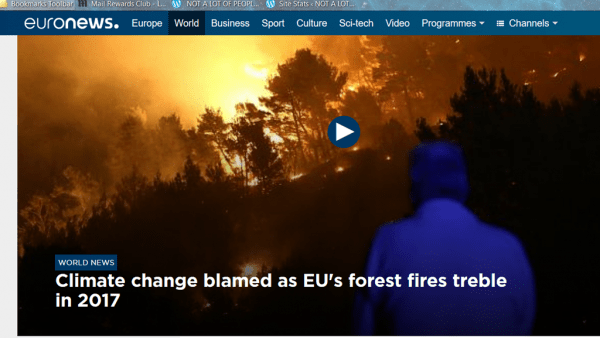
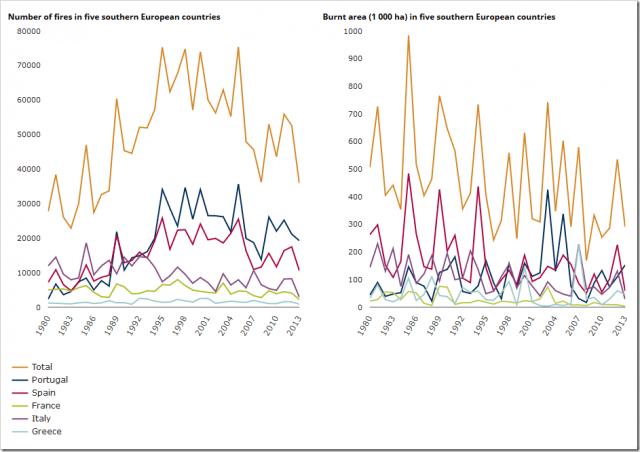
Exclusive: The number of forest fires in the EU has trebled so far this year, according to figures obtained by Euronews, affecting an area nearly the size of Luxembourg.
There have been 677 blazes in 2017 – a huge increase on the 215 the bloc saw annually on average over the previous eight years.
Experts have blamed climate change for the rise, saying it has extended the traditional wildfire season and increased the frequency of blazes.
They have warned Europe’s forest fires will rage more often in the future and engulf new areas.
Portugal, Italy and Croatia have battled blazes in recent days amid high temperatures and lower-than-normal rainfall.
It’s been years since the major pharma companies agreed to participate in the Registry of All Trials, meaning that they’d end the practice of only reporting on trials whose outcomes they were pleased with, leaving about half of all trials unreported-on.
Today, Ben Goldacre (who is the Registry’s most prominent advocate) and colleagues released a paper in the British Medical Journal reporting on their audit of pharmaceutical companies’ record on keeping that promise.
What they found is pretty dismal: to put it bluntly, pharma companies are cheating like crazy.
The paper is accompanied by a website that will shortly publish a ranking showing which pharma companies are most honest in reporting in on their trials.
This is a vital scientific/health question: pharmaceutical companies have spent decades cherry-picking their studies, suppressing those that put their products in a bad light, only telling regulators about the successful ones. About half of all pharmaceutical trials were never reported on. If you were trialing a quarter to see if it always came up heads, and you got to suppress half of your results, you could prove that it was fair, that it was all-heads, or all-tails, or anything in between.
So what did we find? The results on the individual companies are important, but we also came across some fascinating patterns. While companies superficially have commitments to register and report clinical trials, in reality, there are often huge gaps in their policies, with many failing to include past trials (trials on the medicines we use today) and trials on off-label uses or unlicensed medicines, which are both important. We also found a huge range of commitments, which is exactly what audits are good for: identify who’s doing well, and who’s doing badly, so that everyone can learn from the best players. Lastly, as we went along we collected some fascinating examples of problematic policies, ambiguous language, inconsistent commitments, odd exclusions, and so on.
Overall this audit was a huge project, and we hope it will be widely used. You can see which companies are the best, and the worst. If you’re a researcher trying to get information on a trial from a company, you can use this to determine whether a company are breaching their commitments. If you’re an ethical investor (at the AllTrials campaign we have a network of dozens, covering €3.5t trillion of investments) you can use this to guide your activist investment choices. If you’re a doctor, or a patient, you might use this as a benchmark for the trustworthiness of a company.
MMR Vaccine (Measles, Mumps, and Rubella) Is It Safer Than Measles, Mumps and Rubella?
Physicians for Informed Consent | December 2024
… It has not been proven that the MMR vaccine is safer than measles, mumps, and rubella. The vaccine package insert raises questions about safety testing for cancer, genetic mutations, and impaired fertility. Although VAERS tracks some adverse events, it is too inaccurate to measure against the risk of measles, mumps, and rubella. Clinical trials do not have the ability to detect less common adverse reactions, and epidemiological studies are limited by the effects of chance and possible confounders. Safety studies of the MMR vaccine are particularly lacking in statistical power. A review of more than 60 MMR vaccine studies conducted for the Cochrane Library states, “The design and reporting of safety outcomes in MMR vaccine studies, both pre- and post-marketing, are largely inadequate.”19 Because permanent sequelae (aftereffects) from measles, mumps, and rubella are so rare (especially in children with normal levels of vitamin A and infected after birth),6,15-17 the level of accuracy of the research studies available is insufficient to rule out the possibility that the MMR vaccine causes greater death or permanent disability than measles, mumps, and rubella. – Read full article
This site is provided as a research and reference tool. Although we make every reasonable effort to ensure that the information and data provided at this site are useful, accurate, and current, we cannot guarantee that the information and data provided here will be error-free. By using this site, you assume all responsibility for and risk arising from your use of and reliance upon the contents of this site.
This site and the information available through it do not, and are not intended to constitute legal advice. Should you require legal advice, you should consult your own attorney.
Nothing within this site or linked to by this site constitutes investment advice or medical advice.
Materials accessible from or added to this site by third parties, such as comments posted, are strictly the responsibility of the third party who added such materials or made them accessible and we neither endorse nor undertake to control, monitor, edit or assume responsibility for any such third-party material.
The posting of stories, commentaries, reports, documents and links (embedded or otherwise) on this site does not in any way, shape or form, implied or otherwise, necessarily express or suggest endorsement or support of any of such posted material or parts therein.
The word “alleged” is deemed to occur before the word “fraud.” Since the rule of law still applies. To peasants, at least.
Fair Use
This site contains copyrighted material the use of which has not always been specifically authorized by the copyright owner. We are making such material available in our efforts to advance understanding of environmental, political, human rights, economic, democracy, scientific, and social justice issues, etc. We believe this constitutes a ‘fair use’ of any such copyrighted material as provided for in section 107 of the US Copyright Law. In accordance with Title 17 U.S.C. Section 107, the material on this site is distributed without profit to those who have expressed a prior interest in receiving the included information for research and educational purposes. For more info go to: http://www.law.cornell.edu/uscode/17/107.shtml. If you wish to use copyrighted material from this site for purposes of your own that go beyond ‘fair use’, you must obtain permission from the copyright owner.
DMCA Contact
This is information for anyone that wishes to challenge our “fair use” of copyrighted material.
If you are a legal copyright holder or a designated agent for such and you believe that content residing on or accessible through our website infringes a copyright and falls outside the boundaries of “Fair Use”, please send a notice of infringement by contacting atheonews@gmail.com.
We will respond and take necessary action immediately.
If notice is given of an alleged copyright violation we will act expeditiously to remove or disable access to the material(s) in question.
All 3rd party material posted on this website is copyright the respective owners / authors. Aletho News makes no claim of copyright on such material.
 A commercial LNG tanker has sailed across the colder, northern route from Europe to Asia without the protection of an ice-breaker for the first time.