BBC: Inform, Educate And Confuse
Global Warming Policy Forum – 18/11/15
It was with a sense of optimism tinged with experience that I sat down to listen to BBC Environment Analyst Roger Harrabin’s first of his three part series on the climate timed to coincide with forthcoming Paris talks. I know how such programmes are put together, how interviews are solicited, conducted, edited and juxtaposed to form a narrative. I also know the subjectivity involved.
At the start we get an American politician who doesn’t believe that mankind has any influence on the climate and who is also a creationist. Her inclusion concatenated climate change “sceptism” with a denial of evolution. There was no need to have her in the programme at its start except to place in the listener’s minds such an association, which was not shared by anyone else in the programme.
Near the beginning of the programme Roger Harrabin said; “Out and out rejection of climate science has mostly passed.” This is a straw man. In reality, only a very few rejected climate science, and they were regarded by most who took an interest in climate science as being eccentric, irrelevant and wrong. Their importance was often exaggerated as many in the media paraded them as being representative of the “sceptic” movement. For many years anyone who was regarded as having non-mainstream views (often arbitrarily judged) was obliged to go through the ritual of admitting that the world has warmed, that carbon dioxide was a greenhouse gas and that mankind was responsible for the carbon dioxide increase, despite these being commonly accepted and not part of the real debate. A few years ago the presenter on a BBC TV programme introduced Lord Lawson and added that for the purposes of the discussion they are all assuming that carbon dioxide is a greenhouse gas! Thankfully that loaded question had been assigned to the past until Roger Harrabin’s programme that is when Matt Ridley went through this credo.
Matt Ridley is described as a lukewarmer in that he favours the lower end of estimate of transient climate response, TCR (1.5°C – 4.0°C). There is nothing unusual in holding that view as it is held by many “mainstream” climate scientists. So much so that the IPCC reduced the lower bound of TCR from 2.0°C to 1.5°C in response to debates about TCR in the scientific and “sceptic” community.
Later in the programme another contributor introduced another illogical twist. She said she prefers “lukewarmist to climate denial,” as if there was a choice between the two. The implication is that deniers have become lukewarmists which is absurd. Roger Harrabin says Ridley now finds himself inside the IPCC’s big tent but misses the point that it was the IPCC that changed. Interesting isn’t it, Matt Ridley is still a lukewarmer, and not acknowledged as being within the mainstream even when Ridley’s views agree with the IPCC (the epitome of “mainstream” science opinion and “consensus”). Being a “sceptic” or a “lukewarmer” seems to be more about where you come from than the scientific views you hold.
Stubborn, Simplistic
It was also said that the debate about climate science has moved on from the stubborn and simplistic and onto what to do about it. Again, this is incorrect. The main motivation for scientists and “sceptics” is to find out what is exactly going on, and as we find out more we realise that some of we thought was wrong and that there is so much more we don’t know. For example, today we have a different view of decadal climatic variations compared to forced variations than we did a decade ago, and improving our understanding of such variations is essential to contemplating what to do. If anyone thinks the debate has been “stubborn and simplistic” they are mistaken.
Then we have a nice example of doublespeak. A professor states an opinion about climate science and then says there is too much uncertainty to decide if his opinion is correct! Another point is that lukewarmers do not, as a whole, say that the “pause” in annual average surface temperature is because we exaggerated the heating effect of carbon dioxide in the atmosphere. Another contributor was irked by the “media focus” on the “pause.” Presumably she is also somewhat irritated by those scientists who are constantly coming up with explanations for it, more than 35 at my last count, most of which are unreported by the media. She adds that she always knew it would rise in fits and starts so perhaps the real problem was that there was not enough media focus on this in the 1990′s when the world warmed fairly rapidly!
Then we have reference to the loss of sea ice in the Arctic referring to the 2007 low. Perhaps the contributor and the programme’s editor is unaware with what has been happening to Arctic ice cover in the past few years?
Roger Harrabin then talks of those suffering from extreme weather events after the 1°C increase already experienced. This is a controversial area in the journals but is also a subject on which the IPCC has already proclaimed: There is no increase in extreme weather events as a result of climate change.
Roger Harrabin concluded the programme by saying that the world’s warming is largely driven by humans. Yet the IPCC AR5 says; “It is extremely likely that more than half of the observed increase in global average surface temperature from 1951 to 2010 was caused by the anthropogenic increase in greenhouse gas concentrations and other anthropogenic forcings together. The best estimate of the human induced contribution to warming is similar to the observed warming over this period.”
The observed warming since 1950 is about half of the warming observed since pre-industrial times so without mentioning timescales Roger Harrabin’s statement is misleading. It seems that one can refer to post-1950 or pre-industrial periods without qualification to get a good quote.
Thus at the end Roger Harrabin abandons mainstream science and consensus altogether in a programme supposed to be about the science of climate change. Overall the broadcast was an intellectual shambles. It is a rewriting of history worthy of the reporting of the war between Oceania and Eurasia.
Feedback: david.whitehouse@thegwpf.com
EIKE Meteorologist: Climate-Refugee Claims “Invented Stories” … Even Refuted By IPCC
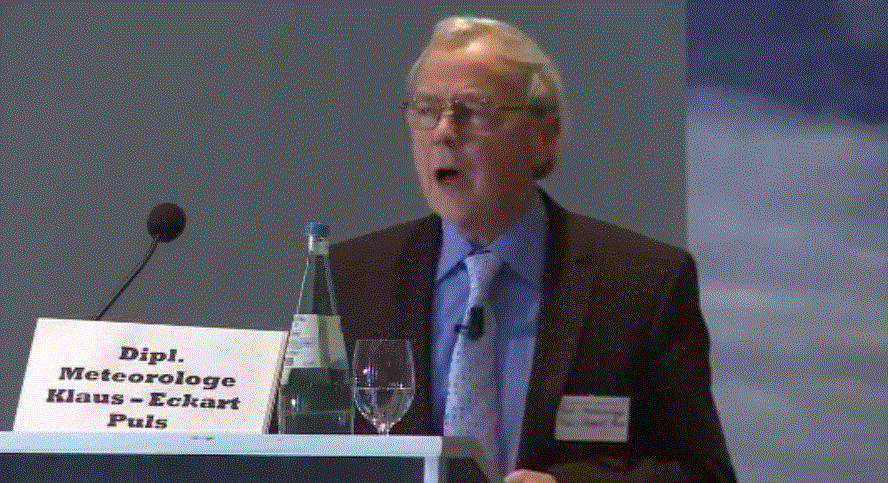
German Meterologist Klaus-Eckart Puls. Photo: EIKE
By P Gosselin | NoTricksZone | November 18, 2015
At the Germany-based European Institute for Climate and Energy (EIKE) veteran, retired meteorologist Klaus-Eckard Puls flatly dismisses the assertion made by many leading officials that climate change is a driving force behind the wave of refugees now sweeping into Europe from the Middle East and Africa.
Germany Minister of Environment Barbara Hendricks recently blamed the refugee crisis on climate change, and urged countries to commit themselves to a binding Treaty in Paris with renewed vigor. Puls responded at EIKE.
Puls reminds us that even the IPCC has found no basis to support the claim. A number of skeptics view the claim as a desperate stretch designed to divert attention away from the real reasons: abject social and foreign policy failure. Recently the IPCC backed off from the speculative claims of climate driven refugees.
Puls writes that the “UN IPCC took back its analyses and prognoses on climate refugees in its last 2013/14 report” and that “the steppes and deserts are in fact ‘greening’”. At EIKE he provides the following chart which clearly shows that Africa is greening and that it is all part of a natural cycle:

Chart depicting Sahel Zone June-October precipitation from 1950 to 2010. Source K.E. Puls
Last weekend meteorologist Joe Bastardi showed that also in Syria precipitation has been on the rise over the past few years.
Puls cites Spiegel, where in 2011 the UN took back its earlier 2005 projection of 50 million refugees by 2010. Spiegel writes:
The UN told SPIEGEL ONLINE that it is backing off its prognosis – in countries of the alleged danger zones populations are in fact growing. The corresponding prognosis has been removed from the UNEP site.”
That particular UN backpedaling incident took place back in 2011. Puls also writes that the latest UN IPCC 2013 report also distanced itself from the projections, seeing no scientific relationship. The claim that climate change is driving the refugee waves appears totally baseless and highly speculative.
The seasoned German meteorologist also cites a recent paper by Colorado University-Boulder geography professor John O’Loughlin on the subject. The paper concludes:
While a new study led by the University of Colorado Boulder shows the risk of human conflict in East Africa increases somewhat with hotter temperatures and drops a bit with higher precipitation, it concludes that socioeconomic, political and geographic factors play a much more substantial role than climate change.”
Puls summarizes in his commentary:
When Ms. Hendriks makes up stories of climate refugees, it is all about her private Weltanschauung. It has nothing to do with reality – and also nothing to do with the statements of the IPCC because the IPCC finds no climate refugees, and even writes this (AR5 2013/14). The UNO/UNEP deleted such claims (made in 2005) from its website! The waves of refugees have many reasons – climate is not among them!”
Veteran Meteorologist Says John Kerry’s Claim Climate-Change Drought Is Causing Refugees Is Completely False
By P Gosselin | November 15, 2015
Veteran meteorologist Joe Bastardi at his latest Weatherbell Analytics Saturday Summary explains why US Secretary of State John Kerry’s claim that the refugee crisis is caused by climate-change-driven drought is total nonsense and is easily disproved.
Secretary Kerry would like to have the public believe that the refugee crisis from Syria and Africa is due to man-made climate drought in the region – and not his abject foreign policy debacle.

Chart shows Nigeria has been too wet. Source Weatherbell.
At the 2:34 mark Joe shows a precipitation chart for western Africa which clearly depicts how rainfall has in fact been above average over the past 15 years, and thus drought cannot be cited as a reason for the Boko Haram terror group. Bastardi says:
There’s no drought here. And so you cannot blame drought in Nigeria for the rise of Boko Haram.”
The above chart’s blue shows that it’s been too wet in Nigeria, and not too dry. Indeed there are number of scientific papers showing that the Sahara region has been getting greener over the past 30 years.
In the Middle East Bastardi shows that the drought has hit part of Turkey, but that most of Syria has had normal precipitation, and explains that “drought” is the normal climate condition there. At the 4:20 mark the Weatherbell meteorologist puts up a precipitation chart for the Middle East for the last five years:

The chart above shows more wet (blue) than dry (yellow/green) with Syria being completely normal. Joe shakes his head at how anyone could even make the claim that Kerry does:
What’s really interesting about all this is, this is just so easy to disprove. […] So I don’t understand why that was said.”
Most readers here do understand why. The falsehood was said because US foreign policy has been a total catastrophe in that region, and now Kerry is desperate for any excuse. And he couldn’t have picked a lamer one. In real life any company or employee blaming poor performance on climate change would be immediately shown the door. This is a blatant unwillingness to accept any responsibility.
The nonsense of climate change leading to terrorism excuse is so clear on so many fronts that it’s a wonder than anyone with even a few points of IQ would take it seriously.
Unmasking the GMO ‘Humanitarian’ Narrative
By Colin Todhunter | CounterPunch | November 13, 2015
Genetically modified (GM) crops are going to feed the world. Not only that, supporters of GM technology say it will produce better yields than non-GM crops, increase farmers’ incomes, lead to less chemical inputs, be better suited to climatic changes, is safe for human consumption and will save the lives of millions. Sections of the pro-GMO lobby are modern-day evangelists who denounce, often with a hefty dose of bigoted zeal, anyone who questions their claims and self-proclaimed humanitarian motives.
But their claims do not stack up. Even if some of their assertions about GMOs (GM organisms) appear to be credible, they are often based on generalisations, selective data or questionable research and thus convey a distorted picture. The claims made about GMOs resemble a house of cards that rest on some very fraudulent foundations indeed (see ‘Altered Genes and Twisted Truth’ by Steven Druker).
The fact that many of the pro-GMO lobby spend a good deal of their time attacking and smearing critics and flagging up the technology’s alleged virtues while ignoring certain important issues says much about their priorities.
If they care about farmers so much, indeed if they value food security, choice and democracy so much – as they frequently claim to – why do they not spend their time and energy highlighting and challenging the practices of some of the corporations that are behind the GM project and which have adversely impacted so many across the world?
For instance, consider the following.
1) There is a massive spike in cancer cases in Argentina which is strongly associated with glyphosate-based herbicides – a massive earner for agribusiness. Not only that but throughout South America smallholders and indigenous peoples are being driven from their lands as a result of a corporate takeover aimed at expanding this type of (GM) chemical-intensive agriculture. The outcome has been described as ecocide and genocide.
2) GM technology has not enhanced the world’s ability to feed itself and has arguably led to greater food insecurity (also see this).
3) Petrochemical, industrialised agriculture is less productively efficient than smallholder agriculture. However, the latter is being squeezed onto less and less land as a result of the expansion of corporate commodity crop farming and the taking over of fertile land by institutional investors and agribusiness concerns. As a result of this, the world is in danger of losing the ability to feed itself. Across the world, not least in Asia, peasant farming is being dismantled in favour of this type of corporate agriculture, which is unsustainable and associated with cancers, water contamination, soil degradation and falling water tables.
4) This is a model that from field to plate is causing obesity, diabetes and various other ailments and diseases. Facilitated and supported by trade agreements like NAFTA, people’s quality of food is being sacrificed and local farming devastated (see this to read about the situation in Mexico).
5) In India, 300,000 farmers have committed suicide over the past 20 years as farming has deliberately been made financially non-viable. The aim is to displace hundreds of millions who rely on agriculture to make a living and free up land for Western agribusiness to reshape farming. As NAFTA has done to Mexico, the agribusiness-backed Knowledge Initiative on Agriculture seems likely to do to India. The aim is to dismantle Indian agriculture for the benefit of corporate agribusiness.
We now witness grass-root responses to what is outlined above on a daily basis: farmer protests on the streets of Delhi and local movements from Ghana to Brazil resisting the corporatization of seeds, land, water, food processing, food retail and decision making/regulatory processes.
We also see the wrecking of traditional, productive rural economies and the attack on indigenous knowledge at the behest of global agribusiness, facilitated by compliant politicians. If corporate aims cannot be achieved via trade agreements or the machinations of international institutions like the WTO (whose rules agribusiness shape), they are sought on the back of war or through strings-attached loans as is the case in Ukraine. Objectives are sought by various means.
The world can feed itself without GMOs. It is current policies and the global system of food production that militate against achieving global food security and which contribute towards hunger and poverty. No amount of gene splicing can rectify this.
How convenient it is for sections of the pro-GMO lobby to ignore, side-line or dismiss all of the above and offer a techno-fix supposed panacea that comes courtesy of the same companies whose practices are helping to undermine food security and which are fuelling much of the devastation in the first place. It betrays an ideological adherence to a pro-corporate neoliberal agenda.
Instead of attempting to dismiss the issues set out here as being based on ‘romantic twaddle’, the ramblings of wicked ideologues or the fads and inventions of some notional ‘green blob’ red in tooth and claw that hates humanity, science and freedom of choice (all of which have been levelled at critics), it would be better to acknowledge the issues described here and work to address them and challenge the practices that fuel them.
The pro-GMO lobby is fond of trying to discredit its critics and engages in pious, emotive rhetoric. They often ask them: ‘What are you doing to save the lives of millions?’
The question for them is: What are you?
MIT grad challenges Monsanto over ‘nonexistent GMO safety standards’
RT | November 13, 2015
One of the world’s largest GMO producers has been challenged by an MIT graduate who claims there are absolutely no GMO safety assessment standards. He earlier alleged that GMO-engineered plants accumulate high levels of formaldehyde.
Livingston (New Jersey) High School Hall of Fame member, Dr. V A Shiva Ayyadurai threw down the gauntlet to the Monsanto Company, claiming it would be next to impossible for the agro-giant to disprove his claim that safety assessment standards for genetically-modified organisms (GMO) are nonexistent.
“If Monsanto can disprove the fact that there are no safety assessment standards for GMOs, the conclusion of our fourth paper, then I will give them my $10 million building,” Ayyadurai, also a Massachusetts Institute of Technology graduate, told Patch.
Ayyadurai’s argument is based on his alleged discovery that GMO plants accumulate high levels of formaldehyde, a finding Ayyadurai asserted in an article published back in July in an expert opinion for the Agricultural Sciences trade journal.
“This is not a pro- or anti-GMO question,” Ayyadurai wrote in his abstract. “But [rather], are we following the scientific method to ensure the safety of our food supply? Right now, the answer is no. But we need to, and we can if we engage in open, transparent and collaborative scientific discourse, based on a systems approach.”
“Formaldehyde is a known class-one carcinogen,” Dr. Ray Seidler, a former EPA senior scientist, said in a statement on Ayyadurai’s study. “Its elevated presence in soybeans caused by a common genetic engineering event is alarming and deserves immediate attention and action from the FDA and the Obama administration.”
An estimated 94 percent of US-grown soybeans are genetically engineered.
Indian Ocean As A Prize Or Crisis Of Multipolarity? (I)
By Andrew Korybko | Oriental Review | November 10, 2015
State Of Emergency In The Maldives
The tropical paradise and world-famous tourist destination of the Maldives has been put under a month-long state of emergency over fears that a violent regime change scenario is about to commence. The tiny but geographically disperse Indian Ocean archipelago sits along a key maritime transit route linking the expanding East African economies with their counterparts in South, Southeast, and East Asia, thus making military-political events in this otherwise relatively obscure country of heightened global significance. Although it’s still too early to conclusively say, circumstantial evidence points to the islands’ instability being part of the broad Chinese-Indian rivalry playing out all throughout the Indian Ocean rimland, and that the Maldives are just the latest in a chain of competitions this year that have also included Sri Lanka and Nepal.
Part I begins by describing the current situation and explaining how it’s really just the latest act of a decades-long drama that’s been unfolding in the island nation. Following that, Part II sheds light on the heated struggle for influence that China and India are partaking in over the strategic orientations of the Indian Ocean island states, strongly suggesting that the current turmoil has something to do with their rivalry. Wrapping everything up, Part III concludes the series by arguing that the situation in the Maldives should be seen in the larger picture of the Cold War between China and India that’s been actively unfolding since the beginning of this year, and offers some closing thoughts about what this means for the future cohesiveness of BRICS.
The Seesaw Of Stability
The post-independence history of the Maldives has been marked by bitter personal rivalries that periodically upset its tranquil stability. The present predicament is actually no different, and it perfectly correlates to the political trends that the country has experienced throughout the course of the past half century.
General Information
 The Maldives have traditionally been stable and largely unaffected by global events owing to their oceanic isolation. Fishing had been the dominant industry for generations until the advent of tourism in the early 1970s, after which the latter eventually came to occupy the top spot and bring in loads of much-needed foreign currency. With time, this helped the Maldives become an upper middle income country, although the reliance on fishing to provide jobs and exports still remains, with the country’s expansive 859,000 square kilometer exclusive economic zone guaranteeing that this isn’t likely to ever change. The country’s nearly 400,000 people live on only 200 of the total 1,190 islands that make up the Republic, with more than a quarter of the population residing in the capital of Malé. Just about all of the citizens are Muslim and Islamic law has a special place in the country’s system, but society is relatively moderate and extremism hasn’t historically been a problem.
Nasir vs Gayoom
Ibrahim Nasir was the second President after independence (1965) and served from 1968-1978, during which the Maldives began to develop its tourism industry and establish consistent contact with the outside world. The 1975 closing of a British airbase in the southern reaches of the archipelago hit the country’s economy hard at the time, and his government was blamed for the difficulties that ensued. In 1978, instead of seeking a third term in power, Nasir fled the Maldives for Singapore amid rising public resentment over his rule, and from then on out, he became the arch-rival of his successor, Maumoon Gayoom.
Just as parliament had done with Nasir and per the constitutional configuration at the time, it selected Gayoom to be the only candidate to stand in the upcoming election, and he won heartily. His victory marked the beginning of 30 years of non-interrupted [rule] over the Maldives, during which the economy soared and the political situation largely stabilized. However, it wasn’t without any ‘hiccups’, as there were three coup attempts during the 1980s that were widely suspected to be attempts by Nasir and his loyalists to return to power.
The most dramatic of these occurred in 1988 when the People’s Liberation Organization of Tamil Eelam, a Sri Lanka-based ethno-separatist group along the lines of the Tamil Tigers, invaded the capital island of Malé and nearly succeeded in overthrowing the government. Gayoom was forced to rely on a rapid military intervention by India (Operation Cactus) to restore order and remain in power, and the successful conclusion of the mission deeply strengthened bilateral relations between the two. Interestingly enough, this was also the last conventional coup attempt in the Maldives, and Nasir was later pardoned for his in absentia convention in an earlier 1981 incident and somewhat rehabilitated as an independence-era hero (although he never returned back to the Maldives).
Nasheed vs Gayoom

Mohamed ‘Anni’ Nasheed
The neutralization of Gayoom’s primary rival, Nasir, only led to the emergence of another one, albeit in a completely different manner. Mohamed Nasheed was born in the Maldives in 1967 but spent a large portion of his life abroad in Sri Lanka and later the UK from 1981-1990 (8 years of which were in the latter). He was arrested the year after he returned when he wrote an article about how the 1989 presidential election was supposedly falsified, and his imprisonment (the first in a chain of 12 others on various charges) catapulted him to international fame in 1997 when Amnesty International bestowed him with the pro-Western ‘honor’ of being a “prisoner of conscience”.
The so-called “human rights activist” behaved in the style of 1989-era revolutionaries, in that his goal wasn’t to lead a military coup like his Cold War predecessors, but rather a social one that would be broadcast all across the world as a “pro-democratic” victory. His first step in getting there was when he entered parliament in 2000 and founded the unofficial Maldivian Democratic Party (MDP), but he suffered a temporary setback when he was accused of corruption and fled the country for the UK in 2003, where he was granted “political asylum” the year after. The Telegraph notes that “he forged close ties to Britain’s Conservative party” during the 18 months he was in self-imposed exile, and he returned to the Maldives a few months before political parties were legalized there in June 2005.
In August he was arrested after a failed Color Revolution attempt that he staged under the ‘plausibly justifiable’ grounds of commemorating an earlier “pro-democracy” destabilization the year prior. As would have be expected, this earned him global fanfare from the West and endeared him as a ‘daredevil of democracy’ in their eyes, and the increasing international pressure that this put on the Gayoom government pushed it into acceding to political reforms. The 2008 presidential elections that followed saw Nasheed beating Gayoom in a run-off vote by an 8% margin (53.65% vs 45.32%), which came off as somewhat surprising considering that Gayoom was ahead in the previous round with 40.3% to 24.9%. No matter how it happened, though, the result was still the same, and it’s that the “Maldivian Suu Kyi” had usurped power in a “democratic coup” and was now in charge of the geostrategic state.
The People vs Nasheed
While hailed by the West as a posterchild for “democracy” and buoyed abroad by the cult-like following he gained for being a “green” president obsessed with combating climate change, Nasheed could barely govern his own country owing to the multiple defections from his powerbase, which eventually came to include all of his coalition partners and his entire cabinet. The politicians resigned from Nasheed’s government in protest for him overstepping the new constitutional limits on the presidency and trying to impose himself on parliament. The irony wasn’t lost on anyone, it seemed, since it became patently obvious that the pro-Western “democratic reformer” harbored authoritarian ambitions that were bolder than his predecessor’s, but because he received the ‘stamp of approval’ from Western leaders and “democratic” NGOs like Amnesty International, he behaved as though he has a blank check to do as he pleased. Being a globally recognized “climate change crusader” also helped, since it filled him with reservoirs of international goodwill no matter what actions he decided to take at home.
Nasheed wasn’t shrewd enough to heed the glaring signs of skyrocketing opposition to his rule, and his politically fatal moment happened when he blatantly overstepped his constitutional authority by ordering the arrest of perceived pro-Gayoom judge Abdulla Mohamed on corruption charges. This outraged the entire country and would prove to be the catalyst needed to galvanize the people’s will and initiate a popular movement against him. After protesting against him for weeks, the demonstrators gained a major victory when the police forces that were ordered to violently disperse them abruptly switched sides and turned against the government. That same day on 7 February, 2012, Nasheed resigned from his post as president and was replaced by his second-in-command Mohammed Waheed Hassan, in a stunning reversal of political fortunes that left many in the West scratching their heads at what happened. They seemed unable to understand how their “pro-democratic” and “green” “prisoner of conscience” could produce such popular outrage against his presidency that he would be overthrown by the masses before he could even finish his first term, but lo and behold it happened, and the changes it brought would lead to significant international repercussions (which will be explored at length in Part II).
Nasheed vs Yameen (Gayoom’s Half-Brother)
The 2013 Presidential Election that followed Hassan’s year-long caretaker government led to the narrow victory of Abdulla Yameen (former President Gayoom’s half-brother) over Nasheed by a 51.39% to 48.61% margin in what was essentially the second round. As it would be, the earlier round where Nasheed won 46.93% to 29.72% (still not a clear majority to have clinched the presidency) was annulled after the country’s highest court found that extensive fraud had been practiced. It was this second round (legally a re-do of the first round) that Yameen, the current president, won. Despite what many would have suspected to have been a controversial victory at least in the eyes of the West, the results were recognized the world over and a brief period of stability returned to the island nation, although it wasn’t to last for long.
In February of this year, Nasheed was jailed on the grounds that he illegally arrested judge Abdulla Mohamed back during the time of his presidency, and he was sentenced to 13 years in prison one month later after having been found guilty for violating the country’s anti-terror laws through his action. A brief controversy occurred in the summer when he objected to returning to prison after having been temporarily released on house arrest for medical reasons. He says the government promised to commute the rest of his sentence to house arrest and alleges that he had a document to prove it, but the state said that it was a forgery and swiftly returned him to jail where he’s remained ever since. It misleadingly appeared as though Nasheed and the external backers behind him had thrown in the towel and recognized the futility of their efforts in staging a comeback, but then all of a sudden three assassination plots emerged against President Yameen in the course of only a little more than one month.
The Three Assassination Plots And The State Of Emergency
The first plot was an actual attempt on the President’s life, and it dealt with a bomb exploding in his speedboat on 28 September. Yameen was uninjured but his wife and two associates were hospitalized in the aftermath. 33-year-old Vice-President Ahmed Adheeb was arrested on 24 October over his involvement in the plot, and President Yameen said that the decision to do so to his recently appointed protégé was “not easy”. Then on 31 October, the security forces retrieved a cache of weapons and explosives that were hidden 42 meters underwater off an island resort, concluding that they were to be used in a forthcoming violent seizure of power. Even more disturbing, they discovered that the munitions were actually stolen from the state armory, raising the uncomfortable prospects that they could have been used to implicate the government in a false-flag attack. Just a few days later on 2 November, a remote-controlled bomb was found and defused near the presidential palace, clearly confirming that the President is indeed the target of very powerful forces that are desperately intent on killing him.
Amidst all of this, Nasheed’s MDP announced that they’d be holding an anti-government rally on 6 November to pressure the authorities into releasing their leader. Considering that the government had already realized by this time that an unspecified number of weapons had been stolen from the armory and might be used against the protesters by the regime change elements conspiring against Yameen, the authorities enacted a month-long state of emergency on 4 November in order to ensure both the citizens’ safety and overall national security. The last thing that the Maldives needs at this moment is for a Kiev-like false-flag sniper attack to target the protesters as they march against the President, as this would surely be interpreted by the Western media (without any shred of proof whatsoever) as Yameen “killing his own people”, just as Yanukovich was wrongfully accused of, with all of the resultant international (Western) hostility and potential sanctions that this could bring to his administration. Depending on the intensity of the false-flag violence that breaks out, it might even lead to a lightning-fast pre-planned Indian “humanitarian intervention” to depose of his government, a reverse-Operation Cactus, if one will, for reasons that will be explored in Part III.
In hindsight, Yameen wasn’t being paranoid but actually quite pragmatic in having declared the state of emergency, since the day after the MDP protesters were supposed to rally, the authorities arrested a Sri Lankan sniper that had been tasked with assassinating the President. Keeping in mind the lessons from Kiev, it’s very probable that this individual and any of his fellow contractors (whether he was even aware of them or not owing to what looks to be the ultra-clandestine nature of this operation) could have also turned their sniper fire or even possible small arms and explosives on the opposition protesters and committed a massacre of shattering proportions. The reader would do well to realize that Malé is a tiny island of 5.8 square kilometers and 153,379 people, giving it a record-setting population density of 26,000 people per square kilometer. To put that into relative perspective, it’s about five times as dense as the Gaza Strip, which is conventionally recognized as one of most densely populated places on earth. Combined sniper fire, small arms fire, and strategically placed and timed explosions by a small team of Unconventional Warfare experts (urban terrorists, in this specific context) could turn the tropical paradise into a chilling cemetery in no time, and coordinated expertise in this lethal manner inevitably has to have some degree of state sponsorship behind it.
Featured Video

Dan Dicks with James Corbett on Solutions Watch
or go to
Aletho News Archives – Video-Images
From the Archives
$1.5bn up in smoke: US THAAD missile stockpile dries up defending Israel against Iran
By Ivan Kesic | Press TV | July 2, 2025
According to American media, defense news outlets, and independent analysts, the 12-day Israeli military aggression against Iran significantly depleted the US stockpile of THAAD (Terminal High Altitude Area Defense) interceptor missiles.
Citing official sources, American magazine Newsweek reported on Friday that the US transferred a substantial portion of its advanced missile defense capabilities to support the Israeli regime, an effort with questionable results and a critical impact on US strategic reserves.
THAAD, developed by Lockheed Martin arms manufacturing company, is a key component of Israel’s multi-layered air defense architecture. It is designed to intercept medium-range ballistic missiles, including those launched from Iran and Yemen.
The US-made system is capable of targeting short-, medium-, and intermediate-range ballistic missiles during their terminal phase, whether inside or outside Earth’s atmosphere.
THAAD uses a “hit-to-kill” method, relying on kinetic energy rather than explosive warheads to destroy incoming threats, intercepting at altitudes of up to 150 km and ranges between 150-200 km.
Operated exclusively by American personnel, the US military maintains eight THAAD batteries with an estimated 350–400 interceptors in total. The eighth battery was activated during the June 20 Israeli aggression against Iran and is capable of intercepting hypersonic missiles. … continue
Blog Roll
 Aletho News
- Zionist Bought Senate Blocks Information About American Citizens Killed By Israel
- While Gaza dominates the UN, these are the people keeping it alive
- New Report: “Scholasticide and Genocide in Gaza: Assessment, Testimonies and Legal Analysis”
- ‘THAAD Delusion’: Iran war exposes US missile shield limits – The Atlantic
- Moscow issues warning to NATO over Russian exclave
- Yes, the Iran war has destroyed Trump’s presidency
- The fallacy of US delusions about Iran’s economic collapse
- Hezbollah denies Syria cell link, warns of Israeli plan to sow discord
- The legacy of US sanctions, war, and occupation in Iraq
- Iraqi resistance group rejects disarmament, vows to maintain support for Lebanon
- If Americans Knew
- Mamdani releases plan to combat antisemitism and hate crimes in New York City
- Iran’s Revolutionary Guards Publish Letter to the American People
- DMFI launches $1 million ad campaign supporting Virginia’s Elaine Luria
- US Senate blocks resolution seeking report on Americans killed by Israel
- Israeli Attacks Kill Ten Palestinians in Gaza
- Massacre at Minab: The School That Became a Grave
- Israeli media: The IDF Shows It Doesn’t Turn a Blind Eye; It Actively Emboldens Settler Havoc
- As settlers ravage West Bank, Israeli forces kill 10 in Gaza – Daily Update
- New Report: “Scholasticide and Genocide in Gaza: Assessment, Testimonies and Legal Analysis”
- Ex-Biden officials are desperate for a Gaza scapegoat
- No Tricks Zone
- Green Energy Debacle: German Expert Professor Fritz Vahrenholt Warns Of Severe Economic And Social Consequences
- Two More Paleo Reconstructions Affirm Meters-Higher Sea Levels Across Ireland, Brazil 7000-6000 Years Ago
- New Study: Earth And Venus Surface Warmth Largely Explained By Convection And Lapse Rate, Not CO2 Or Radiation
- 2025 Nature Paper Claiming Worsening Global Drought Gets RETRACTED …Heavily Flawed
- New Study: ‘Global Drought Shows No Detectable Recent Acceleration Under Climate Warming’
- Economic Masterminds: German Socialists Suggest Taxing Productivity Gains Stemming From Using AI
- The South China Sea Has Not Been Cooperating With The Climate Change Narrative
- Energy Crisis: Germany Enters Heating Season With Historically Low Gas Reserve Fill Levels
- New Study: The Antarctic Ice Sheet Gained Mass From 2020-2024 Due To Staggering Snow And Ice Accumulation
- Study: Ocean Heating Rates From Thousands Of Years Ago ‘Dwarf’ Modern Ocean Heating Rates

