Anti-war activists in Munich protest major security confab
Press TV – February 5, 2012

German policemen block demonstrators trying to approach Munich’s Bayerischer Hof Hotel, where the 48th Munich Security Conference is held.
Hundreds of anti-war activists have taken to the streets in the southern German city of Munich to protest against an annual, high-profile security conference.
Some 800 demonstrators marched on Saturday toward the Bayerischer Hof Hotel in Munich where the 48th Munich Security Conference is being held.
The three-day event brings together foreign and defense ministers and military experts from around the world.
The activists said that they were demonstrating against global arms deals, calling for a genuine global peace. The anti-war protesters also condemned the conference for ‘only paving the way for future conflicts.’
The event gathers the world’s major weapons producers who seek to invent wars and move profit backwards and forwards with certain countries, they said.
The 48th Munich Security Conference, focusing on Europe’s debt crisis and strategies for global security, was held with security provisions that were not as tight as the previous years, with police presence at a 3,100-strong low.
Related articles
- Rudd heads to the Munich Security Conference to get his orders from Kissinger (seeker401.wordpress.com)
- Clinton Urges Bulgaria to Be Energy Independent (abcnews.go.com)
Kufr ad-Dik and Burqin march against boars, pollution, and violence by Israelis
International Solidarity Movement, West Bank | 3 February 2012
Burqin and Kufr Ad-Dik face daily obstructions in justice as nearby illegal Zionist settlements encroach on the livelihood of local Palestinians. The villages are surrounded by several hilltop illegal settlements and industrial sites with polluting factories and an army base.
“This is a microcosm of Palestinian suffering” stated a resident upon the arrival of International Solidarity Movement volunteers.
Burqin and Kufr Ad-Dik are under siege by settlers and soldiers. The villages are situated in Areas B and C as stipulated by the Oslo Agreement and sit dangerously close to the 1948 Green Line. Burqin has approximately 4000 residents which include many refugees from Al Nakba, or the Catastrophe, known to Palestinians when they faced exile from their villages in 1948 at the creation of Israel.

Kufr ad-Dik face to face with their oppressor
The village relies on small scale agriculture for its existence. The Israelis from the illegal settlements know this and routinely destroy Palestinian crops often by burning olive trees as part of the extremist “Price Tag Campaign.” They have also released wild boars from their settlements which eat Palestinian crops and are very dangerous, especially to the young of the villages. In an act of callousness the settlers destroyed a newly bought piece of farm machinery about two weeks ago. During this attack they also burned a car and unsuccessfully firebombed the local mosque, leaving threatening graffiti that they will be back.
While a local place of worship, graffiti, and vandalism seem like small offenses, one must keep in mind that these are systematically done to pressure the villages into abandoning what is left of their homes.
As with many of the Palestinian villages who have suffered the injustice of having their lands stolen by Israel in order to build illegal settlements, which continue to expand, Burqin and Kufr Ad-Dik are forced to endure regular attacks from the illegal occupants of their land as well as harassment by the Israeli military. The settlers, soldiers and Israeli government, which is benefiting from and funding the existence of these illegal settlements work cooperatively to forcibly remove Palestinians from their land.
There is an industrial estate, situated on top of a hill, which houses several severely polluting factories. These factories could not gain a license to be constructed inside of Israel due to the pollution that will be created, but they were granted permission by the Israeli government to be built within the West Bank illegally under international law. The waste from these factories is channeled in an open sewer through the villages.
Since the factories began polluting there has been a sharp rise in health problems within the village including an anomaly in cancer cases. A German charity volunteered to pay for the sewer to be covered and managed.
Permission to build this cover was flatly denied by the Israelis. The pollution from the factories has severely affected the surrounding land causing trees to die, crops to fail, and the meat from animals grazed on the land cannot be sold due to fear of contamination.
According to an article published by the Baheth Center for Strategic and Palestinian Studies, information on the size and power of these factories is not available to local Palestinians. In an article published by the Baheth center, they describe the extent of the factory waste:
The waste water and solid waste these industries produce, provide important clues about the type and extent of industrial activity… Clear evidence that Israeli factories operating in the Occupied Territories do not follow pollution prevention measures is provided by the Barqan industrial zone, which houses factories producing aluminum, fiberglass, plastic, electroplating, and military items. Industrial waste water from this zone flows untreated to the nearby valley, damaging agricultural land belonging to the Palestinian villages of Sarta, Kufr Al-Deek, and Burqin, and polluting the groundwater with heavy metals.
Unemployment is now very high in the villages since much of the land has been taken by settlers and the military. To add insult to the pollution inflicted on the villages, the Palestinians are banned from working the factories surrounding them. With more land being taken away every day, unemployment and poverty continue to rise. Yesterday an army order was issued to take another 60 dunums (1000m squared = 1 dunum) for “military purposes.” Farmers are now collating deeds to their lands in an attempt to argue their case in court.
Burqin has lost over 8000 dunums to the illegal occupation, most of which was stolen in the last 10 years. The land theft is sharply on the increase. The farm land that is left is still extremely dangerous to farm due to settler attacks and the threat of wild boars.
Not satisfied with attacking the food production, the Israelis have destroyed several wells, which are vital to the well-being of the villagers. The illegal settlers have commandeered most of the water supply leaving the Palestinians with critically low access to clean water. A recent study found that the average settler uses 18 times that of one Palestinian villager.
In addition to the destruction of wells several homes have been demolished including a home that the owner worked for 30 years to save enough to build.
Leaving or reentering the villages is high risk as settlers will often throw rocks at Palestinian cars. If the villagers successfully run the gauntlet they then have to pass through harassing Israeli Army checkpoints.
The villages have just started a weekly protest against their oppression in Kufr Ad-Dik. This was met last week with tear gas and steel bullets thinly coated with rubber leaving 10 villagers wounded.
The protest will continue every Friday.
Related articles
- West Bank village steps up protests against Israel’s theft of land (alethonews.wordpress.com)
- 13 injured in Nabi Saleh demonstration (alethonews.wordpress.com)
- Anata falls victim to militarized, illegal settlement once again (alethonews.wordpress.com)
13 injured in Nabi Saleh demonstration
Ma’an – 03/02/2012
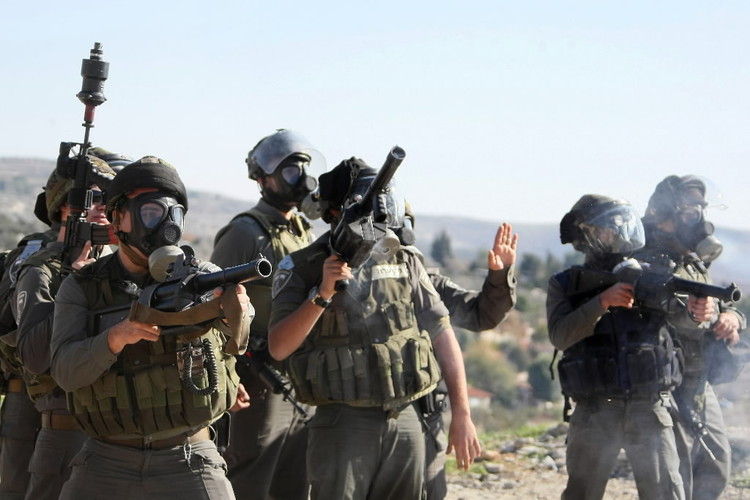 BETHLEHEM – Israeli forces injured 13 people in the village of Nabi Saleh, near Ramallah, during a Friday demonstration against Israeli land confiscation, witnesses said.
A French national sustained an injury from a tear-gas canister, activists said. She was taken to a hospital in Ramallah and her injury was described as moderate, they said.
Maj. Peter Lerner of the Israeli army suggested the injury was actually caused by a Palestinian stone-thrower. Israeli border police were injured at the same “riot,” he wrote on Twitter.
Palestinian residents of Nabi Saleh and their local and international supporters demonstrate each week against a nearby settlement’s encroachment toward lands owned by the village.
In December 2011, a tear-gas canister killed Mustafa Tamimi, a resident of the village.
Related articles
- We Are Nabi Saleh, a new film capturing people’s struggle, Mustafa Tamimi (alethonews.wordpress.com)
- Protester seriously hurt by gas canister (alethonews.wordpress.com)
- Palestinian protester severely injured in Nabi Saleh (alethonews.wordpress.com)
- Live sniper-fire injures protester in Nabi Saleh (alethonews.wordpress.com)
- Confronting Occupiers in Nabi Saleh (alethonews.wordpress.com)
- Nabi Saleh Protest Organizer Shot in Face at Weekly Protest (alethonews.wordpress.com)
European MPs call on Israel to release Palestinian lawmakers
Ma’an – 02/02/2012
BETHLEHEM – A group of European Parliamentarians on Wednesday called on Israel to release 26 imprisoned Palestinian lawmakers, official news agency Wafa reported.
The group, composed of 26 members of the European Parliament, urged “the EU and its Member States to take immediate action” to release all imprisoned members of the Palestinian Legislative Council, a letter said.
“A strong and determined demand by the international community to free all Palestinian parliamentarians is long overdue and must become a priority,” the group said.
The EU lawmakers condemned the recent arrest of Palestinian parliamentary speaker Aziz Dweik, who was seized by Israeli forces at a Ramallah checkpoint on Jan. 19.
They also criticized the arrest of Palestinian MP Mohammad Tawtah and former Jerusalem affairs’ minister Khalid Abu Arafa, who were detained on January 23. during a raid on the Jerusalem headquarters of the International Red Cross.
“The most recent arrests aim clearly at undermining the prospect of Palestinian reconciliation and preventing the resumption of parliamentary life. They also jeopardize peace efforts,” said the letter written by EU parliamentarians.
Related articles
- Speaker Of Palestine Parliament Receives Six Months Administrative Detention (alethonews.wordpress.com)
- Israel detains 2 more lawmakers (altahrir.wordpress.com)
- Jerusalem lawmaker to be deported to Ramallah (alethonews.wordpress.com)
- Israeli special forces kidnap Jerusalemite MP, minister from Red Cross premises (alethonews.wordpress.com)
Four injured as Beit Ommar marks anniversary of Yousef Ikhlayl’s murder
31 January 2012 | Palestine Solidarity Project
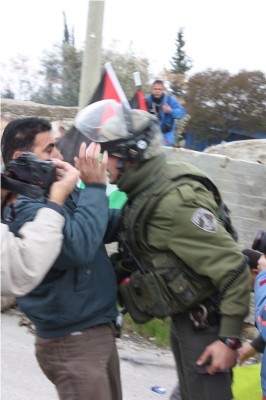 On Tuesday, January 31st, 2012, Beit Ommar villagers demonstrated near Route 60 at the entrance of the village to commemorate the one year anniversary of the murder of Yousef Ikhlayl, a 17-year-old Beit Ommar youth who was murdered by Israeli settlers on January 28th, 2011. The demonstration was organized by the Popular Committee in Beit Ommar and was supported by the Palestine Solidarity Project, the Popular Committee in Yatta, and several other Palestinian organizations.
As the demonstrators approached Route 60 at the entrance of the village, dozens of Israeli soldiers blocked their path and attacked the gathering with tear gas, sound bombs, and beatings. Israeli Forces used wooden clubs to strike at activists, and four demonstrators were injured. Yousef Abu Maria had his nose broken, Emad Abu Hashem was hit in the forehead with a club, Ahmad Abu Hashem was hit in the head with a soldier’s rifle butt, and Jamil Shuhada, an Executive Committee member for the PLO, was beaten with clubs and rifle butts.
The demonstrators remembered Yousef’s murder with the following demands:
- Try the murderers of Yousef Ikhlayl (the settlers came from Bat Ayn, one of five Israeli settlements built on land stolen from Beit Ommar villagers. To date, no settler has been arrested, let alone investigated, for Yousef’s murder.)
- Dismantle the Bay Ayn settlement
- Open the closed military roads around Beit Ommar which prevent farmers from reaching and cultivating their lands.
- Free all Palestinian political prisoners.
- Remove the Israeli military watchtower and checkpoint at the entrance of Beit Ommar and allow area residents freedom of movement.
Related articles
- Demanding justice for Yousef, a quiet boy killed by Israeli settlers (alethonews.wordpress.com)
- Beit Ommar (whatisawthere.wordpress.com)
- Settlers torch cars in Beit Ummar (alethonews.wordpress.com)
- Israeli army arrests Popular Committee official in Beit Ummar early dawn raid (alethonews.wordpress.com)
Arab participation at Israeli security summit enrages BDS activists
Al Akhbar | January 30, 2012
The participation of Arab officials and institutions at a major Israeli security conference has drawn staunch criticism from Palestinian and human rights activists.
The annual Herzliya conference, which includes high-profile guest speakers focusing on Israel’s major security challenges, invited a number of key Arab speakers, including Jordan’s Prince el Hassan bin Talal and senior Palestinian official Saeb Erekat.
Omar Barghouti of the Boycott, Divestment and Sanctions (BDS) campaign against Israel slammed Arab involvement at the conference as “an act of complicity in the promotion of Israeli occupation and apartheid.”
The conference, which is being held for the 12th year, aims at enhancing Israel’s national security through developing the country’s military and intelligence fields.
“The participation of any Arab speaker…[is] a move that undermines our struggle for freedom and our right to return and self-determination,” Barghouti said.
The conference is being held under the name of “In the Eye of the Storm: Israel and the Middle East” and will be attended by Israeli and international speakers as well as several Arab political, business and academic figures.
Some of the most prominent participants also include Salman Shaikh, Director of the Brookings Doha Center, and Riad al-Khouri, a member of the International Council of Quest-scope in Amman as well as others.
“The Palestinian civil society calls on all Arab participants to immediately withdraw from the Herzliya conference and respect the demands of the majority of the Palestinians who fully support the BDS campaign,” Barghouti added.
Herzliya’s website listed Saeb Erekat, the Palestine Liberation Organization’s (PLO) chief negotiator, as a speaker at the conference, but an official source told al-Akhbar that he was never invited to the conference and therefore will not be attending it.
The official, who wished to remain anonymous, said Yasser Abed Rabbo, a senior Palestinian official was the only member of the PLO to be invited to the Israeli conference, but declined the invitation.
A spokesperson for the Palestinian Embassy in Lebanon – who also wished to remain anonymous – declined to confirm who of the PLO was invited and would attend.
However, sources in Ramallah told Barghouti that Erekat had been invited to the conference, but withdrew following pressure from the Palestinian civil society.
“If true, this would crucially deny other Arab participants their Palestinian excuse,” Barghouti said.
“We hope that all Arab – and international – participants will withdraw from this shameful conference. Raising awareness about this form of Arab complicity is a key goal of our campaign.”
BDS campaigners aim to increase Israel’s international isolation and raise awareness of the plight of Palestinians suffering under Israeli military occupation.
“Our campaign for a boycott of the Herzliya conference is based on this meeting’s singular importance in building Israel’s strategy, especially in the security and military fields, to enhance its oppressive system of settler-colonialism, occupation and apartheid,” he explained.
Barghouti said Israel is “keen to display” the Arab officials and figures at the conference since it “boosts its propaganda efforts and cover up its increasingly isolated regime.”
The BDS activist also condemned the participation of the Brookings Doha Center, whose director is participating in the event despite the institution working to cement itself in the Arab world.
An “academic endeavor should never justify complicity in covering up grave violations of human rights and international law,” Barghouti said.
“At a time when BDS is achieving spectacular successes and turning Israel into a world pariah, these Arab participants are knowingly colluding in Israeli propaganda efforts, siding with the wrong side of history.”
Salman Shaikh of the Brookings Doha Center failed to respond to an interview request before this story was published.
~
Arabs declared as participants in the Herzliya Conference:
 1. Prince al-Hassan Bin Talal: the Regent of Jordan since 1965 until his discharge on the 25th of January, 1999, and the youngest son of King Talal and Queen Zein ash-Sharaf. Western institutes describe him as “an outstanding Arab economist and intellect” as he is actively involved in international forums and conferences for economy and intellect, which twin with the Western ideology. He is making a direct speech via video-link in the opening of “the Herzliya Conference”.
 2. Dr. Saeb Erekat: Chief Palestinian Negotiator for “the Process of Settlement” with the Zionist entity since 1996 and senior member of the Palestinian-“Israeli” negotiations, which accomplished “the Oslo Accords” in 1993. On the 12th of February, 2011, he made his resignation to the President of the Palestinian Authority Mahmoud Abbas after “the Process of Settlement” had reached a dead end. Seldom has Erekat missed membership in the negotiations of Palestinian delegations with the representatives of the “Israeli” Occupation. In the Conference he is addressing the recent developments of the Palestinian-“Israeli” relations entitled:
 3. Riad el-Khouri: Jordanian economist “specialized” in Middle East and Africa affairs; previously participated in “the Herzliya Conference”; a former member of “the Carnegie Middle East Center”; a professor at the American University of Beirut (AUB) and the Lebanese-American University (LAU); consultant for the European Commission, the World Bank, the Economic and Social Commission for Western Asia (ESCWA), the United Nations Development Program (UNDP), and the US Aid Program (USAID); member of the International Council of “Questscope” in Amman, Jordan, a British organization involved in “changing and merging” communities. El-Khouri is lecturing on these topics:
“THE RISE OF POLITICAL ISLAM ACROSS THE MIDDLE EAST: ARAB SPRING OR ISLAMIST WINTER?”
 4. Salman Sheikh: a Qatari researcher; Director of “the Brookings Doha Center” and Fellow at the corresponding “Saban Center for Middle East Policy”. Sheikh’s researches involve “settlement” issues and “solutions” for the Middle East struggle. Among his researches is “A Chance for Hamas to Seek Friends outside Damascus”. He has held several earlier positions, including: the Personal Representative of the Secretary General for Lebanon; the UN the Special Advisor to the UN Secretary General on the Middle East; the UN Special Coordinator for the Middle East “Peace Process”; and “the Director for Policy and Research at the office of Sheikha Mozah Bint Nasser el-Missned”. Currently he is the Special Representative to the European “Muslim West Facts Project”; he is also “the Counselor of Oxford Research Group for Middle East Affairs”. Sheikh is lecturing on:
“THE RISE OF POLITICAL ISLAM ACROSS THE MIDDLE EAST: ARAB SPRING OR ISLMAIST WINTER?”
 5. Tony Badran: Lebanese-American Research Fellow at “the Foundation for Defense of Democracies” (FDD) in Washington DC, which is sponsored by the “Israeli” Lobby and the Neo-Conservatives of the US; whereby he is specialized in the Lebanese and Syrian political affairs. He is known for his extremism and discrimination against Arabs; yet, he is in contact with the Lebanese “Future Party” (of “the March 14 Alliance”) and has been considered to be “the foreign secretary of the Future Party” for many US lobbies. Previously he joined “the Lebanese Forces”, and he has actually acknowledged this when interviewed by several US media, including “Fox News”; whereby he bragged about taking part in the perpetration of “the Sabra and Shatila Massacre” against the Palestinian refugees in Lebanon (in 1982). Actually, even some “Israeli” associations refrain from inviting him to their conferences as he has called for killing Muslims – even American Muslims. Badran is lecturing on:
“POST ASSAD: WHAT NEXT FOR SYRIA AND LEBANON?”
 6. Sherif el-Diwany: an Egyptian economist and Director of “al-Marsad Incorporation”. He has held the position of the Director of “the Middle East and North Africa for the World Economic Forum Annual Meeting in Davos”, the policies of which are quite known. Though el-Diwany has no publicity or post in Egypt, he’s going to lecture on:
 7. Advocate Basha’er Fahoum Jayoussi: a Palestinian of the lands occupied in 1948, one of the founders and the Chairwoman of “the Jewish-Arab Center” at the University of Haifa, which concentrates on “merging Arabs with the “Israeli” community” and establishing “common actualities” between Jewish and Arab students; whereby the Center offers awards and scholarships to students doing researches on the issue of “common Arab-Jewish livelihood”, as well as to students reinforcing this “common livelihood” in appreciation for their “social activity”. Most of Jayoussi’s activities focus on the normalization between Palestine and “Israel”. She is lecturing on:
“GOVERNING “ISRAEL’S” ECONOMY: SOCIAL JUSTICE VS CAPITALISM”
 8. Nahed Khazem: Mayor of the Shafa Amr (Shfaram) Municipality in the Western al-Jalil (Galilee) in the north of occupied Palestine; is well known for his cooperation and good terms with the Zionist-government ministers, particularly with the Culture Minister Gideon Saer. Khazem also participates in merging Arabs with “the “Israeli” community” in the Galilee Region. He is lecturing on:
 1. Muhammad Darawshe: a Palestinian of the lands occupied in 1948; Fellow Member at “the Abraham Fund”, an “Israeli” foundation; has held the position of the Foreign Affairs Director of “the Abraham Fund Initiatives” since 1996, of which he and Amnon Be’eri-Sulitzeanu have been the Co-Executive Directors since 2004. The foundation actually aims at eliminating the Arab presence in occupied Palestine; claiming the conduct of a “Merging and Equality Policy” targeting the Jews and Arabs in occupied Palestine. For more than twenty years, Darawshe has been significantly involved in the field of “Jewish-Arab co-existence”.
 2. Masad Barhoum: a Palestinian of the lands occupied in 1948; the M.D. Director General of “the Nahariya Governmental Hospital” in Western al-Jalil (Galilee). Barhoum is known for his activity and cooperation with the “Histadrut” (“the “Israeli” General Federation of Laborers”), as well as his outstanding relations with the consecutive governments of the Zionist entity, particularly with the Zionist health ministers.
 3. Ayman Seif: the Director of “the Center for the Development of the Arab Minority” at the office of the Zionist Prime Minister Benjamin Netanyahu. In 1996 through 2008, he was in charge of “the “Israeli” Financial Committee” of the Prime Ministry, an economist at the Economy and Planning Ministry, and a member of “the Governmental Committee” in charge of securing the backgrounds of Arabs, claiming “Convenient Representation of Arab Scholars at Governmental Centers” as a policy; also a member of “the Special Committee for Promoting Work Opportunities and Initiatives in the Arab Mainstream”.
 4. Dr. Khaled Abu Asbah: a Palestinian of the lands occupied in 1948; the Director of “the Massar Institute for Research, Planning, and Educational Counseling”; a Sociology-Department Lecturer at the Zionist “Beit Berl Academic College” in “the Third Sector” in occupied Palestine. He received his Sociology and Anthropology PhD from “the Bar Ilan University” in occupied Palestine. His dissertation addressed “Family and School Perceptions: Indicators for Arab-“Israeli” Students’ Involvement in Violence”. Abu Asbah is a pioneer as to merging Palestinians with the Zionist entity; whereby he is in charge of “the Strategy for the Advancement of Arab-“Israeli” Citizens in “Israel””, a project regarding which he has made studies at “the Van Leer Jerusalem Institute”.
Related articles
- Palestinians for Dignity: Saeb Erekat, Go Home (alethonews.wordpress.com)
Israel losing the PR battle
By Yousef M. Aljamal | Centre for Political and Development Studies | 30 January 2012

Huwaida Arraf - image via Wikipedia
For the third week in a row, the Centre for Political and Development Studies (CPDS), a Gaza-based think tank, held a video link to explore issues related to the Palestinian cause, with the presence of Palestinian and international activists. Huwaida Arraf, the co-founder of the International Solidarity Movement, chair of the Free Gaza Movement, and a prominent Palestinian-American activist, talked to Gaza activists about “The Palestine solidarity movement: Countering Zionist propaganda globally.”
Choosing discourse to communicate with others is one of the basic requirements to get one’s voice heard. Zionists have mastered this, while Palestinians have been misrepresented in the West. Ironically, Palestine’s just story isn’t getting out. “Through the years we have not done a very good job of conveying our plight, and that’s largely because telling our story was left to our ‘official spokespeople’ who didn’t know how to communicate well with the western media”, said Arraf. “On the other side, Israel depends largely on PR, a fundamental part of its strategy. One of the biggest propaganda projects is The Israel Project. Its annual budget for last year alone was eleven million dollars. This is not counting the official support of the Israeli government, companies, and AIPAC”.
“Israel is losing the PR battle for various reasons: law and justice are on our side, there is an increasing awareness among Palestinians, the growth of alternative media like Facebook and Twitter, and, I believe, the effect of the International Solidarity Movement”, Arraf continued.
The second Palestinian Intifada, which was characterized by Israel’s aggression against Palestinian civilians and the role of the media in covering it, pushed Arraf, with the help of other colleagues, to found ISM. It grew to include 8,000 activists, who have worked hard to expose Israel’s grievous and vivid violations of human rights in Occupied Palestine.
“One of the reasons we founded ISM was because we noticed what was happening in terms of Israel’s massive use of violence”, said Arraf. “The media was not portraying the truth of what was happening. We realised that the Palestinian civil society, and Palestinians as a whole, especially after Oslo, needed a resource to be able to stand up and confront what Israel is doing”.
ISM turned out to be something practical, not merely a plan on paper. Its first campaign included 50 people. Since then, over 8,000 activists have actively worked on the ground to help the Palestinian people.
“The first campaign started in August, 2001”, said Arraf. “Fifty people came. We started another campaign. We tried to say the conflict is not about a religion against another. It’s about freedom versus occupation. It’s not Muslims against Jews. We wanted the mass media to know this. ISM aimed at forming advocacy groups and helping the Palestinian people sustain their struggle and get their stories heard”.
Palestinians share values with all other nations, based on tolerance, understanding, and working together for the good of humankind.
“Once, I organised a meeting between a Palestinian farmer from Bodrous village in the West Bank, named Ayed Murra, and a Vermont senator on Capitol Hill”, said Arraf. “We talked about how the wall affects farmers in the West Bank. We spent an hour talking to the senator, who lives in an area full of farmers”.
Israel tries to tell the world that the entire Palestinian movement is Hamas. They play on an anti-Islamic atmosphere in the West. This clearly distorts history and the facts on the grounds.
“Hamas was founded in 1987” said Arraf. “What about the ethnic cleansing in 1948 and 1967? Op-eds and articles were written on Hamas accepting a truce with Israel. In 2003, the late Palestinian president, Yasser Arrafat, arranged a ceasefire included all Palestinian factions. In the first two-and-a-half months, Israel killed 74 Palestinians and destroyed 480 Palestinian homes”.
Absence of leadership is one of the things Palestinians are discussing today. “The current leadership does not represent the Palestinian people, particularly who live in the Diaspora”, said Arraf. Elections should be held to represent the Palestinian people as a whole. This will help them win representation for their aspirations and dreams.
“The Palestinian leadership is gone, of course”, said Arraf. “Direct elections to Palestinian National Council should be held. After years of not having a strong Palestinian official voice to be able to refer to in terms of what to do abroad, there came the unification of the Palestinian civil society in the form of BDS”.
“CPDS is looking forward to work hand-in-hand with ISM to help the Palestinian people get heard”, said Dr. Mahmoud Alhirthani, CPDS chairman. “It would be a good idea to organize lectures and courses with your help to make this idea a success”.
Next Sunday, the General Union of Palestinian Students (GUPS) in the United Kingdom will talk with Gaza activists at CPDS on how to be a good ambassador of Palestine when in the U.K. This link is part of a programme named “For you, Palestine”, aiming at drawing Palestinian people’s attention to global issues that can help them represent their cause.
Related articles
- “They Have Lies to Spin; We Have Truths to Tell” (desertpeace.wordpress.com)
A call from Palestinians in Palestine to join the Global March to Jerusalem
29 January 2012 | Global March to Jerusalem
 Join us as we intensify our struggle against forced exile and the system of Israeli apartheid on Land Day 2012. We Palestinians have been ethnically cleansed and uprooted from our lands starting in the 1948 Nakba (Catastrophe) which resulted in the creation of the millions of refugees who are now living in the Diaspora. Nineteen years later, in 1967, Israel illegally annexed East-Jerusalem and the West Bank in a move which marked the Naksa (Setback), and subjected the remaining Palestinians to a brutal military occupation.
We are now in 2012, and we are still living in exile or under the Israeli apartheid regime, the illegal construction of colonial settlements is confiscating the remaining parts of Palestine, the Separation Wall divides and separates villages and towns, and Palestinians in Jerusalem are threatened with being driven out of their homes and lands for the mere purpose of the Judaization of this sacred city.
But we will not leave. We will stand and be firm. We will not permit thousands of years of our attachment to our land and our Holy City to be broken. We therefore invite and call upon all persons of courage and good will around the world to stand up and walk, with your fellow human beings, regardless of religion, of political affiliation – to stand up as responsible human beings and walk peacefully towards Jerusalem on the 30th of March, 2012.
We therefore ask all our brothers and sisters throughout the world to join Palestinians on Land Day, 30 March, 2011, in challenging the barriers, borders and procedures that separate Palestinians from Jerusalem and from their homes and lands in all of historic Palestine.
Related articles
- World Civilian Coalition Gathers for Global March to Jerusalem (alethonews.wordpress.com)
- Communique No. 1 of “The Global March to Jerusalem” (alethonews.wordpress.com)
Featured Video
Integrity Initiative: UK-funded network framed dissent as Russian disinformation for years
or go to
Aletho News Archives – Video-Images
From the Archives
Why Saudi Ties to 9/11 Mean U.S. Ties to 9/11
By Kevin Ryan | Dig Within | September 27, 2015
Media interest in Saudi Arabian connections to the crimes of 9/11 has centered on calls for the release of the 28 missing pages from the Joint Congressional Inquiry’s report. However, those calls focus on the question of hijacker financing and omit the most interesting links between the 9/11 attacks and Saudi Arabia—links that implicate powerful people in the United States. Here are twenty examples. … continue
Blog Roll
 Aletho News
- IAEA inspectors cannot return to Iran amid US threats: Russia
- Senate Rejects Iran War Powers Resolution Passed By House
- ‘We did not attack Pakistan with drones’: Afghan sources
- Iraqi Resistance faction links arms to sovereignty, questions US exit
- Cannon fodder no more… South Korea rejects Trump’s pressure to join his criminal war on Iran
- Neria Leiter Was A Legitimate Military Target
- Integrity Initiative: UK-funded network framed dissent as Russian disinformation for years
- ‘We don’t seek permission to defend our country’: Snippets from President Pezeshkian’s UNGA address
- NATO chief wants Europeans to fight American wars [for Israel]
- German chemicals giant reveals details of downsizing
- If Americans Knew
- Israel displaces hundreds of Palestinians amid wave of demolitions in West Bank
- Aid, reconstruction, and Israel’s history of obstruction in Gaza
- Trump administration digs an ever-deeper hole of complicity in genocide – Daily Update
- US-Israel $2.8 Billion Arms Deal, 40,000-Bomb Supply Faces New Gaza Complicity Accusations
- Caught on Tape: AIPAC CEO Boasted of Controlling Trump’s National Security Officials
- Why Hamas Attacked Israel in October 2023 – Israeli professor Ilan Pappé
- They see them, then kill them: Israeli quadcopters track, deliberately target civilians in Gaza
- Winter could turn Gaza’s treacherous, war-damaged buildings into deathtraps
- Majority of Democratic Voters Want to Prosecute Both Biden and Trump Administration Officials Over Gaza
- As Gaza languishes, world leaders gather at the UN – Daily Update
- No Tricks Zone
- New Study: Earth And Venus Surface Warmth Largely Explained By Convection And Lapse Rate, Not CO2 Or Radiation
- 2025 Nature Paper Claiming Worsening Global Drought Gets RETRACTED …Heavily Flawed
- New Study: ‘Global Drought Shows No Detectable Recent Acceleration Under Climate Warming’
- Economic Masterminds: German Socialists Suggest Taxing Productivity Gains Stemming From Using AI
- The South China Sea Has Not Been Cooperating With The Climate Change Narrative
- Energy Crisis: Germany Enters Heating Season With Historically Low Gas Reserve Fill Levels
- New Study: The Antarctic Ice Sheet Gained Mass From 2020-2024 Due To Staggering Snow And Ice Accumulation
- Study: Ocean Heating Rates From Thousands Of Years Ago ‘Dwarf’ Modern Ocean Heating Rates
- Climate Extremists Target, Attack Large-Scale Power Grid Infrastructure In Germany!
- New Study: Antarctic Ice Melt Has Contributed Less Than 1 Centimeter To Sea Level Rise In The Last 30 Years

