Bahrain police open fire on protesters
Press TV – March 11, 2011
 Bahraini police preventing anti-government protesters from marching towards the royal palace.

Bahraini police have opened fire on anti-government protesters marching towards the royal palace in the capital, injuring at least 150 people.
There are also reports suggesting that security forces and pro-government vigilantes armed with clubs, swords and metal pipes are beating protesters near the royal complex.
Witnesses say at least ten ambulances were rushed to the area.
The violence came as nearly 50,000 demonstrators tried to stage a protest rally near the royal palace in the Refaa area of Manama on Friday, demanding political reforms.
Thousands of women have also joined the protest rally demanding an end to King Hamad bin Isa Al Khalifa’s rule. Protesters are also calling for the ouster of the government and want a new constitution.
Bahraini authorities, however, claim that security forces fired tear gas on anti-government protesters to stop them from heading toward a square near the royal palace, where hundreds of armed pro-regime loyalists were waiting for them.
Bahraini security officials had earlier warned against demonstrations near the palace, saying they would deal with the issue as a national security threat.
“The march that some people are trying to hold today to the Reffa area threatens security and social peace,” an interior ministry statement said on Friday.
“The interior ministry holds the organizers and participants of this march responsible for the consequences and reiterates the need to avert any confrontation among the residents that could result in unnecessary loss of life,” the statement added.
“Under these conditions…the interior ministry confirms that forces to defend public order will be present to prevent any clash that may occur between the residents.”
All roads leading to the palace were blocked since early in the morning, forcing protesters to walk long distances to reach the area where members of the Sunni royal family live.
Dutch opposition boycotts parliamentary delegation to Israel
Adri Nieuwhof, The Electronic Intifada, 10 March 2011
Dutch opposition parties boycotted a parliamentary delegation to the Middle East in February after parties supporting the right-wing government insisted on going ahead with the visit despite an Israeli government ban on allowing the lawmakers to visit the besieged Gaza Strip.
Following the uprising that overthrew former Egyptian President Hosni Mubarak and after Israeli Foreign Minister Avigdor Lieberman blocked a proposed visit to Gaza, all parties opposing the right-wing government preferred to postpone the visit.
In spite of the tradition of deciding on such official parliamentary visits on the basis of consensus, right-wing and Christian parties decided to proceed on their own and their visit from 22 to 28 February became a right-wing junket.
In 2009, the parliamentary Committee on Foreign Affairs decided to plan an official visit to Egypt, Israel, the West Bank and Gaza Strip, Lebanon and Jordan. Egypt was to have been the focus of the visit given the important role of the country in the region.
But after the dissolution of the Egyptian parliament by the transitional military government, the Dutch parliamentarian delegation lost its major counterpart. After Lieberman refused permission for the delegation to visit Gaza, opposition parties called for the delegation to be postponed so that it would not become unbalanced.
The visit by the exclusively right-wing parties pours more oil on the fire started when Dutch Foreign Minister Uri Rosenthal attacked Dutch donor organization ICCO for its support to The Electronic Intifada last November.
In Jerusalem, the parliamentarians were briefed on Dutch subsidies to human rights and development organizations by the Israeli extreme right organization NGO Monitor, which was behind the attack on The Electronic Intifada.
This report shocked Kees Van der Staaij, an MP from the SGP (Reformed Political Party), which states on its website that its positions are based on the Bible. Van der Staaij said he would approach Rosenthal for “clarification” about the financial support from Dutch civil society groups ICCO, Oxfam Novib, Cordaid and the Dutch representation in Ramallah to organizations that “act against the State of Israel” (“Nederlands geld ingezet tegen Israel,” Reformatisch Dagblad, 25 February 2011).
Citing the NGO Monitor report, Van der Staaij tweeted that organizations that characterized Israel as an “apartheid colonial regime” should receive no funding.
Meanwhile, all four opposition parties held the opinion that a trip to the Middle East without stops in Egypt and Gaza is unbalanced. Alexander Pechtold of Democrats 66 said of the right-wing MPs, “Let them justify their decision to the voters and taxpayers. The trip could have been easily postponed by half a year.” Harry van Bommel of the Socialist Party characterized the decision as “undesirable and anti-social.” Labor Party representative Nebahat Albayrak, chair of the Parliamentary Committee on Foreign Affairs, announced her intention to take up the issue with the chair of parliament, Gerdi Verbeet (“Oppositie boycot Kamerreis naar Midden-Oosten,” de Volkskrant, 17 February 2011).
By pushing through the delegation against the long-standing tradition of decision-making by consensus, Dutch far-right parliamentarians have turned the visit into a private outing that was paid with public funds.
Adri Nieuwhof is a consultant and human rights advocate.
‘Yemen referendum call dubious act’
Walid Al-Saqaf: Yemeni people’s demand to end dictatorship is irreversible
Press TV – March 10, 2011
Yemeni opposition groups are taking to the streets, demanding the ouster of President Ali Abdullah Saleh who has been in power for 30 years.
Press TV interviewed journalist Sarah Marusek regarding the popular uprising in Yemen.
Press TV: Do you think it’s too late for Saleh announce a referendum on constitution? If he thinks that a new constitution and new parliamentary system is the right decision, why hasn’t he made it before and he’s making it now while facing these protests. Do you think it’s not going to work?
Marusek: That is a very good question. I think whether or not, Western interests have a role in this most recent decision. Certainly it has been very unfortunate that a lot of attention has not been focused on Yemen over the last several weeks because these protests have continued regularly. The weapons that the Yemenis are using against their own people are often supplied by the UK and the United States. I think this is incredibly worrying and I’ve been very upset that I haven’t seen more attention being paid. All eyes are focused on Libya and perhaps that is strategic from Washington and London’s perspective. I think there are a lot of questions that need to be asked from both governments. Why they are continuing to support such an autocratic government that uses violence regularly. This is not just over the protests. It has been over the past several years. They have been using British weapons to attack their own citizens, particularly in some of the areas that are trying to obtain some autonomy. So I think that this raises a lot of questions. Now all of a sudden the president is willing to create a new constitution. There have been efforts for many years in Yemen to try and alter the system. So I would really look upon this with a lot of skepticism and whether or not it’s going to achieve anything and at this point whether the critical mass have proven in Yemen that it’s time for Saleh to step down.
Press TV: The stance was raised in some comments that may be taken by Yemen’s neighboring countries or its allies including Saudi Arabia which is facing its own protests. Do you think the likes of Saudi Arabia or the governments in Bahrain are closely watching the events in Yemen, and how do you think they will be taking a stance? What stance would you think they would be taking considering the way President Saleh is facing these demonstrations?
Marusek: I certainly think they are watching very carefully. I believe Bahrain obviously has its own situation that is really reaching critical mass as well. We are starting to see some protests in Saudi Arabia, and I think that not only are they watching what is happening in Yemen with their eyes, but they are also calling Washington probably hourly trying to press the United States to put pressure on Saleh to handle things correctly, and to look for ways of framing the situation so this empowers the dictatorships in the region because they certainly do not want to step down; any of them. In my opinion, one of the really heinous ways they are doing this and this is not something new; it’s something that has been happening for a while now. But we see it happening more and more now in Libya and Yemen. It’s the so-called threat of al-Qaeda that is being thrown out there. It’s being used to justify mass violations of human rights and violence. It’s often used to generate support from Western publics to continue this repression of populations. I think that Saudi Arabia is guilty of these things and I think that Yemen is guilty and certainly Gaddafi is going crazy with accusing al-Qaeda for everything, which is quite interesting. He usually blames al-Qaeda for atrocities that his own militias are performing on the Libyan people.
Press TV: Is the Yemeni government prepared to end the discrimination against the people in Yemen? If he is going to stay in power until 2013 while the people have been calling for the entire regime to go along with him; to let go of the three decades of power he has been clinging to; do you think that these moves are going to appease the protesters or do you think we are going to see these protests carry on and this new constitution and national unity government proposal not be accepted with President Saleh in the middle of it?
Marusek: That is a very good question and I think we all have to just wait and watch. I would think that looking at the history of oppression against the organized opposition — the political opposition that’s been attempting to gain some sort of say in the government in Yemen for the last several years, and the continued oppression against them is one thing. We know that the system right now excludes them. It has excluded them from elections. It has excluded them from decision making. Then the other part of this equation is that many of the protesters actually started off and their youth are not organized. They are not part of the formal opposition and political opposition movement. So you have two different blocks who only have recently joined together to demand (in some sort of union) the same thing. So whether or not this decision by Saleh is going to divide the people on the streets right now, that is a really good question. My hunch is that it won’t and people will demand more than what he is offering, and just be incredibly skeptical that he will be able to carry through and offer anything to people he’s been marginalizing and oppressing for so many years now.
Roger Waters: My Journey to BDS
By Roger Waters | AIC | March 7, 2011

In 1980, a song I wrote, “Another Brick in the Wall Part 2,” was banned by the government of South Africa because it was being used by Black South African children to advocate their right to equal education. That apartheid government imposed a cultural blockade, so-to-speak, on certain songs, including mine.
Twenty-five years later, in 2005, Palestinian children participating in a West Bank festival used the song to protest Israel’s apartheid wall. They sang “We don’t need no occupation! We don’t need no racist wall!” At the time, I hadn’t seen first-hand what they were singing about.
A year later in 2006, I contracted to perform in Tel Aviv.
Palestinians from the movement advocating an academic and cultural boycott of Israel urged me to reconsider. I had already spoken out against the wall, but I was unsure whether a cultural boycott was the right way to go. The Palestinian advocates of a boycott asked that I visit the occupied Palestinian territory, to see the Wall for myself before I made up my mind. I agreed.
Under the protection of the UN I visited Jerusalem and Bethlehem. Nothing could have prepared me for what I saw that day. The Wall is an appalling edifice to behold. It is policed by young Israeli Soldiers who treated me, a casual observer from another world with disdainful aggression. If it could be like that for me, a foreigner, a visitor, imagine what it must be like for the Palestinians, for the underclass, for the passbook carriers. I knew then that my conscience would not allow me to walk away from that Wall, from the fate of the Palestinians I met, people whose lives are crushed daily in a multitude of ways by Israel’s occupation. In solidarity, and somewhat impotently, I wrote on their wall that day: “We don’t need no thought control.”
Realizing at that point that my presence on a Tel Aviv stage would inadvertently legitimize the oppression I was witnessing, I canceled my gig at the football stadium in Tel Aviv and moved it to Neve Shalom an agricultural community devoted to growing chick peas and also, admirably, to cooperation between people of different faiths, where Muslim, Christian and Jew live and work side by side in harmony.
Against all expectations, it was to become the biggest music event in the short history of Israel. 60,000 fans battled traffic jams to attend. It was extraordinarily moving for me and my band, and at the end of the gig I was moved to exhort the young people gathered there to demand of their government that they attempt to make peace with their neighbors and respect the civil rights of Palestinians living in Israel.
Sadly in the intervening years, the Israeli government has made no attempt to implement legislation that would grant civil rights to Israeli Arabs equal to those enjoyed by Israeli Jews, and The Wall has grown, inexorably, illegally annexing more and more of The West Bank.
I had learned that day in Bethlehem in 2006 something of what it means to live under occupation, imprisoned behind a Wall. It means that a Palestinian farmer must watch olive groves centuries old, uprooted. It means that a Palestinian student cannot get to school because the checkpoint is closed. It means a woman may give birth in a car, because the soldier won’t let her pass to the hospital that’s a ten minute drive away. It means a Palestinian artist cannot travel abroad to exhibit work, or to show a film in an international film festival.
For the people of Gaza, locked in a virtual prison behind the wall of Israel’s illegal blockade, it means another set of injustices. It means that children go to sleep hungry, many chronically malnourished. It means that fathers and mothers, unable to work in a decimated economy, have no means to support their families. It means that university students with scholarships to study abroad must watch the opportunity of a lifetime slip away because they are not allowed travel.
In my view, the abhorrent and draconian control that Israel wields over the besieged Palestinians in Gaza, and the Palestinians in the occupied West Bank (including East Jerusalem), coupled with its denial of the rights of refugees to return to their homes in Israel, demands that fair minded people around the world support the Palestinians in their civil, nonviolent resistance.
Where governments refuse to act, people must, with whatever peaceful means are at their disposal. For some that meant joining the Gaza Freedom March, for others it meant joining the humanitarian flotilla that tried to bring much needed humanitarian aid to Gaza.
For me it means declaring my intention to stand in solidarity, not only with the people of Palestine, but also with the many thousands of Israelis who disagree with their governments racist and colonial policies, by joining a campaign of Boycott, Divestment, and Sanctions (BDS) against Israel, until it satisfies three basic human rights demanded in international law.
1. Ending its occupation and colonization of all Arab lands [occupied since 1967] and dismantling the Wall;
2. Recognizing the fundamental rights of the Arab-Palestinian citizens of Israel to full equality; and
3. Respecting, protecting and promoting the rights of Palestinian refugees to return to their homes and properties as stipulated in UN resolution 194.
My conviction is born in the idea that all people deserve basic human rights. My position is not anti Semitic. This is not an attack on the people of Israel. This is, however, a plea to my colleagues in the music industry, and also to artists in other disciplines, to join this cultural boycott.
Artists were right to refuse to play in South Africa’s Sun City resort until apartheid fell and whites and blacks enjoyed equal rights. And we are right to refuse to play in Israel until the day comes — and it surely will come — when The Wall of occupation falls and Palestinians live alongside Israelis in the peace, freedom, justice and dignity that they all deserve.
Venezuelans Commemorate Popular Uprising against Privatization
By Edward Ellis – Correo del Orinoco International – March 6, 2011
Thousands of Venezuelans from all over the South American country took to the streets last Sunday to commemorate the 22nd anniversary of the seminal uprisings that marked the beginning of the end of neoliberalism in the now socialist nation.
Speaking at a rally held in the Caracas neighborhood of Petare, Venezuelan President Hugo Chavez referred to the uprising, known as the Caracazo, as the day “when the people woke up”.
“[The Caracazo] opened the doors of a new history and here we are, 22 years later,” he said.
Understood to be the historical antecedent to Venezuela’s current Bolivarian Revolution, the street rebellions of February 27, 1989 swept across the country in defiance of a structural adjustment package implemented by the International Monetary Fund under the presidency of Carlos Andres Perez.
Spurred on by egregious price hikes in public transportation and scarcity of important consumer commodities, street riots, looting and spontaneous political protests rocked the poor areas of the capital Caracas and other urban centers throughout the national territory.
The protests lasted for more than two days as the Perez government implemented a curfew and sent the armed forces into the streets to put down the uprising.
Although the official death toll resulting from the massacre that ensued has been put at 300, experts and witnesses estimate the number of disappearances as a result of the repression to be closer to three thousand.
“Thousands of Venezuelans were massacred in 1989 by the so-called ‘democrats’ who today accuse me of being a tyrant and who today say they are the hope of the nation,” Chavez said, pointing out that neither the United Nations nor the Organization of American States came out against the Perez government after the bloodshed.
As part of the commemoration events on Sunday, the Venezuelan Public Attorney’s Office oversaw the burial of more than seventy cadavers determined by forensic anthropologists to be victims of state security forces during the Caracazo.
The cadavers, exhumed from a common grave, were laid to rest in the General de Sur cemetery in Caracas where a monument was erected in their honor and in remembrance of all those murdered during the uprising.
“These acts will never happen again in Venezuela… We will never allow an official or police force to act as they did during the Caracazo,” said Attorney General Luisa Ortega Diaz.
According to Diaz, the security bodies of the current government represent a drastic break with the past because they “respect life and understand what it means to respect human rights and love the Venezuelan people”, she said.
With respect to bringing those responsible for the violence of the Caracazo to justice, the Attorney General informed that the investigations are on-going. “We will continue with the investigative work. We already have some information to indict some people,” Diaz said.
As the first popular and widespread revolt against the free-market policies of the Washington Consensus, the importance of the Caracazo in relation to Venezuela and Latin America’s leftward turn cannot be understated. … Full article
Egyptian protesters brutally attacked
Press TV – March 6, 2011
Plainclothes forces have attacked hundreds of Egyptian demonstrators with knives and rocks outside the State Security Agency headquarters in Cairo.
Around 500 protesters, demanding the closure of the secret police headquarters, were met with violence by security forces wearing civilian clothing on Sunday, AFP reported.
To stop protesters from storming the building — where documents were reportedly being destroyed that proved human rights violations — the army fired warning shots and used batons to disperse the crowd, witnesses said.
Earlier, in a similar incident, hundreds of demonstrators gathered outside the headquarters of the State Security Agency in Alexandria to protest human rights abuses, which stemmed from ousted President Hosni Mubarak’s nearly three decades of state of emergency rule.
The gathering also turned violent when security forces opened fire on protesters, injuring at least three.
State security agents have been blamed for the violence during massive protests in Liberation Square to overthrow Mubarak.
On Saturday, former interior minister in charge of the secret services under Mubarak — General Habib al-Adly — was summoned to court and charged with money-laundering and corruption. He has denied all the charges.
Egypt’s former Petroleum Minister Sameh Fahmy has also been summoned to court over accusations of selling gas to Israel and six European states for prices lower than international ones.
Fahmy claims he only carried out the orders made by Mubarak.
Egyptians marching to Gaza border
Press TV – March 6, 2011
Hundreds of Egyptians are marching to the country’s border with the Gaza Strip to demand that it be opened. They are currently in Al Arish, about 50 kilometers from Rafah.
Press TV correspondent Roshan Muhammed Salih is also in Al Arish, where he spoke to several of the Egyptian activists, who told him they plan to hold a demonstration on the border on Sunday, with the aim of entering the besieged territory.
Egypt has imposed a blockade on Gaza since the democratically elected Hamas government took control of the territory in 2007. Gaza is also blockaded by Israel — a situation that international agencies and non-governmental groups say has led to a humanitarian crisis.
The initiative to open the Gaza border is the brainchild of the Tahrir4Gaza campaign, whose organizers say they want to test the extent to which Egypt has really changed since its revolution.
Ahmed El-Assy, the main campaign organizer, told Press TV, “The Mubarak regime collaborated with Israel to keep the Palestinians weak, but now he’s been overthrown, so there’s no need to maintain the status quo.”
El-Assy added that several days ago he was detained by the Egyptian authorities for launching the campaign. He said they tried to dissuade him from marching on the border, arguing that the timing was wrong.
“There’s a lot of fear and intimidation, but we know that the Palestinian issue is an important one for Egyptians, and we need to keep the momentum up following the successful revolution,” he stated.
A group of Egyptians and foreigners set out from Cairo on Saturday morning heading toward the Rafah border. They had to pass through at least twelve military checkpoints and were detained at one of them for two hours. Eventually they were allowed to proceed to Al Arish, 50 kilometers from Rafah. Upon arriving in Al Arish, the locals welcomed them with open arms and promised to accompany them to Rafah on Sunday.
Another member of the Tahrir4Gaza campaign told Press TV, “If we are refused entry to Gaza, we are thinking about setting up a permanent camp at the border. This is a test of whether this really is the new Egypt, or whether the old Egypt remains.”
Israeli troops fire on women marking International Women’s Day, serious injuries reported
Stun grenade fired at woman’s face
Ma’an – March 6, 2011
RAMALLAH — Israeli forces violently shut down a demonstration led by women north of Jerusalem on Saturday, organizers said.
Border police fired tear gas and rubber-coated bullets at the protesters marking International Women’s Day at the Qalandiya checkpoint.
The event was organized by minister of social affairs Majeda Al-Masri, a leader in the Democratic Front for the Liberation of Palestine, and union officials from Hebron and Ramallah in the occupied West Bank.
It was not clear how many people were hurt, but union official Nehad Al-Akhras said a Swedish activist was seriously injured by a stun grenade which struck her in the face. She was hospitalized in Ramallah.
~
Addameer Prisoner Support and Human Rights Association
Join us in calling for the immediate release of all Palestinian women political prisoners.
Petition: We, the undersigned members of worldwide civil society, are marking International Women’s Day on 8 March 2011 by calling on the Israeli authorities to immediately release all Palestinian women political prisoners and detainees from Israeli jails, including women in administrative detention. We condemn the cruel and discriminatory treatment that Palestinian women prisoners and detainees are subjected to during their arrest and interrogation and in prison, including sexual harassment, psychological and physical punishment and humiliation, and deprivation of gender-sensitive healthcare. This is in contravention of international law and must stop immediately.
To sign the petition, please go here.
Iraqis march for economic reform
Press TV – March 4, 2011
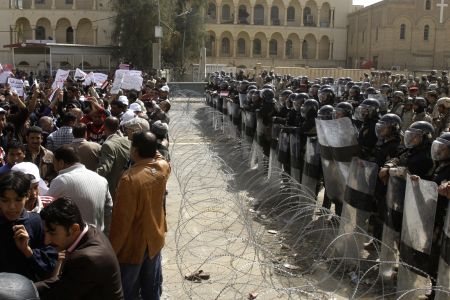 Security forces stand guard as people protest in Baghdad over corruption, unemployment and poor public services.
Thousands of Iraqi protesters have taken to the streets in main cities across the country, demanding economic reform and better living conditions.
Protest rallies over corruption, unemployment and poor government services were held in Baghdad, Basra, Nineveh, Anbar and Salahuddin following the Friday Prayers.
Unlike other demonstrations sweeping the Arab world, Iraqi protesters are seeking reforms, but not regime change.
“We live in a country rich with oil, yet we don’t have jobs,” demonstrators said. “The oil [is] for the people and not for thieves.”
They also chanted “Liar, Liar, Nouri al-Maliki” while carrying banners reading, “Where has the people’s money gone?” and “Yes to democracy and the protection of freedom.”
In the capital, where several thousands of demonstrators have already gathered in the city’s Tahrir (Liberation) Square, authorities have banned traffic across the city, forcing protesters to walk several kilometers to the square.
Iraqi authorities have also deployed thousands of security forces to Baghdad streets and protesters were frisked three times before reaching the square.
There were no reports of clashes between protesters and security forces.
Some Iraqis have named Friday’s rallies as the “Day of Regret,” to mark one year since the parliamentary elections. It took politicians more than nine months to form a new government after the poll on March 7, 2010, and even now, several major positions, including the ministers of interior, defense and planning, are unfilled.
Last week, at least 20 people were killed and more than 130 others were injured after Iraqi security forces attacked protesters.
Four top Iraqi officials, three southern provincial governors and Baghdad’s mayor, resigned following mass protests on February 25.
In response to nationwide protests, Iraqi Prime Minister Maliki called an emergency cabinet meeting on Sunday and gave government ministers a 100-day ultimatum to deliver results and eliminate corruption or face dismissal.
“Mr. Maliki specified a 100-day period after which an assessment of the work of the government and ministries will be carried out to find out the level of their individual success or failure in performing their jobs,” AFP quoted the statement as saying.
The Iraqi premier has also introduced measures to combat graft, cut politician salaries and dedicate more money to providing food for the poor in an attempt to contain protests.
Is entertaining dictators worse than normalizing apartheid?
Nada Elia and Laurie King, The Electronic Intifada, 3 March 2011
As revolutions continue to sweep the Arab world, and the days of dictators seem numbered, we are learning a lot about the ties and alliances that have long characterized the west’s dealing with tyrants around the globe. “Stability,” apparently, requires us to make deals with the devil. And so we discover that the United States has long known about the human rights abuses of deposed Egyptian president Hosni Mubarak, deposed Tunisian president Zine el-Abedine Ben Ali, and Libyan leader Muammar Gaddafi. But it was willing nonetheless not only to turn a blind eye to these, but even to enable and fund, directly or indirectly, oppressive regimes, for the sake of what exactly? Oil? Corporations? The so-called “peace process?” Iraqi “freedom?” Israel’s security?
And as Arab tyrants are challenged, one by one, social media are abuzz with the embarrassing and numerous compliments and kind remarks that western heads of state, academics, pundits, and entertainers have given these deposed dictators. In a typical statement, US Secretary of State Hillary Clinton, for example, said in 2009: “I really consider President and Mrs. Mubarak to be friends of my family.” Apparently, the Clinton-Mubarak friendship goes back about 20 years. Gaddafi’s son Saif al-Islam, a close friend of Prince Andrew, Queen Elizabeth’s second son and fourth in line to the British throne, has been a guest at Windsor Castle and Buckingham palace. The list is long.
But as the people seem determined to overthrow all those oppressive regimes, liberal Americans are openly questioning the wisdom and morality of “dealing with the devil.” In a highly critical segment on Anderson Cooper’s program AC 360, Cooper, a CNN journalist exhibiting an unusual level of courage and integrity among mainstream American media personalities, called out the various US presidents who have welcomed Gaddafi into their diplomatic circles, even as they acknowledged his tendency towards malice and mental instability, best epitomized by Ronald Reagan’s name for him: “the madman of the desert” (KTH: The West and Gadhafi’s regime,” 24 February 2011).
In that same episode, Cooper was critical of American artists Beyonce, Usher, and Mariah Carey, all three of whom gave private performances for the Gaddafis. Carey apparently received one million dollars for performing four songs for the Gaddafis on New Year in 2009. The following year, it was Beyonce and Usher who graced the Libyan dictator’s New Year’s celebration. Cooper asked why artists would perform for tyrants, and suggested that they donate the money they received to the Libyan people.
The news item was quickly picked up by other media. Rolling Stone magazine also ran an article stating that the music industry is lashing out at these artists, and quoting David T. Viecelli, agent for Arcade Fire and many other acts, as saying “Given what we know about Qaddafi and what his rule has been about, you have to willfully turn a blind eye in order to accept that money, and I don’t think it’s ethical” (Industry Lashes Out at Mariah, Beyonce and Others Who Played for Qaddafi’s Family,” 25 February 2011).
Amid all this uproar, Canadian singer Nelly Furtado announced on Twitter that she would donate to charity a one million dollar fee she received to perform for the Gaddafi family in 2007 (“Nelly Furtado to give away $1 million Gaddafi fee,” Reuters, 1 March 2011).
Those of us who have long been engaged in Palestine justice activism cannot help but notice glaring double-standards in these denunciations of the various deals with devils. And at this critical point in the history of the Arab world, we must request that our readers begin to “connect the dots” throughout the region. Is entertaining dictators a lesser crime than normalizing Israeli apartheid?
Why hold artists accountable for performing at the behest of tyrants, and let them off the hook for whitewashing Israel’s regime which engages in massive human rights abuses, all subsidized by the United States government?
Why not call out Beyonce, Usher, Mariah Carey, and so many other artists, all of whom have performed in Israel, a state which practices a form of apartheid worse than anything the South African apartheid government had ever done? In 1973, the United Nations General Assembly defined the crime of Apartheid as “inhuman acts committed for the purpose of establishing and maintaining domination by one racial group of persons over any other racial group of persons and systematically oppressing them.” As Israel’s official policy privileges Jewish nationals over non-Jewish citizens, creating de facto and de jure discrimination against the indigenous Palestinian people, it is hard to dispute that this supposed “democracy” is in reality an apartheid state.
Many of the discriminatory measures Israel practices today were unthought of in apartheid South Africa. In his powerful essay, “Apartheid in the Holy Land,” penned shortly after his return from a visit to the West Bank, Archbishop Desmond Tutu wrote: “I’ve been very deeply distressed in my visit to the Holy Land; it reminded me so much of what happened to us black people in South Africa” (“Apartheid in the Holy Land,” The Guardian, 29 April 2002).
In 2009, a comprehensive study by South Africa’s Human Sciences Research Council confirmed that Israel is practicing both colonialism and apartheid in the occupied Palestinian territories.
That study was inspired by the observations of John Dugard, South African law professor and former UN special rapporteur on human rights in the occupied Palestinian territories, who wrote in 2006: “Israel’s large-scale destruction of Palestinian homes, leveling of agricultural lands, military incursions and targeted assassination of Palestinians far exceeded any similar practices in apartheid South Africa. No wall was ever built to separate blacks and whites.” And no roads were ever built for whites only in South Africa either, while Israel continues to build Jewish-only roads, cutting through the Palestinian landscape.
Israel’s form of apartheid includes the crippling blockade of Gaza; the ongoing seizure of Palestinian land and water sources; construction of the West Bank apartheid wall declared illegal by the International Court of Justice in The Hague; the ongoing ethnic cleansing of Jerusalem; the denial of the rights of Palestinian refugees and discriminatory laws and mounting threats of expulsion against the 1.2 million Palestinians who hold Israeli citizenship.
And as word inevitably gets out, because we are no longer pleading for permission to narrate, but seizing our right to expose these crimes, Israel is hard at work trying to fix its image, without changing the policies and actions that have tarnished that image. As it cements its apartheid policies, Israel is funneling millions of dollars into burnishing its public image as a culturally vibrant, progressive, and thriving democracy.
Among its PR moves is the cultural “Re-Brand” campaign. Israel is intentionally inviting international artists to such “hip” places as Tel Aviv to mask the ugly face of occupation, apartheid, displacement, and dispossession. If we are to hold artists accountable for their choice of performance venues and income sources — as indeed we should — then we should hold them accountable for complicity in normalizing apartheid no less than for entertaining dictators.
In an important article that appeared in The Grio, Lori Adelman also asks: “Why are black pop stars performing at the behest of dictators?” before making the comparison to Sun City, the extravagant whites-only entertainment resort city in apartheid South Africa. And she reminds her readers of the impact of the Artists United Against Apartheid music project, which contributed one million dollars for anti-Apartheid efforts and, most importantly, raised awareness about the global power of artists to influence political discourse on human rights issues (“Why are black pop stars performing at the behest of dictators?,” 24 February 2011).
Today, there is global awareness of Israel’s numerous crimes. And there is a call for artists to boycott Israel, until the country abides by international law. The call was issued in 2005 by the Palestinian Campaign for the Academic and Cultural Boycott of Israel (www.pacbi.org/). In the US, where we live, the campaign is coordinated by the US Campaign for the Academic and Cultural Boycott of Israel. When we learn of an artist who is planning to perform in Tel Aviv, we contact them, inform them of the reality on the ground (should they need such information), and urge them to reconsider and cancel any concerts they may have scheduled. Many have already done so, including the industry’s biggest names: Carlos Santana, Bono, The Pixies, Elvis Costello and Gil Scott-Heron. Folk legend Pete Seeger also recently announced his support for boycotting Israel.
In what may be the most eloquent statement to date, Costello wrote: “One lives in hope that music is more than mere noise, filling up idle time, whether intending to elate or lament. Then there are occasions when merely having your name added to a concert schedule may be interpreted as a political act that resonates more than anything that might be sung and it may be assumed that one has no mind for the suffering of the innocent. … Some will regard all of this an unknowable without personal experience but if these subjects are actually too grave and complex to be addressed in a concert, then it is also quite impossible to simply look the other way” (“It Is After Considerable Contemplation …,” 15 May 2010).
Today, Artists Against Apartheid are still around, and they are active in promoting the boycott of a country that is practicing apartheid in the 21st century, namely Israel. The question should be, then, if artists boycotted Sun City, shouldn’t they also boycott Tel Aviv? Why the outrage when Beyonce entertains Gaddafi, but not when Madonna, Lady Gaga, Rihanna, and so many more, entertain apartheid in Israel?
~
Laurie King, an anthropologist, is co-founder of The Electronic Intifada.
Nada Elia is a member of the Organizing Committee of USACBI, the US Campaign for the Academic and Cultural Boycott of Israel (Facebook).
Ohio Senate Restricts Workers’ Rights
Press TV – March 3, 2011
The Republican-controlled Ohio state Senate has followed Wisconsin in passing controversial legislation that restricts collective bargaining rights by public workers unions.
The Ohio bill was approved on Wednesday in a vote of 17 to 16, with six Republicans joining Democrats in opposing the measure.
“I’ve been saying for weeks that we have the votes to pass this bill. It reflects the diverse interests that our members have around the state of Ohio,” CNN quoted Senate President Tom Niehaus as saying.
The measure, known as Senate Bill 5, would limit a 1983 Ohio State law that grants collective bargaining rights to public employees.
The proposal was amended on Tuesday to include limits on worker’s vacation, new measures to settle workplace arbitration and to cut seniority-based pay hikes.
The modified regulation would restore collective bargaining rights on wages while it bans any kind of strikes by public workers. Ignoring the ban would impose fines and termination of employment contracts.
Meanwhile, demonstrators gathered outside the Senate in Columbus, Ohio and shouted slogans such as “Shame on you!” and “We will remember this,” following the vote.
On Tuesday, protesters occupied Wisconsin’s Capitol for the fifteenth consecutive day in a bid to oppose a similar measure taken by the Republican Governor Scott Walker to reduce employee pay and undermine unions in the state.
Also on Saturday, tens of thousands of people staged rallies in nearly all 50 states, including Washington, New York, California, and Nevada, to express their solidarity with Wisconsin protesters.
Featured Video

Racist Seinfeld Dances for Joy as Bibi Unveils His New Map
or go to
Aletho News Archives – Video-Images
TV Drama Review
Japanese drama projects Japan’s wartime atrocities onto Chinese characters

Global Times | October 25, 2026
By portraying Chinese characters as perpetrators of ruthless violence while casting Japanese Self-Defense Forces (SDF) intelligence operatives as defenders, the season 2 of the Japanese drama Vivant has recently drawn criticism from Chinese netizens, who argue that its depiction turns historical reality on its head while ignoring Japan’s wartime atrocities.
The TBS drama series – a spy suspense story in which an alleged unofficial intelligence unit of the SDF operates across the globe — has attracted a passionate fanbase. Its currently airing season 2 opened with a household rating of 18.8 percent, the highest for a TV drama this year, according toa commentary article by Japanese media Toyo Keizai.
What draws attention is the portrayal of the enemies in the series, the article noted. Scenes in which the Chinese organization subjects kidnapped members of the SDF unit to brutal torture are repeated with unrelenting intensity.
It is rare for Japanese TV dramas to explicitly portray a real-life country as the enemy, the article noted.
Japanese Prime Minister Sanae Takaichi also made a reference to the drama, saying that she has been recording Vivant and hopes to binge-watch it over the year-end and New Year holidays, according to Japanese media outlets.
China’s CCTV News report on Sunday revealed that the drama features scenes in which Chinese personnel cut off the fingers of and stab Japanese intelligence operatives in the abdomen. Such acts bear striking similarities to the torture inflicted on Chinese nationals by invading Japanese troops during the World War II.
The drama distorts the truth by attributing these atrocities to modern Chinese characters. Beneath the surface, it subtly glorifies Japan’s cross-border overseas operations, blurs the functional boundaries of the SDF and implicitly promotes an expansionist narrative, per CCTV News. … continue
Blog Roll
 Aletho News
- Up in arms… Koreans reject U.S. empire’s plan to make South Korea the next Ukraine
- Iran, Turkey, Pakistan, Saudi Arabia could advance region-led security framework in Tehran: FM spox
- Netizens condemn Japanese drama for projecting Japan’s wartime atrocities onto Chinese characters
- Racist Seinfeld Dances for Joy as Bibi Unveils His New Map
- A West Bank War for Netanyahu’s Election Campaign, Could It Backfire?
- Yemen denounces European Parliament’s ‘hypocritical’ push to blacklist Ansarullah
- Qalibaf: UAE’s UN bid aims to ‘clear the runway’ for ‘Greater Israel’, whitewash genocide
- Pakistan reopens Iran border after boosting security: Report
- Why are so many Brazilians voting for Flávio Bolsonaro?
- Democrats Put Anti-Russia Agenda Ahead of American Workers
- If Americans Knew
- An error has occurred; the feed is probably down. Try again later.
- No Tricks Zone
- Sudden Stratospheric Warming, Powerful El Niño Combination May Lead To Extreme Europe Cold, Energy Crisis!
- Two New Studies Find Thwaites Glacier Melt Cannot Be Driven By Human Activity Or A Warming Ocean
- E-Cars Reduce CO2 Emissions By Only 41% Compared To Internal Combustion Engine Vehicles
- Predictions Made By Renowned Climate Professor Over Past Decades Have Been Proven To Be Poor
- New Study Suggests Large Regions Of The Pacific Ocean Have Been Cooling For The Last 80 Years
- Germany’s Green Energy Debacle: High Energy Costs Force Kahla Porzellan to Close After 182 Years!
- New Study: 50 Years Of The Most Aggressive ‘Net Zero’ Policies Can Only Affect The Global Climate By 0.03°C
- US September “Heat” Was No Record…Many Records Set Decades Ago
- Latest European Green Energy Debacle; Portugal’s Largest Flagship Solar Park Insolvent!
- Green Energy Debacle: German Expert Professor Fritz Vahrenholt Warns Of Severe Economic And Social Consequences

