Lies and Truth in Wisconsin
Fact-Checking Gov. Walker
By WALTER M. BRASCH | CounterPunch | March 3, 2011
Historian Thomas Carlyle said “a lie cannot live.” However, Mark Twain casually remarked, “It shows that he did not know how to tell them.”
More than a century later, newly-elected Gov. Scott Walker and the Republican-dominated Wisconsin legislature have proven themselves to be “quick studies,” having learned how to tell whoppers about the working class and unions. Here are just a few.
LIE: The public workers’ pensions are what caused much of the financial crisis not just in Wisconsin but throughout the country. Gov. Walker has repeatedly said, “We’re broke . . . We don’t have any money.”
FACTS: Wisconsin had a $120 million surplus when Walker came into office in January. Had the newly-elected Republican-dominated Legislature in January not given about $140 million in special tax breaks (also known as “corporate welfare”) to business, the state could have had a surplus, according to the Legislative Fiscal Bureau. About two-thirds of all Wisconsin corporations pay no taxes at all, according to the Wisconsin Department of Revenue.
Wisconsin could also save significant expenses by having state-employed fiscal analysts, not Wall Street investment counselors, handle the entire pension investment portfolio. Wisconsin pays about $28 million to state managers to handle about half the portfolio; it pays about $195 million to Wall Street investment brokers to handle the other half, according to the 2010 annual report of the Wisconsin Investment Board… Even with the Wall Street crisis, and lower-than-expected revenue, the Wisconsin pension fund is fully funded, able to meet its obligation for several years, according to the independent PEW Center for the States.
Columnist Robert Greenwald says the “shortfall” would be wiped out if Wisconsin brought home only 151 troops from the war in Afghanistan. If the U.S. left Afghanistan completely, the state would save $1.7 billion, according to Greenwald’s analysis.
LIE: The reason the Republicans throughout the country want to end collective bargaining by the public service unions bargaining is to bring fiscal responsibility to the states.
TRUTH: In January 2010, the Supreme Court by a 5–4 decision along party lines declared that corporations enjoy the protection of the First Amendment. This meant that companies could increase funding and advertising for candidates. As expected, the Chamber of Commerce and corporate America gave vast amounts of money to Republican and conservative candidates; labor donated to liberal and Democratic candidates, who traditionally support the working class. In the 2010 mid-term election, seven of the top 10 donors contributed to conservative and Republican candidates. The other three in the Top 10 were labor political action committees. Eliminating collective bargaining for public sector workers would destroy the union movement and significantly reduce the influence of labor in campaigns. Walker has already shown his colors and intent when he was caught in a radio prank. On Feb. 23, Ian Murphy, editor of The Buffalo Beast, pretended to be billionaire David Koch, a supporter of far-right causes, and a major contributor to Walker’s gubernatorial campaign. Punked by the 20-minute call, Walker seemed to be little more than a sycophant for Big Business. The Republicans’ reaction? Instead of worrying about possible ethics violations by the governor, the Republicans planted a bill into the legislature to criminalize prank phone calls
LIE: The unions are greedy and won’t budge.
FACTS: The 267,000 Wisconsin public sector workers, as well as all elected officials, Democrat and Republican, do pay very little to their pensions. However, the unions have already said they’d be willing to pay a higher contribution, essentially taking an 8 percent pay cut, and negotiate fairly other parts of the contracts. Gov. Walker not only refused to budge on his autocratic stand, he refused to take calls from elected Democrats and bluntly told the Milwaukee Journal, “I don’t have anything to negotiate.”
LIE: Gov. Walker’s proposal affects every union in Wisconsin.
TRUTH: He exempted firefighters and police from his draconian assault upon unions, possibly because he was attempting to get support from the first responders, while mining sympathy from the public. What he didn’t count on was that the firefighters and police unions are firm in their opposition to the abolishment of collective bargaining.
LIE: Gov. Walker says he’s just helping the worker when he argues for elimination of the “dues check-off,” saying the workers would have more disposable income.
TRUTH: Eliminating dues check-off would cripple unions, which would have to rely solely upon voluntary contributions.
MYTH: Gov. Walker enjoys wide-spread support for his stand against the unions.
TRUTH: Walker has been governor less than two months. If the election were repeated, he’d receive only about 45 percent of the vote, according to the independent Public Policy Polling (PPP) of Raleigh, N.C. More important, while only 3 percent of Republicans voted for Tom Barratt, the Democratic candidate in the November election, 10 percent of the Republicans say they’d vote for him in a new election, according to PPP. The Republican governors of Florida, Michigan, Pennsylvania, and Indiana have said they will not follow Walker’s lead, and will support the rights of public workers to bargain collectively. The massive protests in Wisconsin—more than 100,000 in Madison on the same day—and throughout the nation give evidence that Walker doesn’t have the popularity he and his supporters believe. A New York Times/CBS poll, released March 1, indicates only about one-third of the nation supports the campaign against public sector collective bargaining. A week earlier, an independent USA Today/Gallup poll had almost the same results.
LIE: The protestors are unruly, and should be arrested for violating the law.
TRUTH: The First Amendment gives people the right to assemble peacefully. There have been no arrests because there have been no crimes committed by the protestors. Further, when the governor and the Legislature demanded that protestors be thrown out of the state capitol, and not allowed to stay overnight, the chief of the Capitol Police refused to do so, believing the order was a violation of Constitutional rights. In contrast, Walker had actually considered, then rejected, the idea of planting troublemakers among the protestors—a “dirty trick” that dates back to the ’60s.
LIE: Public sector union workers are overpaid.
TRUTH: A USA Today analysis, published March 1, shows that, on average, public service workers, with wages and benefits included, are paid about $2,500 more per year than those in the private sector. In Wisconsin, the difference is only about $1,800. However, government workers usually are “older and substantially better educated than private sector workers,” according to researchers Robert Pollin and Jeffrey Thompson, professors of economics at the University of Massachusetts. But, again contrary to the lies spewed by the anti-worker Rabid Right, individual union workers, when compared to the same criteria as private sector workers, actually earn 4 percent less income, according to the Center for Economic Policy Research. In Wisconsin, public sector union workers actually earn 4.8 percent less total compensation, according to research published in February by the Economic Policy Institute. One statistic stands out. “The average member of AFSCME, our largest public-sector union, earns less than $45,000 a year,” says author/journalist Bill Press, “and retires after a career in public service with a whopping pension of $19,000 per year.”
LIE: Public service union workers are lazier than non-unionized private sector workers.
TRUTH: Strong labor unions generally have higher productivity, according to independent research done by Harley Shalen of the University of California, because there is less turnover, better worker communication, better work conditions, and a better-educated workforce.”
~
Walter Brasch is an award-winning syndicated columnist, author of 17 books, is a former newspaper and magazine writer/editor and tenured full professor of mass communications. You may contact him at walterbrasch@gmail.com.
Bahrainis call for prisoners’ release
Press TV – March 2, 2011
Thousands of Bahraini protesters have gathered outside the building of the interior ministry in the capital, demanding the release of political prisoners.
Chanting anti-government slogans on Wednesday, the protesters in Manama marched to Pearl Square — the epicenter of the movement — demanding the ruling family to step down.
As the popular uprising entered its 17th day in Bahrain, the opposition groups in the Persian Gulf kingdom called for more private and public sector strikes and more rallies to oust the government.
They also urged protesters to block all main roads and take over government buildings to force the Sunni-dominated regime to respond to their demands.
Protesters demand major political reforms, including the establishment of a “real constitutional monarchy,” as well as the resignation of the government, which they hold responsible for the killing of peaceful demonstrators.
Many protesters, mainly Shias, have also called for an end to the rule of Al Khalifa dynasty which has been in power the country for over two centuries.
“230 years is enough, Al Khalifa leave,” read a banner, referring to the Sunni royal family which rules Bahrain.
Meanwhile, many protesters have vowed to continue to camp out in Pearl Square and have refused to enter talks with the government until their demands are met.
Last week, in an attempt to contain massive anti-government demonstrations, Bahrain’s King Hamad bin Isa Al Khalifa pardoned 23 political prisoners and ventured a minor cabinet reshuffle.
But the measures seem not to have been enough for the opposition who say hundreds of political activists are still in Bahraini jails, and for thousands of anti-government protesters who are still out, demanding the ruling family to step down.
Social Crisis in America: Should Public Workers Make Concessions?
By Shamus Cooke | GlobalResearch | March 2, 2011
As workers all over the U.S. become inspired by the massive demonstrations in Wisconsin, a dangerous idea is being voiced by some working-class allies that could unravel it all. The threat lies in the following argument: to protect the bargaining rights of unions, state and city workers must be prepared to make concessions over wages, benefits, etc. This line of reasoning is not only false to the core, it’s suicidal.
Take for example a recent New York Times article on the battle in Wisconsin:
“It is not yet clear whether Gov. Scott Walker of Wisconsin will succeed in his quest to strip public employee unions of most of their bargaining rights. But by simply pressing the issue, he has already won major concessions that would have been unthinkable just a month ago.”
This is extraordinary: The Governor makes a radically anti-union threat, and some union leaders are ready to give him EVERYTHING, just not the kitchen sink.
The article continues:
“Some of Wisconsin’s major public sector unions, faced with what they see as a threat to their existence, have decided to accept concessions that they had been vigorously fighting…translating into a pay cut of around 7 percent…But Mr. Walker is not settling for that. He said that those concessions were “an interesting development, because a week ago they said that’s not acceptable.” (February 28, 2011).
So the anti-union Governor is making the unacceptable acceptable, merely by voicing a threat. If this precedent were established, what future do unions have? Especially when one considers that state budget deficits are projected to continue for years.
Imagine the following scenario: A war is declared by a foreign army and the defending General responds by announcing to the invaders, “I will only fight one battle to preserve this particular parcel of land (bargaining rights), and will wave the white flag over all other territory (wages, benefits, etc.).
Of course the foreign army would conclude “the enemy is already defeated!” And fight without mercy for total victory.
This is the situation in Wisconsin and other states. War has been declared on unions and some labor leaders are pretending that they can offer concessions to appease their attackers. Unfortunately, this strategy has failed for years, and is in fact why the right wing felt confident enough to officially declare war.
Every time unions agree to lower wages and benefits — as they have been doing for years — they weaken themselves internally, thus opening the way for further, deeper attacks. The right-wing attack on bargaining rights did not appear from nowhere; it was the result of years of concessionary bargaining, which inevitably leads to worker demoralization within the union. An army which concedes every battle will be composed of demoralized soldiers.
The union policy of concessionary bargaining is the policy of committing slow suicide, and after years of providing their executioners with nooses, some labor leaders act stunned when their hanging is announced. They believed that they could befriend the hangman, as long as they didn’t create too much trouble by aggressive protesting or well-planned strikes.
But hangmen are hangmen, and they must be treated accordingly.
Labor unions must mobilize the entire community in every state to demand “No Concessions” for all public workers. The fight to save collective bargaining can only be won if workers believe that collective bargaining will save their wages and benefits; the two cannot be separated.
Contrary to what the mainstream media and politicians constantly tells us, the general public would support such a fight. A recent CBS News/New York Times poll found that “Those surveyed said they opposed, 56 percent to 37 percent, cutting the pay or benefits of public employees to reduce deficits.” (March 1, 2011).
The battle in Wisconsin proves that private-sector workers do not hate their public-sector brothers and sisters, they passionately support them.
How can labor unions mobilize the general public towards a pro-worker solution to the state budget deficits? By exposing another media lie: that Americans are against ALL tax increases. In fact, the same pollsters discovered in 2009 that 74 percent of respondents “support higher taxes on the rich.” (April 6, 2009).
Labor unions must place this demand at the head of their campaign to save collective bargaining rights and workers wages and benefits. Workers will be further encouraged to fight for their wages and benefits when they see that there is a solution to the budget crisis.
Rose Ann DeMoro of National Nurses United agrees:
“So it’s time for all of us to say it loud: No More Cuts in Public Sector Pay, Pensions, or Health Benefits; Balance Budgets By Closing Corporate Tax Loopholes, Restoring Fair Share Taxes on Corporations and Wealthy Individuals; Guarantee Retirement Security and Healthcare for All.”
~
Shamus Cooke is a social service worker, trade unionist, and writer for Workers Action (www.workerscompass.org) He can be reached at shamuscooke@gmail.com
http://www.cbsnews.com/8301-503983_162-4923732-503983.html
http://www.globalresearch.ca/index.php?context=va&aid=23457
Egypt: Revisiting the Demands
Global Voices | February 10, 2011

A list of demands from the protesters at Tahrir Square is being circulated online today, the 17th day of massive demonstrations across Egypt calling for the overthrow of the Mubarak regime. The first item calls for the resignation of president Hosni Mubarak.
Wael Khalil lists those demands on his blog (Ar) and says:
These demands are the summary of various discussions at Tahrir Square, and are, of course, not representative of everyone at the square
The immediate demands are:
1. The resignation of president Mohammed Hosni Mubarak
2. Canceling the Emergency Law
3. Dismantling the state secret service
4. An announcement by (Vice-President) Omar Sulieman that he will not run in the next presidential elections
5. Dissolving the Parliament and Shura Council
6. Releasing all the prisoners since January 25
7. Ending the curfew so that life resumes as normal across the country
8. Dismantling the university guards system
9. Referring officials responsible for the use of violence against the peaceful protesters since January 25 and those responsible for the organised thuggery which followed January 28 to an investigation committee
10. Sacking Anas El Fiqi and stopping the attack on protesters in government owned media through threats and calling protesters traitors, and ending the spread of hate against foreigners in the streets
11. Reimbursing shop owners for their losses during the curfew
12. Announcing the demands above on government television and radio
Wael Khalil also lists demands for the transitional period as follows:
1. Drafting a new constitution
2. The right to set up newspapers and open television and radio stations without a prior permission
3. Putting the minimum wage of 1,200 Egyptian Pounds into effect
4. The right to set up political parties, by notification
5. The right to set up associations and unions, by notification
6. Achieving a real autonomy and independence for national newspapers and television and radio stations, through new legislation and the reformation of companies, establishments of ministries
7. Cancling the national service in the police force
8. Ending the security clampdown on telecommunications and the internet
Emphasis – Aletho News
Bahrainis want ‘elected government’
Press TV – February 26, 2011
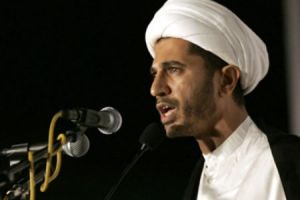 Sheikh Ali Salman of Bahrain’s leading opposition party al-Wefaq
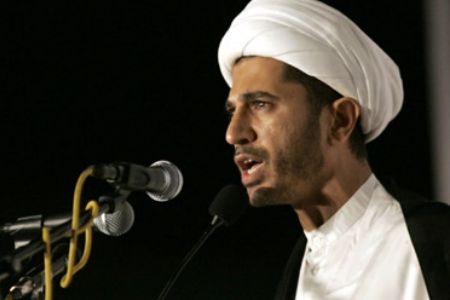
The head of Bahrain’s al-Wefaq party says the opposition only welcomes dialogues that will lead to the establishment of an elected government.
Sheikh Ali Salman told Press TV on Saturday that Bahrainis from all walks of life are calling for a democratic government.
“It’s part of the Arabic revolution. The Arab revolution is looking for a democracy, it’s simple like that. You can’t find it [here],” Salman said.
“There are no clashes between the Sunnis and the Shias,” he continued, “It’s really a clash between the dictatorship… and the people whose demands are a democratic government.”
“What is the meaning of a dialogue if there is no chance for this dialogue to reach a solution?” he added.
“We need from the government not just to say, I am ready for dialogue, but that I am ready to have a dialogue that is leading to an elected government,” Salman stated.
On Saturday, Bahrain’s King Hamad bin Isa Al-Khalifa dismissed the ministers of cabinet affairs, housing, health and electricity amid mass pro-democracy protests in the capital Manama.
The most recent wave of protests is calling for the resignation of the king as well as constitutional reforms. The Bahraini people are demanding free elections and the release of political prisoners as well.
The protesters, who have camped at Manama’s Pearl Square for the 12th straight day, say they will keep rallying until their demands are met.
Bahrain is a key US ally in the Middle East and home to Washington’s Fifth Fleet.
Libya: Is Washington Pushing for Civil War to Justify a US-NATO Military Intervention?
By Mahdi Darius Nazemroaya | Global Research | February 25, 2011
One should be opposed to dictatorship, but one should not forget the issue of foreign domination.
Is Tripoli being set up for a civil war to justify U.S. and NATO military intervention in oil-rich Libya?
Is “manufactured destruction” or “creative destruction” at work?
If Qaddafi is not ousted, are the talks about sanctions a prelude to an Iraq-like intervention?
Something is Rotten in the so-called “Jamahiriya” of Libya
There is no question that Colonel Muammar Al-Gaddafi (Al-Qaddafi) is a dictator. He has been the dictator and so-called “qaid” of Libya for about 42 years. (“UK Hague: some information that Qaddafi on way to Venezuela,” Reuters, February 21, 2011) Yet, it appears that tensions are being ratcheted up and the flames of revolt are being fanned inside Libya. This includes earlier statements by the British Foreign Secretary William Hague that Colonel Qaddafi had fled Libya to Venezuela. This statement served to electrify the revolt against Qaddafi and his regime in Libya.
Although all three have dictatorship in common, Qaddafi’s Libya is quite different from Ben Ali’s Tunisia or Mubarak’s Egypt. The Libyan leadership is not outright subservient to the United States and the European Union. Unlike the cases of Tunisia and Egypt, the relationship that exists between Qaddafi and both the U.S. and E.U. is a modus vivendi. Simply put, Qaddafi is an independent Arab dictator and not a “managed dictator” like Ben Ali and Mubarak.
In Tunisia and Egypt the status quo prevails, the military machine and neo-liberalism remain intact; this works for the interests of the United States and the European Union. In Libya, however, upsetting the established order is a U.S. and E.U. objective.
The U.S. and the E.U. now seek to capitalize on the revolt against Qaddafi and his dictatorship with the hopes of building a far stronger position in Libya than ever before. Weapons are also being brought into Libya from its southern borders to promote revolt. The destabilization of Libya would also have significant implications for North Africa, West Africa, and global energy reserves.
Colonel Qaddafi in Brief Summary
Qaddafi’s rise to power started as a Libyan captain amongst a group of military officers who carried out a coup d’état. The 1969 coup was against the young Libyan monarchy of King Idris Al-Sanusi. Under the monarchy Libya was widely seen as being acquiescent to U.S. and Western European interests.
Although he has no official state or government position, Qaddafi has nurtured and deeply rooted a political culture of cronyism, corruption, and privilege in Libya since the 1969 coup. Added to this is the backdrop of the “cult of personality” that he has also enforced in Libya.
Qaddafi has done everything to portray himself as a hero to the masses, specifically the Arabs and Africans. His military adventures in Chad were also tied to leaving his mark in history and creating a client state by carving up Chad. Qaddafi’s so-called “Green Book” has been forcefully portrayed and venerated as being a great feat in political thought and philosophy. Numerous intellectuals have been forced or bribed to praise it.
Over the years, Colonel Qaddafi has tried to cultivate a romantic figure of himself as a simple man of the people. This includes pretending to live in a tent. He has done everything to make himself stand out. His reprimanding of other Arab dictators, such as King Abdullah of Saudi Arabia, at Arab League meetings have made headlines and have been welcomed by many Arabs. While on state visits he has deliberately surrounded himself with an entourage of female body guards with the intent of getting heads to turn. Moreover, he has also presented himself as a so-called imam or leader of the Muslims and a man of God, lecturing about Islam in and outside of Libya.
Libya is run by a government under Qaddafi’s edicts. Fear and cronyism have been the keys to keeping so-called “order” in Libya amongst officials and citizens alike. Libyans and foreigners alike have been killed and have gone missing for over four decades. The case of Lebanon’s Musa Al-Sadr, the founder of the Amal Movement, is one of the most famous of these cases and has always been a hindrance to Lebanese-Libyan relations. Qaddafi has had a very negative effect in creating and conditioning an entire hierarchy of corrupt officials in Tripoli. Each one looks out for their own interests at the expense of the Libyan people.
Fractions and Tensions inside the Hierarchy of Qaddafi’s Regime
Because of the nature of Qaddafi’s regime in Tripoli, there are a lot of internal tensions in Libya and within the regime structure itself. One of these sets of tensions is between Saif Al-Islam Gaddafi and his father’s circle of older ministers. Libyan ministers are generally divided amongst those that gather around Saif Al-Islam and those that are part of the “old guard.”
There are even tensions between Qaddafi and his sons. In 1999, Mutassim Al-Qaddafi tried to ouster his father while Colonel Qaddafi was outside of Libya. Mutassim Qaddafi holds a Libyan cabinet portfolio as a national security advisor. He is also famously known amongst Libyans for being a playboy who has spent much of his time in Europe and abroad. There is also Khames Gaddafi who runs his own militia of thugs, which are called the Khames militia. He has always been thought of as possible contender for succession too against his other brothers.
There have always been fears in Libya about the issue of succession after Colonel Qaddafi is gone. Over the years, Qaddafi has thoroughly purged Libya of any form of organized opposition to him or prevented anyone else, outside his family, from amassing enough power to challenge his authority.
The Issue of Loyalty and Defection in Libya
Undoubtedly, little loyalty is felt for Qaddafi and his family. It has been fear that has kept Libyans in line. At the level of the Libyan government and the Libyan military it has been both fear and self-interest that has kept officials, good and corrupt alike, in line. That mantle of fear has now been dispelled. Statements and declarations of denunciation against Gaddafi’s regime are being heard from officials, towns, and military barracks across Libya.
Aref Sharif, the head of the Libyan Air Force, has renounced Qaddafi. Interior Minister Abdul Fatah Al-Yunis (Al-Younis), who is from Benghazi (Bengasi) and oversees a branch of the special operations work in Libya, has resigned. Yunis is reported to be Qaddafi’s “number two” or second in charge, but this is incorrect. Abdullah Sanusi, the head of Libyan Internal Intelligence and Qaddafi’s relative through marriage, is the closest thing to a “number two” within the structure of power in Tripoli.
Reports have been made about two Libyan pilots defecting to Malta and Libyan naval vessels refusing to attack Benghazi. Defections are snowballing amongst the military and government. Yet, there must be pause to analyze the situation.
The Libyan Opposition
At this point, however, it must be asked who is the “opposition” in Libya. The opposition is not a monolithic body. The common denominator is the opposition to the rule of Qaddafi and his family. It has to be said that “actions of opposition or resistance against an oppressor” and an “opposition movement” are also two different things. For the most part, the common people and corrupt Libyan officials, who harbour deep-seated hate towards Qaddafi and his family, are now in the same camp, but there are differences.
There is an authentic form of opposition, which is not organized, and a systematic form of opposition, which is either external or led by figures from within the Libyan regime itself. The authentic people’s internal opposition in Libya is not organized and the people’s “actions of opposition” have been spontaneous. Yet, opposition and revolt has been encouraged and prompted from outside Libya through social media networks, international news stations, and events in the rest of the Arab World.
The leadership of the internal opposition that is emerging in Libya is coming from within the regime itself. Corrupt officials that have rebelled against Gaddafi are not the champions of the people. These opposition figures are not opposed to tyranny; they are merely opposed to the rule of Colonel Qaddafi and his family. Aref Sharif and Al-Yunis are themselves Libyan regime figures.
It has to also be considered that some Libyan officials that have turned against Qaddafi are doing it to save themselves, while others in the future will work to retain or strengthen their positions. Abdel Moneim Al-Honi, the Libyan envoy to the Arab League in Cairo, can be looked at as an example. Al-Honi denounced Qaddafi, but it should be noted that he was one of the members of the group of Libyan officers who executed the coup in 1969 with Qaddafi and that later in 1975 he himself tried to take power in a failed coup. After the failed coup, he would flee Libya and only return in 1990 after Qaddafi pardoned him.
Al-Honi is not the only Libyan diplomat to resign. The Libyan ambassador to India has also done the same. There is an intention on the part of these officials to be members of the power structure in a Libya after the ouster of Qaddafi:
Libyan Ambassador to India Ali al-Essawi told the BBC that he was quitting, opposing his government’s violent crackdown on demonstrators.
Mr. Al-Essawi was reported to be a Minister in Tripoli and could be an important figure in an alternative government, in case Libyan President Muammar Qadhafi steps down.
The second Libyan diplomat to put in his papers was Tripoli’s Permanent Representative to the Arab League Abdel Moneim al-Honi, who said in Cairo that he had quit his job to “join the revolution” in his country.
“I have submitted my resignation in protest against the acts of repression and violence against demonstrators, and I am joining the ranks of the revolution,” said Mr. Al-Honi. The Second Secretary Hussein Sadiq al Musrati, announced his resignation from China, in an interview with Al-Jazeera, and called on the Army to intervene in the uprising. (“3 Libyan Diplomats resign,” The Hindu, February 22, 2011)
Again, these revolting officials, like Al-Yunis and Sharif, are from within the regime. They are not mere diplomats, but former ministers. There is also the possibility that these types of “opposition figures” could have or could make arrangements with external powers.
External Forces at Play in Libya
The governments of the U.S., Britain, France, Germany, and Italy all knew very well that Qaddafi was a despot, but this did not stop any of them from making lucrative deals with Tripoli. When the media covers the violence in Libya, they should also ask, where are the weapons being used coming from? The arms sales that the U.S. and the E.U. have made to Libya should be scrutinized. Is this a part of their democracy promotion programs?
Since rapprochement between the U.S. and Libya, the military forces of both countries have moved closer. (James Wolf, “U.S. eyes arms sales to Libya,” Reuters, March 6, 2009) Libya and the U.S. have had military transactions and since rapprochement Tripoli has been very interested in buying U.S. military hardware. In 2009, a Pentagon spokeswoman, Lieutenant-Colonel Hibner, affirmed this relationship best: “[The U.S.] will consider Libyan requests for defen[s]e equipment that enables [Libya] to build capabilities in areas that serve our mutual interest [or synchronized U.S. and Libyan interests].” The qualifier here is U.S. interests, meaning that the Pentagon will only arm Libya on the basis of U.S. interests.
In what seems to have happened overnight, a whole new arsenal of U.S. military hardware has appeared in Libya. American-made F-16 jets, Apache helicopters, and ground vehicles are being used inside Libya by Qaddafi. This is a shocking revelation, if corroborated. There are no public records about some of this U.S. military hardware in the the arsenal of the Libyan military. In regards to the F-16s, Libyan jets are traditionally French-made Mirages and Russian-made MiGs.
Silvio Berlusconi and the Italian government have also been strong supporters of Qaddafi’s regime. There is information coming out of Libya that Italian pilots are also being used by the Libyan Air Force. Mercenaries from Chad, Sudan, Niger, and Nigeria are also being used. This has been verified through video evidence coming out of Libya. The Libyan regime is also considering contracting American or European security firms (mercenaries).
The Politics of Al Jazeera
The Libyan government has shut down the internet and phone lines and an information war is underway. Although one of the most professional news networks in the world, it has to be cautioned that Al Jazeera is not a neutral actor. It is subordinate to the Emir of Qatar and the Qatari government, which is also an autocracy. By picking and choosing what to report, Al Jazeera’s coverage of Libya is biased. This is evident when one studies Al Jazeera’s coverage of Bahrain, which has been restrained due to political ties between the leaders of Bahrain and Qatar.
Reports by Al Jazeera about Libyan jets firing on protesters in Tripoli and the major cities are unverified and questionable. Hereto, the reports that Libyan jets have been attacking people in the streets have not been verified. No visual evidence of the jet attacks has been shown, while visual confirmation about other events have been coming out of Libya.
Al Jazeera is not alone in its biased reporting from Libya. The Saudi media is also relishing the events in Libya. Asharq Al-Awsat is a Saudi-owned paper that is strictly aligned to U.S. interests in the Middle East-North Africa (MENA) region. Its editor-in-chief is now running editorials glorifying the Arab League for their decision to suspend Libya, because of the use of force by Tripoli against Libyans protesters – why were such steps not taken for Egypt, Tunisia, Bahrain, or Yemen? Inside and outside the Arab World, the mainstream media is now creating the conditions for some sort of intervention in Libya.
The Role of Foreign Interests in Libya
Qaddafi and his sons have run Libya like a private estate. They have squandered its wealth and natural resources. One of Gaddafi’s son’s is known to have paid the American singer Beyoncé Knowles a million or more U.S. dollars for a private music concert. (Marine Hyde, “Beyoncé and the $2m gig for Colonel Gaddafi’s son,” The Guardian (U.K.), January 8, 2010) Foreign corporations also play a role in this story.
The positions and actions of foreign corporations, the U.S., and the European Union in regards to Libya should not be ignored.
Questioning the role of foreign governments and corporations in Libya is very important. The Italian and U.S. governments should be questioned about the role that pilots of Italian nationality and newly bought U.S. weaponry are playing in Libya.
It is very clear that democracy is only used as a convenient pretext against dictators and governments that do not bow down and serve U.S. and E.U. interests. All one needs to do is to just look at the way Mutassim Qaddafi was welcomed with open arms in Washington on April 21, 2009 by Hillary Clinton and the Obama Administration. Upon their meeting, Secretary Clinton publicly said:
I am very pleased to welcome Minister Gaddafi to the State Department. We deeply value the relationship between the United States and Libya. We have many opportunities to deepen and broaden our cooperation and I am very much looking forward to building on this relationship. So Mr.Minister welcome so much here.
What the U.S. and the E.U. want to do now is maximize their gain in Libya. Civil war seems to be what Brussels and Washington have in mind.
The Balkanization of Libya and the Push to Civil War
Qaddafi’s son Saif Al-Islam has made statements on Libyan television about deviant Taliban-like faith-based organizations taking over Libya or attempting to take it over. Nothing is further from the truth. He has also warned of doom and civil war. This is part of the Qaddafi family’s efforts to retain power over Libya, but a path towards civil war is unfolding in Libya.
Amongst the ranking members of the military, Mahdi Al-Arab, the deputy chief of Libya’s military staff, was said to have renounced Qaddafi. Al-Arab, however, has modified his position by saying that he does not want to see Libya spiral into a civil war that will allow foreign intervention and tutelage. This is why Al-Arab prevented the people of his city, Zawarah, from joining the revolt and going to nearby Tripoli.
The drive towards civil war in Libya is fuelled by two factors. One is the nature of Qaddafi’s regime. The other is an external desire to divide and weaken Libya.
Qaddafi has always worked to keep Libyans divided. For years there have been fears that Qaddafi’s sons would start a civil war amongst themselves or that some other high ranking officials could try to jockey for power once Qaddafi was gone. Civil war on the basis of ethnicity, regionalism, or tribalism is not a big threat. Tribes and regions could be co-opted or allied with, but the people that would spark a civil war are regime figures. The threats of civil war arise from the rivalries amongst regime officials themselves. Yet, it must be understood that these rivalries are deliberately being encouraged to divide Libya.
The flames of revolt are being fanned inside Libya. Chaos in the Arab World has been viewed as beneficial in many strategic circles in Washington, Tel Aviv, London, and NATO Headquarters. If Libya falls into a state of civil war or becomes balkanized this will benefit the U.S. and the E.U. in the long-term and will have serious geo-political implications.
All the neighbouring states in North Africa would be destabilized by the events in Libya. West Africa and Central Africa would also be destabilized. The tribal boundaries running in Libya and Chad extend into countries like Niger, Algeria, and Sudan. The chaos in Libya would also have a significant effect on Europe and global energy. Already the events in Libya are being used to validate the drive to control the Arctic Circle and its energy resources.
What Will Be Qaddafi’s End?
It is very likely that Qaddafi will not have as fortunate an exit from power as Ben Ali in Tunisia and Mubarak in Egypt. Finding refuge for Qaddafi will not be easy. In general, Qaddafi is considered a liability by other governments. Saudi Arabia, which can be portrayed as a refuge for Arab dictators, will most likely not give Qaddafi refuge. Libya and Saudi Arabia have bad relations. He is also wanted for investigation in Lebanon. Generally, Qaddafi’s relationship with the leaders of the Arab petro-sheikhdoms in the Persian Gulf is tense and negative. He will not be granted refuge anywhere in the Persian Gulf.
In general, Arab governments will also be afraid to host him. In his efforts to present himself as a champion of the people, he has insulted many of his fellow Arab dictators. There is something to be said, however, when Qaddafi’s statements at Arab League meetings or about Palestine and Iraq are far more popular or candid than the rest of the Arab dictators.
It is highly improbable that any Latin American, European, or ex-Soviet countries will give him refuge. A country in sub-Sahara(n) Africa is the mostly likely place Qaddafi could seek refuge.
His options are limited and he is determined to hold on to power. Civil War seems to be looming in the horizon. It is highly unlikely that he will leave Libya peacefully and the U.S. and its allies have no doubt examined this scenario. On February 23-24, 2010, he met with the leaders of the three biggest tribes in Libya (Werfala, Tarhouna, and Wershfana), to secure their support. His own tribe, Qaddafa is supporting him and it seems that the Madarha and Awlad Slieman tribes are also supporting him.
The Threats of NATO Intervention and U.S. and E.U. Control over Libya
Libya has been in the cross-hairs of the Pentagon for years. According to Wesley Clark, the retired general who was the supreme military commander of NATO, Libya was on a Pentagon list of nations to be invaded after Taliban-controlled Afghanistan. The list included Iraq, Somalia, Sudan, Lebanon, Syria, and lastly Iran. In Clark’s own words:
So I came back to see him [a high ranking military officer in the Pentagon] a few weeks later, and by that time we were bombing in Afghanistan. I said, “Are we still going to war with Iraq?” And he said, “Oh, it’s worse than that.” He reached over on his desk. He picked up a piece of paper. And he said, “I just got this down from upstairs” — meaning the Secretary of Defence’s office — “today.” And he said, “This is a memo that describes how we’re going to take out seven countries in five years, starting with Iraq, and then Syria, Lebanon, Libya, Somalia, Sudan and, finishing off, Iran.” (“92 Street Y Exclusive Live Interview,” interview by Amy Goodman, Democracy Now, March 2, 2007)
In one way or another all the nations on the list have been attacked directly or indirectly and all of them, but Syria and Iran, have succumbed to the U.S. and its allies. Again, the only exceptions are Iran and its ally Syria. In Lebanon, the U.S. has made partial gains, but it is now receding with the decline of the Hariri-led March 14 Alliance.
Libya started secret negotiations with Washington in 2001 that materialized into formal rapprochement after the fall of Baghdad to British and American troops in 2003. Yet, the U.S. and its allies have always wanted to expand their influence over the Libyan energy sector and to appropriate Libya’s vast wealth [proceeds of sales]. A civil war provides the best cover for this.
Libyans Must Be Aware of the Pretext of Humanitarian Intervention
The Libyan people should be on their high guards. It is clear that the U.S. and the E.U. are supporting both sides. The U.S. and the E.U. are not the allies of the people of the Arab World. In this regard, the U.S. supports Qaddafi on the ground through military hardware, while it also supports the “opposition.” If the so-called Western governments were serious about democracy, they would have cut their business ties to Libya, specifically in the energy sector, before 2011.
Both Washington and the powers in Brussels could co-opt opposition forces. They have supported Gaddafi, but they do not control him or his regime like they controlled Ben Ali in Tunisia and Mubarak in Egypt. Libya is a very different story. The objectives of Washington and Brussels will be to strengthen their control over Libya either through regime change or civil war.
“Actions of opposition to Gaddafi” are strong, but there is no strong organized “opposition movement.” The two are different. Nor is democracy guaranteed, because of the nature of the coalition opposed to Gaddafi, which includes corrupt regime officials.
There is now talk about a “humanitarian intervention” in Libya, similar to Yugoslavia and Iraq. A “no-fly zone” over Libya has been mentioned, as has NATO military intervention. The aims behind such statements are not humanitarian, but are intended to justify foreign interference, which could potentially lead to an invasion. Should this come to fruition, Libya would become an occupied country. Its resources would be plundered and its assets privatized and controlled by foreign corporations as in the case of Iraq [more to the point, as with Iraq, a steadfast source of support for Palestine would be neutralized].
Today, in Libya and the Arab World the ghosts of Omar Mukhtar and Saladin are still very much alive and active. Getting rid of Gaddafi and his sons alone is not the solution. The entire corrupt system of governance in Libya and the culture of political corruption must be dismantled. At the same time, however, foreign interference or domination should also not be allowed to take root in Libya. If the Libyan people are mobilized and steadfast, they can fight such schemes.
‘Mad as Hell’ in Madison
By Ralph Nader | February 25, 2011
The large demonstrations at the state Capitol in Madison, Wisconsin are driven by a middle class awakening to the spectre of its destruction by the corporate reactionaries and their toady Governor Scott Walker.
For years the middle class has watched the plutocrats stomp on the poor while listening to the two parties regale the great middle class, but never mentioning the tens of millions of poor Americans. And for years, the middle class was shrinking due significantly to corporate globalization shipping good-paying jobs overseas to repressive dictatorships like China. It took Governor Walker’s legislative proposal to do away with most collective bargaining rights for most public employee unions to jolt people to hit the streets.
Republicans take rigged elections awash in corporatist campaign cash seriously. When they win, they aggressively move their corporate agenda, unlike the wishy-washy Democrats who flutter weakly after a victory. Republicans mean business. A ram rod wins against a straw all the time.
Governor Walker won his election, along with other Republicans in Wisconsin, on mass-media driven Tea Party rhetoric. His platform was deceitful enough to get the endorsement of the police, and firefighters unions, which the latter have now indignantly withdrawn.
These unions should have known better. The Walker Republicans were following the Reagan playbook. The air traffic controllers union endorsed Reagan in 1980. The next year he fired 12,000 of them during a labor dispute. (This made flying unnecessarily dangerous.)
Then Reagan pushed for tax cuts—primarily for the wealthy—which led to larger deficits to turn the screws on programs benefiting the people. Reagan, though years earlier opposed to corporate welfare, not only maintained these taxpayer subsidies but created a government deficit, over eight years, that was double that of all the accumulated deficits from George Washington to Jimmy Carter.
Maybe the unions that endorsed Walker will soon realize that not even being a “Reagan Democrat” will save them from being losers under the boot of the corporate supremacists.
The rumble of the people in Madison illustrates the following:
1. There is an ideological plan driving these corporatists. They create “useful crisis” and then hammer the unorganized people to benefit the wealthy classes. Governor Walker last year gave $140 million in tax breaks to corporations which produced the $137 million deficit for this fiscal year. Note this oft-repeated dynamic. President Obama caved to the Minority party Republicans in Congress last December by going along with the deficit-deepening extension of the huge dollar volume tax cuts for the rich. Now the Republicans want drastic cuts in programs that help the poor.
2. Whatever non-union or private union workers, who are giving ground or losing jobs, think of the sometimes better pay and benefits of unionized public employees, they need to close ranks without giving up their opposition to government waste. For corporate lobbyists and their corporate governments are going after all collective bargaining rights for all workers and they want to further weaken The National Labor Relations Board.
3. Whenever corporations and government want to cut workers’ incomes, the corporate tax abatements, bloated contracts, handouts and bailouts should be pulled into the public debate. What should go first?
4. For the public university students in these rallies, they might ponder their own tuition bills and high interest loans, compared to students in Western Europe, and question why they have to bear the burden of massive corporate welfare payouts—foodstamps for the rich. What should go first?
5. The bigger picture should be part of the more localized dispute. Governor Walker also wants weaker safety and environmental regulations, bargain-basement sell-outs of state public power plants and other taxpayer assets.
6. The mega-billionaire Koch brothers are in the news. They are bankrolling politicians and rump advocacy groups and funding media campaigns in Wisconsin and all over the country. Koch Industries designs and builds facilities for the natural gas industry. Neither the company nor the brothers like the publicity they deserve to get every time their role is exposed. Always put the spotlight on the backroom boys.
7. Focusing on the larger struggle between the people and the plutocracy should be part and parcel of every march, demonstration or any other kind of mass mobilization. The signs at the Madison rallies make the point, to wit—“2/3 of Wisconsin Corporations Pay No Taxes,” “Why Should Public Workers Pay For Wall Street’s Mess?”, “Corporate Greed Did the Deed.”
8. Look how little energy it took for these tens of thousands of people to sound the national alarm for hard-pressed Americans. Just showing up is democracy’s barn raiser. This should persuade people that a big start for a better America can begin with a little effort and a well-attended rally. Imagine what even more civic energy could produce!
Showing up lets people feel their potential power to subordinate corporatism to the sovereignty of the people. After all, the Constitution’s preamble begins with “We the People,” not “We the Corporations.” In fact, the founders never put the word “corporation” or “company” in our constitution which was designed for real people.
As for Governor Walker’s projected two-year $3.6 billion deficit, read what Jon Peacock of the respected nonprofit Wisconsin Budget Project writes at: http://www.wisconsinbudgetproject.org about how to handle the state budget without adopting the draconian measures now before the legislature.
Bahrain and the “Freedom Contagion”
By RANNIE AMIRI | CounterPunch | February 25, 2011
“Saudi Arabia did not build a causeway to Bahrain just so that Saudis could party on weekends. It was designed for moments like this, for keeping Bahrain under control.”
– Dr. Toby Jones, expert on Saudi Arabia at Rutgers University
If Saudi Arabia was rattled by the fall of former Egyptian President Hosni Mubarak, they will be in convulsions should Bahrain’s monarchy collapse. By all indications, the five other member nations of the Gulf Cooperation Council (GCC) (Kuwait, Oman, Qatar, Saudi Arabia and United Arab Emirates) will go to all lengths to prevent it.
The Arab world’s “freedom contagion” is rapidly spreading. Bahrain’s revolt is being spearheaded by the country’s poor, disenfranchised Shia Muslim majority. Although Mubarak was deposed by a nation of 80 million, unrest in the tiny island kingdom of only 530,000 citizens poses a greater ostensible threat to the GCC, particularly Saudi Arabia and its own sizable, restive Shia minority.
While many turned to the Qatar-based Al-Jazeera television network for coverage of the Tunisian, Egyptian—and now Libyan—revolutions, scant coverage was accorded to Bahrain, even when unarmed, peaceful protestors were being gunned down on the streets of the capital just a day after sleeping protestors in Pearl Square were savagely attacked by the regime’s security forces.
Should other Shia, like those in Saudi Arabia’s oil-rich Eastern Province (where they form a majority), become “infected” with the idea of taking to the streets to peacefully demand political reforms and representation, civil rights, and freedom of religion and assembly, other citizens might do likewise.
This explains why King Abdullah, who returned from Morocco on Wednesday after a prolonged 3-month convalescence from back surgery, announced he will lavish $37 billion in benefits on Saudis in the form of pay raises, unemployment benefits, debt forgiveness and housing subsidies.
Among those who first greeted Abdullah upon his arrival was the very one counting on the aging Saudi monarch for the survival of his regime—Bahrain’s king, Sheikh Hamad bin Isa al-Khalifa. In a bid to placate Bahraini Shias, Sheikh Hamad released 100 political prisoners from Manama’s prisons prior to leaving for Riyadh, including the 25 activists charged last year with plotting against the state.
Saudi Arabia has sustained resource-poor Bahrain with a steady cash inflow for years and it wasted no time in issuing a statement saying it would stand by the monarchy “with all capabilities.” It had always justified doing so by framing Bahrain as an alleged bulwark against perceived encroaching Iranian influence, but today it is to help insulate Saudi Arabia from experiencing similar events along its eastern border and beyond. The emir of Kuwait added that “the security of Bahrain is the security of the region.” Last Tuesday, as tanks were rolling into Pearl Square, GCC foreign ministers met in Manama to reaffirm their solidarity with al-Khalifa rule.
Exactly one week later, Bahrain witnessed the largest anti-regime protests to be staged since the revolt began: 100,000 people strong—one-fifth of all nationals—turned out in massive, peaceful demonstrations along the highway leading into Pearl Square.
“This is the first time in the history of Bahrain that the majority of people, of Bahraini people, got together with one message: this regime must fall,” said one.
As the al-Khalifa regime’s brutality escalated, so did protestors’ demands. Initially it was for Khalifa bin Salman al-Khalifa, the king’s uncle and four-decade-old prime minister, to step down. Then came calls for Bahrain to transform itself into a legitimate constitutional monarchy. Now, many say the monarchy itself must be abolished.
So how influential has Bahrain’s uprising been?
Small protests have broken out in Saudi Arabia’s Eastern Province. Saudi troops have already starting heading that way.
~
Rannie Amiri is an independent Middle East commentator.
Madison Wisconsin Budget Protest Movement
cinderbelle319 | February 19, 2011
I don’t feel that national news has been giving accurate coverage of the rallies in Madison, WI, so I’m here to tell you what people are REALLY protesting about. Hint: it’s not about pay-cuts.
Here’s the Legislative Fiscal Bureau Memo:
http://legis.wisconsin.gov/lfb/Misc/2…
Source for the $140 Million in tax breaks:
http://www.onewisconsinnow.org/press/…
And if you think that’s not bad enough, consider this: 2/3 of corporations in WI don’t pay any taxes AT ALL. Where do YOU think the money should be coming from?
http://www.huffingtonpost.com/2011/02…
Israel Philharmonic Orchestra to be Met with Protest in the U.S
By Ramona M. – IMEMC & Agencies – February 21, 2011
According to Adalah-NY, performances by the Israel Philharmonic Orchestra (IPO) will be met with protests in six of the seven cities where it is scheduled to appear during its U.S tour, during February and March.
Human rights advocates plan to protest the IPO’s role in whitewashing Israel’s apartheid policies against the Palestinian people. The protests will be held in West Palm Beach, New York City, Newark, Seattle, San Francisco and Los Angeles.
Those involved in organizing the events are heeding the call by Palestinian civil society to boycott institutions that work to normalize Israel’s occupation of Palestinian territories.
The growing international movement for Boycott, Divestment and Sanctions (BDS) against Israel has gained momentum in recent years with more supporters worldwide, and performers like Elvis Costello, Gil Scott-Heron, Roger Waters, Devendra Banhart, and the Pixies all refusing to play in Israel.
By serving as cultural ambassadors for Israel, the Israel Philharmonic Orchestra is supporting the Israeli government’s “Brand Israel” initiative, a campaign by Israel’s Ministry of Foreign Affairs to divert public attention from Israel’s oppression of the Palestinian people.
The IPO refrains from criticism of Israel’s policies and is described by the American Friends of the Israel Philharmonic Orchestra as “Israel’s finest cultural emissary.” American Friends of the IPO further notes that “the goodwill created by [the IPO’s] tours…is of enormous value to the State of Israel. As a result, the Israel Philharmonic Orchestra maintains its position at the forefront of cultural diplomacy and the international music scene.”
One corporate sponsor of the IPO’s US tour is Israeli billionaire Lev Leviev, who hosted a gala fundraiser last November for the IPO tour at his New York jewelry store. The IPO partners with Leviev, whose companies have built illegal Israeli settlements in the occupied West Bank and have been involved in human rights abuses in the diamond industry in Southern Africa.
Leviev’s companies have been openly criticized by UNICEF, CARE, Oxfam, the British and Norwegian government, Hollywood stars and international investment firms because of these activities.
In 2004, Palestinian civil society, led by the Palestinian Campaign for the Academic and Cultural Boycott of Israel (PACBI), called on colleagues in the international community to boycott Israeli academic and cultural institutions until Israel respects Palestinians’ basic rights. A year later, the Palestinian call for Boycott, Divestment and Sanctions against Israel was endorsed by over 170 Palestinian civil society groups. The Palestinian BDS movement is a nonviolent campaign for Palestinian rights inspired by the international boycott campaign that helped to abolish apartheid in South Africa.
The following are the scheduled dates and locations for the protests:
February 22, New York, NY, Carnegie Hall, 5:30 PM – 7:15 PM, Adalah-NY
February 23, Newark, NJ, New Jersey Performing Arts Center, 6:30 PM – 7:30 PM, Adalah-NY & People’s Organization for Progress (POP)
February 26, Seattle, WA, Benaroya Hall, 7:15 PM – 8:15 PM, Palestine Solidarity Committee – Seattle
February 27, San Francisco, CA, Davies Symphony Hall, 6 PM, Queers Undermining Israeli Terrorism (QUIT!)
March 1, Los Angeles, CA, Walt Disney Concert Hall, 6:30 PM – 8 PM, BDS-LA
Palestinian Refugees, Supporters Protest Canada Park
Palestinian, Israeli and international activists gathered in front of the Representative Office of Canada to the Palestinian Authority in Ramallah and the Embassy of Canada to Israel in Tel Aviv for protest vigils on Monday (21/2) organized by the Committee for the Defense of the Rights of the Latrun Villages.
A Memorandum to the Representative of Canada to the Palestinian Authority in Ramallah and the Ambassador of Canada in Tel Aviv respectively was submitted, protesting on behalf of families of the Latrun villages, who were forcibly expelled from their villages in the 1967 war by the criminal action of ethnic cleansing, classified as a crime against humanity under international law.
Canada Park, built in cooperation with the Jewish National Fund, now occupies the site of the villages of Imwas, Yalo and Bayt Nuba, which were were completely destroyed in 1967. Their residents are now refugees in the West Bank and Jordan.
“Canada Park was planted and funded with the support of the Jewish National Fund of Canada over the lands and over the ruins of three ethnically-cleansed villages: Imwas, Yalu and Beit Nuba, occupied and ethnically cleansed in the course and the wake of the 1967 war,” Dr. Uri Davis told the Alternative Information Center (AIC) outside the Canadian Embassy.
“The ethnic cleansing was perpetrated by the Israeli army, not the JNF, but the JNF is complicit in this crime against humanity by veiling and covering up the crime, planting the Canada Park over the lands and over the ruins, and presenting itself as an environmentally-friendly organization concerned with public will and recreational welfare of all citizens of Israel.”
Participants carried banners reading:
“CANADA PARK IS COMPLICIT WITH A CRIME AGAINST HUMANITY PERPETRATED IN OUR VILLAGES,” “WE DEMAND THAT THE GOVERNMENT OF CANADA RECOGNIZE AND ACT TO IMPLEMENT THE RIGHTS OF THE PEOPLE OF THE LATRUN VILLAGES,”
and,
“WE DEMAND THE NULLIFICATION OF THE LEGAL STATUS OF THE JEWISH NATIONAL FUND (JNF) IN CANADA.”
The village defense committee has repeated requested that the Representative Office of Canada to the Palestinian Authority in Ramallah meet with the Ambassador of Canada to Israel in Ramallah and together tour the Latrun area and the visiting the remains of the destroyed villages over whose ruins the Jewish National Fund (JNF) has planted “Canada Park.”
“Most representatives of the destroyed Latrun villages are not able to come to Tel Aviv to meet the Ambassador, it is our request that the Ambassador arrive in Ramallah, meet the people concerned and with a delegation of the destroyed, ethnically cleansed villages, visit Canada Park and submit an official report of his fact-finding to his government,” Dr. Davis said.
He continued saying, “Canada Park represents a blatant violation of international law, but it also represents a blatant violation of official Canadian policy condemning any intervention of settlement or occupation or change of demographic composition or any other alteration in the 1967 occupied territories.”
Featured Video

Racist Seinfeld Dances for Joy as Bibi Unveils His New Map
or go to
Aletho News Archives – Video-Images
TV Drama Review
Japanese drama projects Japan’s wartime atrocities onto Chinese characters

Global Times | October 25, 2026
By portraying Chinese characters as perpetrators of ruthless violence while casting Japanese Self-Defense Forces (SDF) intelligence operatives as defenders, the season 2 of the Japanese drama Vivant has recently drawn criticism from Chinese netizens, who argue that its depiction turns historical reality on its head while ignoring Japan’s wartime atrocities.
The TBS drama series – a spy suspense story in which an alleged unofficial intelligence unit of the SDF operates across the globe — has attracted a passionate fanbase. Its currently airing season 2 opened with a household rating of 18.8 percent, the highest for a TV drama this year, according toa commentary article by Japanese media Toyo Keizai.
What draws attention is the portrayal of the enemies in the series, the article noted. Scenes in which the Chinese organization subjects kidnapped members of the SDF unit to brutal torture are repeated with unrelenting intensity.
It is rare for Japanese TV dramas to explicitly portray a real-life country as the enemy, the article noted.
Japanese Prime Minister Sanae Takaichi also made a reference to the drama, saying that she has been recording Vivant and hopes to binge-watch it over the year-end and New Year holidays, according to Japanese media outlets.
China’s CCTV News report on Sunday revealed that the drama features scenes in which Chinese personnel cut off the fingers of and stab Japanese intelligence operatives in the abdomen. Such acts bear striking similarities to the torture inflicted on Chinese nationals by invading Japanese troops during the World War II.
The drama distorts the truth by attributing these atrocities to modern Chinese characters. Beneath the surface, it subtly glorifies Japan’s cross-border overseas operations, blurs the functional boundaries of the SDF and implicitly promotes an expansionist narrative, per CCTV News. … continue
Blog Roll
 Aletho News
- Up in arms… Koreans reject U.S. empire’s plan to make South Korea the next Ukraine
- Iran, Turkey, Pakistan, Saudi Arabia could advance region-led security framework in Tehran: FM spox
- Netizens condemn Japanese drama for projecting Japan’s wartime atrocities onto Chinese characters
- Racist Seinfeld Dances for Joy as Bibi Unveils His New Map
- A West Bank War for Netanyahu’s Election Campaign, Could It Backfire?
- Yemen denounces European Parliament’s ‘hypocritical’ push to blacklist Ansarullah
- Qalibaf: UAE’s UN bid aims to ‘clear the runway’ for ‘Greater Israel’, whitewash genocide
- Pakistan reopens Iran border after boosting security: Report
- Why are so many Brazilians voting for Flávio Bolsonaro?
- Democrats Put Anti-Russia Agenda Ahead of American Workers
- If Americans Knew
- An error has occurred; the feed is probably down. Try again later.
- No Tricks Zone
- Sudden Stratospheric Warming, Powerful El Niño Combination May Lead To Extreme Europe Cold, Energy Crisis!
- Two New Studies Find Thwaites Glacier Melt Cannot Be Driven By Human Activity Or A Warming Ocean
- E-Cars Reduce CO2 Emissions By Only 41% Compared To Internal Combustion Engine Vehicles
- Predictions Made By Renowned Climate Professor Over Past Decades Have Been Proven To Be Poor
- New Study Suggests Large Regions Of The Pacific Ocean Have Been Cooling For The Last 80 Years
- Germany’s Green Energy Debacle: High Energy Costs Force Kahla Porzellan to Close After 182 Years!
- New Study: 50 Years Of The Most Aggressive ‘Net Zero’ Policies Can Only Affect The Global Climate By 0.03°C
- US September “Heat” Was No Record…Many Records Set Decades Ago
- Latest European Green Energy Debacle; Portugal’s Largest Flagship Solar Park Insolvent!
- Green Energy Debacle: German Expert Professor Fritz Vahrenholt Warns Of Severe Economic And Social Consequences

