Bethlehemite lives in cave to save land from confiscation
31/01/2010
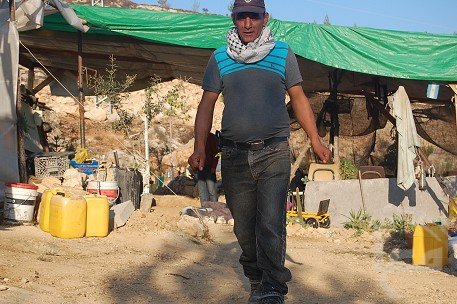
Bethlehem – Ma’an – Abdul-Fattah Abed Rabbo has lived in a cave adjacent to his agricultural land for the last ten years, in the village of Walaja, west of Bethlehem, to protect his land from being annexed by nearby Israeli settlements.
The Popular Committee for Resisting Settlements and the Separation Wall visited Abed Rabbo in his cave to offer their support to him and all Palestinians faced with land confiscation.
Coordinator for the committee, Awad Abu Swayy, described Abed Rabbo as an example to be followed, pointing out that he refused significant financial offers made by Israeli settlement agencies wanting to buy his land.
Abu Swayy said that the popular committee would try to erect a sit-in tent near the cave to host international solidarity activists and a tin roofed gallery which will be connected to the nearest water network.
The committee will also organize regular visits by international activists and Palestinian Authority officials, Abu Swayy said.
In December, coordinator of the popular committee in Nablus, Arafat Abu Ras, visited Abed Rabbo along with international human rights activists and journalists.
Our Last Port Is Freedom
Sending a Flotilla in the Spring to Break the Siege of Gaza
By Free Gaza Team | 28 January 2010
 [Istanbul, Turkey] Today the Free Gaza Movement and the Turkish Relief Foundation (IHH), announce a joint venture, sending 10 boats in the spring of 2010 to the besieged Gaza strip. Organizations from Greece, Ireland and Sweden have also promised to send boats to join the flotilla with the Free Gaza movement and Turkey.
Mr. Bulent Yildirim, chairman of the IHH said, “We sail in the spring to Gaza, and our last port is freedom; freedom for the 1.5 million Palestinians denied the right to rebuild their society. We will never stop sailing until Israel’s siege is lifted.”
Two cargo ships will be part of the flotilla, one donated by the Malaysia-based Perdana Foundation and one from IHH. Both will be laden with building supplies, generators and educational materials that Israel prohibits from entering Gaza since their brutal attack on the civilian population a year ago.
The many passenger boats accompanying the cargo ships will carry members of Parliament from countries around the world as well as high-profile journalists and human rights workers.
According to the chair of the Free Gaza Movement, Huwaida Arraf, “The illegal blockade on Gaza and Israel’s continued intransigence make a mockery of international law. If our governments will not take a stance to stop Israel’s abuse of the Palestinian people, global civil society is showing that we will.”
Since 1992, the Turkish Relief Foundation (IHH) has provided humanitarian assistance to civilians who have been victims of war or natural disasters all over the world. One of IHH’s main objectives is to take necessary steps to prevent any violations against civilian basic rights and liberties. IHH aims at providing relief help so communities can resume their daily life and stand on their own feet, as well as strengthening leadership and institutions of communities that have been made dependent on aid. http://www.ihh.org.tr
Press release available also in Arabic, Spanish, French and Italian, other translations available soon.
Contact:
* IHH, Ahmet Emin +90 530 341 19 34
* Free Gaza Movement, Eliza Ernshire +44 754 011 22 94
Village children gassed while taking refuge from military
International Solidarity Movement | 29 January 2010
Over 20 village residents – including 14 children – were targeted by Israeli soldiers in a volley of tear gas and rubber coated bullets as they took refuge in the Tamimi family house in An Nabi Salih. The residents were not part of the weekly demonstration and children from surrounding houses had gathered there for safety. One boy was hit in the stomach with a gas canister. Five people, children and elderly women, were taken away in ambulances and treated for injuries including tear gas asphyxiation.
Earlier, near 12:30PM, Israeli soldiers blocked the non-violent demonstration as they attempted to reach a spring recently taken by settlers from the near-by Jewish-only Hallamish settlement. Demonstrators slowly advanced a few meters and sat down. Israeli and international activists joined in solidarity. This tactic was repeated many times until soldiers began firing tear gas canisters directly at the demonstrators. As soldiers surrounded the village, shooting tear gas from three sides, a water cannon shooting foul smelling waste-water was deployed.
Just after the water cannon emptied its tanks, the Tamimi house was fired on.
As tear gas canisters and rubber-coated bullets flew through windows of the house, Red Crescent and activist volunteers responded to the attack, helping women and children outside to safety. In all, nine women, one man and 14 children were caught inside during the attack.
The same house was targeted one week ago when tear gas and sound grenades broke through the windows. Seven people were gassed but no injuries were serious. As the women and children exited the house, soldiers told them to go back in. They refused due to large amounts of tear gas lingering inside and the soldiers hit them. One woman was arrested.
This brutal repression of a non-violent demonstration and targeting innocent bystanders comes as the Israeli government attempts to squash the popular resistance through illegitimate arrests and disproportionate force.
According to one An Nabi Salih resident, the demonstration’s goal was to reach a spring taken by Israeli settlers, but the over all motivation for ongoing demonstrations is to stop the constant advance of the Hallamish settlement onto Palestinian land. Residents say that since 1977 the settlement has taken half of the village’s farm-land, burning or cutting down trees tended by the village for generations.
Approximately six weeks ago, a group of Halamish settlers took over the spring located in privately owned Palestinian land in between the village and the settlement. Since then, and despite the fact that ownership of the land undisputed, the army began preventing Palestinians from accessing the area.
Bilin grassroots leader Mohammed Khatib arrested in late-night raid
Press release, Popular Struggle Coordination Committee, 28 January 2010
The following edited press release was issued today by the Popular Struggle Coordination Committee:
 |
Mohammed Khatib (Tadamon!) |
BILIN, occupied West Bank – At 1:45am today, Mohammed Khatib, his wife Lamia and their four young children were woken up by Israeli soldiers storming their home, which was surrounded by a large military force. Once inside the house, the soldiers arrested Khatib, conducted a quick search and left the house.
Roughly half an hour after leaving the house, five military jeeps surrounded the house again, and six soldiers forced their way into the house, where Khatib’s children sat in terror. The forces conducted another very thorough search of the premises, without showing a search warrant. During the search, Khatib’s phone and many documents were seized, including papers from Bilin’s legal procedures in the Israel high court.
The soldiers exited an hour and a half later, leaving a note saying that documents suspected as “incitement materials” were seized. International activists who tried to enter the house to be with the family during the search were aggressively denied entry.
Mohammed Khatib was previously arrested during the ongoing wave of arrests and repression on 3 August 2009 with charges of incitement and stone throwing. After two weeks of detention, a military judge ruled that evidence against him was falsified and ordered his release, after it was proven that Khatib was abroad at the time the army alleged he was photographed throwing stones during a demonstration.
Khatib’s arrest today is the most severe escalation in a recent wave of repression again the Palestinian popular struggle and its leadership. Khatib is the 35th resident of Bilin to be arrested on suspicions related to anti-wall protest since 23 June 2009.
The recent wave of arrests is largely an assault on the members of the Popular Committees — the leadership of the popular struggle — who are then charged with incitement when arrested. The charge of incitement, defined under Israeli military law as “an attempt, whether verbally or otherwise, to influence public opinion in the area in a way that may disturb the public peace or public order,” is a cynical attempt to punish grassroots organizing with a hefty charge and lengthy imprisonment. Such indictments are part of the army’s strategy of using legal persecution as a means to quash the popular movement.
Similar raids have also been conducted in the village of al-Maasara, south of Bethlehem, and in the village of Nilin — where 110 residents have been arrested over the last year and half — as well as in the cities of Nablus, Ramallah and East Jerusalem.
Among those arrested in the recent campaign are three members of the Nilin Popular Committee, Said Yakin of the Palestinian National Committee Against the Wall, and five members of the Bilin Popular Committee — all suspected of incitement.
Prominent grassroots activists Jamal Juma’ (East Jerusalem) and Mohammed Othman (Jayyous) of the Stop the Wall nongovernmental organization, involved in anti-wall and boycott, divestment and sanctions campaigning, have recently been released from detention after being incarcerated for long periods based on secret evidence and with no charges brought against them.
Brethren Church Leader Deported from Israel
By Kawther Salam • Jan 27th, 2010
In early January 2010, On Earth Peace, an agency of the Church of the Brethren reported that the executive director Bob Gross was detained and deported by Israeli authorities when he arrived at the Tel Aviv airport as part of a Christian peacemaking delegation meant to build connections with Israelis and Palestinians who are working for a non-violent resolution to their conflict.
The deportation of Mr. Gross is not the first and it will not be the last. It also has nothing to do with terrorism or the security of Israel, but it has to do with the daily crimes of genocide committed by the Israeli occupation against the Palestinians in their own homeland, cities, towns and villages in the West Bank. It is all about the crimes which the Israeli occupation does not want the international delegations to see or to report about.
Mr. Gross stated in an interview which he gave to me by Email that he had previously visited Palestine and Israel on April 2002, November 2004, January 2006, and January 2008.
 According to on Earth Peace report, the deportation of the executive director of On Earth Peace is part of a pattern of excluding from Israel any visitor who seeks peace and security for both Palestine and Israel. This has the effect of blocking peacemaking efforts by churches and other groups, and sets back the hopes of a constructive Middle East peace.
The full text of an interview with Director Bob Gross is below.
Q: Had you ever visited Palestine and Israel before?
Gross: Four times before, April 2002, November 2004, January 2006, January 2008.
Each time I was with a Christian Peacemaker Teams delegation. In 2004, 2006, and 2008, I was the delegation leader. In those trips, we were in Jerusalem, East Jerusalem, Hebron, Bethlehem, and the South Hebron Hills. We met with Israeli, Palestinian and international peacemakers, and with Palestinian families, as well as one Israeli couple.
Q: Would you describe your trip since you were stopped by the Israeli customs officer and until your deportation?

Gross: I probably would not have been stopped at passport control, except that I was travelling with my colleague, who was to co-lead the delegation with me. Her name is not Alice Bartlett, but she has asked that her real name not be used so that any publicity about this trip will not affect her later efforts to travel in the Middle East. She is Egyptian-American, and has an Egyptian last name. For this reason alone, she and I were stopped and asked to wait for questioning rather than being allowed to enter Israel.
We were made to wait in a room in the arrival hall of the Tel Aviv airport, and we were each questioned separately for 5-10 minutes. Then we waited for an hour or so, then my colleague was questioned again for about 30 minutes.
Later they took us to find our checked bags, and searched both our checked and carry-on bags very thoroughly, and searched us with very close body searches (with clothes on).
After 9.5 hours, they called my colleague in and told her they were not going to allow her into Israel, and would ban her for 10 years. A few minutes later they called me in, and asked me for names of my Palestinian and Israeli contacts. I would not give them any names. They also said that I would need to sign a paper saying that I would not enter the “Palestinian territories” while in Israel. I did not sign this paper. So they denied entry for me also, with a 10-year ban. They took photographs and electronic fingerprints of each of us, and took us to gather our bags to wait for being moved to the jail. However, it was another two hours — 12 hours in all — before they took us to the jail.
Q: How did they treat you? How was the comportment of the israeli officers in general and towards you?
Gross: They treated us OK. They were not harsh and did not mistreat us, but they exercised complete control and authority, treating us sometimes as if we were a nuisance, sometimes as if we were dangerous, sometimes as if we were dishonest.
Q: How many hours did the Israelis “investigate” you?
Gross: 9.5 before deciding to deport us.
Q: What kind of questions did they ask you?
Gross: Always the first question was, “What is the purpose of your visit to Israel?”
We answered that question truthfully, but briefly, and they seemed to know there was more we were not saying.
I was asked where I had travelled in Israel/Palestine on my earlier visit, and what I did. As I said above, in the last interrogation they asked for my contacts names and information.
I don’t know all of the questions my colleague was asked, because we never had a chance to talk about what we each had been asked without being overheard, so we did not talk about that while we were being held.
Q: Which was the silliest question, and what did you answer?
Gross: Maybe it was when they said I should give them the names of some of my contacts in Israel and Palestine, so they could call them and ask whether I should be trusted.
Q: How did you spend your night at the Israeli airport jail?
Gross: I was in the cell from 5 pm to 5 am. There was one other prisoner there, also being deported. He was Muslim, from Morocco, and had lived and worked in the Netherlands for many years. He was denied entry simply because of who he was, it seemed.
We talked some, and I slept some in the evening, since I had spent two nights on air-planes by that time, and was tired. They brought us some kind of sandwich and tea for supper. As it happened, my cell-mate snored very loudly, and so it was hard to sleep that night. I slept only a little, and then got up and prepared to leave. Just walked back and forth, looked out the windows, sat on the bed, and waited.
Q: Would you explain me your feelings during your stay in jail?
Gross: I was concerned for my colleague, who was in a different cell, and so I could not talk with her. I was relieved to be out of the waiting and to know what their decision was, even though it was for deportation.
Q: How many people do you think were illegally jailed in Israel at the same time with you?
Gross: One additional person was brought in after midnight, so there were three of us in my cell, and there was one person in the cell with my friend. I don’t know how many others.
Q: Did you sign any papers during the investigation, or before your deportation? What did you sign exactly? What was the justification given by the Israelis for your deportation?
Gross: I don’t remember signing anything.
Q: Which was your reaction when they notified you of your deportation? What did you say or ask?
Gross: I was not surprised, and I did not ask anything. I was not willing to agree to their terms, and so I knew they would not allow me in.
Q: What is your message for Israel after this tragic deportation?
Gross: Israel will not be made secure by expelling persons who seek peace and security for both Palestine and Israel.
Livni, Barak ‘Wanted for War Crimes’ in Poland
|

Chavez writes off Haiti’s oil debt to Venezuela
Irish Sun | 26th January, 2010
Caracas (IANS/EFE) President Hugo Chavez has announced that he will write off the undisclosed sum Haiti owes Venezuela for oil as part of a regional bloc’s plans to help the impoverished Caribbean nation after the devastating Jan 12 earthquake.
‘Haiti has no debt with Venezuela, just the opposite: Venezuela has a historical debt with that nation, with that people for whom we feel not pity but rather admiration, and we share their faith, their hope,’ Chavez said after the extraordinary meeting of foreign ministers of the Bolivarian Alliance for the Americas, or ALBA.
He also announced that ALBA has decided on a comprehensive plan that includes an immediate donation of $20 million to Haiti’s health sector, and a fund that, Chavez said, will be at least $100 million ‘for starters’.
Oil-rich Venezuela is the economic heart of ALBA, which also includes Cuba, Bolivia, Ecuador, Nicaragua, Dominica, Antigua and Barbuda, and St. Vincent and the Grenadines. Haiti is among several countries that send observers to ALBA meetings.
Chavez said one part of ALBA assistance to Haiti would consist of fuel distribution via ‘mobile service stations’ set to be up and running within a few weeks.
The ALBA plan of aid for Haiti includes support for such sectors as agriculture, production, food imports and distribution, and immigration amnesty for Haitians living illegally in the bloc’s member-states.
Cuba and Venezuela sent assistance and aid workers to Haiti within days of the magnitude-7.0 temblor that left over 100,000 dead and 1.5 million people homeless.
Danish pension funds divest from Israeli companies
27/01/2010
Bethlehem – Ma’an – Two Danish pension funds announced on Tuesday their decision to divest from two Israeli companies implicated in the construction of Israel’s illegal wall and settlements inside the West Bank, a statement issued by the Stop the Wall Campaign said.
Danske Bank, the biggest financial group in Denmark, has excluded Elbit Systems and Africa Israel from its investment portfolio because of their involvement in providing equipment for the wall and in settlement construction.
Thomas H. Kjaergaard, responsible for socially responsible investment in the Danish Bank Group commented: “We handle clients’ interests, and we do not want to put customers’ money in companies that violate international standards.”
PKA Ltd., one of the largest funds administrating workers’ pension funds in Denmark, announced it would no longer consider investments in Elbit Systems, and US companies Megal Security Systems and Detection Systems.” All three are supplying equipment for the Wall. PKA has sold shares in Elbit worth almost one million dollars,” Stop the Wall wrote.
“The ICJ [International Court of Justice, the Hague] stated that the barrier only serves military purposes and violates Palestinian human rights. Therefore we have looked at whether companies produce custom-designed products to the wall and thus has a particular involvement in repressive activities. We cannot rule out the inclusion of other companies in our blacklist for their role in this area,” said Michael Nellemann, investment director of PKA, in the statement.
Viva Palestina Malaysia In Boycott Israel Walkabout
KUALA LUMPUR, Jan 24 (Bernama) — More than 100 members of Viva Palestina Malaysia (VPM), a coalition of NGOs, on Sunday participated in a walkabout for about five kilometres here in support of the efforts towards creating a free and independent state of Palestine.
The walkabout, held at Jalan Changkat Haji Abang Openg here, saw the participants wearing white T-shirts bearing the words “Boikot Israel” (Boycott Israel) as part of a campaign to boycott the products of four multinational companies alleged to be strong supporters of the Zionist regime.
VPM chairman Datuk Adnan Mohd Tahir said the walkabout was the third in the series of the VPM “Boikot Israel” programme, the first having been held in August last year at Menara Dewan Bandaraya Kuala Lumpur (DBKL) and the second in November at the Sunway Pyramid in Selangor.
VPM, formerly known as the Coalition of Malaysian NGOs Against Persecution of Palestinians (Complete), was set up on Jan 5 last year grouping 50 NGOs.
Larijani: Iran proud to support the Palestinian and Lebanese resistance
20/01/2010

TEHRAN, (PIC)– Speaker of the Iranian parliament Ali Larijani on Tuesday expressed his country’s pride to support resistance movements in the region including the Lebanese resistance and the Movement of Hamas, stressing that the resistance became the only option to confront the occupation after the failure of peace projects.
These remarks came during a conference dubbed “Gaza, the symbol of resistance” which was organized by the association for the defense of the Palestinian people and attended by a representative of Hamas and Iranian officials.
According to the reporter of the Palestinian information center (PIC), Larijani stated in his speech that the resistance achieved tangible results in the 33-day war in Lebanon and the war on the Gaza Strip and announced that the Iranian parliament agreed January 19 to be marked annually as “Gaza day.”
The Iranian speaker recalled how the US and some European countries stood by Israel and provided it with all kinds of support and prevented many countries on many occasions from raising the issue of the Israeli military aggression on Gaza in the UN.
“During 22 days, no one talked about human rights and humanity, although we have seen the advent of the new US president who declared that he would make several changes in the policies of America and that he did not accept the practices of his predecessors,” the speaker underscored.
“And during the war, the Zionist entity killed more than 1,400 Palestinians, wounded more than five thousands, murdered large numbers of Palestinian children and turned Gaza into a scorched land, but all this was of no importance to Obama who preferred to be preoccupied with choosing a dog for his daughters,” he added.
Speaking about the visit of US president Barack Obama to Turkey and Egypt, the speaker said, “Obama told the Turkish parliament that he wanted to restore the Muslims’ rights and to adopt a new approach in dealing with them, and then traveled to Cairo and said there he knew about Islam and wanted to restore Palestinian rights, but it was shameful that he did nothing during this period, while Gaza is still besieged.”
Israel withholding NGO employees’ work permits
Amira Hass | Ha’aretz | 20 January 2010
The Interior Ministry has stopped granting work permits to foreign nationals working in most international nongovernmental organizations operating in the Palestinian territories, including East Jerusalem, Haaretz has learned.
In an apparent overhaul of regulations that have been in place since 1967, the ministry is now granting the NGO employees tourist visas only, which bar them from working.
Organizations affected by the apparent policy change include Oxfam, Save the Children, Doctors Without Borders, Terre des Hommes, Handicap International and the Religious Society of Friends (a Quaker organization).
Until recently, the workers would register with the international relations department at the Social Affairs Ministry, which would recommend the Interior Ministry to issue them B1 work permits. Although the foreign nationals are still required to approach the Social Affairs Ministry to receive recommendations to obtain a tourist visa, the Interior Ministry is aiming to make the Ministry of Defense responsible for those international NGOs and also requiring them to register with the coordinator of government activities in the territories (COGAT), which is subordinate to the Ministry of Defense.
Foreign nationals working for NGOs had understood they would receive a stamp or handwritten note alongside their tourist visa, permitting them to work “in the Palestinian Authority.” Israel is refusing work visas to most foreign nationals who state that they wish to work within the Palestinian territories, such as foreign lecturers for Palestinian universities and businessmen.
Israel does not recognize Palestinian Authority rule in East Jerusalem or in Area C, which comprises some 60 percent of the West Bank. The NGO workers say they’ve come to believe that the new policy is intended to force them to close their Jerusalem offices and relocate to West Bank cities. This move would prevent them from working among the Palestinian population of East Jerusalem, defined by the international community as occupied territory.
The organizations fear the new policy will impede their ability to work in Area C, whether because Israel doesn’t see it as part of the Palestinian Authority or because they will eventually be subjected to the restrictions of movement imposed on the Palestinians. Such restrictions include the prohibition to enter East Jerusalem and Gaza via Israel, except with specific and rarely obtained permits; and prohibition to enter areas west of the separation fence, except for village residents who hold special residency permits and Israeli citizens.
One NGO worker told Haaretz that the policy was reminiscent of the travel constraints imposed by Burmese authorities on humanitarian organizations, albeit presented in a subtler manner.
NGO workers told Haaretz that they had been informed by the COGAT official that a policy change was forthcoming, as early as July 2009. When a number of them approached the Interior Ministry in August to renew their visas, they found that their applications had been submitted to a “special committee.” They were not told who constituted this committee, and had to make do with a “receipt” confirming that they had submitted the request. The workers said the tourist visas they received differed from each other in duration and travel limitations, and surmised from this that the policy has not been entirely fleshed out.
Latest in a series of steps
A number of NGO workers who spoke with Haaretz voiced deep apprehensions about having to submit to the authority of the Defense Ministry. The groups are committed to the Red Cross code of ethics, and therefore see being subjugated to the ministry directly in charge of the occupation as problematic and contradictory to the very essence of their work.
Between 140 and 150 NGOs operate among the Palestinian population. Haaretz could not obtain the exact number of foreign nationals they employ.
The new limitations do not apply to the 12 organizations that have been active in the West Bank prior to 1967. Those groups, which include the Red Cross and several Christian organizations, were registered with the Jordanian authorities.
The new move by the Interior Ministry is the latest in a series of steps taken in the last few years to constrain the movement of foreign nationals in the West Bank and Gaza, including Palestinians with family and property in the occupied territories. Most of those who have been effected are nationals of countries with which Israel has diplomatic relations, especially Western states. Israel does not apply any similar constraints on citizens of the same countries traveling within Israel and West Bank settlements.
The Interior Ministry said in a statement that the only relevant authority empowered to approve the stay of foreign citizens in the Palestinian Authority is the coordinator of government activities in the territories. “The Interior Ministry is entrusted with granting visas and work permits within the State of Israel. Those staying within both the boundaries of Israel and the Palestinian Authority are required to secure their permits accordingly,” the ministry said.
“Recently, a question was raised on the issue of visas granted to those staying in the Palestinian Authority and in Israel, as it transpired that they spend most of their time in the PA despite having been provided with Israeli work permits,” the statement continued. “The matter is under intense discussions, with the active participation of the relevant military authorities, with a view to finding the right and appropriate solution as soon as possible.”
The Carlos Santana “Concert of Shame”
January 10, 2010
The Zionist daily newspaper Yedioth Ahronoth reported that Israeli producer Shuki Weiss has booked the world famous Mexican born rock musician and guitarist Carlos Santana to perform at the Blumfield Stadium in Jaffa, Israel this coming June.
Carlos Santana was born in Autlán de Navarro, Jalisco, Mexico but was raised in Tijuana, Baja California. Carlos Santana presently lives across the San Francisco Golden Gate Bridge in Marin County. He is considered one of the world’s greatest musicians and was named “The Greatest Guitarists of All Time” by Rolling Stone. He is also a Grammy Award-winning performer
 |
Palestinian child burried in the rubble after Israeli bombing strike |
Carlos Santana is in addition a very well known humanitarian and active advocate for children’s rights. He is the founder and principal supporter of the Milagro Foundation that benefits underserved and vulnerable children around the world by making grants to community based tax-exempt organizations that work with children in the areas of education, health and the arts. Milagro means “miracle” says its website at http://www.milagrofoundation.org/ . It adds, “The image of children as divine miracles of light and hope, even as gifts to our lives, is the meaning of the name.”
Apparently Carlos Santana is not aware that Zionist Israel massacred over 300 innocent Palestinian children in a brutal military attack on the Gaza Strip about a year ago and is now planning to murder more through starvation and bombs. We believe that if Carlos Santana knew the facts, he would not be entertaining these Zionist war criminals.
Latino human rights organizations are calling for Carlos Santana to cancel his “Concert of Shame” scheduled for June in Zionist Israel. His representative may be contacted through e-mail at:
fanmail@santana.com
or
tourinfo@santana.com
or through:
The Milagro Foundation
P.O. Box 9125
San Rafael, CA 94912-9125
Ph. 415-460-9939
Fx. 415-460-6802
info@milagrofoundation.org
or through Michael Jensen of Jensen Communications at:
info@jensencom.com
or through:
Creative Artists Agency
9830 Wilshire Boulevard
Beverly Hills, CA 90212 USA
Tel: 310-288-4545
Fax: 310-288-4795
Featured Video

AIDS Inc. by Gary Null (2007)
or go to
Aletho News Archives – Video-Images
From the Archives
Clash of Civilization, Iran Part II
By Jamal Kanj – Intifada-Palestine.com – January 14, 2011
Israel’s survival kit is: perpetuate conflict, insecurity to rationalize collective hate and finally playing victim.
Devoid of conflict, Israel implodes internally; without hate, Zionism loses its justification; and playing eternal victim to continue blackmailing the West. Absence of this holy trinity, Israel ceases to exist.
From its inception, the house of Zion has mastered exploiting adversarial powers to advance Israel’s cause. For instance, their influence over the Democratic Party in the US began with President Truman’s bid for 2nd term election in 1948.
Responding to strong opposition from Secretary of State General George Marshall and Department experts urging against recognition of Israel, President Truman replied: “I’m sorry gentlemen but I have to answer to hundreds of thousands [Jewish voters] who are anxious for the success of Zionism. I do not have hundreds of thousands of [voting] Arabs among my constituents”
Zionists influence over liberal American politics was matched with the doctrinal school of Conservative theoreticians aligning the Republican Party’s platform with Israel’s objectives. The Neoconservative Zionists, coined Zioncons, invented the “Clash of Civilization” concept to fight Israel’s wars. … continue
Blog Roll
 Aletho News
- Mauritius denies landing permit to flight from Israel, forcing cancellation: Tour operator
- Israeli finance minister calls for genocidal war on West Bank, annexation of south Lebanon
- 12 Things Your Psychiatrist Was Trained Not to Tell You
- From Unipolar Universalism to Multipolar Civilizational Distinctiveness
- RSF military group defects, joins Sudanese army: State media
- Ireland goalkeeper refuses to play ‘Israel’ as squad weighs boycott
- China pushes back against US on Cuba, Iran
- Ukrainian Soldiers, Potential Mercenaries: Have Gun, Will Travel!
- Burnham’s UN debut… A masterclass in British disinformation
- Iran flights continue despite US aviation sanctions
- If Americans Knew
- Israel forces Gazans to live in constant peril – Daily Update
- Deconstructing Netanyahu’s pants-on-fire UN rant – Daily Update
- Trump betrayed voters with his campaign lies and prioritized a foreign country once he took office
- Netanyahu calls Israel’s war in Gaza ‘opposite of genocide’ in UN speech to near-empty hall
- Settler Kidnappings: Torture, Sexual Abuse and Terrorisation of Palestinian Abductees as Israel Deepens Annexation of West Bank
- Gaza winter nears as 162,000 tents become unusable, raising fears of humanitarian crisis
- Netanyahu says, “It’s the opposite of genocide”; UN says Gaza economy is world’s ‘most severe crisis on record’ – Daily Update
- Israel’s US-Backed Assault on Gaza Has Created the ‘World’s Most Severe Economic Crisis on Record’: UN
- ‘Protecting U.S. Citizens’… From Israel
- ‘This is where I live now, the back of a truck’: a day in the life of a grandmother in Gaza
- No Tricks Zone
- New Study: Earth And Venus Surface Warmth Largely Explained By Convection And Lapse Rate, Not CO2 Or Radiation
- 2025 Nature Paper Claiming Worsening Global Drought Gets RETRACTED …Heavily Flawed
- New Study: ‘Global Drought Shows No Detectable Recent Acceleration Under Climate Warming’
- Economic Masterminds: German Socialists Suggest Taxing Productivity Gains Stemming From Using AI
- The South China Sea Has Not Been Cooperating With The Climate Change Narrative
- Energy Crisis: Germany Enters Heating Season With Historically Low Gas Reserve Fill Levels
- New Study: The Antarctic Ice Sheet Gained Mass From 2020-2024 Due To Staggering Snow And Ice Accumulation
- Study: Ocean Heating Rates From Thousands Of Years Ago ‘Dwarf’ Modern Ocean Heating Rates
- Climate Extremists Target, Attack Large-Scale Power Grid Infrastructure In Germany!
- New Study: Antarctic Ice Melt Has Contributed Less Than 1 Centimeter To Sea Level Rise In The Last 30 Years

