Justin Trudeau, Enough Disinformation! Canadians Do Support BDS!
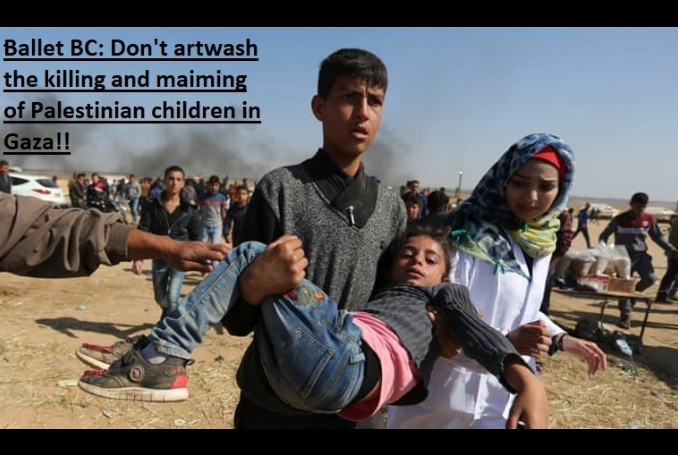
The Canadian BDS Coalition sent an Open Letter to the Government of Canada, regarding their involvement in the upcoming CanaDanse Festival in Israel. (Photo: via Social Media)
By Marion Kawas – Palestine Chronicle – January 28, 2019
On January 15, 2019, Canadian PM Justin Trudeau further embellished his “trash talk” on BDS by responding to a questioner at a town hall meeting with announcing he will “continue to condemn the BDS movement”. The prime minister also repeated the claim that BDS is “anti-Semitic” and alleged that Jewish students are fearful and targeted on campuses “because of their religion” due to BDS-linked intimidation.
Trudeau is now fully exposed to all, especially those who might have been previously swayed by his slick image and marketing; the lines are clear, if you support Palestinian rights, you can no longer pretend that Trudeau is anything but a continuation of the Stephen Harper legacy.
He does not represent the majority of people in Canada on BDS or Palestine, or on any indigenous issues for that matter. A national survey done almost two years ago in Canada as to how people felt about boycotts found that seventy-eight percent of Canadians said they believe the Palestinians’ call for a boycott is “reasonable”. The disconnect by Trudeau and his government on this issue is intentional and politically motivated. His collaboration with the Zionist lobby is well-documented but let’s suffice by saying that none other than Gilan Erdan, the Israeli BDS-busting cabinet minister, personally congratulated Trudeau on his most recent condemnations of BDS.
Against this backdrop, you might think that BDS activism in Canada would suffer a setback. Not so! In the last 3 months, activists in Vancouver and across the country have been engaged in a campaign against 3 different ballet companies, as well as several levels of government, that were involved in the CanaDanse Festival in Israel.
The initiators of the campaign, BDS Vancouver, were truly inspired by the immediate and overwhelming public reaction and the sense of outrage at the involvement of Ballet BC (and the other participants/sponsors) in this art-washing of Israeli war crimes. It clearly showed that people both within Canada (and globally as the campaign spread) are more than ready to embrace BDS and have strong feelings about why Israeli government policies require sanctions from all sectors of society, both institutional and civic.
The first focal point of the campaign was the petition to Ballet BC, which has now gotten more than 10,300 signatures. However, the campaign went far beyond just the petition and emphasized gathering support from activist groups across Canada as well as from within Israel itself (Boycott from Within). It also included leafleting Ballet BC performances, and extensive outreach through social media and other avenues.
Why did Ballet BC make this first ever trip to perform in Israel? Why now, with all the horrific things happening on the ground? Was it just part of the increasing moves by the Israeli government to emphasize cultural ties to whitewash its image?
Curiously, Ballet BC lists 11 choreographers for its 2018-19 season, and 4 of those 11 are Israeli, with 3 of them citing strong ties with the Israeli Batsheva dance company on their public profiles. Batsheva has a long history of flaunting the BDS call and is often touted as a cultural ambassador for Israel.
Activists were also shocked to find that the Israeli consulate in Canada back in May 2017 was a sponsor for one of Ballet BC’s performances by Ohad Naharin, probably the best known of the 4 mentioned choreographers. They had hoped that Naharin, who recently stepped down as Artistic Director at Batsheva after 30 years, might seize this moment and this change of company to act upon his professed support for Palestinians. They were disappointed.
As they were disappointed by the Georgia Straight, Vancouver’s leading “progressive” newspaper and also one of Ballet BC’s most ardent media supporters. Despite many attempts to contact Georgia Straight with press releases and other information, the paper never covered the campaign calling out Ballet BC for performing in Israel. In contrast, one of the 2 corporate media sponsors of Ballet BC, City (CityNews ), ran an extensive article early in the campaign presenting both the activists’ demands and Ballet BC’s response. Given the Georgia Straight’s history as an “anti-establishment alternative to Vancouver’s conservative daily newspapers”, and some good coverage in the past of Palestinian events, activists were baffled (and still are) as to why this story was so “off bounds”.
Despite the herculean efforts of the Israeli government to tarnish and smear the Boycott, Divestment and Sanctions movement as “racist and divisive”, even “terrorist”, BDS campaigns continue to increase in popularity with an expanding breadth of support. And the Ballet BC campaign is just one example of that. The more the Israeli government rants about BDS, the more it seems to grow in strength. 2018 was a pivotal year in exposing the brutality of the Israeli government towards Palestinians, especially in the Great Return March, and we may have reached a watershed moment for BDS that can only intensify.
– Marion Kawas is a member of the Canada Palestine Association and co-host of Voice of Palestine. Visit: www.cpavancouver.org.
Gerd Büntzly, Crime Fighter

Photo by John LaForge: International youth group blockades one of three main gates to Buchel Air Force in Germany, July 2018.
By John Laforge | CounterPunch | January 25, 2019
Hamburg, Germany – I was with Gerd Büntzly, 69, of Herford, in a demonstration in Germany July 17, 2017. So were Steve Baggarly, Susan Crane, and Bonnie Urfer, all of the United States. Ours was a peaceful if covert, night-time occupation of a protected aircraft shelter or bomb bunker far inside the Büchel Air Force Base, near the beautiful Mosel River valley.
We were there to help prevent the unlawful use of the shelter in nuclear attacks or nuclear war preparations. Routine nuclear war planning by US and German Air Force personnel there, using US B61 nuclear bombs (NATO’s so-called “nuclear sharing”), violates the Treaty on the Nonproliferation of Nuclear Weapons (NPT) and several other international treaties, all binding on the United States and Germany.
In spite of our formal complaint to state prosecutors against “selective prosecution” of Gerd, and the violation of his “equal protection” rights, only he was charged, tried, and convicted of trespass and property damage (for clipping fences) in January last year. This Jan. 16, he was in court again appealing the conviction. Susan Crane from California and I travelled to Koblenz to speak on his behalf. Attorneys were quite sure that we two could testify, but ultimately were not allowed.
We wanted to explain that international law has the force of state and federal law in Germany and the United States, a fact recognized by Germany’s Constitution (Art. 25) and the US Constitution (Art. 6). According to Univ. of Illinois Law School Prof. Francis Boyle, writing recently for other nuclear weapons resisters, “International law is not ‘higher’ or separate law; it is part and parcel of the structure of federal law. The Supreme Court so held in the landmark decision in The Paquete Habana (1900), that was recently reaffirmed in Hamdan v. Rumsfeld, in 2006.”
Contrary to modern military strategists, there is no such thing as a “limited nuclear war.” Nuclear weapons only produce massacres. Beginning with 8 to 10 million degrees at detonation, followed by indiscriminate mass destruction from blast effects, city-size mass fires (firestorms) in which nothing survives, and uncontrollable radiation poisoning that produces genetic damage unlimited by space or time, nuclear weapons are just massacre delivery systems.
International law has prohibited the planning and not just the commission of such massacres since 1946.
Professor Boyle wrote last November 1st: “The Judgment of the Nuremberg International Military Tribunal meted out severe punishment in 1946 against individuals who, acting in full compliance with domestic law but in disregard of the limitations of international law, had committed war crimes and crimes against peace as defined in its Charter.”
The Nuremberg Charter and Principles apply to individual civilians like us and oblige individuals to disobey domestic laws that protect government crimes. And Nuremberg prohibits all “planning and preparation” of wars that violate international treaties.
The 1949 Geneva Conventions prohibit indiscriminate attacks on noncombatants, attacks on neutral states, and long-term damage to the environment. The 1907 Hague Conventions forbid the use of poison and poisoned weapons under any circumstances.
Under the 1970 NPT, it is prohibited for Germany to receive nuclear weapons from the United States and for the US to transfer them to Germany. Germany and the United States are both formal state parties to all of these Treaties.
“By implication,” Boyle explains, “the Nuremberg Judgment privileges all citizens of nations engaged in war crimes to act in a measured but effective way to prevent the continuing commission of those crimes. The same Nuremberg Privilege is recognized in Article 38 of the Statute of the International Court of Justice which has been adopted as a Treaty (the United Nations Charter) by the United States” [and Germany]. In my opinion, such action certainly includes nonviolent exposure and inspection of sites of ongoing war crimes.”
Because nuclear weapons cannot be used without violating these binding international treaties; since Germany and United States at Büchel are planning and preparing war that violates these treaties; and because the Nuremberg Charter and Principles forbid this planning and preparation, and apply to civilians and military personnel alike, and hold citizens individually responsible; and require citizens to disobey illegal orders, to refuse participation in or ignore international crimes, civil resistance at Büchel is no offense but a civic duty, a lawful obligation, and an act of crime prevention.
In the courtroom, crowded with 40 people, the three-person “bench” (two lay volunteers and one criminal court judge) found Gerd guilty — but reduced his fine from 1,200 Euros to 750 — after making a yawning apology for “deterrence.” Prescient as ever, Professor Boyle’s latest book is, “The Criminality of Nuclear Deterrence” (Clarity Press 2013).
John LaForge is a Co-director of Nukewatch, a peace and environmental justice group in Wisconsin, and edits its newsletter.
Civilians storm & burn Turkish military base in northern Iraq

RT | January 26, 2019
A mob of angry civilians has attacked a Turkish military camp near the Iraqi city of Dohuk, burning equipment and vehicles. The incident comes in response to the deaths of civilians during Turkish airstrikes, local media reports.
The incident occurred in northern Iraq on Saturday, when a large mob of civilians attacked a Turkish military encampment located in the predominantly-Kurdish region of Dohuk.
Footage from the scene which surfaced online shows civilians at the military encampment with Turkish military vehicles and tents burning in the background. At least one person died and 10 were reportedly wounded during the incident. It remains unclear if the Turkish Army sustained any casualties – servicemen are nowhere to be seen in the footage.
According to local media, the attack on the encampment came in protest to Turkish airstrikes and shelling, which have repeatedly hit the vicinity of Dohuk. Earlier on Saturday, at least two civilians were reportedly killed in an airstrike and the incident at the base might have been prompted by the attack.
The incident was acknowledged by the Turkish Defense Ministry, which blamed it on activities of the outlawed Kurdistan Workers’ Party (PKK), which Ankara considers to be a terrorist group. The Turkish military, however, did not confirm that it was the encampment in Dohuk that was attacked.

“An attack has occurred on one of [the] bases located in northern Iraq as a result of provocation by the PKK terrorist organization. There was partial damage to vehicles and equipment during the attack,” the ministry tweeted, adding that it has been “taking necessary measures” regarding the incident.

Malaysia’s Decision to Bar Israeli Athletes Was Much Needed
By Yousef Aljamal | Palestine Chronicle | January 22, 2019
Malaysia has historically been a strong supporter of the Palestinian people who experienced and continue to experience colonization, military occupation and many forms of discrimination for over 100 years.
In fact, it has always been Malaysia’s policy to support the Palestinian people, who have suffered immensely due to the ongoing Zionist colonization project in Palestine, which resulted in establishing Israel on the ruins of Palestinian homes.
Support for Palestine has been expressed under different Malaysian governments, most notably under the administrations of Tun Dr. Mahathir Mohamad, who has always been vocal in his criticism of Israel’s discriminatory and militant policies.
Palestine has always enjoyed the support of ordinary Malaysians, who exhibited their strong solidarity, often in emotional ways, during times of Israeli wars on the Gaza Strip in 2008-9, 2012 and 2014.
Islam and its shared values among Palestinians and Malaysians have always played a big part in the existing rapport between both nations.
However, due to existing ethnic tensions in the country, solidarity with the Palestinian people, has, at times, seemed confined to the Malay Muslim community.
While such a truth remains paramount, perspectives began to change in recent years, as Chinese and Indian communities developed a keener understanding of the situation in Palestine. Therefore, seeing Chinese and Indian activists at the forefront of Palestine solidarity in Malaysia is no longer a rare event. A reason behind this important shift is the fact that the approach of solidarity itself evolved from a religious-based appeal to a human-rights based one.
The year 2015 saw the first Boycott, Divestment and Sanctions (BDS) conference in the country, held at the University of Malaya, where the importance of boycott as a political tool for change was stressed and thoroughly discussed.
It would not be an exaggeration to say that a radical shift started on that very date. More Malaysians engaged with the BDS movement then, launching campaigns against HP, G4S and other international companies involved in facilitating Israel’s occupation of Palestine.
Therefore, the decision by Prime Minister, Mahathir Mohamad, to ban Israeli athletes is a rational step in that direction.
Last year, Malaysians voted in historical elections that changed their government to what many Malaysians hoped would be in the best interests of their country. The move by the Malaysian government to ban Israeli athletes from participating in an international sports event set to be held in the city of Kuching this year is a representation of this momentous change.
The elections, many hope, would decrease ethnic tensions and bring more justice to all Malaysians.
Palestinians have been suffering under Israeli colonization and military occupation for more than 70 years. Despite massive Palestinian political and territorial compromises, Israel gave up nothing. For example, the Palestine Liberation Organization (PLO) has conceded 78% of historic Palestine in return for peace, which never actualized. To the contrary, the pace of illegal Jewish construction has increased by several folds and military occupation of Palestine is more entrenched than ever before.
This grim reality was the main motive behind the 2005 call by Palestinian civil society to boycott Israel. The BDS movement is the outcome of that collective Palestinian decision.
According to this call, Palestinians demand:
- Ending Israeli occupation and colonization of all Arab lands and dismantling the Apartheid Wall.
- Recognizing the fundamental rights of the Arab-Palestinian citizens of Israel to full equality.
- Respecting, protecting and promoting the rights of Palestinian refugees to return to their homes and properties as stipulated in United Nations Resolution 194.
The truth is this, Israel has never respected Malaysia, its people and national security. The Israeli Mossad is widely believed to have been behind the assassination of Palestinian scholar Dr. Fadi Al-Batsh on a Malaysian soil last year. Thus, Israel has actively been engaged in harming Malaysia’s national security. This alone should be a compelling rationale for Malaysia – which has no diplomatic relationship with Israel anyway – to ban Israeli athletes.
Sports and politics are directly linked as the boycott of the South African Apartheid regime has shown in the past. Malaysia certainly did the right thing by banning Israeli athletes, especially as the Palestinian people are reduced to live in disconnected Bantustans in the West Bank and under a hermetic siege in Gaza.
Malaysians are important in the global solidarity movement, and their support for BDS can prove crucial considering the country’s large and diverse economy. This country, which has often chosen morality over politics can indeed help the Palestinian people end the oppressed Israeli Apartheid regime.
As a Malaysia Alumnus, and a Palestinian who lost two of my siblings because of Israel’s colonization, I call upon every single Malaysian to support equality for all in Palestine, by contributing to our collective struggle through the BDS movement.
Apartheid can only be defeated when we all realize that “a threat to justice anywhere is a threat to justice everywhere.”
Rebranding MLK: How the Establishment Blackened His Dream and Whitewashed His Legacy
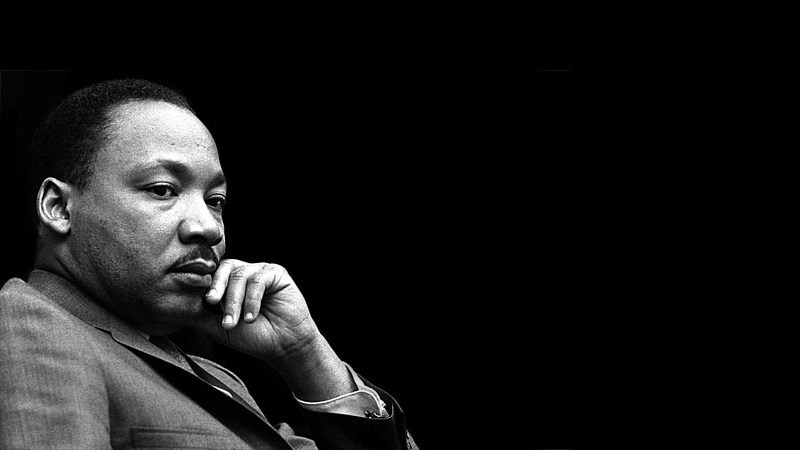
By Teodrose Fikre | The Ghion Journal | January 19, 2019
First, the ruling class kill messengers and then co-opt their messages. It’s a ploy that dates back to biblical times; Pharisees dispatch prophets and then whitewash their legacies in a concerted campaign to appropriate their movements. Truth tellers are twice victimized, once by assassins and the second time around by propaganda. Their likeness and their teachings are then cunningly marketed by the same powers they spoke against to reinforce the status quo.
This same playbook—which has been used to silence dissenters throughout the ages—was unleashed with ruthless efficiency against Martin Luther King Jr. Lost in the chorus of politicians, pundits and media personalities who are praising MLK is the core message that he was pushing before he was felled on the balcony of the Lorraine Motel. King evolved in his thinking; instead of seeking Civil Rights for “African-Americans”, he made the fatal decision to fight for economic justice for all.
King realized that the infringements against “black” folks in America were interconnected to the injustices felt by marginalized people throughout the world. That awakening is the reason he traveled to Memphis, by standing up for striking sanitation workers, he was hoping to form a bridge between poor folks irrespective of their skin color. The establishment love people who lead sectional movements—those who seek exclusive justice are doing the work of the status quo—what they will not abide are those who try to unify the oppressed and inspire collective actions.
King paid with his life for having the courage to pursue inclusive justice. After he was murdered, institutions of power—from government, academia to mainstream media and beyond—kicked in, stealthily erased King’s legacy and replaced it with disinformation. What has taken place over the past fifty years is a systematic and coordinated effort to blacken his narrative and dilute the power of his message.
I must pause here and explain what I mean by blackening Martin Luther King. What MLK fought for, and ultimately died on behalf of, was for equality and fairness for all. By narrowing the scope of his cause and containing his sacrifice to only as a struggle for “black” people, opinion leaders successfully ghettoized him in an effort to lessen his appeal to a broader constituency.
This is one of the main reasons why I reject racial labels and disavow constructs that were imposed by the very racists who shattered humanity. When you see me using quote marks around “black” and “white” in describing people, it’s because I know the true intentions behind these designations. Terms that we have come to embrace are actually insidious conventions used to dehumanize people, reduce us into abstractions and induce tribalism. As I make clear in this video below, it is vital for us to understand where these epithets come from and why bigots imposed these insidious labels on us to begin with.
Labels are insidious forms of reductionism, they are so subtle that most of us don’t understand how malicious they are. Martin Luther King is described as a “black leader” or an “African-American hero”, the adjectives in front of the title being used to depreciate the worth of the people they are describing. Nobody ever says Mozart was a European pianist or that Michelangelo was an Italian painter, yet when it comes to “black” folk, that descriptor is always attached to them—like a Scarlet letter used to insinuate that we are 3/5th human. Martin Luther King is not a black hero, he is a hero who spoke on behalf of all oppressed people.
To hide this truth and marginalize King, instigators and impostors are being propagated by mainstream media and moneyed interests. The profound message behind Martin Luther King’s “I have a dream” speech is continually transmuted by opportunists who use identity politics to advance their own agendas. “I have a dream that my four little children will one day live in a nation where they will not be judged by the color of their skin, but by the content of their character.” These words were eloquently spoken by King in order to free us from the shackles of imposed identities. We are creeping further and further away from MLK’s dream as we let demagogues lead us into the wasteland of sectarianism.
“One unfortunate thing about [the slogan] Black Power is that it gives priority to race precisely at a time when the impact of automation and other forces have made the economic question fundamental for blacks and whites alike. In this context a slogan ‘Power for Poor People’ would be much more appropriate than the slogan ‘Black Power.’”
This was a quote from King in August of 1967, eight months before he was executed. After spearheading the Civil Rights movement from the 50’s into the early 60’s, it dawned upon King that the struggle for equality was greater than being able to sit at lunch counters and riding at the front of buses. He realized that the only way to overcome oppression was to stitch together the pains felt by the proletariat in ways that would attract anyone who felt disenfranchised.
King articulated his apprehension about the movement he organized and expressed how he might have unwittingly directed his people into a quagmire. During a conversation he shared with Harry Belafonte and his inner-circle, King detailed the flaws of fighting racism’s symptoms without addressing the system that gives rise to inequalities.
“I’ve come upon something that disturbs me deeply. We have fought hard and long for integration, as I believe we should have, and I know we will win, but I have come to believe that we are integrating into a burning house. I’m afraid that America has lost the moral vision she may have had, and I’m afraid that even as we integrate, we are walking into a place that does not understand that this nation needs to be deeply concerned with the plight of the poor and disenfranchised. Until we commit ourselves to ensuring that the underclass is given justice and opportunity, we will continue to perpetuate the anger and violence that tears the soul of this nation. I fear I am integrating my people into a burning house.”
Martin Luther King was not disregarding the plight of “black” folks, nor was he giving short shrift to the struggles faced by “African-Americans”. What he recognized is that the struggles being borne by “minorities” would never be alleviated unless a majority of humanity formed a broad coalition to defend their common interests. Martin Luther King was not alone in this realization; Malcolm X came around to this same viewpoint once he visited Mecca and saw that the only way to attain justice was through mass-movements. Do you think it was an accident that both met the same gruesome fate?
Gone are the days of moral giants like Malcolm and Martin, we are firmly entrenched in the era of charlatans who profit from our disunion. What is truly sad is that so many hypocrites readily praise Martin Luther King while they get paid by the same powers that he was speaking against. Proving that treachery is truly bipartisan, on the day Martin Luther King is being celebrated, the King Center is commemorating warmonger emeritus John McCain. What better way to remember Dr. King than by praising the man who vehemently fought against honoring him and as the King Center dismantles his memory.
Meanwhile, Kamala Harris, California’s junior Senator—who was one of the biggest proponents of the prison-industrial complex—is expected to announce her presidential campaign on Martin Luther King Day. This is the same Kamala Harris whose office argued against early release of inmates on the grounds that it would hurt the labor supply [slave workers] of for-profit prisons. It is truly an affront that someone who reserved draconian measures for poor and working Californians— while giving a pass to banking executives like Steven Mnuchin—is going to use Martin Luther King day to hide the fact that she made a name for herself by being a staunch advocate of penal plantations. Kamala Harris 2020: chains you can believe in!
As always, the way to unravel conspiracies is to follow the money. Martin Luther King was sent to his grave because he connected the dots between wars overseas and economic inequalities in America. The hundreds of billions of dollars that were being spent to perpetuate the Vietnam War and conflicts around the world prevented investments in programs that could have alleviated suffering and lifted millions of people out of crushing poverty. That’s why King decided to come out against the Vietnam War, this brave stance made MLK radioactive and shortly led to his assassination.
Every politician, pundit and/or media personality who is “praising” Martin Luther King and leaving out King’s harsh criticism of wars and economic inequalities are the worst kind of hypocrites, They are erasing his legacy while pretending to honor King’s memory #RebrandingMLK
— Teodrose Fikre ✒ (@TeodroseFikre) January 20, 2019
What is lost in all the pageantry and the pomp surrounding King’s holiday is the fact that he was once savagely attacked by the very establishment that is now lionizing him. Not only was his character maligned by opinion leaders, the FBI targeted him and terrorized King and his family to such an extent that they drove him into a period of deep depression. COINTELPRO was a program launched by J. Edgar Hoover to identify and neutralize, by any means necessary, the Civil Rights icons who dared speak truth to power. A generation later, the same power structure that extinguished their flames is now lighting candles on their behalf while annulling their true stories—they’ve turned a martyr into a merchandise.
As hard as the “elites” try to commandeer King’s narrative to suit their purposes, the harsh truth is that King was murdered because he threatened the hustle of capital gangsters. If this sounds very familiar, that is because currency traders have a way of exterminating anyone who speaks against their pyramid schemes. As noted earlier, those who defy profiteers are given death sentences only for their memories to be raised to further the very greed they crusaded against. King died standing against wars and economic inequalities; notice how these themes are rarely mentioned by politicians, pundits and media personalities who cry crocodile tears for him. #RebrandingMLK Click To Tweet
There is a biblical poetry to it all, the same way Jesus was sold out by his own people, crucified by imperial enforcers and had his teachings inverted to advance the evils he died fighting against, these modern day Judases are embracing King while working for the very institutions he courageously took on. Goes to show, change agents will never be found amidst supposed activists who cast their lot with the same powers they pretend to speak against. True revolutionaries are either ignored by the establishment or silenced by bullets.
“For there is nothing hidden that will not be revealed, and nothing concealed that will not be known and brought into the light.” ~ Luke 8:17
Teodrose Fikre is the editor and founder of the Ghion Journal. A published author and prolific writer, a once defense consultant was profoundly changed by a two year journey of hardship and struggle.
French Democracy Dead or Alive?
The Gilets Jaunes in 2019

Gilets Jaunes song performed at French traffic circle: Les Gentils et les Méchants
By Diana Johnstone | Unz Review | January 11, 2019
Paris, France – French Democracy Dead or Alive? Or perhaps one should say, buried or revived? Because for the mass of ordinary people, far from the political, financial, media centers of power in Paris, democracy is already moribund, and their movement is an effort to save it. Ever since Margaret Thatcher decreed that “there is no alternative”, Western economic policy is made by technocrats for the benefit of financial markets, claiming that such benefits will trickle down to the populace. The trickle has largely dried up, and people are tired of having their needs and wishes totally ignored by an elite who “know best”.
President Emmanuel Macron’s New Year’s Eve address to the nation made it perfectly clear that after one unconvincing stab at throwing a few crumbs to the Gilets Jaunes (Yellow Vests) protest movement, he has determined to get tough.
France is entering a period of turmoil. The situation is very complex, but here are a few points to help grasp what this is all about.
- The METHODS
The Yellow Vests gather in conspicuous places where they can be seen: the Champs-Elysées in Paris, main squares in other cities towns, and the numerous traffic circles on the edge of small towns. Unlike traditional demonstrations, the Paris marches were very loose and spontaneous, people just walking around and talking to each other, with no leaders and no speeches.
The absence of leaders is inherent in the movement. All politicians, even friendly ones, are mistrusted and no one is looking for a new leader.
People are organizing their own meetings to develop their lists of grievances and demands.
In the village of Commercy, Lorraine, a half hour drive from Domrémy where Jeanne d’Arc was born, inhabitants gather to read their proclamation. Six of them read in turns, a paragraph each, making it quite clear that they want no leaders, no special spokesperson. They sometimes stumble over a word, they are not used to speaking in public like the TV talking heads. Their “Second appeal of the Gilets Jaunes de Commercy invites others to come to Commercy on January 26-27 for an “assembly of assemblies”.
- The DEMANDS
The people who first went out in the streets wearing Yellow Vests last November 17 were ostensibly protesting against a hike in gasoline and diesel taxes that would hit people in rural France the hardest. Obsessed with favoring “world cities”, the French government has taken one measure after another at the expense of small towns and villages and the people who live there. That was just the last straw. The movement rapidly moved on to the basic issue: the right of the people to have a say in measures taken that affect their lives. Democracy, in a word.
For decades, parties of the left and of the right, whatever their campaign speeches, once in office pursue policies dictated by “the markets”. For this reason, people have lost confidence in all parties and all politicians and are demanding new ways to get their wishes heard.
The fuel tax was soon forgotten as the list of demands grew longer. Critics of the movement note that achieving so many demands is quite impossible. It’s no use paying attention to popular demands, because the silly people ask for everything and its opposite.
That objection is answered by what has quickly emerged as the single overriding demand of the movement: the Citizens’ Initiative Referendum (CIR).
- The REFERENDUM
This demand illustrates the good sense of the movement. Rather than making a “must” list, the GJ merely ask that the people be allowed to choose, and the referendum is the way to choose. The demand is for a certain number of signatories – perhaps 700,000, perhaps more – to gain the right to call a referendum on an issue of their choice. The right to a CIR exists in Switzerland, Italy and California. The idea horrifies all those whose profession it is to know best. If the people vote, they will vote for all sorts of absurd things, the better-knowers observe with a shudder.
A modest teacher in a junior college in Marseilles, Etienne Chouard, has been developing for decades ideas on how to organize direct democracy, with the referendum at its center. His hour has come with the Yellow Vests. He insists that a referendum must always be held after a long debate and time for reflection, to avoid emotional spur-of-the-moment decisions. Such a referendum requires honest, independent media which are not all owned by special interests. It requires making sure that politicians who make the laws follow the popular will expressed in the referendum. All this suggests the need for a people’s constitutional convention.
The referendum is a bitter point in France, a powerful silent underlying cause of the whole Gilets Jaunes movement. In 2005, President Chirac (unwisely from his point of view) called for a popular referendum on ratification of the proposed Constitution of the European Union, certain it would be approved. The political class, with a few exceptions, went into full rhetoric, claiming a prosperous future as a new world power under the new Constitution and warning that otherwise Europe might be plunged back into World Wars I and II. However, ordinary citizens organized an extraordinary movement of popular self-education, as groups met to pour through the daunting legalistic documents, elucidating what they meant and what they implied. On May 29, 2005, with a turnout of 68%, the French voted 55% to reject the Constitution. Only Paris voted heavily in favor.
Three years later, the National Assembly – that is, politicians off all parties – voted to adopt virtually the same text, which in 2009 became the Treaty of Lisbon.
That blow to the clearly expressed popular will produced such disillusion that many backed helplessly away from politics. Now they are coming back.
- The VIOLENCE
From the start, the government has reacted with violence, in an apparent desire to provoke responding violence in order to condemn the movement as violent.
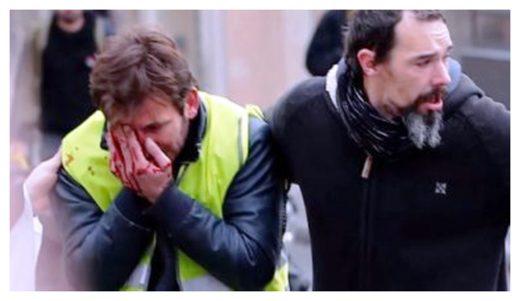
An army of police, dressed like robots, have surrounded and blocked groups of peaceful Yellow Vests, drowning them in clouds of teargas and firing flash balls directly at protesters, seriously wounding hundreds (no official figures). A number of people have lost an eye or a hand. The government has nothing to say about this.
On the third Saturday of protest, this army of police was unable to stop – or under orders to allow – a large number of hoodlums or Black Blocs (who knows?) to infiltrate the movement and smash property, vandalize shops, set fire to trash cans and parked cars, providing the world media with images proving that the Yellow Vests are dangerously violent.
Despite all this provocation, the Gilets Jaunes have remained remarkably calm and determined. But there are bound to be a few people who lose their tempers and try to fight back.
- The BOXER
On the 8th Saturday, January 5, a squad of plexiglass-protected police were violently attacking Gilets Jaunes on a bridge over the Seine when a big guy lost his temper, emerged from the crowd and went on the attack. With his fists, he beat down one policeman and caused the others to retreat. This amazing scene was filmed. You could see Yellow Vests trying to hold him back, but Rambo was unstoppable.
It turned out that this was Christophe Dettinger, a French Rom, former light heavyweight boxing champion of France. His nickname is “the Gypsy of Massy”. He got away from the scene, but made a video before turning himself in. “I reacted badly”, he said, when he saw police attacking women and other defenseless people. He urged the movement to go ahead peacefully.

Dettinger faces seven years in prison. Within a day, his defense fund had gathered 116,433 euros. The government shut it down – on what legal pretext I don’t know. Now a petition circulates on his behalf.
- The SLANDER
In his New Year’s Eve address, Macron patronizingly scolded his people telling them that “you can’t work less and earn more” – as if they all aspired to spending their lives lounging on a yacht and watching stock prices rise and fall.
Then he issued his declaration of war:
“These days I have seen unthinkable things and heard the unacceptable.” Apparently alluding to the few opposition politicians who dare sympathize with the protesters, he chastised those who pretend to “speak for the people”, but are only the “spokesmen for a hateful mob going after elected representatives, police, journalists, Jews, foreigners and homosexuals. It is simply the negation of France.”
The Gilets Jaunes haven’t been “going after” anybody. The police have been “going after” them. People have indeed spoken up vigorously against camera crews of channels that systematically distort the movement.
Not a word has been heard from the movement against foreigners or homosexuals.
The key word is Jews.
Qui veut noyer son chien l’accuse de la rage. (French proverb).
As the French saying goes, whoever wants to drown his dog claims he has rabies. Today whoever wants to ruin a career, take vengeance on a rival, disgrace an individual or destroy a movement accuses her, him, or it of antisemitism.
So, faced with a rising democratic movement, playing the “antisemitism” card was inevitable. It was almost a sure thing statistically. In almost any random batch of hundreds of thousands of people, you might find one or two who have something negative to say about a Jew. That’ll do it. The media hawks are on the outlook. The slightest incident can be used to suggest that the real motive of the movement is to revive the Holocaust.
This gently ironic little song, performed on one of France’s traffic circles, contrasts the “nice” establishment with the “bad” ordinary folk. It is a huge hit on YouTube. It gives the tone of the movement. Les Gentils et les Méchants.
It didn’t take long for this merry number to be accused of antisemitism. Why? Because it was ironically dedicated to two of the very most virulent critics of the Gilets Jaunes: May ’68 star Daniel Cohn-Bendit and old “new philosopher” Bernard-Henri Lévy. The new generation can’t stand them. But wait, they happen to be Jewish. Aha! Anti-Semitism!
- The REPRESSION
Faced with what government spokesman Benjamin Griveaux described as “agitators” and “insurrectionists” who want to “overthrow the government”, Prime Minister Edouard Philippe announced a new “law to better protect the right to demonstrate”. Its main measure: heavily punish organizers of a demonstration whose time and place have not had official approval.
In fact, the police had already arrested 33-year-old truck driver Eric Drouet for organizing a small candle ceremony in honor of the movement’s casualties. There have been many other arrests, with no information coming out about them. (Incidentally, over the holidays, hoodlums in the banlieues of several cities carried out their ritual burning of parked cars, with no particular publicity or crackdown. Those were cars of working class people who need them to go to work, not the precious cars in the rich section of Paris whose destruction caused such scandal.)
On January 7, Luc Ferry, a “philosopher” and former Minister of Youth, Education and Research, gave a radio interview on the very respectable Radio Classique in which he declared: “The police are not given the means to end this violence. It’s unbearable. Listen, frankly, when you see guys kick a poor policemen when he’s down, that’s enough! Let them use their arms once and for all, basta! […] As I recall, we have the world’s fourth army, capable of putting an end to this garbage.”
Ferry called on Macron to make a coalition with the Republicans in order to push through his “reforms”.
Last month, in a column against the Citizens’ Initiative Referendum, Ferry wrote that “the current disparaging of experts and criticism of elitism is the worst calamity of our times.”
- The ANTIFA
Wherever people gather, Antifa groups may pursue their indiscriminate search to root out “fascists”. In Bordeaux last Saturday, Yellow Vests had to fight off an attack by Antifa.
It is now completely clear (as indeed it always has been) that the self-styled “Antifascists” are the watch dogs of the status quo. In their tireless search for “fascists”, the Antifa attack anything that moves. In effect, they protect stagnation. And curiously enough, Antifa violence is tolerated by the same State and the same police who insult, attack and arrest more peaceful demonstrators. In short, the Antifa are the storm troopers of the current system.
- The MEDIA
Be skeptical. At least in France, mainstream media are solidly on the side of “order”, meaning Macron, and foreign media tend to echo what national media write and say. Also, as a general rule, when it comes to France, the Anglophone media often get it wrong.
- The END
It is not in sight. This may not be a revolution, but it is a revelation of the real nature of “the system”. Power lies with a technocracy in the service of “the Markets”, meaning the power of finance capital. This technocracy aspires to remake human society, our own societies and those all over the planet, in the interests of a certain capitalism. It uses economic sanctions, overwhelming propaganda and military force (NATO) in a “globalization” project that shapes people’s lives without their consent. Macron is the very embodiment of this system. He was chosen by that famous elite to carry through the measures dictated by “the Markets”, enforced by the European Union. He cannot give in. But now that people are awake to what is going on, they won’t stop either. For all the lamented decline in the school system, the French people today are as well-educated and reasonable as any population can be expected to be. If they are incapable of democracy, then democracy is impossible.
To be continued…
France Moves To Ban All Protests As PM Announces Major Crackdown On Yellow Vests
By Tyler Durden – Zero Hedge – 01/09/2019
France is signaling it’s making preparations for a massive new crackdown on the gilets jaunes or “yellow vests” anti-government protests that have gripped the country for seven weeks. A new law under consideration could make any demonstration illegal to begin with if not previously approved by authorities, in an initiative already being compared to the pre-Maiden so-called “dictatorship law” in Ukraine.
In the name of reigning in the violence that has recently included torching structures along the prestigious Boulevard Saint Germain in Paris, and smashing through the gates of government ministry buildings, the French government appears set to enact something close to a martial law scenario prohibiting almost any protest and curtailing freedom of speech.
Prime Minister Edouard Philippe presented the new initiative to curtail the violence and unrest while targeting “troublemakers” and banning anonymity through wearing masks on French TV channel TF1 on Monday. He said the law would give police authority crack down on “unauthorized demonstrations” at a moment when police are already arresting citizens for merely wearing a yellow vest, even if they are not directly engaged in protests in some cases.
PM Philippe said the government would support a “new law punishing those who do not respect the requirement to declare [protests], those who take part in unauthorized demonstrations and those who arrive at demonstrations wearing face masks”.
Philippe’s tone during the statements was one of the proverbial “the gloves are off” as he described the onus would be on “the troublemakers, and not taxpayers, to pay for the damage caused” to businesses and property.
“Those who question our institutions will not have the last word,” he added.
However, if anything the protests have grown fiercer in response to any police crackdown or violence against demonstrators. Should all protests be banned under the new law, it could be the start of more violent riots gaining steam, as what began Nov. 17 as anger over fuel tax hikes has now turned into rage at President Emmanuel Macron and policies that seem to favor the urban elite.
Other yellow vest inspired protests previously broke out across Europe, and in perhaps a sign of things to come a video from The Netherlands of a woman pushing her baby in a stroller being arrested by police apparently for merely wearing a yellow vest is going viral.
Shocking Video of police brutality in The #Netherlands of a Women being arrested yesterday, because she was wearing an Yellow Vest, and did not wanted to take it off. while walking with her baby in the streets. #YellowVests SHAME ON YOU DUTCH POLICE OFFICERS! RT this to the world pic.twitter.com/vL99D1ThW0
— Sotiri Dimpinoudis (@sotiridi) January 6, 2019
In the video, police confront the woman in what appears a quiet neighborhood far away from any visible protest. Police were photographed alongside the baby on the street as the mother was dragged away.

Image via journalist Sotiri Dimpinoudis
With the French prime minister now announcing coming draconian measures banning all protest, this is precisely the horrific scene that could begin to be repeated across France and the EU.
In total at least six people have died and over 1,400 people injured during the French protests, with thousands arrested weekly, according to international reports. Over the weekend some 50,000 protesters continued demonstrating in multiple cities, leading to significant clashes in Paris, Bordeaux and Rouen. A number of commentators have noted that though there appear fewer demonstrators compared to December, there appears a serious uptick in violent acts on the part of both demonstrators and police response.
Mumia Abu-Jamal Wins Major Court Victory
By Jeff Mackler | CounterPunch | January 3, 2019
On December 27, Philadelphia Superior Court Judge Leon Tucker ruled in favor of Mumia Abu-Jamal, holding that the actions of former Pennsylvania Supreme Court Judge Ronald Castille demonstrated a “lack of impartiality” and “the appearance of bias.”
Tucker’s decision represents a major victory for Abu-Jamal that opens the door to a new trial–or dismissal of the murder charges against him–after an appeal to the Pennsylvania courts.
Incarcerated in 1981 in a racist frame-up murder trial of police officer Daniel Faulkner and on death row for most of the past 37 years, Mumia was a prize-winning journalist and today the author of 10 books on various aspects of the freedom struggle. His latest book, Murder Incorporated: Empire, Genocide, Manifest Destiny, 2017, co-authored by filmmaker Stephen Victoria (Long Distance Revolutionary, 2014) with a forward by Chris Hedges, is invaluable reading for revolutionary activists who seek the truth about capitalist imperialism’s centuries of horrors and the historic resistance against them.
Mumia’s freedom struggle has been supported by scores of trade unions across the U.S. and in Europe as well as by Amnesty International, the NAACP and numerous city council resolutions from San Francisco to Detroit.
Tucker’s 27-page ruling was in two parts. He held in Part Two that with regard to all of Mumia’s numerous denied Post Conviction Relief Act (PCRA) appeals between 1998 and 2014, Supreme Court Judge Ronald Castille’s actions in campaigning for the Pennsylvania governor to sign death penalty warrants for all “convicted cop killers” and other biased acts, violated Mumia’s fundamental constitutional rights.
Castille had participated in PA Supreme Court decisions that denied all of Mumia’s appeals, including a request from Mumia’s attorneys that he recuse himself from deciding the case he had helped to prosecute and another decision where the same Castille court refused to consider documented evidence submitted by court stenographer Terri Maurer Carter that Mumia’s trial judge Albert “the hanging judge” Sabo had stated in his antechambers before entering the courtroom to adjudicate Mumia’s case, “Yeah, I’m going to help ‘em fry the nigger.” Mumia’s decades long sojourn through the racist U.S. “criminal justice system” is replete with what has become infamously known as “the Mumia exception,” that is, contorted applications of the “law” aimed at denying its applicability to the facts in Mumia’s case. These include systematic exclusion of eyewitness testimony proving his innocence, intimidation of witnesses, falsification of exonerating ballistics findings, fabrication of testimony that Mumia admitted to the killing of police officer Daniel Faulkner and Mumia’s physical exclusion from a majority of his trial proceedings – to name a few of the legal atrocities attendant to his trial and subsequent proceedings.
Judge Tucker’s ruling opens the door for Mumia to appeal all of Castille’s decisions over a 17-years period. Tucker denied Part One of Mumia’s appeal that pertained to whether or not Castille had been significantly or personally involved in Mumia’s prosecution in order to qualify under the provisions of the 2016 Supreme Court William’s case. Mumia’s attorneys may appeal this decision in order to fight on both legal fronts.
While the present Philadelphia District Attorney, Larry Krasner may well appeal Tucker’s amazing and unexpected decision, the door is nevertheless wide open to a lengthy legal battle along with renewed national and international campaigns to win massive and united support in the streets to demand Mumia’s freedom.
Jeff Mackler is a staffwriter for Socialist Action. He can be reached at jmackler@lmi.net socialist action.org
Why France’s Yellow Vest Protests Have Been Ignored by “the Resistance” in the U.S.

By Max Parry • Unz Review • January 2, 2019
”The rich are only defeated when running for their lives.”— C.L.R. James, The Black Jacobins
In less than two months, the yellow vests (“gilets jaunes”) movement in France has reshaped the political landscape in Europe. For a seventh straight week, demonstrations continued across the country even after concessions from a cowed President Emmanuel Macron while inspiring a wave of similar gatherings in neighboring states like Belgium and the Netherlands. Just as el-Sisi’s dictatorship banned the sale of high-visibility vests to prevent copycat rallies in Egypt, corporate media has predictably worked overtime trying to demonize the spontaneous and mostly leaderless working class movement in the hopes it will not spread elsewhere.
The media oligopoly initially attempted to ignore the insurrection altogether, but when forced to reckon with the yellow vests they maligned the incendiary marchers using horseshoe theory to suggest a confluence between far left and far right supporters of Jean-Luc Mélenchon and Marine Le Pen. To the surprise of no one, mainstream pundits have also stoked fears of ‘Russian interference’ behind the unrest. We can assume that if the safety vests were ready-made off the assembly line of NGOs like the raised fist flags of Serbia’s OTPOR! movement, the presstitutes would be telling a different story.
It turned out that a crisis was not averted but merely postponed when Macron defeated his demagogue opponent Le Pen in the 2017 French election. While it is true that the gilets jaunes were partly impelled by an increase on fuel prices, contrary to the prevailing narrative their official demands are not limited to a carbon tax. They also consist of explicit ultimatums to increase the minimum wage, improve the standard of living, and an end to austerity, among other legitimate grievances. Since taking office, Macron has declared war on trade unions while pushing through enormous tax breaks for the wealthy (like himself) — it was just a matter of time until the French people had enough of the country’s privatization. It is only a shock to the oblivious establishment why the former Rothschild banker-turned-politician, who addressed the nation seated at a gold desk while Paris was ablaze, is suddenly in jeopardy of losing power. The status quo’s incognizance is reminiscent of Marie Antoinette who during the 18th century when told the peasants had no bread famously replied, “let them eat cake” as the masses starved under her husband Louis XIV.
While the media’s conspicuous blackout of coverage is partly to blame, the deafening silence from across the Atlantic in the United States is really because of the lack of class consciousness on its political left. With the exception of Occupy Wall Street, the American left has been so preoccupied with an endless race to the bottom in the two party ‘culture wars’ it is unable to comprehend an upheaval undivided by the contaminants of identity politics. A political opposition that isn’t fractured on social issues is simply unimaginable. Not to say the masses in France are exempt from the internal contradictions of the working class, but the fetishization of lifestyle politics in the U.S. has truly become its weakness. We will have to wait and see whether the yellow vests transform into a global movement or arrive in America, but for now the seeming lack of solidarity stateside equates to a complicity with Macron’s agenda.
It serves as a reminder of the historically revisionist understanding of French politics in the U.S. that is long-established. The middle class dominated left-wing in America ascribes to a historical reinterpretation of the French Revolution that is a large contributor of its aversion to transformative praxis in favor of incrementalism. The late Italian Marxist philosopher and historian Domenico Losurdo, who died in June of this year, offered the most thorough understanding of its misreading of history in seminal works such as War and Revolution: Rethinking the Twentieth Century. The liberal rereading of the French Revolution is the ideological basis for its rejection of the revolutionary tradition from the Jacobins to the Bolsheviks that has neutralized the modern left to this day.
According to its revised history, the inevitable outcome of comprehensive systemic change is Robespierre’s so-called ‘Reign of Terror’, or the ‘purges’ of the Stalin era in the Soviet Union. In its view, what began with the Locke and Montesquieu-influenced reforms of the constitutional monarchy was ‘hijacked’ by the radical Jacobin and sans-culotte factions. Losurdo explains that counter-revolutionaries eager to discredit the image of rebellion overemphasize its violence and bloodshed, and never properly contextualize it as self-defense against the real reign of terror by the ruling class. The idea behind this recasting of history is to conflate revolutionary politics with Nazi Germany whose racially-motivated genocide was truly the inheritor of the legacy of European colonialism, not the ancestry of the Jacobins or the Russian Revolution.
Maximilien Robespierre’s real crime in the eyes of bourgeois historians was attempting to fulfill the egalitarian ideals of republicanism by transferring political power from the aristocracy and nouveaux riche directly into the hands of the working class, just as the Paris Commune did nearly 80 years later. It is for this reason he subsequently became one of the most misunderstood and unfairly maligned figures in world history, perhaps one day to be absolved. The U.S. reaction to the yellow vests is a continuation of the denial and suppression of the class conflict inherent in the French Revolution which continues to seethe beneath the surfaces of capitalism today.
In today’s political climate, it is easy to forget that there have been periods where the American left was actually engaged with the crisis of global capitalism. In what seems like aeons ago, the anti-globalization movement in the wake of NAFTA culminated in huge protests in Seattle in 1999 which saw nearly 50,000 march against the World Trade Organization. Following the 2008 financial collapse, it briefly reemerged in the Occupy movement which was also swiftly put down by corporate-state repression. Currently, the political space once inhabited by the anti-globalization left has been supplanted by the ‘anti-globalist’ rhetoric mostly associated with right-wing populism.
Globalism and globalization may have qualitatively different meanings, but they nevertheless are interrelated. Although it is shortsighted, there are core accuracies in the former’s narrative that should be acknowledged. The idea of a shadowy world government isn’t exclusively adhered to by anti-establishment conservatives and it is right to suspect there is a worldwide cabal of secretive billionaire power brokers controlling events behind the scenes. There is indeed a ‘new world order’ with zero regard for the sovereignty of nation states, just as there is a ‘deep state.’ However, it is a ruling class not of paranoiac imagination but real life, and a right-wing billionaire like Robert Mercer is as much a globalist as George Soros.
Ever since capitalism emerged it has always been global. The current economic crisis is its latest cyclical downturn, impoverishing and alienating working people whose increasing hardship is what has led to the trending rejection of the EU. Imperialism has exported capital leading to the destruction of jobs in the home sectors of Western nations while outsourcing them to the third world. Over time, deep disgruntlement among the working class has grown toward an economic system that is clearly rigged against them, where the skewed distribution of capital gains and widespread tax evasion on the part of big business is camouflaged as buoyant economic growth. When it came crashing down in the last recession, the financial institutions responsible were bailed out using tax payer money instead of facing any consequences. Such grotesque unfairness has only been amplified by the austerity further transferring the burden from the 1% to the poor.
Before the gilets jaunes, the U.K.’s Brexit referendum in 2016 laid bare these deep class divisions within the European Union. One of the most significant events in the continent since WWII, it has ultimately threatened to reshape the Occident’s status in the post-war order as a whole. Brexit manifested out of divisions within Britain’s political parties, especially the Torys, which had been plagued for years by internal dispute over the EU. Those in power were blind to the warning signs of discontent toward a world economy in crisis and were shocked by the plebiscite in which the working class defied the powers that be against all odds with more than half voting to leave.
In general, well-to-do Brits were hard remainers while those suffering most severely from the destruction of industry, unemployment and austerity overwhelmingly chose to leave in what was described as a “peasants revolt” by the media. The value of the pound sterling quickly plunged and not long after the status of the United Kingdom as a whole came into question as Britain found itself at odds with Scotland’s unanimous decision to remain. Brexit tugged at the bonds holding the EU together and suddenly the collective standing clout of its member states is at stake in a potential breakup of the entire bloc.
Euroscepticism is also by no means a distinctly British phenomenon, as distrust has soared in countries hit the hardest by neoliberalism like Greece (80%), with Spain and France not far behind. In fact, before there was Brexit there was fear among the elite of a ‘Grexit.’ In response to its unprecedented debt crisis manufactured by the International Monetary Fund (IMF), the Greek people elected the Coalition of the Radical Left, SYRIZA, to a majority of legislative seats to the Hellenic Parliament during its 2015 bailout referendum. Unfortunately, the synthetic alliance turned out to be anything but radical and a trojan horse of the establishment. SYRIZA was elected on its promise to rescind the terms of Greek membership in the EU, but shortly after taking office it betrayed its constituency and agreed to the troika’s mass privatization. Even its former finance minister Yanis Varousfakis admitted that SYRIZA was a controlled opposition and auxiliary of the Soros Foundation.
Apart from suffering collective amnesia regarding the EU’s neoliberal policies, apparently the modern left is also in serious need of a history lesson regarding the federation’s fascist origins. It has been truly puzzling to see self-proclaimed progressives mourning Britain’s decision to withdraw from a continental union that was historically masterminded by former fifth columnists of Nazi Germany. It was in the aftermath of WWII’s devastation that the 1951 Treaty of Paris established the nucleus of the EU in the European Coal and Steel Community, a cooperative union formed by France, Italy, West Germany, and the three Benelux states (Belgium, Luxembourg and the Netherlands). The Europe Declaration charter stated:
“By the signature of this Treaty, the involved parties give proof of their determination to create the first supranational institution and that thus they are laying the true foundation of an organized Europe. This Europe remains open to all European countries that have freedom of choice. We profoundly hope that other countries will join us in our common endeavor.”
The idea of forming a “supranational” union was conceived by the French statesman Robert Schuman, who during the outbreak of WWII served as the Under-Secretary of State for Refugees in the Reynaud government. When Nazi Germany invaded France in 1940, Schuman by all accounts willingly voted to grant absolute dictatorial powers to Marshall Philippe Pétain to become Head of State of the newly formed Vichy government, the puppet regime that ruled Nazi-occupied France until the Allied invasion in 1944. By doing so, he retained his position in parliament, though he later chose to resign. Following the war, like all Vichy collaborators Schuman was initially charged with the offense of indignité nationale (“national unworthiness”) and stripped of his civil rights as a traitor.
More than 4,000 alleged quislings were summarily executed following Operation Overlord and the Normandy landings, but the future EU designer was fortunate enough to have friends in high places. Schuman’s clemency was granted by none other than General Charles de Gaulle himself, the leader of the resistance during the war and future French President. Instantly, Schuman’s turncoat reputation was rehabilitated and his wartime activity whitewashed. Even though he had knowingly voted full authority to Pétain, the retention of his post in the Vichy government was veneered to have occurred somehow without his knowledge or consent.
Schuman is officially regarded as one of the eleven men who were ‘founding fathers’ of what later became the EU. One of the other major figures that contributed to the federal integration of the continent was Konrad Adenauer, the first Chancellor of the Federal Republic of Germany. The Nuremberg Trials may have tried and executed most of the top leadership of the Nazi Party, but the post-war government that became West Germany was saturated with former Third Reich officials. Despite the purported post-war ‘denazification’ policy inscribed in the Potsdam agreement, many figures who had directly participated in the Holocaust were appointed to high positions in Adenauer’s administration and never prosecuted for their atrocities.
One such war criminal was the former Ministry of the Interior and drafter of the Nuremberg race statutes, Hans Globke, who became Adenauer’s right hand man as his Secretary of State and Chief of Staff. Adenauer also successfully lobbied the Allies to free most of the Wehrmacht war criminals in their custody, winning the support of then U.S. General and future President Dwight Eisenhower. By 1951, motivated by the desire to quickly rearm and integrate West Germany into NATO in the new Cold War, the policy of denazification was prematurely ended and countless offenders were allowed to reenter branches of government, military and public service. Their crimes against humanity took a backseat to the greater imperialist priority of rearmament against East Germany and the Soviets.
In the years following WWII, there was also concern among the elite of anti-Americanism growing in Western Europe. The annual Bilderberg Group conference was established in 1954 by Prince Bernard of the Netherlands, himself a former Reiter-SS Corps and Nazi Party member, to promote ‘Atlanticism’ and facilitate cooperation between American and European leaders. Invitations to the Bilderberg club meetings were extended to only the most exclusive paragons in politics, academia, the media, industry, and finance. In 2009, WikiLeaks revealed that it was at the infamous assembly where the hidden agenda of the European Coal and Steel Community, later the EU, was set:
“E. European Unity: The discussion on this subject revealed general support for the idea of European integration and unification among the participants from the six countries of the European Coal and Steel Community, and a recognition of the urgency of the problem. While members of the group held different views as to the method by which a common market could be set up, there was a general recognition of the dangers inherent in the present divided markets of Europe and the pressing need to bring the German people, together with the other peoples of Europe, into a common market. That the six countries of the Coal and Steel Community had definitely decided to establish a common market and that experts were now working this out was felt to be a most encouraging step forward and it was hoped that other countries would subsequently join it.”
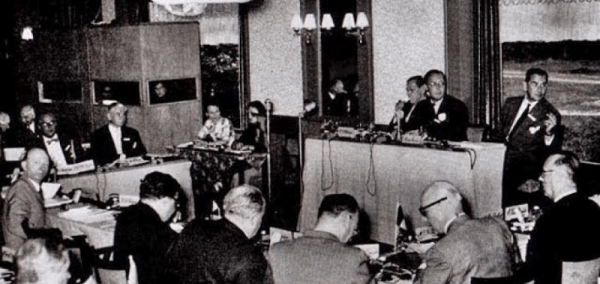
Prince Bernard presides over the first annual Bilderberg meeting in 1954.
At the 1955 conference, the rudimentary idea for a European currency or what became the Eurozone was even discussed, three years before the Treaty of Rome which established the European Economic Community, without the public’s knowledge:
“A European speaker expressed concern about the need to achieve a common currency, and indicated that in his view this necessarily implied the creation of a central political authority.”
The mysterious Bilderberg gatherings are still held to this day under notorious secrecy and are frequently the subject of wild speculation. One can imagine a topic behind the scenes at this year’s meeting would be how to address the growth of anti-EU ‘populism’ and uprisings like the gilet jaunes. Hitlerite expansionism had been carried out on the Führer’s vision for a European federation in the Third Reich — in many respects, the EU is a rebranded realization of his plans for empire-building. How ironic that liberals are clinging to a multinational political union founded by fascist colluders while the same economic bloc is being opposed by today’s far right after its new Islamophobic facelift.
While nationalism may have played an instrumental role in Brexit, there is a manufactured hysteria hatched by the establishment which successfully reduced the complex range of reasons for the Leave EU vote to racism and flag-waving. They are now repeating this pattern by overstating the presence of the far right among the yellow vests. Such delirium not only demonizes workers but coercively repositions the left into supporting something it otherwise shouldn’t — the EU and by default its laissez-faire policies — thereby driving the masses further into the arms of the same far right. Echoes of this can be seen in the U.S. with the vapid response to journalist Angela Nagle’s recent article about the immigration crisis on the southern border. The faux-left built a straw man in their attack on Nagle, who dared to acknowledge that the establishment only really wants ‘open borders’ for an endless supply of low-wage labor from regions in the global south destabilized by U.S. militarism and trade liberalization. Aligning itself with the hollow, symbolic gestures of centrists has only deteriorated the standards of the left participating in such vacuousness and dragged down to the level of liberals.
There is no doubt Brexit and Trump pushed the xenophobia button and could not have come about without it. However, such criticism means nothing when it comes from moral posturers who claim to “stand with refugees” while supporting the very ‘humanitarian’ interventionist policies displacing them. Nativism was not the sole reason the majority voted to leave the EU and many working class minorities also were Brexiters. Of course their fellow workers and migrants are not the true cause of their misery. After all, it was not just chattel slaves who came to the U.S. unwillingly but European immigrants fleeing continental wars and starvation as well — the crisis in the EU today is no different.
Fundamentally, migrants seek asylum on Europe’s doorstep because of NATO’s imperial expansion and the unexpected arrival of Brexit has threatened to weaken the EU’s military arm. Already desperate to reinvent itself and a new enemy in Russia despite its functional obsolescence, the shock of the referendum has inconveniently undermined NATO’s ability to pressure Moscow and Beijing, a step forward for mitigating world peace in the long run and a silver lining to its outcome. It is the task of the left to reject the EU’s neoliberal project while transmitting the message that capital, not refugees, is the cause of the plight of the masses. It is also necessary to have faith in the people, something cynical liberals lack. Racism may historically be the achilles heel of the working class but underlying Brexit, the election of Trump, and the yellow vests is the spirit of defiance in working people, albeit one of political confusion in need of guidance.
If the yellow vests are today’s sans-culottes, like those which became the revolutionary partisans in the French Revolution, they will eventually need a Jacobin Club. Relatively progressive but ultimately reformist figures like Mélenchon are no such spearhead and will only lead them down the same dead end of SYRIZA. The absence of any such vanguard has forced the working class to take matters into their own hands in the interim. If history is any guide, the gilets jaunes will be stamped out until a new cadre takes the reins whose objective is, as Lenin said,“not to champion the degrading of the revolutionary to the level of an amateur, but to raise the amateurs to the level of revolutionaries.” We also cannot fall into ideological fantasies that we live in permanent revolutionary circumstances or that a spontaneous uprising can become comprehensive simply because of ingenious leadership. Nevertheless, as Mao Tse-Tung wrote, “a single spark can start a prairie fire” and hopefully the yellow vests are that flame.
Max Parry is an independent journalist and geopolitical analyst. Max may be reached at maxrparry@live.com
Fiasco In Islington, Part 2

Gilad Atzmon
By Richard Hugus | December 26, 2018
More facts have come to light in the case of Gilad Atzmon and his banning by the Islington Town Council from performing at a jazz concert on December 21, 2018. The original scenario was that one e-mail from one person calling Atzmon an antisemite somehow persuaded the Islington council to take the drastic step of removing Atzmon from a town-owned venue. Many who heard the story felt this was a rash decision which would surely be reversed when the facts were brought to light. But the Council voted to uphold its decision and Atzmon was indeed not allowed to play.
Now it appears that the single complainant – Martin Rankoff – was not just an anonymous fan of Israel but the UK director of Likud-Herut. Herut (or ‘freedom’) was Israel’s founding nationalist party from 1948 until it later merged with Likud. It is a militant and extreme Zionist organization whose roots go in a straight line from Ze’ev Jabotinsky and Menachem Begin up to Benjamin Netanyahu today. Jabotinsky and Begin helped form the Irgun terrorists in 1937. Irgun committed notorious massacres in Palestine leading up to and during the Nakba (or ‘catastrophe’) of 1947-1948. These include the bombing of the King David Hotel in Jerusalem in 1946, killing 91 people, and the massacre at Deir Yassin in 1948 in which 254 unarmed Palestinian villagers were brutally murdered as an incentive for other Palestinians to leave. On its web site Likud-Herut UK lists Jabotinsky and Begin as “visionaries.” Likud-Herut is a member of the World Zionist Organization and the Zionist Federation of the UK who believe in “the inalienable right of all Jews to live and settle in all parts of the Land of Israel.”
In a letter to the New York Times in 1948 Albert Einstein, Hannah Arendt, and others compared Herut to the Nazis and Fascists who had just been defeated in World War II. Referring to this letter, Ramzy Baroud recently wrote, “the ‘Nazi and Fascist’ mentality that defined Herut in 1948 now defines the most powerful ruling class in Israel. Israel’s leaders speak openly of genocide and murder, yet they celebrate and promote Israel as if an icon of civilization, democracy and human rights.”
–
The history of Herut and Likud tells us a great deal about who the people are who complained about Atzmon to Islington Town Council. When Atzmon moved to appeal his being banned, formidable opponents again appeared in the form of the Simkins Law firm, one of the most expensive law practices in Britain, with not one but two partners at Simkins being put on the case. These are Gideon Benaim and Tom Iverson. Benaim recently became well known in Britain for winning an invasion of privacy suit against the BBC on behalf of pop singer Cliff Richard, who said he spent £3.4m ($4.3 million) on the case. Clearly, representation by Simkins doesn’t come cheap. Also listed in Benaim’s resumé as a client is the Las Vegas Sands Corporation which likely has no problem with Simkins’ fees either. The Sands casino is owned by billionaire Sheldon Adelson, who, as it happens, is a primary sponsor of the Likud Party in Israel, led by Benjamin Netanyahu. Adelson owns the newspaper Israel Hayom, a mouthpiece for Netanyahu and Likud.

American businessman and investor Sheldon Adelson with Prime Minister Benjamin Netanyahu at the ceremony of a laying of a cornerstone for new Medicine Faculty buildings at the Ariel University in the West Bank, on June 28, 2017. Photo by Ben Dori/Flash90
It now appears that Atzmon’s banning was not the result of a casual complaint; it was an intentional attack on a well-respected supporter of Palestinian human rights by the Likud organization, directly represented by Martin Rankoff. The attack was followed up by the hiring of a lawyer who has worked for Likud godfather Sheldon Adelson. The connection to these powerful forces may explain why Islington Town Council leader Richard Watts, without any delay or attempt at negotiation, took the step of going straight to a decision to hire an expensive law firm. This is while Islington is facing serious austerity and shortage of funds in its own operating budget. Islington has a population of about 206,000 people. This very month, 43 of those people were counted in one survey as homeless and sleeping on the streets.
Regarding the financial problems of his borough and others around London, Richard Watts, told The Independent in October 2018 :
“unprecedented” funding pressures and demand for adult and children’s social care and homelessness services was “pushing councils to the limit”.
“As a result less money is being spent on the other services that keep our communities running such as libraries, local roads, early intervention and local welfare support,” he added.
Yet, to Watts and his fellow councilors in Islington, backing partisans for a foreign country -Israel- took precedence over the pressing needs of the people whom they are supposed to represent. Either Watts was inexcusably careless with scarce town funds or a deal was made and he knew that he could depend on Likud-Herut to back him. Or, like politicians all across Europe and the US facing the power of the Israel lobby, he knew he couldn’t afford to say no.
According to Simkin’s web site, Gideon Benaim “has extensive expertise in the areas of defamation, privacy, harassment and copyright.” Perhaps it is not a coincidence that immediately after Islington brought in Simkins, identical statements from an unnamed Labour spokesman describing Atzmon as “a vile antisemite” appeared in both the BBC and The Guardian. Perhaps a lawyer experienced in defending people against defamation and harassment would also know how to perpetrate these things. Perhaps this was Benaim’s opening move. Character assassination is a common tactic in cases that have a weak legal foundation, such as this one, as it goes a long way to convicting the accused before their case ever reaches a courtroom.
The involvement of Likud-Herut in the attack on Gilad Atzmon, and Islington’s official backing of that attack, constitutes a monumental scandal. This wasn’t just a stupid mistake; it was a hit. It is an affront to reason that an an arch-racist organization like Likud, who from the beginning have stood for the removal of the people of Palestine from their own land by means of terror, murder, and forced expulsion, could possibly claim they they were defamed by someone pointing out these very crimes. There is a case of defamation here for sure – the defamation of Gilad Atzmon. For Zionists, defamation is nothing more than a tool to destroy opponents who can’t be dealt with by other means. We are long since tired of truth tellers being accused of antisemitism. We’re tired of national and local resources being used to prop up the criminal state of Israel. Coercion by advocates for Israel is at the center of this issue in Islington, as it is in many other towns and many other countries. For the sake of Palestine and our own sovereignty, it has to be called out and stopped.
To sign a petition in support of Gilad click here
Lodge a formal complaint with Islington Council: https://www.islington.gov.uk/contact-us/comments-and-complaints?status=inprogress
Email: assemblyhall@islington.gov.uk
Contact the Council: +4420 7527 2000
To support Gilad’s legal battles: https://donorbox.org/gilad-needs-additional-support
Inside Banksy’s The Walled Off Hotel in Bethlehem
We check in to Banksy’s bizarre Palestinian hotel, where the hospitality is as peculiar as the message is powerful

By Jonathon Cook – The National – December 21, 2018
Anonymous British street artist Banksy made headlines in October when his $1.4 million artwork Girl with Balloon self-destructed by passing through a shredder concealed in its frame at a London auction moments after it had been bought.
But in the Palestinian city of Bethlehem, a much larger Banksy art project – a hotel boasting “the worst view in the world” – appears to be unexpectedly saving itself from similar, planned destruction.
When it opened in March last year, The Walled Off Hotel – hemmed in by the eight-metre-high concrete wall built by Israel to encage Bethlehem – was supposed to be operational for only a year. But nearly two years on, as I joined those staying in one of its nine Banksy-designed rooms, it was clearly going from strength to strength.
Originally, The Walled Off Hotel was intended as a temporary and provocative piece of installation art, turning the oppressive 700-kilometre-long wall that cuts through occupied Palestinian land into an improbable tourist attraction. Visitors drawn to Bethlehem by Banksy’s art – both inside the hotel and on the colossal wall outside – are given a brief, but potent, taste of Palestinian life in the shadow of Israel’s military infrastructure of confinement.
It proved, unexpectedly, so successful that it was soon competing as a top tourist attraction with the city’s traditional pilgrimage site, the reputed spot where Jesus was born, the Church of the Nativity. “The hotel has attracted 140,000 visitors – local Israelis, Palestinians, as well as internationals – since it opened,” says Wisam Salsa, the hotel’s Palestinian co-founder and manager. “It’s given a massive boost to the Palestinian tourism industry.”
Exception to Banksy’s rule
The Walled Off Hotel was effectively a follow-up to Banksy’s “Dismaland Bemusement Park”, created in the more familiar and safer setting of a British seaside resort. For five weeks, that installation in Weston-super-Mare, Somerset, England, offered holidaymakers a dystopian version of a Disney-style amusement park, featuring a nuclear mushroom-cloud, medical experiments gone wrong, boat people trapped on the high seas and the Cinderella story told as a car crash.
But unlike Girl with Balloon and Dismaland, Banksy appears uncharacteristically reluctant to follow through with the destruction of his Bethlehem creation. Some 21 months later, it seems to have become a permanent feature of this small city’s tourist landscape.
Given that Banksy is notoriously elusive, it is difficult to be sure why he has made an exception for The Walled Off Hotel. But given his well-known sympathy for the Palestinian cause, a few reasons suggest themselves. One is that, were he to abandon the hotel, it would delight the Israeli military authorities. They would love to see The Walled Off Hotel disappear – and with it, a major reason to focus on a particularly ugly aspect of Israel’s occupation. In addition, dismantling the hotel might echo rather uncomfortably Israel’s long-standing policy of clearing Palestinians off their land – invariably to free-up space for Jewish settlement.
Israel strenuously claims the wall was built to aid security by keeping out Palestinian “terrorists”. But the wall’s path outside The Walled Off Hotel seals off Bethlehem from one of its major holy sites, Rachel’s Tomb, and has allowed Jewish religious extremists to take it over.
A rare success story
In sticking by the hotel, Banksy appears to have been influenced by Palestinian “sumud”, Arabic for steadfastness, a commitment to staying put in the face of Israeli pressure and aggression. But significantly, there is a practical consideration: The Walled Off Hotel has rapidly become a rare success story in the occupied territories, boosting the struggling Palestinian economy. That has occurred in spite of Israel’s best efforts to curb tourism to Bethlehem, including by making a trip through the wall and an Israeli checkpoint a time-consuming and discomfiting experience.
Israel’s attitude was highlighted last year when the interior ministry issued a directive to travel agencies warning them not to take groups of pilgrims into Bethlehem to stay overnight. After an outcry, the government relented, but the message was clear.
Salsa notes that The Walled Off Hotel has not only attracted a new kind of visitor to Bethlehem, but has also persuaded many to spend time in other parts of the occupied West Bank, too.
Salsa understands the importance of tourism personally. He was an out-of-work guide when mutual friends first introduced him to Banksy in 2005, shortly after the wall cutting off Bethlehem from nearby Jerusalem had been completed. The city was economically dead, with tourists too fearful to visit its holy sites as armed uprisings raged across the occupied territories. The Second Intifada from 2000-2005 was the Palestinians’ response after Israel refused to grant them the viable state most observers had assumed was implicit in the Oslo Accords of the 1990s.
Banksy arrived in 2005 to spray-paint on what was then a largely pristine surface, creating a series of striking images. It unleashed a wave of local and foreign copycats. The wall in Bethlehem quickly became a giant canvas for artistic resistance, says Salsa.
Much later, in 2014, Banksy came up with the idea of the hotel. Salsa found a large residential building abandoned for more than a decade because of its proximity to the wall. In secret, The Walled Off was born. “It was a crazy spot for a hotel,” says Salsa. “It felt like divine intervention finding it. It was close to the main road from Jerusalem so no one could miss us.”
Palestinians’ reality
Importantly, the hotel was also in one of the few areas of Bethlehem inside “Area C”, parts of the West Bank classified in the temporary Oslo Accords as under full Israeli control. That meant the army could not bar Israelis from visiting. “Nowadays there are no channels open between Palestinians and Israelis. So The Walled Off Hotel is a rare space where Israelis can visit and taste the reality lived by Palestinians.
“True, Israelis mostly come to see the art. But they can’t help but learn a lot more while they are here.”
Salsa is happy that the Walled Off Hotel provides a good salary to 45 local employees and their families. His hope in setting up the hotel was to “encourage more tourists to stay in Bethlehem and for them to hear our story, our voice”.
But Banksy’s grander vision had been fully vindicated, he says. “The Walled Off Hotel gives tourists an experience of our reality.
“But it also emphasises other, creative ways to struggle and speak up. It offers art as a model of resistance.
“The hotel magnifies the Palestinian’s voice. And it makes the world hear us in a way that doesn’t depend on either us or the Israelis suffering more casualties.”
Global impact
The hotel’s continuing impact was underscored last month when it featured for the first time at the Palestinian stand at the annual World Travel Market in London, the largest tourism trade show in the world. The event attracts 50,000 travel agents, who conduct more than $4 billion in deals over the course of the show.
Banksy had announced beforehand that he would bring a replica of one of his artworks on the wall just outside the Bethlehem hotel: cherubs trying to prise open two concrete slabs with a crowbar. He also promised a limited-edition poster showing children using one of Israel’s military watchtowers as a fairground ride. A slogan underneath reads: “Visit historic Palestine. The Israeli army liked it so much they never left!” As a result, there was a stampede to the Palestinian stand, one of the smallest, that caught the show’s organisers by surprise.
Rula Maayah, the Palestinian tourism minister, praised Banksy for changing the image of Palestinian tourism by diverting younger people into the West Bank, often during a visit to Israel. “He promotes Palestine and focuses on the occupation, but at the same time he is talking about the beauty of Palestine,” she said.
At the Walled Off Hotel, however, Israel has made it much harder to see the beauty. Most windows provide little more than a view of the wall, which dwarfs in both height and length the Berlin Wall to which it is most often compared. That is all part of the Walled Off “experience” that now attracts not only wealthier visitors keen to stay in one the hotel’s rooms, but a much larger audience of day trippers.
So successful has the Walled Off Hotel proved in such a short space of time that even some locals concede it upstages the Church of the Nativity – at least for a proportion of visitors. A local taxi driver who was guiding two French sisters along the wall outside the hotel said many independent tourists now prioritised it ahead of the church.
Only wanting to be identified as Nasser, he said: “We may not know who Banksy is, but the truth is, he has done us a huge favour with this hotel and his art.”
Sanctuary in a police state
If Dismaland created a dystopian amusement park in the midst of a fun-filled seaside resort, the Walled Off Hotel offers a small sanctuary of serenity – even if a politically charged one – in surroundings that look more like a post-apocalyptic police state.
Along the top of the wall, there are innumerable surveillance cameras, as well as looming watchtowers, where ever-present Israeli soldiers remain out of view behind darkened glass. They can emerge unexpectedly, usually to make raids on the homes of unsuspecting Palestinians.
When I made a trip to the Walled Off in October, I parked outside to find half a dozen armed Israeli soldiers on top of the hotel’s flat roof. When one waved to me, I was left wondering whether I had been caught up in another of Banksy’s famous art stunts. I hadn’t. They were real – there to watch over Jewish extremists celebrating a religious holiday nearby at Rachel’s Tomb.
The hotel’s lobby, though not the rooms, are readily accessible to the public. It is conceived as a puzzling mixture: part cheeky homage to the contrived gentility of British colonial life, part chaotic exhibition space for Banksy’s subversive street art. Visitors can enjoy a British cream tea, served in the finest china, sitting under a number of Israeli surveillance cameras wall-mounted like hunting trophies or alongside a portrait of Jesus with the red dot of a marksman’s laser-beam on his forehead.
A history of resistance
The lobby leads to a museum that is probably the most comprehensive ever to document Israel’s various methods of colonisation and control over Palestinians, and their history of resistance.
At its entrance sits a dummy of Lord Balfour, the foreign secretary who 101 years ago initiated Britain’s sponsorship of Palestine’s colonisation. He issued the infamous Balfour Declaration promising the Palestinians’ homeland to the Jewish people. Press a button and Balfour jerks into life to furiously sign the declaration on his desk. Upstairs is a large gallery exhibiting some of the best of Palestinian art, and the hotel reception organises twice-daily tours of the wall.
Entry to the rooms is hidden behind a secret door, disguised as a bookcase. Guests need to wave a room key, shaped like a section of the wall, in front of a small statue of Venus that makes her breasts glow red and the door open.
A stairway leads to the second and third floors, where the landings are decorated with more fading colonial splendour and Banksy art. Kitsch paintings of boats, landscapes and vases of flowers are hidden behind tight metal gauze of the kind Israel uses to protect its military Jeeps from stone-throwers.
A permanent “Sorry – out of service” sign hangs from a lift, its half-open doors revealing that it is, in fact, walled up.
No mementos
Although the rooms are designed thematically by Banksy, only a few contain original artworks, most significantly in the Presidential Suite.
Hotels may be used to customers taking shampoos and soaps, even the odd towel, as mementos of their stay. But at the Walled Off, the stakes are a little higher. Guests are issued with an inventory they must sign on departing, declaring that they have not pilfered any art from their room. But it is the wall itself that is the dominant presence, towering over guests as they come and go, trapping them in a narrow space between the hotel entrance and an expanse of solid grey.
A proportion visit the neighbouring graffiti shop, Wall Mart, where they can get help on how to leave their mark on the concrete. Most of the casual graffiti is short-lived, with space regularly cleared so that new visitors can scrawl their messages and use art as a tool of resistance.
Protest pieces
Banksy’s better-known artworks, however, are saved from the spray-paint pandemonium elsewhere.
The crowbar-armed cherubs he brought to London were painted in time for Christmas last year, when he recruited film director Danny Boyle – of Slumdog Millionaire fame – to stage an alternative nativity play for local families in the hotel car park. The “Alternativity”, featuring a real donkey and real snow produced by a machine on the Walled Off’s roof, became a BBC documentary. Banksy had once again found a way to persuade prime-time TV to shine a light on Israel’s oppressive wall.
Another artwork is his “Er sorry”, a leftover from the Walled Off’s “apologetic street party” of November last year, marking the centenary of the Balfour Declaration’s signing. Children from two neighbouring refugee camps were invited to wear Union-Jack crash helmets and wave charred British flags. A person dressed as Queen Elizabeth II unveiled “Er Sorry” stencilled into the wall. It served both as a hesitant apology on behalf of Britain and as a play on the initials of the Queen’s official Latin title, Elizabeth Regina.
The event, however, illustrated that Banksy’s subversive message, directed chiefly at western audiences, does not always translate well to sections of the local Palestinian population. The party was hijacked by local activists who stuck a Palestinian flag into the Union Jack-adorned cake and chanted “Free Palestine”.
Is this ‘war tourism’?
Salsa outright rejects claims from some locals and foreign critics that the hotel is exploiting Palestinian misery and is an example of “war tourism”.
He points out: “The Balfour party got the media interested in a story they probably would not have covered otherwise, because it lacked violence and bloodshed.”
He adds that the area of Bethlehem in which the Walled Off is located would have been killed off by the wall were it not for Banksy investing his own money and time in the project. As well as the staff, it has brought work to tour guides, taxi drivers, neighbouring and cheaper hotels, shops and petrol stations. “That is a very important form of resistance,” he says.
It is also a rare example of Palestinians reclaiming land from the Israeli army. On the other side of the wall there had been a large army camp until the hotel started drawing significant numbers of visitors.
“The army didn’t like lots of tourists taking pictures nearby, so they moved further away, out of sight.”
Eternal memories
Canadian tourist Mike Seleski, 30, visited the hotel to see Banksy’s art before standing in front of the wall. He said he had heard about the Walled Off from an Israeli he befriended in Vietnam during a year travelling.
This was a detour from his stay in Israel – his only stop in the occupied territories. “I don’t like the usual tourist experiences,” he said. “It is important to hear the other side of the story when you travel.”
In every one of the 32 countries he has visited, he has stood to be photographed before a famous local spot holding a cardboard sign with words to reassure his worried mother: “Mum – I’m OK.”
In Bethlehem, he said it was obvious he’d take the photo in front of Banksy’s art on the wall, rather than the Church of the Nativity. “You see the wall on TV and forget about it. You get on with your life. But when you stand here, you realise Palestinians don’t have a choice. They simply can’t ignore it.”
Be Offensive and Be Damned: The Cases of Peter Ridd and Tim Anderson
By Binoy Kampmark | Dissident Voice | December 20, 2018
It has been an ordinary year for universities in Australia. While the National Tertiary Education Union pats itself on the back for supposedly advancing the rights and pay of academics, several face removal and castigation at the hands of university management. Consumerism and pay are the sort of quotidian matters that interest the NTEU. Less interesting is the realm of academic ideas and how they clash with the bureaucratic prisons that have been built into universities.
At James Cook University, Peter Ridd was sacked on “code of conduct” grounds applied with a delightful elasticity. He claimed that it was for holding views on climate change out of step with his colleagues, and attacking the credibility of the Australian Institute of Marine Science and the ARC Centre of Excellence for Coral Reef Studies. (The pettiness of such institutions knows no bounds: Ridd’s knuckles were rapped, for instance, for satirising, trivialising or parodying the university.)
At the University of Sydney, Tim Anderson, a full time critic of Western interventions in the Middle East and acquitted for ordering the 1978 Sydney Hilton Hotel bombing, has been suspended pending what would seem to be imminent sacking. Causing “offense” was what mattered.
A cardinal rule applies in this case: Be suspicious of those who use good behaviour as a criterion of policing, notably in an environment where bad behaviour and dangerous ideas should hold sway over meek bumbling and submissiveness. Be wary of the demands to be vanilla and beige – behind them lies administrative venality and the dictates of compliance.
Such rubbery provisions as being “civil” or not causing offense shield the weak, spineless and fraudulent and, most dangerously, create the very same intolerable workplace that managers are supposedly opposed to. Very importantly, such code of conduct regulations are designed to immunise management from questions about their behaviour and often daft directives, letting institutions grow flabby with corruption. Inoculated, that class thrives in its toxicity.
The Deputy Vice-Chancellor of JCU, Iain Gordon, has drawn upon the usual stock nonsense defending the decision regarding Ridd. “The issue has never been about Peter’s right to make statements – it’s about how he has continually broken a code of conduct that we would expect all our staff to stick to, to create a safe, respectful professional workplace.” The thrust of this is simple: Never cause offense; be compliantly decent; be cripplingly dull and go back to your homes in your suburbs living a life unexamined. As an academic, you are merely delivering a service mandated by individuals several steps removed from the education process, not performing an ancient duty to educate mankind.
The code of conduct, the product of a corporatized imbecility, assumes the mantle of dogma in such disputes. “All staff members must comply with the Code of Conduct,” goes Gordon’s official statement in May, with its distinct politburo flavour of placing things beyond debate. “This is non-negotiable. It is a fundamental duty and obligation that forms part of their employment.” Ridd, explains Gordon, “sensationalised his comments to attract attention, has criticised and denigrated published work, and has demonstrated a lack of respect for his colleague and institutions in doing so. Academic rebuttal of his scientific views on the reef has been separately published.”
Anderson, having found himself at stages in the University of Sydney’s bad books, has also run the gauntlet of offensiveness. The specific conduct resulting in his suspension featured lecture materials shown to students suggesting the imposition of a swastika upon Israel’s flag. This was deemed “disrespectful and offensive, and contrary to the university’s behavioural expectations”. Tut, tut, Anderson.
The Sydney University provost and acting vice-chancellor Stephen Garton followed the line taken at JCU towards Ridd with zombie-like predictability. “The university has, since its inception, supported and encouraged its staff to engage in public debate and it has always accepted that those views might be controversial.” But debate – and here, behavioural fetters were again to be imposed – had to be undertaken “in a civil manner.” Contrarianism should be expressed with a good measure of decency.
The letter of suspension from Garton to Anderson is one-dimensionally authoritarian. Principles of academic freedom were supported by the university, but only in “accordance with the highest ethical, professional and legal standards”. But the all supreme, and trumping document, remained the Code of Conduct, capitalised by the bureaucrats as Mosaic Law. “The inclusion of the altered image of the Israeli flag in your Twitter Posts, Facebook Posts and teaching materials is disrespectful and offensive, and contrary to the University’s behavioural expectations and requirements for all staff.”
Some heart can be taken from the protest last Friday on the part of 30 academics who signed an open letter objecting to the treatment meted out to Anderson, stating that academic freedom was “meaningless if it is suspended when its exercise is deemed offensive.” His suspension pending termination of his employment was “an unacceptable act of censorship and a body-blow to academic freedom at the University of Sydney”. Reaction to Ridd has been somewhat cooler.
The point with Anderson is that his views are deemed bad for university business, which tolerates no room for the offensive. This, in a place where the most varied, and, at points, tasteless views, should be expressed. But as universities have become shabby entrepreneurial endeavours which see students as obesely delicious milch cows for their existence, the idea is less important than the process.
As is so often the case of free speech, advocates of it always assume it doesn’t apply to others. It is only to be extolled as a mark on paper and university policy. But never, for instance, challenge inane university policy or the hacks who implement it. Never ridicule ideas that deserve it. Never mock the obscene nature of managerialism’s central principle: massaged incompetence and assured decline. University managers and the colourless suits aided by their ill-tutored human resources goon squads tend to hold sway over opinions, taking against anybody who questions certain aspects of their (non)performance.
The Ridd and Anderson cases, coming from separate parts of the academic spectrum, demonstrate the prevalence of toadyism on the part of those who wish to avoid questioning the rationale of a university’s management process. They also suggest an immemorial tendency of authority to savagely oppress those who ignore it; to manifest its existence through punishment. In truth, it is precisely in ignoring those officials long barnacled upon the research and teaching endeavours of the University and drawing revenue best spent on students and scholars that a grave sin is committed. Such officialdom should be ignored, treated as the bureaucratic irrelevance that it is. Time for sit-ins, occupations, boycotts and a retaking of the University.
Binoy Kampmark was a Commonwealth Scholar at Selwyn College, Cambridge. He lectures at RMIT University, Melbourne and can be reached at: bkampmark@gmail.com.
Featured Video

Seyed M. Marandi: Negotiations Collapsed – Return to War
or go to
Aletho News Archives – Video-Images
From the Archives
The US-Iran Scenario That Most Scares Israel
By Ali Haydar | Al-Akhbar | October 9, 2013
Israeli Prime Minister Benjamin Netanyahu issued a series of threats toward Iran and its interlocutors in the West, including the US, as serious negotiations on Iran’s nuclear program seem more plausible.
As a possible rapprochement looms between the US and Iran, Netanyahu has attempted to impose impossible Israeli conditions on the negotiators, such as the full dismantling of Iran’s nuclear program, not to mention threatening military force.
Whatever the deal that could materialize between Iran and the West, Israel is going to find itself before an open-ended path. One can foresee three possible scenarios… continue
Blog Roll
 Aletho News
- UK, Spain reject Trump’s new scheme to blockade Hormuz Strait
- Russian frigate ‘resurfaces’, chases off NATO pirates days after Kiev ‘sank’ it
- Ukraine Targets Russian Merchant Fleet With NATO Intel Support – Presidential Aide
- Russia’s ‘shadow fleet’ makes mockery of UK naval power
- Ukraine plans to attack Russian ships with Norwegian support
- US’s ‘Very Foolish’ Double Blockade of Hormuz Strait Makes Absolutely No Sense: Here’s Why
- China issues rules on countermeasures against foreign states’ unlawful extraterritorial jurisdiction
- Seyed M. Marandi: Negotiations Collapsed – Return to War
- Tomorrow’s naval blockade showdown
- ‘Israel’ attacks civilians to hide its embarrassing military failures & out of pure sadism
- If Americans Knew
- Critical shortages in Gaza, Lebanon in ruins, “piracy” in Iran – Daily Update
- US-Iran ceasefire negotiations make zero progress – Daily Update
- Pro-Israel ‘Thinktanks’ and Individuals who Influence U.S. Foreign Policy
- Mearsheimer reveals how Israel dictates US policies on Iran, Gaza – video
- After killing 350+, Israel still has a “score to settle” with Lebanon before ceasefire – Daily Update
- Military aid to Israel emerges as the latest political litmus test for Democrats
- The only Palestinian children’s rights organization closes following years-long Israeli campaign against it
- ‘I Can’t Forget the Smell’: Lebanese Reel After Israel Kills Over 300 in Single Day
- DNC Shoots Down Resolutions Calling Out AIPAC and Limiting Arms to Israel
- TCN: Is Israel Blackmailing President Trump?
- No Tricks Zone
- Cave Discovery Reveals Today’s Desert Climates Were Recently Far Warmer, Wetter, Teeming With Life
- German Expert: Heat Dome Led To Record Temps In Western USA…Warmer In 1934, 1936
- New Study: No Linear Warming Or Glacier Retreat Along Northern Antarctic Peninsula Since 1980s
- An Inconvenient Tree: Uncovered In Alps… Europe Much Warmer Than Today 6000 Years Ago
- New Study Reports A 60% Slowdown In Greenland’s Ice Loss Rate In The Last Decade
- Low Intensity Tornado Wrecks Major Solar Farm, Creating A Potential Toxic Dump
- New Study Finds Warming Saves Lives…Cold Temperatures 12 Times More Deadly Than Excess Heat
- German Science Blog Accuses PIK Climate Institute Of Hallucinating Climate Tipping Points
- Devastating Assessment Of Comirnaty Vaccine By Former Senior Pfizer Europe Toxicologist
- New Study: CO2 Is ‘Effectively Negligible’ As An Explanatory Climate Change Factor Since 2000
 Aletho News