Netanyahu slams Ireland’s pro-Palestine stance
Press TV – July 12, 2017
Enraged by Dublin’s financial aid to anti-Israel Palestinian rights groups, Prime Minister Benjamin Netanyahu has lashed out at visiting Irish Foreign Minister Simon Coveney over his country’s pro-Palestine policy.
Netanyahu’s office made the criticism in a statement issued on Tuesday after the premier’s meeting with Coveney in Jerusalem al-Quds.
The premier “expressed his dissatisfaction over Ireland’s traditional stance” on Palestine and urged Coveney to condemn what he called Palestinian “incitement,” the statement read.
He also challenged the top Irish diplomat over Dublin’s assistance to the “NGOs that call for the destruction of Israel,” it added.
Coveney, for his part, said in a news briefing that his discussions with Netanyahu touched on a range of issues, including Israeli settlements, the humanitarian and political situation in the blockaded Gaza Strip and the so-called peace process.
“Of course, we have clear differences on some issues, but these differences are honestly held and openly expressed,” he noted.
Ireland runs Irish Aid, an official overseas development program for overseas development.
A number of Palestinian rights groups, such as Al-Haq, Addameer and the Palestinian Center for Human Rights, are funded by the program.
During his three-day trip, which began on Monday, Coveney is scheduled to meet with Palestinian President Mahmoud Abbas, United Nations officials and representatives from the NGOs funded by Irish Aid.
Speaking prior to his departure for the occupied territories, Coveney said he was “looking forward to hearing a diverse range of views from” the Palestinians, Israelis and NGOs.
“Of course, I will also use the opportunity to make clear Ireland’s concerns about the impact of the continuing occupation and the fact that, as things stand, the prospects of a comprehensive peace agreement remain dim,” he pointed out.
The meeting took place on the same day that Ireland’s South Dublin County Council voted unanimously to fly the Palestinian flag over the County Hall in Tallaght for a month in solidarity with the “oppressed people of Palestine.”
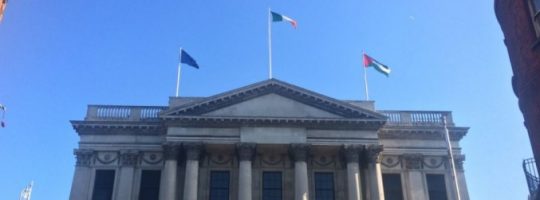
It has become the fourth Irish local authority to make such a move in recent months.
“I am delighted with [the] vote in solidarity with the people of Palestine. It might seem like a very small gesture but I know from the reaction to similar decisions made by other councils that today’s vote will be applauded across Palestine and elsewhere,” said Councilor Enda Fanning.
About 600,000 Israelis live in over 230 settlements built illegally since the 1967 occupation of the Palestinian territories.
Palestinian officials say they want the resolution of the conflict with Tel Aviv based on the so-called two-state solution along pre-1967 boundaries.
However, Netanyahu has on several occasions said Israel should maintain its military occupation of the West Bank under any agreement with the Palestinians.
In recent months, the Tel Aviv regime has stepped up its illegal settlement construction activities in the occupied lands and oppressive measures against the Palestinians, leading to an increase in global anti-Israel sentiment.
BDS gains support from US Mennonite churches
MEMO | July 12, 2017
The Mennonite Church of America has voted to sell its holdings in companies that profit from the Israeli occupation, according to the Washington Post.
The church, which has over 75,000 members voted by a majority of 98 per cent to support the Boycott Divestment Sanctions (BDS) campaign last week in Orlando.
The resolution voted upon, called on “individuals and congregations to avoid the purchase of products associated with acts of violence or policies of military occupation, including items produced in [Israeli] settlements.”
In a statement, the Mennonite Church explained its decision: “The Palestinian people have suffered injustices, violence, and humiliation, including … life under Israeli military occupation and in refugee camps throughout the Middle East.”
The church has also turned to their own $3 billion fund and asked investment managers to review all investment practices that may benefit the ongoing Israeli occupation.
Numerous churches in the US have also committed to a divestment campaign of Israeli goods, including the Presbyterian Church, the United Church of Christ, the Quakers, the Unitarian Universalists and the Evangelical Lutheran Church. Whilst the 12.8 million-member United Methodist church did not move to support BDS outright, they have barred investment in five Israeli banks citing human rights concerns.
Read also: BDS campaign supported by African churches
British government ‘content’ to let Palestine Expo proceed
MEMO | June 27, 2107
Despite the best efforts of Britain’s pro-Israel lobby, the organisers of the biggest-ever Palestine event in Europe have been told by the British government that it is “content to let the event proceed.” A spokesperson for the Department for Communities and Local Government (DCLG) advised the chairman of Friends of Al-Aqsa of the decision this morning.
Palestine Expo will be held at the Queen Elizabeth II Conference Centre in Westminster on 8 and 9 July. The organisers promise to provide a Palestinian social, cultural and entertainment event of a kind not seen before. Palestinians and their supporters from Jewish, Christian and Muslim faith backgrounds, as well as varied political perspectives, will be taking part.
The venue, which is on parliament’s doorstep in Westminster, comes under the remit of an agency within the DCLG. Pro-Israel lobbyists have been trying to have Palestine Expo 2017 cancelled, making what Ismail Patel of the organising group called “false and baseless allegations” against Friends of Al-Aqsa. The Secretary of State at the DCLG, Sajid Javid MP, had made it known to the organisers that he was “minded” to cancel the event, but representations by Friends of Al-Aqsa appear to have persuaded him otherwise.
Describing the government’s decision as “very good news indeed” for freedom of speech in Britain, Mr Patel said that this should enable people to book their tickets for the event with more confidence. “Advance ticket sales are already very healthy,” he explained, “but the DCLG decision will give them a welcome boost.”
Friends of Al-Aqsa’s chairman is confident that the British public will not be disappointed by the programme on offer. Speaking to MEMO, he emphasised the intention to foster good community relations and promote democratic means to end the occupation of Palestine. “We invite everyone who wishes to see peace in Palestine and champion freedom of speech to attend Palestine Expo,” he added.
Palestine: Another Desperate Cry for Help

By Stuart Littlewood | American Herald tribune | June 23, 2017
The National Coalition of Christian Organizations in Palestine (NCCOP) has just issued a final plea for help in the form of an open letter to the World Council of Churches and the ecumenical movement. It is signed by over 30 organisations in Jerusalem, the West Bank and Gaza and can be read in full here.
The problem is well known to everyone who’s paying attention. The letter recaps for us: “We are still suffering from 100 years of injustice and oppression that were inflicted on the Palestinian people beginning with the unlawful Balfour declaration, intensified through the Nakba [Palestinian ‘catastrophe’] and the influx of refugees, followed by the Israeli occupation of the West Bank including East Jerusalem and Gaza and the fragmentation of our people and our land through policies of isolation and confiscation, and the building of Jewish-only settlements and the Apartheid Wall.
“A hundred years later and there is still no justice! Discrimination and inequality, military occupation and systematic oppression are the rule…. Despite all the promises, endless summits, UN resolutions, religious and lay leader’s callings – Palestinians are still yearning for their freedom and independence, and seeking justice and equality.”
The letter harks back to the Amman Call of 2007. “We are concerned that ten years later the situation is worse…. the Amman Call did not achieve its goal of a just peace and we must ask ourselves today – why?”
Concern is also expressed at Israel’s “systemic assault on Palestinian creative resistance” (by which they mean BDS – boycott, divestment and sanctions), and on their partners worldwide who use BDS to persuade Israel to end the occupation.
“While we are grateful for the ‘costly solidarity’ articulated in the Amman Call and exercised by many churches around the world, we are concerned that some churches have weakened their positions in the last ten years as a result of pressure. Many still hide behind the cover of political neutrality, not wishing to offend their religious dialogue partners.”
So now they ask us to do the following:
1. Call things as they are: recognize Israel as an apartheid state in terms of international law and the UN ESCWA report which said: “Israel is guilty of imposing an apartheid regime on the Palestinian people”. They are concerned that States and churches continue dealing with Israel as if the situation were normal, ignoring the reality of occupation, discrimination and daily deaths. Churches united to end apartheid in South Africa, the WCC playing a pivotal role, and they are expected to do the same again in Palestine
2. Unequivocally condemn the Balfour declaration as unjust, and demand the UK asks forgiveness and compensates the Palestinian people for their losses. Unfortunately Zionist stooges in high places, like Theresa May, have said they will be celebrating the centenary of the Balfour Declaration “with pride” and inviting Mr Netanyahu along for the fun.
3. Take the strongest possible stand against any theology or Christian group that justifies the occupation and favours one nation over the other based on ethnicity or a covenant.
4. Take a stand against religious extremism and any attempt to create a religious state in Palestine or the region.
5. Challenge our religious dialogue partners, and withdraw from the partnership if they won’t condemn the occupation.
6. Encourage church leaders and pilgrims to visit Bethlehem and other Palestinian cities using Palestinian travel agencies, not Israeli.
7. In response to Israel’s war on BDS, defend the Palestinians’ right to resist non-violently, and support economic measures that pressure Israel to stop the occupation. Go further and include sport, cultural and academic measures until Israel complies with international law and UN resolutions.
8. Create lobby groups in defence of Palestinian Christians.
9. Urgently create a strategy within the WCC, like the programme “To Combat Racism”, to co-ordinate lobbying, advocacy and other activities aimed at achieving justice and peace and maintaining the presence of the Palestinian Christians.
“We fully grasp the pressure church leaders are facing here and abroad not to speak the truth, and it is because of this that we are raising this call,” says the NCCOP.
Their message ends with these ominous words: “Things are beyond urgent. We are on the verge of a catastrophic collapse. The current status-quo is unsustainable. This could be our last chance to achieve a just peace. As a Palestinian Christian community, this could be our last opportunity to save the Christian presence in this land.”
As I’m writing news has come in of a legal victory against the UK Government for trying to stifle BDS. The Government recently issued guidance to stop divestment campaigns against Israeli and international firms implicated in Israel’s violations of international law, and to protect the UK’s defence industry. Pension holders, for example, could have been forced into investing in companies complicit in human rights abuses contrary to their conscience and beliefs.
Thanks to action by the Palestine Solidarity Campaign the court held that the Government had acted improperly by seeking to use pension law to pursue its own foreign and defence policy. Parts of the guidance are now held to be unlawful and no longer applicable local government in their pension decisions.
Other last-gasp appeals
The Amman Call mentioned earlier was issued exactly ten years ago at the WCC’s International Peace Conference “Churches together for Peace and Justice in the Middle East” held in Amman, Jordan. It contained a number of imperatives.
- Enough is enough. No more words without deeds. It is time for action.
- The Churches are part of the conflict, because they cannot remain silent while there is still suffering.
- There is no military solution to the conflict, UN resolutions are the basis for peace and the Geneva conventions are applicable to the rights and responsibilities of the affected people.
- Palestinians have the right of self-determination and the right of return.
- Jerusalem must be an open, accessible, inclusive and shared city for the two peoples and three religions.
- Israeli settlements in the occupied Palestinian territories are illegal, and constitute an obstacle to peace, and Israel’s “Separation Barrier” is a grave breach of international law and must be removed.
The Kairos Document of 2009 called itself a “cry of hope in the absence of all hope”. They said they had “reached a dead end” in the tragedy of the Palestinian people and the decision-makers “content themselves with managing the crisis rather than committing themselves to the serious task of finding a way to resolve it”. The faithful were asking: What is the international community doing? What are the political leaders in Palestine, in Israel and in the Arab world doing? What is the Church doing? “The problem is not just a political one. It is a policy in which human beings are destroyed, and this must be of concern to the Church.”
Kairos told the international community to stop practising “double standards” and start implementing international resolutions. “Selective application of international law threatens to leave us vulnerable to a law of the jungle. It legitimizes the claims by certain armed groups and states that the international community only understands the logic of force.” So Kairos was calling for a system of economic sanctions and boycott to be applied against Israel – not as a revenge tactic but action to reach a just and definitive peace.
It also urged churches to revisit the fundamentalist positions that support the evil policies imposed on the Palestinian people, and to stop providing theological cover for the injustices they suffer.
Local action
These heart-rending pleas are all very well but churches are hard to mobilise. Some have flirted with BDS but only after much internal wrangling. Others have allowed themselves to be put off by interference from their interfaith partners.
What can we ordinary mortals do?
Well, I pop into churches randomly and ask what links they have with the Holy Land. They usually stare at me in blank amazement and an awkward silence follows. I therefore recommend a national campaign to visit all churches throughout the land and ask that same question. Shame them.
But you never quite know when you’re up against the ‘enemy within’ – the Christian Zionist. Many readers will remember The Jerusalem Declaration on Christian Zionism by the Patriarch and Local Heads of Churches in Jerusalem in 2006.
It says among other things:
- We categorically reject Christian Zionist doctrines as false teaching that corrupts the biblical message.
- We reject the alliance of Christian Zionist leaders and organizations with elements in the governments of Israel and the United States [add the UK] that are presently imposing their unilateral pre-emptive borders and domination over Palestine.
- We reject the teachings of Christian Zionism that support these policies as they promote racial exclusivity and perpetual war.
- We call upon all Churches that remain silent, to break their silence and speak for reconciliation with justice in the Holy Land.
- We call upon all people to reject Christian Zionism and other ideologies that privilege one people at the expense of others.
- We are committed to non-violent resistance as the most effective means to end the illegal occupation.
- And, of course, Palestinians are one people, both Muslim and Christian. Don’t anyone forget that.
Memorise it.
Did you ever hear any of the 26 Church of England bishops sitting in the House of Lords roundly condemn the British government’s unshakable support for the rogue regime in Israel that’s causing all this misery? No, they’re scared to death of ruffling the feathers of their ‘inter-faith dialogue’ partners and being branded antisemitic. And yes, the Church does have its fearless heroes but they are few and far between and not always tolerated. The Anglican Church by and large doesn’t give a damn about their brethren in the Holy Land or the military jackboot on their necks. And, by extension, they don’t give a four-x whether, in another 10 years, there will be any Christians left in the place where Christianity was born. No, maybe they will care, but by then it will be too late.
If I had my way every clergyman and every political leader calling him/herself a Christian would have the Jerusalem Declaration tattooed on their rump.
I’d like to invite some of them to spend a week with priests in the front line in Jenin, Nablus or Hebron for a real taste of life under brutal Israeli occupation; then queue for hours at daybreak with Palestinian workers in the obscene human holding pens at the Bethlehem checkpoint as they struggle to get to work… and home again; then watch Israeli bulldozers evict Palestinian families and destroy their homes for no good reason; then join Gaza fishermen as they try to earn a living while getting shot at in their own waters by Israeli gunboats; then stay with a Gaza family in the rubble, experience living with only 2 hours’ electricity a day, with the kids going to school in shifts and studying by candlelight; then sit down with Hamas ministers to learn what it’s like running this tiny, overcrowded enclave after 10 years of cruel blockade; then visit Gaza’s hospitals to see first-hand the crisis in medical equipment and spares; then watch the groups of young, uniformed Israeli gunslingers swaggering through the Old City of Jerusalem making that beautiful place so ugly….
The opportunities to learn the nasty truth about today’s Holy Land are endless.
And when they return home…. who knows, they might just feel pricked to do something about it. At least they could ensure every parish in England twins itself with a parish in the West Bank to offer solidarity and provide moral and material support.
Largest Israeli Public Transportation Company Loses Netherlands Contract Worth 190 Million Euros Following Campaign by BDS Activists
IMEMC News & Agencies – June 23, 2017
Last month, Egged Bus Systems (EBS), a subsidiary of Egged Israel Transport Cooperative Society, Israel’s largest public transportation operator, lost a bid for a decade-long contract to run public transportation in the North-Holland region of the Netherlands, which includes the country’s capital, Amsterdam. This contract was valued at 19.1 million euros a year, with a total worth of 190.1 million euros.
Egged Bus Systems lost this lucrative bid after Dutch BDS activists launched a campaign charging its Israeli parent company with facilitating grave violations of Palestinian human rights and international humanitarian law.
Specifically, Egged Cooperative operates Jewish-only buses to and between almost all of Israel’s illegal settlements built on stolen Palestinian land in the militarily occupied West Bank, including remote outposts and East Jerusalem.
Egged buses traveling on Israeli settlement bus routes bar access to Palestinians. They use an extensive network of roads built to seamlessly connect illegal settlements on both sides of the illegal Israeli separation Wall to cities within present-day Israel.
The company thus supports and profits from a racist, segregated bus system that actively facilitates the maintenance and expansion of Israel’s illegal settlements, which are themselves considered war crimes under international law.
A spokesperson for DocP, a coalition of Dutch BDS activists for Palestinian rights, said,
We are very happy with this result, with the fact that our regional government rejected Egged’s bid to run North-Holland’s public transportation system.
People can now step into a bus in Amsterdam without helping pay for Israeli apartheid buses that discriminate against Palestinians. Without helping normalize coming and going from Tel Aviv to illegal Jewish-only settlements built on stolen Palestinian land.
There is nothing normal about the daily oppression faced by Palestinians, and I’m heartened that our Dutch BDS campaigns are growing in popular support and showing results.
Riya Hassan, Europe’s campaigns officer for the Palestinian Boycott, Divestment and Sanctions National Committee (BNC) said:
Congratulations to all the activists, organizations and collectives in the Netherlands who successfully built on their earlier BDS campaigns to exclude from their communities a powerful Israeli transportation company that profits from segregated busing, segregated roads and segregated Israeli settlements illegally built on stolen Palestinian land.
You have helped ensure that the regional council of North-Holland adheres to its own obligations under international law by not aiding and abetting Israel’s serious violations of Palestinian rights.
Egged Cooperative has also been accused of putting its Palestinian drivers in harm’s way, and not doing enough to protect them from violent Israeli extremists. In 2014, 100 Palestinian Egged bus drivers resigned fearing attacks by Israeli settlers and after Palestinian Jerusalem-line bus driver Yusuf Hassan al-Ramouni was found dead and hanging in an Egged bus.
Egged Bus Systems was one of four companies bidding for the lucrative public transportation contract in the Netherlands. The winning company Connexxion, a Dutch public transportation company, will provide buses and run public transportation in North-Holland for the next 10-years, beginning in July 2018.
Connexxion is itself owned by Veolia, a French corporate giant which was complicit in the Israeli occupation until an extensive BDS campaign cost it tenders around the world estimated to be worth over $20 billion, causing it to exit the Israeli market. Veolia and Connexxion have ended their complicity with Israel’s violations of Palestinian human rights, but have yet to pay reparations to the Palestinian communities they harmed, and campaigners are still demanding that they do so.
US police arrest anti-nuclear weapons activists at UN
Press TV – June 20, 2017
A number of anti-nuclear weapons activists have been arrested in New York during a protest against Washington’s decision to boycott negotiations on a nuclear weapons ban treaty.
The arrests were made after the activists chanting slogans such as “US join the talks, ban the bomb,” blocked the entrances to the US mission to the United Nations.
The protesters sat in front of the doors before the police moved in. police said they warned the demonstrators that they would be arrested if they did not leave the place.
In March, US Ambassador to the United Nations Nikki Haley announced that the United States, Britain and France had decided not to join talks on a nuclear weapons ban treaty.
The United Nations is currently holding a second round of negotiations about the issue.
The world body adopted a resolution in December to negotiate a legally binding instrument to prohibit nuclear weapons, leading toward their total elimination and encouraged all member states to participate.
A total of 113 nations voted in favor of the resolution but 35 countries, including the United States, Britain and France, voted against it. Thirteen countries abstained.
According to the US military’s recent declaration, the United States has 806 deployed ICBMs (intercontinental ballistic missile), SLBMs (submarine-launched ballistic missile), and heavy bombers as well as 1,722 deployed nuclear warheads.
The Pentagon is also equipped with a multiple independently targetable reentry vehicle (MIRV), a highly advanced version of the intercontinental nuclear missile carrying several independent warheads.
Palestine Scholars: Qatar stood by Gaza when nobody else did
Palestine Information Center – June 18, 2017
GAZA – Head of the Palestine Scholars Association, Dr Marwan Abu Ras, lauded Qatar’s pro-Palestine position and stressed Palestinians’ support for the government and people of Qatar.
“We are here today, in the blockaded Gaza Strip, to tell the world that our sole enemies are the Israeli colonizers who forced us out of our own and only lands,” said Abu Ras. “It is high time Arabs and Muslims combined forces in the face of the Israeli occupation.”
“We, Palestine Scholars, hail all those who have rallied round the Palestinian people and Gaza. We are most grateful to Qatar which has left its stamp in every street and at every home in besieged Gaza,” he said.
“Our homes have been lit, infrastructure rehabilitated, and hospitals equipped thanks to Qatar,” added Abu Ras as he paid tribute to the Qatari government and NGOs.
He slammed the Israeli occupation and all the other parties who have been involved in underway schemes to tighten grip around Gazans’ neck and famish the Palestinians.
Corbyn and UK Labour Victory Signals Pro-Palestine Mood, Diminished Israeli Legitimacy

Jeremy Corbyn at a pro-Palestinian rally in London, 2014. | Photo: Palestine Solidarity Committee
teleSUR | June 9, 2017
Jeremy Corbyn’s gains in the British general election mollified his political opponents, ranging from Rupert Murdoch’s yellow press to officials Tel Aviv, drawing outrage due to his support for causes considered taboo in Western capitals. Foremost among these causes is the popular opposition to Israeli war crimes and settler-colonialism in Palestine.
In fact, the Israeli state was established thanks, in no small part, to the British Empire’s occupation of the region following the collapse of the Ottoman Empire, with Labour Party support playing a crucial role in laying the early groundwork for the state’s creation. Labour’s support for Zionism began when Sidney Webb, a founding leader of the Fabian socialist movement, penned the Memorandum on the Issues of War in August 1917, three months before the issuance of the Balfour Declaration, which recommended the creation of a “national home for the Jewish people.”
The document codified British Labour’s embrace of the First World War on the grounds that “the world may henceforth be made safe for democracy” through British war efforts while ironically denouncing “the imperialist aims of governments and capitalists” in the Middle East. The document also made a firm commitment to the resettlement of Jews in Palestine, calling for a “free state” to which European Jewry would be entitled the right to “work out their salvation, free from interference by those of alien race and religion.” Of course, British support for Zionism was a cynical and self-serving means to advance its own geopolitical interests in the region.
Labour’s 2017 election manifesto reflected, to some extent, a pro-Palestine mood among the party’s increasingly young support base that resembles Corbyn’s own record of solidarity with the Palestinian cause. In addition to revealing a social democratic aspect of Labour long suppressed or hidden from sight, the document stated the party’s commitment to a “two-state solution” to Israeli expansionism in Palestinian territories, warning Israeli authorities that it won’t tolerate further militarist excesses. It also states that a Labour government would “immediately recognize” the de jure Palestinian West Bank state. The manifesto further calls for a “world free from all forms of racism, anti-Semitism and Islamophobia.”
However, the Israeli lobby – through the Labour Friends of Israel and the press – spared no effort to have references to West Bank settlements as “wrong and illegal” removed from the final draft of the party platform while also axeing a line referring to the “the continued humanitarian crisis in the Occupied Palestinian Territories.” The manifesto also falsely equates Palestinian resistance “rocket and terror attacks” with the highly-advanced, destructive weaponry of the Israeli state.
The equivocation surrounding the drafting of points on the Israeli-Palestinian “conflict” raised questions about Corbyn’s willingness – or, rather, his ability – to consistently stand alongside the Palestinian struggle for self-determination while simultaneously leading Britain’s institutional center-left party.
Corbyn himself has visited Palestine nine times, in addition to multiple visits to refugee camps in Lebanon and Syria. In 2013, following his return from the Gaza Strip, he wrote to then-Foreign Secretary William Hague and urged that the U.K. “stop allowing Israel’s criminal politicians to come to our country.” The Labour leader has also called for the lifting of the blockade on Gaza, an end to the abuse of Palestinian civilians by Israeli occupation forces, and the holding of Israeli politicians accountable for crimes against humanity and other rights abuses.
While Corbyn has conceded that the two-state solution would be difficult to implement given the significant Israeli-backed illegal settlement activity in the West Bank, he remains a supporter of the widely-discredited proposal as “all that’s on offer.” To his credit, though, Corbyn is on record noting that the fundamental “key” to addressing the root of the tragedy is ensuring the Palestinian people’s right to return to the homes and lands from which they were ethnically cleansed during the Nakba of 1948 and the 1967 Israeli onslaught and annexation of remaining Palestinian territories.
While not a supporter of the Boycott, Divestment and Sanctions (BDS) movement’s call to reject Israeli cultural, academic and economic products – a call seen as “reasonable” by two of five Brits from across the political spectrum, according to recent polls – he has called for “targeted” boycotts of universities involved in weapons research and the boycott of goods produced in illicit Israeli settlements in the Occupied Territories. Despite that, the Labour manifesto fails to call for sanctions on the Israelis.
Corbyn also advocates engaging in diplomacy with regional players such as Palestinian Hamas and Hezbollah of Lebanon, noting their significant support base and the fact that, whether Tel Aviv likes it or not, they represent mass popular opinion in their respective countries.
Predictably, Britain’s right-wing – including many among the aggressively pro-U.S. Blairite New Labour clique – frantically sought to brand Corbyn’s humanitarian support for the Palestinian people as a reflection of “the new anti-Semitism,” a slur commonly applied to any stance opposing Israeli war crimes and impunity to the slightest extent.
Ultimately, British voters seemed unmoved by alarmist calls denouncing Labour as a bigoted party. This was proven when people from all walks of life – including British Jews – turned out in droves to support the party’s program and its candidates.
Labour’s victory came in spite of the hyperbolic attacks on Corbyn, perhaps signaling the shifting winds of public opinion regarding the Israeli occupation.
However, the longer-term question of whether an ascendant Corbyn will be able to sideline or dislodge U.S.-loyal and pro-Zionist layers within his own party – or resist the temptation to compromise with the Israeli lobby for the sake of political expediency – remains yet to be seen.
Major Chilean Universities Heed BDS Call, Cancel Events Sponsored by Israeli Embassy
IMEMC | June 10, 2017
 Student-led BDS campaigns resulted in two major Chilean universities canceling events co-sponsored by the Israeli embassy and featuring Joe Uziel, a director of the Israel Antiquities Authority (IAA). On Monday, Alberto Hurtado of the University’s Anthropology Department announced the event’s cancellation, and yesterday the University of Chile’s Social Sciences Faculty did the same.
BDS Chile highlighted the reasons behind the campaign to cancel the event:
Universities cannot be passive accomplices in grave human rights violations. The State of Israel maintains an illegal occupation, colonization and apartheid regime against the Palestinian people, and the Israeli Embassy is this regime’s representative in Chile. In addition, the Israel Antiquities Authority is a government entity illegally based in occupied East Jerusalem that carries out illegal excavations in the occupied Palestinian West Bank. Some of these illegal excavations are directed by the invited speaker, Joe Uziel.
The confiscation and theft of Palestinian cultural heritage are part of Israel’s attempts to erase Palestinian memory and cultural identity. Since 1967, the IAA has been deeply involved in cultural crimes and serious violations of international law, such as illegally removing and plundering hundreds of thousands of precious artifacts from the Occupied Palestinian Territory (OPT), including East Jerusalem. Fearing BDS campaigns, Israel has been trying to prevent information about archeological work in the OPT from being made public and to whitewash these violations by promoting events like these abroad.
Sharaf Qutaifan, from the Palestinian Campaign for the Academic and Cultural Boycott of Israel (PACBI) said:
Through the Israel Antiquities Authority, Israel attempts to bury the history of the indigenous people of Palestine, which was always home to groups with diverse cultures and religions. This is an extension of Israel’s policies of expulsion and cultural theft that it has carried out against Palestinians since its establishment. Israel has a troubling record of systematically looting Palestinian lands and properties, cultural treasures and even books and artworks, which continues until today.
We salute the Chilean students for pressuring the Anthropology Department of Alberto Hurtado University and the Social Sciences Faculty of University of Chile to take principled positions. Academic institutions should not lend their good names to Israel’s denial of Palestinian rights. We hope to see all Chilean universities fully free of Israeli apartheid.
BDS Chile celebrated the victory:
We welcome the decisions of Alberto Hurtado University and the University of Chile. The Palestinian people expect principled acts of solidarity in support of their human rights and the respect of international law. These cancellations demonstrate Chilean students’ determination to denounce Israel’s oppression and to work towards interrupting our universities’ ties with institutions complicit in Israeli apartheid.
This latest news is another stride in the growing academic boycott of Israel in Chile. Last year, law faculty students at the University of Chile overwhelmingly voted in support of BDS, as did more than 90% of the social sciences students. At the Catholic University of Chile, the Student Council also passed a BDS resolution by a large majority.
The cancellations are also another strike against the Israel Antiquities Authority. At the end of 2016, the 8th World Archaeological Congress published a resolution condemning Israel’s excavations in the Occupied Palestinian Territory and called on international academic publishers to refuse publishing works related to archaeological research in those areas.
The Palestinian Campaign for the Academic and Cultural Boycott of Israel (PACBI) was initiated in 2004 to contribute to the struggle for Palestinian freedom, justice and equality. PACBI advocates for the boycott of Israeli academic and cultural institutions, given their deep and persistent complicity in Israel’s denial of Palestinian rights as stipulated in international law. Visit PACBI at https://bdsmovement.net/pacbi and follow us on Twitter @PACBI
Featured Video

Trita Parsi: Israel Set a Trap for Total War in the Region
or go to
Aletho News Archives – Video-Images
From the Archive
Zionism’s Violent Legacy
By Donald Neff | Washington Report On Middle East Affairs | January 1996
On January 4, 1948, Jewish terrorists drove a truck loaded with explosives into the center of the all Arab city of Jaffa and detonated it, killing 26 and wounding around 100 Palestinian men, women and children.[1] The attack was the work of the Irgun Zvai Leumi – the “National Military Organization,” also known by the Hebrew letters Etzel – the largest Jewish terrorist group in Palestine. The Irgun was headed by Revisionist Zionist Menachem Begin and had been killing and maiming Arabs, Britons and even Jews for the previous ten years in its efforts to establish a Jewish state.
This terror campaign meant that at the core of Revisionist Zionism there existed a philosophical embrace of violence. … continue
Blog Roll
 Aletho News
- Trita Parsi: Israel Set a Trap for Total War in the Region
- Trump’s Iran war is on an Israeli leash
- Saudi oil boss issues global supply warning
- Riyadh Says Its Oil System Is Intact. The Numbers Say Otherwise.
- Trump and Netanyahu Want to “Finish the Job” on Iran
- US ‘one-sided dictation’ not Iran’s beliefs makes rational talks impossible: Baghaei
- Iran’s Next Strike May Not Explode. It Could Shut You Down /Col Doug Macgregor
- Iran: US political targets legitimate if assassinations return
- Iraq shuts key border crossing with Iran under US pressure: Report
- Undersea Internet cables could be targeted in retaliation for attacks on Iran: IRGC deputy chief
- If Americans Knew
- The Israel Lobby’s Changing Fortunes
- AIPAC has become such a political liability that it’s shifting to a more “nimble” approach to buying politicians
- At least 160 Israeli settler attacks in 2 weeks
- Will Gaza’s Ancient Christian Community Disappear Forever?
- Israel’s vision of regional security rests on keeping Arab states weak
- Heidi Levine recounts how Palestinian youths helped save her in settler attack
- DAILY UPDATE: Latest essential news on Palestine, Israel, & region
- Trump’s Intensifying Sabotage of the ICC, for Israel’s Sake
- Israeli military detain US and UK volunteers in West Bank including Democratic NY politician Brad Lander
- Americans at National Conservatism Conference held in Israel this year criticize Israel
- No Tricks Zone
- E-Cars Reduce CO2 Emissions By Only 41% Compared To Internal Combustion Engine Vehicles
- Predictions Made By Renowned Climate Professor Over Past Decades Have Been Proven To Be Poor
- New Study Suggests Large Regions Of The Pacific Ocean Have Been Cooling For The Last 80 Years
- Germany’s Green Energy Debacle: High Energy Costs Force Kahla Porzellan to Close After 182 Years!
- New Study: 50 Years Of The Most Aggressive ‘Net Zero’ Policies Can Only Affect The Global Climate By 0.03°C
- US September “Heat” Was No Record…Many Records Set Decades Ago
- Latest European Green Energy Debacle; Portugal’s Largest Flagship Solar Park Insolvent!
- Green Energy Debacle: German Expert Professor Fritz Vahrenholt Warns Of Severe Economic And Social Consequences
- Two More Paleo Reconstructions Affirm Meters-Higher Sea Levels Across Ireland, Brazil 7000-6000 Years Ago
- New Study: Earth And Venus Surface Warmth Largely Explained By Convection And Lapse Rate, Not CO2 Or Radiation

