Israeli court sentences Sheikh Raed Salah to nine months in prison
MEMO | April 19, 2016
 The Israeli Supreme Court has sentenced Sheikh Raed Salah, head of the Northern Branch of the Islamic Movement, to nine months in prison over charges of “inciting violence” in a religious sermon dating back to 2007, Anadolu reported on Monday.
The Israeli District Court in Jerusalem sentenced Sheikh Salah to 11 months in prison, giving him permission to appeal to the Supreme Court, which reduced the sentence to nine months.
Deputy Head of the Islamic Movement in Israel, which was banned in November last year, Sheikh Kamal al-Khatib condemned the ruling against Sheikh Salah, describing it as “absolutely political” and aimed at keeping him far from Jerusalem and Al-Aqsa Mosque.
On 16 February 2007, Salah delivered a sermon in Wadi al-Juz in the Old City of Jerusalem. Over remarks in that sermon, the Israeli court charged him with “inciting violence” and “inciting hatred”.
In March 2014, the Magistrate Court charged Sheikh Salah with “inciting violence” over this sermon, but acquitted him of “inciting hatred” and sentenced him to eight months.
Then, the District Court called for charging him with “inciting hatred” and to sentence him to 18 to 40 months. In October 2015, it sentenced him to 11 months, giving him the permission to appeal to the Supreme Court.
Palestinian youth and students among 11 raided and arrested by Israeli occupation forces
Samidoun Palestinian Prisoners Solidarity Network | April 19, 2016
 Israeli occupation soldiers arrested 11 Palestinians in dawn raids on Tuesday, 19 April, focusing on students and youth. Three students at Al-Quds University’s Abu Dis campus – Noor al-Islam Darwish, Hala Beitar and Salam Abu Sharar, all women – were raided and arrested in Ramallah.
Majd Yousef Atwan, 22, from al-Khader near Bethlehem, a recent beauty school graduate, was arrested in a 2:00 am army raid on her home; her father said that she was being accused of “incitement for Facebook postings.”
Many students and youth have been arrested by Israeli occupation forces in the run-up to Palestinian campus elections; while many Palestinians are being persecuted for Facebook posts, including poetry.
Murad Mohammed Taqatqa and Walid Issa Taqatqa of Beit Fajar near Bethlehem were also arrested by occupation forces, as was Abdel-Rahim Mahmoud Awad from Beit Awwa near al-Khalil. Ahmed Nidal Awel, 20, and Ayman Farouk Barham, 35, were arrested by Israeli occupation forces in Kufr Qaddoum.
In Al-Ram, north of Jerusalem, the Israeli forces shot a 15-year-old boy in the leg at the entrance to the village as they invaded it; Palestinian Red Crescent medics reported they were prevented from accessing the boy to provide medical care and that he was then arrested by the occupation forces. Another al-Ram resident was also arrested.
Palestinian Prisoners Day Statement: In Struggle, Towards Liberation
Samidoun Palestinian Prisoner Solidarity Network – April 17, 2016

On 17 April, Palestinian Prisoners’ Day, Samidoun Palestinian Prisoner Solidarity Network salutes the struggle of 7,000 Palestinian prisoners inside Israeli jails: struggling for not only their own freedom, but for the freedom of the land and people of Palestine. Palestinian prisoners struggle through torture, solitary confinement, abuse, repression, denial of family visits, arbitrary imprisonment and brutal racism on a daily basis. Yet they not only persist and exemplify “samidoun” – those who are steadfast – the Palestinian prisoners are leaders of the Palestinian liberation movement, and of the global struggle for justice and liberation.
Each year, on 17 April, in Palestine and around the world, Palestinians and supporters of justice in Palestine come together to review the situation of Palestinian prisoners and demand their freedom. It is an opportunity to renew our work and our activity to free Palestinian prisoners, and to examine the last year of struggle, inside and outside the prison walls.
Imprisonment has always been a weapon of colonialism in Palestine. From the British colonizers who suppressed Palestinian revolts through mass imprisonment, home demolitions, and execution – and who first imposed the “emergency law” of administrative detention used against Palestinians today – to the Zionist colonizers who for 68 years have imposed a system of occupation, apartheid, criminalization, racism and dispossession upon the Palestinian people, the colonizers of Palestine have imprisoned strugglers, leaders, fighters, and visionaries. Imprisonment targets all sectors of the Palestinian people: workers, strugglers, teachers, journalists, doctors and health workers, farmers, fishers; from Jerusalem, the West Bank, the Gaza Strip, Occupied Palestine ’48; refugees in the camps inside Palestine and around the world – millions denied their right to return and yet pursued and imprisoned in international jails.
In the past year, as throughout this history of struggle, we have witnessed time and again the resilience, resistance and struggle of Palestinian prisoners. It is not only the case that thousands of Palestinians have been jailed since October 2015 in an attempt to stop the rising intifada in the streets and villages of Palestine; it is also the case that Palestinian prisoners are engaged in daily intifada, daily resistance, behind the prison walls. They are part of the struggle – indeed, leaders in the struggle – confronting occupation, colonialism, settlements, home demolition, land confiscation and extrajudicial executions.
From Palestinian lawyer Muhammad Allan, to Palestinian journalist Mohammed al-Qeeq, to baker and resistor Khader Adnan, to the strugglers of the “Battle of Breaking the Chains” – Nidal Abu Aker, Ghassan Zawahreh, Shadi Ma’ali, Munir Abu Sharar and Badr al-Ruzza – Palestinian prisoners have put their bodies on the line in hunger strikes, demanding not only their own freedom but an end to the system of administrative detention without charge or trial that currently holds approximately 700 Palestinians in Israeli prisons. Today, Sami Janazrah, Fouad Assi, and Adib Mafarjah are on hunger strike against administrative detention. Eyad Fawaghra is refusing food, demanding an end to the denial of family visits. Shukri Khawaja is demanding an end to solitary confinement, joined by up to 88 other Palestinian prisoners expressing their solidarity in daily hunger strikes.
Today, 17 April, thousands of Palestinian prisoners are refusing food in a one-day hunger strike in support of prisoners in Nafha subject to violent attacks by Israeli occupation prison guards and special forces on 14 April. Throughout the prisons of the south, prisoners have joined across political lines in rejection of the violent raids that are a constant of Palestinian prisoner life in Israeli jails.
Statistics: Israeli jails hold approximately 7,000 Palestinian prisoners. These include over 400 children and 70 women prisoners, held in 22 prisons and interrogation centers. There have been 4,800 arrests since October 2015, including 1,400 children and minor teens. Approximately 700 Palestinians are held in administrative detention without charge or trial.
Women Prisoners: The number of women prisoners is now 68, including 17 girls under 18. Imprisoned in Hasharon and Damon prisons, injured women prisoners are being denied access to needed medical services and are instead supported by their fellow prisoners. The longest-serving woman prisoner, Lena Jarbouni, has been imprisoned since 2001. The youngest girl prisoner, Dima al-Wawi, is 12 years old. Khalida Jarrar. Palestinian parliamentarian, leftist and prisoner advocate, serving a 15-month sentence, is also among the women prisoners at Hasharon.
Administrative Detainees: Approximately 700 Palestinians are imprisoned without charge or trial under administrative detention by Israeli military order. Administrative detention orders are issued on the basis of secret evidence hidden from both the detainee and their lawyer. These orders are indefinitely renewable and are often renewed repeatedly over years.
Sick and ill prisoners: Over 1,700 sick prisoners inside Israeli jails suffer from various diseases, worsened by ill treatment, delay and denial of medical care, and dismissal of medical issues. Dozens of Palestinian prisoners suffer from serious diseases, including cancer, heart disease, kidney disease, rheumatoid arthritis, stomach ulcers and high blood pressure. There are 24 prisoners with cancer in Israeli prisons, and 23 Palestinians permanently confined in the Ramle Prison Clinic, infamous among Palestinian prisoners for its poor treatment. Some of them are unable to move from their hospital beds. Despite severe illness, they are consistently denied medical release or access to private physicians.
Child Prisoners: Over 400 Palestinians under 18 are imprisoned. Many are arrested in traumatic and violent night-time military raids on their homes, and Palestinian child detainees report very high levels of physical and psychological abuse and torture. Six children are held in administrative detention. Several Palestinian children between the ages of 12 and 14 are imprisoned in Israeli jails. Recent reports from Defence for Children International Palestine and Human Rights Watch highlight the abuse of Palestinian children in Israeli detention, interrogation and imprisonment.
Former Prisoners, Re-Arrests and Pursuit: Former prisoners, including over 70 released in the 2011 Wafa al-Ahrar prisoner exchange for captured Israeli soldier Gilad Shalit, are pursued for renewed arrest and imprisonment. Under Israeli Military Order 1651, released prisoners in an exchange face the reimposition of their original sentence at any time on the basis of “secret evidence.” As in administrative detention cases, Palestinian prisoners and their lawyers are denied access to this evidence, which can include allegations such as “association” or “support” for a “prohibited organization,” a category which includes all major Palestinian political parties. 47 former prisoners have seen their sentences reimposed under this order. The targeting of former prisoners does not only happen inside Palestine. The pursuit, attempt to extradite, and killing of Omar Nayef Zayed in the Palestinian Embassy in Sofia, Bulgaria emphasizes the global nature of this targeting. Rasmea Odeh, Palestinian community leader in the United States, is threatened with imprisonment and deportation on the basis of her imprisonment – and torture – by Israeli forces in the 1960s and 1970s.
Torture is a constant reality of Israeli occupation arrest, detention and interrogation of Palestinians, including beatings, psychological torture, threats and insults, including threats of sexual abuse and violence and threats to family members; forced stress positions and shackling; sleep deprivation; long-term solitary confinement and isolation.
Palestinians are facing ongoing and increasing attacks. The extrajudicial execution of Palestinians under the control of Israeli occupation soldiers – including but not limited to the filmed and photographed executions of Abdelfattah Al Sharif and Hadeel al Hashlamoun – are a new attack on Palestinians that is part and parcel of the same system of terror and repression that carries out mass arrests and violent dawn raids on Palestinian homes. This comes alongside the ongoing imprisonment of the bodies of Palestinians killed by Israeli occupation soldiers. Some Palestinian corpses have been held for over 30 years. Today, the Israeli occupation forces continue to withhold 15 bodies of Palestinians. Nearly every week brings news of a new racist and repressive law being considered or enacted by the Israeli occupation: the “Law to Prevent Harm Caused by Hunger Strikers” permitting forced feeding; lengthy sentences for stone throwing; the imprisonment of 12-year-old Palestinians; threats to execute Palestinian prisoners.
The imprisonment of Palestinians is a collective attack on the Palestinian people and their struggle for liberation. These are not individual cases, but part of the comprehensive attempt of a colonial power to erase and suppress the indigenous Palestinian people and their collective struggle. We see this in the criminalization of Palestinian political parties, all declared “prohibited” by military order, and the military courts and trials that convict Palestinians at a rate of over 99% on the basis of these military orders that govern occupied Palestine. We see this in the targeting of Palestinian student organizers and leaders like Abdullah Ramadan, Asmaa Qadah and Donya Musleh, the ransacking of student blocs’ offices and the attempt to disrupt the vibrant political life of Palestinian students on campuses. We see this in the increased threats of arrests or denial of residence made against Palestinian BDS organizers and activists building the international movement for boycott, divestment and sanctions against Israel. And we see this, of course, in the imprisonment of Palestinian political leaders like Ahmad Sa’adat, General Secretary of the Popular Front for the Liberation of Palestine; Marwan Barghouthi, Fateh leader; Khalida Jarrar, Palestinian parliamentarian and prisoners’ advocate; Hassan Yousef, Hamas leader and Palestinian Legislative Council member; and the countless local leaders targeted for administrative detention and military trials.
We see this in the imprisonment of over 18 Palestinian journalists – 43 in the past six months – and the forced closure of Palestinian TV and radio stations, and in the targeting of Palestinian researchers and human rights defenders like Eteraf Rimawi of Bisan Center, and also in the administrative detention of teachers like circus trainer Mohammed Abu Sakha, 24, who combined Palestinian identity with circus performance as he taught numerous Palestinian children.
We also see the targeting and imprisonment of Palestinians and strugglers for Palestine in international courts and prisons. Georges Ibrahim Abdallah, Lebanese Arab communist struggler for Palestine, has been imprisoned in French jails for 32 years, despite being eligible for release for 16 years. Hillary Clinton – today a US presidential candidate – personally intervened to pressure the French state to overturn its own judiciary to keep him imprisoned. The interior minister who agreed to do so, Manuel Valls, today threatens and supports the prosecution of dozens of Palestine solidarity activists across France for calling for boycott, divestment and sanctions against the Israeli state for its ongoing crimes against Palestinians. In the United States, the Holy Land Five are serving lengthy sentences for fundraising for charity for Palestinians among the Palestinian community. Rasmea Odeh, torture survivor and community leader, is facing imprisonment and deportation because of her time in Israeli prisons. Omar Nayef Zayed was pursued in Bulgaria for extradition and renewed imprisonment over 25 years after he escaped Israeli prisons, only to be found dead inside the Palestinian Embassy in Sofia, where he had taken refuge, on 26 February.
Towards Liberation
Just as imprisonment is a collective experience, the resistance struggle for the liberation of the prisoners is also collective. As the Palestinian Human Rights Organizations Council noted in their statement for Palestinian Prisoners’ Day, “The issues of prisoners transcends one of individual human rights; it is also one of collective rights of an entire people – the Palestinian people, who continue to be deprived of the right to self-determination and sovereignty.”
And so the struggle to liberate Palestinian prisoners – and all political prisoners – is not simply a struggle for an individual human right, but for collective liberation from occupation, apartheid and settler colonialism. This is one reason why this struggle finds such resonance with other struggles for justice and liberation, linked in collective confrontation of oppression, imperialism, settler colonialism, Zionism and racism.
The movement to boycott G4S, the British-Danish security conglomerate that provides security systems, equipment and control rooms for Israeli prisons, checkpoints and police training centers – and youth imprisonment, migrant detention and deportation contracts in the US, UK and Australia – has grown even more in the past year. Palestinian prisoners and Palestinian civil society organizations joined with hundreds of international organizations to demand the UN stop doing business with G4S, a demand that has achieved clear victories in Jordan and elsewhere. In the United States, prison divestment movements challenging the mass incarceration of Black youth and other oppressed communities in the US have won divestment from G4S and the cancellation of its contracts at multiple universities. Indeed, the collective movements against G4S have garnered so much strength that the corporation announced that it would be selling off its Israeli subsidiary and exiting other “reputationally damaging” industries like youth incarceration in the US and UK within the next one to two years. At the same time, on a daily basis, G4S and its “security” technology continue to contribute to the insecurity and oppression of Palestinians and other oppressed people. The struggle to boycott G4S must continue until it is out of occupied Palestine and the prison business.
Palestinian prisoners called for “the inclusion of our cause, as prisoners of freedom and fighters for the freedom of our people, human dignity, and the right to a dignified life, within the program of the boycott movement as a major issue of paramount importance.” The struggle of Palestinian prisoners is an essential and powerful part of BDS and boycott struggles, and builds our solidarity and our responsibility to act in support of other oppressed peoples and communities.
As the Black4Palestine statement highlighted, “Israel’s widespread use of detention and imprisonment against Palestinians evokes the mass incarceration of Black people in the US, including the political imprisonment of our own revolutionaries. Soldiers, police, and courts justify lethal force against us and our children who pose no imminent threat. And while the US and Israel would continue to oppress us without collaborating with each other, we have witnessed police and soldiers from the two countries train side-by-side.”
The United States, European Union and Canada are complicit in the imprisonment of Palestinians, funding Israel and its military, supporting its military research and development and defending it in international bodies from prosecution or condemnation for its oppression of Palestinians. At the same time, these states are responsible for the detention and incarceration of migrants, the mass targeting, criminalization and oppression of Black communities, police repression, racist incarceration in countries throughout Europe, and the colonial repression of Indigenous people and communities. These policies represent one logic, that of imperialism.
At the same time, these forces are confronted by a growing movement of joint struggle against racist imprisonment and mass incarceration, in North America and around the world. Black communities, migrant justice movements, Indigenous movements and others have been leading powerful upsurges against the state repression, violence and incarceration targeting entire communities and oppressed peoples. Palestinian and pro-Palestinian activists and organizations are involved – and must be more deeply so – in all of these critical struggles.
These powerful grassroots movements – including the movement for justice in Palestine – are witnessing breakthroughs on a popular level, witnessing real, mass public demand for an end to the policies of mass incarceration and the state violence of imprisonment and police repression. Prison divestment and abolition movements and demands are growing, gathering allies and support.
The movement to free Palestinian political prisoners – and to free Palestine – is a movement to confront settler colonialism, Zionism and imperialism. It is connected deeply to movements to free international political prisoners imprisoned by the same forces: Mumia Abu-Jamal, Leonard Peltier, Oscar Lopez Rivera, Ricardo Palmera, the political prisoners of the Philippines, of the Black Liberation Movement, and all prisoners jailed for their struggle for justice.
On 17 April 2016, Palestinian Prisoners’ Day, it is critical to escalate the struggle; to consolidate and build on the victories achieved in the G4S campaign; to deepen our collective movements against mass incarceration, racism, police repression and state violence; to raise high the voices, ideas and visions of imprisoned Palestinians, leaders in the struggle for a free and liberated Palestine; and to do everything we can, at grassroots, popular and official levels, to support the demands of the Palestinian prisoners, to seek the freedom of the Palestinian people, and to hold accountable and prosecute the Israeli officials responsible for their oppression and torture in all international arenas, from prosecutions in the International Criminal Court to the international grassroots isolation of settler-colonial Israel through BDS campaigns.
We invite activists and organizations to build on and intensify their work on Palestinian prisoners in the coming year, as we seek to do this in our own organizing. We invite organizers to form Samidoun chapters in your own cities and areas, or to form Samidoun committees and subcommittees to work on Palestinian prisoners in your existing organizations. To join us, please email us at samidoun@samidoun.net.
Mexican Federal Agents Implicated in Students’ Disappearance
teleSUR – April 14 2016
Two Mexican federal police officers allegedly participated in the disappearance of 43 Ayotzinapa students, the National Human Rights Commission said Thursday, implicating national agents in the 2014 case for the first time, Agence France-Presse reports.
Jose Larrieta Carrasco, a commission official investigating the case, said the authorities should now look into a “new route in the disappearance” of the students.
Prosecutors have already charged municipal police officers in connection with the mass abduction in the southern city of Iguala on September 26-27, 2014.
But the governmental rights commission said it found an eyewitness who saw two federal agents near Iguala’s courthouse, where municipal officers had stopped a bus carrying 15 to 20 students.
The commission also said another local police department, from the town of Huitzuco, had a previously unknown role in the disappearance.
Many in Mexico, including the families of the disappeared, suspect that the police force was ordered to kill the student protesters by high level members of a local cartel.
European parliamentarians urge release, EU action on case of Khalida Jarrar

samidoun – Palestinian Prisoner Solidarity Network | April 12, 2016
23 Members of European Parliament directed a letter today, 12 April, to Federica Mogherini, High Representative of the European Union for Foreign Affairs, expressing their “great concern with the arrest, detention and sentencing of the Palestinian Legislative Council member Khalida Jarrar.” Jarrar, a prominent Palestinian leftist, feminist and advocate for political prisoners, is serving a 15-month term in Israeli prison; she was arrested on 2 April 2015.
The MEPs called on Mogherini to raise Jarrar’s case with the Israeli government and demand her immediate release, that the issue of Palestinian political prisoners is raised and investigated, and that the EU mission in Israel and future EU delegations visit Jarrar and fellow Palestinian prisoners.
Further, they raised the overall situation of Israeli military courts, which convict Palestinians at a rate of over 99%, the transfer of Palestinian prisoners inside Israel, and new legislation threatening heavy sentences for children and stone-throwers, as well as the legislation allowing force-feeding of hunger strikers.
The letter, signed by members of the Socialists & Democrats (S&D), European United Left/Nordic Green Left (GUE/NGL), Alliance of Liberals and Democrats for Europe (ALDE), Greens/European Free Alliance (Greens/EFA), and Europe for Freedom and Direct Democracy (EFDD) groups in the Parliament, highlighted the injustice of Israeli military courts and the nature of “prohibited organization” charges which deny Palestinian freedom of association and criminalize Palestinian politics. The letter discussed the nature of the charges against Jarrar, which focused on public political activity and speeches, and the use of alleged secret evidence to jail Jarrar and deny her bail.
Download letter here: Letter on Khalida Jarrar’s situation
Two Smooth Faces of Evil
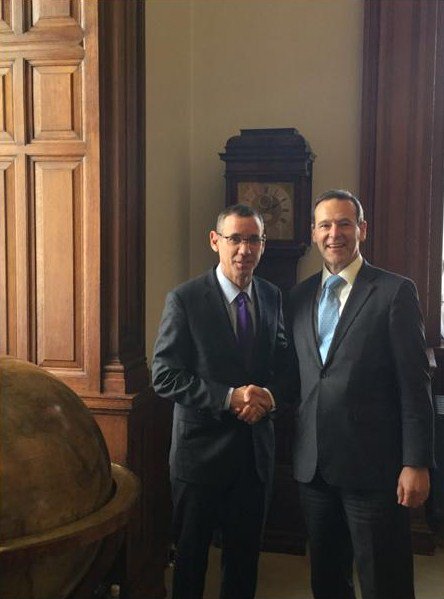
By Craig Murray | April 12, 2016
Many of you will recognise one of the faces in this photograph, Mark Regev. He is Israel’s new Ambassador to London and of course was the Israeli government spokesman who justified the massacre of more than 600 women and children in Gaza, and the murder of peace activists aboard the Mavi Marmara.
The other face of evil is Simon McDonald, head of the UK Diplomatic Service. You probably now think I am indulging in hyperbole. But no, I am not.
Simon McDonald was the Foreign Secretary Jack Straw’s Private Secretary at the time of the implementation of the British government’s extraordinary rendition and intelligence from torture programmes. When I became the only member of the UK’s senior civil service to make formal objection to these programmes, it was Simon McDonald who managed Jack Straw’s response in continuing to use torture.
I have indisputable documentary evidence of this, plain despite redactions by the British government censors (redactions which primarily remove all references to the CIA).
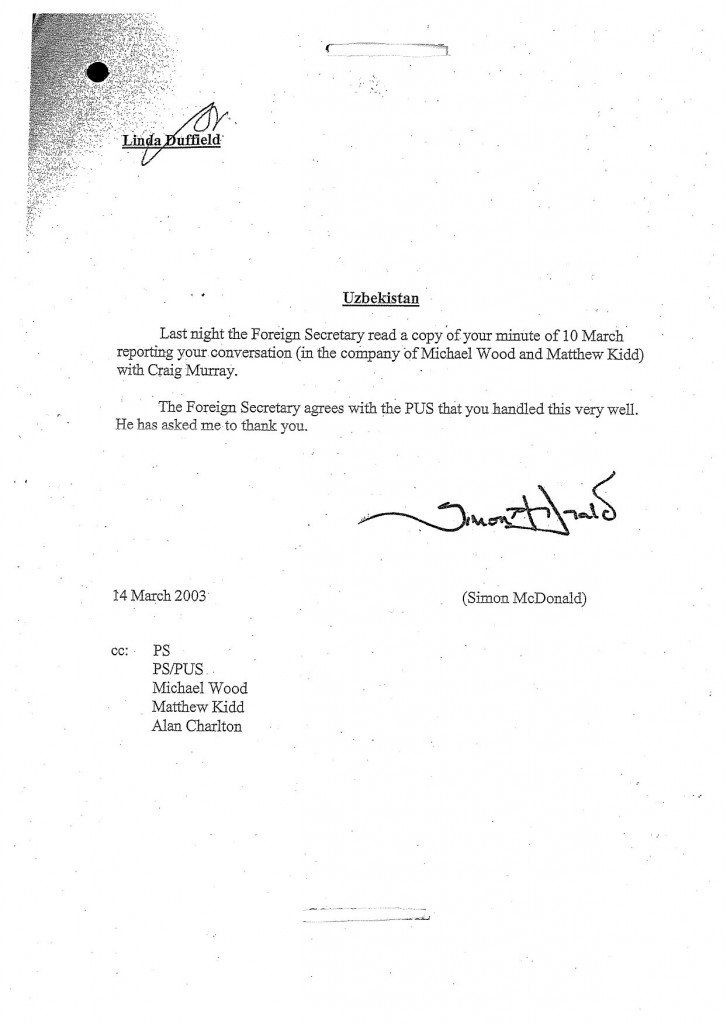
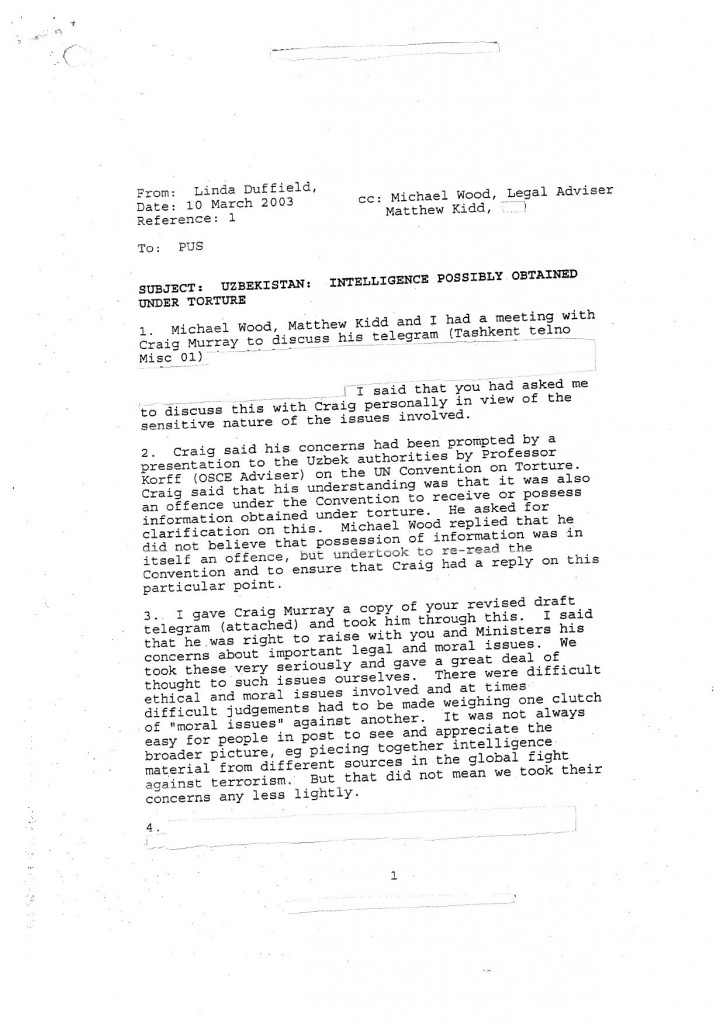
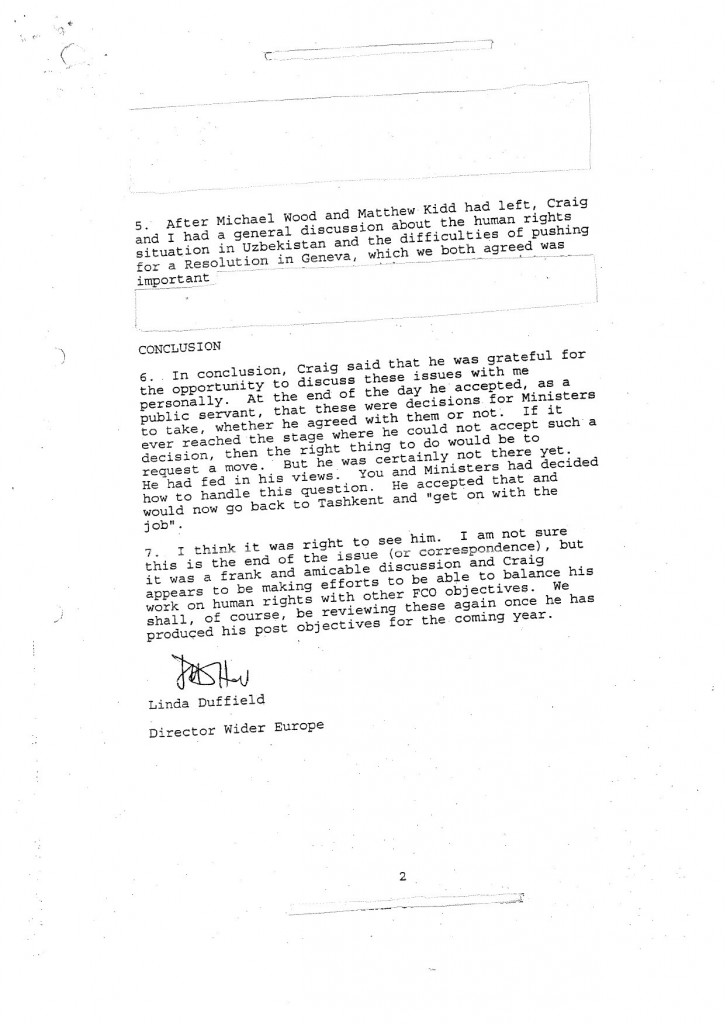
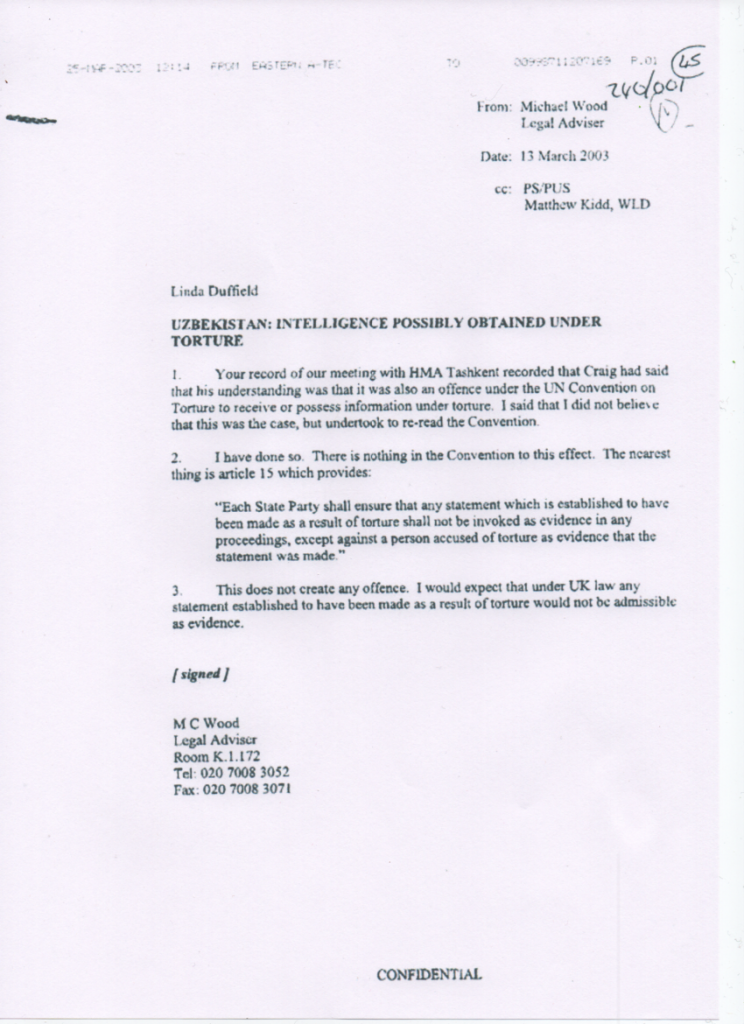
It is put to me frequently that people like McDonald, who were merely implementing a policy of torture, are not evil. That of course is the age old “only doing my job” defence. As somebody who was sacked for refusing to go along with torture, I think I have walked the walk and can describe him as evil. It is also worth noting that, while McDonald meets all new Ambassadors to London, he went far further with Regev than with anybody else. He tweeted out their photo with the message “Happy to see Mark Regev newly arrived Israeli Ambassador, an old friend from Tel Aviv ten years ago.”
Ten years ago, when they were friends in Tel Aviv, was of course the year in which Israel invaded Lebanon and Mark Regev was the chief Israeli spokesman justifying that attack, with its mass civilian casualties. Regev also defended the bombing by Israel of a United Nations observation post.
It is hardly surprising McDonald and Regev became friends at this time, as Gordon Brown’s government were doing everything possible behind the scenes to assist the Israeli invasion. As I wrote at that time
I have just watched on television sixty bodies being buried in a mass grave in Tyre, victims of Israeli bombing. At the same time I saw the odious Kim Howells, Foreign Office minister, arguing that a ceasefire would not solve the problem.
British diplomats at the UK Mission to the United Nations in New York – people I know personally – are putting massive effort into working against a ceasefire. They have the ultimate weapon that they and the US can veto any resolution at the Security Council, but are bending their backs into heading the subject off the agenda.
I hope they are proud of their succesful efforts. For every hour they prevent a ceasefire, on average two more Lebanese children are dying. Israel claims now to have killed 100 Hizbollah fighters. Even if true, that means they are killing two children to every fighter.
McDonald and Regev. Torture meets child-killing. Don’t they make a lovely couple?
International Day of Solidarity for Palestinian Prisoners – Paris, London, NYC, Toulouse
BDS France Toulouse, Coup Pour Coup 31, NPA31, Collectif Palestine Libre
As of March 2016, there are over 7,000 Palestinians, including more than 100 children, in Israeli prisons, in violation of international law which prohibits an occupying power to imprison in its territory the people of occupied territories.
Since 1967, over 750,000 Palestinians (20% of the total population and 40% of the male population) have been imprisoned by the occupation army. There is no Palestinian family that has been untouched by imprisonment.
 99.74% of Palestinians are convicted by Israeli military courts, the majority of these resulting from forced “plea bargains” (the accused must plead guilty or face a much higher sentence, in a context that they will certainly be found guilty)
Nearly 700 Palestinian prisoners are held under administrative detention, an arbitrary and illegal procedure that allows the Israeli army to detain Palestinians for a period of six months, indefinitely renewable, without charge or trial.
Among the detainees are Palestinian parliamentarians, including Ahmad Sa’adat, General Secretary of the Popular Front for the Liberation of Palestine; Marwan Barghouti, Fateh leader; and several Hamas lawmakers. In April 2015, Khalida Jarrar, member of the Palestinian Legislative Council and advocate for prisoners’ rights, was arrested and sentenced to 15 months in prison. Lawyer and activist Shireen Issawi was convicted along with her brother Medhat Issawi, and sentenced to 4 and 8 years in prison respectively. Medhat Issawi was previosly imprisoned for 20 years!
Palestinian prisoners are subject to torture, sleep deprivation, lack of hygiene and medical care, confinement in tiny cells and sordid, humiliating treatment. A growing number are held in prolonged solitary confinement. Threats, intimidation and denial of family visits are all means of the Israeli occupation to silence the legitimate struggle of the Palestinian people for land and freedom.
Many prisoners went on hunger strike, risking their lives to confront inhumane treatment; for example, Mohammed al-Qeeq ordered to administrative detention in November 2015 and after 94 days of hunger strike, securing his release in May 2016.
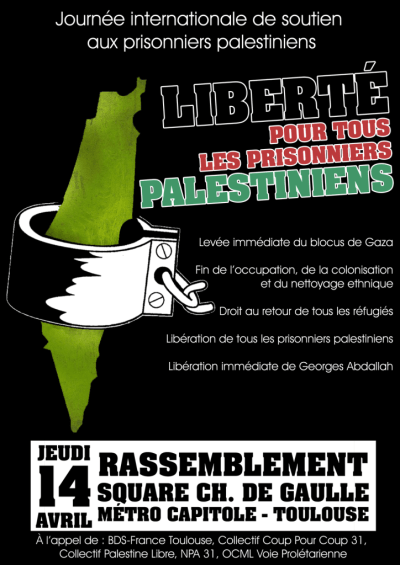
As part of the International Day of Solidarity for Palestinian Prisoners, we salute the thousands of Palestinians imprisoned for struggling against the apartheid and ethnic cleansing of their people. We also salute Georges Abdallah, communist activist for the Palestinian cause, imprisoned in France since 1984 for resisting the Israeli invasion of his country, Lebanon.
Let us unite for their release, to end the oldest military occupation in the world, to develop the movement for boycott, divestment and sanctions against the criminal regime of Israel, to demonstrate and popularize the struggle of the Palestinian people.
We demand:
The release of all Palestinian prisoners
The immediate end of the blockade and siege of Gaza
The end of occupation, colonization, and ethnic cleansing of Palestine
The Right of return of all Palestinian refugees
The immediate release of Georges Abdallah
Palestine lives, Palestine will be victorious!
Rassemblement jeudi 14 avril 2016 à 17h30 Square Charles De Gaulle (Métro Capitole).
16 April, Paris: Rally in support of Palestinian Prisoners
Saturday, 16 April
3:00 pm
Place du Chatelet
Paris, France
Facebook: https://www.facebook.com/events/229128724111169/
March via the Boulevard Sebastopol to the Place de la Republique, where we will hold a mass rally to support the 7000 Palestinian political prisoners. We will not forget Georges Ibrahim Abdallah, the great defender of the Palestinian cause, held for 32 years in French prisons at the demand of Israel and the US!
Organizers: CAPJPO-EuroPalestine, Droits Devant, Children of Palestine, Palestine Nanterre, Saint-Ouen Palestine, Friends of Nablus, Collective for the Liberation of Georges Ibrahim Abdallah
16 April, London: Palestine Prisoners Parade
Saturday, 16 April
12:30 pm
Gower Street (Corner of Torrington Place)
London, UK
Facebook: https://www.facebook.com/events/600881743402205/
On the occasion of Prisoners’ Day, we invite you to join us in solidarity with all Palestinians currently languishing in Israeli jails. We will march from Gower street to Trafalgar square along with another march that is being held that day (people against austerity). In keeping with the circus theme that has been used to raise awareness about Abu Sakha, a Palestinian clown currently held in administrative detention, we encourage people to come dressed as colourfully and clowny as you dare! We also encourage as many specific performers as possible (circus artists, musicians, dancers etc). If you have a specific tallent to perform, please get in touch at info@freeabusakha.com or private messaging to www.facebook.com/freeabusakha so we can coordinate the acts.
15 April, NYC: Celebrate resistance before Palestinian Prisoners’ Day
Friday, 15 April
4:00 pm
G4S Office – NYC (19 W 44th St)
Facebook: https://www.facebook.com/events/1042793672451086/
On 17 April each year, Palestinian prisoners, the Palestinian people, and the world mark the International Day of Solidarity with Palestinian Prisoners.
Commemorated since 1974, when the first Palestinian prisoner, Mahmoud Hijazi, was freed in a prisoner exchange with the Palestinian Resistance, 17 April is a day of protests, rallies, marches, forums and more to commemorate the struggle of Palestinians imprisoned in Israeli occupation jails and demand their freedom.
We join with the Palestinian prisoners’ movement in calling on organizations and people of conscience around the world to take action to to express solidarity and call for freedom for Palestinian political prisoners.
Over 7,000 Palestinian prisoners are currently held in Israeli jails. More than 700 of them are held in administrative detention without charge or trial. The others face military courts which convict over 99% of the Palestinians that appear before them. Over 400 Palestinian children as young as 12 years old are held in Israeli prisons.
Every night, Israeli occupation forces conduct violent armed invasions of Palestinian villages, cities, refugee camps and homes, ransacking them and arresting dozens of Palestinians. This comes amid near-daily killings and extrajudicial execution of Palestinians by occupation forces, the demolition of the homes of the families of Palestinian prisoners, new racist laws targeting Palestinians who hold Israeli citizenship, and further escalating repression.
International action has seen some response: G4S, the British-Danish security corporation targeted for a global boycott because of its role in providing security systems, control rooms and equipment to Israeli prisons, has announced it is selling off its Israeli subsidiary and leaving the market entirely. However, it’s critical to keep the pressure on G4S until their equipment and security systems are no longer being used to imprison Palestinians, block their movement at checkpoints, or besiege Gaza.
G4S doesn’t only profit on the imprisonment of Palestinians, of course. Black student movements at Columbia University, the University of California and Cornell University have led in building campus boycotts and divestment against G4S because of its role in private imprisonment in the United States, especially of youth, and have won significant victories. Organizing with movements confronting imprisonment and racist oppression, including the Black movement and the prison divestment movement, is particularly crucial in confronting common oppressors.
Palestinian Prisoners’ Day this year also comes amid international repression of Palestinian organizing – for example, the attacks on BDS in France and the arrest and prosecution of BDS activists – and the imprisonment and persecution of Palestinians and fellow strugglers in international prisons, as in the cases of Georges Ibrahim Abdullah, the Holy Land Five, and Rasmea Odeh. Confronting racism and oppression of all forms comes hand in hand with confronting Zionist settler-colonial racism in Palestine.
After a regular, weekly protest of G4S on Friday, join Samidoun Palestinian Prisoner Solidarity Network as we rally with CUNY Prison Divest and NYC Students for Justice in Palestine on Sunday, 17 April to demand freedom for Palestinian political prisoners and an end to private, for-profit incarceration in the United States:
Israeli forces carry out predawn raids, detain 2 students
Ma’an – April 8, 2016
 BETHLEHEM – Israeli forces detained six Palestinians including two university students from the occupied West Bank during predawn detention raids Friday, locals and Israel’s army said.
Locals told Ma’an that two members of Palestine Polytechnic University’s student council were detained in the raids, identified as Ibrahim Salhab from Doha and Salsabil Shalaldeh from Sair, both villages located near Bethlehem.
Locals added that Salsabil is the daughter of prisoner Sheikh Zawadi Shalaldeh who is currently held in Israeli prison.
Israeli forces also raided the town of Silwad in the Ramallah district and delivered an interrogation summons to former prisoner Malik Hamed.
Clashes erupted when Israeli military forces raided al-Duheisha refugee camp also near Bethlehem, with no initial injuries reported.
An Israeli army spokesperson told Ma’an that four Palestinians were detained from al-Arrub refugee camp, one of whom was a suspected Hamas operative.
One suspected Hamas operative was also detained from Qalqilya, the spokesperson said, adding that the Palestinian detained from Sair was suspected for “illegal activities.”
Around 7,000 Palestinians are currently held in Israeli prisons, according to prisoners’ rights group Addameer.
The majority were detained in predawn detention raids carried out by the Israeli military, including in areas under full Palestinian jurisdiction according to the Oslo Accords.
Such raids often lead to clashes between locals and Israeli military forces entering their communities, regularly resulting in injury and sometimes death of Palestinian residents.
Featured Video

Trita Parsi: Israel Set a Trap for Total War in the Region
or go to
Aletho News Archives – Video-Images
Book Review
Why the War on Conspiracy Theories Is Bad Public Policy
By Kevin Barrett • Unz Review • February 1, 2019
 A Review of Conspiracy Theories and Other Dangerous Ideas by Cass Sunstein (based on an earlier paper co-authored with Adrian Vermeule); In Defense of Troublemakers: The Power of Dissent in Life and Business by Charlan Nemeth; and Conspiracy Theories and the People Who Believe Them, edited by Joseph E. Uscinski
On January 25 2018 YouTube unleashed the latest salvo in the war on conspiracy theories, saying “we’ll begin reducing recommendations of borderline content and content that could misinform users in harmful ways—such as videos promoting a phony miracle cure for a serious illness, claiming the earth is flat, or making blatantly false claims about historic events like 9/11.”
At first glance that sounds reasonable. Nobody wants YouTube or anyone else to recommend bad information. And almost everyone agrees that phony miracle cures, flat earthism, and blatantly false claims about 9/11 and other historical events are undesirable.
But if we stop and seriously consider those words, we notice a couple of problems. First, the word “recommend” is not just misleading but mendacious. YouTube obviously doesn’t really recommend anything. When it says it does, it is lying. … continue
Blog Roll
 Aletho News
- Easy fix for Europe’s chaos? Stop fueling war against Russia
- Putin’s key remarks on peace talks and Europe’s ‘schizophrenia’
- Trita Parsi: Israel Set a Trap for Total War in the Region
- Trump’s Iran war is on an Israeli leash
- Saudi oil boss issues global supply warning
- Riyadh Says Its Oil System Is Intact. The Numbers Say Otherwise.
- Trump and Netanyahu Want to “Finish the Job” on Iran
- US ‘one-sided dictation’ not Iran’s beliefs makes rational talks impossible: Baghaei
- Iran’s Next Strike May Not Explode. It Could Shut You Down /Col Doug Macgregor
- Iran: US political targets legitimate if assassinations return
- If Americans Knew
- DAILY UPDATE: Latest essential news on Palestine, Israel, & region
- The Israel Lobby’s Changing Fortunes
- AIPAC has become such a political liability that it’s shifting to a more “nimble” approach to buying politicians
- At least 160 Israeli settler attacks in 2 weeks
- Will Gaza’s Ancient Christian Community Disappear Forever?
- Israel’s vision of regional security rests on keeping Arab states weak
- Heidi Levine recounts how Palestinian youths helped save her in settler attack
- DAILY UPDATE: Latest essential news on Palestine, Israel, & region
- Trump’s Intensifying Sabotage of the ICC, for Israel’s Sake
- Israeli military detain US and UK volunteers in West Bank including Democratic NY politician Brad Lander
- No Tricks Zone
- E-Cars Reduce CO2 Emissions By Only 41% Compared To Internal Combustion Engine Vehicles
- Predictions Made By Renowned Climate Professor Over Past Decades Have Been Proven To Be Poor
- New Study Suggests Large Regions Of The Pacific Ocean Have Been Cooling For The Last 80 Years
- Germany’s Green Energy Debacle: High Energy Costs Force Kahla Porzellan to Close After 182 Years!
- New Study: 50 Years Of The Most Aggressive ‘Net Zero’ Policies Can Only Affect The Global Climate By 0.03°C
- US September “Heat” Was No Record…Many Records Set Decades Ago
- Latest European Green Energy Debacle; Portugal’s Largest Flagship Solar Park Insolvent!
- Green Energy Debacle: German Expert Professor Fritz Vahrenholt Warns Of Severe Economic And Social Consequences
- Two More Paleo Reconstructions Affirm Meters-Higher Sea Levels Across Ireland, Brazil 7000-6000 Years Ago
- New Study: Earth And Venus Surface Warmth Largely Explained By Convection And Lapse Rate, Not CO2 Or Radiation

