UN appointment endorses fabricated Israeli human rights advances
By Ramona Wadi | MEMO | February 21, 2014
Only a few months after rejoining the UN Human Rights Council (HRC) and a few days after being allowed to participate in JUSCANZ, an advisory group affiliated with the UN providing consultation on human rights to UN bodies including the HRC, Israel has been awarded for its constant contempt and human rights violations by the unanimous nomination of UN Ambassador Ron Prosor to chair the elections for the Human Rights Committee.
Prosor’s nomination has been described by Israeli representatives as “a sign of the popularity that the current Israeli ambassador enjoys in New York”. A prompt substitution of “popularity” for “strategic allegiance” is a more suitable reflection of the dynamics which the UN, the US and Israel seek to enforce through collaboration to further oppression in the name of safeguarding human rights.
Following the nomination, Prosor stated, “It is a great honour to chair the elections for the Human Rights Committee. The central role Israel plays to advance human rights across the world is the real answer to anyone calling for boycotts against Israel.”
Prosor’s words attempt to project the image of the allegedly isolated settler-colonial state necessitating international support as having overcome hurdles allowing it to establish a formidable facade of resistance against the growing boycott movement.
On February 10, the US Ambassador to the UN Samantha Power declared, “We have pushed relentlessly for the full inclusion of Israel across the UN system.”
However, despite the human rights rhetoric spouted during the discourse, the only example provided of Israel’s international contribution to human rights was the humanitarian response to the Haiti earthquake, which is expected to compensate for the criticism regarding the collective punishment cruelly inflicted upon Palestinians for decades.
The rhetoric clearly portrays the manner in which coercion has become an integral part of human rights discourse.
The US and the UN have constantly utilised human rights discourse and humanitarian concerns as a pretext to distribute violence as means of preserving the imperialist manipulation of freedom, a factor conveniently shunned to create avenues for structured charters attempting to address vestiges of dignity.
Depicting Israel’s inclusion and prominent participation in matters pertaining to human rights as an asset signifies the exerted domination to maintain oppression, as well as unconditional support for Israel’s protection.
In turn, the platform granted to Prosor gives precedence to the fabricated narratives which ensured the creation of the settler-colonial state upon the destruction of Palestine, in complicity with the UN and its approach to eradicating the protection of human rights.
Prosor’s choreographed appointment reaffirms the imperialist efforts to compromise Palestinian freedom from within an organisation which legitimises its own violations while revelling in its self-imposed impunity.

Saudi forces kill two anti-government protesters in Qatif
Al-Akhbar | February 20, 2014
A Saudi court has jailed seven protesters for up to 20 years for joining a demonstration and chanting anti-government slogans in the kingdom’s Eastern Province, local media reported Thursday.
The Eastern Province, where Qatif is located, was the site of frequent Shia-led protests between February 2011 and August 2012.
A specialized court in Riyadh on Wednesday sentenced the young defendants to between six and 20 years in prison and imposed travel bans of the same duration as their jail terms.
They were convicted of “taking part in protests,” “chanting slogans against the state,” and “possessing and making Molotov cocktails,” according to local newspapers.
The court in the ultra-conservative kingdom also sentenced one of the defendants to 80 lashes for consuming alcohol.
The defendants said they would appeal.
Protests first erupted in the province of eastern Saudi Arabia in March 2011. Since then 10 people have been killed in clashes with security forces.
The Eastern Province is home to many of the kingdom’s minority Shias, who have long complained of discrimination in a country that hews to the rigid Wahhabi school of Sunni Islam.
Shias say they are passed over for government jobs, that some of their neighborhoods lack investment afforded to Sunni districts and that powerful government-paid clerics publicly denigrate their faith. The authorities deny discrimination.
Fighting intensified after the arrest in July 2012 of Sheikh Nimr al-Nimr, considered to be a driving force behind the protests.
However, tensions eased in August that year when seven dignitaries from Qatif hailed a call by King Abdullah for the creation of a center for Sunni-Shia interfaith dialogue.
(AFP, Al-Akhbar)
Israel continues military violence against Palestinian fishermen in Gaza waters
By Charlie Andreasson | International Solidarity Movement | February 19, 2014

Palestinian fishermen paddle a small fishing boat, or hasaka, off the Gaza coast. (Photo by Charlie Andreasson)
Gaza, Occupied Palestine – Three Palestinian fishermen were arrested and had their boats and gear confiscated by occupation forces on Tuesday, 11th February, in two separate incidents, despite the fact that they were well within the Israel-permitted zone and could not be classified as security threat to the State of Israel, its civilians or its military.
Mohamed Sleeby, 42, paddled out early in the morning in his hasaka with his son, Ahmed, 16, from the beach at Shati, north of Gaza City. Mohamed’s is a smaller hasaka without an engine, four meters long, and can only fish close to shore. While they pulled on their nets about half a nautical mile from the shore, Israeli patrol boats approached. When they started shooting, other Palestinian fishing boats nearby fled.
“It was like a horror movie,” Mohamed said. “I closed my eyes. When I opened them again, they were right in front of the hasaka with aimed guns and masked faces. They shot into the water right next to us and ordered us to strip completely naked and swim, one at a time, towards them. It was humiliating to stand there completely naked in front of them, stripped of all humanity, with my son at my side. But I dared not disobey.”
Despite his fear, Mohamed asked that his son be spared. The soldiers shouted at him to shut up. They shot near his son, even though he held his hands outstretched while waiting for his turn to step into the cold water. Once they were pulled onto one of the patrol boats, they were given clothes, but hoods were also pulled over their heads. They were taken to a waiting, larger military boat outside the zone allowed by Israel to Palestinian fishermen. Even with shackles on the hands and feet, they were forced to kneel on their knees. Fadel Al-Sultan, 25, was also on board. Earlier that morning, he had also been detained, and had his small hasaka without an engine seized, less than half a nautical half from the shore.
In Ashdod, they all underwent health checks, were photographed holding their results and their personal details on sheets of paper, and were accused of having been outside the permitted zone. Fadel, who had previously been captured twice while fishing, was threatened with being sent directly to jail without trial if he was caught again. As with previous detentions of Palestinian fishermen, the interrogators focused on collecting information about government buildings and their staff in Gaza, on possible contacts with insurgents and on personal networks. Unlike previous detentions, they also asked where any fish farms were located on land. Later they were transported to Erez, where a new hearing began with Mohamed Sleeby, his skin was checked for traces of explosives and attempts were made to recruit him to the Israeli intelligence service.
“He [the lone interrogator] knew everything about me,” Muhamed said. “He knew I did not pay taxes on electricity. He offered to pay them, promised I would get my hasaka and nets back, and even said I would get a little money. He said I should not be afraid, that I am in good hands and that no one but me, him and God would know anything about this, that I ought to think about my family and not miss the chance. But I cannot do that to my brothers and neighbors. He said I should think about it and that he would contact me by phone. But how can he do that? I was left with my clothes in the hasaka they seized. No, I would rather starve than help the ones keeping us in poverty.”

Fadel Al-Sultan. (Photo by Charlie Andreasson)
Muhamed Sleeby and Fadel Al-Sultan’s answers on why the Israeli military attack the fisherman so close to the shore, even though they can pose no threat to the State of Israeli or its residents, were consistent. “They want to make life even more difficult for us,” they say, “to prevent us from supporting ourselves.” Fadel also says that to get better catches, they need to go 7-8 nautical miles from the coast, but that is impossible because Israel has limited them to six nautical miles. But even that limit is irrelevant, as they are attacked so far inside it that they all have to fight for the small catches along the beach. Those who have to paddle out to fish are now competing with larger boats forced toward the shore.
In January, thirteen attacks have been carried out by the Israeli military against Palestinian fishermen. At one time the occupying power decreed a six-nautical mile limit, at another three miles, but it has consistently attacked far within three nautical miles from the coast. Both these attacks and the limits are violations of international law.
Related articles


Are Palestinians Allowed to Resist? Part II
By Dina Jadallah-Taschler | Palestine Chronicle | February 28, 2009
There is an abundance of discourse over the means and methods that are pursued and/or justified by the Palestinians in their quest for independence and liberation. In the first part of this essay, I presented the legal, historical, and current context that forms the root of their current predicament. In this segment, I want to address the pros and cons of pursuing an exclusively non-armed struggle both by looking at the uniqueness of Palestinian circumstances and also by comparing it with the Indian National Liberation Movement, which is usually presented in Western narratives as almost exclusively non-violent, and successful, for having (ostensibly) been so.
A Brief History of Palestinian Non-Violent Resistance
Palestinians are continuously asked to not resist. The truth is that whether they resist violently or non-violently, Israeli violence continues unabated. Perhaps the scale, ugliness and the immediacy of the trauma are exaggerated in a massacre like we recently saw in Gaza, but the reality of purposeful eradication persists.
Examples of Palestinian non-violent resistance have existed since the very start of Jewish immigration into Palestine, but were never enough to attain freedom. Ultimately it is an imperative but frequently unstated precondition, that Palestinians accept a permanent subjugated and defeated status, preferably outside of their historic lands. It is otherwise known as the Yigal Allon Plan (1967), a policy actively pursued by even the “Dove” Shimon Peres and entailing the expulsion of Palestinians. The Allon plan formed the basis of Israel’s settlements/colonization. Frequently unacknowledged in mainstream Western coverage is that only after acceptance of defeat and eradication can Israel’s violence (aka “retaliation”) against Palestinians stop.
Unwilling to accept that, and choosing a policy of “sumoud”/steadfastness on the land, Palestinians pursue(d) non-violent resistance as a complimentary and grassroots approach against the occupation. Here are just a few examples of Palestinian non-violent resistance to Israeli aggression: in 1902, villages of al-Shajara, Misha, and Melhamiyya peacefully protested against the takeover of 7000 hectares of agricultural land by the first Zionist settlers; in 1936, Palestinians held a six-month industrial strike protesting the British Mandate’s refusal to grant them self-determination; in 1986, Hannah Siniora and Mubarak ‘Awad (who advocates the power of non-violence and is a self-described disciple of Gandhi; recently deported by Israel) drew a list of civic disobedience activities heavily reliant on boycotting Israeli products and economic self-sufficiency, helping launch the 1987-93 First Intifada; in 1993, the signing of the Oslo Accords and the pursuit of the “settlement” path; and currently, the holding of protests in the villages of Jayyous, Budrus, Bil’in, Ni’lin and Umm Salamonah against the apartheid wall (1: See here). Today, the tradition of non-violence is still practiced and promoted by some secular and independent Palestinian political leaders, like the Palestinian National Initiative led by Mustafa Barghouti. And even Hamas, often presented as the ultimate terrorist organization, upheld a six month ceasefire with Israel but was still subjected to a non-lifting of the suffocating siege of Gaza. (The ceasefire ended on November 4, 2008 when Israel conducted a targeted assassination that killed six Hamas members.)
Needless to say, these facts are rarely, if ever covered in mainstream accounts. Instead the focus is consistently on “terror” and “Israel’s right to defend itself,” ignoring the cumulative suffering of the occupation. As for Israel’s response, it consistently uses overwhelming force, including tear gas, rubber bullets, live ammunition, etc. against protesters and justifies this as “self-defense,” even when protecting illegal settlement colonies.
Which raises the question of the efficacy of non-violent resistance as the sole or primary means of achieving national liberation. While each national liberation struggle is unique, there are certain conditions and methods that may translate across people. One thing that many have in common is that non-violent resistance was not pursued exclusively. This was true of the African National Congress’ anti-apartheid Boycott and Divestment Movement in South Africa, which accompanied armed struggle. It was also true of the struggle for national liberation from British rule in India, a fact usually unmentioned in Western press, which tends to focus on Mahatma Gandhi’s satyagraha / non-violent path to resistance. In doing so, there is a grave disservice done to explaining how Indian independence came to be. There is also a convenient decontextualization of the struggle. And I use “convenient” intentionally, because Gandhi’s model is often held up (by Israel and the West) as the best and “most civilized” one that ought to be emulated by the oppressed Palestinians.
Gandhi in Context: Was the Indian National Liberation Struggle Entirely Non-Violent? The name Gandhi and non-violent resistance (satyagraha) are almost synonymous in most people’s minds. Satyagraha’s aim is not just to defeat the opponent, but aims to convert the adversary as well. And yet there are important nuances and definite progression in Gandhi’s approach to war and colonialism. On the subject of whether it is better to be a coward or to resist violently, he said: “I do believe that, where there is only a choice between cowardice and violence, I would advise violence… I would rather have India resort to arms in order to defend her honour than that she should, in a cowardly manner, become or remain a helpless witness to her own dishonour…” (2: Eds. R. K. Rabhu & U. R. Rao, “Between Cowardice and Violence,” The Mind of Mahatma Gandhi, Ahemadabad, India, 1967, p. 3) He also said: “Though violence is not lawful, when it is offered in self-defence or for the defence of the defenseless, it is an act of bravery far better than cowardly submission. The latter befits neither man nor woman. Under violence, there are many stages and varieties of bravery. Every man must judge this for himself. No other person can or has the right. (3: Ibid, pp. 369-70) Applied to the Palestinian context, this would indicate that Palestinians have the duty to fight back against their own annihilation. However, he would have probably qualified that by saying that non-violence could cause the same changes with lower loss in life.
Historically, too Gandhi’s attitudes to war evolved. While still in South Africa, and in reaction to the Bambatha (Zulu) Rebellion of 1906 against a new British poll-tax, to which Britain responded by declaring a war, Gandhi encouraged the British to recruit Indians. He wanted to advance Indian claims as full citizens of the Empire. He also encouraged Indians to join the war through his columns in Indian Opinion.
Gandhi’s statecraft and thought did not happen in a vacuum. Likewise, India’s independence was not the work of only one man or one concept or one strategy. In fact, India’s nationalist feelings pre-existed Gandhi and the Congress Party, and evidence of it can be found as early as 1857. The first group to call for complete independence was the uncompromisingly secular Ghadar Party, organized in 1913 by Indian immigrants in California. (3: See here) The party actively pursued violent resistance and revolution (rejecting caste as well) and predictably, their actions were labeled as “terrorism” by Britain. Operating mainly in the first two decades of the 20th Century, the Ghadarites were successful in recruiting Indian soldiers in the British Army (in Hong Kong, Singapore, Rangoon, and Basra) and urging them to revolt.
As for Gandhi, once in India, he progressed to advocating non-violent resistance as a “weapon.” His political views on Indian independence evolved as well. Consider that at the age of 45, Gandhi still held some esteem for the British empire, calling it a “spiritual foundation,” in contrast to the views of most Indian revolutionaries. (4: See here) It wasn’t until after the Amritsar Massacre of civilians by British troops in the Punjab, that Gandhi advocated complete self-government maturing into independence (swaraj). In the intervening years there was a constant push and pull between Gandhi’s satyagraha policy and other political personalities and groups pursuing independence — not always non-violently.
A massive wave of revolutionary unrest swept India in 1919. British violent retaliation was unable to quell it. For example, there were more than 200 strikes in the first six months of 1920 alone. And yet in 1921, when Muslim leader Hasrat Mohani wrote a resolution asking for complete independence, Gandhi led the opposition against it and secured its rejection. Likewise, he supported Britain in WWI by trying to recruit Indians for the war effort. He himself volunteered twice for it, in present-day Iraq and in France, reasoning that he “owed” this to the empire in return for military protection. (5: Ibid) This led to deep divisions within the Congress party and also caused a dramatic drop in the popularity of Congress. Young revolutionaries like Rash Behari Bose, Shaheed Bhagat Singh, and revolutionary groups like the Workers and Peasant Party (Kirti Kisan Party) and militant unions like the Bombay textile workers were frequently at odds with Congress. Armed revolutionary groups that emerged in this period included the Hindustan Republican Army and the Hindustan Socialist Republican Army in northern India, as well as the “Revolt Groups” in Bengal (e.g. Chittagong group led by Surya Sen). Working class and union resistance continued throughout the 1930s. Eventually, it was in response to this revolutionary tide, that the Congress Party became less conservative and more supportive of the more militant attitude. As for Gandhi, he returned to advocating non-violent struggle and launched the salt satyagraha (1930-31) and the boycott campaigns. He has been criticized by some for not taking advantage of this revolutionary tide, thereby delaying independence.
Even at the time of World War II, Gandhi prevaricated on non-violence: first offering “non-violent moral support” to the British effort, and only later rescinding that decision when members of the Congress Party objected to the inclusion of India in the war effort without her consultation. In 1939-40, strikes and uprisings in the countryside swelled dramatically. Afterwards, the Congress party was compelled by grassroots pressure to launch the Quit India movement in August of 1942. It is important to note that this period in the struggle was one of extreme violence, mass arrests, and so forth. And yet, Quit India’s success in contributing to independence is controversial. Those arguing that it failed say that it fizzled out after five months (largely due to the army’s loyalty) and didn’t topple the Raj or bring it to the negotiating table for independence. In contrast, those who see it as a success, focus on how it sapped colonial energy and resources and on its success at mobilizing masses of people.(5: See here) Importantly, it inspired the final phase of the fight for independence, which witnessed increasingly militant peasant uprisings, sometimes joined by some of the landlords.
By the end of the war, Britain was indicating that power would be transferred to Indians. Aware that they couldn’t hold on any longer, they instead focused on partitioning India – bringing to mind Israel’s recent attempts to divide Gaza from the West Bank. In the meantime, Congress’ adherence to a policy of non-violence was entirely dependent on the British soldiers – as opposed to the armed Muslim League – and were unable to prevent partition. Thus, Congress’ inherent conservatism with regards to armed struggle hindered its goal of keeping India intact. They failed to build on numerous past instances of Hindu-Muslim cooperation against British colonialism. (Not all members of the Muslim league supported Muslim self-determination: Communist leader Ghaffar Ali opposed it vociferously.)
As is evident from the history recounted above, the agreeable and reasonable- sounding frame of the superiority of peaceful resistance sets up a false dichotomy. Presenting satyagraha as the exemplary approach to liberation is deceptive mainly because India’s independence was not achieved through non-violence alone. Moreover, its historical context and enemy are do not translate well across time and location. Finally, while inspirational and useful on many levels, it is not sufficient as sole guide or solution to achieving Palestinian liberation.
Options for Palestinian Resistance
Fundamentally, all theories of national liberation emanate from the ethical and legal principle that a people have the right to be free from alien occupation and exploitation. Resistance is their inalienable right. Insistence on non-violent resistance can sometimes be counterproductive – as happened with Gandhi’s insistence on it when confronting partition. Relying solely on non-violence subordinates the fundamental moral and ethical goal of independence to all sorts of conditionalities in order to achieve it in the “right” way.
All events so far indicate that non-violent resistance has been of modest benefit to Palestinians, with the important exceptions of tarnishing Israel’s image and moral claims. One could argue that Israel pursued the (sham) Oslo peace process precisely because the First Intifada rendered the population ungovernable. Unfortunately for the Palestinians, the Fateh leadership of the PLO squandered those achievements and marginalized popular input. Since then, pursuit of “settlement” and “negotiation” in the absence of a concomitant armed struggle has produced regressive and contradictory effects. Why is that?
One reason is the nature of the adversary. Zionist and Israeli ideology and statecraft are fundamentally violent, involving ethnic cleansing and relying first and foremost on war as an instrument in achieving Greater (Eretz) Israel. Unlike Great Britain, which had developed a liberal democratic tradition when Indians were struggling for their independence, Israel is essentially a highly militarized, ethnically-based and legally privileged society. It made no difference whatsoever how the Palestinians resisted, whether violently or not. As happened in other Western colonial historical experiences, like the US, Australia, or apartheid South Africa, the settlers use overwhelming force to convince the native populations of their ultimate defeat.
A second important difference is that after World War II, England could no longer hold onto its colonies. This is in sharp contrast to the US-superpower-backed-Israel, which maintains a pronounced military superiority over all its neighbors.
A third difference is that ever since the Jewish Land Agency started buying Palestinian lands from absentee landowners, and continuing after its war-time conquest of land, Israel stipulated that Palestinians cannot lease or be employed on purchased land. As a result, Palestinians are less important to the Israeli economy than India was to Britain. Their marginalization and de-development are intentional and serve to facilitate Israeli expropriation of valuable water, land, and other resources. Moreover, Israel receives significant financial and military “aid” from the United States which also reduces its need to integrate economically with its neighbors. The lack of economic dependency makes non-violent resistance much less effective as a weapon in fighting the occupation. Any economic levers the Palestinians may have had were further diminished (intentionally) via their PA leadership’s dependency on and distribution of foreign “aid.” This had the double effects of corrupting and ensuring the cooptation and cooperation of the leadership, as well as minimizing the size and role of an educated middle class that could lead the struggle – as was the case in India.
A fourth difference is the lack of a charismatic leader like Gandhi. Which brings us right back to the first reason, the nature of the opponent. Israel has a long history of assassinating and / or deporting any potential leader who is incorruptible or charismatic or effective. (6: For a partial list of Palestinian leaders assassinated by Mossad, see here.)
In the final analysis, non-violence is still a worthy means of resistance. Significantly, it enhances growing international perceptions of the brutality of the occupation and builds on the legal consensus and framework of the legitimacy of Palestinian rights, as recurrently affirmed through UN General Assembly annual resolutions and the most recent ruling against the apartheid wall at the International Court of Justice. Non-violent resistance, by being more accessible to ordinary people, additionally creates more sustainable and widespread networks of resistance. At a minimum, it establishes a network of interdependence for the newly liberated society to build on.
But it is not enough. And arguably, it has never been enough, especially in the absence of a more just as opposed to legalistic international relations.
– Dina Jadallah-Taschler is an Arab-American of Palestinian and Egyptian descent, a political science graduate, an artist and a writer. Contact her at: dina.jadallah.taschler@gmail.com.
Related articles
Do We Care About People If They Live in Bahrain?
By David Swanson – February 17, 2014
I had a heck of a time making sense of the U.S. Navy’s new motto “A Global Force for Good” until I realized that it meant “We are a global force, and wherever we go we’re never leaving.”
For three years now people in the little island nation of Bahrain have been nonviolently protesting and demanding democratic reforms.
For three years now the king of Bahrain and his royal thugs have been shooting, kidnapping, torturing, imprisoning, and terrorizing nonviolent opponents. An opponent includes anyone speaking up for human rights or even “insulting” the king or his flag, which carries a sentence of 7 years in prison and a hefty fine.
For three years now, Saudi Arabia has been aiding the King of Bahrain in his crackdown on the people of Bahrain. A U.S. police chief named John Timoney, with a reputation for brutality earned in Miami and Philadelphia, was hired to help the Bahraini government intimidate and brutalize its population.
For three years now, the U.S. government has been tolerating the abuses committed by Bahrain and Saudi Arabia, continuing to sell weapons to Bahrain and Saudi Arabia, and continuing to dock the U.S. Navy’s Fifth Fleet in Bahrain. In fact, the U.S. military has recently announced big and pricey plans to expand its bases in Bahrain and add more ships.
For three years now, the U.S. government has continued to dump some $150 billion (with a ‘B’) each year into the U.S. Navy, a large portion of which goes for the maintenance of the Fifth Fleet in Bahrain. Withdrawing and disbanding that fleet would save that gargantuan expense. Retraining and re-employing in peaceful activities all personnel would cost a fraction of $150 billion. Providing aid to nonviolent pro-democracy activists in Bahrain would cost a tiny fraction of a fraction. Establishing a policy in the case of this one country of supporting human rights over brutal dictatorship would be, as they say, priceless. It would create a very useful model for a transformation of U.S. policy in numerous other nations as well.
Accurate and timely information about the horrors underway for the past three years in Bahrain are available online, via Western human rights groups, and via small back-page stories in U.S. newspapers. There’s little dispute over the general facts. Yet, there’s little outrage. There appears to have been no polling done of the U.S. public on the topic of Bahrain whatsoever, so it’s impossible to know what people think. But my impression is that most people have never heard of the place.
The U.S. government is not shouting about the need to bomb Bahrain to protect its people. Senators are not insisting on sanctions, sanctions, and more sanctions. There seems to be no crisis, no need for “intervention,” only the need to end an intervention we aren’t told about.
Which raises a tough question for people who give a damn. We’re able to reject a war on Iran or Syria when the question is raised on our televisions. But we can’t seem to stop drone strikes nobody tells us about. How do we create a question nobody is asking, about a topic nobody has heard of, and then answer it humanely and wisely? And how do we overcome the inevitable pretense that the Fifth Fleet serves some useful purpose, and that this purpose justifies a little teargas, a bit of torture, and some murders here and there?
The Fifth Fleet claims to be responsible for these nations: Afghanistan, Bahrain, Egypt, Iran, Iraq, Jordan, Kazakhstan, Kyrgyzstan, Lebanon, Oman, Pakistan, Qatar, Saudi Arabia, Syria, Tajikistan, Turkmenistan, United Arab Emirates, Uzbekistan, and Yemen. None of these nations have ships in U.S. waters claiming to be responsible for it. None of these nations’ peoples have indicated majority support for having the Fifth Fleet be responsible for them. Afghanistan has suffered under U.S. occupation for over a decade, with chaos and tyranny to follow. Egypt’s thugs are rising anew with steady U.S. support, money, and weaponry. Iran has threatened and attacked no other nation for centuries, has never had a nuclear weapons program, spends less than 1% what the U.S. does on its military, and moves away from democracy with every U.S. threat. Why not leave Iran alone? Iraq, Jordan, Qatar, Saudi Arabia, Yemen, and others of these nations, including Bahrain, suffer under the rule of U.S.-backed governments. One might reasonably add Israel and the lands it occupies to the list, even if the Navy cannot bring itself to mention them. Yemen and Pakistan suffer under the constant buzzing and missile launching of U.S. drones, which are creating far more enemies than they kill. In fact, not a single nation falling under the past 19 years of benevolent “responsibility” of the Fifth Fleet has clearly benefited in any way.
At a third annual conference recently held in Lebanon, Bahraini activists laid out a plan of action. It includes building international connections with people who care and are willing to help. It includes supporting the International Day to End Impunity on November 23rd. It includes pushing Bahrain to join the ICC, although that may be of little value until the U.S. can be persuaded to do the same and until the United Nations can be democratized. The plan includes calls for an end to weapons sales and the initiation of sanctions against the Bahraini government (not its people).
Those would certainly be good steps. The first question in my mind remains: do the people in the nation that screams most loudly about “freedom” and does the most to support its repression wherever deemed useful, care?
CIA seeks new bases for deadly drones
Press TV – February 17, 2014
The US Central Intelligence Agency is seeking new drone bases in unnamed countries in Central Asia, fearing the full withdrawal of US troops from Afghanistan would affect the targeted killings in neighboring Pakistan.
The spy agency asserts that if the US fails to sign a bilateral security deal with Afghanistan and secure an enduring military presence there, it would not be able to fly drones from its Afghan bases because drone operations are covert and need US military protection.
The security deal, which Washington says “ought to be signed” and is not renegotiable, could allow thousands of US troops to stay in Afghanistan beyond 2014.
However, despite pressures from the White House and Congress, Afghan President Hamid Karzai has so far refused to sign the deal and the US intelligence community is hoping that the next Afghan president will agree to sign it.
Worried that its drone killings can become a casualty of strained relations between Kabul and Washington, the CIA is reportedly making contingency plans to use bases in other countries.
“There are contingency plans for alternatives in the north,” an unnamed US official briefed on the matter told the Los Angeles Times without specifying the countries.
According to Brian Glyn Williams, a University of Massachusetts professor, the CIA and the Pentagon used to fly drones from an airbase in Uzbekistan until the US was evicted in 2005.
Michael Nagata, commander of US special operations in the Middle East and Central Asia, also traveled last month to Tajikistan, which is Afghanistan’s northern neighbor, to discuss “issues of bilateral security cooperation” and “continued military cooperation.”
Meanwhile, US officials say a new jet-powered drone, called Avenger, which will be able to “get to ‘hot’ targets in Pakistan much faster,” could soon be flying from bases outside Afghanistan.
The CIA is in charge of drone strikes in Pakistan since the country is not officially a war zone and the CIA’s program is covert.
US President Barack Obama has already stated that the responsibility for Washington’s deadly drone attacks could gradually shift from the CIA to the Pentagon. However, the idea of putting the US military in charge of drone attacks is not favored by US lawmakers.
Israeli forces use tear gas against schoolchildren in Hebron
International Solidarity Movement | February 17, 2014
Hebron, Occupied Palestine – On Sunday, the 16th of February, Israeli soldiers and border police in Hebron fired tear gas and sound grenades at children on their way to school. The border police also chased the children, attempting to arrest them.
At Checkpoint 29, around 7:30 a.m., a few children on their way to school (there are three schools near the checkpoint) were throwing stones at the soldiers stationed there. In response to this two border police and a soldier appeared from an alley and threw a sound grenade at the kids close to the United Nations school on Tareq Ben Ziyad Street.
This frightened not only the children who had thrown stones but all the children on their way to school, causing them to flee. When they did not catch any children the two border police and the soldier stood in front of the school blocking the entrance and started firing teargas at those who had fled.
As the border police and the soldier returned to the checkpoint, three new soldiers came out of an apartment across the street, preventing the children from entering their school. The soldiers continued firing teargas towards the crowd of upset and frightened children.
Tear gas is a nondiscriminatory nerve gas which affects all persons nearby. The gas often takes a long time to disperse, forcing children to go through the half-dispersed gas clouds on their way to school, leaving them crying and coughing. The use of tear gas against schoolchildren is common in Hebron.
In total, seven soldiers and two border police were involved in the incident, firing six tear gas grenades and two sound grenades at the children.
Related articles


Palestinian footballers shot by Israeli forces never to play again
Ma’an – February 14, 2014
BETHLEHEM – Two young Palestinian football players shot by Israeli forces last month have learned that they will never be able to play sports again due to their injuries, according to doctors.
Doctors at Ramallah governmental hospital said the pair will need six months of treatment before they can evaluate if the two will even be able to ever walk again, at best.
Jawhar Nasser Jawhar, 19, and Adam Abd al-Raouf Halabiya, 17, were shot by Israeli soldiers as they were walking home from a training session in the Faisal Hussein Stadium in al-Ram in the central West Bank on Jan. 31.
Israeli forces opened fire in their direction without warning as they were walking near a checkpoint.
Police dogs were subsequently unleashed on them before Israeli soldiers dragged them across the ground and beat them.
The pair was subsequently were taken to an Israeli hospital in Jerusalem, where they underwent a number of operations to remove the bullets.
Medical reports said that Jawhar was shot with 11 bullets, seven in his left foot, three in his right, and one in his left hand. Halabiya was shot once in each foot.
The two were taken to Ramallah governmental hospital before being transferred to King Hussein Medical Center in Amman.
Chairman of the Palestinian Football Association Jibril al-Rajoub condemned the shooting and said that “Israeli brutality against them emphasizes the occupation’s insistence on destroying Palestinian sport.”
Rajoub called for imposing penalties on the Israeli football association, and demanded its removal from the FIFA as it should not accept racist organizations that do not adhere to international law.
Related article
Will the flowers of Gaza break Israel’s siege this Valentine’s Day?
By Tom Anderson and Therezia Cooper | Corporate Watch | February 12, 2014

Flowers from Gaza being prepared for export (Photo by Corporate Watch)
Gaza, Occupied Palestine – Valentine’s Day is almost upon us and for supermarkets and florists that means a massive increase in the sale of flowers. But how many romantic couples consider where the flowers they exchange are grown?
Farmers in Gaza have long been encouraged by Israeli export companies to focus their production on high risk ‘cash crops’ such as flowers and strawberries, and the arrival of carnations from Rafah to European markets for Christmas or Valentine’s day is often cheered on by the Israeli Government who uses it as a PR exercise to show how it ‘facilitates’ Palestinian exports. Unsurprisingly, this is not the full story.
According to the Palestinian Union of Agricultural Work Committees (UAWC) there used to be over 500 dunams of carnations planted in the Gaza Strip, but since the beginning of the siege in 2007 flower exports have plummeted year on year and there are only around 60 dunams left. The planted land used to produce over forty million stems for export, but now the few carnation farmers who are left are struggling to sell 5-10 million.
“The Israeli occupation allows us to export a small quantity of produce, just to show the world that they are nice to the Palestinians, but they are using us. Everything we do is controlled by them”, said Saad Ziada from UAWC when we met him in his Gaza City office in November last year, just before what was supposed to be the start of the flower exporting season. This statement is true of all produce in Gaza but flower exporters are particularly susceptible to the control Israel holds over exports, as their produce relies on hitting the market at exactly the right time for popular flower buying holidays. If the border is closed for a week and the flowers miss the export window for Valentine’s Day, for instance, their profit for the whole year can be lost.
We visited Rafah to talk to one of the few flower growers still in business and hear about the situation for farmers under the siege.
“The problem is the border and the siege”
Hassan Gazi al Hijazi has been in the flower business for over 25 years and has seen many changes in the flower export industry. When he started out he had to be registered as an Israeli grower, despite growing his flowers in Gaza, and he gave classes in the art of flower growing to new farmers. “There used to be 53 flower farmers in the Rafah area and now there are only 4 of us left” he told us. “I personally used to have 40 dunams and now I only have 4”. He said that he needs assistance from outside to even operate them now, his flower packing house displays signs showing that he receives financial support from Spain.

(Photo by Corporate Watch)
Just as with all produce from Gaza, his flowers have to be exported via Israel, through an Israeli company. In the past this used to be Carmel Agrexco, which used the name Coral for Palestinian produce, but after its liquidation he now works with a Palestinian Co-operative which exports under the brand name Palestine Crops using the slogan ‘From Palestine Land to Global Markets’. Palestine Crops is a Gaza initiative which works with agricultural co-ops in the strip and aims to create a market for Palestinian labelled goods and, eventually, independent exports. For now, however, this is impossible and although some exports from Gaza come with Palestine Crops branding, they are dependent on their Israeli distributor. In the case of flowers, this is primarily the Flower Board of Israel. Once transported out of Gaza, the flowers are taken to the big flower auction houses in Holland, where they are sold by grower name. By the time the bouquets reach our shops they will have been mixed with other flowers and it is unlikely the the buyer will be aware of their origin.
Talking to Hassan, it becomes obvious just how much the farmers of Gaza are at the mercy of the Israeli occupation forces. Palestine’s flower export season lasts from December until May. The most important sales periods are Christmas and Valentine’s Day. According to Hassan, these are often the seasons when the border is closed. Our interview took place on 5 December, a time which should be busy in Rafah. “I should be exporting my flowers around the 15th of December to be in time for the Christmas market, but I do not know how much I will be allowed to export yet”, Hassan told us. “if you are not able to export for those occasions the price for flowers drops and you lose”. Farmers in Gaza are not able to export flowers during the summer as this is the season when Holland grows the same crops.
“The problem is not the growing of the flowers, the problem is the border and the siege” Hassan said whilst showing us his beautiful dunams of ready to go flowers. As with most custom designed cash crops there is not enough of a local market for Hassan’s flowers if he fails to export them, they either just go to waste or become animal food. No one in Gaza can pay a price which would even make the enterprise break even.
In the past Hassan could get around $120 000 for exporting two million flowers if he had a good season, but for the last five years he has been paying the big upfront outlay necessary in flower growing from his own pocket, just dreaming that he will be able to get a return on his investment.
The statistics: The decline of Gaza’s flower exports
Recorded Gaza Flower Exports (according to Palestine Crops):
Date Carnations Stems Trucks End of 2004 44,000,000 200 2005 30,700,000 210 2006 21,500,000 205 2007 37,400,000 187 2008 2,100,000 10 2009 0 0 2010 10,668,520 74 2011 8,974,890 57 2012 0 0
The table above shows that flower exports have decreased to a fraction of what they were in 2004. During 2012 and 2009, the years of major Israeli attacks on the Strip, exports were prevented entirely.
Gaza’s flower growers see no light at the end of the tunnel with most not having the cash flow to continue their profession. Exports are declining and becoming even more unpredictable with increased border closures.
We asked Hassan for his opinion about the boycott, divestment and sanctions movement. We particularly wanted his opinion as his livelihood relies on exporting produce through Israeli companies. “You should continue these campaigns even if it damages our business” he said. “The problem for us is that there is no other way we can export, but people on the outside should continue to boycott and help us keep the borders open”.
This sentiment was one that was repeated over and over again across the Gaza Strip, and the challenge for the solidarity movement is clear: in order for Palestinians to be able to control their own exports we first need to break the siege -permanently.
We will publish some further articles on the problems faced by Palestinian exporters in the coming weeks.
Related article

Israeli forces protect settlers as they cut down Palestinian family’s trees
International Solidarity Movement | February 12, 2014
Hebron, Occupied Palestine – On the afternoon of February 11, 2014, settlers in the Tel Rumeida neighborhood of Al-Khalil (Hebron) cut down trees belonging to the Abu Eisheh family. While attempting to film the destruction of the trees, four human rights activists were arrested by Israeli police.
At approximately 3:30 p.m., three activists, a Swiss-American, an American, and an Italian, were sitting in their apartment in Tel Rumeida when they heard a commotion outside. Outside the apartment, they found a group of settlers, Palestinians, Israeli soldiers and Israeli police. They were informed by the Palestinians that a group of settlers was cutting down trees at a house just up the road.
The three activists began filming but were not allowed up the road to where the tree-cutting was taking place. While filming, the American activist was physically assaulted by a settler. None of the soldiers or police officers present intervened. Instead, the Israeli police took the passports belonging to the American and Swiss-American and told them to sit on the ground.
At this time, the Italian citizen returned to the apartment, where she was joined by a fourth activist, an American, who had just arrived. Shortly thereafter, a group of soldiers and police officers attempted to enter the apartment. They were not allowed entry, but briefly questioned the two activists outside the apartment door. The Israeli police then confiscated the passports belonging to the American and the Italian.
Not long after, all four activists were transported to the police station near Kiryat Arba, where they were interrogated and threatened with deportation. After seven hours, the activists were released.
The following day, February 12th, two activists from Christian Peacemaker Teams visited Tel Rumeida to document the destruction of the trees. They were not there long before several Israeli soldiers approached them, told them to stop filming, and took their passports. They were held for two hours before their passports were returned. Israeli soldiers informed the two activists that if they approached the trees again they would be arrested.
The destruction of Palestinian trees by settlers is a chronic problem, not only in Tel Rumeida, but all over the West Bank. In the past month alone, more than 2500 trees in the village of Sinjil were destroyed by settlers. Trees have also recently been destroyed by settlers in Qusra, Ramallah, and Nablus. Fruit trees are an essential resource for the Palestinian community, and their damage causes serious economic loss. It takes as long as 12 years for an olive tree to reach full maturity.

ISM activist with settlers in Tel Rumeida (photo by ISM Italy)
Related articles


PALESTINE: Border Police detain, humiliate and arrest men trying to go to Friday prayers; CPTer’s camera taken.
CPTnet | February 11, 2014
On 7 February 2014, CPTers went to the routine Friday mosque patrol around prayer time. Often during Friday prayers, Israeli Border police will take the IDs of young Palestinian men while they going into the Ibrahimi Mosque, check to see if they have any outstanding warrants and then return the IDs when the men come out of the mosque. This Friday, however, Border Police were not allowing the men to go to the mosque while they were checking the IDs.
When CPTers called members of the Temporary International Presence in Hebron (TIPH), TIPH personnel told them that Border Police were detaining men at several H-2 checkpoints. The CPTers decided to look at Checkpoint 29 and found Border Police detaining twenty to thirty men there. Several of them were quite angry because of the way the Border Police had been treating them. Other men were trying to calm the situation. When one man, after realizing he was going to miss prayers at the mosque, began to lay his prayer rug on the ground to pray at the checkpoint, one of the Border Police shoved him against a wall, which really enraged several people in the crowd.
Soldiers pepper-sprayed a boy who appeared to be about eleven or twelve and an older man, who was later hospitalized. The boy passed out and was taken down the hill to a shop. Additional soldiers arrived and began deploying sound bombs and teargas. Police arrested eight men.
Video of Border Police pepperspraying man
After the police took away the men they had arrested, CPTers remained in the area because of the heavy soldier and Border police presence. Civilian police approached one and asked for his passport and his camera. They insisted on taking his camera to the police station and he accompanied it. While he was at the police station, they asked him questions about what he had witnessed, periodically coming out of a room and telling another CPTer that “your friend isn’t arrested; he is just giving testimony.”
As of this writing, six of the men arrested on Friday have been released, while two are still in custody.
Related articles
Featured Video
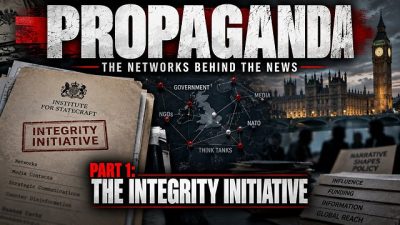
Integrity Initiative: UK-funded network framed dissent as Russian disinformation for years
or go to
Aletho News Archives – Video-Images
From the Archives
Why Saudi Ties to 9/11 Mean U.S. Ties to 9/11
By Kevin Ryan | Dig Within | September 27, 2015
Media interest in Saudi Arabian connections to the crimes of 9/11 has centered on calls for the release of the 28 missing pages from the Joint Congressional Inquiry’s report. However, those calls focus on the question of hijacker financing and omit the most interesting links between the 9/11 attacks and Saudi Arabia—links that implicate powerful people in the United States. Here are twenty examples. … continue
Blog Roll
 Aletho News
- ‘A Big Victory’ – Palestine Chronicle Wins Two-Year Legal Battle
- IAEA inspectors cannot return to Iran amid US threats: Russia
- Senate Rejects Iran War Powers Resolution Passed By House
- ‘We did not attack Pakistan with drones’: Afghan sources
- Iraqi Resistance faction links arms to sovereignty, questions US exit
- Cannon fodder no more… South Korea rejects Trump’s pressure to join his criminal war on Iran
- Neria Leiter Was A Legitimate Military Target
- Integrity Initiative: UK-funded network framed dissent as Russian disinformation for years
- ‘We don’t seek permission to defend our country’: Snippets from President Pezeshkian’s UNGA address
- NATO chief wants Europeans to fight American wars [for Israel]
- If Americans Knew
- In UN Speech, Iran’s President Displays Pictures of Children Killed by US, Brings Attention to Israel’s Nuclear Arsenal
- Israel displaces hundreds of Palestinians amid wave of demolitions in West Bank
- Aid, reconstruction, and Israel’s history of obstruction in Gaza
- Trump administration digs an ever-deeper hole of complicity in genocide – Daily Update
- US-Israel $2.8 Billion Arms Deal, 40,000-Bomb Supply Faces New Gaza Complicity Accusations
- Caught on Tape: AIPAC CEO Boasted of Controlling Trump’s National Security Officials
- Why Hamas Attacked Israel in October 2023 – Israeli professor Ilan Pappé
- They see them, then kill them: Israeli quadcopters track, deliberately target civilians in Gaza
- Winter could turn Gaza’s treacherous, war-damaged buildings into deathtraps
- Majority of Democratic Voters Want to Prosecute Both Biden and Trump Administration Officials Over Gaza
- No Tricks Zone
- New Study: Earth And Venus Surface Warmth Largely Explained By Convection And Lapse Rate, Not CO2 Or Radiation
- 2025 Nature Paper Claiming Worsening Global Drought Gets RETRACTED …Heavily Flawed
- New Study: ‘Global Drought Shows No Detectable Recent Acceleration Under Climate Warming’
- Economic Masterminds: German Socialists Suggest Taxing Productivity Gains Stemming From Using AI
- The South China Sea Has Not Been Cooperating With The Climate Change Narrative
- Energy Crisis: Germany Enters Heating Season With Historically Low Gas Reserve Fill Levels
- New Study: The Antarctic Ice Sheet Gained Mass From 2020-2024 Due To Staggering Snow And Ice Accumulation
- Study: Ocean Heating Rates From Thousands Of Years Ago ‘Dwarf’ Modern Ocean Heating Rates
- Climate Extremists Target, Attack Large-Scale Power Grid Infrastructure In Germany!
- New Study: Antarctic Ice Melt Has Contributed Less Than 1 Centimeter To Sea Level Rise In The Last 30 Years

