Do Only Some Massacres Matter?
Munich Olympics, Revisited
By Alison Weir | CounterPunch | February 11, 2014
The Washington Post has published a moving article, “Russian Jews remember Israeli athletes murdered at 1972 Munich Olympic Games.” Unfortunately, it gets a few things wrong and provides a one-sided context for the tragedy.
Allow me to correct the report and fill in a few of the missing facts.
Just 23 years before the Olympic incident, Israel had been created through ethnically cleansing much of the indigenous Palestinian population.
This had been accomplished through at least 33 massacres and was maintained in the years following by still more acts of ethnic cleansing and additional massacres. (These included areas from which the Munich kidnappers came).
Five years before the Munich incident, Israel violently conquered even more Palestinian land (illegal under international law), pushing out another 325,000+ Palestinian men, women, and children, and killing at least 13,000 Arabs in all. About 800 Israelis died.
The violence continued, and beginning in 1968 Israeli forces repeatedly savaged 150 or more towns and villages in south Lebanon alone. By the time of the Munich Olympics, Israel held hundreds of prisoners in its notorious prison system.
It is widely known, but rarely stated, that the goal of the Munich hostage-taking was not to kill them; it was to return the athletes to Israel in return for Israel returning its Palestinian prisoners.
Many of these prisoners were also young people, and, if we could have seen them, they might have looked very much like the Israeli athletes, minus the physical health. Israel is not known for its merciful treatment of those it dislikes.
When the Israeli government refused to consider an exchange, the German police, with the Mossad at hand, were pushed into an ill-planned rescue attempt in which some of the hostages (no one knows how many) were killed accidentally by the attackers, and a German policeman was also killed.
The day after the botched and unnecessary “rescue,” Israel launched heavy air attacks against Lebanon and Syria, killing between 200 and 500 Lebanese, Syrians and Palestinians, mostly civilians.
While Washington Post reporter Kathy Lally gives a great deal of information about the position of Russian Jews, going back over 100 years, it would have been valuable for her to tell a little about what the Munich incident was about – and about all the tragic victims of violence connected to the event, not just the 11 preferred ones.
~
Alison Weir is the executive director of If Americans Knew, president of the Council for the National Interest, and author of the upcoming history of US-Israel relations, Against Our Better Judgment, to be released next month.
Related article


Israeli Soldiers Take Pictures Of Themselves Abusing Wounded Youth
By Saed Bannoura | IMEMC | February 9, 2014
Jerusalem – A video, captured by Rami Alarya of the Alqods Independent Media Center, showed a number of Israeli soldiers assaulting a Palestinian child, on Friday evening, February 4 2014, after shooting him by a rubber-coated metal bullet in the leg, and photographing themselves abusing him.
The soldiers assaulted the child during clashes that took place in the al-Ezariyya town, east of occupied East Jerusalem.
One of the soldiers tried to push the cameraman, Alarya, and his colleague, Amin Alawya, away from the scene, and was yelling at them, “Enough, enough…. go away… what do you want…”
Medical sources said the soldiers shot the child, Yassin al-Karaky, 13 years of age, with a rubber-coated metal bullet, which hit the 13-year old in the leg. After he fell, the soldiers began assaulting and abusing him.
The attack took place after soldiers, who hid in a building near the Annexation Wall in the Qabsa area, ambushed a group of children, and one of the soldiers opened fire on the children.
Then several soldiers attacked and assaulting the wounded child before kidnapping him.
The soldiers took pictures of themselves with the wounded child, and a soldier picked up a Molotov cocktail from the ground, while the child shouted in Hebrew, “it’s not mine, it’s not mine”, and a soldier responded, “it’s yours, it’s Ok… it’s yours”.
One of the soldiers was holding him in a choke-hold, and was mocking the child by imitating wrestling moves while other soldiers took pictures, although the child was barely able to breathe.
The soldiers then placed the child in their jeep, while one of them was still filming the incident.
See also:
Related:
Photos of Israeli soldiers humiliating Palestinian detainees disclosed
Honduras and Mexico: Open Season for Journalists
By Nick Alexandrov | CounterPunch | February 7, 2014
Last December, the New York Times’ David Carr reported on Vice President Biden’s trip to China, where he “spoke plainly about the role of a free press in a democratic society.” The benighted audience was surely keen to learn about this Western institution, and “it was heartening to see the White House at the forefront of the effort to ensure an unfettered press,” Carr affirmed. No doubt. Down here on Earth, meanwhile, Washington has long been at the forefront of an effort to promote cultural devastation, targeting journalists, artists, and independent thinkers more generally. This cultural ruin is a predictable consequence of U.S. support for repressive regimes—a tradition Obama has worked hard to uphold.
Consider the June 2009 coup against Honduran President Manuel Zelaya, which four School of the Americas graduates helped orchestrate. Even the attorney responsible for giving it a legal veneer admitted the ouster was “a crime,” and in its aftermath Obama recognized Porfirio Lobo, winner of a fraudulent election marred by political violence and ballot irregularities, as the country’s new leader. Now, Honduran journalists are weathering a “deluge of threats, attacks and targeted killings,” PEN International reported recently. Honduran “economic elites have established unwritten limits as to what can be investigated by major news agencies,” and independent journalists face similar restrictions. Whoever ignores these limits pays the ultimate price.
Nahúm Palacios “opposed the 2009 coup and turned his TV station into an openly pro-opposition channel,” PEN notes. The military threatened him, but he persisted, and he and his girlfriend were murdered in March 2010. Israel Zelaya Díaz covered politics and crime, and managed a program aired on San Pedro Sula’s Radio Internacional. Assailants torched his home in May 2010, and then shot him to death three months later. A group of men stopped television producer Adán Benítez, who had put out a story on gang activity, in July 2011; they demanded his valuables, and then killed him. Medardo Flores Hernández was a volunteer reporter and finance minister for a pro-Zelaya organization when he was gunned down in September 2011. Early the following month, Obama received Honduran President Lobo at the White House, commending his “strong commitment to democracy.” Radio journalist Luz Marina Paz Villalobos, a coup critic, was murdered on December 6, 2011.
Mexican reporters are also at risk, as theirs “has become the most dangerous country in the Western Hemisphere for journalists,” Emily Edmonds-Poli wrote in a Wilson Center report last April, reviewing the situation in this “drug war” ally. In the state of Veracruz, for instance, there was a series, in the spring of 2012, of high-profile killings: a group of men invaded investigative reporter Regina Martínez’s home in Xalapa, and murdered her there. The dismembered bodies of three photojournalists pursuing stories on organized crime were discovered on the side of a highway four days later. “The fear is terrible and well founded,” an ex-reporter told the Guardian’s Jo Tuckman. “The heroes are in the cemetery.” This woman is hardly the only one to have abandoned the profession. A university official in Veracruz, quoted by Edmonds-Poli, surveyed the corpse-strewn landscape: “It’s not that they’re just killing reporters, they’re killing the drive to become one.” The destructive effects are equally far-reaching in Honduras. PEN quotes Honduran activists who “stressed that the neglect, marginalization and underfunding of cultural spaces” have gutted the nation’s creative sector, sharply delimiting the range of questions to which artists and independent researchers can safely respond.
The Honduran and Mexican governments restrict inquiry with generous U.S. assistance. Both states have strong ties to organized crime: efforts to distinguish legitimate from outlaw Honduran institutions, for example, are often meaningless, given the government’s illicit origins in the June 2009 coup. “A representative from a leading NGO in Honduras says at least four high-ranking police officials head drug trafficking organizations,” InSight Crime’s Charles Parkinson wrote on January 29, and Honduran history reveals that such activity is no obstacle to continued U.S. funding. When a Reagan-era DEA agent amassed evidence implicating the country’s top military officials in prohibited activities, for instance, the organization responded by shutting down its Honduran office in 1983. At the time, Washington’s core concern was the vital role Honduras played in the anti-Sandinista crusade. Their ally’s involvement in drug-smuggling was a non-issue, as irrelevant then as today, when the projected 2014 U.S. governmental military and police aid is over 1.75 times the 2009 figure.
Mexican institutions resemble their Honduran counterparts: ties between political elites and organized crime can be traced back at least a century, and this connection was blatantly obvious by the 1970s. That was the decade the national intelligence arm—the Dirección Federal de Seguridad (DFS)—aided by “the attorney general’s office and Federal Judicial Police,” established itself as “the country’s major criminal mafia,” Paul Kenny and Mónica Serrano point out. U.S. officials knew DFS facilitated drug trafficking’s expansion, and “continued to defend and protect the agency” because it “played a central part in Mexico’s fight against left-wing subversion, both directly and through a death squad organized under [DFS head Miguel] Nazar’s supervision, the ‘White Brigade,’” Peter Dale Scott and Jonathan Marshall write. Years later, Mexican law enforcement committed “one out of every three crimes against journalists” from 2009-2011, Edmonds-Poli reports in her Wilson Center study. That three-year span overlaps with the period—between 2008 and 2010—when Washington “allocated over $1.5 billion to Mexico” via the Mérida Initiative, and “U.S. military and police aid in each of these years marked nearly a 10-fold increase over 2007 levels,” according to Witness for Peace. Obama then extended the program—a true Nobel Peace Laureate, reminiscent of luminaries like Henry Kissinger.
In June 1976, for example, Kissinger proclaimed his support for Argentina’s military dictatorship: “We have followed events in Argentina closely,” he stated. “We wish the new government well. We wish it will succeed.” These remarks came six weeks after “military officers organized an exemplary event to combat immorality and communism,” Fernando Báez—author of A Universal History of the Destruction of Books—notes, when they burned volumes “confiscated from bookshops and libraries in the city of Córdoba,” loudly condemning Freud, Marx, Sartre and others. In August 1980, “trucks dumped 1.5 million books and pamphlets… on some vacant lots in the Sarandí neighborhood in Buenos Aires.” After a federal judge gave the command, “police agents doused the books with gasoline and set them on fire. Photos were taken because the judge was afraid people might think the books were stolen and not burned.” The situation was much the same in neighboring Chile, under Pinochet, when “thousands of books were seized and destroyed” during his dictatorship. In 1976, Kissinger met with Pinochet in Santiago, assuring him Washington was “sympathetic with what you are trying to do here.”
Washington also sympathized with South Vietnam’s Ngo Dinh Diem, who in the late 1950s “banned works of fiction that presented the government in an unflattering light,” Joint Chiefs of Staff historian Willard J. Webb wrote. Diem thus proved himself a worthy heir to Pope John XXII, who in 1328 “ordered a book burned because it cast doubt on his omnipotence,” Báez observes, arguing that we have to look further back in time, to 1258, to comprehend the effects of the recent U.S. assault on Iraq. It was in the mid-13th century that “the troops of Hulagu, a descendant of Genghis Khan, invaded Baghdad and destroyed all its books by throwing them into the Tigris.” Hulagu’s particular form of savagery was unsurpassed until the U.S. occupation—“nation-building,” liberal commentators insist, but in reality just one case of Washington-supported cultural destruction.
Nick Alexandrov lives in Washington, DC.
UK admits role in India Golden Temple massacre
Press TV – February 5, 2014
The British government has admitted complicity in a deadly attack on Sikhism’s holiest shrine in India, the Golden Temple, almost three decades age.
Appearing in the House of Commons on Tuesday, British Foreign Secretary William Hague disclosed the findings of a government investigation into the level of British involvement in the June 1984 massacre of Sikhs in India’s northwestern city of Amritsar.
Hague acknowledged that a British officer from the Special Air Service (SAS) travelled to India in February that year and advised Indian authorities on planning one of the most notorious atrocities in Britain’s imperial history in the South Asian country.
The UK’s top diplomat, however, sought to play down the SAS role in the assault, as he insisted that the advice to the Indian Intelligence Services on their Operation Blue Star raid on the temple had “little impact” on the outcome.
“The nature of the UK’s assistance was purely advisory, limited and provided to the Indian government at an early stage,” he said.
British Prime Minister David Cameron launched the probe in January after newly-released documents showed that the government of former British premier Margaret Thatcher was involved in the Amritsar raid.
Cameron said in a video message that he hopes the report would give “reassurance to the Sikh community here in Britain and elsewhere.”
But Sikh groups criticized the scope of the Whitehall review, saying it failed to cover the British complicity during the time of the massacre.
In a letter to Cameron, Bhai Amrik Singh, the chairman of the Sikh Federation, said he was “hugely disappointed” with the probe’s “narrow terms.”
“It appears the review has looked at a narrow period and not covered the period in the latter half of 1984 and may not have addressed some of the concerns raised by UK politicians in the last three weeks,” Singh wrote.
The death toll from the temple raid still remains disputed, with Indian authorities putting it in the hundreds and Sikh groups in the thousands.
In February last year, Cameron visited the scene of the massacre in the state of Punjab at the end of his three-day trade trip to India but he stopped short of making a formal apology.
Gaza official: Israel ‘killed 6 Palestinians, injured 41’ in January
Ma’an – 01/02/2014
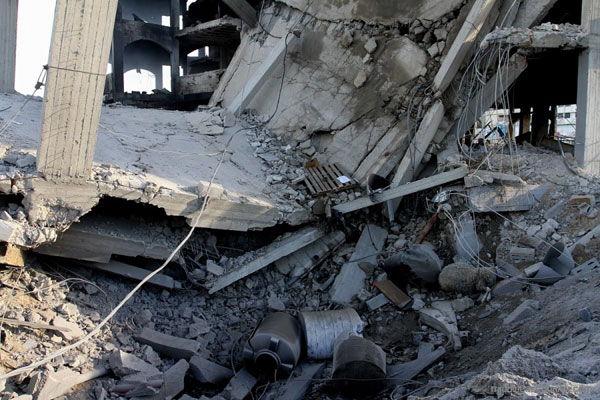 GAZA CITY – Israeli forces killed six Palestinians and injured 41 in attacks on Gaza in January, a ministry official said Saturday.
Ashraf al-Qidra, spokesman for Gaza’s Ministry of Health, said in a statement that “the Israeli occupation intensified airstrikes against unarmed civilians, particularly in the eastern Gaza Strip” in January.
The statement pointed out that a large number of the injured were children.
The health sector in the Strip has been suffering a severe shortage in medicines and medical equipment, al-Qidra added.
Over the past month, tensions have risen in and around Gaza after more than a year of relative calm following Israel’s war on the coastal territory in November 2012 which killed over 170 people, mainly civilians, and injured thousands.
Israeli army figures show nine rockets have struck Israeli territory since Jan. 1, and another five were intercepted by the Iron Dome anti-missile system. None of the rockets caused injuries.
Israeli airstrikes this year on targets in Gaza have injured dozens of people, mainly civilians.
A riot near Yizhar demonstrates the essence of Israeli occupation
The comedy, in whole
By Yossi Gurvitz | Yesh Din | January 31, 2014

Settlers hurl stones near the settlement of Yitzhar.
On April 25th, 2013, Raed Mahmoud Ahmad Sabah was in his house in the village of Urif, when he noticed three Israeli civilians, all wearing hoods, approaching his house from the settlement of Yizhar. Shortly afterwards, a settlement security vehicle arrived and joined the raiders, and out stepped a man who Sabah identified as a settlement security officer. Several minutes late, two IDF vehicles joined the group, out of which emerged a handful of soldiers. The squad of hooded Israelis were reinforced by more hooded Israelis, who also came from the direction of Yizhar. Together they began to hurl stones at Sabah’s home and at the neighboring houses. The group also started to uproot saplings. The Israeli soldiers, as well as the settlement security officer, stood about aimlessly, without bothering to stop the attack. The young men of Urif gathered to defend themselves and their property, and only then did the army spring into action. Large forces of the IDF and Border Police began firing tear gas canisters – at the Palestinians, naturally. Sabah would later count seven tear gas canisters in his courtyard. The Israeli rioters used the opportunity to sneak back home under cover of the gas screen. Needless to say, none of them were detained.
Yizhar is one of the most notorious settlements. Its municipal council recently resigned (Hebrew) after its residents? decided to stop cooperating with the IDF and appointed a suspected criminal, Boaz Albert (Hebrew) as their representative to the army. Last August, the Yizhar settlers denied Druze workers entry to the settlements. At the time, the army decided once more to retreat (Hebrew) and sent Jewish workers in their stead. Yizhar is home to the Od Yosef Khai Yeshiva (religious school), whose rabbis published the gentile-slaying manual, “Torat HaMelekh”. The yeshiva students operate the “HaKol HaYehudi” website, which several years ago published an article (Hebrew) by Yossi Elizur (one of the writers of Torah/torat? Hamelekh), which detailed the principles of “arvut hadadit,” the name given by the settlers at the time to the terror acts known as “price tag” attacks. The security system alleges that several Yizhar residents are involved in a series of “price tag” incidents, as well as daily terror attacks on Palestinians.
So, here was another story of the usual riot and collaboration by the army with the attackers. We’ve become inured to that. Our client, Sabah, possesses a sense of humor, so he complained to the Military Police Criminal Investigations Department (MPCID) about the behavior of the soldiers, and to the police against the settlers and settlement security officers. This, we should note, is his second complaint: three months earlier, Sabah lodged another complaint about a settler attack.
So, what did the police do with Sabah’s complaint? It did nothing. Just like Sabah’s earlier complaint, this case was also closed by the police on grounds of “perpetrator unknown.” The police did so even though Sabah presented it with a video showing the settlement security officer exiting the vehicle near the hooded settlers. Indeed, the only investigative action taken by the JSDP (Judea and Samaria Police District Police) was taking Sabah’s statement and watching his video.
As noted by our attorneys, Anu Lusky and Noa Amrami, there were quite a few actions the police could have taken. It could have interrogated Sabah’s neighbors; he said in his testimony that they, too, were attacked. The police didn’t do so. The JSDP could have interrogated the settlement’s security officer, but instead it was satisfied with a short question presented to him about the issue, which was dropped when he replied that he “did not remember” such an incident.
The police could have located the soldiers, who Palestinians testified were seen talking to the Israeli rioters during the incident, and interrogated them – but the investigators did not bother to find out who they were. In a handwritten memo, a police officer noted that he asked the security coordinator of Yizhar whether he could identify the rioters – but the officer didn’t even bother to write down the answer.
This is how it looks. First, you build a settlement. Then you let it turn into a base of attacks against the local villages and towns, while the army not only refrains from stopping the attacks but provides cover for them; and then comes the police and puts the investigation out to pasture. In the West Bank, this desolate state of affairs is masquerading as “the rule of law.”
We’ll repeat this again: the residents of the West Bank are protected persons according to the Geneva Conventions and the rulings of the Israeli High Court of Justice. When the army and the police refrain from providing them with this protection, they betray their basic duty. The words of Attorneys Lusky and Amrami in the appeal against the decision to close the case are worth quoting:
“We shall further remind you that according to Israeli law, as well as international law, the military commander and the police in the region are under an active duty to ensure the realization of the rights of the Palestinian residents and their protection. Hence, it is clear that our client is entitled to full protection by the JSDP, as has been ordered by the military commander in the region, particularly as this is not a single offense. […] This duty was blatantly violated in this case by the failure of the IDF troops and settlement security officials, who stood idly by and did not stop the violence started by [the settlement’s] residents, even though they were present at the scene in real time. This duty was violated once more, when a decision was made to close the case without fully investigating it.”
Israel should decide to which world it wants to belong: that which performs tikkun olam based on the rule of law and international law, or that of the rogue nations. Even though the question has never been presented to the citizens of Israel, the State’s actions in the West Bank provide a fitting answer.
Related articles
Israeli forces shoot, injure Palestinian youths at checkpoint
Ma’an – 31/01/2014
BETHLEHEM – Two Palestinian youths were shot and injured by Israeli forces early Friday at a checkpoint east of Jerusalem in the West Bank, witnesses said.
Witnesses told Ma’an that 19-year-old Jawhar Nasser Jawhar was injured by Israeli fire at al-Zaayyem checkpoint near Abu Dis.
Additionally, Adam Abd al-Raouf Halabiya, 17, was injured in the incident.
Jawhar remains in Israeli custody, and was not immediately given access to first aid, witnesses said.
His mother Svetlana, a Ukrainian citizen, said that her son was admitted to an Israeli hospital.
She spoke to Ma’an via telephone from the hospital, where she said she was being prevented from seeing her son. She said Israeli soldiers instructed doctors not to answer her questions about his health.
Israeli forces also threatened to deport her to Ukraine, she said.
An Israeli Border Police spokesman was unable to be reached for comment.
Related article

Two international activists arrested on visit to military court
International Solidarity Movement | January 29, 2014
Occupied Palestine – On Wednesday 29th January, 2014, two international human rights activists were arrested at Salem Military Court, in Jenin district. The activists, Norwegian and Canadian, were at the court to attend a hearing for Ahmad Atatreh, a 20-year-old Palestinian activist who had been arrested ten days earlier at a peaceful demonstration in the Jordan Valley.
Following the hearing, which the activists had attended in solidarity with Mr Atatreh and his family, Israeli soldiers violently pushed the defendant, who was in handcuffs, out of the courtroom. When the internationals asked why he was receiving this rough treatment, the soldiers took the passport from the Norwegian and arrested her on the accusation of having “slapped a soldier.”
The two remaining activists and the family of Mr Atatreh left the court facilities and were getting into a car outside when they were approached by another soldier, who subsequently arrested the Canadian, accusing him of “attempting to prevent an arrest.”
The activists were held overnight in the police station in the illegal settlement of Ariel. Under Israeli law they should be taken before a civil court judge within 24 hours of their arrest, although in recent cases the police have disregarded this, preferring to initiate deportation procedures without following due process.
The Canadian citizen was released on Thursday afternoon. The Norwegian citizen is being processed for deportation.
In the past month alone, five international human rights activists have been arrested, leading to concerns of a military crackdown on international solidarity with the Palestinian people.
With regard to the case of Ahmad Atatreh, who was arrested on the accusation of assaulting a soldier, the judge postponed the trial for a further month, in order to re-examine the evidence. The next time he appears in court he will have spent six weeks in administrative detention.
The Israeli military judicial system has been criticized by various human rights groups for their lack of fair trial guarantees and discrimination in procedural law. For more information on Israeli military courts see: http://www.addameer.org/etemplate.php?id=291

Salem Military Court
Related articles


Soldiers Invade Homes, Conduct Training, In West Bank Village

IMEMC & Agencies | January 30, 2014
At dawn on Thursday dozens of Israeli soldiers invaded Ein Shibli village, in the West Bank’s Central Plains, east of the northern West Bank city of Nablus, broke into several homes, and conducted military drills.
Resident Osama Abu Hatab said the soldiers violently searched several local families, and interrogated the residents before taking pictures of their ID cards.
Abu Hatab added that the soldiers violently banged on the doors, threatening to detonate them should the Palestinians refuse to open them, causing anxiety attacks among the children.
The families were then forced out in the cold for more than two hours, while the soldiers conducted training between the homes, wearing military combat gear.
In December of last year, the soldiers conducted three similar attacks and drills in Ein Shibli, An-Nassariyya, and Al-‘Aqrabaniyya villages, using military gear, army helicopters and various armored vehicles.
In related news, dozens of soldiers invaded Khirbet Um Al-Jamal village, in the Northern Plains of the occupied West Bank, and demolished tents and residencies that belong to 13 families.
Local sources said that army bulldozers demolished the sheds and structures, displacing the families, and also demolished barns.
‘Aref Daraghma, head of the Wady Al-Maleh local council, said the soldiers demolished more than 50 structures, including sheds, barns, wood fired ovens and tents.
Daraghma stated that the latest attack is part of numerous similar violations against the residents in the area, and that the army demolished dozens of structures over the last few months in the northern plains of the occupied West Bank.
“These violations are a continuation of war crimes carried out by the occupation”, he said. “The Palestinians are facing ongoing displacement, harassment, and are exposed to serious danger due to ongoing military training in the area”.
Related article
Palestinian man shot dead by Israeli forces near Ramallah
Ma’an – 29/01/2014
RAMALLAH – Israeli soldiers shot and killed a Palestinian man near the Ramallah village of Ein Siniya on Wednesday.
A Ma’an reporter identified the victim as Muhammad Mahmoud Mubarak, 22, from al-Jalazun refugee camp.
Israeli forces in the area denied Palestinian ambulances access to the body before medics were eventually allowed to transfer the man to Ramallah Medical Complex.
A Palestinian official in the military liaison department told Ma’an that Mubarak was shot dead by a soldier positioned in a military watchtower.
“A Palestinian terrorist opened fire at an IDF (army) post near Ofra. The soldiers responded immediately in order to eliminate the imminent threat to their lives and fired towards the terrorist, identifying a hit,” Israel’s army said.
Eyewitnesses in the area told Ma’an that Mubarak was a laborer working with the al-Tarifi company on a USAID funded project to refurbish the main road in Ein Siniya.
Earlier, he had been directing traffic in the area with a handheld sign.
“While he was doing his job, a number of Israeli soldiers arrived and started to harass him,” witnesses told Ma’an.
“They forced him to take off his clothes, then put them on again. Then they ordered him to take a few steps forward, then walk back, and finally they shot him and left him bleeding preventing ambulance and medics from reaching him.”
Coworkers and an executive from the al-Tarifi company were close-by when the shooting took place.
Last year, Israel’s army killed 27 Palestinians in the occupied West Bank, according to UN statistics.
Related article

Outsourcing Probation: A Lucrative and Growing Industry
By Noel Brinkerhoff and Danny Biederman | AllGov | January 29, 2014
Privatization of the criminal justice system has extended beyond prisons that are run for profit and now includes probation operators making a buck off Americans who have violated the law.
Quietly over the past four decades, private probation companies have gone into business in 40% of U.S. states, most of them in the South. Georgia alone has 34 businesses providing probation services.
These entrepreneurs have replaced county offices that used to oversee individuals given probation instead of jail time for their offenses.
But the switch from public to private probation has resulted in excessive financial costs levied on probationers, some of whom have been threatened with incarceration for not paying these companies on time.
Circuit Judge Hub Harrington called the private probation system in Harpersville, Alabama, a “judicially sanctioned extortion racket.”
Take for example Sentinel Offender Services, a $30 million enterprise operating in four states. An investigation by NBC News found that Sentinel demanded payments for fees from low-income probationers and resorted to arrest warrants to force the issue, regardless of the individuals’ financial status.
All of this despite a 1983 federal ruling that said that people on probation cannot be imprisoned for being indigent.
In Florida, private firms can add as much as 40% in surcharges on top of the debt owed by probationers. In Illinois, the add-on fees can amount to 30% of the standing debt.
The Brennan Center for Justice says that at least nine states allow companies to charge probationers excessive fees.
Former law enforcement officials control this industry—at least in Georgia—having leveraged their connections into profitable contracts. “This is completely dominated by retired state probation people and wardens of state prisons,” Putnam County Sheriff Howard Sills told the Atlanta Journal-Constitution. “They created this industry for themselves.”
They did so after Georgia passed a law in 2000 that transferred state probation services to the counties, thereby allowing local courts to outsource those services to private companies. They are allowed to handle all probation cases other than those involving felons.
Bobby Whitworth, the former head of the Georgia Board of Pardons and Paroles, accepted payoffs in return for helping to pass that law. He was eventually imprisoned on public corruption charges for having done so.
“My problem [with private probation services] is with…the fact that people are getting rich off the poorest people in society,” Steve Bright, senior counsel for the Southern Center for Human Rights, told the Journal-Constitution. “Many private probation companies don’t do anything but collect checks from people. Perhaps someone who has run a loan company would be better qualified.”
To Learn More:
Connections Matter in Ga. Private Probation Industry (by Rhonda Cook, Atlanta Journal-Constitution)
‘Cash Register Justice’: Private Probation Services Face Legal Counterattack (by Hannah Rappleye and Lisa Riordan-Seville, NBC News)
Related article

Torture in the Age of Obama
Article 5 of the UN Declaration of Human Rights expressly forbids that any person “be subjected to torture or to cruel, inhuman or degrading treatment or punishment.”
When then-Senator and presidential candidate Barack Obama promised to end torture, close the Guantanamo Bay gulag and restore habeas corpus, he was speaking to a fundamental desire within the American public consciousness to restore the ideals upon which the United States is based – ideals which had been all but discarded under the Bush administration.
Americans wanted an end to CIA torture sites, an end to “enhanced interrogation” and an end to arbitrary and indefinite detention. Once elected, President Obama did his best to present the appearance that the country had restored its humanity by signing Executive Order #13,491, effectively ending the “enhanced interrogation” policies enacted under George W. Bush.
Yet the United States, under both the Bush and Obama administrations, has engaged in systematic torture and inhuman treatment in blatant violation of international law. Buried in the text of Obama’s Executive Order was the condition that, “an individual in the custody… of the United States Government… shall not be subjected to any interrogation technique or approach, or any treatment related to interrogation, that is not authorized by and listed in Army Field Manual 2 22.3.” Essentially then, the Obama administration began its first term of office by sanctioning the use of the Army Field Manual and the standards, protocols and methods of interrogation outlined within it. Rather than officially ending the torture practices implemented during the Bush years, Obama simply put an end to certain egregious methods while validating others.
As the Center for Constitutional Rights noted at the time: “While the current Army Field Manual does not allow waterboarding, it does include approved techniques that constitute torture.” Some of these techniques are outlined in the infamous Appendix M of the field manual which describes the use of “Separation” which is applied to the ambiguously termed “unlawful combatants” who, because of their status as something other than prisoners of war, are subjected to gross violations of international law. Appendix M describes techniques such as prolonged isolation, sleep deprivation, sensory deprivation and the use of fear and humiliation of prisoners. And yet Obama claims to have “ended torture.”
It should be noted also that, instead of pushing for strict anti-torture legislation that would have codified policies against the use of “enhanced interrogation,” Obama chose to issue an executive order that can be reversed with the stroke of a pen from any future president. Moreover, he chose to limit the scope of the order in order to provide political wiggle-room for himself in case he was seen as “soft on terror.” It is within this context that one should remember that, despite his promises, Guantanamo Bay remains open, rendition programs continue and not one person from the CIA or any other agency has ever been held to account for their myriad crimes. As Obama said in 2009 “[I have a] belief that we need to look forward as opposed to looking backwards… at the CIA you’ve got extraordinarily talented people who are working very hard to keep Americans safe. I don’t want them to suddenly feel like they’ve got to spend all their time looking over their shoulders.”
In 2013, the non-partisan Constitution Project issued a report that, among other things, documented in painstaking detail many of the ways in which the Obama administration has cleverly manipulated and ignored the laws, not to mention Obama’s campaign promises, in order to continue the torture and rendition programs. The report noted: “Taken as a whole, the lack of successful prosecutions demonstrates major gaps in enforcement of the laws against torture and war crimes, which likely reduces their deterrent effect.” Essentially then, the current administration, by turning a blind eye to crimes committed by interrogators under Bush as well as Obama, has effectively negated any perceived anti-torture stance it might have taken.
While the president has managed, through rhetoric and spin, to keep up the appearance that he has put a stop to torture when it comes to the so-called “War on Terror,” he has maintained a deafening silence when it comes to torture at home.
Torture and the American Gulag
Despite managing to lecture countries such as Russia, China and Cuba for human rights abuses and political prisoners, the United States continues to be, by far, the greatest police state in the world. With only 5 percent of the world’s population, the US has 25 percent of the world’s prison population. Within this pervasive prison-industrial complex, many thousands of prisoners are held in extended solitary confinement, which undoubtedly constitutes torture. In fact, United Nations Special Rapporteur on Torture Juan E. Mendez stated in 2011:
“Segregation, isolation, separation, cellular, lockdown, Supermax, the hole, Secure Housing Unit… whatever the name, solitary confinement should be banned by states as a punishment or extortion technique… Solitary confinement is a harsh measure which is contrary to rehabilitation, the aim of the penitentiary system… Considering the severe mental pain or suffering solitary confinement may cause, it can amount to torture or cruel, inhuman or degrading treatment or punishment when used as a punishment, during pre-trial detention, indefinitely or for a prolonged period, for persons with mental disabilities or juveniles.”
It should of course be noted that, like the prison population in general, solitary confinement is disproportionately applied to people of color. More to the point, it is most often utilized to break the mind, body and spirit of political prisoners, especially those from civil rights and radical political movements. So, if the president were actually interested in putting an end to torture, not to mention paying attention to the issues most directly affecting people of color in the US, wouldn’t it stand to reason that he might have something to say about this abhorrent practice in the US prison system? Obama meets such questions with silence.
Did you think that the United States only operated secret prisons abroad? If so, you’d be wrong. Under the Obama administration there has been an expansion of the use of so called “Communication Management Units” (CMUs) – secret prisons specifically designed to house political prisoners in isolation and in blatant violation of their constitutional rights. Prisoners of Middle Eastern descent, animal rights activists, environmental activists and others have found themselves locked up in CMUs with little to no contact with family and/or their legal representatives. Naturally, the President has never spoken on this issue as it would once again fly in the face of the picture of the constitutional scholar-cum-president and his image as a defender of human rights.
There has been resistance to these inhuman policies carried out by the United States. In Guantanamo, the world watched as a number of prisoners risked their lives in a prolonged hunger strike to call attention to their continued illegal imprisonment. Similarly, recent hunger strikes in US prisons, most notably at California’s infamous Pelican Bay prison, have attempted to focus media attention and public scrutiny on the continued torture of inmates. Luis Esquivel, an inmate at Pelican Bay, succinctly illustrated the point when he said: “I feel dead. It’s been 13 years since I’ve shaken someone’s hand and I fear I’ll forget the feel of human contact.”
Whether engaging in systematic torture abroad or at home, the United States continues to be a world leader in this regard. Despite the rhetoric from President Obama, substantive changes have not been made to the way in which the US treats its prisoners, nor to the rights afforded them. Indeed, despite the high-minded ideals Obama espouses in speech after speech, the sad reality is that, like Bush before him, Obama is the figurehead of the most aggressive and repressive power in the world today.
Featured Video
Integrity Initiative: UK-funded network framed dissent as Russian disinformation for years
or go to
Aletho News Archives – Video-Images
From the Archives
Why Saudi Ties to 9/11 Mean U.S. Ties to 9/11
By Kevin Ryan | Dig Within | September 27, 2015
Media interest in Saudi Arabian connections to the crimes of 9/11 has centered on calls for the release of the 28 missing pages from the Joint Congressional Inquiry’s report. However, those calls focus on the question of hijacker financing and omit the most interesting links between the 9/11 attacks and Saudi Arabia—links that implicate powerful people in the United States. Here are twenty examples. … continue
Blog Roll
 Aletho News
- ‘A Big Victory’ – Palestine Chronicle Wins Two-Year Legal Battle
- IAEA inspectors cannot return to Iran amid US threats: Russia
- Senate Rejects Iran War Powers Resolution Passed By House
- ‘We did not attack Pakistan with drones’: Afghan sources
- Iraqi Resistance faction links arms to sovereignty, questions US exit
- Cannon fodder no more… South Korea rejects Trump’s pressure to join his criminal war on Iran
- Neria Leiter Was A Legitimate Military Target
- Integrity Initiative: UK-funded network framed dissent as Russian disinformation for years
- ‘We don’t seek permission to defend our country’: Snippets from President Pezeshkian’s UNGA address
- NATO chief wants Europeans to fight American wars [for Israel]
- If Americans Knew
- In UN Speech, Iran’s President Displays Pictures of Children Killed by US, Brings Attention to Israel’s Nuclear Arsenal
- Israel displaces hundreds of Palestinians amid wave of demolitions in West Bank
- Aid, reconstruction, and Israel’s history of obstruction in Gaza
- Trump administration digs an ever-deeper hole of complicity in genocide – Daily Update
- US-Israel $2.8 Billion Arms Deal, 40,000-Bomb Supply Faces New Gaza Complicity Accusations
- Caught on Tape: AIPAC CEO Boasted of Controlling Trump’s National Security Officials
- Why Hamas Attacked Israel in October 2023 – Israeli professor Ilan Pappé
- They see them, then kill them: Israeli quadcopters track, deliberately target civilians in Gaza
- Winter could turn Gaza’s treacherous, war-damaged buildings into deathtraps
- Majority of Democratic Voters Want to Prosecute Both Biden and Trump Administration Officials Over Gaza
- No Tricks Zone
- New Study: Earth And Venus Surface Warmth Largely Explained By Convection And Lapse Rate, Not CO2 Or Radiation
- 2025 Nature Paper Claiming Worsening Global Drought Gets RETRACTED …Heavily Flawed
- New Study: ‘Global Drought Shows No Detectable Recent Acceleration Under Climate Warming’
- Economic Masterminds: German Socialists Suggest Taxing Productivity Gains Stemming From Using AI
- The South China Sea Has Not Been Cooperating With The Climate Change Narrative
- Energy Crisis: Germany Enters Heating Season With Historically Low Gas Reserve Fill Levels
- New Study: The Antarctic Ice Sheet Gained Mass From 2020-2024 Due To Staggering Snow And Ice Accumulation
- Study: Ocean Heating Rates From Thousands Of Years Ago ‘Dwarf’ Modern Ocean Heating Rates
- Climate Extremists Target, Attack Large-Scale Power Grid Infrastructure In Germany!
- New Study: Antarctic Ice Melt Has Contributed Less Than 1 Centimeter To Sea Level Rise In The Last 30 Years

