Checkpoint – Jasiri X
jasirix · January 28, 2014
“Checkpoint” is based on the oppression and discrimination Jasiri X witnessed firsthand during his recent trip to Palestine and Israel “Checkpoint” is produced by Agent of Change, and directed by Haute Muslim. Download “Checkpoint” at https://jasirix.bandcamp.com/track/ch….
LYRICS
Journal of the hard times tales from the dark side
Evidence of the settlements on my hard drive
Man I swear my heart died at the end of that car ride
When I saw that checkpoint welcome to apartheid
Soldiers wear military green at the checkpoint
Automatic guns that’s machine at the checkpoint
Tavors not m16s at the checkpoint
Fingers on the trigger you’ll get leaned at the checkpoint
Little children grown adults or teens at the checkpoint
All ya papers better be clean at the checkpoint
You gotta but your finger on the screen at the checkpoint
And pray that red light turns green at the check point
If Martin Luther King had a dream of the checkpoint
He wake with loud screams from the scenes at the checkpoint
It’s Malcolm X by any means at the check point
Imagine if you daily routine was the checkpoint
Separation walls that’s surrounding the checkpoint
On top is barbwire like a crown on the checkpoint
Better have ya permits if your found at the checkpoint
Gunmen on the tower aiming down at the checkpoint
The idea is to keep you in fear of the checkpoint
You enter through the cage in the rear of the checkpoint
It feels like prison on a tier at the check point
I’d rather be anywhere but here at this checkpoint
Nelson Mandela wasn’t blind to the check point
He stood for free Palestine not a check point
Support BDS don’t give a dime to the checkpoint
This is international crime at the checkpoint
Arabs get treated like dogs at the checkpoint
Cause discrimination is the law at the checkpoint
Criminalized without a cause at the checkpoint
I’m just telling you what I saw at the checkpoint
Soldiers got bad attitudes at the checkpoint
Condescending and real rude at the checkpoint
Don’t look em in they eyes when they move at the checkpoint
They might strip a man or woman nude at the checkpoint
Soldiers might blow you out of ya shoes at the checkpoint
Gas you up and then light the fuse at the checkpoint
Everyday you stand to be accused at the checkpoint
Each time your life you could lose at the checkpoint
If Martin Luther King had a dream of the checkpoint
He wake with loud screams from the scenes at the checkpoint
It’s Malcolm X by any means at the check point
Imagine if you daily routine was the checkpoint
At the airport in Tel Aviv is a checkpoint
They pulled over our taxi at the checkpoint
Passport visa ID at the checkpoint
Soldiers going all through my things at the checkpoint
Said I was high risk security at the checkpoint
Because of the oppression I see at the checkpoint
Occupation in the 3rd degree at the checkpoint
All a nigga wanna do is leave fuck a checkpoint
Follow Jasiri X at https://twitter.com/jasiri_x

The Story of the Individual is Testimony to the Story of the Public
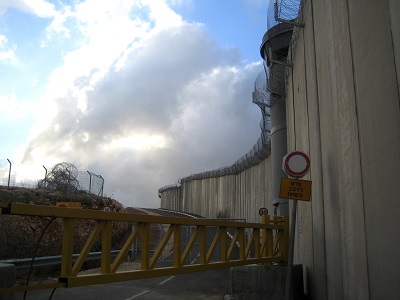
Here, right to freedom of movement is relative. (Photo: Tamar Fleishman)
Palestine Chronicle | January 27, 2014
We usually prefer to exit Palestine using Hizme checkpoint, where unlike other exit checkpoints, there are no long lines of cars, we aren’t detained and there is no need for identification or getting out of the vehicle to open and present the content of the trunk. You merely slow down by the soldier and answer a generic question like “how is it going?” with an “OK”. Sometimes even that isn’t required, just nod your head and that’s it, you can drive on.
But it’s different for us than for those who don’t pass the test examining the visage and accent of the driver. They, Palestinians from east Jerusalem, in spite of being permanent residents who have the right for freedom of movement (unlike their brothers who reside in the West Bank), are forced to stop, park their vehicle by the soldier’s post on the side of the road, identify themselves, exit the car and open the trunk so the solider can see inside.
Their right to freedom of movement is relative and they are subjected to the mercy and whims of the men in uniform.
The individual’s story is testimony to the story of the general public. The individual in this case was A who after visiting his family intended to drive through Hizme on his way back, with him were his wife, his baby son and someone he knew that said to him: “could you do me a favor, I need to get to Jerusalem, could I ride with you?”- So he did. A didn’t give him a thorough inspection, and had no idea what color his ID was and what was his address. He was just doing someone a favor. But the soldier at the checkpoint did perform an inspection and found out that A was giving a lift to someone who wasn’t permitted to pass through a checkpoint intended only for settlers, like Hizme checkpoint.
The man was arrested and taken away.
A was told to turn his engine off and to stay in the vehicle, in addition they took his car keys.
A, his wife and their child sat and waited. But the baby, who had yet to learn that a soldier’s order must be obeyed, began crying and wailing. The minutes that passed were long and the crying only grew stronger. But they couldn’t step out of the car, they couldn’t take the baby out of his booster, and he couldn’t be cradled in his mother’s arms. A tried getting out to reason with them, but was told to: “stay in the car!” and so he got back in.
After an hour his car keys were handed back to him and his wife and child were sent back home, while A was taken to the police station. There he waited for another hour, until he was given a summons to return on the next day.
Ever since he has been going back and forth to the police station, each day he waits for his name to be called, then he is taken into a room, the piece of paper he was handed on the previous day is taken from him and in return he is given a new paper summoning him to come back on the next day.
The time, the agitation, not to mention the money- all these are of no importance and are not taken into account.
Once he dared to ask why they weren’t handling his case and a policeman said to him: “I don’t have time for you, I’ve got lots of work”- “But my case is part of your work”, replied A, but instead of an answer he got a piece of paper in exchange for the one given to him on the previous day.
Yes, he will be back tomorrow, and perhaps even on the day after that.
This is how the representatives of the authority, who have unlimited power in their hands, handle people, whose rights are conditioned by circumstances.
(Translated by Ruth Fleishman)
Related articles


Israeli forces kidnap two teenagers fishing off Gaza

(Photo by Charlie Andreasson)
By Rosa Schiano | International Solidarity Movement | January 27, 2014
Gaza, Occupied Palestine – On Monday, 20th January, at about 6:00 am, Yousef Amin Abo Warda (age 18) and his cousin Ahmad Kamal Abo Warda (age 16) left their house to go fishing in a small boat without an engine.
Around 7:30 am they were fishing in front of the al-Waha area, in the northern Gaza Strip, and sank their fishing nets about three kilometers, or 1.6 nautical miles, offshore.
The arrest
Yousef said two large Israeli gunboats approached the fishing boats. While other fishermen were able to escape, for Yousef and Ahmad it was impossible, as their boat had no engine and was made heavy by seawater seeping through a hole.
“Soldiers from one of the gunboats began shooting into the water, while the second gunboat quickly turned around us to create waves,” Yousef said.
The soldiers, as they usually do when they want to arrest fishermen, asked the two young Palestinians to undress, dive into the water and swim to the Israeli ship.
“I tried to get closer to their ship by swimming, but the ship moved away, so it became hard for me,” Yousef said. ”I cried that I was tired moving my arms. I could no longer swim. The ship stopped. I went directly to the ladder that they putdown and I climbed on board the ship.”
“They made me kneel down and handcuffed my hands behind my back,” Yousef added. ”They gave me some clothes and helped me put them on. They yelled to my cousin Ahmad to swim toward the ship. After about half hour Ahmad was sitting behind me. Our hands and feet were tied.” Moreover, the soldiers kicked the two fishermen on their back.
The arrival at the port of Ashdod
After about half an hour the ship reached the Israeli port of Ashdod. The soldiers removed the bandages from the fishermen’s eyes, as well as their cuffs, to allow them to get off the ship. On shore, the fishermen were again handcuffed and blindfolded. They were asked personal information: their names, place of residence, dates of birth, phone numbers. Some soldiers wrote this information in Hebrew on a paper. They asked Yousef to hold the paper in his hands and took a picture of him. Yousef and Ahmad were held in two separate rooms for about three hours. Then some soldiers took Yousef into the room where Ahmad was detained. They left them handcuffed in a room for another three hours. Then some soldiers made the fishermen get in a Jeep and brought them to Erez.
Erez and the interrogation
At Erez, the two fishermen were brought into a room and interrogated separately.
The investigator asked Yousef about his name, his family, his brothers, the age of his relatives, his work and other personal information. “The detective showed me on a computer a map of the city of Jabalia, he told me the name of the streets with specific details,” he said. “He asked me to select my house. He showed me a house in which some people working for Hamas and the al-Qassam brigades are living, and he asked me if I know them. I said no. Then he showed me other houses belonging to people connected with Hamas. He indicated more than two houses. He was trying to get information from me. I said I don’t know anything. He told me ‘Are you afraid? You are in a safe place and you can tell us everything. These people are trying to destroy your life, they are terrorists.’ He indicated about six families that live in my neighborhood”.
The investigator showed him also the beach and asked him on which part of the beach he usually works and where he keeps his boat. The investigator also asked him about a police site in the area and how many people work there. Yousef replied that he knows only two policemen, to whom the fishermen show their permits on the beach, and that he doesn’t go to the governmental site. The investigator asked Yousef about a training site of the al-Qassam brigades. Yousef replied that he doesn’t know anything about it. “The investigator then showed me photos of some hasakat [small fishing boats] and asked me to whom they belong, and he asked me about some cafes on the beach and about the harbor. I told him that I don’t know anything about the harbor and I don’t go there. The investigator asked me ‘In Jabalia refugee camp there is a site that belongs to Hamas?’ I told him that I don’t know.”
“The investigator asked me what I thought of al-Sisi [commander of the Egyptian armed forces] and how the relation are between Hamas and al-Sisi. I told him that I do not follow the news or politics. I said,‘I go to fish and I go home’.
“The detective told me ‘If you are near the border and you get shot by the army, who will you blame and would you consider responsible?’ ‘You are responsible,’ I said. He replied ‘Hamas should be blamed, not us.’”
“The investigator then asked me, ‘What do you think of the Hamas government and what is your opinion of it in comparison with Fatah? Do you feel comfortable? Why did you elect them? You were happy under the Israeli government. Many Palestinians came here to work and had money. Can you compare your current life to the life in which Israel controlled Gaza?’ I told him that I’m only 18 years old. I can’t know and I have never gone to Israel.”
The investigator then asked Yousef about the tunnels , Yousef replied that he’s just a fisherman and has never seen one. Finally, the investigator asked him if he was feeling hungry. Yousef said yes. The soldiers brought him a shawarma sandwich and a Coke.
Yousef was then taken to another room and remained there for an hour. Meanwhile, investigators had questioned his cousin Ahmad. The soldiers then accompanied the two young fishermen to the Erez gate and told them to return to the Gaza Strip.
“They closed the door behind us,” he said.
Their relatives, frightened by the lack of news, had tried to contact the International Committee of the Red Cross and other organizations. They also asked some fishermen to look for them in the sea. But only around 11:00 pm did the ICRC inform them that the two had been arrested.
Escalation
The fishermen told us that since the beginning of 2014, there has been an increase in Israeli attacks on Gaza fishermen and the situation is worsening day by day. According to the fishermen, Israeli attacks increase during fishing seasons.
Loss and hope
The large family Abo Warda, whose name is also used to denote the area where it lives, includes about 35 fishermen, of whom about half have been arrested.
In November, two other young men from the same family, Saddam and Mahmoud Abo Warda, were also arrested. One of them suffered a light injury in the abdomen caused by Israeli gunfire. Both were attacked while fishing on a boat without an engine, and were therefore unable to escape.
Several of the family’s boats have been confiscated and are currently in the Israeli port of Ashdod.
Yousef and Ahmad have lost their fishing nets.
“Before, we had three boats with nets,” Yousef said. ”Now my family has only one boat and no nets. I ask the international community to stop these Israeli attacks.”
“Eight persons in this house are fishermen,” another fisherman said. “One of our boats was damaged during Israel’s ‘Operation Pillar of Defense’ in November 2012. We can’t fix it and need to buy new nets.”
Background
Israel has progressively imposed restrictions on Palestinian fishermen’s access to the sea. The 20 nautical miles established under the Jericho agreements, between Israel and the Palestine Liberation Organization (PLO) in 1994, were reduced to 12 miles in the Bertini Agreement of 2002. In 2006, the area Israel allowed for fishing was reduced to six nautical miles from the coast. After its military offensive “Operation Cast Lead” (December 2008 – January 2009) Israel imposed a limit of three nautical miles from the coast, preventing Palestinians from accessing 85% of the water to which they are entitled under the Jericho agreements of 1994.
Under the ceasefire agreement reached by Israel and the Palestinian resistance after the Israeli military offensive “Operation Pillar of Defense” (November 2012), Israel agreed that Palestinian fishermen could again sail six nautical miles from the coast. Despite these agreements, the Israeli navy has not stopped its attacks on fishermen, even within this limit. In March 2013, Israel once again imposed a limit of three nautical miles from the coast. On 22 May, Israeli military authorities announced a decision to extend the limit to six nautical miles again.
Related articles


The Act of Killing
As a major new documentary about the Indonesian genocide goes on national release, an AHRC film looks at the research behind ‘The Act of Killing’
To mark the national release of the film ‘The Act of Killing’, the AHRC is today releasing a film of an interview with Professor Joram ten Brink of the University of Westminster, Principal Investigator of the AHRC-funded Genre and Genocide research project, of which the new documentary is a major output.
‘The Act of Killing’ depicts a group of unrepentant former members of Indonesian death squads being challenged to re-enact some of their many murders in the style of the American movies they love. The film focuses particularly on one individual, Anwar Congo, whose initial enthusiasm for the re-enactments slowly gives way to outward expressions of unease and remorse.
When the government of Indonesia was overthrown by the military in 1965, Congo and his friends were promoted from small-time gangsters who sold movie theatre tickets on the black market to death squad leaders. They helped the army kill more than one million alleged communists, ethnic Chinese and intellectuals in less than a year. As the executioner for the most notorious death squad in his city, Congo himself killed hundreds of people with his own hands.
‘The Act of Killing’ is a journey into the memories and imaginations of the perpetrators, offering insight into the minds of mass killers. The film is a nightmarish vision of a frighteningly banal culture of impunity in which killers can joke about crimes against humanity on television chat shows, and celebrate moral disaster with the ease and grace of a soft shoe dance number.
The Act of Killing CLIP
The Act of Killing Director’s Cut — Clip 1
The Act of Killing Director’s Cut — Clip 2
The Act of Killing – final scene
Who Profits report: Corporations profit from Israeli prisons
Samidoun: Palestinian Prisoner Solidarity Network | January 26, 2014
 Who Profits released the following report on the involvement of Israeli and multinational corporations in the Israeli prison system:
On December 2013, the Israel Prison Service (IPS) responded to a freedom of information request by Who Profits, which was submitted three months earlier, regarding twenty-two corporations that provide services to Israeli prisons.
These companies mainly provide security equipment and services to incarceration facilities that hold Palestinian prisoners and detainees inside Israel and in the occupied West Bank. These incarceration facilities hold Palestinian political prisoners in violation of international law, and torture and systematic violations of human rights take place within their walls. According to Addameer’s latest monthly detention report (December 2013), there are 5033 Palestinian political prisoners in the Israeli prisons, 173 of whom are minors and 145 are administrative detainees.
The following table is an English translation of information provided by the Israel Prison Service to Who Profits, regarding twenty-two corporations that provide services to Israeli prisons and detention facilities.
| Company Name | Characteristics of Contract | End of Contract | Comments | Financial Scope |
| G4S | Maintaining supporting management systems, magnetometer gates, scanning machines and ankle monitors | During the fiscal year 2015 | According to an IPS tender | Tens of millions of shekels |
| 3M | Based on occasional bids | |||
| MOTOROLA SOLUTIONS ISRAEL | Maintaining wireless systems and lighting bridgesRepairing wireless devices | During the fiscal year 2016 | According to an IPS tender | Tens of millions of shekels |
| HEWLETT- PACKARD (HP) | PrintersMaintaining HP systems and central servers | During the fiscal year 2016 | Tenders by the Accountant General + tenders by the IPS | Tens of millions of shekels |
| MERKAVIM TRANSPORTATION TECHNOLOGIES | Based on occasional bids | |||
| MAYER’S CARS AND TRUCKS | Based on occasional bids | |||
| VOLVO GROUP | Based on occasional bids | |||
| Biosense | Supplying and maintaining a dog-bark identification system | During the fiscal year 2014 | According to an IPS tender | Hundreds of thousands of shekels |
| Myform | Based on occasional bids | |||
| MIRS COMMUNICATIONS | Purchase of battery servicesProviding wireless services | During the fiscal year 2016 | Tenders by the Accountant General + Tenders by the IPS | Hundreds of thousands of shekels |
| AFCON HOLDINGS | Installing, providing year-round service and maintaining fire detection systems | During the fiscal year 2015 | According to an IPS tender | Tens of millions of shekels |
| Contact | Based on occasional bids | |||
| SHAMRAD ELECTRONICS | Relocating communication infrastructureSupplying electronic equipmentRepairing sound system | During the fiscal year 2015 | According to an IPS tender | Tens of millions of shekels |
| B.G. ILANIT GATES AND URBAN ELEMENTS | Based on occasional bids | |||
| Dadash Hadarom Distribution | Purchase of canteen products | 31/07/14 | According to a tender | |
| Shekem | Based on occasional bids | |||
| Shiran | Based on occasional bids | |||
| S.I.R.N. | Based on occasional bids | |||
| Shekel | Based on occasional bids | |||
| ASHTROM GROUP | Based on occasional bids | |||
| Lymtech | Based on occasional bids |
Who Profits also provides documentation and research on several of these companies at the links below:
Related article
American Psychological Association Refuses to Charge Member Who Committed Torture at Guantánamo
By Noel Brinkerhoff and Danny Biederman | AllGov | January 25, 2014
 An American psychologist who took part in the torture of a Guantánamo detainee has avoided disciplinary action by an association of his peers.
The American Psychological Association (APA) wrote in a letter that John Leso, a former U.S. Army reserve major and psychologist, would not be rebuked for participating in the harsh interrogation of Mohammed al-Qahtani in November 2002.
Qahtani was suspected of helping plot the September 11, 2001, attacks.
The APA said in the letter to Trudy Bond, an APA member who filed the complaint against Leso, that it had “determined that we cannot proceed with formal charges in this matter. Consequently the complaint against Dr Leso has been closed.”
The association did not deny that Leso took part in the brutal interrogation of Qahtani, whose treatment was categorized as torture by a U.S. military commission.
A classified record of the interrogation, which surfaced in 2005, showed Leso (identified as “MAJ L”) was present while Qahtani was forcibly given liquids, denied use of bathrooms, resulting in him urinating on himself, subjected to loud music, and repeatedly kept awake while being “told he can go to sleep when he tells the truth.”
Leso’s role in the use of torture at Guantánamo was bolstered by documents that surfaced during a U.S. Senate Armed Services Committee torture inquiry which highlighted Leso’s involvement with a special team at the prison that crafted torture techniques. Leso’s name, rank and membership on the team were cited in minutes of a Guantánamo meeting that was published by the committee. That record quoted Leso, at the time, as pointing out that the detainees “are used to seeing much more barbaric treatment” and therefore the team’s use of “force” on them “may be ineffective.”
Leso also helped write a 2002 memorandum that detailed the use, at Guantánamo, of “stress positions,” sleep deprivation, dietary manipulation, isolation and exposure to extreme cold. The memo made its way through the Pentagon bureaucracy, leading U.S. forces to apply those same abusive techniques to detainees at Iraq’s Abu Ghraib prison in 2003.
The Senate’s torture report quoted Leso as telling them he had been uncomfortable with the memo he helped produce, preferring instead a “rapport-building approach” to interrogation. APA’s ethics office made note of this, and it has been speculated that it played a role in Leso’s exoneration by the group.
Bond and other APA members who wanted Leso punished were dismayed by the decision. They believe that APA gave more weight to the doubts that Leso expressed after the fact than to his actual participation in the torture program.
“With Leso, the evidence of his participation is so explicit and so incontrovertible, the APA had to go to great lengths to dismiss it,” Steven Reisner, a New York clinical psychologist who unsuccessfully ran for the APA presidency last year, told The Guardian. “The precedent is that APA is not going to hold any psychologist accountable in any circumstance.”
Bond said the organization had sent the message that “psychologists are free to violate our ethical code, perhaps, in certain situations.”
An APA spokesperson, Rhea Farberman, told The Guardian that its investigation could not meet the burden of finding “direct unethical conduct” by Leso, and said it was “utterly unfounded” to fear the organization has condoned professional impunity. Farberman added that the APA’s “standing policies will clearly demonstrate that APA will not tolerate psychologist participation in torture.”
To Learn More:
US Psychology Body Declines to Rebuke Member in Guantánamo Torture Case (by Spencer Ackerman, The Guardian)
American Psychological Association Letter on Dr John Leso: ‘We Cannot Proceed with Formal Charges’ (The Guardian)
Shrinks, Lies and Torture (by Trudy Bond, Counterpunch)
Is It Finally Time to Punish Pro-Torture Judge and Doctors? (by Noel Brinkerhoff and David Wallechinsky, AllGov)
Psychologists Move against One of Their Own Who Helped Torture (by Noel Brinkerhoff and David Wallechinsky, AllGov)
How Israel kills at will and in total impunity while the world asks the Palestinians for non-violent resistance
April 20, 2009
Frank Barat writes of the life and death of Bassem Abu Rahme, shot by an IOF soldier with “the rocket”, a new kind of weapon also used on critically injured US citizen Tristan Anderson some weeks ago.
On April the 17th, like any Friday afternoon for the last 4 years, the small village of Bil’in, north of Ramallah, was preparing for the usual demonstration against Israel’s annexation wall … The village of Bil’in has, since the mid eighties, lost more than 60% of its land for the purpose of Israeli growing settlements and the construction of the wall. The inhabitants of the village used to live mainly from agriculture and olive trees plantations but more and more, the people of Bil’in have to rely on the women to survive. Embroidery has become one of the main resource of the place, located a few kilometres away from Tel Aviv (on a nice day, you can see the “inaccessible”–for the Palestinians– beach from the roof tops of Bil’in).
In January 2005, a village committee (led by Mohamed Khatib, Iyad Burnat and Abdullah Abu Rahme) was created and a month later non-violent demonstrations started, first taking part every day, then once a week, on Yum Al Juma’a (Friday, day of prayer).
The village won a huge battle in August 2008 (1) when the Israeli High Court of Justice ruled that the new route of the barrier in Bil’in was in violation of the Court ruling released on September 2007 (2) (which ruled that the Wall path was prejudicial to Bil’in and must be altered) and ordered the State to present within 45 days a new route, which will uphold the principles of the ruling.
On Friday the 17th of April 2009, the wall still had not moved one inch and while the inhabitants of the village were praying at the village mosque, many internationals (coming from all around the world) and the strong Israeli contingent (including people from the Alternative Information Centre (3) and Anarchists Against the Wall (4)) were looking for some shade (to hide from the baking sun) and chatting about the day’s event. As soon as prayer was over with, the demonstration started to move forward in direction of the wall, a few kilometres away.
You can be sure that Bassem (aka Phil) was right at the front of the march. He always was. I had met Bassem a few times while visiting Bil’in. He was a strong looking man, singing the loudest, joking all the time, jumping around and leading the way, accompanied by the rest of the village committee and the Israeli contingent.
As it usually happens, as soon as the march reached the corner where the Israeli soldiers can be seen, the tear gas started. A few brave ones, always continue anyway and reach the beginning of the wall, after a few minutes. Bassem, as usual, was one of those. The Israelis present at the front of the demonstration started talking with the nearby soldiers in Hebrew and Bassem too, screamed “We are in a non violent protest, there are kids and internationals…”. He was shot in the chest and never managed to finished his sentence. He fell on the floor, moved a little bit, fell again, and died. ( http://www.bilin-village.org/english/articles/testimonies/Basem-Abu-Rahme-killed-in-Bilin-weekly-protest , scroll down for stills and videos)
Bassem was shot by a new kind of Tear Gas, called “the rocket”. The soldier who shot was a mere 40 meters away. This is the same type of tear gas that critically injured US citizen Tristan Anderson a few weeks ago. Those tear gas canisters are as fast and lethal as live ammunition. Very hard to get away from. Normally, tear gas canisters fly in the air for a long time, then fall and bounce a few times. Those ones fly like a bullet and go straight, not up and down.
Once more, Israel using the West Bank as its testing ground, the Palestinians as guinea pigs.
The soldier who fired, knew what he was doing and who he was targeting. The shame is that he probably knew Bassem. Bassem was always at the front, and had been for a few years now. The soldiers often come back more than once in Bil’in and start to get to know the ones facing them. Bassem did not get a chance to say hi, or bye.
On April the 17th , Bil’in and Palestine lost one of their heroes.
What is going to happen next?
Israel has already said that it will investigate the incident (out of every single investigation into such crimes, only 6% of the soldiers were ever prosecuted, often let off with a few weeks suspension), but before it did, started the usual propaganda, saying that the protest had been really violent and that the soldiers had to react (the video of the demonstration clearly shows otherwise).
We might even hear in a few days that it was actually the Palestinians who fired the tear gas and killed their beloved friend.
The P.A, instead of issuing the strongest statement against this act, stopping once and for all the negotiations with the Israeli government and joining the demonstrators every Friday to be hand in hand with its people, said next to nothing, and is looking forward to the upcoming White House meeting between Mahmoud Abbas and Obama (this is being planned while I write).
The media hardly reported this. The Palestinians do not count. Even more shocking when a video of the event is available to all and could have been used to great effect.
The international community (for what it means) will not mention this “incident” (it is for them) and continue issuing calls for the Palestinians to renounce violence and resist peacefully while saying nothing about Israel’s killings (since the start of the second intifada, 87% of the dead have been Palestinians), violations of international law and oppression of the Palestinians.
It is therefore down to us, the citizens of this world, to act, join solidarity groups, write articles, make films and talk, constantly, about the plight of the Palestinian people. Palestine has to become the number one issue.
This is a must.
For Bassem, his family, Bil’in and Palestine.
Frank Barat is in the organizing committee of the Russell Tribunal on Palestine and a member of Palestine Solidarity Campaign UK.
1. http://www.bilin-village.org/english/articles/testimonies/The-Supreme-Court-The-new-barrier-in-Bilin-violates-the-Court-ruling
2. http://www.bilin-village.org/english/articles/press-and-independent-media/Palestinians-celebrate-rare-victory-over-hated-barrier
3. http://www.alternativenews.org/
4. http://www.awalls.org/
Related article

Israeli gunfire blocks sowing of Palestinian farmland in Gaza
Resistenza Quotidiana | January 22, 2014
 Gaza, Occupied Palestine – Since the Zionist occupation forces’ bulldozers had destroyed part of Khaled Qudaih’s field in Khuza’a, east of Khan Younis, he and his family went out to sow it again. The military responded with about half an hour of gunfire, threatening to strike Qudaih directly if he had not moved away.
Qudaih had sown wheat a little less than a month ago. It was growing, it was green and in May would be ripe. On 19th January, he went to his lands with his family to spray fertilizer. Samiha, his twelve year old daughter, wanted to get closer to the separation barrier, but she knew that it was forbidden: mamnua in Arabic.
She came as close as she could, until she reached foreign activists with yellow jackets. She approached and, with the voice of a twelve-year-old child, with the slightly clumsy behavior of those approaching foreigners for the first time, explained that the land is forbidden to her.
“I am forbidden to approach the barrier more than this,” she said. “Over there, there are the Israelis and they shoot. That land is prohibited (mamnua). It is my family’s land and is prohibited. Sometimes the Israelis shoot even when we are away from the barrier, but today it is quiet. Will you come back when we will harvest? For the harvesting, the whole family will come. There will also be my grandfather, uncles … a few days ago the bulldozers came and destroyed this plot of land that we had sown. Now it is destroyed.”
 It gives a certain feeling to hear that horrible word mamnua from a young girl referring to her family’s land, “prohibited.”
In any case, on the 19th, fertilizer was sprayed fertilizer and there was no Zionist aggression.
Qudaih, however, was not entirely satisfied.
There was the land he had planted at the edge of the field, beside the barrier, which had been destroyed by occupation bulldozers. Even that was his land. The Zionists had no right to prevent him from cultivating it, to prevent him from reaping its benefits. He would be back the next day to reclaim it. That land could not be mamnua, “forbidden,” because it was his land, because he had also sown there, because the grain was used to make bread for his family, because the stems and bran are used to feed the sheep in his backyard , and they produce milk to drink and wool for warmth. No, not even the extreme limit of his land, 50 meters from the barrier, could be mamnua land.
So Qudaih promised that the next day he would return. He would come back with hoes to clear the ground , and with the donkey and plow for after sowing. If it was not under Zionist threat he would do it all with the tractor. But not here. This area is too close to the separation barrier. The Zionists would not let him use a tractor.
Qudaih’s case is not an isolated one. Indeed, one can almost say that he is lucky, because usually, it is impossible to approach the less than 300 meters from the separation barrier. This is not only to attack the freedom of movement of Palestinians in their own land, but also their right to work, and , even worse, their food self-sufficiency. The Gaza Strip’s population density is among the highest in the world and, with its demographic explosion in progress, the enclave is becoming increasingly dependent on external aid, unable to meet its own needs.
 Qudaih reaches his land with his wife, his wife’s sister, and three of his sons. Wael, no older than ten years, is also among them. Some foreign activists accompany them. A donkey cart carries the seeds, hoes and plow; Qudaih leaves the cart at the edge of the field, farthest from the barrier, and carries everything by hand. The Zionists cannot claim they could not see what was on the cart, and nothing, neither the donkey nor the material it brought could pose a threat to Israel’s security or the safety of the soldiers of the occupation forces.
Qudaih and his sons aggressively work the ground with hoes. After about ten minutes a Jeep arrives. A few seconds after it stops, the Zionists shoot a few rounds of gunfire, without any warning, without any provocation toward them. Qudaih and his sons, including Wael, are not intimidated and continue to work. Their land cannot be mamnua just because a racist and unjust occupation force has decided so. Who is stronger, the occupation forces with all their weapons and armor, or these farmers armed with hoes? The older children continue to pave the way. Khaled holds the plow in the right position while Wael drives the donkey. It takes a long time to plow the land with the donkey, because it cannot pull a heavy plow, only a small plow, which must go back and forth several times.
While the farmers continue to work, several Jeeps pass on the other side of the barrier. They continue to shoot every now and then, just to remind that they are not gone, and that the land is mamnua. But Qudaih and his family do not move away until a soldier exits a Jeep. He remains a few minutes hidden behind a mound of earth, created to hide the occupation forces, and then comes out shouting, in Arabic with a strong Hebrew accent, that they have to leave otherwise he will shoot to hit them.
While it is nice to think that the presence of internationals helped ensure the soldier got the first shot in the air, and that it has discouraged them from directly targeting Qudaih, on the other hand, it is frustrating to realize that if this happens it is only because the world is fundamentally racist, and a witness from the West is more inconvenient than a Palestinian witness.
Meanwhile, the soldier continues to shoot. Not only single shots, but also bursts of gunfire. At first Qudaih continues to plow the land. Then he must desist: He has a family, he can not afford to get hurt, he needs be able to continue working. Then, half an hour after the first rounds of gunfire, all of us return to where the donkey had been left, with the cart, in safer territory. A few grains of wheat remain on a spot that Qudaih has not been able to plow, in a Palestinian land where a violent occupying force said mamnua.
Related articles


So when will international justice save Palestine?
By Stuart Littlewood | Intifada Palestine | January 21, 2014
Eighteen months ago UK foreign secretary William Hague delivered an important speech at the Hague, home of the International Criminal Court . He was saying all the right things, for example:
“The rule of law is critical to the preservation of the rights of individuals and the protection of the interests of all states.”
“You cannot have lasting peace without justice and accountability.”
“International laws and agreements are the only durable framework to address problems without borders.”
“Such agreements – if they are upheld – are a unifying force in a divided world.”
He spoke of a growing reliance on a rules-based international system. “We depend more and more on other countries abiding by international laws…. We need to strengthen the international awareness and observance of laws and rules….”
Some emerging powers, he said, didn’t agree with us about how to act when human rights are violated on a colossal scale, while others didn’t subscribe to the basic values and principles of human rights in the first place. He was talking about Syria although many in the audience must have had Israel in mind.
“The international community came together in an unprecedented way to address the crisis in Libya last year,” said Hague. “The Arab League, the UN Security Council, the UN Human Rights Council, the European Union, NATO and the International Criminal Court all stepped forward and played their part to protect a civilian population.”
Yeah. Funny how they have never come together for crisis-torn Palestine these last 65 years.
‘We pledge to fight impunity for grave international crimes wherever they occur’
Hague, positively overflowing with fine words and sentiments, chuntered on.
“We have to ensure that when we are trying to build peace, we don’t overlook the need for justice…. Our coalition Government is firmly of the view that leaders who are responsible for atrocities should be held to account…. Institutions of international justice are not foreign policy tools to be switched on and off at will.”
He said referring leaders in Libya and Sudan to the ICC showed that not signing up to the Rome Statute was no guarantee for escaping accountability. “If you commit war crimes, crimes against humanity or genocide you will not be able to rest easily in your bed: the reach of international justice is long and patient…. There is no expiry date for these crimes….”
Woweee! Had he told Netanyahu this? Was this tough talking really from the man who watered down Britain’s laws of Universal Jurisdiction to protect Israel’s war criminals from arrest while shopping in London’s Bond Street? Israel and the US, after signing up to the Rome Statute, had second thoughts and ‘unsigned’ in order to escape the long reach of international justice. At last it was beginning to sound like bad news for TelAviv’s and Washington’s thugs.
At the time of the Libya fiasco Hague announced he had signed a directive revoking Gaddafi’s diplomatic immunity and also that of his sons, his family and entire household. He bragged how the UK “drove” through a Security Council resolution referring what was happening in Libya to the ICC Prosecutor, saying it “sends a clear message to all involved, in the regime and any other groups that if they commit crimes and atrocities there will be a day of reckoning for them.”
Bravo! What a splendidly high-principled chap Hague suddenly seemed to be. And how swiftly he managed to get the International Criminal Court’s attention when he wanted to. But we didn’t hear Hague and his friends call for a reckoning with the psychopaths of the Israeli regime when they committed mega-atrocities against Gaza’s civilians just two years earlier. Instead they tinkered with our laws of universal jurisdiction to enable suspected war criminals to walk free. Gaddafi wasn’t welcome in London but the Foreign Office happily rolled out the red carpet for Livni, Lieberman, Barak and Netanyahu, while Hague conducted the brass band.
Our foreign secretary rounded off his speech by saying:
“There is no doubt where Britain stands: we are with those who say that international law is universal and that all nations are accountable to it…. We are a country that believes in and upholds the Responsibility to Protect, and that is prepared to act to save lives – including through military action as a last resort. We actively support a rules-based international system…. We pledge to recommit to the importance of fighting impunity for grave international crimes wherever they occur…. We will be a robust supporter of the International Criminal Court in its investigations.”
Trampled Palestinians dispossessed by a brutal military occupier and sitting among the smoking ruins of their homes, or eking out a squalid existence in their refugee camp, must have been impressed.

Related article

Drawing the Kafr Qasem Massacre: An Introduction to the Ongoing Project

[Samia Halaby, “The Kafr Qasem Massacre of 1956, the Third Wave of Killing, the Child Fathi” (2012).]
By Samia Halaby | Jadaliyya* | January 19, 2014
When I first accepted the challenge of drawing the Kafr Qasem massacre, I wanted to represent its events as though I were a camera on site. Documentary drawings, I thought, could recreate what photography might have given us if done on a historical basis. I would learn all I could and present the specific individuals and the documented events. I worked on the project in three major periods, each occupying most of a year or several years. I began work in 1999 and continued into 2000. In 2006, on the occasion of the fiftieth memorial of the massacre, I created both a web page and an exhibition of the drawings. In 2012, I returned to the project with the intention of finalizing it by making large-scale drawings and developing a book.
The story of the Kafr Qasem massacre is compelling. At first hidden from the world, it was members of the Communist Party who broke the military and information blockade in order to call attention to the horrific massacre; a detailed press release was finally published by party member Tawfiq Toubi twenty-six days after the massacre on 23 November, 1956 in Arabic, English, and Hebrew. His comrade, the distinguished Palestinian writer, Emile Habibi covered the massacre in issues of the CP organ, Al Ittihad, and in 1976 published a booklet on the subject. In one chapter, Habibi recounted the events and provided a structure whereby the chronology of events were numbered and termed “waves” of killing.
Israel’s military campaign against Egypt and the Suez started at 3pm on 29 October, 1956. One and a half hours later, at 4:30pm, the mukhtar (mayor) of Kafr Qasem was informed of an imminent curfew to begin at 5pm. Twenty-five minutes after this sudden warning, at 4:55, soldiers of the Israeli Border Police began killing anyone they found outside their home—be they man or woman, child or elder. Many were workers unaware of the curfew, as they were just then returning home. At the end of the night, forty-nine civilians lay dead on the roadways. Although each event of the massacre was nightmarish, the last one seemed to shock the villagers most of all, as fourteen women who had been olive picking were forced off a truck and shot at continuously from close range until they all fell dead over each other. The sole survivor of this wave of killing was a fifteen-year-old girl, who, when heavily wounded, lost consciousness, and lay under the corpses of the other women for most of the night. To add terror to brutal injury, the Israelis buried their bodies while their relatives were imprisoned in their homes on pain of death through the use of a twenty-four hour curfew.
A massacre is like a hammer blow that shatters a hard mass to smithereens. At first the pieces, the individuals who suffer this blow, do not all see who wields the hammer nor are they able to attack it. Anger and blame are bottled up. Painful energy flies in all directions. The town receiving the blow is shattered, broken to pieces, and as the pieces settle, loss, recrimination, shock, disbelief, and desperation emerge. Added to all this, as in the case of the Kafr Qasem massacre, is the poverty and depression resulting from a brutal military occupation.
What does a father tell his wife when he returns home alive but their eight-year old child whom she sent to warn him dies in the massacre? Why is a small girl unable to tell her mother that her father lies dead or wounded in the street except to say that dinner need not be prepared for him? Why do men and women, unable to believe their own experience, return to the scenes of the massacre to confirm its reality with those who shared it only to find death instead of fellowship? Why was the only survivor of one of the events of the massacre insensitively asked why she was the only one to survive? Why does a wounded man who had escaped, return on seeing the Israeli soldiers killing fourteen women only to be shot dead himself? Why did some whisper that the pregnant woman in her final month dropped the baby in the agony of her death?
When I first met Aishy Amer of Kafr Qasem, the beautiful scent of revolution permeated her words and manners. We had met through the internet and from her first visit to my loft she began to persuade me that, as an artist, I must do drawings of the massacre. Aishy and I eventually visited Kafr Qasem together, where she introduced me to her large family and friends and opened the way for me into a tightly knit village society made up of only five extended families. Following this first visit, she would assign her friends to help me. After interviewing some individuals several times over a period of thirteen years, they came to trust me as a friend. In fact in 2012, during my last visit to attend the annual memorial march, I found myself receiving extended interviews while members of the press were disregarded.
Along with my interviews, I conducted extensive research for historical materials and found a gold mine in the locally published magazine, Al-Shorok, each October issue of which is dedicated to the massacre. In it are countless long interviews conducted by Majd Sarsour, editor and principal of one of the town’s high schools. In general, the outside press did not match this valuable source of detailed information. It was rare to find newspaper articles that contained more than small bits of quoted information. Yet Al-Shorok allowed each individual to fully tell his or her story. Al-Shorok also insisted on detailing not only the names of victims and their ages, but also those of their children, the gender of the children, and their ages at the time of the parents’ death. In one particular article, the magazine detailed the ages of over four thousand offspring of the victims who had already given birth. An intense need to replenish the village overtook the survivors.
I came to truly respect the village, now grown into a town, regardless of its various types and admire the combination of earthy nobility, innocence, and wisdom they possessed. I learnt of the depth of pain they experienced, causing many to be unwilling to tell their stories. I learnt to value their trust and grew to understand that documentation should respectfully memorialize, avoiding sensation and spectacle.
I began drawing immediately after the first visit and continued to do so in separate periods of intense focus. As I worked and my knowledge grew, many of my initial aesthetic decisions matured. I determined that I would avoid simply showing piles of dead bodies. I would show people in their dignity at the last moments of their life. There would be no blood. I determined that the individual victims should face out towards the viewer, be in control of the aesthetic situation if not the original situation, which brought their violent end.
I began drawing in an illusionist way in the traditions of Renaissance art, but as the project progressed, I often questioned whether I perhaps should use an expressionist method. I admired Diego Rivera and thought that working in that manner, which many of the Palestinian artists of the Intifada were influenced by, might be a more modern path. However, after a lot of thought, I decided that the expressionism and semi-cubist style of Rivera did not suite the ambition of presenting people as specific individuals in documented events.
There is a paucity of visual information on the massacre, leaving written material as the basic source. Transforming verbal description and researched information into visual images presented serious problems. Words can focus on one subject and describe it accurately but not wholly. Pictures describe a scene wholly (from one point of view) but cannot show what happened just before or after. Pictures lack the specificity of time while words lack the specificity of space.
Truthful witness statements can hold up in a court of law but they lack the type of information pictures need regarding the appearance of a whole scene, information about color, light, background, relative positions of parts, and a host of other scenic details. This forced me into a certain amount of invention, which seriously conditioned my ambition to be a camera.
One of my initial inquiries was how to represent the killers, the soldiers of the Israeli Border Police who had executed the massacre. Based on things that I have seen in Palestine combined with my loathing, I made several horrifying renditions. In the end, I decided that the story was not about them and eliminated them from the drawings. However, in the final set done in 2012, I included fragments of them in outlined silhouette although I rendered their weapons carefully. By then I had researched the weapons and noted that they were semi-automatic weapons and that some of them were British made, reminding me of the part British colonialism had in arming and organizing the Zionist terrorists.
I asked for a great deal of criticism from residents of Kafr Qasem and from friends, and their opinions helped me greatly. I was not on a research mission to discover new formal languages but rather on a mission to tell a piece of Palestinian history in comprehensible visual form. I received a rating of seventy over one hundred on my drawing of the sixth wave of killing. I was flattered to have such a high grade for the man grading me, Omar Ahmad Hamdan Amer, known as Abu Naser, was the town’s historian, a man who lived his entire life immersed in the history of the massacre.
Did I meet my own challenge? An inner voice says: do it all over again and do it better. But another voice says: another way to fail is to disregard time. For now, I will be happy when my planned publication of drawings on the subject of the massacre is complete. The book will be called “Drawing the Kafr Qasem Massacre.” It will include a detailed history, a timeline, numerous witness statements, the drawings with my commentary, a roster of victims, and essays by scholars.
Below is a selection of drawings from the series with the artist’s captions:

[The Kafr Qasem Massacre of 1956, Killing Inside the Village, the Easa Family (1999).]
During less than two hours on 29 October, 1956, Israeli Border Police killed forty-nine people in the Palestinian village of Kafr Qasem. They were mostly workers and children returning home in the evening. Most were killed on the western entrance, while inside the village it began when eight-year-old Talal Easa went out to retrieve a goat after the suddenly announced curfew. Talal’s father, Shaker, heard the shots and dashed out to his son. He was also shot. Talal’s mother, Rasmiyya, and, right after, Talal’s teenage sister, Noor, ran to their bleeding family and suffered the same fate. They remained where they fell, bleeding until morning when they were hauled off by truck to a hospital. Talal died. The grandfather, Abdallah Isaa, then ninety years old, was left alone and saw the massacre of his family. The following morning, Abdallah was found dead.

[The Kafr Qasem Massacre of 1956, Killing in the Northern Fields (2012).]
In the northern fields of the village, three shepherd boys were out watering the family’s flock of sheep not knowing that Israel had launched a surprise attack on Egypt just hours before, nor did they know of the curfew imposed on their village. The oldest boy, Abdallah Easa was sixteen and the youngest, Abed Easa, was nine years old. Ibraheem Easa, their uncle who was thirty-five years of age, had learnt of the curfew and left the safety of his home to bring them back. They returned immediately with Ibraheem leading. Abed and Abdallah were just behind him while the third boy, Sami Mustafa, was watching the rear of the herd. The boys were met by Israeli soldiers of the Border Police, who immediately shot and killed Ibraheem, Abed, and Abdallah. Sami saw them being shot and fell to the ground, played dead and survived.

[The Kafr Qasem Massacre, the First Wave of Killing (2012).]
Five minutes before the curfew, and unaware of it, four quarry workers were returning home to Kafr Qasem on bicycles. When confronted by Israeli soldiers, with whose harassment they were familiar, they reached for their identity cards. Instead, an order to “harvest them” was given. Two, Ahmad Freij, age thirty-five, and Ali Tah, age thirty, died. Both were fathers of young children. Two others, Mahmoud Freij and Abdallah Badair, managed to escape. Mahmoud was wounded in the thigh and managed to crawl to an olive tree and hide until morning.

[The Kafr Qasem Massacre of 1956, the Third Wave of Killing, Child Fathi (2012).]
The twelve-year-old shepherd boy, Fathi Easa, was leading his family’s herd of black goats home after pasture. His father was driving the herd from the rear having heard of the curfew and had come to hurry his son home. There were three weapons in the hands of the Israeli Border Police all aimed at the boy, an Uzi, a Bren, and a rifle. All were fired, and the boy collapsed and died.

[The Kafr Qasem Massacre of 1956, the Sixth Wave of Killing (2012).]
Evening was darkening as the Israeli Border Police ordered thirteen or more workers to lineup on one side of the road. They had arrived on bicycles and a mule wagon. One of the workers, seventeen-year old Saleh Easa, had arrived with his two cousins. They had heard about the curfew and only feared a beating. When the execution style shooting began six fell dead. Saleh, wounded, playing dead, was dragged to the pile of bodies. He remained quiet, gritting his teeth in spite of extreme pain. He witnessed the rest of the massacre and later crawled to safety.

[The Kafr Qasem Massacre of 1956, the Ninth Wave of Killing, Implosion (2012).]
Night had fallen when the truck arrived at the location of the massacre. Among the victims of the ninth wave were two men in the cab of the truck and fourteen women with two boys in the back. The driver, seeing the scattered dead, tried to escape at high speed. This interrupted the singing women, who unwittingly began to scream, thus alerting the recumbent soldiers resting at the school’s well. The soldiers ran after the truck, shot its tires and gas tank, and stopped it. Safa Sarsour, having just seen her sixteen-year-old son, Jum’a, dead on the side of the road, now witnessed her second son, fourteen-year-old Abdallah, being killed with the men. The women, some pregnant, elders and girls, pleaded for their lives. The only survivor was Hana’ Amer, fifteen years of age, who said that the women clung to each other for protection, even the two girls who had managed to escape returned to the circle. As they were being shot, they turned in a big group and one by one they fell. The soldiers continued shooting into their heads to insure their death. How does it measure western civilization when soldiers of the Israeli border police line up defenseless women—some pregnant, tired, returning home from work—and kill them with cold deliberation?
*All images copyright the artist.
Related articles


Palestine Under Siege
By Richard Hugus
A video documentary of the destruction caused by the April 2002 Israeli attack on Jenin refugee camp in Palestine. Filmed three months after the attack. Also visits Jerusalem and Gaza. 41 minutes.
Winner of 2006 award from Al-Awda, The Palestine Right to Return Coalition worldwide film contest at Al-Awda’s Third Annual International Convention in Los Angeles
Full screen view recommended.
Related article

Peaceful protest ends in deportation and imprisonment
International Solidarity Movement | January 20, 2014

Photo by ISM
Occupied Palestine – On Saturday 18th January during a peaceful protest in the Jordan Valley, 19-year-old Ahmad Walid Atatreh, a Palestinian activist and 24-year-old Sven W, a German activist who lives in Switzerland, were arrested and beaten after a march held in Jiftlik Adam Junction. Ahmad is a law student, studying at Al-Quds University in Jerusalem.
The march in Jiftlik was organized in protest against a legislation bill recently approved in the Knesset to annex the Jordan Valley to the current state of Israel. While the Israeli government declares that the move is purely for security reasons, the large number of illegal agricultural settlements and theft of Palestinian water rights demonstrate that the motives are largely economic.
Almost 95% of the Jordan Valley lies in Area C, under full Israeli civil and military control. Palestinian Bedouin herders suffer repeated demolitions of their homes and animal shelters, and water tanks are frequently confiscated. A large section of the area is reserved as a firing zone and residents are often forcibly removed from their homes to make way for military exercises.
Approximately 60 people gathered in the Jordan Valley and began a protest holding banners and chanting against the Israeli occupation of Palestine. As the march ended, Israeli forces invaded the area and began to arrest Palestinian demonstrators. Sven W and a British volunteer succeeded in stopping the detention of a Palestinian youth and in the process were both arrested by the Israeli army.
The two international activists were violently pushed to the ground by an Israeli soldier and handcuffed. The British activist managed to escape detention, whilst Sven was blindfolded and forced to kneel on the ground.
One Israeli soldier purposefully pushed Sven’s face in dirty water before taking him behind a military jeep and repeatedly kicking him in the ribs. Ahmad was also beaten after his arrest and received injuries to his knee. The British activist received a similar assault before escaping detention.
During the arrests, Israeli soldiers fired live ammunition into the air, and on several occasions pointed their rifles at protesters’ faces.
Sven and Ahmad were blindfolded for 3 hours and were driven to an Israeli military base. While they were blindfolded, Israeli forces attempted to intimidate and frighten the activists by pointing guns in their faces.
At the military base Sven was told he was a “terrorist” and was arrested because he “threw stones”.
Sven is committed to non-violent resistance and during this particular demonstration, no stones were thrown.
Both activists were taken to a ‘medical’ room in the military base where their blindfolds were briefly removed, although their handcuffs remained. Sven told the Israeli soldiers that he had a headache after being unable to see for such a long period of time, and also that his ribs were sore due to the beating he received after his arrest. According to Sven this information was noted down although Israeli forces did nothing to assist with his pain. During this time in the medical room, many Israeli soldiers entered and took pictures of both Sven and Ahmad using their mobile phones.
Ahmad and Sven were then blindfolded again and driven to a police station in the illegal settlement of Ariel, neither activist was given any information with regard to where they were being taken or allowed to contact legal representation. During this drive Israeli forces stopped the car, tightened Ahmad’s blindfold and stole a camera from Sven’s bag, using it to take pictures of the two blindfolded men.
When they arrived at Ariel, Sven was finally informed of the three charges against him, assaulting an Israeli soldier, attempting to steal a rifle from a soldier and blocking a highway and therefore ‘”endangering” lives (however at no moment was anyone blocking the main highway, activists were gathered at the side of the road). The same charges were also given to Ahmad and are completely fabricated for both activists.
Sven and Ahmad spent the night in Ariel police station along with five other Palestinian prisoners. The light was kept on all night with Israeli forces constantly entering the cell, ensuring that none of the prisoners were able to sleep. At one point Sven was woken by a police officer and told he would have court in the morning.
Under Israeli law internationals must be taken before a judge within 24 hours.
In the morning of the 19th, Sven repeatedly asked when he would be transferred for his court hearing and he was ignored by Israeli police. At this point neither Sven nor Ahmad were allowed to contact legal representation. Ahmad also requested to speak to his lawyer and was told that unless he gave information about the demonstration he would not be allowed to contact anyone.
At 5pm, Sven was transferred from Ariel police station to a terminal at Ben Gurion airport. He was never taken before a judge and was instead asked to sign a piece of paper saying he agreed to be deported to Germany, although he has been living in Switzerland for the last 4 years.
Sven refused to sign unless he was allowed to speak to legal representation. Finally he was allowed to make a phone call, though was unable to get through to his lawyer and therefore unwilling to sign the document.
Sven was transferred to a prison in Ramle, near Tel Aviv, which is where he currently resides. He is expected to be deported on Thursday. When Sven left the illegal settlement of Ariel, Ahmad was still imprisoned. He has now been transferred to Hadarim prison in Netanya and should attend Salem court within the next few days. However he has still not been allowed to contact his lawyer, the first time Ahmad will speak to him will be when he is taken before a judge.
When Sven is deported this week, he will be the third international activist in less than two weeks to be arrested and deported by Israeli forces. Vincent Mainville and Fabio Theodule were arrested on the 8th January and deported a week later. Their arrest was ruled illegal by an Israeli court in Jerusalem, although this did not stop their transfer to the immigration center.

Photo by ISM

Photo by ISM
Related articles
Featured Video
Integrity Initiative: UK-funded network framed dissent as Russian disinformation for years
or go to
Aletho News Archives – Video-Images
From the Archives
Why Saudi Ties to 9/11 Mean U.S. Ties to 9/11
By Kevin Ryan | Dig Within | September 27, 2015
Media interest in Saudi Arabian connections to the crimes of 9/11 has centered on calls for the release of the 28 missing pages from the Joint Congressional Inquiry’s report. However, those calls focus on the question of hijacker financing and omit the most interesting links between the 9/11 attacks and Saudi Arabia—links that implicate powerful people in the United States. Here are twenty examples. … continue
Blog Roll
 Aletho News
- Big tech hands in its DSA censorship reports to the EU
- ‘A Big Victory’ – Palestine Chronicle Wins Two-Year Legal Battle
- IAEA inspectors cannot return to Iran amid US threats: Russia
- Senate Rejects Iran War Powers Resolution Passed By House
- ‘We did not attack Pakistan with drones’: Afghan sources
- Iraqi Resistance faction links arms to sovereignty, questions US exit
- Cannon fodder no more… South Korea rejects Trump’s pressure to join his criminal war on Iran
- Neria Leiter Was A Legitimate Military Target
- Integrity Initiative: UK-funded network framed dissent as Russian disinformation for years
- ‘We don’t seek permission to defend our country’: Snippets from President Pezeshkian’s UNGA address
- If Americans Knew
- ‘This is where I live now, the back of a truck’: a day in the life of a grandmother in Gaza
- In UN Speech, Iran’s President Displays Pictures of Children Killed by US, Brings Attention to Israel’s Nuclear Arsenal
- Israel displaces hundreds of Palestinians amid wave of demolitions in West Bank
- Aid, reconstruction, and Israel’s history of obstruction in Gaza
- Trump administration digs an ever-deeper hole of complicity in genocide – Daily Update
- US-Israel $2.8 Billion Arms Deal, 40,000-Bomb Supply Faces New Gaza Complicity Accusations
- Caught on Tape: AIPAC CEO Boasted of Controlling Trump’s National Security Officials
- Why Hamas Attacked Israel in October 2023 – Israeli professor Ilan Pappé
- They see them, then kill them: Israeli quadcopters track, deliberately target civilians in Gaza
- Winter could turn Gaza’s treacherous, war-damaged buildings into deathtraps
- No Tricks Zone
- New Study: Earth And Venus Surface Warmth Largely Explained By Convection And Lapse Rate, Not CO2 Or Radiation
- 2025 Nature Paper Claiming Worsening Global Drought Gets RETRACTED …Heavily Flawed
- New Study: ‘Global Drought Shows No Detectable Recent Acceleration Under Climate Warming’
- Economic Masterminds: German Socialists Suggest Taxing Productivity Gains Stemming From Using AI
- The South China Sea Has Not Been Cooperating With The Climate Change Narrative
- Energy Crisis: Germany Enters Heating Season With Historically Low Gas Reserve Fill Levels
- New Study: The Antarctic Ice Sheet Gained Mass From 2020-2024 Due To Staggering Snow And Ice Accumulation
- Study: Ocean Heating Rates From Thousands Of Years Ago ‘Dwarf’ Modern Ocean Heating Rates
- Climate Extremists Target, Attack Large-Scale Power Grid Infrastructure In Germany!
- New Study: Antarctic Ice Melt Has Contributed Less Than 1 Centimeter To Sea Level Rise In The Last 30 Years

