In a breathtaking display of absurdity, US secretary of defense Chuck Hagel and Britain’s Foreign Minister William Hague were among senior Western delegates to address the annual conference on “regional security” held in Bahrain at the weekend.
These officials pontificated about regional threats, conflict, international law, human rights and so on; meanwhile out on the streets of Bahrain, not far from the venue, peaceful protesters calling for democratic freedom were being bludgeoned by regime police thugs.
How absurd can it get? Like a comedy double act, Hagel and Hague were enthusing about high-minded democratic principles to their unelected, dictatorial hosts, the Al Khalifa rulers, surrounded by representatives of the other Persian Gulf Arab dictatorships, prime among them the absolute, tyrannical monarchy of the House of Saud.
And yet outside, ordinary Bahraini civilians yearning to see these same principles put into practice were getting their heads cracked open by uniformed thugs acting under the orders of the very same despots applauding Hagel and Hague. Talk about inside-out, upside-down doublethink.
When Bahrain’s mainly Shia majority rekindled their decades-old protests against the unelected Khalifa crime family in February 2011, it was the Saudi-led [Persian] Gulf Cooperation Council that marched into the tiny island to crush the pro-democracy movement.
The GCC military force is perversely, but aptly, named “a defense operation”. For its purpose is not the defense against some alleged, non-existent threat from without, but the imminent threat from within.
That threat is the spread of democracy in the region, which would sweep away the unelected super-wealthy families that rule over Saudi Arabia, Kuwait, Qatar, the United Arab Emirates, Oman and Bahrain – the six member states of the [Persian]GCC.
The Saudi-led invasion of Bahrain in March 2011 to wipe out “the contagion” of democracy in the oil-rich region was given the green light by Washington and London, with whom the Saudi rulers consulted days before sending in the troops and tanks.
Saudi forces still remain in Bahrain – albeit covertly, wearing Bahraini uniforms – where they continue to brutally attack pro-democracy demonstrators every week, as they have done for the past nearly three years.
And it’s not just protesters on the streets that are killed and injured. Saudi-backed Bahraini forces attack whole villages and family homes with night raids and poisonous gas, many of the occupants, including infants and elderly, having died from suffocating fumes.
Thousands of Bahraini families have been ripped apart, as fathers, mothers, sons and daughters are hauled off to jails and torture centers. The prisoners are denied any legal rights, convicted on the basis of tortured confessions, and many of them imprisoned for life.
Prisoners who have incurred disabilities and diseases from their trauma are also denied basic medical attention, putting their lives at risk. Such detainees include the photographer Hussain Hubail, suffering cardiac problems, elderly political opposition leader Hassan Mushaima, who is battling cancer, and human rights defenders Abdulhadi al-Singace and Naji Fateel, both of whom have become paralyzed from their physical beatings.
The same vicious assault on pro-democracy civilians goes on in Saudi Arabia where some 30,000 prisoners of conscience are rotting away behind dungeon bars, as well as in the other Persian Gulf states, although to a lesser extent.
The US and British governments are fully apprised of the systematic violations and torture carried out by their Persian Gulf dictator allies. Let’s be under no illusion. It’s not just that Washington and London are merely aware of the abominations and turn a blind eye; these Western governments are colluding in the ongoing barbarity.
Addressing the Manama Dialogue conference in Bahrain at the weekend, US Defense Secretary Chuck Hagel said: “I am under no illusions, like all of you, about the daily threats facing this region, or the current anxieties that I know exist here in the [Persian] Gulf.”
Indeed, Hagel is “under no illusions”. The threat to security that he alludes to is not the fairytale, fictional threat attributed to Iran.
The very real danger is that of democracy taking hold in the Persian Gulf. Whereby the people of the region might be able to avail of the vast oil wealth for genuine social development instead of the billions of dollars being funneled into the hands of crony royal families who in turn squander these billions on American and British weaponry.
The abundantly evidenced risk to security in the region is from the US and British-backed Arab tyrannies fuelling terrorism in Syria, Lebanon, Iraq, Yemen and elsewhere, as well as brutally repressing their own people.
When Hagel and Hague and their despotic clients talk about “defense” what they are referring to is the defense of dictatorships against democracy in the Persian Gulf and the protection of multi-billion-dollar weapons contracts to American and British companies (who in turn buy political prostitutes like Hagel and Hague to do their bidding).
There is zero evidence of any other kind of threat, certainly not from Iran, except in the figment of twisted, propagandized imaginations. By contrast, the evidence for American and British-backed despotic terrorism (including that of nuclear-armed Israel) is glaringly real in the form of thousands of lives killed, maimed, displaced and rotting away in ghettoes and jails.
But cracks in this absurd façade are appearing and widening. The Omanis have given notice that they are no longer willing to participate in this ludicrous charade, saying at the weekend that they will not be part of any Persian Gulf military club, probably knowing that its pretext is patently untenable.
Also, Western and international public awareness is becoming increasingly indignant and intolerant of the parody. Why are billions of dollars being spent on planet-destroying weapons and manufacturing terrorism when so many urgent social needs are being trampled on at home and abroad?
Ordinary people around the world know that the threat to peace, security, democracy and prosperity is not Iran or any other alleged bogeyman.
They know the real and imminent danger stems from elite Western-dominated capitalism and its satellite terrorist-sponsoring regimes in Israel, Saudi Arabia and the other Persian Gulf dictatorships.
The truth is both arresting and liberating. Western ruling cliques and their despotic “allies” – under the control of corporate fascism – are now seen more acutely than ever as the enemies of democracy and peace.
The absurd pretence otherwise is well and truly over.
Palestinian medical sources have reported that twin girls have been wounded after being rammed by an Israeli settler’s vehicle in the Al-Walaja road, west of Beit Jala, in the West Bank city of Bethlehem on Tuesday.
Mohammad Awad, head of the Emergency Unit in Bethlehem, said that one of the girls suffered a fracture in one of her legs, while her sister suffered various cuts and bruises to different parts of her body.
The 17-year-old sisters were moved to the Arab Society Hospital in Beit Jala, Awad added.
On Monday, December 9, a young Palestinian man was injured after being rammed by an Israeli military jeep in Nahhalin village, west of Bethlehem.
On November 19, 2013, a young woman identified as Zeina Omar Awad, 21, was injured after being rammed by a settler’s vehicle at the main entrance of Beit Ummar. She suffered cuts and bruises, while the settler fled the scene.
On the same day, a Palestinian woman was wounded after being rammed by the speeding vehicle of an Israeli settler, near the northern West Bank city of Nablus.
On October 22, resident Abdul-Hafith Tayyem, 76, died of serious injuries suffered after being hit by a settler’s vehicle in Al-Fondoq town, near the northern West Bank city of Qalqilia. The incident took place on October 16, 2013.
On September 29, a Palestinian worker was injured after being rammed by a settler’s vehicle, near Husan town, west of the West Bank city of Bethlehem.
On September 20, a Palestinian man was injured in a similar accident with an Israeli settler who fled the scene.
A week before the incident took place, Palestinian child was seriously injured after being hit by a settler’s vehicle as she was walking home from school in Teqoua’ village, near the West Bank city of Bethlehem.
The child, Hayat Mohammad Suleiman, 8 years of age, was walking back home from school on the main road that is also used by Israeli settlers living in illegal settlements in the area.
Every month or so I drive for three hours from Ramallah to my native village in Upper Galilee to hike in the olive orchards engulfing my village and to reminisce about my childhood. My village, which was perched alone on that hill under the cold drift from Mount Hermon, as I remember it, now is forced to share the surrounding hills with Jewish-only colonies. One morning, one of those Saturday hiking mornings, two Jewish colonists from a nearby colony passed me on their dirt bikes on their way to promenade in our olive orchards and hurled at me a soft and humane “boker tov” (good morning), to which I responded, equally softly and humanely. They continued their ride, and I was forcefully left with my unanswered questions about the nature of our “living together.”
On the face of it, the “boker tov” greeting was natural and expected. But why did it upset me? Something did not settle well with me. By itself, it was a natural human greeting, but in an unnatural context and environment: these two men were there, on my land, only because they happened to be Jews (and, most likely, Zionists). Thus, they were rendered privileged to live in a subsidised house that was built for them on stolen Arab land, while people in my village are not even permitted to build or expand their houses on their very own land in order to meet the need of their extended families, only because they happened to be Palestinian Arabs. This is what did not settle well with me. Because, as they passed me on that October Saturday morning, we were not equal under this Zionist-Jewish system, nor did we have access to the same resources – economic, legal, political, etc. – in a place where I should have been “more equal” and more privileged, having been born on this very land. My narrative has been undermined by force and mythology.
How do I interpret what I might call our expropriated narrative? And how can we, as a people – individuals and collectives – repossess this narrative?
I begin by posing two interrelated questions: What does it mean to be a Palestinian Arab living in Israel? And what does it mean to be part of an indigenous minority that is a remaining fragment of the Palestinian people, living in a country that is directly responsible for this historical evil?
To heighten our Palestinian narrative, I propose to look at three interconnected events in our very recent history, threaded by the same historical sequence, and underpinned by the same racist ideology. The focus on these events will shape the answer to the above two questions. The three events are Yawm al-Ard (Land Day) of March 1976, Habbet October (the October uprising) of October 2000, and the Zionist-Jewish attack on Palestinian Arab Citizens in Akka of October 2008.
Yawm al-Ard, 1976
Yawm al-Ard refers to the day of the general strike that was held on 30 March 1976 among the Palestinian communities in Israel to protest the new wave of government-approved expropriation of Arab-owned lands, hitting at the heart of Arab villages in Central Galilee. The decision to strike was an exercise of the Palestinian community’s right to protest and civil disobedience, as a means of affirming the indigenous Palestinian struggle against the gradual dispossession of their patrimony, the “Judaisation” (tahweed) of historical Palestine, and the “de-indigenisation” of their native place. Through protest and public strike, the Palestinians in Israel sought to halt the vicious and determined process aiming toward their ethnic cleansing. The Israeli security apparatus made a conscious attempt to forcefully put down the strike by deploying police, “border guards,” and army units in the heart of Palestinian communities. As a result, 6 Palestinian civilians were killed, about 50 injured, and about 300 arrested.
Israel’s colonisation plans for the Galilee were explicitly expressed in 1976 in what became known as the “Koenig Memorandum,” which was submitted to and approved by the Israeli government. The Memorandum detailed the “Judaisation of the Galilee Project,” whose objective was to expropriate Arab lands in the Galilee and develop 58 additional Jewish colonies by the end of the decade, increasing the Jewish population of the Galilee by 60 percent. The explicit purpose of this “development” was to break up the concentration of the Palestinian Arab population in large contiguous areas by infusing them with new Jewish colonies.
Since the breakup of the indigenous demographic contiguity of the Galilee and al-Naqab and their transformation from Arab majority areas have not yet been completed, the Israeli government created in 2005 a new portfolio for its deputy prime minister at the time (Shimon Peres) to “develop” al-Naqab and the Galilee. In a follow-up speech, Peres stated, “The development of al-Naqab and the Galilee is the most important Zionist project of the coming years.” Thus, the responsible ministerial committee allocated US$ 450 million “to building Jewish majorities in the Galilee and al-Naqab over the coming 5 years.”
Habbet October, 2000
Habbet October (or the October uprising) refers to the subsequent events that occurred during the general strike and protest marches of the Palestinian community in Israel on 1 October 2000, heeding the call of the “Higher Follow-up Committee of the Arab Masses” a week after Sharon’s insistent entry to al-Haram al-Sharif, which resulted in the killing of 80 Palestinians and the injuring of hundreds in the West Bank and Gaza during the week following Sharon’s visit.
As for the protest marches during the day of the general strike of the Palestinian communities inside Israel, the police were instructed by Ehud Barak, the minister of internal security at the time, to use all means possible to quell the protest. As a result, the police used live ammunition, rubber-coated bullets, and snipers, which resulted in the killing of 13 Palestinian civilian citizens. According to documented testimonies, the police used violent means to “inflict the maximum damage possible.” To avert severe protests from all quarters, and with the approach of elections for the prime minister, the government appointed an official commission of inquiry headed by a judge of the Supreme Court (Theodore Orr) eleven months later.
The Orr Commission laid the blame for what happened on the Palestinian community in Israel and its political leadership, on the basis that the protest marches were illegal and unjustified and that they were only intended to disrupt the public order; on the other hand, the Commission maintained that the response of the police was equally illegal and unjustified. Thus, in their “balanced” response, the Commission blamed the victim.
The allusions in the Commission’s conclusions are very telling. I shall focus only on two: the first has to do with the relationship of the police with the Palestinian community in Israel, and the second has to do with what is referred to as “Arab-Jewish relations.”
Regarding the first: the Commission emphasised the need for “conceptual transformation” in how the police deal with the “Arab sector.” The police are viewed in the Arab sector not as an agent of support, or assistance provider, but as an “enemy agent that serves an enemy authority.” The Commission emphasised the need for re-training and re-indoctrination among the police, stressing that the Arab communities in the state are not an enemy and that they should not be treated as such.
As for the conclusion regarding “Jewish-Arab relations,” the Commission stated, as summarised two years later by the academic member of the Commission (Shamir’s lecture, Tel Aviv University, 19 September 2005, p. 6):
· The Arab minority population of Israel is an indigenous population which perceives itself subject to the hegemony of a society that is largely not indigenous.
· The Arab minority in Israel is a majority transformed; it bears a heritage of several centuries of belonging to the majority, and views with disapproval its minority status, forced upon it with the establishment of the state.
· This reversal was the result of a harsh defeat suffered by the Arabs which, in their historical memory, is tied to the Nakba – the most severe collective trauma in their history.
· There was a continuous dynamic aspect to the decisive outcome gained by the Zionist movement in the struggle over the establishment of the State, reflected primarily in the takeover of extensive lands, clearing space for the masses of new immigrants. This fact fostered a feeling among the Arabs that the Israeli democracy is not as democratic toward the Arabs as it is toward the Jews.
Regarding the two events above, it is worth remembering that in all previous violent confrontations with Jewish protest movements in Israel, e.g., Black Panthers, the Rabbi Uzi Meshulem Movement, etc., never before was live ammunition used to quell a protest by Israeli Jews; and never was a Jew killed by the agents of the state.
The Zionist-Jewish attack on Palestinian Arab citizens in Akka, October 2008
This refers to the events that happened in Akka (Acre) on the eve of the Jewish Yom Kippur (the Day of Atonement). The sequence of events went this way (based on a meticulously documented report by the Akka Residents Coalition):
A 48-year-old Arab citizen of Israel from Akka rides in his car to the house of relatives … who live in the eastern part of the city (with a Jewish majority), to pick up his daughter … He drove slowly and quietly with no radio or speakers turned on (to respect the solemn Jewish holiday). Jewish youth attacked the car with stones.…
After Yom Kippur ended (9 October,) a large group of Jewish residents, estimated at 1,500, gathered around the train station in the eastern and northern parts of the city (where a small minority of Palestinian Arabs live in Jewish-majority neighbourhoods) … The Jewish rioters threw stones, clashed with the police, and attacked Arab passersby.
In these areas of the city, there is a Jewish majority; about twenty Arab families live there in total. The Jewish rioters gathered in the streets and cried “death to the Arabs.” They attacked Arab family homes trying to make their inhabitants flee; they damaged the homes and set them on fire … A text message distributed to Jewish residents called for a boycott of Arab tradesmen and shopkeepers.
Violent harassment by Jewish-Zionist extremists against Arab residents of the city of Akka did not start on Yom Kippur 2008; it started at least since 2002 when slogans such as “death to Arabs” started appearing on walls, elevators of apartment buildings, etc. This is not accidental vandalism; it is part of a trend to establish Jewish “purity” in the so-called Arab-Jewish mixed cities such as Akka, Lod, Ramleh, and Yaffa, which Jewish-Zionists consider areas of “demographic risk.” This trend is being pushed by the national right-wing party called “the seeds of the settlements” in recent years, by transplanting Jewish “yeshivas” and settlers into the Arab areas, brought in generally from the most extreme racist Jewish colonies in the West Bank. Today there are around 200 yeshivas in Akka, in addition to approximately 1,000 settler-extremists. The clear and overt purpose is to “Judaise” these cities.
In an interview (on Channel 7), the head of the Hesder Yeshiva in Akka, Rabbi Yosi Stern, stated:
“Akka is a national test. Akka today is Israel in ten years’ time. What happens in Akka today is what will happen in Israel.…
“Co-existence is a slogan. Ultimately Akka is a town like Raanana, Kfar Saba, or Haifa, and must safeguard its Jewish identity. I think everyone would agree that Akka is the capital city of Galilee, of thousands of years of Jewish history. We are here to preserve that Jewish identity and to reinforce that spirit, to stand for our nation’s honour.”
Concluding remarks
How are these three events that happened over the last thirty-some years interconnected? And how do they shape the answer to the two questions I posed earlier?
The ideological underpinnings of the three events are the same and focus on two levels with overt objectives: one is the Judaisation of the entire country through the Jewish colonisation of the land and the prevention of the existence of any Arab majority concentration (hence, the targeting of Galilee, al-Naqab and the Triangle, etc.). The second is the forced disconnection in identity and shared future between the Palestinian minority in Israel and the Palestinians in the West Bank and Gaza and in the shatat (diaspora).
The only future for us, as an indigenous national minority that can exercise our inherited basic human rights on our land and that can achieve true justice and equality, is to reclaim and re-assert our narrative. We should seek to regain our status as part of our national Palestinian majority, in historical Palestine, as we struggle for the dismemberment and dissolution of the Zionist racist system and its transformation into a “normal” democratic system, responsive to the needs of all its citizens. Our future, as a national minority in and on our land, and as part of the Arab nation, is organically connected to the future of the Arab nation and to the entire Palestinian people – the communities in the West Bank and Gaza, the refugees, and all those dispersed throughout the world; and it has to be realised in a democratic society in historical Palestine, where we would be ready to co-exist with non-Zionist Jews. Our repossessed narrative cannot be a reinterpretation of our history as a dull shadow of Jewish-Zionist narrative. Our repossessed narrative must be based on the deconstruction of the racist Zionist-Ashkenazi system, which itself is a precondition for such a just solution. The existing Israeli system is, by definition, racist and exclusivist, and it is inherently and structurally incapable of providing justice and genuine equality to my Palestinian people.
Dr. Khalil Nakhleh is a Palestinian anthropologist, writer, and independent development and educational consultant from Galilee who resides in Ramallah. He is the editor of The Future of the Palestinian Minority in Israel (Ramallah: Madar Center, 2008). He may be reached at abusama@palnet.com
Today, standing in front of news-cameras and press, newly elect mayor of New York City, Bill de Blasio responds to the grievances of stop and frisk critics and progressive non-profits groups by appointing ‘America’s Top Cop,’ William Bratton as chief commissioner of the New York City Police Department. This is a slap in the face for many liberals across the city as their dreams of a progressive mayor are quickly dashed. Yet, for the few community activists that have not sold their hopes to city electoral politics, the appointment of Bratton signals the state response to dissent and a reaffirmation of the role of police in the neoliberal era with new points of interest, namely the criminalization of youth across New York City.
Now 66 years old, Bratton, admonished by many as “America’s Top Cop” comes back to the city that in the 1990s gave him the free pass to practice his zero-tolerance policing strategies, albeit, back then under a republican mayor. Some may question de Blasio’s decision. Given the tensions that have mounted recently against stop and frisk, why appoint someone that is so closely tied to this particular form of ‘quick-fix’ policing that continues to alienate communities of color?
Broken-windows policing was the brainchild of social science. James Q. Wilson and William Kelling in a 1982 article in The Atlantic proposed that eradicating graffiti, loitering, and other outward signs of community decay would effectively make communities safer and simultaneously address future crimes. The theory was taken up and applied by William Bratton, in his tenures as police chief in New York City in the 1990s and Los Angeles in 2000s. Since then the relationship between broken windows policing and crime rates has been debunked. Bernard Harcourt for example, in his book The Illusion of Order, challenges the correlation often drawn by criminologists between crime and disorder. It is also important to note that broken windows theory, also known as zero tolerance policing became the main form of policing strategy as neoliberal agenda was being consolidated. The consequences of zero tolerance policing have been documented far and wide from heightened surveillance to harassment, police brutality, over-arrests and overall dehumanization of poor communities and communities of color. Zero-tolerance policing has effectively allowed the NYPD to practice search and stops that are similar to the counterinsurgency military techniques of ‘cordon and search’ used in Afghanistan.
So given the way in which Bratton was instrumental in implementing zero tolerance policing, out of which ‘stop and frisk’ is an aspect of, why assign him again to the task of overseeing the NYPD?
Before we get angry at DeBlasio for failing to fulfill the role that many liberals across the city have boxed him into, let us recall the mainstream response to stop and frisk policing by the “progressive” elements of NYC.
On February 4th, 2012 at a rally in the South Bronx for the beating of Jatiek Reed and the murder of Rahmarley Graham, city council members and progressive officials took the opportunity to get on the microphone and to speak against stop and frisk and to criticize the NYPD for the egregious assault of one young man and the murder of another. While politicians gave speeches on end, no one from the community was invited to speak about their experiences with the NYPD. Furthermore, the rhetoric remained one that was critical of ‘stop and frisk’ but supportive of the role that police play in combating crime. Take Back the Bronx along with other activists drew attention away from the banter of the politicians to the heart of the matter by chanting: “Fuck the NYPD.” The real problem community members shouted was not only ‘stop and frisk’: the real enemy was the NYPD. The angry politicians tried to quiet the voices, but it was too late. The community members attending the march already left the politicians behind, chanting and taking over the streets of the South Bronx. This is a unique response to stop and frisk and to policing in general that is missing from progressive mainstream accounts.
Instead, the progressive activists and their non-profits have hijacked the discourse and have focused their energies on reforming the NYPD. Examples of this abound from so-called progressive East Flatbush councilmember Jumaane Williams to coalitions like Communities United for Police Reform (which includes many progressive non-profit groups throughout NYC). Together, they have been fundamental in channeling a radical critique of the NYPD to one that has boiled down to essentially legislative reform.
So, I wonder if these same groups will be surprised today as Bratton “the father of community policing” is called up to the task of overseeing the NYPD?
It may seem confusing to try to pinpoint why Bratton is hired at a moment when ‘stop and frisk’ has come under such scrutiny. Yet when we look at developments in Chicago and Oakland the picture is clearer.
Recently, in Oakland community groups came together to challenge City Council’s decision to hire Bratton as a consultant for its police department. In Chicago, Rahm Emmanuel[1] has openly embraced broken windows policing as a way to deal with violence. While politicians and their middle-class supporters cite violence as one of the main reasons for the need for heightened police presence, they do not look deeper to see the ways in which neoliberalism has affected Chicago, Oakland and New York City. Neoliberal re-structuring has displaced thousands. In neighborhoods that continue to ‘hold out’ and whose location is prime target for developers the only people that stand in the way are the youth. So, what we see in places like Chicago, Oakland and increasingly New York City is a focus on criminalization of youth, particularly street families or as the police likes to call them: gangs.
In Oakland, Bratton’s hire as a consultant for the police department was proposed at a time when community groups were heavily fighting gang injunctions, youth curfews etc. Similarly, in New York City, his appointment as Chief Commissioner of NYPD comes at time of increased scrutiny of police practices. The state is making a particular choice when it hires Bratton as chief commissioner of the NYPD. It is responding to its critics and is clamping down on them. Bratton is coming into New York City at time when the NYPD is turning its attention to youth gangs like never before. In the next year, we will see the state focus more of its forces more heavily on criminalization of youth. What will be our response?
Zhandarka Kurti lives in the Bronx. She can be reached at zh.kurti@gmail.com
A group of high-profile academics has written an open letter warning that food poverty has become an “emergency” in the UK. Use of food banks has tripled in the past year alone, but the government says this does not mean more people are starving.
“This has all the signs of a public health emergency that could go unrecognised until it is too late to take preventive action,” said the letter, co-signed by six leading public health experts, and addressed to the prestigious British Medical Journal (BMJ).
The authors, led by David Taylor-Robinson from the Medical Research Council, speculate that “the rising cost of living and increasingly austere welfare reforms” from the Conservative-Liberal government are at fault.
“The effects of these policies on nutritional status in the most vulnerable populations urgently need to be monitored… Access to an adequate food supply is the most basic of human needs and rights.”
Official statistics show that the number of those admitted to hospitals with malnutrition has risen from 3,161 in 2008/09 to 5,499 in 2012/13.
Even those who are not on the verge of starvation are suffering. The signatories cite a recent report by the Institute for Fiscal Studies that claimed that families are spending 8.5 percent less on food than before the recession, and there has been a “reduction in quality” of produce consumed during a “substitution towards processed sweet and savoury food and away from fruit and vegetables” particularly by poorer and single-parent families.
Leading food bank charity The Trussell Trust, which operates 400 outlets, says that three times more people have asked it for help than just a year ago. Nearly 350,000 people have received at least three days’ worth of meals from it in the 12 months leading to October.
British Red Cross has also started its first food aid collection drive since World War II.
The government has not only refused to take blame for increased food poverty, but has questioned that there has been an increase at all.
“The benefits system supports millions of people who are on low incomes or unemployed and there is no robust evidence that welfare reforms are linked to increased use of food banks,” said an official statement in response to the open letter.
“In fact, our welfare reforms will improve the lives of some of the poorest families in our communities with the universal credit making three million households better off – the majority of these from the bottom two fifths of the income scale.”
Government officials have said that the rise of food banks – which are made up from private donations – has actually been the result of greater generosity from private citizens, and charities opening new access points. Another issue is that of entitlement to receiving meals from the food banks. In order to be given a free meal, a needy individual has to be issued a voucher by a local official, policeman, or church minister. In recent months, employment office workers have begun to offer more food vouchers, whereas before, they might have handed out cash benefits.
But no definitive, non-ideological estimations of the scale of the food poverty problem are likely at least until the publication of an official Department for Environment Food and Rural Affairs (Defra) report on the issue commissioned last February, which has been completed but not released to the public.
The authors of the BMJ letter and The Trussel Trust have both hit out at the government for failing to publish the report – supposedly finished in July – implying that it is hiding the devastating effect of its welfare reforms, which include stricter criteria for receiving state aid and greater penalties for those who fail to comply with them.
In response Defra has said that it is simply conducting the “necessary review and quality assurance process” before publication.
It is impossible to predict the future. But one can state with a degree of certainty that little good can possibly be awaiting Palestinians when their political leadership seems to value their ties with Israel more than the fate of Gaza and all of its inhabitants. An exaggeration? Hardly.
In an interview with Voice of Russia, Palestinian Authority President Mahmoud Abbas replied to an ‘invitation’ by Israeli Prime Minister Benjamin Netanyahu to speak at the Israeli Parliament (Knesset). “If (Netanyahu) wants me to come and say the things I want to say, then I am ready to do it,” Abbas said, according to YNet and other media on November 23rd. However, he had no response to a call for unity by Gaza Prime Minister Ismail Haniyeh.
“Let’s have one government, one parliament and one president,” Haniyeh said in a recent speech, as quoted by Reuters. A spokesman for Hamas’ rival, Fatah, Ahmed Assaf, dismissed the call for it “included nothing new.”
Sure, Hamas and Fatah have been engaged in a terrible factional conflict that continues to undermine Palestinian national unity, and the Palestinian cause altogether. But the timing of Haniyeh’s call and Fatah’s dismissal is particularly sensitive, for Gaza is suffering its worst energy crisis since the Israeli-Egyptian siege of 2007.
For weeks, Gaza has been flooded with sewage as a result of a severe energy crisis caused mainly by Egypt’s systematic destruction of hundreds of tunnels that served as Gaza’s economic lifeline. The cheap diesel fuel which normally helps 1.8 million people survive a very harsh and relentless siege and boycott isn’t being smuggled in from the tunnels anymore. Israel has ensured that there can be no alternative to the Egyptian fuel, thus the Gaza government was forced to shut down the strip’s only power station.
Gaza has a high threshold to suffering, so for a place as poor as Gaza to be hurting, this additional agony means that the humanitarian crisis is at its worst. Even before the most recent crisis, a comprehensive UN report last year said that if no urgent action were taken, Gaza would be ‘unlivable’ by 2020. Since the report was issued in August 2012, the situation has grown much worse. Considering the sea of sewage, one would argue that Gaza is already ‘unlivable’.
But for nearly one year, many had hoped that the dramatic political changes in Egypt could in fact bode well for Palestinians in general and Gaza in particular. Gaza was still bleeding from Israel’s so-called Operation Cast lead – the 22-day war of 2008-9 that killed over 1,400 Palestinians and wounded over 5,500 more. The war had destroyed much of Gaza’s poor infrastructure, and the siege made a complete recovery impossible.
Then there was the war of November 2012 – eight days of fighting that killed 167 Palestinians and six Israelis. As strange as it may sound, the second war was a source of hope for Palestinians. Back then, Egypt had a democratically elected president. Sure, Morsi at times seemed to behave as a lame duck president, but he sided with the Palestinians against Israel, and helped craft a ceasefire agreement that met more of Hamas’ terms than Israel’s. It was the first time that Palestinians felt that the Egyptian government was truly on their side since the Camp David agreement in 1979.
Morsi was under severe pressure from the US and his own military, generously funded by the US, to isolate Hamas. Although he didn’t do so, he was too weak to offer Gaza a sustainable solution to break the Israeli siege. The Rafah border crossing, however, was mostly open, and relations were in constant improvement.
But the ousting by General Abdel Fatah al-Sisi of Morsi on July 3rd changed all of that. The Egyptian military cracked down with vengeance by shutting down the border crossing and destroying 90-95 percent of all tunnels, which served as Gaza’s main salvation. The strip became more vulnerable than ever before. Its haggard infrastructure began falling apart, as Egypt, Ramallah and Israel watched, preparing for various outcomes. Cairo found in Ramallah a willing ally who never ceased colluding with Israel in order to ensure that their Hamas rivals were punished, along with the population of the strip.
The New York Times reported on November 21st that 13 sewerage stations in the Gaza Strip have either overflowed or are close to overflowing, and 3.5 million cubic feet of raw sewage find their way to the Mediterranean Sea on a daily basis. “The sanitation department may soon no longer be able to pump drinking water to Gaza homes,” it reported. Farid Ashour, the Director of sanitation at the Gaza Coastal Municipalities Water Utilities, told the times that the situation is ‘disastrous’. “We haven’t faced a situation as dangerous as this time,” he said.
Gaza’s only power plant has been a top priority target for Israeli warplanes for years. In 2006 it was destroyed in an Israeli airstrike, to be opened a year later, only to be destroyed again. And although it was barely at full capacity when it operated last, it continued to supply Gaza with 30 percent of its electricity needs of 400 megawatts. 120 megawatts came through Israel, and nearly 30 megawatts came through Egypt. The total fell short from Gaza’s basic needs, but somehow Gaza subsisted. Following the ousting of Morsi and the Egyptian military crackdown, the shortage now stands at 65 percent of the total.
It was precisely then that Haniyeh tried to reach out to Abbas. This time, his call for unity had a particularly urgent humanitarian dimension. Although willing to speak at the Knesset, Abbas had no consolatory words for Haniyeh. Instead, it was time for some cruel politics. The PA decided to end its subsidy on any fuel shipped to Gaza via Israel, increasing the price to $1.62 per liter from 79 cents. According to Ihab Bessisso of the PA, the decision to rescind Gaza’s tax exemption on fuel was taken because sending cheap fuel to Gaza “was unfair to West Bank residents,” according to the Times.
Reports by the Economist, Al Monitor and other media speak of Egyptian efforts to reintroduce Gaza’s former security chief and Fatah leader Mohammed Dahlan to speed-up the projected collapse of the Hamas government. Al Monitor reported on November 21rst that Dahlan, a notorious Fatah commander who was defeated by Hamas in 2007, had met with General al-Sisi in Cairo. Evidently, the purpose is to oust Hamas. But the question is how? Some “suggest that a Palestinian brigade mustered in al-Arish could march on Gaza and, with Egyptian support, defeat the broad array of Hamas forces created in the last decade.”
No words can describe the deterioration of the moral standards of the Palestinian political elites. Even during particularly disgraceful episodes of their history, things had never sunk so low. In the meantime, Palestinians in Gaza continue to subsist in an atrocious reality, while pondering future possibilities. And with leaders like Abbas and Dahlan, little good can be expected.
– Ramzy Baroud (www.ramzybaroud.net) is a media consultant, an internationally-syndicated columnist and the editor of PalestineChronicle.com. His latest book is: My Father was A Freedom Fighter: Gaza’s Untold Story (Pluto Press).
In the first ever public hearing, Europe’s human rights court examined Poland’s role in CIA ‘black site’ prisons and torture of suspects.
Lawyers of two terror suspects currently held at the US detention facility in Guantanamo Bay, accused Poland of abuse during Tuesday’s hearing at the European Court of Human Rights in Strasbourg, France.
The hearing examined claims that Warsaw allowed the CIA to operate a jail for suspected terrorists, who were tortured, in Stare Kiejkuty, a remote village in north-east Poland.
Both suspects said at the hearing that they were brought to Poland in December 2002 with the knowledge of the Polish authorities.
Poland declined to reveal to the court any information saying that it could compromise a separate investigation by Polish prosecutors, and because the court could not guarantee the information would be kept confidential.
“The government does not wish to confirm or deny the facts cited by the applicants,” said Artur Nowak-Far, Under-Secretary of State in the Polish foreign ministry.
The Polish investigation has gone on for five years without an outcome. Polish authorities have never disclosed the investigation’s terms or scope, while human rights groups have accused Warsaw of deliberately postponing the investigation.
The UN Committee Against Torture has criticized the “lengthy delays” and said that it was “also concerned about the secrecy surrounding the investigation and failure to ensure accountability in these cases.”
The lawyers of the two detainees said that the evidence of torture presented to the judges at the hearing will make it harder for the Polish government to close its eyes to the case.
“A really strong and compelling case has been put here, so in that sense the hearing was very encouraging,” said lawyer Helen Duffy, on behalf of Interrights, a human rights group, Reuters reported.
The ECHR is to take several months before issuing a ruling, while no further hearings have been scheduled.
The CIA’s post 9/11 extraordinary rendition and secret detention programs are believed to have involved up to 54 foreign governments which aided the US in its operations in a variety of ways. This included hosting CIA black sites on their territories, detaining, interrogating and torturing suspects, allowing the use of domestic airspace and airports for secret flights transporting detainees, and providing intelligence which aided efforts to the detain and rendition individuals.
American lawmakers have never said where the ‘black site’ prisons were based, but intelligence officials, aviation reports and human rights groups said they included Afghanistan and Thailand as well as Poland, Lithuania and Romania.
Investigators believe a military base in north-eastern Poland was the location of one of the CIA secret prisons between December 2002 and September 2003.
Former US President George W. Bush first acknowledged the secret prisons in 2006 after numerous media reports on the issue. He ordered their closure and announced that many of the detainees would be transferred to Guantanamo Bay, Cuba.
The two detainees – Abd al-Rahim Hussayn Muhammad al-Nashiri, a Saudi Arabian national of Yemeni descent and a Palestinian, Zayn al-Abidin Muhammad Husayn, also known as Abu Zubaydah – claim that they were waterboarded at the Polish facility during the interrogations. Currently, the two detainees are held under ultra-secure conditions in a section of Guantanamo known as Camp 7 according to a declassified report released in 2009.
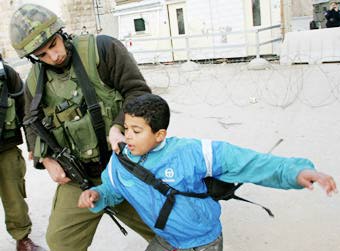
On November 27th B’Tselem volunteer videographer Abu Ahmad documented clashes between Palestinian youth and soldiers in Beit Ummar. An officer fired a canister that hit him in the chest, while he filmed. Abu Ahmad was bruised and required medical treatment. The firing of tear gas canisters directly at individuals is a routine practice by security forces and has already claimed the lives of two people and injured dozens. The military continues to deny the existence of the practice and avoids addressing it systematically.
The Ahrar Center for Detainees Studies and Human Rights issued its monthly report Sunday revealing that Israel soldiers shot and killed 13 Palestinians in the West Bank and Gaza in November, while more than 374 Palestinians, including eight women, have been kidnapped.
Ahrar said that, similar to previous months, the southern West Bank district of Hebron witnessed the largest number of Israeli violations, while the army also kidnapped 95 Palestinians.
The Center stated that eight Palestinian women, including two teenagers, were among the kidnapped in Hebron. All kidnapped women, except the two young women, were released later on.
In occupied Jerusalem, soldiers kidnapped 85 Palestinians, including a journalist identified as Mohammad Abu Khdeir, who works for the Al-Quds daily; he was taken prisoner at the Ben Gurion Airport after concluding a visit to Egypt.
In Jenin, the army kidnapped 47 Palestinians, while 45 Palestinians were kidnapped in Nablus, 34 in Bethlehem, 30 in Ramallah, 18 in Qalqilia, 10 in Tulkarem, and one Palestinian has been kidnapped in Jericho.
Israeli soldiers also kidnapped nine Palestinians in the Gaza Strip, including three who allegedly tried to cross the border fence.
The Israeli Navy continued its attacks and assaults against the Palestinian fishermen in the Gaza Strip, and kidnapped four fishermen in Palestinian waters after the soldiers opened fire on them and their boats.
Soldiers also kidnapped a Palestinian patient from the Gaza Strip after he headed to the Erez terminal on his way for medical treatment at a hospital in Jerusalem. Israel granted him a permit to head to Jerusalem, but the soldiers still kidnapped him.
Ahrar added that soldiers also kidnapped a Palestinian from Gaza after he allegedly approached the border fence and “hurled a grenade” at an Israeli military vehicle.
In Jerusalem, soldiers kidnapped two Palestinian women, both teachers, and a young woman was kidnapped at an Israeli military roadblock near the northern West Bank city of Tulkarem. She is a college student from Nablus.
As for Palestinians killed by Israeli military fire in November, Ahrar said that Israeli soldiers shot and killed 13 Palestinians, including four from the Gaza Strip.
The four killed in Gaza have been identified as Rabee’ Baraka, 23, Khaled Mohammad Abu Bakra, 35, Mohammad Rashid Dawoud, 26, and Mohammad Issam Al-Qassam, 23; all were killed after the army bombarded Gaza on November 1st.
In the West Bank, detainee Hasan Toraby, 22, from the northern West Bank city of Nablus, died of cancer at the Al-‘Affoula Hospital after Israel failed to provide him with the needed medical treatment, and only moved him to hospital after having a very serious deterioration in his health condition.
On the night of November 7, resident Bashir Habaneen, 28, a university teacher from the northern West Bank city of Jenin, was shot and killed by soldiers at the Za’tara roadblock, south of the northern West Bank city of Nablus.
On the same night, Anas Al-Atrash, 22, from Hebron, was killed at the Container roadblock, near Bethlehem.
On November 26, soldiers assassinated three Palestinian from the southern West bank city of Hebron. The three have been identified as Mohammad Nairoukh, Mahmoud Najjar, and Mousa Fansha.
On November 28, Mahmoud Awwad, 24, from the central West Bank city of Ramallah, died of serious injuries he suffered in March. He was shot in the head and remained in a coma until his death.
On the same day, a Palestinian child identified as Nour Mohammad Affana, 14, died at an Israeli military roadblock as the soldiers closed the roadblock and prevented an ambulance, transporting her to a hospital in Bethlehem, from crossing.
On November 30, Israeli officers shot and killed Antar Al-Aqdra’, 24, from Qablan town, as he was working in the Petah Tikva area, north of historic Palestine. Twelve workers were taken prisoner.
Furthermore, Ahrar said that Israeli soldiers have escalated their attacks and assaults against Palestinian political prisoners, forced several detainees into solitary confinement, and denied family visits to dozens of detainees.
Palestinian researcher, former detainee and the head of the Ahrar Center, Fuad Al-khoffash, said that Israel’s violations, including deadly attacks and arrests, are ongoing, while extremist Israeli settlers carried out dozens of attacks, as part of organized assaults against the Palestinians, their lands and property, in the occupied West Bank, and occupied Jerusalem.
It has now been five years since the sentencing of the Holy Land Five: Muslim-American humanitarians who were falsely convicted of providing “material support for terrorism” because of their charitable work in Palestine. To mark the occasion, the daughters of the Holy Land Five have produced a powerful video message featuring the families of those imprisoned, as well as people around the world, expressing solidarity with the innocent men.
Alas the overtly politicised case against the Holy Land Five is only one among many. Since 11 September 2001, there have been numerous legal efforts to criminalise compassion in the US, ultimately denying Muslim-Americans of the right to freely practice their religion.
Founded in 1989, the Holy Land Foundation was once the largest Islamic charity in the US. The Texas-based foundation helped to raise funds for people misplaced by both natural and man-made disasters, focusing primarily on Palestinian refugees living in the Occupied Palestinian Territories as well as in the neighbouring countries, but also helping both American and international victims of tornadoes, earthquakes and floods. The Foundation even assisted the victims of the Oklahoma City bombing in 1995.
However three months after the 11/9 attacks, the US government suddenly designated the Holy Land Foundation as a terrorist organisation, closing down the charity and seizing all its assets. Federal prosecutors accused the foundation and its members of providing financial assistance to individuals and organisations linked to Hamas, claiming that this constituted “material support for terrorism” as stipulated in the USA PATRIOT Act. The government based its case on the twisted logic that the money the foundation was sending to zakat associations in Gaza to build hospitals and feed the poor relieved the social organisations affiliated with Hamas of carrying out this responsibility.
None of the zakat associations were listed as “Specially Designated Nationals” (SDNs) at the time of the alleged offence. The US Treasury Department considers SDNs to be criminal actors and thus “their assets are blocked and US persons are generally prohibited from dealing with them.” But it did not matter because the government has consistently adopted a loose interpretation of the material support clause to target Muslim-Americans, often using ex post facto relationships to prove that suspects are, according to President George W. Bush’s Executive Order 13224 of September 24, 2001, “otherwise associated with” terrorists.
While the US government does indeed classify Hamas as an SDN, the Islamist movement is not at all connected to Al-Qaeda or the attacks on 11/9 which precipitated the closure of the Holy Land Foundation. After all, the Foundation had been operating since 1989, so why else would the government wait twelve years to target the charity except to conflate all Muslims with terrorism after 11/9, creating a climate of fear that would lead Americans to support the so-called war on terror and the US-led invasions of Iraq and Afghanistan. President Bush even called the closure of the Foundation “another step in the war on terrorism”.
Leading up to the trial, the government amassed an amazing 197 counts against six members of the Holy Land Foundation, many of them trumped up criminal charges. However, in 2007 the case ended in mistrial for five of the defendants, with one defendant being found not guilty of all but one charge against him, for which the jury was deadlocked.
Nevertheless, the government refused to drop its case, and a retrial was ordered in late 2008 against the Holy Land Five: Ghassan Elashi, co-founder and chairman of the board; Shukri Abu-Baker, president and CEO; Mohammad El-Mezain, co-founder and the California office representative; Mufid Abdulqader, volunteer fundraiser and Abdulrahman Odeh, the New Jersey office representative.
For the 2008 retrial, the government dropped almost half of the original charges and called an anonymous Israeli intelligence expert as a witness, who according to Mondoweiss testified that he knew the defendants had ties to Hamas because he “could smell Hamas”. Several lawyers have noted that the use of an anonymous witness was a legal first, and clearly violates the defendants’ sixth amendment right to face their accusers in court.
Needless to say, in the second trial the Holy Land Five were found guilty of every criminal charge that was brought against them. They were given draconian sentences of between 15 and 65 years in prison, a devastating punishment for them and their families.
In addition to putting the Holy Land Five in jail for what could possibly be the rest of their lives, according to the New York Times the government also “publicly named more than 300 individuals and American Muslim organisations as ‘unindicted co-conspirators’, without allowing them to hear the evidence against them or defend themselves in court.”
So much for innocent until proven guilty.
The Holy Land Five tried to appeal their convictions, but the US Supreme Court declined their final appeal in 2012. They have now exhausted all their legal options. Four of the five men are currently imprisoned in a severely restricted facility for prisoners deemed to be “security threats” known as the Communications Management Unit (CMU). After 11/9 two CMUs were built, one in Indiana and the other in Illinois, and the vast majority of prisoners in both are Muslims. Most prisoners have extremely limited contact with the outside world, including their families. American public radio station NPR has called the CMUs “Guantanamo North” and the Nation magazine describes them as “Gitmo in the Heartland.”
To date, the US government still has not published a list of approved Islamic charities, probably because the current ambiguity allows federal officials to selectively pursue politically motivated cases. This has had a chilling effect on charitable giving.
The Holy Land Foundation case did inspire one Washington-based group called the American Task Force on Palestine to come up with a list of acceptable projects for individuals and charities to support in Palestine, which have all been vetted by the US Agency for International Development. Unsurprisingly, the American Task Force on Palestine has been described by one Palestinian-American writing for Al-Jazeera as “a Washington organisation designed to promote a particular line on Palestine. The group is tasked with feeding the State Department palatable fictions – like, ‘two states for two peoples’. In return, organisation heads are invited to dinners with important people.”
The overt politicisation of the American judiciary to deny Muslims in America of their rights is not exclusive to individuals and charities working in Palestine. Since 11/9, thousands of Muslim-Americans have been detained, deported or profiled, even though very few are ever prosecuted in the courts, and dozens of Islamic charities have been either closed down or financially disabled, creating a climate of fear that denies Muslim-Americans of the right to give to charity, rendering them unable to practice zakat, one of the Five Pillars of Islam.
Similar to the Holy Land Foundation, many of the individuals and charities that have been targeted were singled out to justify foreign invasions. When President Bush addressed a joint session of Congress on 20 September 2001 to declare, “Either you are with us, or you are with the terrorists,” the “us” he was referring to was not the American people, but American empire. He was saying that you must support our foreign invasion and occupation, otherwise you will be criminalised. And in fact, Muslims in America were never even given a choice, because the government had already started to reproduce a particular typology of Muslims-as-terrorists. As scholar Mustafa Bayoumi has argued, immigrant males from targeted countries were obliged to “misidentify from the Muslim-as-terrorist figure” or else face the consequences, a typology repeatedly emphasized in the media.
For example, in February 2003, Dr Rafil Dhafir, a prominent Iraqi-American oncologist and respected imam living in Central New York, was arrested because his charity Help the Needy was sending humanitarian aid to Iraq, including money to build mosques, parcels of food and medical supplies, all of which allegedly violated the UN sanctions, measures which Dennis Halliday, the former UN Humanitarian Coordinator in Iraq, says killed around one million Iraqis. Although the FBI had kept Dhafir under surveillance since at least 1997, Help the Needy was never prevented from delivering the supposedly illegal aid to Iraq. Instead, the charity openly carried out its operations until 85 agents went to Dhafir’s home to arrest him only weeks before the launch of the US-led invasion of Iraq. The same morning he was arrested, around 150 Muslim contributors to the charity living in Central New York were also questioned by various government agencies.
To dispel any doubts about this case being linked to the invasion of Iraq, former Attorney General John D. Ashcroft referred to Dhafir as a terrorist when he was apprehended, a charge repeated by former New York Governor George Pataki. The Washington Post called Dhafir a “high profile suspect” and reported that: “A federal prosecutor suggested that an Arab engineer who was a friend of Dhafir’s might be proficient in fashioning ‘dirty bombs’.”
However when Dhafir finally went to trial, he was only accused of white-collar crimes, with the most serious counts being related to money-laundering. He did not face any charges of terrorism. Nevertheless, by then the US had already invaded Iraq in the name of fighting the war on terror. The reason for Dhafir’s “high profile” arrest was already a moot point, and the alleged terrorist was only found guilty of criminal activity. However, we was given a harsh sentence of 22 years in prison and was initially placed in the CMU prison in Indiana. He has since been transferred to a lower security facility.
Although it was not mentioned at all during the trial because the information was sealed, during the sentencing the prosecution suggested that the government had evidence that while volunteering with Doctors Without Borders in Afghanistan during the 1980s, Dhafir had met with a member of the mujahedin who later became a supporter of Al-Qaeda, leaving out the context of Washington’s financial and military support for the mujahedin at that time.
Indeed the National Security Division of the Department of Justice subsequently listed the case against Dhafir and his charity as a successful terrorist prosecution. He too has lost every judicial appeal, exhausting all his legal options for seeking justice.
Numerous other Islamic charities have also been targeted since 11/9. These include Benevolence International Foundation, Global Relief Foundation, Kind Hearts USA and Islamic American Relief Agency. The witch hunt even led the American Civil Liberties Union to release a report in 2009 entitled “Blocking Faith, Freezing Charity“.
In 2006 the FBI raided the Michigan offices of Life for Relief and Development, a large and highly regarded Islamic charity, on the eve of Ramadan, the holy month when Muslims fast and make considerable charitable contributions. The charity was reportedly under investigation in connection with its activities in Iraq. Despite having its property seized, the case against the charity was ultimately closed and it was allowed to remain open. Nevertheless, the timing of the raid had already achieved a wider purpose.
In another timely coincidence, on the first day of the 2007 trial against the Holy Land Foundation, federal agents raided the offices of the Michigan-based branch of the Al-Mabarrat Association, a charity affiliated with the late Ayatollah Mohammad Hussein Fadlallah in Lebanon, as well as the offices of the Goodwill Charitable Organization, also connected to Lebanon. The US Treasury Department accused the latter of having ties to Hizbullah’s Martyr’s Foundation, an organisation already on the SDN list. The same day, the FBI searched a number of local businesses and homes, again traumatising the community. Subsequently the Goodwill Charitable Organization was shut down and also listed as an SDN. However the FBI allowed Al-Mabarrat Association’s Michigan offices to remain open.
It is important to note that while each case is uniquely tragic, non are unusual. There have been many other domestic victims of the US war on terror, including many Islamic charities. Indeed these coordinated and well-publicised actions against both Muslims and Islamic charities have successfully created a climate of fear that makes it extremely difficult for Muslims in America to give or perform charity, thus criminalising compassion and denying Muslim-Americans of their constitutionally guaranteed right to freely practice their religion.
Egypt’s constitution-drafting committee has agreed to an article that grants immunity to the Supreme Council of the Armed Forces (SCAF).
According to a draft published in Egypt’s state media on Thursday, the new constitution would grant more powers to the SCAF and could ban Islamic parties completely.
The 50-member assembly is scheduled to finish the draft of the constitution this week. The constitution will then be put to a referendum in December.
Earlier this month, it was revealed that General Abdel Fattah el-Sisi, the army chief and minister of defense, had been seeking immunity for the military council for a period of five to ten years.
It has also been leaked that he asked for a media campaign to lobby for a specific clause to be included in the constitution. The clause would allow Sisi to retain his post as defense minister in the event he loses in the presidential election.
The military representatives of the committee also called for the constitution to allow the military to name the defense minister during the next two presidential terms. The move has been widely criticized by legal experts, who say this would give the military more power than the president.
Egypt has been experiencing unrelenting violence since July 3, when the army ousted President Mohamed Morsi’s government, suspended the constitution, and dissolved the parliament. It also appointed the head of the Supreme Constitutional Court, Adly Mahmoud Mansour, as the new interim president.
The government of Mansour has launched a bloody crackdown on Morsi supporters and arrested more than 2,000 Muslim Brotherhood members, including the party’s leader, Mohamed Badie, who was detained on August 20.
About 1,000 people were killed in a week of violence between Morsi supporters and security forces after police dispersed their protest camps in a deadly operation on August 14. The massacre sparked international condemnation and prompted world bodies to call for an independent investigation into the violence.
Britain systematically destroyed documents in colonies that were about to gain independence, declassified Foreign Office files reveal. ‘Operation Legacy’ saw sensitive documents secretly burnt or dumped to cover up traces of British activities.
The latest National Archives publication made from a collection of 8,800 colonial-era files held by the Foreign Office for decades revealed deliberate document elimination by British authorities in former colonies.
The secret program dubbed ‘Operation Legacy’ was in force throughout the 1950s and 1960s, in at least 23 countries and territories under British rule that eventually gained independence after WWII. Among others these countries included: Belize, British Guiana, Jamaica, Kenya, Malaysia and Singapore, Northern Rhodesia (today Zambia and Zimbabwe), Tanzania, and Uganda.
In a telegram from the UK Colonial Office dispatched to British embassies on May 3, 1961, colonial secretary Iain Macleod instructed diplomats to withhold official documents from newly elected independent governments in those countries, and presented general guidance on what to do.
British diplomats were briefed on how exactly they were supposed to get rid of documents that “might embarrass members of the police, military forces, public servants (such as police agents or informers)” or “might compromise sources of intelligence”, or could be put to ‘wrong’ use by incoming national authorities.
‘Operation Legacy’ also called for the destruction or removal of “all papers which are likely to be interpreted, either reasonably or by malice, as indicating racial prejudice or bias”.
The newly declassified files revealed that the Royal Navy base in Singapore was turned into the Asian region’s primary document destruction center. A special facility called a “splendid incinerator” was used to burn “lorry loads of files”, Agence France-Presse reported.
The “central incinerator” in Singapore was necessary to avoid a situation similar to that in India in 1947, when a “pall of smoke” from British officials burning their papers in Delhi, ahead of India proclaiming independence, filled the local press with critical reports. That diplomatic oversight was taken into account, as ‘Operation Legacy’ operatives were strictly instructed not to burn documents openly.
But not all the doomed archives could be shipped to Singapore. In some cases documents were eliminated on site, sometimes being dumped in the sea “at the maximum practicable distance from shore” and in deep, current-free areas, the National Archives publication claims.
The newly published collection of documents reveals that the British cleared out Kenyan intelligence files that contained information about abuse and torture of Kenyans during the Mau Mau uprising against British colonial rule in the 1950s. A special committee formed in 1961 coordinated document elimination in Kenya. Yet some files were spared simply when an estimated 307 boxes of documents were evacuated to Britain, just months ahead of the country gaining independence in December 1963.
The existence of some remaining Mau Mau legal case documents was revealed in January 2011.
Even after eliminating important evidence half a century ago, earlier in 2013 the British government was forced to pay 23 million dollars in compensation to over 5,200 elderly Kenyans, who had suffered from Britain’s punitive measures during the Mau Mau uprising.
In another documented occasion, in April 1957, five lorries delivered tons of documents from the British High Commission in Kuala Lumpur to the Royal Navy base in Singapore. Files were incinerated there; these contained details about British rule in Malaya, such as a massacre of 24 rubber plantation workers at the Malayan village of Batang Kali in 1948, who had allegedly been murdered by British soldiers.
Despite the mass document elimination, Britain’s Foreign Office still has some 1.2 million unpublished documents on British colonial policy, David Anderson, professor of African history at the University of Warwick, told AFP.
So Her Majesty’s government might still publish more valuable material that can shed more light on how one of the biggest empires in human history used to be governed. Overall, Britain had total control over 50 colonies including Canada, India, Australia, Nigeria, and Jamaica. Currently, there are 14 British Overseas Territories that remain under British rule, though most of them are self-governing and all have leaderships of their own.
The label for Humira, once the best-selling drug in the world, lists its risks in plain print. One of them, in the label’s own words, is new “autoimmune” disease.
A drug prescribed for a condition labelled autoimmune carries a warning that it can cause a condition labelled autoimmune. That contradiction sits in every box, on a folded paper almost nobody reads.
My new book starts there.
No Autoimmunity: The Body Doesn’t Attack Itself
For seventy years, “your body is attacking itself, and we don’t know why” has ended the conversation for people diagnosed with multiple sclerosis, lupus, rheumatoid arthritis, Hashimoto’s, Type 1 diabetes, Crohn’s and psoriasis. More than eighty conditions now carry the autoimmune label. The diagnosis comes with a prescription for life. It almost never comes with a question about cause.
This book asks the question and answers it from the framework’s own records: its drug labels, its journals, its regulatory filings, and its own experiments. … continue
This site is provided as a research and reference tool. Although we make every reasonable effort to ensure that the information and data provided at this site are useful, accurate, and current, we cannot guarantee that the information and data provided here will be error-free. By using this site, you assume all responsibility for and risk arising from your use of and reliance upon the contents of this site.
This site and the information available through it do not, and are not intended to constitute legal advice. Should you require legal advice, you should consult your own attorney.
Nothing within this site or linked to by this site constitutes investment advice or medical advice.
Materials accessible from or added to this site by third parties, such as comments posted, are strictly the responsibility of the third party who added such materials or made them accessible and we neither endorse nor undertake to control, monitor, edit or assume responsibility for any such third-party material.
The posting of stories, commentaries, reports, documents and links (embedded or otherwise) on this site does not in any way, shape or form, implied or otherwise, necessarily express or suggest endorsement or support of any of such posted material or parts therein.
The word “alleged” is deemed to occur before the word “fraud.” Since the rule of law still applies. To peasants, at least.
Fair Use
This site contains copyrighted material the use of which has not always been specifically authorized by the copyright owner. We are making such material available in our efforts to advance understanding of environmental, political, human rights, economic, democracy, scientific, and social justice issues, etc. We believe this constitutes a ‘fair use’ of any such copyrighted material as provided for in section 107 of the US Copyright Law. In accordance with Title 17 U.S.C. Section 107, the material on this site is distributed without profit to those who have expressed a prior interest in receiving the included information for research and educational purposes. For more info go to: http://www.law.cornell.edu/uscode/17/107.shtml. If you wish to use copyrighted material from this site for purposes of your own that go beyond ‘fair use’, you must obtain permission from the copyright owner.
DMCA Contact
This is information for anyone that wishes to challenge our “fair use” of copyrighted material.
If you are a legal copyright holder or a designated agent for such and you believe that content residing on or accessible through our website infringes a copyright and falls outside the boundaries of “Fair Use”, please send a notice of infringement by contacting atheonews@gmail.com.
We will respond and take necessary action immediately.
If notice is given of an alleged copyright violation we will act expeditiously to remove or disable access to the material(s) in question.
All 3rd party material posted on this website is copyright the respective owners / authors. Aletho News makes no claim of copyright on such material.

 The label for Humira, once the best-selling drug in the world, lists its risks in plain print. One of them, in the label’s own words, is new “autoimmune” disease.
 Aletho News
