The Plot Thickens: Gaza is Flooded with Sewage and Conspiracies
By Ramzy Baroud | Palestine Chronicle | November 27, 2013
The latest punishment of Gaza may seem like another familiar plot to humiliate the strip to the satisfaction of Israel, Mahmoud Abbas’s Palestinian Authority, and the military-controlled Egyptian government. But something far more sinister is brewing.
This time, the collective punishment of Gaza arrives in the form of raw sewage that is flooding many neighborhoods across the impoverished and energy-chocked region of 360 km2 (139 sq mi) and 1.8 million inhabitants. Even before the latest crisis resulting from a severe shortage of electricity and diesel fuel that is usually smuggled through Egypt, Gaza was rendered gradually uninhabitable. A comprehensive UN report last year said that if no urgent action were taken, Gaza would be ‘unlivable’ by 2020. Since the report was issued in August 2012, the situation has grown much worse.
Over the years, especially since the tightening by Israel of the Gaza siege in 2007, the world has become accustomed to two realities: the ongoing multiparty scheme to weaken and defeat Hamas in Gaza, and Gaza’s astonishing ability to withstand the inhumane punishment of an ongoing siege, blockade and war.
Two infamous wars illustrate this idea: The first is Israel’s 22-day war of 2008-9 (killing over 1,400 Palestinians and wounding over 5,500 more) and the second is its more recent war of Nov 2012 – eight days of fighting that killed 167 Palestinians and six Israelis. In the second war, Egypt’s first democratically-elected president Mohammed Morsi was still in power. For the first time in many years, Egypt sided with Palestinians. Because of this and stiff Palestinian resistance in Gaza, the strip miraculously prevailed. Gaza celebrated its victory, and Israel remained somewhat at bay – while of course, mostly failing to honor its side of the Cairo-brokered agreement of easing Gaza’s economic hardship.
In relative terms, things seemed to be looking up for Gaza. The Rafah border crossing between Gaza and Egypt was largely opened, and both Egypt and the Hamas governments were in constant discussions regarding finding a sustainable economic solution to Gaza’s many woes. But the ousting by General Abdel Fatah al-Sisi of President Morsi on July 3 changed all of that. The Egyptian military cracked down with vengeance by shutting down the border crossing and destroying 90-95 percent of all tunnels, which served as Gaza’s main lifeline and allowed it to withstand the Israeli siege.
Hopes were shattered quickly, and Gaza’s situation worsened like never before. Naturally, Cairo found in Ramallah a willing ally who never ceased colluding with Israel in order to ensure that their Hamas rivals were punished, along with the population of the strip.
Citing Gaza officials, the New York Times reported on Nov 21 that 13 sewerage stations in the Gaza Strip have either overflowed or are close to overflowing, and 3.5 million cubic feet of raw sewage find their way to the Mediterranean Sea on a daily basis. “The sanitation department may soon no longer be able to pump drinking water to Gaza homes,” it reported.
Farid Ashour, the Director of sanitation at the Gaza Coastal Municipalities Water Utilities, told the Times that the situation is ‘disastrous’. “We haven’t faced a situation as dangerous as this time,” he said. But the situation doesn’t have to be as dangerous or disastrous as it currently is. It has in fact been engineered to be that way.
Gaza’s only power plant has been a top priority target for Israeli warplanes for years. In 2006 it was destroyed in an Israeli airstrike, to be opened a year later, only to be destroyed again. And although it was barely at full capacity when it operated last, it continued to supply Gaza with 30 percent of its electricity needs of 400 megawatts. 120 megawatts came through Israel, and nearly 30 megawatts came through Egypt. The total fell short from Gaza’s basic needs, but somehow Gaza subsisted. Following the ousting of Morsi and the Egyptian military crackdown, the shortage now stands at 65 percent of the total.
In an interview with the UN humanitarian news agency, IRIN, James W. Rawley, the humanitarian coordinator for the Occupied Palestinian Territory, depicted a disturbing scene in which the impact of the crisis has reached “all essential services, including hospitals, clinics, sewage and water pumping stations.”
Israelis on the other hand, have been doing just fine since the last military encounter with Hamas. “The past year was a great one,” the Economist quoted the commander of Israel’s division that ‘watches’ Gaza, Brigadier Michael Edelstein. Due to the massive drop in the number of rockets fired from Gaza in retaliation to Israeli attacks and continued siege (50 rockets this year, compared to 1,500 last year), “children in Israel’s border towns can sleep in their beds, not in shelters, and no longer go to school in armored buses,” according to the Economist on Nov 16.
“But Israel’s reciprocal promise to help revive Gaza’s economy has not been kept,” it reported. Israel has done everything it its power to keep Gaza in a crisis mode, from denying the strip solar panels so that they may generate their own electricity to blocking Gaza exports. “In the meantime, Gaza is rotting away.”
Desperate to find immediate remedies, Gaza Prime Minister Ismail Haniyeh issued new calls to Mahmoud Abbas for a unity government. “Let’s have one government, one parliament and one president,” Haniyeh said in a recent speech, as quoted by Reuters. A Fatah spokesman, Ahmed Assaf, dismissed the call for it “included nothing new.” Meanwhile, the PA decided to end its subsidy on any fuel shipped to Gaza via Israel, increasing the price to $1.62 per liter from 79 cents. According to Ihab Bessisso of the PA, the decision to rescind Gaza’s tax exemption on fuel was taken because sending cheap fuel to Gaza “was unfair to West Bank residents,” according to the Times.
But fairness has little to with it. Reports by the Economist, Al Monitor and other media speak of Egyptian efforts to reintroduce Gaza’s former security chief and Fatah leader Mohammed Dahlan to speed-up the anticipated collapse of the Hamas government. Al Monitor reported on Nov 21 that Dahlan, a notorious Fatah commander who was defeated by Hamas in 2007 because of, among other reasons, his close ties with Israeli intelligence, had met with General al-Sisi in Cairo. Evidently, the purpose is to oust Hamas in the Gaza Strip. But the question is how? Some “suggest that a Palestinian brigade mustered in al-Arish could march on Gaza and, with Egyptian support, defeat the broad array of Hamas forces created in the last decade.”
With Morsi’s Muslim Brotherhood out of the picture, at least for now, Gaza is more vulnerable than ever. Some of Abbas’s supporters and certainly Dahlan’s may believe that the moment to defeat their brethren in Gaza is now.
– Ramzy Baroud (www.ramzybaroud.net) is a media consultant, an internationally-syndicated columnist and the editor of PalestineChronicle.com. His latest book is: My Father was A Freedom Fighter: Gaza’s Untold Story (Pluto Press).
Cover not their blood
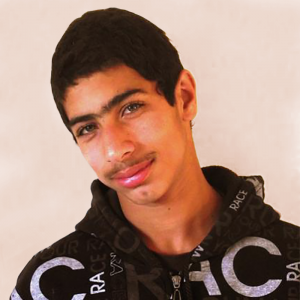
Yusuf Fahri Mussa Ahleil, 1995-2011
Yesh Din | November 24, 2013
Yusuf Fahri Mussa Ahleil, aged 16, was shot and killed on January 28th, 2011, probably by a settler. The prosecution took 14 months to appoint an attorney to the case, and eventually closed it due to lack of evidence.
Many of the posts in this blog deal with the incompetence of Israeli police investigations, and it’s possible that the death of Yusuf Fahri Mussa Ahleil, a 16-year old boy from Beit ‘Ummar, will be added to this list; but for the time being, it is a story of criminal negligence on behalf of the prosecution.
On January 28th, 2011, something happened in the village of Beit Ummar in the Hebron region. The testimonies describe an assault by Israeli civilians from two different directions simultaneously. Both incidents involved shooting; the second one ended in death. Witnesses describe a large group of Israeli civilians raiding the village, among whom three fired at the Palestinians using weapons, likely M-16 assault rifles. According to one of the witnesses, the Israelis were conducting some sort of ceremony, blew a shofar, and then opened fire. The witnesses agree that no military troops were present and that they arrived only after the shooting.
When it was all over, Yusuf Ahleil, who was on his way to help his father with his work in the field, lay dead on the ground. The testimony of the father, Fahri, is worth quoting: “I work in agriculture, and that is my main profession. During their vacations the children help me. Before I went to work [on the morning of the incident] I asked my son Yusuf to come with me to work later during the day. At some point I heard the sound of gunshots; I did not know what it was about and kept on working. And then, I don’t remember the time, some people from the village came with a vehicle and asked to take me home. I did not understand why – I refused but they insisted, took me with them and brought me back home. When we arrived, I saw that most of the village was gathered next to my house. I asked what happened? I was told, your son was shot. I said, how can that be? We agreed that he should join me at work. This is how I learned that my son, while on his way to work with me, had been wounded by the settlers.” Yusuf was shot in the head, and died.
The family filed a complaint with the police that same day. From that point onwards, our monitoring tells the story. On February 16th, 2011, the police informed us that the case was under investigation. On March 14th, 2011, it told us it received testimonies and photographs, and asked that we provide any further information we may come across. On May 2nd, 2011, the police informed us that the case had been transferred to the Jerusalem District Prosecution Office.
On June 5th, 2011, we called the Jerusalem District Attorney Office to ask which prosecuting attorney is handling the case. None had yet been appointed. We asked the same office again on August 24th, 2011, i.e. almost seven months after the incident, but the prosecution did not consider the violent death – this fact is not disputed – of a 16-year old boy as something requiring the immediate attention of an attorney. We repeated our query in September 25th, 2011. We might as well be speaking to the walls.
October 24th came and went, and the death of Yusuf still did not hinder the sleep of the prosecutors. We had reached December 15th, 2011, and the boy who had dropped dead from a bullet in his head still failed to arouse the interest of the prosecutors. On January 15th, 2012, almost a year since he had been killed, Yusuf’s prosecution file was still gathering dust. We kept on pestering, and on March 20th, 2012 – that is almost 14 months since the killing – we were informed that on this happy day a prosecutor had been assigned to the case. A week later, we tried to verify with her what steps she she had taken with the case so far. We were not dignified with an answer.
We repeated the question, to no avail, two months later. We are stubborn people, studied in the ways of banging our heads against the system’s wall, so we asked once again on July 30th, 2012 whether the prosecutors made any decision – four months since a prosecutor had been assigned to the case, and more than 18 months since the killing itself, but who’s counting. We did not receive a response.
On January 3rd, 2013, nearly two years after the killing and nine months after a prosecutor was assigned to the case, she still had no answer for us. Six months breezed by, and on August 4th, 2013, the prosecutor informed us that on July 30th, 2013, she had made the decision to close the case. The police had identified four suspects; the prosecutor closed the case against three of them for lack of evidence and against the fourth, for lack of criminal culpability.
That was the beginning of August. Since then we’ve been trying to get a hold of the investigative file so we can appeal the decision to close it. Until recently, the prosecution had failed in the rather simple job of providing us with it. There were contradictory claims as to what happened to it. The prosecution said it was sent back to the Hebron Police, which in turn said they never got it back. We are happy to report, however, that recently the file was found, photocopied, and will be reviewed by us soon.
Let’s conduct a mental experiment. Let’s say the victim is still 16 years old, still residing in the Occupied Palestinian Territories, but is not burdened with a foreign, Palestinian, name like Yussuf Alhleil; let’s say his name is something familiar, say Yossi Hebroni. Our hypothetical Yossi Hebroni was shot near a Palestinian village. Can anyone imagine that the prosecution would amble slowly to the case after 14 months? Or that it would need 16 more months to make up its mind?
The prosecution is entrusted, since Israel controls the Occupied Palestinian Territories, with protecting its residents from violence. When they are the victims of theft, it ought to bring the thief to justice. When they are killed, its duty is to bring justice for the dead.
The case of Yusuf Fahri Mussa Alhleil shows us how seriously the prosecution takes this duty. It removes another thin layer of the already crumbling patina of the claim that there is something you may refer to with a straight face as “rule of law” in the West Bank. Where the rule of law is absent, what we see is the law of nature, where the strong rule over the weak. The point of our social contract with the government is to overcome nature’s law, under which, to quote Hobbes, life is “nasty, brutish and short.” In the most gentle words possible, in Yusuf’s case – and, unfortunately, in far too many others – the prosecution has betrayed the social contract.
The result that there is the father who waits in vain for his son to return to him in the field, and killers who know that nothing will happen to them if they kill once more.
Related articles
- Israeli admits shooting at Palestinian children on TV game show (alethonews.wordpress.com)
- Nablus woman injured in hit and run vehicular assault by Jewish settler (alethonews.wordpress.com)
- Jewish Terrorism (alethonews.wordpress.com)
- Outrage as Palestinian child faces possible life prison sentence for throwing stones (gazasolidarity.blogspot.com)
- Israel to displace Palestinian community south of Hebron (altahrir.wordpress.com)
Israli admits, on game show, to shooting at Palestinian children

Zakusilo pictured on the television show (MaanImages)
By Alex Shams – Ma’an – 24/11/2013
BETHLEHEM — An Israeli soldier admitted that she shot and killed unknown numbers of Palestinian people, including children, on a Ukrainian television program that aired in early November.
Elena Zakusilo, a Ukrainian Jewish woman who moved to Israel in order to serve in the Israeli army, revealed on the Nov. 4 episode of the program “Lie Detector” that she had killed Palestinians and had shot at Palestinian children, but was unsure how many she managed to kill.
Zakusilo, who goes by the name Elena Gluzman in Israel, also explained that she trained army dogs to raid Palestinian villages and conducted video surveillance that she monitored from up to 10 kilometers away.
Zakusilo said on the show that one of the times when she shot Palestinians was during protests that broke out after Yasser Arafat died in 2004.
“It’s scary, especially when children run with Molotov cocktails, and they send children, to turn the attention to them, little kid, barely walking, 3-4 years old,” she added, explaining that she was unsure how many Palestinian children she had shot dead.
Although Zakusilo said that she was “not proud” of these acts, she blamed Palestinian mothers for sending their children to be “suicide bombers” and suggested that they did not care about their children’s lives.
Zakusilo also spoke about her work training dogs for reconnaissance missions into Palestinian villages, which involved placing headphones and cameras on them and directing them to attack Palestinians they encountered until soldiers could arrive.
“The doggy gets a little bag in teeth, it can be a video camera.”
“It has an electronic collar, and a camera that hangs on the collar, and the trainer has the remote control, and he, from a distance up to ten kilometers, can watch and give orders to the dog, to attack or not attack,” she added.
Zakusilo explained that she was a “senior trainer” and trained a total of 150 dogs, and for her work she was promoted to the rank of major.
‘Willing to go back to Israel and continue killing enemies’
Zakusilo’s mother was also present during the show’s filming, and when asked if she knew her daughter had killed people, said, “Of course, how can you be in the military without (killing).”
Zakusilo responded in the affirmative when asked by the game show host if she was “willing to go back to Israel and continue killing enemies” if she had financial difficulties in Ukraine, and said that she was unafraid of potential repercussions for revealing what she had done while in the Israeli forces.
She also explained that she goes by the name of Gluzman in Israel, “so that they won’t hear there our Ukrainian family name, and with the other name (Gluzman), with Jewish roots, they’d treat (me) differently.”
Zakusilo added that while at first she hesitated to kill people, she came to see her fellow soldiers as “family,” and they helped her come to terms with killing Palestinian children and other feelings she had.
Referring to her commander, she said, “He is a general, he tells you to go and shoot like this, so you go. But if you come to him and say, just for example, you know, I was walking down the road, and there was a kitten there, ran over by a car, or a person hit, and I feel bad.”
“He will sit with you for an hour to talk, and try to understand why you feel bad.”
The transcript of the television show was uploaded by Palestinian activist Abir Kopty on her blog, and although the video is freely available on the television show’s website, the translation could not be independently verified by Ma’an.
‘Because we’re human, we get shocked by people who kill’
Kopty, the Palestinian blogger who found the video and posted it, explained that she was “shocked,” but not surprised by Zakusilo’s comments.
“We see and hear this all the time and we know it first hand but it’s always shocking. Because we’re human, we get shocked by people when they talk about killing.”
She also explained that the “case represents a wider phenomenon,” and that it shows what “the military does this to people – it disconnects them from their own humanity, and makes it so easy to kill people and do not even remember the number.”
“The Israeli military will probably either discredit her, or justify her actions or say, as always, it’s an individual case” in order to explain it, she argued.
“This case represents the way they act.”
Kopty said that individual Israelis had responded or commented on the piece repeating the Israeli army’s “mantra” justifying what she says, in order to absolve the Israeli forces as a whole of responsibility.
“The machinery of propaganda always works, and they try to justify everything,” she said.
“I really hope, that one day all these criminals face trial.”
An Israeli army spokeswoman could not immediately confirm whether Zakusilo had served in the Israeli forces when contacted over the weekend.
Amnesty International’s 2013 report on Israel and the Occupied Palestinian Territories highlighted the lack of accountability for Israeli soldiers’ crimes against Palestinian civilians, pointing out that, “The authorities again failed to independently investigate killings of Palestinian civilians by Israeli soldiers in the West Bank and Gaza or to prosecute those responsible.”
The Israeli organization Breaking the Silence has collected 700 testimonies of Israeli army veterans, documenting a culture of widespread mistreatment and dehumanization of Palestinians among Israeli soldiers.
The internationally recognized Palestinian territories of which the West Bank and East Jerusalem form a part have been occupied by the Israeli military since 1967.
Related articles
- Report: Hundreds of European mercenaries in the ranks of the Israeli army (occupiedpalestine.wordpress.com)
- Israeli soldiers shoot, wound four Palestinians: medics (dailystar.com.lb)
Religous students found guilty of being Pakistani
By Charles Davis | False Dichotomy | November 21, 2013
When a man shot up a Sikh temple in Wisconsin last year, Barack Obama announced how “deeply saddened” he was that such an attack “took place at a house of worship.” His Republican challenger for the presidency, Mitt Romney, likewise expressed his disgust at “a senseless act of violence . . . that should never befall any house of worship.”
At the time, that was grotesquely funny because, by that point, Barack Obama had himself committed numerous acts of senseless violence against houses of worship. And, being the commander-in-chief of a military fighting a war in Afghanistan and Pakistan that he dramatically expanded upon taking office, he has continued to bomb religious institutions ever since.
As Reuters reported on Wednesday:
A suspected U.S. drone fired on an Islamic seminary in Pakistan’s northwestern region of Khyber Pakhtunkhwa early on Thursday, killing at least five people, police said. […]
Fareed Khan, a police officer, said the unmanned aircraft fired at least three rockets at the madrassa in the Hangu district, killing two teachers and three students just before sunrise on Thursday.
Now, and this is important: an anonymous official did say a potentially bad person was potentially seen at that madrassa a few days earlier (potentially), so Barack Obama can sleep soundly at night knowing he authorized the killing of a few people who were probably familiar with that bad guy…
Meanwhile Reuters continues:
The attack took place a day after Pakistan’s foreign policy chief Sartaj Aziz was quoted as saying that the United States had promised not to conduct drone strikes while the government tries to engage the Taliban in peace talks.
The United States has not commented on Aziz’s remarks.
I’m really pretty sure that it has.
Nablus woman injured in hit and run vehicular assault by Jewish settler
IMEMC & Agencies | November 20, 2013
Palestinian medical sources have reported that a Palestinian woman was wounded after being rammed by a speeding vehicle of an Israeli settler, near the northern West Bank city of Nablus on Tuesday.
The sources said that Shamsa Sharif, 60 years of age, was moved to the Rafidia Hospital in Nablus, suffering moderate but stable injuries.
Sharif is from Huwwara village, south of Nablus. The settler fled the scene after the incident.
There have been numerous similar hit-and-run incidents in different parts of the occupied West Bank, mainly in the Hebron district in the southern portion of the West Bank.
On November 19, 2013, a young woman identified as Zeina Omar Awad, 21, was injured after being rammed by a settler’s vehicle at the main entrance of Beit Ummar. She suffered cuts and bruises, while the settler fled the scene.
On October 16, 2013, an elderly Palestinian man was seriously injured after being hit by a settler’s vehicle in Al-Fondoq village, east of Qalqilia, in the northern part of the West Bank.
On September 29, 2013, a Palestinian worker was injured after being rammed by a settler’s vehicle, near Husan town, west of the West Bank city of Bethlehem.
On September 20, a Palestinian man was injured in a similar accident with an Israeli settler who fled the scene.
A week before the incident took place, Palestinian child was severely injured after being hit by a settlers’ vehicle as she was walking home from school in Teqoua’ village, near the West Bank city of Bethlehem.
The child Hayat Mohammad Suleiman, 8 years of age, was walking back home from school on the main road that is also utilized by Israeli settlers living in illegal Israeli settlements in the region.
Related articles
- Elderly man seriously injured by speeding Jewish settler in hit and run assault (alethonews.wordpress.com)
- Dozens injured after jewish terrorists attack Palestinian villagers nr. Nablus (uprootedpalestinians.wordpress.com)
Israeli forces destroy water tank, agricultural facility in West Bank village
Al-Akhbar | November 20, 2013
Israeli forces demolished a water tank and an agricultural structure in a West Bank village near Nablus on Wednesday, a local official said.
Deputy mayor of Aqraba Bilal Abdul-Hadi told Ma’an news agency that three bulldozers escorted by seven military vehicles stormed the neighborhood of al-Taweel and began demolishing the structures, claiming they were built without authorization.
Shaddad Attili, who heads the Palestinian Water Authority, said the World Bank, the United Nations and other international organizations have issued reports condemning Israel’s attacks on Palestinian water rights.
“Israel controls all the water resources in the occupied West Bank. It exploits these resources for near exclusive Israeli use, allocating a mere fraction of the available water supply to Palestinians,” Ma’an quoted Attili as saying. “While Israelis enjoy some of the highest water consumption rates in the world, Palestinians continue to face a series of crippling water shortages artificially engineered by Israel as a matter of policy.”
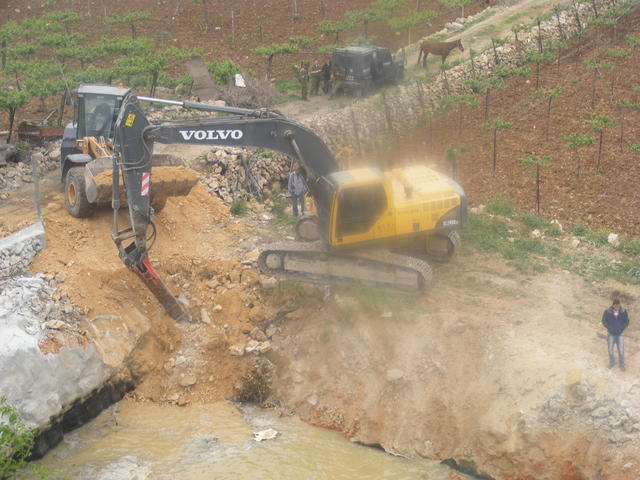 The official added that Israel used water to target vulnerable Palestinian communities.
Israel has destroyed more than 558 Palestinian properties in the West Bank and East Jerusalem since the beginning of this year, displacing 919 people, according to the UN Office for the Coordination of Humanitarian Affairs.
Between 2009 and 2011, Israel’s military destroyed 173 water, sanitation and hygiene structures in the West Bank including 40 wells, 57 rainwater collection cisterns and at least 20 toilets and sinks, OCHA reported.
A 2012 report by the Emergency Water, Sanitation and Hygiene group slammed Israel’s policies towards water and sanitation facilities in the West Bank, saying their extensive destruction was in contravention of international law.
(Ma’an, Al-Akhbar)
Related articles
- Israel to displace Palestinian community south of Hebron (altahrir.wordpress.com)
- Israeli Forces Open Fire On West Bank Protests, Injuring Dozens (eurasiareview.com)
- LA Times – Israel’s policy of erasure (iajv99.wordpress.com)
Israeli military detains driver, confiscates vehicle donated for transport of schoolchildren in South Hebron Hills
CPTnet | November 19, 2013
On 18 November 2013 at 11:00, Mufid Abu Qbeita—the driver for the students who live in the South Hebron Hills area that the Israeli military has designated as “Firing Zone 918”—was driving children back to their homes from Al Fakheit school. Israeli Security Forces and representatives of the Israeli Civil Administration stopped him near Al-Sfai, one of the villages in the Firing Zone, while he had six children in the car.
Soldiers took his ID and detained him for thirty minutes; afterwards, they told him to follow them to Gush Etzion Police Station. Two soldiers accompanied Abu Qbeita in the car. He had to leave all six children in Al-Sfai.
Abu Qbeita informed the soldiers that the jeep belonged to the Palestinian Ministry of Education and was donated by Japan, but they still forced him to drive to the settlement of Gush Etzion. After several hours, they released him, but the jeep remains at the police station. When Abu Qbeita asked why the soldiers had confiscated the jeep, they answered, “Because you were driving in the firing zone of the South Hebron Hills which is not allowed.”
CPT, EAPPI and Operation Dove take turns accompanying Abu Qbeita and the SUV from the city of Yatta into the Firing Zone during the week, in order to prevent incidents like the above occurring, but until recently, once in the zone, he had not faced problems. On 27 October, eight Israeli soldiers detained him, verbally abused him, and then beat him on his abdomen, face, and back. Afterwards, they forced him drive over spikes used to stop vehicles at army checkpoints to puncture the SUV’s tires.
Related articles
- SOUTH HEBRON HILLS: Despite court order, Israeli military intimidates villagers in ‘Firing Zone 918′ (alethonews.wordpress.com)
- Israel to displace Palestinian community south of Hebron (altahrir.wordpress.com)
- Israeli forces assault Palestinian school bus driver near Hebron (altahrir.wordpress.com)
- Israeli military rules that mock attacks in Palestinian villages are acceptable (imemc.org)
- Military Training Amid Villages in South Hebron Hills (alethonews.wordpress.com)
Israeli navy captures two Gaza fishermen, including one injured by gunfire
By Rosa Schiano | International Solidarity Movement | November 13, 2013
Gaza, Occupied Palestine – On the morning of Sunday, 10th November, brothers Saddam Abu Warda (age 23) and Mahmoud Abu Warda (age 18) were captured by the Israeli navy in Palestinian waters off the Gaza Strip. They were released later in the evening and their boat was confiscated. Mahmoud was injured by a bullet in the right side of his abdomen.
We went to visit the two young fishermen in their home in the town of Jabaliya, in the northern Gaza Strip.
In the absence of electricity, the house was dark like most homes in Gaza Strip, which is stifled by the siege and a severe fuel crisis. Without electricity, water could not reach the house’s plumbing system.
“We cast our nets into the sea at a distance of about 500 meters from the forbidden fishing area,” Saddam told us. “We were far away from the Israeli gunboats.” The two fishermen were on a small boat, or hasaka, without an engine.
Saddam told us that an Israeli gunboat approached their boat. The soldiers shouted for them to leave in less than five minutes. “We had to cut our nets in order to flee,” Saddam said. “The soldiers came closer to us and started shooting at our boat.”
Without a motor, the two fishermen could not escape. The Israeli soldiers ordered the two fishermen to undress and jump into the water. Meanwhile, they continued to open the fire. “I was shocked,” Saddam said. “I could not move. They were shooting, and I thought I would be killed.”
As we listened to Saddam, F-16 fighter jets rumbled overhead at low altitudes, a constant threat in the darkness.
“I shouted, asking the soldiers to stop shooting and save our lives,” Saddam said. According to him, another Israeli gunboat reached them and attacked the fishermen using water cannons. The two fishermen jumped into the water. “Three Israeli gunboats surrounded us, our boat was now far away, and the water was cold,” he added. The soldiers told them to swim to the forbidden maritime area. “I was scared. My brother was away from me, and the soldiers kept firing. He was wounded. He could not swim. I reached him to save him. His blood was everywhere in the sea. Two Israeli dinghies reached us. The soldiers took my brother Mahmoud and closed his wound to stop the bleeding. They didn’t take me, too. They left me in the water. They told me to swim to the marker that delimits the maritime area allowed by Israel, then took me. They covered my head. I could not see anything. They pointed a gun at my head and cuffed my hands and feet. They hit me, kicking me on the back. Then I fainted for about an hour. I don’t remember anything more.”

Mahmoud (left) and Saddam Abu Warda. (Photo by Rosa Schiano)
The two fishermen were transported to a medical center in the port of Ashdod. “When I woke up, I saw my brother beside me,” Saddam said. “Two soldiers then took me to a special room and interrogated me. They asked me why we were fishing in the forbidden area. I told them that we were 500 meters away from the limit, and that the soldiers forced us to swim until we reached it. An investigator asked me how my brother was wounded, since it was not by the Israeli soldiers. I told him my brother was wounded by Israeli gunfire. The investigator tried to convince me that Mahmoud was not wounded by the soldiers. Then I told him that three Israeli gunboats were shooting over our heads and my brother’s blood was everywhere in the sea”.
The investigators then showed Saddam a map on a laptop, placing their boat in the forbidden maritime area. Investigators interrogated the two fishermen individually. Afterwards, the two brothers were detained in another room, and at the end of the day, were transferred to Erez, where they received another interrogation. “They asked me about my family, my neighbors, fishermen, and every detail of my life,” said Saddam. “Then they showed me a map and asked me about every house around my home. They also asked me how many boats I had.”
The Israeli port of Ashdod now holds three boats belonging to Saddam’s family. In the past, in fact, other members of the Abu Warda family had been arrested and seen their boats confiscated. Now they have none left.
After interrogation, the fishermen were detained in a cell for two hours before being released through the Erez checkpoint later in the evening.
Saddam’s family has 15 members. Fishing is their only source of livelihood. The other eight brothers are also fishermen. They don’t have any other source of income, and they don’t believe they will get their boats back.
Mahmoud showed us the wound on the right side of his abdomen. The bullet did not enter his body, but brushed it. Doctors in the Ashdod medical center closed his wound with two stitches. Mahmoud also told us of the physical and verbal abuse he received from Israeli soldiers. We asked him if he will return to fishing. “Of course,” he said. “We have no choice. We have to face the danger.”
What its fishermen earn only allows the Abu Warda family to survive. Sometimes, they return home without anything. Other times, what they earn only covers the cost of fuel.
The fishermen told us that they would like more support from international associations, especially when they are in the north of the Gaza strip. There, attacks are more frequent and the majority of confiscated boats have been lost.
We continue to hope that one day the international community will break its silence and force Israel to stop attacking Gaza fishermen, and to release all their boats it has confiscated.
Background
Israel has progressively imposed restrictions on Palestinian fishermen’s access to the sea. The 20 nautical miles established under the Jericho agreements, between Israel and the Palestine Liberation Organization (PLO) in 1994, were reduced to 12 miles in the Bertini Agreement of 2002. In 2006, the area Israel allowed for fishing was reduced to six nautical miles from the coast. After its military offensive “Operation Cast Lead” (December 2008 – January 2009) Israel imposed a limit of three nautical miles from the coast, preventing Palestinians from accessing 85% of the water to which they are entitled under the Jericho agreements of 1994.
Under the ceasefire agreement reached by Israel and the Palestinian resistance after the Israeli military offensive “Operation Pillar of Defense” (November 2012), Israel agreed that Palestinian fishermen could again sail six nautical miles from the coast. Despite these agreements, the Israeli navy has not stopped its attacks on fishermen, even within this limit. In March 2013, Israel once again imposed a limit of three nautical miles from the coast. On 22 May, Israeli military authorities announced a decision to extend the limit to six nautical miles again.
Related article
- Army Invades Southern Gaza (imemc.org)
Featured Video

EUROPE FEARS RUSSIA’S NEXT MOVE / Ian Proud
or go to
Aletho News Archives – Video-Images
New Book
New Book: No Autoimmunity The Body Doesn’t Attack Itself
Lies are Unbekoming | September 24, 2026
 The label for Humira, once the best-selling drug in the world, lists its risks in plain print. One of them, in the label’s own words, is new “autoimmune” disease.
A drug prescribed for a condition labelled autoimmune carries a warning that it can cause a condition labelled autoimmune. That contradiction sits in every box, on a folded paper almost nobody reads.
My new book starts there.
No Autoimmunity: The Body Doesn’t Attack Itself
For seventy years, “your body is attacking itself, and we don’t know why” has ended the conversation for people diagnosed with multiple sclerosis, lupus, rheumatoid arthritis, Hashimoto’s, Type 1 diabetes, Crohn’s and psoriasis. More than eighty conditions now carry the autoimmune label. The diagnosis comes with a prescription for life. It almost never comes with a question about cause.
This book asks the question and answers it from the framework’s own records: its drug labels, its journals, its regulatory filings, and its own experiments. … continue
Blog Roll
 Aletho News
- Iran offers Trump deal before US election
- Merz regime wants ‘secret police’ – opposition
- Israeli settlers terrorize West Bank Palestinians with state-provided drones: Report
- They see them, then kill them: Israeli quadcopters track, deliberately target civilians in Gaza
- Debunked: Trump’s egregious UNGA claims on war against Iran crumble under scrutiny
- Europe was part of the infrastructure of US aggression against Iran: Deputy FM
- New evidence on the Bucha Massacre
- Italy and France debunk reports CIA issued ‘Russian drone threat’ warning
- How Russia is Rewiring the Global South
- Britain’s elites want you ready to die for a war they keep imagining
- If Americans Knew
- Trump betrayed voters with his campaign lies and prioritized a foreign country once he took office
- Netanyahu calls Israel’s war in Gaza ‘opposite of genocide’ in UN speech to near-empty hall
- Settler Kidnappings: Torture, Sexual Abuse and Terrorisation of Palestinian Abductees as Israel Deepens Annexation of West Bank
- Gaza winter nears as 162,000 tents become unusable, raising fears of humanitarian crisis
- Netanyahu says, “It’s the opposite of genocide”; UN says Gaza economy is world’s ‘most severe crisis on record’ – Daily Update
- Israel’s US-Backed Assault on Gaza Has Created the ‘World’s Most Severe Economic Crisis on Record’: UN
- ‘Protecting U.S. Citizens’… From Israel
- ‘This is where I live now, the back of a truck’: a day in the life of a grandmother in Gaza
- In UN Speech, Iran’s President Displays Pictures of Children Killed by US, Brings Attention to Israel’s Nuclear Arsenal
- Israel displaces hundreds of Palestinians amid wave of demolitions in West Bank
- No Tricks Zone
- New Study: Earth And Venus Surface Warmth Largely Explained By Convection And Lapse Rate, Not CO2 Or Radiation
- 2025 Nature Paper Claiming Worsening Global Drought Gets RETRACTED …Heavily Flawed
- New Study: ‘Global Drought Shows No Detectable Recent Acceleration Under Climate Warming’
- Economic Masterminds: German Socialists Suggest Taxing Productivity Gains Stemming From Using AI
- The South China Sea Has Not Been Cooperating With The Climate Change Narrative
- Energy Crisis: Germany Enters Heating Season With Historically Low Gas Reserve Fill Levels
- New Study: The Antarctic Ice Sheet Gained Mass From 2020-2024 Due To Staggering Snow And Ice Accumulation
- Study: Ocean Heating Rates From Thousands Of Years Ago ‘Dwarf’ Modern Ocean Heating Rates
- Climate Extremists Target, Attack Large-Scale Power Grid Infrastructure In Germany!
- New Study: Antarctic Ice Melt Has Contributed Less Than 1 Centimeter To Sea Level Rise In The Last 30 Years

