Time to Raise Political Asylum Quotas for Americans?
US Should Top the List of the International Quota for Political Refugees
By Sybel Edmonds | Boiling Frogs Post | June 17, 2013
I don’t know how you feel about surveys, ranking or indexes, but whether you follow them or not, you must be aware of how we’ve been falling steadily as a nation. Those of you who follow lists-surveys and global indexes, let’s admit it- as a nation we have not been going up on most global ranking lists – in fact, just the opposite.
We have been going down on the list of the World’s Least Corruption Nations-way down. We have been dropping continuously when it comes to our ranking in the education arena. We have been dropping royally when it comes to Healthcare Systems. When it comes to World Press Freedom, we are embarrassingly low, behind Cape Verde, Cyprus, and even trailing Mali, Tanzania, El Salvador, Botswana and Comoros!! We didn’t even make it onto the ridiculous list of the top ten nations’ national happiness index.
All these competitive areas aside, there is one list we should be climbing steadily and rapidly. Even if you don’t care about all those other global lists you must care about this particular one; for your own good and even your survival. I am talking about a list pertaining to a nation’s status as to its need for acceptance of its political refugees by the global community.
 Please don’t laugh or shrug off this suggestion. Instead, pause and think about our whistleblowers in jail or those awaiting the results of their prosecutions. Remember the journalists and reporters being targeted and investigated by our national police. Recall our new laws recently put in place to secretly and indefinitely detain any American citizen (that is you and me)-without any warrant or even having to show any justification. Think about the still-growing national no-fly list. Remind yourself of torture as our government’s common practice; abroad and here at home. Take a look at your land line, cell, laptop, fax and I-Pad as tools used by our government to illegally-secretly-continuously spy on you.
Now you see what I am talking about.
If you still find the notion difficult to accept, then think of the dozens of Hollywood movie classics on the Stasi and KGB. Remember how people climbed the wall or crawled through tunnels to escape the constant surveillance and arbitrary detentions of their national police. Their national police cited national security and unity. Now consider how the NSA and dozens of mega-corporations have you under surveillance illegally; around the clock. Our national police have been citing national security.
How do you think our camps for our citizens to be detained under our new national law, NDAA, would be different than those set up by the Stasi, KGB and the like?
You remember how other western nations received the lucky escapees from the fascistic or communist regimes with open arms? Well, now they should be receiving us, our escapees; with open arms.
They have to. They must. Not doing it would be in violation of their laws and their international pledge:
Asylum is granted to people fleeing persecution or serious harm in their own country and therefore in need of international protection. Asylum is a fundamental right; granting it is an international obligation, first recognized in the 1951 Geneva Convention on the protection of refugees. In the EU, an area of open borders and freedom of movement, countries share the same fundamental values and States need to have a joint approach to guarantee high standards of protection for refugees. Procedures must at the same time be fair and effective throughout the EU and impervious to abuse. With this in mind, the EU States have committed to establishing a Common European Asylum System.
…
And here is the international law describing who qualifies for international protection-Based on UN Convention & Protocols[Emphasis Mine]:
Grounded in Article 14 of the Universal Declaration of human rights 1948, which recognizes the right of persons to seek asylum from persecution in other countries, the United Nations Convention relating to the Status of Refugees, adopted in 1951, is the centerpiece of international refugee protection today.(1)
A refugee, according to the Convention, is someone who is unable or unwilling to return to their country of origin owing to a well-founded fear of being persecuted for reasons of race, religion, nationality, membership of a particular social group, or political opinion.
…
Today, we, the citizens of the United States of America, face prosecution, persecution, torture, and possible assassination for engaging in certain journalistic or even Good Samaritan reporting of illegal-criminal-unconstitutional activities by those trusted with our nation’s health, wealth, and security.
Our government has been engaged in ongoing torture and human rights violations at home and abroad. Whether it is the globally recognized USA halls-of-shame in Guantanamo, Bagram and Abu Ghraib, or, secretly carried out atrocities in our government’s black cites around the globe, or, tortures inflicted on a citizen here at home who is guilty of exposing government criminalities, our government is now recognized and acknowledged as a Supreme Torturer.
This situation now is being extended to those of us who may have read or disseminated information originally gathered and distributed by others. Today our whistleblowers-truth tellers-Good Samaritans are thrown behind bars, while our criminals who engage in robbing our taxpayers of billions of dollars, or those who engage in torture and murder, are highly protected and handsomely awarded by our rulers.
We United States Citizens have been deprived of expressing collective dissent even through the most peaceful means and in the most pacifist manner. Our participation or membership in social groups or gatherings that challenge illegal wars or anti humanitarian practices land us on our government’s never-defined ‘enemy & terrorist’ list, with consequences ranging from being prohibited from traveling , to having our homes raided and families intimidated by armed government militia, to being persecuted and thrown before a federal grand jury to face possible incarceration for our beliefs.
We Americans, every single one of us, are treated as potential terrorists, are considered guilty with no way to prove otherwise. We all are subjected to round the clock warrantless-illegal surveillance , and degrading violation-probing-groping searches as mandatory requirements for our travel.
I believe, and you should as well, that we have more than enough cases of recorded atrocities, criminalities and violations inflicted upon us by our very own government to expect a substantial increase in our nation’s status-ranking for acceptance of our political refugees.
I know, and you do too, that there are many nations with governmental practices worse than ours. However, our bad government is much bigger than their bad governments, with much higher capabilities. When you have a huge government like ours, with incredible technological and weaponry capabilities as ours does, you risk far graver atrocities than with smaller bad governments with limited capabilities. That’s a fact. Our big bad government is far worse than their small bad government. And that should increase and elevate our nation’s ranking in the international community’s political refugee quota-status.
As for the so-called liberal nations: we urge you to remember the Stasi and the suffocating repression suffered by the East Germans, and then, go ahead and multiply that by a six-digit number of your choice. Any number will do, that is, as long as it has six digits. Our technology-enabled Stasis can tap, record, analyze and save billions of communications. Our rulers’ mega corporate collaborators can pull the plug on millions of us with no recourse available or even imaginable. Our mega military’s ferocious drones can pinpoint and turn us into ashes with a secret order issued on a simple letterhead.
We implore the international community to grant us, the Citizens of the United States of America, ‘High Priority Political Asylum’ status. At least consider a swapping arrangement whereby the international community’s highest-level criminals, con artists, professional swindlers, and or psychotic serial torturers are sent here where they can find an agreeable working-practicing environment and unlimited government protection and rewards, in exchange for those of us in search of peace, a reasonable degree of freedom and justice.
Sibel Edmonds is the Publisher & Editor of Boiling Frogs Post and the author of the Memoir Classified Woman: The Sibel Edmonds Story. She is the recipient of the 2006 PEN Newman’s Own First Amendment Award for her “commitment to preserving the free flow of information in the United States in a time of growing international isolation and increasing government secrecy”
Related article
US senators question aid to Honduras, citing extrajudicial killings
Press TV – June 19, 2013
A number of US senators have questioned the Obama administration’s foreign aid to Honduras, pointing to growing reports of human rights atrocities in the Central American country that has long been regarded as a US-client state.
In a Tuesday letter to US Secretary of State John Kerry, 21 US senators cited “numerous recent killings and threats targeting [labor] union leaders, opposition figures, farmers, students, journalist and others,” emphasizing that officials of the US-backed government have been implicated in such criminal acts, which often go unpunished, The Los Angeles Times reports Wednesday.
“As the November 2013 [Honduran presidential] elections draw near, we are particularly troubled by reports of corruption and extrajudicial killings,” the senators wrote in the letter.
The development comes nearly four years after a US-sponsored military coup in Honduras, ousted its popular and democratically-elected President Manuel Zelaya, despite objections by many South American heads of state.
This is while many military and civilian officials involved in the brutal military coup still remain in power in the impoverished country, whose wealth and resources are almost entirely controlled by American corporations that operate under the protection of the country’s heavy-handed military and police forces, broadly trained by US instructors.
Honduras, according to the report, has one of the highest homicide rates in the Western Hemisphere due to a profound presence of drug traffickers, vicious gangs and brutal political killings in the country.
The growing violence has especially climbed since the US-backed military coup in the country, the report adds.
The ousted president’s wife, Xiomara Castro, was recently picked as an opposition candidate for president in the upcoming election, and “several people from her Free Party have been killed or attacked,” the report adds.
The senators further asked Kerry to submit to Congress a detailed analysis of whether the Honduran regime was doing something to “protect freedom of expression and association, the rule of law and due process” and to investigate death-squad-style killings involving government security forces.
According to the report, the United States suspended a portion of its aid to Honduras after the country’s top police commander was linked to numerous killings.
“All but about $10 million was resumed, but the Honduran government is supposed to meet a set of criteria that includes ensuring free speech, due process and the prosecution of authorities who commit human rights crimes,” it adds.
In their letter to the Secretary of State, however, the senators expressed doubts that such conditions were being met, urging Kerry to “ensure that no US assistance is provided to police or military personnel or units credibly implicated in human rights violations.”
Related articles
- State propaganda on NPR’s “Morning Edition” (alethonews.wordpress.com)
- The New York Times on Venezuela and Honduras: A Case of Journalistic Misconduct (alethonews.wordpress.com)
- Senator Menendez Meets with President Lobo to Discuss U.S. Funding for Honduras (alethonews.wordpress.com)
An Insight Into Palestinian Resilience in Gaza
Cold Nights in an Indifferent World
By SARAH MARUSEK | CounterPunch | June 17, 2013
In the eyes of many Westerners, Gaza is a dangerous and war torn place. Even activists, including myself, often imagine Gaza primarily as a place of suffering, and one that has unfairly come to eclipse the affliction of all of Palestine. But while Israel’s wars of aggression against the people of Gaza, as well as its brutal siege, have cost many lives and inflicted countless casualties, Gaza today is a remarkably calm, protected and beautiful place where everyday lives go on, despite the continued suffering of its people. Indeed, Gaza is a place where the heart and soul flourish even if the body is ailing; where people and community are so alive and resilient that it rekindles one’s hope in humanity.
I only know this now because I traveled to Gaza earlier this month to participate in the second annual Global March to Jerusalem (GMJ) on Friday, 7th June 2013, when thousands of Palestinians and international activists mobilized in peaceful demonstrations around the world to draw attention to Israel’s continued violations against Jerusalem and its people. Although Israeli police violently suppressed GMJ demonstrations in Jerusalem and throughout the West Bank, peaceful mass demonstrations did successfully take place in Gaza and the neighboring countries of Jordan and Egypt, as well as in Tunisia, Mauritania, Morocco, Yemen, Malaysia, and Turkey. In addition, there were demonstrations in solidarity with the GMJ all around the world, including several major cities across Europe and North America.
On Friday, 7th June I was fortunate enough to join Palestinians and a group of international activists in a peaceful mass rally in Beit Hanoun, the nearest point possible to Jerusalem in Gaza. Many thousands attended the rally, and during my address I promised to carry their voices back home with me to the US in order to communicate their struggle to live under the footprint of a racist occupying power that my government funds and arms. Of course, the few days I spent in Gaza are hardly enough to fulfill this promise. There are too many voices that I was not able to hear, both because there was not enough time and because of my identity as an American woman. But I am hoping that what I can offer begins to communicate the complex life stories of a people resisting against horrific injustices, while at the same time encouraging other Westerners to travel to Gaza in order to do the same.
My entry into Gaza was made possible by the Miles of Smiles convoy organized by the International Committee for Breaking the Siege on Gaza (ICBSG). While there have been many international convoys entering Gaza in recent years, all of which bring much needed aid to the besieged people of Gaza, the Miles of Smiles convoy offers something unique by focusing on development aid. The first Miles of Smiles convoy reached Gaza in November 2009, and since then the ICBSG has successfully organized twenty additional convoys into Gaza. Our convoy included activists from Jordan, Egypt, Tunisia, Libya, Yemen, Saudi Arabia, Bahrain, Malaysia, South Africa, the UK, and the USA.
Miles of Smiles works closely with Partners for Peace and Development for Palestinians (PPDP) to sponsor projects that empower Palestinians to develop the means to live dignified lives on their own terms. The PPDP is a UK-based organization that works with a dedicated team of Palestinian employees and volunteers in Gaza to offer interest-free loans and small grants to Palestinians, helping them to establish family businesses and development projects. One example of this is a small bakery that we visited during the first night we spent in Gaza, which thanks to a PPDP loan generates employment for an entire family.
PPDP’s Palestinian employees and volunteers in Gaza coordinated our program, which included many different activities that allowed us access to a diverse array of Palestinian voices and experiences. For example, our second day in Gaza we met with the children and spouses of Palestinians who are currently imprisoned by the occupation authorities, often without any formal charges ever being brought against them. And even when Palestinians are tried, it is in military courts – an apartheid system of justice that separates Palestinian children from their fathers, mothers, brothers, and sisters.
Earlier that day we also visited a government hospital that specializes in caring for children. We asked one of the doctors there what the needs of the hospital are, and his answer was a lack of resources – a problem that more international activists could easily help alleviate if the US and Europe did not impose such draconian penalties for working with Hamas, the ruling party of the government in Gaza that Israel and its Western allies label as a terrorist organization because of its resistance activities against the occupation. The doctor explained to us that they have many doctors, in fact too many to employ. Even during Israel’s recent war against Gaza in November of last year they had a sea of volunteers to help. However the hospital still needed equipment and medication to meet the needs of their patients. Indeed according to the human rights organization B’Tselem, Israeli forces killed 167 Palestinians during last November’s military operation, at least 87 of them civilians and more than one third under the age of 18. As we visited some of the sick children I felt so helpless and angry because as an American I am unable to contribute anything to the important work of this hospital, which saves innocent children’s lives. Fortunately, those in Arab countries are able to donate without fear of prosecution, and their contributions help keep the hospital running.
On our fourth day we visited Islamic University, the best university in Gaza (there are seven in total) and ranked among the top 250 universities around the world. Founded in 1978, the university’s campus is modern and beautiful, servicing around 20,000 students each year. The university offers many degrees across the arts and sciences, with Islamic values guiding the behavior of the students as well as the curriculum, which is in line with international scientific standards. But even this university has suffered unjustly under the occupation. During Israel’s December 2008 war against Gaza, occupation forces destroyed 74 of the university’s laboratories, as well as a library, a collective punishment against the entire population. Lest anybody think that this was collateral damage, Israel deliberately bombed the university in six separate air strikes. When I think of violent acts that would terrorize me as a teacher and a scholar, this ranks among the worst. And yet this terrorism is exactly what my government is uncritically supporting.
During our time in Gaza, we also met with Prime Minister Ismael Haniyeh, and distributed aid to orphans as well as to needy families thanks to the generosity of our Libyan delegation (as well as my own friends and colleagues who kindly donated money so that I could distribute toys to children). But most of us will never really know what it is like to live under a violent occupation. What it is like to be cruelly besieged by your neighbor and demonized by Western countries for fighting back. We spoke to some graduates of Islamic University who are involved in the Gaza student community, to try and learn more about their own experiences.
One member of the convoy, an American filmmaker of Pakistani origin, remarked how surprising it was that the Palestinians working with us were not more angry. One young man responded that, in fact, they are very angry, but that they still have to live. He explained that he holds his pain and suffering deep inside himself, as do other Palestinians in Gaza. It has to be contained for fear that if expressed it could destroy their lives. And even though he spoke these words calmly and quietly, the inner anguish distorted his face and the grief filled his wide eyes. He told us that he lost seven friends in the last war against his people. On his way to sit his university exams he also saw bombs destroy the buildings around him. His exams were postponed. But what really made the suffering intolerable was getting through the cold nights during that war.
I can only conclude that this coldness is symbolic of a world where an occupying power can terrorize and ethnically cleanse a native population with impunity. Because if there were any warmth left in our hearts, then we would all be doing everything that we possibly could do to stop Israel’s crimes against the Palestinian people. Convoys like Miles for Smiles help, as do solidarity activities like the GMJ, but considering the extent of their suffering, the Palestinians deserve more from all of us.
Sarah Marusek is a member of the International Executive Committee of the Global March to Jerusalem.
Related articles
- Palestinian farmer injured by Israeli army fire (alethonews.wordpress.com)
- Mass protest aims to focus attention on Jerusalem (palsolidarity.org)
Palestinian farmer injured by Israeli army fire
By Rosa Schiano | International Solidarity Movement | June 17, 2013
Gaza, Occupied Palestine – Friday afternoon, June 14, 2013, Muhareb Abu Omar, a Palestinian farmer aged 48, was wounded by Israeli army fire in the Deir El Balah, in the center of the Gaza Strip.
Omar was irrigating his land in the village of Wadi As-Salqa, 600 meters from the barrier that separates Israel from the Gaza Strip.
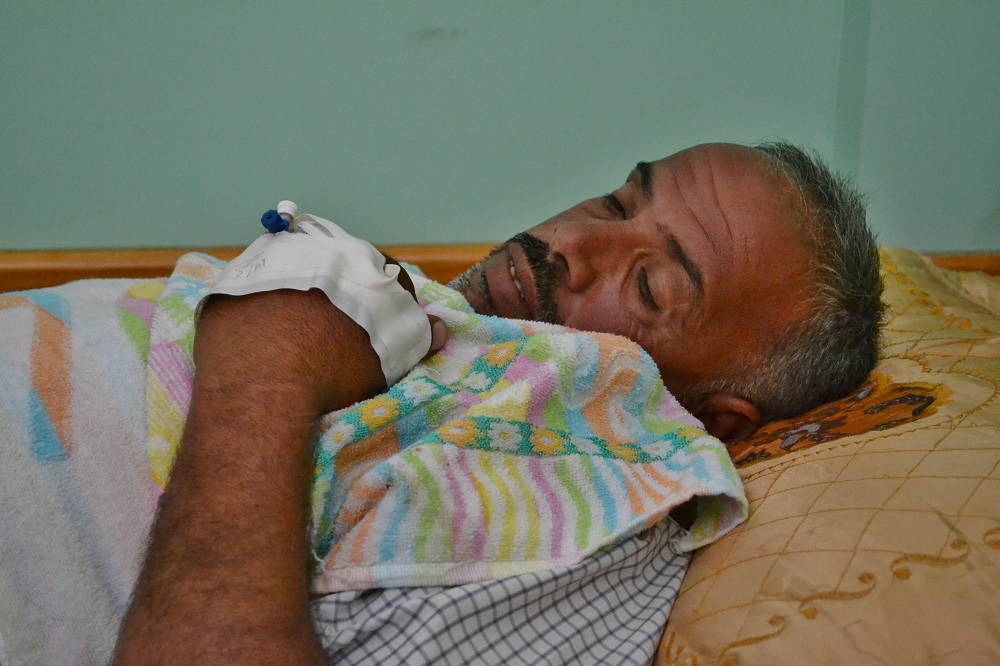
Muhareb Abu Omar, 48 (Photo: Rosa Schiano)
Omar reported that Israeli jeeps moved along the border while he was working. Suddenly, after about 10 minutes into the job, at approximately 19:30, a bullet struck him in the right leg. The soldiers probably shot from a jeep hummer.
Omar was alone on his land while other farmers were working in adjacent lands.
“I didn’t hear any firing, the soldiers used silent bullets. Suddenly I found myself wounded. I ran for 50 yards, then I crashed and I cried to my cousins that I was wounded”, said Omar. His cousins transported him to Al Aqsa Martyrs hospital.
Omar’s family is composed of 14 members: Omar, his wife, 8 sons and 4 daughters. Five of his sons work with him on the family land. The whole family depends on the production on this land.
Two of his sons, Nedal and Tareq, reported that Omar was reported to have an intermediate wound in the right tibia.
Dr. Saleman Al Attar, Department of Orthopaedics of Aqsa Martyrs hospital, reported that the general conditions of Omar are good. “The wound shot from a firearm always creates complications. The bullet hit the right thigh and there is the presence of fragments”, said Dr. Al Attar. In the emergency room, the doctors performed a cleansing of the wound, firstly a debridement followed by bandaging. After 3 days or 72 hours, Omar will be subjected to a further removal of devitalized tissue.
The doctors will not remove the bullet. “It is dangerous to remove the bullet as it is located in the neurovascular, where there are the arteries,” said Dr. Al Attar.
The wound is closed. The patient will then be given antibiotics and analgesics for about 4 weeks.
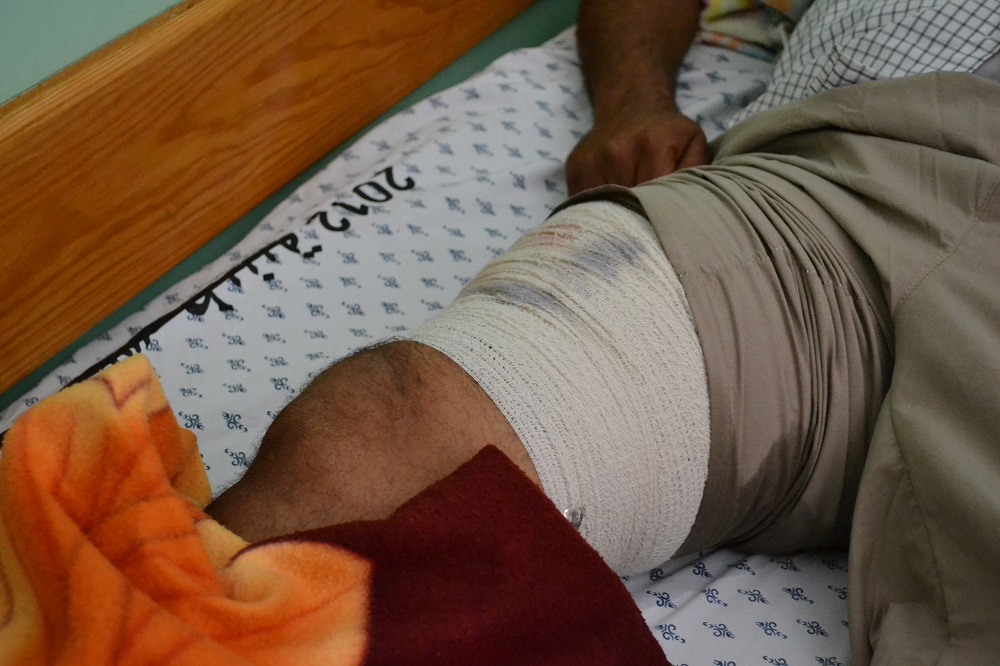
(Photo by Rosa Schiano)
Dr. Al Attar stressed the psychological effect on patients who are aware of the a bullet still inside the body. “The patient will always have the impression of experiencing pain in the area where the bullet is, even if the pain is not real. There are social workers who can provide psychological support for this. Every Palestinian suffering since birth suffers some psychological problems”, concluded Dr. Al Attar.
During the last military offensive of November 2012, the al-Aqsa hospital has received many victims. “The hospital was full, we were trying to save those who were in better condition while others were dying patients in serious condition,” said Dr. Al Attar.
The arrangements for the cease-fire of 21 November 2012 established that the Israeli military forces should “refrain from hitting residents in areas along the border” and “cease hostilities in the Gaza Strip by land, by sea and by air, including raids and targeted killings.”
However, Israeli military attacks by land and sea have followed from the day after the ceasefire, and Israeli warplanes are flying over the sky constantly in the Gaza Strip. These attacks against the civilian population of Gaza continue to occur amidst international silence.
Israeli man assaults 2 Palestinian women in Jerusalem
Ma’an – 17/06/2013
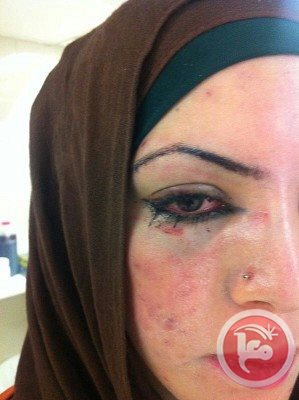 JERUSALEM – Two Palestinian women are pressing charges against an Israeli man after being assaulted in Jerusalem on Friday.
Layali al-Sayyad, 23, and Anwar Abu Rmooz, 21, told Ma’an that they were attacked by an Israeli man in his twenties while buying a ticket for the Jerusalem Light Rail near the central bus station in West Jerusalem.
The man reportedly asked the women in both Arabic and Hebrew whether he could help them, before swearing at them and punching al-Sayyad in the face, causing her to pass out.
The man then attacked Abu Rmooz and assaulted a member of the light rail security staff before Israeli police arrived at the scene and arrested him, al-Sayyad said.
Both women, who are from the al-Tur neighborhood, suffered a broken nose and bruising to their eyes and face.
An Israeli police spokesperson could not be reached for comment.
In February, a group of Jewish women attacked a Palestinian woman while she was waiting at a light rail station in Jerusalem, beating her severely.
The women asked if she was Arab before spitting on her and physically attacking her.
Weeks later, a group of Jewish youths in Tel Aviv assaulted a Palestinian cleaner after asking whether he was Arab. A co-worker of the man said it was a “lynching, plain and simple,” according to Israeli media.
Related article
- Settlers burn 300 olive trees near Nablus, Israeli army obstructs firefighters (occupiedpalestine.wordpress.com)
Netanyahu urges continued boycott of Iran
Al-Akhbar | June 16, 2013
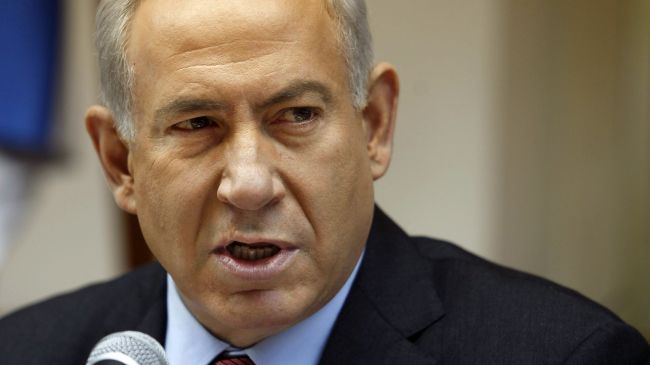
Israeli Prime Minister Benjamin Netanyahu called on Sunday for nations to continue boycotting Iran over its nuclear efforts after the election of a new president widely hailed as a moderate.
Netanyahu said it was Iran’s supreme leader, Ayatollah Ali Khamenei, and not the newly elected president, Hassan Rohani, who set a nuclear policy that has been challenged by tough economic sanctions and the prospect of military action.
“The international community must not give in to wishful thinking or temptation and loosen the pressure on Iran for it to stop its nuclear program,” the right-wing Netanyahu told his cabinet, according to a statement released by his office.
Israel, the Middle East’s only only nuclear power, has threatened to strike Iran over its nuclear program. It is also believed to be behind a string of assassinations targeting Iranian nuclear scientists over the past several years.
“The greater the pressure on Iran, the greater the chance of bringing a halt to the Iranian nuclear program, which remains the greatest threat to world peace,” Netanyahu said.
Iran insists its nuclear program is peaceful, and its main ally Russia has repeatedly said that there is no evidence to suggest otherwise.
Netanyahu’s remarks come one day after Israeli Defense Minister Moshe Yaalon called for tougher sanctions against Iran regardless of who is elected as its new president.
“We must toughen the sanctions against Iran and make this country understand that the military option remains on the table to halt the progress of its dangerous nuclear program,” Israeli radio quoted Yaalon as saying on a visit to the United States Saturday.
(Reuters, AFP, Al-Akhbar)
Israeli army detains a 10-year-old during the weekly demonstration in Kafr Qaddum
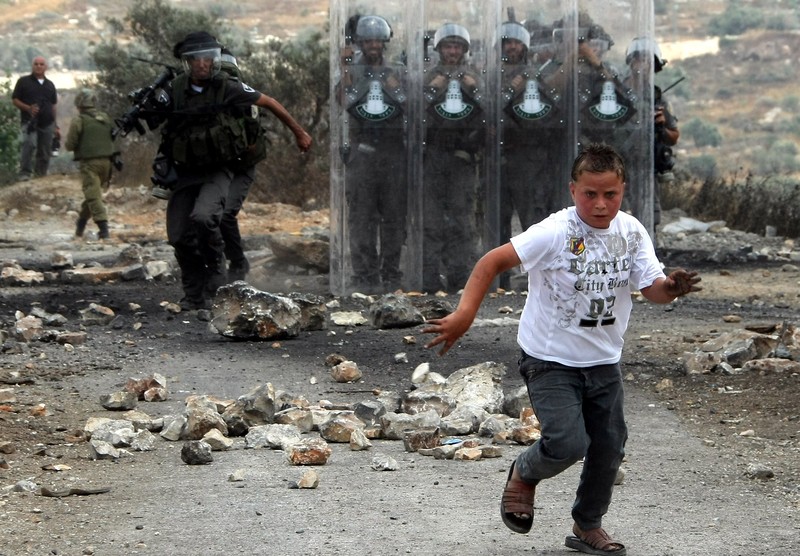
A young Palestinian protester runs away from Israeli soldiers during a demonstration against the expropriation of Palestinian land by Israel in the village of Kafr Qaddum, near the West Bank city of Ramallah on June 22, 2012. – Source
International Women’s Peace Service | June 14, 2013
Kafr Qaddum, Occupied Palestine – On Friday 14 June, the Israeli army arrested a 10-year-old child during the weekly protest in Kafr Qaddum. Israeli soldiers fired tear gas canisters and sound bombs at the villagers; many local residents suffered from tear gas inhalation.
At approximately 12:00, when residents and international solidarity activists started gathering for the demonstration before the Friday prayers, nearly 30 foot soldiers stormed the village from the main road leading toward the illegal Israeli settlement Qedumim. As they entered the village, they fired tear gas canisters directly at the group before the demonstration even began. Local youth resisted the incursion, chasing the soldiers back from the bystanders toward a hill overlooking the village.
Over the next two and a half hours, soldiers shot tear gas and threw sound bombs at demonstrators in the olive groves next to the main road of the village. At approximately 12:30, soldiers detained a 10-year-old boy. While in their custody, soldiers tied his hands, grabbed him by the neck, beat him and threatened to “drop [him] from this rock.”
Nearly one and a half hours later, the boy was released and residents of Kafr Qaddum celebrated his return. Soldiers continued to fire tear gas at local youth protesting at the edge of the village close to the illegal settler colony of Qedumim. No further arrests were made and the demonstration ended at around 15:00.
Kafr Qaddum is a 3,000-year-old agricultural village that sits on 24,000 dunams of land. The village was occupied by the Israeli army in 1967; in 1978, the illegal settler-colony of Qedumim was established nearby on the remains of a former Jordanian army camp, occupying 4,000 dunams of land stolen from Kafr Qaddum.
The villagers are currently unable to access an additional 11,000 dunams of land due to the closure by the Israeli army of the village’s main and only road leading to Nablus in 2003. The road was closed in three stages, ultimately restricting access for farmers to the 11,000 dunams of land that lie along either side to one or two times a year. Since the road closure, the people of Kafr Qaddum have been forced to rely on an animal trail to access this area; the road is narrow and, according to the locals, intended only for animals. In 2004 and 2006, three villagers died when they were unable to reach the hospital in time. The ambulances carrying them were prohibited from using the main road and were forced to take a 13 km detour. These deaths provoked even greater resentment in Kafr Qaddum and, on 1 July 2011, the villagers decided to unite in protest in order to re-open the road and protect the land in danger of settlement expansion along it.
Kafr Qaddum is home to 4,000 people; some 500 residents attend the weekly demonstrations. The villagers’ resilience, determination and organization have been met with extreme repression. More than 120 village residents have been arrested; most spend 3-8 months in prison; collectively they have paid over NIS 100,000 to the Israeli courts. Around 2,000 residents have suffocated from tear-gas inhalation, many in their own homes. Over 100 residents have been shot directly with tear-gas canisters. On 27 April 2012, one man was shot in the head by a tear-gas canister that fractured his skull in three places; the injury cost him his ability to speak. In another incident, on 16 March 2012 an Israeli soldier released his dog into the crowded demonstration, where it attacked a young man, biting him for nearly 15 minutes whilst the army watched. When other residents tried to assist him, some were pushed away while others were pepper-sprayed directly in the face.
The events of the past week are part of a continuous campaign by the Israeli military to harass and intimidate the people of Kafr Qaddum into passively accepting the human rights violations the Israeli occupation, military and the illegal settlers inflict upon them.
Related articles
- Kafr Qaddum – Blocked from life’s basics; pushed back when doing something about it (alethonews.wordpress.com)
- Palestinians demonstrate across West Bank (altahrir.wordpress.com)
- “We are the army…we will catch you or we will come to your house” – Soldiers threaten children of Kafr Qaddum (palsolidarity.org)
- Violent repression continues by the Israeli Army against protesters in Kufr Qaddum (occupiedpalestine.wordpress.com)
Israeli occupation police close streets, confiscate lands in Jerusalem
Palestine Information Center – 13/06/2013
OCCUPIED JERUSALEM — Israeli occupation police closed main streets leading to the Old City in occupied Jerusalem on Thursday, local sources said.
The Israeli decision to close the streets came due to the preparations for the organization of the Formula 1 race, which will take place on Thursday and Friday in the occupied city of Jerusalem with the participation of the Ferrari World team, under the sponsorship Kaspersky Company specialized in computer protection programs.
The police declared, in a statement, their intention to close the streets leading to al-Khalil, Asbat, and Al Magharibah Gates in the Old City on Thursday and Friday, according to Jerusalemite sources.
The race will be launched from the neighborhoods in the western part of Jerusalem towards the eastern part, in the vicinity of the Old City wall.
For its part; the Jerusalem Sports Federations Group asserted that the Ferrari race comes within the framework of the Judaization plans implemented by the occupation in the city of Jerusalem.
Meanwhile, the Israeli police, accompanied with bulldozers and trucks, evacuated on Wednesday Wadi Joz car park east of Jerusalem claiming that it belongs to Israel Lands Administration (ILA).
Siyam, Abu Ta’a, and Farhan families confirmed that the car park was established on their own lands, declaring their intention to prosecute the ILA for its racial policy.
The families confirmed that the Israeli authorities have notified them since 6 months to evacuate the car park.
The park owners affirmed that they have official documents confirming their ownership of the land, where they appealed to the Israeli Municipal Authorities which permitted them to rehabilitate the park to be used as a car park, however they were surprised yesterday by the ILA breaking into the park.
Related article
- Settlers Burn Two Cars In Jerusalem (imemc.org)
Palestinian activist detained in Israeli raid
Ma’an – 08/06/2013
HEBRON – Israeli forces on Friday raided the al-Sumoud (“steadfastness”) center in Hebron and detained Jawad Abu Aisheh, 39, from the Old City, an official said.
The director of the center, Ahmad Amro, said six soldiers and two policemen stormed the center, causing damage. They also assaulted some of the activists there and threatened them.
Forces detained Jawad Abu Aished who lives near the center.
The coordinator of Youth Against Settlements, Badi Dweik, said that “detaining Abu Aisheh is proof that the Israeli authority helps and supports settlers in their attempts to control … the Old City.”
Dweik called on President Mahmoud Abbas and his new Prime Minister Rami Hamdullah to respond to Israel’s “continuous crimes” in the West Bank in general and Hebron in particular.
An Israeli army spokeswoman referred inquiries to the police. A police spokesman did not immediately return calls.
Hebron man arrested for filing complaint about settler attack
International Solidarity Movement | June 8, 2013
Hebron, Occupied Palestine – Human rights activist Jawad Abu Eysheh, 39, was arrested Friday 7th June following a complaint he made four months ago about a settler attack.
At 4:20 pm on 7th June, Israeli Police arrived at the house of the Hebron organisation Youth Against Settlements and demanded to see the ID’s of Jawad and three other men present. The police then told Jawad that they wanted to take him away ‘for investigation’, and called the Israeli military to escort Jawad away in handcuffs.
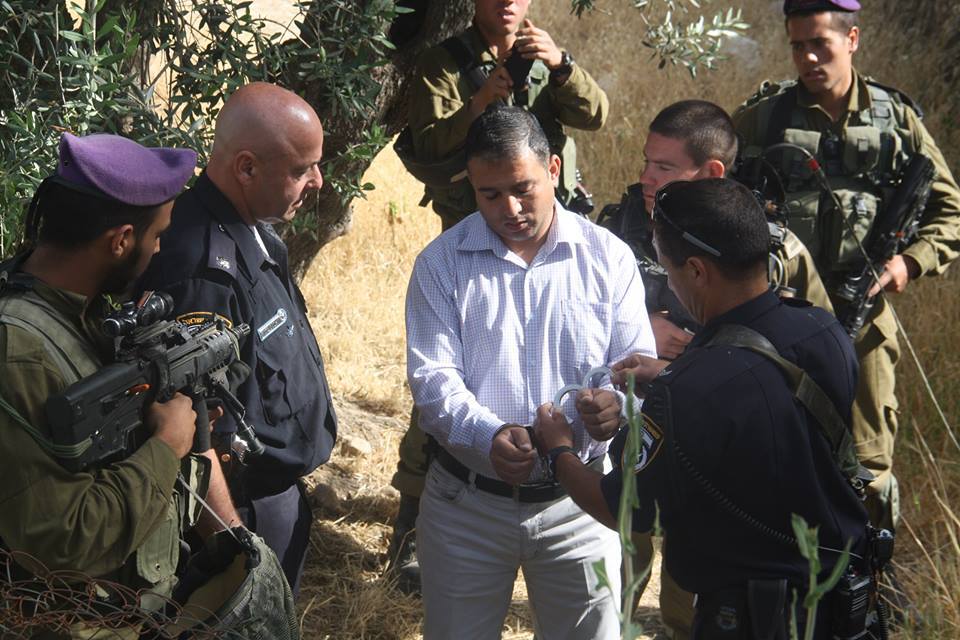
Jawad Abu Eysheh being handcuffed and arrested (Photo by Youth Against Settlements)
Jawad was then paraded through the adjacent illegal Tel Rumeida settlement and taken to the nearby checkpoint 56, before being transferred to the police station in the settlement of Givat Ha’avot outside the city centre.
The line of questioning from the police made clear that Jawad was being detained as a result of events that happened back in February, when Jawad and other activists were attacked by American-born extremist Baruch Marzel and other settlers.
Despite being a victim of that violent assault in February, it was Jawad who was subjected to arrest today, not the perpetrators. During his detention, Jawad was also forced to submit a DNA sample against his will, and to sign conditions that he will not speak with Baruch Marzel for the next 30 days. Jawad stated his is happy to comply with this stipulation at least. Jawad was released at around 9pm.As well as today’s arrest, Jawad has faced other harassment recently, including not being allowed to walk on the street where his factory space and uncle’s house are located.
The Israeli army and police in Hebron have a long history of harassing human rights defenders such as Jawad and his colleague Issa Amro, and of following the wishes of extremist settlers when deciding who to harass.
Related articles
- Jewish settlers setting up tent and planning road on Palestinian owned land in Al Khalil (alethonews.wordpress.com)
- Witnesses: Settlers open fire at Palestinian homes in Hebron village (altahrir.wordpress.com)
- Jewish settlers attack West Bank village with Israeli army support (alethonews.wordpress.com)
Featured Video
Death Spikes & Rising Cancer In Our Youth Explained
or go to
Aletho News Archives – Video-Images
From the Archives
Politicians lie
By Mazin Qumsiyeh | Popular Resistance | August 18, 2013
There is no way to say this truth nicely: Politicians lie. That includes Japanese, American, Egyptian, Israeli, and Palestinian politicians! Is there something more common sense than that? Yet, so many citizens around the world believe their own politicians or wistfully acknowledge lies but think it is part of the job needed to run things. They believe even when politicians contradict themselves blatantly. This phenomenon is rather remarkable. It is a dissonance and disconnect from reality that many seem oblivious to. It is very dangerous because it can lead to accepting rationales for going to war. These can be deadly wars that lead to millions of lives lost as happened in what was called World War 1 and WW2. Even when incredible and declassified evidence abound, politicians continue to lie and old mythologies refuse to die. Here are just a few of the countless lies told to us over the past few decades… continue
Blog Roll
 Aletho News
- The day-after at the White House: USA and Xi Jinping
- The Geopolitical Balance in the Red Sea: The UAE Being Displaced by New Players
- Iraqi resistance group vows to stage airport sit-ins over Iran aerial blockade
- Turkish parliament to review Saudi-Pakistan defense pact next month
- DEATH SPIKES & RISING CANCER IN OUR YOUTH EXPLAINED
- Iran offers Trump deal before US election
- Merz regime wants ‘secret police’ – opposition
- Israeli settlers terrorize West Bank Palestinians with state-provided drones: Report
- They see them, then kill them: Israeli quadcopters track, deliberately target civilians in Gaza
- Debunked: Trump’s egregious UNGA claims on war against Iran crumble under scrutiny
- If Americans Knew
- Trump betrayed voters with his campaign lies and prioritized a foreign country once he took office
- Netanyahu calls Israel’s war in Gaza ‘opposite of genocide’ in UN speech to near-empty hall
- Settler Kidnappings: Torture, Sexual Abuse and Terrorisation of Palestinian Abductees as Israel Deepens Annexation of West Bank
- Gaza winter nears as 162,000 tents become unusable, raising fears of humanitarian crisis
- Netanyahu says, “It’s the opposite of genocide”; UN says Gaza economy is world’s ‘most severe crisis on record’ – Daily Update
- Israel’s US-Backed Assault on Gaza Has Created the ‘World’s Most Severe Economic Crisis on Record’: UN
- ‘Protecting U.S. Citizens’… From Israel
- ‘This is where I live now, the back of a truck’: a day in the life of a grandmother in Gaza
- In UN Speech, Iran’s President Displays Pictures of Children Killed by US, Brings Attention to Israel’s Nuclear Arsenal
- Israel displaces hundreds of Palestinians amid wave of demolitions in West Bank
- No Tricks Zone
- New Study: Earth And Venus Surface Warmth Largely Explained By Convection And Lapse Rate, Not CO2 Or Radiation
- 2025 Nature Paper Claiming Worsening Global Drought Gets RETRACTED …Heavily Flawed
- New Study: ‘Global Drought Shows No Detectable Recent Acceleration Under Climate Warming’
- Economic Masterminds: German Socialists Suggest Taxing Productivity Gains Stemming From Using AI
- The South China Sea Has Not Been Cooperating With The Climate Change Narrative
- Energy Crisis: Germany Enters Heating Season With Historically Low Gas Reserve Fill Levels
- New Study: The Antarctic Ice Sheet Gained Mass From 2020-2024 Due To Staggering Snow And Ice Accumulation
- Study: Ocean Heating Rates From Thousands Of Years Ago ‘Dwarf’ Modern Ocean Heating Rates
- Climate Extremists Target, Attack Large-Scale Power Grid Infrastructure In Germany!
- New Study: Antarctic Ice Melt Has Contributed Less Than 1 Centimeter To Sea Level Rise In The Last 30 Years

